


Introduction: Once Upon a Time, a “Sapling of Literature”
In 1335 AH (1915‒16), a small collection of poems was made available to Persian readers:Footnote 1 its title, Nahāl-i adab (Sapling of literature), was evocative of a fresh poetic start. On page two, the booklet was adorned with a photograph of the author: the cleric-poet Yaḥyā Dawlatābādī, wearing the full attire of the traditional Shi’ite mullah of alleged prophetic descent, with cloak (ʿabā) and black turban. The place of publication was nowhere mentioned, but hinted at by two major clues: the name of the publishing house, Chāpkhāna-i Shams, inscribed on the bottom left side of the cover page;Footnote 2 and the introduction to the volume, signed by the office of Khāvar (Orient), a pro-German Persian weekly paper from Istanbul produced by the same publisher.Footnote 3
Indeed, the collection was issued during Dawlatābādī’s second sojourn in the Ottoman capital. The author had already stayed there once, during the “minor despotism” era under Muḥammad-ʿAlī Shāh’s rule. Again, Dawlatābādī sought asylum in Istanbul after World War I, when his pro-German activities in western Iran were doomed. In fact, as early as the nineteenth century, the Ottoman metropolis had become not only a place of refuge but also a vibrant hub for political, economic, cultural and intellectual activities for many Iranian emigrants, particularly for the opponents of Qājār despotism and Anglo-Russian interference in Iranian affairs.Footnote 4
At the time, publishing a booklet of Persian poems—as opposed to a full-fledged dīvān—and, what is more, including a photograph of the author, was far from common practice. Yet the originality of Nahāl-i adab lies chiefly in its content. The collection was divided into two sections. The first section contained four French poems and a fable in prose alongside Dawlatābādī’s Persian translations in verse.Footnote 5 The second section, entitled Az manẓūmāt-i jadīda (New poems), included nine poems, all by Dawlatābādī. Lyrical and didactic in content, eight poems in this section display the conventional features of the mathnawī, ghazal, or qiṭʿa. Applied to these poems, the adjective jadīd (new) should probably be understood to mean “recently composed.” On the other hand, the sixth poem in the section, titled Zisht-u zībā (Bad and nice), stands out by its unconventional features. Instead of relying on traditional quantitative prosody (ʿarūḍ), the poem’s meter is based on syllable count. What is more, its structure does not fully match any conventional pattern in Persian poetry.
An expanded version of the collection was published in 1925 under the title Urdībihisht.Footnote 6 It was divided into three sections. The first section, Az āthār-i ʿahd-i shabāb (Early works), was a combination of didactic and moral narratives (ḥikāyat) in prose and verse inspired by Dawlatābādī’s own life experience, “in emulation of Saʿdī’s Gulistān.” The second section, Az āthār-i jadīd (New works), contained about 150 poems, including Ṣubḥdam (Dawn) and Sabk-i tāza (New style), both based on syllabic meters. The latter was, in fact, a slightly modified version of Zisht-u zībā. Changing the poem’s title from Zisht-u zībā to Sabk-i tāza at a later stage was clearly intended to highlight the poem’s innovative features.
Only in the first edition of Urdībihisht does Dawlatābādī provide the story behind the genesis of the two syllabic poems. In the introduction to Ṣubḥdam, he writes:
In 1912, while I was staying in Switzerland, the Orientalist master Edward Browne sent me a letter from London.Footnote 7 He explained that he was engaged in a controversy with members of the Anglo-Persian Literary Association over the issue of Arabic metrics and Persian literature. They claimed that, were Arabic ‘arūḍ taken away from them, the Iranians would be incapable of producing versified discourse. [Browne] objected that, before the Arab invasion, Iranians were not lacking in poetry and that the Persian language was perfectly capable of wielding syllabic poetry.Footnote 8 For this reason, he said, he would be most grateful if I could provide him with a poem of my own making, without recourse to standard quantitative metrics.Footnote 9 The following poems were composed at the request of the master, and he was pleased with them.Footnote 10
The first collection, Nahāl-i adab, included no such introduction crediting Browne for suggesting the use of syllabic meters. Which is to say that, no matter the prompt, Dawlatābādī entirely appropriated the idea and assumed full responsibility for it, as early as the first edition.
Indeed, both syllabic poems testify to Dawlatābādī’s participation in the general endeavor for modernity characteristic of the poetry of his time. Soon after Nahāl-i adab was published,Footnote 11 however, the use of syllabic meters triggered a heated debate. Dawlatābādī’s initiative elicited mixed reactions on the part of the critics. Despite their complex, unusual features, the poems were often overlooked, misjudged, or merely acknowledged for their syllabic prosody. Their role in the literary modernization process was deemed a “failed” attempt to promote the use of syllabic meters in lieu of traditional ʿarūḍ.
In what follows, I show that Dawlatābādī’s syllabic poems offer formal innovations far beyond mere metrical audacity. At the time Dawlatābādī experimented with syllabic rhythms modernists were avid for individualized poetic forms. I argue that Dawlatābādī’s poems stand at the forefront of this quest for subjectivity in poetry. The evidence is adduced by the poems themselves, subjected to close thematic, linguistic, and formal scrutiny. After a brief biography of the author, I give an overview of the literary context in which the two syllabic poems were produced; then I consider the reception of the poems among the critics and actors of literary modernity in Dawlatābādī’s time.
Yaḥyā Dawlatābādī: A Successful Educator Turned Frustrated Politician
Yaḥyā Dawlatābādī was a political activist, an educator, a poet, and a storywriter.Footnote 12 He was born in 1863 in Dawlatābād near Isfahan to an influential family of clerics. His father, Ḥāj Sayyid Mīrzā Hādī Dawlatābādī, was a popular religious leader affiliated to the Azalī branch of Bābism. Yaḥyā Dawlatābādī received his primary education in the local Koranic and traditional schools before entering the Najaf seminary in 1873, close to where his father resided. After his family returned to Isfahan, Dawlatābādī left for Tehran, and later went to Mashhad, due to conflicts involving his father and other local religious leaders. In 1882, he returned to Isfahan, where he became acquainted with the reformist beliefs of such influential Bābi personalities as Shaykh Muḥammad Manšādī Yazdī and Mīrzā Āqā Khān Kirmānī. However, he was ousted from Isfahan again, until 1886. He conducted a pilgrimage to Mecca and spent most of his time in the ʿatabāt (the Shiʿite shrine cities of Iraq) before returning to Iran where, by a decree issued by Nāṣir al-Dīn Shāh, he was allowed to settle with his father in Tehran.
Endorsed by Muẓaffar al-Dīn Shāh’s reformist vizier, Mīrzā ʿAlī Khān Amīn al-Dawla, Dawlatābādī contributed to the foundation of new educational institutions, such as the Anjuman-i maʿārif (Council of Education), as well as modern schools relying on a secular curriculum. What is more, he took part in several of the major events that led to the outbreak of the Constitutional Revolution. Because of his Bābī background, however, his own political ambitions were frustrated, both before and after the constitutional decree was signed by Muẓaffar al-Dīn Shāh in 1906.
After Muḥammad-ʿAlī Shāh’s coup in 1908, Dawlatābādī only survived the persecution against the constitutionalists thanks to the British embassy, and he went into exile in the Ottoman Empire. Settling in Istanbul, he became acquainted with other Iranian activists in exile, Ottoman reformists, constitutionalists, and members of the Committee of Union and Progress. It is from Istanbul that he undertook his first travel to Europe. He visited the Iranian communities in Paris, Berlin, and London, where he met Edward G. Browne.
After the downfall of Muḥammad-ʿAlī Shāh, Dawlatābādī returned to Tehran and struggled against the election of the clergy to the second parliament in 1909. As a result of his secular advocacy, he had to resign from his post after being elected deputy for Kirmān. In 1911, he traveled again to Europe and took part in the International Congress of the Races in London, before settling in Lausanne (Switzerland) for a while.
At the outbreak of World War I, Dawlatābādī returned to Iran to join the ranks of the nationalist “immigrants” (muhājirīn) and took part in the National Defense Committee established in Hamadan and Kermanshah with the support of the Germans. After the Committee’s endeavors against the Anglo-Russian aggression failed, Dawlatābādī fled again, to Baghdad in 1916, and then to Istanbul, where he renewed his Ottoman networks and published Nahāl-i adab. From Istanbul he went to Berlin, then to Stockholm to take part in the International Socialist Congress. The Russian withdrawal from Iranian Azerbaijan in the aftermath of the Bolshevik Revolution of 1917 prompted Dawlatābādī to return to Iran in 1918, where he was in charge of organizing pro-German nationalist resistance against the British infiltration to the north.
From 1921, Dawlatābādī granted Riḍā Khān his support. In the Cossack commander he saw a modernizer and a guarantor of national security. In 1923, Dawlatābādī was elected to the fifth parliament. He even took part in a small committee advising Riḍā Khān on domestic and foreign affairs. Yet, however strongly he endorsed Riḍā Khān’s initial republican project, Dawlatābādī was one of the few deputies to overtly oppose Riḍā Khān’s plan to replace the Qājār dynasty by a new monarchy. As a consequence, he was banished from the political stage forever. He served three years as an informal cultural attaché in Brussels before returning to Tehran to complete his four-volume memoirs,Footnote 13 his best-known writing to date. He died in 1939 in Tehran and was buried in his summerhouse in Qulhak.Footnote 14
This late Qājār and early Pahlavī era was a time of political, economic and social transformation. The same restless desire for change and renewal also spread to literature. At the time Nahāl-i adab was published, Iranian writers and intellectuals were increasingly convinced of the necessity of modernizing Persian literature. This modernization was often claimed as a “literary revolution.”
The Literary Context in Iran: Toward a Persian “Literary Revolution”
Historians often refer to the late nineteenth and early twentieth century as the Iranian “awakening and enlightenment” period. Iran’s own social and political circumstances, together with intensified contacts with Europe, played a key role in the emergence of new social claims and political values. The Iranian intelligentsia aspired to reform and strove for renewal in various aspects of social life. Writers and intellectuals such as Fatḥ-ʿAlī Ākhūndzāda, ʿAbdulraḥīm Ṭālibuf, Zayn al-ʿĀbidīn Marāghayī, Malkum Khān, and Āqā Khān Kirmānī claimed a “rational,” “straightforward,” and “socially and politically committed” literature.Footnote 15
The Constitutional Revolution of 1906 numbers as one of the prominent outcomes of this societal and intellectual metamorphosis. Not surprisingly, literature in general and poetry in particular came to meet the aspirations of their time. Poetry, as it were, soon echoed the demand for political and social progress. The latest developments in printing techniques contributed to some extent to the democratization of poetry. Poets themselves sought a more active role in society, as poetry was coming down from its ivory tower to reach out to a broader audience by use of a simpler, more straightforward language.Footnote 16
By 1918, a new literary movement had emerged that would come to be known as the Iranian “Literary Revolution” (Inqilāb-i adabī). At that point, the Iranian literati advocated the necessity for literature, following the political circumstances, to undergo a “revolution” of its own—a notion appropriated directly from the French Romantics. It should be noted that, for those authors who claimed the “Literary Revolution” as their goal, “literary” really meant “poetic,” as poetry had been the dominant form of expression in Persian literature for a thousand years. As for “Revolution,” it mainly connoted renewal and reform, both in sound and sense.
Yet not all the actors of the Iranian “Literary Revolution” agreed on how the modernization process should best be carried out. They mostly sided with one of two conflicting groups: the modernists of Tehran and the modernists of Tabriz. The latter were headed by Taqī Rafʿat, a young poet and journalist. Rafʿat expressed his reformist views in his journals Tajaddud (Modernity) and Āzādīstān (Land of freedom). Quoting from the French romantic poet Victor Hugo, Rafʿat summarized his modernist motto as follows:
We always keep in mind what the French romantic poet Victor Hugo said, that “the rigorous corollary of a political revolution is a literary revolution;” and his appeal to “partake in material revolutions only by means of an intellectual revolution.”Footnote 17
The quotation was an excerpt from Hugo’s introduction to Littérature et philosophie mêlées, issued in 1834, four years after the French July Revolution of 1930.Footnote 18 Rafʿat further relied on a different passage from the same text to set the guidelines for his literary “revolution”: “insofar as it seeks to survive, art must confront itself with the question of form, language and style.” Rafʿat viewed the Tehrani modernists as a bastion, or “dam,” of conservatism (sadd-i muḥāfizakārī) standing against the flow of literary progress.Footnote 19
The modernists of Tehran, on the other hand, were for the most part members of the newly founded literary association Dānishkada (Abode of knowledge) headed, in the capital, by one of the most prominent poets of the time, Muḥammad-Taqī Bahār. The association produced a monthly journal, also called Dānishkada, the purpose of which was to expound a “moderate” notion of literary modernity, both in theory and in practice. A strong critic of Rafʿat’s views, Bahār elaborated his theory in a series of articles published in Dānishkada.Footnote 20 Unlike Rafʿat, Bahār’s initial claim was that Persian poetry was in need of reform at the level of themes and contents, not form. Instead, poets should make sure to uphold the formal rules of traditional poetry, especially prosody. In Bahār’s view, the modernists of Tabriz were merely a bunch of extremists (ifrāṭiyūn) who knew no better than to mimic European poetry, out of ignorance of their own literary heritage.Footnote 21
However, Bahār’s perception evolved over time. Another prominent member of Dānishkada, Rashīd Yāsimī, may have helped him refine his conception of poetic modernity. Indeed, in a series of articles entitled “Literary Revolution,” Rashīd Yāsimī described the various stages of literary metamorphosis played out in the history of French literature, from the Middle Ages up until the nineteenth century.Footnote 22 This longue durée account of French literary history provides fascinating insights into the Iranian modernist project. Rashīd Yāsimī depicts French romanticism as a modern movement headed by Victor Hugo. In Dānishkada issue 9, he defines the principles of what he calls the “Romantic revolution” as follows:
Romanticism emerged in opposition to Classicism. To establish itself, Romanticism destroyed whatever came before it and freed itself from the strictures of Classicism by openly rebutting them. The Romantics abolished past literary rules …. Romanticism dismantled the obsolete, binding style of old and overturned the ancient mode of writing which was constrained by strict rules that stifled the individual author’s taste.Footnote 23
This definition was of great relevance, not only for the members of Dānishkada, but for the community of Iranian modernists as a whole. It identified the romantic modernist attitude with the promotion of literary subjectivity against classical academism, and with the need for poets to overturn old rules and canons so that their individuality might be reflected in their work. Heeding Rashīd Yāsimī’s example, Bahār’s new “literary manifesto” (dastūr-i adabī), published in the same issue, points to the major poetic undertakings of the time, both within and outside of Dānishkada:
If we do not bypass the rules bequeathed to us by the Ancients, if we remain confined within the boundaries set by them, we will be unable to attain new meanings, useful innovations and supreme progress. Let us add a thousand new meters to our prosody, let us add rules and principles to the canons of rhyme and rhetoric … Let us do away with all these principles and rules the observance of which now appears ridiculous and absurd. Let the keepers of the relics of the Ancients take offense and stir up scandal; what do we care! Let us free poetry and literature just like the Romantic poets did.Footnote 24
This speaks to the considerable impact of French Romanticism, considered an anti-Classical movement, among the Iranian modernists. Bahār himself, a longstanding proponent of the retention of classical poetic forms, had switched to embrace the daring modernist attitude associated with the French Romantics. In the intellectual effervescence characteristic of the Iranian “literary revolution” period, Dawlatābādī’s work was overlooked by poets and critics, and never made its way into the records of Persian poetic modernity.
The Reception of Dawlatābādī’s Syllabic Poems
Perhaps Muḥammad-Taqī Bahār’s indirect criticism was the first negative reaction to Dawlatābādī’s syllabic poetry. In the opening article of the first issue of Dānishkada, he alludes to the use of syllabic meters in disparaging terms, deeming it “pointless to match” Persian poetry with what he dubs “non-metrical European syllables.”Footnote 25
At a later date, as a distinguished member enumerating the guidelines of Dānishkada, Rashīd Yāsimī writes:
Emulation of European poetry, be it in form or content, should always be undertaken with discernment. … Trying to substitute the alexandrine for our old meters, as they did, is a violation of the genius of our language. Are we so destitute of meters? Do we not possess infinite numbers of those?Footnote 26
This passage makes it clear that contemporaneous experiments with syllables were dismissed as a substitution of traditional Persian quantitative meters for typical French meters such as the alexandrine. Although Rashīd Yāsimī avoids mentioning the culprits by name, there is little doubt that he had Dawlatābādī in mind, since we know of no other recorded syllabic undertaking in the Persian poetry of the time.Footnote 27
In 1924, Mīrzāda ʿIshqī published his poem Īdiāl in the daily newspaper Shafaq-i surkh. In the brief introduction he later appended to it,Footnote 28 ʿIshqī boasts that it is his poem that sparked the “Persian literary revolution.” With equal nerve, the text entitled Preamble to the Iranian Literary Revolution (Dībācha-i inqilāb-i adabī-yi Īrān) summarizes ʿIshqī’s grievances against his contemporaries. He accuses them of failing to “revolutionize” poetry and to initiate a modern Persian poetics, despite all their efforts. Among the accused stands Yaḥyā Dawlatābādī,Footnote 29 the only one mentioned by name, yet without any additional explanation.
Similarly, in his Modern Persian Poetry M. Ishaque considers Dawlatābādī’s poems merely for their prosodic aspect.Footnote 30 At the beginning of his monograph, he states that
Yaḥyá is more an imitator than an original composer. He will be remembered for his attempt to revive the syllabic system in Persian metres, as also for his verse-translation of many a French poem into Persian.Footnote 31
Later in the book, while discussing the “actual departure from the traditional metrical principles” in modern Persian poetry, Ishaque returns to Dawlatābādī’s syllabic poems. He concludes his thorough prosodic analysisFootnote 32 with the following value judgment:
Yaḥyá has endeavored only to indicate the possibility of composing poems in Persian without the help of Arabic metres. His specimens … are at once crude, artificial and devoid of poetic value. But … we cannot deny the fact they are interesting as the first attempts of the poets to revive the ancient metres of Īrān.Footnote 33
More recently, when such scholars as Khānlarī and Shafīʿī-Kadkanī single out Dawlatābādī’s undertakings, it is merely to find fault in his prosody, which they regard as imperfect and ineffectual with respect to the modernization of Persian poetry.Footnote 34
Positive assessments of Dawlatābādī’s syllabic poems are scarce; most of these are allusive, if not equivocal. The first words of praise are from the publisher of Nahāl-i adab.Footnote 35 He writes anonymously on behalf of the publishing house, Idāra-i Khāvar, to promote the poetry collection:
On the occasion of the arrival of the great erudite and sagacious litterateur, Mr. Ḥājī Mīrzā Yaḥyā Dawlatābādī, to our great Islamic capital [Istanbul], Idāra-i Khāvar publishes a small selection of his literary works, at once translations and creations, which have triggered a revolution on the Persian literary scene and appear to the learned minds to be of particular subtlety and novelty.Footnote 36
The publisher’s use of the term “revolution” is to be understood with all its literary and contextual connotations. The blurb assesses Dawlatābādī’s poetics against that of his contemporaries, the many actors of the Inqilāb-i adabī who claimed to have “revolutionized” Persian poetry with their modernist works.Footnote 37 The publisher does not specify further these flattering but vague assertions.
In his essay entitled “Arzish-i iḥsāsāt dar zindagī-i hunarpīshagān” (The value of emotions in the artist’s life), the forefather of Persian free verse Nīmā Yūshīj ranks Dawlatābādī alongside those authors whose work matters to the history of modern Persian poetry. Yet, he does not justify his claim either.Footnote 38
In his preface to the last edition of Urdībihisht, Jamālzāda acknowledges Dawlatābādī’s two syllabic poems for contributing a noteworthy endeavor towards a “new poetics” in the history of Persian poetry. However, even he seems to find no interest in them beyond their daring prosody.
Dawlatābādī’s poetry also attracted Bozorg Alavi’s attention. In his history of modern Persian literature, Alavi writes: “It is deliberately that I discuss his work a bit more at length, especially since his novel approach and artistic innovations were disavowed at the time and their true value, even today, are widely misunderstood.”Footnote 39 But Alavi does not delve deeper into the nature of this “true value.” Nowhere does he explain what he means by “artistic innovations,” and he only briefly discusses the choice of syllabic metrics. It would seem that some discomfort remained with the historian of literature regarding the literary “value” of Dawlatābādī’s enterprise. Of Ṣubḥdam he writes: “One may wonder whether this poem has any artistic value. Yet which innovator met such success as to create a masterpiece on his first try?”Footnote 40
Over time, mentions of Dawlatābādī in literary histories dwindled continuously.Footnote 41 In fact, none of these judgments were based on a serious discussion of the texts. These poems, it would seem, had fallen victim to their own prosodic originality. The reviews, negative and positive, have a point in common: they focus on the metrical feature exclusively and fail to consider the poems as a semantic and formal whole, with a literary and historical context. For this reason, an impartial assessment of Dawlatābādī’s role in Iranian literary modernity is nowhere to be found. What follows is a first step in this direction.
Ṣubḥdam and Sabk-i Tāza: An Expression of Hope and Revolt
Dawlatābādī’s two syllabic poems, Ṣubḥdam and Sabk-i tāza, appeared during the tumultuous literary environment of the Iranian “awakening and enlightenment” period sketched out in the introduction. To fully appreciate Dawlatābādī’s poems in their literary context, with respect to the new poetic trends of their time, one should first examine the texts and their formal features closely.
The first poem, Ṣubḥdam, runs as follows:Footnote 42
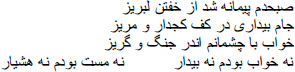
At dawn, the cup of sleep was filled up to the brim
The glass of awakening in hand, threatening yet to spill,
Sleep waging war against my eyes,
I was neither asleep nor awake Neither drunk nor sober.
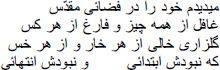
I saw myself in a sacred space
Carefree and unaffected by a thing or soul.
A rose-garden it was, devoid of thorns and motes,
With no beginning And no end.
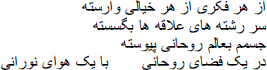
Free of concern and imagination
The knots of attachments all untied
My body had joined the celestial world
In a spiritual space Bathed in a radiant light.
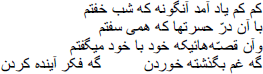
Gradually, I remembered how I’d slept at night
All the regrets I’d strung like pearls
And all the stories I’d told myself
At times lamenting over the past At times worrying about the future.
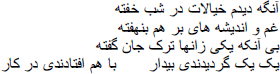
Then I understood that the illusions asleep at night,
The accumulation of sorrows and concerns,
Would not let go of my soul
One by one awakening They all resumed business together.
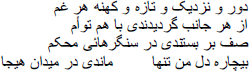
Far and near, new and old, all my concerns
Came together from all directions
To line up neatly in sturdy barricades.
My poor heart alone Was left on the battleground.
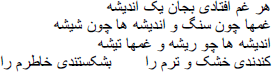
Every concern engaged in combat with a thought,
Concerns like stones thrown at glass-like thoughts,
Thoughts like roots and concerns like a hoe.
They plucked the best and the worst of me, [and] Upset my mind.
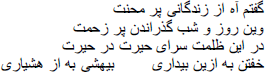
I said: enough of this life full of sorrow,
And of this painful crossing between night and day.
In this dark abode of wonder and perplexity,
Better sleep than stay awake Better pass out than be aware.
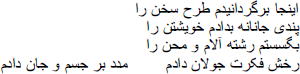
At this point I changed my discourse,
I gave myself a wonderful advice.
I cut off the thread of pain and sorrow.
I spurred the steed of thought forward And gave my body and soul some relief.
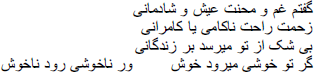
I said: sorrow and grief, good life and joy,
Hardship, welfare, misfortune and good fortune
In life no doubt are your own doing.
Be well and happy; life will go happily. Be sad and unwell; life will be unhappy.
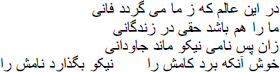
In this short-lived, fleeting world
We, too, have a right to live
And leave behind a lasting good repute.
Happy he who can seize the day And be remembered by his good name.
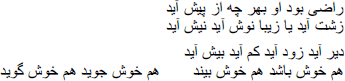
He who is content with his lot,
Awful or beautiful, good or bad,
Late or early, too little or too much,
Will be happy and optimistic Will seek the good and tell the good.
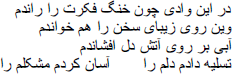
When I conducted my thoughts along this path
And spoke these heartwarming words
I quenched in water the fire of my heart,
I consoled my heart And solved my problem.
Voiced in the first person singular, Ṣubḥdam captures the mental and psychological state of the speaker as he appears, in the morning, slowly awakening from sleep. The discourse is set in four steps. At first, the speaker emerges, free of thought or concern, from the numbing effect of nocturnal sleep. He pictures himself as occupying a “sacred space” in the form of a “rose-garden,” in a “spiritual universe” free of terrestrial bonds. But this initial impression soon recedes: as he gradually regains consciousness, the speaker is again overcome by concerns and anxiety, as if they had never left him. Torn between regret of the past and fear for the future, the speaker develops a creeping aversion for life, a life full of sorrow and affliction. Yet he refuses to let this feeling overtake him. Giving up his lament, the speaker undertakes to lecture himself out of his own dark thoughts, addressing himself with moral “advice.” He reflects on man’s responsibility for his own destiny; contentment, he claims, is the key to happiness. Relying on this moral axiom, man becomes able to attain his true purpose in this “fleeting” life: by doing good, one can achieve a good and lasting renown for oneself.
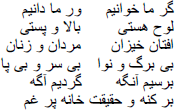
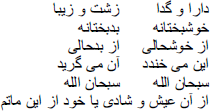
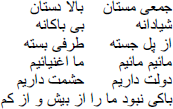
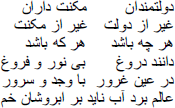
Also written in the first person, the second poem, Sabk-i tāza, opens on a different type of complaint, this time tainted with disappointment. The following is the oldest version of the poem as it appeared in 1335q (1916‒17) in Nahāl-i adab, under the title Zisht-u zībā:Footnote 43
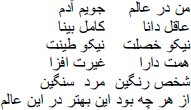
I search the world for
A wise, learned, perfect, clear-sighted man;
A virtuous man, of good constitution,
Brave and proud;
A brilliant person, a serious man,
The best in all things in the world
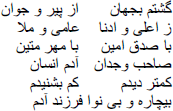
I sought the world among the elderly and the youth,
From top to bottom, the illiterate and the learned,
In search of an honest man, trustworthy, caring, strong,
Dutiful, humane
Few such people did I see, and seldom heard of;
Wretched is the human being:
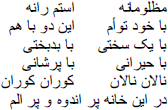
Oppressed, oppressive,
Or both of these at once;
Miserable, unhappy,
Perplexed, confused,
Moaning loudly, blinded fully,
In this abode of sorrow and grief
If we read and trust
The tablet of destinies, with its highs and lows,
The fall and rise of men and women,
Poor and destitute,
We can at last become aware
Of the true state of this sorrowful abode
Rich or poor, ugly or pretty,
Out of luck or of bad luck,
In fortune or misfortune,
One laughs while the other cries,
Great God! O God!
[Enough] of these celebrations, [enough] of this mourning!
A party of high-ranking drunkards
Disingenuous, dauntless,
Boasting, once safely come across the bridge:
Here we are! We are the rich!
We have fortune and magnificence,
We do not fear to own more or less!
The wealthy, the opulent,
Beyond their wealth and opulence,
Anything and anyone,
They consider vain, false and obscure,
All proud and boastful,
Should a storm carry the world away, they would not care to frown
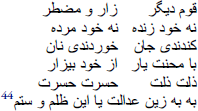
Another people, miserable and wretched,
Neither dead nor alive,
Sacrifices themselves for a piece of bread,
Privy to sorrow, weary of themselves,
Humiliated deeper still, and frustrated yet again;
What an injustice! O what cruelty!
The protagonist is in search of the “perfect” man, a being at once “wise,” “clear-sighted,” “virtuous,” “of good constitution,” “brave,” and “proud.” But such a man is nowhere to be found. The conclusion soon imposes itself upon the poet: life is fundamentally unfair and mankind is struck by some kind of wretchedness. Life is nothing but an “abode of sorrow and grief,” the speaker concludes in disbelief. On the one hand, the “wealthy” and “opulent” have nothing to worry about but their own “fortune”; on the other hand, the “wretched” and the “miserable” stand “frustrated” by the “injustice” and “cruelty” they are forever subjected to.
Both Ṣubḥdam and Zisht-u zībā are voiced in the first person. The “I” in these poems takes on a generic human bearing: it conveys existential questions all men are faced with. The poems carry a universal statement, inclusive of the reader, as is evidenced by the shift in personal pronoun, in both poems, from first person singular to plural, in the eleventh stanza of Ṣubḥdam, and in the fourth stanza of Zisht-u zībā.
At first glance, Ṣubḥdam could recall the moral, didactic trend present in traditional Persian ḥikāyat.Footnote 45 This is by no means surprising considering that, at the time these poems were composed, moralistic and didactic genres were still very much in vogue in the poetic milieu. Parvīn Iʿtiṣāmī’s poetry, for instance, is emblematic of that trend.Footnote 46 Besides, western fables were highly popular with the public. Translated in prose or verse, mostly from the French, they often appeared in the papers and periodicals of the time. Also, narrative poems tackling contemporary social and political issues were many.Footnote 47
If it is read literally, Ṣubḥdam does not address a specific societal issue; rather, it raises a great existential question. The “sacred universe” depicted in the opening of the poem in the form of a “rose-garden” reminds the reader of the spiritual world (‘ālam-i malakūt) familiar to the tradition of mystical poetry. Unlike the latter, however, Ṣubḥdam moves on to a worldly discourse in which real-life concerns are the priority. This withdrawal from an abstract “sacred” locus back into the real world is attuned to the overall resolution of the poetry of the “enlightenment and awakening” era to forgo the lofty aspirations of its elders and embrace the more urgent concerns of daily life instead.
Examined in its historical context, the poem readily lends itself to an allegorical deciphering of the current political atmosphere. The initial oneiric environment can thus be understood as the ideal country the author and his peers had dreamt of, sometimes fought for: a life of political freedom, stability and rights, of social equality and progress, and economic prosperity; an ideal world they believed was about to come about by the time Muẓaffar al-Dīn Shāh Qājār ratified the constitution in 1906.
In stark contrast to this daydream, the speaker awakens to a bitter reality. Its rudeness is emphasized by the semantics of “sorrow” and by the harshness of the setting, defined by “sturdy barricades” enfolding a “battleground” where man is left wrestling with his own anxiety, every thought a weapon, “stone,” “glass” or “hoe,” and every idea a new instrument of torture, through “pluck[ing]” and “upset[ting].” Suggestive of conflict and violence, this lexicon evokes the troublesome period that followed the Constitutional Revolution, bringing further instability and disturbance to the country, and disappointment and frustration to the revolutionaries. The Anglo-Russian treaty of 1907 that divided Iran into areas of foreign influence dealt a fatal blow to the country’s independence. One year later, Muḥammad-ʿAlī Shāh Qājār’s coup against the newly established parliament and the persecution of its members forced Dawlatābādī into exile. After Muḥammad-ʿAlī Shāh’s downfall, Dawlatābādī was elected deputy for Kerman. Soon thereafter, however, his ambitions gave way to disappointment and frustration as he was forced to resign from his seat due to his affiliation with Bābīsm and his secular vision of politics.Footnote 48 In 1911, following the Shuster affair, the Russian invasion of northern Iran triggered the dissolution of the second parliament, sealing the end of the Constitutional Revolution.Footnote 49
Yet Ṣubḥdam concludes on a hopeful note. The optimistic resolution of the poem somehow conveys the psychological and mental state constitutionalists like Dawlatābādī aspired to if they were to withstand pessimism and distrust in these difficult times. Upon close reading, this contextual interpretation reveals the poem’s strong affinities with the major literary trend of the “awakening and enlightenment” period.
In Zisht-u zībā, unlike Ṣubḥdam, the speaker’s philosophical lament is not resolved into a moral conclusion. In the absence of a specific event or time marker, the discourse is a-temporal. Most sentences are set in the present tense: they confer universal value on the poet’s assessment of human life, social issues and injustice, as truths valid in any timeframe. Even in the absence of an explicit didactic closure, this universalization of the speaker’s meditation concurs with the dominant trend in the social poetry of the time.Footnote 50
It should be noted that, in their themes, Ṣubḥdam and Sabk-i tāza are no exception in Dawlatābādī’s writings. From 1912 onwards in particular, Dawlatābādī composed political and social poems in full accordance with the main poetic concerns of the “awakening and enlightenment” period.Footnote 51 Even from a linguistic standpoint, Ṣubḥdam and Sabk-i tāza fully meet these concerns. As regards their structural and prosodic properties, however, these are Dawlatābādī’s only poems to display such unconventional features.
Simple Language and Innovative Structure
One could easily guess the time of composition merely by considering the language of these poems: short, simple sentences no longer than a hemistich or two, a straightforward construction and accessible meaning. In Zisht-u zībā, the many synonyms contribute to the clarity of expression. From a linguistic point of view, both poems comply with the pursuit of straightforwardness and intelligibility characteristic of the period. In their metrical, strophic, and rhythmic structure, however, they diverge greatly from the common poetic practice of their time.
As I mentioned earlier, these two poems only ever attracted critical attention to their metrical peculiarities, often with strong negative biases. Assessed on their prosody alone, they were deemed a “failure” in the poetic milieu. However, meter is but one of their formal features.
If Dawlatābādī ever hoped to convert his contemporaries to syllabic metrics in lieu of traditional quantitative metrics, there is little doubt that he failed: we do not know that anyone after him built a poem on mere syllable count. On the other hand, if his goal was merely to implement syllabic meters in Persian poetry, as some critics have claimed, one may wonder why he did not cast his syllabic poems in a simple, traditional form, such as the qiṭʿa, the mustazād, or the musammaṭ. Clearly, the originality of Ṣubḥdam and Zisht-u zībā goes well beyond the choice of meter: it involves their formal structure as a whole. In what follows, I examine the form of both poems from several perspectives.
Hybrid Rhyme and Stanzaic Structure
In classical Persian poetry, moral and philosophical contents tend to appear chiefly in mathnawī, qiṭʿa, or rubāʿī form.Footnote 52 Yet Dawlatābādī chose to set the philosophical content of Ṣubḥdam in a strophic form unknown to tradition. Ṣubḥdam is composed of thirteen five-line stanzas. In each stanza, the first three hemistichs form one rhyming set, and the last two hemistichs form another set. Since the number of hemistichs in the first set is odd, they do not come together as verses. The second set, on the other hand, appears to form a single verse composed of two rhyming hemistichs. Since the rhymes in the first set are distributed among hemistichs rather than verses, the closest classical poetic form to come to mind would be the musammaṭ. In a four-line stanza musammaṭ, the first three hemistichs in each stanza rhyme together, the rhyme changing from stanza to stanza, while the fourth hemistichs, called band, share a single rhyme in all the stanzas, binding them together.Footnote 53
Rhyme scheme of Ṣubḥdam: a a a BB, c c c DD, e e e FF, …
Rhyme scheme of a four-line stanza musammaṭ: a a a B, c c c B, d d d B, …
In Ṣubḥdam, however, there is no single rhyme to bind the stanzas together. The ending couplet has a different rhyme in each stanza, whereby Ṣubḥdam’s rhyme pattern differs from the musammaṭ. From this standpoint, it could rather be said to echo another classical strophic form: the tarkībband. The tarkībband can display one of three typical rhyme schemes in Persian:Footnote 54
-
(1) aa ba ca ( … ) FF; dd ed gd ( … ) PP; …
-
(2) aa ba ca ( … ) FF; dd ed gd ( … ) PF; …
-
(3) aa aa aa ( … ) BB; cc cc cc ( … ) DD; …
One common feature distinguishes all three from the rhyme pattern in Ṣubḥdam. In all three cases, the hemistichs preceding the ending couplets of the tarkībband come in pairs. In the tarkībband, in other words, the basic component of the poem is the verse (two hemistichs), no matter the rhyme scheme. In Ṣubḥdam, however, the hemistichs that precede the ending couplet in the stanzas do not come together in verses. In its organization and rhyme pattern, therefore, Ṣubḥdam identifies neither as a musammaṭ nor as a tarkībband; rather, it is a strophic innovation halfway between these two classical forms. Interestingly, the traditional tarjīʿband, tarkībband and especially the musammaṭ were favorites among early twentieth century poets for their political and social expression.Footnote 55 Dawlatābādī winks at both, without settling for either.
Zisht-u zībā is, likewise, a strophic poem. Yet here too Dawlatābādī opts out of the traditional strophic forms available to him, and instead coins his own distinctive form. This poem is composed of eight six-line stanzas, bound together by a recurring rhyme in the last line of all the stanzas, just like in a musammaṭ.
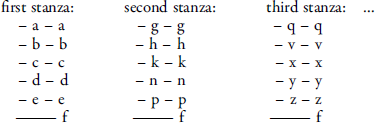
Unlike a musammaṭ, however, the first five lines in the stanza are not separate hemistichs sharing the same rhyme; instead, they are full-fledged verses composed of two hemistichs that rhyme with one another like in a mathnawī. In other words, Zisht-u zībā presents another strophic innovation in its own right.
Such is, at least, the form in which the poem was first published in Nahāl-i adab. In its later version, entitled Sabk-i tāza and published in Urdībihisht, the poem’s structure has undergone slight changes: the hemistichs in each of the five first lines of the stanzas are combined in a continuous whole. This change does not affect the overall characteristic of the poem: its form remains unclassifiable by any traditional standard.
In their rhyme and strophic combinations, both poems point to Dawlatābādī’s intent to breach the rules of conventional poetic composition. Their unusual metrical features only confirm and deepen this endeavor.
Syllabic Meters in Lieu of Quantitative ʿArūḍ
By the ninth century of the Common Era, the Persian poets, influenced by Arabic poetry, had adopted quantitative metrics in full. They took over the Arabic meters and adapted them to the linguistic features of their mother tongue; they coined new quantitative meters capable of reflecting, to some extent, their pre-Islamic poetic heritage, and devoted entire treatises to the science of poetic meters, the science of ʿarūḍ.Footnote 56 Since the earliest poems known, quantitative meters have been a crucial, constant component of the Persian poetic heritage. Over the centuries, it became a major defining feature of its identity. This millennial prosodic heritage was anchored in Persian literary culture so deeply that Browne’s attempt at stirring up Iranian nationalism against it proved ineffective. As late as the 1940s, the authority of ʿarūḍ was such that Nīmā Yūshīj’s tampering with prosodic rules caused a huge commotion in the poetic milieu.Footnote 57 Even today, when numerous poets dispense with traditional prosody altogether, quantitative poetry still constitutes a significant portion of the Persian poetic landscape.Footnote 58
In the first quarter of the twentieth century in particular, using syllabic meters in lieu of traditional ʿarūḍ was quite a daring break from the millenary practice. In the introduction, I pointed to the fact that both Bahār and Rashīd Yāsimī explicitly condemned the use of syllabic meters. Bahār considered it a harmful endeavor to equate Persian poetry to “non-metrical European syllables,” yet without referencing the European sources these “syllables” could be borrowed from. Rashīd Yāsimī’s claim was more specific: he condemned the use of syllabic meters as an attempt to substitute the alexandrine, the typical French twelve-syllable meter, for Persian quantitative meters.
In the absence of an identifiable classical Persian model for these poems, it could be that Dawlatābādī, as a noted francophone, sought inspiration in French poetry.Footnote 59 If this is the case, however, the only traceable reference is the syllable count. Twelve-syllable, ten-syllable and eight-syllable lines number among the most common meters in French poetry. Yet French poetic meters involve rules a little more complex than mere syllable count. The classical alexandrine, for instance, is not just any twelve-syllable combination. It relies on such technical elements as the caesura and a set of primary and secondary accents, the position of which is strictly codified. Similarly, in the ten-syllable meter, the place of caesura is determined by well-defined rules. Among these three French meters, only the eight-syllable meter does not have a caesura.Footnote 60
Upon close inspection, none of the rules of French syllabic prosody apply to Dawlatābādī’s twelve-syllable and ten-syllable verses, based solely on syllable count. Only in the eight-syllable verses of Sabk-i tāza does one perceive a tendency to distribute the lines into two units of four syllables each: a feature in fact contrary to the rules of French eight-syllable meter, which cannot be divided into hemistichs. In Sabk-i tāza, verses are split into two parts, equivalent in size and cohesive in meaning, divided by a pause that falls at the end of a word or phrase.Footnote 61 The sole exception lies in the fourth line of the sixth strophe, where the break falls in the middle of the word māʿīm. To alert the reader of the necessity to mark the pause, the poet made sure to make the break apparent, dividing the syllables by a dash:  Footnote 62
We saw that syllabic poetry was never truly successful with the Iranian audience. Beyond the enduring popularity of ʿarūḍ, the reasons for this fact remain unclear. One possible factor may be that the ear of the public, attuned to the millenary cadences of “learned” quantitative poetry, and perhaps to the syllabic-accentual meters of Persian folk poetry,Footnote 63 had trouble perceiving in it any rhythm at all. This could explain why Bahār called syllabic poetry “non-metrical,” and why the only feature of Dawlatābādī’s poetry to attract some critical attention was his use of syllabic meters. But there is more. By focusing on syllables only, the critics failed to see what other challenges Dawlatābādī’s poems posed to classical Persian prosody.
Unconventional Metrical Combinations
Traditionally, metrical combinations in a poem were only tolerated in the mustazād.Footnote 64 The mustazād is a poem based on a set form, such as the qaṣīda or the ghazal, the lines of which are expanded by the addition of a shorter metrical segment. No matter their length, these segments can only display the metrical feet and rhyme scheme present in the core poem.Footnote 65 The following couplet is an excerpt from a regular qaṣīda-i mustazād by Dawlatābādī entitled Inqilāb Footnote 66 (Revolution):

The similitudes and differences between the hemistichs of the core poem and the appended segments are obvious. Both are based on the same set of feet, fāʿilātun (– ᴗ – –) and fāʿilun (– ᴗ –), which belong to the same metrical category: that of the meter ramal. Yet the hemistichs and the segments differ in length, or metrical quantity. The hemistichs are composed of four feet, whereas the segments are made up of two feet only. In classical prosody, the meter of the verses is called ramal muthamman maḥdhūf and that of the segments ramal murabbaʿ maḥdhūf.Footnote 69 The result is an unambiguous combination of two metrical variants.
Unlike this conventional model, Ṣubḥdam and Sabk-i tāza both display a combination of heterogeneous meters. To make this clear to his readers, Dawlatābādī provides a short outline of the structure of his poems in Urdībihisht :Footnote 70 in Ṣubḥdam, each stanza is composed of three twelve-syllable lines followed by two eight-syllable lines; in Sabk-i tāza, stanzas display a combination of five eight-syllable lines followed by one ten-syllable line. Both poems, in other words, offer a combination of two distinct syllabic meters. In themselves, such combinations constitute yet another violation of the classical rules of prosody. It becomes obvious that neither Ṣubḥdam nor Sabk-i tāza identifies with the mustazād, the sole traditional form to allow for metrical combinations. What is more, in Dawlatābādī’s syllabic poems, there is no such common feature between hemistichs and segments as the identical metrical feet of the mustazād.
Dawlatābādī’s metrical innovations were even more spectacular in the earlier version of Sabk-i tāza. In Zisht-u zībā, four out of eight stanzas displayed an irregular number of syllables: most of the hemistichs above the final twelve-syllable lines contained four syllables, but some of them counted five. Even the number and position of the five-syllable hemistichs differed from one stanza to the next: the first four hemistichs of the second stanza; the second, fourth, fifth, and sixth hemistichs of the fourth stanza; in the fifth stanza, the first hemistich only; and in the seventh stanza, the eighth, ninth, and tenth hemistichs contain five syllables. This random distribution of syllables seems guided by no principle other than the poet’s whim. It certainly trampled the rules of metrical equality so critical to national poetic identity.
The second version of the poem, published in Urdībihisht, bears no trace of this initial audacity, and Dawlatābādī nowhere accounts for his palimpsest. He turned the five-syllable hemistichs into four-syllable units, mainly by removing a conjunction here and there, and by substituting single words or expressions with a shorter equivalent. The second stanza of the poem, for instance, becomes the following:
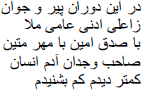
The initial  (I sought the world) is replaced by
 (in this time), and the preposition
 (of, from) before
 (elderly and youth) as well as the conjunction
 (and) in the second line are removed. Considering these changes, one may wonder: could it be that these amendments were merely corrections of editorial mistakes in the first version of the poem? If this was the case, why did Dawlatābādī remain silent about these emendations in Urdībihisht? Upon closer inspection, none of these changes appear to proceed from proofreading, since the initial wording was perfectly suited to the semantic context. Could they bear witness to Dawlatābādī’s retraction from the bold metrical irregularities of Zisht-u zībā, considered overly daring in hindsight? The question remains open. Whatever the reason for this palimpsest, Dawlatābādī’s Zisht-u zībā is, in fact, by virtue of its variations in metrical length, the first instance of free verse ever published in Persian.Footnote 71
Still another metrical amendment distinguishes Sabk-i tāza from Zisht-u zībā. In Zisht-u zībā, stanzas ended on a twelve-syllable line. In the revised version, these are replaced by ten-syllable lines, with only slight changes in words and phrasing. The overall meaning is not affected. Table 1 displays the variations in the last line of the stanzas, from one version to the next.
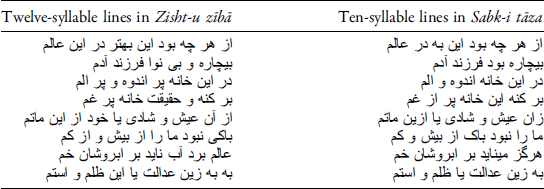
Dawlatābādī never commented on these changes. One thing, however, is certain: while turning to the ten-syllable verse, the poet broadened his syllabic repertoire, since he had already experimented with the twelve-syllable meter in Ṣubḥdam. Even in its revised form, the poem retained its innovative features and unconventional metrical combinations.
Conclusion: Dawlatābādī, a Pioneer in Poetic Subjectivity
From the three formal aspects discussed above, it becomes clear that Dawlatābādī’s innovations challenged the poetic conventions in more than one way. In my opinion, such innovations testify to the high poetic aspirations of their author. Indeed, there is little doubt that Dawlatābādī had set himself a goal far more ambitious than the mere metrical investigation suggested to him by his Orientalist friend Edward Browne. What was Dawlatābādī aiming for? What part did he really play in Iranian literary modernity? To approach this question without bias, one must consider Dawlatābādī’s enterprise in its actual literary context.
In the aftermath of his dispute with Rafʿat, Bahār recast the roadmap he had set for modernist poets. In “Dastūr-i adabī,” published in January 1919, he called for an alleviation of traditional constraints, and allowed poets to develop new poetic forms and patterns.Footnote 72 On this particular issue, the modernists of Tabriz could not have agreed more: both parties welcomed modernity as a breath of fresh air over dusty poetic rules, and as a chance for poets to claim their own individual creativity.Footnote 73 In this perspective, three facts should be kept in mind.
Firstly, as regards the modernization of Persian verse, practice always anticipated theory. Theory only came at a later stage, to single out and interpret modernist experiments carried out beforehand. Famous instances of novel poetic forms include Rashid Yāsimī’s emulation of the French “quatrain” in Parvāna va gul (The butterfly and the rose), Jaʿfar Khāminaʾī’s adoption of the sonnet in Bi vaṭan (To the homeland), and Lāhūtī’s sonnet-like Bāzgasht bi vaṭan (Return to the homeland), all composed before the great theoretical dispute over the meaning of poetic modernity.Footnote 74 Dawlatābādī’s syllabic poems likewise illustrate this claim.
Secondly, it should be noted that these initial modernist experiments were exceedingly few. Most of Dawlatābādī’s better-known contemporaries owe their reputation to a small number of “modern” poems, in some cases just one or two. However limited in number, these poems had a great impact on the literary milieu because they challenged the belief in an immutable essence of poetry. For the same reason, Dawlatābādī’s poetic innovations deserve to be considered not in terms of quantity, but after their effect in the poetic circles of the time.
Lastly, let us not forget that the poets read and even drew inspiration from one another, even if they otherwise seriously disagreed. In his Preamble to the Iranian Literary Revolution, for instance, after strongly disavowing all his predecessors on the path to poetic modernization, ʿIshqī writes: “Yet, I have to admit that I benefited from their experience, emulating what good I found, and avoiding any mistakes I saw in them.”Footnote 75 Despite his initial rejection of foreign models in Persian poetry, Bahār himself came to adopt the chahārpāra, a form adapted from the French by several of his contemporaries.Footnote 76 The slightest innovation in form or content was scrutinized, assessed and debated by both parties. This was also the case for Dawlatābādī’s syllabic poems: his usage of syllabic meters was overtly criticized for the first time in the initial issue of Dānishkada. For this reason, the silence surrounding his other innovations may well have meant consent. To be sure, Bahār only devised his personal theory after pondering the benefits gained from avant-garde experiments.Footnote 77 Though only few such experiments became acknowledged as trailblazers for new directions in poetic reform, many others proved instrumental in deconsecrating the classical Persian heritage in the eyes of the poets themselves. After all, what Bahār, Rafʿat, and their peers achieved was little more than to adapt foreign patterns, mainly from the French, and to invent forms hitherto unknown to the Persian poetic tradition.Footnote 78
Dawlatābādī’s undertaking, some years earlier, was no different: by the same token, he coined novel patterns, regular and irregular, unfamiliar to the Persian tradition. It is thanks to such daring enterprises that the younger generation became aware that, for all its might and weight, the Persian literary heritage was not altogether untouchable, and that it bore its own potential for change and modernization within itself. Dawlatābādī’s endeavor should not be overshadowed by his alleged “failure” to popularize syllabic meters in Persian poetry. Instead, his poetry should be appreciated for all its innovative potential, which helped foster the guiding principle of literary modernity: the subjectivation of poetic creativity. By contributing to this new trend, Dawlatābādī indisputably numbers among the pioneers of Iranian literary modernity, as Bozorg Alavi and Jamālzāda understood well. For this reason alone, he should be given his proper place in the history of modern Persian literature.



