Introduction
In 1928 Sir C. L. Woolley started to dig stratigraphic soundings (Trial Pits) in the Royal Cemetery area at Ur. During the 1929–1930 campaign a large scale sounding, Trial Trench F (Pit F), was planned with the aim of investigating an area located in the south-eastern portion of the sacred precinct. The area, a rectangle of 25.0 × 16.0 m, seemed promising due to the presence of architectural remains on the surface (Woolley Reference Woolley1930: 330). In this pit the excavators identified eight superimposed architectural phases, under which there were several metres of pottery kiln debris (Kiln Strata), water-laid sand, and at the bottom of the pit occupation levels dated to the Ubaid period.
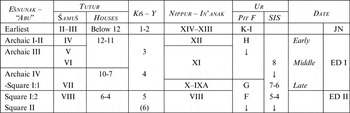
In spite of the importance of this unbroken sequence, it is only recently that Pit F has received adequate consideration in scholarship. The most extensive studies on the Pit F sequence have been carried out by Sürenhagen (Reference Sürenhagen1999) and Dittmann (Reference Dittmann2006; cf. also Moorey Reference Moorey1979 and Gockel Reference Gockel1982). Sürenhagen produced a new stratigraphic framework for the Pit F levels, plotting the surface level at 17.0 m, and from this was able to reorganize the assemblages spanning from the prehistoric periods to the ED I/II (Sürenhagen Reference Sürenhagen1999: 188–92, table 22.). On the basis of Sürenhagen's reconstruction, R. Dittmann (Reference Dittmann2006) surveyed the sequence and proposed a new chronological framework (ibid., table 1). Most recently the concordance and relative stratigraphy between the different operations excavated at Ur has been discussed afresh within a sound methodological approach by N. Marchetti (Marchesi and Marchetti Reference Marchesi and Marchetti2011: 51–64, table 12). The stratigraphic analysis produced by Sürenhagen has been revised and improved through a re-examination of the original excavation records and materials. The study of the cards redacted in the field by Woolley and his assistants has revealed a significant array of new data. The analysis of a wide range of either previously unpublished or poorly illustrated items, kept at the British Museum and at the Penn Museum, completed this review. Given the large quantity of materials recovered in Pit F, this paper deals with only one—albeit an important one—of the investigated strata, providing a sample of the methodology applied in reconstructing the Early Dynastic levels at Ur.Footnote 2 Architecture, stratigraphy and find distribution are analysed in the first part of the article, followed by a separate discussion of the ceramic and glyptic finds with the aim of providing a chronological framework for Level H. The hypothetical reconstruction of the activities carried out within the two buildings is proposed in the final part of the paper.
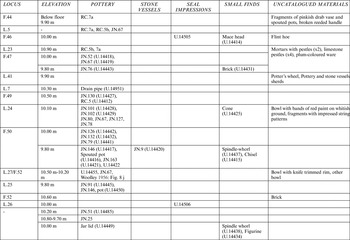
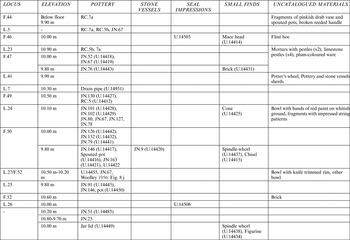
Summary of the data concerning Level H contexts.
Architecture
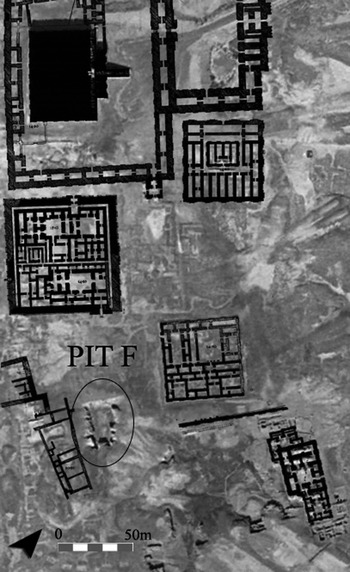
Among the deep soundings dug by Woolley, Pit F is the only one marked by significant structures. Eight building phases were distinguished and labelled with capital letters—A to H—from top to bottom. Hence the earliest traces of coherent architecture were identified between 9.7 and 10.9 m according to the original records, in a layer named “Building Level H”.Footnote 3 The area of the pit was divided into squares measuring 5 × 5 m, labelled with capital letters and numbers. This grid was used as a reference to record the position of excavated features and finds (Fig. 2).
Location of Pit F in relation to the sacred precinct at Ur (based on Woolley Reference Woolley1934: pl. 1 and Google Earth 2012 image).

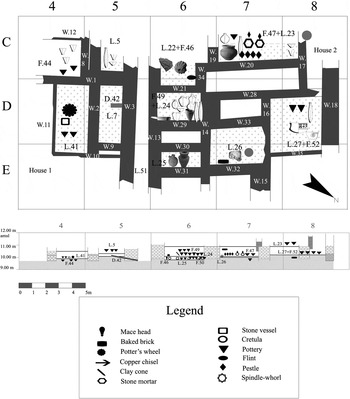
Plan and schematic section showing Level H architectural remains and distribution of finds (after Woolley Reference Woolley1956: pls. 73, 75).

Woolley's plan shows two free-standing buildings separated by a narrow alley stretching from north-east to south-west (Woolley Reference Woolley1956: pl. 75). The complex investigated to the south-east (hereafter House 1) consisted of two broad parallel rooms, and two others only partially preserved. The majority of the walls, c. 1 m thick and built with rectangular mudbricks, had shallow foundations set at around 9.75 m.
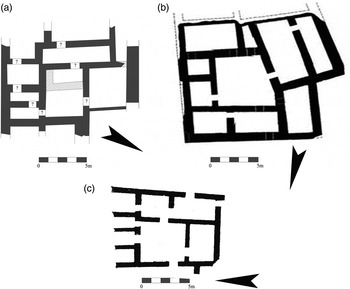
The compound identified to the north-west (hereafter House 2) measured c. 15 × 15 m for a total surface of about 225 square metres.Footnote 4 The walls were preserved to a height of c. 1 m and were mostly founded at around 9.9 m. The only exception are the wall on Square E7 (W.15), apparently founded at 9.6 m, and W.18 that had a stone foundation at 9.7 m.Footnote 5 Two pottery drains sunk from higher levels ended in this layer. In Square C8, P.15 stopped at 10.8 m, whilst in L.26 the bottom of P.19 reached 10.5 m. The pavements of both buildings were repaired several times and the average floor level was raised by c. 80 cm. This caused the preservation of materials on the lower pavements, sealed by the upper floors that on the other hand yielded very few finds. This might be explained by inferring that the buildings were at some point emptied, abandoned and purposely demolished. No information on doorways, sills, doorjambs and built-in installations was apparently registered, and as a consequence circulation patterns cannot be safely reconstructed. Notwithstanding these limitations, the architectural layout of House 2 appears to be that of a large single-unit courtyard house (see Fig. 3).
(a) Hypothetical reconstruction of the north-western house in Level H (after Woolley Reference Woolley1956: pl. 75); (b) Khafajah-House XXXII, House level 6 (adapted from Delougaz, Hill and Lloyd Reference Delougaz, Hill and Lloyd1967: pl. 8; (c) Fara, XVad West House (adapted from Martin Reference Martin1988: fig. 30).

Stratigraphy and spatial distribution of finds
Aspects of Woolley's reports may be challenged on the basis of his own informative unpublished records. The cross-checking of the object cards catalogue demonstrates in fact that textual description, section-drawing, and catalogues are frequently inaccurate. As a consequence, the inventory of objects retrieved in situ has been improved thanks to the data from the cards, where find spots and elevations were systematically registered. The stratigraphy of the level underwent further elaboration and stratigraphic units (loci) have been distinguished and renamed according to their typology (Locus = L.; Fill = F.; Wall = W.; Drain = D.; Pit = P.; etc.; see Table 1). With the aim of drawing observations on the function of the excavated rooms, the objects are presented here on a contextual basis.
House 1
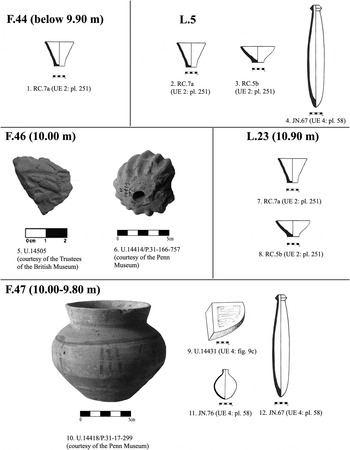
The room in Square C4 had a bitumen floor at 9.9 m (L.4). In the fill below L.4 (F.44) some clay bowls (type RC.7a), together with unpublished pottery fragments, were found (Fig. 4: no. 1).Footnote 6 Although no pavements were apparently preserved, L.5 produced additional examples of low bowls (RC.7a, RC.5b), together with some bottles (JN.67; Woolley Reference Woolley1956: 62; Fig. 4: nos. 2–4). In Squares D–E4 two superimposed beaten clay pavements were excavated at 10.50 m (L.6) and at 9.9 m (L.41). L.41 yielded pottery and stone fragments (Woolley Reference Woolley1930: 331; Woolley Reference Woolley1956: 62).Footnote 7 In the excavators' opinion the ceramic fragments were part of a potter's wheel.Footnote 8 The room in D5 also had two pavements, one at 10.3 m (L.7) and the other at 10.1 m (L.40). In this room a terracotta pipe (D.42) connected to L.7 intersected W.3 and emptied in the alley (L.51; ibid., 62).
Finds from loci F.44, F.46, L.5, L.23, F.47 (UE 2 = Woolley Reference Woolley1934; UE 4 = Woolley Reference Woolley1956; BM. = British Museum big number; P. = Penn Museum catalogue number).

House 2
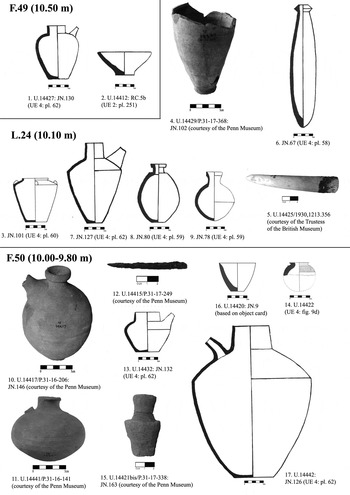
The south-eastern side of the compound consisted of a row of four rectangular rooms set parallel. L.24 had a clay floor at 10.1 m and yielded the most important bulk of pottery from this stratum. In the fill below L.24 (F.50) finds were excavated between 10.0 and 9.8 m. At 10.0 m spouted jars (U.14442: JN.126; U.14432: JN.132) and a rounded bottle (U.14441: JN.79) were retrieved (Fig. 5: nos. 17, 13, 11). While at 9.8 m miniature jars (U.14421b: JN.163), spouted jars (U.14416; U.14417: JN.146) and a “frit” bottle (U.14422), were found together with a spindle-whorl (U.14437), a copper chisel (U.14415), and a stone bowl (U.14420: JN.9; Fig. 5: nos. 15, 10. 14, 12, 16).Footnote 9
Finds from loci F.49, L.24, F.50 (UE 2 = Woolley Reference Woolley1934; UE 4 = Woolley Reference Woolley1956; BM. = British Museum big number; P. = Penn Museum catalogue number).

On L.24 (10.1 m) stood a four-lugged jar (U.14428: JN.101), a three-lugged jar of reddish clay (U.14429: JN.102), two ledge-rim jars (JN.78, JN.80), two tall bottles (JN.67), two spouted vessels (JN.127), a clay cone with painted tip (U.14425) and a bowl with bands of red paint on whitish ground that was never published (Fig. 5: nos. 3, 9, 8, 6, 7, 5). A spouted vessel (U.14427: JN.130) a fragmentary bowl (RC.5) containing plum coloured powder were found at 10.5 m in the fill above L.24 (F.49) (Fig. 5: nos. 4, 2).Footnote 10
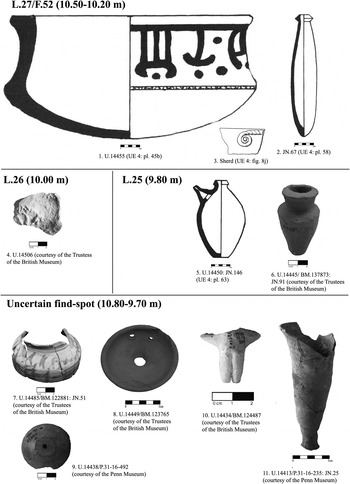
A surface was probably preserved at 9.8 m in L.25, though not indicated on plan. At this same level, a miniature jar (U.14445: JN.91), a spouted vessel (JN.146), and a pot (U.14450, unpublished) were excavated (Fig. 6: nos. 5–6). The small room to the west had two superimposed pavements at 10.9 m (L.22) and 10.1 m (L.43). In the fill below L.43 (F.46) a seal impression on clay (U.14505; Woolley Reference Woolley1956: fig. 9, a), a baked clay mace-head (U.14414), and probably a flint hoe, were excavated at 10.0 m (Fig. 4: nos. 5–6).
Finds from loci L.27/F.52, L.26, L.25 and from uncertain find-spots (UE 2 = Woolley Reference Woolley1934; UE 4 = Woolley Reference Woolley1956; BM. = British Museum big number; P. = Penn Museum catalogue number).

On the south-western flank of the house, two broad parallel rooms were cleared. In Squares C7–8 two superimposed floor levels were detected at 10.9 m (L.23) and 10.1 m (L.43). On L.23 some bowls (RC.7a, RC.5b) were clustered (Fig. 4: nos. 7–8). In the fill below L.48 (F.47) a painted jar (U.14418: JN.52), and a bottle (U.14419: JN.67) were excavated at 10.0 m, while another bottle (U.14443: JN.76) was lying a little lower (9.8 m; Fig. 4: nos. 10–11).Footnote 11 We are also informed that in the same room (perhaps in F.47), two mortars with pestles, four limestone pestles, and fragments of plum coloured ware were retrieved, although these were never published in full (Woolley Reference Woolley1956: 62).
The central part of the building was occupied by a room (L.26) that according to its central position might be interpreted as a court. A floor was probably preserved at 10.0 m and yielded a seal impression (U.14506; Fig. 6: no. 4).Footnote 12 Similarly in L.27 a pavement was probably preserved at 10.2 m. According to the plan (Woolley Reference Woolley1956: pl. 75) several vessels were excavated either on this floor or in the fill above it (F.52). A large bowl (U.14455) was retrieved between 10.2 m and 10.5 m (Fig. 6: no. 1) alongside with a bottle (JN.67), a bowl with “knife trimmed rim” that remained unpublished (ibid., 63, pl. 75), and a pottery fragment with applied decoration (Woolley Reference Woolley1956: fig. 8j), previously enlisted among the finds of Level G (ibid., 62).
It is also worth mentioning a group of objects that have not been allocated a certain find-spot. According to their cards, a clay jar lid (U.14449), a stone spindle whorl (U.14438), and a clay figurine (U.14434), were excavated at 10.0 m (Fig. 6: nos. 8–10). The same consideration is valid for a painted jar (U.14485: JN.51) excavated at 10.2 m (Fig. 6: no. 7).Footnote 13 Furthermore, the 1929–1930 campaign report makes it clear that solid-footed goblets (hereafter sfg) were concentrated in the layer between 10.8 and 9.7 m (cf. also Sürenhagen Reference Sürenhagen1999: 202–4), in particular at 10.3 m, “the broken examples numbering hundreds” (Woolley Reference Woolley1930: 331). Probably sfg were also amongst the pottery finds from 9.8 m in L.4 (F.44), L.24 (F.50) and L.25, and perhaps L.6. Similarly sfg were probably scattered on the floors in rooms L.27, L.7, L.22, L.23, L.24 lying at 10.1, 10.2 and 10.3 m. Although the final report says sfg were found from 10.8 m, one goblet (U.14413) has its own object card that says it was found at 11.0 m and therefore in Level G.Footnote 14
The pottery assemblage
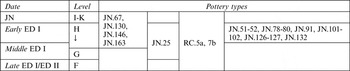
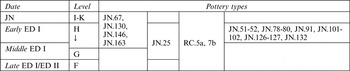
Level H yielded a rich pottery assemblage, mostly composed of simple wares. The assemblage can be divided into open shapes such as bowls (RC.5b, 7a) and sfg (JN.25), and closed shapes such as bottles (JN.67, JN.76, JN.78-80), spouted jars (JN.126-127, JN.130, JN.146, JN.132), squat jars (JN.51–52) and lugged jars (JN.101–102). The pottery repertoire is completed by some specimens of miniature (JN.163, JN.91), cooking (U.14455) and preservation ware (JN.126).
This assemblage is characterized by late Jemdet Nasr pottery specimens as well as ED I hallmarks.Footnote 15 In particular, the typologies JN.67, JN.130, JN.146 are attested in the layers below H (K–I) and appear to be long-lasting Jemdet Nasr productions. The tall bottle with triangular rim and convex base JN.67 appears in Levels K–I (Woolley Reference Woolley1956: 64–65) and is no longer attested after Level H.Footnote 16 This typology might match with tall spouted vessels found at Jemdet Nasr (cf. Matthews Reference Matthews1992: fig. 5: 4) and in Late Uruk period contexts at Habuba Kabira (cf. Sürenhagen Reference Sürenhagen1978: fig. 17: 102). Similarly the carinated jar with vertical neck and flat base JN.130, and the jar with thick band rim JN.146 can be paralleled with examples from late JN and ED I period contexts at Nippur, Jemdet Nasr, Uruk and the Diyala (cf. Dittmann Reference Dittmann2006: 29-30). The miniature juglet JN.163 (Woolley Reference Woolley1956: fig. 10), is also attested in Level K and might be paralleled with examples from Uruk, mostly dated to the ED I (Dittmann Reference Dittmann2006: 29, n. 42). The “glazed” frit globular jar with out-turned rim, decorated with impressed chevrons on the shoulder (U.14422, Woolley Reference Woolley1956: fig. 9d) might be paralleled with the “low-necked jar rim” category considered by Wilson (Reference Wilson, U. Finkbeiner and W. Röllig1986: 60) as a significant component of Jemdet Nasr pottery assemblages. Moreover the incised “chevron” motif on the shoulder of the pot might match the herringbone patterns on some examples from the Jemdet Nasr levels of the In'anak temple at Nippur (ibid., figs. 4: 5, 7: 1). The bowls of reddish clay with convex sides and footed bases (RC.5b and 7a), on the other hand appear in Jemdet Nasr contexts and are attested throughout the ED period (cf. Woolley Reference Woolley1956: 64–65).
By contrast some typologies appear to be restricted to Level H within Pit F sequence (JN.51–52, JN.76, JN.78–80, JN.91, JN.101/JN.102, JN.126–27, JN.132). The miniature version of type JN.91 is dated to the Jemdet Nasr period by S. Kolbus (in Vertesalji and Kolbus Reference Vértesalji and Kolbus1983: 88). This assumption appears to be confirmed by comparison with jars from Śamuš (“Sin”) temple II at Khafajah (Delougaz Reference Delougaz1952: pl. 182, C.536.270),Footnote 17 Jemdet Nasr (Matthews Reference Matthews1992: fig. 3: 2), and Nippur, In'anak XIII (Wilson Reference Wilson, U. Finkbeiner and W. Röllig1986: fig. 7: 14), dated to the late JN period.
Of particular importance for the chronology of this assemblage is the four lugged jar type JN.101 that matches the late Jemdet Nasr/ED I examples from Khafajah, Śamuš III (Delougaz Reference Delougaz1952: pl. 154, B.455.253; cf. also Dittmann Reference Dittmann2006: 32, n. 76), and above all the specimens from the houses in the Süd-Abschnitt II at Isin (Sürenhagen-Wittmann Reference Sürenhagen, Beatrice and Hrouda1992: table 53: 5) attested together with sfg.Footnote 18 The ledge-rim jar JN.80 can be paralleled with examples from JN–ED I contexts at Fara (Martin Reference Martin1988: nos. 14–15), Jemdet Nasr (Matthews Reference Matthews1992: fig. 3: 1), and Nippur (Wilson Reference Wilson, U. Finkbeiner and W. Röllig1986: fig. 8: 1–5). Small jars with globular body and thick out-turned rim (JN.78) are attested in ED I levels at Kiš (Sounding Y, level 3; Houses Stratum I) and Khafajah, Śamuš III (Delougaz Reference Delougaz1952: pl. 164, B.664.540b).Footnote 19 The rounded bottle with triangular rim and short handle (U.14441) might be paralleled with bottles from Jemdet Nasr (Matthews Reference Matthews2002: fig. 35, no. 10). The globular bottle with out-turned rim of type JN.76 appears to be a long-lasting ED production and has been compared by Dittmann (Reference Dittmann2006: 31, n. 64) with specimens attested in the Diyala region between ED I and ED III (cf. Delougaz Reference Delougaz1952: pl. 165, B.666.620, B.666.640).Footnote 20
Among the vessels from this stratum spouted jars are commonly attested. The carinated type JN.126 might match with a category of similar jars from Jemdet Nasr compared by Matthews with vessels from “Protoliterate c–d” graves at Khafajah (Matthews Reference Matthews1992: figs. 5: 2, 5: 7). Other similar specimens are attested in ED I domestic contexts at Khafajah Houses 11–9 (Delougaz Reference Delougaz1952: pl. 175, C.405.362; pl. 178, C.515.363, pl. 180: C.525.362a). The small spouted jar with triangular body, vertical neck and flat base, JN.127, may on the other hand match with specimens from ED I contexts at Uruk, Grabung I XIII (Pongratz-Leisten Reference Pongratz-Leisten1988: no. 232). Notably, according to Dittmann (Reference Dittmann2006: 32, n. 79) the squat carinated spouted vessel with vertical neck JN.132 also appears to match with ED I examples, from Khafajah, Grave 8 (Delougaz Reference Delougaz1952: pl. 157: B.533.262), Tell Gubba VII (Fujii Reference Fujii1981: fig. 19, 6), and Nippur, In'anak IXA (Zettler Reference Zettler, Leonard and Williams1989: fig. 51 h). Drab clay jar ladles with three piercings (U.14449b) are widely attested in Mesopotamia from the Late Uruk to the ED I period (cf. Adams and Nissen Reference Adams and Nissen1972: fig. 30 ah; Wilson Reference Wilson, U. Finkbeiner and W. Röllig1986: fig. 7: 8; Martin Reference Martin1988: 56, 202–3; Pongratz-Leisten Reference Pongratz-Leisten1988: no. 428; Matthews Reference Matthews2002: fig. 12: 5–9).
In this level some painted vessels were also found. The globular jar with flaring neck and flat base U.14418 (type JN.52) shows horizontal and vertical bands of red paint above the shoulders. The large bowl with rounded base and out-turned rim U.14455 appears to be characterized by a similar design, though made with bitumen (ibid., 178).Footnote 21 The carinated jug with low out-turned rim and flat base, U.14485 (type JN.51), was decorated with an abstract pattern on the shoulder (Woolley Reference Woolley1956: 178, fig. 9e). It might be useful to compare these decorated vessels with transitional monochrome painted wares from Nippur, In'anak XIV–XII (Wilson Reference Wilson, U. Finkbeiner and W. Röllig1986: fig. 9, 1–6), as well as some painted wares from Kahafajah, Śamuš III (Delougaz Reference Delougaz1952: pl. 186, C.603.253a–b, C.634.453), characterized by similar decorative patterns on the shoulder.
Distribution of Level H Woolley's pottery types (cf. n. 5).
Given the transitional character of this assemblage, the presence of sfg (JN.25), universally considered the hallmark of the ED I period, plays a key role in determining the chronology of Level H. The excavations carried out by the Oriental Institute of Chicago demonstrated that in the lower Diyala sites the sfg were peculiar to the central part of the period.Footnote 22 Similar indications came from Nippur, where sfg appeared in In'anak XII, reached their maximum in Level XI, then decreased through the ED I levels and were lastly attested in Level IXA (cf. Hansen Reference Hansen and E. Ehrich1965: 209; Wilson Reference Wilson, U. Finkbeiner and W. Röllig1986: 86). Notably sfg and lugged jars (similar to the JN.101 type) are attested together in the domestic buildings excavated at Isin (Sürenhagen and Wittmann Reference Sürenhagen, Beatrice and Hrouda1992: table 53: 2, 5).
Lastly, the reddish painted fragments described by Woolley (Reference Woolley1956: 62–63; Reference Woolley1930: 331) as fairly common towards the bottom of the stratum, might match the red painted (and perhaps scarlet ware) vessels considered by Delougaz (Reference Delougaz1952: 135–37) as common features of both the Jemdet Nasr and ED I periods, and with the plum-slip ware commonly attested in JN–Early ED I levels at Nippur (In'anak XV–XIV, XII; cf. Wilson Reference Wilson, U. Finkbeiner and W. Röllig1986: 62).Footnote 23
The glyptic finds
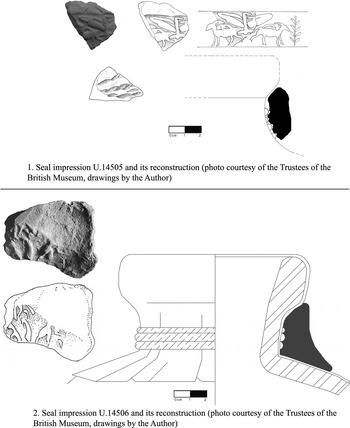
Sürenhagen (Reference Sürenhagen1999: 283) attributed two seal impressions to Level H: U.14505 (Woolley Reference Woolley1956: fig. 9a) and U.14568 (Moorey Reference Moorey1979: no. 595). The object cards make it clear that U.14505 was retrieved in Level H while U.14568 was excavated at 8.9 m and therefore should be plotted in Level K. In addition, the impression U.14506—never published in print—can now be added to the list of finds from Level H.
As correctly noted by Woolley (Reference Woolley1930: 331), the scene on U.14505, a spread-winged eagle grabbing a bovid with its talons (Fig. 7: no. 1), is well attested in the Seal-impression strata (hereafter SIS) glyptic repertoire.Footnote 24 Heraldic compositions are also widely attested in sealings from Fara (Šuruppak),Footnote 25 mostly dated by Martin (Reference Martin1988: 71–73) to between the ED I and early ED II. Unfortunately the impression preserved on U.14506 is problematic (Fig. 7: no. 2). I propose here to interpret the motif as a boat scene on the basis of a comparison with some impressions from the SIS layers (cf. Legrain Reference Legrain1936: nos. 300–1, 492, pl. 35). With regard to the chronology of SIS 8–4, R. Matthews (Reference Matthews1993), R. Zettler (Reference Zettler, Leonard and Williams1989) and recently N. Marchetti (in Marchesi and Marchetti Reference Marchesi and Marchetti2011: 51–61, table 8) proposed an ED I date with sound arguments.
Glyptic specimens from Level H.

As for the functional study, the traces of use preserved on the back of U.14506 and U.14505, enable me to conclude that both were probably applied to the neck of pots closed with cloth or leather and bound with cords (Fig. 7: nos. 1–2).Footnote 26 It is also possible to attempt a reconstruction of the pottery profile to which these sealings were fixed. The ceramic profile reconstructed from U.14505 might fit with a beveled-ledge rim jar similar to types JN.78–80, attested in this phase. While the partial profile reconstructed from U.14506 reverse appears to match with vertical band rim jars reconstructed by Zettler (Reference Zettler, Leonard and Williams1989: fig. 49: I) and compared with some examples from ED I levels of the In'anak temple at Nippur (Levels X–IX; ibid., fig. 52).
Functional Interpretation
As mentioned above, architectural features and installations are poorly documented in the reports. In addition, ash deposits, food discards and waste material are seldom accounted for. Consequently only the observation of the artefacts' distribution, on a room-by-room basis, allows us to reconstruct the activities carried out within the two excavated buildings (cf. in general Roaf Reference Roaf, E. Henrickson and I. Thuesen1989). In spite of the paucity of finds from House 1, the presence of a potter's wheel may indicate that this building was used as workshop. The presence of a ceramic drain as well as a bitumen floor in nearby rooms substantiates the hypothesis that activities involving the handling of liquids—such as clay processing—took place in this area. Unfortunately, only a small ceramic repertoire was retrieved in this house. These vessels may be considered appropriate for food consumption and liquid serving.
House 2, already defined as a “courtyard house” on architectural criteria, shows a different range of functions. The clusters of spouted vessels, bottles, and miniature jars, intended for storing or serving liquids, demonstrates that the primary function of L.24 and L.25 was the short/medium term storage of liquid and semiliquid goods.Footnote 27 Furthermore, according to the large amount of pottery specimens retrieved in L.24, one might note that this was the main storage area of the house. Since the assemblages stratified below and above the floor of the room have similar compositions, we might conclude that the function of this room did not change over time.Footnote 28
Food processing probably occurred in rooms L.23 and L.27. The cluster of a short-necked jar, mortars, and stone pestles in F.47, let us see that dry food was probably transformed in this area, while in L.27, the presence of a large open bowl—interpreted as a cooking pot on the basis of its globular body, large mouth and coarse fabric—a bottle, a knife-trimmed bowl and another pot, might let us interpret L.27 as a “living room”, where social activities took place. Unfortunately the lack of information on the presence of ovens or hearths prevents us from ascertaining where the food was cooked.Footnote 29 The seal impressions found in the house demonstrate that some domestic activities required administrative supervision. On the basis of the traces of function on the reverse one might conclude that the householders were sealing vessels or that they were handling sealed receptacles.
The foregoing reconstruction makes it clear that both buildings were engaged in domestic endeavours. Moreover, the remarkable size of House 2, the presence of a large repertoire of finds and of administrative devices, might let us conclude that this was a large household housing a wealthy residential group. Lastly, it must be noted that no intramural burials were recorded in the building levels of Pit F. This datum contradicts the evidence from other ED Mesopotamian sites such as Khafajah and Abu Salabikh, where the domestic structures investigated produced numerous burials.Footnote 30 Considering that at Ur extramural burial grounds are attested at least from the Jemdet Nasr period, one might interpret the absence of graves in domestic contexts as an avoidance pattern.Footnote 32
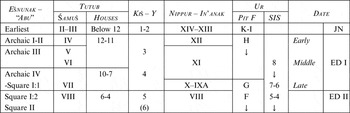
Relative stratigraphy of the main JN-ED I-II period Mesopotamian contexts (after Marchesi and Marchetti Reference Marchesi and Marchetti2011: 87, table 12; JN = Jemdet Nasr, ED = Early Dynastic).Footnote 31
Conclusions
This paper aims to demonstrate that a better knowledge of the Pit F contexts can be achieved by using archival records and original material from museum collections. Applying the same methodology to the other levels excavated in this sounding would provide a contextual reconstruction of an unbroken sequence of ED residential buildings. A sequence of well stratified materials would provide fresh evidence to help us discuss the chronology of the ED period at Ur and by extension in southern Mesopotamia. In this light it can be argued that the materials yielded by Level H provide significant data for the reassessment of the relative chronology of the beginning of the ED period at Ur. The analysis of the pottery repertoire and the glyptic specimens allows us to suggest a lifespan between early and middle ED I for the Level H houses. In this light, a concordance between Level H and the SIS could be attempted. The lowest SIS layer, namely SIS 8, and Level H overlap, according to the presence of sfg in both levels (Woolley Reference Woolley1956: 79). Alongside the sfg in SIS 8, flat bowls with internal compartments (RC.1; Woolley Reference Woolley1934: pl. 251) were retrieved. This specimen is attested in Pit F from Level G onwards and can be compared to mature ED I specimens from other Mesopotamian sites (cf. McCown et al. Reference McCown, Haines and Biggs1978: pl. 44: 3; Wilson Reference Wilson, U. Finkbeiner and W. Röllig1986: fig. 11: 6; Calvet Reference Calvet and Huot2003: 23–33; Pongratz-Leisten Reference Pongratz-Leisten1988: nos. 180, 229). Furthermore brocade style specimens, albeit very few, are attested at Ur only in SIS 8 and 7 (cf. Legrain Reference Legrain1936: nos. 36, 40, pl. 43). According to the dataset from the Śamuš temple at Khafajah—where brocade specimens are first attested in level V, reach a floruit in level VII and then decrease and are last attested in level IX (cf. Frankfort Reference Frankfort1955: 7–8)—it is possible to propose a correspondence between SIS 8 and 7 and Śamuš levels V–VII, dated between the mature and late ED I period. As a consequence one might argue for a mid ED I date for SIS 8.
On the other hand, fresh examination of the seal impressions from Level H demonstrated that they appear to match the SIS 7–4 assemblage, dated to the late ED I, rather than SIS 8. This evidence shows that the buildings of Level H remained in use for quite a long time span. At urban plan level, the analysis of the building levels of Pit F might provide some relevant data on the evolution patterns of the area across a considerable time span. The fact that in Level H (and perhaps the two layers labelled K and I) domestic buildings were erected over a thick stratification of pottery kiln debris (Kiln Strata), underlines that between the Jemdet Nasr and the ED I period a large open air workshop area was transformed into a wealthy domestic quarter.Footnote 33 Careful reconstruction of the stratification of building levels that covered Level H will provide further hints on the evolution of this urban area during the Early Dynastic period.
Note on the illustrations
The photographs of the objects kept at the British Museum were taken by the Author and are reproduced courtesy of the Trustees of the British Museum. The photographs of the materials from the Penn Museum were taken by the Penn Photographic Office and are reproduced courtesy of the Penn Museum (UE = Ur Excavations volumes; BM = British Museum big number; P. = Penn Museum).