Bread as a cultural marker
When I was digging with David French at Aşvan, a site in the Keban dam on the upper Euphrates not far north-west of Elazıǧ, we processed finds on the flat roof of a big house, which we shared with a family of storks. Down below at the foot of the stairs our village hosts operated an outdoor oven, in which they baked hemispherical brown loaves, much nicer than the regular chalky white loaves which were the norm in Turkish town bakeries. Enquiry revealed that the family, along with most of the village, had been transported by the Ottomans to this eastern village in the years shortly before the First World War from Bulgaria. They were pretty much integrated with the local culture: just one old gentleman could be found who still recalled five words of Bulgarian, and the one obvious remaining indicator of their origin was this delicious bread. That it was their bread that had persisted longer than any other element of their material culture led me to realize that bread can serve as a very sensitive cultural marker.Footnote 1 This is hardly an astonishing insight—one only has to look at European countries to recognize that bread can vary from place to place. Pumpernickel is characteristically German, a baguette or a croissant is quintessentially French, and in Ireland they bake a traditional Celtic loaf called barmbrack.
So when displaced from their homeland a century ago it is understandable that the Bulgarian farmers went on making and baking their familiar loaves: this may have been a positive choice because they preferred their traditional bread, or simply because they knew how to make it and were not familiar with other products, but consciously or unconsciously it may also have been an assertion of their communal identity.
Bread as the staff of life
Bread's role as a cultural marker is all the more significant because it is so universally present, acting as a fundamental part of any European or Middle Eastern diet. As a tribute to bread I would like to quote Laurens van der Post. He is best known as the chronicler of the Kalahari bushmen, or as Prince Charles’ guru, but he also wrote an account of a visit to the Soviet Union in the 1960s, when he was much taken by the local attitude to bread.
I noticed that my Russian companion enjoyed nothing so much as the bread, and watching him I realized that all Russians seemed to eat bread as if the very eating of it gives them a kind of reassurance. Bread has always been the main Russian food and rarely have the Russians been able to be certain that there would be enough of it ….. No matter how tempting, varied and abundant the dishes on the table, the hands of the Russians present would all first reach for bread. (van der Post Reference van der Post1964: 104–05)
Similarly to this day bread has a special and often symbolic importance in the Middle East. Unwanted bread is never thrown away, but conserved: when we threw some crusts out of the car window in Tatvan, small boys upbraided us, and carefully placed them in a doorway “for the mice” so that it would not be wasted. Yesterday's bread in Turkish cities is regularly bagged up and hung outside on a gate or a fence for any consumer that can use it—often the local dog population.
In antiquity the special role of bread is expressed in the Old Babylonian Gilgamesh Epic when Enkidu is enjoined by Šamḫat to “eat bread, the emblem of life” (simat balāṭim, using the virtually untranslatable simtu which CAD S 280 here renders “requisite”).Footnote 2 Such phrases are uncommon, and to my surprise the description of bread as the “staff of life” is not a Biblical (and hence not a first millennium b.c. Hebrew) phrase, but the sentiment must be generally valid. To exemplify the role of bread take this detailed description of the kind of famine Esarhaddon would like the breakers of his vassal treaties to suffer: “May the locust who diminishes the land devour your harvest, in your houses may there be no noise from grindstones or ovens, may the grain for grinding vanish from you, instead of the grain may your sons and daughters grind your bones.”Footnote 3 Comparing campaign rations with urban menus, Kabti-ilani-Marduk, the author of the poem Erra and Ishum, wrote (in Andrew George's translation): “The luxury bread of town cannot compare with a loaf baked in ashes, sweet pale ale cannot compare with water from a leather bottle.”Footnote 4 In both contexts, town and country, the food element of the diet is supplied by bread, albeit of differing kinds.
Assyrian bread
With the quantum leap in the written sources available for the Middle Assyrian period, it occurred to me that this might be a good moment to look at Assyrian bread in its cultural setting. We suffer of course from the fact that bread itself doesn't survive in archaeological contexts (outside Egypt),Footnote 5 and so we are thrown back on lexicography and iconography, and it is best to start with the lexicon. Given what we know of the potential variety of breads in the modern world, and indeed in the Classical world—read Athenaeus writing from Alexandria in the third century a.d.—combined with the variety of terms bearing the determinative NINDA in cuneiform texts, we can reasonably expect a wide range of products in Assyria too, and it is likely that some of these were quintessentially “Assyrian”, as opposed to Babylonian, or Mesopotamian, or just generally ancient Near Eastern.
The bread section of Ḫarra-ḫubullu itself is sadly lacking, but two of the early Old Babylonian forerunners have about 70 to 80 entries, many of which are types of bread.Footnote 6 These lists are of course both Babylonian and early second millennium, and so on two counts unreliable witnesses for Middle and Neo-Assyrian usage. We should therefore be grateful that the bread section of the first millennium Practical Vocabulary of Aššur has survived more or less intact:

However, it is only fourteen entries, and although it does list some varieties of bread, there are many fewer than in the Old Babylonian lists, and many terms for breads which we meet in the administrative and cultic texts do not appear in the Practical Vocabulary. Turning then to these sources, the relevant administrative texts are mostly in Fales & Postgate (Reference Fales and Postgate1992), because they appear to derive from temple administrations. Some varieties of bread also feature in ritual instructions edited by Zimmern, Ebeling, van Driel or Menzel.Footnote 7 Fortunately for the writer, a thorough survey of Neo-Assyrian bread terminology is offered in Gaspa (Reference Gaspa2011), dispelling the necessity for voluminous referencing here.
As noted by Stol,Footnote 8 bread does not normally feature in ration texts: obviously it goes stale too quickly, and recipients of rations were no doubt expected to, and preferred to, bake their own bread with the flour which was issued to them as rations. So for instance, one text from Nimrud lists supplies for a Neo-Assyrian soldier: he gets fodder and straw for the horses, and for himself flour, wine, oil and salt, but no bread (ND 3467).Footnote 9 Equally the Middle Assyrian officials in the countryside at Tell Chuera handed out flour as monthly rations for their regular personnel, but bread when they were required to make provision for incidental visiting dignitaries on a one off basis.Footnote 10
Hence where we meet bread in the Neo-Assyrian texts it is normally as part of a meal, listed alongside other components of the menu. The most elaborate menu is rather unhelpful: in his Banquet Stele Assurnaṣirpal simply lists 10,000 breads between 10,000 eggs and 10,000 jugs of beer (Grayson Reference Grayson1991: 292, 115). Most of the Neo-Assyrian texts mentioning bread belong in a cultic context and this has to be borne in mind, as the bread repertoire of cultic or ritual procedures may have differed from secular repertoires. Sometimes the lists may be records of an actual meal, in other cases the text may be listing the prescribed contents of a meal—so it could be a list of contributions to be made by a given official, or it could be the assemblage of dishes required for the god or goddess. In each case they are listing what is about to be consumed, and so bread is there, ready to eat, and accompanied by the other components of the meal.
SAA 7, 161 lists the contributions expected from a succession of officials. These were really basic meals, and fairly standardized: bread, onions, some meat and some beer. Here is a typical section:

The type of bread called ebbi’āte appears to mean “thick (loaves)”.Footnote 11 Second millennium b.c. Hittite texts know a “thick bread” written NINDA KUR4.RA (as noted by CAD E 16), and there is at least one mention of this type of loaf in the Middle Assyrian texts (10 kal-lu ša NINDA.MEŠ KUR4.RA, Donbaz Reference Donbaz1988: A. 3211:5).
As far as I know the gariṣāte are attested only in these lists and in one Late Babylonian text; von Soden, Akkadisches Handwörterbuch 282a cites an Aramaic gerīṣ(t)ā, which is clearly the same word, and since it is absent from the Middle Assyrian repertoire this may well be an Aramaic word loaned into Akkadian in the first millennium.Footnote 12 In a text from the Nabu Temple at Nimrud we learn that the temple staff boasted an “Aramaean baker” (ND 5457)Footnote 13 , and personnel receiving issues of wine from Fort Shalmaneser included not only Assyrian and Aramaean, but also Suḫaean and Babylonian (Kaldayu) bakers.Footnote 14 I think we should probably assume that there were distinctive varieties of bread produced by each ethnic baking tradition.
Most of the lists which have come down to us are in the Kouyunjik collection from the palace at Nineveh, but belong in a cultic context. In one case we have a list of sacrifices (UDU.SISKUR.MEŠ) of the chief eunuch. It must have been quite an elaborate affair with: 1 ox 2 sheep 2 lambs 1 duck 10 doves etc., but also a bread section consisting of “2 crates of giriṣāte, 60 giriṣāte, and 20 small loaves”.Footnote 15 The giriṣāte we have already met, and “small” loaves turn up again after the jerboas in a similar text (SAA 7, 160) alongside more “thick” loaves (ebbiāte) and 40 ḫu-ḫu-rat, a term which recurs in another text from the same group (SAA 7, 162) and is discussed at length below.
Aššur Temple offerings
The lists which have just been cited fail to mention which temples they are involved with, but in addition to them the British Museum's Kouyunjik collection includes 37 tablets listing daily food offerings to the Neo-Assyrian Aššur Temple (at Aššur). Why they were stored in the palace at Nineveh, rather than at Aššur remains obscure, but they reveal to us the “bread of Aššur” in a narrower sense, and give us a good idea of the Aššur Temple menu. In his edition of this archive van Driel tabulated 55 separate commodities, which were listed in a fairly consistent order (van Driel Reference van Driel1969, final table). After a whole ox and various cuts of beef come several categories of whole sheep and cuts of mutton, and lambs. Then follow geese, ducks and doves, and bowls of meat broth. The next menu entries, items 26 to 29 in his table, are the breads:Footnote 16
26 aklu dannu
27 NINDA (ginû)
28 NINDA qadūtu
29 NINDA miṭru
Of these the first are just “big loaves” and the second are “regular offerings bread”. The varieties called qadūtu and miṭru are well attested in other texts. We have no sure way of defining their meaning closely, but they have a long pedigree in Aššur's cuisine as we now know from the Middle Assyrian Aššur Temple offerings archive. This archive from the courtyard of the Aššur Temple mostly consists of tablets recording the receipt and transmission through the “Offerings House” (bēt ginā’ē) of ginā'u offerings, in four categories: grain, sesame, fruit and honey.Footnote 17
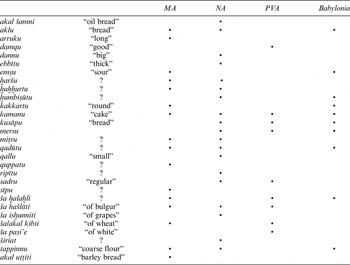
The Middle Assyrian scribes do exceptionally mention bread offerings. As noted already in Neo-Assyrian contexts, where bread is listed it usually means that the text was drawn up to record actual food items on their way to the shrine for immediate consumption, rather than receipts or disbursements transferring commodities from one part of the organization to another. The best evidence for breads comes from one important text which lists foodstuffs going to individual deities.Footnote 18 The breads mentioned here include miṭru,Footnote 19 qadūtu, ḫuḫḫurtu, emṣu, ḫaršu, mersu and punnugu. Most of these reappear in the Neo-Assyrian sources.Footnote 20 Rather than discuss each term in turn, Table 1 below gives an overview of the principal bread varieties attested in the Middle and Neo-Assyrian administrative and cultic texts, with further columns for the Practical Vocabulary (PVA) and for Babylonian texts. Presented like this it becomes easy to see if any term occurs in both periods, and/or in both Assyria and Babylonia, issues which are discussed below.
An overview of the principal bread varieties

Some of these terms are self-explanatory. They may specify the ingredients—barley bread, wheat bread, white (grain) bread, raisin bread, bulgur bread, coarse flour (bread), sweet bread—or just the size or shape—big, small, long, thick, round. Other terms seem to be attested only as the word for the particular type of bread, and hence are hard to interpret, even with a positivist approach to etymology.
Attention can now be concentrated on four of these specialist terms which are found in both the Middle and Neo-Assyrian columns, and are regularly present in cultic contexts, but seem to be exclusively Assyrian: miṭru, qadūtu, ḫaršu, and ḫuḫḫurtu. There is not much we can say about the first two: miṭru features in the Middle Assyrian Aššur Temple offerings archive, and likewise in the Neo-Assyrian Aššur Temple texts. Similarly qadūtu, although much less frequent, is definitely present at both periods. Etymology and context tell us nothing about the possible meaning of either bread type, but we do know that in Middle Assyrian times qadūtu breads had a volume varying from 1 qa (~ 1 litre) to 1 sūtu (~10 litres) each,Footnote 21 and in NA times qadūtu could be made from wheat. Both terms are found only in offerings lists and related texts. This may be because they were an archaic and traditional product, but it may merely reflect the fact that the great majority of the texts which have come down to us mentioning bread are from a cultic environment.
The word ḫaršu is frequent in Middle Assyrian contexts and less common in Neo-Assyrian. Way back when CAD Ḫ was written, it appeared to be a fruit, and von Soden Reference Soden1965–81, 328b under ḫaršu II has “eine Frucht?”. It is true that in some Neo-Assyrian contexts it appears with fruit, notably in the phrase dug aṣūdu ḫar-še zamri,Footnote 22 but there is now plentiful new Middle Assyrian evidence showing that it is some kind of bread product, so this phrase should be understood as “1 bowl of fruit ḫaršu”, i.e. ḫaršu made of or incorporating fruit. In the Middle Assyrian texts ḫaršu is not counted like some other breads such as miṭru, but measured by volume. In one case (MARV 5, 32:1) we read of 1 litre of bread “for ḫaršu”, which would seem to imply that it goes through some secondary process (like bread and butter pudding or—given that it seems to have involved fruit—summer puddingFootnote 23 ). Although it does usually have the NINDA determinative, we can see from MARV 5, 66 that it was sufficiently distinct from ordinary bread to rate a separate category between bread and beer: “From 9th Kuzallu of the eponymate of Pišqiya the bread, ḫaršu, beer, oil, honey (and) fruit is completely (delivered) into the presence of the god”.Footnote 24 Another Middle Assyrian text lists a quantity of sesame “received for his haršu”,Footnote 25 and a Neo-Assyrian text mentions equal quantities of honey and oil (probably sesame oil) for ḫaršu (SAA 12, 69: 8), so it must have been quite a tasty concoction. Etymologically, ḫaršu should belong with a verb ḫarāšu, and indeed this has now turned up in one Middle Assyrian passage where an official is charged with the processing (iḫarraš).Footnote 26 This must describe what has to be done to the bread to make it into ḫaršu, but beyond confirming that some process is involved, this does not help much at present because it is the first time we have met the verb.Footnote 27 I have suggested elsewhereFootnote 28 that it might mean “to crumble” making ḫaršu “crumbled (bread)” but obviously other culinary processes could be considered. As far as I am aware, in both the Neo-Assyrian and the Middle Assyrian texts this menu item like miṭru and qadūtu is only found in cultic contexts. As with them, this may not be significant, because there are so few Neo-Assyrian “food texts” that do not relate to the cult, but it could be an example of conservatism in ritual practice.
The same is possibly true of ḫuruḫuru / ḫuḫḫurātu. There are various forms of this word, which must have begun life as the reduplicated form ḫuruḫuru and later lost a syllable by assimilation to ḫuḫḫuru and associated forms.
Middle Assyrian: ḫu-ru-ḫu-ru, ḫu-ru-ḫa-ra-tu, ḫu-ur-ḫu-ra-a-te; ḫu-ḫu-ru, ḫu-ḫa-ra(-a)-tu
Neo-Assyrian: ḫu-ḫu-ra(-a)-te, ḫu-ḫu-rat
Aramaic/Syriac: ḥḥwrh, ḥḥwrt’
In both Middle and Neo-Assyrian texts we meet ḫuruḫuru/ḫuḫḫurātu bread of 1 qa (~1 litre) each; in one Middle Assyrian text there are some of 2 litres. Usually they are just classed as “bread”, but in one Middle Assyrian text we have 1 ḫu-ru-ḫu-ru ša muttāqi “of sweet stuff”.Footnote 29
Discovering the meaning of this word is difficult. The first thing to note is that it is not exclusively used of bread. Confusingly, the same word, or a homophone, seems to refer to the kermes beetle and the crimson dye which comes from it.Footnote 30 Both in Middle and in Neo-Assyrian texts the word seems to crop up in specifications of dyed wool, especially in association with a coloured wool called tabribu.Footnote 31 However in the second millennium texts it also turns up in one context where it is counted,Footnote 32 and in another where it is an attachment to a shield.Footnote 33 Neither passage suggests a dye, and I think it must refer to an item with a distinctive three dimensional shape which the ḫuḫḫurtu bread imitated. As for what that shape might be, for a while I have had a hunch, and it is no more than that, that it could be a plait. This was perhaps suggested by the repetitive shape of the word, reminiscent of words in English such as criss-cross or zig-zag. It must also have been influenced by the subconscious awareness that plaited or braided loaves are widely made today. A handsome example from the hand of a television chef called Hollywood is displayed on the internet, and so are a number of images of and recipes for a Jewish braided loaf favoured for the solemn Friday evening meal. This is known as challah, where (thanks perhaps to the influence of German) the ch stands for the Hebrew letter Ḥeth, since this word ḥallah is mentioned several times in the Pentateuch as a type of bread used for offerings. It seems to have no agreed etymology, but it is possible that the braided or plaited shape is of some antiquity, since in a recent book on “First Century fare” we read that “There were plaited loaves, square loaves, rustic breads, flat breads, whole-grain breads, rye breads, and dark bran breads” (Neel & Pugh Reference Neel and Pugh2012: 39). The word ḫuḫḫurtu was transferred into Aramaic and can be found in the Syriac dictionary.Footnote 34 What may change my hunch into a respectable theory worth considering is the fact that the Syriac attestations of ḥḥwrh, ḥḥwrt’ are renderings of ḥallah in the Biblical Hebrew text.Footnote 35 This makes it a fairly reasonable proposal to see both Biblical ḥallah and Assyrian ḫuḫḫurtu as braided loaves, principally if not exclusively attested in the cult or ritual meals.Footnote 36
The same is broadly true of the Middle Assyrian sources—the majority of the mentions of bread varieties are from the offerings archive. There is one secular archive concerned with bread production. It is composed of 56 tablets from a domestic house in square eC91 in the southwestern part of the city (Ass. 14842n; Miglus Reference Miglus1996: 259–60; Pedersén Reference Pedersén1985 archive M13), where a “confectioner” (kakardinnu) called Mušallim-Marduk is receiving bread deliveries from a “flour-processer” (alaḫḫinu) called Ṣilli-Aššur. This situation has been reconstructed by Pedersén from the Assur excavation photos, and unfortunately as yet only a couple of texts are published, with excerpts from two others in Istanbul, so that nothing much more can be said at present.Footnote 37
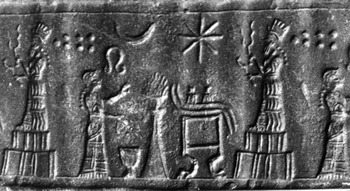
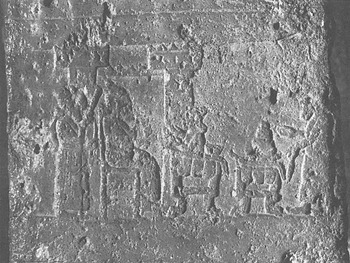
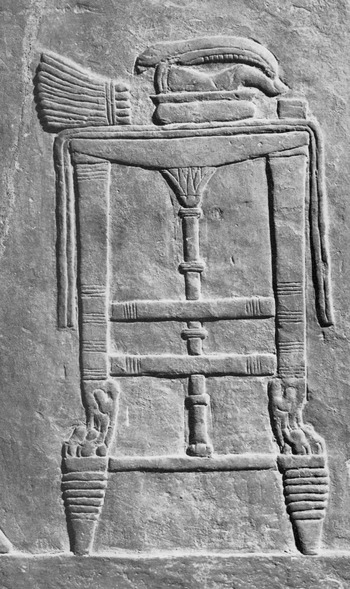
There is obviously a possibility that the scenes of cultic offerings in Neo-Assyrian seals and reliefs include representations of bread among other items. There is one instance, now well advertised, of a seal illustrating a divine offering mentioned by the textual sources, and that is the Middle Assyrian cylinder seal from Tyre which shows ziggurrats on an offering table (Fig. 1). Sesame ziggurrats are mentioned several times in the Middle Assyrian texts, and there is a Neo-Assyrian palace official called the “ziggurrat-man” showing that these delicacies survived into the 1st millennium.Footnote 38 They also make two appearances on the ninth (or eleventh) century White Obelisk on tables alongside other items which are presumably equally edible but have much less distinctive shapes. One of these is an offering table in the temple of Ištar (Reade Reference Reade and Porter2005: fig. 7), the other is part of a royal banquet for King Assurnaṣirpal himself (Fig. 2). It seems likely enough that these other items include bread in some form, but demonstrating this is difficult.
Middle Assyrian seal from Tyre. © D. Collon

Royal banquet on the White Obelisk of Assurnaṣirpal (Reade Reference Reade and Porter2005: fig. 26)

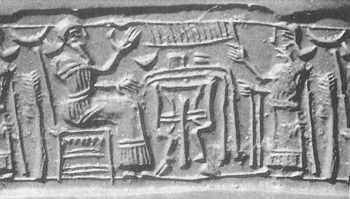
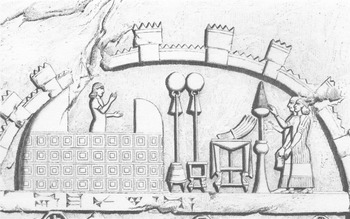
One issue may be a red herring, but has to be discussed. Scenes with offering tables are not rare on seals, where they have a role in the divine cult. The artists are usually careful to show the cultic offering tables with a table cloth. The typical Neo-Assyrian example in the Linear Style seal shown in Fig. 3 has a cloth draped over the table top and falling to the ground on at least one side, with two layers clearly indicated. In similar scenes the double layer is surprisingly consistent, but I am not sure how it should be interpreted. It is found in the later ninth century on Shalmaneser's Balawat Gates, on the offering table in front of a rock relief, clearly double but dropping little below the table top.Footnote 39 In a Tiglath-pileser camp scene the double cloth drops more than half-way down each side.Footnote 40 In the seventh century in the libation scene after Assurbanipal's lion hunt, the double cloth falls to about half-way from the ground (Fig. 4), and in a secular context at tea-time in the garden with Teumman's head the table has a fine cloth reaching down to the “ankles” of the table.
Neo-Assyrian Linear Style cylinder seal (Porada Reference Porada1948 no. 673)

Offering table at the libation scene after Assurbanipal's lion hunt (Barnett Reference Barnett1976: pl. LIX)

Back in the Middle Assyrian period we seem to have a doubled cloth on the offering table shown in the seal from Tyre (Fig. 1), but there is some cause for doubts. The “cloth” is very clearly double, but on one side instead of falling back down the left side of the table it bends upwards to give an S-shape, one side turning up, the other down. That this is not a mistake is clear from the two White Obelisk scenes where the cloth has the same S-shape; here it is not shown double, but rather thick, which may equate to the double layer shown so clearly on the Tyre seal and elsewhere. However, it is hard to see how this could represent the same kind of table cloth. An alternative interpretation might see these as large flat breads which had enough tensile strength to maintain an upward curve, and could serve as a sort of tray for other smaller offerings.
On the Linear Style seal (Fig. 3) there are plainly three items on the table, one semi-circular or crescentic, one square or cubic, and one which looks like a split hamburger bun. In our present state of knowledge, any of these could be a variety of bread. On the Balawat Gates offering table either there is nothing, or what was there is now too damaged to see. However offering tables are not infrequently shown later in the military camp scenes on the reliefs. One regular component of meals on offering tables is described by Reade as “crescentic objects resembling slices of melon”.Footnote 41 They seem to be staple components in depictions of offering tables on Sennacherib reliefs and with Gaspa (Reference Gaspa2012: 71) may perhaps be one of the varieties of bread known to us from the texts.Footnote 42
Equally enigmatic is another item shown on offering tables in the first millennium. The clearest depiction is on Assurbanipal's lion hunt libation scene, where next to a bowl with cuts of meat there is a bundle held together by some kind of band. There are five ends on the right-hand side, but nine or ten leaves on the left, suggesting that each piece had been folded in half before being bound together. Reade describes the table as being “laden with a bunch of onions, a small container, and a bowl containing the jaw and leg of a ram” (Reference Reade and Porter2005: 23), but he is less definite when describing a camp scene from Khorsabad where the offering table has “a single object, curved and resembling a bunch of onions” (Fig. 5).Footnote 43 With Maul and Gaspa I am inclined to think that they may have been flat breads of some description.Footnote 44
Camp scene with offering table before divine standards (Botta & Flandin Reference Botta and Flandin1849–50: II pl. 146)

Continuity: Middle Assyrian through to Neo-Assyrian
There are four varieties of bread which are already present in the Middle Assyrian texts and remain in currency down to the seventh century: miṭru, qadūtu, ḫaršu and ḫuḫḫurāte. They testify to a cultural continuity from the Late Bronze Age across the little known eleventh and tenth centuries into the Neo-Assyrian state. Since almost all the documents are related to temple offerings, there is a snag here: it is probable that the gods and goddesses were conservative in their dietary preferences. It must be a commonplace that the strong influence of tradition in religious cults tends to retain archaic ritual practices and this extends to culinary items. That the gods in seventh century Assyria were being offered the same varieties of bread as they were in the twelfth century does not necessarily mean that the Assyrian population in general was still eating them. As far as I know, few people munch communion wafers outside a church today, while unleavened Passover bread, the challah mentioned above, and the Irish Barmbrack which is eaten especially at Halloween, are all varieties of bread favoured in a specific cultic context.Footnote 45
Of course there are plenty of other indicators, both philological and archaeological, showing that culturally Assyria in the first millennium was a genuine successor of the Land of Aššur created in the second millennium. There are for example the obelisks: the Broken Obelisk, from the reign of Aššur-bel-kala in the eleventh century, which in its outward shape at least foreshadows Assurnaṣirpal's obelisks and the Black Obelisk of Shalmaneser III from the late ninth century. The offering tables visible on both Middle and Neo-Assyrian artefacts give an example of continuity of both a motif in the iconography, and a piece of ritual furniture used in the cult (and elsewhere). It may seem too normal to signify, but offering tables like this do not feature in second or first millennium Babylonian glyptic.
It is true that there are some big changes across the millennium divide. Neo-Assyrian glyptic is very different from Middle Assyrian, both stylistically and in respect of most of its motifs. But in other areas of the decorative arts there are more similarities. One example is the “stumbling ibex”. This motif, characteristic of Middle Assyrian seals, resurfaces in the ninth century in the glazed brick panel outside the Fort Shalmaneser Throne Room. While the bas-reliefs in the Neo-Assyrian palaces are undeniably an innovation of Assurnaṣirpal's reign, the idea of decorating walls with narrative iconography is not, since the Kar-Tukulti-Ninurta inventory text published by Köcher includes in its catalogue of luxury items not only more “stumbling ibex”, but also a tapestry (mardutu) with scenes including a fortified farmstead (dunnu) and a town.Footnote 46
Of course the most distinctive marker of Assyrian identity is their language. The Assyrians themselves called it “Assyrian” (and not, for example, Akkadian or northern Babylonian). Numerous features of the dialect, in terms of vocabulary and grammar (often indeed originating from Old Assyrian) are passed down intact from Middle Assyrian to Neo-Assyrian. Yet here again there are also significant differences. The language itself, while remaining decisively Assyrian, undergoes plenty of changes between the Middle Assyrian and Neo-Assyrian dialect, and the outward format and verbal formulation of legal documents undergo a complete transformation,Footnote 47 which can probably partly be explained by a dilution of formal scribal training leading to the adoption of new practices and vocabulary.
Taken altogether, though, the Assyrian identity formulated in the Late Bronze Age was perpetuated into the first millennium both linguistically and visually in the artistic repertoire for all of eight centuries. Just as the first millennium brought in new words and grammar, but the dialect was recognizably retained, so the traditional loaves persisted at least in the cult, while new kinds of bread also make their appearance.
Assyria and Babylonia, the cultural divide
The Assyrian dialect was also sharply differentiated throughout its history from its southern neighbour. The way the two main dialects of Akkadian maintained their separate identity, while at the same time undergoing some of the same or similar changes (e.g. the loss of mimation) is a fascinating linguistic phenomenon well worth studying in its own right. When investigating how Assyria retained its linguistic independence despite the heavy Babylonian influence in the scribal world, especially in literary texts and royal inscriptions, one has to assign a role to human geography, because the settled parts of Assyria were always separated from northern Babylonia by the zone of terrain which did not permit rainfall agriculture and was occupied solely by Aramaean transitory settlements, so that the two dialects did not rub shoulders across a frontier.
Alongside the language as such, there is the script. The handsome Middle Assyrian cuneiform ductus is strikingly different from the contemporary Middle Babylonian script. It seems to have been created afresh without much relationship to the Old Assyrian, but was transmitted to the Neo-Assyrian script without a great deal of change. In the realm of artistic representation, although Middle Assyrian glyptic differs from Neo-Assyrian cylinder seals in its exceptional quality and in some of its subjects, they are both strikingly different from contemporary glyptic in Babylonia. Lastly, the contrast between Assyria and Babylonia is encapsulated in the throne base from the ēkal māšarti at Kalḫu, where Shalmaneser himself stands clasping hands with Marduk-zakir-šumi, and both the kings and their retinue are clothed in Assyrian or Babylonian robes respectively.
Conclusion
Unquestionably Assyria's material culture as well as its dialect was at all times readily distinguishable from Babylonian, and so it is no surprise to find that in addition to Assyrian, Aramaean and Suḫaean bakers, there were Babylonian (Chaldaean) bakers at work in the palace at Kalhu. No doubt they baked their own Babylonian loaves, but of the four breads singled out earlier (miṭru, ḫaršu, ḫuḫḫurtu, and qadūtu) only qadūtu may turn up in Babylonia, where one text mentions a qadû bread. The other three, which are met with consistently throughout the Middle and Neo-Assyrian periods, seem to be strictly Assyrian.
To recycle a well-known remark, Assyria and Babylonia, like Scotland and England, were two countries divided by a common language. So too are they divided by their bakery products. The Scots are renowned for their porridge, and in the eighteenth century Dr Samuel Johnson famously encapsulated this in his dictionary under the lemma “oats” : “a grain, which in England is generally given to horses, but in Scotland supports the people”. One senses that as they travelled north he and his companion Boswell were alerted to the changing culture not merely by the unfamiliar dialect, but also by breakfasts involving porridge. Who knows if any Babylonian lexicographer ever took the road to Aššur—though some scribes certainly did—but if he did, then the likelihood is that it was the bread of Aššur as much as the Assyrian dialect that told him he had crossed a cultural as well as a political frontier.