




Introduction
In line with my earlier work on Jesuit finances in China during the seventeenth and eighteenth centuries, this article examines the account-keeping practices of missionaries as revealed by the surviving accounting sources.Footnote 1 Sources for reconstructing Jesuit finances in China are incomplete and extremely fragmentary. They can be divided into two categories. On the one hand, there are numerous offhand and anecdotal references to monetary transactions or economic opportunities and challenges in Jesuit letters and reports. On the other hand, only four in-depth (yet incomplete) accounting documents have survived. The nature of these two types of sources is opposite in every way. Both have limitations and strengths. They are similar in that neither type allows for a complete and accurate assessment of the Jesuits’ overall financial situation. To improve the evaluation of Jesuit finances, one needs to investigate them using multiple strategies, each built upon and geared towards the nature of these two types of sources.
Interest in preserving these two types of documents for the French Jesuit missions in Beijing increased only after the Society of Jesus was dissolved in 1773. The accounting sheets and reports on the French possessions in Beijing became the centerpiece of a struggle for control, which is why no fewer than four different copies of the Jesuit accounting book, entitled “Les Biens de la Maison Française de Pékin en 1776–1778,” survived.Footnote 2 After 1773, both ecclesiastical and state agents took an interest in the Jesuit possessions. While multiple rulers – the French king and the Kangxi emperor foremost – had provided funding to establish these missions, the inability of their keepers to secure these substantial possessions explains why the accounting books and other documentation were painstakingly tracked down and safeguarded. Compared to other surviving Jesuit mission accounting sources in China and the Philippines, “Les Biens de la Maison Française” shows that local investments and property revenue were the most important sources of income by the end of the eighteenth century. Urban real estate made up 73% of the total value of all French Jesuit properties.Footnote 3 Along with references to these properties in Jesuit letters, this set of accounting documents illustrates that the main trend in Jesuit finances in China was that they became increasingly regional and local after the failure to secure sustainable global funding transported from Europe to Asia via ever-changing and continuously insecure networks.
The lack of sources makes studying the finances of Jesuit missions in China frustrating and unfulfilling. Although the economy of early modern missions has received increased scholarly attention, the finances of Jesuit missions in China have not yet been thoroughly studied by more than a few scholars in recent decades. According to Noël Golvers, the author of the first monograph on this topic, incomplete sources explain this lack of scholarly interest.Footnote 4 However, Golvers’s micro-study thoroughly examined one of the few surviving sources on missionary accounting practices. This leaves other sources, such as those I will analyse and place in the context of both the global and local history of that particular time period, as well as within the broader history of early modern Jesuit missions in China. Before delving into the details of the available account books, I will present the larger trends I have gleaned thus far from the financing sources for those missions since their inception at the end of the sixteenth century. To explain these trends, I will start with a man who had a plan.
The Impossibility of Global Financing
The first to formulate a plan for financially self-sustaining Jesuit missions, was Niccolò Longobardo. In 1613 Longobardo sent Nicolas Trigault (1577–1628) to Europe to propose exactly that. Following thirty years of missionary work, Jesuits in China had converted approximately 5,000 people. This figure stands in stark contrast to the substantial number of converts achieved by the Jesuits in Japan during the same period. Matteo Ricci (1552–1610) passed away shortly before Trigault’s arrival in China. With this formidable missionary no longer at the helm, Longobardo developed a new plan to realise the potential of the missions. He thus charged Trigault with traveling to Europe on a “propaganda tour” to edit and publish Ricci’s memoirs and return with more money, missionaries, books, and a few institutional changes such as detachment from the Japan province and the acceptance of Chinese recruits into the ranks of the Society of Jesus as priests.Footnote 5 This event marked a critical juncture in the history of Jesuit missions in China. The superiors of the Japan province (which included all China missions at the time) located in Macau did not support Longobardo’s vision. Their primary focus was on the existing missions of the Society in Japan. In contrast to China, approximately 300,000 people had embraced Christianity in Japan. The superiors did not approve of Trigault’s mission and sent letters and officially appointed procurators to Europe to obstruct and point out the irrationality of Longobardo’s planning.
Longobardo’s plan was as follows. He requested that Trigault collect sufficient money to ensure the financial autonomy of the China missions, which Longobardo anticipated would evolve into an independent China province. The Jesuit province of Japan faced significant financial challenges, leading its superiors to exercise caution regarding potential investments in the China missions, which had proven to be unprofitable. From an economic perspective, this allocation of resources can be considered the most rational. In their correspondence to Rome, Japan’s superiors expressed opposition to Longobardo’s financial plan and its underlying calculations. In practice, Longobardo’s strategic vision for the China missions was to ensure their independence from Macau, the logistical hub for both the Japan and China missions. This approach was intended to establish de facto independence from both the Japan province and Europe.Footnote 6 Longobardo’s observation that the limited financial resources allocated to the China missions by Europe, Goa, and the Japan province were routed through Macau led to Chinese observers suspecting the Jesuits’ true intentions and their affiliation to the Portuguese state.Footnote 7 Chinese officials (and critics) were aware that not all missionaries were Portuguese, but rather, the Portuguese patronage sustained missionaries from a variety of European nationalities. While the ability of Portugal to enforce the acceptance of its patronage, known as the padroado, by all Jesuits would face significant challenges by the conclusion of the seventeenth century, this did not alter the fact that until that point (and even extending into the eighteenth century) the padroado “played an important political role in justifying the Portuguese crown’s continued imperial claims in Asia.”Footnote 8 As Macau’s role as a logistical centre remained constant, this dynamic gave rise to tensions between the Japan province and the (future) China vice-province.
Long before the China missions became dependent on rents from local real estate for a portion of their financial needs, Longobardo had conceptualized self-sustaining missions and residences in China, driven by annual rents.Footnote 9 Longobardo’s calculations indicated that each of the five residencies required an initial endowment of 2,000 Roman scudi, which would generate a yearly rent of 10% for each property.Footnote 10 In total, for the five existing residences and the five prospective ones, Longobardo hoped Trigault would raise 20,000 Roman scudi. If he collected 40,000 Roman scudi, “the infidels of China would provide for the Jesuits’ mission costs forever.”Footnote 11 While Longobardo’s plan foresaw what would happen to Macau and presented a long-term strategy for the China missions, its implementation encountered various challenges at the time of its proposal. Initially, the calculations were, in essence, imprecise estimations. In various letters, Longobardo alluded to 20,000 taels (China, money of account), pardoes (Portuguese currency), cruzados (Spanish), and Roman scudi (Italian).Footnote 12 This made his numbers appear amateurish to the procurators and treasurers of the Japan province. Furthermore, Longobardo’s proposal to shift resources from sea loans or Jesuit engagement in the Macau–Japan maritime commerce would have placed those resources beyond the reach of the people controlling the finances of the Japan province (and the China missions). This was unacceptable to them. Nevertheless, Longobardo’s assessment was correct: these sea loans and the Jesuit engagement in maritime commerce were unsustainable. Maritime commerce was volatile, to say the least. He was also right that rent from real estate was the way to finance future Jesuit missions. However, his proposal came too early. Sea loans and unofficial commerce remained the main means of funding the Japan and China missions until the second half of the seventeenth century. The importance, scale, and overall profitability of the Macau–Japan trade declined steadily during the 1650s, when the Qing empire and Tokugawa bakufu restricted intra-East Asian trade.Footnote 13 Meanwhile, the regional economy shifted towards trade in Indian textiles, tropical goods from Southeast Asia, and minerals such as copper, tin, and gold. Guangzhou, also known as Canton, became the main trading centre for these goods, attracting northern European companies and Chinese traders. As this economic trend continued, the Qing closed all customs houses in 1759, restricting private trade to Guangzhou. Although Portuguese traders in Macau survived, their critical role in the Macau–Japan trade did not. Despite Longobardo’s visionary plan, the Jesuits’ finances itself did not immediately change. The Jesuits of the China vice-province remained financially dependent on the Japan province. Trigault collected some money – 3,000 pardoes from the Portuguese king, 500 florins from the Bavarian dukes, and an unsuccessful ‘monte’ from Naples – but not enough to make the Portuguese Jesuit missions in China self-sustaining.Footnote 14 There is little evidence that any of these promised funds were actually paid, either partially or in full, to the China missions, and no accounting books have survived. The treasurer who might have compiled such a record, Trigault’s older brother Elie, died.
During the seventeenth and eighteenth centuries, Jesuit finances gradually changed, but these changes were embedded in the evolving economy of Ming and Qing China, as well as the economic interactions between Europeans and Chinese. The importance and scale of income from maritime trade decreased. Meanwhile, the income from real estate in China increased, although this was interrupted by the wars that accompanied the dynastic transition. Ultimately, donations from Chinese benefactors became a significant source of income for numerous Jesuit missions.
A Most Remarkable Account Book
In 1992, Noël Golvers rediscovered the first and arguably most complete account book in the Royal Archives in Brussels. He translated the entire document and published a thorough study of it in 1999.Footnote 15 The account book contains incredible detail about what de Rougemont bought and sold during the last two years of his life, from 1674 to 1676. The circumstances in which the account book came to light reveal a great deal about its intended audience, its author, the role of the procurator (de Rougemont’s friend and fellow missionary Philippe Couplet), and how the Society of Jesus preserved it upon its arrival in Europe. The first Jesuit account book was an incomplete draft to be copied in a larger ledger, which is now lost.Footnote 16 The author did not intend it to be published, and it was only two decades after his death that this draft was taken back to Europe by a Jesuit working in an adjacent Chinese county who was elected as procurator for the China missions (Philippe Couplet). The intention was to show aspiring missionaries what a missionary’s day-to-day finances might look like in a regional Chinese mission, far from the Jesuit presence in the imperial capital.
As with Discalced Carmelite and Jesuit missionaries around the world, the account book sheds light on the financial isolation of missionaries from European funding, and the specific circumstances of this disruption in early Qing China during the late 1660s and early 1670s. The ongoing chaos resulting from the Ming-Qing dynastic transition, coupled with the War of the Three Feudatories, rendered it nearly impossible to transfer income from Macau commerce, European benefactors or European political patrons’ stipends from southern China (Macau) to provinces further north. However, as de Rougemont’s account book clearly demonstrates, income from local Chinese benefactors became all the more critical for his daily expenses. As is often the case, Jesuit income from real estate fared poorly during periods of war. As well as providing a reference point for these broader trends, de Rougemont’s account book is significant because, fifty years after Longobardo outlined a more sustainable financial future for the Jesuits, it shows how their finances had evolved. While incomplete and only a draft, it does one thing better than almost all accounting sources. Its detailed descriptions of daily financial transactions are simply unparalleled!
The wealth of information on the transactions behind the numbers allows us to glimpse the day-to-day life at this local node, which was part of a global network of people exchanging ideas, money, and information. De Rougemont’s accounting entries shed light on local and regional interactions and demonstrate the extent to which he was disconnected from the global Jesuit financial network in the 1660s and 1670s. Within the context of the Portuguese Jesuit finances in China during the seventeenth century, analysis of de Rougemont’s financial projections also reveal that he was barely able to make ends meet. He depended heavily on irregular gifts from local Chinese benefactors and benefactresses, and his projections were unbalanced due to a lack of revenue from (real estate) investments. This last observation is important when studying and contextualising de Rougemont’s sources alongside Bourgeois’ accounting sheets on the finances of the French Jesuit missions during the eighteenth century.
Unlike any other surviving Jesuit accounting source, de Rougemont’s draft is unique in its level of detail, allowing comparisons to be made between Asian and European accounting sources, even though they do not always align in their understanding of financial transactions. The next two surviving accounting documents were very different in nature and did not contribute much to our understanding of the general trends outlined in the introduction, such as the declining importance of income from trade, the rising income from real estate, and the increasing financial clout and leadership of Chinese Christians in their communities.
Second and Third Accounting Documents
The next surviving accounting document after de Rougemont’s was that of the French Jesuit Jean-François Foucquet (1665–1741), who arrived in Amoy (Xiamen) in 1699.Footnote 17 He developed missions in the southern Fujian and Jiangxi provinces before being called to Beijing in 1711 by the Kangxi emperor, who ordered him to assist Joachim Bouvet (1656–1730) in studying the Yijing (Book of Changes).Footnote 18 Before leaving the south, Foucquet jotted down a series of entries, entitled “Journal de la dépense commune a Voutchoufou,” which the French sinologist Paul Pelliot classified as a Cahier de comptes de dépenses, etc.Footnote 19 In seven brief folios, Foucquet recorded his daily food expenses and money owed to other French Jesuits from 1701 to 1706.Footnote 20 Foucquet’s rough draft – comparatively much rougher than de Rougemont’s – details the expenses he incurred on certain days (the first entry is dated 28 December 1701) and months (January 1702). Each time, he calculates the total of his expenses. On 28 December, he bought wine (176), meat (48), chickens (58), 100 oranges (70), and three other items (90, 60, and 15) that are illegible, totalling 515 (no currency).Footnote 21 It is immediately clear that, although Foucquet’s draft covers three more years than de Rougemont’s, it offers significantly less detail.
Just like de Rougemont’s account book, Foucquet’s accounting sheets must have been drafts. Unfortunately, Foucquet only wrote seven folios (or eleven pages), whereas de Rougemont wrote over 150 pages. Not only are Foucquet’s disorganised entries barely legible, suggesting that his draft was intended solely for his own use and that a larger account book was lost, but they also lack information about quantities, currencies, and precise dates. Consequently, they lose almost all documentary value and can hardly be compared to those in de Rougemont’s account book.Footnote 22 There is little paper trail as to how Foucquet’s folios eventually made their way back to Europe. His web of social and economic connections is too complex to disentangle in order to trace local, regional, and global funding within his finances.
The next surviving accounting document was from the French Jesuit Valentin Chalier (1693–1747).Footnote 23 Chalier entered the Society in 1715, travelled to China in 1728, and began working at the court of the Qing emperor in Beijing alongside his fellow countryman Dominique Parennin (1665–1741). He invented the Chinese hour clock, and was governor general of the French missions in China from 1745 until his death in 1747.Footnote 24 Unlike de Rougemont’s and Foucquet’s account books, Chalier’s was not a draft. It was printed, though it is unclear whether it is complete or part of a larger volume. It is unique in another way: Chalier, or “Mr. Sha,” wrote his records in Chinese.Footnote 25 His Shifeizhang 使費賬 “Account of Expenses” details all his expenses from 19 October 1739 to 23 December 1739.Footnote 26 In total, he wrote down 473 entries, 151 of which (or almost 32%) had a specific quantity. Similar to de Rougemont’s account, Chalier’s was highly personal. He simply recorded his daily shopping lists. Among his everyday necessities, water, lard, wood, and several other basic goods featured most frequently. While Chalier’s account cannot be used to analyse local, regional, or global funding, or the methods by which the Jesuits financed their missions, it could provide valuable insights into the dietary habits of a Jesuit living in Beijing in 1739.
Fourth Accounting Document: Three Personal Documents vs. One Official Inquiry?
Unlike the lists of expenses compiled by Foucquet and Chalier, the fourth and final surviving accounting document relating to the Jesuit missions in China sheds light on the shift in Jesuit funding from global to local/regional levels. This memoir on the properties (“biens”) of the French missionaries in Beijing from 1776 to 1778 can be used to examine the interaction between the local and global finances of the Jesuits in China, and to further contextualise and demonstrate the increasingly important role of real estate investments. Thanks to the letters and reports archived in the Brotier collection at the French Jesuit archives in Vanves, this accounting document enables historians to investigate the evolution and significance of revenue from real estate investments between 1612 and 1785.Footnote 27 Additionally, when studied alongside all other sporadic evidence on the finances of the Jesuit missions in China, it clearly elucidates the aforementioned trends. It demonstrates the importance of real estate in the French Jesuit mission in Beijing by the second half of the eighteenth century; showcases the different methods used by the Portuguese, the French Crown, and the Jesuits to finance religious missions in China; and finally allows historians to assess the visionary nature of Longobardo’s plan.
Whereas de Rougemont’s account book reflects the integration of a single Jesuit into the Jiangnan regional economy, later French accounts of Jesuit properties in Beijing show how the French fathers were involved in the regional economy and housing market of Beijing almost a century later, in the 1770s and 1780s. The first three accounting documents analysed here were highly personal records. In contrast, the accounting sheets and reports on the French possessions in Beijing were intended for ecclesiastical and governmental agents responsible for the Jesuit possessions after the Pope dissolved the Society in 1773. The king of France had provided the funding to establish the French Jesuit missions in China. This is why the accounting documents were kept carefully, to inform the king of his properties and of any potential threats to them when the French Jesuits were no longer able to manage them. As both Europeans in China and those in Europe sought to determine who could claim possession of the substantial real estate portfolio and govern it, it became clear that there was another ruler: the Kangxi emperor, who considered the properties and the missionaries living in them to be his “personal property.”Footnote 28 As divisions within the former Jesuit community widened and the missionaries received notice that French Lazarist fathers had been sent to take possession, quarrels intensified to the point that accusations were made about whether one was French enough to qualify as a trustworthy manager of the lands, houses, and rents.
On 15 November 1775, the Jesuits in Beijing discovered that the rumours concerning the dissolution of their order by the Pope were true and that their way of life was about to change drastically. However, it would be another ten years before their successors, the French Lazarist fathers (also known as the Congregation of the Mission, or C.M.), arrived to take over the administration of the missions in the name of the French king. From 1775 to 1785, competing non-French congregations tried to do so, and quarrels arose even within the large French community itself about how best to run the missions. National feelings played a significant role in these power struggles, with French ex-Jesuits accusing other French ex-Jesuits of not being “French” enough, as previously mentioned. As the entire administrative structure of the Society of Jesus was no longer recognised, nobody knew who had the authority to guide the community and oversee the finances of the sixty-four people attached to the Jesuit mission. There were twelve missionaries at the time – nine French and three Chinese fathers – each with their own domestic help. Another forty Chinese Christians lived within the French missions.Footnote 29 This was by far the largest French religious community in China, as there were only four more French missionaries and three Chinese fathers working in all the other French missions in the Chinese provinces combined. In order to avoid any disruption to the finances, in 1779 Father François Bourgeois (1723–1792) (the disputed superior of the Beijing missions) wrote up an overview of the accounts and sent it to the secretary of state for the navy, Antoine-Raymond de Sartine (1729–1801).Footnote 30
Bourgeois was neither the oldest nor the most prominent missionary. Perhaps this explains why others, such as Ventavon and Grammont, did not accept him as their superior or administrator, and why they fought his authority by referring both to the French king and to the Chinese emperor. Bourgeois arrived in China in 1767 and travelled from Canton to Beijing the following year. Less than eight years later, a patent from the French king appointed him as the superior administrator of all the French missions.Footnote 31 He took this role very seriously, defending the French king’s resources against a French faction that wanted to divide them up. They may also simply have disliked Bourgeois’ authoritarian approach to managing all this money. In 1781, Jean-Baptiste-Joseph de Grammont (1736–1812?) took over as administrator. Prior to this change in leadership, Bourgeois sent his account book to Louis-Marie Du Gad de Vitré (1707–1786), who presented it alongside his own memoirs on the possessions of the French missions in China to the French king.Footnote 32
Bourgeois’s report to Sartine was brief and was appended to the numerous other reports on the French Jesuit missions in China. On one page, Bourgeois provided an introduction to the rest of the document, listing the personnel in order of seniority: first the European missionaries, then the Chinese missionaries, followed by the scholars, catechists, porters, rent collectors, and the Chinese Christian community leaders.Footnote 33 This took up another two pages. Bourgeois recorded the French missionaries in other Chinese provinces (seven in total), and began a second chapter introducing “Les Biens,” or properties. These were divided into five categories: shops and houses (sixty-nine contracts), good works (twelve contracts),Footnote 34 terrains and graveyards (nine contracts), gardens (four contracts), and lands (twenty-five contracts).Footnote 35 Bourgeois then discussed the obligations and the operating costs (chapter four) before finally addressing the accounts (chapter five). Despite the brevity of his detailed report, two volumes of documents in the Brotier collections 134 and 135 (276 pages in total) repeat and elaborate on parts of Bourgeois’s original report. These supporting documents distinguish this final accounting from the three earlier ones. Correspondence between French (ex-)Jesuits and French royal officials sheds light on the role of French real estate investments in the overall finances of the French Jesuit missions in China during the eighteenth century. This final account book provides a clear and coherent assessment of the local versus global financing of Jesuit missions in Beijing, China.
Uncertainty in Beijing: Local, Regional, and Global Finances
As evidenced by the numerous documents and accounting records from the 1770s and 1780s relating to the French Jesuit missions in China and Paris, many individuals were interested in the Jesuits’ possessions in Beijing. Letters and official reports sought to explain exactly how the Jesuits in China obtained money. In late eighteenth-century France, there were many critics, and several disapproving ministers were motivated to piece together the complicated economic picture of the Jesuit missions in Beijing.Footnote 36 The Jesuits would undoubtedly have viewed all critics as enemies of the Society. Another reason for this interest was that these critics realised that valuable French assets had been allocated to China, and the Jesuits were responsible for them. They believed that the Jesuit real estate in Beijing belonged directly to the French king, and with the French revolution in full swing at the beginning of the 1790s, it became the property of the French state. Interest spiked when it was revealed that this Beijing property alone was valued at over half a million French livres (553,930).Footnote 37 Understandably, critics wrote reports to the secretary of state for the navy commenting that “the local revenue should suffice,” and questioning whether former Jesuits were the best people to manage these French assets.Footnote 38 They asked questions such as, ‘Was the presence of the missionaries really beneficial for commerce and sciences? Or were they just artists in the emperor’s service?’ These concerns confirmed that the Jesuits were not the only ones eyeing the faraway investments.
Unlike de Rougemont’s account book, Bourgeois’s records mostly concerned the annual income and expenditure of the French missionary houses and the community as a whole. The growing interest of ministers and other French officials in his accounting information influenced the way it was understood in France. Commentators who argued that the king should stop funding the Jesuit missions in China because they were self-sufficient had a point. However, unlike de Rougemont, whose mission was mostly sustained by local resources and revenue, the Jesuits in Beijing relied on income from local, regional, and global investments. Bourgois – and Du Gad, who copied this approach in his reports – was vague about the importance of this regional income. Critics in Europe revealed the significance of Asian investments to the Beijing missions, correctly assuming that combined with local income, the French missions in China appeared economically successful. To disentangle the web of resources available to the ex-Jesuits in Beijing, and to investigate whether regional income helped to make the Beijing missions self-sustaining, it is helpful to categorize the yearly revenue based on origin: local, regional, and global.Footnote 40 This would also explain why external observers could claim that global patronage was no longer required to keep the Jesuit missions financially afloat – in other words, Longobardo’s vision had become a reality.
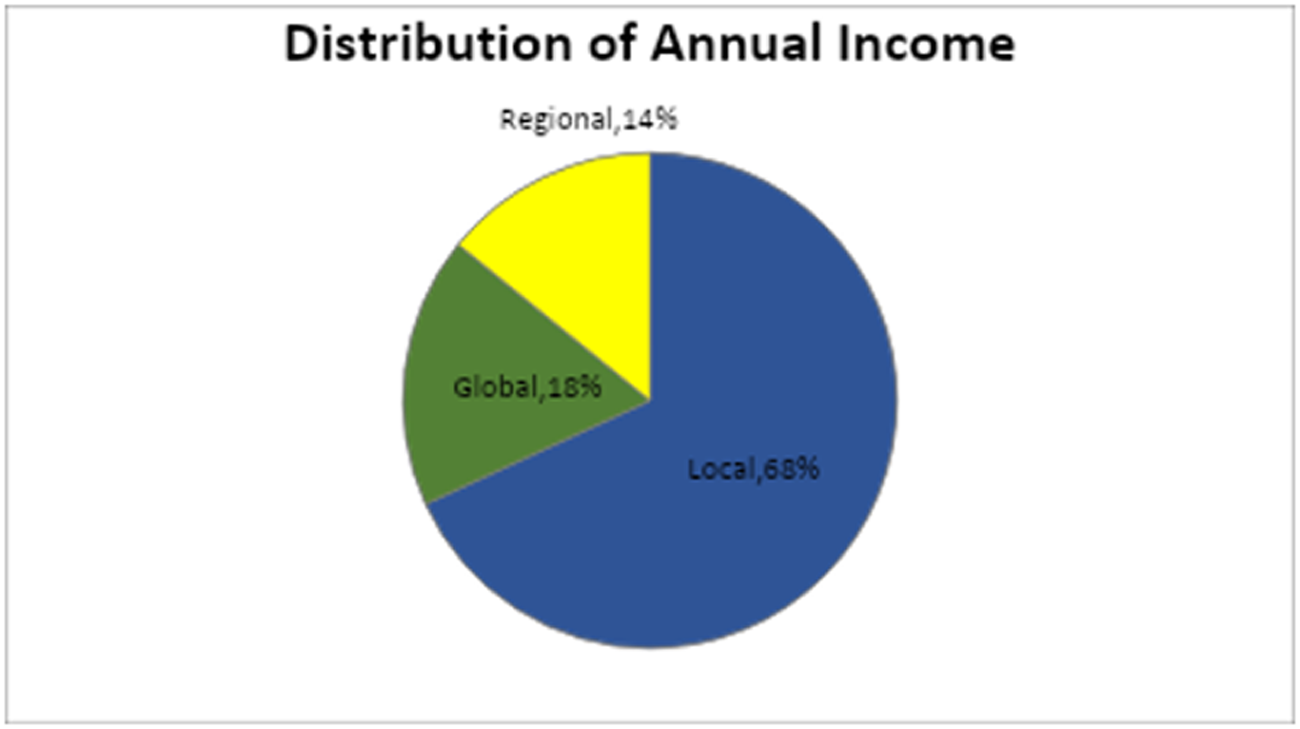
Table 1 is an abbreviated version of the overview that Father Du Gad made of the goods and revenue from the Beijing French mission. The origins of the investments and its revenue were Beijing, Canton, India, and France. As indicated above, I have categorised these places into: Beijing = local, Canton and India = regional, and France = global. The total annual revenue is 67,814 livres (see Figure 1).
Distribution of Annual Income Based upon Du Gad’s Overview.

The Goods of the French Missionaries Established in China (Not Dated)

Table 1 Long description
French missionary assets are listed by origin with two measures: value of principal in French livres and annual revenue in French livres. Beijing holdings in shops, houses, gardens, and land are the largest, with 553,930 livres principal and 46,214 livres annual revenue. India capital deposited with the English East India Company shows 160,000 livres principal and 9,600 livres annual revenue. France patronage via lotteries reports annual revenue of 12,000 livres but the principal is unknown. Two Canton investments, one with Mr. Montigny du Timeur and one with Mr. Henri de Vigny, list principal as 300,000 for the first and unknown for the second, and both have annual revenue left blank. Missing values mean totals and direct comparisons across all origins are incomplete.
Source: “Les Biens des Missionnaires Français Établis en Chine (Non Daté).” The overview of the goods of French missionaries is not dated, but this must be the annual revenue of 1777, 1778, or 1779. Principal: a sum of money lent or invested on which interest is paid. AFCJ, Brotier 135, f. 173. See also Dehergne, “Les Biens de la Maison Française de Pékin,” 263.
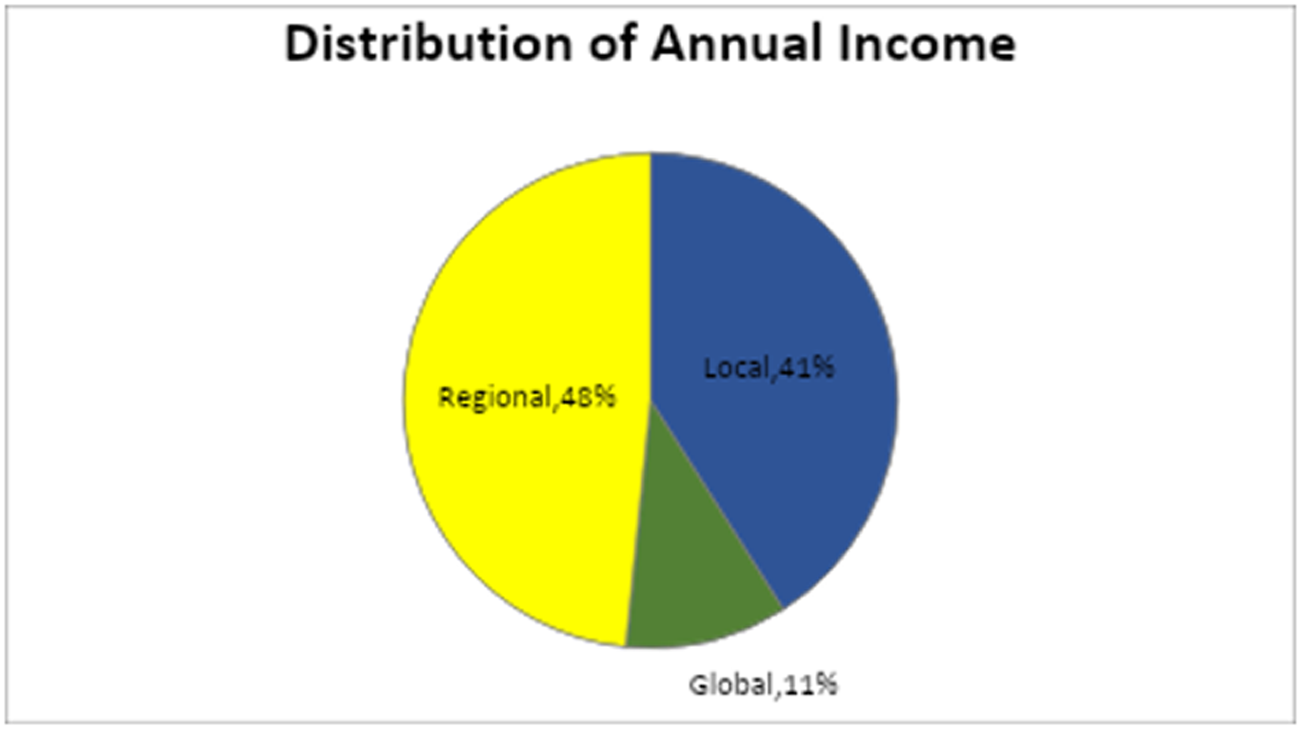
After analysing the letters and reports of other commentators, I completed and added the regional investments to Du Gad’s overview. The total annual revenue is 112,814 livres (see Table 2 and Figure 2).
Corresponding Distribution of Annual Income with Regional Revenue.

Complete Overview of the Goods of French Missionaries in Beijing

Table 2 Long description
French missionary goods are listed by origin with principal value and annual revenue, both in French livres. Beijing is the largest holding, with principal of 553,930 and annual revenue of 46,214. Canton investments with Mr. Montigny du Timeur show principal of 300,000 and annual revenue of 30,000. India capital deposited with the English East India Company lists principal of 160,000 and annual revenue of 9,600. Two entries report annual revenue but not principal: Canton investments with Mr. de Vigny at 15,000 per year, and France patronage via lotteries at 12,000 per year. Comparisons of principal across all origins are limited because two principal amounts are unknown.
The following sections will provide further explanation of this categorisation, as well as the differences between Tables 1 and 2, and the accompanying charts. This will provide more context for larger trends in Jesuit finances at the end of the eighteenth century.
The Declining Importance of Global Patronage
The finances of the French missionaries in Beijing contained several references to the global patronage of Louis XVI. This included a yearly stipend of 16,200 livres,Footnote 41 which was divided between Du Gad de Vitré (1,500), Le Fevre (1,500), Bréquigny (4,200), and the French missions (9,000).Footnote 42 French patronage was more reliable than Portuguese patronage, the latter of which most likely did not reach de Rougemont’s mission in the 1660s and 1670s (see above). Sources suggest that, even after the dissolution of the Society of Jesus, the money arrived every year with minimal delay.Footnote 43 However, only after 1792 did the French assistance stop arriving in China, as a consequence of the domestic chaos caused by the French Revolution and its anti-ecclesiastical policy.
Despite the efficient performance of the global French network, sending money or goods from Europe to China was not entirely safe in the 1760s and the 1770s. In 1767, a Jesuit father reported the loss of over 17,000 livres en route from France to Macau.Footnote 44 Several other sums of money (totalling 24,000 livres), and an even larger sum invested in another Asian region were also seemingly “missing.” While the reason for these financial setbacks was not explicitly stated, it is reasonable to assume that it was due to increased pressure from European competitors (such as the English, despite the fact that the East India Company paid out the 6% interest on capital deposited in India in all but six yearsFootnote 45). Although French Jesuits and Italian missionaries praised the English networks for their reliability and speed, it seems that this cooperation deteriorated significantly after 1760. The French Jesuits were alarmed when the English seized some of their ships in 1779,Footnote 46 and the general tone of letters from 1760 onwards was that the English were a powerful presence in Asia, but not always trustworthy. The business of all settlements in India was increasingly decided by English needs and wants.
Losing small fortunes at sea due to natural disasters or greedy competitors was never pleasant. However, compared to the Portuguese China missions of a century earlier, the French Jesuits had one advantage. The crippling effect of financial misfortune was less devastating for them in the late eighteenth century thanks to the significant royal funding they had received during the first half of that century. This enabled the French Jesuits to invest in real estate in peaceful, thriving Qing China, following the end of the political and economic upheaval of the dynastic transition in seventeenth-century China. Even if the English had damaged the French colonial maritime network as the Dutch had done to the Portuguese a hundred years earlier, the French missions in China still generated enough revenue from local sources.
According to Bourgeois’s figures, global patronage accounted for only 17% of the Jesuits’ available revenue in Beijing.Footnote 47 This number may have been even lower, given that Bourgeois’s reports excluded certain regional investments from Macau, Manila, and Southeast Asia that generated significant revenue for the missions in Beijing. Excluding the two regional sources of revenue from Canton, global revenue from France (12,000 livres) accounted for almost 18% of the total income of 67,814 livres. With these two sources included, global revenue accounted for just 11% of the total of 112,814 livres. Similar to the importance of the local economy in de Rougemont’s case, global French patronage was overshadowed by income generated locally. This accounted for 68% of the total revenue (excluding income from Canton) or 41% (including it). As competition between the French and English empires intensified towards the end of the eighteenth century, it endangered the transportation of French global patronage. Given the crucial nature of local income, was it not reasonable for Jesuit critics at the French court to question the necessity of the French king’s patronage?
Local Investments in Bourgeois’s Reports
De Rougemont’s account book provided the most interesting insights into the local economy. Despite their differences, Bourgeois’s reports tell a similar story, revealing that the local economy provided the Jesuits with the largest and most secure share of annual revenue. If payments from Canton failed to reach Beijing, the local economy would provide the necessary funds to maintain the mission. However, it is not possible to continue comparing the two accounts because of the lack of detail in Bourgeois’s reports.
While de Rougemont had received significant economic aid from Chinese benefactors,Footnote 48 the Chinese community was almost entirely absent from Bourgeois’s reports. Individual missionaries were also not central to the spending and collection of revenue. A few missionaries, such as Gaubil and his small personal foundation for mathematical research (34.56 taels per year) and brother de Rhodes’s gift of 200 taels to build a pharmacy, were mentioned in passing only because these smaller gifts and endowments were added to the annual total revenue. Total income in 1779 was 6,521.51 taels. This was set against total costs that year of 6,310.65 taels, enabling Bourgeois to calculate the profit made by all the missions in Beijing that year: 123.48 taels, or just under 1,000 French livres.Footnote 49
It is difficult to ascertain whether this was the missions’ actual yearly profit and whether all their sources of income had truly been considered. However, the symbolic value of this figure is quite clear. Profit of less than 1,000 livres in 1779, coupled with an equally modest deficit the previous year, demonstrated to critics and accountants across Europe that the Jesuit missions were not driven by profit. The modest profit may have seemed appropriate for a religious organisation with an austere yet self-sufficient lifestyle, and it could also be interpreted as meaning that the missions could support themselves.
The records also show that, in some months such as the eleventh lunar month, expenses were much higher than monthly income. However, it is difficult to ascertain the reasons behind this.Footnote 50 From the seventh to the eleventh lunar month, which would have been autumn in Beijing, both revenue and expenses increased. The largest expenses were repairs to houses, scholars’ and domestic staff’s wages, food, care of the sick, and pit coal stocking. Did this mean that these expenditures occurred in autumn? Unfortunately, unlike de Rougemont’s account book, the records do not contain sufficient information to explain this pattern.
In summary, the French accounting sources confirm that the local sources of income were more important for maintaining balanced expenses than financial support from global patronage or regional income. The most significant difference between de Rougemont’s finances and those of the French Jesuits in Beijing is that the latter were self-sufficient thanks to revenue from local real estate investments. In contrast, de Rougemont was barely able to balance his income and expenses and was highly dependent on the donations from local Chinese Christians. By contrast, urban real estate constituted 73% of the total value of all French Jesuit properties.Footnote 51 Bourgeois noted that contracts for houses and shops in Beijing cost 54,578 taels and 8 mas, 5 condorins.Footnote 52 Land in three different locations cost 10,343.55 taels, accounting for 14% of the total property values; terrains and graveyards cost 5,669 taels, accounting for 7%; good works cost 2,351 taels, accounting for 3%; and gardens cost 915 taels, accounting for 1%.Footnote 53 Bourgeois also calculated the monthly and annual revenue from these five sources of local income. Revenue from houses and shops made up over 71% of the annual income.Footnote 54
In the context of Chinese accounting documents, Bourgeois’s report indicates that local investments and revenue from these properties were the most important sources of income by the end of the eighteenth century. However, the different nature of these sources means that we cannot make calculations based on Bourgeois’s report with the same level of precision as was possible with de Rougemont’s account book. A clear shift does emerge from relying on financial equilibrium attained through irregular gifts from local benefactors to relying on monthly income from local real estate. Therefore, Bourgeois’s accounting data align with the financial vision that Longobardo had developed at the beginning of the seventeenth century.
Regional Investments
Figures 1 and 2 show that the regional sources of income made up 14% or 48% of the Jesuit mission’s total income in Beijing, depending on the reliability of transporting said revenue. Those investigating the Jesuit finances at the time were convinced that the Jesuits in Beijing were benefiting from this revenue. These critics (who were based in France) monitored the Jesuits carefully so that they would not lose their revenue to the French state. Throughout the seventeenth and eighteenth centuries, the Jesuits invested regionally. From the late sixteenth to the mid-seventeenth century, Portuguese Jesuits in China kept their missions afloat thanks to the flourishing Macau–Nagasaki trade.Footnote 55 After the 1670s, evidence of Jesuit income from this type of regional investment became scarcer, although it undoubtedly remained important. However, incomplete sources prevent us from measuring precisely how important it was. Initially, Bourgeois’s report is equally vague. However, when combined with all the other available documents, a more accurate picture emerges.
Bourgeois reported that the annual interest on capital deposited in India equalled 9,600 livres, equivalent to just over 14% of the Jesuits’ total income in Beijing. This revenue equalled 6% rent on an investment worth 150,000 or 160,000 livres, or 20,000 Indian pagodas.Footnote 56 This figure was examined in detail in at least five different letters and reports dating from 1727, 1776 (two reports), 1778, and 1781.Footnote 57 The rent on the capital deposited in India was shipped to Canton by the East India Company, which took the necessary legal steps in the 1770s, when the Jesuit order was dissolved, to redirect the rent payments to former Jesuits.Footnote 58 Consequently, the English continued their collaboration with the French ex-Jesuits.
In addition to this investment, a larger regional source of income were investments placed with Mr. Montigny of Timeur in Canton, valued at around 300,000 livres, according to Bourgeois’s documents in Dehergne, but at 375,000 livres according to another accounting report on the missions of China and Malabar.Footnote 59 While this sort of regional investment did not require any overseas transport, tracking it was no easier.Footnote 60 Mr. Montigny du Timeur, Julien Bourgogne, and Charles Henri de Vigny were French private merchants who established a merchant house in Canton in 1773.Footnote 61 During the 1770s, these procureurs (proxy holders) of French shipowners and merchants helped transfer money to the French Jesuits in China at the request of the French minister, Bertin.Footnote 62 By the end of the decade, Montigny reported that he had entrusted all the Jesuits’ financial investments in trade to some Hong merchants in Canton. The annual revenue from this amounted to 2,000 taels, equivalent to around 15,000 livres. These investments generated an annual return of around 7% or 8%, equivalent to almost 30,000 livres. However, Montigny had left his post and had no intention of returning to China. The return on these investments was not being paid, and nobody knew what had happened to the money being managed by the unknown Hong merchants in Canton. Had these payments (15,000 and 30,000 livres) arrived in Beijing, the importance of regional investment would have equalled 48% of their total annual revenue, instead of 14%. French critics interested in managing the overall investments, worth 553,930 French livres, brought these investments to light and inspected them in multiple reports.Footnote 63
This income provided further proof that global patronage had become redundant by the second half of the eighteenth century. It also shows that, at this time, Asian investments - both local and regional - were crucial for European networks such as the Jesuits. This is comparable to the way European merchant companies financed their own global networks.
The Importance of Intra-Asian Trade to Europe in the Eighteenth Century
As previously mentioned, these regional investments were not a new phenomenon. Further research on regional investments from the Portuguese Jesuit missions in China is needed, but it is my understanding that, when combined with local sources, these regional investments were crucial for the self-sustainability of French Jesuit missions.Footnote 64 These Asian investments also played an important role in how merchant companies funded their business ventures.
The bond between the French East India Company and the French Jesuits had been strong since the time of the independent French Jesuit missions in China at the end of the seventeenth century. A surviving memoir carefully records the dates and services provided by missionaries, beginning with the support given to the Amphitrite crew in 1699.Footnote 65 Because of this connection, the profits of the French Jesuits in Asia were tied to those of the French East India Company. Following an initial profitable period at the beginning of the eighteenth century, the French Jesuits also collaborated with the English East India Company, investing 20,000 pagodas in exchange for an annual 6% return from 1727 onwards.Footnote 66 Missionaries in China acknowledged that the English network had become the most reliable means of transporting goods in Asia.Footnote 67 Thanks to their ties with French and English merchants, the Jesuits’ economic fortunes became increasingly dependent on these two merchant companies. Consequently, Jesuit investments were equally affected by the changes these two companies had to implement to remain profitable during the eighteenth century.
According to economic historian Jan de Vries, the “conventional wisdom” is that merchant companies that “conveyed ‘the riches of the Indies’ to Europe” gradually became richer during the seventeenth and eighteenth centuries.Footnote 68 However, de Vries suspects that this is not entirely accurate. Gross profit margins deteriorated after 1660; manning rates were higher; and the cost of transporting goods from Asia to Europe remained relatively sFootnote table 69 while the price of Asian goods in Europe decreased.Footnote 70 As a result, this meant that merchant companies had “two significant ways to escape this squeeze on profitability.” They could engage in intra-Asian trade and supplement their trading revenue with political revenue.Footnote 71 The idea that intra-Asian trade was crucial to long-distance European networks is not new. Niels Steensgaard puts it as follows: “The long-term viability of the Portuguese and later the Dutch, English, French, and Danish companies was determined by their ability to engage in intra-Asian trade.”Footnote 72 The most pertinent example of European merchant companies engaging in Asian trade was the opium trade. The English and Dutch companies successfully combined both escape techniques, whereas the French did not.Footnote 73 One possible explanation is that, in the 1720s, the French Jesuits were aware of the instability of the French EIC, its multiple reorganisations, and its fragility following the John Law’s experiments,Footnote 74 and thus preferred to invest their capital with the English rather than with the French East India Company. Despite their conflicts with the French Crown, the English could be relied upon to pay the 6% rent.
It is in this context that we should understand the importance of the Jesuit regional investments. The detailed information provided in Bourgeois’s accounting sheets, as well as the increasing value of the investments, suggests that the French Jesuits in Beijing relied on regional revenue, just like the European merchant companies with which they cooperated closely.
Conclusion
This article examined the four surviving Jesuit accounting documents, particularly Bourgeois’s records, to illustrate the changing significance of the local, regional, and global financial sources of Jesuit missions. Following Longobardo’s initial vision of financial independence, Bourgeois’s records demonstrated that, 166 years later, the French Jesuit missions in Beijing were finally sustained by local and regional investments. While the scarcity of sources on the finances of religious missions in the Far East prevents us from precisely charting the shift from dependence on gifts from local benefactors to self-sustaining missions that relied on revenue from investments and properties, the French Jesuit community in Beijing had achieved Niccolò Longobardo’s dream by the 1770s. A stable Chinese economic and political environment, combined with the accumulation of properties over eighty years of mission building, resulted in a sizable community that was independent from the challenges of early modern world travel. Incomplete sources also prevent historians from determining whether the French Jesuits’ cooperation with the French Crown from 1690 to 1705 provided enough start-up capital to make Longobardo’s strategy successful from the beginning of the eighteenth century or whether the patronage of the Qing emperors and the environment they provided played a larger role. Unfortunately, I have not found sources on the Portuguese Jesuit missions that would allow me to compare the possessions of the French and Portuguese Jesuit during the 1770s. As far as financial investments are concerned, the French Jesuits’ regional investments followed a larger trend of economic behaviour among Europeans trading in Asia during the eighteenth century. An analysis of “Les Biens de la Maison Française de Pékin en 1776–1778” highlights the importance of local history within long-distance connections and reemphasizes the significance of local and regional elements in the financial networks of the Jesuits in China in the early modern world.
Acknowledgements
I would like to thank my colleagues Felicita Tramontana, Hélène Vu Thanh, and Christian Windler for creating this wonderful opportunity and for their significant scholarly support.



 Open access

