


1. Introduction
Affective polarization has become a central concern in contemporary democratic politics. At its core, affective polarization refers to the widening emotional gap between citizens’ evaluations of their own party and those of the opposing party and its supporters (Iyengar et al., Reference Iyengar, Sood and Lelkes2012, Reference Iyengar, Lelkes, Levendusky, Malhotra and Westwood2019). In other words, it is not simply hostility towards political opponents in isolation, but the extent to which citizens evaluate the rival partisan camps in sharply differentiated affective terms. Although this phenomenon has been most extensively documented in the United States, comparative research shows that emotionally charged partisan conflict is also evident across a broader set of democracies (Harteveld, Reference Harteveld2021). This development matters not only because it reflects intensifying partisan competition, but also because affective polarization can erode democratic norms, weaken social trust, and make citizens less willing to regard political opponents as legitimate members of the same democratic community (Hetherington and Rudolph, Reference Hetherington and Rudolph2015; Graham and Svolik, Reference Graham and Svolik2020; Kingzette et al., Reference Kingzette, Druckman, Klar, Krupnikov, Levendusky and Ryan2021). In South Korea, too, recent scholarship shows that partisan identity has become increasingly consequential in structuring citizens’ emotional evaluations of parties and political opponents (Jang and Suh, Reference Jang and Suh2019; Jang and Chang, Reference Jang and Chang2020; Kim and Lee, Reference Kim and Lee2021).
Existing research has identified several major drivers of affective polarization. One influential line of work emphasizes partisan identity, drawing on social identity theory to show that partisan attachments foster in-group favouritism and out-group derogation (Tajfel, Reference Tajfel1981; Huddy et al., Reference Huddy, Mason and Aarøe2015; Mason and Wronski, Reference Mason and Wronski2018). Related scholarship argues that social sorting has intensified this process by aligning party identities with other salient social identities, thereby magnifying emotional conflict between partisan camps (Mason, Reference Mason2015, Reference Mason2018). Another line of research emphasizes ideological conflict and issue disagreement, showing that partisan hostility intensifies when citizens perceive opposing parties as ideologically distant, morally threatening, or supportive of harmful policies (Abramowitz, Reference Abramowitz2010; Webster and Abramowitz, Reference Webster and Abramowitz2017; Dias and Lelkes, Reference Dias and Lelkes2022). These approaches jointly explain a great deal about why affective polarization has become politically consequential in contemporary democracies.
Yet an important question remains insufficiently explored: why do citizens with similar partisan attachments or broadly similar ideological locations nonetheless differ substantially in the degree to which they affectively differentiate between partisan camps? Existing accounts centred on partisanship, ideological distance, and issue conflict are highly informative, but they do not fully explain this within-camp heterogeneity. Even among voters who identify with the same party, some exhibit intense emotional antagonism, whereas others do not. This gap suggests that the study of affective polarization should pay greater attention to individual-level orientations that shape how citizens interpret political competition, group conflict, and partisan opposition (Luttig, Reference Luttig2018).
This study focuses on two orientations—right-wing authoritarianism (RWA) and social dominance orientation (SDO)—because they are especially relevant to explaining variation in affective polarization within partisan camps. Because affective polarization is a form of emotionally charged intergroup evaluation, explaining why similarly situated partisans differ in the size of the affective gap they place between their own party and the opposing camp requires attention to orientations that shape how citizens interpret political conflict across group lines. RWA and SDO are well suited to this task because both are directly concerned with the organization of social relations among groups rather than with issue-specific preferences alone. At the same time, they capture distinct dimensions of political conflict. RWA is centred on conformity, submission to established authority, and punitive responses towards perceived norm violators (Altemeyer, Reference Altemeyer1981, Reference Altemeyer1996, Reference Altemeyer1998; Duckitt and Sibley, Reference Duckitt and Sibley2010), whereas SDO reflects a preference for group-based hierarchy and inequality and the legitimation of dominance across social groups (Pratto et al., Reference Pratto, Sidanius, Stallworth and Malle1994; Sidanius and Pratto, Reference Sidanius and Pratto1999; Ho et al., Reference Ho, Sidanius, Kteily, Sheehy-Skeffington, Pratto, Henkel, Foels and Stewart2015). Although both orientations have often been linked to conservative political preferences, they are conceptually distinct and may shape partisan hostility through different pathways (Duckitt and Sibley, Reference Duckitt and Sibley2010; Johnston, Reference Johnston2018; Satherley et al., Reference Satherley, Sibley and Osborne2021).
This perspective contributes to the literature in two respects. First, it extends research on affective polarization by shifting attention from differences between partisan camps alone to variation within them. In doing so, it helps explain why similarly situated partisans may differ in the extent to which they place emotional distance between their own party and its rival. Second, it brings psychological factors into conversation with political science accounts of polarization without reducing affective polarization to ideology or personality alone. Rather than displacing explanations based on partisan identity or ideological distance, RWA and SDO are better understood as orientations that condition how political attachments are experienced and translated into affective evaluations of partisan opponents. This argument is consistent with work showing that prejudice-related orientations and authoritarian predispositions are associated with partisan strength, partisan sorting, and affective polarization at the individual level (Johnston, Reference Johnston2018; Luttig, Reference Luttig2018).
South Korea provides a useful setting in which to examine this argument. Comparative evidence suggests that South Korea is among the democracies in which partisan conflict is especially intense (Silver, Reference Silver2022), and Korean scholarship likewise documents the salience of partisan identity and partisan hostility in Korean politics (Jang and Suh, Reference Jang and Suh2019; Jang and Chang, Reference Jang and Chang2020; Kim and Lee, Reference Kim and Lee2021). At the same time, South Korea differs from the Western cases that dominate the literature in important respects, including the historical role of regionalism, the comparatively fluid programmatic boundaries of parties, and the centrality of electoral context and political leadership in structuring partisan competition. This makes South Korea a theoretically informative case for examining whether the individual-level foundations of affective polarization travel beyond the settings in which they have most often been studied.
To test this argument, we analyse survey data from South Korea’s 2022 presidential election and 2024 legislative election. We show that the effects of RWA and SDO are both asymmetric and conditional on partisan alignment. RWA is positively associated with affective polarization among conservative partisans, whereas SDO is associated with lower levels of affective polarization among liberal partisans. These relationships persist even after accounting for partisan identity and ideological distance. The findings suggest that affective polarization is not simply a function of partisan attachment or ideological extremity. It is also shaped by deeper orientations that influence how citizens perceive political threats, hierarchies, and partisan opposition, and thus how sharply they differentiate affectively between their own party and its rival.
The paper proceeds as follows. The next section reviews existing political science explanations of affective polarization and then introduces RWA and SDO as distinct orientations that may help explain variation within partisan camps. The following section describes the South Korean case, the survey data, and the measurement strategy. We then present empirical findings and conclude by discussing their implications for research on affective polarization and democratic politics.
2. Theoretical framework
2.1. Existing political science explanations of affective polarization
Affective polarization refers to the tendency for citizens to evaluate their own party and its supporters positively while expressing dislike, distrust, or hostility towards opposing parties and their supporters, thereby widening the affective gap between rival partisan camps (Iyengar et al., Reference Iyengar, Sood and Lelkes2012, Reference Iyengar, Lelkes, Levendusky, Malhotra and Westwood2019). Although initially studied most intensively in the United States, subsequent scholarship has shown that affective polarization is not confined to a single country and can also emerge in multiparty and non-Western settings (Garrett et al., Reference Garrett, Gvirsman, Johnson, Tsfati, Neo and Dal2014; Harteveld, Reference Harteveld2021). The phenomenon has drawn increasing attention because it affects not only electoral competition but also broader democratic life, including citizens’ willingness to trust political opponents, accept electoral outcomes, and uphold democratic norms (Hetherington and Rudolph, Reference Hetherington and Rudolph2015; Graham and Svolik, Reference Graham and Svolik2020; Kingzette et al., Reference Kingzette, Druckman, Klar, Krupnikov, Levendusky and Ryan2021). In this sense, affective polarization matters not simply because citizens disagree, but because they may come to perceive rival partisan camps as socially distant, morally suspect, or politically illegitimate.
The most influential explanation of affective polarization emphasizes partisan identity. Drawing on social identity theory, this perspective argues that party attachments function as politically salient group identities, encouraging in-group favouritism and out-group derogation (Tajfel, Reference Tajfel1981; Tajfel and Turner, Reference Tajfel, Turner, Austin and Worchel1986; Huddy et al., Reference Huddy, Mason and Aarøe2015). Once partisan identities become psychologically meaningful, politics is no longer experienced merely as competition over policies or office; it is experienced as conflict between ‘us’ and ‘them’. Citizens, therefore, respond not only to what opposing parties advocate, but also to who those parties are understood to represent. This perspective helps explain why partisan conflict often persists even when specific policy disagreements are limited or unstable, and why affective evaluations of partisan camps may diverge sharply.
Recent research extends this argument by emphasizing social sorting. As partisan identities become aligned with other salient social identities, partisan conflict becomes layered onto broader social divisions, thereby intensifying emotional polarization (Mason and Wronski, Reference Mason and Wronski2018; Mason, Reference Mason2015, Reference Mason2018). The more partisan camps become associated with distinct lifestyles, regions, social groups, or moral communities, the more easily ordinary political competition takes on the character of intergroup conflict. Kane et al. (Reference Kane, Mason and Wronski2021), for example, show that partisan identity is often reinforced by broader perceptions of group membership and social attachment. In this respect, affective polarization grows not simply because parties disagree, but because partisan conflict comes to organize how citizens perceive the social world around them and how strongly they differentiate affectively between partisan sides.
A second major line of research emphasizes ideological divergence, issue alignment, and policy conflict. As parties and their supporters become more clearly sorted across salient issues, citizens may come to view opposing partisans not merely as competitors with different preferences, but as supporters of substantively harmful and morally objectionable positions (Abramowitz, Reference Abramowitz2010; Bougher, Reference Bougher2017; Webster and Abramowitz, Reference Webster and Abramowitz2017). Recent work further suggests that policy disagreement and partisan identity are closely intertwined. Dias and Lelkes (Reference Dias and Lelkes2022), for instance, show that policy disagreement contributes to interparty animus, but that its influence is difficult to separate from the partisan identities attached to those positions. Comparative experimental evidence also indicates that policy disputes can causally increase affective polarization across democratic publics, although their consequences may depend on the type of issue and the broader partisan context (Gidron et al., Reference Gidron, Adams, Horne and Tichelbaecker2025). Issue-based conflict, therefore, matters not only because citizens disagree over policy, but because perceived policy distance can become a cue for judging the social, moral, or political distance of rival partisan camps.
At the same time, ideological and issue-based explanations alone cannot fully explain the rise or distribution of partisan hostility. The same degree of ideological or policy distance does not necessarily produce the same level of emotional hostility for all citizens. Some individuals respond to political disagreement with especially intense animus, whereas others do not. This implies that ideological and issue conflict can be filtered through additional predispositions that shape whether political opposition is experienced as tolerable democratic competition or as threatening group conflict.
Related scholarship highlights the role of elite conflict, political context, and socially homogeneous networks in reinforcing affective polarization. Partisan leaders can sharpen group boundaries by framing competition in emotionally charged or morally absolute terms, although politically aligned peer environments can deepen social pressure to conform to partisan expectations (Huddy et al., Reference Huddy, Mason and Aarøe2015; Parsons, Reference Parsons2015). These dynamics matter because citizens rarely encounter partisan competition in an abstract form. Instead, partisan conflict is embedded in social networks, political campaigns, and elite narratives that shape how opposing camps are interpreted. As a result, affective polarization may intensify even when formal ideological differences remain relatively modest, so long as politics is experienced as a high-stakes struggle between rival camps.
These approaches have also been applied to South Korea. Existing scholarship shows that partisan identity and ideological positioning are strongly associated with affective polarization in the South Korean electorate, and that partisan hostility has consequences extending beyond formal political behaviour (Jang and Suh, Reference Jang and Suh2019; Jang and Chang, Reference Jang and Chang2020; Kim and Lee, Reference Kim and Lee2021). In the South Korean case, partisan conflict has long interacted with historically salient regional and ideological cleavages, making South Korea an important setting for examining how party competition becomes emotionally charged. These features do not make South Korea wholly exceptional, but they do make it a useful case for evaluating whether explanations of affective polarization developed largely in Western settings travel beyond those contexts.
The South Korean case also clarifies why issue-based explanations should not be understood too narrowly. Unlike many Western European cases, South Korean party competition is not organized as neatly around a conventional left–right dimension, nor has immigration become a central axis of partisan conflict. Nevertheless, recent Korean experimental evidence suggests that elite- and issue-centred explanations remain relevant. Choi et al. (Reference Choi, Park and Koo2024) show that political elite cooperation can significantly reduce affective polarization, suggesting that voters’ partisan affect is responsive to elite behaviour and the tone of partisan competition. Relatedly, Koo et al. (Reference Koo, Park and Choi2025) show that informing voters about policy–attitude similarities between supporters of the two major parties reduces affective polarization by weakening negative affect towards the out-party. These findings suggest that partisan affect in South Korea is responsive to elite behaviour and perceived issue distance, even though the substantive content of partisan conflict differs from many Western cases.
At the same time, these studies also clarify the scope of the present argument. Elite cues and issue-related information may shape the salience, intensity, and emotional tone of partisan competition, but they do not by themselves explain why voters within the same partisan camp vary in the extent to which they affectively differentiate between major parties. The key unresolved question, then, is why voters who identify with the same party and occupy broadly similar ideological positions nonetheless differ in the intensity of affective polarization. Some partisans place a much wider emotional distance between their own party and the opposing camp than others with similar political attachments. This suggests that partisan identity, ideological distance, issue conflict, and elite cues, although central, do not fully explain how citizens translate political difference into affective differentiation between partisan camps. To account for this within-camp heterogeneity, it is useful to examine individual-level orientations that shape how political conflict is interpreted in intergroup terms. Luttig (Reference Luttig2018), for example, shows that prejudice-related orientations are associated with partisan strength, partisan sorting, and affective polarization. Building on this insight, the present study focuses on two orientations that may structure partisan affect in distinct ways: RWA and SDO.
2.2. Authoritarianism, dominance, and conditional partisan affect
This study treats RWA and SDO as politically relevant orientations that help explain variation in affective polarization beyond partisanship and ideological distance alone. Although both are often associated with conservative political preferences, they are conceptually distinct and should not be collapsed into a single notion of authoritarian, illiberal, or hierarchy-supporting predispositions (Altemeyer, Reference Altemeyer1981, Reference Altemeyer1996; Duckitt and Sibley, Reference Duckitt and Sibley2010; Johnston, Reference Johnston2018; Sidanius and Pratto, Reference Sidanius and Pratto1999). Distinguishing between them is especially important if the goal is not merely to show that ‘psychology matters’, but to specify what kinds of orientations matter and under what partisan conditions. At the same time, these orientations should not be treated as the exclusive property of conservative partisans. Although average levels of RWA and SDO may differ across partisan camps, both are distributed across the electorate and can also be observed among liberal identifiers. This is precisely what makes them analytically useful for the present study: if they were reducible to conservative partisanship itself, they would add little leverage in explaining variation within partisan camps.
RWA refers to a disposition that emphasizes social conformity, submission to established authority, and punitive reactions towards those perceived as threatening social order (Altemeyer, Reference Altemeyer1981, Reference Altemeyer1996, Reference Altemeyer1998). In the dual-process framework, RWA is associated with a worldview in which the social environment is perceived as dangerous and disorderly, making authority, cohesion, and norm enforcement especially attractive (Duckitt and Sibley, Reference Duckitt and Sibley2010). In political contexts, this orientation may heighten negative affect towards partisan opponents when they are viewed as disruptive, morally deviant, or threatening to collective order. Thus, the political importance of RWA lies not only in its correlation with conservatism but also in the specific way it structures perceptions of threat, disorder, and legitimate authority.
Importantly, RWA should not be treated as synonymous with conservatism itself. Although the two are often correlated, authoritarian predispositions are not conceptually reducible to conservative party identification or right-wing ideology alone (Hetherington and Weiler, Reference Hetherington and Weiler2012; Johnston, Reference Johnston2018). What matters analytically is whether political conflict is experienced through the lens of order, authority, and norm violation. In some contexts, those concerns may align especially strongly with conservative partisan mobilization. In others, they may be activated more unevenly. This is precisely why RWA may be useful for explaining variation in affective polarization within partisan camps, rather than only differences between the left and the right.
These considerations imply that RWA should be especially consequential among conservative identifiers. When partisan conflict is framed in terms of transgression, threat, and the defence of established norms (Hetherington and Weiler, Reference Hetherington and Weiler2012; Johnston, Reference Johnston2018), higher RWA should strengthen the emotional translation of conservative partisan identity into a wider affective distance from the out-party. This widening of affective distance may operate through both sides of the favourable feeling gap. On the one hand, conservative identifiers high in RWA may evaluate liberal opponents more negatively when they view them as disruptive, morally permissive, or threatening to social order. On the other hand, RWA may also reinforce positive affect towards the in-party when the conservative camp is perceived as defending authority, stability, national cohesion, or normative order. In this sense, RWA may increase affective polarization not only by intensifying out-party dislike but also by strengthening in-party warmth among conservative partisans. Accordingly, we expect higher RWA to be associated with stronger affective polarization among conservative partisans.
H1 (RWA and conservative partisanship): Among conservative partisans, higher levels of RWA will be associated with a wider affective gap between liberal and conservative parties.
SDO, by contrast, refers to a preference for group-based hierarchy and inequality and for social arrangements that legitimate dominance across groups (Pratto et al., Reference Pratto, Sidanius, Stallworth and Malle1994; Sidanius and Pratto, Reference Sidanius and Pratto1999; Ho et al., Reference Ho, Sidanius, Kteily, Sheehy-Skeffington, Pratto, Henkel, Foels and Stewart2015). Although RWA is centred on order and conformity, SDO is centred on hierarchy and competitive intergroup relations. Individuals high in SDO are more likely to endorse ideologies and policies that sustain inequality across groups and to interpret social life through the lens of relative group standing. In this sense, SDO is conceptually distinct from authoritarian submission, even though the two may be positively correlated in some political settings (Duckitt and Sibley, Reference Duckitt and Sibley2010; Johnston, Reference Johnston2018).
The distinction between RWA and SDO is analytically important because the two orientations imply different images of political conflict. RWA is oriented towards the preservation of order, cohesion, and norm conformity. Citizens high in RWA are therefore likely to respond strongly when partisan competition is framed as disorderly, transgressive, or threatening to established authority. SDO, by contrast, is less concerned with conformity than with relative group standing. Individuals high in SDO may evaluate political competition in terms of hierarchy, dominance, and comparative advantage rather than moral threat. For this reason, the two orientations should not be expected to map onto affective polarization in identical ways. One may be activated more strongly by perceived threat and norm violation, whereas the other may be activated more strongly by perceptions of status competition and group hierarchy.
This distinction is especially important in the South Korean context. Party identification in South Korea is not always organized solely by left–right ideological congruence. Regional loyalties, leader-centred mobilization, and historically rooted anti-conservative alignments can also shape partisan attachment. As a result, some citizens may identify with the liberal camp even though their broader social worldview is not strongly egalitarian. In other words, liberal partisan identification and dominance-oriented social beliefs may coexist when party attachment is formed through cross-cutting cleavages rather than through programmatic ideological alignment alone.
The point can be stated more precisely in terms of partisan-worldview alignment. High SDO among liberal partisans can be interpreted as weaker alignment between liberal partisan identity and an egalitarian or anti-hierarchical worldview. Since affective polarization is likely to intensify when partisan identity is reinforced by broader ideological and social orientations, lower-SDO liberal partisans may be especially likely to interpret conservative opponents as representatives of hierarchy, privilege, or illegitimate inequality. Higher-SDO liberal partisans, by contrast, may still support the liberal camp for regional, historical, retrospective, or candidate-centred reasons, but their broader orientation towards hierarchy and status differentiation is less consistent with a strongly anti-hierarchical interpretation of partisan conflict. As a result, liberal partisan identity may translate less strongly into affective distance from conservative opponents among high-SDO liberal identifiers.
A related implication can be drawn from research on system-justification (Jost et al., Reference Jost, Glaser, Kruglanski and Sulloway2003; Jost and Hunyady, Reference Jost and Hunyady2005; Jost, Reference Jost2019). This literature does not imply that liberal partisans constitute a disadvantaged group, nor that high-SDO liberal identifiers should systematically favour conservative parties. Its relevance is more limited: it shows that hierarchy-accepting orientations do not necessarily produce stronger in-group favouritism or out-group hostility. Under some conditions, acceptance of hierarchy and status differentiation can coexist with more favourable, or at least less antagonistic, evaluations of groups associated with established status relations.
For liberal partisans high in SDO, this implies a cross-pressured configuration rather than a fully aligned one. Their partisan identification places them in the liberal camp, but their broader social ideology is less strongly egalitarian and may be more accepting of hierarchy and status differentiation. The implication is not that such voters necessarily favour conservative parties or consciously endorse the conservative camp. Rather, the point is that the affective consequences of liberal partisanship may be weaker when liberal identity is not reinforced by a consistently egalitarian worldview. Accordingly, we expect the relationship between SDO and affective polarization to be negative among liberal identifiers.
H2 (SDO and liberal partisanship): Among liberal partisans, higher levels of SDO will be associated with a narrower affective gap between liberal and conservative parties.
These arguments jointly suggest that affective polarization is conditioned not only by partisan identity and ideology but also by the way citizens interpret political competition through orientations towards authority, threat, hierarchy, and intergroup relations. In this sense, RWA and SDO are not substitutes for political science explanations of affective polarization. Rather, they help explain why citizens located in similar partisan camps may nonetheless differ in the emotional distance they place between their own party and the opposing camp.
3. Research design
3.1. Cases and data
This study examines the relationship between ideological orientations and affective polarization using survey data from two recent South Korean elections: the 2022 presidential election and the 2024 legislative election. These two elections provide analytically useful variation because they took place in distinct partisan contexts: the former was shaped by demand for power alternation, whereas the latter functioned largely as a midterm evaluation of the incumbent administration.
The 2022 South Korean presidential election unfolded amid strong public demand for political change. Despite President Moon Jae-in’s relatively high personal popularity, his administration faced significant criticism over policy failures, especially real estate policy and rapidly rising housing prices, as well as controversies surrounding Cho Kuk, the nominee for Minister of Justice. These issues intensified dissatisfaction with the incumbent liberal government and created a favourable environment for opposition mobilization.
Yoon Suk-yeol, the candidate of the main conservative party, was an unusual opposition standard-bearer. He had previously led investigations related to the impeachment of President Park Geun-hye, which made him a controversial figure among some conservative voters. Yet after being the Prosecutor General, his investigations into figures associated with the Moon administration, including Cho Kuk, brought him into direct conflict with the incumbent government. In the absence of a clear opposition frontrunner, Yoon’s outsider image and confrontational stance towards the Moon administration helped him consolidate conservative support.
Lee Jae-myung, the Democratic Party candidate, had built his political profile as the mayor of Seongnam and the governor of Gyeonggi Province. Although he faced judicial and political controversies, including allegations related to real estate development and remittances to North Korea, he quickly consolidated support within the Democratic Party and won the nomination. The 2022 election thus became a highly conflictual contest between two controversial candidates, each capable of mobilizing strong partisan attachments despite broader public liabilities.
The 2024 legislative election took place in a different partisan environment. Unlike the 2022 presidential election, which centred on executive succession, the 2024 election functioned largely as a midterm evaluation of the Yoon administration. Since taking office in 2022, Yoon had governed under divided government, with the opposition Democratic Party controlling the National Assembly. The election was therefore widely viewed as a test of whether the ruling People Power Party could gain legislative momentum or whether the opposition would retain its capacity to constrain the administration (Kim, Reference Kim2024; Yim and Kim, Reference Yim and Kim2024).
The campaign was structured around competing interpretations of the incumbent government’s performance. The opposition framed the election as a judgement on the Yoon administration, whereas the ruling party emphasized the need for governmental stability and legislative support for the president’s agenda. The opposition bloc’s decisive victory reinforced the interpretation of the election as a setback for the incumbent administration and as a continuation of divided government (Kim, Reference Kim2024). In this sense, the 2024 election provides a useful contrast to the 2022 presidential election: although the earlier election centred on alternation in power and a personalized contest between rival presidential candidates, the later election was more clearly structured around retrospective evaluation of the incumbent government.
The first dataset comes from an online-based survey conducted between January and March 2022 during the presidential election campaign. The survey was jointly administered by the Korean Association of Party Studies (KAPS) and Joongang Ilbo. An important limitation of this dataset is that respondents aged 60 and older were excluded from the sample frame. This exclusion was not the result of post-survey attrition but reflected a design decision made by the survey organizers, who anticipated high attrition rates among older respondents in an online panel survey. As a result, the analysis based on the 2022 survey should not be interpreted as representative of the full Korean electorate. We therefore treat this age restriction as a limitation of the data and avoid making claims that extend beyond the surveyed population.
The second dataset comes from the 2024 Voter Awareness Survey, conducted as part of a joint research project involving the National Election Commission (NEC) and the Korean Political Science Association (KPSA). The survey was fielded online by K-Stat Research from 2 April to 4 April 2024, immediately before the legislative election, using a national sample of adults aged 18 and older stratified by region, gender, and age.
Because our theoretical argument concerns how partisan alignment conditions the relationship between ideological orientations and affective polarization, the main analyses focus on respondents with identifiable partisan attachments. At the same time, because excluding independents may introduce selection concerns, we explicitly discuss this issue next and address it in supplementary analyses.
The two surveys are not identical in questionnaire design. Some variables available in the 2022 survey, such as politically aligned peer environments, are absent from the 2024 survey, whereas the 2024 survey includes a measure of in-party identity not available in the earlier dataset. For that reason, the empirical analysis prioritizes conceptual comparability across the two surveys while also acknowledging survey-specific differences where relevant.
3.2. Measurement
The dependent variable is individual-level affective polarization, operationalized as the affective distance between the major partisan camps in South Korea, namely the Democratic Party of Korea and the People Power Party. Both surveys include feeling thermometer evaluations of major political parties on a 0–100 scale. This study measures affective polarization among supporters of the two major parties using the absolute gap in feeling thermometer ratings between their in-group and out-group parties. Higher values indicate greater emotional distance between the respondent’s evaluations of the competing partisan camps and, therefore, higher levels of affective polarization.
This operationalization is preferable in the present context for both conceptual and empirical reasons. Conceptually, affective polarization is fundamentally relational: it concerns the evaluative distance between partisan objects rather than warmth or dislike towards only one party in isolation (Iyengar et al., Reference Iyengar, Sood and Lelkes2012, Reference Iyengar, Lelkes, Levendusky, Malhotra and Westwood2019). A respondent may evaluate one party negatively without necessarily displaying strong affective polarization if evaluations of all major parties are similarly low. By focusing on the gap between evaluations of the major camps, the present measure captures the extent to which respondents differentiate emotionally between partisan sides.
From an empirical standpoint, a relational measure is also well suited to the South Korean case, where baseline evaluations of parties can vary across electoral contexts. Presidential and legislative elections may differ in the extent to which voters are evaluating party brands, incumbent performance, or candidate-centred competition. Under these conditions, an out-party-only measure may be more sensitive to context-specific shifts in baseline party evaluations. Measuring affective distance allows the analysis to capture the relative emotional divide between partisan camps more consistently across the two surveys.
The two principal explanatory variables are RWA and SDO. RWA is measured using the seven-item abbreviated scale introduced by Manganelli-Rattazzi et al. (Reference Manganelli-Rattazzi, Bobbio and Canova2007), who demonstrated its validity and reliability as a measure of RWA. The items tap support for strong authority, obedience, law and order, and harsh responses to groups perceived as threatening social cohesion or moral order. All items are measured on five-point scales, and higher scores indicate stronger authoritarian predispositions. Because the full wording of these items is lengthy, it is reported in Appendix A together with coding details.
SDO is measured using eight items drawn from the SDO tradition originating in Pratto et al. (Reference Pratto, Sidanius, Stallworth and Malle1994) and adapted into the shorter format (Ho et al., Reference Ho, Sidanius, Kteily, Sheehy-Skeffington, Pratto, Henkel, Foels and Stewart2015).Footnote 1 These items capture preferences for group-based hierarchy and inequality, including endorsement of dominance and resistance to intergroup equality. Egalitarian items are reverse-coded so that higher scores indicate stronger dominance-oriented beliefs. This shorter version has also been used and validated in prior research, including studies in the South Korean context (Ha and Lee, Reference Ha and Lee2017; Yoon, Reference Yoon2022; Koo, Reference Koo2025). As with the RWA items, the full wording and coding details are reported in Appendix A.
Since the two scales use different response formats, both are rescaled to range from 0 to 1, with higher values indicating stronger authoritarian or dominance orientations. This standardization facilitates comparison across coefficients while preserving the substantive interpretation of higher values as stronger endorsement of the relevant orientation.
The analysis also includes measures of partisan alignment and ideological distance, given that existing research consistently shows that affective polarization is strongly associated with partisan identity and ideological divergence. The main analyses focus on respondents with identifiable partisan attachments because the theoretical argument concerns how RWA and SDO condition affective polarization within partisan camps. At the same time, this design choice involves a trade-off between conceptual fit and broader representativeness. Excluding independents allows for a cleaner test of conditional partisan effects, but it may also introduce selection concerns if citizens without clear party attachments differ systematically from partisan identifiers. This restriction also follows from the relational definition of affective polarization used in this study. Because the dependent variable is defined as the affective gap between respondents’ in-party and out-party evaluations, the main analyses necessarily focus on individuals with identifiable partisan attachments. In that sense, the exclusion of independents is not an arbitrary truncation of the sample, but a measurement-consistent design choice that is broadly consistent with research on affective polarization treating the concept as an in-party/out-party evaluative gap (Iyengar et al., Reference Iyengar, Sood and Lelkes2012, Reference Iyengar, Lelkes, Levendusky, Malhotra and Westwood2019).
To capture ideological positioning, the models include both respondents’ self-placed ideology and a measure of policy attitudes. Because the theory is concerned not only with directional ideology but also with the intensity of ideological distance, the analysis uses the absolute distance between each respondent’s ideological score and the midpoint of the scale. The same logic is applied to the policy–attitude measure. The exact wording of items for policy attitudes is provided in Appendix A. These variables allow us to account for the possibility that affective polarization increases as respondents move farther from ideological moderation, independent of RWA and SDO.
In addition to these political variables, the main models include a limited set of demographic controls. We keep the main specification intentionally parsimonious to present the core relationships in a transparent and substantively interpretable way. Broader sets of political and attitudinal controls are introduced in the robustness analyses rather than in the main models. Descriptive statistics are reported in Appendix B.
3.3. Empirical strategy
Because the dependent variable is continuous, the empirical analysis uses linear regression models. We estimate models separately for the 2022 and 2024 surveys to assess whether the relationship between ideological orientations and affective polarization is consistent across the two electoral contexts.
The empirical strategy proceeds in two steps. First, we estimate baseline models that assess associations between RWA, SDO, and affective polarization while controlling for partisanship, ideological intensity, policy-attitude intensity, and demographic covariates. Second, we estimate interaction models to test whether these associations vary by partisan alignment, as implied by the theoretical argument. Specifically, the analysis evaluates whether higher RWA is more strongly associated with affective polarization among conservative partisans, and whether higher SDO is associated with lower affective polarization among liberal partisans.
The main text reports parsimonious specifications that focus on the most theoretically relevant covariates. This choice also reduces the risk of overcontrol, particularly because some political variables, such as political interest, political efficacy, partisan peer environments, and in-party identity, may be closely related to the processes through which ideological orientations shape partisan affect. To assess the robustness of the findings, Appendix C reports fuller specifications that add these broader controls. For the 2022 survey, the appendix models include politically aligned peer environments, which may reinforce partisan affect and heighten the salience of partisan conflict (Huddy et al., Reference Huddy, Mason and Aarøe2015; Parsons, Reference Parsons2015). For the 2024 survey, they include in-party identity, which captures the extent to which party attachment is experienced as a meaningful social identity (Huddy et al., Reference Huddy, Mason and Aarøe2015).
Because the data are observational, we interpret the results as associational rather than causal. We also interpret interaction terms cautiously, especially because interaction estimates can be sensitive to model specification and sample size. The robustness analyses in Appendix C are therefore used to assess whether the main patterns involving RWA and SDO remain stable when the covariate set is expanded. Because the dependent variable captures the affective distance between respondents’ emotions towards their in-party and out-party, the substantive question is not simply whether respondents dislike political opponents, but whether ideological orientations widen or narrow the affective gap between partisan camps.
Nevertheless, as additional checks, we re-estimate the models using favourability towards the conservative and liberal parties, respectively, as the dependent variables. These supplementary analyses are diagnostic rather than substitutive; they assess whether the observed affective gap is associated with party-specific evaluations, not whether affect towards any single partisan target fully captures affective polarization. The results reported in Appendix C suggest that similar relational patterns can arise through somewhat different directional pathways across surveys and partisan groups, involving weaker out-party negativity, stronger in-party warmth, or both. This is why the main hypotheses and analyses are framed in terms of the affective gap between the two major parties rather than affect towards a single party. Appendix D further suggests that the substantive patterns remain broadly similar when the analysis is re-estimated on the full sample, including independents as a reference category, using the thermometer gap between the two major parties.
4. Results
4.1. The 2022 presidential election: the alternation-in-power context
The empirical focus is on two questions. First, is higher RWA associated with greater affective polarization among conservative partisans? Second, is higher SDO associated with lower affective polarization among liberal partisans? In evaluating these questions, we place greater weight on the interaction models and the predicted patterns by partisan alignment than on average sample-level coefficients alone. At the same time, because interaction estimates can be sensitive to model specification, the results are interpreted cautiously and in conjunction with the full set of model estimates.Footnote 2 Accordingly, the analyses should be read as evidence of conditional associations rather than as definitive tests of causal mechanisms.
Figure 1 illustrates the distribution of ideological orientations by partisanship. Conservative partisans (PP) generally score higher on both the RWA and SDO scales. At the same time, some respondents with liberal partisan identification (DEM) also record relatively high scores on one or both orientations. This pattern reinforces the central premise of the study; ideological orientations are associated with partisanship, but they are not reducible to it. The key question, therefore, is whether these orientations help explain why respondents with similar partisan attachments differ in the affective distance they place between the major partisan camps.
Distribution of ideological orientations (SDO and RWA) by partisanship: 2022 survey (N = 859).

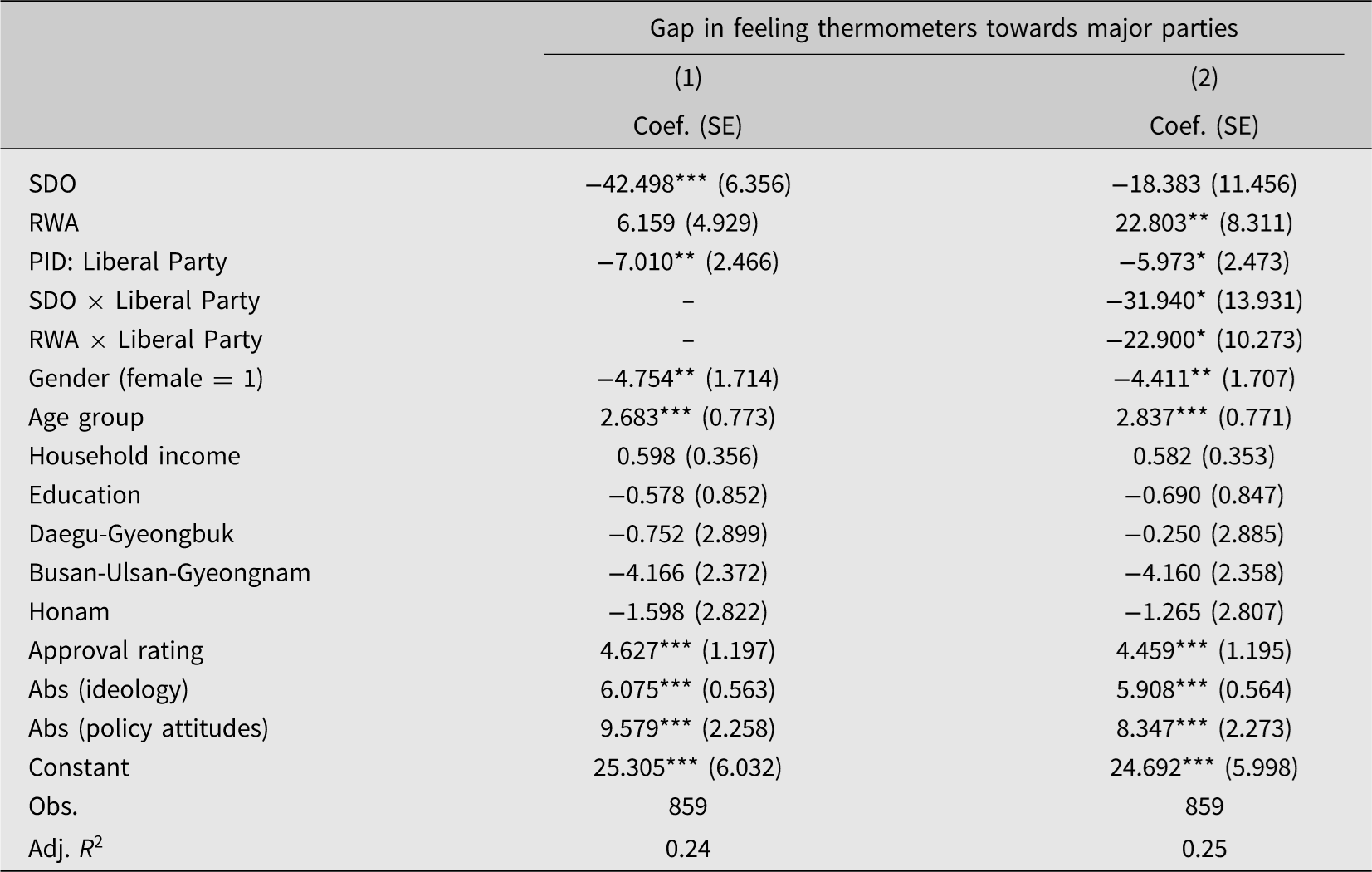
Table 1 presents the regression estimates for the 2022 survey. The results indicate that affective polarization is positively associated with ideological extremity, measured as the distance between a respondent’s self-placement and the midpoint of the ideological scale. The findings also show that greater distance from the midpoint in policy attitudes is associated with higher levels of affective polarization.
Regression results of individual-level affective polarization: 2022 survey

Table 1. Long description
A table showing regression results of individual-level affective polarization from a 2022 survey. The table has 18 rows and 4 columns. Column headers are SDO, RWA, PID: Liberal Party, SDO x Liberal Party, RWA x Liberal Party, Gender (female = 1), Age group, Household income, Education, Daegu-Gyeongbuk, Busan-Ulsan-Gyeongnam, Honam, Approval rating, Abs (ideology), Abs (policy attitudes), Constant, Obs, Adj. R^2. Row 1: SDO, -42.498***, (6.356), -18.383, (11.456). Row 2: RWA, 6.159, (4.929), 22.803**, (8.311). Row 3: PID: Liberal Party, -7.010**, (2.466), -5.973*, (2.473). Row 4: SDO x Liberal Party, -, -, -31.940*, (13.931). Row 5: RWA x Liberal Party, -, -, -22.900*, (10.273). Row 6: Gender (female = 1), -4.754**, (1.714), -4.411**, (1.707). Row 7: Age group, 2.683***, (0.773), 2.837***, (0.771). Row 8: Household income, 0.598, (0.356), 0.582, (0.353). Row 9: Education, -0.578, (0.852), -0.690, (0.847). Row 10: Daegu-Gyeongbuk, -0.752, (2.899), -0.250, (2.885). Row 11: Busan-Ulsan-Gyeongnam, -4.166, (2.372), -4.160, (2.358). Row 12: Honam, -1.598, (2.822), -1.265, (2.807). Row 13: Approval rating, 4.627***, (1.197), 4.459***, (1.195). Row 14: Abs (ideology), 6.075***, (0.563), 5.908***, (0.564). Row 15: Abs (policy attitudes), 9.579***, (2.258), 8.347***, (2.273). Row 16: Constant, 25.305***, (6.032), 24.692***, (5.998). Row 17: Obs, 859, 859. Row 18: Adj. R^2, 0.24, 0.25.
Note: ***p < 0.001; **p < 0.01; *p < 0.05.
In addition, the standardized coefficients suggest that the associations of SDO and RWA are nontrivial relative to several established predictors of affective polarization. In the baseline model, the negative association between SDO and affective polarization is comparable in magnitude to the positive effect of ideological extremity, although in the opposite direction. In the interaction model, the coefficient for RWA approaches that of ideological extremity. Although partisan distance remains the strongest predictor by construction, the estimated associations of SDO and RWA are substantial relative to other attitudinal variables.
In Model (1), there is a significantly negative association between liberal partisanship and affective polarization (β = −7.010, p < 0.01). This regression coefficient is consistent with contextual differences between partisan camps in the 2022 election, suggesting that supporters of the conservative party, who were mobilized around the goal of alternation in power, exhibited a wider affective distance between the major partisan camps than those of the liberal party did.
The interaction results reported in Model (2) are broadly consistent with the expectation that higher RWA is associated with stronger affective polarization among conservative partisans. By contrast, the negative association between SDO and affective polarization is more apparent among liberal partisans, in line with the direction anticipated by H2. These patterns should be interpreted cautiously, however, given the sensitivity of interaction estimates to model specification.
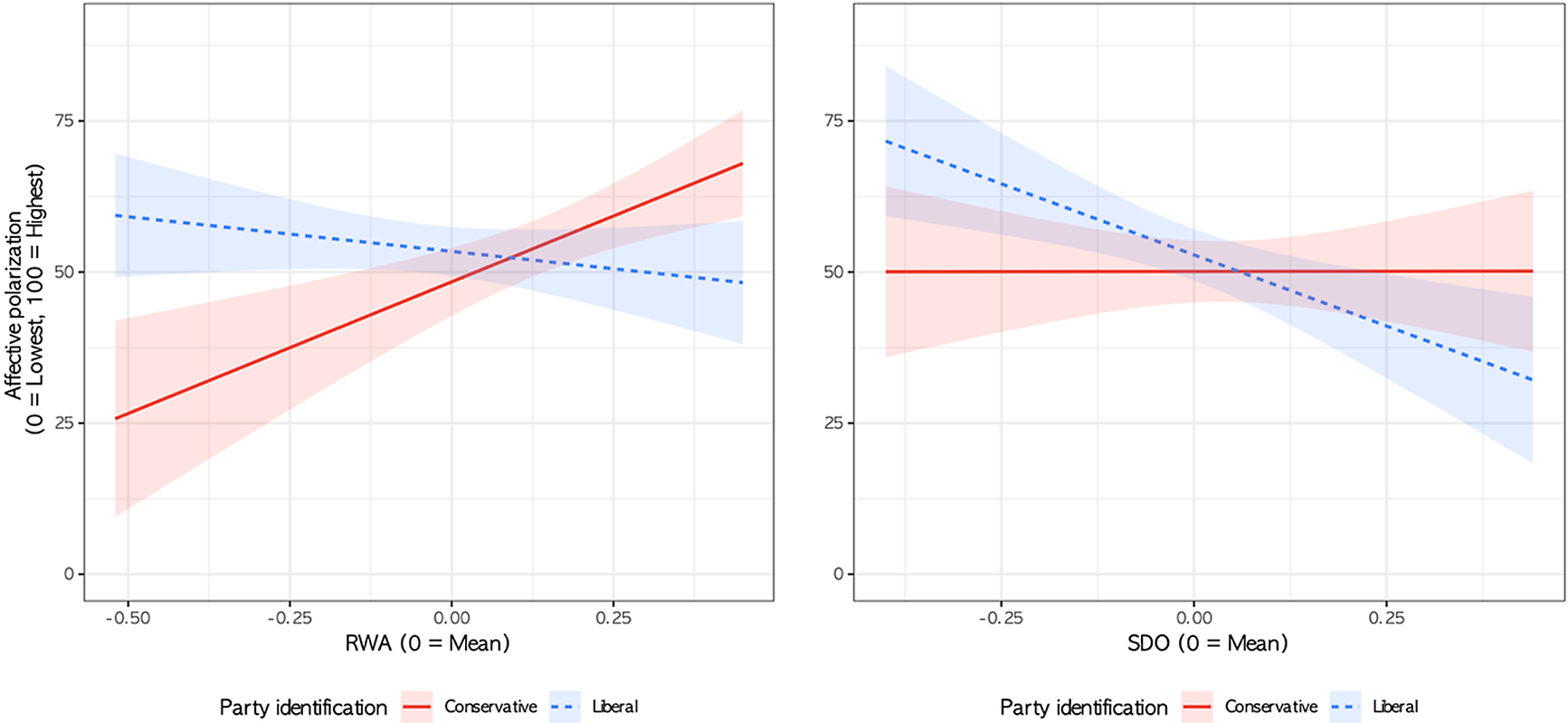
These interaction patterns are more readily interpreted through the marginal effects shown in Figure 2. The left panel shows that the positive association between RWA and affective polarization is concentrated among conservative partisans. This pattern is consistent with the argument that authoritarian predispositions may intensify the emotional translation of conservative partisan identity into affective distance from the out-party. The right panel exhibits that the negative association between SDO and affective polarization is concentrated among liberal partisans. Among conservatives, the slope is also negative, but it is not statistically distinguishable from zero.
Affective polarization and ideological orientations by partisanship: 2022 survey.

Figure 2. Long description
Two line graphs show the relationship between affective polarization and ideological orientations by partisanship. Panel A: The line graph plots affective polarization against RWA (Right-Wing Authoritarianism) with the horizontal axis labeled RWA (0 = Mean) and the vertical axis labeled Affective polarization (0 = Lowest, 100 = Highest). The graph includes two lines representing Conservative and Liberal party identification, with Conservative shown in red and Liberal in blue. The red line for Conservatives shows an upward trend, indicating increasing affective polarization with higher RWA scores. The blue line for Liberals shows a slight downward trend. Panel B: The line graph plots affective polarization against SDO (Social Dominance Orientation) with the horizontal axis labeled SDO (0 = Mean) and the vertical axis labeled Affective polarization (0 = Lowest, 100 = Highest). The graph includes two lines representing Conservative and Liberal party identification, with Conservative shown in red and Liberal in blue. The red line for Conservatives shows a slight downward trend, while the blue line for Liberals shows a more pronounced downward trend, indicating decreasing affective polarization with higher SDO scores.
Collectively, the 2022 results provide suggestive evidence that affective polarization is structured not only by partisan identity and ideological distance, but also by the interaction between partisan alignment and broader ideological orientations. Higher RWA is associated with a wider affective distance among conservative partisans, whereas higher SDO is associated with a narrower affective distance among liberal partisans. These findings are consistent with the conditional expectations developed in the theory section.
4.2. The 2024 legislative election: the midterm evaluation context
Figure 3 shows the distribution of RWA and SDO by partisanship in the 2024 data. The distribution of SDO does not exhibit a statistically significant difference. By contrast, the distribution of RWA reveals a clearer partisan distinction than in the 2022 survey. In particular, respondents affiliated with the liberal party show lower RWA scores than their 2022 counterparts, whereas conservative respondents show notably higher RWA values. This widening partisan difference in RWA suggests that authoritarian predispositions may have been more sharply sorted by partisanship in the 2024 context.
Distribution of ideological orientations (SDO and RWA) by partisanship: 2024 survey (N = 422).

Figure 3. Long description
Two density plots compare ideological orientations by partisanship. Panel A: The density plot shows the distribution of Right-Wing Authoritarianism (RWA) scores by party identification. The x-axis represents RWA scores ranging from 0 (lowest) to 1 (highest), and the y-axis represents kernel density. The plot includes two overlapping distributions: one for conservatives in red and one for liberals in blue. Conservatives show a higher density towards higher RWA scores, while liberals show a higher density towards lower RWA scores. Panel B: The density plot shows the distribution of Social Dominance Orientation (SDO) scores by party identification. The x-axis represents SDO scores ranging from 0 (lowest) to 1 (highest), and the y-axis represents kernel density. The plot includes two overlapping distributions: one for conservatives in red and one for liberals in blue. Conservatives show a higher density towards higher SDO scores, while liberals show a higher density towards lower SDO scores.
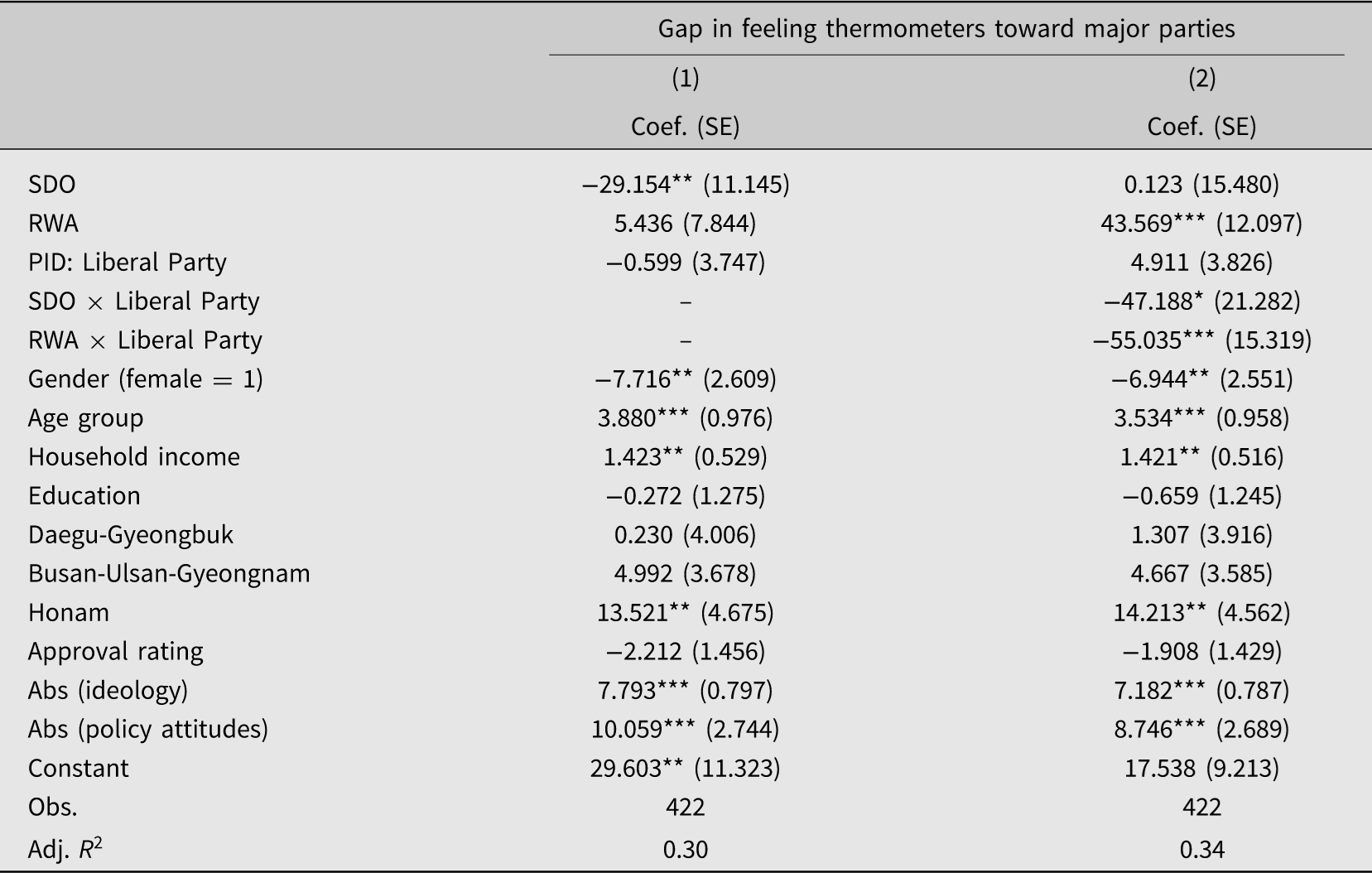
Table 2 presents the regression estimates for the 2024 survey. The results are consistent with H1. As shown in the left panel of Figure 4, higher RWA is positively associated with affective polarization among conservative partisans, whereas no comparable positive association appears among liberal partisans.
Affective polarization and ideological orientations by partisanship: 2024 survey.

Regression results of individual-level affective polarization: 2024 survey

Table 2. Long description
The table presents regression estimates for a 2024 survey, focusing on affective polarization. It has 18 rows and 6 columns. The columns are labeled SDO, RWA, PID: Liberal Party, SDO × Liberal Party, RWA × Liberal Party, and Gender (female = 1). Additional columns include Age group, Household income, Education, Daegu-Gyeongbuk, Busan-Ulsan-Gyeongnam, Honam, Approval rating, Abs (ideology), Abs (policy attitudes), Constant, Obs., and Adj. R². Each row lists coefficients and standard errors (SE) for various factors. Notable values include significant coefficients for SDO, RWA, Age group, Household income, Abs (ideology), and Abs (policy attitudes).
Note: ***p < 0.001; **p < 0.01; *p < 0.05.
The results also align with the direction anticipated by H2. As shown in the right panel of Figure 4, the negative association between SDO and affective polarization is concentrated among liberal partisans. Within the 95 percent confidence interval, no comparable negative association is evident among conservative partisans. The overall negative relationship between SDO and affective polarization in the pooled sample is therefore largely attributable to the pattern among liberal partisans, among whom higher SDO is associated with a narrower affective gap between partisan camps.
It is also notable that in-party identity is positively associated with affective polarization in the supplementary analysis reported in Appendix C. Given that this variable is measured on a four-point scale, coefficients exceeding 10 indicate a substantively meaningful relationship between stronger in-party identity and greater affective distance between the major parties. This result is consistent with the broader literature emphasizing the role of partisan identity in affective polarization, although the conditional associations involving RWA and SDO suggest that partisan identity does not exhaust individual-level variation in affective distance.
To assess the possibility that the age restriction in the 2022 survey affected the main findings, we re-estimated the same statistical model using the 2024 data after excluding respondents aged 60 and older.Footnote 3 Contrary to concerns, the overall results are similar to those obtained using the full dataset, which includes respondents aged 60 and older. However, once respondents aged 60 and older are excluded, the sample size falls to 246, which increases uncertainty around the estimates. This exercise does not fully resolve the external-validity limitation of the 2022 survey, but it suggests that the core patterns reported here are not simply artefacts of the age composition of that dataset. We therefore interpret this analysis as a limited robustness check rather than as definitive evidence that the 2022 age restriction has no bearing on the results.
5. Conclusion
This study examined whether RWA and SDO help explain variation in affective polarization in South Korea. Drawing on survey data from the 2022 presidential election and the 2024 legislative election, the study found suggestive evidence that the relationship between ideological orientations and affective polarization is neither uniform nor politically neutral. Instead, the associations between these orientations and affective polarization appear to be conditional on partisan alignment. Across the two surveys, higher RWA is associated with greater affective polarization among conservative partisans, whereas higher SDO is associated with lower affective polarization among liberal partisans. Although some estimates are sensitive to model specification and should therefore be interpreted cautiously, these patterns are broadly visible even after accounting for partisan identity and ideological distance.
These findings make two broader contributions to the literature on affective polarization. First, they suggest that affective distance between partisan camps cannot be understood solely in terms of partisan identity, ideological extremity, or issue conflict. Those factors remain central, but they do not fully explain why citizens with similar partisan attachments differ in the degree of emotional distance they place between their own party and political opponents. By focusing on RWA and SDO, this study highlights the importance of individual-level orientations in explaining variation within partisan camps rather than only between them. Second, the findings extend the study of affective polarization beyond the Western contexts that dominate much of the literature. The South Korean case suggests that the micro-foundations of affective polarization may travel across democratic settings, even when the historical and institutional structure of party competition differs from that of the United States or Western Europe. More broadly, the findings suggest that partisan competition may become emotionally asymmetrical even within the same camp, depending on how broader orientations towards authority and hierarchy are mapped onto partisan conflict.
The results also underscore the value of distinguishing between authoritarian and dominance-oriented dispositions. RWA appears to matter most in settings where partisan conflict is likely to be interpreted in terms of threat, order, and norm enforcement. SDO, by contrast, does not simply intensify affective polarization across the board. Its relationship to affective distance is more conditional and appears to vary with partisan location. In this respect, the findings caution against treating ideologically relevant psychological orientations as interchangeable predictors of polarization. Different orientations may structure partisan affect through different political logics, and those effects may depend on the position from which citizens encounter partisan competition.
At the same time, the conclusions of this study should be interpreted with appropriate caution. The analyses are observational and therefore do not identify causal mechanisms directly. The results are consistent with the interpretation that RWA and SDO are associated with differences in how voters experience partisan conflict, but they do not provide direct evidence about the perceptual or motivational processes through which this occurs. In addition, the 2022 survey excludes respondents aged 60 and older, which limits the generalizability of the findings from that dataset. The measures available in the two surveys are also not identical, making exact comparability impossible even though the broad patterns are similar across the two electoral contexts.
These limitations point to several directions for future research. One is to examine party-specific affect more directly to distinguish more clearly between in-party warmth, out-party hostility, and relational affective distance. Another is to investigate the mechanisms linking ideological orientations to partisan animus using research designs better suited to causal inference, such as panel or experimental approaches. Comparative work across additional democracies would also help clarify whether the conditional patterns observed here reflect features of South Korean partisan competition specifically or broader dynamics of affective polarization across democratic contexts.
Overall, this study suggests that affective polarization is not simply a product of partisan sorting or ideological disagreement. It is also shaped by deeper orientations that structure how citizens interpret authority, hierarchy, and political opposition. Understanding these micro-level differences is important for explaining why similarly situated partisans may nonetheless place sharply different degrees of emotional distance between their own party and the opposing camp.
Supplementary material
The supplementary material for this article can be found at: https://doi.org/10.1017/S1468109926100486.
Competing interests
The authors declare no conflicts of interest related to this work.





 Open access

