


1. Introduction
Economic inequality has increased across democratic countries over the past few decades. The national income share of the wealthiest one percent in advanced democracies rose from eight percent in the 1970s to twenty percent in the 2010s, leading some to call this era the ‘New Gilded Age’ (Atkinson et al., Reference Atkinson, Piketty and Saez2011; Bartels, Reference Bartels2016). According to the canonical political economy model, such rising income inequality should lead to greater support for redistribution and increased government spending (Meltzer and Richard, Reference Meltzer and Richard1981). The theory posits that the median voter, expected to benefit economically from redistribution, supports such policies, and democratic governments reflect this preference. However, empirical evidence presents a stark contrast. Studies have suggested a limited relationship between economic inequality and support for redistribution, while some even suggest a negative correlation (Kenworthy and McCall, Reference Kenworthy and McCall2008; Kelly and Enns, Reference Kelly and Enns2010; Cavaillé, Reference Cavaillé2023).
Previous research explaining redistribution preferences has centred on egocentric and sociotropic motives. On one hand, the egocentric explanation suggested that individuals form their redistribution preferences based on their economic self-interest (e.g., Rehm, Reference Rehm2009; Wiedemann, Reference Wiedemann2022). On the other hand, some studies suggested that redistribution preferences are shaped by sociotropic concerns such as the norms of fair distribution and distributive justice in the context of economic inequality (e.g., Alesina and Angeletos, Reference Alesina and Angeletos2005; Benabou and Tirole, Reference Benabou and Tirole2006; Cavaillé, Reference Cavaillé2023). One central assumption of both lines of research is that people hold correct information on their economic status and the inequality level of the society. However, empirical evidence suggests that individuals are often not aware of their position in the income distribution and the extent of inequality (Norton and Ariely, Reference Norton and Ariely2011; Gimpelson and Treisman, Reference Gimpelson and Treisman2018).
Building on previous studies of information effects (e.g., Cruces et al., Reference Cruces, Perez-Truglia and Tetaz2013), this paper re-examines both egocentric and sociotropic explanations without assuming perfect information. We posit that providing information can influence individuals’ preferences for redistribution. Specifically, we propose two hypotheses corresponding to the egocentric and sociotropic explanations. First, we expect that individuals who misperceive their relative income position will adjust their support for redistribution in line with their economic self-interest (egocentric motive) when presented with accurate information about their income rank. Second, we hypothesize that individuals exposed to information about rising income inequality will be more likely to support redistribution due to concerns about societal inequality (sociotropic motive), compared to those who are not informed. By juxtaposing these two motivational logics, we test whether both egocentric and sociotropic concerns contribute to the support for redistribution, particularly among individuals with limited prior knowledge about their own economic standing and the broader level of inequality. Moreover, we disaggregate the concept of redistribution into three dimensions: redistribution from the rich (progressive taxation), redistribution to the poor (income transfer), and beliefs about the government’s responsibility to reduce income inequality (government responsibility). Through this approach, our study contributes to the literature both methodologically and theoretically by identifying the effects of egocentric and sociotropic information on the demand for redistribution across its multiple facets.
We conducted a survey experiment in South Korea (henceforth Korea) in 2022.Footnote 1 Korea offers an ideal setting to examine preferences for redistribution under rising inequality. Over the past few decades, the top ten percent’s income share has steadily increased, while the bottom half remains stagnant. Despite the fact that economic inequality has been a salient political issue, support for redistributive policies has fallen in the same period. As the country is a racially homogeneous small welfare state, it is a suitable case to focus on the economic dimension of redistribution preferences to explain the puzzle. In this study, a nationally representative sample of 1,800 individuals was randomly assigned to one of three groups: Treatment Group 1 received information about their own income position, Treatment Group 2 received information about national income inequality, and the control group received no information.
Our empirical analysis supports the egocentric motive hypothesis but not the sociotropic one. We find that individuals largely misperceive their economic position in the national income distribution, typically identifying themselves as middle class. When provided with accurate information about their actual position, respondents adjust their preferences for redistribution in an economically consistent manner. Specifically, individuals who overestimate (underestimate) their income position and learn that they are poorer (richer) than they believed are more likely to support (oppose) redistribution compared to those who remain uninformed. Interestingly, we also find that the increase in support among those who discover they are worse off is nearly twice as large as the decrease among those who discover they are better off, implying the asymmetric reaction to negative versus positive information. By contrast, information about national inequality does not significantly affect redistribution preferences relative to the control group. Importantly, individuals who were previously unaware of rising inequality also do not express greater support for redistribution when informed. We conduct the additional exploratory analysis and the null finding remains robust across subgroups divided by income level, trust in government, and belief in meritocracy. Our results suggest that egocentric rather than sociotropic considerations drive the redistribution preferences.
This paper makes several contributions to the political economy and public opinion literature. First, it advances research on information and redistribution methodologically by directly comparing egocentric and sociotropic informational mechanisms within a unified experimental framework. Whereas prior studies typically examine either income-rank information or aggregate inequality information in isolation (Cruces et al., Reference Cruces, Perez-Truglia and Tetaz2013; Kuziemko et al., Reference Kuziemko, Norton, Saez and Stantcheva2015; Fernández-Albertos and Kuo, Reference Fernández-Albertos and Kuo2018), our design randomizes individualized income-position information and national-level inequality information side by side, while holding outcome measures constant across treatment arms. This design feature allows us to identify the relative behavioural impact of self-relevant versus aggregate information. By isolating and comparing these informational logics within the same empirical setting, we clarify how different types of information translate into redistribution preferences.
Second, this paper contributes theoretically by arguing that egocentric information – information that updates individuals’ perceptions of their own material position – has stronger effects than aggregate inequality information. While Kuziemko et al., (Reference Kuziemko, Norton, Saez and Stantcheva2015) document limited effects of inequality information in the United States, we extend this insight by showing that even potential moderators such as trust in government do not generate sociotropic responsiveness in our context. Although we recognize that our experimental design cannot fully disentangle the sources of null effects, the consistent null effects across multiple subgroup analyses and alternative specifications suggest that sociotropic information does not have a meaningful influence compared to pocketbook considerations.
Third, our study contributes to the literature by showing that treatment effects vary systematically across different operationalizations of redistribution preferences. Informational effects are more pronounced for concrete policy instruments – such as income transfers and progressive taxation – than for the widely used government-responsibility item. This distinction is substantively important. It suggests that abstract questions about state responsibility may capture stable ideological orientations rather than policy-contingent preferences. As a result, reliance on a single survey item may obscure meaningful variation in how citizens connect information to specific redistributive policies (Cavaillé and Trump, Reference Cavaillé and Trump2015; Margalit and Raviv, Reference Margalit and Raviv2024).
The remainder of the paper proceeds as follows. The next section briefly reviews the existing research and provides our theoretical expectations. We then introduce the Korean context. We then introduce our experimental design, followed by the presentation and discussion of the results. The final section concludes and discusses several implications.
2. Egocentric and sociotropic motives of redistribution
2.1. Explaining redistribution preferences
The existing literature on the demand for redistribution can be broadly categorised into three strands. First, the extended economic self-interest approach posits that individuals maximize not only their current incomes but also future economic benefits when shaping preferences for redistribution and social policy (Rueda and Stegmueller, Reference Rueda and Stegmueller2019). One important factor influencing these preferences is labour market risk. Individuals with skill-specific human capital face higher unemployment risk and therefore demand stronger social insurance, while those with portable skills are less exposed and demand less (Iversen and Soskice, Reference Iversen and Soskice2001; Rehm, Reference Rehm2009; Rehm et al., Reference Rehm, Hacker and Schlesinger2012). Beyond labour markets, rising housing prices, for instance, can reduce support for redistribution, since homeownership increases permanent income and serves as a form of self-insurance (Ansell, Reference Ansell2014). It thus emphasizes that the interaction of income and the ability to self-insure through liquid assets determines the demand for redistribution (Jensen and Wiedemann, Reference Jensen and Wiedemann2023). Similarly, access to credit markets alters preferences. Indebted households are more supportive of redistribution, though the effect depends on welfare state institutions (Wiedemann, Reference Wiedemann2022). Finally, beliefs about upward mobility also matter. Individuals who expect to move up the income ladder may oppose redistribution because they anticipate being harmed by it in the future (Piketty, Reference Piketty1995; Alesina et al., Reference Alesina, Stantcheva and Teso2018). In short, this literature highlights that demand for redistribution is shaped not just by current income but also by permanent income, asset security, access to credit, and expectations about mobility.
The second perspective suggests that preferences for redistribution can be influenced by sociotropic concerns such as the norms of fair distribution and distributive justice in the context of economic inequality. In this perspective, beliefs in fairness and altruism shape how individuals perceive inequality and ultimately impact their support for redistribution. For example, individuals who attribute economic success to hard work are more likely to view unequal outcomes as deserved and fair, thus exhibiting less support for redistribution (Alesina and Angeletos, Reference Alesina and Angeletos2005; Benabou and Tirole, Reference Benabou and Tirole2006; Ballard-Rosa et al., Reference Ballard-Rosa, Martin and Scheve2017; Cavaillé, Reference Cavaillé2023). Additionally, some individuals may consider redistributing economic resources from the rich to the poor as unfair, believing that the government should treat all citizens equally (Scheve and Stasavage, Reference Scheve and Stasavage2023). These arguments partly aligned with the social affinity theory, which suggests that the middle class is more likely to support redistribution when they feel closer economic proximity and greater social affinity to the poor than to the rich (Lupu and Pontusson, Reference Lupu and Pontusson2011). It implies that if the income distance between the middle and the poor is close, then the middle feels empathy towards the poor and therefore supports more redistribution. Conversely, if the middle perceives the poor as undeserving and disproportionately belonging to minority groups like immigrants, they are more likely to oppose redistribution that benefits the ‘economic others’ (Gilens, Reference Gilens2009; Condon and Wichowsky, Reference Condon and Wichowsky2020; Alesina et al., Reference Alesina, Miano and Stantcheva2023).
Although the former two strands presume an informed individual, the third strand, which focuses on misperception and information, suggests that subjective perception matters. It has been shown that individuals, regardless of their actual economic status, tend to perceive themselves as being in the middle class and have limited awareness of the overall level of inequality within society (Norton and Ariely, Reference Norton and Ariely2011; Gimpelson and Treisman, Reference Gimpelson and Treisman2018). This misperception can influence political preferences that sometimes go against their material self-interest (Bartels, Reference Bartels2005). In turn, perceived inequality and subjective economic status, rather than actual inequality and objective income, determine redistribution preferences (Cansunar, Reference Cansunar2021). This leads to the question of whether correcting the misperception could change redistribution preferences.
Experimental research has provided mixed results regarding the impact of information on redistribution preferences. On one hand, providing information about income position and the level of inequality can correct misperceptions and change attitudes towards redistribution consistent with economic self-interest (Cruces et al., Reference Cruces, Perez-Truglia and Tetaz2013; Boudreau and MacKenzie, Reference Boudreau and MacKenzie2018; Engelhardt and Wagener, Reference Engelhardt and Wagener2018; Fernández-Albertos and Kuo, Reference Fernández-Albertos and Kuo2018). For instance, lower-income groups informed about their objective position are more likely to support redistribution than misinformed lower groups, whereas high-income groups with accurate information are less likely to support redistribution than those without information. On the other hand, some argued that information has only a limited effect because other factors such as trust in government and social comparison mitigate the effect of information (Kuziemko et al., Reference Kuziemko, Norton, Saez and Stantcheva2015; Hoy and Mager, Reference Hoy and Mager2021).
While the literature offers valuable insights, it falls short of identifying the specific motivations driving support for redistribution. For example, while Boudreau and MacKenzie (Reference Boudreau and MacKenzie2018) demonstrated that inequality information influences support for taxation, they did not distinguish between egocentric motivations and sociotropic concerns. By treating all inequality information as part of the self-interest mechanism, the nuanced effects of different types of information have been overlooked. This is especially problematic when considering the role of societal concerns in shaping preferences for redistribution. As Rueda and Stegmueller (Reference Rueda and Stegmueller2016) demonstrate, there might be other psychological mechanisms that cannot be measured by mere income, departing from the economic self-interest motivation. Second, the umbrella concept of redistribution might not capture the diverse range of redistributive policies, such as taxation from the rich and redistribution to the poor (Cavaillé and Trump, Reference Cavaillé and Trump2015). This urges for a more nuanced understanding of the multifaceted aspects of redistribution (Margalit and Raviv, Reference Margalit and Raviv2024).
2.2. Theoretical expectations
We expect that people may lack awareness of the exact level of inequality and their income position, thereby shaping their redistributive policy preferences based on what can be termed as ‘unenlightened self-interest’ (Bartels, Reference Bartels2005).
It is widely acknowledged that material self-interest is a significant factor driving preferences for redistribution. Consistent with Meltzer and Richard (Reference Meltzer and Richard1981)’s self-interest model, individuals with lower incomes are typically more supportive of redistribution, while the affluent often oppose such policies. Empirical evidence consistently shows that individuals with lower incomes are more likely to support redistributive policies compared to the rich as it is an economically rational choice for them (Beramendi and Rehm, Reference Beramendi and Rehm2016). However, this straightforward relationship may be complicated if there is misperception. For example, the rich who compare themselves to the super-rich are likely to support progressive taxation because they perceive themselves as less wealthy (Cansunar, Reference Cansunar2021), while the lower-income group’s misperceiving themselves as middle class could decrease demand for redistribution. It suggests that providing accurate information about the objective income position could shift their preferences. Among individuals who underestimate (overestimate) their income position, learning their actual position would decrease (increase) support for redistribution, aligned with their self-interest.
Several studies have investigated the impact of correcting individuals’ misperceptions about their income position on redistribution preferences, but with mixed findings (Cruces et al., Reference Cruces, Perez-Truglia and Tetaz2013; Engelhardt and Wagener, Reference Engelhardt and Wagener2018; Fernández-Albertos and Kuo, Reference Fernández-Albertos and Kuo2018; Hoy and Mager, Reference Hoy and Mager2021). For example, Cruces et al., (Reference Cruces, Perez-Truglia and Tetaz2013) and Fernández-Albertos and Kuo (Reference Fernández-Albertos and Kuo2018) report that individuals change support for redistribution and progressive taxation in an economically congruent way when receiving information about their income position.Footnote 2 Although Engelhardt and Wagener (Reference Engelhardt and Wagener2018) find only a limited overall effect of information, the study shows that once respondents were informed whether they are net beneficiaries or net contributors, they adjusted their preferences for redistribution in ways consistent with their material self-interest. This suggests that, under conditions of perfect information about one’s economic status, the logic of material interest does play a role. Based on the above discussion, we derive the following hypothesis.
2.2.1. Egocentric motive hypothesis (H1-1)
Among those who underestimate (overestimate) their income position, those who are informed about their objective income position are more likely to support (oppose) redistribution than those who are not. Our baseline theoretical framework (H1-1) models individuals as rational updaters who revise their policy preferences in response to new information about their relative economic position. Under this framework, learning that one is poorer than previously believed should increase support for redistribution to the same extent that learning one is richer should decrease it.
However, a growing body of behavioural research suggests that individuals respond asymmetrically to negative and positive information. Prospect theory predicts that losses loom larger than equivalent gains, while relative deprivation theory argues that downward social comparisons carry greater political salience (Kahneman and Tversky, Reference Kahneman and Tversky1979; Tversky and Kahneman, Reference Tversky and Kahneman1991; Soroka, Reference Soroka2006). Consequently, learning that one is worse off than previously believed should generate a stronger increase in support for redistribution than the decrease produced by learning that one is better off.
Therefore, we posit that information revealing that one is worse off than previously believed constitutes a loss relative to prior expectations and is therefore likely to trigger a stronger response. By contrast, information indicating that one is better off than expected represents a gain, which tends to generate weaker behavioural and attitudinal adjustments. Taken together, it implies that downward revisions in perceived income should lead to larger increases in support for redistribution than the corresponding decreases generated by upward revisions. We therefore derive the following exploratory hypothesis.
Relatedly, theories of relative deprivation emphasize that perceptions of being disadvantaged relative to others carry distinct political significance (Gurr, Reference Gurr1970). Learning that one occupies a lower position in the income distribution may heighten perceptions of unfairness, increase demands for corrective state intervention, and strengthen support for redistributive policies. In contrast, upward revisions in relative position may reinforce satisfaction with the status quo without producing a commensurate reduction in redistribution preferences. From this perspective, asymmetric responses reflect the fundamentally different political meanings attached to negative and positive information about one’s economic standing. Building on this discussion, we derive the following exploratory hypothesis.
2.2.2. Asymmetric response hypothesis (H1-2)
While information about relative income is expected to affect redistributive preferences in general, negative information should have a larger effect than positive information of comparable magnitude. The mechanism linking sociotropic concerns regarding national-level inequality to individual preferences for redistribution is more nuanced than pure self-interest and rests on other-regarding concerns. In particular, support for redistribution may rise in the face of growing inequality because individuals are concerned about the broader societal consequences of inequality. These sociotropic concerns can take multiple forms. First, individuals may be motivated by altruistic or fairness-based considerations. A large body of psychological and behavioural research shows that people display inequality aversion. They dislike unequal outcomes even when they themselves are not disadvantaged (Epper et al., Reference Epper, Fehr, Kreiner, Leth-Petersen, Olufsen and Skov2024). Experimental studies demonstrate that individuals reject unfair distributions, and even nonhuman primates display strong reactions to unequal rewards (Brosnan and De Waal, Reference Brosnan and De Waal2003). Studies further show that concerns about fairness regarding income distribution undergird preferences for redistribution (Ballard-Rosa et al., Reference Ballard-Rosa, Martin and Scheve2017; Cavaillé, Reference Cavaillé2023; Scheve and Stasavage, Reference Scheve and Stasavage2023). These findings suggest that redistribution may be supported not because of direct self-interest but because inequality itself is perceived as normatively undesirable.
Second, individuals may emphasize ingroup solidarity. Redistribution can be seen as a way to protect one’s community, ethnic group, or nation, even if it does not directly benefit the individual. Research shows that perceptions of inequality are often filtered through group identities and reference groups, leading individuals to evaluate policies based on their implications for ‘people like us’ rather than for themselves alone (Gilens, Reference Gilens2009; Shayo, Reference Shayo2009; Condon and Wichowsky, Reference Condon and Wichowsky2020). In this view, redistribution is not valued primarily for personal gain but for its role in reinforcing the cohesion and stability of one’s reference group, whether defined by ethnicity, class, or nation. By nature, the salience of this mechanism depends on the degree of social homogeneity. In more homogeneous societies, for instance, individuals are more likely to perceive the poor as part of their own group and thus extend support for redistribution.
A growing body of empirical research documents the relevance of such sociotropic reasoning. For example, studying trade preferences, Mutz (Reference Mutz2021) shows that Americans’ trade preferences are shaped less by individual economic self-interest than by beliefs about how trade affects the national economy as a whole. Extending this logic, information that highlights rising inequality may likewise influence preferences for redistribution by activating sociotropic concerns – prompting individuals to support redistribution based on broader societal considerations rather than personal economic interest.
Empirical studies have shown that individuals frequently misperceive the extent of economic inequality and that providing accurate information about the actual level of inequality can influence their preferences for redistribution (Gimpelson and Treisman, Reference Gimpelson and Treisman2018). For example, Boudreau and MacKenzie (Reference Boudreau and MacKenzie2018) found that providing rising inequality information alters redistribution preference, and it even overrides the partisanship effect in the U.S. Specifically, Republicans exposed to rising inequality information tended to exhibit greater support for progressive taxation, while Democrats with similar information were more likely to reject regressive taxation. Furthermore, Kuziemko et al., (Reference Kuziemko, Norton, Saez and Stantcheva2015) found that informing individuals about the general level of inequality has large effects on perceptions towards the current level of inequality, but limited effects on the preferences for redistribution except for the estate tax. They attributed this small effect to distrust in the government and insufficient knowledge about the impact of public policy. These results suggest that respondents with a better understanding of the effects of redistribution policies on economic disparity may alter their preferences upon learning the exact level of inequality in society. Based on the above discussion, we derive the following hypothesis.
2.2.3. Sociotropic motive hypothesis (H2)
Individuals informed about rising income inequality are more likely to support redistribution compared to those who are not informed. While the existing studies have treated redistribution as a largely unified concept, this simplification may obscure important differences in how individuals connect information to policy preferences (Cavaillé and Trump, Reference Cavaillé and Trump2015). Accordingly, in our analysis, we disaggregate the concept of redistribution into three dimensions: redistribution from the rich (progressive taxation), redistribution to the poor (income transfer), and beliefs about the government’s responsibility to reduce income inequality (government responsibility).
We expect that concrete policies such as income transfers or progressive taxation involve clear and immediate cost-bearing implications, making it easier for individuals to map information about their economic interest onto expected consequences. By contrast, abstract notions of redistribution or government responsibility are more weakly linked to individual material interests and are therefore more likely to be filtered through ideological predispositions or partisan cues. This distinction is particularly relevant given widespread limitations in citizens’ understanding of policy mechanics. When policy complexity is high, individuals rely more heavily on heuristics and symbolic attitudes, reducing the impact of newly acquired self-relevant information. Conversely, when policies are cognitively accessible and their distributive consequences are salient, information is more likely to translate into meaningful preference change.
3. The Korean context
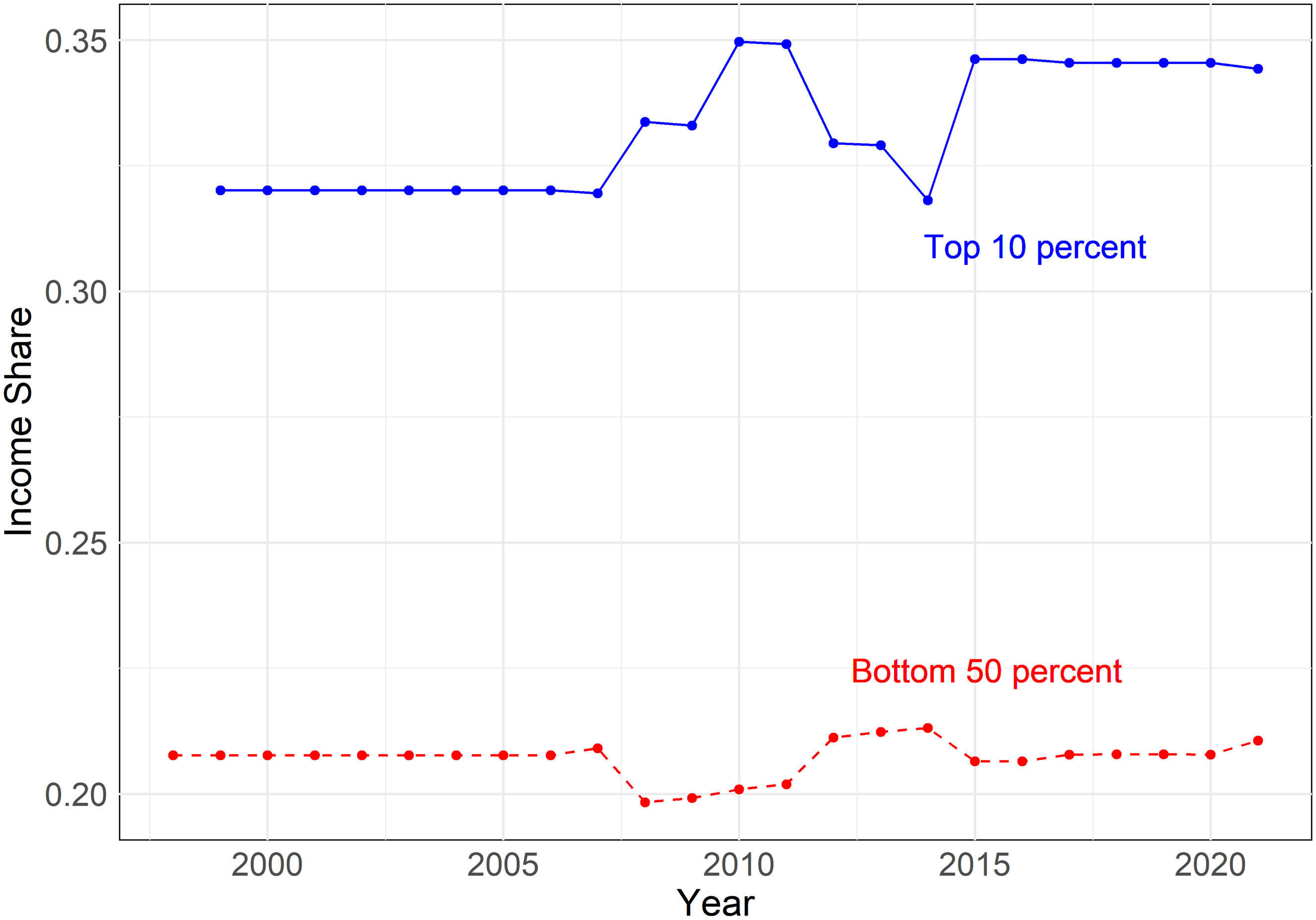
In this section, we place the Korean case into context. Economic inequality in Korea has increased since the early 1990s, particularly following the Asian financial crisis in 1997. Figure 1 presents the trend in income inequality based on data from the World Inequality Database. While the income share of the top 10% has steadily increased over the past few decades, the share held by the bottom 50% has stagnated, accounting for only about 22% of national income. According to a group of Korean economists and sociologists who analyse tax data to measure inequality, by 2015, the top 10% of income earners in Korea captured nearly half of the national income (Kim and Kim, Reference Kim and Kim2020).
Income inequality in Korea.

In 2019, Korea’s pre-tax and pre-transfer Gini coefficient stood at 0.339, making it the eighth unequal country among OECD members. Notably, income inequality in Korea is primarily driven by widening disparities within the bottom half of the income distribution – unlike many Western democracies, where rising inequality is largely attributed to the growing concentration of income among the super-rich (Lee et al., Reference Lee, Shin and Kim2020). The sharp decline in the relative income share of the poor, particularly in comparison to the middle class, has reinforced the connection between inequality and poverty.
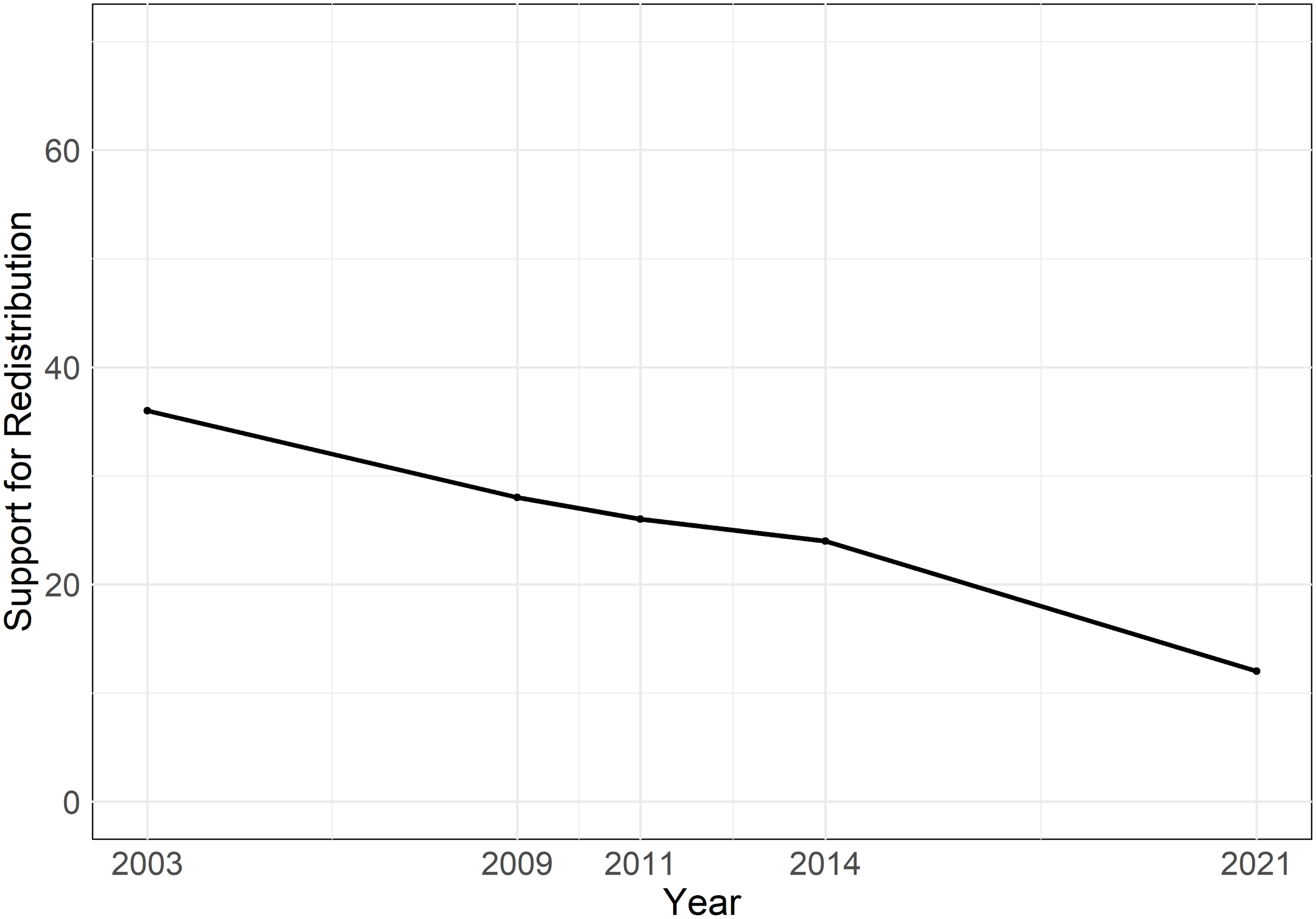
Despite economic inequality and its strong correlation with poverty – factors that would typically increase public support for redistribution – Koreans appear to show relatively low levels of such support. Figure 2 illustrates overall support for redistribution, measured by the proportion of individuals who strongly agree with the statement: ‘It is the government’s responsibility to reduce the gap between the rich and the poor’. Using data from the Korean General Social Survey, we observe a steady decline in strong support for redistribution over time: from 36% in 2003 to 28% in 2009, 26% in 2011, 24% in 2014, and dropping further to just 12% in 2021.
Support for redistribution in Korea.

This trend becomes more intriguing from a comparative perspective. According to Wave 7 of the World Values Survey, which asked respondents about the government’s responsibility to ensure economic basics for its citizens, only 21% of Koreans believed that the government should bear greater responsibility to ensure everyone is provided for. This sharply contrasts with other advanced democracies: 49% in Japan, 27% in the U.S., and 33% in Germany.
Another reason Korea provides an ideal setting to test our expectations is its relative racial homogeneity compared to Western democracies. As Alesina et al., (Reference Alesina, Miano and Stantcheva2023) argue – and as numerous studies confirm – racial and ethnic diversity is a significant factor that dampens support for redistribution in the United States. In such contexts, it is challenging to isolate the economic dimension of redistribution preferences, as attitudes towards redistribution are often intertwined with racial and ethnic animosities. In contrast, despite a gradual increase in immigration in recent years, Korea remains a highly homogeneous society, and this perception is widely shared by its citizens. Korea provides an appropriate context for examining redistribution preferences primarily along economic dimensions, as it is largely free from the confounding effects of racial heterogeneity.
Furthermore, a substantial body of Korean political economy scholarship emphasises that Koreans display a form of class-interest incongruence, shaped by the country’s developmental trajectory under authoritarian rule (Moon, Reference Moon2020). According to the literature, distributive conflict in Korea is structured less by income than by asset ownership, particularly housing. As a result, income-based cleavages have historically been weaker predictors of redistributive preferences than asset-based stratification (Kim and Kwon, Reference Kim and Kwon2017; Kim and Kang, Reference Kim and Kang2022; Han, Reference Han2024).
Moreover, research on public opinion in Korea documents the prevalence of strong meritocratic beliefs, which tend to legitimize income inequality as the outcome of individual effort rather than structural disadvantage (Han and Kwon, Reference Han and Kwon2024). These beliefs can weaken the translation of income inequality information into preference for redistribution. In addition, comparatively low trust in government further constrains the extent to which citizens view redistributive policies as effective or desirable instruments for addressing inequality (Kim and Ha, Reference Kim and Ha2020). Park (Reference Park2017) examines how subjective perceptions of income position influence support for redistribution. However, existing research has yet to address a key question: whether Koreans accurately perceive their own income position and the level of inequality, and whether providing accurate information would shift their preferences for redistribution.
4. Experimental design
We conducted an online survey experiment from April 29 to May 6, 2022, in Korea through the research company Embrain. Although the study was not pre-registered, the two core hypotheses of the personal income (H1-1) and the national inequality information treatment (H2) were specified ex ante and are treated as confirmatory. A nationally representative sample of 1,800 respondents participated in the survey. Participants were randomly assigned to one of three groups: control, treatment 1, or treatment 2. Before receiving any treatment, respondents were asked about their demographic characteristics, subjective income position, and objective income.
The subjective income was measured using the following question: ‘Where do you think your household’s annual income belongs within the income distribution in South Korea? (Annual household income refers to the total income of all household members from labour, business, property income excluding real estate, and transfers.)’ Subsequently, respondents were asked to select from 1 to 10, representing their subjective income decile. For objective income, respondents were asked: ‘What is the approximate annual income of your household? (Annual household income refers to the total income of all household members from labour, business, property income excluding real estate, and transfers.)’ They were then presented with multiple-choice options representing 10 income deciles, based on data from the Korean National Statistics Office. To reduce potential bias, participants answered the subjective income question before the objective income question. Additionally, once respondents proceeded to the next section of the survey, they were unable to return and change their previous answers.
The demographic variables include factors such as education, age, gender, marital status, employment status, and religion. The survey also asks other questions, including trust in government and meritocratic belief, which also reflects the belief in upward mobility, given the findings that these factors affect preference for social policies (Alesina and Angeletos, Reference Alesina and Angeletos2005; Kuziemko et al., Reference Kuziemko, Norton, Saez and Stantcheva2015). We also include home ownership to directly control for the asset level and indirectly address the broader economic insecurity.Footnote 3 , Footnote 4
For Treatment Group 1, participants were provided with information about their objective income position within the national income distribution, based on their earlier response to the objective income question. For example, if a respondent indicated that her annual household income was between 21,000,000 KRW (approximately 18,000 USD) and 30,000,000 KRW (approximately 28,000 USD), she received tailored information reflecting this income bracket, accompanied by Figure 3, which visually depicts her position in the distribution. Additionally, participants were required to view the treatment information for a minimum of 10 s before proceeding.Footnote 5
Income treatment (T1).

According to the National Statistical Office, based on your household’s objective income, as of 2021, your household belongs to the 3rd decile of the income distribution in South Korea, that is, the bottom 30 percent.
For Treatment Group 2, participants were provided with information about the rise in income inequality. They received a descriptive explanation along with Figure 4, which visually illustrates the trend.
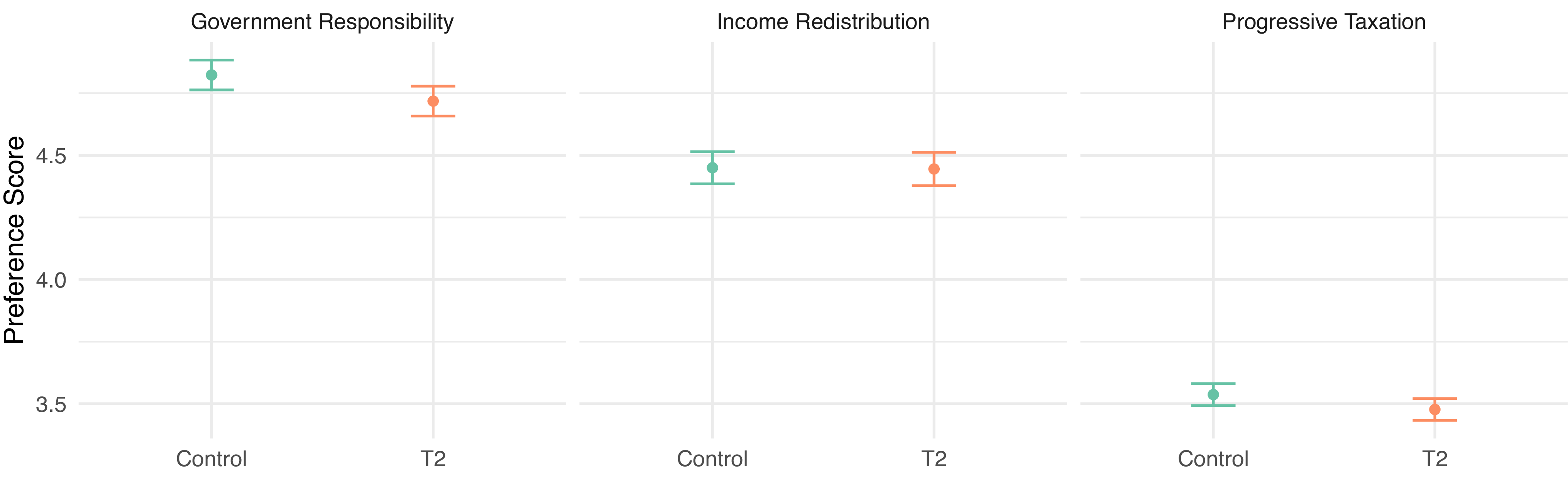
Inequality treatment (T2).

According to the National Statistical Office, as of 2021, the average annual income of individuals in the top 10 percent in South Korea was 130 million won, while that of individuals in the bottom 10 percent was 11 million won. This means that individuals in the top 10 percent earned approximately 11 times more per year than those in the bottom 10 percent. Moreover, the top 10 percent accounted for 49.4 percent of total national income, an increase of 14 percentage points from 35.6 percent in 2003.
The control group did not receive any information. After assigning the treatment information, we measured the dependent variables using three questions. The specific questions are as follows: (1) Government Responsibility: ‘It is the government’s responsibility to reduce the income gap between the rich and the poor’. (2) Income Transfer: ‘The government should expand redistribution, transferring income from high-income earners to low-income earners, to reduce income inequality’. This question addresses the common gap between concern about inequality and support for specific redistributive policies (Bartels, Reference Bartels2005). (3) Progressive Taxation: ‘Progressive tax rate should be increased’. Since redistribution from the rich and redistribution to the poor may involve different policies (Cavaillé and Trump, Reference Cavaillé and Trump2015), this question specifically focuses on attitudes towards progressive taxation.
For the first two questions (Government Responsibility and Income Transfer), respondents rated their agreement on a seven-point scale ranging from 1 (strongly disagree) to 7 (strongly agree). For the Progressive Taxation question, a five-point scale from 1 (strongly disagree) to 5 (strongly agree) was used.Footnote 6
After providing the treatment information and collecting responses to these questions, we conducted attention checks at the end of the survey to confirm that respondents correctly received their assigned treatment (or no treatment in the control group). The exact question wording of all main variables is included in the Appendix.
Because the full sample was randomly assigned, eliminating endogeneity concerns, we compared the mean values of the dependent variables between treatment groups and the control group. Specifically, to test the effect of information about income level, we compared Treatment Group 1 with the control group. To examine the effect of information about rising inequality, we compared Treatment Group 2 with the control group.
5. Results
This section presents the results of our analysis. We find evidence supporting our first hypothesis: that egocentric information influences preferences for redistribution. However, we do not find support for the second hypothesis related to the sociotropic motive, even across various subgroups. Overall, the empirical findings suggest that information plays a significant role in shaping individuals’ redistribution preferences primarily when it addresses egocentric concerns.
5.1. Egocentric information treatment
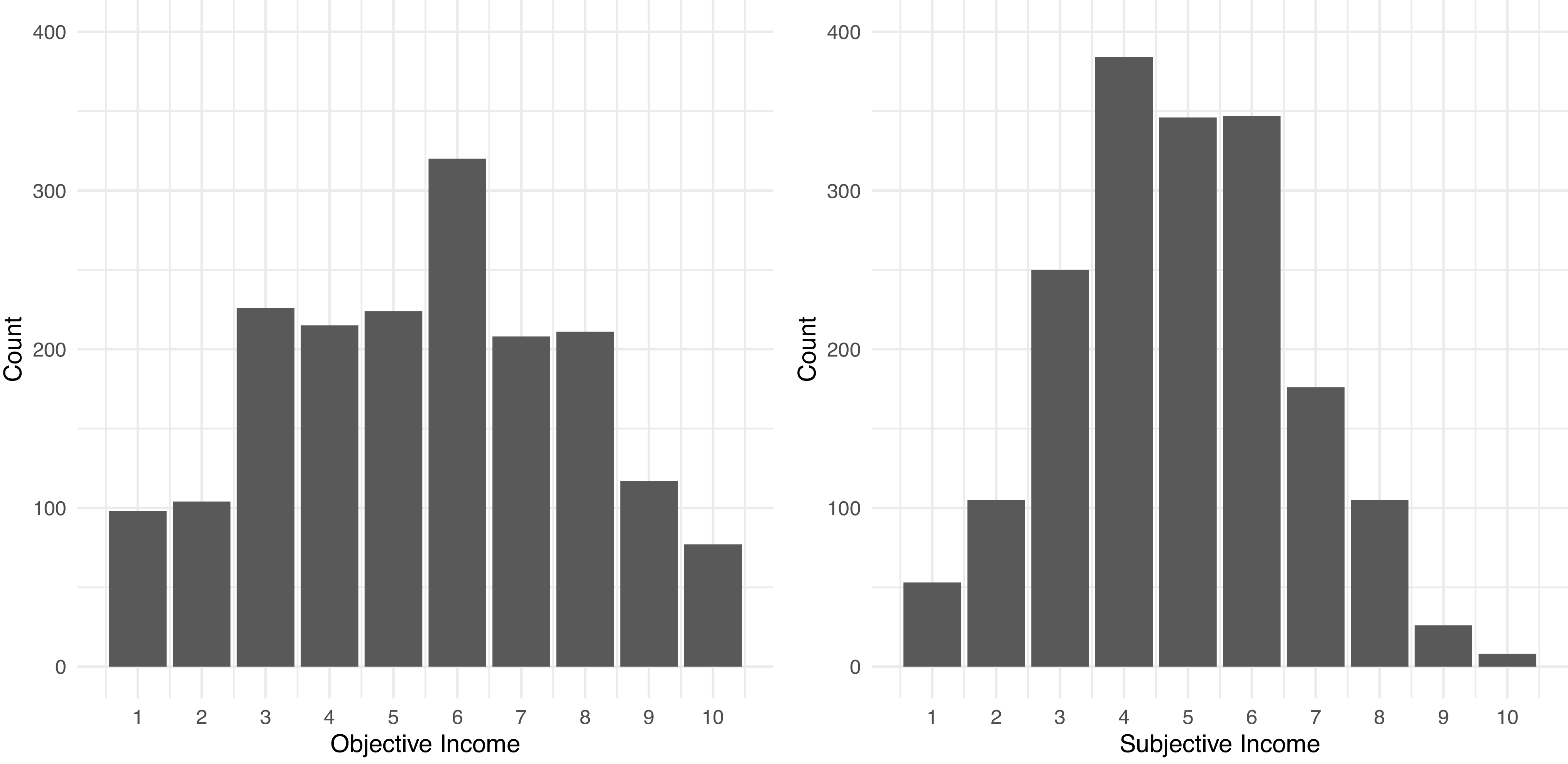
Figure 5 illustrates the distributions of objective and subjective income. The left panel shows the distribution of objective income, while the right panel presents the distribution of subjective income. There is a clear tendency for individuals to overestimate or underestimate their income position, often identifying as middle class. The left panel reveals a relatively even distribution across income deciles, whereas the right panel shows a pronounced concentration within the middle-income group (deciles four to six).
Distribution of objective and subjective income.

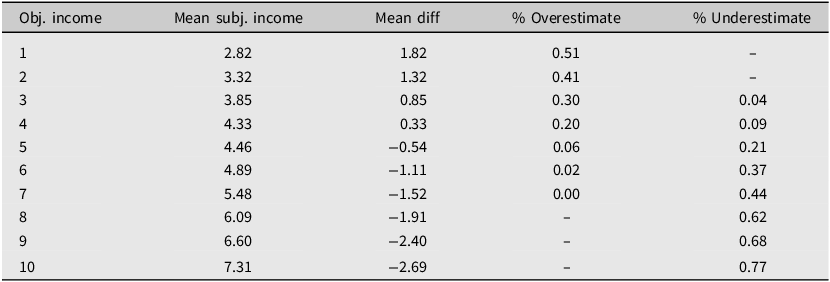
Table 1 provides a detailed breakdown of these findings. It reveals that a significant portion of wealthy individuals underestimate their actual income position, while many less affluent individuals overestimate their economic standing. For example, individuals in the richest bracket (the 10th objective income decile) perceive themselves, on average, to be in the 7.31st decile. As shown in the under ratio column, about 77% of them underestimate their true economic status, believing they are poorer than they actually are. Conversely, individuals in the 2nd objective income decile perceive themselves to be in the 3.32nd decile on average, and approximately 41% of them overestimate their income, believing they are wealthier than they actually are. These results indicate that Koreans generally have an inaccurate understanding of their position within the national income distribution.
Distribution of objective and subjective income

Table 1. Long description
The table has 10 rows and 5 columns. The columns are labeled Obj. income, Mean subj. income, Mean diff, % Overestimate, and % Underestimate. Each row represents a decile of objective income and corresponding mean subjective income, mean difference, percentage overestimate, and percentage underestimate. Row 1: Obj. income, 1; Mean subj. income, 2.82; Mean diff, 1.82; % Overestimate, 0.51; % Underestimate, -. Row 2: Obj. income, 2; Mean subj. income, 3.32; Mean diff, 1.32; % Overestimate, 0.41; % Underestimate, -. Row 3: Obj. income, 3; Mean subj. income, 3.85; Mean diff, 0.85; % Overestimate, 0.30; % Underestimate, 0.04. Row 4: Obj. income, 4; Mean subj. income, 4.33; Mean diff, 0.33; % Overestimate, 0.20; % Underestimate, 0.09. Row 5: Obj. income, 5; Mean subj. income, 4.46; Mean diff, -0.54; % Overestimate, 0.06; % Underestimate, 0.21. Row 6: Obj. income, 6; Mean subj. income, 4.89; Mean diff, -1.11; % Overestimate, 0.02; % Underestimate, 0.37. Row 7: Obj. income, 7; Mean subj. income, 5.48; Mean diff, -1.52; % Overestimate, 0.00; % Underestimate, 0.44. Row 8: Obj. income, 8; Mean subj. income, 6.09; Mean diff, -1.91; % Overestimate, -; % Underestimate, 0.62. Row 9: Obj. income, 9; Mean subj. income, 6.60; Mean diff, -2.40; % Overestimate, -; % Underestimate, 0.68. Row 10: Obj. income, 10; Mean subj. income, 7.31; Mean diff, -2.69; % Overestimate, -; % Underestimate, 0.77.
Next, we investigate the impact of treatment information on redistribution preferences by comparing the control group with Treatment Group 1, which received information about their income position. Before analysing the treatment effect, we conducted a covariate balance test to confirm that the sample was randomly assigned. Table C.0.1 in the Online Appendix presents the results of t-tests for covariate balance between the control and Treatment Group 1. The p-values indicate that the samples were randomly assigned, ruling out endogeneity concerns – except for liberal partisanship, which we control for in the regression analysis.
For the analysis, following previous experimental research by Cruces et al., (Reference Cruces, Perez-Truglia and Tetaz2013), we coded misperception as the degree to which an individual’s perceived income position differs from their objective position by two deciles or more.Footnote 7 For example, if an individual with an objective income in the 5th decile perceives themselves to be in the 4th, 5th, or 6th decile, they are labelled as ‘no-misperception’, indicating an accurate perception of their income position. If an individual’s objective income falls in the 8th decile but they perceive themselves to be in the 6th decile, they are categorized as part of the ‘underestimate’ group. Conversely, an individual with an objective income in the 3rd decile who perceives themselves to be in the 5th decile is classified as ‘overestimate’.
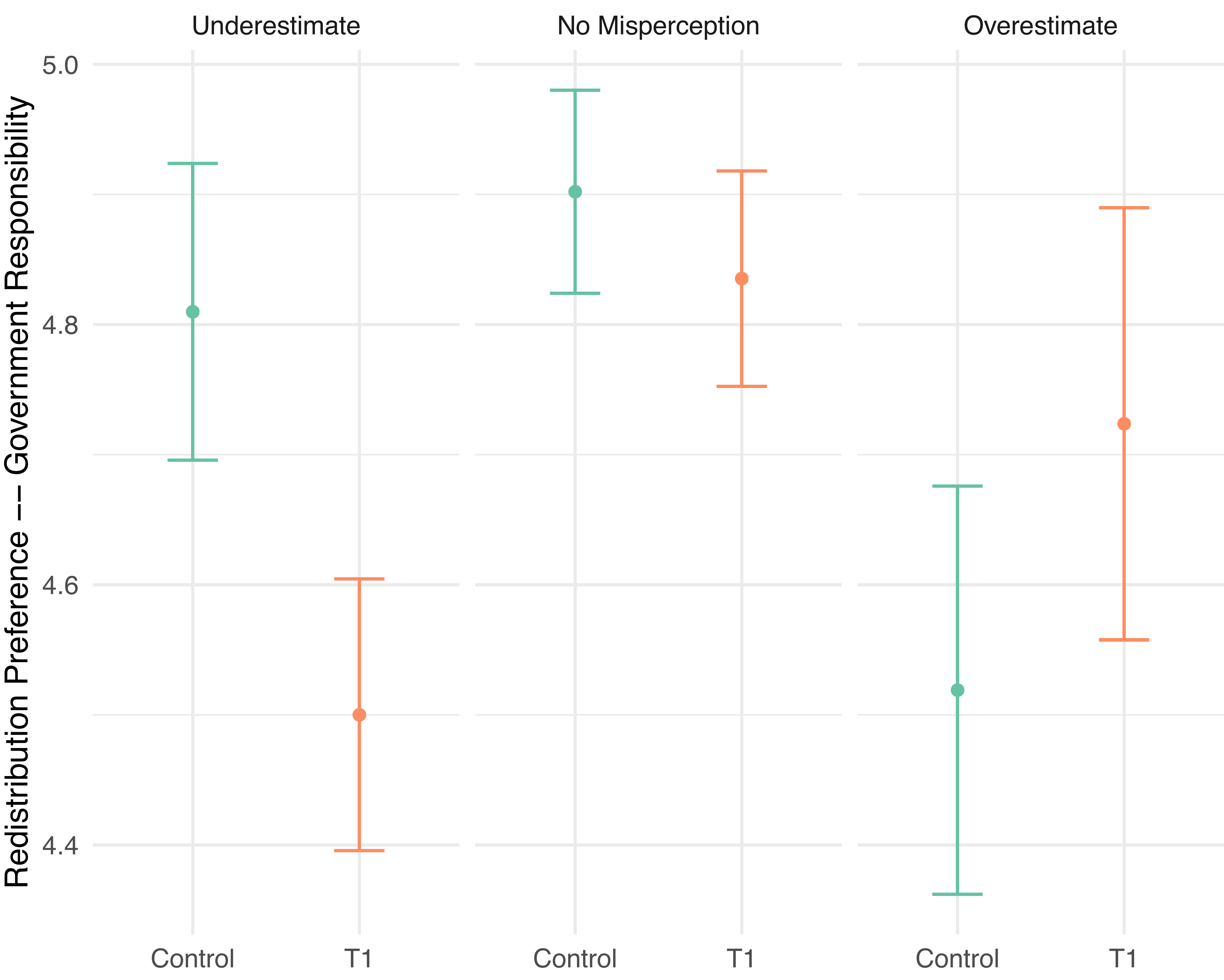
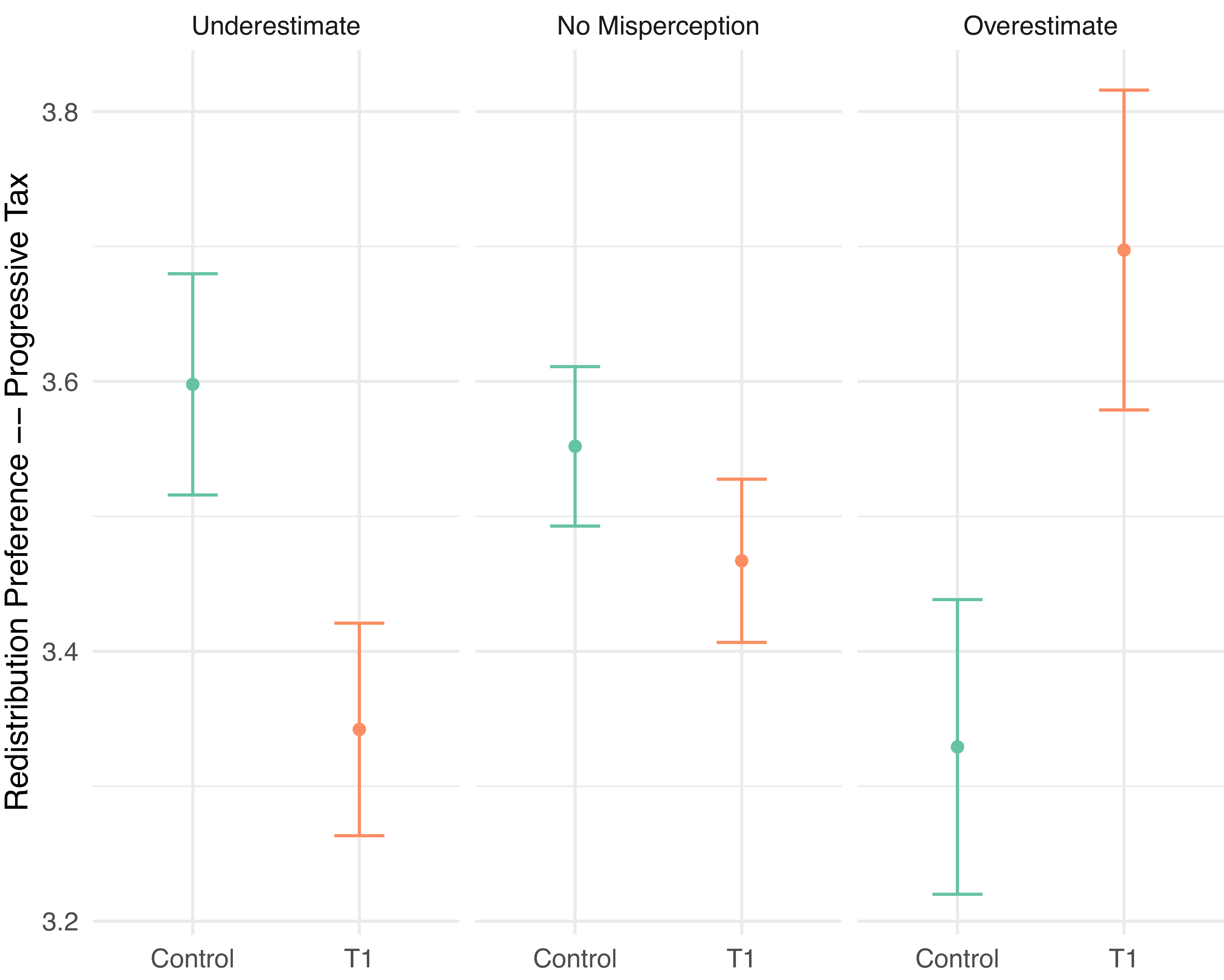
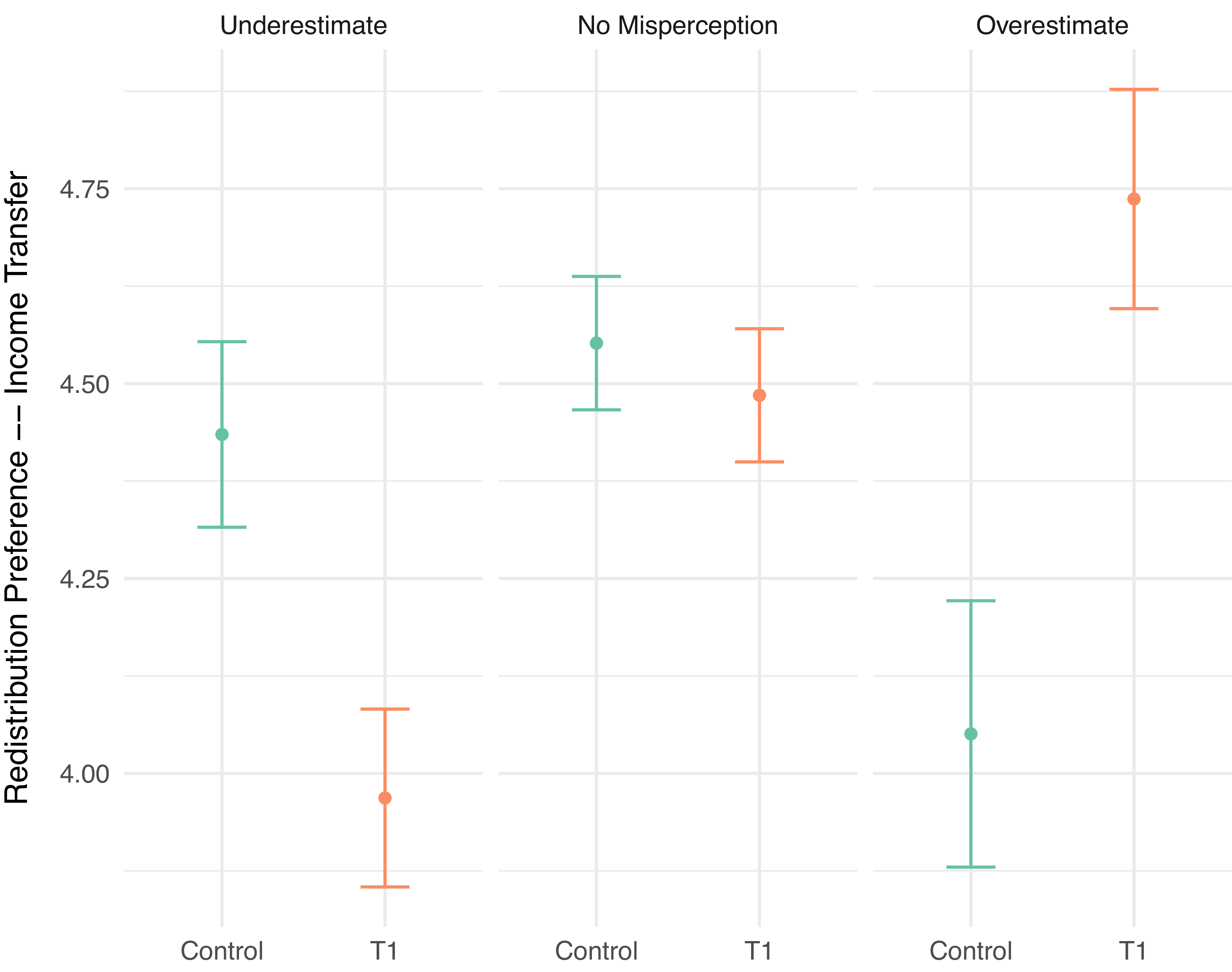
Figures 6–8 present the main results, illustrating the effects of providing accurate information about individuals’ income positions on their redistribution preferences, along with 95% confidence intervals. The dependent variables include redistribution to the poor (Government Responsibility), redistribution from the rich (Progressive Taxation), and redistribution through direct income transfers (Income Transfer).
T1 – gov responsibility.

T1 – progressive taxation.

T1 – income transfer.

Consistent with the egocentric motive hypothesis, individuals who underestimated their income position and received treatment information reported lower levels of support for redistribution. For instance, among those who underestimated their position, the average support for income transfer in the control group was 4.43. In contrast, those in Treatment Group 1, who received accurate income information, reported a significantly lower average score of 3.97. In other words, when relatively affluent individuals are informed that they are wealthier than they had believed, they become less supportive of redistributive policies. Conversely, among those who overestimated their income position, individuals who received information indicating they are poorer than they thought showed greater support for redistribution. The absence of any significant effects among the no-bias group further reinforces the conclusion that information about income position primarily influences redistribution preferences among those who misperceive their standing in the income distribution.Footnote 8
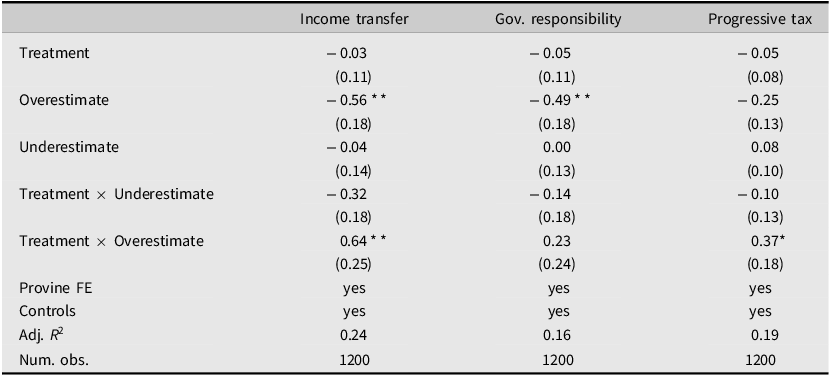
To demonstrate the heterogeneous effects of the information treatment, Table 2 presents the results of OLS regression analyses using data from the control group and Treatment Group 1. These models control for demographic, regional, and political variables, including partisanship. Consistent with the patterns shown in the previous figures, the results indicate that providing accurate income information significantly alters preferences for redistribution, depending on individuals’ actual economic status. Among individuals who overestimated their income position, the treatment has a positive effect on redistribution preferences across all dependent variables. In contrast, for those who underestimated their position, the treatment is negatively associated with support for redistribution. Notably, the reduction in support among the ‘underestimate’ group is smaller in magnitude than the increase in support among the ‘overestimate’ group. This suggests that people are more responsive to information indicating that they are poorer than they believed, compared to information revealing they are richer. Overall, these findings highlight the substantial impact of the information treatment and suggest that individuals’ preferences for redistribution are shaped by self-interest – particularly when they are made aware of their true economic position.
OLS regression for income treatment (T1)

Table 2. Long description
The table presents the results of OLS regression analyses comparing the effects of income treatment on redistribution preferences. It has three columns labeled Income transfer, Gov. responsibility, and Progressive tax, and eight rows labeled Treatment, Overestimate, Underestimate, Treatment × Underestimate, Treatment × Overestimate, Province FE, Controls, Adj. R², and Num. obs. Each row contains values corresponding to the columns. The table shows how different factors influence preferences for redistribution, with notable effects observed for individuals who overestimated or underestimated their income position.
Note: * * *p < 0.001; * *p < 0.01; *p < 0.05.
Another notable finding is that we did not observe a statistically significant treatment effect when redistribution preference was measured using the government responsibility question, unlike the income transfer and progressive taxation questions. This discrepancy likely stems from the fact that the latter two questions use more explicit and direct language. While the government responsibility question is widely used as a proxy for redistribution preference, our results suggest that it may not fully capture the nuances of public attitudes towards redistribution policies when used in isolation. Furthermore, we interpret the absence of significant effects on the government responsibility question as being consistent with a distinction between instrumental policy preferences and ideological beliefs about the role of the government. Beliefs about government responsibility are typically rooted in long-standing ideological orientations, shaped by political socialization and normative commitments, and are therefore relatively stable over time. While egocentric information about relative income may prompt individuals to update their preferences regarding specific redistributive instruments – such as taxes or transfers – it is less likely to overturn views about the government’s role. From this perspective, the null effects observed for government responsibility may reflect ideological anchoring rather than informational irrelevance.
To assess the robustness of our main findings regarding the information-provision treatment (Treatment 1), we re-analyse the data using alternative thresholds for misperception. In our baseline specification, misperception is defined as a discrepancy of two deciles or more between an individual’s perceived and objective income positions. This coding scheme allows for a two-decile margin of error. In the tables below, we report results using alternative coding schemes. Table E.3.1 in the Online Appendix shows the results from using one decile as a threshold. The general conclusion from our main analysis still holds in these models, that individuals who underestimated their income position become less supportive to re distributive policies. Table E.3.2 in the Online Appendix reports results using the raw misperception score as a continuous variable. This variable ranges from −9 to 9, where negative values indicate underestimation and positive values indicate overestimation of one’s income position. These results are again consistent with our primary analysis. The coefficient for the interaction term is positive and statistically significant, indicating that the treatment increases support for redistribution more significantly as the degree of overestimation increases.
Additionally, we apply an IRT-based approach to all three of our dependent variables. Specifically, we estimate the hierarchical IRT model developed by Zhou (Reference Zhou2019) and Stoetzer et al., (Reference Stoetzer, Zhou and Steenbergen2025). Rather than analysing the treatment effect on each dependent variable separately, we assume that all three variables reflect different dimensions of a single latent construct: redistribution preference. Under this assumption, and using the IRT framework, we leverage all three dependent variables jointly to estimate the treatment effect on the latent variable. The hierarchical IRT model employs the EM algorithm for estimation. As shown in Table E.2.1 in the Online Appendix, the results are consistent with our earlier findings. The information treatment significantly increased redistribution preference among those who initially overestimated their income position, while it decreased redistribution preference among those who underestimated it.
5.2. Sociotropic information treatment
In this section we compare the control group to the treatment 2 group that receives information about national income inequality. Table C.0.2 in the Online Appendix shows the result of the covariate balance test. The p-value column demonstrates that the sample was randomly assigned and well-balanced, ruling out the endogeneity issue.
Figure 9 presents the key findings related to the second hypothesis. Contrary to the sociotropic motive hypothesis, there is no statistically significant difference between the control group and treatment group 2. Providing information about national income inequality does not change the aggregate support for redistribution, and this holds across three dependent variables. Put differently, those who learn about rising income inequality do not reveal more support for redistribution compared to those who do not learn about the inequality trend.
Inequality treatment (T2).

In Online Appendix Table E.5.1, we examine whether the null effect of Treatment 2 is driven by prior perception of the level of inequality and information saturation due to the widespread media coverage of inequality in the Korean context. To test this possibility, we use one of our pretreatment questions that asks about respondents’ perceptions of national-level inequality in Korea. The logic is that if the null effect is primarily driven by people being already well informed about national inequality, then we should at least observe some treatment effect among respondents who initially perceived inequality as less severe. To test this possibility, we tested the main model with the interaction term between Treatment 2 and respondents’ pre-treatment perceptions of national-level inequality. However, the results show that providing national inequality information had no significant impact on redistribution preferences even among individuals who did not previously perceive inequality as severe. This suggests that even individuals with limited prior awareness of existing inequality do not revise their preferences for redistribution after being presented with objective information. Taken together, these results imply that national-level inequality, when presented in abstract informational terms, may not be a salient or compelling factor for individuals when forming or updating their preferences for redistribution.
5.3. Additional analysis on sociotropic information treatment
Why does information about national income inequality have a null effect, even among respondents who initially underestimated inequality? Although our theoretical framework predicted that information about national income inequality would increase support for redistribution, Treatment 2 produced no significant average effect despite providing relatively direct and salient information. To better understand this unexpected finding, we conducted a set of exploratory subgroup analyses. These analyses were developed after observing the main results and should therefore be interpreted as exploratory rather than confirmatory.
We examined three potential moderators: subjective income, trust in government, and belief in meritocracy. First, subjective income may shape responsiveness to inequality information because lower-income individuals are generally less politically informed and may react more strongly when confronted with evidence of economic disparity. We therefore re-estimated the main models including an interaction between Treatment 2 and subjective income.Footnote 9 As reported in Table E.5.2 of the Online Appendix, subjective income significantly moderates the treatment effect only for government responsibility, while no moderation is observed for Income Transfer or Progressive Taxation.
We next examined whether trust in government and belief in meritocracy condition responses to inequality information. Individuals with greater trust in government may be more likely to believe redistribution can reduce inequality (Kuziemko et al., Reference Kuziemko, Norton, Saez and Stantcheva2015), while meritocratic beliefs may shape whether inequality is viewed as fair or unjust (Alesina and Angeletos, Reference Alesina and Angeletos2005). However, neither factor significantly moderates the treatment effect across our three outcome measures (Tables E.5.3 and E.5.4). Overall, these exploratory analyses provide little evidence that the null effect of inequality information is driven by heterogeneity in subjective income, trust in government, or meritocratic beliefs, with the exception of a single significant interaction for government responsibility.
6. Discussion and conclusion
The findings from our survey experiment reveal that when provided with accurate information about their actual income position, individuals’ preferences for redistribution adjust in line with their economic self-interest. Specifically, those who overestimate their income position tend to increase support for redistribution upon receiving corrective information, while those who underestimate their position tend to reduce their support. Conversely, providing information about rising national income inequality does not appear to influence redistribution preferences, even among respondents who were previously unaware of the high inequality. This null effect persists across various subgroups, including distinctions by income level, trust in government, and belief in meritocracy. These findings suggest that preferences for redistribution are driven by individuals’ perceptions of their own economic status rather than by sociotropic concerns about broader national inequality.
This paper offers several important implications and suggests promising avenues for future research. First, it contributes to the literature on redistributive politics by highlighting the differential impact of distinct types of information. Specifically, our survey design and findings hold both methodological and theoretical contributions. While much of the existing literature examines either income-rank information or inequality information in isolation, few studies have directly compared the effects of income and inequality information. Our experimental design, which compares two types of information, extends this line of research by showing the relative weight of self-relevant versus national information. The results show that egocentric motivations have a stronger influence on redistribution preferences than sociotropic considerations. Theoretically, this suggests that the political consequences of inequality depend not simply on aggregate levels of inequality but on whether such information reshapes individuals’ perceived material self-interest. In doing so, the paper refines existing accounts of inequality and redistribution by specifying the mechanism through which inequality becomes politically consequential.
At the same time, further research is needed to draw firmer conclusions about these relationships. One possible explanation for our findings is that the two treatments differ not only in informational content but also in personal salience. Information about one’s own income rank is inherently more self-relevant than information about aggregate inequality, making it difficult to disentangle the effects of informational content from those of personal relevance. Future research should therefore develop experimental designs that more cleanly isolate these mechanisms by holding treatment salience constant while varying informational content.
Second, this study disaggregates the concept of redistribution into three distinct dimensions – government responsibility, income transfer, and progressive taxation – to examine how information affects diverse facets of redistribution preferences. Notably, treatment group 1’s results reveal a more pronounced impact of income position information on support for income transfer policies compared to the government responsibility question. This pattern suggests that individuals may not fully understand how redistribution works in practice and therefore may struggle to link concerns about inequality to specific policy instruments. In this sense, abstract survey questions about redistribution may fail to capture what respondents actually mean when they express support. By highlighting these divergences across policy dimensions, the findings resonate with Margalit and Raviv (Reference Margalit and Raviv2024) and reinforce the need for more concrete and policy-specific measures to capture genuine redistributive preferences.
Third, the limited relationship observed between national inequality and redistribution preferences points to important directions for future research on how concerns about inequality develop and influence redistributive attitudes at both macro and micro levels. Building on Kuziemko et al., (Reference Kuziemko, Norton, Saez and Stantcheva2015)’s emphasis on the role of trust in government, future studies could explore how macro-level factors – such as government quality, transparency, and institutional trust – moderate the connection between perceptions of inequality and support for redistribution. At the micro-level, it would be valuable to examine how everyday exposure to inequality shapes redistribution preferences and to uncover the underlying mechanisms driving this relationship (Franko, Reference Franko2016; Sands, Reference Sands2017; Condon and Wichowsky, Reference Condon and Wichowsky2020; Sands and Kadt, Reference Sands and de Kadt2020). Additionally, given the significant role of media in shaping political beliefs, including perceptions of upward mobility (Kim, Reference Kim2023), future research should investigate how media consumption influences attitudes towards redistributive policies. Moreover, it would be interesting to broaden the geographical scope of studies on redistribution preferences, as most existing work has focused primarily on Europe and the U.S., with few exceptions (Hoy and Mager, Reference Hoy and Mager2021). Developing countries, in particular, present a compelling context due to their combination of high inequality and often lower state capacity, which leads to heightened salience of inequality alongside low trust in government policies. Investigating how individuals in such settings respond to information about income disparity could yield important insights into the interplay between inequality, trust, and redistribution preferences across diverse political and economic environments.
Finally, one limitation of this study concerns the measurement of asset wealth. Although we control for baseline homeownership, this binary indicator cannot capture the substantial variation in housing and real estate values among homeowners. This limitation is particularly important in the Korean context, where distributive conflict is increasingly structured by asset wealth in addition to labour income. Consequently, individuals with similar income positions may differ substantially in accumulated housing wealth, making it difficult to fully disentangle the effects of income and asset wealth on redistributive preferences. Future research should therefore incorporate more detailed measures of household assets, such as continuous measures of property value or broader net wealth, and examine whether individualized information about one’s position in the asset distribution influences redistributive preferences in ways analogous to income-rank information.
Supplementary material
The supplementary material for this article can be found at https://doi.org/10.1017/S1468109926100462.
Data availability statement
All data used in this study are shared at Harvard Dataverse (https://dataverse.harvard.edu/dataset.xhtml?persistentId=doi:10.7910/DVN/WYUQPS).
Funding statement
This work was supported by the National Research Foundation of Korea funded by the Korean government [NRF-2022S1A3A2A01089543] and a Korea University grant [K2534881].
Competing interests
None.
AI tools
We used AI tools to correct grammatical errors in the writing.




 Open access

