

Published online by Cambridge University Press: 10 May 2013

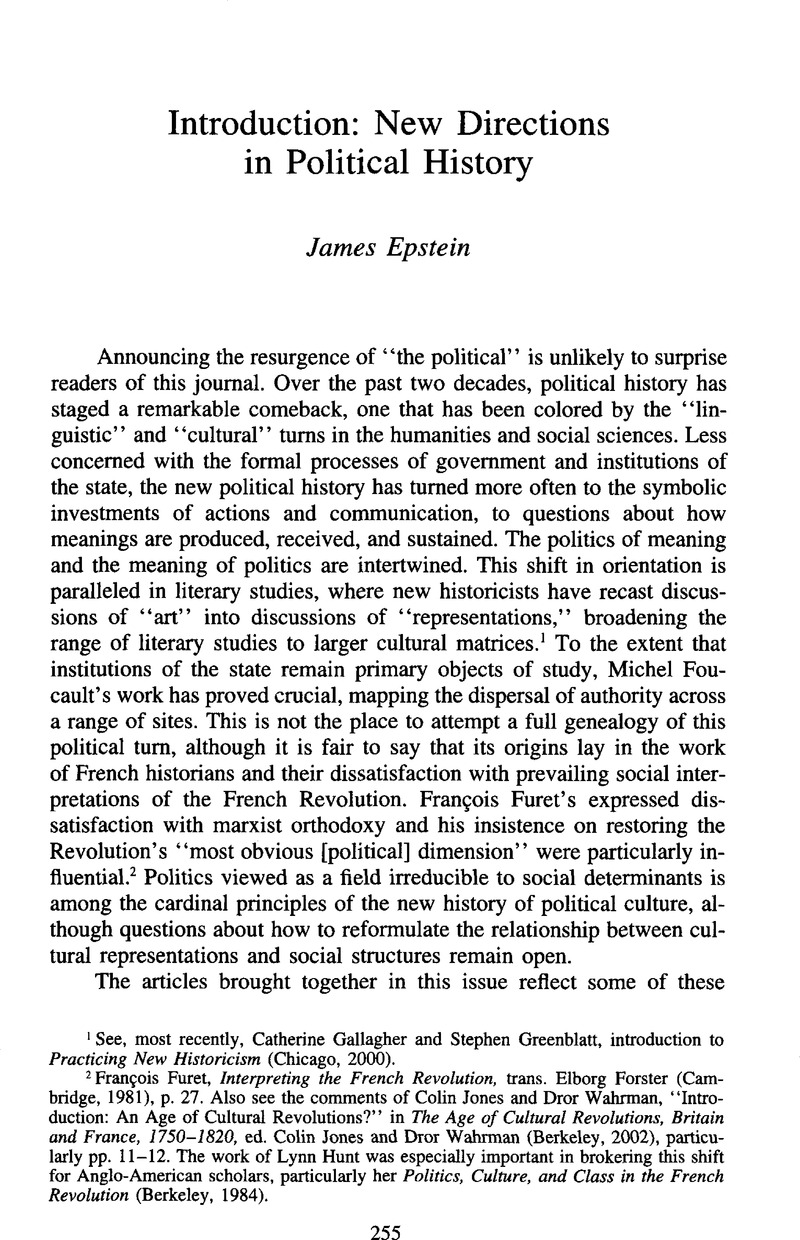
1 See, most recently, Gallagher, Catherine and Greenblatt, Stephen, introduction to Practicing New Historicism (Chicago, 2000).
2 Furet, François, Interpreting the French Revolution, trans. Forster, Elborg (Cambridge, 1981), p. 27. Also see the comments of Jones, Colin and Wahrman, Dror, “Introduction: An Age of Cultural Revolutions?” in The Age of Cultural Revolutions, Britain and France, 1750–1820, ed. Jones, Colin and Wahrman, Dror (Berkeley, 2002), particularly pp. 11–12. The work of Lynn Hunt was especially important in brokering this shift for Anglo-American scholars, particularly her Politics, Culture, and Class in the French Revolution (Berkeley, 1984).
3 Burke, Edmund, Reflections on the Revolution in France: A Critical Edition, ed. Clark, J. C. D. (Stanford, Calif., 2001), p. 229.
4 de Baecque, Antoine, Glory and Terror: Seven Deaths under the French Revolution, trans. Mandell, Charlotte (New York, 2001), p. 7.
5 Nora, Pierre, “Between Memory and History: Les Lieux de Mémoire,” Representations 26 (Spring 1989): 7–25.
6 For what is at stake more generally, see Reddy, William M., “Against Constructionism: The Historical Ethnography of Emotions,” Current Anthropology 18, no. 3 (1997): 327–51.