Introduction
Using morphophonological constructions involves changes in the surface phonological forms of stems and suffixes and thus requires the phonological analysis of morphemes. Morphophonological patterns are complex to acquire and are likely to entail many errors during development (Buckler & Fikkert, Reference Buckler and Fikkert2016; Pierrehumbert, Reference Pierrehumbert2003; Tomas et al., Reference Tomas, Demuth and Petocz2017a; Reference Tomas, van de Vijver, Demuth and Petocz2017b; Zamuner, Kerkhoff, & Fikkert, Reference Zamuner, Kerkhoff and Fikkert2012). Differences in production accuracies of allomorphs, i.e., phonologically variant forms of morphemes, have been observed in many languages with some allomorphic forms reaching adult-like accuracies before others (Bybee & Slobin, Reference Bybee and Slobin1982; Kerkhoff, Reference Kerkhoff2007; Matthews & Theakston, Reference Matthews and Theakston2006; Rispens & de Bree, Reference Rispens and de Bree2014; Royle & Stine, Reference Royle and Stine2013; Song, Sundara, & Demuth, Reference Song, Sundara and Demuth2009; Tomas, et al., Reference Tomas, Demuth, Smith-Lock and Petocz2015; Tomas et al., Reference Tomas, Demuth and Petocz2017a, Reference Tomas, van de Vijver, Demuth and Petocz2017b; Zamuner et al., Reference Zamuner, Kerkhoff and Fikkert2012, amongst others). Some researchers attribute this variation to effects of type or phonotactic frequencies mostly (among others Blom, Paradis, & Duncan, Reference Blom, Paradis and Duncan2012; Bybee, Reference Bybee2007; Bybee & Slobin, Reference Bybee and Slobin1982; de Bree & Kerkhoff, Reference de Bree and Kerkhoff2010; Marchman, Reference Marchman1997; Matthews & Theakston, Reference Matthews and Theakston2006; Zamuner et al., Reference Zamuner, Kerkhoff and Fikkert2012), while others acknowledge the phonological characteristics of the stems that give rise to the allomorphs which lead to more or less phonologically complex representations (among others Berko, Reference Berko1958; Marchman, Wulfeck, & Weismer, Reference Marchman, Wulfeck and Weismer1999; Marshall & Van der Lely, Reference Marshall and Van der Lely2006; Mealings, Cox, & Demuth, Reference Mealings, Cox and Demuth2013; Oetting & Horohov, Reference Oetting and Horohov1997; Song et al., Reference Song, Sundara and Demuth2009; Tomas et al., Reference Tomas, Demuth and Petocz2017a; Tomas et al., Reference Tomas, Demuth, Smith-Lock and Petocz2015).
The main aim of the present study was to investigate possible factors involved in the production of morphophonological patterns: phonological characteristics of the stem, phonotactic frequencies of the stem and allomorph, and type frequencies of the allomorphs. In previous studies these factors have been studied in isolation. In the current study the goal was to investigate the relative influence of these three factors on the production of the Dutch diminutive, which has five allomorphs. Production accuracies of these allomorphic forms were investigated and we analysed what kind of substitutions were produced, i.e., which allomorph was used instead of the expected allomorph. Below, we will first report on previous studies that have found a protracted course of acquisition of some allomorphs and the factors they attribute this to. Subsequently, the formation of the Dutch diminutive will be expanded on, followed by a more extensive overview of the goals and expectations of the current study.
The acquisition of morphophonological phenomena
The acquisition of a range of morphophonological phenomena has been studied in different languages and across different populations. The general finding of these studies is that morpho(phono)logical processes, such as the past tense or subject–verb agreement, are not acquired ‘all-at-once’, but that variation in the speed of acquisition exists between the different allomorphic forms reflecting these phenomena (Berko, Reference Berko1958; Blom, Reference Blom2003; Blom et al., Reference Blom, Paradis and Duncan2012; Kerkhoff & de Bree, Reference Kerkhoff, de Bree, Kerkhoff, de Lange and Leicht2004; Marchman et al., Reference Marchman, Wulfeck and Weismer1999; Oetting & Horohov, Reference Oetting and Horohov1997; Paradis, Tulpar, & Arppe, Reference Paradis, Tulpar and Arppe2016; Rispens & de Bree, Reference Rispens and de Bree2014). For example, the regular past tense in English can be expressed by three allomorphs /t/, /d/, and /id/. Several studies have reported that the past tense forms of verbs that take the syllabic /id/ allomorph are acquired more slowly by typically developing (TD) children, children with English as their second language, and in children with language impairments (Blom & Paradis, Reference Blom and Paradis2013; Marchman, Reference Marchman1997; Matthews & Theakston, Reference Matthews and Theakston2006; Oetting & Horohov, Reference Oetting and Horohov1997; Paradis et al., Reference Paradis, Tulpar and Arppe2016; Tomas et al., Reference Tomas, Demuth and Petocz2017a). Different explanations have been given for this protracted acquisition of some allomorphs. Frequency of the stems and stem+allomorph combinations and complexity of the morphophonological pattern may play a role in morphophonological development. The sections that follow will first expand on studies showing effects of frequency and will then describe studies that have found that the phonological complexity of the combination of stem+allomorph has an effect on production.
Previous research has shown that the higher the type frequency, the earlier the allomorph is acquired (Blom et al., Reference Blom, Paradis and Duncan2012; Bybee, Reference Bybee2007; Bybee & Slobin, Reference Bybee and Slobin1982; Marchman, Reference Marchman1997; Matthews & Theakston, Reference Matthews and Theakston2006). Type frequency is a measure of how many items a certain pattern, such as an allomorph, is applicable to, and has been shown to play a role in morphological productivity (Bybee, Reference Bybee1985, Reference Bybee2007). The allomorph that is attached most often to known items will most probably also be applied to new items (Bybee, Reference Bybee2007). It is, for example, assumed that highly frequent past tense markers, i.e., with the highest type frequency, are the most productive. In the case of the English past tense, the /id/ allomorph has the lowest type frequency and is also the least productive (Blom & Paradis, Reference Blom and Paradis2013; Blom et al., Reference Blom, Paradis and Duncan2012; Marchman, Reference Marchman1997; Matthews & Theakston, Reference Matthews and Theakston2006; Tomas et al., Reference Tomas, Demuth and Petocz2017a). As will be elaborated on in the next section, the few studies that have investigated the Dutch diminutive have also found that type frequencies of the different diminutive allomorphs affected production accuracies (Den Os & Harder, Reference Den Os and Harder1987; Peelaerts, Reference Peelaerts2008; Snow, Smith, & Hoefnagel-Höhle, Reference Snow, Smith and Hoefnagel-Höhle1979). In contrast, Rispens and de Bree (Reference Rispens and de Bree2014) did not find an effect of type frequency on production accuracies of the Dutch past tense in TD children and children with language impairment. They found that children produced the voiceless /tә/ past tense allomorph more accurately compared to the voiced /dә/ allomorph, although the /dә/ allomorph has a higher type frequency (62%) compared to the /tә/ allomorph (38%). However, the final consonants of the verb stems included in their study combined with the allomorph /tә/ had a higher phonotactic frequency than the final consonants of verb stems and /dә/. They argued that this made it easier for the children to use /tә/ as the combinations of stem+/tә/ are more frequent in Dutch than stem+/dә/. Phonotactic probability or phonotactic frequency is defined as the probability/frequency that adjacent phonemes (biphones) appear together in a language. In several previous studies effects of phonotactic frequency on the production of morphophonological phenomena have been reported as well (de Bree & Kerkhoff, Reference de Bree and Kerkhoff2010; Kerkhoff, Reference Kerkhoff2007; Zamuner, Kerkhoff, & Fikkert, Reference Zamuner, Kerkhoff and Fikkert2006; Zamuner et al., Reference Zamuner, Kerkhoff and Fikkert2012).
Next to these frequency accounts, explanations based on phonological and/or phonetic mechanisms have been given for findings in studies investigating English past tense, plural, and third person singular marking. For example, effects of coda complexity, articulatory difficulties, and perceptual saliency have been found (Berko, Reference Berko1958; Marchman et al., Reference Marchman, Wulfeck and Weismer1999; Marshall & Van der Lely, Reference Marshall and Van der Lely2006; Mealings et al., Reference Mealings, Cox and Demuth2013; Oetting & Horohov, Reference Oetting and Horohov1997; Song et al., Reference Song, Sundara and Demuth2009; Tomas et al., Reference Tomas, Demuth, Smith-Lock and Petocz2015; Tomas et al., Reference Tomas, Demuth and Petocz2017a). Variations in the phonological characteristics of stem+allomorph combinations thus also impact on children's ability to use morphemes. For example, Song et al. (Reference Song, Sundara and Demuth2009) tested the third person singular in English TD children between the ages of one and three-and-a-half. They found that children produce the third person singular suffix /s/ more accurately in phonologically simple coda contexts where there is no consonant cluster in the resulting coda, e.g., sees, as compared to complex coda contexts, where production of the stem + suffix results in a coda containing a consonant cluster which is more complex relative to a singleton coda, e.g., needs. These findings thus provide support for the role of phonological complexity in morphophonological accuracy. Furthermore, results of many studies indicate that children tend to acquire syllabic allomorphs (in which the suffix is expressed by adding a syllable to the stem) later than segmental ones, in which the suffix is expressed by adding a sound to the stem, which does not lead to an addition of a syllable (Berko, Reference Berko1958; Marchman, Reference Marchman1997; Matthews & Theakston, Reference Matthews and Theakston2006; Mealings et al., Reference Mealings, Cox and Demuth2013; Song et al., Reference Song, Sundara and Demuth2009; Tomas et al., Reference Tomas, Demuth, Smith-Lock and Petocz2015; Tomas et al., Reference Tomas, Demuth and Petocz2017a). In the case of the English past tense and plural, stems that take the syllabic allomorphs (/iz/ and /id/) end in an alveolar (past tense) or sibilant (plural) phoneme, which might make children think that these stems are already inflected (Berko, Reference Berko1958; Marchman, Reference Marchman1997; Matthews & Theakston, Reference Matthews and Theakston2006). However, Mealings et al. (Reference Mealings, Cox and Demuth2013) tested the English plural in two-year-olds and did not find any evidence for this hypothesis. Instead they argued that their results demonstrated that the children understood that something needed to be added to the noun, but had difficulty articulating the entire morpheme as it involves a complex phonemic sequence. Testing derivational morphology in children between the ages of eight and ten, Jarmulowicz and Hay (Reference Jarmulowicz and Hay2009) showed that children found it easier to produce derived forms that were phonologically consistent with their noun stems in terms of stress placement and syllabification, e.g., kind–kindness, than words that exhibited changes, e.g., alphabet–alphabetic. Together these studies indicate that the variable production accuracies of allomorphs seem to be related to the phonological characteristics and complexity of the stems to which the allomorphs are attached.
In sum, the aforementioned studies provide evidence for the importance of both frequency, not only type but also phonotactic frequency, and the phonological characteristics of the stems and allomorphs. However, the relative impact of these factors on morphophonological acquisition is unclear as these factors are generally studied in isolation. The goal of this study is to gain a better understanding of why some allomorphs are acquired before others by focusing on the Dutch diminutive. By doing so it is possible to evaluate the effects of frequency and complexity of the phonological characteristics as the Dutch diminutive entails five allomorphs based on different phonological characteristics and with varying type and phonotactic frequencies (see below).
The Dutch diminutive
In Dutch, diminutives have been used relatively frequently for a long time; they have been encountered in texts from the Middle-Dutch period, and are still a frequent phenomenon in everyday language. The most common way of forming a diminutive is by attaching the diminutive suffix to nouns (hond-je ‘dog-DIM’). However, it can also be attached to other word classes, a process that results in a change of word class: adjectives (adjective klein + DIM tje > noun kleintje; adjective ‘little’ + DIM > noun ‘little one’), verbs (verb speel + DIM tje > noun speeltje; verb ‘play’ + DIM > noun ‘small toy’), and a few prepositions (preposition uit + DIM je > noun uitje; preposition ‘out’ + DIM > noun ‘short trip’). Semantically, the diminutive usually expresses smallness in that the referent is a smaller version of its sort but it can also express the fact that a referent is a great deal smaller than the speaker, i.e., a human being (Bakema, Defour, & Geeraerts, Reference Bakema, Defour and Geeraerts1993; Peelaerts, Reference Peelaerts2008). As in many languages, the diminutive can also express an affective meaning. In colloquial Dutch it is considered normal to use the diminutive form in other instances as well. Examples of diminutives used in this way are collegaatje (colleague + DIM suffix referring to an adult colleague); vriendje (boyfriend + DIM suffix referring to an adult); wijntje/biertje (glass of wine/beer + DIM suffix in which no small glass is intended).
The Dutch diminutive consists of five allomorphs, /jə/, /tjə/, /pjə/, /kjə/, and /ətjə/, which are attached to the noun stems based on the phonological characteristics of these stems. A summary of the regularities of the context in which the different allomorphs can appear as provided by Booij (Reference Booij1995) is listed in (1) to (5).
(1) /jə/ appears after stem-final obstruents
Hof ‘yard’ hofje
Baas ‘owner’baasje
Huis ‘house’ huisje
Kat ‘cat’ katje
(2) /pjə/ appears after /m/ except if preceded by a short vowel
Boom ‘tree’ boompje
Duim ‘thumb’ duimpje
Raam ‘window’ raampje
Zalm ‘salmon’ zalmpje
(3) /kjə/ appears after /η/ except when there is no stress on the penultimate syllable
Woning ‘home’ woninkje
Koning ‘king’ koninkje
Botsing ‘crash’ botsinkje
Ontploffing ‘explosion’ ontploffinkje
(4) /tjə/ appears after /n/, /r/, or /l/ except if preceded by a short vowel
Laan ‘lane’ laantje
Veer ‘feather’ veertje
Schoen ‘shoe’ schoentje
Boon ‘bean’ boontje
(5) /ətjə/ appears after sonorant consonants if preceded by a short vowel with primary or secondary stress
Bal ‘ball’ balletje
Bom ‘bomb’ bommetje
Tekening ‘drawing’ tekeningetje
Ring ‘ring’ ringetje
The formation of the diminutive form can be described by three processes by which the underlying form /tjә/ also can surface as /jə/, /pjə/, /kjə/, and /ətjə/ (Booij, Reference Booij1995; Van de Weijer, Reference Van de Weijer2002). In the case of /pjə/ and /kjə/, the diminutive form is determined by place assimilation: the first consonant of the allomorph shares the place of articulation with the final consonant of the stem and replaces the /t/ of /tjә/. The allomorph /pjə/ is used in the case of stems ending in a nasal labial, for example raam-pje ‘window’. Stems ending in a nasal velar take the allomorph /kjә/, for instance in koning-kje ‘king’. To illustrate place assimilation; in the case of the first example the final consonant of the noun raam and the first consonant of the allomorph /pjә/ are both bilabial and thus have a similar place of articulation.
In the case of stems ending in an obstruent, combining an obstruent with /tjə/ results in a complex obstruent cluster which is subject to the phonological process of t-deletion in Dutch (Booij, Reference Booij1995). For example, dop ‘cap’ + tje results in dopje after t-deletion in doptje. Thus, /jə/, /pjə/, /kjə/ diminutives are derived by stem + tje and are subject to the Dutch phonological processes place assimilation and t-deletion.
The insertion of an /ә/ in front of /tjə/ follows from different phonological processes. For stems ending in a velar sonorant, stress placement on the stem (ultimate vs. penultimate) and the number of syllables is relevant; compare koning-kje ‘king’ versus ring-etje ‘ring’. For stems ending in a sonorant labial or alveolar, the length of the vowel is relevant; compare boom-pje ‘tree’ with a long vowel versus bom-etje ‘bomb’ with a short vowel; similarly zoon-tje ‘son’ versus zon-etje ‘sun’. The allomorph /ətjə/ is therefore derived by inserting an /ə/ in front of /tjə/ when the stem ends in a velar sonorant and stress lies on the ultimate syllable or when the stem ends in a sonorant labial or alveolar and the vowel is short. Also, as a consequence of the insertion of the schwa, the diminutive form of the noun is two syllables longer than the original noun (for example ring–ringetje ‘ring’), instead of one syllable longer (compare boom–boompje ‘tree’). As mentioned above, studies have found that allomorphs which make words longer have lower production accuracies (Song et al., Reference Song, Sundara and Demuth2009; Tomas et al., Reference Tomas, Demuth, Smith-Lock and Petocz2015; Tomas et al., Reference Tomas, Demuth and Petocz2017a).
In all, the allomorph /ətjə/ seems to be more complex to derive correctly as multiple phonological characteristics of the stem need to be taken into account (see Dahl, Reference Dahl2004, for a definition of complexity that relates to this idea of complexity), compared to the other allomorphs. Moreover, its application results in an extra syllable compared to the other allomorphs. As a consequence, it might be expected that /ətjə/ is more difficult to acquire. In a previous study testing the productivity of the Dutch diminutive in adults, it was found that, for nonce nouns that take /ətjə/, adults only produced the target stem+/ətjə/ combinations 43% of the time (Boersma, Reference Boersma2018). They instead constructed their answers following place assimilation constraints adding /tjə/, /pjə/, and /kjə/ based on the final consonant of the stem. This indicates that /ətjə/ is not as productive as the other allomorphs and is more complex to use in a target-like manner even in adults (Boersma, Reference Boersma2018). In sum, the four short forms without a schwa follow from regular phonotactic (nasal)–obstruent cluster generalisations in Dutch (Booij, Reference Booij1995). This makes these four allomorphs fairly transparent and relatively easy to apply. In contrast, /ətjə/ is more complex and less transparent in its use, as is reflected in the adult findings (Boersma, Reference Boersma2018).
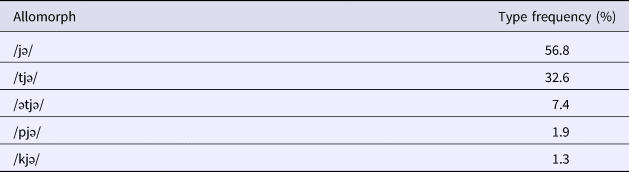
In addition to the phonological characteristics of the nouns, the diminutive allomorphs need to also be considered in terms of their frequency of occurrence. We calculated the type frequencies of the five allomorphs by categorising the allomorphs involved in all diminutives in the SUBTLEX-NL database (Keuleers, Brysbaert, & New, Reference Keuleers, Brysbaert and New2010) using an automated script segmenting the words into stems + allomorphs that were expected based on the morphophonological rules involved in diminutive formation as outlined above. We then manually checked the words to see whether the categorisation of diminutives into stems + allomorphs had been done correctly. This was especially important in the case of words ending in the three graphemes ‘tje’, as words with a stem ending in a ‘t’ should be segmented as CV[t] + /jә/ instead of CV + /tjә/. Table 1 gives an overview of the type frequencies of the allomorphs in Dutch (based on the SUBTLEX-NL database). It appears that /jə/ has the highest and /kjə/ and /pjə/ the lowest type frequency, with /ətjə/ being located somewhere in between but at the lower end. Therefore, in terms of type frequency /kjə/ and /pjə/ would be expected to have lower production accuracies due to their low type frequencies. As mentioned above, although the production of the Dutch diminutive allomorphs in children has not been studied extensively, results from previous studies do indeed confirm that type frequency has an effect. Snow et al. (Reference Snow, Smith and Hoefnagel-Höhle1979) assessed both adult second language learners and four-and-a-half- and seven-year-old native Dutch children on their production of the diminutive allomorphs. Considerable variation was found between the acquisition of the different diminutive allomorphs, which was attributed to the type frequencies of the allomorphs: the higher the type frequency, the earlier the allomorph seemed to be acquired. In their study testing four- to twelve-year-old native speakers of Dutch, Den Os and Harder (Reference Den Os and Harder1987) found that the allomorph /jə/ was acquired first followed by /tjə/. Thereafter the other allomorphs appeared, with /kjə/ only being acquired around the age of twelve. Note that they also found /ətjə/ to be less productive than initially expected even in adults. More recently Peelaerts (Reference Peelaerts2008) confirmed the findings from the Snow et al. (Reference Snow, Smith and Hoefnagel-Höhle1979) and Den Os and Harder (Reference Den Os and Harder1987) studies. She tested four- to ten-year-old children and also found that the lower the type frequency of the allomorph, the later it was acquired.
Type frequencies per allomorph expressed as percentage of all diminutive use

Notes. The type frequencies are based on the SUBTLEX-NL database, which is a database based on subtitles (Keuleers et al., Reference Keuleers, Brysbaert and New2010). In the type frequency count of the allomorph /tjә/, nouns with a stem ending in a /t/ or a /d/ such as maat-je ‘mate’ are included although these nouns are actually derived with a stem + /jә/. We chose the /tjә/ calculation due to the syllabification of the word (maa + /tjә/). To calculate the type frequency of /kjә/, we selected nouns ending in a /η/ which were followed by /kjә/ in the database. Words like haak-je ‘hook’ are not taken into account.
Finally, the Rispens and de Bree (Reference Rispens and de Bree2014) study, but also many other studies (among others, de Bree & Kerkhoff, Reference de Bree and Kerkhoff2010; Zamuner et al., Reference Zamuner, Kerkhoff and Fikkert2012), indicates that phonotactic frequency of the sound combination between stem and allomorph might also influence morphophonological development. In the current study, the phonotactic frequencies of the combination of the final stem phoneme with the phonemes of the allomorphs were calculated by averaging the log value of the biphone transitional probabilities (Dutch phonotactic frequency database (Adriaans, Reference Adriaans2006), derived from the corpus of spoken Dutch (Oostdijk, Reference Oostdijk, Gravilidou, Caravannis, Markantonatou, Piperidis and Stainhaouer2000)). The phonotactic frequencies were relatively similar for /tjə/ (–1.2), /pjə/ (–1.8), /kjə/ (–1.3), and /ətjə/ (–0.90); the phonotactic frequency of the final phoneme of the stems and /jə/ was relatively low (–2.4).
The current study
The goal of the present study was to explore the effect of item-specific characteristics of the Dutch diminutive. The effects of phonological characteristics (in terms of complexity), type frequency of the allomorphs, and phonotactic frequency of the stem and allomorphs, on production accuracies in five- to ten-year old typically developing children were investigated. The diminutive has five allomorphs based on different phonological characteristics of the noun stem and with different type and phonotactic frequencies (see above). As such, the diminutive in Dutch provides information about the influence of both phonological complexity and type and phonotactic frequency. In order to gain a better understanding of the extent to which these factors are related to the development of the different allomorphs we looked at the age at which the allomorphs are acquired. In addition, we looked at the error patterns of the children, focusing on (possible) substitutions of allomorphs.
Diminutive derivations of both real and nonce nouns were assessed. Nonce forms typically follow the same structural patterns of real items but by definition have no lexical representation stored in long-term memory that can be retrieved. Children are thus required to make use of their knowledge of morphophonological patterns to apply the appropriate allomorphs to the nonce nouns. Generalisations of the diminutive to nonce items thus give extra information as to whether the children actually use a morphophonological rule. Previous studies have indicated that only from around the age of five do children start to make generalisations about morphophonological forms to inflect nonce items (Tomas et al., Reference Tomas, van de Vijver, Demuth and Petocz2017b; Zamuner et al., Reference Zamuner, Kerkhoff and Fikkert2012). The children tested in this study are five and above and should therefore be able to inflect nonce nouns. Nevertheless, we expected to find the younger children to have more difficulties with inflecting nonce items than the older children. Moreover, all children were expected to perform better on real versus nonce items.
Research questions and hypotheses
Our first research question was whether the production of the Dutch diminutive improves between the age of 5;0 and 10;0. We hypothesised that we would find improvement with age, i.e., the older the children the better they are with inflecting the Dutch diminutive in an appropriate manner. Children's sensitivity to morphophonological patterns appears to increase with age (Tomas et al., Reference Tomas, van de Vijver, Demuth and Petocz2017b), and we expected to find that in this study as well. However, an earlier study testing adults’ production accuracies with the Dutch diminutive found that, when inflecting nonce nouns, instead of the target /әtjә/, adults often produced /tjә/, /pjә/, and /kjә (Boersma, Reference Boersma2018). The adults performed at ceiling on the other allomorphs with both real and nonce items. For the allomorph /әtjә/ we therefore hypothesised that the older the children the more they would use one of the other allomorphs when the target was /ətjə/, as the adults did (Boersma, Reference Boersma2018).
Our second research question concerned the influence of phonological stem characteristics, type frequency of the allomorphs, and phonotactic frequency of the stem+allomorph combinations on the production accuracies of the Dutch diminutive in five- to ten-year-old typically developing children. Our hypothesis was two-fold. Based on the morphophonological patterns for forming the diminutive, we hypothesised (Hypothesis 2a) lower production accuracies, relative to the other allomorphs, for /әtjә/ due to phonological complexity effects (see above), and /kjә/ and /pjә/ based on the relative low type frequencies of these two allomorphs (Den Os & Harder, Reference Den Os and Harder1987; Peelaerts, Reference Peelaerts2008; Snow et al., Reference Snow, Smith and Hoefnagel-Höhle1979). In addition, although /jə/ is based on the phonologically least complex stem characteristics and has the highest type frequency, based on its phonotactic frequency in combination with the final phoneme of the stem, children might also show difficulties with this allomorph (Hypothesis 2b).
Our third and final research question was whether children make erroneous stem+allomorph combinations, and, if so, whether they overgeneralise specific allomorphs. We hypothesised that when children produce erroneous stem+allomorph combinations, we would find overgeneralisations of /jә/ and /tjә/ based on the type frequencies of the allomorphs. However, the first allomorph only follows stems ending in an obstruent. Assuming that the children adhere to the basic manner of articulation obstruent–sonorant distinction, we expected to find mainly overgeneralisations of /tjә/. As also mentioned above, for /ətjə/ we expected overgeneralisations of /tjә/, /pjә/, and /kjә/ as these were also found in the adult study (Boersma, Reference Boersma2018).
Methodology
Participants
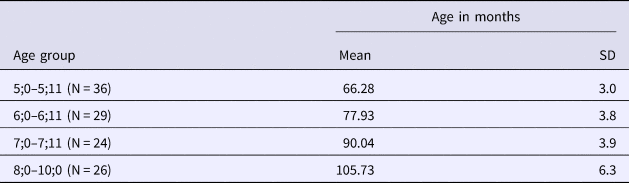
The participants were 125 typically developing (TD) children. All children were between the ages of 5;0 and 10;0, native speakers of Dutch, and raised in monolingual families. The children were tested on a large test battery that included other general language and reading measures, which are not reported on in this study (but see Boersma, Rispens, Baker, & Weerman, Reference Boersma, Rispens, Baker and Weerman2018). Ten children had to be excluded. Three children had scores on the tasks testing general language measures that fell below the norm. Four children were raised in bilingual families (as reported by their teachers after completion of the tasks) and were therefore excluded. Three children scored 1 SD below the mean on the Dutch real- and pseudo-word reading tasks (Brus & Voeten, Reference Brus and Voeten1979; Van Den Bos, Spelberg, Scheepstra, & De Vries, Reference Van Den Bos, Spelberg, Scheepstra and De Vries1994), indicating a possibility of a reading impairment. After exclusion, a total of 115 children remained. They were divided into four age groups. An overview of the participant characteristics per age group can be found in Table 2.
Mean age per age group

The children were recruited at five primary schools and were tested at their schools during school time. The teachers reported no problems such as hearing, sight, or language difficulties that could affect the outcome of the study in any of the children.
Test materials
The tasks administered to the children relevant for this study are the production task testing production accuracies of the diminutive allomorphs and the Raven progressive matrices task (Raven, Raven, & Court, Reference Raven, Raven and Court2003). The Raven was used to control for non-verbal IQ performance at the time of testing.
Test items
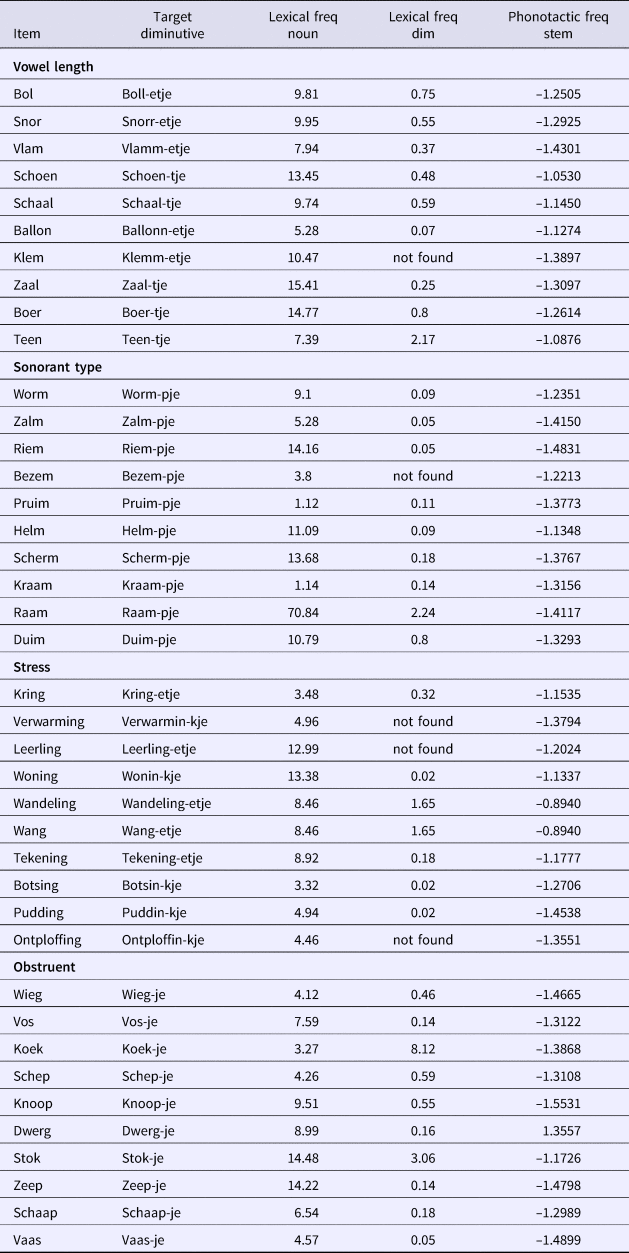
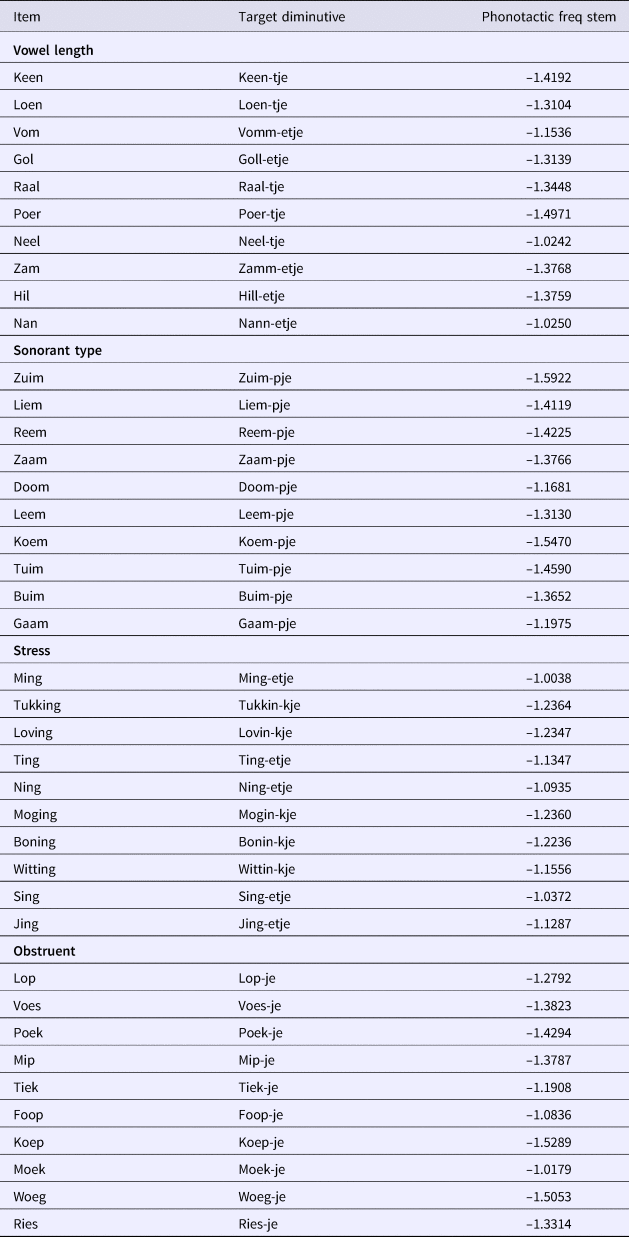
To make sure that the real nouns were as similar as possible and known to the children, they were selected from a list of words which had previously been established as known to children aged four to six years (Damhuis, Reference Damhuis1992). The lexical frequencies (based on the SUBTLEX-NL database) of the nouns lay between 3 and 15 instances per million (except for the noun raam, which has a higher frequency). All items were controlled for phonotactic frequency or probability, i.e., the frequency with which phonological segments occur in words in a language. This was calculated by averaging the log value of the biphone transitional probabilities, i.e., the probability that two phonological segments co-occur based on the Dutch phonotactic frequency database (Adriaans, Reference Adriaans2006) derived from the corpus of spoken Dutch (Oostdijk, Reference Oostdijk, Gravilidou, Caravannis, Markantonatou, Piperidis and Stainhaouer2000) (range real nouns –0.87 to –1.55; range nonce nouns –0.97 to –1.55). The nonce nouns were constructed with a pseudo-word generator called Wuggy (Keuleers & Brysbaert, Reference Keuleers, Brysbaert and New2010). Wuggy constructs nonce words based on given input by the researcher, which for this study were the real words. However, the items were adapted so that they consisted of one or two syllables and did not contain any consonant clusters, to make sure that even the youngest children could produce them. They also had to conform to the phonological and phonotactic rules of Dutch. The nonce items were tested with a word likeness task to make sure the items were considered by adult speakers as possible in the Dutch language. An overview of the items can be found in ‘Appendix B’.
The diminutive stimuli were presented semi-randomly. The stimuli were grouped into four phonological conditions based on the phonological characteristics of the stems that give rise to the five allomorphs. There were ten items per phonological condition: (1) obstruent, stems ending in an obstruent taking /jә/; (2) sonorant type, stems ending in a labial taking /pjә/; (3) vowel length, stems ending in an alveolar with a long vowel taking /tjә/ and stems ending in an alveolar or labial with a short vowel taking /әtjә/; and (4) stress, stems ending in a velar with either stress on the penultimate syllable taking /kjә/ or stress on the ultimate syllable taking /әtjә/.
Due to restrictions on time, the stimulus set was divided into two. The stimuli were semi-randomly assigned to one of the two sets. Each child was randomly assigned to one of the two sets. No significant differences between the two sets were found, so analysis of the data was done on the two sets taken together.
Production task
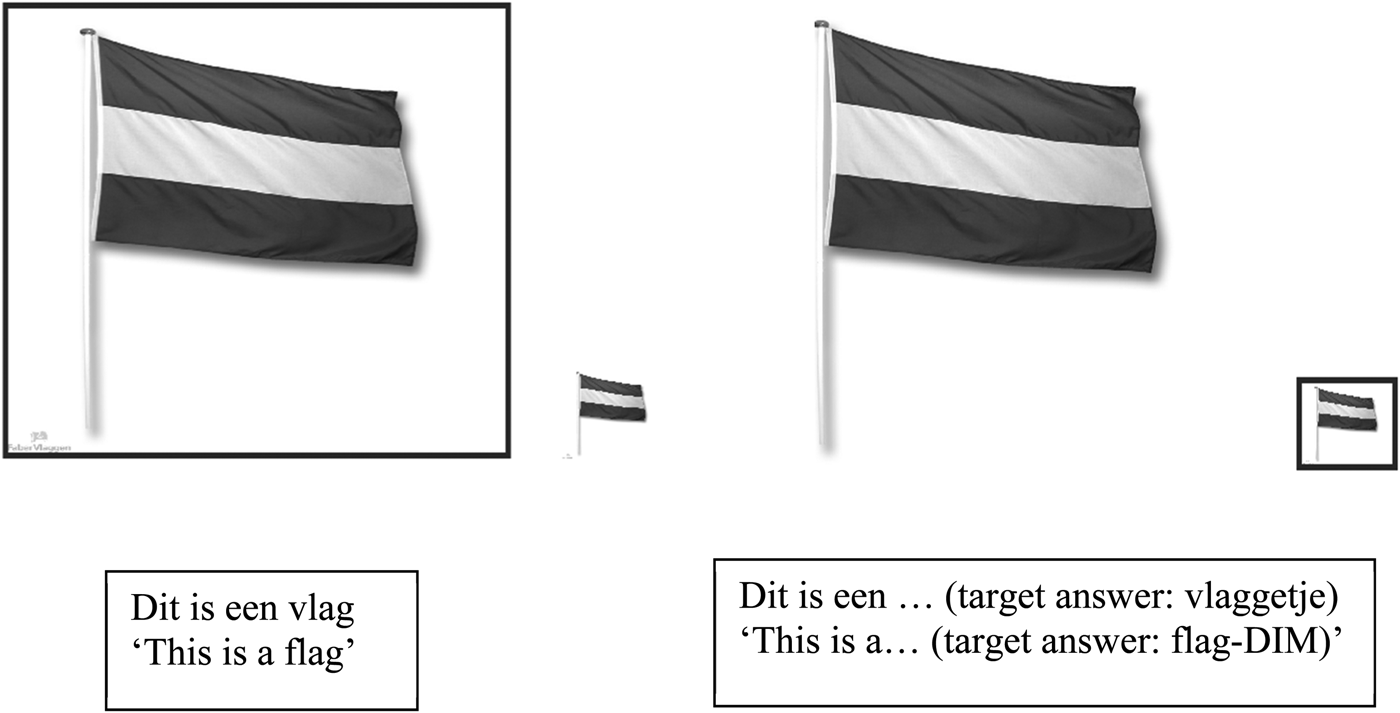
A wug-type task (see Figure 1 for an example of how the diminutive was elicited) was used in which children had to provide the diminutive form of a noun. The stimuli were presented auditorily: first via the computer and a second time by the experimenter. Figure 1 shows a test item to elicit the diminutive. The child looked at the pictures and the experimenter told them what the picture exhibited. Thereafter the child was asked to name the smaller version of the same picture by using a diminutive form. The answer was scored as correct if the target/appropriate stem+allomorph combination, i.e., the diminutive form that is expected based on the theoretical descriptions as provided in the previous section, was produced. Non-responses, the bare noun, and unrelated responses were scored as ‘other’. When the child gave a diminutive form but with the non-target/inappropriate allomorph, this was scored as incorrect/non-target. These erroneous responses were used for the follow-up error analyses. The Dutch past tense was also tested in this task and used as a filler.
Example diminutive production task. The example is with a real noun.

The Dutch diminutive forms are used more frequently than in many other languages and, as such, many of the stimuli presented in this study might seem odd to readers not familiar with Dutch. Although there are a few forms that are indeed slightly odd, diminutives are very frequent in Dutch and sometimes even preferred over the non-diminutive form (see Table 6 in ‘Appendix B’ for the frequency counts of the diminutive forms).
Procedure
The study was reviewed and approved by the ethics review board of the Faculty of Humanities, University of Amsterdam. Schools were approached and asked whether they wanted to participate in the study. Parents were then contacted and received an information letter with an active consent form they needed to sign if the parent and child were willing to participate.
Children were tested individually at their school during school time. Testing took three to five sessions of approximately 30 minutes. The children also completed other tasks which are not reported on in this study. Results on a judgement task and associations between morphophonological processing and other language measures are presented in a different paper (Boersma et al., Reference Boersma, Rispens, Baker and Weerman2018). In the first session the children did the production task followed by some of the other tasks, such as, for example, the Raven. Sessions two and three consisted of the other tasks. A Sony Vaio and Dell laptops were used for the tasks that had to be administered online. An Olympus digital voice recorder was used to record all the sessions.
Scoring was done by two native speakers of Dutch who were trained linguists. Approximately 12% of the data from the production task was compared to calculate the inter-rater reliability. This was high (Cronbach's ɑ = .82). Any discrepancies were solved by discussion until 100% consensus was reached.
Analysis
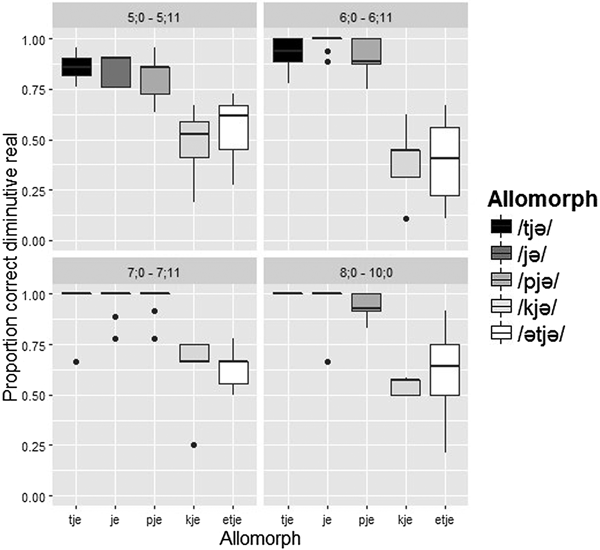
Boxplots representing differences between age groups and within age groups between allomorphs for both real and nonce nouns are presented in Figures 2 and 3 (research question and Hypothesis 1). Generalised linear mixed effects modelling was used to analyse the data. We investigated whether a child gave a target (correct) or non-target (incorrect) answer (binary data) and whether this was dependent on which allomorph was to be used and the age of the child, i.e., the fixed effect factors were allomorph and age in months. This was done to evaluate the second research question and the corresponding hypotheses concerning differences in production accuracies between the allomorphs, and the first research question and hypothesis concerning development of the allomorphs. Performance scores on the Raven were included to control for the effect of IQ. The models with age, age+Raven, and age+Raven + allomorph were compared to each other using log-likelihood comparisons (using analysis of variance function in R). If age and allomorph significantly improved the model, the interaction between age and allomorph was examined as well. This was done to assess whether production of the different allomorphs had similar or diverging developmental pathways in this group of children (Hypothesis 1). Participant and item were taken as the random effect factors (random intercept) to control for participant and item variability. Data were modelled in R (version 3.2.0; RStudio Team, Reference RStudio Team2015) using the lme4 package (version 1.1-7; Bates, Maechler, Bolker, & Walker, Reference Bates, Maechler, Bolker and Walker2015). Separate models were built to see whether production performance of the diminutive with real or nonce nouns differed for the different allomorphs.
Mean proportion correct on the production task per age group for the real diminutive; allomorph type is expressed on the x-axis.

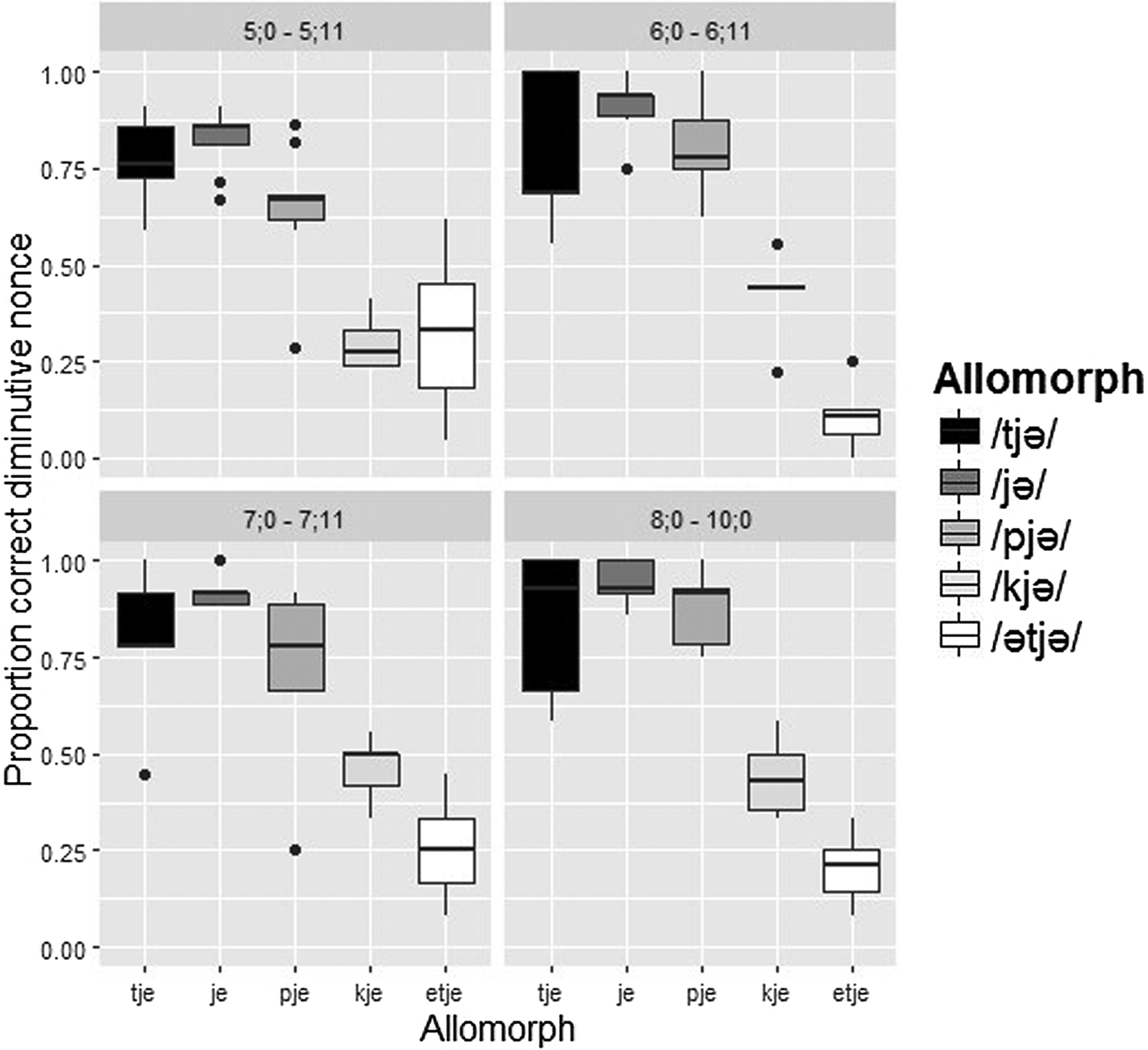
Proportion correct on the production task per age group for the nonce diminutive; allomorph type is expressed on the x-axis.

The fixed effect factor allomorph was modelled by means of contrasts between levels. Each level of this factor is contrasted to a specified reference level. We hypothesised that both /ətjə/ and /kjə/ would have the lowest accuracy scores (Hypothesis 2a). Therefore these two allomorphs were taken as the reference levels to which the accuracy scores of the other allomorphs were contrasted. Hypotheses 2a and 2b stated that /pjə/ and /jə/ would have lower production accuracies. However, Figures 2 and 3 clearly show that both allomorphs are produced at ceiling level in all age groups. Consequently, no models were run with /pjə/ and /jə/ as the reference levels.
Finally, to be able to evaluate Hypothesis 3, the erroneous productions of the children were assessed per age group. Specifically, the erroneous forms were grouped according to which allomorph was used instead of the appropriate allomorph. In this way we could investigate whether the children based their erroneous answers on the phonological characteristics of the stems, or phonotactic and type frequencies of the stems and allomorphs. In addition, we also looked at whether the substitutions changed between the different age groups. Two-tailed chi-square tests were conducted and error percentages per inappropriately used allomorph and age group are presented in the graphs. A final option for coding the children's answers was ‘other’, which reflects answers such as ‘don't know’, null responses, and wrong stems, or uninflected stems.
Results
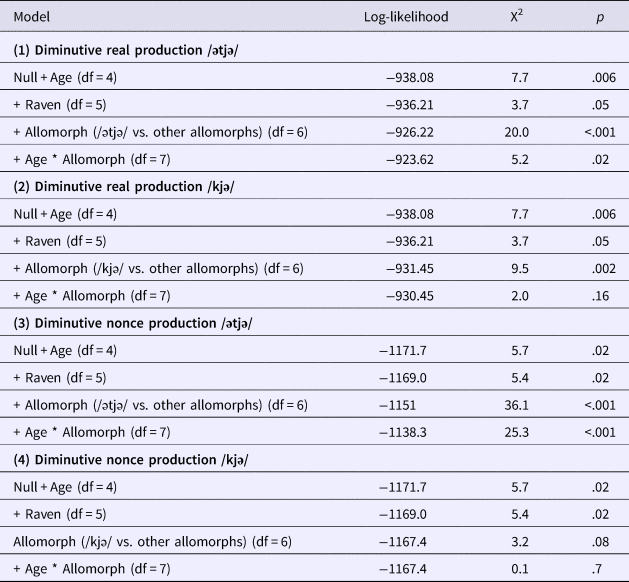
Figures 2 and 3 show the boxplots for the different allomorphs per age group for the real and nonce diminutives, respectively. As the figures indicate, there was an improvement with age. The results from the multilevel models confirm this (see Table 3 for model comparisons; the final optimal models can be found in ‘Appendix A’). For the real diminutive, the model with age was significantly different from the null model (p = .006). For the nonce diminutive, the null model compared to model with age included was significant (p = .02). Figures 2 and 3 indicate that, for both the real and the nonce diminutives, production accuracies were low for /ətjə/ and /kjə/ while accuracies were higher for the other allomorphs and approached ceiling levels in all the age groups and especially in the older age groups with the real diminutive.
Linear mixed effects model comparisons for production accuracies of the real and nonce diminutives in which accuracy of the allomorphs (/ətjə/ and (/kjə/) are compared against the other allomorphs

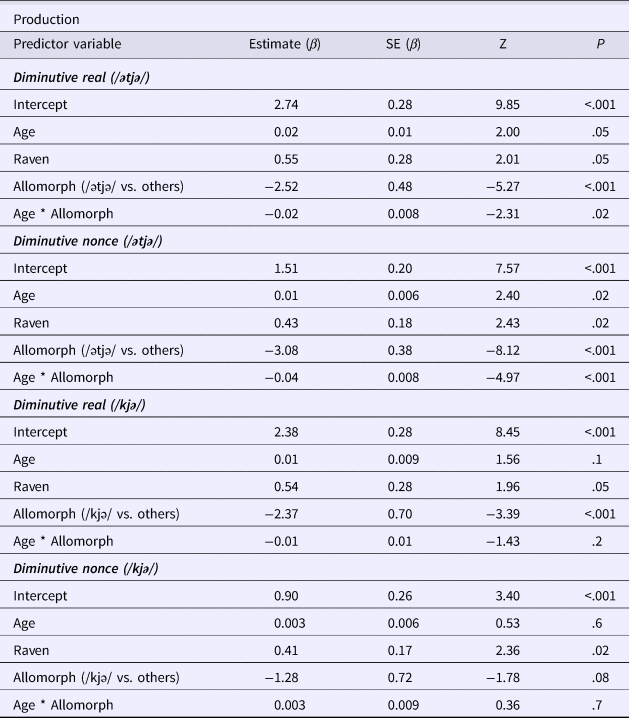
The model comparisons as presented in Table 3 confirm the findings from the figures: for the real diminutives, performance on /ətjə/ and /kjə/ was significantly worse relative to the other allomorphs (respectively p < .001 and p = .002). For the nonce diminutives, a significant difference in production accuracy of /ətjə/ compared to the other allomorphs was found (p < .001). This was not the case when accuracy of /kjə/ was compared to the accuracy of diminutives in which the other allomorphs were involved (p = .08). No significant interaction between age and /kjə/ when it was contrasted to the other allomorphs was found with either the real or the nonce items (respectively p = .16 and p = .7). A significant interaction between age and /ətje/ was found for both the real and nonce items (respectively p = .02 and p < .001). These significant interaction effects indicate that /ətjə/ seems to follow a different developmental pattern compared to the other allomorphs. The interaction with age and /ətjə/ for the real nouns reflects that /ətjə/ does not improve with age to the same extent as the other allomorphs (see Figure 2). Interestingly, for the nonce diminutive the accuracy scores for /әtjә/ actually decrease between ages 5;0 and 10;0 (see Figure 3).
Non-target productions: types of substitutions
We performed follow-up analyses to gain a better understanding of the factors influencing acquisition during the course of development. For production of the real diminutive there was a significant association between the age group the child was in and the erroneous productions (χ 2 (15) = 71.7, p < .001). For production of the nonce diminutives there was also a significant association between the age group the child was in and the erroneous productions (χ 2 (15) = 94.4, p < .001).
Because the production accuracies of the /әtjә/ and /kjә/ allomorphs were significantly lower than the accuracy scores on the other allomorphs, it was decided to do a separate substitution analysis for these two conditions. Recall that, in our adult study with the same production task, the adults scored significantly lower on the nonce nouns that (should) take /әtjә/ (Boersma, Reference Boersma2018). They substituted this allomorph with /tjә/ for nouns ending in an alveolar, /pjә/ for stems ending in a labial, and /kjә/ for stems ending in a velar. The adults therefore relied on regular place assimilation processes instead of the more complex phonological characteristics of the stems. We investigated whether the children's substitutions for nouns that take /әtjә/ were also based on place assimilation constraints and whether there were differences between the age groups. In addition, the substitutions for /kjә/ were examined.
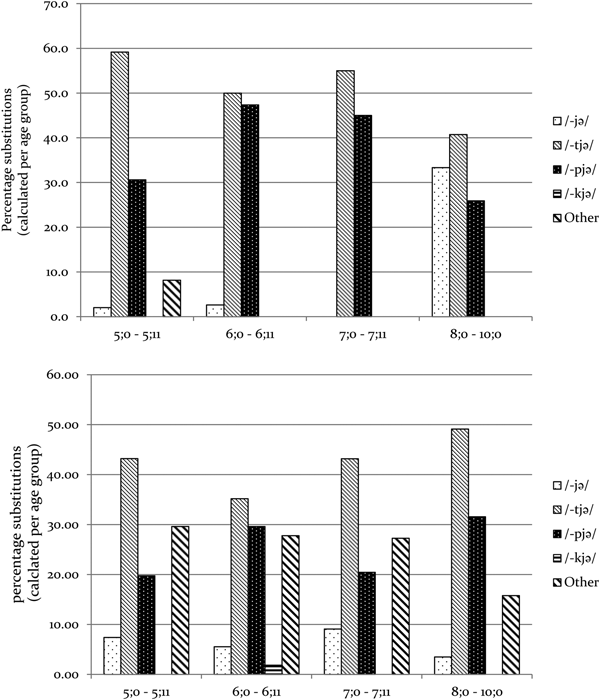
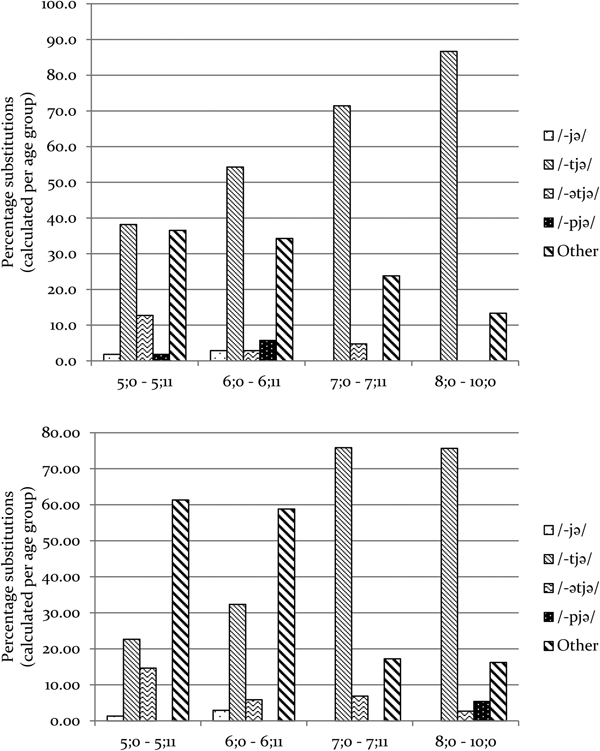
Figure 4 shows the probabilities of allomorph substitutions per age group for respectively the real (upper graph) and nonce (lower graph) diminutive for /әtjә/ in the vowel length condition. What is clear from these graphs is that the older the children are, the more adult-like they become in their choice of non-target allomorphs, i.e., substitutions. Especially when inflecting the real diminutive in a non-target manner, the eight- to ten-year-olds mainly replaced the target allomorph with either /tjә/ or /pjә/. Surprisingly, however, the eight-year-olds replaced some target allomorphs with the non-target allomorph /jә/, violating the phonological rule that stems ending in a sonorant do not combine with /jә/. A closer look at these substitutions shows that the eight-year-olds used /jә/ for the stems ending in the labial sound /m/. The substitutions for the nonce diminutive forms are somewhat more diverse and many ‘other’ answers were given by children in all the age groups. Yet, similar to the real items, the older the children were, the more they started to rely on simple place assimilation processes in their substitutions. It should also be noted that even the youngest children based many of their non-target stem+allomorph answers on simple place assimilation processes when inflecting both real and nonce nouns.
Substitutions for /әtjә/ in the vowel length condition calculated per age group (upper graph real diminutive, lower graph nonce diminutive).

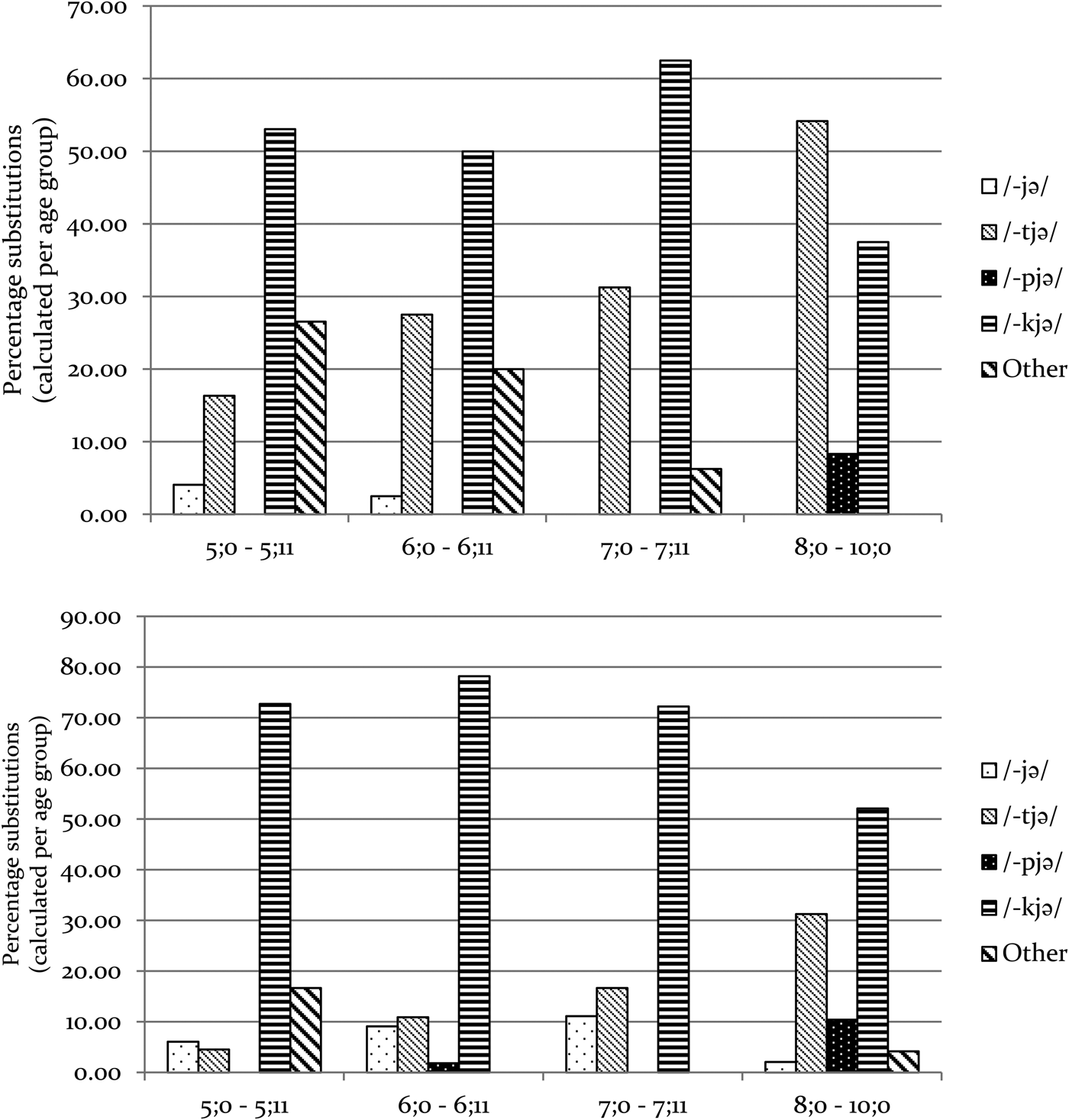
In the stress phonological condition (allomorphs /ətjə/ and /kjə/), Figure 5 (respectively real (upper graph) and nonce (lower graph)) shows the substitutions for /әtjә/, and Figure 6 (respectively real (upper graph) and nonce (lower graph)) the substitutions for /kjә/. Figure 5 indicates that many children used the /kjә/ allomorph instead of /әtjә/. Somewhat surprisingly, some children used the /tjә/ allomorph. This is especially apparent with the real nouns. However, the older the children the fewer non-target forms they produced, especially with the real items. As such the depiction of the substitutions might be somewhat inflated. With the nonce nouns, it is clear that most children adhered to the place assimilation process, and used /kjә/ instead of /әtjә/. Figure 6 indicates that the older the children, the more they replaced the target allomorph /kjә/ with /tjә/. The graphs also indicate that the younger children had a lot of problems with producing the target stem+/kjә/ combinations as there are many ‘other’ answers. These answers consisted mainly of ‘don't know’ or reductions of the stems, e.g., instead of bonin-kje they produced boon-tje.
Substitutions for /әtjә/ in the stress phonological condition calculated per age group (above real diminutive, below nonce diminutive).

Substitutions for /kjә/ calculated per age group (above real diminutive, below nonce diminutive).

Discussion
This study investigated the development of Dutch diminutive allomorphs in a group of five- to ten-year-old typically developing children. More specifically, we investigated whether phonological characteristics of the stems, type frequency of the allomorphs, and phonotactic frequency of the stem+allomorph combinations influence production accuracies of the diminutive allomorphs, their erroneous productions, and whether the influence of these factors changes during development. A wug-type production task was used to study children's ability to produce diminutive allomorphs in Dutch. Based on previous studies in both English and Dutch, it was hypothesised that type frequency of the allomorphs, phonotactic frequency of the stem+allomorph combinations, and phonological characteristics of the stems would have an effect on production accuracies. Additionally, we expected to find an age-effect, i.e., the older the children, the more adult-like their performance.
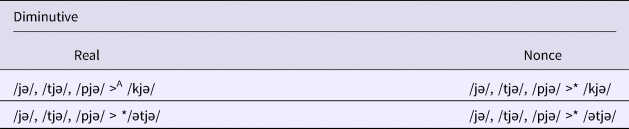
Table 4 gives a general overview of the results found in this study in terms of production accuracies. The two diminutive allomorphs /ətjə/ and /kjə/ had the lowest production accuracies for both the real and nonce diminutive, as expected (see second research question and Hypothesis 2a).
Overview of the findings in terms of production accuracies

Notes. * = significantly lower production accuracies compared to the other allomorphs, A = not significant, but trend is in the right direction.
We expected (Hypothesis 1) and found higher production accuracies in older children compared to younger children. In addition, all age groups had lower production accuracies for nonce nouns compared to real nouns. The results indicated that, while even the youngest children were already sensitive to the morphophonological contexts for the use of the /jə/, /tjə/, and /pjə/ allomorphs for both real and nonce nouns, all the children, including the oldest, had problems using /ətjə/ and /kjə/ in an appropriate manner (Hypothesis 2a).
The findings indicate that type frequencies of the allomorphs had some influence, as hypothesised based on previous studies (Den Os & Harder, Reference Den Os and Harder1987; Jolly & Plunkett, Reference Jolly and Plunkett2008; Peelaerts, Reference Peelaerts2008; Snow et al., Reference Snow, Smith and Hoefnagel-Höhle1979; Tomas et al., Reference Tomas, Demuth, Smith-Lock and Petocz2015, Reference Tomas, Demuth and Petocz2017a, Reference Tomas, van de Vijver, Demuth and Petocz2017b). As previously mentioned, /jə/ has the highest type frequency, followed by /tjə/, while /kjə/ has a relatively low type frequency of only 1.3%. Many children used the /jə/ allomorph in an appropriate manner and the accuracy scores for this allomorph were at ceiling level in all age groups. Since /jә/ has the lowest phonotactic frequency, but the highest type frequency, it can be concluded that phonotactic frequency did not have an effect, while the high type frequency of /jə/ probably did have an effect on the accuracy scores (Hypothesis 2b).
However, type frequency does not explain why even the youngest children performed in a target-like manner on the /pjə/ allomorph as this allomorph has a similar (low) type frequency to /kjə/ (1.9%). As was discussed, /pjə/ follows regular place assimilation constraints in that it always follows a labial, i.e., boom–boompje ‘tree’. The stem+/pjə/ combinations are relatively easy and straightforward to pronounce as they follow regular articulatory processes. In contrast, although /kjə/ also follows place assimilation constraints in that it always follows a velar nasal, velars are different from other nasals as they are subject to some strong phonotactic constraints, are relatively difficult in terms of articulation, and are acquired relatively late (Mennen, Levelt, & Gerrits, Reference Mennen, Levelt, Gerrits, Scobbie, Mennen and Watson2006; Trommelen, Reference Trommelen1984). Stem+/kjə/ combinations might therefore be harder to produce than stem+/pje/ combinations. An effect of token frequency might also be apparent. Even though every attempt was made to control for token frequency, we could not always control for the lexical frequencies of the diminutive forms. The token frequency of the diminutive forms taking /kjə/ could either not be found, i.e., they were not represented in the database, or were as low as 0.02 instances per million (taken from the SUBTLEX-NL database). Experimental evidence has shown that token frequency, the number of times a specific item appears, influences past tense marking of both regular and irregular verbs (Matthews & Theakston, Reference Matthews and Theakston2006; Oetting & Horohov, Reference Oetting and Horohov1997; Rispens & de Bree, Reference Rispens and de Bree2014). Stems taking the /kjə/ allomorph are thus rather infrequent in their diminutive form in child (-directed) speech, e.g., the diminutive form of verwarming ‘heater’ – verwarminkje ‘heater-DIM’ is not something children hear on a daily basis. Finally, as also mentioned in the introduction, stems taking /kjə/ consist of two or more syllables, as only stems that have stress on the penultimate syllable can take this allomorph. This makes these stems more complex compared to the other segmental stems. In sum, the low type frequency of /kjə/, the low token frequency of stem and /kjə/ combinations, the late and more complex acquisition of the velar nasal, and the fact that the stems always consisted of more than one syllable most probably caused the difficulties children had with appropriately using /kjə/. Thus, although this confirms our second hypothesis (Hypothesis 2a), the relative difficulty with /kjə/ is not exclusively due to this allomorph's low type frequency as was expected, but was also, and possibly mostly, due to the phonologically more complex characteristics of the stems that give rise to this allomorph.
The substitution analyses indicated that /tjə/ most often replaced /kjә/. This confirms our third hypothesis and follows the type frequency account, as the children thus replaced /kjə/ with the allomorph with the highest type frequency for stems ending in a sonorant. Especially the older children appeared to be strongly influenced by type frequency. Note that the children adhered to the obstruent–sonorant distinction and did not replace /kjə/ with /jə/, which, although it has a higher type frequency than /tjə/, only comes after stems ending in an obstruent.
As hypothesised (Hypothesis 2a), low production accuracies for /ətjə/ were also found for both real and nonce items. Although this allomorph does not have a very low type frequency, it is used by inserting a sjwa+‘tje’ rather than assimilation or t deletion (see the ‘Introduction’). In addition, in a previous study testing diminutive production in adults, it was found that adults did not always apply /ətjə/ in nonce nouns in the way predicted, but often replaced it with /tjə/, /pjə/, and /kjə/ based on place assimilation between the final phoneme of the stem and the first phoneme of the allomorph (Boersma, Reference Boersma2018). In the current study we found that most substitutions for /ətjə/ were allomorphs that assimilated with the final phoneme of the stem, i.e. *vompje instead of the target vommetje (as predicted in Hypothesis 3). This was the case for both the real and the nonce items and was already apparent in the youngest children. Nonetheless, the nonce items were clearly more difficult as even the oldest children still had relatively many answers that could be classified as ‘other’. Surprisingly, the children even replaced /әtjә/ with /kjә/, although they found this latter allomorph difficult to use in a target-like manner. Apparently, when phonological characteristics are complex, children will rely on the phonologically less complex characteristics even if they are infrequent. In general, these findings suggest that although type frequency does influence production accuracies, the complexity of the phonological characteristics that determine the allomorph appear to have a bigger influence on the production accuracies.
As mentioned above, in the study referred to in Boersma (Reference Boersma2018) non-target forms based on place assimilation were only found for nonce nouns, but adults performed at ceiling when inflecting real nouns. The adults seemed to have stored real stem+/ətjə/ combinations in their lexicon. In this study, production accuracies for /ətjə/ improved with age for the real diminutive (in accordance with Hypothesis 1) – i.e., the older the children, the higher the production accuracies for the real items – but decreased with the nonce diminutive. Based on these findings and on previous studies showing effects of vocabulary size (Boersma et al., Reference Boersma, Rispens, Baker and Weerman2018; Marchman & Bates, Reference Marchman and Bates1994; Paradis et al., Reference Paradis, Tulpar and Arppe2016; Rispens & de Bree, Reference Rispens and de Bree2014), it can be argued that the older the children the more instances of real stem+/ətjə/ combinations are stored as a whole in the children's lexicon.
In relation to this, a limitation of this study is that we do not know whether children learn diminutive forms in general as surface forms, or whether they first learn the base form and then assemble the diminutive via the base noun and the allomorph. A study by Kempe, Brooks, and Gillis (Reference Kempe, Brooks and Gillis2005) suggests that Dutch diminutives contain features that aid word segmentation. Studying the acquisition of diminutives in a less lab-based experiment may shed light on this question.
Conclusion
This study investigated the production of the Dutch diminutive in five- to ten-year-old typically developing children. We examined whether and to what extent the phonological characteristics of the stems that give rise to the allomorphs, phonotactic frequency of the stem+allomorph combinations, and type frequency of the allomorphs influence Dutch diminutive production accuracies.
An age-effect was found in that the older the children had higher accuracy scores (research question and Hypothesis 1). However, no improvement with age was found for production of real and nonce nouns that take /ətjə/. This allomorph, which is based on the phonologically most complex characteristics of the noun stems, was found to have significantly lower production accuracies than the other allomorphs (second research question and Hypothesis 2a). Additionally, although it was hypothesised that /kjə/ and /pjə/ would have lower production accuracies due to their low type frequencies (Hypothesis 2a), this was only the case for /kjə/, which was most probably to a large extent due to the more complex phonological characteristics of the stems it attaches to. No effect of phonotactic frequency was found (Hypothesis 2b). In addition, an age-effect was found with respect to the substitution of /ətjə/. The older the children the more adult-like their performance was in terms of their substitutions for /әtjә/, i.e., substitutions were based on place assimilation with the final phoneme of the stem (research question and Hypothesis 3). Erroneous productions for stems that should receive /kjə/ were mostly productions with the allomorph with the highest type frequency for stems ending in a sonorant, namely the allomorph /tjə/ (Hypothesis 3). Children of all ages were able to generalise to nonce items and their performance with nonce nouns also improved with age.
In conclusion, this study has shown that, from the age of five onwards, children are sensitive to the morphophonological patterns of Dutch. The phonological characteristics of the stems and type frequency of the allomorphs were found to be related to not only appropriate but also erroneous diminutive productions. However, complexity of the phonological characteristics of the stems appeared to have a bigger impact than type frequency. The findings indicate that both the frequency of the allomorphs and the phonological characteristics of the stems are important when learning the morphophonological properties of a language, but that, for five- to ten-year-old children, especially the phonological complexity of the morphophonological patterns impacts on the ability to correctly produce diminutive allomorphs.
Author ORCIDs
Tiffany BOERSMA, 0000-0002-0429-6481
Acknowledgements
We thank all the schools, children, and parents who have participated in this study. We would also like to thank the research assistants on this project for their help with testing the children. This research received no grant from any funding agency in the public, commercial, or not-for-profit sectors.
Appendix A
Final most explanatory models linear mixed effects analysis
Optimal models predicting production real and nonce diminutive

Appendix B
Test items
Items real diminutive

Items nonce diminutive