





1. Introduction
Morphology is a branch of linguistics that refers to the study of the structure of a word and its formation. The development of morphology in children is a complex process influenced by a variety of factors, including innate cognitive mechanisms, language input, and the nature of the language being acquired. Inflectional morphology refers to the modification of words to express different grammatical categories, such as number (e.g., bekku-gaLu in Kannada, cat-s in English), tense (e.g., maad- utta in Kannada, do-ing in English), or case (e.g., mane- ge in Kannada, to home in English), without changing the lexical category (Sridhar, Reference Sridhar1990).
Children develop inflectional morphology gradually, progressing through identifiable developmental stages. Morphosyntactic development begins in the second year of life, with the emergence of early inflectional markers around 18–24 months, and continues well into the school-age years, as children refine rule-based generalizations and master low-frequency or abstract morphological forms (Brown, Reference Brown1973; Slobin, Reference Slobin and Slobin1985). The years between four and six represent an important period during which grammatical knowledge becomes increasingly structured and productive, with greater consistency and abstraction in morphological use (Tomasello, Reference Tomasello2003). During this time, children shift from relying on item-specific patterns to applying abstract morphological rules more reliably, which helps us understand their underlying grammatical representations (Brown, Reference Brown1973; Slobin, Reference Slobin and Slobin1985). Cross-linguistic research additionally shows that in languages with complex inflectional systems such as those involving case marking and agreement in agglutinative structures, mastery continues to develop throughout this four-to-six-year age range (Aksu-Koç & Ketrez, Reference Aksu-Koç, Ketrez, Bittner, Dressler and Kilani-Schoch2003; Lukács et al., Reference Lukács, Kas and Leonard2013; Raghavendra, Reference Raghavendra1989). Accordingly, morphosyntactic proficiency during preschool years is a strong predictor of later literacy and academic success (Snow, Reference Snow, Neuman and Dickinson1999), and it is within this developmental window that enduring grammatical weaknesses begin to clearly differentiate children with language difficulties from those who show typical development (Ravid, Reference Ravid, Stephany and Voeikova2009; Rice et al., Reference Rice, Wexler and Hershberger1998). For these reasons, studying morphosyntax in preschool-aged children offers valuable insight into both typical language development and emerging profiles of language impairment.
Understanding how children acquire inflectional morphology has long been a central concern in developmental linguistics. Theoretical approaches to morphological acquisition can be situated along a continuum from rule-based to usage-based frameworks (Pothos, Reference Pothos2005). This study focuses on usage-based perspectives, as they align with examining how exposure, frequency, and interaction shape development and as the data on agglutinative languages are compatible with core assumptions of these accounts.
Usage-based approaches argue that linguistic knowledge emerges gradually through meaningful language use, via domain-general cognitive mechanisms such as categorization, pattern recognition, analogy, memory, and attention (Bybee, Reference Bybee2007; Diessel, Reference Diessel and Dancygier2017). The connectionist and constructivist perspectives within the usage-based approach view language development as shaped by experience and mediated by cognitive processes (Tomasello, Reference Tomasello2003). Children learn morphology through repeated experience with constructions, forming a dynamic network of stored exemplars that grows more structured over time (Goldberg, Reference Goldberg2006; Langacker, Reference Langacker1987). A central assumption within usage-based theory is the role of frequency. Both token frequency (how often a specific form is encountered) and type frequency (how many distinct items follow a pattern) support morphological acquisition in complementary ways (Bybee, Reference Bybee2006; Diessel, Reference Diessel and Kidd2011). High token frequency supports accurate retrieval of commonly occurring forms, while high type frequency promotes generalization beyond memorized exemplars to novel items (Granlund et al., Reference Granlund, Kolak, Vihman, Engelmann, Lieven, Pine, Theakston and Ambridge2019; Ibbotson, Reference Ibbotson2013). MacWhinney’s Competition Model (Reference MacWhinney2021) further explains that children rely on probabilistic cues-such as morphology, meaning, and word order-strengthened by experience. Over time, the most reliable and frequently encountered cues dominate production, resulting in gradual consolidation of morphological patterns rather than abrupt mastery. Importantly, usage-based theories also recognize the role of social and environmental factors in shaping morphological development. The richness, frequency, and responsiveness of linguistic input strongly predict the pace and accuracy of inflectional learning. Studies have shown that children exposed to more syntactically diverse and frequent parental input demonstrate faster growth in grammar and vocabulary (Huttenlocher et al., Reference Huttenlocher, Vasilyeva, Cymerman and Levine2002; Rowe, Reference Rowe2012).
Over the past two decades, a growing body of research has demonstrated that child-directed speech (CDS), a type of linguistic input, plays a central role in children’s acquisition of inflectional morphology. Rather than simplifying language uniformly, caregivers selectively adjust key properties of the input-such as frequency, predictability, and transparency of forms – in ways that support children’s early processing and pattern extraction. For instance, Kempe et al.’s (Reference Kempe, Brooks, Pirott, Almgren, Barreña, Ezeizabarrena, Idiazabal and MacWhinney2001) study on CDS across Russian, Spanish, and German languages found that caregivers of children aged 1;11–2;4 years modulated the use of diminutives (e.g., In Russian dom “house” → dom-ik “little house”) depending on whether they clarified or obscured gender distinctions, suggesting that caregivers highlight morphologically relevant cues aligned with communicative needs and learning salience.
Cross-linguistic studies provide further support for this input–learning relationship. Using a large comparative dataset from Hebrew, Dutch, Danish, and German, Ravid et al. (Reference Ravid, Dressler, Nir-Sagiv, Korecky-Kröll, Souman, Rehfelddt, Laaha, Bertl, Basbøll, Gillis and Behrens2008) showed that children’s plural production reflected the frequency and predictability patterns found in CDS, demonstrating that learners are highly sensitive to statistical distributions in the input. Similar patterns have been observed in the development of morphological production. Veneziano and Parisse (Reference Veneziano and Parisse2010) reported that French-speaking caregivers reduced morphological variability when speaking to young children, and that children’s early verb forms closely mirrored these dominant patterns.
Research from polysynthetic languages aligns with these findings: Crago and Allen (Reference Crago and Allen2001) found high consistency in overt verbal inflections in CDS addressed to Inuktitut-speaking toddlers, with child productions matching this regularity. More recent work by Johnson and Allen (Reference Johnson and Allen2022) extends this evidence, showing that Inuktitut CDS increases in morphological complexity as children advance linguistically, indicating that CDS is developmentally responsive rather than static. Further evidence of morphological development is provided by Lee et al. (Reference Lee, Johnson and Allen2023) who examined spontaneous interaction between eight Inuktitut-speaking caregivers and their children aged 1 to 4 years. Their findings revealed clear developmental changes in the use of verbal inflections: caregivers used fewer types and tokens for younger children and progressively introduced more complex morphology as children’s skills developed. Children’s early productions strongly reflected the structure and frequency of the input, supporting the role of familiarity, frequency, and scaffolded interaction in early morphological learning. Over time, children began producing inflections that were not present in their immediate input, demonstrating emerging productivity and rule abstraction. These studies show that CDS supports the acquisition of complex inflectional systems and provides learners with structured input that aligns with their developmental stage. This input appears to play a crucial role in enabling children to extract morphological patterns and progress from early imitation to productive use of inflectional morphology.
1.1. Tasks for assessing inflectional morphology
Studies exploring language development have employed both elicited and naturalistic tasks. A story or narrative retelling task is one of the naturalistic methods commonly used in child language research. Retelling has been described as the oral presentation of causally linked events (Peterson, Reference Peterson1990). Retelling has been utilized as an ecologically valid assessment tool for revealing subtle differences in children’s language production, over standardized tests that often miss some aspects of children’s language abilities (Manolitsis & Botting, Reference Manolitsis and Botting2011). Narrative analysis provides a richer assessment of children’s language by documenting key structural components such as lexical diversity, syntactic complexity, listening comprehension, mean sentence length, and pragmatic elements, including discourse cohesion and referential adequacy, which formal tests may not fully capture (Kuijper et al., Reference Kuijper, Hartman and Hendriks2017; Westerveld & Gillon, Reference Westerveld and Gillon2010).
The story retelling task has also been used to investigate the development of inflectional morphology in children. Restrepo (Reference Restrepo1998) identified morphosyntactic markers that distinguish Spanish-speaking children (between 5 and 7 years) with language impairments from their typically developing peers in a structured elicitation procedure using the story retelling task. Typically developing children in the study demonstrated consistent and accurate use of verb morphology, including correct tense marking, subject–verb agreement, articles, and prepositions, whereas children with language impairments showed notable difficulties with verb conjugation, omission or misuse of articles, and limited syntactic complexity, often relying on shorter, simpler sentences. The findings underscore the diagnostic value of story retelling tasks in identifying subtle morphosyntactic deficits and support the use of narrative-based assessments for the early detection of language impairments in children. Similarly, Müller et al. (Reference Müller, Leonard, Deevy and Kunnari2019) examined the acquisition of initial mutations among typically developing bilingual Irish children using a story-retelling task designed to elicit spontaneous use of morphologically marked forms. In Irish, initial mutations are changes to the first consonant of a word triggered by grammatical contexts such as tense, possession, or prepositions (e.g., bád “boat” → a bhád “his boat”). The study revealed that children showed emerging but variable control over these mutations, applying them more accurately in frequent and predictable contexts. Their performance reflected partial rule internalization, with English dominance influencing consistency and accuracy. Unlike children with language impairment, typically developing children showed a gradual developmental pattern, suggesting growing morphological competence. The narrative task effectively captured these subtleties, highlighting how input frequency and grammatical salience support acquisition.
1.2. Kannada morphology
The present study focuses on Kannada, a Dravidian language predominantly spoken in the South Indian state of Karnataka. Kannada is characterized by an agglutinative morphological structure in which grammatical relationships are expressed through inflectional suffixes attached to lexical roots. Its inflectional morphology is highly complex, comprising rich systems for marking grammatical categories in both noun and verb paradigms (Sridhar, Reference Sridhar1990).
Nouns in Kannada are inflected for case, number, and gender, whereas verbs encode tense, aspect, and mood, and must agree with the subject in person, number, and gender. This morphological structure plays a critical role in sentence formation and meaning-making, suggesting mastery of inflectional morphology central to Kannada language development (Krishnamurti, Reference Krishnamurti2009; Sridhar, Reference Sridhar1990). However, the complexity of the system also presents notable developmental challenges. Case marking, for instance, is optional in many syntactic contexts, where formal nominative, accusative, and genitive markers are considered as optional affixes (Amritavalli, Reference Amritavalli and Joshi1999; Krishnamurti, Reference Krishnamurti2009; Sridhar, Reference Sridhar1990). As a result, children often exhibit variability and higher rates of errors in case morphology during early acquisition (Amritavalli, Reference Amritavalli and Joshi1999), making this domain a sensitive diagnostic indicator of morphosyntactic development.
Further contributing to acquisitional difficulty is the presence of affix polysemy, a characteristic feature of Kannada morphology wherein a single affix can express multiple semantic or grammatical functions depending on syntactic context, lexical category, and animacy (Nag, Reference Nag, Amritavalli and Narasimhan2025). For example, the dative marker -ge / -ige / -ke is used not only to mark indirect objects but also to encode experiencer subjects (nanage beku “I need”), goals or locations (manege “to the house”), and benefactive relations (Sridhar, Reference Sridhar1990). The genitive suffix -a / -na / -da similarly serves multiple roles, including possession, nominal modification, kinship marking, and compounding linkage (Shankaranarayanan & Karanth, Reference Shankaranarayanan and Karanth2017). Polysemy is also evident in plural and honorific morphology: the suffix -aru functions both as a plural marker for animate nouns and as an honorific singular referent, reflecting sociopragmatic extensions consistent with broader South Asian grammatical traditions (Sadananda, Reference Sadananda2005; Subbarao, Reference Subbarao2012). Such flexibility enriches the linguistic system while it requires children to map not only to grammatical meaning but also to semantic nuance and pragmatic context, retracting the acquisition trajectory. The complexity of Kannada morphology, combined with optional case marking and multifunctional affixes, means children must slowly learn patterns from variable input. Kannada thus provides an important context for studying how children acquire inflectional morphology in a language where meaning and social use influence grammatical forms.
Empirical work examining morphological development in Kannada is limited but suggests gradual acquisition during the school years. Rupela and Manjula (Reference Rupela and Manjula2007), using storytelling tasks with Kannada-speaking children aged 6–8 years, reported increased accuracy in using gender, plural, and tense markers, indicating expected developmental growth. Similarly, Abhishek and Priyadarshini (Reference Abhishek and Priyadarshini2023) assessed free recall of seven noun case inflectional markers in 30 typically developing Kannada-speaking children aged 6–9 years (grades 1–3) and reported age-related improvements in morpheme recall. Also, Raghavendra (Reference Raghavendra1989) reported that children as young as 2;02 years of age use verb inflections with high accuracy. By the age of 4 years, Kannada-speaking children typically demonstrate productive use of a range of inflections, including tense (past, present, future), person-number-gender (PNG) agreement, case markers (such as nominative, accusative, dative, and genitive), and noun plural markers.
While the above-mentioned studies in Kannada show age-related improvements in the use of gender, number, and tense markers, the precise mechanisms supporting this development remain underexplored. In particular, the role of parental language input has received limited attention. In line with the usage-based theory for morphologically rich and agglutinative languages such as Kannada, parental input likely plays a critical role in shaping children’s acquisition of inflectional morphology. However, empirical research examining the impact of parental input on the development of morphological production in children is limited in under-researched languages such as Kannada. Therefore, the present study aimed to investigate the development of inflectional morphology using a story retelling task (as a proxy for parental input or CDS) in typically developing Kannada-speaking preschool children. We asked the following research questions:
-
1. Is there a significant change in the types and tokens of inflections in children’s production compared with parental production across the preschool period?
According to usage-based theory, there would be a gradual increase in both types and tokens of inflectional morpheme production in children, unlike parental production, across age, reflecting growing grammatical complexity. An increase in types of inflections in children’s production would possibly indicate generalization of inflectional morphemes, reflecting productive and abstract morphological knowledge. While an increase in the tokens of inflections in children’s production would possibly indicate consolidation (improved accuracy and automaticity), reflecting strengthening of morphological knowledge.
-
2. Is there a positive association between the parental and child’s production in terms of types as well as tokens of inflections during the preschool period?
In line with the usage-based theory, we would expect a positive association between the types and tokens of inflectional morphemes in parents and the child’s production, suggesting that greater exposure to diverse and frequent inflectional forms in their input would facilitate the child’s productive use of those forms.
2. Method
A cross-sectional study design was employed to investigate the production of inflectional morphology using story retelling tasks.
2.1. Participants
A total of 214 bilingual children (Kannada-Tulu/Konkani) aged between 4–6 years (4;01 to 4;06 years, 4;07 to 5;0 years, 5;01 to 5;06 years, and 5;07 to 6;0 years) and their respective parents from Kannada-speaking households were included to investigate inflectional morphology during a story retelling task. The children were recruited from eight preschools in Udupi Taluk of Udupi district in Karnataka.
All the participating children were proficient Kannada speakers as rated by their parents based on their responses to an adapted version of the Child Language Experience and Proficiency Questionnaire (Nakshathri et al., Reference Nakshathri, John and Tiwariin press). Additionally, they demonstrated age-appropriate developmental skills, including receptive and expressive language as assessed on “The Communication DEALL Developmental Checklist” (Karanth, Reference Karanth2020). Children were excluded from the study if they had a known history of neurological, speech, language, hearing, cognitive, or motor delays or impairments as reported by parents or observed by the researcher. Children with a family history of speech-language or cognitive disorders were also excluded.
The study included parents of children within the target age range (4–6 years), residing in urban areas and classified under middle-low socioeconomic status according to the modified Kuppuswamy socioeconomic scale (Saleem & Jan, Reference Saleem and Jan2021). Most of the parent participants were mothers, with only three fathers. All parents had a minimum educational qualification of secondary school completion (10th grade) and were proficient in Kannada according to the Language Experience and Proficiency Questionnaire (LEAP-Q; Maitreyee & Goswami, Reference Maitreyee and Goswami2009). Parents were excluded if they were nonfluent in Kannada, or had any self-reported neurological, psychological, or language-related difficulties.
2.2. Stimulus
Stimuli consisted of three sets of Level 1 story picture cards, each depicting a sequence of 5–6 events sourced from the Story Weaver digital library. These materials were designed for children aged 2–6 years, containing fewer than 250 words and featuring rich visual support to aid comprehension. The story picture cards were validated by nine speech-language pathologists, nine preschool teachers, and nine parents to ensure content, clarity, and age appropriateness. A perfect content validity Index (CVI = 1) was obtained, confirming strong consensus among the experts on the suitability of the materials for the target age group.
2.3. Procedure
Formal approval for the study was obtained from the Institutional Ethics Committee (IEC1 102/2022). The study protocol was also registered under the Clinical Trial Registry – India (CTRI, Trial registration No CTRI/2022/10/046345), and permission from the concerned school authorities was obtained before the initiation of the study.
The study objectives were initially explained to the parents, and written informed consent was obtained. The data were collected individually in a quiet room within the child’s home or in the preschool environment. The parents were provided with three sets of story picture cards. Each parent was asked to describe each picture and narrate a story using sequential picture cards. The child was subsequently asked to retell the story by referring to the same set of sequential picture cards. The total duration of testing spanned between 20 and 25 minutes for each story. Sufficient breaks were provided between the stories to avoid fatigue.
2.4. Data analysis
Children’s and parents’ narratives were audio-recorded during the story retelling task using mobile phones and later transcribed verbatim. Transcriptions were then manually parsed and glossed using a morpheme-by-morpheme approach to identify and annotate inflectional elements. The analysis focused specifically on inflectional morphology, examining both the types (i.e., the variety of distinct inflectional morphemes used) and tokens (i.e., the total frequency of inflected forms) in each sample. For example, in the sentence manga-gaLu haNNu-gaL-annu tind-avu (“The monkeys ate the fruits”), three types of inflections are present: plural marker (- gaLu : PL), accusative case marker (- annu: ACC), and past tense agreement marker (- avu : 3 N.PL), with a total of four tokens. This method enabled a systematic comparison of morphological productivity between children and their parents.
Data analysis was conducted using Jamovi statistical software,version 2.3 (The jamovi project, 2022). A General Linear Model (GLM) was employed to examine the effects of age and production (child versus parental production) on inflectional morphology measures, including both type and token count. In addition, Spearman’s rank-order correlation analyses were performed to assess the relationships between children’s morphological usage and the corresponding parental production.
To ensure reliability, an inter-rater agreement was computed between two independent raters who were proficient in Kannada and trained for both the data transcription and data coding procedures. Both raters transcribed and coded a randomly selected subset of 43 samples (20%) of the data. Cohen’s kappa (κ) statistic was used to assess the level of agreement between the raters for transcription and for coding the morphological categories. The results indicated a substantial level of agreement between the two raters for transcription (κ = 0.69, p < .001) as well as for the morphological coding (κ = 0.74, p < .001), suggesting that the coding scheme was applied consistently (Landis & Koch, Reference Landis and Koch1977).
3. Results
The study setting reflects a linguistically diverse population, with Kannada as the state language alongside widely spoken Konkani and Tulu. All the children were mostly bilingual in Kannada (the dominant home/school language) and Tulu/Konkani (often community/heritage language), reflecting typical regional demographics. Children are exposed to more than one language from a very young age, fostering proficiency in multiple languages. This was confirmed via parent reports on the Child LEAP-Q questionnaire. Recruitment targeted Kannada-speaking families via local preschools, with bilingualism as a natural inclusion criterion rather than a selection bias, ensuring ecological validity for this population.
The participants were grouped into four age categories ranging from 4;01 to 6;0 years (see Table 1). A total of 214 parent–child dyads participated, with 106 female and 108 male children. There was a decrease in the mean child proficiency score from Group 3 (3.7) to Group 4 (3.21). Many children in Group 4 were attending English-medium schools, where English increasingly becomes the language of instruction and peer interaction. This could have resulted in a drop in Kannada proficiency scores, while proficiency ratings were still high. Overall, the average child language proficiency score ranged between 3.2 and 3.7 across groups, indicating good to near-perfect proficiency. All parents reported perfect proficiency with a consistent score of 4 on the LEAP-Q.
Demographic details of the study participants. F = Female, M = Male; *Adapted Child LEAP-Q and Adult LEAP-Q scores: 1 – Zero proficiency, 2 – Low proficiency, 3 – Good proficiency, 4 – Perfect proficiency

Table 1. Long description
The table consists of seven columns and four data rows.
Column headers from left to right are: Group; Parent-child dyad (n); Children’s age in years (mean plus or minus S D); Children’s Gender; Language proficiency score – Child (Adapted Child L E A P Q); Parent’s age in years (mean plus or minus S D); and Language proficiency score of Parent (Adult L E A P Q).
Row 1: Group 1 (4;01 to 4;06 years); 48 dyads; Child age 4;03 plus or minus 0;2; Gender 26 F, 22 M; Child proficiency 3.2; Parent age 27;02 plus or minus 0;5; Parent proficiency 4.
Row 2: Group 2 (4;07 to 5;0 years); 78 dyads; Child age 4;08 plus or minus 0;1; Gender 37 F, 41 M; Child proficiency 3.3; Parent age 30;08 plus or minus 0;3; Parent proficiency 4.
Row 3: Group 3 (5;01 to 5;06 years); 50 dyads; Child age 5;03 plus or minus 0;2; Gender 21 F, 29 M; Child proficiency 3.7; Parent age 28;04 plus or minus 0;3; Parent proficiency 4.
Row 4: Group 4 (5;07 to 6;0 years); 38 dyads; Child age 5;09 plus or minus 0;2; Gender 22 F, 16 M; Child proficiency 3.21; Parent age 31;06 plus or minus 0;4; Parent proficiency 4.
Proficiency scores are based on a scale where 1 is zero proficiency and 4 is perfect proficiency.
As depicted in Table 2, descriptive analysis was carried out for types and tokens of inflectional morphemes across four age groups for both children’s and parental production. Medians and inter-quartile range were reported, as the data were not normally distributed. Both the types and the tokens of inflectional morphemes increased with age in child production, suggesting an ongoing morphological development. However, the types and tokens of inflectional morphemes remained stable across age groups in parental production.
Median types and tokens of inflections in children’s and parental production. Q1 = 25th percentile, Q3 = 75th percentile

Table 2. Long description
The table is organized into five columns. The first column lists the age group and sample size n. The next two columns cover Child production (Types and Tokens), and the final two columns cover Parental production (Types and Tokens). All numerical values are presented as Median followed by the 25th and 75th percentiles in brackets.
* Row 1: Age 4;01 to 4;06 years (n = 48). Child Types 14 (9, 18), Tokens 25 (10, 29). Parental Types 33 (21, 39), Tokens 34 (26, 39).
* Row 2: Age 4;07 to 5;0 years (n = 78). Child Types 18 (10, 23), Tokens 29 (21, 34). Parental Types 31 (21, 38), Tokens 34 (24, 40).
* Row 3: Age 5;01 to 5;06 years (n = 50). Child Types 23 (13, 29), Tokens 34 (24, 40). Parental Types 30 (21, 36), Tokens 35 (25, 40).
* Row 4: Age 5;07 to 6;0 years (n = 38). Child Types 25 (20, 30), Tokens 33 (27, 39). Parental Types 31 (22, 36), Tokens 36 (23, 44).
We further listed various noun and verb inflectional morphemes observed in child and parental production across four age bands (Table 3). The data presented in Table 3 indicates that both children’s and parental production demonstrated similar patterns in morphological usage, with some notable differences in frequency. In the present data, children produced all case markers along with their possible allomorphic* variants, indicating productive knowledge of both the morphemes and their phonologically conditioned forms. Allomorphic variants were counted as “single types” but counted as separate “tokens”, following standard morphosyntactic coding procedure (see Appendix A for coding scheme). In terms of noun inflections, dative case markers (e.g., -ge, -ikke) were the most frequent in both datasets. Genitive, locative, and instrumental markers showed moderate usage that increased with age, while accusative (-annu) and plural (-gaLu) markers demonstrated a gradual age-related increase. Plural markers showed consistent growth in child production and greater type diversity in parental production showing that children are yet to master the irregular plural markers (-aru, -kkalu).
Medians of noun and verb inflections in children’s and parental production across age groups. 1 = 1st person, 2 = 2nd person, 3 = 3rd person, ACC = accusative, ADJ.PPL = adjectival participial, ASP = aspect marker, DAT = dative, EMPH = emphasizer, F = feminine, GEN = genitive, H = human, HON = honorification, INF = infinitive, INST = instrumental, INT = interrogative, LOC = locative, M = masculine, MODAL = modal, N = neuter, NEG = negative, NOML = nominalizer, PL = plural, PPL = participial, PRES = present tense, PST = past tense, REFL = reflexive, SG = singular

Table 3. Long description
The table is divided into two main sections: Noun inflections and Verb inflections. Each row lists the Affix function, Inflectional morphemes, and Gloss, followed by production values for four age groups: 4;01 to 4;06 years, 4;07 to 5;0 years, 5;01 to 5;06 years, and 5;07 to 6;0 years. Values are formatted as Child production (Parental production).
Noun Inflections:
* Case markers: A C C (-annu) ranges from 1 to 4 for children and 8 to 16 for parents. D A T (-ge, -ikke, etc.) is the highest noun inflection, ranging from 31 to 38 for children and 43 to 54 for parents. G E N, I N S T, and L O C markers show steady production.
* Plural markers: P L (-gaLu, -aru, -kkaLu) shows low child production (0 to 4) compared to parents (5 to 25).
Verb Inflections:
* Tense markers: I N F, P R E S, and P S T. P S T (-nd, -id, etc.) shows a significant increase in child production from 19 to 32 as age increases.
* P N G markers: Includes 1.S G, 3F.S G, 3H.P L, 3H.S G.H O N, and 3 N.S G. The 3 N.S G marker is the most frequent, peaking at 44 for children.
* Participles: P S T.P P L shows high frequency, matching parental production at 46 in the oldest group.
* Modals and Aspect: Includes M O D A L, N E G.M O D A L, A S P, and R E F L.A S P. R E F L.A S P is rarely produced by children (0 to 2).
* Negative: N E G (-illa) ranges from 9 to 13 for children.
Total production increases with age: 217 (458) at 4;01-4;06 years, 242 (464) at 4;07-5;0 years, 307 (526) at 5;01-5;06 years, and 312 (537) at 5;07-6;0 years.
Verb inflections exhibited parallel but more complex patterns. Present and past tense markers (e.g., -id, -nd) were frequently used by both children and parents, with parental production showing a peak in present tense usage at 5;01–5;06 years while a steady increase in past tense forms across ages. Person-number-gender (PNG) markers, especially third person neuter singular forms (e.g., -a, -itu), showed marked increase in children’s production and strong age-related growth in parental production, remaining the most common among all the inflection types. Other PNG forms (e.g., first person singular, third person feminine singular) remained relatively low but consistent in children and stable in parental production. Participles production, particularly past participles, increased notably with age in both datasets, reflecting early complexity in verb constructions. Modal, negative, and aspect markers were moderately used in child production with slow developmental gains, while parental production displayed more consistent usage of modal forms. Although children’s token frequency was lower compared to parents, most inflection types appeared from the earliest age band, indicating that children were exposed to and began producing a wide range of morphological forms by preschool.
Our findings thus suggest that while parental production remained relatively stable, children demonstrated steady age-related gains for both noun and verb inflections production. Growth was particularly notable for plural markers, PNG forms, and participles, pointing to an ongoing developmental trajectory towards greater morphological productivity between the ages of 4 and 6 years.
3.1. Developmental changes in the types and tokens of inflections in children against parental production during preschool period
A General Linear Model (GLM) was used to examine the effects of age on child versus parent production and their interaction on the type and token counts of inflections.
Types of inflections produced. The results of GLM analysis revealed that the overall model was significant, F(7, 420) = 30.18, p < .001, with an R 2 of 0.335, indicating that approximately 33.5% of the variance in type inflection production was explained by age as a predictor. Age had a significant main effect, F(3, 420) = 5.44, p = 0.001, partial η 2 = 0.037. Inflectional types, post-hoc comparisons (Bonferroni-adjusted) revealed that children aged 5;01 to 5;06 years (p = 0.019) and 5;07 to 6;0 years (p = 0.004) produced significantly more inflection types than children aged 4;01 to 4;06 years. No other age differences reached significance after correction. Child versus parent inflection production showed a significant main effect, F(1, 420) = 140.65, p < 0.001, partial η 2 = 0.251, with parents producing significantly more inflection types than children (mean difference = 10.9, p < 0.001).
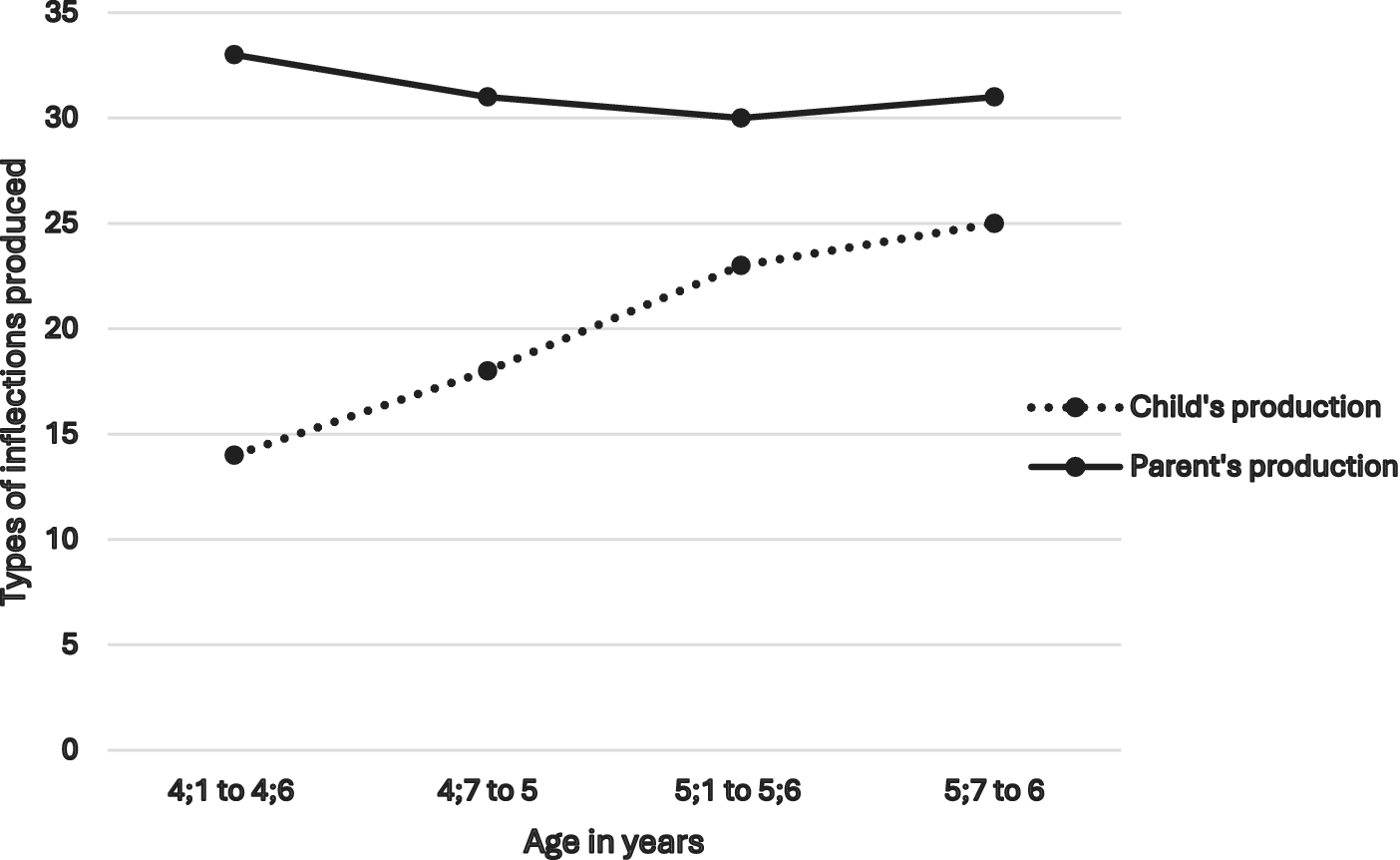
As indicated in Figure 1, the interaction between child and parental production showed that the increase in the type of inflection used with age was more pronounced in children than in parents. Specifically, children in the 5 to 6 years age range presented significantly greater inflection type usage than did the youngest group (4;01 to 4;06 years), with interaction reaching significance for both (β = 1.050 and 1.120, respectively, both p < .001).
Comparison of inflection types produced by children and parents across age bands.

Figure 1. Long description
The X axis is labeled Age in years and contains four categories: 4,1 to 4,6; 4,7 to 5; 5,1 to 5,6; and 5,7 to 6. The Y axis is labeled Types of inflections produced and ranges from 0 to 35 in increments of 5.
Two data series are plotted with circular markers:
1. Parent’s production is represented by a solid black line. It starts at approximately 33 for the first age band, slightly decreases to 31 and then 30 across the middle bands, and ends at 31 for the final age band.
2. Child’s production is represented by a dotted black line. It shows a steady linear increase, starting at 14 for the first age band, rising to 18, then 23, and reaching 25 for the final age band.
A legend on the right side of the graph identifies the solid line as Parent’s production and the dotted line as Child’s production.
Tokens of inflections produced. In terms of tokens of inflections produced, the model was statistically significant F(7, 420) = 7.55, p < 0.001, with an R 2 of 0.112, indicating that approximately 11.2% of the variance in token inflection production was explained by age as a predictor. Age significantly predicted tokens of inflection produced, F(3, 420) = 7.05, p < 0.001, partial η 2 = 0.048. Post hoc comparisons (Bonferroni-adjusted) revealed that children aged 5 to 6 years produced significantly more token inflections than those aged 4;01 to 4;06 years (p < 0.001 and p = 0.004, respectively). The difference between the younger group and those aged 4;07 to 5;0 years approached significance (p = 0.207), whereas other pairwise comparisons were not significant.
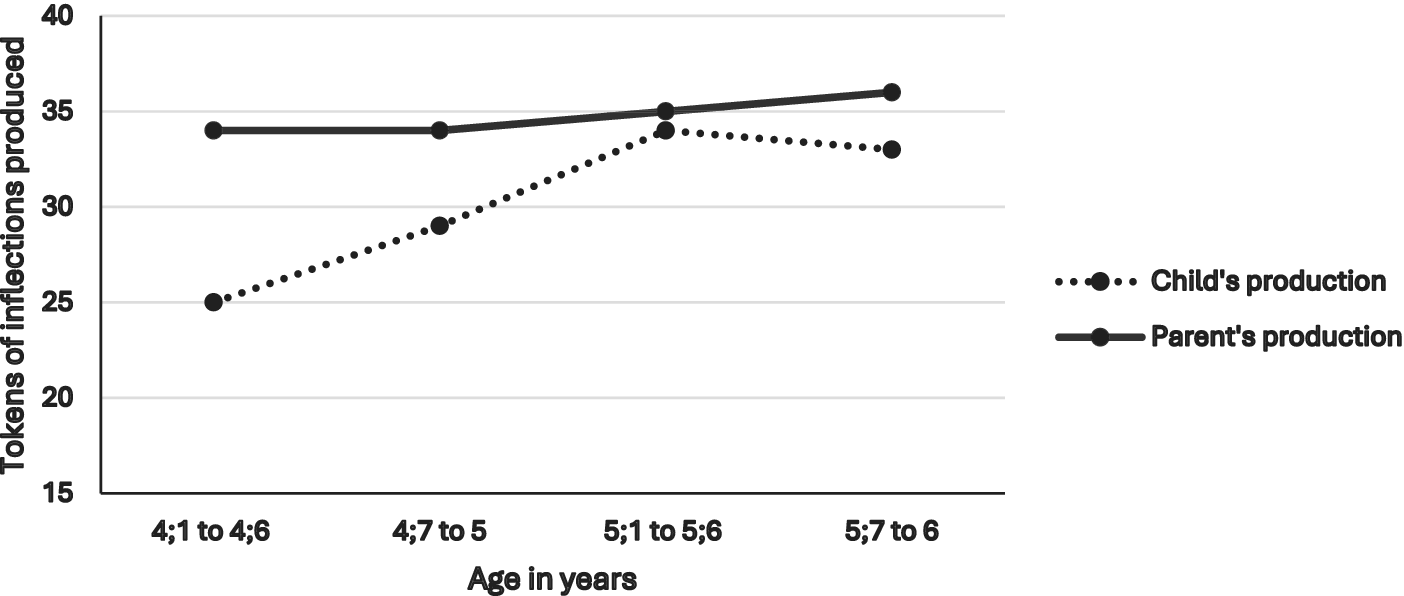
Child versus parent inflection production also showed a significant main effect, F(1, 420) = 18.20, p < 0.001, partial η 2 = 0.042, with parents producing more tokens of inflections on average than children (mean difference = 4.15, p < .001). The interaction effect between age and group (parent vs child) was also statistically significant, F(3, 420) = 3.27, p = 0.021, partial η 2 = 0.023. Simple effects analyses indicated that age-related increases in tokens of inflections produced were more pronounced in children than in parents. For example, compared with 4;1 to 4;06-year-old children, children aged 5; to 5;06 years (p = 0.003) and 5;7 to 6;0 years (p = 0.036), produced significantly more tokens of inflections. The age × group interaction suggests that while token inflection usage increased with age, this growth was steeper among children than in parental production (Figure 2).
Comparison of inflection tokens produced by children and parents across age bands.

Figure 2. Long description
The X axis is labeled Age in years and contains four categories: 4;1 to 4;6, 4;7 to 5, 5;1 to 5;6, and 5;7 to 6. The Y axis is labeled Tokens of inflections produced and ranges from 15 to 40 in increments of 5.
Two data series are plotted:
* Parent’s production is represented by a solid black line with circular markers. It starts at 34 tokens for the first two age groups, increases slightly to 35 for the third group, and reaches 36 for the final group.
* Child’s production is represented by a dotted black line with circular markers. It shows a steeper upward trend, starting at 25 tokens for the first group, rising to 29 for the second, peaking at 34 for the third group, and slightly decreasing to 33 for the final group.
The gap between the two lines narrows significantly as the age increases, with the child’s production nearly meeting the parent’s production in the 5;1 to 5;6 age band.
Post hoc comparisons further supported this interaction: children aged 5 to 6 years produced significantly more tokens of inflections than 4;01 to 4;06-year-old children (p < 0.001 and p = 0.003, respectively). Additionally, parents consistently outperformed children of the same age group, particularly at younger ages (e.g., p < 0.001 for 4;01 to 4;06-year-old comparisons).
3.2. Association between parents’ and children’s production of inflectional morphemes during the preschool period
Spearman’s rank-order correlations were used to analyze the associations between the types and tokens of inflections produced by parents and children within the story retelling task. A strong positive correlation was observed between the number of tokens and types of inflections in child production, r(212) = 0.974, p < 0.001, suggesting that children who used more tokens of inflections also produced a wider variety of inflection types.
No significant correlations were found between parental tokens of inflections with either child tokens of inflections, r(212) = −0.064, p = 0.352, or child’s types inflections production, r(212) = −0.026, p = 0.709, suggesting that the quantity of parental inflection production did not predict children’s inflection production. However, parental types of inflection production were significantly positively correlated with both child tokens of inflections, r(212) = 0.203, p = 0.003, and child types of inflections produced, r(212) = 0.259, p = 0.020. These findings indicate that a greater diversity of inflections used by parents is associated with more frequent and more varied inflectional production in children.
4. Discussion
The present study examined the development of inflectional morphology production in Kannada-speaking preschool children aged 4 to 6 years through a story retelling task. By analyzing both the type (variety) and token (frequency) of inflections used, the study provides a nuanced view of morphological acquisition during the preschool period and documents the potential influence of parental input, drawing on usage-based theory. The results revealed a dynamic, age-related progression in children’s inflectional production, wherein both the types and tokens of inflectional forms in nouns and verbs increased significantly with age, despite parental production remaining relatively stable across age groups. Notably, children between 5 and 6 years of age presented markedly greater morphological productivity than those aged 4–5 years, though these changes were not strictly linear across every 6-month interval. This pattern suggests that internal cognitive and linguistic maturation, rather than differences in quantity of input, plays a more prominent role in shaping morphological development during this period (Wexler, Reference Wexler1998). These findings highlight a clear ongoing developmental trend in morphological production during the preschool years between 4 and 6 years of age using story retelling task as a proxy for parental input.
In line with the first hypothesis, our findings align with usage-based theory by demonstrating that children’s production of inflectional morphemes increases significantly in both types and tokens, reflecting growing grammatical complexity between 4 and 6 years of age in Kannada-speaking children. This suggests that the children first learn frequently used forms and then generalize inflectional patterns across a growing range of lexical items. The observed developmental gains in the context of relatively stable parental input suggest a plausible role for children’s developing cognitive mechanisms, such as categorization, analogy, and pattern recognition, in enabling increasingly sophisticated extraction of morphological patterns from consistent input, which is in accordance with constructivist and connectionist perspectives (Diessel, Reference Diessel and Dancygier2017; Tomasello, Reference Tomasello2003). It is however, important to note here that the parental input measured in this study was based on the story retelling task alone, which might not reflect the parental input in other naturalistic contexts at home or in school settings. These findings thus warrant validation using other naturalistic tasks by future studies.
In agglutinative languages such as Kannada, words consist of multiple morphemes, and children tend to acquire inflectional morphology earlier and with greater consistency than children learning non-agglutinative or isolating languages such as English (Aksu-Koç & Ketrez, Reference Aksu-Koç, Ketrez, Bittner, Dressler and Kilani-Schoch2003). Results from the present study revealed that various morphemes, such as nouns (case and plural markers) and verb inflections (tense markers and PNG markers), were produced as early as 4 years of age. Findings from Kannada thus support early, consistent, and robust acquisition of inflectional morphology. This might be attributed to saliences such as frequency, morpheme length, linear structure, and predictable functions in the Kannada language (Abhishek & Priyadarshini, Reference Abhishek and Priyadarshini2023; Raghavendra, Reference Raghavendra1989). Within this trend, we observe that across categories of noun and verb inflectional markers, some inflections are acquired earlier than others. For instance under noun inflectional markers, while the dative case marker (-ge,-ikke,-ige, -kke,-akke) is acquired early (with consistently higher counts across age groups), accusative (-annu) and genitive (-a, -ara, -ra) case markers, along with irregular plural markers (-aru, -kkalu), are acquired later (or protracted). Data from our study show that, for noun inflections, this pattern reflects the exceptionally high functional load of the dative in Kannada. The dative marker is not plausibly restricted to marking indirect objects but extends to a wide range of functions, including goal arguments, experiencer subjects, possession, benefactive roles, purpose clauses, and non-canonical subject constructions. Because the dative participates in multiple core argument structures, children encounter and use it frequently in everyday discourse, resulting in higher token counts (Tiwari et al., Reference Tiwari, Karanth, Amritavalli, Amritavalli and Narasimhan2025). In contrast, accusative and genitive case markers, while grammatically important, are often optional or pragmatically recoverable in Kannada, possibly reducing their overt use in child speech. Similarly, instrumental and locative case markers, despite being semantically transparent, appear restricted to more specific spatial or event-structural contexts, resulting in lower overall frequencies (Tiwari et al., Reference Tiwari, Karanth, Amritavalli, Amritavalli and Narasimhan2025). Irregular plural markers appear least frequently because these forms are low in frequency, lexically restricted, and lack transparent form–meaning mappings, making them difficult to generalize. As a result, children preferentially rely on the high-frequency, productive default plural marker (-gaḷu), which is easier to process and apply during early morphological development (Bybee, Reference Bybee2007; Tomasello, Reference Tomasello2003). Similarly, our data from verb inflectional markers show that tense and person–number–gender (PNG) agreement markers are produced with higher frequency than other verbal inflections, such as participial, modal, aspectual, and negative markers, possibly reflecting their higher functional load, greater frequency in input, and obligatory status in finite clauses (Tiwari et al., Reference Tiwari, Karanth, Amritavalli, Amritavalli and Narasimhan2025).
The findings of the second research question showed no significant correlation between parental inflection tokens and child production, but positive associations for parental types, partly supporting the hypothesis. This is consistent with usage-based accounts, where input variety may foster abstraction and generalization more than quantity alone (Bybee, Reference Bybee2006; Diessel, Reference Diessel and Dancygier2017; Hoff, Reference Hoff2006). Interaction effects revealed children’s steeper developmental trajectories despite stable parental patterns, plausibly reflecting gradual internalization from rich input (Tomasello, Reference Tomasello2003). The lack of token associations suggests child production may increasingly diverge from input as rules generalize, aligning with interactionist views (Pinker, Reference Pinker1999).
In summary, the findings from this study demonstrate that the preschool years between four and six represent an important period for the learning of inflectional morphology in Kannada-speaking children. Children showed a clear age-related increase in both the variety (types) and frequency (tokens) of inflectional forms, reflecting growing grammatical productivity, even though parental inflectional input remained relatively stable within the story retelling task domain. Within noun morphology, dative case markers were produced more frequently than other cases, consistent with their high functional load and wide range of grammatical roles in Kannada, whereas accusative, genitive, instrumental, and locative case markers occurred less often due to optionality, restricted contexts, or lower transparency. Irregular plural markers were least frequent, with children relying primarily on the productive default plural form. In verb morphology, tense and PNG (agreement) markers showed higher accuracy and frequency than other verbal inflections, underscoring their obligatory status and salience in finite clauses. Together, these findings suggest that while inflectional morphology emerges early in agglutinative languages like Kannada, specific inflections continue to differentiate during the preschool years, shaped by functional load, transparency, and children’s developing capacity to generalize from rich but stable input.
The study had a few limitations as well. The primary limitation was that the parental input in this study was measured using an elicited story retelling task alone. The actual parental input might be different than what is measured in the story retelling task context. Parent–child production correlations thus reflect “associations between parental repertoire and child production”, plausibly linked to cumulative exposure, though direct CDS recordings would offer a fuller naturalistic measure (Huttenlocher et al., Reference Huttenlocher, Vasilyeva, Cymerman and Levine2002). While we used parent production as a proxy for the language input to these children, it is very likely that children at this age also receive input from teachers and others (siblings, grandparents, friends and family members) in school and home. It is also possible that the children receive input through books and other reading materials, which can also explain the results. A related limitation of the story retelling task (with pictures) is that it may elicit only a limited set of inflections rather than capturing the full range. Secondly, although the story retelling task effectively elicited morphological forms, performance may have been influenced by factors such as attention, working memory, and familiarity with the task. A further limitation of the study is that we did not consider other effects on morphological development, which could have provided a better understanding of morphological development. Future research should thus employ longitudinal designs, incorporate a broader range of linguistic and cognitive measures, and further explore the interaction between executive function and morphological acquisition. Other speech elicitation tasks could be used to investigate inflectional development. Additionally, future research can focus on error analysis of inflectional morphological production.
5. Conclusion
This study shows that preschool years between four and six are important for learning inflectional morphology in Kannada, an agglutinative language. Children exhibited a clear age-related increase in both the variety (types) and frequency (tokens) of inflections, reflecting growing grammatical productivity, even though parental input remained stable. Children’s morphological development was associated with the diversity of inflectional types in parental speech rather than token frequency, suggesting the importance of input richness over quantity. Development also differed across inflections, with high functional load markers such as dative case, tense, and PNG (agreement) showing greater use and acquired earlier than optional, restricted, or irregular forms. The overall findings align with usage-based theories and a constructivist viewpoint. Together, these findings underscore how functional load and input diversity shape morphological development in agglutinative languages. While the story retelling task demonstrated ecological validity and sensitivity to developmental differences, making it a valuable tool for assessing language use in naturalistic contexts, these findings warrant future validation across other naturalistic tasks and contexts. The results carry important educational and clinical implications, highlighting the need to provide children with rich and varied language exposure at home and in school to support early language development.
Supplementary material
The supplementary material for this article can be found at http://doi.org/10.1017/S0305000926100981.
Funding statement
The work was supported by funding to the corresponding author, ST, by ICSSR (F. No. ICSSR/RPD/MJ/2023–24/G/94).
Competing interests
The authors declare no competing interests.
Data availability statement
The data that support the findings of this study are available on request from the corresponding author.
Author contributions
M.K.N. was involved in data curation, formal analysis, investigation, methodology, validation, and writing of the original draft. S.J. was involved in project administration, validation, supervision, writing – review and editing. G.K. was involved in intellectual inputs, methodology, supervision, and writing – review and editing. S.T. was involved in conceptualization, funding acquisition, project administration, methodology, validation, supervision, and writing – review and editing.
Ethical standards
The study protocol was approved by the Kasturba Medical College and Kasturba Hospital Institutional Ethics Committee (IEC1 102/2022). All participants’ parents provided written informed consent prior to their participation.




 Open access

