INTRODUCTION
English-acquiring children frequently make pronoun case errors of the sort below:
(1) Then us taked off all our clothes. (Douglas 3 ; 4: Huxley, Reference Huxley, Flores d'Arcais and Levelt1970)
(2) Him can't see. (Nina 2 ; 1: Vainikka, Reference Vainikka1994)
(3) Her cries a lot. (Child 2, 3 ; 0: Rispoli, Reference Rispoli1994)
Interestingly, the same cannot be said for German. In fact, case-marking errors in the use of personal pronouns are exceedingly rare in the literature on the speech of children acquiring German (Kaper, Reference Kaper1976; Stenzel, Reference Stenzel and Meisel1994; Schütze, Reference Schütze1997; Mills, Reference Mills and Slobin1985; Tracy, Reference Tracy1986). Beyond the few reports of what seem to be quite rare errors,Footnote 1 little is mentioned in the literature regarding the acquisition of case in the personal pronoun paradigms. Mills (Reference Mills and Slobin1985) notes, ‘An early distinction is made between nominative and accusative forms of the first pronouns to appear … Case forms are marked quite distinctly’ (p. 181).
In contrast Mills (Reference Mills and Slobin1985: 242, 243) reports, ‘When full forms of articles are produced, the nominative case form is frequently used where other case-marking would be appropriate … After prepositions, the accusative form of the articles is commonly overgeneralized’. Independent reports of children's case errors confirm this (MacWhinney, Reference MacWhinney1978; Tracy, Reference Tracy1986; Stenzel, Reference Stenzel and Meisel1994; Czepluch, Reference Czepluch and Sackmann1996; Szagun, Reference Szagun2004), showing that case on articles poses a particular problem for German children.
These reports pose an interesting conundrum. Why should children acquiring English frequently make case errors in their use of personal pronouns while children acquiring German seldom seem to do so? And why should German-acquiring children apparently master the case system of the German personal pronoun paradigms with ease, while making frequent case errors with articles? To date, no theory or combination of theories has provided an adequate answer to these questions. However, a factor heretofore uninvestigated – case ambiguity in the input to children – may prove crucial in creating or preventing case errors in child language.
English case
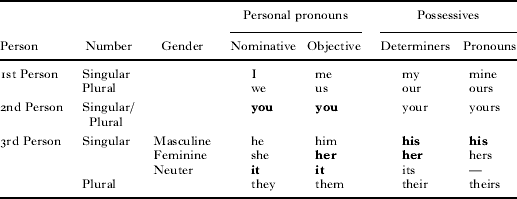
English has an impoverished case system with the only overtly case-marked forms being personal pronouns, which are either nominative or objective, and possessive determiners, which are genitive. For English, straightforward syntactic rules govern case assignment. Nominative case is assigned to spec-IP, so syntactic subjects in English are nominative. Objective case is assigned to complements of verbs and prepositions. Additionally, objective case has been argued to function as the default case in adult English (Radford, Reference Radford1990; Schütze, Reference Schütze1997, Reference Schütze2001). Genitive case is quite different from nominative or objective case in that it applies strictly within DPs, and such DPs are not inflected for nominative or objective case. Given that, possessive determiners will not be considered herein, except insofar as they are ambiguous with forms that are of interest in the present study.
Table 1 shows the personal pronouns and possessive determiners in English with case-ambiguous forms in bold. Only personal pronouns and the possessive determiner /her/ are included in the analyses that follow.
Case forms in English
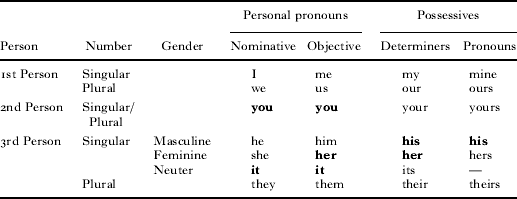
While her is not ambiguous within the personal pronoun paradigm being investigated here, it is ambiguous outside the paradigm, and the fact that her functions as both the third person feminine singular objective pronoun and the possessive determiner has been argued to be responsible for the fact that children overextend her to nominative contexts comparatively frequently (Vainikka, Reference Vainikka1994). Consequently, her is considered ambiguous in the following analyses.
German case
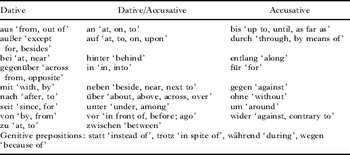
In contrast to English, the case system of German is quite rich. In addition to marking personal pronouns for case, German determiners, wh-words, quantifiers and adjectives also bear case-markings, as do some nouns, and where English distinguishes three cases, German distinguishes four: nominative, accusative, dative and genitive. Unlike English, German contains both structural and lexical case. Structural case-marking dictates the case of DPs as follows: nominative case is assigned to spec-IP, so syntactic subjects in German are nominative; transitive verbs assign accusative case to direct objects, and indirect objects receive dative case.Footnote 2 Like English, German has possessive determiners; however, unlike English, these are inflected for nominative, accusative, dative or genitive case. Lexical case-marking is a lexically defined exception to structural case-marking, such that some intransitive verbs, such as graue' ‘to be horrified by something’ and frieren ‘to be cold’, have dative and nominative or accusative subjects respectively, while some transitive verbs, such as helfen ‘to help’ and danken ‘to thank’, have dative direct objects. Also like English, German is said to have default case, which for German is nominative (Schütze, Reference Schütze1997; Reference Schütze2001; Eisenbeiss, Bartke & Clahsen, Reference Eisenbeiss, Bartke and Clahsen2006). Additionally, there are the case-marking properties of prepositions. Table 2 shows the prepositions in German and the case their complements take. Depending on one's perspective, all prepositions assign case lexically (Haider, Reference Haider and Toman1985; Haegeman, Reference Haegeman1991), all prepositions structurally assign accusative case (Eisenbeiss, Reference Eisenbeiss2003), or all prepositions structurally assign dative (Bierwisch, Reference Bierwisch, Bierwisch, Motsch and Zimmermann1988).
German prepositions

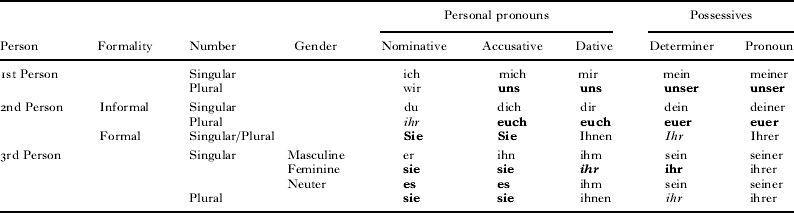
Table 3 lists the personal pronouns and possessive determiners/pronouns for German. Those forms that are case-ambiguous within the same person/number cell are in bold and those that are case-ambiguous across different person/number cells are in italics. Except for ihr, possessive forms are not included in these analyses. These have been excluded because of their asymmetry to English possessive determiners, which are not overtly marked for case. However, the possessive determiner ihr has been included because it is ambiguous across different number/person cells within the personal pronoun paradigm as it represents both the second person plural informal nominative pronoun and the third person singular feminine dative pronoun, and ihr is clearly ambiguous with the possessive determiner ihr. Furthermore, treating ihr as ambiguous is consistent with treatment of her as ambiguous for English. Hence, though doing so can only serve to weaken support for the present hypothesis, ihr is considered ambiguous in this study.
Case in German personal pronouns and possessive determiners and pronouns
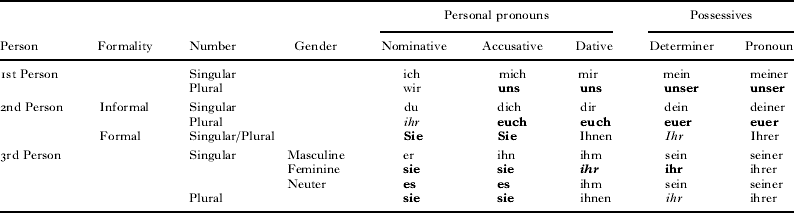
As noted, German also marks determiners, wh-words, quantifiers, adjectives and some nouns for nominative, accusative, dative and genitive case. Also, in addition to their use as determiners, definite articles can be used as pronouns. For example, the English sentence We love them, can be translated into German as either Wir lieben sie or Wir lieben die. Table 4 provides the declension for the German definite article.
Definite article declension

* Dative feminine /der/ is not in bold because genitive forms are not analyzed herein.
Indefinite determiners, along with other determiners ending in -ein (possessive pronouns and kein), can also be used as pronouns, and when used as such they exhibit the same case endings as do the determiners that decline like the demonstrative determiner dieser, shown in Table 5 (Eisenbeiss et al., Reference Eisenbeiss, Bartke and Clahsen2006).
Declension of dieser ‘this’, jener ‘that’, welcher ‘which’, jeder ‘each’, alle ‘all’, viele ‘many’

* Dative /dies - er/ is not in bold because genitive forms are not analyzed herein.
Table 6 shows the declension of the -ein determiners when they are used prenominally, that is as determiners (note: there are no plural forms for the indefinite article).
Declension of -ein determiners: indefinite article, possessive pronouns, kein

Note: Plural forms exist only for -ein determiners other than the indefinite article.
* Dative feminine /ein - er/ is not in bold because genitive forms are not analyzed herein.
As above, those forms that are case-ambiguous within the same gender/number cell are in bold while those that are case-ambiguous across different gender/number cells are in italics. Genitive forms are excluded from analysis due to their rare use in spoken German (Eisenbeiss et al., Reference Eisenbeiss, Bartke and Clahsen2006) and late acquisition by children (Mills, Reference Mills and Slobin1985), and in order to maintain consistency throughout this investigation.
As the tables show, nominative and accusative articles and determiners are ambiguous within the feminine, neuter and plural cells. Across different gender/number cells, the masculine nominative forms of the definite article der, and the demonstrative determiner dieser (and other determiners that decline in the same way), are ambiguous with the feminine dative forms. Also, the masculine accusative forms of the definite article den, the -ein determiner keinen, and the demonstrative determiner diese (and other determiners that decline in the same way), are ambiguous with the plural dative forms. However, none of these forms is considered ambiguous in these analyses for two reasons. First, it has been noted that gender errors are relatively rare in German children's speech (see MacWhinney, Reference MacWhinney1978: 60) and that gender seems to be acquired at an early age (Mills, Reference Mills and Slobin1985: 173, 174). This suggests that children begin to accurately distinguish gender at an early age, and at such time as children accurately distinguish gender, der and dieser, along with den, diesen and keinen, cease being case-ambiguous. Another reason for considering these forms case distinct is that doing so can only weaken support for the present hypothesis; hence, this interpretation is the most conservative given the question under investigation.
Children's case acquisition
Children acquiring English and German tend to make case errors en route to adult-like performance. However, there is a perplexing asymmetry in these errors that is in need of adequate explanation. An ideal explanation would provide a single account for children's treatment of case in both English and German. Descriptions of theories posited for case errors/acquisition in English and German follow. While no theory fully accounts for all aspects of English and German children's performance with case, the Input Ambiguity hypothesis articulated below offers a simple explanation which accurately predicts the presence or lack of case errors in English and German, and it is hoped that it will prove equally adequate in predicting case errors or their lack in children's acquisition of other languages.
English case acquisition
As children learn English, many of them make case errors. Such errors are well documented (Huxley, Reference Huxley, Flores d'Arcais and Levelt1970; Bloom, Lightbown & Hood, Reference Bloom, Lightbown and Hood1975; Radford, Reference Radford1990; Reference Radford1998; Rispoli, Reference Rispoli1994, Reference Rispoli2005; Vainikka, Reference Vainikka1994). The most common errors are overextension of objective case forms to non-objective contexts (Rispoli, Reference Rispoli1994; Vainikka, Reference Vainikka1994; Schütze, Reference Schütze1997). However, children also err by overextending the genitive (Rispoli, Reference Rispoli1994; Vainikka, Reference Vainikka1994; Radford, Reference Radford1998) and nominative forms (Rispoli, Reference Rispoli1994, Reference Rispoli2005; Vainikka, Reference Vainikka1994). Numerous linguists have attempted to explain these errors (Kaper, Reference Kaper1976; Nelson, Reference Nelson1975; Radford, Reference Radford1990, Reference Radford1998; Rispoli, Reference Rispoli1994; Vainikka, Reference Vainikka1994; Schütze & Wexler, Reference Schütze and Wexler1996; Schütze, Reference Schütze1997, Reference Schütze2001; Wexler, Schütze & Rice, Reference Wexler, Schutze and Rice1998). From these efforts, a number of theories have emerged. Of these, syntactic and morphosyntactic theories have received the most attention.
Syntactic theories
Systematicity has been observed among case errors in child English; in particular, English-speaking children tend to make numerous case errors in nominative contexts and relatively few in objective and genitive contexts (Rispoli, Reference Rispoli1994). A number of linguists (Vainikka, Reference Vainikka1994; Schütze & Wexler, Reference Schütze and Wexler1996; Schütze, Reference Schütze1997; Wexler et al., Reference Wexler, Schutze and Rice1998) have developed syntactic theories which focus on explaining the stereotypical objective or genitive for nominative case error and its eventual resolution.
Syntactic explanations of children's pronominal case errors take as given an extended INFL model of syntax and assume case assignment occurs according to Checking Theory. Such models posit that children's pronominal case errors result from incomplete or under-specified phrase structure, and that children supply a default case pronoun in all positions until the requisite phrase structure for case assignment is present in the child's grammar. Regarding nominative case, it is specifically a lack of or an under-specified INFL that creates the problem. The most fully articulated syntactic hypothesis, the Agreement/Tense Omission Model or ATOM (Schütze & Wexler, Reference Schütze and Wexler1996; Wexler et al., Reference Wexler, Schutze and Rice1998), predicts that after INFL is present, pronouns of all cases may surface in subject position depending on what features are present in INFL (Schütze & Wexler, Reference Schütze and Wexler1996), but that when agreement features are overtly marked on the verb, pronoun errors will not arise.
Nominative case errors are rare in sentences containing verbs overtly marked for tense and agreement (Schütze, Reference Schütze1997; Rispoli, Reference Rispoli2005). However, they are not unheard of. In fact, a recent study found the co-occurrence of objective case pronominal subjects and finite verbs was as high as 30% in the speech of some children (Pine, Rowland, Lieven & Theakston, Reference Pine, Rowland, Lieven and Theakston2005). According to ATOM, if the children in that study lacked the nominative form of the pronouns where they erroneously supplied the objective case, such errors would not be treated as case errors per se, since they would have arisen from lexical gaps in the pronominal paradigm rather than from a structural case error. A weakness of this model is the existence of examples that refute the assertion that once a child masters the syntax and features of nominative case, he/she will make no case errors. Sentence (4) provides one such counter-example.
(4) Her is jolly strong, isn't she? (Douglas 2 ; 4: Huxley, Reference Huxley, Flores d'Arcais and Levelt1970)
Morphosyntactic theories
Morphosyntactic theories of case errors hold that case errors result from an inconsistency between morphology and the case it encodes. Rispoli's Paradigm Building hypothesis (Reference Rispoli1994) is such a model. Under this model, children ‘attempt’ to find some regularity in a system that has none, and in so doing they extract a phonetic core (e.g. m- for first person singular) for each pronoun paradigm. Then, until such time as they learn the correct forms for each cell within each paradigm, they supply pronouns that share the phonetic core.
The data show that children are much more likely to overextend pronominal forms sharing part of the phonetic core (Rispoli, Reference Rispoli1994). However, when finiteness is high, children tend to make fewer case errors than when finiteness is low (Schütze, Reference Schütze1997; Schütze & Wexler, Reference Schütze and Wexler1996), and a strictly morphosyntactic model cannot account for this. Rispoli (Reference Rispoli2005) has proposed an explanation for the interaction between Paradigm Building and finiteness which may strike the proper balance between the interplay of paradigm expansion and syntactic development.
German case acquisition
Reports of German children making pronominal case errors are extremely rare. However, German-acquiring children frequently produce case forms of the definite and indefinite articles that do not conform to the adult grammar.Footnote 3 Unlike in English, German children rarely make errors in nominative contexts, though it would be inaccurate to suggest that they never do so. Indeed, Leopold (1949, cited in Kaper, Reference Kaper1976) reports that for a period of time, Hildegard consistently overextended accusative den to nominative contexts. Much more common errors are overextensions of the nominative forms of articles to accusative contexts and accusative forms to dative contexts. Also attested in the literature are dative for accusative substitutions.
While one would expect errors to arise in German children's language, given the idiosyncrasies of lexical case-marking, it is vital to note that case errors occur not only where case is marked lexically but also where it is structurally marked. All nominative substitutions for accusative direct objects are certainly instances of structural case-marking errors. Sentences (5–10) provide examples of such errors. In each example, the incorrect form used by the child precedes the slash while the adult-like utterance follows the slash.
(5) *der/den korb ich alleine festhaltenthe (*Nom/Acc) basket I alone hold onto
‘I alone hold onto the basket.’ (Daniel 2 ; 9.28⩽3 ; 6.28: Clahsen, 1982; in Schütze, 1997)
(6) hab *der/den Stuhl (g)ehaut have the (*Nom/Acc) stool hit
‘I have hit the stool.’ (Child 3 ; 2: Stern, 1975; in Mills, Reference Mills and Slobin1985)
(7) da nehm ich mir *ein/einen Regenschirm there take I (Nom) me (Dat) an (*Nom/Acc) umbrella
‘There I take an umbrella (with/for) me.’ (J 2 ; 8: Tracy, Reference Tracy1986)
(8) hab ich so *ein/einen grossen bösen Finger have I such a (*Nom/Acc) big (Acc) bad (Acc) finger
‘I have such a big bad finger.’ (Child 2 ; 6: Scupin, 1907, 1910; in Mills, Reference Mills and Slobin1985)
(9) hat sie *ein/einen so vollen Bauch has she a (*Nom/Acc) such full (Acc) stomach
‘She has such a full stomach.’ (Child 5 ; 3: Scupin, 1907, 1910; in Mills, Reference Mills and Slobin1985)
(10) ich mal *der/den mond weg I paint the (*Nom/Acc) moon away
‘I paint the moon away.’ (Children 1 ; 4⩽3 ; 8: Szagun, Reference Szagun2004)
Another structural case-marking error that occurs in German children's language is accusative substitutions for dative indirect objects. Examples of this type of structural case-marking error are shown in sentences (11) and (12).
(11) mach *den/dem Mann Beine make the (*Acc/Dat) man legs
‘Make legs for the man.’ (Child 2 ; 9: Scupin, 1907, 1910; in Mills, Reference Mills and Slobin1985)
(12) ich will Briefe ins Hous *die/der Mama schicken I want letters into house the (*Nom-Acc/Dat) Mommy send
‘I want to send letters to Mommy in the house.’ (Child 2 ; 6: Scupin, 1907, 1910; in Mills, Reference Mills and Slobin1985)
Whether or not post-preposition case errors of the sort in sentences (13–17) below should be considered lexical or structural case-marking errors is unclear. Here I simply report the existence of these errors and defer to others to determine their nature.
(13) und auf *einen/einem bein stehen and on one (*Acc/Dat) leg stand
‘And stand on one leg.’ (Pascal 3 ; 1.20: Stenzel, Reference Stenzel and Meisel1994)
(14) der geht auf *der/den Stuhl he goes on the (*Nom/Acc) stool
‘He goes on the stool.’ (Child 3 ; 0: Grimm, 1975; in Mills, Reference Mills and Slobin1985)
(15) fur *(de)m/den Axel for the (*Dat/Acc) Axel
‘for Axel’ (Child 2 ; 4: Preyer, 1882; in Mills, Reference Mills and Slobin1985)
(16) jetz kommt der tiger mit *ein'n/ein'm schneemannkopf now comes the tiger with a (*Acc/Dat) snowman's head
‘Now the tiger comes with the snowman's head.’ (Szagun, Reference Szagun2004)
(17) der war auf *das/dem dach he was on the (*Nom-Acc/Dat) roof
‘He was on the roof.’ (Szagun, Reference Szagun2004)
Several researchers have noted that children appear to acquire nominative case first, followed by accusative and then dative case (Mills, Reference Mills and Slobin1985; Tracy, Reference Tracy1986). Summarizing numerous accounts of German child language, Eisenbeiss et al. (Reference Eisenbeiss, Bartke and Clahsen2006) state, ‘The picture that emerges from these studies is that in the two-word stage, children do not yet use case-markings contrastively’ (p. 11). Additionally, they maintain that, ‘An early case system that distinguishes between nominative and non-nominative forms begins to develop during the third year of life’ (p. 12). However, a recent longitudinal study by Szagun (Reference Szagun2004) calls these characterizations into question.
Szagun's (Reference Szagun2004) study found that from the earliest MLU level analyzed (MLU 1.89), children correctly produced the definite article in nominative, accusative and dative case. While it is true that Szagun's data show that children supplied nominative case articles with the greatest accuracy, followed by accusative case forms with intermediate accuracy, and datives with the lowest accuracy, she notes, ‘the suggestion of an acquisitional sequence with nominatives being acquired before accusatives and datives is, at best, an imprecise way of describing the data’ (p. 24). Furthermore, children's correct use of all three case forms beginning from MLU 1.89 suggests that children may actually use case contrastively at the two-word stage.
Czepluch's (Reference Czepluch and Sackmann1996) results, based on his review of a child's data from fourteen transcripts recorded at regular intervals from 2 ; 00.17 to 3 ; 09.10, also conflict with the earlier characterization of case acquisition. He notes that at age 2 ; 01.08, the child, Lisa, overgeneralized the accusative to dative contexts after prepositions. This contrasts with the characterization that children have only a rudimentary nominative/non-nominative case system beginning to develop during their third year of life. Further, Czepluch states, ‘By the age of 2 ; 03, Lisa uses the DAT-ACC pattern productively’ (p. 100), and these cases were used productively with direct and indirect objects as well as with prepositional complements.
The difference between Czepluch's results and earlier accounts of children's case usage may be related to the fact that the subject of Czepluch's study was ‘a straightforward and fast language acquirer as compared to other children in the Tübingen group’ (p. 94). The difference in Szagun's results and characterizations of case acquisition based on earlier diary studies and spontaneous language data may lie in the nature of the data. Szagun's data are longitudinal, from multiple children whose language was collected in a controlled environment and transcribed in a consistent manner. Whatever the reasons for these differences, one aspect of older characterizations of German child language that is entirely consistent with more recent work is the characterization of a ‘slow and error-ridden acquisition of case-marking on articles in German-speaking children (Szagun, Reference Szagun2004: 24).
Though several researchers have noted that children tend to use correctly case-marked pronouns earlier than correctly case-marked articles (Mills, Reference Mills and Slobin1985; Tracy, Reference Tracy1986; Clahsen, Eisenbeiss & Vainikka, Reference Clahsen, Eisenbeiss, Vainikka, Clahsen and Rutherford1994; Czepluch, Reference Czepluch and Sackmann1996), no theory specifically attempts to account for this incongruity. However, several theories have been proposed to account for children's case acquisition and/or errors with articles.
Syntactic accounts
Tracy (Reference Tracy1986), Clahsen et al. (Reference Clahsen, Eisenbeiss, Vainikka, Clahsen and Rutherford1994) and Czepluch (Reference Czepluch and Sackmann1996) have proposed syntactic theories to account for German children's acquisition of case and their case errors. While all these researchers have made important contributions to the subject at hand, only Clahsen et al.'s model is discussed in detail, as this model provides an explanation, albeit brief and unelaborated, as to why German children err with articles but not with pronouns.
Clahsen et al. (Reference Clahsen, Eisenbeiss, Vainikka, Clahsen and Rutherford1994) proposed a model of case acquisition in which UG principles, morphological case-marking and semantic bootstrapping drive acquisition. According to their analysis, UG provides children with all possible heads of maximal projections, the existence of which children acquire based on the linguistic input. Once a head is projected, so is its complement position, since UG requires that all heads have complement positions. In contrast, specifiers are not simultaneously projected with acquisition of a functional head, and instead are only projected based on positive evidence from the input. According to Clahsen et al., the prenominal genitive -s lies in spec-DP and provides the evidence required for specifier acquisition. Hence, its acquisition triggers the acquisition of the DP phrase structure necessary for determiner case.
While Clahsen et al. find evidence for this developmental sequence in the data they reviewed, others have noted results that run counter to these predictions. The child in Czepluch's (Reference Czepluch and Sackmann1996) study, prior to acquisition of the prenominal genitive, acquired productive use of accusatives clearly inflected with the -n accusative suffix, as evidenced by self-corrections like neues ‘new’ (neuter accusative) to neuen ‘new’ (masculine accusative), clearly demonstrating the status of -n as an accusative suffix (p. 99). Additionally, Szagun (Reference Szagun2004) notes that children at every MLU level in her study correctly use definite articles in the nominative, accusative and dative cases – something that would not be expected were children following the path to acquisition outlined above.
Clahsen et al. suggest the incongruity between children's behavior with case-marked pronouns and articles results from the fact that personal pronouns are uninflected lexical items requiring no carrier system for affixation. In contrast, case-marked articles result from regular inflectional affixation onto stems. Further, correct case-marking of articles can only occur within the appropriate DP structure. Hence, absent determiner phrase structure, articles cannot be correctly case-marked. Under this model, one would also expect pronominal case prior to determiner case, since pronouns can receive structural case-marking in child German in the domain of comp-VP/spec-IP without an elaborated DP structure, while case assignment with articles can only occur in those domains after DP has been posited.
A problem with this model is that it predicts that case on complements should be acquired prior to case on specifiers. Hence, accusative case should be acquired before nominative case. However, nominative case appears to be acquired as early as, if not earlier than, accusative case for both pronouns (Mills, Reference Mills and Slobin1985) and determiners (Szagun, Reference Szagun2004; Tracy, Reference Tracy1986).
Input driven errors
Several researchers (Szagun, Reference Szagun2004; Eisenbeiss et al., Reference Eisenbeiss, Bartke and Clahsen2006) have proposed that aspects of the input are responsible for German children's case errors with articles. In the first comprehensive, multi-subject, controlled, systematic, longitudinal study of its kind in German, Szagun (Reference Szagun2004) examined the possibility that low perceptual salience among articles, e.g. accusative den and dative dem in the masculine singular paradigm, and frequency of articles in the input influence the types of errors children make.Footnote 4
Szagun's results confirmed the hypothesis that low discriminabilty between den/dem results in higher error rates in that den for dem substitutions were significantly more common (p<0·013) than other incorrect uses of den. However, no significant effect of low perceptual salience on frequency of error types was found for the indefinite article paradigms. Regarding the effect of frequency of input on children's errors, Szagun's results show that frequency of errors with indefinite articles corresponded exactly to the frequency of the forms in the input to the children. However, regarding the definite article, the most frequent error was overextension of den, though the form that was most frequent in the input was die.
Across article types and paradigms, these analyses demonstrate an imperfect fit between parental input and frequency of errors. Furthermore, children make case errors in paradigms where there is no problem with perceptual salience. Hence, perceptual salience+input frequency alone do not appear to fully account for German children's errors with articles.
A general model of language acquisition
MacWhinney (Reference MacWhinney and MacWhinney1987) and Bates & MacWhinney's (Reference Bates, MacWhinney and MacWhinney1987) Competition Model is a comprehensive model of language acquisition within an input-driven framework. Within this model, certain aspects of language act as cues to particular functions in the language. However, cues vary in their reliability and availability, and together these factors determine a cue's overall cue validity.
The Competition Model accurately predicts German children's lack of case errors with personal pronouns. The vast majority of German pronouns are 100% reliable cues of case throughout the entire paradigm, making them ‘easy to learn’ and resistant to error. However, the model does not predict, and cannot account for, the kinds of case errors that occur in German children's use of articles. For example, within the masculine singular paradigm for definite articles, der is a 100% valid cue to nominative case, den is a 100% valid cue for accusative case, and dem is a 100% valid cue to dative case. Furthermore, der is highly available in the input, and critically it never cues for accusative case in any paradigm. Nonetheless, German children's most frequent case error with definite articles is overextension of the nominative form der to accusative contexts (Szagun, Reference Szagun2004). According to the Competition Model, however, this error should almost never occur, since der has 0% validity as a cue to accusative case.
Input Ambiguity hypothesis
Two questions posed in the Introduction remain unanswered and unanswerable under the models and theories described above. Why should English-acquiring children frequently make case errors with personal pronouns while children acquiring German seldom seem to do so? And why should German-acquiring children apparently master the case system of the German personal pronoun paradigms with ease, while making frequent case errors with articles?
It is proposed that the answer to both these questions may lie in the level of case ambiguity in child-directed speech. Specifically, where the percentage of case-ambiguous forms in child-directed speech is below a critical threshold of ambiguity, errors should be uncommon, but where the percentage of case-ambiguous forms in child-directed speech is above a critical threshold of ambiguity, errors should be common in child speech. This could account for the presence of pronominal case errors in child English, the lack of pronominal case errors in child German, and the presence of article case errors in child German.
METHOD
In order to evaluate the plausibility of the hypothesis that input ambiguity may be relevant for answering the questions raised about the acquisition of the English and German case systems, an archival study comparing the level of ambiguity in the speech directed to English- and German-acquiring children was carried out using data from CHILDES as described below.
Selection of corpora
A number of factors were considered in determining which data to analyze for the present study. Sufficient data from both English- and German-acquiring children was a priority. Other important factors included that the children be approximately age matched, that there be an equal number of children from each language, that data from the children span an appropriate age range, and that the children be normally developing and acquiring a standard dialect of their language. It was also paramount that adult utterances be transcribed fully and consistently. Given that CHILDES has fewer German than English corpora, appropriate data from the German corpora were identified, and English corpora were age matched to the German data.
German corpora
Prior to selecting the German corpora, the appropriate beginning age at which data should be examined was identified. It was assumed that any effect of the input on acquisition of case-marked forms would begin prior to children's production of the forms under investigation, and would decrease as children gained mastery of the forms in question. Given this, it was necessary to attempt to identify the onset of production of case-marked forms. A review of the literature provides little detail as to the acquisitional course of personal pronouns in German. However, Stenzel (Reference Stenzel and Meisel1994) reports that between the ages of 1 ; 9.30 and 2 ; 4.7, a bilingual child in his study acquired ‘the whole range of personal pronouns except es, man, and wir’ (p. 172). Szagun reported that at MLU 1.89, the children in her study occasionally used the correct nominative, accusative and dative forms of the definite article. These facts suggest that inclusion of data as early or even earlier than 1 ; 0 would be appropriate for the present study. Unfortunately, of the four German corpora available on CHILDES, only the Nijmegen corpus (Miller, Reference Miller1979) contained data from prior to 1 ; 0. However, the Szagun (2002) and Wagner (Reference Wagner1985) corpora contained data beginning at between 1 ; 3 and 1 ; 6. Hence, data from these three corpora were evaluated for possible inclusion in the present study.
As noted, an important consideration was that there be a sufficient quantity of data from each language, i.e. a large number of transcripts over a reasonably lengthy period of time from a large number of children. Among the German corpora, only the Szagun corpus contained numerous transcripts from numerous children of an appropriate age. These data contained transcripts from 22 hearing-impaired and 22 normally hearing children. For the present study, transcripts from the 22 normally hearing children were analyzed. Data from these children's transcripts were consistent in that all the children were recorded at regular intervals under controlled conditions beginning at age 1 ; 4 until 2 ; 10 or beyond. These data are ideal for the present investigation in a number of respects, not the least of which is that this corpus provides ‘the first comprehensive data collection of child directed adult speech in German’ (Szagun, Reference Szagun and MacWhinney2000: 47).
Despite the exceptional concurrence between the Szagun data and the present investigation, it seemed prudent to include data from other corpora so as to ensure that if differences in investigative techniques, transcription procedures and environment in which data were recorded, etc. affected the data, this might come to light in the course of the analyses. The Wagner (Reference Wagner1985) corpus contained data from four young children. However, these data were inappropriate for the present investigation because some interlocutor utterances were abbreviated. The Nijmegen corpus (Miller, Reference Miller1979), contained data from three children, Caroline, Kerstin and Simone, with data from Caroline spanning from 0 ; 10 to 4 ; 3. Transcripts from Kerstin and Simone, on the other hand, began and ended at or about the same time as all the transcripts in the Szagun corpus. All the Nijmegen transcripts contained complete utterances on adult tiers. However, only data from Kerstin and Simone were included in the present study because all their transcripts were approximately age-matched to those in the Szagun corpus. This allowed for inclusion of all the transcripts without the need to arbitrarily determine which transcripts to include and exclude, something that would have been necessary with the Caroline transcripts. In all, data from 24 German-acquiring children were identified as appropriate for inclusion in the present study. A summary of the data is presented in the Appendices.
English corpora
Having identified the German data to be analyzed, English corpora were identified that roughly matched the age range for which German data were available. All data from the Manchester corpus (Theakston, Lieven, Pine & Rowland, Reference Theakston, Lieven, Pine and Rowland2001) fell within the age range of the German data, and all 12 children in the corpus were normally developing and from predominately middle-class British families and hence assumed to be acquiring a standard English dialect. This provided data from 12 English-acquiring children. In order to ensure that the data be as balanced as possible, the remaining 12 English-acquiring children whose data were to be included were found among US English corpora. Unfortunately, there are no US English corpora available on CHILDES that have been gathered in the same methodical way as the Szagun and Manchester data were collected. This left the prime guidelines for inclusion being age-match and the dialect of the child and his interlocutors. Using these criteria, 12 English-acquiring children from US English corpora were identified and their transcripts analyzed. The children and corpora included are the following: Peter from the Bloom 1970 corpus (Bloom et al., Reference Bloom, Lightbown and Hood1975); Allison from the Bloom Reference Bloom1973 corpus (Bloom, Reference Bloom1973); Adam, Eve and Sarah from the Brown corpus (Brown, Reference Brown1973); Shem from the Clark corpus (Clark, Reference Clark, Wanner and Gleitman1982); June from the Higginson corpus (Higginson, Reference Higginson1985); Abe from the Kuczaj corpus (Kuczaj, Reference Kuczaj1976); Lew, She and Tow from the Post corpus (Demetras, Post & Snow, Reference Demetras, Post and Snow1986); and Nina from the Suppes corpus (Suppes, Reference Suppes1974). To the extent feasible, corpora were picked that allowed for inclusion of all of a child's files.
Analyses
CLAN was used to analyze the corpora identified for inclusion. Cut files for English pronouns (I, we, you, he, she, it, they, me, us, him, her, them), German pronouns (ich, mich, mir, du, dich, dir, er, ihn, ihm, sie, ihr, es, wir, uns, euch, ihnen), and German articles (der, die, das, den, dem, ein, eine, einen, einer, einem Footnote 5) were used in CLAN to do frequency analyses of files for all children. Though not central to the current investigation, other German determiners (kein, keine, keinen, keiner, keinem, dieser, diese, dieses, diesen, diesem, jener, jene, jenes, jenen, jenem, welcher, welche, welches, welchen, welchem, jeder, jede, jedes, jeden, jedem, alle, allen, viele, vielen) were also analyzed.
For each English-acquiring-child, two frequency analyses using the cut file for English pronouns were performed on all his/her transcripts: one on all adult tiers and one on the caregiver (mother, father) tiers. For the German-acquiring children, six frequency analyses were performed on all files for each child: two using the cut file for German pronouns, one on all adult tiers and another on caregiver tiers; two using the cut file for German articles, one on all adult tiers and another on caregiver tiers; and two using the cut file for other German determiners, one on all adult tiers and another on caregiver tiers. Analyses of caregiver input and all adult input were done to ascertain whether inclusion of speech directed to the children by adults other than their caregivers substantively changed the level of case ambiguity in child-directed speech; the results below show that it did not.
Once the frequency analyses were complete, a frequency merge operation was done on each child's saved frequency files, and from the resulting files the percentage of ambiguity was calculated for each child along with totals and percentage ambiguity for all children. The percentage of ambiguity was determined by taking the total number of words from each group that was previously identified as ambiguous and dividing that number by all the words in that group (e.g. total ambiguous English pronouns divided by total English pronouns). In calculating ambiguity, the totals from the frequency merge operations were used without further analysis. Hence, though der, dieser, einer, etc. in the German data may have been used in their genitive forms, no attempt to remove such instances and recalculate totals and percentage ambiguity was made.
Considered ambiguous for English were you, it and her. Considered ambiguous for German personal pronouns were es, euch, sie, uns and ihr. Considered ambiguous for definite and indefinite articles were die, das, eine and ein. Considered ambiguous for the other determiners were kein, keine, diese, dieses, welche, welches, jede, jedes, jene, jenes, alle and viele.
Some readers may disagree with the inclusion or exclusion of various words as ambiguous. For instance, some may think that ihr should be considered unambiguous. Others may believe der or den should be considered ambiguous. Given that, the total numbers of words spoken to children by their caregivers are provided in the sections that follow so interested readers can re-calculate the rates of ambiguity according to their own intuitions. It should be readily apparent that excluding ihr from the ambiguous pronouns lowers overall pronoun ambiguity, adding support for the present hypothesis. It will be equally clear that including der and/or den as ambiguous raises the overall ambiguity of the articles, which also provides additional support for the present hypothesis.
RESULTS
English personal pronouns
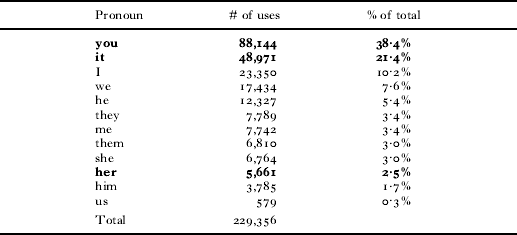
The total number of pronouns spoken to all the English-acquiring children by their caregivers was 229,356; of those, 142,776, or 62·3%, were ambiguous (Table 7 provides a breakdown of these data). The total number of pronouns spoken to all children by all adult speakers in the corpora was 274,704; of these 170,094, or 61·9%, were ambiguous. Averaging the percentage ambiguity for each of the 24 children results in an average of 63·3% for caregivers only and 62·6% for all adults.
English pronouns spoken to children by caregivers
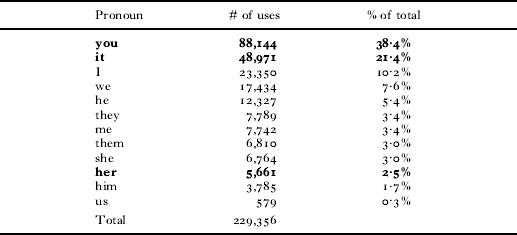
Note: Forms in bold treated as ambiguous.
The rate of ambiguity among the 24 children ranged from a low of 53·2% to a high of 72·7%, and this was normally distributed, as indicated by a Kolmogorov–Smirnov (K–S) test for normality which yielded the following: (D(24)=0·13, p=0·20). Figure 1 shows the distribution of input to children falling within ranges of 2·5% from a low of 53·1% to a high of 73%.
Distribution of case-ambiguous pronouns in caregiver child-directed English.

There was no apparent cause for the differences. Country of origin seems to have been unrelated, in that seven children from the United States and seven from the United Kingdom fell below the mean, while five children from the US and five children from the UK fell above it. Inasmuch as low total numbers of pronouns were associated with both high and low percentages of ambiguity, as were high total numbers of pronouns, the number of pronouns directed to the children does not appear to have been responsible for the differences in percentage ambiguity. Nor does the age range or the total number of files seem causally related to differences in percentage of ambiguity among children. The data for all 24 children, along with pertinent information about age, number of files, country of origin, etc. is provided in Appendix I.
German personal pronouns
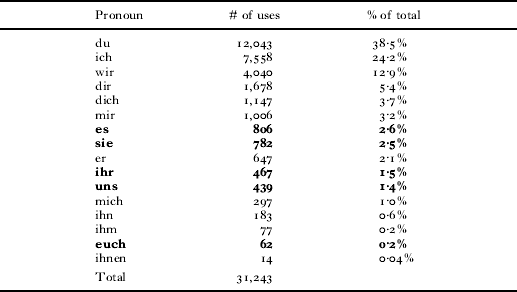
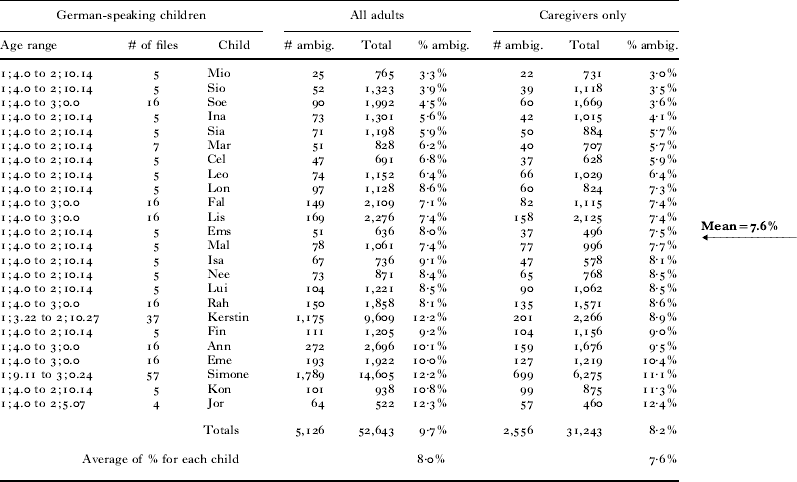
The total number of personal pronouns directed to German-acquiring children by their caregivers was 31,243, and of these 2,556, or 8·2%, were ambiguous (Table 8 provides a breakdown of these data). The total number of pronouns directed to these children by all adults was 52,643; of these, 5,126, or 9·7%, were ambiguous. For caregivers only, the average ambiguity of personal pronouns was 7·6%, while for all adults the average was 8·0%. As with the English data, there is a small range among the various calculations of average rate of ambiguity, indicating that these numbers are likely quite robust.
German pronouns spoken to children by caregivers
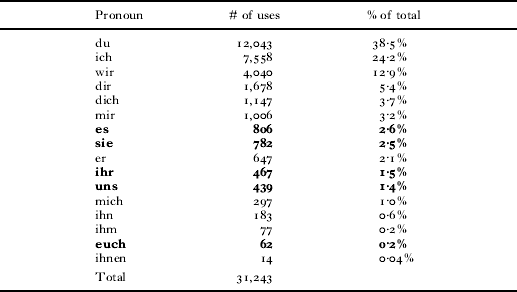
Note: Forms in bold treated as ambiguous.
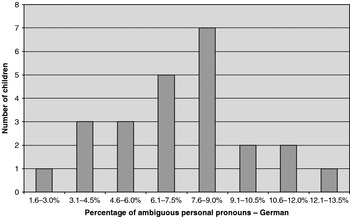
The percentage of ambiguity of personal pronouns varied somewhat less among the German-acquiring children than among the English-acquiring children, from a low of 3·0% ambiguity to a high of 12·4%. It is difficult to be certain whether or not there was an influence of total number of pronouns on the percentage of ambiguity; however, it seems unlikely when one considers the data. See Appendix II for pertinent information for the 24 German-acquiring children.
As can be seen, the child with the lowest percentage of ambiguity, 3·0%, had 731 pronouns in his corpus. The child with the highest rate of ambiguity, 12·4%, had only 460 pronouns spoken to him. The child with 3·5% percent ambiguity had 1,118 pronouns in his corpus, while two other children with approximately that number of pronouns in their corpora (1,115 and 1,156) had much higher percentages of ambiguity (7·4% and 9·0%, respectively). As was the case for English, there is no obvious cause for the variation in the levels of ambiguity. Rather it appears that the percentage of case ambiguous personal pronouns directed toward German-acquiring children is fairly normally distributed along a continuum from very low to comparatively high (D(24)=0·13, p=0·20). Figure 2 shows this distribution. It can be immediately verified, by comparing Figures 1 and 2, that the distribution of ambiguous case forms in the input of personal pronouns across the two languages is non-overlapping, with a large difference between the mean rate of ambiguous pronoun input.
Distribution of case-ambiguous pronouns in caregiver child-directed German.

German definite and indefinite articles
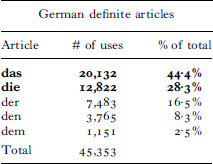
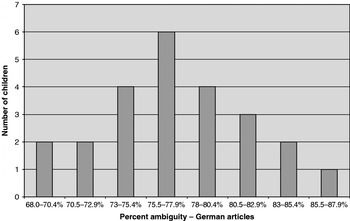
In stark contrast to the quite low levels of case-ambiguous personal pronouns in the speech to German-acquiring children is the high level of case-ambiguous articles in the speech directed to these children (Tables 9 and 10 provide a breakdown of these data). The same corpora which yielded the above data for personal pronouns yielded the following for definite and indefinite articles. Caregivers used a total of 52,646 articles, of which 39,600, or 75·3%, were ambiguous. Data from all adult tiers of the corpora yielded 84,785 articles, of which 61,908, or 73·0%, were ambiguous. The percentage of case-ambiguous articles in the speech directed to these children ranged from a low of 68·4% to a high of 86%. For caregivers only, the average rate of ambiguity was 77·2%, while for all adults it was 76·5%. See Appendix III for these data.
German articles spoken to children by caregivers
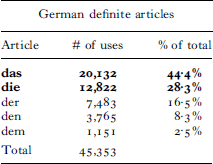
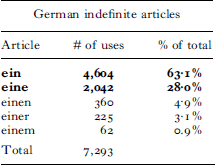
Note: Forms in bold treated as ambiguous.
Figure 3 shows that the percentage of case-ambiguous articles in child-directed speech is fairly normal, as does the K–S test of normality (D(24)=0·08, p=0·20). However, whereas the range for percentage of ambiguity for German personal pronouns began at only slightly above zero, the bottom end of the continuum for the distribution of article ambiguity begins at close to 70%. Thus the ranges are completely non-overlapping, with an enormous difference in central tendencies.
Distribution of case-ambiguous articles in caregiver child-directed German.

Other German determiners
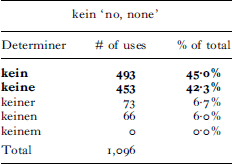
The other determiners analyzed for German showed even higher levels of ambiguity than did the definite and indefinite articles. Only 2,764 of these words were found in the corpora, compared to nearly 53,000 articles, but of these 2,397, or 86·7%, were ambiguous. Tables 11–16 provide a breakdown of the data.
Other German determiners spoken to children by caregivers
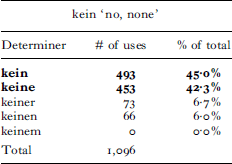
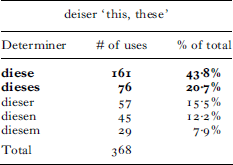
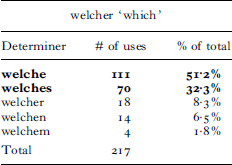
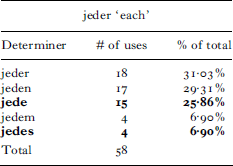
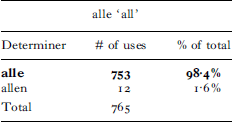
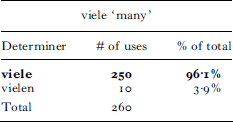
Note: Forms in bold treated as ambiguous.
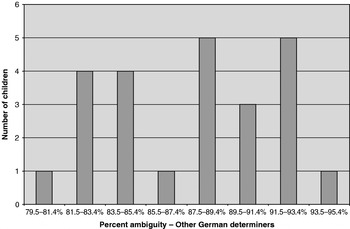
In the speech of caregivers, ambiguity ranged from a low of 82·0% to a high of 93·7%. Figure 4 provides a bar graph of the distribution of ambiguous forms in caregiver child-directed speech. This distribution appears less normal than the previous distributions. However, a K–S test of normality indicates that it does not differ significantly from a normal distribution (D(24)=0·13, p=0·20). See Appendix IV for these data.
Distribution of case-ambiguous determiners in caregiver child-directed German.

DISCUSSION
The facts to be accounted for are these: (a) pronominal case errors are a common feature of child English; (b) they are not a common feature of child German; but (c) article case errors are a common feature of child German. The literature indicates that structure, competition and paradigm building may all play a role in case acquisition, but regarding case errors, the data suggest that ambiguity may play a crucial role.
Why not syntax?
At a time when English-speaking children are making pronoun case errors, we might suggest, as many have (Radford, Reference Radford1990; Vainikka, Reference Vainikka1994; Schütze, Reference Schütze1997; Wexler et al., Reference Wexler, Schutze and Rice1998), that the problem arises from grammatical structure. If we accept the claim that the grammars of all languages are constrained by some universal grammar, then we expect that at some point in their acquisition, German-speaking children should have the same problem with structure as English-acquiring children. Further, if German-acquiring children have the same problematic grammatical structure that causes English-acquiring children to make pronoun case errors, we should expect German children to make pronoun case errors just as English-speaking children do. If, as has been claimed, nominative is the default case for German, then we should expect to find few examples of case errors in nominative contexts and more numerous pronoun case errors in accusative and dative contexts. However, occasionally we should find German-acquiring children who overextend non-default cases (i.e. accusative/dative case) to default contexts (i.e. nominative contexts), just as we find that some English-speaking children do. However, contrary to these expectations, pronoun case errors in the speech of children acquiring German have not been reported with any significant frequency, and such errors do not appear to be typical of German child language. Hence, a simple structural explanation for the presence of pronominal case errors in English and their lack in German lacks strong empirical support. Some other factor must be involved. The input data suggest that that factor may be ambiguity.
If ambiguity, then how?
The difference between the level of ambiguity in the pronouns directed to English- and German-speaking children is enormous, and it does not stretch the imagination to suppose that this factor could be responsible for pronominal case errors in English and their absence in German. This explanation is all the more plausible given the inadequacy of a structural account, and its feasibility is further bolstered by the fact that the differing levels of pronoun and article ambiguity in German accurately predict German-speaking children's differing competence with case-marked pronouns and articles. Indeed, the fact that the Input Ambiguity hypothesis provides a unitary explanation for both the differences between English and German and the differences within German itself strongly recommends it as a viable explanation for children's case errors. Despite the clear explanatory value of the hypothesis, the data herein only provide broad correlational evidence in support of the hypothesis. However, if ambiguity were to cause case errors, how might it do so?
I propose the following. When input to children is highly ambiguous, children are essentially blinded to the case distinctions by the overwhelming ambiguity present in the system as a whole. This case blindness occurs as a natural result of the fact that humans have limited attentional resources. Consider the task children face when acquiring language. They are bombarded with linguistic input and must somehow allocate their attention so they can learn the language to which they are exposed. Attending to aspects of the input that are highly ambiguous would be a waste of children's limited attentional resources, in that no important difference in meaning appears to be conveyed by such input. Consequently, ambiguous input does not initially win children's attention. When ambiguity is low, as with German personal pronouns, case distinctions are highly visible and easily acquired. However, when ambiguity is high, as with English personal pronouns and German articles and determiners, it overwhelms the few case distinct forms, blinding children to the case distinctions, causing them to ignore the few case distinct forms, and leading to error.Footnote 6
Eventually though, even ambiguous input must reach a level of activation that captures children's attention. However, if children are blinded to case distinctions by ambiguity in the personal pronoun/determiner systems of their languages, English and German children may not initially posit a place for case-distinct forms within the gender and number paradigms of those systems. And even if they have posited such a place, having initially erred in their use of case, they would certainly have trouble placing correct case forms in their proper places. At this point, Bates and MacWhinney's Competition Model provides an answer for how children might come to see the distinctions that ambiguity might previously have obscured, i.e. through competition. As children master various aspects of the grammar of their language, production becomes more automatic, thus freeing up attentional resources that allow children to recognize the morphosyntactic associations that had previously escaped their notice.
It is important to point out that while competition may be responsible for resolving case errors, it does not predict that ambiguity would cause case errors in the way posited here. Under the Competition Model, grammar is built up as children map individual form/function relations. If ambiguity is responsible for case errors, as it may prove to be in English and German, then it is because the pattern of ambiguity within categories of lexical items, not associations between individual lexical items and their functions, serves to lead children astray. In this way, the Input Ambiguity hypothesis suggests a top-down aspect to case acquisition that is incompatible with the bottom-up Competition Model.
Nonetheless, these hypotheses are not irreconcilable. Were the Competition Model to incorporate ambiguity as a factor in calculating cue validity, this could reconcile the apparently contradictory top-down/bottom-up aspects of the hypotheses. In this case, cue validity would be calculated as (cue reliability×cue availability×overall ambiguity), where the ambiguity variable is calculated as 1 minus the percentage of ambiguity. Then the problem becomes defining precisely how the effect of ambiguity declines over time to allow cue validity to rise, such that children eventually learn the distinctions present in their language.
It should be noted that the Input Ambiguity hypothesis only predicts whether case errors should be a common aspect of child speech in a given language. It has nothing to say about the form such errors should take. For that, a hypothesis like Rispoli's (Reference Rispoli1994) Paradigm Building would be required. While the proposed cause of case errors under Paradigm Building and the present hypothesis is fundamentally different, these hypotheses need not be regarded as inherently contradictory. Indeed, if/once children assume that one form should represent each gender/number paradigm, it would seem reasonable that the best candidate for that form would be one containing a phonetic core. Hence, while the present hypothesis only predicts whether errors should be a common aspect of child speech in a given language, Paradigm Building provides predictions about what those errors should look like if ambiguity causes them in the first place.
Like the Competion Model and Paradigm Building hypothesis, Szagun's hypothesis is equally compatible with the present hypothesis. Indeed, even if ambiguity is primarily responsible for the presence or lack of case errors, which, though plausible is far from an established truth, low discriminability and overall frequency of particular forms could clearly add to the effect of ambiguity.
Likewise, syntactic theories of case acquisition are compatible with the present hypothesis in that case assignment cannot occur absent the requisite syntactic structure. However, given the ease with which German children appear to master case in the pronominal system, it may be that the problems English-/German-speaking children have with pronominal/article case have little to do with under-articulated structure and much to do with the ambiguous morphology that encodes case in particular systems.
Evidence from other languages
Japanese
An example of a language containing considerable ambiguity in its case system is Japanese. In Japanese, the particle -ga marks the subjects of transitive and intransitive verbs. The particle -o marks most direct objects, but -ga marks objects of stative verbs. The dative particle -ni marks indirect objects and locative arguments, but this particle also marks the subjects of some stative verbs. Adding to the problem of ambiguity is noun phrase and case particle ellipsis. Not only are noun phrases and particles often dropped in Japanese, in speech to children case particles are dropped even more frequently than they would be in adult conversation (Clancy, Reference Clancy and Slobin1985: 387). Given case ambiguity in Japanese, the Input Ambiguity hypothesis would predict that case errors would be a common feature of Japanese children's speech, and the data seem to indicate that this is so.
Most researchers, usually citing Clancy (Reference Clancy and Slobin1985), state that Japanese children acquire case with little difficulty. However, reports of Japanese children's case errors suggest this is inaccurate. Furthermore, while Clancy (p. 387) states, ‘In general, Japanese children acquire case particles early and without much apparent difficulty’, she later states, ‘Japanese children have difficulty acquiring the case-marking for transitive events’ (p. 389). The literature contains numerous reports supporting the latter statement. The most frequently reported case errors are substitutions of -ga for -o (Takahashi, 1975, Fujimoto, 1977, Fujiwara, 1977, all cited in Clancy, Reference Clancy and Slobin1985; Yokoyama, 1997, cited in Suzuki, Reference Suzuki1999; Morikawa, Reference Morikawa1989; Suzuki, Reference Suzuki1999). However, there are also reports of Japanese children substituting -o for -ga (Clancy, Reference Clancy and Slobin1985; Yokoyama, 1997, cited in Suzuki, Reference Suzuki1999), -ga for -ni (Fujiwara, 1977, cited in Clancy, Reference Clancy and Slobin1985; Morikawa, Reference Morikawa1989; Ito, 1990, cited in Suzuki, Reference Suzuki1999; Cho, Lee, O'Grady, Song & Suzuki, 1998, cited in Suzuki, Reference Suzuki1999), -ni for -ga (Sanches, 1968, cited in Clancy, Reference Clancy and Slobin1985; Morikawa, Reference Morikawa1989; Suzuki, Reference Suzuki1999), and -ni for -o (Suzuki, Reference Suzuki1999).
These numerous reports of Japanese children's case errors are in stark contrast to the dearth of reports of pronominal case errors by German children. Furthermore, in controlled experiments by Suzuki (Reference Suzuki1999), children age 3 ; 0 to 6 ; 1 manifested case errors in as many as 50·8% of their utterances. Suzuki notes, ‘One [important finding] is that case-marking errors were not rare at all’ (p. 77), something that may not always be obvious in children's spontaneous speech, perhaps due to noun phrase and particle ellipsis. Given the foregoing, the Input Ambiguity hypothesis appears to be supported by the data from Japanese.
Turkish
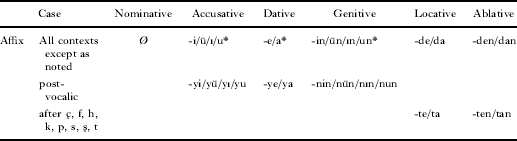
In Turkish, pronouns, nouns, demonstratives and question words are inflected according to extremely regular patterns of affixation, and are marked for accusative, dative, genitive, locative and ablative case, while nominative case is unmarked (Kornfilt, Reference Kornfilt, Lust, Suner and Whitman1994). Though the Turkish case system is quite elaborate, it contains no ambiguity of case forms, as Table 17 shows.
Turkish case affixes
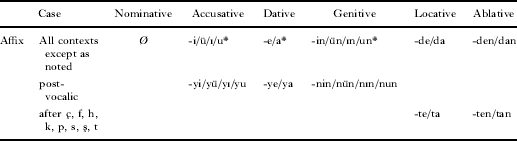
* For words ending in -k, change -k to -ğ before adding the affix.
Accordingly, the Input Ambiguity hypothesis would predict that case errors would not be typical in the speech of children acquiring Turkish. One might nonetheless expect children to struggle with Turkish case, given the number of cases children must master. However, the exact opposite appears true. Indeed, Aksu-Koç & Slobin (Reference Aksu-Koç, Slobin and Slobin1985) state, ‘The inflectional system appears early, and the entire set of noun inflections is mastered by 24 months or earlier … Both noun and verb inflections are present in the one-word stage, and there is evidence for productive use as young as 15 months’ (p. 845). Regarding Turkish children's morphological errors, they later state, ‘Turkish child speech is almost entirely free of error’ (p. 854). Aksu-Koç & Slobin do note that children make some morphological errors of the sort where they occasionally fail to change the stem-final -k to -ğ before suffixes beginning with vowels. However, such mistakes are clearly not case errors. Just as there is a paucity of pronominal case errors reported for German-acquiring children, the literature on Turkish indicates that children do not err with case, exactly as the Input Ambiguity hypothesis would predict.
Input Ambiguity hypothesis revisited
This hypothesis is intended to be a general one, applying to languages in general and to the ‘typical’ child speaker of a language. Under this hypothesis, there is a threshold of ambiguity beyond which children are initially blinded to case distinctions, with the result that their speech generally manifests case errors, but beneath which their speech is generally free of such errors. Establishing whether ambiguity causes case errors, and if so at what level it begins to do so, requires much additional research. However, the present data provide ample evidence that the hypothesis is plausible, and as such it should be investigated further.
Future research
One might suppose that a simple analysis comparing individual children's case error rate with the percentage ambiguity in the input to those individual children would provide evidence to either support or refute this hypothesis. While such analyses might prove useful, they might simply prove inconclusive, because if there is a threshold of ambiguity, then well above or below that threshold children's error rates might be unaffected. Though a correlation might exist, the absence of such a correlation would not refute the hypothesis. Even so, it would be useful for future research to include this kind of analysis.
Another possible correlation between individual children's performance with case and the level of case ambiguity in the speech directed to those children that should be investigated is the duration of case errors in child speech. Even well above a threshold of ambiguity, there might be a reliable correlation between the duration of individual children's case errors and the level of ambiguity, with case errors enduring longer at higher rates of ambiguity and resolving more quickly at lower rates of ambiguity. Certainly, future research should investigate this possibility.
Though analyses seeking reliable correlations between individual children's case errors and the ambiguity of the input to those children is desirable, the most fruitful direction for future research lies in analyzing other languages. Ideally, analysis of case ambiguity in child-directed speech should be carried out for numerous languages and compared to the typical course of acquisition for those languages. If the hypothesis is correct, then it should be impossible to find a language with high rates of case ambiguity in child-directed speech where children's language does not typically manifest case errors. Furthermore, analysis of other languages where ambiguity falls between the very low rates found for German pronouns and the quite high rates found for English pronouns and German articles/determiners could help to establish if a threshold of ambiguity exists and if so exactly where it falls.
When do children acquire case?
It has long been acknowledged that adults' language competence and performance are not identical, and this may be even truer for children acquiring language than it is for adults. The present investigation brings this possibility into sharp relief by noting just how inaccurately production may reflect knowledge. German children's highly accurate performance with case-marked pronouns seems to indicate that they do actually ‘know’ case from very early on. However, their frequent case errors with articles would seem to indicate just the opposite. In short, correct case becomes a characteristic of their production in one part of their grammar, but does not immediately generalize to another, a fairly ‘mosaic’ form of acquisition (Rispoli, Reference Rispoli1991).
This raises interesting and important questions. At a time when German children can correctly supply case-marked forms of pronouns, should they be regarded as having acquired case? Perhaps their apparent competence with pronominal case does not represent case acquisition at all, but rather lexical associations within fixed frames. If we regard German children as having acquired pronominal case when they are still making errors with articles, have they also acquired article case but simply lack the morphology to encode it, or is the problem one of syntactic structure? Is it possible that children can acquire case in one system of their language while lacking it in another? If so, how would we expect children's grammars to require case-marking in one system while allowing for its absence in another? Would we suggest separate syntactic structures for these systems which would, at some point, converge? The answers to these questions are not at all clear, and much work will be required if we hope provide definitive answers to any of them.
Regarding German children, it seems that they may, indeed, ‘know’ case from quite early on, so perhaps their difficulty with articles is purely an issue of morphological learning. Fertile ground for investigating the relationship between structural and morphological case-marking lies in investigating German children's acquisition of nominative/accusative case with pronouns, and comparing their behavior with Clahsen et al.'s (Reference Clahsen, Eisenbeiss, Vainikka, Clahsen and Rutherford1994) model, which would predict that children should acquire accusative case before nominative case. If their hypothesis is upheld by the data, this would support the idea that spec-head relations are not provided by UG and must be learned. This, in turn, would suggest that the problem with case on articles is initially one of structure; after such time as DP structure becomes transparently present in children's speech, remaining problems would clearly be problems of morphological case. Another way in which researchers might tease apart syntactic and morphological case in German would be by investigating children's pronominal versus their prenominal use of determiners. Were children's language to contain few errors with pronominally used determiners while containing frequent errors with prenominally used determiners, this would suggest that the problem with prenominal determiners is a problem of syntactic case. If, on the other hand, children demonstrated the same types of case errors with pronominal and prenominal determiners, it would indicate that the problem is certainly one of morphological case, but perhaps also one of syntactic case.
CONCLUSION
The questions posed herein are exceedingly important, and the disconnect between German and English children's behavior with pronominal case and German children's behavior with pronominal versus article case provide rich environments for important work in teasing apart competence and performance and the roles of structure, morphology and input in case acquisition. However, until such work is undertaken, we would be wise to keep in mind the fact that we lack definitive answers to these fundamental questions, and the presence of these unanswered questions should serve as a cautionary note regarding our interpretations of children's linguistic behavior with case in particular and language in general. In the meantime, the results of the present study are consistent with several interpretations. Regardless of one's theoretical bent, the data strongly suggest that understanding the role input and ambiguity play in acquisition is crucial in understanding cross-linguistic and intra-language results.
APPENDIX I: DATA FOR ENGLISH-ACQUIRING CHILDREN

APPENDIX II: DATA FOR GERMAN-ACQUIRING CHILDREN – PERSONAL PRONOUNS
APPENDIX III: DATA FOR GERMAN-ACQUIRING CHILDREN – DEFINITE AND INDEFINITE ARTICLES

APPENDIX IV: DATA FOR GERMAN-ACQUIRING CHILDREN – OTHER DETERMINERS