Introduction
Two-year-olds Luca and Elena are learning French and English at their daycare and in their community, where both languages are spoken regularly. Their situation is not unique, as migration and globalization have increased the number of children growing up multilingual (Surrain & Luk, Reference Surrain and Luk2019). However, Luca's parents also speak French and English to him at home, while Elena's parents speak Spanish to her at home. Increasing research has investigated the language development of bilingual children like Luca, but very little research has studied trilinguals like Elena (Hoffmann, Reference Hoffmann2001; Unsworth, Reference Unsworth2013b). In a unique approach, the current study compared bilingual and trilingual toddlers aged 17–33 months growing up in Montréal, where both French and English are widely spoken. This bilingual community context enabled us to compare French–English vocabularies of bilinguals learning only these two languages (n = 170), with the French–English vocabularies of trilinguals who were also learning a third language (n = 20). Our main research question was how exposure to a third language would impact French–English vocabulary size in trilinguals compared to bilinguals.
Contributors to Multilingual Vocabulary Development
Vocabulary size is an important and widely used measure of language development in toddlers. Vocabulary at this age is readily measured via parent-report questionnaires, which have a high degree of reliability and validity (Dale, Reference Dale1991; Fenson et al., Reference Fenson, Marchman, Thal, Dale, Reznick and Bates2007). Understanding early vocabulary development is important, as vocabulary size has been shown to predict later academic achievement (Bleses, Makransky, Dale, Højen & Ari, Reference Bleses, Makransky, Dale, Højen and Ari2016; Marchman & Fernald, Reference Marchman and Fernald2008).
Vocabulary size is highly variable across children, whether they are from monolingual or multilingual backgrounds (De Houwer, Bornstein & Putnick, Reference De Houwer, Bornstein and Putnick2014; Frank, Braginsky, Marchman & Yurovsky, Reference Frank, Braginsky, Marchman and Yurovskyin press). While not all of this variability has been explained, two robust predictors are age and sex: older children know more words than younger children (e.g., Fenson et al., Reference Fenson, Marchman, Thal, Dale, Reznick and Bates2007; Rescorla & Achenbach, Reference Rescorla and Achenbach2002), and girls know more words than boys (e.g., Andersson et al., Reference Andersson, Gauding, Graca, Holm, Öhlin, Marklund and Ericsson2011; Huttenlocher, Haight, Bryk, Seltzer & Lyons, Reference Huttenlocher, Haight, Bryk, Seltzer and Lyons1991).
There is mounting evidence that vocabulary size is tightly coupled with the amount of language input that children receive (Cattani, Abbot-Smith, Farag, Krott, Arreckx, Dennis & Floccia, Reference Cattani, Abbot-Smith, Farag, Krott, Arreckx, Dennis and Floccia2014; Floccia, Sambrook, Delle Luche, Kwok, Goslin, White, Cattani, Sullivan, Abbot-Smith, Krott, Mills, Rowland, Gervain & Plunkett, Reference Floccia, Sambrook, Delle Luche, Kwok, Goslin, White, Cattani, Sullivan, Abbot-Smith, Krott, Mills, Rowland, Gervain and Plunkett2018; Gonzalez-Barrero & Nadig, Reference Gonzalez-Barrero and Nadig2018; Thordardottir, Reference Thordardottir2011). Amongst monolingual children, those who hear more home language input have larger vocabularies and show steeper growth in vocabulary (Bee, Van Egeren, Pytkowicz Streissguth, Nyman & Leckie, Reference Bee, Van Egeren, Pytkowicz Streissguth, Nyman and Leckie1969; Pan, Rowe, Singer & Snow, Reference Pan, Rowe, Singer and Snow2005; Song, Spier & Tamis-Lemonda, Reference Song, Spier and Tamis-Lemonda2014). Children of higher socioeconomic status (SES) tend to have larger vocabularies than those of lower SES, likely due to higher quantity and quality of language input (Fernald, Marchman & Weisleder, Reference Fernald, Marchman and Weisleder2013; Qi, Kaiser, Milan & Hancock, Reference Qi, Kaiser, Milan and Hancock2006).
Language input is particularly relevant to understanding vocabulary development in multilingual children. Monolingual children encounter all words in a single language, but multilinguals’ time is divided across their languages. As a result, multilingual children hear individual words, on average, less frequently than monolinguals. For example, a monolingual child will hear the word “dog” every time they encounter the four-legged pet; a French–English bilingual child will hear “dog” or “chien”; and a French–English–Spanish trilingual child will hear “dog”, “chien”, or “perro” (Unsworth, Reference Unsworth2013b).
Studies that have compared monolingual to bilingual children support the link between amount of input and vocabulary size. When their vocabulary is measured in a single language (for example, just English), bilinguals know fewer words than monolinguals (Hoff, Welsh, Place & Ribot, Reference Hoff, Welsh, Place, Ribot, Grüter and Paradis2014; Pearson, Fernández & Oller, Reference Pearson, Fernández and Oller1993). Bilinguals’ single-language vocabulary appears highly associated with input, in that the greater the proportion of time a bilingual hears a particular language, the more words they will know in that language and the more their single-language vocabularies will approach those of monolinguals (Byers-Heinlein, Reference Byers-Heinlein2013; De Houwer, Reference De Houwer2007; Place & Hoff, Reference Place and Hoff2011). Although research on trilinguals’ vocabulary development is quite limited (e.g., Albin & Gershkoff-Stowe, Reference Albin, Gershkoff-Stowe and Stinger2016; Arnaus Gil, Müller, Sette & Hüppop, Reference Arnaus Gil, Müller, Sette and Hüppop2020; Chevalier; Reference Chevalier2015; De Houwer, Reference De Houwer, Hoffmann and Ytsma2004; Montanari, Reference Montanari2010; Quay, Reference Quay2011), extant studies indicate that the more trilingual children are exposed to one language, the more their vocabulary develops in that language compared to the other two (Montanari, Reference Montanari2010; Oller, Reference Oller2010; Potgieter, Reference Potgieter2016). There is little evidence that multilingualism reduces children's overall rate of word learning, given that monolinguals and bilinguals have similar vocabulary sizes when words from both languages are considered (Core, Hoff, Rumiche & Señor, Reference Core, Hoff, Rumiche and Señor2013; De Houwer et al., Reference De Houwer, Bornstein and Putnick2014; Gonzalez-Barrero, Schott & Byers-Heinlein, Reference Gonzalez-Barrero, Schott and Byers-Heinlein2020; Pearson et al., Reference Pearson, Fernández and Oller1993).
However, there are other aspects of multilinguals’ experience beyond amount of input that might contribute to vocabulary size. For example, there is some evidence that language balance (i.e., whether the languages are heard in similar or different proportions) contributes to vocabulary outcomes in bilinguals, although language balance is dynamic and often changes over time (Barnes & Garcia, Reference Barnes and Garcia2013; De Houwer, Reference De Houwer, Fletcher and MacWhinney1995, Reference De Houwer2007; Hoff et al., Reference Hoff, Core, Place, Rumiche, Señor and Parra2012; Pearson, Fernández, Lewedeg & Oller, Reference Pearson, Fernández, Lewedeg and Oller1997; Place & Hoff, Reference Place and Hoff2011; Thordardottir, Reference Thordardottir2011; Unsworth, Reference Unsworth2013b).
Moreover, multilinguals often learn languages that are of unequal sociolinguistic status, and a language's sociolinguistic status may contribute to its acquisition. For example, in a study of Welsh–English bilingual children, the acquisition of Welsh (the minority language) was dependent on the amount of Welsh input, while the acquisition of English (the majority language) was robust across different levels of input (Gathercole & Thomas, Reference Gathercole and Thomas2009). In one of the few studies that included monolinguals (English), bilinguals (English–Polish), and trilinguals (English–Polish–Other), multilingual children growing up in the United Kingdom produced a similar number of English words (the majority language) as monolingual children (Mieszkowska, Łuniewska, Kołak, Kacprzak, Wodniecka & Haman, Reference Mieszkowska, Łuniewska, Kołak, Kacprzak, Wodniecka and Haman2017). However, they produced fewer Polish words (a minority language) than Polish monolinguals. These studies suggest that quantity of input may be more tightly coupled to vocabulary size for minority languages than for majority languages.
The Current Study
The current study used a novel approach to test the effects of input on majority language vocabulary size in multilinguals. While most studies investigating this question have compared monolinguals and bilinguals, we extended this approach by comparing bilinguals and trilinguals. All children were growing up in Montréal, a bilingual community where French and English are both spoken widely and have majority language status relative to other languages. Many Montréal children grow up bilingual in French and English, and, due to the city's cultural diversity, others grow up trilingual, hearing a third minority language at home. We compared bilinguals’ and trilinguals’ dual-language vocabulary in the two majority languages.
Bilinguals received all their input in French and English, while trilinguals received less total input in these two languages because they sometimes heard their third language. We hypothesized that the amount of French–English input would be linked to toddlers’ French–English vocabulary size, and thus predicted that trilinguals would have smaller French–English productive vocabularies than bilinguals. Roughly, we expected that trilinguals’ French–English vocabulary would be proportional to their exposure to these two languages. Thus, if a trilingual was exposed to each of their three languages 1/3 of the time, we expected that their French–English vocabulary size would be 2/3 (1/3 + 1/3) that of a French–English bilingual. However, an alternate possibility was that because both French and English are majority languages in the Montréal context, bilinguals and trilinguals could have similar French–English vocabulary size, despite trilinguals’ reduced input in these languages.
In order to isolate the potential effects of trilinguals’ reduced exposure to French and English, we used two analytic approaches that a) matched and b) statistically controlled for effects of age, sex, socioeconomic status, and balance of exposure to English versus French. Finally, we limited our investigation to French–English vocabulary size, as vocabulary data were not available in trilinguals’ third language due to the archival nature of our dataset.
Method
This study was approved by the Concordia University Human Research Ethics Board (approval #10000439). All parents provided written and verbal consent prior to participation. The hypotheses and analysis plan for the current study were pre-registered in the Open Science Framework. The raw data and analysis scripts can be found at https://osf.io/us27h/.
Participants
Archival data from 215 multilingual toddlers (age range: 17–33 months) who had participated in studies at an infant research laboratory between January 2010 and May 2019 and met the trilingual or bilingual exposure criteria (described below) were available for the present study. Data from 25 of these toddlers were excluded due to premature birth (< than 37 weeks of gestation; n = 6), low birthweight (< 2500 grams; n = 10), reported health or developmental issues (n = 6), or missing information on one or more of the key variables (n = 3). Therefore, the final sample included data from 20 trilingual toddlers and 170 bilingual toddlers, for a total of 190 participants who met the inclusion criteria. Of these children, 24 (1 trilingual and 23 bilinguals) contributed vocabulary data at more than one age. Thus, there were a total of 217 sets of vocabulary data available for analysis (21 trilingual, 196 bilingual). Sample sizes reported in the remainder of this paper will reflect the number of these vocabulary data sets, rather than the number of individual children.
All participants were growing up in the Montréal area, a multicultural city in the province of Québec (Canada) where French and English are commonly used in everyday life and share similar sociolinguistic status. Fifty-four percent of Montrealers report being bilingual in English and French, and 25% have a first language other than English or French (Schott, Kremin & Byers-Heinlein, Reference Schott, Kremin and Byers-Heinlein2019; Statistics Canada, 2017).
All participants were exposed to both French and English, and some participants (trilinguals) were exposed to a third language. These third languages varied across children: Arabic (n = 3), Chinese (n = 1), Creole (n = 1), German (n = 3), Italian (n = 1), Portuguese (n = 1), Romanian (n = 1), Russian (n = 1) and Spanish (n = 8). Bilingual participants were exposed to each of their two languages (French and English) between 25% to 75% of their lifetime and had no exposure to a third language, following guidelines from previous studies (Pearson et al., Reference Pearson, Fernández, Lewedeg and Oller1997). Similar to Byers-Heinlein and Werker (Reference Byers-Heinlein and Werker2009), minimum exposure criteria for trilinguals were somewhat relaxed compared to the bilingual criteria, as even perfectly balanced trilingual exposure would yield only 33% exposure to each language. Thus, trilingual participants included in the study were exposed to each of their three languages (English, French, and one other) at least 15% of their lifetime. Most children had been acquiring French and English simultaneously from birth (trilinguals = 55%, bilinguals = 84%), and the vast majority of others had an early onset of exposure (between 2 to 18 months). In addition, most trilingual children (90%) had been acquiring their third language since birth.
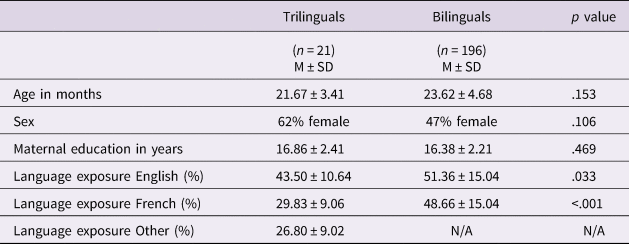
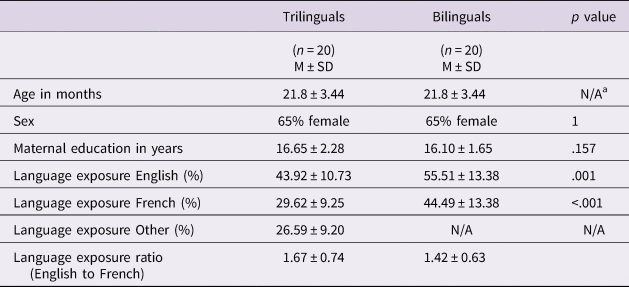
We defined language dominance as the language to which the child had the highest lifetime exposure. By definition, all of the bilinguals were dominant in either French or English, and in our sample the vast majority of the trilinguals were also dominant in one of these two languages. Of the 190 participants, 104 (55%) were dominant in English, 83 (44%) were dominant in French and three (2%) were dominant in their third language. For children who contributed data at multiple ages, this reflects their dominance at their first visit, and we note that four bilingual children's dominance changed across ages. Participants were recruited through government birth lists, daycares, and community organizations. Participants’ demographic characteristics (i.e., age, sex, and maternal education) were not statistically significantly different between groups. Children received a t-shirt and an honorary diploma as compensation for their participation. Participants’ demographic characteristics are presented in Table 1.
Demographic Characteristics of the Trilingual and Bilingual Groups

Note. Here, sample size (n) reflects number of French–English vocabulary datasets, which is greater than the number of participants as some participants contributed datasets at multiple ages. p value reflects t-tests (for continuous variables) or chi-square results (for categorical variables) comparing the two groups, using one datapoint per participant (youngest datapoint) for those who contributed data at more than one age.
Measures
MacArthur-Bates Communicative Development Inventories: Words and Sentences
The MacArthur-Bates Communicative Development Inventories: Words and Sentences (CDI) questionnaire was used to gather data on children's expressive vocabulary. The CDI is a parent-report instrument that assesses expressive language development in children aged 16 to 30 months. This study focused on the vocabulary checklist of the questionnaire, where parents check off words their child can say (e.g., car, mommy, shirt). Caregivers completed the American English (Fenson et al., Reference Fenson, Marchman, Thal, Dale, Reznick and Bates2007) and Québec French (Trudeau, Frank & Poulin-Dubois, Reference Trudeau, Frank and Poulin-Dubois1999) versions of the CDI. Vocabulary data were not gathered in trilinguals’ third language, as the data used for this study were archival data collected as part of unrelated experimental studies not specifically focused on trilingual development.
Single-language vocabulary scores in French (with a range of scores from 1 to 664; Trudeau et al., Reference Trudeau, Frank and Poulin-Dubois1999) and English (with a range of scores from 1 to 680; Fenson et al., Reference Fenson, Marchman, Thal, Dale, Reznick and Bates2007) were calculated by counting the number of words produced in each language. Our primary measure, however, was total words known in both French and English. This was calculated by summing the French and English vocabulary scores. We note that some studies of multilingual children have focused on concept vocabulary, which counts the number of concepts lexicalized rather than total number of words produced (e.g., translation equivalents “dog” and “chien” are counted as one concept, rather than two words; Pearson et al., Reference Pearson, Fernández and Oller1993). However, we opted to focus on word vocabulary rather than concept vocabulary for two reasons. First, all toddlers’ vocabularies were measured in the same two languages (unlike typical studies that use this approach, where monolinguals’ vocabularies are measured in one language, but bilinguals’ vocabularies are measured in two). Second, we were not able to assess concepts that trilinguals might have only known in their third language.
Language Exposure Questionnaire using the MAPLE approach
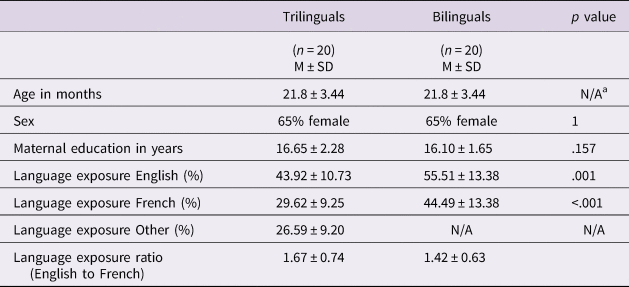
Language exposure was measured with the Language Exposure Questionnaire (LEQ; Bosch & Sebastián-Gallés, Reference Bosch and Sebastián-Gallés2001) using the Multilingual Approach to Parent Language Estimates (MAPLE; Byers-Heinlein et al., Reference Byers-Heinlein, Schott, Gonzalez-Barrero, Dubé, Jardak, Laoun-Rubenstein, Mastroberardino, Morin-Lessard, Iliaei, Salama-Siroishka and Tamayo2019). Parents were interviewed about their child's language exposure, providing estimates of how many hours per day the child was exposed to each language across different periods of their lifetime. We computed a percentage estimate of the cumulative exposure, from birth, to each language heard. These estimates were used to classify children as trilingual or bilingual. As expected, trilinguals had significantly less exposure to both French and English than bilinguals, due to their exposure to their third language (see Table 1 and 2). Additionally, we computed a language exposure ratio score for French and English in order to quantify balance of exposure, by dividing participants’ percentage of lifetime exposure to English by their percentage of lifetime exposure to French. For instance, if a bilingual child was exposed to 67% English and 33% French, then their English–French language exposure ratio would be 67/33 = 2. If a trilingual child was exposed to 50% English, 25% French, and 25% to their third language, then their English–French language exposure ratio would also be 50/25 = 2, and thus equated to that of the bilingual child despite reduced exposure to English and French. We note that, for trilinguals, this score did not reflect their absolute dominance across their three languages, as only English and French were used for the calculation. As discussed further below, this ratio score was used to match bilinguals and trilinguals, but not for statistical analyses.
Demographic Characteristics of the Trilingual and Bilingual Pairwise Matched Groups
Note. Dataset with 18-month-old observation and its bilingual match.
p value reflects t-tests (for continuous variables) or chi-squared results (for categorical variables) comparing the two groups.
a Age in months matched exactly between the trilingual and bilingual group.
Demographic Questionnaire
Parents completed a demographic questionnaire which included information about the child's age, sex, health history, and maternal education. Information from this form was used to identify the children who met the inclusion criteria and to calculate maternal education in years, which was used as a proxy for socioeconomic status (Hoff & Tian, Reference Hoff and Tian2005).
Procedure
Parents were given the Language Exposure Questionnaire and the demographic questionnaire during their children's participation in one of various experimental studies on language development at the laboratory. The caregiver most familiar with each language was asked to fill out that language's version (French or English) of the CDI. The majority of caregivers completing the questionnaire were mothers (69.4%), followed by fathers (5.8%), both parents (3.2%), and other family members (.5%). Some caregivers did not indicate who completed the questionnaire (21.2%). The vocabulary checklists were completed by the parents within the two weeks prior to their visit to the lab or during their visit. Parents completed the questionnaire either via an iPad or on paper forms. Paper forms were later double-entered into a digital file and checked for accuracy.
Results
Pre-registered analyses
Our confirmatory analyses were pre-registered via the Open Science framework prior to analysis, https://osf.io/us27h/.
Our research goal was to compare the effects of trilingualism versus bilingualism on the acquisition of French and English vocabulary size. As discussed above, vocabulary size is known to be correlated with a range of other factors, including age (Rescorla & Achenbach, Reference Rescorla and Achenbach2002), sex (Andersson et al., Reference Andersson, Gauding, Graca, Holm, Öhlin, Marklund and Ericsson2011; Hyde & Linn, Reference Hyde and Linn1988; Rescorla & Achenbach, Reference Rescorla and Achenbach2002), SES (Bates et al., Reference Bates, Marchman, Thal, Fenson, Dale, Reznick, Reilly and Hartung1994; Fernald et al., Reference Fernald, Marchman and Weisleder2013; Hoff, Reference Hoff2003), and, for bilinguals, their ratio of exposure to each language (Barnes & Garcia, Reference Barnes and Garcia2013; De Houwer, Reference De Houwer, Fletcher and MacWhinney1995, Reference De Houwer2007; Hoff et al., Reference Hoff, Core, Place, Rumiche, Señor and Parra2012; Pearson et al., Reference Pearson, Fernández, Lewedeg and Oller1997; Thordardottir, Reference Thordardottir2011). Thus, we pre-registered two analytic strategies to control for these potentially confounding factors. First, we selected a subsample (i.e., matched sample) of the full bilingual sample that was closely matched to our trilingual sample on these variables, and compared the two groups’ mean vocabulary sizes. As there is disagreement in the literature as to whether matched samples of this nature should be considered statistically independent, our pre-registered analysis plan included both independent and repeated measures samples t-tests, as well as non-parametric Mann-Whitney-Wilcoxon and Wilcoxon Signed Rank tests in the case of non-normal data. Second, we analyzed the full sample (n = 217) with a regression model that statistically controlled for the potential confounding variables by including them in the model as predictors.
Matched sample
Matching process
Under the matched sample approach, trilingual toddlers were matched with bilingual toddlers on age, sex, socioeconomic status, maternal education and language exposure ratio. This was done with the Optimal Matching method (i.e., minimizing the average absolute distance between all matched pairs) from the Optmatch package in the R software (Hansen & Klopfer, Reference Hansen and Klopfer2006; R Core Team, 2013). First, Optmatch generated 13 trilingual data points matched to 13 bilingual data points on exact age in months, sex and maternal education along with the closest match on language exposure ratio. This left eight trilingual data points without exact matches on the first three variables. Next, these eight data points were matched by exact age and sex with Optmatch to multiple comparison individuals. Finally, the authors hand-selected the closest bilingual match for each trilingual data point first on maternal education and then on language exposure ratio for the matches generated by this package. Researchers were blind to children's vocabulary size during the matching process. Paired sample t-tests and a chi-squared test showed that there were no statistically significant differences between the trilingual and bilingual group on age, sex and maternal education. Furthermore, we note that one trilingual toddler contributed data at two time points: at age 18-months and at age 19-months. For this child we selected a different bilingual data point that matched at each age and ran all analyses twice (once with the data at the younger time point, once with the data at the older time point). We report the analyses with the younger time point in the main text and the older time point in the supplemental materials, as the pattern of results was highly similar in both cases. See Table 2 for participants’ characteristics for the matched sample.
Mean comparisons
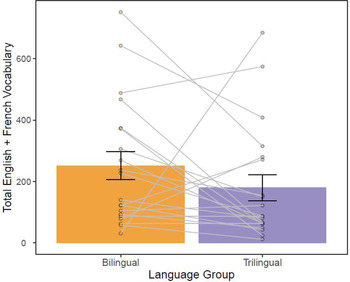
The trilingual group had a mean vocabulary size of 180 words (SD = 188) and the matched bilingual group had a mean vocabulary size of 252 words (SD = 206). Thus, trilinguals had a smaller French–English vocabulary size, knowing 71% as many words as bilinguals. The difference between these matched groups was, however, not statistically significant with either the independent t-test, t(38) = 1.15, p = .257, d = .36, or the repeated measures t-test, t(19) = 1.32, p = .202, d = .28, mean difference = 71.8. Because the data were skewed, planned non-parametric tests were also conducted. We report Cohen's d as effect size for parametric tests, and r as effect size for non-parametric tests. A Mann-Whitney-Wilcoxon test for independent data again indicated that the difference between trilinguals and bilinguals was not statistically significant: trilinguals had a median score of 87 words while bilinguals had a median score of 184 words (U = 146, p = .148, r = .23). Similarly, a Wilcoxon Signed Rank test for paired data showed no statistically significant differences between trilinguals and bilinguals (Z = −1.77, p = .079, r = .40). Total vocabulary scores for the trilingual and bilingual matched sample are presented in Figure 1.
Bar graphs showing total vocabulary scores (English + French) across pairwise-matched trilinguals and bilinguals with data from 18-month-old trilingual toddler who participated in two studies. Lines connect matched participants.

Full Sample
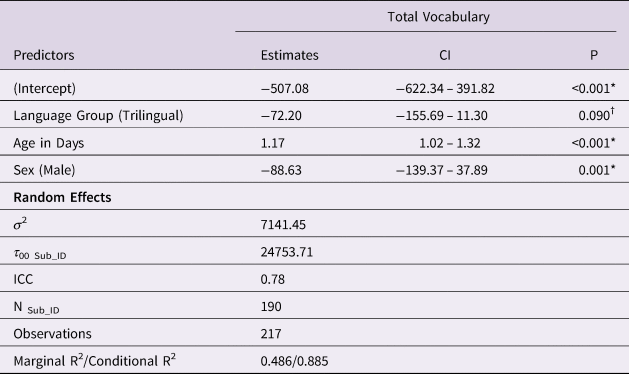
A regression including all participants was used as a second planned approach to control for potential confounds between bilinguals and trilinguals. Moreover, this approach allowed us to directly examine the magnitude of the effect of language group (bilingual vs. trilingual) compared to other predictors including age, sex and maternal education on vocabulary size. Because in our full data set some participants contributed data at multiple ages, we explored the use of linear mixed-effects models, rather than traditional linear regression, to account for these correlated data points (Tabachnick & Fidell, Reference Tabachnick and Fidell2013). To determine whether this type of model was necessary, we fit an intercept-only mixed model, which included the intercept (grand mean of vocabulary score) as a fixed effect, and the participants (variance of participants’ average vocabulary score) as a random effect. This model showed a significant random effect and an intraclass correlation coefficient with a medium effect (ICC = .55, p = .003), supporting the use of a linear mixed-effects model instead of a simple regression model.
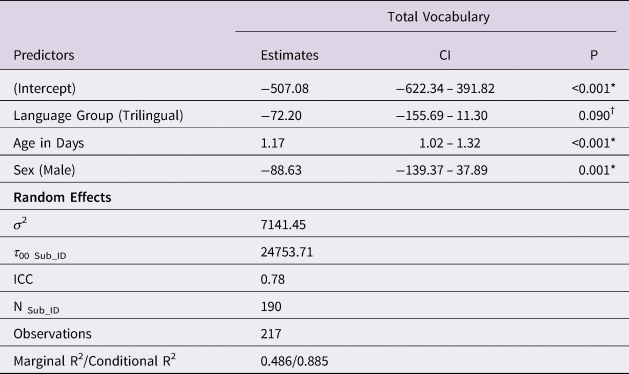
Next, we added our main variable of interest – language group (trilingual or bilingual) – and our covariates – age, sex and maternal education – to our model as predictors. Results showed that maternal education was not a significant predictor in the model (β = 2.30, p = .674): thus, following our pre-registered analysis plan, it was removed to retain power before rerunning the analysis with the more parsimonious model. The final model included language group, age, and sex as predictors, and was a good fit to the data: the fixed effects explained 49% of the variance, and the combination of fixed and random effects explained 89% of the variance (the full model is reported in Table 3). Addressing our main research question, being trilingual was associated with producing 72 fewer words than being bilingual, although this difference failed to reach statistical significance. Replicating previous findings, age and sex were statistically significant predictors, where each additional day of age was associated with one more word produced (e.g., a 28-month-old child produced approximately 30 words more than a 27-month-old), and being female was associated with producing 89 more words on average.
Results from the Final Linear Effects Mixed Model Including all Bilingual and Trilingual Vocabulary Data Sets
Note: † p < .10; * p < .05
Exploratory Analyses
Two exploratory analyses, which were not pre-registered, were conducted to further investigate vocabulary development in the two multilingual groups. First, two-tailed Pearson product-moment correlation coefficients were computed to assess the relation between amount of French and English exposure (measured as proportion exposure to each language) and total vocabulary size in French and English. These correlation analyses were conducted to compare the current study's results with those of past studies evaluating language exposure and vocabulary size, particularly in terms of trilingual vocabulary development (e.g., Mieszkowska et al., Reference Mieszkowska, Łuniewska, Kołak, Kacprzak, Wodniecka and Haman2017). All data points (n = 434) were included in the correlation analyses (trilingual n = 21 and bilingual n = 196 for each language).
The first analysis explored the relation between English language exposure and number of English words for the full sample. Results showed that children with more exposure to English produced significantly more English words, r(216) = .37, p < .001. This correlation had similar magnitude for the bilingual, r(195) = .36, p < .001, and trilingual subsamples, r(20) = .41, p = .064, although it did not reach statistical significance in the trilingual group, possibly due to the smaller sample size. A similar pattern was observed for the correlation between language exposure in French and number of French words with the full sample, r(216) = .36, p < .001, and the bilingual subgroup, r(195) = .33, p < .001. However, for the trilingual sample this correlation was near-zero and not statistically significant, r(20) = −.14, p = .533.
The second exploratory analysis examined whether age moderated the relation between language group (trilingual or bilingual) and total vocabulary size in the community languages (French and English) observed in the main analyses. Based on previous research, it was predicted that language group differences might attenuate with age, as children spend more time in the community: for example, by attending daycares and joining social events such as play groups. This was examined by running the mixed linear model with the full sample and adding an interaction term between age and language group. Results showed no statistically significant interaction between age and language group (β = −0.53, p = .172). We also conducted an exploratory analysis including language exposure ratio in the linear mixed model; however, it was not a significant predictor and was thus not included in the final model.
Discussion
The objective of the current study was to better understand multilingual vocabulary development by comparing productive vocabulary size in the two community languages (French and English) across bilingual and trilingual toddlers. We hypothesized that trilinguals’ reduced exposure to French and English (due to time spent hearing their third language) would lead to reduced French–English vocabulary size relative to bilinguals who were learning only those two languages. Descriptively, our results were in line with our prediction. On average, bilinguals produced 252 words, while trilinguals produced 180 words. That is, trilinguals produced 29% fewer words than bilinguals did, although, as a reminder, vocabulary in trilinguals’ third language was not measured. What is striking is that trilinguals were exposed to French and English 73% of the time (with the remaining 27% exposure to their third language). Thus, trilinguals’ vocabularies in those two languages strongly tracked their exposure. In fact, within each language, our exploratory analyses showed a positive correlation between language exposure and total number of words, further supporting the input–vocabulary link that has been suggested by previous research (e.g., David & Wei, Reference David and Wei2008; Gathercole & Thomas, Reference Gathercole and Thomas2009; Goodman, Dale & Li, Reference Goodman, Dale and Li2008; Oller, Reference Oller2010; Scheele, Leseman & Mayo, Reference Scheele, Leseman and Mayo2010; Thordardottir, Reference Thordardottir2011; Unsworth, Reference Unsworth2013a).
We expected this relation between exposure and vocabulary size to be borne out by a statistically significant difference in vocabulary size between trilinguals and bilinguals. Instead, of the five pre-registered ways in which we tested this prediction, none were statistically significant, although two approached significance (p = .079, p = .090) and all effect sizes were in the expected direction. We had a relatively small sample of trilingual data points available for analysis (n = 21) and this limited our statistical power. In addition, even monolingual children show highly variable vocabulary sizes across the first few years of life (Frank et al., in press), and the substantial variability amongst our participants may have prevented us from detecting a statistically robust difference between trilinguals and bilinguals in most of our analyses. However, our analyses did statistically replicate previous findings that older children produce more words than younger children, and girls produce more words than boys.
Our results support the position that, for a complete picture of multilinguals’ vocabulary development, each of the languages must be assessed (Paradis, Genesee & Crago, Reference Paradis, Genesee and Crago2011). It has been well-demonstrated that measuring bilinguals’ vocabularies in only one language results in an under-assessment of their full capacities (Thordardottir, Rothenberg, Rivard & Naves, Reference Thordardottir, Rothenberg, Rivard and Naves2006). In line with this finding, our results suggest that assessing trilinguals in only two of their three languages will similarly put them at a disadvantage. These results extend the recommendation that bilinguals should be assessed in both of their languages (Hamers & Blanc, Reference Hamers and Blanc2000; Hoff et al., Reference Hoff, Core, Place, Rumiche, Señor and Parra2012) by indicating that trilinguals likely need to be assessed in all three of their languages. We acknowledge that assessing a child's three languages might be difficult in clinical practice; however, it appears important in order to gather comprehensive information on trilingual children's language skills. While the current study did not have data available in trilinguals’ third language to directly test whether three-language vocabulary scores can equate development across children learning different numbers of languages, it will be important for future research to test this directly, and the use of new technologies (e.g., web-based CDI; see Frank et al., in press) might be a helpful avenue to accomplish this goal. Moreover, some studies with bilinguals have suggested that children do achieve similar vocabulary scores to monolinguals when the exposure to their dominant language is over 60% (Cattani et al., Reference Cattani, Abbot-Smith, Farag, Krott, Arreckx, Dennis and Floccia2014; Thordardottir, Reference Thordardottir2011). Future studies could examine if similar thresholds exist for trilinguals.
On the surface, our results differ from a previous study (Mieszkowska et al., Reference Mieszkowska, Łuniewska, Kołak, Kacprzak, Wodniecka and Haman2017) comparing trilingual with bilingual and monolingual children in the United Kingdom, where trilinguals and bilinguals showed similar productive vocabulary size in the majority language (i.e., English). However, these findings can be reconciled when examining the relative input that the different samples had in each of their languages (although we note that the two studies differed somewhat in how they measured exposure). In Mieszkowska and colleagues’ study, bilingual and trilingual participants had similar exposure to the community language (English): 36% at home and 53% outside home for trilinguals, and 30% at home and 58% outside home for bilinguals. Exposure to the community language was similar, and bilinguals and trilinguals knew similar numbers of words. However, in our study, the two groups differed importantly in their cumulative lifetime exposure to both French and English. Bilinguals in our study heard French and English 100% of the time, while trilinguals only heard these languages 73% of the time. In our case, trilinguals had less exposure to the community language than bilinguals, and they produced fewer words. Thus, both studies are consistent with the hypothesis that vocabulary development and input are tightly linked. At least at younger ages, effects of a language's sociolinguistic status on development might be mediated by differences in amount of language input, rather than direct effects of language status on learning.
Our study suggests that trilingualism does not seem to disadvantage children's vocabulary trajectory beyond what would be expected by differences in input that stem from having their time divided across multiple languages. That is, there is no evidence that learning three languages from an early onset results in confusion or in difficulties in acquiring new words. Findings from the present study could further encourage parents and schools to foster vocabulary development in all three languages in early childhood, rather than solely focusing on one language (i.e., the school's language). Despite common concerns related to all types of multilingual children's linguistic (King & Fogle, Reference King and Fogle2006) and intellectual development, including those with speech and language delays (e.g., the widespread negative attitude regarding development when learning more than one language; Gonzalez-Barrero & Nadig, Reference Gonzalez-Barrero and Nadig2018; Paradis, Reference Paradis2007), multilingualism itself does not negatively affect school performance (Collier & Thomas, Reference Collier and Thomas2004; Oller & Eilers, Reference Oller and Eilers2002), and instead may put children at an advantage in school readiness tasks (McLeod, Harrison, Whiteford & Walker, Reference McLeod, Harrison, Whiteford and Walker2016). Although young multilingual children tend to have a smaller vocabulary size relative to their monolingual peers when considering only the majority language, these children appear to eventually catch up to their peers in the school years (Grosjean, Reference Grosjean2010; Mieszkowska et al., Reference Mieszkowska, Łuniewska, Kołak, Kacprzak, Wodniecka and Haman2017).
Limitations
A common challenge in studying multilingual development is that multilingual children are a difficult population to recruit, and this difficulty is particularly acute for trilinguals. Indeed, most past research on young trilinguals has consisted of case studies (Albin & Gershkoff-Stowe; Chevalier, Reference Chevalier2015; Montanari, Reference Montanari2010; Quay, Reference Quay2011), or small samples (Mieszkowska et al., Reference Mieszkowska, Łuniewska, Kołak, Kacprzak, Wodniecka and Haman2017). Our sample was the largest to date of trilingual toddlers (n = 21), but nonetheless was smaller than ideal, which reduced our statistical power. We made use of an archival dataset, and thus did not have control over the sample of trilinguals, but future studies should expressly recruit larger samples.
A second common challenge in studies of multilinguals is that children's language background cannot be randomly assigned, leaving open the possibility for confounds between groups. We made several efforts to minimize potential confounds between our bilingual and trilingual groups, through a careful matching approach and a regression model that controlled for known contributors to vocabulary development, such as age, sex and socioeconomic status. Nonetheless, we cannot fully rule out that unmeasured factors contributed to trilingual–bilingual differences. For example, some studies have found that overheard speech plays a role in bilingual vocabulary development (Floccia et al., Reference Floccia, Sambrook, Delle Luche, Kwok, Goslin, White, Cattani, Sullivan, Abbot-Smith, Krott, Mills, Rowland, Gervain and Plunkett2018; however, see Oller, Reference Oller2010). We did not measure overheard speech in our study, and it is possible that this differed between trilinguals and bilinguals.
Finally, as previously discussed, while bilinguals’ vocabularies were assessed in both of their languages, trilinguals’ vocabularies were only assessed in two of their three languages. Our research question and discussion have carefully taken this limitation into account. Nonetheless, it will be important for future research to measure trilinguals’ vocabularies in all three of their languages. Future studies could also expand the research to investigate concept vocabulary (i.e., the number of concepts lexicalized), since the current study focused on word vocabulary.
Conclusion
This study quantitatively measured the amount of words that young multilingual children know in order to determine the extent that trilingual vocabulary and bilingual vocabulary differed across two community languages. In line with past evidence of the relation between language input and vocabulary acquisition (De Houwer, Reference De Houwer2007; Place & Hoff, Reference Place and Hoff2011), trilingual toddlers had vocabulary sizes in French and English that were proportional to their exposure, but the difference between their knowledge and that of their French–English bilingual peers was not always statistically robust. This is likely due to the relatively small size of our trilingual sample, together with the high variability in vocabulary development seen across children. Vocabulary size in trilinguals appears to be largely determined by the same factors that explain monolingual and bilingual vocabulary development, particularly the amount of input that is encountered in each language.
Acknowledgements
We are grateful to all the families who participated in this research. This work was funded by a grant from the Natural Sciences and Engineering Research Council of Canada (NSERC 2011-402470, 2018-04390), a National Institutes of Health grant (NIH R03HD079779), and a Fonds de Recherche du Québec-Société et Culture grant (FQRSC 2012-NP-145009) to Byers-Heinlein, and by a FQRSC (2018-B3-205717) postdoctoral fellowship to Gonzalez-Barrero. Krista Byers-Heinlein holds the Concordia University Research Chair in Bilingualism.
Supplementary Material
For supplementary material accompanying this paper, visit http://doi.org/10.1017/S030500092000077X