INTRODUCTION
Children learn many things about the world through first-hand experience, but they also learn through conversations with other people. Linguistic input from more knowledgeable others is especially important in domains where important concepts are not readily accessible through direct observation (Gelman, Reference Gelman2009). Reading is one such domain. For example, hearing an adult say “That word says dog” while pointing at some small black marks may help a child realize that the marks serve a purpose. The present study investigated conversations between parents and their young children in the home that touch on elements and processes of reading and writing.
Literacy-related conversations could occur in a number of settings, but most studies of these conversations have examined story-book reading. In this context, parents and children talk less about printed words and letters than about story content and illustrations (e.g., Haden, Reese, & Fivush, Reference Haden, Reese and Fivush1996; Hindman, Connor, Jewkes, & Morrison, Reference Hindman, Connor, Jewkes and Morrison2008; Price, Kleeck, & Huberty, Reference Price, Kleeck and Huberty2009; Yaden, Smolkin, & Conlon, Reference Yaden, Smolkin and Conlon1989). However, parents report in questionnaire studies that they sometimes teach their children about letters of the alphabet through games and other activities (Burgess, Reference Burgess2011; Martini & Sénéchal, Reference Martini and Sénéchal2012; Wood, Reference Wood2002). Thus, we did not limit the present investigation of literacy-related conversations to the book-reading context.
We used data from the Chicago Language Development Project, a study in which parents and children were videotaped every four months, starting from when children were 1;2 (years; months), as they went about their daily activities. Parents’ and children's talk during each 90-minute videotaped session was transcribed and supplemented with information about the activities in which they were engaged and the objects that were involved. We defined literacy-related conversations as those that included explicit talk about alphabet letters, printed words, reading, writing, spelling, book conventions (e.g., which page of a book is read first), and phonological awareness, and we asked how often such conversations occurred when children were aged 1;10, 2;6, 3;6, and 4;2. Because letter-related conversations appear to have a special link with later decoding skills (Evans, Shaw, & Bell, Reference Evans, Shaw and Bell2000; Sénéchal & Lefevre, Reference Sénéchal and Lefevre2002), we also conducted analyses of this subset of literacy-related conversations.
Our first goal was to determine how the frequency of literacy-related conversations varied with the age of the child and the context of the conversation; for example, whether it occurred during book-reading or toy play. Several studies have observed literacy-related conversations involving children as young as one to two years (Robins & Treiman, Reference Robins and Treiman2009; Robins, Treiman, Rosales, & Otake, Reference Robins, Treiman, Rosales and Otake2012; Treiman, Schmidt, Decker, Robins, Levine, & Demir, Reference Treiman, Schmidt, Decker, Robins, Levine and Demir2015), but these studies do not provide information about the proportion of talk in children's homes that is devoted to literacy-related matters or how the frequency of such talk may vary across contexts. A previous study using data from the Chicago Language Development Project found that parents were increasingly likely to mention letters of the alphabet as their children increased in age from 1;2 to 4;2, but this study did not examine other types of literacy-related talk, nor did it examine talk by children (Treiman et al., Reference Treiman, Schmidt, Decker, Robins, Levine and Demir2015).
A second goal of our study was to examine the extent to which children contributed to literacy-related conversations. In a study of mealtime conversations involving parents and three-year-olds, Aukrust and Snow (Reference Aukrust and Snow1998) found that the proportion of utterances contributed by children was lower for some types of talk, such as explanations about the workings of household appliances, than to other types of talk, such as discussions of the taste of food. Here we asked whether the proportion of utterances contributed by children was lower in conversations about literacy-related matters than conversations about other topics. We also asked whether the proportion of utterances contributed by children increased as they got older, as would be expected given children's increasing language proficiency.
A third research question was whether the frequency of literacy-related conversations and the rate of child participation in these conversations varied with the family's socioeconomic status (SES). The common view that the early home literacy environment is richer in higher-SES families than lower-SES families and that this helps to explain SES-related differences in academic achievement (e.g., Neumann, Reference Neumann2016; Strang & Piasta, Reference Strang and Piasta2016) leads to the expectation that the proportion of utterances devoted to conversations about literacy-related matters would be higher in higher-SES families. Indeed, questionnaire studies suggest that reading books to children is a more common activity in higher-SES than lower-SES US homes (e.g., Chen, Pisani, White, & Soroui, Reference Chen, Pisani, White and Soroui2012; Kuo, Franke, Regalado, & Halfon, Reference Kuo, Franke, Regalado and Halfon2004; Schaub, Reference Schaub2015; Yarosz & Barnett, Reference Yarosz and Barnett2001). Questionnaires are subject to social desirability biases, however, and respondents do not always remember the details of how they spend their time. It is important to examine possible SES differences directly.
To summarize, we used longitudinal, observational data to examine the proportion of utterances in young children's homes that occurred in conversations about literacy-related matters in general and about a specific literacy-related topic – alphabet letters. We asked how the proportion of talk during the home visits that was devoted to these topics varied with children's age, the context of the conversation, and the SES of the family. We also examined the degree to which children contributed to the conversations.
METHOD
Participants
We used data from fifty-six children (29 boys) and their parents from the Chicago Language Development Project. Sixty-four families who were representative of the greater Chicago area in ethnicity and income were selected for the project. All the parents spoke English as the primary language. The project includes twelve home visits before children entered kindergarten, and we used data from all fifty-six families for whom transcripts were available for the visits when children were 1;10, 2;6, 3;6, and 4;2. The primary caregiver was the mother in forty-nine families and the father in one; the parents in the other families reported that they shared caregiving duties. Forty children were reported to be White, ten African American, and six of two or more races. Eight of the children were reported to be Hispanic.
Information about the parents’ education level and the family's income was collected categorically in a questionnaire that was given at or before the first home visit. Each category for education was assigned a value equivalent to years of education. We used the value for the primary caregiver for families that reported a single primary caregiver and the average for the two caregivers for families that reported two. The categories for family income, which ranged from less than $15,000 to over $100,000 per year, were transformed into a scale by using the midpoints of the incomes in each category except the highest, which was coded as $100,000. As in several previous studies using data from the Chicago Language Development Project (e.g., Rowe & Goldin-Meadow, Reference Rowe and Goldin-Meadow2009; Treiman et al., Reference Treiman, Schmidt, Decker, Robins, Levine and Demir2015), we used principal components analysis to combine education and income into a composite measure of SES with a mean of 0 and a standard deviation of 1·0.
Procedure
Home visits
Visits were conducted by research assistants, each of whom continued with a family over a series of visits. At each visit, the researcher videotaped the parent and child for a target length of 90 minutes. Because the goal was to obtain a picture of typical parent–child interactions, the researcher did not bring toys or books and did not engage the child in conversation. Families were asked to carry out their normal daily activities, and they did not know that literacy-related conversations would be studied. All speech in the videotaped sessions by the parent and the child of interest was transcribed. Transcription reliability was established by having a second individual transcribe 20% of each transcriber's videotapes. Reliability was achieved when coders agreed on 95% of transcription decisions about an utterance, which was defined as a sequence of words that was preceded and followed by a pause, a change in a conversational turn, or a change in intonation pattern.
Coding of literacy-related conversations
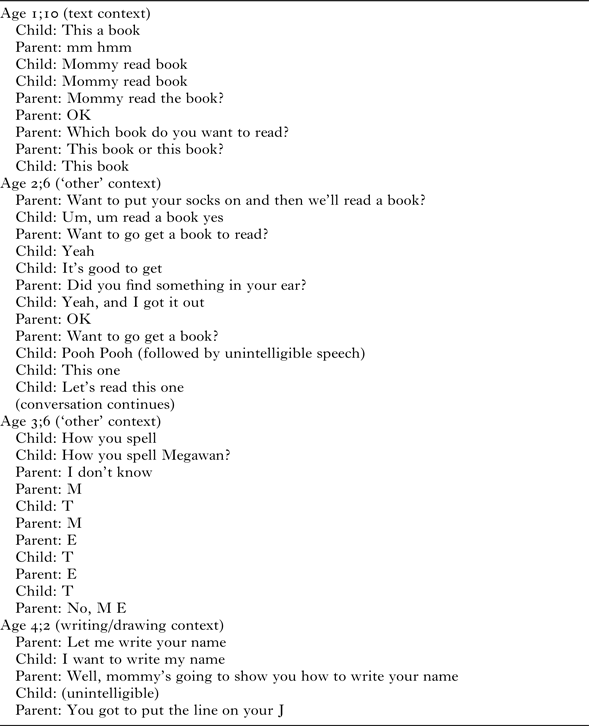
We coded conversations as literacy-related if they included explicit talk about alphabet letters, printed words, reading processes and conventions, writing, spelling, or rhyming. Letter-related conversations were the subset of these conversations that included talk about letters. Table 1 shows some sample literacy-related conversations. We determined whether each conversation occurred while participants were looking at or reading a book or other written text, writing or drawing, looking at or playing with toys, or doing something else (e.g., dressing, eating). We coded these contexts as text, writing/drawing, toy play, and ‘other’, respectively. We did not separate writing and drawing because the two activities were sometimes intermingled or difficult to distinguish. We considered that a new conversation began when the context changed, as when a parent and child transitioned from discussing a book to eating dinner, or when the focus of the conversation changed, for example, from talking about letters on a puzzle piece to discussing a program on television. A second individual coded the data from nine home visits. The percentage of agreement between coders was 94% for whether a conversation was literacy related, 96% for whether a conversation was letter related, 86% for the context coding, and 96% for conversation start and stop points.
Examples of literacy-related conversations involving children of different ages

RESULTS
Literacy-related conversations
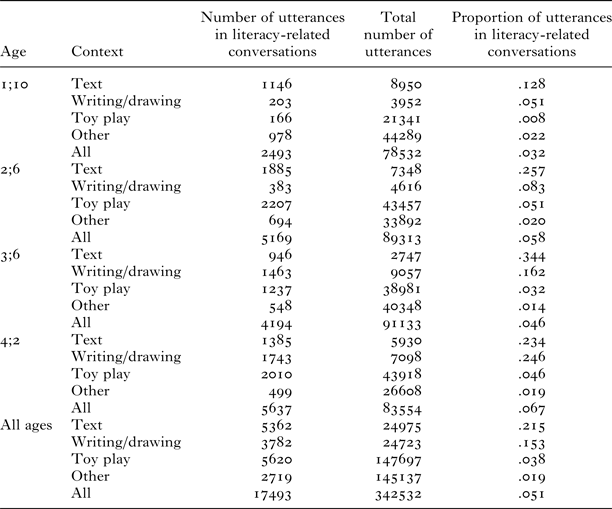
The first column of data in Table 2 shows the total number of utterances that occurred in literacy-related conversations in each conversational context at each age. The second column shows the total number of utterances in the context, and the third column gives the proportion of the utterances that occurred in literacy-related conversations. We present the data this way rather than calculating proportions for each family for each age and context and averaging those proportions because the distributions of the proportions were skewed, with large standard deviations.
Number and proportion of utterances in literacy-related conversations as a function of child age and context

To analyze the data statistically, we used negative binomial regression. This procedure is appropriate for count data, here the number of times that a certain type of utterance occurred. Our dependent variable was the number of utterances that were part of a literacy-related conversation. The offset variable, namely the number of times the event could have occurred, was the number of utterances. These values were calculated for each context for each family at each session. Using the glm.nb program in the MASS package in R (Venables & Ripley, Reference Venables and Ripley2002), we fit negative binomial regression models with the age of the child (calculated to two decimal points in years), the context, and the composite measure of family SES as predictors. Continuous dependent variables were centered, and text was the reference level for the categorical variable of context. Family identification number was included as a covariable.
We first fit a model with main effects of child age, context, and SES. Using likelihood ratio tests, we compared this model to a model that included the interaction between age and SES, a model that included the interaction between age and context, and a model that included the interaction between SES and context. Adding the interaction between age and SES did not significantly improve the fit of the model (p = ·20), but adding the interaction between age and context improved the fit, as did adding the interaction between SES and context (p < ·002 for both). Our final model, which included the main effects of age, context, and SES, the interaction between age and context, and the interaction between SES and context, was not a significantly poorer fit than a model that also included the three-way interaction of age, context, and SES (p = ·20).
The final model showed a main effect of age, such that the likelihood that an utterance was part of a literacy-related conversation increased significantly as children got older (β = 0·49, SE = 0·15, p = ·001). The likelihood that an utterance was part of a literacy-related conversation was significantly higher if the utterance occurred in a text context than if it occurred during writing/drawing (β = 0·95, SE = 0·23, p < ·001), toy play (β = 3·21, SE = 0·19, p < ·001), or in ‘other’ contexts (β = 2·82, SE = 0·18, p < ·001). The main effects of age and context were qualified by a statistically significant contrast between age and the text versus ‘other’ contrast (β = –0·66, SE = 0·20, p < ·001), as well as by significant interactions between SES and the contrast between the text and toy play contexts (β = 0·65, SE = 0·20, p < ·001) and SES and the contrast between the text and ‘other’ contexts (β = 0·75, SE = 0·19, p < ·001).
To shed light on the interactions involving context, we conducted analyses for each context using main effects of age and SES. We found a significant effect of age in each of the text, writing/drawing, and toy play contexts (text: β = 0·41, SE = 0·08; writing/drawing: β = 0·65, SE = 0·16; toy play: β = 0·67, SE = 0·15; p < ·001 for all), such that the likelihood that an utterance was a part of a literacy-related conversation increased reliably as children grew older. There was no significant effect of SES in these contexts (p > ·09). In contexts classified as ‘other’, there was no significant effect of age but a significant effect of SES, such that the likelihood that an utterance was a part of a literacy-related conversation was greater in higher-SES than lower-SES families (β = 12·54, SE = 4·60, p = ·006). To illustrate, the mean proportion of utterances in literacy-related conversations in ‘other’ contexts was .015 (SD = ·043) in the 25 families with a value below zero on the composite measure of SES and .041 (SD = ·134) in the 31 families with a value above zero.
Letter-related conversations
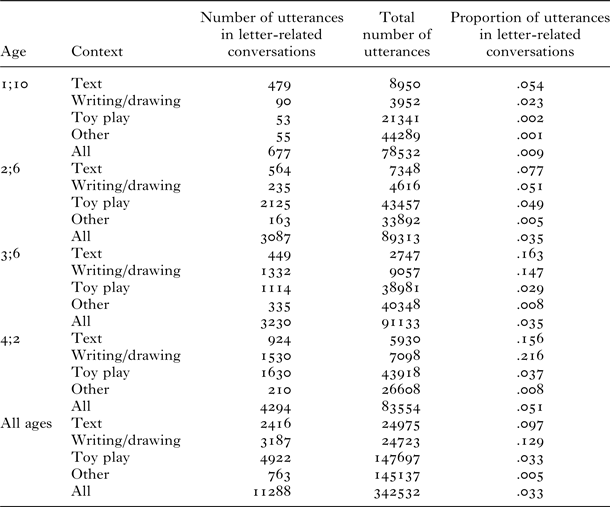
Table 3 provides information about one important type of literacy-related conversations, those related to letters. It shows the number of utterances in letter-related conversations, the total number of utterances, and the proportion of utterances that occurred in letter-related conversations as a function of age and context. A comparison of the numbers in Table 3 with those in Table 2 shows that the majority of literacy-related conversations included talk about letters. As in the analyses of literacy-related conversations in general, we fit a negative binomial regression model with main effects of age, context, and SES. Using likelihood ratio tests, we found that this model was not a significantly poorer fit than models that included the two-way interactions. A model with the main effects of age and context was not a significantly poorer fit than a model that also included the main effect of SES (p > ·27 for all model comparisons), so our final model included main effects of age and context.
Number and proportion of utterances in letter-related conversations as a function of child age and context

According to the final model, the likelihood of an utterance being a part of a letter-related conversation increased significantly as children got older (β = 0·78, SE = 0·12, p < ·001). An utterance was significantly more likely to be part of a letter-related conversation if it occurred in the text context than if it occurred during toy play (β = 2·36, SE = 0·30, p < ·001) or in ‘other’ contexts (β = 3·40, SE = 0·30, p < ·001). The difference between text and writing/drawing was not statistically reliable (p = ·31). Thus, whereas literacy-related conversations as a whole were significantly more likely to occur in text contexts than writing/drawing contexts, letter-related conversations were statistically equally likely to occur in these contexts.
Children's contributions to conversations
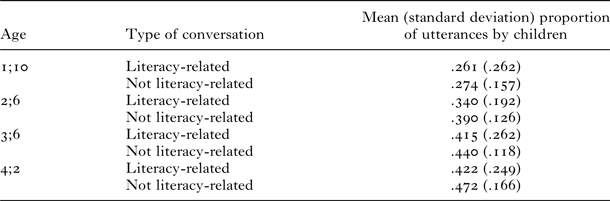
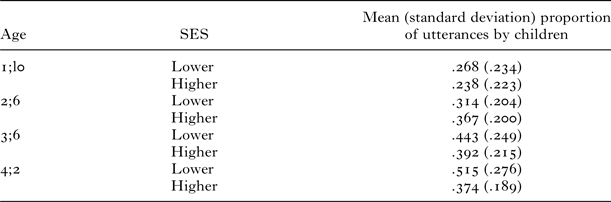
Table 4 shows the proportion of utterances by children as opposed to parents in literacy-related conversations and, for comparison, in all other talk in the sessions. The small number of cases in which a child and a parent were coded as producing an utterance simultaneously were excluded from these analyses. The data were more normally distributed than the data on the proportion of literacy-related utterances, making mixed-model analyses appropriate. We used the package lme4 (Bates, Mächler, Bolker, & Walker, Reference Bates, Mächler, Bolker and Walker2015), treating family as a random factor. Our first model included the fixed factors child age, SES, and conversation type (literacy-related vs. not). Adding interactions between age and conversation type and between SES and conversation type did not significantly improve the model's fit (p > ·37), but adding the interaction between age and SES did (p < ·001). Because a model that also included the three-way interaction did not offer a significant improvement (p = ·56), we retained the model with main effects of age, SES, and conversation type and the interaction between age and SES.
Mean (and standard deviation) proportion of utterances by children of different ages in literacy-related conversations and conversations without literacy-related content

The final model showed a significant main effect of age, such that the proportion of utterances contributed by children increased as they grew older (β = 0·07, SE = 0·01, p < ·001). There was also a main effect of conversation type, such that children were significantly less likely to contribute to conversations about literacy than those about other topics (β = –0·03, SE = 0·02, p = ·041). The main effect of SES was significant (β = –0·04, SE = 0·02, p = ·022), such that the proportion of utterances contributed by children was lower in higher-SES than lower-SES families. Because there was also an interaction between SES and age (β = 0·04, SE = 0·01, p < ·001), we conducted separate analyses for each session using SES as a factor. We found no reliable effect of SES at child ages 1;10 and 2;6 (p > ·44) and a trend toward less participation by children in higher-SES families at 3;6 (p = ·06). There was a robust effect of SES at 4;2, such that the proportion of utterances contributed by children was lower in higher-SES than lower-SES families (p < ·001). Table 5 shows the mean proportion of utterances contributed by children out of all talk in a session as a function of the child's age and whether the family's score on the composite measure of SES was below or above zero.
Mean (and standard deviation) proportion of utterances by children in sessions as a function of child age and SES (below vs. above zero on composite measure of SES)

DISCUSSION
Learning to produce and interpret written language is vital for success in modern societies. Although formal instruction in these skills begins at school, learning about written language begins at home, often through informal discussions between children and parents about literacy-related topics. Given the role of these experiences in preparing children for school (e.g., Evans et al., Reference Evans, Shaw and Bell2000), it is important to study the characteristics of the home literacy environment. The present study did so not by using questionnaires, as in many previous studies (e.g., Chen et al., Reference Chen, Pisani, White and Soroui2012), but by analyzing talk that was recorded during daily activities at home.
Averaging across contexts and ages, 5·1% of parents’ and children's utterances were part of a conversation about a literacy-related matter. This figure is striking given the many topics that parents and children have to discuss and given that we had a fairly restricted definition of literacy-related conversations. Conversations about the elements and processes of reading and writing were considered literacy-related, but play that incorporated themes from a book, for example, was not. The proportion of utterances that were part of a literacy-related conversation increased from 3·2% at child age 1;10 to 9·0% at 4;2. Literacy-related conversations covered a range of matters, but the majority included talk about alphabet letters, a type of talk that appears to be helpful for learning to decode written words (Evans et al., Reference Evans, Shaw and Bell2000; Sénéchal & Lefevre, Reference Sénéchal and Lefevre2002). Although children contributed a smaller proportion of utterances to literacy-related conversations than to conversations about other topics, the literacy-related conversations were by no means monologues by parents.
Previous studies have focused on story-book reading as a context for literacy-related talk, and the overall rate of literacy-related utterances in our study was significantly higher in the text context than in any of the other contexts. However, text contexts and writing/drawing contexts were statistically equally likely to give rise to letter-related conversations. This latter result highlights writing as an important but often under-appreciated context for learning about letters (Levin, Aram, Tolchinsky, & McBride, Reference Levin, Aram, Tolchinsky and McBride2013; Skibbe, Bindman, Hindman, Aram, & Morrison, Reference Skibbe, Bindman, Hindman, Aram and Morrison2013).
Our results suggest a need to re-evaluate some conclusions that have been drawn about the talk that occurs when parents read books to their young children. In particular, the statement that explicit talk about literacy-related topics ‘rarely’ occurs in this context (Aram & Aviram, Reference Aram and Aviram2009, p. 188; Hindman, Skibbe, & Foster, Reference Hindman, Skibbe and Foster2014, p. 291; Piasta, Justice, McGinty, & Kaderavek Reference Piasta, Justice, McGinty and Kaderavek2012, p. 810) seems too strong. The proportion of utterances in text contexts that were part of a literacy-related conversation was 21·5% in our study, pooling across ages, and the proportion of utterances in text contexts that were part of a letter-related conversation was 9·7%. These figures are probably more representative of what normally occurs in homes than are the results of studies in which parents are asked to read unfamiliar books to their children, sometimes in a laboratory setting.
Surprisingly, given the common view that the home literacy environment is richer in higher-SES than lower-SES families (e.g., Neumann, Reference Neumann2016; Strang & Piasta, Reference Strang and Piasta2016), we found few differences as a function of SES in the proportion of talk during the home visits that was devoted to literacy-related matters. The rate of letter-related talk did not differ significantly as a function of SES, and the rate of literacy-related talk as a whole did not differ significantly as a function of SES in text, writing/drawing, or toy play contexts. In contexts that did not involve texts, writing, drawing, or toy play, the proportion of utterances that occurred in a literacy-related conversation, although low in all families, was significantly higher in higher-SES than lower-SES families. If this finding can be replicated, it would suggest that certain materials, including books or blocks with letters on them, elicit talk about writing to a similar extent in families varying in SES. Differences in families’ orientations toward literacy may be more likely to emerge when situational encouragement is not present.
The most notable SES difference that we found concerned the degree to which children versus parents contributed to conversations. Whether the topic of the conversation was literacy or some other matter, the proportion of utterances contributed by children was lower in higher-SES families than lower-SES families during the later sessions of the study. This finding fits with other reports that lower-SES parents tend to talk less with their children than higher-SES parents and that these differences may increase over the first years of life (e.g., Hoff, Laursen, & Tardif, Reference Hoff, Laursen, Tardif and Bornstein2002; Torr, Reference Torr2004; Vanormelingen & Gillis, Reference Vanormelingen and Gillis2016). If children carry much of the conversational load in conversations about literacy and other topics, concepts that are new to children may not come up as often, children's requests for information may not be answered, and children may be asked fewer questions that encourage them to make observations and demonstrate their knowledge (Robins, Ghosh, Rosales, & Treiman, Reference Robins, Ghosh, Rosales and Treiman2014).
Several programs designed to improve the literacy skills of children, including children at risk of poor academic performance due to low SES, have encouraged parents and preschool educators to talk about and point to print when reading books to children (Justice & Ezell, Reference Justice and Ezell2002; Justice, McGinty, Piasta, Kaderavek, & Fan, Reference Justice, McGinty, Piasta, Kaderavek and Fan2010; Piasta et al., Reference Piasta, Justice, McGinty and Kaderavek2012). Our findings suggest the potential value of targeting other activities, including those involving production of writing. More generally, it may be beneficial to encourage adults to talk more with children and to take a large role in the conversations (Ridge, Weisberg, Ilgaz, Hirsh-Pasek, & Golinkoff, Reference Ridge, Weisberg, Ilgaz, Hirsh-Pasek and Golinkoff2015; Suskind et al., Reference Suskind, Leffel, Graf, Hernandez, Gunderson, Sapolich and Levine2016). One would not want to encourage conversations that leave no room for participation by children, but lower-SES children may benefit if parents took more of the conversational load.
The present study shows the value of obtaining objective information about the home literacy environment by examining it directly. The results show that conversations about letters and other literacy-related matters occur when parents and children read together, and more often than is generally acknowledged, but that book reading is not the only setting for such conversations. The results further show that SES differences in the early home literacy environment may lie less in the proportion of parents’ and children's talk that deals with literacy-related matters than in the extent to which the more knowledgeable member of the dyad, the parent, contributes to the conversations.