





1. Introduction
Spanish is a null-subject language, which means that the overt expression of a subject is optional, so there can be cases such as (1), in which no subject is expressed, or cases such as (2), in which it is expressed.
(1)
∅
Siempre
entregamos
el
trabajo
antes
de
la
fecha
límite.
always
turn-in-1st,pl.pres.
the
work
before
of
the
date
limit
“We always turn in our work before the due date.”
(2)
Nosotros
siempre
entregamos
el
trabajo
antes
de
la
fecha
we
always
turn-in-1st,pl.pres
the
work
before
of
the
date
límite.
limit
“We always turn in our work before the due date.”
The reasons for the subject’s expression or omission have been widely explored in adult Spanish research. Variationist approaches (see Otheguy & Zentella, Reference Otheguy and Zentella2012, for review) have proposed that many factors probabilistically constrain the expression of a subject (also called the overt subject). This probabilistic view of the phenomenon allows us to understand that it does not obey binary, black-and-white rules, but rather a wide spectrum of factors involved in determining the likelihood of a subject pronoun being expressed.
Most of the factors that have been studied come from two main categories: on the one hand, “purely linguistic” ones such as the verb’s tense, mood, and aspect, clause type, person/number of the verb, and on the other, social factors have also been studied concerning their role in constraining subject expression, such as age, bilingualism/dialect levelling, sex. Although not as extensively as with adults, both categories have been explored in child Spanish, and the focus has centred on determining at what age children become sensitive to the same subject expression constraints as those of adults. However, it is also worth considering what is underneath the probabilistic constraints. That is, is it that how much a person knows about morphosyntax is also a predictor of overt pronoun expression? Does vocabulary size significantly predict subject personal pronoun (SPP) expression and, vice versa, does less knowledge of vocabulary predict more subject pronoun omission (i.e., more use of null pronouns)?
Our contribution to the field of Spanish subject expression consists of testing whether cognitive and linguistic abilities are important for subject pronoun expression in child language. The value of doing this work in child language is that children are undergoing development in all these domains of language and cognition, which provides variance for statistical modelling. This variance can be missing from adult measures because of ceiling effects. We modelled three categories of predictor variables: executive function (EF) abilities, lexical abilities, and morphosyntactic abilities.
This article has two main components. The first component seeks to replicate previous findings on children’s overt pronoun constraints. It specifically describes SPP usage using mixed-effects binary logistic regressions of SPP expression, which is conventional in the field. As described in the methodology section below, we are including a sample of children who are younger than those in previous investigations. The second component explores the relationship between SPP rates of occurrence in particular sub-types (e.g., SPPs with verbs in third-person singular) with previously unexplored cognitive and linguistic abilities using a Pearson product–moment correlation and multiple linear regressions.
This article is organised as follows: In Sections 2 and 3, we discuss what previous work on subject pronoun expression has found to be important in adult and child Spanish. In Section 4, we review a prominent theoretical proposal for how cognitive and linguistic abilities relate to overt subject pronouns. In Section 5, we describe the research questions, hypotheses, and methods of analysis, including transcription and coding conventions, as well as procedures for measuring the cognitive and linguistic abilities of interest. In Section six, the descriptive and inferential statistics (logistic regression model and correlation analysis) are reported. Finally, in Section 7 and Section 8, we discuss the results and conclusions.
2. Variationist accounts of overt subjects in adult Spanish
Subject expression in Spanish has been studied widely. Much of the foundational work that established adult subject use patterns in Spanish was reviewed in Otheguy and Zentella (Reference Otheguy and Zentella2012), as well as Otheguy et al. (Reference Otheguy, Zentella and Livert2007), Cameron (Reference Cameron1993), Erker and Guy (Reference Erker and Guy2012), inter alia. The first two studies analysed Spanish in the US, grouping the Spanish dialects into Caribbean and “continental” (non-Caribbean) categories. The authors found that among social factors that predict overt subject use (age, gender, education, etc.), only regional origin predicted the use of the subject pronoun. Likewise, both dialectal groups followed the same grammatical predictors of overt pronoun expression: switch-reference contexts, verbs in imperfect tense, main (vs subordinate) clauses, cognitive verbs, singular verbs, nonreflexive verbs, absence of /s/ in coda position of 2nd person singular, and the presence of uno. Outside the US, Orozco and Guy (Reference Orozco, Guy, Westmoreland and Thomas2008), who follow the Otheguy and Zentella (Reference Otheguy and Zentella2012) methodology, focused their attention on the Caribbean Colombian coast. The authors identified the subject pronominal rate as a reliable parameter for dialect delimiting.
Since the children in the present study are from Mexico City, it is important to review previous findings on overall pronoun rates among Mexican adults. Using an oral corpus from Mexico City, Lastra and Butragueño (Reference Lastra, Butragueño, Carvalho, Orozco and Shin2015) analysed verbal tokens and coded 11 independent variables, including person/number, specificity (specific and non-specific tú “you”), verbal mood, verbal tense, verb class, morphological ambiguity, enunciative type, co-reference, textual genre, conversational style, and pronoun position. Their results showed that grammatical person/number, coreference, verbal mood, enunciative type, textual genre, verbal tense, ambiguity, and style significantly predicted subject pronoun expression in Mexico City. Nonetheless, the low pronominal rate for specific Tú might differentiate the Mexico City dialect from other varieties. The overall overt SPP rate in this research was 21.7%, which is lower than the 44.8% rate in Puerto Rico (Cameron, Reference Cameron1993), the 34.2% rate in Barranquilla, Colombia (Orozco and Guy, Reference Orozco, Guy, Westmoreland and Thomas2008), the 24.8% rate in the Gulf of Mexico coastal area in Veracruz, Mexico (Orozco, Reference Orozco2016), the 24.0% rate of Mexicans in New Jersey (Flores-Ferrán, Reference Flores-Ferrán2007), and the 22% rate of Mexicans in New York (Otheguy & Zentella, Reference Otheguy and Zentella2012). On the contrary, it was higher than the 19.7% rate of Yucatan Spanish (Michnowicz, Reference Michnowicz, Carvalho, Orozco and Shin2015) and the 18.7% rate of New York Mexican Newcomers (Shin & Otheguy, Reference Shin and Otheguy2013).
In general, adult rates of subject pronoun expression have shown variation across speakers from one Spanish dialect to another, yet they have demonstrated probabilistic and systematic patterns across communities; that is, even though Mexican Spanish has shown higher percentages of SPP omission than Puerto Rican Spanish, both dialects typically follow the same constraints for their omission and expression.
Shin (Reference Shin2016) has summarised five main predictors of subject pronoun expression from the broad field of adult overt subject pronoun constraints:
-
(i) Person/number: the singular pronouns are more likely to be expressed than plural ones. E.g.,yo ronqué (“I snored”), versus ∅ [nosotros] roncamos (“∅ [we] snored”).
-
(ii) Reference: Expressed pronouns are more frequent in switch-reference contexts (e.g., Ella se durmió y él roncó toda la noche; “She fell asleep and he snored all night”) than in same-reference contexts (e.g., Ella se durmió y ∅ roncó toda la noche; “She fell asleep and ∅ snored all night). The former illustrates how adults tend to avoid ambiguity by using the overt pronoun in a switch-reference context, while the latter shows how they reject redundancy (overt pronoun in a same-reference context).
-
(iii) Tense/mood/aspect: Ambiguous person verbal morphology, such as the imperfect (e.g., 1sg-yo dormía and 3sg-ella dormía;“1sg-I was sleeping and 3sg-she was sleeping”), favours overt pronoun expression.
-
(iv) Verb type: cognitive verbs like considerar promote expression (e.g., yo considero; “I consider”), whereas non-mental activity verbs like saltar disfavour its expression (e.g., ∅ [yo] salto; ∅ [I] jump).
-
(v) Clause type: Main and subordinate clauses promote expression of the overt pronoun (e.g., Yo sabia que tú no ibas a venir; I knew that you were not coming) while coordinate clauses favour omission (e.g., ∅ [yo] cociné y ∅ [tú]viniste; ∅ [I] cooked and ∅ [you] came).
3. Variationist accounts of overt subjects in child Spanish
How do these constraints play out in the development of child Spanish? There has been limited research on the extent to which Spanish-speaking children follow these constraints. In particular, the work of Shin and colleagues (Lapidus Shin & Cairns, Reference Lapidus Shin and Cairns2012; Shin & Erker, Reference Shin and Erker2015; Shin, Reference Shin2016) addressed the question of whether these linguistic constraints on subject pronoun expression develop during early childhood.
Lapidus Shin and Cairns (Reference Lapidus Shin and Cairns2012) conducted an experiment comparing 30 adults and 139 Spanish-speaking monolingual Mexican children (5;09 to 15;08) to determine their preference for expressed and null Spanish subject pronouns. The authors were interested in the effects of switch/same-reference on third-person singular personal pronoun selection. Their research questions consisted of understanding at what age children become sensitive to same/switch-reference contexts regarding noun phrase (NP) selection and to understand at what age their preferences become like those of adults. Lapidus Shin and Cairns found that the same- and switch-reference constraints in their experiment are indeed a powerful predictor of third-person singular pronoun selection. In particular, in their switch-reference contexts, Spanish-speaking adults tended to use overt pronouns (avoiding ambiguity), whereas in same-reference contexts, they used null pronouns (avoiding redundancy). In contrast, their children’s results showed that six- and seven-year-olds did not statistically prefer overt third-person singular pronouns in switch-reference contexts. Nonetheless, eight-, nine-, ten-, eleven-, twelve-, and thirteen-year-olds did prefer overt pronouns in switch-reference contexts; however, their preferences did not rise to adult-like levels. Only fourteen- and fifteen-year-olds performed at adult levels. Finally, their results showed there was a tolerance for redundancy up to adolescence, i.e., overt pronouns in same-reference contexts.
It is important to highlight Lapidus Shin and Cairns finding about the six- and seven-year-olds’ lack of preference for third-person singular overt pronouns in switch-reference contexts, which, according to the authors, might mean that there was a perspective-taking difficulty: perhaps children were not taking into account that their interlocutors needed to hear an overt subject when they were referring to a different referent and not to the same (previously mentioned) referent.
The authors, however, hypothesized that this was not due to Piaget’s egocentric stage, as one might conclude, but rather was a consequence of the inherent difficulty of the experimental task and its exclusive use of third-person singular verb forms, which they also hypothesized may heavily tax working memory (WM). This suggestion about WM having a role in SPP expression is the topic that is explored in the second part of the present article. Lapidus Shin and Cairns’ (Reference Lapidus Shin and Cairns2012) experimental investigation was then followed by spontaneous production studies, using the methodology that had previously been applied in adult variationist morphosyntactic research on overt subject pronoun use.
Shin and Erker (Reference Shin and Erker2015) analysed overt pronominal use in 2508 verbs from interviews with 24 monolingual Spanish-speaking children (six to eight years of age) from Oaxaca, Mexico. Children’s pronominal behaviour was compared to that of 19 Mexican adult immigrants in New York City from the Otheguy and Zentella (Reference Otheguy and Zentella2012). The authors explored when and how children start following probabilistic patterns of pronoun expression and stated three main findings: (1) overall, children produced far fewer pronouns than adults, (2) out of the small production of pronouns expressed by children, boys produced fewer than girls, who, on the contrary, showed adult-like pronoun production, (3) finally, the authors explored various linguistic constraints for pronoun expression and analyzed how early children became sensitive to them. Their data indicated that it was sequentially predictable: the stronger the sensitivity pattern among adults, the earlier it appeared in children’s language production.
In a follow-up study, Shin (Reference Shin2016) worked with a larger sample of children and adults, again in Mexico, by obtaining data from 154 monolingual Spanish-speaking Mexican children across four age groups: 6–7, 8–9, 10–11, and 12–16. The author considered five predictor variables in 6481 verbs that the children produced, including person/number; reference; tense, mood, and aspect (TMA); verb type; and clause type. The participants talked about different stories and narrated a story from a picture book. The results indicated that even though children produced far fewer instances of subject pronouns than adults, their usage was constrained by several of the same probabilistic constraints as adults. Moreover, the first-person singular in switch-reference contexts was among the strongest constraints on overt pronoun expression across ages. Verbs in the imperfect tense and in the imperative mode also significantly favoured overt pronouns only among older children.
Shin (Reference Shin2016) reached a series of conclusions based on her findings: (1) as children get older, they become more sensitive to a greater number of subject pronoun expression constraints. (2) Frequency matters. The more frequent a pattern is, the earlier and easier it is for children to detect and learn. (3) Children are influenced by the more frequent conditioning contexts before they are influenced by the more infrequent ones. (4) Complexity also matters. When a pattern is relatively more complex, it will be acquired later than the non-complex ones.Footnote 1 (5) Cognitive factors might determine how the sensitivity to constraints develops.
Finally, another investigation with Spanish-speaking children from Mexico is Dickinson et al. (Reference Dickinson, Ortiz-Ramírez, Arrieta-Zamudio, Grinstead and Flores-Avalos2020) who explored the role of probabilistic constraints on subject pronoun expression, comparing typically developing children and children diagnosed with developmental language disorder, DLD (referred to in their study with its previous name, specific language impairment, or SLI). Dickinson et al. confirmed previous studies that found children diagnosed with DLD producing significantly fewer overt subjects of all types, including subject pronouns, than typically developing children (Grinstead et al., Reference Grinstead, Lintz, Pratt, Vega-Mendoza, De la Mora, Cantú-Sánchez and Flores-Avalos2018), and they also had lower rates of mean length utterance in words (MLUw). Perhaps most intriguingly, the authors showed that children with DLD used significantly fewer overt subject pronouns, specifically in switch-reference contexts, than did typically developing age-matched controls, which was a novel finding. Further, the study showed that overt subject pronoun use in switch reference contexts can be used to identify children diagnosed with DLD, suggesting its potential clinical utility.
Most research on children’s overt subject pronoun use has focused on SPP expression. In the following table, we summarize results from studies of Mexican children’s overt subject use, both overall subject use and subject pronoun use.
Table 1 presents data from previous research on typically developing Spanish-speaking monolingual children from monolingual communities. Data from monolingual Spanish-speaking children brought to non-Spanish-dominant communities are not included because the children in the current research live in predominantly monolingual communities in Mexico City. Columns two and four show the percentage of use of any overt subjects and the percentage of SPP, respectively.
Rates of overt pronouns in previous studies with Mexican children

Table 1. Long description
Column one shows previous studies; column two indicates the overt subject rate (when disclosed); column three shows age and the number of participants; and column four shows the overt subject pronoun rate.
4. Linguistic and cognitive variables and their relation to probabilistic constraints
Most of the subject pronoun expression constraints that have been studied so far belong to both the realm of social factors, such as age, gender, dialect, and to the realm of the linguistic factors, such as type of verb; referent; tense, mood, and aspect of the verb (TMA); person/number; pronoun position. Age and dialect are some of the stronger constraints within the social factors, while reference, TMA, and person/number are some of the stronger linguistic factors.
Shin (Reference Shin2016) discussed other factors that might play a role in determining sensitivity to overt subject expression’s constraints: there is a general necessity to communicate clearly, according to Grice’s (Reference Grice, Cole and Morgan1975) Cooperative Principle. Shin then analyzed the role accessibility can have in the expression of overt subject pronouns. In general, the less accessible a referent is (e.g., not in the conversational common ground or newly introduced), the higher the tendency to produce full lexical NPs and vice versa (Ariel, Reference Ariel1990).
While not discarding the role of accessibility and clear communication, Lapidus Shin and Cairns (Reference Lapidus Shin and Cairns2012) also explored other factors that influence overt pronoun expression, especially because, as previously mentioned (see Section 3), their six- and seven-year-old group did not significantly produce overt SPP in switch-reference context with their third-person singular experimental task. The authors proposed that children’s pronoun expression was affected because they were faced with complex linguistic structures, such as discourse-level anaphora and complex experimental tasks. Children, on their hypothesis, had to keep in their WM the mental representations of the conversational referents and assess their prominence for establishing anaphoric relationships with subject pronouns. The authors hypothesized that this complex computation children had to do taxed their WM, known to be underdeveloped in young children, which in turn limited their expression of third-person singular pronouns in switch-reference contexts.
Pursuing Lapidus Shin and Cairns’s hypothesis that WM may be related to SPP expression in their research, we explored this hypothesis, as there was no work looking at the impact of WM on SPP expression in monolingual Spanish-speaking children. Additionally, there was also no work on Mexican children addressing different types of WM, such as visual versus auditory WM (following Shah & Miyake, Reference Shah and Miyake1996), nor the other two components of EF (inhibition and attention) postulated by influential studies such as Miyake et al. (Reference Miyake, Friedman, Emerson, Witzki, Howerter and Wager2000) in adults and Diamond (Reference Diamond2013), Lehto et al. (Reference Lehto, Juujarvi, Kooistra and Pulkkinen2003) in child cognitive development. Thus, we judged that it remained an open question whether subject pronoun expression was related to domain-general EF abilities in Spanish-speaking children.
This investigation examined two sets of variables that might influence the probabilistic constraints of SPP expression. On the one hand, SPP constraints, such as grammatical person/number, TMA, discourse continuity (reference), are all expressed through morphosyntax and lexicon, which undergo developmental changes in typically developing preschool and elementary-school-aged children. In this sense, by independently measuring morphosyntax and lexicon, we could potentially see their association with the linguistic-internal probabilistic constraints.
On the other hand, cognitive non-linguistic variables such as attention, inhibition, and WM may help children focus their attention on what the common referent or referents of a conversation are, while children’s WM capacity keeps such referents accessible, and finally, inhibitory control might inhibit antecedents that could potentially associate with either null or overt pronouns.
In sum, we see a substantial body of research identifying the main linguistic and social constraints on the expression of subject pronouns among adult Spanish speakers. In contrast, fewer investigations have examined the acquisition of those constraints by children. The acquisition studies have been able to demonstrate that children follow some, though not all, of the adults’ constraints, depending on specific circumstances such as the frequency and complexity of the constraint and the age of the child. Further, differences in the strength of a single categorical predictive constraint’s value have been identified.
This article examines whether children’s cognitive and linguistic abilities play a role in the expression of third-person singular SPPs in switch-reference contexts. This approach offers a different perspective on the topic of Spanish overt subject pronouns in children, as there is a lack of research examining other variables that might correlate with SPP expression, such as EF, as well as lexical and morphosyntactic abilities.
Research Questions
Two main questions guide this research.
-
1) Can we find evidence for the existence of probabilistic variationist morphosyntactic constraints on overt SPP occurrence in the spontaneous production data of child Spanish speakers?
-
2) Can we find evidence that linguistic or non-linguistic cognitive factors, such as auditory WM, are significantly associated with the occurrence of overt subject third-person singular pronouns in switch-reference contexts, as suggested in the literature?
For the first research question, we hypothesized that by replicating the methodology of Shin (Reference Shin2016) with a younger sample, we would find evidence for the same hierarchical constraints of overt SPP expression found in previous literature. However, we might not find a lack of expression of third-person singular SPP in switch-reference contexts (as found in Lapidus Shin and Cairns [Reference Lapidus Shin and Cairns2012]) because our approach, sociolinguistic interviews, was more naturalistic than their experimental approach.
For the second research question, we expected both linguistic and EF abilities to be significantly associated with the expression of third-person singular SPPs. Nevertheless, we expected the different explanatory variables to also correlate and carry covariance, meaning that, after regression analyses, only some of those variables would be responsible for unique variance.
5. Methodology
5.1. Participants
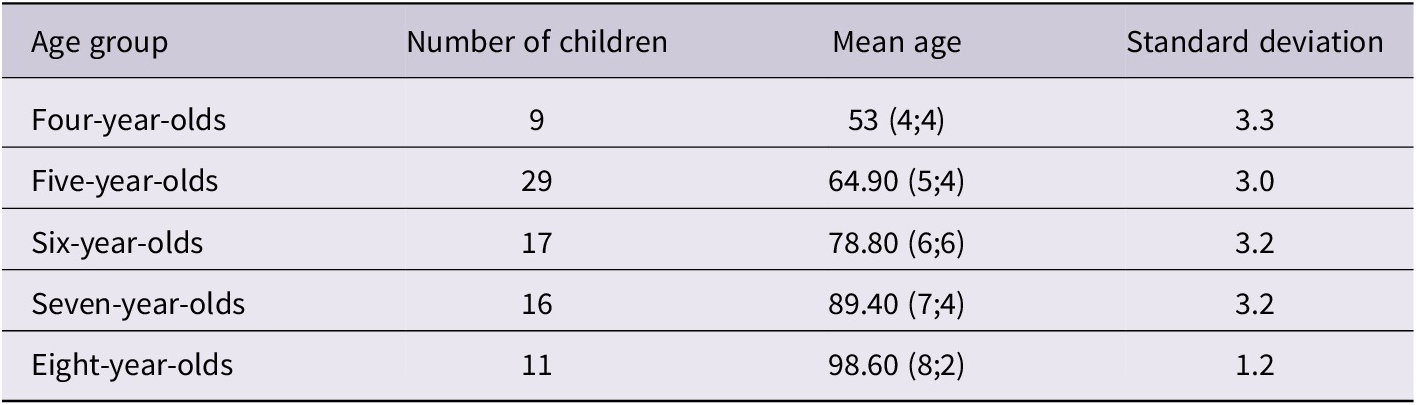
Eighty-two typically developing, monolingual Mexican Spanish-speaking children from Mexico City participated in this study. Ages ranged from four to eight years old (50–101 months), with a mean age of 75.80 months (six years), SD = 14.74 months (Table 2).
Number of participants in each age group

Table 2. Long description
Column one shows the age group, column two shows the number of participants, columns three and four show the mean age and the standard deviation respectively.
Participants included 42 girls and 40 boys.Footnote 2 They were determined to be monolingual by parental questionnaire, using the criterion of whether they used a language other than Spanish, outside of school, for daily communication in the home. All children passed ASHA protocol hearing screenings at 20, 25, and 30 decibels. Only participants whose parents reported no history of language problems for their child were included. A parent or guardian signed an IRB-approved informed consent document before initiating participation in all cases. The reported mean maternal level of education was 15 years, SD = 3.6 (from first grade, with additional years added if the starting age was not uniform).Footnote 3 Research assistants who were native speakers of Mexico City Spanish, the same dialect as the children, interacted with the participants to complete this experimental protocol, which included standardized language and cognitive tests, as well as experimental measures of pragmatics. Eleven of these measures are relevant to this study and provide the empirical basis for our consideration. The children in the study came from private and public elementary schools across different locations within Mexico City, providing us with diversity in socioeconomic status, as indexed by maternal level of education.
5.2. Spontaneous production data and transcription
Following Labov (Reference Labov1981), children were in a video-recorded sociolinguistic interview for at least 20 minutes each, responding spontaneously to questions about different conversation topics, including their favourite cartoons, favourite subjects at school, things they liked doing, and past and future vacation plans. These video recordings were then transcribed in CHAT format, following CHILDES transcription conventions (MacWhitnney, Reference MacWhitnney2000). Four native speakers of Spanish completed four hours of trainings on the conventions of transcribing children’s narratives using CHAT. After several practice sessions, all transcribers achieved an initial reliability of 90% or more agreement on a master transcription. Audio files were transcribed iteratively. After a first pass, 100% of transcriptions were reviewed, and any discrepancies were resolved in conference with other transcribers. In a third pass, all audio and transcriptions were reviewed by an independent transcriber, following Castilla-Earls et al. (Reference Castilla-Earls, Petersen, Spencer and Hammer2015).
5.3. Coding of verbal utterances
Children’s verbal utterances were then independently analyzed by three coders for overt and null subject use, as well as a series of probabilistic constraints, which have been traditionally used in variationist morphosyntactic studies of child and adult Spanish. Coders were normed on sample transcripts; coding agreement was 96%. No verb uttered by the interviewer was included, although the interviewer’s utterances in the transcripts were constantly consulted for clarification when a referring expression uttered by the child could refer to a subject referent uttered by the interviewer’s last verb. All the children’s finite verb instances were collected, though not all of them were included for analysis.
Instances in which a finite verb occurred with any type of overt pronoun, even if it was mandatory in adult language, as well as any null instance that could have occurred with an overt pronoun, but did not, were coded for the analysis. Nevertheless, when a specific verb did not meet the inclusion requirements, it was excluded from our analysis. Following convention (as in, e.g., Otheguy & Zentella, Reference Otheguy and Zentella2012), cases that were excluded from consideration included non-finite verb forms (e.g., infinitives, gerunds, and past participles), existential verbs that usually take place without overt subjects (haber; “there is”), verbs in relative clauses that describe a noun (El señor que acaba de llegar; “The gentleman who has just arrived”), verbs whose subject is a noun clause (El señor que acaba de llegar es mi vecino; “The gentleman who has just arrived is my neighbour”), instances in which it was not possible to know whether there was an overt or null subject (due to interference or problems in the recording); and situations in which a finite verb is located within a set phrase or in fillers (e.g., es que; “it’s just that”). Intercoder reliability was examined for the coding of a subset of the corpus (n = 362 utterances from three different samples). A reliability statistic, Krippendorf’s α showed an alpha value of 0.94, which is considered high reliability (Hayes and Krippendorf, Reference Hayes and Krippendorf2007).
From the 20-minute spontaneous production sample of the 82 children, a total of 15453 utterances were manually coded, including all subject pronoun types. 2040 had to be excluded from the analysis due to the referent of a verb not being recoverable, or a specific verb not fulfilling all the requirements to be included. The mean length of utterance (MLUw) and the number of different words (NDW) were calculated using the program Computerised Language Analysis (CLAN) from the CHILDES Project (MacWhitnney, Reference MacWhitnney2000).
From the 13413 remaining utterances, 3663 were excluded because they contained overt subjects that were not SPPs, such as lexical NPs, demonstratives, question words, leaving 9750 analyzed utterances that contained only null and SPPs.
5.4. Coding of probabilistic constraints
Subject type, either a SPP or a null subject, was the dependent variable in this study. The independent variables included seven categorical variables and 36 values: (1) Person/number of the verb. This variable was coded for verb instances referring to the three singular and three plural grammatical persons. Even if the overall use of a particular grammatical person was relatively small, it was coded and included. (2) Grammatical number. It was coded by grouping verbs between those referring to a plural referent and those referring to a singular one. (3) Discourse reference, this variable had two values: same if the finite verb in question and the finite verb directly preceding it have the same referent, and different if the finite verb in question and the finite verb directly preceding it do not have the same referent. (4) Co-referentiality, the presence of a co-referential object with the subject, was coded to test if it could predict the dependent variable; yes/no were the two possible values. (5) Tense, mood, and aspect included 14 values and reflected the participants’ usage, meaning that even if there might have been just one instance of the use of a particular conjugation among all participants’ production, it was coded and included.
Additionally, we also included grouped categories: (6) Grouped TMA was coded following Shin (Reference Shin2016) with the four most common TMAs: present indicative, preterite indicative, imperfect indicative, and other (the rest of the values were collapsed in an “other” category). (7) Grouped person/number of the verb, just like variable six listed above, but with both 2nd person singular and 2nd person plural collapsed into just one value.Footnote 4
5.5. Linguistic and cognitive non-linguistic abilities
Lexical abilities. To determine each child’s lexical abilities, multiple measures were obtained. Three were from standardized tests: Adivinanzas (“riddles”) and Definiciones (“definitions”) from the Batería de Evaluación de la Lengua Española, BELE, (Rangel Hinojosa et al., Reference Rangel Hinojosa, Romero and Gómez1988) and the Test de Vocabulario en Imágenes Peabody (TVIP – Dunn et al., Reference Dunn, Lugo, Padilla and Dunn1986), the fourth measure, NDW (Miller, Reference Miller and Miller1991), was calculated from an independent spontaneous production story retelling task, using the “Frog, Where Are You?” story (Mayer, Reference Mayer1969).
The first two measures are subset vocabulary sections from the BELE, a battery for measuring child language that was normed in Mexico City and standardized for children aged 3–11 years. The third is the Spanish adaptation of the Peabody Picture Vocabulary Test, a norm-referenced measure of Spanish vocabulary standardized in Mexico and Puerto Rico. The fourth one is the NDW, which is the total number of unique words produced by children, engaged in the Frog Story Retell task, using the Spanish adaptation of the Mercer Mayer storyteller book Frog, Where Are You? in Spanish Rana, ¿dónde estás? (Mayer, Reference Mayer1969). All four lexical measures were highly correlated with one another (Grinstead & Sorine, Reference Grinstead and Sorine2024). It is important to point out that the retelling task used to calculate the NDW was independent of the 20-minute sociolinguistic interview, from which the analysis of null and overt pronouns was extracted.
Morphosyntactic abilities. Four different measures of morphosyntactic abilities were taken. The mean length of utterance measured in words (MLUw) was calculated for each child using the CLAN programs from the CHILDES Project (MacWhitnney, Reference MacWhitnney2000). These data are from the re-telling activity of Rana, ¿dónde estás? The subtests Comprensión (“comprehension”) and Producción Dirigida (“elicited production”) from the BELE battery were also used to measure each child’s morphosyntactic abilities.
Comprensión consists of a picture-verification comprehension task that presents children with three pictures, but only one accurately represents the morphosyntactic structure uttered by the researcher. The three options show practically the same elements, but the correct one differs from the two incorrect ones only by the pictographic details determined by the morphosyntactic feature in question.
Among many different features, the syntactic features tested included: nominal pluralisation with -e, −es; nominal pluralization with present simple indicative verbs, nominal and adjectival gender, verb estar + gerund, preterite and imperfect in the indicative mood, regular and irregular participles, grammatical agent in active and passive constructions, superlatives, negative imperatives, simple-present-subjunctive subordinate-final sentences, direct objects in relative clauses, imperfect tense in relation to preterite embedded in subordinate clauses, and so forth: a total of 43 items that measure 27 morphosyntactic structures. This task requires decoding different types of morphosyntactic structures, and, just like the vocabulary test, TVIP, this is a receptive test, so participants do not have to express their answers verbally but only signal them with their finger.
Producción Dirigida also assesses the same morphosyntactic constructions, but each participant is shown two drawings, and the researcher produces one sentence for each drawing. Each sentence conveys grammatically opposite structures. After the examiner has produced the sentences, the participant is asked to repeat the sentence that corresponds to the drawing of the grammatical structure being analyzed.
Executive function. Participants completed four EF measures, three of which were presented using the standardized PsychoPy-based program EXAMINER (Kramer et al., Reference Kramer, Mungas, Possin, Rankin, Boxer, Rosen and Widmeyer2014). The Flanker Task (Eriksen & Eriksen, Reference Eriksen and Eriksen1974) measures inhibitory control, the Set-shifting Task (Kray & Lindenberger, Reference Kray and Lindenberger2000) measures attention, and the Dot-counting Task (Case et al., Reference Case, Kurland and Goldberg1982) measures auditory WM. An adaptation from the Roman et al. (Reference Roman, Pisoni and Kronenberg2014) visual WM capacity experiment, the “Missing Scan Task,” was created and included alongside the Examiner’s WM subsection. The reason for including different WM tests was that we worked with children as young as four years of age. Though it has been validated with pediatric populations (see Kramer et al., Reference Kramer, Mungas, Possin, Rankin, Boxer, Rosen and Widmeyer2014), Dot-counting did not change its adult version to the one that children are given. Also, it required children to know how to count correctly (which is not necessarily the case with all four-year-olds). Our adaptation of the Roman et.al. task consisted of presenting a series of wooden animal figures to the participant, asking to name them and memorize the set, after a fixed time visually scanning the animal set, they were removed from the participant’s view , and one of the animal figures was removed. Then, the rest were randomly moved from their original place, and the set was presented to the participant again. The participant had to indicate which animal was missing. A summary of cognitive and linguistic measures is provided in Table 3.
Linguistic and non-linguistic cognitive measures

Table 3. Long description
There are three main categories listed: tools to measure lexical abilities, morphosyntactic abilities, and Executive Function.
6. Results
6.1. Descriptive statistics
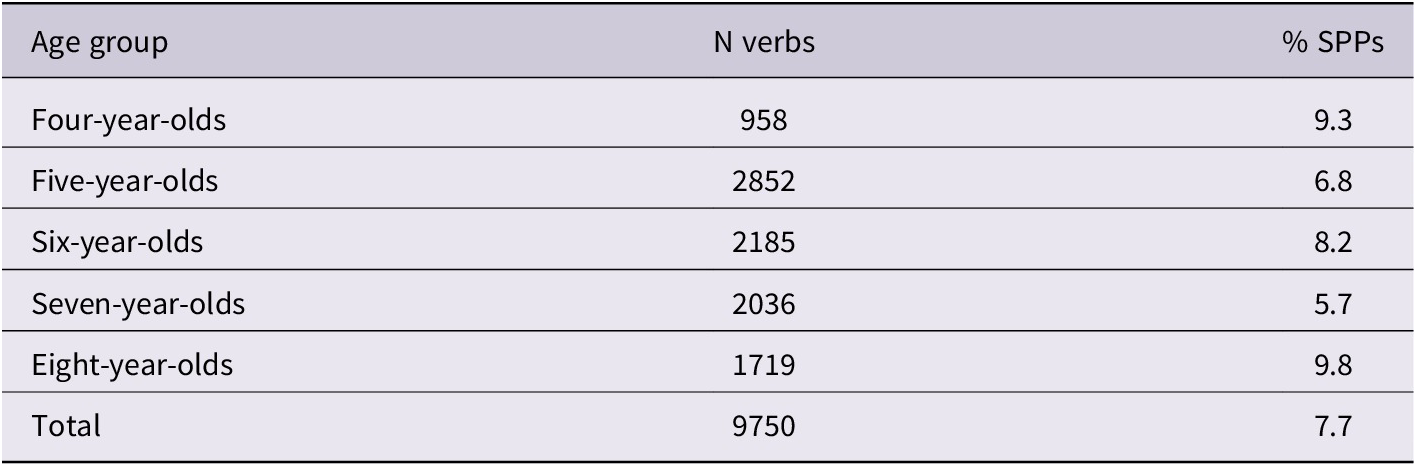
We analyzed 9750 utterances containing only null pronouns and SPPs. In the following two tables, for clarity, we include both age-specific results and a composite across all ages. Table 4 shows SPP rates and lists the number of overt pronouns from all the contexts where an expressed SPP was possible.
Subject personal pronoun rates

Table 4. Long description
Column one shows the age group, column two shows the number of verbs analyzed, and column three indicates the percentage of those verbs that were accompanied by an overt subject personal pronoun.
As can be seen, the SPP rates showed that, in general, children produced relatively few subject pronouns. The total SPP rate was 7.7%. To know what linguistic factors can constrain children’s pronoun usage, five of them listed in Table 5 were analyzed. For the sake of clarity, we included the factor “grouped TMA” rather than all TMA conjugations, since there were many instances of 0% SPP use. Similarly, “grouped person/number” was not included (see Section 5.4).
Observed SPP percentage by conditioning factors

Table 5. Long description
Column one shows each predictor in bold, and the non-bolded values represent the different levels. The remaining columns on the right show the different age groups and all ages. Each age group has the number of verbs on the left and the percentage of those verbs expressed with a personal subject pronoun on the right.
N = Total Number of tokens per context (null pronouns + SPP).
Table 5 shows the total number of tokens within each context (null pronouns + SPP) in the “N” columns. The percentage of overt SPPs per context appears under the columns named “%SPP.” For instance, in the rightmost column showing all ages combined, we see that children produced a total of 2475 first-person singular (1SG) verbs, 14% of which were used with the SPP yo “I.”
In the current data, the pronoun expression rate in Table 5 indicates that children expressed the 1SG pronoun yo “I” at a high rate (14%) and the plural pronouns nosotros “we” and ustedes “you all” at low rates (3% and 0%, respectively). Likewise, children, in general, favoured using a singular SPP (yo, tú, ella, etc; 9%) over a plural (ustedes, ellas, nosotros; 3%).
Regarding the discourse referent, the rightmost column shows that switch-reference contexts favoured the expression of an SPP (10%) compared with same-reference contexts (5%). Although not the verb form most frequently produced by children, the imperfect indicative was the TMA that favoured the presence of SPP (12%). On the contrary, “others” (the 11 other TMAs) was the least frequent TMA to co-occur with SPP (5%). Finally, regarding the verbs in which the object pronoun was co-referential with the subject, (e.g., Yo me bañé “I bathed [myself]”), the percentage was lower (5%) than in non-coreferential objects (8%).
Following Shin (Reference Shin2016), we consider that although descriptive per cent rates are useful for observing trends in SPP expression, they do not accurately capture the mechanisms underlying these trends. Several factors may simultaneously influence the expression of an SPP. To sort out this multifactorial phenomenon, in the next section, we present mixed-effects logistic regressions that measure each predictor variable.
6.2. Inferential statistics
Logistic regression for probabilistic constraints. The statistical analyses presented below are modelled on those given in Shin (Reference Shin2016). Using a chi-square test, a significant difference in SPP expression was found among the five age groups of participants [X 2(4, N = 9750) = 29.10, p < .01]. Nevertheless, the SPP rate did not correlate with age as a categorical variable or with age calculated in months.
To explore both the role of linguistic constraints and the extent to which age might interact with them on SPP expression, we first fitted an omnibus mixed-effects logistic regression model that included all linguistic constraints and age group as predictor variables using the lme4 package in R (Bates et al., Reference Bates, Mächler, Bolker and Walker2015). Those constraints were: grouped person/number, grammatical number, reference, grouped TMA, and co-referentiality. It is important to point out that the inclusion of the “grouped” categories was intended to prevent the model from failing to converge due to sparse cells in our tables. “Sparse tables occur when the sample size n is large but so is the number of cells. Sparseness is common in tables with many variables” (Agresti, Reference Agresti2002, p. 392). Thus, by following conventions regarding the problem of having categorical independent variables with sparse cells, only the “grouped” variables were used in the inferential analyses (See Section 5.4).
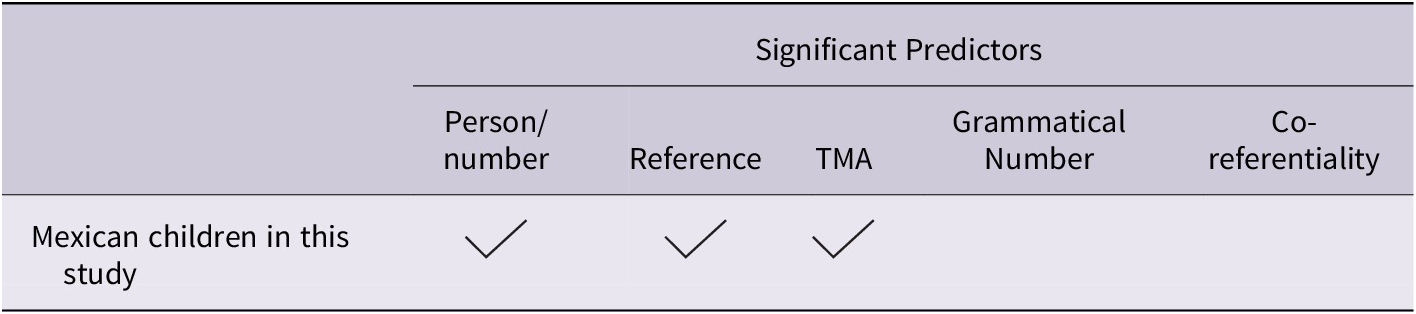
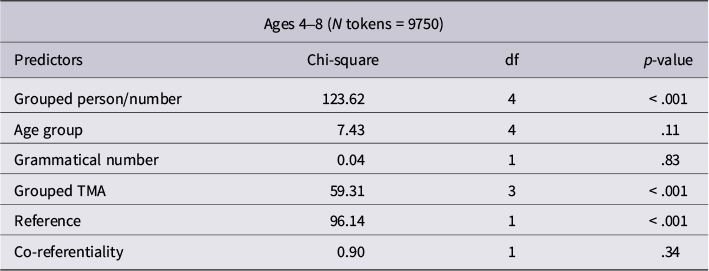
Due to the large size of this omnibus model, we used the bobyqa optimiser (Powell, Reference Powell2009) to increase the number of iterations. After fitting the omnibus model, we assessed the significance of categorical predictors using the CAR package’s Anova function in R (Fox & Weisberg, Reference Fox and Weisberg2019), which calculated chi-square coefficients and reported statistical significance. Table 6 shows that grouped person/number significantly predicted subject pronoun expression (χ 2(4) = 123.62, p < .001; henceforth referred to simply as person/number), as did reference (χ 2(1) = 96.14, p < .001), and grouped TMA (χ 2(3) = 59.31, p < .001; henceforth TMA). On the other hand, age group, grammatical number, and co-referentiality did not significantly predict SPP expression (see Table A1).
Significant predictors of subject pronoun expression, children in Mexico

Table 6. Long description
The table shows that only the predictors in columns 1-3 are significant.
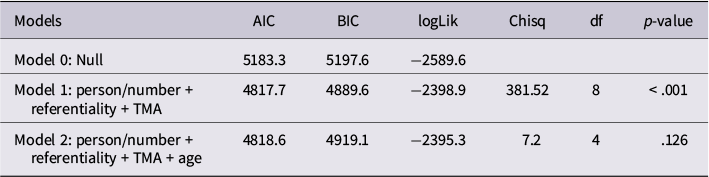
Although age did not significantly predict SPP expression in the chi-square analysis, in order to assess the convenience of dividing the data into the five age groups of participants, we used likelihood ratio tests and the Akaike Information Criterion (AIC) to compare models. We compared the previous model (henceforth referred to as Model 1), which included Person/Number, Reference, and TMA as fixed effects (npar = 10; AIC = 4817.7; logLik = −2398.9), to a model that added age group as a main effect (henceforth referred to as Model 2; npar = 14; AIC = 4818.6; logLik = −2395.3). Model 1 showed a good fit (χ 2(3) = 56.25, p < .001; AIC = 4817.7); adding age group did not significantly improve model fit (χ 2(4) = 7.20, p = .126; AIC = 4818.6) and resulted in a higher, and therefore less favoured, AIC value (+0.9).
Additionally, to directly assess whether age moderates the effects of the linguistic constraints, we fitted an omnibus model to test all two-way interactions between age and the linguistic constraints (henceforth, Model 3) and compared it with Model 1. Model 3 included the parameters for each main effect minus the reference (e.g., TMA has four levels, minus one as the reference = three parameters), three interactions (e.g., reference × age group = four parameters), the intercept, and the random intercept, for a total of 46 parameters (npar = 46; AIC = 4821.6; logLik = −2364.8).
Although a likelihood ratio test comparing the models demonstrated that Model 3 accounts for a greater proportion of variance (χ 2(36) = 68.11, p < .001), its elevated AIC value (4821.6 compared to 4817.7) indicates that this enhancement is not justified by the inclusion of the 36 additional parameters (Model 1 npar = 10).Footnote 5 Therefore, in our sample, no systematic evidence was found of age moderating the associations between linguistic constraints and SPP expression, and the more parsimonious model without age was preferred (see Table A2). Consequently, for inferential statistics, it was more appropriate not to divide our sample into age groups; hence, the analyses presented below are collapsed across all ages.Footnote 6
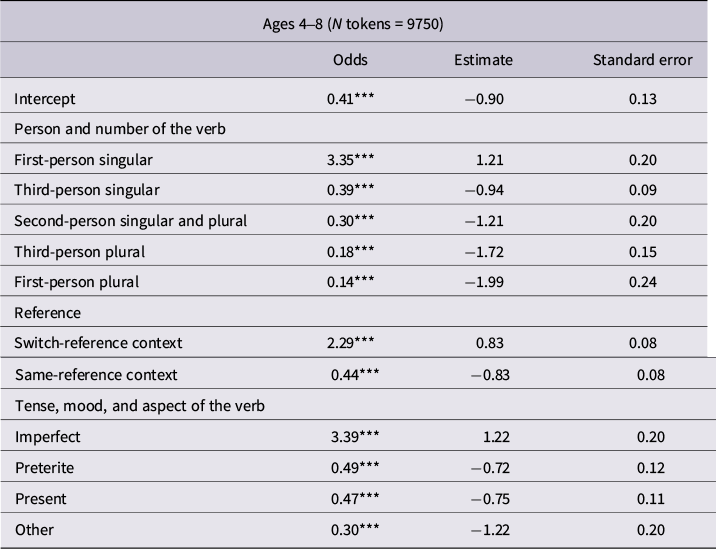
Following Shin (Reference Shin2016), the logistic regression included here operates baseline-treatment contrasts, which require a one-level predictor to be chosen as the baseline or reference level. The reference levels selected were set to the categories with the highest rates of SPP expression: Person/number – 1st person singular; Reference – different referent; TMA – imperfect (see Table 5). The intercept thus represents the expected log-odds of SPP when all predictors are at these baseline levels. To obtain comparisons across all levels, we performed a re-levelling step, setting the reference levels to the categories with the lowest SPP rates: Person/number – 2nd person singular and plural; Reference – same referent; TMA – others. This allows us to report odds ratios for all pairwise comparisons.
Figure 1 shows odds ratios that indicate the likelihood of an SPP occurring in a specific context compared with the null pronoun. The figure shows the significant factors along the x-axis. On the y-axis, odds ratios are displayed. Shin (Reference Shin2016) used odds ratios – an approach which we adopt here. When the odds ratios are above 1.0, it indicates that a constraint favours SPP expression; values below 1.0 indicate that a constraint favours pronoun omission, and a blue horizontal line in Figure 1 indicates that threshold.Footnote 7
Significant constraints on Spanish subject pronoun expression of Mexican children. Note. The blue line represents the 1.0 odds ratio threshold.

Figure 1 Long description
The X-axis lists the significant predictors’ levels. The Y-axis shows the odds ratio numbers. TMA imperfect, Person first-person singular, and Reference different, favored the subject pronoun expression.
For instance, the odds ratio for Imperfect is 3.39, meaning that the odds of a pronoun occurring with a verb in the imperfect tense were 3.39 times greater than the odds of occurring in the baseline condition. The farther the odds ratio was from 1.0, either up or down, the more intense the effect. Consequently, the 1st person plural had a .14 odds ratio, meaning that it disfavoured SPP expression; in other words, the odds for an SPP to be expressed with 1st person plural were .14 times less than the odds of happening in the baseline condition (see Table A3 for the complete regression matrix). Figure 1 suggests that the 1st person singular and the imperfect tense were significantly associated with pronoun expression among all participants. Reference was an important third factor promoting overt SPPs. Alternatively, 1st person plural and 3rd person plural, and TMA other were the values that most highly promoted SPP omission (a null pronoun).
Correlations for developmental variables. To answer our second research question about calculating the relationship of linguistic and non-linguistic cognitive variables to children’s rates of third-person singular in switch-reference contexts, it was necessary to calculate mean values for these constraints. It was not possible to measure these relationships per utterance, as in our just-concluded mixed-effects model, because measures of a child’s individual inhibition, auditory WM, morphosyntactic ability, and other individual characteristics did not vary from one utterance to another. Therefore, had we included these values in a mixed-effects model, we would be vastly underestimating the standard error associated with the non-SPP variables. Instead, to preserve the very important statistical assumption of independence of measurement, we calculated mean rates of SPP occurrence in three main constraint-influenced contexts: SPPs expressed in third-person singular, SPPs in switch-reference contexts, and third-person singular SPPs embedded in switch-reference contexts. Once these rates were calculated, they were entered into a Pearson product–moment correlation.
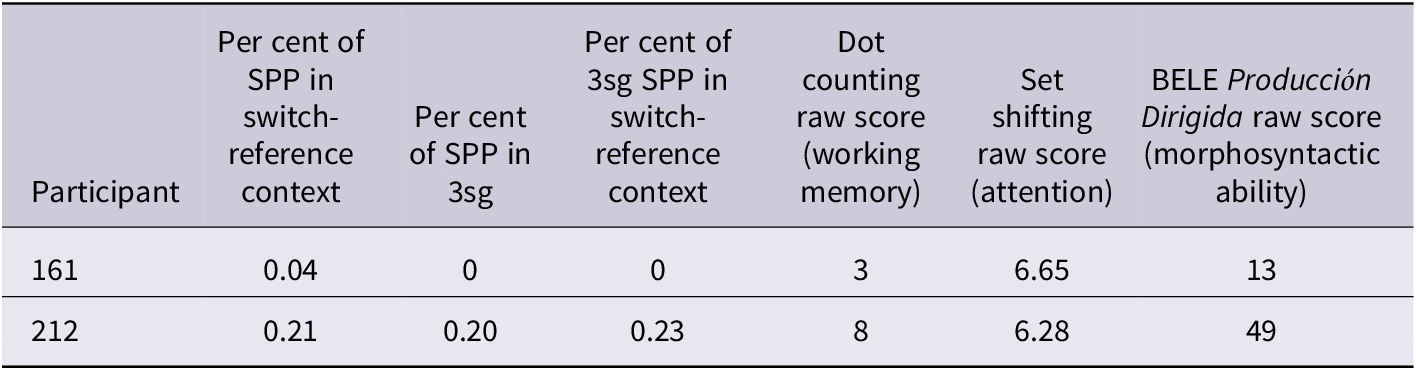
Considering those three probabilistic constraints for SPP occurrence, we calculated percentages per participant of overt subject pronoun expression (the null vs the overt SPPs was possible within those probabilistic constraints). Table 7 shows the data from two participants and the three probabilistic constraints.
Sample calculations of SPP percentage per probabilistic constraint per participant

Table 7. Long description
The first column shows the participant number. Column two shows Instances of switch-reference context; columns 3-4 show the number of times each instance was a null pronoun and an overt subject personal pronoun, respectively. Column 5 shows the percent of SPP in switch-reference contexts per participant. The same situation is seen in columns 6 and 10. The former shows the information about the percent of SPPs in third-person singular, while the latter shows it about the percent of third-person SPPs in switch-reference contexts.
To give a concrete example of how individual children’s data was computed in this correlational analysis, we provide two examples, which are illustrated in Tables 7 and 8. From the spontaneous production of participant 161, 48 utterances represented a change of the verb’s referent (switch-referent), two of which were expressed by an overt SPP, and in 46, the pronoun was not expressed (a null pronoun), which in turn meant that the participant had an SPP expression rate of 4.2% in switch-referent contexts. Similarly, participant 212 produced 59 utterances of third-person singular SPPs in switch-reference contexts, 45 of which had a null pronoun and 14 had an overt third-person singular SPP, meaning that Participant 212’s third-person singular SPP in switch-reference contexts is 23.7%.
Example of data used to feed the Pearson correlation

Table 8. Long description
The first column shows the participant number. Columns 2-6 show the percentages and scores used for each predictor.
We then entered these percentages into a Pearson product–moment correlation with the independently measured variables for lexicon, morphosyntax, and EF. Table 8 shows an excerpt of the information used to feed the Pearson correlation. The leftmost column shows the different individuals’ ID numbers, while the subsequent columns to the right include the scores that each participant obtained.
The three constraint-influenced SPP percentages were analyzed for correlations with the 11 linguistic and non-linguistic cognitive abilities (see Table 3), plus one variable for maternal level of education and one variable for age of the participants.Footnote 8 These were entered into a Pearson-moment correlation. Across the board, we categorically applied Tukey’s Hinges analysis to each of the three constraint-influenced SPPs separately. We excluded any participant with data 1.5x outside the interquartile range, which means no outlier was included in the correlation analysis. For this reason, the constraint-influenced SPPs vary in their n number. Next, Table 9 shows the significant correlations found.
Significant correlations. Pearson-moment correlation

Table 9. Long description
Column 1 shows the Linguistic and non-linguistic cognitive abilities. Column 2 shows the coefficient of the predictor and SPPs in the third-person singular. Columns 3 and 4 do the same with SPPs in switch-reference contexts, and Third-person singular SPPs in switch-reference contexts accordingly.
*p < .05, **p < .01, ***p < .001
Table 9 indicates that two of the three contexts for SPP expression correlated with linguistic abilities, and one correlated with cognitive non-linguistic abilities. The category of third-person singular SPP (él, ella) was predicted by children’s morphosyntax, lexicon, attention and WM. Overall, SPPs in switch-reference contexts (when two or more consecutive verbs have a different referent) did not significantly correlate with any variable. Finally, SPPs in third-person singulars embedded in switch-reference contexts correlated with two morphosyntactic measures, two lexical measures, and the age of the participants. No EF abilities correlated with this specific SPP-influenced context.Footnote 9
The correlation results indicate that an array of cognitive and linguistic variables correlated not only with overt subject use but also with one another, suggesting covariance. Why might this be? Three of the linguistic abilities used to measure morphosyntax required a certain level of attention to what has been said. These variables might capture overlapping variance. For example, in the case of SPPs in the third-person singular, the correlated measure of lexicon, Adivinanzas, also significantly correlated with the measure of morphosyntax, r(79) = .494, p < .001; attention, r(79) = .354, p < .001; and WM r(79) = .384, p < .001. In the case of third-person singular SPPs embedded in switch-reference contexts, both lexicon-correlated measures correlated, in turn, with the morphosyntactic measures; Adivinanzas significantly correlated with both Comprensión r(80) = .499, p < .001, and Producción Dirigida r(80) = .626, p < .001. The NDW independent measure of lexicon also correlated with both Comprensión r(80) = .410, p < .001; and Producción Dirigida r(80) = .491, p < .001. Likewise, the fact that age in months correlated with a single SPPs category might also indicate shared variance. For these reasons, multiple linear regressions were carried out to obtain the model containing the best predictor variables, ruling out covariance, and also to see the influence of the associations found.
For third-person singular SPPs, we analyzed seven possible models, including the null model. First, we explored a model that included only WM, since that is the ability Lapidus Shin and Cairns (Reference Lapidus Shin and Cairns2012) hypothesized might play a role in SPP expression. Then, we moved to the correlated variable with the highest coefficient, morphosyntax, and then added the remaining abilities to each model.
Based on the lowest AIC, Table 10 shows that model two, containing only the morphosyntactic variable, best explained the influence of the independent variables on the expression of SPPs in the third-person singular, indicating a better fit of the model to the data.Footnote 10
Regression on SPPs in the third-person singular. Coefficient (standard error) standardized coefficient

Table 10. Long description
Column one lists the predictors, as well as the constant and the AIC. While the rest of the columns show the different models
AIC: Akaike’s information criterion. *p < .05, **p < .01, ***p < .001.
The morphosyntax ability from model two explained 7.4% of the variance of the SPPs in the third-person singular (R 2 = .074). Although small, for each one-point increase in the morphosyntactic ability, it corresponded .2% increase in the expression of third-person singular pronouns (B = .002).
Moving on to the third-person singular SPPs in switch-reference contexts, we analyzed seven possible models, including the null model. To control for the influence of age, the participants’ age in months was added as a covariate. To create the models, we started with the highest correlation coefficient, morphosyntax measured by BELE comprensión, then we included the lexical measure with the highest correlation coefficient, and we added the rest of the variables iteratively.
Based on the lowest AIC with significant coefficients, Table 11 shows that model one, containing the morphosyntactic variable only, best explained the influence of the independent variables over the expression of third-person singular SPPs in switch-reference contexts, indicating a better fit of the model to the data.Footnote 11
Regression on third-person singular SPPs in switch-reference contexts. Coefficient (standard error) standardized coefficient

Table 11. Long description
Column one lists the predictors, as well as the constant and the AIC. While the rest of the columns show the different models
AIC: Akaike’s information criterion. *p < .05, **p < .01, ***p < .001.
The morphosyntax ability from model one explained 12.9% of the variance of the SPPs in the third-person singular (R 2 = .129). Although small, for each one-point increase in the morphosyntactic ability, it corresponded to a .5% increase in the expression of 3rd person singular pronouns in switch-reference contexts (B = .005).
7. Discussion
7.1. Variationist probabilistic constraints in child Spanish
Turning to our first research question about evidence of the probabilistic morphosyntactic constraints on overt SPPs from sociolinguistic interviews with monolingual Spanish-speaking children, we see that, yes, we were able to replicate the findings of previous research on overt pronouns in child language (Shin, Reference Shin2016; Shin & Erker, Reference Shin and Erker2015). Specifically, we found that person-number; tense-mood-aspect; and reference were significant predictors of overt subject pronoun expression. This was also found in Dickinson et al. (Reference Dickinson, Ortiz-Ramírez, Arrieta-Zamudio, Grinstead and Flores-Avalos2020), who also worked with Spanish-speaking Mexican children diagnosed with DLD.
The total SPP rate was 7.7%, which is a percentage rate far lower than what has been found in adult language studies about SPP expression: 24% (Flores-Ferrán, Reference Flores-Ferrán2007), 33% (Silva-Corvalán, Reference Silva-Corvalán1994), but it is consistent with the 8% usage by the six- to eight-year-olds in Shin (Reference Shin2016) and the 9% of the same age group in Shin and Erker (Reference Shin and Erker2015), though it is numerically a bit higher than the 6.3% in a Lapidus Shin and Cairns (Reference Lapidus Shin and Cairns2012) with similar ages, but many more participants.
When comparing the results of our child participants from Mexico City to the pronoun rate reported for adults in Mexico City by Lastra and Butragueño (Reference Lastra, Butragueño, Carvalho, Orozco and Shin2015), a chi-square analysis shows a notable significant difference [X 2 (1, N = 11790) = 287.74, p < .01], which is consistent with previous research showing children’s small percentage rates of SPP expression in comparison to that of adults, and the overall well-documented tendency of child Spanish-speakers to use fewer overt subjects of all types than do adults (e.g., Grinstead, Reference Grinstead1998, Reference Grinstead2004). Nevertheless, in contrast to Shin (Reference Shin2016), the SPP rate calculated for each child did not correlate with age [r = .017, p = .878]. Thus, we cannot conclude that the pronoun rate in our sample increased with age. One possible reason for this is the age range differences. While we sought to replicate the previous findings of Shin (Reference Shin2016), our participants were younger (four to eight years old), whereas Shin’s were older (6–16 years old), which gives the latter age group a greater chance of differing in their SPP expression rate.
We found that specific values of these variables were individually predictive, as well. To be exact, Shin (Reference Shin2016), but not Shin and Erker (Reference Shin and Erker2015), found that TMA was significantly predictive, though Shin and Erker found that within TMA, the imperative and the imperfect together were predictive. In our results, the TMA category was significant, as were each of its values (imperfect, present, others, and preterite). This is similar to what Shin (Reference Shin2016) found. In this sense, there now exists independently demonstrated replication of evidence showing that even four-year-old Mexican Spanish-speaking children follow the great majority of adult Spanish speakers’ constraints on overt subject pronoun use.Footnote 12
In addition, switch-reference contexts favour the expression of an SPP with the children in our sample, as has been observed in adults (Lapidus Shin & Cairns, Reference Lapidus Shin and Cairns2012; Shin, Reference Shin2016). Nevertheless, in contrast to what Lapidus Shin and Cairns (Reference Lapidus Shin and Cairns2012) found, six- and seven-year-old children in our sample (and even four- and five-year-olds) preferred overt pronouns in switch-reference contexts. This might be because Lapidus Shin and Cairns used an act-out judgment experimental approach, which may have imposed a greater burden on EF, whereas the participants in the current study completed unstructured sociolinguistic interviews, which may have imposed less of a burden on executive function.
7.2. Subject personal pronoun expression, EF, and linguistic abilities
To address our second research question regarding evidence of linguistic or non-linguistic cognitive factors significantly related to the use of third-person singular pronouns in switch-reference contexts, we divided our dependent variables of interest into three categories: SPPs in the third-person singular, SPPs in switch-reference contexts, and third-person SPPs embedded in switch-reference contexts. We chose these categories because they cover the contexts in which Lapidus Shin and Cairns (Reference Lapidus Shin and Cairns2012) found that six- and seven-year-old children had difficulty expressing SPPs. Additionally, exploring third-person singular pronouns separately allows us to add novel information to better understand the known difficulty of third-person singulars for children in null-subject languages, where these pronouns are very challenging and scarcely produced by children under six (Lapidus Shin & Cairns, Reference Lapidus Shin and Cairns2012; Bel, Reference Bel2003, 16–17; Serratrice, Reference Serratrice2005, 454).
Shin and Cairns’ conjecture that children’s immature WM was responsible for their failure to use third-person SPPs in switch-reference contexts is not confirmed in our data, inasmuch as our measures of auditory WM and attention were not correlated with children’s productions of this very specific type of overt subject (see Table 9). However, children’s productions of all third-person SPPs taken together (not just in switch-reference contexts) were significantly correlated with both auditory WM and attention, suggesting that their intuition was perhaps on the right track.Footnote 13 This broader category of third-person SPPs also correlated with a lexical and a morphosyntactic measure, in addition to the two EF variables, showing that the cognitive processing of third-person SPPs recruits resources from multiple domains, including domain-specific language abilities.
For the specific category of third-person SPPs in switch-reference contexts that Shin and Cairns were most concerned with, in fact, the correlation was strictly with language-internal variables (two lexical measures and two morphosyntactic measures), and not with EF variables.
Given the findings of our multiple regressions, in which EF variables cease to account for unique variance, the firmest conclusion from this study, vis-à-vis linguistic and cognitive non-linguistic predictors of overt subjects, is that the language-internal variable of morphosyntax plays the most decisive role in the development of Spanish-speaking children’s use of SPPs, both overall third-person SPPs and third-person SPPs embedded in switch-reference contexts, at least.
Why should there be such a connection, theoretically? It could be that as the utterances and referents produced by children become more complex; they are also more able to refer to them using third-person singular pronouns. Children might stop referring to themselves only and would use more complex structures to refer to other entities, which, in turn, can be expressed using él, ella, and ello (“he,” “she,” “it”).
This is immediately interesting because, in younger, two- to three-year-old children, the opposite pattern, of moving from mostly 3rd person singular verb forms to more 1st person singular verb forms, has been widely noted (Davidson & Goldrick, Reference Davidson, Goldrick, Montrul and Ordóñez2003; Grinstead, Reference Grinstead1998; Hernández-Pina, Reference Hernández-Pina1984, inter alia). This behaviour of referring to entities outside the child, in third-person singular, would seem consistent with emerging from an egocentric view of things, at least at the level of the current phenomena (c.f. Lapidus Shin & Cairns, Reference Lapidus Shin and Cairns2012).
7.3. Morphosyntax, SPPs, and other considerations
At this point, one question that arises from the results showing that morphosyntax is the ability that accounts for unique variance is: why morphosyntax? To answer this question, it is essential to clarify how morphosyntax was measured. As mentioned, we measured morphosyntax using the BELE’s subtest, Comprensión. Footnote 14 This subtest is an adaptation of the procedure used in Fraser et al. (Reference Fraser, Bellugi and Brown1963), in which children were shown to understand different types of syntactic structures through tasks such as the act-out task.
It can be hypothesized that the role of higher morphosyntactic abilities in the expression of third-person SPPs in switch-reference contexts is driven by a general tendency of high grammatical complexity and vocabulary growth, which permits the expression of overt subjects, disregarding the pragmatic context. This is supported by findings that morphosyntax and lexicon correlate with the expression of SPPs in same-referent contexts (r = .232, p < .05; r = .256, p < .05, respectively; see endnote 9). In adults, overt SPPs in these same-reference contexts are known for conveying redundancy; the SPP is expressed even though the previous referent is the exact same one. Furthermore, Lapidus Shin and Cairns (Reference Lapidus Shin and Cairns2012) have observed that children exhibit a high tolerance for this redundancy well into adolescence, when their behaviour becomes adult-like. This has been observed in other languages as well, including Italian, and in bilingual children (Sorace et al., Reference Sorace, Serratrice, Filiaci and Baldo2009). Thus, since morphosyntax abilities correlate with SPPs in same-reference contexts (promoting redundancy), as well as with third-person SPPs in switch-reference contexts (promoting no ambiguity), it may be the case that as children produce more complex morphosyntactic and discursive utterances, they permit overt SPPs in general before the expression of these SPPs is mainly regulated by discourse pragmatics.
The current understanding of the predictive relationship between BELE Comprensión and third-person singular SPPs embedded in switch-reference contexts leaves more room for future investigations. Nonetheless, it underscores the significance of language-internal competencies in the processes of SPP expression. Studies such as Mazzaggio (Reference Mazzaggio2016) with typically developing Italian-speaking children have also found that the use of first- and second-person singular pronouns correlate with grammatical abilities.
At this point, it is important to reiterate that the main goals of this investigation were: (1) to replicate the experimental approach of Shin (Reference Shin2016) to identify the most prevalent linguistic constraints of SPPs, and (2) to explore the role of linguistic abilities and EF in the expression of third-person singular SPP in switch-reference contexts, based on the hypothesis of Lapidus Shin and Cairns (Reference Lapidus Shin and Cairns2012) that WM plays a role. For this second goal, we were only interested in morphosyntax, lexicon, attention, inhibition, and WM; nevertheless, there is a range of other cognitive factors that are out of the scope of this investigation that possibly play an important role, especially those related to Theory of Mind (ToM), since it has been shown that factors like pragmatic informativeness features matter for pronoun expression (Serratrice, Reference Serratrice2005). Likewise, studies such as Mazzaggio (Reference Mazzaggio2016) have found ToM to correlate with the appropriate use of the 2nd-person singular pronoun (but not the 1st-person singular). Additionally, studies comparing non-typically developing children, such as those with autism spectrum disorder and attention-deficit/hyperactivity disorder, to typically developing children have identified both perspective-taking abilities and inhibition abilities (but not WM) to be associated with performance on object pronoun interpretation (Kuijper et al., Reference Kuijper, Hartman and Hendriks2021). Furthermore, the present study would benefit from the inclusion of adult data performing the same tasks to enable direct comparative analysis.
8. Conclusion
This study examined two main questions. The first one explored whether previous findings of Spanish-speaking SPP expression are corroborated by 82 typically developing monolingual Mexican Spanish-speaking children from Mexico City. The results show that the finding of a significant role played by three linguistic constraints was corroborated (person and number of the verb, reference, and tense, mood, and aspect). Regarding the second question about cognitive and linguistic abilities playing a role in the constraints on SPP expression, correlations with attention and auditory WM were found, but only a language-internal ability, morphosyntax, positively predicted the expression of both third-person singular pronouns in general, and third-person singular pronouns embedded in switch-reference contexts. This underscores the significance of internal linguistic faculties on pronoun expression.
Acknowledgements
Agradecemos a las niñas, niños, madres, padres, trabajadores y a las directoras de los colegios Watson & Crick, A Favor del Niño, y Jardín de Niños BabyTec por su inmensa ayuda y disposición sin las cuales este proyecto no habría sido posible. We are thankful to Kendra Dickinson, Amy Pratt, Naomi Shin, and David Melamed for their guidance and feedback. Additionally, we are grateful to the Ohio State University Language Acquisition Lab: Jhovana Elizabeth Sandoval Estrada, Alejandro López Ramos, Debi Gómez, and Mary Carmen Gasca for their help in carrying out the protocol. The first author also acknowledges the support of the Consejo Nacional de Humanidades, Ciencias y Tecnologías (CONAHCyT) during his doctoral studies.
Funding statement
The author(s) disclosed receipt of the following financial support for the research, authorship, and/or publication of this article:
This project was funded by a grant from the National Science Foundation (NSF-1551903).
This project was funded by the NSF Doctoral Dissertation Research Improvement Grant (DDRI Linguistics 2416395)
Competing interests
The authors declare none.
Disclosure of use of AI tools
No AI tool was used in this manuscript.
APPENDIX
Significance of categorical predictors of subject personal pronoun expression in Mexican children. Wald chi-square test

Table A1. Long description
Column one lists the predictors, column 2 shows the Chi-square number, column 3 shows the degrees of freedom, and column 4 shows the corresponding p-value.
Model comparison of mixed-effects binary logistic regressions. Significant linguistic predictors of SPP expression and age

Table A2. Long description
Column one shows the different models, column two indicates the AIC, column three indicates the BIC, column four indicates the logLik, column five shows the Chi-square number, column six indicates the degrees of freedom, and column seven indicates the p-value.
Note: Chi-square values represent improvement from previous model.
Mixed-effects binary logistic regression, subject pronoun expression, Mexican children

Table A3. Long description
Column one lists the predictors and their levels, column two shows the odds ratio, column three shows the estimate, and column four indicates the standard error.
Notes: The first reference levels were: person/number = 1st person singular, reference = different referent, TMA = imperfect; after a re-levelling to obtain all pairwise comparisons: person/number = 2nd person singular and plural, reference = same referent, TMA = others. Random factor included: participant. *p < .05, **p < .01, ***p < .001.








 Open access

