





1. Introduction
Negation is a fundamental component of human cognition, with its linguistic markers found universally across languages (Heine & Kuteva, Reference Heine and Kuteva2007; Horn, Reference Horn1989). Despite its ubiquitous presence in human language, negation is an inherently abstract concept (Horn & Wansing, Reference Horn, Wansing, Zalta and Nodelman2020; Kaup et al., Reference Kaup, Zwaan, Lüdtke, Franz and Perfetti2007), and linguistic negative markers are among the “hard words” for children to acquire (Gleitman et al., Reference Gleitman, Cassidy, Nappa, Papafragou and Trueswell2005), because they are not tied to any consistently observable referents in the environment but simply serve to modify the meaning of the contents they combine with (McDermott-Hinman & Feiman, Reference McDermott-Hinman, Feiman, Blanchette and Lukyanenko2025).
Even after children acquire the meaning of the “hard” negative words in their language, this knowledge alone is not sufficient for interpreting all negative expressions they encounter, as successful interpretation also requires understanding the semantics of the elements being negated. Consider the contrast between The ruler is not bent and The boy is not tall. These two negative expressions appear similar, as the elements being negated (e.g., bent, tall) are both adjectives that denote gradable properties (e.g., an object can be slightly bent, moderately bent, or very bent). However, these two adjectives interact with negation in different ways (Alexandropoulou & Gotzner, Reference Alexandropoulou and Gotzner2024a, Reference Alexandropoulou and Gotzner2024b; Gotzner & Mazzarella, Reference Gotzner and Mazzarella2024; Kennedy, Reference Kennedy2007; Kennedy & McNally, Reference Kennedy and McNally2005; Rotstein & Winter, Reference Rotstein and Winter2004). Specifically, if a ruler is not bent, it must be straight. In this case, the negation of bent is semantically equivalent to its antonym straight. In contrast, The boy is not tall is not equivalent to The boy is short, because it is also possible that the boy is neither tall nor short but somewhere in between.
This difference in interpretation arises from the inherent semantic properties of the elements within the scope of the negative operator, that is, gradable adjectives (GAs hereafter; Kennedy, Reference Kennedy2007). Bent is an absolute gradable adjective (AGA hereafter), which forms a contradictory relation with its antonym straight. Members of a contradictory pair divide the relevant dimension exhaustively: one must be true and the other false. Accordingly, the negation of bent semantically entails its antonym straight. Tall, by contrast, is a relative gradable adjective (RGA hereafter), which stands in a contrary relation with its antonym short. Two contraries do not exhaust their domain: although they cannot be simultaneously true, they can both be false (Horn & Wansing, Reference Horn, Wansing, Zalta and Nodelman2020). As a result, the negation of tall does not necessarily entail short. If children have not acquired the semantic distinction between these two types of GAs, they might encounter difficulty in interpreting their negated forms.
Interestingly, in daily communication, The boy is not tall is often pragmatically strengthened to convey the meaning that The boy is rather short. The hearer might reason that the less direct expression not tall is opted for by the speaker to avoid asserting the socially undesirable property short, as a polite strategy to respect others’ faces (Brown & Levinson, Reference Brown and Levinson1987; Horn, Reference Horn1989). These interesting contrasts in the interpretation of not bent and not tall demonstrate that understanding such negative expressions is also likely to require pragmatic reasoning, in addition to considering the semantic properties of the elements being negated as well as their potential interactions with negation.
Previous research on children’s acquisition of negation has primarily focused on their understanding of sentences like This is not a flower or It’s not in the bucket, where the negative marker operates on concrete objects or locations that are perceptually accessible in the context (e.g., Austin et al., Reference Austin, Theakston, Lieven and Tomasello2014; de Villiers & Tager Flusberg, Reference de Villiers and Tager Flusberg1975; Doyle et al., Reference Doyle, Friesen, Reimer and Pexman2019; Feiman et al., Reference Feiman, Mody, Sanborn and Carey2017; Kim, Reference Kim1985; Nordmeyer & Frank, Reference Nordmeyer and Frank2014, Reference Nordmeyer and Frank2018; Pea, Reference Pea1978; Reuter et al., Reference Reuter, Feiman and Snedeker2018; Szabó & Kovács, Reference Szabó and Kovács2025). However, relatively little is known about how children interpret negative expressions like The boy is not tall or The ruler is not bent, where the elements being negated denote more abstract properties. We believe that these expressions are particularly revealing for theories of child language acquisition because children’s interpretation patterns would shed light on how they compose abstract meanings from the semantics of the negative marker and the elements being negated, as well as their potential interactions. In addition, their responses may further reveal whether they engage in pragmatic reasoning and the underlying mechanisms.
This study attempts to investigate the interpretation of negated GAs such as not bent and not tall by 4- and 5-year-old preschool children. We focus on this developmental stage because children of this age have already grasped the basic semantics of both negation (e.g., Austin et al., Reference Austin, Theakston, Lieven and Tomasello2014; de Villiers & Tager Flusberg, Reference de Villiers and Tager Flusberg1975; Doyle et al., Reference Doyle, Friesen, Reimer and Pexman2019; Feiman et al., Reference Feiman, Mody, Sanborn and Carey2017; Nordmeyer & Frank, Reference Nordmeyer and Frank2014, Reference Nordmeyer and Frank2018; Pea, Reference Pea1978; Reuter et al., Reference Reuter, Feiman and Snedeker2018; Szabó & Kovács, Reference Szabó and Kovács2025) and GAs (e.g., Barner & Snedeker, Reference Barner and Snedeker2008; Foppolo & Panzeri, Reference Foppolo, Panzeri, Kan, Cantwell and Staubs2013; Syrett et al., Reference Syrett, Bradley, Kennedy and Lidz2004, Reference Syrett, Kennedy and Lidz2010; Tribushinina, Reference Tribushinina2013; Weicker & Schulz, Reference Weicker, Schulz, Bertolini and Kaplan2018, Reference Weicker and Schulz2020a, Reference Weicker, Schulz, Brown and Kohut2020b, Reference Weicker and Schulz2024; for a review, see Syrett, Reference Syrett2024). In addition, their ability to make pragmatic inferences about the speaker’s meanings intended by negation is developing rapidly during this period (e.g., de Villiers & Tager Flusberg, Reference de Villiers and Tager Flusberg1975; Zhang & Zhou, Reference Zhang and Zhou2024, Reference Zhang and Zhou2026). However, it remains unclear how children at this age compositionally integrate negation and GAs to infer the intended meanings. We believe that addressing this question promises to shed light on how semantic composition and pragmatic reasoning abilities develop and interact.
In the following subsections, we first introduce the theoretical discussions of the semantics and pragmatics of negated GAs. We then review relevant experimental findings to evaluate how empirical evidence bears on the theoretical accounts. Finally, given that prior research on children’s understanding of negated GAs is rather limited, we turn to developmental studies that examined how children acquire negation and GAs separately and discuss how the findings might inform our understanding of children’s interpretation of negated GAs.
1.1. Semantics and pragmatics of negated gradable adjectives
In standard semantic accounts, GAs are analysed as encoding a function that maps an object to a degree representing the extent to which the object instantiates the property expressed by the adjective. These degrees can be formally modelled as values on an ordered scale, with the dimension of the scale determined by the adjective itself (e.g., cost, height, weight; Kennedy, Reference Kennedy1999, Reference Kennedy2007; Kennedy & McNally, Reference Kennedy and McNally2005).
GAs can be divided into two main categories, that is, RGAs and AGAs, which differ from each other in the structure of the underlying scales and the nature of the standard of comparison they rely on (Kennedy, Reference Kennedy2007; Kennedy & McNally, Reference Kennedy and McNally2005; Rotstein & Winter, Reference Rotstein and Winter2004). AGAs, such as straight and bent, are associated with a scale that is closed at one end (i.e., the endpoint corresponding to the absolute property),Footnote 1 and this point serves as the default, context-independent standard of comparison. For example, in the case of straight and bent, the standard of comparison is the point on the scale denoted by straight, that is, complete straightness. Any deviation from this fixed point, no matter how slight, falls under the scope of bent. Therefore, antonymic pairs of AGAs tend to exhaust the entire scale, leaving no extension gap in between, as illustrated in Figure 1a.
Semantic ranges of antonymic GAs and their negation based on literal readings: (a) antonymic AGAs and their negation; (b) antonymic RGAs and their negation.

In contrast, RGAs, such as tall and short, are associated with scales that are open on both ends, which means that they lack a fixed reference point. Instead, their standard of comparison is determined contextually and may vary depending on their usage. For example, it is possible that the standard for tall is not identical to that for its antonym short in the context. This gives rise to an extension gap between the two, where certain objects are judged to be neither tall nor short, as illustrated in Figure 1b (Kennedy & McNally, Reference Kennedy and McNally2005).
The semantic distinction between AGAs and RGAs leads to different predictions on their interactions with negation (Kennedy, Reference Kennedy2007; Kennedy & McNally, Reference Kennedy and McNally2005; Rotstein & Winter, Reference Rotstein and Winter2004), as illustrated by the following examples:
(1)
a.
The stick is not straight
⊨ The stick is bent.
b.
The stick is not bent.
⊨ The stick is straight.
c.
The disk is not clean.
⊨ The disk is dirty.
d.
The disk is not dirty.
⊨ The disk is clean.
(2)
a.
John is not tall.
⊭ John is short.
b.
John is not short.
⊭ John is tall.
c.
The girl is not happy.
⊭ The girl is sad.
d.
The girl is not sad.
⊭ The girl is happy.
On a literal interpretation of negation,Footnote 2 a negated GA denotes the complement of the corresponding unnegated form. In the case of negated AGAs, such as not straight, the complement of straight denotes the same range as its antonym bent, as illustrated in Figure 1a. Therefore, negating an AGA like straight semantically entails the assertion of its antonym bent, as shown in (1). For negated RGAs, such as not tall, a literal interpretation also denotes the complement of the range conveyed by tall. Crucially, however, this range does not necessarily coincide with the denotation of its antonym short, as shown in Figure 1b. Accordingly, negating an RGA does not semantically entail its antonym as shown in (2).
Although negated RGAs do not semantically entail their antonyms, previous literature has observed a tendency for the negation of RGAs with socially desirable meanings (e.g., not tall) to be pragmatically strengthened to their contraries (e.g., short; Horn, Reference Horn1989). For example, in a context where A tells B that their friend John is not tall, B might infer that A actually intends to convey the strengthened meaning that John is rather short, but he or she opts for the less direct expression not tall as a mitigation strategy for communicating a socially undesirable property (i.e., being short) in order to preserve others’ faces (Brown & Levinson, Reference Brown and Levinson1987; Gotzner & Mazzarella, Reference Gotzner and Mazzarella2021; Horn, Reference Horn1989, Reference Horn1993). Interestingly, John is not short does not typically give rise to the antonymic meaning that John is tall. This is because being tall is a socially desirable attribute, and a speaker would assert this property directly if it were true, rather than using the less direct expression not short (but see Horn, Reference Horn1989 for a counter-example).
This asymmetric strengthening effect of negated RGAs triggered by social considerations is illustrated in Figure 2a. This effect is also known as polarity asymmetry of negative strengthening: the negation of a positive member of an antonymic pair is more likely to be strengthened to convey the contrary meaning than the negation of a negative member (Mazzarella & Gotzner, Reference Mazzarella and Gotzner2021). Here, positive and negative are defined in terms of evaluative polarity, such that positive adjectives like tall denote desirable properties. Polarity can also be defined according to two other criteria (Cruse, Reference Cruse1986; Mazzarella & Gotzner, Reference Mazzarella and Gotzner2021; Ruytenbeek et al., Reference Ruytenbeek, Verheyen and Spector2017). One is dimensional polarity, under which the positive member of an antonymic pair is the one aligned with the dimension used for measurement. For example, tall is positive and short is negative because both are defined with respect to the scale of height. The other is markedness, for example, unhappy is morphologically marked relative to happy.
Hypothesized ranges of negated RGAs after pragmatic reasoning according to (a) Horn (Reference Horn1989) and (b) Krifka (Reference Krifka, Sauerland and Stateva2007).

In contrast to Horn (Reference Horn1989), Krifka (Reference Krifka, Sauerland and Stateva2007) proposed a different account of the interpretation of negated RGAs, which is grounded in complexity-based pragmatic inferences. Unlike Horn who analysed antonymic pairs such as tall and short Footnote 3 as contraries that leave an extension gap in between, Krifka argued that they are in fact contradictories that jointly exhaust the relevant scale. Under this analysis, the meaning of not tall is similar to short, and vice versa. Since the boundary between tallness and shortness is inherently indeterminate, Krifka further proposed that, for safe communication, the use of tall and short is pragmatically restricted to ranges near the ends of the scale, for which the interlocutors can assume to be in mutual agreement. Drawing additionally on Levinson’s (Reference Levinson2000) M-principle, that is, when two expressions are similar in meaning, the morphologically simpler one is typically used to express the stereotypical meaning, while the more complex one tends to signal a less stereotypical meaning (see also Horn, Reference Horn and Schiffrin1984, Reference Horn1993), Krifka suggested that the negated forms, not tall and not short, tend to occupy the intermediate range of the scale, with not short used to describe individuals who are taller than those described by not tall. The hypothesized distribution of RGAs and their negation based on Krifka’s account is illustrated in Figure 2b.
The two theoretical accounts make different predictions about the ranges on the scale communicated by negated RGAs, modulated by distinct underlying mechanisms. The interpretative variability of RGAs stems from their inherent semantic indeterminacy and context dependency. Context-independent AGAs, in contrast, do not exhibit such pragmatic effects in their interaction with negation.Footnote 4 These theoretical accounts have sparked later studies to evaluate their explanatory adequacy. In the next section, we review the empirical evidence on the interpretation of negated AGAs and RGAs.
1.2. Empirical evidence on the interpretation of negated gradable adjectives
Previous studies have primarily focused on examining adults’ interpretation of negated RGAs, with a particular interest in whether they exhibit the asymmetric strengthening effect predicted by Horn (Reference Horn1989) (Colston, Reference Colston1999; Fraenkel & Schul, Reference Fraenkel and Schul2008; Gotzner & Mazzarella, Reference Gotzner and Mazzarella2021; Ruytenbeek et al., Reference Ruytenbeek, Verheyen and Spector2017). These studies have consistently found evidence for this interpretative asymmetry, that is, the negation of RGAs with an inherent positive connotation (e.g., not tall) are more likely to be pragmatically strengthened to their antonyms than the negation of RGAs with an inherent negative connotation (e.g., not short). In contrast to these studies, Tessler and Franke (Reference Tessler and Franke2019) reported a pattern more consistent with Krifka’s (Reference Krifka, Sauerland and Stateva2007) ordering. Specifically, when adults were presented with RGAs of both polarities (e.g., reliable vs. flaky) and their negation simultaneously in the same context, they considered RGAs occupying the ranges near the ends of the scale and their negated forms occupying the intermediate range. The occurrence of this pattern was presumably due to that presenting all four types of expressions simultaneously might have encouraged participants to infer that each of them should receive a distinct interpretation.
More recent studies have systematically compared the interpretation of negated RGAs and AGAs. For example, in Alexandropoulou and Gotzner (Reference Alexandropoulou and Gotzner2024a, Reference Alexandropoulou and Gotzner2024b), English-speaking adults were presented with sentences containing either negated antonymic RGAs (e.g., Anna’s room was not large/small) or negated antonymic AGAs (e.g., The Saint Anthony’s Hospital is not dirty/clean) of both polarities and were asked to rate the relevant property (e.g., how large Anna’s room was) on a 1–5 Likert scale. The results showed that adults exhibited asymmetric strengthening for negated RGAs, but such an effect was not observed in their interpretation of negated AGAs.
It is important to note that the adult studies reviewed earlier have some methodological concerns that might lead to biased interpretations. First, the majority of the target adjectives employed (e.g., polite vs. impolite/rude, intelligent vs. unintelligent/stupid) carried inherent socially positive or negative meanings, and thus it is highly likely that participants’ interpretations were modulated by social considerations, as predicted by Horn (Reference Horn1989). For example, even when presented with an isolated sentence like John is not polite with no social context to consider, participants might still infer the intended meaning is that John is impolite or even rude, as not polite can be used in daily communication to convey the socially undesirable property of being impolite or rude. Some of these studies also mixed social-evaluative adjectives (e.g., rude, polite) with a few non-social-evaluative ones (e.g., cold, hot) within the same experimental design, making it difficult to determine whether participants interpreted their negation in the same way. Second, most studies employed rating tasks where participants were asked to select a single point on a discrete scale after hearing the target expressions. But as noted before, GAs and their negation typically denote a range rather than a single point, raising questions about whether this method could adequately capture participants’ interpretations. Taken together, these limitations in experimental design render it hard to draw firm conclusions about how individuals interpret negated GAs. It remains possible that different interpretation patterns would emerge if semantically neutral adjectives were presented separately in non-evaluative contexts and if participants could indicate ranges or multiple points rather than a single point as their response.
A recent study that included both French-speaking adults and 4- to 6-year-old children addressed these concerns by using antonymic RGAs that are semantically neutral (e.g., long/short, heavy/light, wide/narrow) in non-evaluative contexts and by allowing participants to select multiple values on a scale (Moracchini et al., Reference Moracchini, Lungu and Demirdache2024).Footnote 5 For example, participants were presented with a set of six dogs that increased in size while listening to an auditory stimulus “My favorite dogs are X,” where X was one of these expressions: small, not big, not small, or not not big. They were then asked to choose all items that they felt matched the description. The results revealed an interesting developmental pattern. For negated RGAs of either polarity (e.g., not big vs. not small), adults consistently preferred a literal interpretation, that is, the complement of the set denoted by the unnegated form. By contrast, children’s response patterns were less consistent. For negated positive RGAs like not big, children accepted both the literal (i.e., the complement of big) and the strengthened interpretation (i.e., small), with 4.5- to 5.5-year-olds showing a slightly stronger preference for the literal reading, while 5.6- to 6.5-year-old children favouring the strengthened reading. Interestingly, for negated negative RGAs like not small, both groups of children showed a strong preference for the strengthened reading (i.e., big), with the 5.6- to 6.5-year-olds exhibiting a more pronounced preference. These findings seem to suggest that in an experimental setup with fewer social-evaluative factors involved, adults tend to interpret negated RGAs in a literal way, a pattern not observed in previous studies (e.g., Alexandropoulou & Gotzner, Reference Alexandropoulou and Gotzner2024a, Reference Alexandropoulou and Gotzner2024b; Colston, Reference Colston1999; Fraenkel & Schul, Reference Fraenkel and Schul2008; Gotzner & Mazzarella, Reference Gotzner and Mazzarella2021; Ruytenbeek et al., Reference Ruytenbeek, Verheyen and Spector2017). In comparison, children demonstrate a greater preference for strengthened readings regardless of the polarity of the RGAs, and this tendency becomes more pronounced with age.
Overall, although numerous studies have examined the interpretation of negated RGAs, the existing findings are mixed, and empirical evidence on the interpretation of negated AGAs is far more limited. Besides, these studies have mainly focused on adults’ interpretations, with relatively few examining how children interpret such expressions. As discussed earlier, children’s interpretation patterns promise to offer valuable insights into how their semantic composition and pragmatic reasoning abilities function and interact. The current study attempted to systematically examine the interpretation of both negated AGAs and RGAs in preschool children. Given that Moracchini et al. (Reference Moracchini, Lungu and Demirdache2024) is the only study that investigated children’s interpretations of negated GAs, the next section reviews major findings on children’s comprehension of negation and GAs separately to see how these findings might inform our understanding of children’s interpretation of negated GAs.
1.3. Children’s comprehension of negation and gradable adjectives
The concept of negation emerges early in childhood, and negative operators of different linguistic forms are often among the first words children produce (McDermott-Hinman & Feiman, Reference McDermott-Hinman, Feiman, Blanchette and Lukyanenko2025; Pea, Reference Pea1978; Stern & Stern, Reference Stern and Stern1928). For example, data from Wordbank show that 50% of American-English-speaking children produce no by 16 months of age (Frank et al., Reference Frank, Braginsky, Yurovsky and Marchman2017). Another English negative marker not emerges later (Gomes et al., Reference Gomes, Doherty, Smits, Goldin-Meadow, Trueswell and Feiman2023, Reference Gomes, Huh, Yun and Trueswell2026; Jasbi et al., Reference Jasbi, McDermott-Hinman, Davidson, Carey, Danielle and Vidal Covas2021; Liu & Jasbi, Reference Liu and Jasbi2026), with around 50% of American-English-speaking children producing it by 28 months of age (Frank et al., Reference Frank, Braginsky, Yurovsky and Marchman2017). This is also around the time that truth-functional negation used to deny the truth value of a proposition (e.g., This is not a flower) begins to appear in children’s spontaneous speech.
Previous studies on children’s comprehension of negation have primarily focused on truth-functional not negation (e.g., Austin et al., Reference Austin, Theakston, Lieven and Tomasello2014; Doyle et al., Reference Doyle, Friesen, Reimer and Pexman2019; Feiman et al., Reference Feiman, Mody, Sanborn and Carey2017; Kim, Reference Kim1985; Nordmeyer & Frank, Reference Nordmeyer and Frank2018; Pea, Reference Pea1978; Szabó & Kovács, Reference Szabó and Kovács2025). For example, in Feiman et al. (Reference Feiman, Mody, Sanborn and Carey2017), children were presented with two candidate locations and heard either an affirmative (It’s in the bucket) or a negative expression (It’s not in the bucket) for them to infer the location of the targets. The results showed that children performed above chance from around 2.5 years of age, though their comprehension of negation was less robust than their comprehension of affirmation. This asymmetry in processing difficulty between negative and affirmative sentences has also been reported in many other studies (e.g., Doyle et al., Reference Doyle, Friesen, Reimer and Pexman2019; Kim, Reference Kim1985; Pea, Reference Pea1978).
However, recent studies suggest that children’s difficulty in interpreting negation might be attributed to the lack of felicitous context in the experimental settings (e.g., Nordmeyer & Frank, Reference Nordmeyer and Frank2014, Reference Nordmeyer and Frank2018; Reuter et al., Reference Reuter, Feiman and Snedeker2018). In Reuter et al. (Reference Reuter, Feiman and Snedeker2018), for example, 3-year-old children were presented with felicitous contexts where a character DW ate an apple first, then was going to eat the banana but had a cracker instead. After that, children listened to the target sentence Show me the one that DW did not eat,Footnote 6 and their eye movements were recorded. The eye movement data indicated that the processing speed and accuracy rates of affirmative and negative sentences were comparable to each other, suggesting that when negation is presented with felicitous preceding contexts, children as young as 3 years old understand it as accurately and quickly as affirmation.
It is important to note that the aforementioned studies have primarily focused on children’s comprehension of sentences where the negative marker operates on concrete objects or locations observable in the context (e.g., flower, bucket). In contrast, research on children’s understanding of negative expressions where the elements being negated are more abstract concepts is rather limited. A recent study by Zhang and Zhou (Reference Zhang and Zhou2026) addresses this gap by investigating Mandarin-speaking children’s comprehension of metalinguistic negation that targets abstract linguistic forms, as in Xiaomao mei zai he sui, xiaomao zai he shui “Kitty is not drinking water (sui); kitty is drinking water (shui).” The results revealed that 4-year-old children are already able to understand such negative expressions. Together, previous studies on the acquisition of negation suggest that preschool 4- and 5-year-old children have already grasped the meaning of negative markers corresponding to “not” in English and are able to integrate them with both concrete and more abstract concepts to derive negative meanings.
Successful comprehension of negation also requires understanding the elements that fall within the scope of the negative marker. We were mainly interested in how children interpret GAs, in particular whether children have knowledge of the semantics of RGAs and AGAs, which is directly relevant to the current study. There are studies that examined how children speaking different languages interpret GAs (e.g., Ebeling & Gelman, Reference Ebeling and Gelman1994; Eilers et al., Reference Eilers, Oiler and Ellington1974; Nelson & Benedict, Reference Nelson and Benedict1974; Weicker & Schulz, Reference Weicker, Schulz, Bertolini and Kaplan2018, Reference Weicker and Schulz2020a, Reference Weicker, Schulz, Brown and Kohut2020b). There are also studies that directly investigated whether children have knowledge of the semantics of both RGAs and AGAs (e.g., Foppolo & Panzeri, Reference Foppolo, Panzeri, Kan, Cantwell and Staubs2013; Syrett et al., Reference Syrett, Bradley, Kennedy and Lidz2004, Reference Syrett, Kennedy and Lidz2010; Weicker & Schulz, Reference Weicker and Schulz2024). For example, Syrett et al. (Reference Syrett, Bradley, Kennedy and Lidz2004) investigated English-speaking 3- to 5-year-old children’s and adults’ knowledge using a scalar judgment task, where participants were presented with items that varied along different dimensions (e.g., seven cubes varying in size) and were asked to answer, “Is it X (e.g., big)?” The results showed that for RGAs, both children and adults tended to accept objects above the middle reference point, suggesting that they were interpreting RGAs in the target manner. For AGAs like spotted, children’s responses were also adult-like: they accepted all objects that had spot(s) on them. These patterns were also observed in preschool children speaking other languages, such as Italian (e.g., Foppolo & Panzeri, Reference Foppolo, Panzeri, Kan, Cantwell and Staubs2013) and German (e.g., Weicker & Schulz, Reference Weicker, Schulz, Bertolini and Kaplan2018, Reference Weicker and Schulz2020a, Reference Weicker, Schulz, Brown and Kohut2020b), suggesting that 3- to 5-year-old children have acquired a basic understanding of these two types of GAs.Footnote 7
As aforementioned, one key distinction between RGAs and AGAs lies in their context dependency, that is, the standard of comparison for RGAs is contextually determined, whereas that for AGAs is fixed. Further research has confirmed that preschool children are sensitive to this distinction, assigning context-dependent readings to RGAs but interpreting AGAs in a context-independent manner (e.g., Syrett et al., Reference Syrett, Kennedy and Lidz2010; Weicker & Schulz, Reference Weicker and Schulz2024).
To sum up, previous studies on the acquisition of negation and of GAs suggest that preschool children have already acquired the meaning of negative markers and are able to combine them flexibly with both concrete and abstract elements. In addition, preschool children can assign appropriate interpretations to AGAs and RGAs. Yet, it remains an open question whether preschool children are sensitive to the interaction between the negative operator and the semantic properties of the two types of GAs. Although previous research has examined preschool children’s interpretation of negated RGAs, no study to date has investigated their interpretation of negated AGAs and directly compared the two. To fill this gap, this study systematically examines the interpretation of both negated AGAs and RGAs in preschool children.
2. The current study
This study investigated 4- to 5-year-old Mandarin-speaking children’s interpretation of negated GAs and compared their response patterns with those of adults to explore potential developmental differences. Three-year-old children were not included because results from a pilot study showed that they often ignored the negative marker when interpreting negated GAs, thus leading to a substantial number of incorrect responses.
Following previous work (e.g., Alexandropoulou & Gotzner, Reference Alexandropoulou and Gotzner2024a, Reference Alexandropoulou and Gotzner2024b), we conducted two experiments, with Experiment 1 testing the interpretation of negated antonymic AGAs (e.g., not dry vs. not wet), and Experiment 2 focusing on negated antonymic RGAs (e.g., not tall vs. not short).Footnote 8 To ensure that children had already acquired the meanings of the target antonymic pairs used in both experiments, their comprehension of the corresponding unnegated forms (e.g., dry vs. wet, tall vs. short) was also assessed. Following Gotzner et al. (Reference Gotzner, Solt and Benz2018), we classified both AGAs and RGAs according to dimensional criterion, corresponding to natural polarity in Cruse (Reference Cruse1986). On this view, in an AGA pair such as dry versus wet, wet is dimensionally positive and dry is dimensionally negative. Likewise, in an RGA pair such as tall versus short, tall is dimensionally positive and short is dimensionally negative. Accordingly, participants in each experiment were presented with four types of expressions: unnegated positive adjectives (e.g., wet, tall; POS), unnegated negative adjectives (e.g., dry, short; NEG), negated positive adjectives (e.g., not wet, not tall; ¬POS), and negated negative adjectives (e.g., not dry, not short; ¬NEG).
A picture-selection task commonly used in research on the acquisition of GAs (e.g., Weicker & Schulz, Reference Weicker, Schulz, Bertolini and Kaplan2018, Reference Weicker and Schulz2020a, Reference Weicker, Schulz, Brown and Kohut2020b) was employed to examine children’s and adults’ interpretations. For example, participants were presented with a visual scale of seven trees of different heights and asked to select all the trees that they thought were not tall/short. Unlike the majority of previous adult studies where the target GAs carried socially positive or negative meanings and were embedded in social-evaluative contexts (e.g., Alexandropoulou & Gotzner, Reference Alexandropoulou and Gotzner2024a, Reference Alexandropoulou and Gotzner2024b; Gotzner & Mazzarella, Reference Gotzner and Mazzarella2021), the two experiments in this study employed semantically neutral GAs to describe objects (e.g., the trees that are not tall) rather than people (e.g., the men that are not tall) and provided no social context. This design feature minimized social-evaluative biases, allowing us to examine participants’ understanding of the semantics of AGAs and RGAs, as well as how they conducted semantic composition by considering the interaction between negation and the semantic properties of the two types of GAs. We were also interested in whether participants would engage in pragmatic reasoning on negated RGAs even in such a neutral setting.
Building on the theoretical accounts and previous empirical findings, we made the following predictions:
In Experiment 1, both children and adults were predicted to treat negated AGAs of either polarity (e.g., not dry, not wet) as equivalent to their corresponding antonyms (e.g., wet, dry). More specifically, they would choose similar objects in the ¬POS and NEG conditions, as well as in the ¬NEG and POS conditions (see Figure 1a).
In Experiment 2, if children and adults adopted a literal interpretation of negated RGAs (e.g., not tall, not short), they would choose objects that fall within the complement set of the unnegated form (e.g., tall, short; see Figure 1b). However, as aforementioned, the inherent semantic vagueness of RGAs leaves room for interpretive variability when interacting with negation, which might trigger participants to engage in additional reasoning processes. Although the target RGAs in this study were presented in a neutral, non-social-evaluative context, and thus were not expected to trigger the asymmetrical strengthening effect predicted by Horn (Reference Horn1989), it remains possible that participants might over-generalize and still exhibit the response patterns shown in Figure 2a. On the other hand, it is also likely that their interpretations would approximate the ordering hypothesized by Krifka (Reference Krifka, Sauerland and Stateva2007) (see Figure 2b), particularly given that they were exposed to both negated RGAs and the corresponding antonyms within the same task, which might prompt the inference that the two forms encode subtly different meanings (Tessler & Franke, Reference Tessler and Franke2019).
3. Experiment 1: Interpretation of negated absolute gradable adjectives
3.1. Participants
Forty-eight 4- and 5-year-old Mandarin-speaking children participated in this experiment, and they were recruited from a private kindergarten in Shandong Province. All recruited children had no reported history of speech, hearing, or language disorders. The data of one child were excluded from the final analysis because he repeatedly interrupted the test procedure. The final analysis included twenty-three 4-year-olds (age range = 4;0–4;11, mean = 4;7, 12 girls) and twenty-four 5-year-olds (age range = 5;0–5;11, mean = 5;7, 11 girls).
Thirty college students were recruited as adult controls from two universities in Beijing (age range = 19;1–30;6, mean = 24;8, 19 females). This experiment was approved by the Ethics Committee of the School of International Studies, Zhejiang University, SIS2023-04. Informed consent was obtained from each child participant’s parent and each adult participant.
3.2. Materials
Four pairs of antonymic AGAs in Mandarin were selected, including gan-shi “dry-wet,” zhi-wan “straight-bent,” zheng-wai “upright-askew,”Footnote 9 and ping-xie “level-steep.” These AGAs and their negated forms were used to create the audio stimuli for the target trials, where the participants were invited by Peppa Pig to choose the objects on a visual scale that they thought matched her utterance (e.g., Qing xuanze bu gan de yifu “Please choose the clothes that are not dry”).Footnote 10
In addition to the target sentences, four practice sentences (e.g., Qing xuanze wawa “Please choose the dolls”), four control sentences with non-gradable adjectives (e.g., Qing xuanze huangse de qiu “Please choose the balls that are yellow”), and four filler sentences with no adjectives (e.g., Qing xuanze feiji “Please choose the planes”) were included in this task. All these test sentences were dubbed by a female native speaker of Beijing Mandarin in a child-directed manner (Cooper & Aslin, Reference Cooper and Aslin1990; Ma et al., Reference Ma, Golinkoff, Houston and Hirsh-Pasek2011) to maintain children’s engagement. Importantly, the speaker was asked not to place prosodic emphasis on any part of the test sentences.
Four visual scales, each with seven objects corresponding to the properties described by the four antonymic pairs, were created for the target trials (see Figure 3 for an example). The object representing the absolute property (e.g., dry, straight, upright, level) was located at the left end of the scale, and six objects showing increasing degrees of the properties denoted by their antonyms (e.g., wet, bent, askew, steep) were distributed along the rest of the scale. To facilitate data recording and analysis, these objects were labelled as points 1 to 7 from left to right. Similar scales with seven items each were created for the practice, control, and filler trials. The visual scale and the corresponding audio prompt were paired as a complete stimulus, and the order of the stimuli was semi-randomized to ensure that expressions of the same type did not appear on three consecutive trials.
The visual scale for the target stimulus Qing xuanze (bu) gan/shi de yifu “Please select the clothes that are (not) dry/wet” in Experiment 1.

Following Foppolo and Panzeri (Reference Foppolo, Panzeri, Kan, Cantwell and Staubs2013) and Syrett et al. (Reference Syrett, Bradley, Kennedy and Lidz2004), we deliberately kept the direction of the scales consistent across trials, rather than presenting the objects randomly as in Weicker and Schulz (Reference Weicker, Schulz, Bertolini and Kaplan2018, Reference Weicker and Schulz2020a, Reference Weicker, Schulz, Brown and Kohut2020b, Reference Weicker and Schulz2024) or reversing the direction of the scales on half of the target trials (Tribushinina, Reference Tribushinina2013),Footnote 11 because we believed that this would place additional cognitive demands on children to construct the scales by themselves or adjust their comparison standards on each trial.
3.3. Procedure
All the child participants were tested individually in a quiet room at the kindergarten. The experimenter invited each child to sit at a table next to her, in front of a tablet, and she initiated the interaction by asking them to engage in an interesting picture selection game with Peppa Pig. If the child agreed to participate, the experimenter tapped the screen, and Peppa showed up. Peppa explained that she would provide a descriptive clue, and the child’s task was to select all items they felt matched the description. To familiarize children with the materials, Peppa then introduced each visual scale used in the task. For example, a seven-clothes scale was displayed on the screen (Figure 3), and Peppa stated in Mandarin, “Here are some clothes. Some of them are dry, and some of them are wet.”
Following the introduction, the task moved on to the practice phase. During this phase, four scales showed up on the screen one after another, and Peppa asked the children to click on the objects that matched her description. Peppa emphasized that they could select one or more items on each trial, and the number of target items to be chosen varied from 1 to 4 in the practice phase. In cases where the child participants did not respond correctly on the first try, Peppa would indicate the correct response and encourage them to try again. All the child participants successfully passed the practice phase and proceeded to the test phase.
At the beginning of the test phase, Peppa informed the children that she would now give new descriptive cues and that they could select as many items as they wanted. On each trial, she presented one of the target, filler, or control sentences and invited the children to select the corresponding items on the scale. For example, when the scale of clothes appeared on the screen, Peppa said in Mandarin, “Wow, there are so many clothes! Please select the clothes that are not dry.” The task lasted for approximately 10 minutes for the child participants, and the entire procedure was audio-recorded.
The materials and procedure for the adult participants were identical, but the task was administered through the online platform Credamo. The adults were asked to open the link, fill in their demographic information, and select the item(s) that they thought matched Peppa’s utterance on each trial.
3.4. Results
The participants across all three age groups performed at ceiling on the control and filler trials. Figure 4 presents the proportion of choices for each point on the scale across the four types of target expressions for each age group. As shown in the figure, the overall response patterns of the 5-year-olds were similar to those of the adults. In contrast, the 4-year-olds’ responses differed from the older groups in both the POS and ¬NEG conditions.
Proportion of choices for each point for unnegated and negated AGAs by (a) 4-year-olds, (b) 5-year-olds, and (c) adults.

Figure 4. Long description
Three line graphs arranged in two rows. Panel a is top-left, panel b is top-right, and panel c is bottom-center. Each graph has an X axis labeled Point on Scale from 1 to 7 and a Y axis labeled Proportion of Choices from 0.00 to 1.00. A legend to the right of each graph identifies four conditions: P O S (red), N E G (green), not P O S (teal), and not N E G (purple).
* Panel a (4-year-olds): P O S and not N E G start near 0 at point 1 and show a logarithmic increase, with P O S reaching nearly 1.00 and not N E G reaching approximately 0.80 at point 7. N E G and not P O S start at 1.00 at point 1 and show an exponential decay, dropping below 0.25 by point 2 and leveling off near 0 by point 7.
* Panel b (5-year-olds): Similar to panel a, but the trends are more abrupt. P O S and not N E G jump from near 0 at point 1 to above 0.75 at point 2, then plateau near 1.00. N E G and not P O S drop from 1.00 at point 1 to near 0.10 at point 2, then plateau near 0.
* Panel c (Adults): The most extreme trends. P O S and not N E G jump from 0 at point 1 to nearly 1.00 at point 2 and remain flat. N E G and not P O S drop from 1.00 at point 1 to nearly 0 at point 2 and remain flat.
Further statistical analysis was conducted to examine how the participants interpreted negated AGAs. As aforementioned, if the participants had knowledge of the interaction between negation and AGAs, they would be expected to interpret ¬POS expressions (e.g., not wet) as semantically equivalent to their antonyms (NEG; e.g., dry) and ¬NEG (e.g., not dry) expressions as equivalent to POS expressions (e.g., wet). We therefore grouped the four types of sentences into two comparison pairs and compared the distributions of choices for the seven points on the scale between ¬POS and NEG conditions, and between ¬NEG and POS conditions. The absence of a significant difference within each pair would suggest that the participants treated ¬POS and ¬NEG as equivalent to their antonyms.
Each participant completed multiple trials for each of the four types of sentences and was instructed that they could select more than one point on a given trial. Therefore, the experimental task generated repeated multiple-response data. Following Suesse and Liu (Reference Suesse and Liu2013), we analysed the data using generalized estimating equations (GEE) with a binomial family and logit link in R (v4.2.3; R Development Core Team, 2024). The original data were structured in long format at the point level. Specifically, for each trial, each of the seven points was coded as a separate binary observation indicating whether it was selected (1) or not (0). Thus, each trial yielded seven point-level observations. The dependent variable was whether a given point is selected, and the independent variables included Point (seven levels) and Sentence type (four levels).
We first analysed the interpretation patterns of each age group separately. As aforementioned, we were interested in comparing the distributions of selections across the seven points between ¬POS and NEG conditions, and between ¬NEG and POS conditions. Therefore, for each comparison pair, we fitted a model including Sentence type, Point, and their interaction as the predictors for each age group. To determine whether the distribution of selections across the seven points differed within each comparison pair, we compared a full model with the Sentence type × Point interaction with a reduced model excluding the interaction, using the Wald χ 2 test. A significant interaction (p < 0.05) indicated that the effect of Point on the probability of selection differed by Sentence type, suggesting that the two types of sentences in the comparison pair were interpreted differently. To account for within-trial and across-trial non-independence in responses from the same participant, we also specified an exchangeable working correlation structure in the GEE models.
The results of our within-group analysis showed that, for the 4-year-olds, the interaction between Sentence type and Point was not significant for either the ¬POS versus NEG comparison (χ 2 = 1.77, p = 0.41) or the ¬NEG versus POS comparison (χ 2 = 10.61, p = 0.10). Similarly, for the 5-year-olds, no significant interaction was found for the ¬POS versus NEG pair (χ 2 = 0.13, p = 0.72) or the ¬NEG versus POS pair (χ 2 = 1.97, p = 0.58). The same pattern was also observed for the adults, with no significant interactions in either comparison (¬POS vs. NEG: χ 2 = 2.07, p = 0.36; ¬NEG vs. POS: χ 2 = 8.71, p = 0.12). These results indicate that, across all three age groups, the distribution of the selections of the seven points did not differ significantly between the ¬POS and NEG conditions or between the ¬NEG and POS conditions, suggesting that the participants interpreted negated AGAs as semantically equivalent to their antonyms.Footnote 12
Although the global interactions were not significant, this might obscure fine-grained differences at particular points on the scale, especially given that the 4-year-olds appeared not to treat ¬NEG and POS expressions identically (see Figure 4a). Therefore, we conducted follow-up point-by-point comparisons within each comparison pair for each age group, applying Holm correction for multiple comparisons. The results showed that for the 4-year-olds, significant differences between the ¬NEG versus POS expressions were observed at points 5 and 6 (adjusted ps = 0.04), with POS expressions eliciting more selections at both points. A marginal difference was also observed at Point 7 (adjusted p = 0.06). No significant pointwise difference was found for the ¬POS versus NEG comparison in the 4-year-olds. For the 5-year-olds and the adults, no significant pointwise differences were observed (all adjusted ps > 0.05).
To further examine potential developmental patterns, we next tested whether the distribution of selections for each type of expression differed across the three age groups. Specifically, for each type of expression, we fitted a GEE model with Age group (three levels), Point (seven levels), and Age group × Point interaction as predictors, and used Wald χ 2 tests to compare this model with a reduced model excluding the interaction. A significant interaction indicated that, for that type of expression, the distribution of selections across the seven points differed across age groups, that is, the three age groups differed in how they interpreted this type of expression.
The across-group analysis revealed a significant interaction only in the ¬NEG condition across the three age groups (χ 2 = 42.91, p < 0.001). Pairwise comparisons showed significant differences between the 4-year-olds and the 5-year-olds (χ 2 = 22.67, p < 0.001), as well as between the 4-year-olds and the adults (χ 2 = 29.69, p < 0.001), but no difference between the 5-year-olds and the adults (χ 2 = 8.35, p = 0.14). For POS expressions, the interaction was marginally significant (χ 2 = 14.47, p = 0.07), and further analysis showed that the 4-year-olds’ responses differed from those of the adults (χ 2 = 13.31, p < 0.05). These findings suggest that the 4-year-olds’ interpretations of ¬NEG and POS AGAs are still developing and not yet fully aligned with the adult patterns, whereas the 5-year-olds’ interpretations are already adult-like. Additional analyses by treating age as a continuous variable in the 4- and 5-year-old children revealed significant Age × Point interactions for POS and ¬NEG expressions (both ps < 0.05), but not for the other two types of expressions (both ps > 0.05). In both the POS and ¬NEG conditions, the probability of selecting points 2 through 7 increased with age (all adjusted ps < 0.05).
3.5. Discussion
Taken together, the within-group analysis of Experiment 1 showed that both the preschool children and the adults interpreted negated AGAs as equivalent to their antonyms. This suggests that the participants across all age groups recognized that negating an AGA entails the assertion of its antonym. This interpretation aligns with the semantic properties of AGAs (e.g., Kennedy, Reference Kennedy2007; Kennedy & McNally, Reference Kennedy and McNally2005), indicating that the participants were able to derive the meanings of negated AGAs by considering the interaction between negation and the properties of the elements being negated.
Interestingly, more fine-grained analyses revealed that the 4-year-olds’ interpretation of POS and ¬NEG AGAs was not yet adult-like. Specifically, when presented with expressions like wet and not dry, the 4-year-olds did not consistently select all members in the complement set of dry, as the 5-year-olds and the adults did. Instead, their selections gradually increased from point 2 to point 7, reflecting a more relative-like interpretation. However, it is important to note that they did demonstrate the understanding that negating a negative AGA entails its antonym, as they generally considered POS and ¬NEG AGAs as semantically equivalent. Based on these findings, we speculate that the observed divergence lies not in the 4-year-old children’s semantic knowledge per se. One possible explanation is that this pattern reflects greater tolerance for imprecision in language use (Lasersohn, Reference Lasersohn1999; Sperber & Wilson, Reference Sperber and Wilson1986). For example, when presented with a ¬NEG expression like not dry, the 4-year-olds might directly infer that not dry is semantically equivalent to wet and turn to choose the clothes that they perceived as wet. However, their standard for what counts as wet appeared more flexible than that of the older groups, as they considered clothes that were slightly wet as still “pretty dry” and thus refrained from selecting these items. As suggested by Syrett et al. (Reference Syrett, Kennedy and Lidz2010), this might reflect a broader pattern of tolerance for imprecise language use, much like saying “The child ate all her dinner” even when a few bites remain, and it is possible that younger children are more tolerant of such imprecision and therefore apply less strict standards when interpreting AGAs and their negation.
A second possibility is that the 4-year-olds’ pattern was task related. Unlike the 5-year-olds and the adults, who tended to select all objects compatible with the target expressions, some 4-year-olds might just select one or several plausible items rather than the full set. Although the participants were explicitly encouraged to choose all items matching the description, the POS and ¬NEG conditions required selecting a relatively large number of items, which might discourage exhaustive selections in the younger group. By contrast, the NEG and ¬POS conditions required selecting only a single item, and thus it is not surprising that the 4-year-olds did not differ from the older groups in these conditions. Taken together, we believe that the subtle difference between the 4-year-olds and the two older groups might not be semantic in nature, but rather might be attributed to pragmatic factors or task-related demands.
Overall, the results of Experiment 1 suggest that both the preschool children and the adults have knowledge of the semantic properties of AGAs and understand how these adjectives interact with negation.
4. Experiment 2: Interpretation of negated relative gradable adjectives
4.1. Participants
Fifty-two 4- and 5-year-old Mandarin-speaking children participated in this experiment, and they were recruited from the same kindergarten as in Experiment 1. These children had no reported history of speech, hearing, or language disorders. The data of two children were excluded from the final analysis because one of them did not complete the task and the other consistently selected the leftmost object on each trial. None of the children had participated in Experiment 1.
The remaining 50 children successfully completed the task, and the final analysis included twenty-six 4-year-olds (age range = 4;0–4;11, mean = 4;7, 13 girls) and twenty-four 5-year-olds (age range = 5;0–5;11, mean = 5;6, 11 girls). In addition, 30 college students (age range = 19;0–30;7, mean = 25;8, 20 females) were recruited as adult controls. Informed consent was also obtained from each child participant’s parent and each adult participant.
4.2. Materials and procedure
The procedure for Experiment 2 was identical to that of Experiment 1, but the materials differed. In Experiment 2, four pairs of antonymic RGAs were selected, including gao-ai “tall-short,” da-xiao “big-small,” chang-duan “long-short,” and cu-xi “wide-thin,” to create the audio stimuli for the target trials.
Four visual scales were constructed for these RGA pairs, each consisting of seven objects that varied in degree along the relevant property (see Figure 5 for an example). In line with Experiment 1, the direction of the scale was kept consistent across trials. The stimuli for the practice, control, and filler trials were identical to those in Experiment 1.
The visual scale for the target stimulus Qing xuanze (bu) gao/ai de shu “Please choose the trees that are (not) tall/short” in Experiment 2.

4.3. Results
As in Experiment 1, the participants across all three age groups performed at ceiling on the control and filler trials. Figure 6 presents the proportion of choices for each point on the scale across the four types of target expressions for each age group. Overall, the response patterns differed across the three age groups and showed less consistency compared to Experiment 1.
Proportion of choices for each point for unnegated and negated RGAs by (a) 4-year-olds, (b) 5-year-olds, and (c) adults.

Figure 6. Long description
A three-panel set of line graphs labeled a, b, and c. Each graph has a Y-axis titled Proportion of Choices ranging from 0.00 to 1.00 and an X-axis titled Point on Scale ranging from 1 to 7. A legend to the right of each graph identifies four conditions: P O S (red), N E G (green), not P O S (teal), and not N E G (purple).
* Panel a, 4-year-olds: The N E G and not P O S lines start high at point 1 (near 1.00 and 0.80 respectively) and decrease toward 0.00 at point 7. The P O S and not N E G lines start low at point 1 (near 0.00) and increase toward 1.00 at point 7.
* Panel b, 5-year-olds: Similar to panel a, but the curves are steeper. N E G and not P O S drop sharply to near 0.00 by point 5. P O S and not N E G rise sharply from point 4 to point 7. The intersection at point 4 is lower, around 0.15.
* Panel c, Adults: The curves show the highest divergence. N E G and not P O S remain high until point 3 then drop precipitously. P O S and not N E G remain near 0.00 until point 4 then rise sharply. The not N E G line (purple) shows a more gradual, linear increase from point 3 to 7 compared to the steep rise of the P O S line (red).
The participants’ responses were analysed in the same way as in Experiment 1, and we were also interested in whether the distribution of selections differed between the ¬POS and NEG conditions, and between the ¬NEG and POS conditions.
For the 4-year-olds, significant interactions between Sentence type and Point were observed in both comparisons (¬NEG vs. POS: χ 2 = 20.36, p = 0.001; ¬POS vs. NEG: χ 2 = 13.69, p = 0.02). Follow-up point-by-point analyses revealed that for the ¬NEG versus POS comparison, they showed marginally significant more choices at point 4 in the ¬NEG condition (adjusted p = 0.07). In the ¬POS versus NEG comparison, a significant difference was observed at point 1, with more selections of this point in the NEG condition (adjusted p = 0.006). These results suggest that the 4-year-olds did not treat negated RGAs as semantically equivalent to their antonyms.
For the 5-year-olds, no significant interaction between Sentence type and Point was found in either comparison (¬NEG vs. POS: χ 2 = 0.69, p = 0.71; ¬POS vs. NEG: χ 2 = 5.15, p = 0.16), indicating that they assigned similar interpretations for negated RGAs and their antonyms. Further point-by-point analyses revealed no significant differences at any of the seven points in either comparison pair (all adjusted ps > 0.05).
For the adults, significant interactions were observed for both comparisons (¬NEG vs. POS: χ 2 = 17.52, p < 0.001; ¬POS vs. NEG: χ 2 = 13.35, p = 0.004). Follow-up analyses showed that the adults selected points 4, 5, and 6 more frequently in ¬NEG condition than in the POS condition (all adjusted ps < 0.05), and they selected points 3 and 4 more frequently in the ¬POS condition than in the NEG condition (both adjusted ps < 0.05). These findings indicate that the adults did not interpret negated RGAs as entailing their antonyms but instead considered the negated forms more likely to refer to less extreme properties.
We also examined whether the distribution of the selections of each type of expression differed across age groups, as in Experiment 1. The results showed no significant differences among the three age groups for POS expressions (χ 2 = 5.61, p = 0.23) or for NEG expressions (χ 2 = 8.88, p = 0.06). In contrast, significant across-group differences were observed for the negated forms (¬POS: χ 2 = 37.60, p < 0.001; ¬NEG: χ 2 = 36.87, p < 0.001). Follow-up pairwise comparisons showed that for ¬POS expressions, significant differences were found between the 4-year-olds and the adults (χ 2 = 31.49, p < 0.001) as well as between the 5-year-olds and the adults (χ 2 = 13.00, p = 0.04). The difference between the 4- and the 5-year-olds was marginally significant (χ 2 = 12.29, p = 0.06). For ¬NEG expressions, significant differences were observed between the 4- and the 5-year-olds (χ 2 = 13.00, p = 0.04), the 4-year-olds and the adults (χ 2 = 19.60, p = 0.003), and the 5-year-olds and the adults (χ 2 = 24.79, p < 0.001). These findings indicate that while the three age groups showed similar interpretations of unnegated RGAs, their interpretations of the negated forms differed significantly. Additional analyses by treating age as a continuous variable revealed significant Age × Point interactions for all four types of expressions (all ps < 0.05), suggesting that the distribution of selections across the seven points changed with age in each condition. More specifically, for NEG expressions, selections at points 1, 2, and 3 increased significantly with age (all adjusted ps < 0.05), and for ¬POS expressions, selection of points 3 also increased with age (adjusted p < 0.05).
4.4. Discussion
Experiment 2 revealed several important findings. First, all three age groups demonstrated similar interpretations of RGAs. They treated the midpoint of the visual scale as the contextual standard of comparison, with the POS expressions (e.g., tall) referring to objects to the right of the midpoint and NEG expressions (e.g., short) referring to those to the left. This response pattern is consistent with previous empirical findings (e.g., Syrett et al., Reference Syrett, Bradley, Kennedy and Lidz2004, Reference Syrett, Kennedy and Lidz2010; Tribushinina, Reference Tribushinina2013) and the semantics of RGAs (Kennedy, Reference Kennedy2007; Kennedy & McNally, Reference Kennedy and McNally2005).
In contrast, significant developmental differences were observed in the interpretation of negated RGAs. Among the three age groups, the 5-year-olds exhibited the most uniform response pattern, tending to interpret negated RGAs of both polarities as equivalent to their antonyms. This interpretation was not expected for RGAs but rather paralleled the entailment patterns of AGAs. However, it is important to note that their interpretation of RGAs and the negated forms was still relative in nature, as they contextually determined the middle point as the standard of comparison, and their response patterns were not similar to those observed in Experiment 1 (see Figure 4b). This indicates that the 5-year-old children did not completely conflate the semantics of these two types of GAs.
The 4-year-olds and the adults, by contrast, did not treat negated RGAs as semantically equivalent to their antonyms. Instead, both groups appeared to interpret negated RGAs as denoting less extreme properties, with this tendency being more pronounced in the adults. A closer examination of Figure 6 reveals that the response patterns of both groups were not consistent with a literal reading, because if they adopted such an interpretation, they were expected to treat negated RGAs as denoting the complement set of the corresponding unnegated forms (e.g., selecting points 1 to 4 for ¬POS expressions if they selected points 5 to 7 for POS expressions). Both the 4-year-olds and the adults deviated from this literal interpretation. In fact, their response patterns appear to resonate with Levinson’s (Reference Levinson2000) M-principle, that is, for two expressions with similar meanings but differing in morphological complexity, individuals might pragmatically infer that the actual meanings of these two expressions intended by the speaker are subtly different (see also Horn, Reference Horn and Schiffrin1984, Reference Horn1993). Taken together, these findings suggest that the interpretations of negated RGAs in both groups are not strictly literal but triggered by pragmatic reasoning.
It is surprising that the 5-year-olds did not exhibit this type of reasoning. Instead, they appeared to interpret negated RGAs as simply equivalent to their antonyms, a pattern also reported for French-speaking 5.6- to 6.5-year-olds by Moracchini et al. (Reference Moracchini, Lungu and Demirdache2024). This seems to reflect a binary interpretation: either this property or the other. Interestingly, Horn (Reference Horn1989) discusses this type of interpretation, noting that it reflects a psychological preference for simple binary classifications. This tendency has also been emphasized by Sapir and E. S. (Reference Sapir1944), who pointed out that to the naive mind, people are typically divided into stark categories such as “good” or “bad.” In this sense, the 5-year-olds’ interpretation may reflect a naive strategy that lacks the pragmatic reasoning as observed in both the 4-year-olds and the adults.
However, a puzzling question remains: why did the 5-year-olds adopt this seemingly naive strategy, whereas the younger 4-year-olds did not? As suggested by Horn (Reference Horn1989), the pragmatic strengthening of negated RGAs to their antonyms triggered by social considerations is asymmetrical, as only those with positive connotations (e.g., not tall) tend to undergo such strengthening, while expressions like not short are less likely to be interpreted as tall. Yet, the 5-year-olds appeared to treat expressions like not tall and not short both as equivalent to their antonyms, suggesting a symmetrical strengthening pattern. We speculate that the 5-year-olds might overgeneralize the strengthening of negated RGAs beyond its pragmatically licensed scope. Compared to the 4-year-olds, they had more language experience and possessed more advanced pragmatic knowledge about the use of polite or indirect expressions in social contexts (e.g., Yoon & Frank, Reference Yoon, Frank, Goel, Seifert and Freksa2019). As a result, they might have learned that expressions like John is not tall often implied John is rather short in polite language use. However, they overgeneralized this inference, assuming that not short likewise implies tall, and inappropriately applied this pattern in non-social-evaluative contexts.
The observed U-shaped developmental trajectory, where younger children and adults demonstrate more target-like performance than intermediate-age children, is well-documented in early language and cognitive development (for a review, see Pauls et al., Reference Pauls, Macha and Petermann2013). A classic example comes from the acquisition of irregular past tense forms in English, where children initially use correct irregular forms (e.g., went), then over-apply the regular past tense rule (e.g., goed), before eventually mastering the correct forms (e.g., Marcus et al., Reference Marcus, Pinker, Ullman, Hollander, Rosen, Xu and Clahsen1992). According to Siegler (Reference Siegler1981, Reference Siegler1983), the initial target-like performance results from a lack of productive rules, while the subsequent errors reflect an effort to apply newly acquired but incomplete generalizations, and the final return to correct performance is based on more advanced knowledge and increased experience. It is possible that preschool children follow such a developmental path in acquiring the meaning of negated RGAs. With continued exposure to negated RGAs used in varied contexts, they might eventually refine their interpretations and reach an adult-like understanding.
To summarize, the response patterns observed in Experiment 2 indicate that preschool children and adults share similar understanding of unnegated RGAs. However, their interpretations of negated RGAs diverge across age groups, likely due to differences in the underlying mechanisms that guide their reasoning processes.
5. General discussion
This study sought to investigate the interpretation of negated GAs in preschool 4- and 5-year-old children and adults, using a picture selection task where they were asked to identify the objects that they thought matched a given negated adjective. Experiment 1 examined the interpretation of negated AGAs and found that both the children and the adults adopted a literal interpretation, treating the negation of an AGA as entailing the assertion of its antonym. Experiment 2 further tested their understanding of negated RGAs and revealed that neither the children nor the adults interpreted negated RGAs in a literal manner. Instead, the 5-year-olds tended to treat negated RGAs as equivalent to the corresponding antonyms, whereas the 4-year-olds and the adults interpreted the negated forms as conveying less extreme meanings. These non-literal interpretations might involve pragmatic reasoning about the intended meanings of negated RGAs.
The contrast between the consistent interpretations observed across age groups in Experiment 1 and the divergent interpretations in Experiment 2 invites further reflection on the underlying mechanisms for this difference. We hypothesize that this might stem from the contrast in semantic determinacy between absolute and relative GAs, which in turn affects how they interact with negation (see also Gotzner & Mazzarella, Reference Gotzner and Mazzarella2024; Gotzner & Scontras, Reference Gotzner and Scontras2024). Negation is inherently abstract compared to its affirmative counterparts, as it simply signals what is not the case, leaving multiple possibilities for the actual state of affairs (Horn & Wansing, Reference Horn, Wansing, Zalta and Nodelman2020; Kaup et al., Reference Kaup, Zwaan, Lüdtke, Franz and Perfetti2007). If the negated element and its alternative(s) form a clear binary relation in the context (i.e., A or B), then negating A straightforwardly entails B. However, when no such binary relation exists, negating A opens up a wider set of possibilities for what the alternative(s) might be. In the case of GAs, AGAs are context independent with a fixed standard of comparison, and pairs of GA antonyms form a clear-cut binary relationship with no extension gap. As a result, negating an AGA directly leads to the inference that the expression refers to its antonym. In contrast, RGAs are context dependent without a fixed standard, and antonymic RGAs do not form strictly binary relations, but leave an extension gap in between. Thus, negating an RGA does not entail the assertion of its antonym. While individuals could maintain a literal interpretation of negated RGAs by assigning them to the complement of the set denoted by the unnegated forms, the semantic indeterminacy of these expressions renders it likely that listeners might engage in further reasoning about the speaker’s intended meaning. Together, the abstractness of negation and the indeterminacy of RGAs leave room for additional pragmatic reasoning, resulting in greater variability in the comprehension of negated RGAs.
The developmental patterns observed in Experiments 1 and 2 also raise an important question about what exactly is changing over development. The results of Experiment 1 showed that although the 4-year-olds, like the 5-year-olds and the adults, understood that negating an AGA entails its antonym, their interpretation of POS and ¬NEG expressions still differed from those of the two older groups. We do not take this pattern to indicate the 4-year-olds’ problem in semantic representations per se. Rather, we propose that it might be due to a less strict standard of comparison or task-related demands. Experiment 2 revealed a more complex picture. The 4- and 5-year-old children’s interpretation of RGAs are already adult-like, and together with the results of Experiment 1, this strongly suggests that preschool children’s semantic representations of GAs are largely established. However, both child groups differed from the adults and each other in their interpretation of negated RGAs. The 4-year-olds did not treat negated RGAs as strictly equivalent to their antonyms, but given that this pattern is relatively subtle, as shown in Figure 6a, we would refrain from making strong claims about the nature of their interpretation. The 5-year-olds, by contrast, showed a remarkably clear pattern: they consistently treated negated RGAs as equivalent to the corresponding antonyms, which might reflect an over-generalization of the strengthening pattern they discovered in daily communication. Similar difficulty in integrating contextual information and relevant alternatives has also been reported in previous literature on preschool children’s understanding of implicatures (e.g., Skordos & Papafragou, Reference Skordos and Papafragou2016; Zhao et al., Reference Zhao, Ren, Frank and Zhou2021). Overall, our findings suggest that what appears to develop significantly during the preschool stage is not the semantic representations of negated GAs, but the calibration of pragmatic inferences.
Note that unlike prior adult studies (e.g., Alexandropoulou & Gotzner, Reference Alexandropoulou and Gotzner2024a, Reference Alexandropoulou and Gotzner2024b; Gotzner & Mazzarella, Reference Gotzner and Mazzarella2021; Ruytenbeek et al., Reference Ruytenbeek, Verheyen and Spector2017), this study did not find evidence for the asymmetric strengthening of negated RGAs as predicted by Horn (Reference Horn1989). We suggest that this divergence might be attributed to differences in experimental design. As aforementioned, the majority of previous studies introduced social factors into the experimental context, which likely encouraged participants to engage in pragmatic reasoning driven by social considerations, as suggested by Horn. By contrast, the target expressions were presented in a neutral, non-social-evaluative context in this study, which was less likely to trigger such inferences. We acknowledge that dimensionally positive RGAs like tall are also evaluatively positive in some contexts, and individuals who consider John is not tall as having the meaning that John is rather short might apply this interpretation to expressions like The tree is not tall. Further research could embed negated RGAs in socially relevant contexts to examine whether preschool children, like adults in previous studies, engage in asymmetric strengthening based on their social knowledge.
The findings of this study also contribute to our understanding of the acquisition of negation in preschool children. Previous research has primarily focused on children’s understanding of negative expressions targeting concrete concepts (e.g., de Villiers & Tager Flusberg, Reference de Villiers and Tager Flusberg1975; Doyle et al., Reference Doyle, Friesen, Reimer and Pexman2019; Kim, Reference Kim1985; Nordmeyer & Frank, Reference Nordmeyer and Frank2014, Reference Nordmeyer and Frank2018; Pea, Reference Pea1978; Reuter et al., Reference Reuter, Feiman and Snedeker2018), but relatively little is known about how they interpret those negating more abstract concepts. The response patterns observed in this study suggest that preschool children are capable of semantically composing a negative operator with an abstract concept and considering the nature of the element being negated in the interpretation process. Furthermore, when the semantics of the negated expression is indeterminate, children do not rely solely on literal interpretation but instead engage in further pragmatic reasoning to determine a plausible intended meaning, as found in previous literature (e.g., Nordmeyer & Frank, Reference Nordmeyer and Frank2018; Zhang & Zhou, Reference Zhang and Zhou2024, Reference Zhang and Zhou2026).
Unlike most prior research on children’s acquisition of negation and GAs, which has primarily focused on English-speaking children, this study targets Mandarin-speaking children. A significant typological feature of negation in Mandarin is that, unlike English, where the negative adverb not and negative affixes such as in- and un- are clearly distinguishable from their surface forms, it is often less straightforward in Mandarin to determine whether the negative marker bu in a sentence such as Ta bu kaixin “He is not happy” functions as an adverb not or an affix like un- in unhappy. This sentence, in fact, is ambiguous between a truth-functional contradictory reading and an affixal contrary reading, with the latter reading being stronger (Dong, Reference Dong2003). Although all the negated RGAs used in the present study (e.g., bu gao “not tall”) do not have direct affixal counterparts like *untall, and thus they are not ambiguous in the same way as bu kaixin, the existence of such ambiguous expressions in Mandarin raises the possibility that Mandarin-speaking children might differ from English-speaking children in how they interpret negated adjectives. Further cross-linguistic comparisons involving Mandarin, English, and other languages would help address this possibility and further verify the developmental patterns identified in this study.
Finally, we wish to note a few limitations of this study. First, in the experimental task, the children were asked to select all objects matching the target expression, and in some cases, it required that they select as many as six items. Although similar multiple-selection tasks have been used in previous studies (Weicker & Schulz, Reference Weicker, Schulz, Bertolini and Kaplan2018, Reference Weicker and Schulz2020a, Reference Weicker, Schulz, Brown and Kohut2020b), this procedure might still place substantial demands on preschool children, whose motor control and sustained attention are still developing. A related limitation is that although the tasks in Experiments 1 and 2 were similar, they differed in their exhaustivity requirements and potentially task complexity. For example, in Experiment 1, children were expected to select either one or six items, depending on the target expression, whereas in Experiment 2, there was no exhaustively correct response. Future research could adopt a scalar judgment task, as in Syrett et al. (Reference Syrett, Bradley, Kennedy and Lidz2004), in which children are shown each object and asked, Is this X?, where X is the target expression, to reduce potential task demands. In addition, we focused only on AGAs associated with scales closed at one end in Experiment 1. However, this is another type of AGA that involves scales closed at both ends (e.g., full–empty). Children encounter different types of AGAs in the input and must learn the distinctions between them. Previous studies have shown that AGA pairs like full–empty pose more challenges for preschool children to acquire (Syrett et al., Reference Syrett, Kennedy and Lidz2010), and thus it would be interesting to investigate how children interpret their negated forms in future studies. More broadly, future research could also investigate how children’s interpretation of GAs and their negated forms relates to their linguistic input.
GAs are particularly informative for child language research due to their complex semantics and different pragmatic uses that are directly reflected in their interaction with negation. This study demonstrates that preschool children, like adults, are sensitive to the semantic distinctions between absolute and relative GAs as well as their interactions with negation. For negated AGAs that are inherently context independent, both children and adults interpreted such expressions as entailing the antonyms, reflecting a literal interpretation based on the semantic properties of this type of adjective. In contrast, for negated RGAs that are inherently context dependent, the semantic indeterminacy of these expressions in combination with the abstractness of negation triggered children and adults to engage in further pragmatic reasoning about the speaker’s intended meaning. Taken together, these findings reveal important insights into the development and interaction of children’s semantic composition and pragmatic reasoning abilities, as well as the nature of interpretive variability in the context of negation.
Data availability statement
Data supporting the findings of the current study can be found via the OSF link: https://osf.io/dkyxv/?view_only=28851030558046889870f37a1026ac45.
Funding statement
This work was supported by the Philosophy and Social Science Foundation of Zhejiang Province (Grant No. 26NDJC006Z) to P.Z.
Competing interests
The authors declare that they have no known competing financial interests or personal relationships that could have appeared to influence the work reported in this article.
Disclosure of use of AI tools
The authors confirm that no AI tools were used in the preparation of this manuscript.
Appendix
Item-based analysis for the four pairs of absolute gradable adjectives in Experiment 1. The top, middle, and bottom rows show the response patterns of the 4-year-olds, the 5-year-olds, and the adults, respectively.

Figure A1. Long description
A multi-panel figure with 3 rows and 4 columns. The rows represent age groups: 4-year-olds (top), 5-year-olds (middle), and adults (bottom). The columns represent adjective pairs: Dry forward slash wet, Straight forward slash bent, Upright forward slash askew, and Level forward slash steep.
Each graph shares the same axes: the x-axis is labeled Point on Scale from 1 to 7, and the y-axis is labeled Proportion of choices from 0.00 to 1.00. Each graph contains four colored lines representing conditions: the positive adjective (green), the negative adjective (red), ‘not’ plus the positive adjective (purple), and ‘not’ plus the negative adjective (blue).
General trends across all panels:
* The positive adjective (green) and ‘not’ the negative adjective (blue) start high at point 1 and drop sharply toward 0 by point 3.
* The negative adjective (red) and ‘not’ the positive adjective (purple) start low at point 1 and increase toward 1.00 as the scale progresses.
* In the 4-year-old row, the lines show more gradual slopes and variability, particularly for the ‘not’ conditions which often plateau around 0.75.
* In the 5-year-old row, the transitions become sharper, with the ‘not’ conditions reaching higher proportions closer to 1.00.
* In the adult row, the transitions are the most categorical, with nearly vertical shifts between points 1 and 2, and stable plateaus at 0.00 or 1.00 for the remainder of the scale.
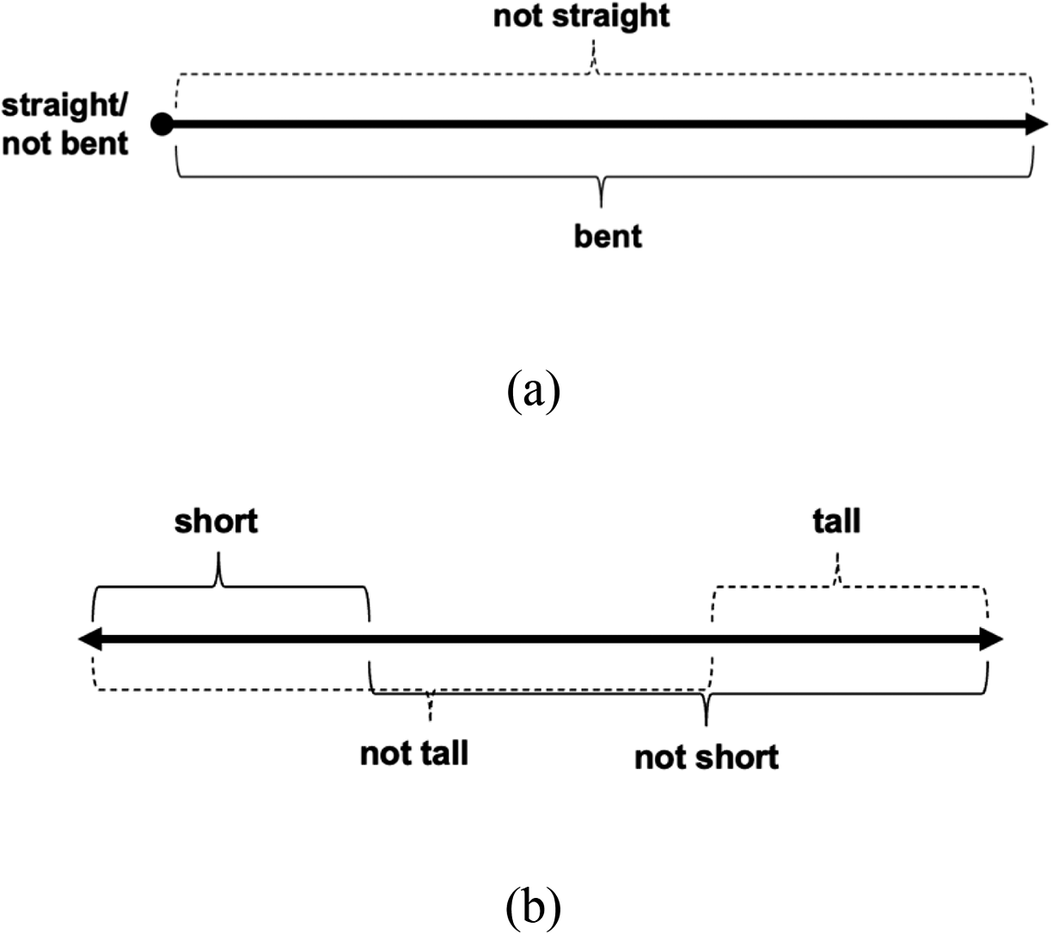
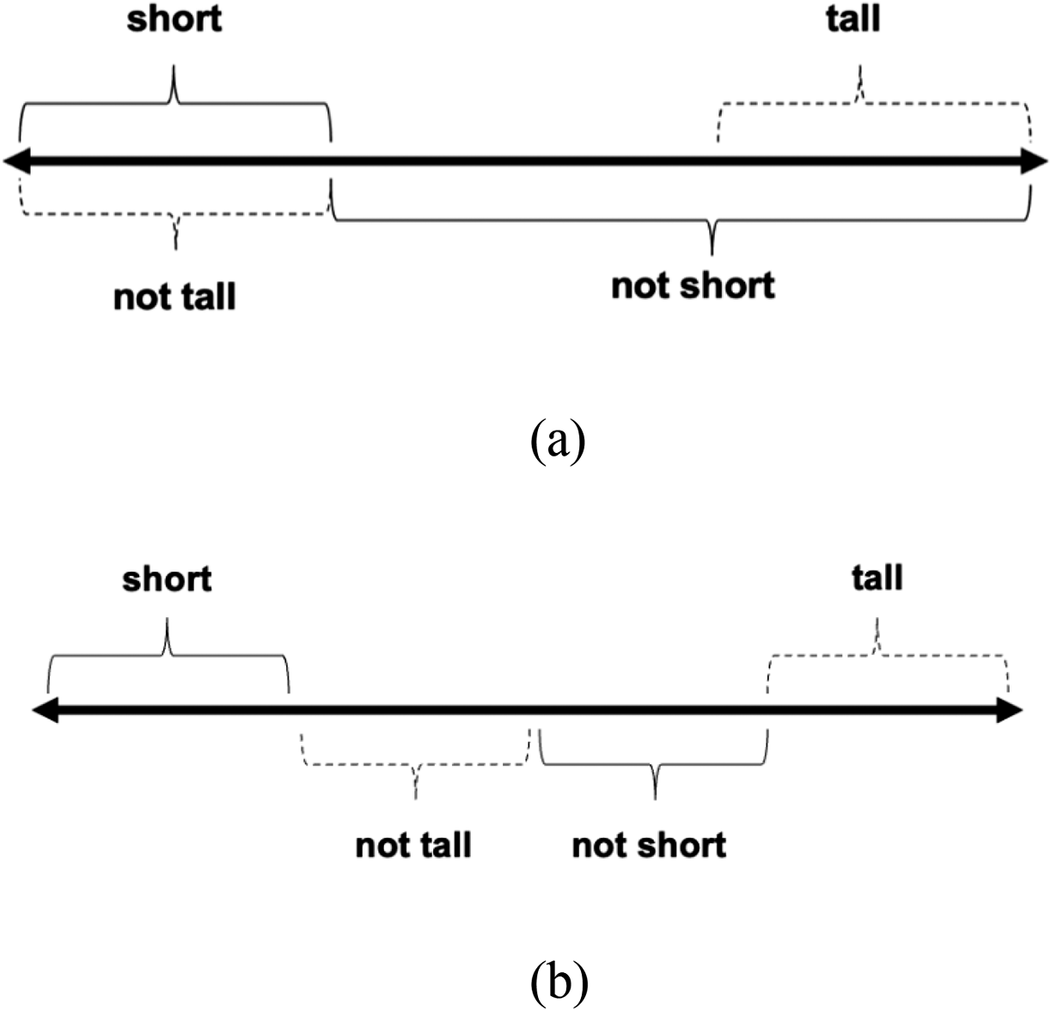


 Open access

