EDITORS' REPORT, SEPTEMBER 2007
This marks my last report to the members of the Association as co-editor of the Journal of Economic History. Effective 1 July 2008, Price Fishback becomes the new North American editor and my co-editor, Phil Hoffman, will be delivering these reports. Time flies when you are having fun, and I find it hard to believe that my term is almost up—but it is and it will soon be time to go.
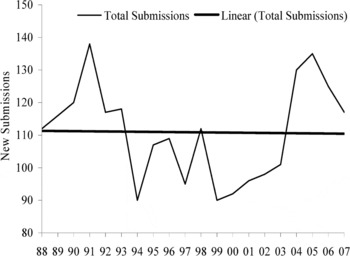
New submissions to the Journal declined again during the year ending 1 July, falling from 125 in the previous year to 117. Much more startling, however, is the decline in submissions to the North American office. The previous year the North American office received a total of 61 submissions compared with 89 to the International office. This year, I received a total of 49 submission—only 34 of them new—whereas Phil received 105—more than twice as many—of which 83 were new. Whether this is simply a random occurrence of an event in the far left tail of the distribution is uncertain, but it is clear that there has been an unmistakable shift towards non-North American topics for some time now. Consequently, we have reallocated some responsibilities and the North American office will henceforth handle all papers dealing with the Americas—North, Central, and South. I know that, at times, I have thought I was overworked and stressed out by this job—I don't even want to think how Phil must feel.
TREND IN NEW SUBMISSIONS, 1987/88–2006/07

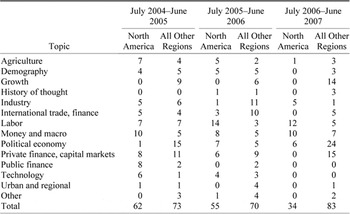
ARTICLE SUBMISSIONS BY WORLD AREA, BROKEN DOWN BY TOPIC, JULY 2004–JUNE 2007

Note:
The numbers include new submissions only. The totals equal the number of new submissions received because a paper is classified in only one topic category. In the latest year, the North American office had 49 total submissions, 34 new and 15 resubmitted. The International office had 105 total submissions, 83 new and 22 resubmitted.
Phil and I share one pet peeve regarding submissions: many are poorly written and sometimes incomplete. We spend much of our time literally editing papers word by word, line-by-line—some of them several times. Perhaps we are overly picky but we have also had many referees voice this same complaint. Does it sway their judgment on a paper? Who knows, but please have others read through submissions and comment, not only upon the content but also on the presentation before you send them to us.
In the very near future the editorial offices will be 100 percent electronic and largely automated. Virtually all submissions, refereeing, and decision-making in recent years have been handled electronically using e-mail. Over the past nine months or so though, we have been working with Cambridge University Press to implement ScholarOne as an electronic interface. This will deliver copy to the editors while simultaneously generating acknowledgments to the authors. It will allow us to assign referees who, in turn, can accept or reject assignments. It will automatically follow up with them—incessantly—should they miss a deadline and badger the editors for a decision when the necessary information is available. Our referee and author pools are already signed up on the system (though you won't be able to access it until we go live). The system should be operational by the time that you read this report.
Many other journals, of course, already have similar systems in place so lots of you are already familiar with them. They are a boon. They can also be a curse. For example, Bob Margo, Fred Bateman, and I recently had a piece accepted by a journal using such a system but the editor requested some minor and fairly straightforward changes—like dropping 20 percent of the text—same kind of thing that Phil and I ask. Unfortunately, when the editor made his decision, checking “Accept” sent the manuscript to typesetting rather than back to us for the needed changes, and recalling it from the production process proved far from simple. So we have learnt from this experience, and the best that you can hope for before your paper goes to the Production Editor will be a conditional acceptance.
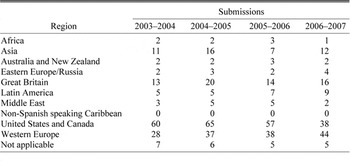
REGULAR ARTICLE SUBMISSIONS BY REGION, 1 JULY–30 JUNE

Note:
The numbers include new submissions only. Totals exceed new submissions because a paper can be classified as pertaining to more than one region.
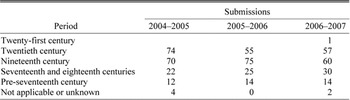
REGULAR ARTICLE SUBMISSIONS BY PERIOD, 1 JULY–30 JUNE 2004–2005, 2005–2006, AND 2006–2007

Note:
The numbers include new submissions only. Totals exceed submissions because a paper can be classified as pertaining to more than one period.
The profession goes through fads and fancies as the topical distribution of submission shows. Interestingly, these are rarely the same topics across the International and the North American offices. Two topics, labor and money/macro, account for more than two-thirds of the new submissions to the North American offices. Forty-six percent of the International Offices submissions are in Political Economy (which accounts for almost 30 percent of the office's total) and finance. Labor and money/macro were also important last year among the North American submissions but industry and international finance topped the charts then at the International Office.
In terms of region of interest, the decline in research on North America is the only clear trend with perhaps some growth of interest in Western Europe. Research interest in the nineteenth century also continues to wane.
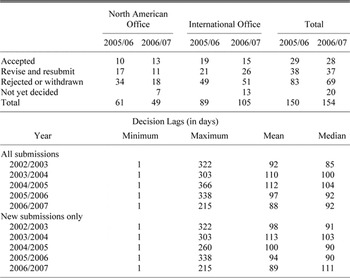
Mean decision times have edged down to 88 days for all submissions and 89 days for new submissions. However, while median turnaround time for all submissions is unchanged from last year, median turnaround time has increased sharply for new submissions. My interpretation of these data are that we are doing better at making the quick decisions about whether or not a paper is suitable for the Journal and stands an fighting chance of making it through the refereeing process. We are also doing a better job at getting a few laggard referees to respond more quickly to our pleas but we are apparently giving more forbearance on getting the reports back from referees reasonably promptly. It will be interesting to see how these statistics change when we go to ScholarOne and many of the reminders are pre-programmed.
ACCEPTANCE AND TURNAROUND

Note:
The acceptance figures include new submissions and resubmissions.
The JEH remains very selective; last year 28 papers were accepted out of 154 manuscripts or about 1 in 5. Acceptances out of the North American office were higher last year—one in four—but frankly I think that I received some very good manuscripts last year.
We have been assisted in our activities by others: Bill Collins has handled the book reviews out of the North American office despite serving as senior staff economist on the President's Council of Economic Advisors this past year, and we have been assisted in our duties by Linda Carter. Alan Miller has handled book reviews out of the International Office, and Sabrina Boschetti has assisted with tasks there.
We have both been assisted by literally hundreds of referees during the past year whose services are gratefully acknowledged in this issue of the Journal. We have also been assisted by our Editorial Board who provide counsel and extraordinary refereeing services at the drop of a hat either when a referee lets us down or we want another opinion. William Collins, Dora Costa, Steve Quinn, Paul Rhode, Joachim Voth, and Susan Wolcott finish their terms at the end of this year. I note too that Larry Epstein was also a member of the Editorial Board until his sudden, unexpected death earlier this year.
Joining the Board in 2007 were Price Fishback, Stephen Haber, Carol Shiue, and Marc Weidenmier. Other appointments to Board will also be made. However, any appointments that I make to represent North American topics will be made in consultation with our new incoming North American editor, Price Fishback.
I want to thank the Association for giving me this opportunity to serve as editor of the Journal and I thank you all for submitting so many good papers and for being so diligent in your duties as referees. You have made this both a fun as well as an educational experience.
Referees for the year were:
Marina Adshade, Dalhousie University
Douglas Allen, Simon Fraser University
Robert Allen, University of Oxford
Lee J. Alston, University of Colorado
George Alter, Indiana University
James E. Anderson, Boston College
Martha J. Bailey, University of Michigan
Dudley Baines, London School of Economics
Theo Balderston, University of Manchester
Jörg Baten, Eberhard-Karls-Universität Tübingen
Robert Bates, Harvard University
Daniel Benjamin, Clemson University
Michael A. Bernstein, Tulane University
Margaret Blair, Vanderbilt University
Hoyt Bleakley, University of Chicago
Howard Bodenhorn, Lafayette College
Daniel Bogart, University of California, Irvine
Rod Bohac, Brigham Young University
Michael Bordo, Rutgers University
Leah Platt Boustan, University of California, Los Angeles
George Boyer, Cornell University
Elizabeth Brainerd, Williams College
Loren Brandt, University of Toronto
Garland Brinkley, Touro College
Stephen Broadberry, University of Warwick
John C. Brown, Clark University Worcester
Warren Brown, California Institute of Technology
William Brown, University of North Carolina at Greensboro
Richard C. K. Burdekin, Claremont McKenna College
Carsten Burhop, University of Münster
Louis P. Cain, Northwestern University
Charles Calomiris, Columbia University
Bruce M. S. Campbell, The Queen's University of Belfast
Ann Carlos, University of Colorado
Mark Carlson, Federal Reserve Board
Linda Carter, Vanderbilt University
Elizabeth Casio, Dartmouth College
Youssef Cassis, University of Geneva
Mark Casson, University of Reading
Ben Chabot, University of Michigan
Siddharth Chandra, University of Pittsburgh
Gregory Clark, University of California, Davis
William J. Collins, Vanderbilt University
Metin M. Cosgel, University of Connecticut
Dora Costa, University of California, Los Angeles
Nicholas F. R. Crafts, University of Warwick
Timothy Cuff, Westminster College
Tomas Cvrcek, Vanderbilt University
Sami Dakhlia, University of Alabama
Tracy Dennison, California Institute of Technology
John Devereaux, City University of New York
Mauricio Drelichman, University of British Columbia
Leonard Dudley, University of Montreal
Colleen A. Dunlavy, University of Wisconsin, Madison
Gerald P. Dwyer Jr., Federal Reserve Bank of Atlanta
Alan Dye, Barnard College
Michael Edelstein, Queens College, City University of New York
Bernard Elbaum, University of California, Santa Cruz
Stanley L. Engerman, University of Rochester
Alvaro Ferreira da Silva, Universidade Nova de Lisboa
Joseph P. Ferrie, Northwestern University
Alexander J. Field, Santa Clara University
Price Fishback, University of Arizona
Valpy Fitzgerald, University of Oxford
Marc Flandreau, Fondation Nationale des Sciences Politiques, Institut d'Etudes Politiques de Paris
Dennis Flynn, University of the Pacific
Nancy Folbre, University of Massachusetts, Amherst
Larry Ford, University of California, San Diego
Rainer Fremdling, University of Groningen
Gerald Friedman, University of Massachusetts
Jan Glete, Stockholm University
Reuven Glick, Federal Reserve Bank of San Francisco
Claudia Goldin, Harvard University
Oliver Grant, University of Oxford
George Grantham, McGill University
William Greene, New York University
Paul R. Gregory, University of Houston
Avner Grief, Stanford University
Wayne Grove, LeMoyne College
Farley Grubb, University of Delaware
Timothy Guinnane, Yale University
Steve Haber, Stanford University
Michael R. Haines, Colgate University
Susan Hamill, University of Alabama
Anne Hanley, Northern Illinois University
Joan Hannon, Saint Mary's College of California
Mary E. Hansen, American University
C. Knick Harley, University of Oxford
Ron Harris, Tel Aviv University
Timothy J. Hatton, University of Essex
Pierre-Cyrille Hautcoeur, Ecole des Hautes Etudes en Sciences Sociales
Alfonso Herranz-Loncan, University of Barcelona
Sarah Hill, California State University, Fullerton
Boyd Hilton, University of Cambridge
Christopher Hoag, Coe College
Sara Horrell, University of Cambridge
Michael Huberman, University of Montreal
Jane Humphries, University of Oxford
William K. Hutchinson, Vanderbilt University
Douglas Irwin, Dartmouth College
David S. Jacks, Simon Fraser University
John James, University of Virginia
Mark Kanazawa, Carleton College
Shawn Kantor, University of California, Merced
Anders Karlsson, London School of Economics
Jonathan Katz, California Institute of Technology
Ian Keay, Queen's University
Zorina, Khan, Bowdoin College
Rod Kiewiet, California Institute of Technology
Sukkoo Kim, Washington University, St. Louis
Alexander Klein, CERGE-EI, Prague
Daniel Klerman, University of Southern California
John Komlos, University of Munich
Timur Kuran, Duke University
Angel Kwolleck-Folland, University of South Florida
Sumner LaCroix, University of Hawaii
Pedro Lains, Universidad de Lisboa
Naomi R. Lamoreaux, University of California, Los Angeles
John Lampe, University of Maryland, College Park
John Langdon, University of Alberta
Marc Law, University of Vermont
Chulhee Lee, Seoul National University
Carol S. Leonard, University of Oxford
Timothy Leunig, London School of Economics
Margaret Levenstein, University of Michigan
James B. Lewis, University of Oxford
Gary D. Libecap, University of California, Santa Barbara
Peter Lindert, University of California, Davis
Katherine Livingston, Vanderbilt University
Trevon Logan, Ohio State University
David Ludden, University of Pennsylvania
Christine MacLeod, University of Bristol
Andrea Maneschi, Vanderbilt University
Robert A. Margo, Boston University
Joseph Mason, Drexel University
Michael McAvoy, State University of New York, Oneonta
Margaret McConnell, California Institute of Technology
Robert McGuire, University of Akron
Bernardo Meuller, University of Brasilia
Boris N. Mironov, Institute of Russian History
Kris James Mitchener, Santa Clara University
Carolyn Moehling, Rutgers University
Jon Moen, University of Mississippi
Joel Mokyr, Northwestern University
Chiaki Moriguchi, Northwestern University
José Morilla-Critz, Universidad de Alcala
Neville Morley, University of Bristol
Matthias Morys, University of Oxford
Petra Moser, Massachusetts Institute of Technology
Reinhold C. Mueller, Università Ca' Foscari di Venezia
John E. Murray, University of Toledo
Aldo Musacchio, Harvard Business School
Martin Myant, University of Paisley
Myung Soo Cha, Yuengnam University
Stephen Nafziger, Williams College
Larry Neal, University of Illinois at Urbana-Champaign
Tom Nicholas, Harvard Business School
Tomas Nonnenmacher, Allegheny College
John Nye, George Mason University
Patrick O'Brien, London School of Economics
Kevin O'Rourke, Trinity College, Dublin
Lawrence Officer, University of Illinois, Chicago
Sheilagh Ogilvie, University of Cambridge
Tetsuji Okazaki, The University of Tokyo
Alan Olmstead, University of California, Davis
Martha Olney, University of California, Berkeley
Kim R. R. Oosterlinck, Universite Libre de Bruxelle
Richard Overy, University of Exeter
Jordi Palafox, Universidad de Valencia
Michael Palairet, The University of Edinburgh
Şevket Pamuk, Bogazici University
Robin Pearson, University of Hull
Edwin Perkins, University of Southern California
Karl Gunnar Person, University of Copenhagen
Luciano Pezzolo, University of Venice
William H. Phillips, University of Georgia
Thomas Piketty, Paris School of Economics
Richard Pomfret, Adelaide University
Gilles Postel-Vinay, EHESS, INRA
Mark Potter, University of Wyoming
Leandro Prados de la Escosura, Universidad Carlos III
Jonathan B. Pritchett, Tulane University
Stephen Quinn, Texas Christian University
Rossitsa Rangelova, Bulgarian Academy of Science
Dominic Rathbone, King's College, London
Thomas G. Rawski, University of Pittsburgh
Angela Redish, University of British Columbia
Paul Rhode, University of Arizona
Gary Richardson, University of California, Irvine
David Ringrose, University of California, San Diego
Albrecht Ritschl, London School of Economics
Jean-Laurent Rosenthal, California Institute of Technology
Peter L. Rousseau, Vanderbilt University
Richard Salvucci, Trinity University
Walter Scheidel, Stanford University
Cheryl Schonhardt-Bailey, London School of Economics and Political Science
Loren Schweninger, University of North Carolina at Greensboro
Andrew Seltzer, University of London
Carol H. Shiue, University of Colorado
Richard Sicotte, University of Vermont
John Siegfried, Vanderbilt University
Alexandre Skiba, University of Kansas
Fred Smith, Davidson College
Mark Spoerer, University of Hohenheim
David Stasavage, New York University
Richard H. Steckel, Ohio State University
Richard J. Sullivan, Federal Reserve Bank of Kansas City
William Summerhill, University of California, Los Angeles
Nathan Sussman, Hebrew University
Donald Sutherland, University of Maryland
Dhanoos Sutthiphisal, McGill University
Richard Sylla, New York University
Rick Szostak, University of Alberta
Alan Taylor, University of California, Davis
Peter Temin, Massachusetts Institute of Technology
Antonio Tena, Universidad Carlos III
Melissa Thomasson, Miami University of Ohio
William R. Thompson, University of Indiana
Mark Toma, University of Kentucky
Adam Tooze, University of Cambridge
Manuel Trajtenberg, Tel Aviv University
Gail Triner, Rutgers University
Werner Troesken, University of Pittsburgh
William Tsutsui, University of Kansas
Richard W. Unger, University of British Columbia
Steven W. Usselman, Georgia Institute of Technology
Jesus Viejo, Tecnológico de Monterrey
Jacob Vigdor, Duke University
Richard Von Glahn, University of California, Los Angeles
Hans-Joachim Voth, Universitat Pompeu Fabra
Hannes Wagner, London Business School
Richard Waller, Bucknell University
John Wallis, University of Maryland
Scott Wallsten, Progress and Freedom Foundation
Peter Wardley, University of the West of England, Bristol
David Washbrook, University of Oxford
Warren Weber, Federal Reserve Bank of Minneapolis
Simone Wegge, City University of New York
Marc D. Weidenmier, Claremont McKenna College
David Weiman, Barnard College
Mark Weinstein, University of Southern California
Robert Whaples, Wake Forest University
David C. Wheelock, Federal Reserve Bank of St. Louis
Eugene White, Rutgers University
David Wier, University of Michigan
Susan Wolcott, State University of New York, Binghamton
Gavin Wright, Stanford University
Robert Wright, New York University
Mary Yeager, University of California, Los Angeles
Madeleine Zelin, Columbia University