

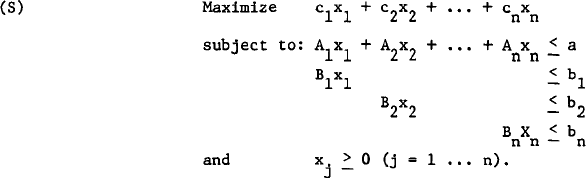
 The various vectors and matrices have the following dimensions:a = an m-vectorA

Crossref Citations

This article has been cited by the following publications. This list is generated based on data provided by Crossref.
Jennergren, Peter
and
Müller, Wolfgang
1973.
Simulation experiments of resource-allocation decisions in two-level organizations.
Social Science Research,
Vol. 2,
Issue. 4,
p.
333.
Burton, Richard M
and
Obel, Børge
1977.
The multilevel approach to organizational issues of the firm—A critical review.
Omega,
Vol. 5,
Issue. 4,
p.
395.
1981.
Issues of Organizational Design.
p.
253.
McAulay, L.
and
Tomkins, C. R.
1992.
A Review of the Contemporary Transfer Pricing Literature with Recommendations for Future Research.
British Journal of Management,
Vol. 3,
Issue. 2,
p.
101.
Larsson, T.
and
Liu, Z.
1997.
A Lagrangean Relaxation Scheme for Structured Linear Programs With Application To Multicommodity Network Flows.
Optimization,
Vol. 40,
Issue. 3,
p.
247.
Larsson, Torbjörn
and
Patriksson, Michael
1998.
Equilibrium and Advanced Transportation Modelling.
p.
125.
Pfeiffer, Thomas
1999.
Transfer pricing and decentralized dynamic lot-sizing in multistage, multiproduct production processes.
European Journal of Operational Research,
Vol. 116,
Issue. 2,
p.
319.
2001.
Transfer Pricing for Financial Institutions.
p.
134.
KARABUK, SULEYMAN
and
DAVID WU, S.
2002.
Decentralizing semiconductor capacity planning via internal market coordination.
IIE Transactions,
Vol. 34,
Issue. 9,
p.
743.