



1 Introduction
Studies of the rotational flow of an incompressible fluid were pioneered in the 1950s (Batchelor Reference Batchelor1951, Reference Batchelor1958). Understanding the problem of a medium’s rotation in bounded volumes has numerous practical applications and continues to be discussed in the literature (cf. Duck Reference Duck2012). Research on flow and heat transfer in rotating gases is also important for many industrial applications, particularly in isotope separation by the gas centrifuge method (Villani Reference Villani1979).
There has also been increased interest recently in the study of rotating conductive gases for various scientific and industrial applications. Earlier studies established that it is possible to control the intensity of the heat exchange process between the medium and a solid containment surface (Sparrow & Cess Reference Sparrow and Cess1962; Borisevich & Potanin Reference Borisevich and Potanin2015). By rotating the conductive gas electromagnetically with sufficient speed, it is possible to separate elemental and isotopic species radially. This capability offers an advantage over the conventional gas centrifuge method where there are no suitable compounds of the element (Fetterman & Fisch Reference Fetterman and Fisch2009).
The problem of rotational instability for a rotating conductive medium in the presence of a magnetic field must also be considered. In application to astrophysics and experimental observation of the so-called magnetorotational instability, this issue has been under investigation since the end of the 1960s (Velikhov Reference Velikhov1959; Ji, Goodman & Kageyama Reference Ji, Goodman and Kageyama2001; Flanagan et al. Reference Flanagan, Clark, Collins, Cooper, Khalzov, Wallace and Forest2015; Plihon et al. Reference Plihon2015). It should be noted that, in laboratory testing of various kinds of instabilities in rotating flows, interaction with bounding surfaces leads to the emergence of secondary flows. The latter produced a masking effect on the mechanism of instability evolution, due to viscous friction and an imbalance between the centrifugal force and the pressure gradient in the vicinity of stationary physical boundaries (Khalzov, Smolyakov & Ilgisonis Reference Khalzov, Smolyakov and Ilgisonis2010). The excitation of secondary flows can be interpreted as a special kind of ‘instability’ of the rotational flow associated with axial non-uniformity of the centrifugal forces near a braking surface.
The hydrodynamic characteristics of a rotational flow between two discs in the presence of suction from a porous surface were studied numerically in Pearson (Reference Pearson1965). The study of a magnetic field’s influence on the flow’s stability near a rotating disc in a stationary gas has also been undertaken (Thomas & Davies Reference Thomas and Davies2013). In this paper we apply an analytical approach to consider the effect of a strong uniform suction and magnetic field on the laminar magnetohydrodynamic (MHD) flow near a rotating dielectric disc. The system under consideration includes the presence of an external flow with almost rigid rotation and an axial temperature gradient, taking into account the centrifugal effects in the boundary layers.
The analysis presented here is limited to three-dimensional rotating laminar flow and does not address the problems of conventional stability and turbulization (Lingwood Reference Lingwood1995). Our approach has been adopted for the following reasons: the problem of conventional hydrodynamic stability is far beyond the scope of this study, and for the specific issue under investigation, we assume that strong suction, or an applied strong magnetic field, provides a stabilizing effect (Lingwood Reference Lingwood1997; Jasmine & Gajjar Reference Jasmine and Gajjar2005). As a consequence, we believe the problem of hydrodynamic stability is reduced in importance.
The model presented here provides a mechanism for numerical simulation that enables flow and heat transfer analysis in various two- and three-dimensional problems of hydro- and gas dynamics. However, finding the analytic solution still plays an important scientific research role, since it enables the analysis of various physical phenomena in the problem under investigation.
2 Statement of the problem
The aim of this work is to study the interaction of the MHD rotating flow in a closed cylinder with solid boundary surfaces. If the solid surfaces are stationary, or rotating with velocities differing from that of a rotating flow, a variety of physical phenomena exist that are associated with the viscous drag effects in the boundary layers. Similar phenomena exist in a plasma centrifuge intended for isotope separation. Plasma centrifuges are considered as a prospective isotope separation technology when there are no suitable gaseous compounds for separation in a conventional gas centrifuge. In this case, the separation process is carried out in a stationary cylinder, which is fully enclosed at each end, causing a circulating flow in the form of two vortices. While the effect of the two vortices tends to reduce the azimuthal velocity in the volume outside the boundary layers, it also facilitates multiplication of the radial separation effect in the axial direction. In the case of the experimental study of instabilities in rotating plasma, its interaction with stationary end surfaces is an undesirable process that prevents identification of the instability type. All the above-mentioned problems are related to a rotating flow in the presence of a fixed disc, or one that is rotating at a velocity (Fetterman & Fisch Reference Fetterman and Fisch2009; Rax & Gueroult Reference Rax and Gueroult2016).
Initially, we consider the general case of a dielectric disc of infinite radius, rotating with an angular velocity
 $\unicode[STIX]{x1D714}_{0}$
in the presence of a uniform axial magnetic field
 $B$
. A conducting medium rotates above the disc with an angular velocity
 $\unicode[STIX]{x1D714}_{1}$
(figure 1). For
 $\unicode[STIX]{x1D714}_{0}=0$
, the conducting medium (plasma) rotates above the stationary surface.
Schematic of a boundary layer on a rotating disc. Here
 $\unicode[STIX]{x1D714}_{0}$
is the angular velocity of a disc,
 $\unicode[STIX]{x1D714}_{1}$
is the angular velocity of an external flow,
 $\unicode[STIX]{x1D6FF}$
is the boundary layer thickness,
 $B$
is a uniform axial magnetic field, and
 $r$
and
 $z$
are radial and axial coordinates, respectively.

For the above arrangement, we assume that there is uniform suction from the boundary layer through the disc’s porous surface and an axial temperature gradient. Consideration of such a problem for an infinite flow domain can be employed when carrying out an engineering calculation of rotational flows that are limited by stationary and rotating surfaces. Such an arrangement is used for the analysis of the boundary layer characteristics in the region of an inviscid core in a rotating cylinder with a braking end surface, or lid (Potanin Reference Potanin2013). Neglecting viscous and Joule dissipation, as well as the induced magnetic field, the equations for the hydrodynamic and thermal boundary layers on the disc can be written in a form that has been used by previous researchers (King & Lewellen Reference King and Lewellen1964; Gorbachev & Potanin Reference Gorbachev and Potanin1969):
 $$\begin{eqnarray}\displaystyle & \displaystyle v_{r}\frac{\unicode[STIX]{x2202}v_{r}}{\unicode[STIX]{x2202}r}+v_{z}\frac{\unicode[STIX]{x2202}v_{r}}{\unicode[STIX]{x2202}z}-\frac{v_{\unicode[STIX]{x1D711}}^{2}}{r}=-\frac{1}{\unicode[STIX]{x1D70C}}\frac{\unicode[STIX]{x2202}p}{\unicode[STIX]{x2202}r}+\frac{1}{\unicode[STIX]{x1D70C}}\frac{\unicode[STIX]{x2202}}{\unicode[STIX]{x2202}z}\left(\unicode[STIX]{x1D702}\frac{\unicode[STIX]{x2202}v_{r}}{\unicode[STIX]{x2202}z}\right)-\frac{\unicode[STIX]{x1D70E}B^{2}v_{r}}{\unicode[STIX]{x1D70C}}, & \displaystyle\end{eqnarray}$$
 $$\begin{eqnarray}\displaystyle & \displaystyle v_{r}\frac{\unicode[STIX]{x2202}v_{\unicode[STIX]{x1D711}}}{\unicode[STIX]{x2202}r}+v_{z}\frac{\unicode[STIX]{x2202}v_{\unicode[STIX]{x1D711}}}{\unicode[STIX]{x2202}z}+\frac{v_{r}v_{\unicode[STIX]{x1D711}}}{r}=\frac{1}{\unicode[STIX]{x1D70C}}\frac{\unicode[STIX]{x2202}}{\unicode[STIX]{x2202}z}\left(\unicode[STIX]{x1D702}\frac{\unicode[STIX]{x2202}v_{\unicode[STIX]{x1D711}}}{\unicode[STIX]{x2202}z}\right)-\frac{\unicode[STIX]{x1D70E}B^{2}}{\unicode[STIX]{x1D70C}}(v_{\unicode[STIX]{x1D711}}-\unicode[STIX]{x1D714}_{1}r), & \displaystyle\end{eqnarray}$$
 $$\begin{eqnarray}\displaystyle & \displaystyle \frac{\unicode[STIX]{x2202}}{\unicode[STIX]{x2202}r}(\unicode[STIX]{x1D70C}rv_{r})+\frac{\unicode[STIX]{x2202}}{\unicode[STIX]{x2202}z}(\unicode[STIX]{x1D70C}rv_{z})=0, & \displaystyle\end{eqnarray}$$
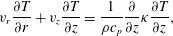 $$\begin{eqnarray}\displaystyle & \displaystyle v_{r}\frac{\unicode[STIX]{x2202}T}{\unicode[STIX]{x2202}r}+v_{z}\frac{\unicode[STIX]{x2202}T}{\unicode[STIX]{x2202}z}=\frac{1}{\unicode[STIX]{x1D70C}c_{p}}\frac{\unicode[STIX]{x2202}}{\unicode[STIX]{x2202}z}\unicode[STIX]{x1D705}\frac{\unicode[STIX]{x2202}T}{\unicode[STIX]{x2202}z}, & \displaystyle\end{eqnarray}$$
 $$\begin{eqnarray}\displaystyle & \displaystyle \unicode[STIX]{x1D707}p=\unicode[STIX]{x1D70C}RT. & \displaystyle\end{eqnarray}$$
Here
 $z$
is an axial coordinate, measured from the disc surface;
 $v_{\unicode[STIX]{x1D711}},~v_{r}$
and
 $v_{z}$
are the azimuthal, radial and axial components of the flow velocity, respectively;
 $\unicode[STIX]{x1D70C}$
is density;
 $p$
is pressure;
 $T$
is temperature;
 $\unicode[STIX]{x1D702}$
,
 $\unicode[STIX]{x1D705}$
and
 $\unicode[STIX]{x1D70E}$
are the dynamic viscosity, thermal conductivity and electrical conductivity;
 $c_{p}$
is specific heat capacity at constant pressure;
 $\unicode[STIX]{x1D707}$
is the molar mass; and
 $R$
is the universal gas constant. Note that these equations are valid in the framework of the MHD approximation.
The system of equations (2.1)–(2.5) should be solved with the following boundary conditions:
 $$\begin{eqnarray}z=0,\quad v_{r}=0,\quad v_{\unicode[STIX]{x1D711}}=\unicode[STIX]{x1D714}_{0}r,\quad v_{z}=-k,\quad T=T_{0},\end{eqnarray}$$
 $$\begin{eqnarray}z\rightarrow \infty ,\quad v_{r}\rightarrow 0,\quad v_{\unicode[STIX]{x1D711}}\rightarrow \unicode[STIX]{x1D714}_{1}r,\quad T\rightarrow T_{1},\end{eqnarray}$$
where
 $T_{0}$
is the temperature on the disc,
 $T_{1}$
is the temperature in the external flow, and
 $k$
is the rate of suction.
In deriving (2.1) and (2.2), the azimuthal symmetry and the negligible presence of Hall currents are taken into account in the following Ohm’s law expressions:
 $$\begin{eqnarray}j_{r}=\unicode[STIX]{x1D70E}(E_{r}-v_{\unicode[STIX]{x1D711}}B_{z}),\quad j_{\unicode[STIX]{x1D711}}=-\unicode[STIX]{x1D70E}v_{r}B_{z},\quad j_{z}=\unicode[STIX]{x1D70E}E_{z},\end{eqnarray}$$
where
 $E_{r}$
and
 $E_{z}$
are the radial and axial components of the electric field intensity. The projections of the magnetic field strength
 $E_{r}$
and
 $E_{z}$
in (2.8) are the internal characteristics that are associated with charge separation in the main plasma volume. In particular, the field
 $E_{r}$
is similar to that generated in the plasma of a hydromagnetic capacitor (Baker et al.
Reference Baker, Bratenahl, DeSilva, Kunkel and Robert Nilsson1959).
Also, we assume that the radial component
 $E_{r}$
does not change with the
 $z$
coordinate within the boundary layer on a dielectric disc. Therefore, the radial component of the electric field strength outside of the boundary layer in the external flow can be calculated as
 $E_{r}^{\infty }=-\unicode[STIX]{x1D714}_{1}rB_{z}$
for the external flow (King & Lewellen Reference King and Lewellen1964). This follows from the relative thinness of the boundary layer and the boundary conditions for the tangential component of the electric field. Simultaneously, the current density in the boundary layer is not equal to zero and varies in accordance with the conditions (2.8) and the dependence
 $v_{\unicode[STIX]{x1D711}}(z)$
.
While there is an absence of radial current flow in the core, the closing of radial current paths in the boundary layers occurs through the sidewall layer and the conductive cylindrical wall, in which the axial current does not interact with the axial magnetic field.
Equations (2.1)–(2.5) do not contain the equation of motion in the
 $z$
direction, as the latter is used only to determine a weak pressure dependence on the axial coordinate in the boundary layer (Dorfman Reference Dorfman1963; King & Lewellen Reference King and Lewellen1964). The last terms on the right-hand side of (2.1) and (2.2) are associated with the azimuthal and radial electric currents in the boundary layer (Gorbachev & Potanin Reference Gorbachev and Potanin1969). Note that neglecting viscous and Joule dissipation with respect to convective heat transfer in the energy equation (2.4) is valid under the following conditions:
 $$\begin{eqnarray}\unicode[STIX]{x1D714}_{0}^{2}r^{2}/c_{p}T^{\ast }\ll 1,\quad \unicode[STIX]{x1D714}_{0}^{2}r^{2}N^{\ast }/c_{p}T^{\ast }\ll 1,\end{eqnarray}$$
where
 $N^{\ast }=\unicode[STIX]{x1D70E}^{\ast }B^{2}/\unicode[STIX]{x1D70C}^{\ast }\unicode[STIX]{x1D714}_{0}$
, and
 $T^{\ast }$
,
 $\unicode[STIX]{x1D70E}^{\ast }$
and
 $\unicode[STIX]{x1D70C}^{\ast }$
are the characteristic temperature, electrical conductivity and density of a gas in the flow, respectively. The magnetic parameter
 $N^{\ast }$
denotes the ratio of the electromagnetic and centrifugal forces (King & Lewellen Reference King and Lewellen1964).
The parameters
 $\unicode[STIX]{x1D714}_{0}^{2}r^{2}/c_{p}T^{\ast }$
and
 $\unicode[STIX]{x1D714}_{0}^{2}r^{2}N^{\ast }/c_{p}T^{\ast }$
are proportional to the ratio of the kinetic energy of the medium’s rotation and the Joule heat release for the period
 $2\unicode[STIX]{x03C0}/\unicode[STIX]{x1D714}_{0}$
to the thermal energy. To demonstrate this by example, we make an estimation of these parameters for weakly ionized argon plasma at a temperature of
 $T^{\ast }=10^{3}~\text{K}$
. Assuming the Poisson constant
 $\unicode[STIX]{x1D6FE}=5/3$
, the angular velocity
 $\unicode[STIX]{x1D714}_{0}=100~\text{s}^{-1}$
,
 $R_{0}=0.05~\text{m}$
,
 $N^{\ast }=5$
and
 $c_{p}=500~\text{J}~\text{kg}^{-1}~\text{K}^{-1}$
, we obtain the values
 $\unicode[STIX]{x1D714}_{0}^{2}r^{2}/c_{p}T^{\ast }\approx 5\times 10^{-5}$
and
 $\unicode[STIX]{x1D714}_{0}^{2}r^{2}N^{\ast }/c_{p}T^{\ast }\approx 3\times 10^{-4}$
. We evaluate the validity of neglecting the induced magnetic field, which is determined by the magnetic Reynolds number
 $Re_{m}^{\ast }=\unicode[STIX]{x1D707}_{0}\unicode[STIX]{x1D70E}^{\ast }\unicode[STIX]{x1D714}_{0}R_{0}^{2}$
, where
 $\unicode[STIX]{x1D707}_{0}$
is the magnetic constant. For
 $\unicode[STIX]{x1D70E}^{\ast }=10^{3}~\text{S}~\text{m}^{-1}$
, the magnetic Reynolds number
 $Re_{m}^{\ast }\approx 3\times 10^{-4}$
. By substituting the following values for the characteristic dynamic viscosity
 $\unicode[STIX]{x1D702}^{\ast }=10^{-4}~\text{kg}~\text{m}^{-1}~\text{s}^{-1}$
,
 $\unicode[STIX]{x1D70C}^{\ast }\approx 1~\text{kg}~\text{m}^{-3}$
,
 $\unicode[STIX]{x1D714}_{0}=100~\text{s}^{-1}$
and
 $R_{0}=5\times 10^{-2}~\text{m}$
, the hydrodynamic Reynolds number is
 $Re=\unicode[STIX]{x1D70C}\unicode[STIX]{x1D714}_{0}R_{0}^{2}/\unicode[STIX]{x1D702}\approx 3\times 10^{3}$
. According to Dorfman (Reference Dorfman1963), the estimated value for the Reynolds number corresponds to the laminar character of a flow.
While it may seem that a kinematic viscosity factor
 $\unicode[STIX]{x1D708}=\unicode[STIX]{x1D702}/\unicode[STIX]{x1D70C}$
should be contained in the above inequalities, the condition for neglecting viscous dissipation in comparison with convective heat transfer has to comprise the boundary layer thickness
 $\unicode[STIX]{x1D6FF}\approx \sqrt{\unicode[STIX]{x1D708}/\unicode[STIX]{x1D714}_{0}}$
and the axial velocity
 $v_{z}$
 ${\approx}\sqrt{\unicode[STIX]{x1D708}\unicode[STIX]{x1D714}_{0}}$
. This outcome leads to the conditions identified above in (2.9). The expressions for the electromagnetic forces in (2.1) and (2.2) are justified elsewhere (King & Lewellen Reference King and Lewellen1964).
Under the conditions
 $B\rightarrow 0$
and
 $\unicode[STIX]{x2202}p/\unicode[STIX]{x2202}r\rightarrow 0$
, equations (2.1)–(2.5) are reduced to the system studied in earlier work (Dorfman Reference Dorfman1963) for the case of a non-conductive and non-rotating external flow (
 $\unicode[STIX]{x1D714}_{1}=0$
).
The azimuthal currents are continuous, due to the symmetry of the system. However, the issue of radial electric current continuity is more complex. Based on earlier studies, we assume that the continuity of the radial current takes place through an external circuit (King & Lewellen Reference King and Lewellen1964). In our study, we consider the case where the compressibility factor
 $\unicode[STIX]{x1D6FC}=\unicode[STIX]{x1D707}\unicode[STIX]{x1D714}_{1}^{2}r^{2}/2RT^{\ast }$
is relatively small, allowing us to neglect the radial distribution of the medium’s density (the so-called Boussinesq approximation). However, the pressure dependence on the radial coordinate is substantial and does not contradict this assumption. In addition, we assume that the thermal flow on and out of the disc are independent of the radial coordinate. Note that, in this case, we only consider the ‘compressibility’ associated with a change in the medium’s temperature in the axial direction, but not the action of the centrifugal force. In fact, we consider the case of a relatively small Mach number
 $M=\sqrt{2\unicode[STIX]{x1D6FC}/\unicode[STIX]{x1D6FE}}$
. For an argon plasma and the above kinematic and geometrical parameters, the Mach number
 $M$
is equal to
 ${\sim}10^{-2}$
. It is for this reason that it is inappropriate to apply the obtained results to the analysis of the gas dynamics in a conventional gas centrifuge used for isotope separation (Borisevich et al.
Reference Borisevich, Borman, Sulaberidze, Tikhomirov, Tokmantsev and Borman2011).
3 The technique to solve the model problem
Following Dorodnitsyn (Reference Dorodnitsyn1942), we introduce the transformation method as follows:
 $$\begin{eqnarray}Z_{0}=\frac{1}{\unicode[STIX]{x1D70C}_{1}}\int _{0}^{z}\unicode[STIX]{x1D70C}(z)\,\text{d}z,\end{eqnarray}$$
where the constant
 $\unicode[STIX]{x1D70C}_{1}$
is the density of the gas in the external flow. The axial component of the transformed velocity takes the following form:
 $$\begin{eqnarray}v_{z1}=v_{z}\frac{\unicode[STIX]{x1D70C}}{\unicode[STIX]{x1D70C}_{1}}+v_{r}\frac{\unicode[STIX]{x2202}Z_{0}}{\unicode[STIX]{x2202}r}.\end{eqnarray}$$
By the introduction of a new variable
 $Z_{0}$
and a modified velocity
 $v_{z1}$
, we can consider the axial change in the medium density caused by a temperature gradient.
We transform the system of equations (2.1)–(2.4), assuming the following:
 $$\begin{eqnarray}v_{r}=rF(Z_{0}),\quad v_{\unicode[STIX]{x1D711}}=rG(Z_{0}),\quad T=T_{0}+(T_{1}-T_{0})t(Z_{0}).\end{eqnarray}$$
The pressure gradient in the boundary layer equates to that in the main flow by the following relationship:
 $$\begin{eqnarray}\frac{\unicode[STIX]{x2202}p}{\unicode[STIX]{x2202}r}=\unicode[STIX]{x1D70C}_{1}\unicode[STIX]{x1D714}_{1}^{2}r.\end{eqnarray}$$
The above relationship plays an important role in the flow dynamics near a disc. The force associated with the pressure gradient, which is directed towards the axis, depends on the gas density in the external flow
 $\unicode[STIX]{x1D70C}_{1}$
, as well as on the angular velocity
 $\unicode[STIX]{x1D714}_{1}$
. The centrifugal force is directed to the periphery and is determined by the axial distribution of the density
 $\unicode[STIX]{x1D70C}(Z_{0})$
and the azimuthal velocity
 $v_{\unicode[STIX]{x1D711}}(Z_{0})$
.
It is assumed that the dynamic viscosity (
 $\unicode[STIX]{x1D702}_{_{1}}$
) and the thermal conductivity (
 $\unicode[STIX]{x1D705}_{1}$
) in the external flow change in proportion to the first power of the temperature (i.e.
 $\unicode[STIX]{x1D702}=\unicode[STIX]{x1D702}_{1}(T/T_{1})$
,
 $\unicode[STIX]{x1D705}=\unicode[STIX]{x1D705}_{1}(T/T_{1})$
). The approximate power dependences of viscosity on temperature were taken from a previous study (Shidlovskii Reference Shidlovskii1960) where they have been applied for calculation of the laminar boundary layer on a rotating disc. Following later work (Chandrasekhar & Nath Reference Chandrasekhar and Nath1989), we also assume that the gas electrical conductivity is inversely proportional to temperature (i.e.
 $\unicode[STIX]{x1D70E}=\unicode[STIX]{x1D70E}_{1}(T_{1}/T)$
, where
 $\unicode[STIX]{x1D70E}_{1}$
is gas conductivity far away from the disc surface). This relationship is not apparent with a conventional gas discharge, but in principle it can be implemented with non-self-sustained discharges. In this case, we find a self-similar solution to the problem, which allows the system of equations (2.1)–(2.4) to be rewritten in the following form:
 $$\begin{eqnarray}\displaystyle & \displaystyle F^{2}+v_{z1}F^{\prime }-G^{2}=-\unicode[STIX]{x1D714}_{1}^{2}\left(\frac{1}{n}+\left(1-\frac{1}{n}\right)t\right)+\unicode[STIX]{x1D708}_{1}F^{\prime \prime }-\frac{\unicode[STIX]{x1D70E}_{1}B^{2}}{\unicode[STIX]{x1D70C}_{1}}F, & \displaystyle\end{eqnarray}$$
 $$\begin{eqnarray}\displaystyle & \displaystyle 2FG+v_{z1}G^{\prime }=\unicode[STIX]{x1D708}_{1}G^{\prime \prime }-\frac{\unicode[STIX]{x1D70E}_{1}B^{2}}{\unicode[STIX]{x1D70C}_{1}}(G-\unicode[STIX]{x1D714}_{1}), & \displaystyle\end{eqnarray}$$
 $$\begin{eqnarray}\displaystyle & \displaystyle 2F+v_{z1}^{\prime }=0, & \displaystyle\end{eqnarray}$$
 $$\begin{eqnarray}\displaystyle & \displaystyle v_{z1}t^{\prime }=\unicode[STIX]{x1D712}_{1}t^{\prime \prime }, & \displaystyle\end{eqnarray}$$
where
 $\unicode[STIX]{x1D712}_{1}=\unicode[STIX]{x1D705}_{1}/\unicode[STIX]{x1D70C}_{1}c_{p}$
is the thermal diffusivity,
 $\unicode[STIX]{x1D708}_{1}=\unicode[STIX]{x1D702}_{1}/\unicode[STIX]{x1D70C}_{1}$
is the kinematic viscosity in the external flow and
 $n=T_{1}/T_{0}$
. The prime denotes the derivative with respect to the
 $Z_{0}$
variable.
By using this approach, the system of differential equations in partial derivatives (2.1)–(2.4) can be transformed into a system of ordinary differential equations (3.5)–(3.8) that are similar to those used for an incompressible fluid. It is worth emphasizing once again that we are considering the ‘compressibility’ associated with change in gas temperature. To solve the system of equations (3.5)–(3.8) we substitute the following function
 $v_{z0}=v_{z1}+k_{1}$
, where
 $k_{1}=\unicode[STIX]{x1D70C}_{0}k/\unicode[STIX]{x1D70C}_{1}$
and
 $\unicode[STIX]{x1D70C}_{0}$
is the density of the conducting gas near the disc surface.
Considering the case where there is large suction (
 $v_{z1}\ll k_{1}$
) and taking (3.7) into account (Dorfman Reference Dorfman1963), we have a new set of equations:
 $$\begin{eqnarray}\displaystyle & \displaystyle -\frac{G^{2}}{\unicode[STIX]{x1D708}_{1}}+\frac{\unicode[STIX]{x1D714}_{1}^{2}}{\unicode[STIX]{x1D708}_{1}n}[1+(n-1)t]=F^{\prime \prime }+\frac{F^{\prime }}{l}-\frac{F}{l_{1}^{2}}, & \displaystyle\end{eqnarray}$$
 $$\begin{eqnarray}\displaystyle & \displaystyle G^{\prime \prime }+\frac{G^{\prime }}{l}-\frac{G}{l_{1}^{2}}=-\frac{\unicode[STIX]{x1D714}_{1}}{l_{1}^{2}}, & \displaystyle\end{eqnarray}$$
 $$\begin{eqnarray}\displaystyle & \displaystyle t^{\prime \prime }+\frac{t^{\prime }}{l_{2}}=0, & \displaystyle\end{eqnarray}$$
where
 $l=\unicode[STIX]{x1D708}_{1}/k_{1}$
,
 $l_{1}=\sqrt{\unicode[STIX]{x1D70C}_{1}\unicode[STIX]{x1D708}_{1}/\unicode[STIX]{x1D70E}_{1}B^{2}}$
and
 $l_{2}=\unicode[STIX]{x1D712}_{1}/k_{1}$
.
By introducing the dimensionless functions
 $g=G/\unicode[STIX]{x1D714}_{0}$
,
 $f=F/\unicode[STIX]{x1D714}_{0}$
and the variable
 $Z=Z_{0}\sqrt{\unicode[STIX]{x1D714}_{0}/\unicode[STIX]{x1D708}_{1}}$
, as well as the dimensionless parameters
 $m=\unicode[STIX]{x1D714}_{1}/\unicode[STIX]{x1D714}_{0}$
,
 $K_{1}=k_{1}/\sqrt{\unicode[STIX]{x1D708}_{1}\unicode[STIX]{x1D714}_{0}}$
and
 $N=\unicode[STIX]{x1D70E}_{1}B^{2}/\unicode[STIX]{x1D70C}_{1}\unicode[STIX]{x1D714}_{0}$
, where the latter is the magnetic parameter in the external flow, we obtain the following set of equations:
 $$\begin{eqnarray}\displaystyle & \displaystyle -g^{2}+m^{2}\left[\frac{1}{n}+\left(1-\frac{1}{n}\right)t\right]=f^{\prime \prime }+K_{1}f^{\prime }-Nf, & \displaystyle\end{eqnarray}$$
 $$\begin{eqnarray}\displaystyle & \displaystyle g^{\prime \prime }+K_{1}g^{\prime }-Nf=-mN, & \displaystyle\end{eqnarray}$$
 $$\begin{eqnarray}\displaystyle & \displaystyle t^{\prime \prime }+K_{1}Prt^{\prime }=0, & \displaystyle\end{eqnarray}$$
where
 $Pr=\unicode[STIX]{x1D708}_{1}/\unicode[STIX]{x1D712}_{1}$
is the Prandtl number. Note that the system of gas dynamic equations (3.12) and (3.13) is still nonlinear because it includes the main centrifugal term in (3.12).
4 The procedure to calculate temperature profiles and radial gas flow near an infinite disc
Integrating the system of equations (3.12)–(3.14), we find the following expressions:
 $$\begin{eqnarray}\displaystyle & \displaystyle t(Z)=1-\exp (-K_{1}PrZ), & \displaystyle\end{eqnarray}$$
 $$\begin{eqnarray}\displaystyle & \displaystyle g(Z)=m+(1-m)\exp \left(\left(-\frac{K_{1}}{2}-\sqrt{\frac{K_{1}^{2}}{4}+N}\right)Z\right), & \displaystyle\end{eqnarray}$$
where
 $t(Z)$
and
 $g(Z)$
are the dimensionless expressions for profiles of temperature and azimuthal velocity, respectively.
The function
 $f(Z)$
is determined by solving the following differential equation:
 $$\begin{eqnarray}\displaystyle f^{\prime \prime }+K_{1}f^{\prime }-Nf & = & \displaystyle -\left[m+(1-m)\exp \left(-\left(\frac{K_{1}}{2}+\sqrt{\frac{K_{1}^{2}}{4}+N}\right)Z\right)\right]^{2}\nonumber\\ \displaystyle & & \displaystyle +\,\frac{m^{2}}{n}[n+(1-n)\exp (-K_{1}PrZ)].\end{eqnarray}$$
The solution for
 $f(Z)$
is as follows:
 $$\begin{eqnarray}\displaystyle f(Z) & = & \displaystyle \exp (-K_{0}Z)\left\{\vphantom{\frac{2m(1-m)Z}{\sqrt{K_{1}^{2}+4N}}}\frac{m^{2}(n-1)}{(Pr(Pr-1)K_{1}^{2}-N)n}[1-\exp (K_{0}Z-PrK_{1}Z)]\right.\nonumber\\ \displaystyle & & \displaystyle \left.+\,\frac{(1-m)^{2}}{(2K_{1}K_{0}+3N)}[1-\exp (-K_{0}Z)]+\frac{2m(1-m)Z}{\sqrt{K_{1}^{2}+4N}}\right\},\end{eqnarray}$$
where
 $K_{0}=K_{1}/2+\sqrt{K_{1}^{2}/4+N}$
.
From (4.2), we can calculate the coefficient of friction torque, acting on one side of the disc, as
 $$\begin{eqnarray}C_{M}=\frac{2M}{\unicode[STIX]{x03C0}\unicode[STIX]{x1D70C}_{1}R_{0}^{4}(\unicode[STIX]{x1D708}_{1}\unicode[STIX]{x1D714}_{0}^{3})^{1/2}}=(1-m)\left(\frac{nK}{2}+\sqrt{\frac{n^{2}K^{2}}{4}+N}\right),\end{eqnarray}$$
where
 $M=2\unicode[STIX]{x03C0}\unicode[STIX]{x1D702}_{0}\int _{0}^{R}r^{2}|\unicode[STIX]{x2202}v_{\unicode[STIX]{x1D711}}/\unicode[STIX]{x2202}z|_{z=0}\,\text{d}r$
and
 $K=K_{1}(\unicode[STIX]{x1D70C}_{1}/\unicode[STIX]{x1D70C}_{0})$
.
In the limiting case when
 $N\rightarrow 0$
, equation (4.5) agrees with the dependence obtained for the case of no magnetic field (Borisevich & Potanin Reference Borisevich and Potanin1987). For
 $N\rightarrow 0$
,
 $n\rightarrow 1$
and
 $m\rightarrow 0$
, the resulting solution transforms into the form that has been discussed in Dorfman (Reference Dorfman1963) and Borisevich & Potanin (Reference Borisevich and Potanin1985).
We can now analyse the influence of suction and the impact of a magnetic field on the spatial distributions of temperature, azimuthal and radial flow in the boundary layer near the surface of an infinite disc. The calculated results of temperature distributions for various values of the Prandtl number
 $Pr$
and the parameter of suction
 $K$
are shown in figure 2.
The profiles of dimensionless temperature
 $t(Z)$
in a boundary layer with respect to the suction parameter
 $K$
and the Prandtl number
 $Pr$
. For the solid lines 1–3,
 $K=1$
and
 $Pr=0.5$
, 0.7 and 1.0, respectively. For the dotted line 4,
 $K=2$
and
 $Pr=1.0$
.

By increasing the Prandtl number, the temperature gradient near the disc also increases, leading to an increase in heat transfer. In addition, a comparison of curves 3 and 4 demonstrates that for the same Prandtl number there is an increase in suction, resulting in a steeper temperature profile in the boundary layer.
At this point, we introduce the Nusselt number, which characterizes the heat transfer intensity on the surface of the disc by the following expression:
 $$\begin{eqnarray}Nu=\frac{q(0)}{(T_{0}-T_{1})\unicode[STIX]{x1D705}_{1}}\left(\frac{\unicode[STIX]{x1D708}_{1}}{\unicode[STIX]{x1D714}_{0}}\right)^{1/2},\end{eqnarray}$$
where
 $q(0)=-\unicode[STIX]{x1D705}_{0}(\text{d}T/\text{d}z)(0)$
is the heat flux density on the disc.
Note that the approach is also valid for a system with no suction, but with strong magnetic field, which corresponds to large values of the
 $N$
parameter. The solid line (curve 1) in figure 3 shows the calculated results of the Nusselt number, neglecting the influence of the gas density axial gradient on the gas dynamic characteristics in the absence of suction
 $(k=0)$
and for large values of the magnetic parameter in the external flow
 $N$
. The dotted line (curve 2) in figure 3 shows the results of a numerical calculation of the Nusselt number under the same conditions and for arbitrary values of
 $N$
(Sparrow & Cess Reference Sparrow and Cess1962). As one can see from a comparison of these two datasets, the analytical and numerical solutions provide a satisfactory agreement for large values of
 $N$
.
Dependences of the Nusselt number
 $Nu$
on the magnetic parameter
 $N$
in the absence of suction obtained by the analytic solution found in this study (solid curve 1) and the numerical solution from (Sparrow & Cess Reference Sparrow and Cess1962) (dotted curve 2).

Using (3.3) and (4.1), we obtain the simple dependence of the Nusselt number on the ratio of the temperatures in the external flow and near the disc with the parameter of suction
 $K$
in the limiting case
 $K_{1}^{2}\gg 4N$
:
 $$\begin{eqnarray}Nu\rightarrow nKPr,\end{eqnarray}$$
indicating that the intensification of heat transfer is caused by two mechanisms: suction and temperature gradient.
Dependences of the dimensionless azimuthal velocity
 $g$
with respect to the
 $Z$
coordinate for
 $m=1.5$
,
 $N=2$
,
 $n=2$
and various values of
 $K$
: for the solid lines 1–3,
 $K=2$
, 0.6 and 0.2, respectively; for the dotted line 4,
 $m=1.5$
,
 $N=2$
,
 $n=1.5$
,
 $K=2$
.

Now we consider the gas dynamic characteristics of a flow. The solid lines in figure 4 demonstrate the calculated results for the profiles of the azimuthal flow near a rotating disc, where
 $m=1.5$
,
 $N=2$
,
 $n=2$
for different values of the
 $K$
parameter. The dotted line shows the velocity profile for the same values of the
 $m$
and
 $N$
parameters and for
 $n=1.5$
and
 $K=2$
. It follows from the results of the calculation that an increase in suction leads to the growth of the axial velocity gradient on the disc. Additionally, with an increase of the temperature difference between the external flow and the disc for the constant parameter
 $K$
, the velocity gradient also increases.
For analysis of the circulation phenomenon, we recall that, if one neglects the change in density over the
 $Z$
coordinate (
 $n=1$
means that the temperatures on the disc and in the external flow are equal), the direction of radial flow in the boundary layer on the disc changes sign, depending on the value of the parameter
 $m$
. For
 $n=1$
and
 $Z\ll 1$
the solution (4.4) is transformed as follows:
 $$\begin{eqnarray}f\approx (1-m)ZU,\quad \text{where }U=\frac{6m(K_{1}^{2}+\sqrt{K_{1}^{2}+4N})+2mN}{2K_{1}(K_{1}+\sqrt{K_{1}^{2}+4N})+3N}\geqslant 0.\end{eqnarray}$$
When
 $m=\unicode[STIX]{x1D714}_{1}/\unicode[STIX]{x1D714}_{0}<1$
(i.e. the disc rotates faster than the external flow), the magnitude of the centrifugal force in the boundary layer on the rotating disc
 $\unicode[STIX]{x1D70C}v_{\unicode[STIX]{x1D711}}^{2}/2$
, directed along the
 $r$
axis, exceeds the force associated with the radial pressure gradient
 $f_{r}=-\unicode[STIX]{x2202}p/\unicode[STIX]{x2202}r=-\unicode[STIX]{x1D70C}\unicode[STIX]{x1D714}_{1}^{2}r$
, directed in the opposite direction to the
 $r$
axis. Hence, the radial flow is positive. However, if
 $m>1$
(i.e. the disc rotates slower than the external flow), the radial pressure gradient exceeds the centrifugal force and the flow within the vicinity to the disc will be directed to the axis. Circulation flow behaviour and its dependence on the parameter
 $m$
are confirmed by the calculated results presented in figure 5. The solid lines 1–4 in the graph show the profiles of the radial velocity near the disc, in the absence of a magnetic field
 $(N=0)$
, for different values of the parameter
 $m$
and for
 $n=T_{1}/T_{0}=2$
.
Profiles of the dimensionless radial velocity
 $f$
in the boundary layer on the disc for
 $K=1$
,
 $n=2$
,
 $Pr=1$
,
 $N=0$
and various values of the
 $m$
parameter: for the solid lines 1–4,
 $m=0.5$
, 1, 1.5 and 1.75, respectively: for the dotted line 5,
 $m=1.75$
and
 $N=0.5$
.

Dependences of the dimensionless radial velocity
 $f$
with respect to the
 $Z$
coordinate for
 $K=1$
,
 $n=0.5$
,
 $Pr=1$
,
 $N=0$
and various values of the
 $m$
parameter: for the solid lines 1–4,
 $m=0.5$
, 1, 1.5 and 1.75, respectively; for the dotted line 5,
 $m=1.75$
and
 $N=0.5$
.

The fact that the radial flow velocity does not disappear when
 $m=1$
is due to the change in density over the axial coordinate for
 $n=2$
. However, in the case where the value of
 $n=m=1$
, the radial flow is absent. The dotted line 5 shows the flow profile in the presence of a magnetic field (
 $m=1.75,~N=0.5$
). Upon comparison with solid line 4, where there is no magnetic field (
 $m=1.75,~N=0$
), it becomes clear that the presence of a magnetic field facilitates slowing the flow in the boundary layer due to the electromagnetic force
 $f_{r}=j_{\unicode[STIX]{x1D711}}B$
retarding the radial flow.
For the inverse ratio of the temperatures in the external flow and near the disc (
 $n=0.5$
in figure 6), the density of the gas in the boundary layer on the disc is already lower than that in the external flow and the radial flow directed to the opposite side. There is an exception to this case when
 $m=0.5$
.
This result leads us to conclude that, even when the value of the parameter
 $m\neq 1$
, we can achieve a significant retardation of the radial flow by variation of the thermal parameters. This result has an important practical value regarding a decrease in the influence of the end surfaces on the rotating medium in limited spaces. The dotted lines in figures 4 and 5 correspond to the results of calculations allowing conclusions to be drawn regarding the influence of a magnetic field on the intensity of the radial flow. These figures demonstrate that a magnetic field retards the secondary flow by the action of the radial electromagnetic force
 $[\,\boldsymbol{j},\boldsymbol{B}]_{r}$
.
Note that suction, as well as a magnetic field, contributes to the reduction of the radial flow in the boundary layer, irrespective of whether the parameter
 $n$
is greater than or less than unity. This statement illustrates the dependences shown in figure 7(a,b), where the results of calculation for the radial velocity are presented for the case when the external flow rotates faster than the disc and the Prandtl number
 $Pr$
is equal to 1.
(a) Profiles of the radial velocity
 $f$
near a disc for
 $m=1.5$
,
 $n=2$
,
 $Pr=1$
,
 $N=1$
and with various values of the parameter
 $K$
: for curves 1–3,
 $K=0.2$
, 0.4 and 0.6, respectively. (b) Profiles of the radial velocity
 $f$
near a disc for
 $K=1$
,
 $m=1.5$
,
 $n=0.5$
,
 $Pr=1$
and with various values of the parameter
 $N$
: for curves 1–4,
 $N=0$
, 0.2, 0.4 and 1, respectively.

The radial velocity profile
 $f(Z)$
for various values of the parameter
 $K$
and
 $N=1$
is shown in figure 7(a), while figure 7(b) illustrates the change of this profile for
 $K=1$
and different values of the magnetic parameter
 $N$
. The results obtained allow us to draw a conclusion about the influence of the temperature effects on the radial motion of a medium close to the disc. For example, if the parameter
 $n=2$
and where the external flow rotates faster than the disc (
 $m=1.5$
) due to an increase of gas density near the disc, the centrifugal force dominates the force associated with the pressure gradient, resulting in the gas flow being directed towards the periphery (figure 7
a).
The above dependences are obtained for the case when the Prandtl number is equal to unity and the thicknesses of the thermal and hydrodynamic boundary layers are similar. To understand the reasons for particular flow behaviour with a change of the Prandtl number, we recall that the thickness of the thermal boundary layer is inversely proportional to the
 $Pr$
number. In addition, the Prandtl number for ordinary gases differs insignificantly from unity while it may differ considerably from unity for a conducting gas (Dresvin & Amouroux Reference Dresvin, Amouroux, Fridman and Cho2007). Figure 8(a) presents the calculated radial velocity profiles for different values of the Prandtl number and
 $m=1.5$
(i.e. where the disc rotates slower than the external flow) and
 $n=0.5$
(i.e. where the gas in the boundary layer on the disc has lower density than that in the main flow).
From the results discussed above, it can be observed that reducing the Prandtl number results in a velocity flow increase in the boundary layer. This process is conditioned by the expansion of the zone of less dense gas in the vicinity of the disc. A more complicated picture for the radial velocity distribution near a disc takes place for
 $m=0.5$
, due to competition between the centrifugal force and the force connected to the pressure gradient at different distances from the disc (see figure 8
b).
(a) Profiles of the radial velocity
 $f$
near a disc for
 $N=0.5$
,
 $K=1$
,
 $m=1.5$
,
 $n=0.5$
and various values of the Prandtl number
 $Pr$
: for curves 1–3,
 $Pr=0.5$
, 0.7 and 1, respectively. (b) Profiles of the radial velocity
 $f$
near a disc for
 $N=0.2$
,
 $K=1$
,
 $m=0.5$
,
 $n=0.5$
and for the same Prandtl numbers as in figure 8(a).

5 Control of a circulation flow in a rotating cylinder with a retarding lid
Consider the flow of a conducting gas in a cylinder with height
 $L$
, rotating with angular velocity
 $\unicode[STIX]{x1D714}_{0}$
, which has a lid rotating in the same direction as the cylinder but with a lower angular velocity
 $\unicode[STIX]{x1D714}_{2}<\unicode[STIX]{x1D714}_{0}$
. Assume for simplicity that there is no suction in this case and that a large axial magnetic field is present. Suppose the cylinder wall is made of metal, while the upper and lower ends are closed by dielectric materials. To simplify the theoretical analysis, we divide the entire system of a rotating flow in the cylinder into the following three areas: the near-rigid inviscid rotating core, the thin Ekman boundary layers on the rotating discs, and the viscous layer on the internal sidewall of the cylinder. The assumption about the formation of a quasi-solid, non-viscous core is confirmed by published calculations (Tuliszka-Sznitko, Zielinski & Majchrowski Reference Tuliszka-Sznitko, Zielinski and Majchrowski2009). The scheme of such a partition has been described in detail in Potanin (Reference Potanin2013).
The inviscid core flow rotates with an angular velocity
 $\unicode[STIX]{x1D6FA}$
, which is less than
 $\unicode[STIX]{x1D714}_{0}$
and more than
 $\unicode[STIX]{x1D714}_{2}$
. Assume that the solution derived above for an infinitely extended disc is valid for the radius
 $R_{1}<R_{0}$
. To solve for the radius
 $R_{1}$
and the angular velocity
 $\unicode[STIX]{x1D6FA}$
, we calculate an approximate solution for the azimuthal velocity component in the core flow by the following set of equations:
 $$\begin{eqnarray}\displaystyle & \displaystyle v_{\unicode[STIX]{x1D711}}^{C}=\unicode[STIX]{x1D6FA}r,\quad \text{for }r\leqslant R_{1}, & \displaystyle\end{eqnarray}$$
 $$\begin{eqnarray}\displaystyle & \displaystyle v_{\unicode[STIX]{x1D711}}^{S}=\unicode[STIX]{x1D6FA}r-\frac{(\unicode[STIX]{x1D6FA}-\unicode[STIX]{x1D714}_{0})R_{0}}{(R_{0}-R_{1})^{2}}(r-R_{1})^{2},\quad \text{for }R_{0}>r\geqslant R_{1}, & \displaystyle\end{eqnarray}$$
where
 $v_{\unicode[STIX]{x1D711}}^{C}$
and
 $v_{\unicode[STIX]{x1D711}}^{S}$
are the azimuthal velocity components in the core flow and in the layer on a sidewall of the cylinder, respectively.
The solution for the axial velocity component in the layer on the cylinder wall
 $v_{z}$
is found from the condition of equilibrium for all forces acting on the environment in the axial direction as follows:
 $$\begin{eqnarray}\frac{1}{r}\frac{\text{d}}{\text{d}r}r\frac{\text{d}v_{z}}{\text{d}r}=-Qr^{2},\end{eqnarray}$$
where
 $Q=\unicode[STIX]{x1D70C}\unicode[STIX]{x1D714}_{0}^{2}/(2\unicode[STIX]{x1D702}L\sqrt{S})(1/2+m+mp-p^{2}/2)$
,
 $p=\unicode[STIX]{x1D714}_{2}/\unicode[STIX]{x1D714}_{0}$
and
 $m=\unicode[STIX]{x1D6FA}/\unicode[STIX]{x1D714}_{0}$
.
By integrating (5.3) with the boundary conditions
 $$\begin{eqnarray}v_{z}(R_{1})=-w_{0}\quad \text{and}\quad v_{z}(R_{0})=0,\end{eqnarray}$$
where
 $w_{0}$
is the absolute value of the axial velocity in the core flow, one obtains
 $$\begin{eqnarray}v_{z}^{C}=-W_{0},\quad W_{0}=2\sqrt{\unicode[STIX]{x1D708}\unicode[STIX]{x1D714}_{0}}\left[\frac{\left(1-m\right)^{2}}{N\sqrt{N}}+\frac{m(1-m)}{N\sqrt{N}}\right],\quad \text{for }r\leqslant R_{1},\end{eqnarray}$$
 $$\begin{eqnarray}v_{z}^{S}(r)=\frac{Q}{16}(R_{0}^{4}-r^{4})+\left(\frac{(R_{0}^{4}-R_{1}^{4})Q}{16\ln (R_{0}/R_{1})}+\frac{w_{0}}{\ln (R_{0}/R_{1})}\right)\ln (r/R_{0}),\quad \text{for }R_{0}\geqslant r>R_{1}.\end{eqnarray}$$
To define
 $R_{1}$
and
 $m$
, we balance the frictional forces acting on the rotating volume outer boundary layers and the continuity of a circulation flow (Potanin Reference Potanin2013).
The system of equations to solve for
 $R_{1}$
and
 $\unicode[STIX]{x1D6FA}$
now take the following form:
 $$\begin{eqnarray}(1-3m)\sqrt{N}+p\sqrt{N}=\frac{l^{2}}{Re_{L}^{1/2}}(m-1)\frac{1+x_{1}}{1-x_{1}},\end{eqnarray}$$
 $$\begin{eqnarray}\displaystyle Re_{L}^{1/2}x_{1}^{2}D & = & \displaystyle \frac{1}{4}\left\{\frac{(1-x_{1}^{2})\,dU}{32\sqrt{N}}-\frac{(1-x_{1}^{6})\,dU}{96\sqrt{N}}+\left[\frac{(1-x_{1}^{4})\,dU}{\sqrt{N}16\ln x_{1}}+\frac{2Re_{L}^{1/2}D}{\ln x_{1}}\right]\right\}\nonumber\\ \displaystyle & & \displaystyle \times \,\left(1+x_{1}^{2}\left(\ln x_{1}-\frac{1}{2}\right)\right),\end{eqnarray}$$
where
 $U=1/2+m+mp-1/2p^{2}$
,
 $D=(1-m)^{2}/(6N\sqrt{N})+(m(1-m))/(N\sqrt{N})$
,
 $x_{1}=R_{1}/R_{0}$
,
 $Re_{L}=(\unicode[STIX]{x1D714}_{0}L^{2})/\unicode[STIX]{x1D708}$
,
 $d=(\unicode[STIX]{x1D714}_{0}^{2}R_{0}^{4})/2\unicode[STIX]{x1D708}^{2}$
and
 $l=L/R_{0}$
is the aspect ratio.
Dependence of the dimensionless azimuthal velocity in an inviscid core
 $m$
on the dimensionless azimuthal velocity of the lid
 $p$
for the parameter of magnetohydrodynamic interaction
 $N=2$
.

Figure 9 is a plot of the dimensionless azimuthal velocity in the core flow
 $m$
with respect to the dimensionless rotation velocity of the lid
 $p$
for
 $N=2$
. Other values used for the cylinder geometry and the conducting medium’s physical properties are as follows:
 $R_{0}=0.05~\text{m}$
,
 $L=0.01~\text{m}$
,
 $\unicode[STIX]{x1D708}=4.5\times 10^{-4}~\text{m}^{2}~\text{s}^{-1}$
and
 $\unicode[STIX]{x1D714}_{0}=100~\text{s}^{-1}$
(
 $Re_{L}=22.2$
,
 $d=1.54\times 10^{5}$
and
 $l=0.2$
).
Figure 10 is a plot of the dimensionless axial velocity
 $W_{0}/\sqrt{\unicode[STIX]{x1D708}\unicode[STIX]{x1D714}_{0}}$
in a core flow with respect to the parameter of magnetohydrodynamic interaction
 $N$
. Other values used for the cylinder parameters and for the conducting medium’s physical properties are the same as those used above for figure 9.
Dependence of the dimensionless axial velocity in a core flow
 $W_{0}/\sqrt{\unicode[STIX]{x1D708}\unicode[STIX]{x1D714}_{0}}$
on the
 $N$
parameter for the dimensionless azimuthal velocity of a lid
 $p=0.4$
.

Figure 10 demonstrates the reduction of the axial flow circulation for an increasing magnetic field, due to the action of the radial electromagnetic force in the boundary layers.
The approach used in this paper to calculate the three-dimensional flows in a rotating cylinder with a braking lid can also be used for the case when there is an absence of a magnetic field. For this purpose it is necessary to perform the calculation of the boundary layers on the upper and lower discs, taking all nonlinear inertial terms in the equations of motion into account.
6 Conclusions
The motivation for this research was to investigate and understand the possibility of controlling a circulation flow in a boundary layer on a rotating disc by means of three drives, i.e. the viscous friction force in the boundary layer, the temperature gradient and suction. We believe that the dependences obtained in this research will be useful in further work aimed at determining the optimal parameters of a new type of a plasma centrifuge for mass separation.
In the first part of this paper we have solved the problem of circulation control of the MHD flow on a rotating disc of infinite radius. The mathematical modelling is performed by means of an analytical approach demonstrating that the direction of the radial flow in the boundary layer on a disc, and ultimately the circulation flow, can be changed by varying the viscous friction force in the boundary layer (which can be termed ‘mechanical drive’) or due to the action of the axial temperature gradient (which can be termed ‘thermal drive’). We have also examined the possibility of implementation of the simultaneous action of both drives, in one or opposite directions, to control the intensity of a circulation flow.
Subsequently, we have considered the rotational motion of a conductive viscous fluid in a rotating cylinder with a top retarding lid in the presence of a uniform axial magnetic field. An approximate analytical solution has been developed, considering the nonlinear centrifugal term in the motion equations.
The obtained results of calculation for the infinite rotating disc for strong suction can be applied for the case of either a conventional non-conductive gas (
 $N=0$
) or sufficiently dense plasma in a magnetic field (
 $N\neq 0$
). In the former case, the calculation data can be used for the qualitative analysis of the thermal and mechanical drive circulation in physical systems that have retarding lids. In the latter case, for a conductive gas in a magnetic field, the calculation data allow us to evaluate circulation intensity in a plasma countercurrent centrifuge in the presence of retarding lids, thereby providing a means of adjustment to achieve the optimum flow regime.
The most interesting outcome of this study is the identification of the possibility that a significant retardation of the circulation flow can be achieved by means of adjustments to the axial temperature gradient. This result will be important for experimental detection of rotating plasma instability, since it provides the means for eliminating the masking effect of the stationary lids in a practical machine.
Acknowledgements
This research is partially funded by the MEPhI Academic Excellence Project (contracts nos. 02.a03.21.0005 and 27.08.2013).



