


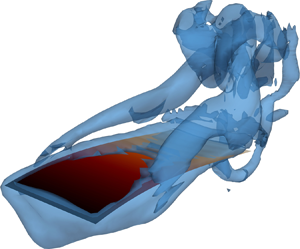

1. Introduction
The pursuit of more effective means of aquatic locomotion has compelled researchers and engineers to tackle the fluid–structure interaction problem of fish swimming (Combes & Daniel Reference Combes and Daniel2001; Chen, Shatara & Tan Reference Chen, Shatara and Tan2009; Liu & Aono Reference Liu and Aono2009; Kolomenskiy et al. Reference Kolomenskiy, Moffatt, Farge and Schneider2011; Alben et al. Reference Alben, Witt, Baker, Anderson and Lauder2012). While current man-made designs generally rely on rigid propulsors to move through a fluid, nature widely harnesses elasticity for aquatic locomotion (Jayne & Lauder Reference Jayne and Lauder1995; McHenry, Pell & Long Reference McHenry, Pell and Long1995; Lauder & Tytell Reference Lauder and Tytell2005; Fish & Lauder Reference Fish and Lauder2006). For instance, fish use their muscles to actively change the shape and stiffness of their bodies in order to swim and manoeuvre (Wardle, Videler & Altringham Reference Wardle, Videler and Altringham1995; Ramananarivo, Godoy-Diana & Thiria Reference Ramananarivo, Godoy-Diana and Thiria2013; Pabst Reference Pabst2015). Fish hydrodynamic performance is intrinsically characterized by the two-way coupling between the deformation of the fish body and the fluid flow. This complex interplay between solid and fluid motion enables fish to exhibit unmatched swimming velocities, manoeuvrability and efficiency.
Multiple experimental studies have explored bio-inspired designs of varying complexity as prototypes for underwater swimmers (Yu et al. Reference Yu, Tan, Wang and Chen2004; Hu et al. Reference Hu, Liu, Dukes and Francis2006; Philen & Neu Reference Philen and Neu2011; Marras & Porfiri Reference Marras and Porfiri2012; Kopman et al. Reference Kopman, Laut, Acquaviva, Rizzo and Porfiri2015). The earliest designs of robotic fish used complex networks of strings and servomotors to replicate the tail motion typically encountered in carangiform swimming modes (Triantafyllou & Triantafyllou Reference Triantafyllou and Triantafyllou1995; Anderson et al. Reference Anderson, Streitlien, Barrett and Triantafyllou1998). More recent designs include a series of linked sections coupled to actuators (Flammang & Lauder Reference Flammang and Lauder2009; Esposito et al. Reference Esposito, Tangorra, Flammang and Lauder2012; Su et al. Reference Su, Yu, Tan and Zhang2014; Lauder & Tangorra Reference Lauder and Tangorra2015). These locomotion approaches share a common actuation method relying on a form of heaving or pitching motion imposed at the propulsor base. We refer to this method of actuation as the external actuation. Numerous experimental and numerical studies have also explored the hydrodynamics of propulsors with a combination of heaving and pitching actuation. For instance, Piñeirua, Thiria & Godoy-Diana (Reference Piñeirua, Thiria and Godoy-Diana2017), Smits (Reference Smits2019), Van Buren, Floryan & Smits (Reference Van Buren, Floryan and Smits2019) and Quinn, Lauder & Smits (Reference Quinn, Lauder and Smits2015) investigated the impact of introducing a phase lag between a heaving and pitching actuation. The authors showed that the phase lag is a critical parameter to maximize the efficiency of the propulsor. Nevertheless, such actuation requires a high level of control of the base motion to enable complex multidimensional biomimetic propulsion, imposing constraints in terms of propulsor implementation and cost.
Research shows that the elasticity plays a critical role in biomimetic locomotion. Using experiments and modelling, Alben et al. (Reference Alben, Witt, Baker, Anderson and Lauder2012) demonstrated the existence of resonance peaks in the free-swimming velocity of an elastic oscillating plate. The model predicted that the plate velocity is proportional to the plate length to the power of  $-1/3$ and to plate flexibility to the power of
 $2/15$. Dai et al. (Reference Dai, Luo, de Sousa and Doyle2012) showed that an elastic plate generates significantly more thrust than a rigid plate at the same Strouhal number. Using experiments, Quinn, Lauder & Smits (Reference Quinn, Lauder and Smits2014) demonstrated that the resonance peaks in free-swimming velocity occur for discrete values of the effective flexibility, defined as a ratio of the added mass and bending forces. Hoover et al. (Reference Hoover, Cortez, Tytell and Fauci2018) further confirmed these findings with three-dimensional simulations of free-swimming flexible plates. Yeh & Alexeev (Reference Yeh and Alexeev2014) used fully coupled three-dimensional simulations to show that elastic propulsors could be operated at a regime of maximum propulsion near the first natural frequency or maximum efficiency away from the resonance.
Recent progress in smart materials makes it possible to overcome certain shortcomings and limitations in designing biomimetic propulsors (Wang et al. Reference Wang, Hang, Li, Wang and Xiao2008; Chen et al. Reference Chen, Shatara and Tan2009, Reference Chen, Um, Zhu and Bart-Smith2011; Chu et al. Reference Chu, Lee, Song, Han, Lee, Kim, Kim, Park, Cho and Ahn2012). Among different smart materials, internally actuated macro-fibre composites (MFCs) offer a balance between actuation control and deformation levels, as well as reduced design complexity and silent operation (Heo et al. Reference Heo, Wiguna, Park and Goo2007; Cen & Erturk Reference Cen and Erturk2013). MFC bimorph actuation is a result of a distributed internal moment due to the contraction of two MFCs bonded by a layer of epoxy. We refer to this method of actuation as internal actuation. While such smart materials are highly attractive for use in biomimetic locomotion, previous research has indicated that internally actuated propulsors underperform in terms of thrust and efficiency when compared to externally actuated propulsors (Yeh & Alexeev Reference Yeh and Alexeev2016a; Demirer et al. Reference Demirer, Wang, Erturk and Alexeev2021). The deficiency of the internal actuation is linked to a suboptimal bending pattern of such propulsors with a characteristic cupping of the actuator tip, which increases viscous losses. This leads to the question of whether a hybrid actuation that uses a combination of external and internal actuation can yield superior hydrodynamics, outperforming either of these actuation methods while offering a high degree of control over the bending pattern and propulsion characteristics.
In this work, we use fully coupled three-dimensional simulations to probe the hydrodynamics of an elastic plate propulsor actuated at resonance by combined external and internal actuation representative of a heaving MFC bimorph. We examine the effects of a phase lag between the externally imposed heaving motion at the propulsor base and the internal distributed bending moment on the propulsor hydrodynamics. We consider hybrid propulsors in constrained and free-swimming configurations. In the former configuration the plate is constrained from moving forward at its base, whereas in the latter configuration the plate can swim freely. Our simulations indicate that the hybrid actuation results in a synergistic relationship between the internal and external actuation that dramatically enhances the hydrodynamic performance of the plate propulsor.
2. Methodology
We consider a bio-inspired elastic propulsor with hybrid actuation that is driven by a combination of external and internal actuation to oscillate in an incompressible Newtonian fluid with density  $\rho$ and dynamic viscosity
 $\mu$. The propulsor is represented by a thin elastic plate of length
 $L$, width
 $w$ and thickness
 $h \ll L$, leading to an aspect ratio of
 $\mathcal {A_R} = L/w = 2.5$ (figure 1a). The plate bending stiffness is
 $D$, the mass density is
 $\rho _s$ and the mass ratio is
 $\chi = {\rho w}/{\rho _s h} = 10$. The external actuation is imposed at the plate base, leading to time-periodic heaving base oscillations
 $a(t) = A_0 L \sin (\omega t)$, where
 $A_0$ is the dimensionless heaving amplitude. The plate internal actuation is due to a time-periodic bending moment
 $m(t) = M_0 D ({L}/{w}) \sin (\omega t+\phi )$, where
 $M_0$ is the dimensionless moment amplitude and
 $\phi$ is the phase lag between the external and internal actuation (figure 1b). This time-varying bending moment is imposed at the free end of the plate through a local force couple. Note that
 $M_0$ represents the magnitude of the static tip deflection of the plate due to the bending moment normalized by the plate length. Practically, the internal actuation represents the behaviour of an MFC piezoelectric plate (Yeh & Alexeev Reference Yeh and Alexeev2016a; Demirer et al. Reference Demirer, Wang, Erturk and Alexeev2021). Here, a local bending moment is generated by bonding two MFCs with a layer of epoxy and applying opposite currents to the two MFCs (Tan & Erturk Reference Tan and Erturk2018). Among different smart materials, MFCs strike an attractive balance between actuation and displacement levels, as well as providing silent operation. The external and internal actuations share the same angular frequency
 $\omega = 2{\rm \pi} /\tau$, with
 $\tau$ being the actuation period. We set
 $\omega = \omega _{res}$, with
 $\omega _{res}$ being the fundamental resonance frequency of the plate in fluid (Weaver, Timoshenko & Young Reference Weaver, Timoshenko and Young1990), leading to a Reynolds number of
 $Re = {\rho u_c L}/{\mu } = 1000$, where
 $u_c = L/\tau$ is the characteristic velocity. The corresponding plate stiffness
 $D$ leads to the Cauchy number
 $C_y = \rho u_c^2L^3/D = 0.065$, which relates the fluid loading to the plate elasticity. To explore the hydrodynamics of combined actuation, we fix the external actuation amplitude as
 $A_0=0.1$ while varying the internal moment amplitude
 $M_0$ and the phase lag
 $\phi$.
(a) Schematic of an oscillating elastic plate with length  $L$, width
 $w$ and thickness
 $h \ll L$. The plate is actuated by a heaving motion at the base
 $a(t)$ and by a distributed internal bending moment
 $m(t)$. (b) Plate actuation signals with a phase lag
 $\phi$. (c) Simulation domain consists of a coarse outer mesh and a fine inner mesh around the oscillating solid plate at the centre.

In the constrained configuration, the plate oscillates in a quiescent fluid, and its base is kept in place in the  $x$-direction (figure 1c). The hydrodynamics of the constrained plate is characterized in terms of the dimensionless period-averaged thrust
 $F_x=f_x/f_c$, power
 $\mathcal {P}=p/p_c$ and efficiency
 $\eta _c = {f_x u_c}/{p}$. Here,
 $f_c = \frac {1}{2}\rho u_c^2 w L$ is the characteristic force, and
 $p_c = f_c u_c$ is the characteristic power. The instantaneous power is computed by integrating over the plate surface the dot product of the hydrodynamic forces and the local velocity. In the free-swimming configuration, the plate is free to propel through the fluid in the
 $x$-direction. In this configuration the total drag and thrust acting on the plate balance each other, leading to a net zero period-averaged hydrodynamic force. The free swimming is characterized by the dimensionless period-averaged swimming velocity
 $U=u/u_c$, power
 $\mathcal {P}=p/p_c$ and efficiency
 $\eta _f = {u f_c}/{p}$.
To characterize and compare the performance of propulsors with different actuation methods, we use an externally actuated plate at resonance with  $A_0 = 0.1$ as a reference configuration. The characteristics of constrained and free-swimming propulsors are normalized by the respective values for the constrained and free-swimming reference propulsors. Table 1 provides the values of the relevant hydrodynamic characteristics for the reference propulsor configurations.
Swimming characteristics of the reference externally actuated elastic plate with  $A_0 = 0.1$.

We model plate oscillations in a viscous fluid using a fully coupled fluid–structure interaction framework integrating a lattice Boltzmann (LB) model and a finite differences model (Demirer et al. Reference Demirer, Wang, Erturk and Alexeev2021). The computational domain is fitted with a cubic lattice of equally spaced nodes with higher grid density near the oscillating plate, as shown in figure 1(c). The flow is characterized by a velocity distribution function  $g_i(\boldsymbol{r},t)$ representing the density of fluid at position
 $\boldsymbol{r}$ that is propagating along the lattice direction
 $i$ with velocity
 $\boldsymbol{c}$ at time
 $t$. We use a D3Q19 lattice that maintains 19 velocity directions in the three-dimensional space. We integrate the discrete Boltzmann equation to calculate the time evolution of the distribution function
 $g_i(\boldsymbol{r},t)$ and retrieve relevant macroscopic quantities by taking moments of the distribution function (Ladd & Verberg Reference Ladd and Verberg2001).
We set  $\rho =1$,
 $\mu =1.25\times 10^{-3}$ and
 $\tau = 2000$ in LB units. The fine and coarse fluid grids, respectively, measure
 $4L \times 3L \times 3L$ and
 $8L \times 6L \times 8L$, where
 $L = 50$ LB units. The fine and coarse node spacing are, respectively,
 $\varDelta _f = 1$ and
 $\varDelta _c = 2$ in LB units. The plate is discretized with 21 nodes in the length and 11 nodes in the width, so that
 $\varDelta _x = 2.381$ and
 $\varDelta _y = 1.82$ in LB units. Further details and validation of our computational framework can be found elsewhere (Masoud & Alexeev Reference Masoud and Alexeev2010, Reference Masoud and Alexeev2012; Mao & Alexeev Reference Mao and Alexeev2014; Yeh & Alexeev Reference Yeh and Alexeev2014; Yeh, Li & Alexeev Reference Yeh, Li and Alexeev2017; Yeh, Demirer & Alexeev Reference Yeh, Demirer and Alexeev2019; Demirer et al. Reference Demirer, Wang, Erturk and Alexeev2021).
3. Results and discussion
Figure 2(a) shows the variation of the normalized thrust  $F_x/F_r$ for the constrained plate and the normalized swimming velocity
 $U/U_r$ for the free-swimming plate with the phase
 $\phi$. We find that these two propulsion metrics are strongly correlated, indicating that either can be used to characterize the plate propulsion. This correlation suggests that, with relation to their respective reference configurations (the constrained and free-swimming externally actuated plates), the hybrid actuation dependence on
 $\phi$ is similarly proportional for the thrust and swimming velocity. The propulsion is maximized when the external actuation and the internal actuation are nearly in phase at
 $\phi = {\rm \pi}/12$, and is minimized when the actuation signals are in phase opposition about
 $\phi = 11{\rm \pi} /12$. Compared to the externally actuated reference case, the combined actuation with
 $M_0 = 0.1$ doubles the propulsion, whereas using
 $M_0 = 0.05$ increases the propulsion by about 50 %. The propulsion with combined actuation increases to nearly 7.7 times that of the reference case with
 $M_0 = 0.4$ (see the inset in figure 2a). For
 $M_0 > 0.4$ the free end cupping negatively affects the swimming performance of combined actuation, decreasing the propulsion. When the plate is actuated out of phase, the combined actuation can reduce the propulsion to nearly zero. Note that the propulsion is not symmetric with respect to
 $\phi =0$ or
 $\phi ={\rm \pi}$. At
 $\phi = {\rm \pi}/2$,
 $F_x/F_r \simeq 1$, while at
 $\phi = 3{\rm \pi} /2$,
 $F_x/F_r \simeq 1.28$, which is a 28 % difference. Note also that the internal actuation alone with, respectively,
 $M_0 = 0.1$ and
 $M_0 = 0.05$ yields propulsion that is only about 50 % and 10 % of that of the externally actuated plate. Thus, the combined actuation not only enables wide control over the propulsion, but can yield propulsion that significantly exceeds the sum of the propulsion of the plates with separate external and internal types of actuation.
(a) Normalized thrust  $F_x/F_r$ and velocity
 $U/U_r$ as functions of the phase difference between the internal and external actuation
 $\phi$. The inset shows the maximum and minimum values of
 $F_x/F_r$ as a function of
 $M_0$. (b) Normalized power
 $\mathcal {P}/\mathcal {P}_r$ as a function of
 $\phi$. The horizontal dashed lines in (a) and (b) show the propulsion for internally actuated plates with
 $M_0 = 0.1$ (red lines) and
 $M_0 = 0.05$ (blue lines). The dashed lines show the thrust, while the dash-dotted lines show the velocity. (c) Dependence of the thrust
 $F_x$ and velocity
 $U$ on the amplitude of the tip displacement
 $d_t$ for
 $M_0 = 0.1$. (d) Dependence of the power
 $\mathcal {P}$ on the amplitude of the plate's centre-of-mass displacement
 $d_{CM}$ for
 $M_0 = 0.1$. In (c) and (d), the coloured circles and squares show, respectively, the combined actuation data for free-swimming and constrained configurations, with the colours indicating the phase lag
 $\phi$. The solid lines with symbols in (c) and (d) show the constrained external (filled diamonds), free-swimming external (empty diamonds), constrained internal (filled triangles) and free-swimming internal (empty triangles) actuation methods with different amplitudes of
 $A_0$ and
 $M_0$.

As shown in figure 2(b), the power exhibits a dependence on  $\phi$ that is similar to that of the propulsion. The power is maximized at
 $\phi = {\rm \pi}/6$ and minimized at
 $\phi = {\rm \pi}$. The maximum power of the plate with combined actuation significantly exceeds the cumulative power of plates with separate external and internal actuation. Furthermore, combined actuation can greatly reduce
 $\mathcal {P}$ compared to external actuation alone. Similarly to the propulsion, the power is not symmetric with respect to
 $\phi =0$ or
 $\phi ={\rm \pi}$. At
 $\phi = {\rm \pi}/2$,
 $\mathcal {P}/\mathcal {P}_r \simeq 1.49$, while at
 $\phi = 3{\rm \pi} /2$,
 $\mathcal {P}/\mathcal {P}_r \simeq 1.2$, which corresponds to a nearly 20 % difference in power. We attribute this symmetry-breaking to nonlinear effects arising from the large deformation of the plate actuated with the hybrid actuation method.
The trailing-edge displacement  $d_t$ is a major parameter that controls the plate propulsion (Michelin & Llewellyn Smith Reference Michelin and Llewellyn Smith2009). Figure 2(c) shows the propulsion metrics as functions of
 $d_t$ (see figure 1 of the supplementary material, available at https://doi.org/10.1017/jfm.2021.558, for the dependence of
 $d_t$ on
 $\phi$). We find that there is a direct relationship between the velocity and thrust data and the trailing-edge displacement. The data for externally actuated plates with varying actuation amplitudes in the free-swimming and constrained configurations closely match the results for the propulsors with combined actuation. On the other hand, free-swimming and constrained internally actuated plates with varying
 $M_0$ yield significantly lower performance than the combined actuation for comparable tip displacement. This is consistent with previous results (Demirer et al. Reference Demirer, Wang, Erturk and Alexeev2021) and can be attributed to the suboptimal bending pattern of internally actuated plates. Thus, in the case of combined actuation, the phase
 $\phi$ controls the tip displacement, which in turn defines the propulsion characteristics. Note that with the combined and external actuation methods,
 $U/U_r$ in the free-swimming configuration increases slightly faster than
 $F_x/F_r$ in the constrained configuration with increasing
 $d_t$. Furthermore, the free-swimming configuration results in somewhat smaller
 $d_t$ than the constrained configuration, which is related to an increased added mass effect due to the incoming fluid flow. Indeed, the incoming flow imposes an additional restoring force to the plate, which in turn increases the effective stiffness and lowers
 $d_t$ (Yeh & Alexeev Reference Yeh and Alexeev2014).
As shown in figure 2(d), the power  $\mathcal {P}$ scales with the displacement of the plate's centre of mass
 $d_{CM}$ (see figure 1 in the supplementary material for the dependence of
 $d_{CM}$ on
 $\phi$). The power consumption is minimized with the reduced centre-of-mass displacement and gradually increases with increasing
 $d_{CM}$. The plates with the combined actuation and the external actuation show similar dependencies, whereas the internally actuated plate requires a slightly greater power for the same centre-of-mass deflection. Note that
 $d_{t}$ and
 $d_{CM}$ for the plates with combined actuation are maximized when the external and internal actuation act in phase,
 $\phi = {\rm \pi}/12$, and minimized when they are in phase opposition,
 $\phi = {\rm \pi}$.
In figure 3(a) we show the efficiencies  $\eta _c$ and
 $\eta _f$ for, respectively, constrained and free-swimming plates with combined actuation. Both these parameters reveal a similar dependence on
 $\phi$. More importantly, the efficiency can significantly exceed the value characterizing the plate with the external actuation. The maximum efficiency of the combined actuation is about 25 % greater than that of the external actuation. The phase difference
 $\phi = 4{\rm \pi} /3$ leading to this actuation regime is nearly independent of
 $M_0$. The enhancement of the efficiency is maximized when
 $M_0 \simeq 0.075$, as shown in the inset in figure 3(a). When
 $M_0 < 0.04$, the efficiency decreases below the reference value. In this
 $M_0$ range, the increased power due to the internal actuation outweighs its benefit for the propulsion. For greater
 $M_0$, the internal actuation translates into a significant increase of the plate efficiency, up to
 $M_0 \simeq 0.1$. Further increase of
 $M_0$ yields less efficient propulsion because of the tip cupping.
(a) Normalized constrained efficiency  $\eta _c/\eta _{c,r}$ and free-swimming efficiency
 $\eta _f/\eta _{f,r}$ as functions of the phase difference
 $\phi$. The inset shows the maximum efficiency as a function of
 $M_0$. The horizontal lines show the efficiency for internally actuated plates with
 $M_0 = 0.1$ (red lines) and
 $M_0 = 0.05$ (blue lines). (b) Dependence of the efficiencies
 $\eta _c$ and
 $\eta _f$ on the ratio between the centre-of-mass and tip deflections,
 $d_{CM}/d_t$, for
 $M_0 = 0.1$. The inset shows the efficiency as a function of
 $\theta / \beta$. (c) Dependence of the efficiencies
 $\eta _c$ and
 $\eta _f$ on the thrust
 $F_x$ and velocity
 $U$ for
 $M_0 = 0.1$. In (b) and (c), the coloured circles and squares show, respectively, the combined actuation data for free-swimming and constrained configurations, with the colours indicating the phase lag
 $\phi$. The solid lines with symbols in (b) and (c) show the constrained external (filled diamonds), free-swimming external (empty diamonds), constrained internal (filled triangles) and free-swimming internal (empty triangles) actuation methods with different amplitudes of
 $A_0$ and
 $M_0$.

Note that the phase of the maximum thrust and the maximum velocity,  $\phi = {\rm \pi}/12$, does not match the phase of the maximum efficiency,
 $\phi = 4{\rm \pi} /3$. Thus, the maximum propulsion is achieved at the cost of reduced efficiency. Furthermore, the combined actuation with
 $M_0 = 0.4$ that yields the overall maximum thrust
 $F_x/F_r \simeq 7.7$ at
 $\phi = {\rm \pi}/12$ (figure 2a) has a reduced efficiency of
 $\eta _c/\eta _{r,c} \simeq 0.86$, whereas at
 $\phi = 4{\rm \pi} /3$ the thrust is
 $F_x/F_r \simeq 2$ and the efficiency is
 $\eta _c/\eta _{r,c} \simeq 0.98$.
The efficiency represents the ratio of the propulsion metrics and the power. Since the propulsion and the power scale with, respectively,  $d_t$ and
 $d_{CM}$, in figure 3(b) we plot
 $\eta _c$ and
 $\eta _f$ as functions of
 $d_{CM}/d_t$. Indeed we find that the data for the plates with combined actuation cluster closely, showing a decreasing trend with increasing
 $d_{CM}/d_t$. Thus, for efficient propulsion, the bending pattern needs to have low
 $d_{CM}$ and high
 $d_t$, whereas plate oscillations in which
 $d_{CM}$ increases with respect to
 $d_t$ result in less efficient propulsion. For plates with independent internal and external actuation, we find that
 $d_{CM}/d_t$ changes only slightly with the amplitude, since at resonance the bending patterns weakly depend on the oscillation amplitude.
Note that for the plates with internal actuation only,  $d_{CM}/d_t$ is relatively small compared to the value for externally actuated plates, and about the same as the lowest
 $d_{CM}/d_t$ obtained with hybrid actuation. Nevertheless, these propulsors show low efficiency due to the suboptimal tip bending. Thus, having low
 $d_{CM}/d_t$ is insufficient for efficient locomotion. In the inset in figure 3(b), we show the efficiency as a function of the ratio
 $\theta /\beta$ between the tip angle at the maximum velocity
 $\theta$ and the base angle
 $\beta = \arctan ({\omega A_0 L}/{U})$ (Ramananarivo, Godoy-Diana & Thiria Reference Ramananarivo, Godoy-Diana and Thiria2011) (see figure 2 in the supplementary material). In the constrained configuration, the plate oscillates in quiescent fluid; therefore we approximate the cruising velocity
 $U$ by the tip velocity
 $V_t$, which yields
 $\beta = \arctan ({\omega A_0 L}/{V_t})$.
For efficient swimming,  $\theta /\beta$ should be between 0.5 and 1 (Ramananarivo et al. Reference Ramananarivo, Godoy-Diana and Thiria2011). We find that the externally actuated plates and the plates with hybrid actuation with higher efficiency are indeed close to the range of efficient
 $\theta /\beta$. The internally actuated plates, on the other hand, have values of
 $\theta /\beta$ that are much lower than the optimum range, confirming that the low efficiency is due to the bending pattern with a suboptimal tip angle. In the free-swimming configuration,
 $\theta /\beta > 1$ leads to flow separation and increased drag, which negatively affects the energetic performance. Although a direct translation between the stationary and free-swimming cases is not expected, we find good agreement with this criterion in both instances. When the propulsor is stationary, the magnitude of the local flow velocity induced by the plate is estimated to be about that of the plate tip velocity. We find that similarly to the free-swimming case, an exceedingly large magnitude of
 $\theta /\beta$ is detrimental to propulsion performance, because of increased dissipation.
Overall, the propulsor performance is enhanced when both the efficiency and propulsion are maximized. In figure 3(c) we show the relationship between the efficiency and the propulsion. For the plate with the external actuation, the efficiency decreases with increasing propulsion. Thus, one needs to compromise by maximizing either the propulsor's efficiency or its propulsion. Although the internally actuated plate performs poorly compared to the plate with external actuation, the plate with a combination of external and internal actuation yields a propulsor that significantly outperforms the externally actuated plate in terms of both characteristics simultaneously, as indicated by the green ellipse in figure 3(c). The combined actuation surpasses the externally actuated propulsor in both propulsion and efficiency in a wide range of  $3{\rm \pi} /2<\phi <2{\rm \pi}$. Note that the maximum propulsion at
 $\phi ={\rm \pi} /12$ is characterized by higher efficiency than an equivalent propulsion level achieved by the external actuation with an increased actuation amplitude. The combined actuation yields up to 60 % greater propulsion for the same efficiency and is 25 % more efficient for the same propulsion output than the external actuation.
In figure 4, we examine the bending pattern and the hydrodynamics of plates with combined actuation at the maximum efficiency ( $\phi = 4{\rm \pi} /3$) and the maximum propulsion (
 $\phi = {\rm \pi}/12$) (see also figure 3 in the supplementary material for additional values of
 $\phi$). At the maximum propulsion, the plate exhibits a typical bending pattern for actuation at resonance that maximizes the tip deflection (figure 4a). At the maximum efficiency, the bending pattern develops a dip near the middle of the plate, reducing the displacement of the centre of mass (figure 4b). Note that the bending pattern at
 $\phi = {\rm \pi}/12$ is similar to that of an externally actuated plate, whereas the internally actuated plate shows a distinctly different pattern with no displacement at the root and non-vanishing curvature at the tip (Demirer et al. Reference Demirer, Wang, Erturk and Alexeev2021) (see figure 4 in the supplementary material).
(a) Bending pattern of a plate with combined actuation at the maximum thrust ( $\phi = {\rm \pi}/12$). (b) Bending pattern of a plate with combined actuation at the maximum efficiency (
 $\phi = 4{\rm \pi} /3$). The solid blue lines and the dashed red lines in (a) and (b) correspond to the plate profiles during the upstroke and downstroke, respectively. (c) Time histories of the tip displacement
 $d_t$ and the centre-of-mass displacement
 $d_{CM}$ at the maximum efficiency and the maximum thrust. (d) Contours of the normalized vorticity
 $\omega \tau = 10$ for (i) the maximum thrust and (ii) the maximum efficiency (see movie 1 in the supplementary material). (e) Dependence of the enstrophy
 $\mathcal {E}$ on the maximum centre-of-mass displacement
 $d_{CM}$. (f) Dependence of the enstrophy
 $\mathcal {E}$ on the power
 $\mathcal {P}$. In (e) and (f), the coloured circles and squares show, respectively, the combined actuation data for free-swimming and constrained configurations, with the colours indicating the phase lag
 $\phi$. The solid lines with symbols in (e) and (f) show the constrained external (filled diamonds), free-swimming external (empty diamonds), constrained internal (filled triangles) and free-swimming internal (empty triangles) actuation with different amplitudes of
 $A_0$ and
 $M_0$.

The tip and centre-of-mass displacements over an oscillation period are shown in figure 4(c). At  $\phi = {\rm \pi}/12$, the tip and centre of mass move by nearly 50 % more than at
 $\phi = 4{\rm \pi} /3$. In terms of the phase lag between the tip and actuation signals,
 $\varphi$, our simulations show that in the regime of maximum efficiency, the tip and actuation are in phase quadrature, as is characteristic of resonance oscillations, whereas at the maximum efficiency the phase is
 $\varphi \simeq 2{\rm \pi} /3$. This confirms that the combined actuation modulates
 $\varphi$ and, therefore, the bending mode (see figure 5 in the supplementary material).
We use the mean enstrophy  $\mathcal {E}$ to quantify the vorticity generated by the plates (Demirer et al. Reference Demirer, Wang, Erturk and Alexeev2021). We find that
 $\mathcal {E}$ roughly scales with
 $d_{CM}$ (figure 4e), indicating that the magnitude of centre-of-mass displacement dictates to a large extent the amount of vorticity produced by the plate. The plates with solely internal or solely external actuation generate
 $\mathcal {E}$ similar to that of the combined actuation plate. Furthermore, when
 $\mathcal {E}$ is plotted against the power
 $\mathcal {P}$ (figure 4f), we find that the data for all actuation methods collapse into a single curve. Thus, the power indeed scales with the amount of enstrophy, which in turn is defined by the centre-of-mass displacement. Interestingly, the enstrophy is sensitive to the plate configuration. Free-swimming plates generate significantly less enstrophy than constrained plates for comparable power
 $\mathcal {P}$, when
 $\mathcal {P}$ is sufficiently large. This holds for combined, external and internal actuation.
4. Conclusions
We have shown that the hybrid internal–external actuation can be used to regulate the hydrodynamic performance of a propulsor by changing the phase difference between the actuation methods while maintaining high efficiency, outperforming propulsors with a single actuation method. Our results suggest that the propulsion scales with the magnitude of the tip displacement, whereas the power scales with the displacement of the centre of mass of the propulsor. The hybrid actuation provides a unique way to regulate the balance between these two metrics, thereby yielding an efficient propulsor with superior performance. These findings indicate that energy dissipation is mostly associated with vortex generation and side-edge vortices, whereas the propulsion is controlled by the trailing-edge vortices, which is consistent with previous studies on flexible propulsors (Dai et al. Reference Dai, Luo, de Sousa and Doyle2012; Quinn et al. Reference Quinn, Lauder and Smits2014; Raspa et al. Reference Raspa, Ramananarivo, Thiria and Godoy-Diana2014; Yeh & Alexeev Reference Yeh and Alexeev2016b; Li, Liu & Su Reference Li, Liu and Su2017). The hybrid propulsor performance is analysed in a constrained configuration, where the propulsor oscillates in a quiescent fluid and its base is kept from moving forward, and in a free-swimming configuration, where the propulsor can freely propel forward through the fluid. Our simulations show that the hydrodynamic performance in these two configurations is closely correlated, although in free swimming, the propulsor exhibits a slightly lower trailing-edge displacement due to the effect of upcoming fluid flow.
Our results are also useful for developing biomimetic propulsors with other modes of combined actuation, such as propulsors using a combination of heaving and pitching root actuation. Such propulsors have been the subject of numerous studies indicating that the angle of attack and the phase lag between the heaving and pitching are critical parameters to maximize the efficiency (Quinn et al. Reference Quinn, Lauder and Smits2015; Piñeirua et al. Reference Piñeirua, Thiria and Godoy-Diana2017; Smits Reference Smits2019). In particular, it has been shown that the thrust is maximized at the phase difference  $11{\rm \pi} /6$, the power is minimized at
 $7{\rm \pi} /6$ and the efficiency is maximized at
 $3{\rm \pi} /2$ (Van Buren et al. Reference Van Buren, Floryan and Smits2019), which are close to the respective phases identified for the hybrid internal–external actuation.
Macro-fibre composite (MFC) piezoelectric materials are particularly attractive for designing active propulsors with combined actuation because of their robustness and high efficiency (Sodano Reference Sodano2003; Williams, Inman & Wilkie Reference Williams, Inman and Wilkie2006; Cen & Erturk Reference Cen and Erturk2013). In this case, the base of the MFC propulsor can be actuated using a mechanical system similar to those used in current designs (Mason & Burdick Reference Mason and Burdick2000; Yan et al. Reference Yan, Han, Zhang and Yang2008; Wu et al. Reference Wu, Yu, Su, Tan and Li2015), whereas the piezoelectric actuation can be harnessed to impose a time-periodic internal bending moment dynamically modulating the propulsor shape. Active propulsors, such as those made of MFC piezoelectric materials, are especially promising for the design of small-scale robotic swimmers, because they offer reduced mechanical complexity, ease of integration and operational control (Tan & Erturk Reference Tan and Erturk2018). We note that our simulations point to the superior hydrodynamic efficiency of propulsors with combined actuation. In practice, additional energy losses associated with the driving and control mechanisms need to be accounted for in evaluating overall swimmer performance. While this depends on the specific implementation, piezoelectric materials typically exhibit high efficiency, up to 90 %, in converting electrical energy into mechanical work (Richards et al. Reference Richards, Anderson, Bahr and Richards2004; Steiger & Mokrỳ Reference Steiger and Mokrỳ2015; Nabawy & Crowther Reference Nabawy and Crowther2016). Consequently, MFC propulsors can be expected to yield high overall efficiency compared to traditional mechanical propulsors, while providing reduced size, enhanced robustness and operational flexibility.
The performance of propulsors with combined actuation could potentially be further improved by employing more advanced forms of internal actuation, such as segmented MFC actuators with independent control of individual sequential segments. In this scenario, each segment could be used to impose a bending moment, enabling greater control over the dynamics of the propulsor that could be further optimized to mimic fish-like kinematics for enhanced hydrodynamic performance. Furthermore, hybrid propulsors could be used not only for forward propulsion but also for swimmer navigation, by applying asymmetric actuation to the MFCs; this would simplify the design and operation of robotic swimmers. Finally, piezoelectric propulsors could be used to harvest energy from unsteady fluid environments, enabling increased autonomy of robotic swimmers (Yang, Tang & Li Reference Yang, Tang and Li2009; Song et al. Reference Song, Choi, Wereley and Purekar2010; Erturk & Inman Reference Erturk and Inman2011).
Supplementary material
A supplementary movie and other material are available at https://doi.org/10.1017/jfm.2021.558.
Funding
We thank the National Science Foundation (CBET-1705739) for financial support.
Declaration of interest
The authors report no conflict of interest.



