


 from the T/NT interface, where
 is the Kolmogorov micro-scale. Deep inside the jet shear layer the characteristics of the IVSs are similar to the IVSs found in many other flows: the mean radius, tangential velocity and circulation Reynolds number are
 ,
 , and
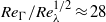 , where
 , and
 are the root mean square of the velocity fluctuations and the Reynolds number based on the Taylor micro-scale, respectively. Moreover, as in forced isotropic turbulence the IVSs inside the jet are well described by the Burgers vortex model, where the vortex core radius is stable due to a balance between the competing effects of axial vorticity production and viscous diffusion. Statistics conditioned on the distance from the T/NT interface are used to analyse the effect of the T/NT interface on the geometry and dynamics of the IVSs and show that the mean radius
 , tangential velocity
 and circulation
 of the IVSs increase as the T/NT interface is approached, while the vorticity norm
 stays approximately constant. Specifically
 ,
 and
 exhibit maxima at a distance of roughly one Taylor micro-scale from the T/NT interface, before decreasing as the T/NT is approached. Analysis of the dynamics of the IVS shows that this is caused by a sharp decrease in the axial stretching rate acting on the axis of the IVSs near the jet edge. Unlike the IVSs deep inside the shear layer, there is a small predominance of vortex diffusion over stretching for the IVSs near the T/NT interface implying that the core of these structures is not stable i.e. it will tend to grow in time. Nevertheless the Burgers vortex model can still be considered to be a good representation for the IVSs near the jet edge, although it is not as accurate as for the IVSs deep inside the jet shear layer, since the observed magnitude of this imbalance is relatively small.


Crossref Citations

This article has been cited by the following publications. This list is generated based on data provided by Crossref.
Philip, Jimmy
and
Marusic, Ivan
2012.
Large-scale eddies and their role in entrainment in turbulent jets and wakes.
Physics of Fluids,
Vol. 24,
Issue. 5,
Jacobitz, Frank G.
Schneider, Kai
Bos, Wouter J.T.
and
Farge, Marie
2012.
On helical multiscale characterization of homogeneous turbulence.
Journal of Turbulence,
Vol. 13,
Issue. ,
p.
N35.
Taveira, Rodrigo R.
Diogo, José S.
Lopes, Diogo C.
and
da Silva, Carlos B.
2013.
Lagrangian statistics across the turbulent-nonturbulent interface in a turbulent plane jet.
Physical Review E,
Vol. 88,
Issue. 4,
Taveira, Rodrigo R.
and
da Silva, Carlos B.
2013.
Kinetic energy budgets near the turbulent/nonturbulent interface in jets.
Physics of Fluids,
Vol. 25,
Issue. 1,
Wolf, Marc
Holzner, M.
Lüthi, B.
Krug, D.
Kinzelbach, W.
and
Tsinober, A.
2013.
Effects of mean shear on the local turbulent entrainment process.
Journal of Fluid Mechanics,
Vol. 731,
Issue. ,
p.
95.
Hickey, Jean-Pierre
Hussain, Fazle
and
Wu, Xiaohua
2013.
Role of coherent structures in multiple self-similar states of turbulent planar wakes.
Journal of Fluid Mechanics,
Vol. 731,
Issue. ,
p.
312.
Taveira, Rodrigo R.
and
da Silva, Carlos B.
2014.
Erratum: “Characteristics of the viscous superlayer in shear free turbulence and in planar turbulent jets” [Phys. Fluids 26, 021702 (2014)].
Physics of Fluids,
Vol. 26,
Issue. 8,
Atkinson, C
Hackl, J
Stegeman, P
Borrell, G
and
Soria, J
2014.
Numerical issues in Lagrangian tracking and topological evolution of fluid particles in wall-bounded turbulent flows.
Journal of Physics: Conference Series,
Vol. 506,
Issue. ,
p.
012003.
da Silva, Carlos B.
Hunt, Julian C.R.
Eames, Ian
and
Westerweel, Jerry
2014.
Interfacial Layers Between Regions of Different Turbulence Intensity.
Annual Review of Fluid Mechanics
,
Vol. 46,
Issue. 1,
p.
567.
Watanabe, T.
Sakai, Y.
Nagata, K.
Ito, Y.
and
Hayase, T.
2014.
Enstrophy and passive scalar transport near the turbulent/non-turbulent interface in a turbulent planar jet flow.
Physics of Fluids,
Vol. 26,
Issue. 10,
ICHIMIYA, Masashi
MATSUDAIRA, Hayato
and
FUJIMURA, Hayato
2014.
Laminar-turbulent transition of an inlet boundary layer in a circular pipe induced by periodic injection (Turbulence within isolated turbulent patches and its growth mechanism).
Journal of Fluid Science and Technology,
Vol. 9,
Issue. 1,
p.
JFST0003.
Watanabe, T.
Sakai, Y.
Nagata, K.
Ito, Y.
and
Hayase, T.
2014.
Wavelet analysis of coherent vorticity near the turbulent/non-turbulent interface in a turbulent planar jet.
Physics of Fluids,
Vol. 26,
Issue. 9,
da Silva, Carlos B
Taveira, Rodrigo R
and
Borrell, Guillem
2014.
Characteristics of the turbulent/nonturbulent interface in boundary layers, jets and shear-free turbulence.
Journal of Physics: Conference Series,
Vol. 506,
Issue. ,
p.
012015.
Taveira, Rodrigo R.
and
da Silva, Carlos B.
2014.
Characteristics of the viscous superlayer in shear free turbulence and in planar turbulent jets.
Physics of Fluids,
Vol. 26,
Issue. 2,
Philip, Jimmy
Meneveau, Charles
de Silva, Charitha M.
and
Marusic, Ivan
2014.
Multiscale analysis of fluxes at the turbulent/non-turbulent interface in high Reynolds number boundary layers.
Physics of Fluids,
Vol. 26,
Issue. 1,
Watanabe, Tomoaki
Sakai, Yasuhiko
Nagata, Kouji
Ito, Yasumasa
and
Hayase, Toshiyuki
2014.
Vortex stretching and compression near the turbulent/non-turbulent interface in a planar jet.
Journal of Fluid Mechanics,
Vol. 758,
Issue. ,
p.
754.
Watanabe, T.
Sakai, Y.
Nagata, K.
Ito, Y.
and
Hayase, T.
2014.
Reactive scalar field near the turbulent/non-turbulent interface in a planar jet with a second-order chemical reaction.
Physics of Fluids,
Vol. 26,
Issue. 10,
Watanabe, T.
Naito, T.
Sakai, Y.
Nagata, K.
and
Ito, Y.
2015.
Mixing and chemical reaction at high Schmidt number near turbulent/nonturbulent interface in planar liquid jet.
Physics of Fluids,
Vol. 27,
Issue. 3,
Watanabe, T.
Sakai, Y.
Nagata, K.
Ito, Y.
and
Hayase, T.
2015.
Turbulent mixing of passive scalar near turbulent and non-turbulent interface in mixing layers.
Physics of Fluids,
Vol. 27,
Issue. 8,
Jahanbakhshi, R.
Vaghefi, N. S.
and
Madnia, C. K.
2015.
Baroclinic vorticity generation near the turbulent/ non-turbulent interface in a compressible shear layer.
Physics of Fluids,
Vol. 27,
Issue. 10,