




1. Relativization in French: Form-function Symmetry vs. Variation
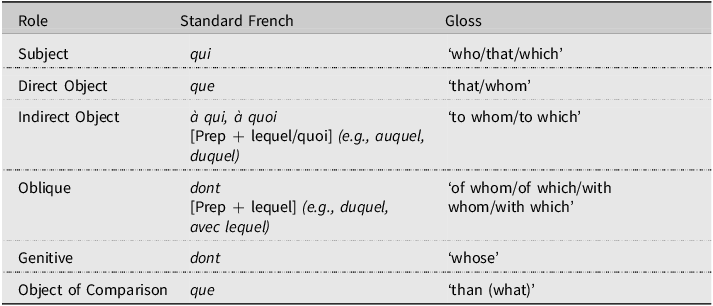
Natural languages allow multiple formally distinct options to alternate in discourse to express comparable meanings, even where only one variant is prescriptively mandated. This tension is particularly visible in relativization. In standard French, relativization is organized around a relatively tight form–function mapping, e.g., qui is associated with subject position, que with direct objects, and dont (along with other prepositional relatives) with oblique and genitive functions (Table 1).
Distribution of the relative markers for standard French, with approximate English equivalents. Adapted from Grevisse and Goosse (Reference Grevisse and Goosse2016)

Table 1. Long description
A table with six rows and three columns comparing the roles, standard French relative markers, and their English glosses. The columns are labeled Role, Standard French, and Gloss. The rows are as follows: Row 1: Role, Subject, Standard French, qui, Gloss, ‘who/that/which’. Row 2: Role, Direct Object, Standard French, que, Gloss, ‘that/whom’. Row 3: Role, Indirect Object, Standard French, à qui, à quoi [Prep + lequel/quoi] (e.g., auquel, duquel), Gloss, ‘to whom/to which’. Row 4: Role, Oblique, Standard French, dont [Prep + lequel] (e.g., duquel, avec lequel), Gloss, ‘of whom/of which/with whom/with which’. Row 5: Role, Genitive, Standard French, dont, Gloss, ‘whose’. Row 6: Role, Object of Comparison, Standard French, que, Gloss, ‘than (what)’
Yet relative clauses also represent a well-documented locus of mismatch between prescriptive paradigms and vernacular usage. Whereas the standard system relies on a rich inventory of specialized relativizers, spontaneous speech displays a far more asymmetrical distribution. In particular, generalized que (Kayne, Reference Kayne, Hensey and Luján1976; Blanche-Benveniste, Reference Blanche-Benveniste, Bechert, Bernini and Buridant1990: 318), also described as a “passe-partout” subordinating marker (Gadet, Reference Gadet1995: 145), extends into contexts where the standard system would require dont in oblique position (1) or qui in subject position (2).
(1)
Il y a un lot d’affaires que je me souviens (standard: dont) [4/160]Footnote
1
‘There are a bunch of things that I remember.’
(2)
Je ne sais pas si j’ai parlé trop ou si j’ai pas parlé assez, mais c’était vraiment ça que ça se passait (standard: qui) [2/202]
‘I don’t know if I talked too much or not enough, but that’s really what was happening.’ (lit. ‘that’s really that which was happening’)
Subject relatives are generally described as highly stable, with limited variation often attributed to informal/popular speech or performance errors (e.g., Larrivée and Skrovec, Reference Larrivée and Skrovec2016: 7). By contrast, non-subject relatives display substantially greater variability. In these domains, que frequently functions as an unmarked default strategy, extending into oblique and genitive contexts where the standard grammar prescribes specialized forms such as dont or complex prepositional relatives. Such uses have long attracted normative censure: relative clauses are normatively characterized as a subordonnée problème or maudite relative (Paret, Reference Paret1991; Dolz-Mestre and Schneuwly, Reference Dolz-Mestre, Schneuwly, Dolz and Simard2009), generalized que is routinely stigmatized as error, and forms such as dont and lequel are imbued with associations of formality and correctness.
Relativizer choice bears on three interrelated dimensions. Structurally, cross-linguistic and French-specific research shows that less accessible syntactic positions are more complex, less frequent (Keenan and Comrie, Reference Keenan and Comrie1977), and more variable, favouring reduced or less specified strategies such as generalized que (Stark, Reference Stark2009). From a processing perspective, relativization involves dependency formation whose cognitive demands increase with distance and structural complexity, potentially favouring in colloquial varieties reduced marking (Tagliamonte et al., Reference Tagliamonte, Smith and Lawrence2005: 97), resumptive strategies, or, in oblique contexts, preposition stranding. Finally, stylistic and social factors may intervene, given the normative salience of complex relativizers such as dont (Gadet, Reference Gadet1989, Reference Gadet1995).
The present study departs from this error-based perspective by treating non-standard relativization strategies as systematic, probabilistic options within the grammar rather than as deviations from it. It examines the interaction of these dimensions in a variety of Acadian French spoken in Nova Scotia, against a broader backdrop of regional variation across Acadian communities.
2. Acadian French: Relativization, Regional Variation, and Standard-Language Pressure
Acadian French offers an important testing ground for the study of relativization because previous research documents a wide range of strategies across Acadian and related North American French varieties. These include variation in subject relatives, the extension of que beyond direct-object contexts, reduced and resumptive relatives, preposition stranding, and contact-induced forms such as which que (King and Roberge, Reference King and Roberge1990: 352; King, Reference King1991: 66; Picolet-Crépault, Reference Picolet-Crépault, Belyazid, Belyazid, Cochrane, Côté, de Blois, Faucher, Jean and Zouali1994: 147–148; Rottet, Reference Rottet2001: 229, 232; Giancarli, Reference Giancarli2005, Reference Giancarli2017; Neumann-Holzschuh and Mitko, Reference Neumann-Holzschuh and Mitko2018: 533).Footnote 2 Subject relatives nevertheless remain the most stable domain: qui is the regular subject relativizer and is considerably more resistant to omission than que (Neumann-Holzschuh and Mitko, Reference Neumann-Holzschuh and Mitko2018: 550–551). Yet this domain is also a well-known site of Acadian morphosyntactic reorganization. With plural antecedents, several varieties allow third-person singular verbal morphology, the so-called “default singular” (King, Reference King2013: 69). The pattern is strongly regionally differentiated, being most advanced in Newfoundland French and Isle Madame French, whereas Chéticamp, Clare, and southeastern New Brunswick retain substantially higher rates of plural agreement (Flikeid, Reference Flikeid, Mougeon and Beniak1989b: 194–195; Flikeid and Péronnet, Reference Flikeid and Péronnet1989: 230; King, Reference King1994: 244, Reference King, Cornips and Corrigan2005: 214, Reference King2013: 71; Neumann-Holzschuh and Mitko, Reference Neumann-Holzschuh and Mitko2018: 537). Comparable patterns are reported for Chiac. Perrot (Reference Perrot, Brasseur and Falkert2005) finds non-agreement in 22% of cases, although agreement remains categorical in existential frames such as y en a qui sont pas trop riches ‘there are some who aren’t very rich’ (ibid: 191). Other subject variants include elided qui and que followed by resumptive subject pronouns in quasi-fixed sequences such as que c’est, que ça, and que ça c’est (Wiesmath, Reference Wiesmath2006: 188–189; Neumann-Holzschuh and Mitko, Reference Neumann-Holzschuh and Mitko2018: 536, 538–540), configurations described as “very widespread in Maritime Acadian speech” (ibid: 539).
Outside the subject domain, the system is more strongly organized around generalized que. Functionally specialized markers such as dont and the lequel series are generally absent from vernacular speech, appearing mainly in highly monitored or formal contexts (ibid: 513). In oblique relatives, three recurrent strategies are attested (ibid: 542–548): prepositional phrase (PP) chopping (also known as preposition ghosting), whereby the preposition is omitted, especially with semantically light à and de (Giancarli, 2005: 92, Reference Giancarli2017: 56; see also Rottet, Reference Rottet2001: 232); resumptive relatives, where the dependency is recovered by a personal pronoun, ça, a possessive determiner, or en (Neumann-Holzschuh and Mitko, Reference Neumann-Holzschuh and Mitko2018: 546–547); and preposition stranding, where the selecting preposition remains clause-final (ibid: 548). Although explicitly condemned by prescriptive grammars (for discussion, see Poplack et al., Reference Poplack, Zentz and Dion2012: 206; Grevisse and Goosse, Reference Grevisse and Goosse2016: 1441), preposition stranding is documented across several North American French varieties, including PEI, Chiac/New Brunswick, Baie Sainte-Marie, and Louisiana French (King and Roberge, Reference King and Roberge1990: 351–354; King, Reference King1991: 71, 81; Giancarli, Reference Giancarli2005: 84, 89, 95; Rottet, Reference Rottet, Neumann-Holzschuh and Bagola2016: 276–278; Giancarli, Reference Giancarli2017: 6, 55–56; Neumann-Holzschuh and Mitko, Reference Neumann-Holzschuh and Mitko2018: 548–550). While their precise structural characteristics are not necessarily isomorphic across varieties, these studies consistently show that preposition stranding forms part of the grammar rather than reflecting isolated performance errors. Péronnet and Kasparian (Reference Péronnet, Kasparian and Brasseur1998: 256–257) further document the expansion of PP-chopping as clause-final prepositions are increasingly eschewed on account of their negative social evaluation. Contact with English has further favoured variety-specific innovations, including which que and WH-ever que, attested in PEI, Nova Scotia (Pubnico, Isle Madame), and southeastern New Brunswick (King, Reference King1991: 66; Neumann-Holzschuh and Mitko, Reference Neumann-Holzschuh and Mitko2018: 565). Which que occurs with inanimate antecedents, thereby introducing an animate/inanimate semantic distinction absent from the standard qui/que paradigm (King, Reference King1991: 74).
Collectively, these studies situate Acadian relativization along a continuum of retention and innovation: non-standard forms are patterned and embedded in community-specific grammars. Yet many of these strategies are also documented in vernacular Hexagonal French (e.g., Gadet, Reference Gadet1989, Reference Gadet1992, Reference Gadet1995). Default singular agreement is one such case; King (Reference King1994: 249) notes earlier reports in working-class European French by Frei (Reference Frei1971) and Bauche (Reference Bauche1946).
Normative pressure is also directly relevant to variation in relativization strategies in Acadian French. Linguistic insecurity is particularly acute in Acadian contexts (Boudreau, Reference Boudreau2009: 441–442; see also Boudreau, Reference Boudreau2005), inciting speakers to monitor their own linguistic practices closely (Boudreau, Reference Boudreau2009: 455, Reference Boudreau2014: 180–181). Functionally specialized markers such as dont are imbued with strong connotations of formality, schooling, and normative control (Gadet, Reference Gadet1995: 145; Neumann-Holzschuh and Mitko, Reference Neumann-Holzschuh and Mitko2018: 513, 533, 540), and may therefore be perceived as more legitimate under prescriptive pressure (Boudreau, Reference Boudreau, Bigot, Friesner and Tremblay2013: 103, Reference Boudreau2014: 180–181). This normative salience has even favoured the extension of dont beyond its canonical syntactic function through hypercorrection, a pattern documented in both Acadian French and other French varieties (Godard, Reference Godard1989; Gadet, Reference Gadet1995: 144, 151; Auger, Reference Auger and Andersen1995: 21; Péronnet and Kasparian, Reference Péronnet, Kasparian and Brasseur1998: 252–253; Tellier and Valois, Reference Tellier and Valois2006: 35; Fiorentino, Reference Fiorentino2007: 268). Higher educational attainment likewise favours more standard agreement patterns in Acadian subject relatives (Flikeid, Reference Flikeid, Mougeon and Beniak1989b; Flikeid and Péronnet, Reference Flikeid and Péronnet1989; King, Reference King2013).
Patterns of relativization in Chéticamp must also be considered against its distinctive sociolinguistic profile: a strong francophone concentration, relatively limited use of English lexical material in contrast with other Nova Scotian regions, and a longer tradition of French-language schooling (Flikeid, Reference Flikeid, Mougeon and Beniak1989b: 196–197; Flikeid and Péronnet, Reference Flikeid and Péronnet1989: 231–232; see also Comeau, Reference Comeau2019: 1).Footnote 3 These features are collectively pertinent because they situate Chéticamp at the intersection of vernacular continuity, local francophone vitality, and exposure to standard-oriented French, rather than as a straightforward case of generalized minority-language attrition.
Against this background, the present study investigates whether que functions as a generalized relative marker, how its distribution is constrained relative to functionally specialized forms (e.g., qui, dont), and whether variation in subject relatives, if attested, reflects internal and/or external conditioning.
3. Methodology
3.1. Data Collection Protocol
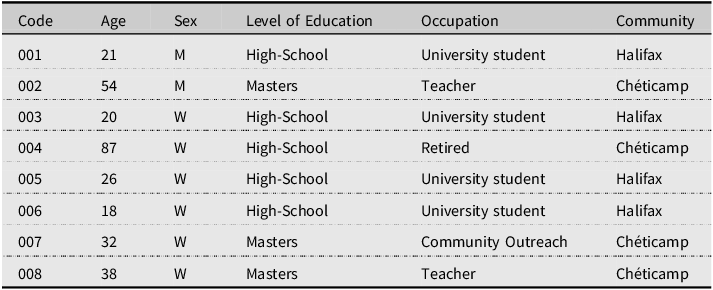
This study draws on a corpus of Acadian French associated with the speech community of Chéticamp (Digesto, Reference Digesto2024).Footnote 4 It consists of sociolinguistic interviews (Labov, Reference Labov, Baugh and Sherzer1984) recorded from eight bilingual speakers with strong ties to Chéticamp, either because they were born and raised there (two now residing in Halifax) or through family background and sustained exposure to the community (Table 2). Transcription aimed to remain scrupulously faithful to speakers’ vernacular usage. Sociodemographic information on educational background, language use, and social networks was collected through an ethnolinguistic questionnaire and supplemented during the interviews. Interviews were conducted either by the author or by a research assistant from the speech community. The author is a speaker of Hexagonal rather than Acadian French, whereas the research assistant was born and raised in the Acadian speech community and is a native speaker of the local variety. The research assistant conducted most interviews independently; the author conducted three interviews (Speakers 004, 007, and 008). Most took place in participants’ homes, with one conducted in a quiet lounge on a university campus. Given the speakers’ educational profiles, some convergence toward the standard might be expected, making the corpus particularly well suited to assessing both the persistence and the limits of non-standard relativization in a socially mobile, highly literate segment of the community.
3.2. Variationist Framework
The analysis adopts a variationist sociolinguistic approach, which treats linguistic variability as systematic and grammatically structured rather than as random or chaotic (Weinreich et al., Reference Weinreich, Labov and Herzog1968; Labov, Reference Labov1972). Following the Principle of Accountability (Labov, Reference Labov1972), the envelope of variation includes all relevant outcomes, standard and non-standard alike, so that observed distributions reflect properties of the grammar rather than artefacts of selective sampling. Because linguistic variation is shaped by multiple interacting constraints, multivariate analyses estimate the contribution of internal and external factors to variant choice (Labov, Reference Labov1972; Bayley, Reference Bayley, Chambers, Trudgill and Schilling-Estes2002; Tagliamonte, Reference Tagliamonte2025; see also Poplack and Levey, Reference Poplack, Levey, Auer and Schmidt2010; Poplack, Reference Poplack, Heine and Narrog2011). Tokens were identified manually by reading through the transcribed interviews, with systematic cross-checking against the digital audio files where necessary. This procedure was designed to account for both canonical and non-canonical (i.e., prescriptively non-sanctioned) relative clause constructions. Constructions outside the envelope of variation – non-restrictive, free, and adverbial relatives – were excluded prior to coding, as were false starts, reformulations, and incomplete tokens. All eligible tokens were coded for a set of predictors motivated by cross-linguistic work on relativization and descriptions of vernacular French relative clause constructions discussed in Sections 1 and 2.
3.3. Operationalization and Coding
Syntactic function of the relativized element. Tokens were coded as subject, direct object, indirect object, oblique, genitive, or object of comparison. This coding follows the Accessibility Hierarchy (Keenan and Comrie, Reference Keenan and Comrie1977; Comrie and Keenan, Reference Comrie and Keenan1979), which predicts a frequency and processing gradient supported by quantitative studies across languages and varieties (e.g., Tarallo, Reference Tarallo1983; Fiorentino, Reference Fiorentino1999; Tagliamonte et al., Reference Tagliamonte, Smith and Lawrence2005; Levey and Hill, Reference Levey and Hill2013):
Subject > Direct Object > Indirect Object > Oblique > Genitive > Object of Comparison
The hierarchy provides a principled framework for testing whether departures from the standard system cluster in structurally less accessible domains, i.e., lower positions on the Accessibility Hierarchy. From a processing perspective, however, Rohdenburg’s Complexity Principle leads to a competing expectation: more explicit options tend to be preferred in cognitively more complex environments (Rohdenburg, Reference Rohdenburg2020: 771). In French, this predicts that as speakers relativize lower-accessibility functions, especially obliques and genitives, selection should shift away from generalized que and toward more explicit marking, notably dont (and, where available, prepositional relatives). Coding syntactic function thus provides a direct empirical basis for examining the interaction between structural accessibility and competing grammatical pressures in relativization.
Dependency length and clause complexity. Processing-related effects were assessed through dependency length and clause complexity. Dependency length was operationalized as a continuous measure of linear distance, i.e., the number of orthographic words separating the antecedent head from the relativized position, excluding the relative marker itself. Clause complexity was coded independently as simple (3), containing only a verb and its non-clausal arguments, or complex (4), containing a clausal argument or an embedded clause.
(3)
[…] les noms des professeurs, les sujets qu’ils vouliont enseigner. [4/366]
‘[…] the names of the teachers, the subjects they wanted to teach.’
(4)
Ça m’a donné… des opportunités que je ne savais pas que je pourrais avoir. [6/73]
‘That gave me… opportunities that I didn’t know that I could have.’
This distinction separates linear distance from structural embedding, disentangling effects often subsumed under “longer relatives.” It also puts competing processing expectations to an empirical test: whether increased processing load favours more explicit marking (Tagliamonte et al., Reference Tagliamonte, Smith and Lawrence2005: 97) or, conversely, lighter marking as structural material increases (Stark, Reference Stark2009; Su and Donati, Reference Su and Donati2023).
Adjacency. To test whether less transparent antecedent-relative boundaries favour more explicit marking, tokens were coded as adjacent (5) when the relative clause immediately followed the antecedent and as non-adjacent (6a–b) when lexical material, pauses, or speech disfluencies intervened. Previous work suggests that intervening material increases parsing demands, favouring overt relativizers (Suñer, Reference Suñer1998; Stark, Reference Stark2009; Levey and Hill, Reference Levey and Hill2013; Su and Donati, Reference Su and Donati2023). We therefore expect adjacent configurations to favour reduced marking and non-adjacent ones to favour more explicit relativization as a boundary cue.
(5)
Adjacent
C’est pas tout le monde qui a vraiment le support de ses parents dans cette sorte. [1/73]
‘It’s not everyone who really has their parents’ support in that kind of situation.’
(6a)
Non-adjacent: pause/disfluency
Donc, ça c’était avec des amis que… j’aimais bien; c’était des amis dans ma classe. [6/709]
‘So that was with friends that… I really liked; they were friends from my class.’
(6b)
Non-adjacent: lexical material
Moi, quatre-vingt-sept ans, je vois des affaires que des fois j’en reparle à ton père. [4/193]
‘Me, at eighty-seven, I see things that I sometimes talk about again with your father.’
Type of antecedent. Previous work shows that relativizer choice is conditioned by the type of antecedent. Qui is more frequent with nominal antecedents, whereas generalized que is favoured with pronominal and especially demonstrative antecedents, which carry relatively little lexical content (Blanche-Benveniste and Martin, Reference Blanche-Benveniste and Martin2010; Larrivée and Skrovec, Reference Larrivée and Skrovec2016). To test this prediction, antecedents were coded as definite (7), indefinite (8), pronominal (9), or demonstrative (10).
(7)
Donc c’est- c’est la raison que c’est important pour moi. [5/649]
‘So that’s- that’s the reason that it’s important to me.’
(8)
C’est probablement pas une expérience que la plupart de mon âge aurait vécue. [7/674]
‘It’s probably not an experience that most people my age would have had.’
(9)
Tu montais deux stairs puis c’est moi qui dormais. [7/529]
‘You went up two stairs and then it was me who was sleeping.’
(10)
C’était vraiment ça que ça se passait. [2/202]
‘That was really what was happening.’
Lexical specificity of the head NP. Antecedent heads were coded for lexical specificity independently of definiteness (Fox and Thompson, Reference Fox and Thompson1990: 297; Levey and Hill, Reference Levey and Hill2013: 45). Lexically specific heads (11) identify a relatively precise discourse referent, whereas non-specific heads (12) include semantically light nouns such as chose, affaire, and monde. Generalized que is predicted to be favoured with weakly specified antecedents.
(11)
Avec le progrès que je fais avec le violon, alors je préfère ça là plutôt qu’étudier trois heures par journée. [3/225]
‘With the progress that I’m making with the violin, I prefer that now rather than studying three hours a day.’
(12)
C’est quelque chose que je connais pas vraiment à l’entier. [6/772]
‘It’s something that I don’t really know that well.’
Animacy of the antecedent head NP. Animacy is a well-established conditioning factor in variationist research (Guy and Bayley, Reference Guy and Bayley1995; Tagliamonte et al., Reference Tagliamonte, Smith and Lawrence2005; Levey and Hill, Reference Levey and Hill2013). It was coded as a property of the antecedent NP, with examples (13–14) illustrating the animate/inanimate distinction.
(13)
J’ai un ami en particulier que j’ai grandi avec, il était dans ma classe. [8/560]
‘I have one friend in particular that I grew up with, he was in my class.’
(14)
Une programme exigeante qui nous mettait beaucoup de travail dessus. [3/233]
‘A demanding program that put a heavy workload on us.’
Unlike some English-contact Acadian varieties, where which que introduces an animate/inanimate distinction (King, Reference King1991), the standard qui/que opposition is not organized around animacy. In the absence of which que-type forms, any animacy effect is therefore unlikely to reflect a grammaticalized animacy contrast in the relativizer system and is more plausibly processing-related. In fact, experimental work on French relative clauses suggests that antecedent animacy affects processing, with inanimate relativized antecedents associated with lower processing costs than animate ones (Baudiffier et al., Reference Baudiffier, Caplan, Gaonac’h and Chesnet2011). Accordingly, inanimate antecedents may favour the less specified relativizer que.
Matrix Construction Type. Matrix construction type was coded given its well-established role in conditioning relative marker choice. Existential il y a constructions and c’est-clefts have been shown to favour qui, while structurally heavier relativizers such as dont and lequel are associated with these constructions to a much lesser extent (Blanche-Benveniste and Martin, Reference Blanche-Benveniste and Martin2010; Larrivée and Skrovec, Reference Larrivée and Skrovec2016). This pattern has been reported across several French varieties, including Acadian, Cajun, and Hexagonal French (Schafroth, Reference Schafroth1993, cited in Wiesmath, Reference Wiesmath2006; Stäbler, Reference Stäbler1995; Wiesmath, Reference Wiesmath2006). Tokens were coded as clefts, existentials, stative possessives, copular structures, or isolated head NPs (15–19), to test whether less canonical matrix environments favour generalized strategies.
(15)
C’est toujours le gossip qu’on entend des autres. [3/268]
‘It’s always the gossip that you hear from others.’
(16)
Il y a un lot d’affaires qui se passait à l’école que lui était présent aussi. [7/529]
‘There are a lot of things that were happening at school that he was also present for.’
(17)
On a comme a flag qu’on va mettre sur notre car si on est chanceux, pis that’s it. [7/617]
‘We have like a flag that we’re going to put on our car if we’re lucky, and that’s it.’
(18)
pis on était une classe qui avait plus de gars que de filles. [7/474]
‘and we were a class that had more guys than girls.’
(19)
puis on a vu quelques vidéos qui sont sorties, puis… wow ! [7/447]
‘and then we saw a few videos that came out, and… wow!’
Presence of resumptive pronoun. Previous work has linked generalized que to resumptive strategies, particularly in lower-accessibility contexts (Stark, Reference Stark2009). Yet corpus-based research shows that resumptive relatives are rare in spontaneous French (≈2%; Gadet, Reference Gadet1995), with PP-chopping representing the dominant vernacular strategy in oblique relatives, as in (20).
(20)
C’était du travail que j’étais pas habitué. [3/285] {que ‘that’ in oblique function ; standard : auquel ‘to which’}
‘It was work that I wasn’t used to.’
In Acadian French, however, que + resumptive configurations occur more frequently in subject relatives, especially in quasi-fixed expressions such as que c’est and que ça (Wiesmath, Reference Wiesmath2006; Neumann-Holzschuh and Mitko, Reference Neumann-Holzschuh and Mitko2018). Given that generalized que lacks the syntactic features encoded by more complex relativizers, we therefore expect it to be favoured in environments licensing resumptive strategies. Each token was coded for whether the relativized element is recovered solely by the relativizer (21) or is overtly resumed by a pronoun (22).
(21)
C’est quelque chose qui tu peux être extrêmement ADD. [7/474] {qui ‘who’ in oblique function; standard: pour laquelle ‘for which’}
‘It’s something which you can be extremely ADD (Attention Deficit Disorder) for.’
(22)
Je crois que c’est pas quelque chose que je dois m’en inquiéter vraiment. [1/143] {que ‘that’ in oblique function; en ‘of it’ = resumptive pronoun; standard: dont ‘of which’}
‘I think it’s not something that I really need to worry about (it).’
Style. Interview segments were coded for speech style using topic as a proxy for speaker monitoring, contrasting normatively salient topics (e.g., school or language) with less monitored topics (e.g., family or personal experience) (Labov, Reference Labov, Eckert and Rickford2001b). More careful speech is expected to favour standard relativization strategies, consistent with previous observations that non-standard relatives are disfavoured under increased normative pressure (Schafroth, 1993; cited in Wiesmath, Reference Wiesmath2006: 205). This predictor is particularly relevant given the speakers’ high levels of formal education.
Age, sex, and community setting. Social factors were considered, although the limited sample size warrants caution in this regard. Given the normative salience of complex relativizers, women might be expected to favour standard forms (Labov, Reference Labov2001a: 279–284), should these occur. Age permits an apparent-time perspective (Bailey et al., Reference Bailey, Wikle, Tillery and Sand1991; Chambers and Trudgill, Reference Chambers and Trudgill2004; Labov, Reference Labov2006), while community setting tests whether Halifax-raised speakers favour more standard patterns than Chéticamp-raised speakers, who may retain community-based vernacular usage.
In addition to factors modelled statistically in the main regression analyses, attention was given to two syntax-specific issues: preposition stranding in oblique relatives and subject–verb agreement in subject relatives.
Preposition stranding. Tokens were coded for preposition stranding in oblique relatives, i.e., cases in which the selecting preposition surfaces clause-finally rather than in the normatively sanctioned position preceding a dedicated relative marker (e.g., dont, avec laquelle, auquel, duquel), as in (23).
(23)
J’ai des amis que j’avais étudié avec. [3/127]
‘I have friends that I had studied with.’
Subject–verb non-agreement in subject relatives. In Acadian French, subject relatives with plural antecedents may show non-agreement with plural subjects (“default singular”; King, Reference King2013: 69), exhibiting a pattern that is claimed to be regionally differentiated (e.g., Flikeid, Reference Flikeid, Mougeon and Beniak1989b: 194–195; Flikeid and Péronnet, Reference Flikeid and Péronnet1989: 230; King, Reference King, Cornips and Corrigan2005: 214; King, Reference King2013: 71). Because many French verbal paradigms neutralize number contrasts, this factor was coded only for verbs with overt number morphology and is interpreted cautiously.
4. Overall Results
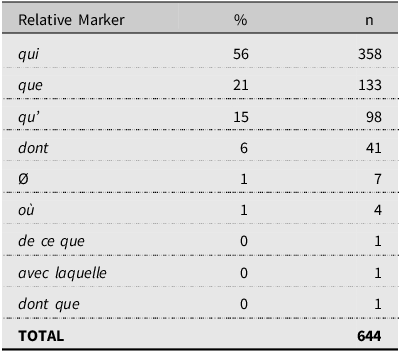
The corpus yielded 644 restrictive relatives distributed unevenly across nine markers (Table 3). Despite a morphologically diverse inventory, usage is highly concentrated: qui is the dominant marker (56%), followed by que (21%) and elided qu’ (15%); together, the three account for 92% of all tokens (589/644). Dont is comparatively infrequent (6%), with the remaining variants only marginally represented. No English-origin relative markers such as which que are attested in the present corpus.
Sociolinguistic profile of the speaker sample

Table 2. Long description
A table with eight rows and six columns detailing the sociolinguistic profile of speakers. Columns include Code, Age, Sex, Level of Education, Occupation, and Community. Row 1: Code 001, Age 21, Sex M, Level of Education High-School, Occupation University student, Community Halifax. Row 2: Code 002, Age 54, Sex M, Level of Education Masters, Occupation Teacher, Community Chéticamp. Row 3: Code 003, Age 20, Sex W, Level of Education High-School, Occupation University student, Community Halifax. Row 4: Code 004, Age 87, Sex W, Level of Education High-School, Occupation Retired, Community Chéticamp. Row 5: Code 005, Age 26, Sex W, Level of Education High-School, Occupation University student, Community Halifax. Row 6: Code 006, Age 18, Sex W, Level of Education High-School, Occupation University student, Community Halifax. Row 7: Code 007, Age 32, Sex W, Level of Education Masters, Occupation Community Outreach, Community Chéticamp. Row 8: Code 008, Age 38, Sex W, Level of Education Masters, Occupation Teacher, Community Chéticamp.
Overall distribution of relative markers in the Acadian French data

Table 3. Long description
A table showing the distribution of relative markers in Acadian French data. The table has 9 rows and 3 columns. The columns are labeled Relative Marker, %, and n. The rows list the relative markers and their corresponding percentages and counts. Row 1: qui, 56 percent, 358. Row 2: que, 21 percent, 133. Row 3: qu’, 15 percent, 98. Row 4: dont, 6 percent, 41. Row 5: null, 1 percent, 7. Row 6: où, 1 percent, 4. Row 7: de ce que, 0 percent, 1. Row 8: avec laquelle, 0 percent, 1. Row 9: dont que, 0 percent, 1. The total is 644.
Cross-tabulating markers by the syntactic function of the relativized element (subject, object, oblique, genitive, comparative) provides a first measure of departure from the prescriptive form–function mapping (Table 4).Footnote 5 Under an idealized standard distribution, qui is confined to subject relatives, que to direct object (and comparative) contexts, and dont to obliques. The data largely conform to this pattern, but include a small number of non-canonical configurations, including dont que (typically treated as hypercorrect; Gadet, Reference Gadet1995; Stark, Reference Stark2009), occasional Ø-relatives, and limited uses of high-frequency markers outside their canonical domains.
Distribution of relative markers by syntactic function. Shading indicates a favouring effect for each syntactic role. Orange boxes indicate the canonical/prescribed syntactic position for each relativizer; unboxed uses represent non-standard distributions

Table 4. Long description
A table titled ‘Distribution of relative markers by syntactic function’ with 644 total entries. The table has 7 columns labeled qui, que, qu’, dont, Ø, où, de ce que, avec laquelle, dont que, and N, and 6 rows labeled SUBJ, OBJ, OBL, GEN, COMP, and TOTAL. Each cell contains a value and a percentage in parentheses. The table shows the distribution of relative markers across different syntactic functions, with shading indicating a favouring effect for each syntactic role. Orange boxes indicate the canonical/prescribed syntactic position for each relativizer; unboxed uses represent non-standard distributions. Row 1: SUBJ, qui 354 (93 percent), que 7 (2 percent), qu’ 14 (4 percent), dont 1 (0 percent), Ø 3 (1 percent), où, de ce que, avec laquelle, dont que, N 379. Row 2: OBJ, qui 1 (1 percent), que 82 (47 percent), qu’ 74 (42 percent), dont 17 (10 percent), Ø, où, de ce que 1 (1 percent), avec laquelle, dont que, N 175. Row 3: OBL, qui 3 (4 percent), que 37 (47 percent), qu’ 8 (10 percent), dont 21 (27 percent), Ø 4 (5 percent), où 4 (5 percent), de ce que, avec laquelle 1 (1 percent), dont que 1 (1 percent), N 79. Row 4: GEN, qui, que 3 (75 percent), qu’, dont 1 (25 percent), Ø, où, de ce que, avec laquelle, dont que, N 4. Row 5: COMP, qui, que 4 (57 percent), qu’ 2 (29 percent), dont 1 (14 percent), Ø, où, de ce que, avec laquelle, dont que, N 7. Row 6: TOTAL, qui 358 (56 percent), que 133 (21 percent), qu’ 98 (15 percent), dont 41 (6 percent), Ø 7 (1 percent), où 4 (1 percent), de ce que 1 (0 percent), avec laquelle, dont que 1 (0 percent), N 644.
Subject relatives therefore constitute the largest category (379/644) and are near-categorically marked by qui (354/379; 93%), confirming the strong association between subject function and qui reported for French generally and Acadian varieties in particular (e.g., Wiesmath, Reference Wiesmath2006; Larrivée and Skrovec, Reference Larrivée and Skrovec2016; Neumann-Holzschuh and Mitko, Reference Neumann-Holzschuh and Mitko2018: 550–551). The remaining forms – qu’, que, Ø, and a single dont token – are marginal. Among these, subject-position qu’ is analytically relevant because elision obscures whether the underlying form is que or qui, although prescriptively only que normally elides before a vowel. Both elision and zero marking remain rare, consistent with previous findings for vernacular and Acadian French (Blanche-Benveniste, Reference Blanche-Benveniste1997: 95; Wiesmath, Reference Wiesmath2006: 188, 195–198; Martineau, Reference Martineau, Montreuil and Birdsong2021: 276). Overall, the subject domain appears highly stable, with very limited scope for non-canonical marking.
Non-subject relatives (object, oblique, genitive, comparative) show an expected increase in formal diversity, though competition remains limited. Direct object relatives overwhelmingly select que/qu’ (89%), whereas obliques show the greatest competition between que/qu’ (57%) and dont (27%). The frequent use of que in obliques confirms its extension beyond the canonical object domain, precisely where syntactic complexity is highest and where prior work locates pressure toward generalized strategies (e.g., Gadet, Reference Gadet1989; Blanche-Benveniste and Martin, Reference Blanche-Benveniste and Martin2010; Larrivée and Skrovec, Reference Larrivée and Skrovec2016). By contrast, the occurrence of dont in object relatives is compatible with hypercorrection given its normative value (e.g., Gadet, Reference Gadet1995: 144–145, 151; Auger, Reference Auger and Andersen1995: 21; Péronnet and Kasparian, Reference Péronnet, Kasparian and Brasseur1998: 252–253). At the low-accessibility end of the Accessibility Hierarchy, genitive and comparative relatives are expected to be relatively infrequent because these functions are structurally less accessible and impose greater processing demands (Keenan and Comrie, Reference Keenan and Comrie1977; Comrie and Keenan, Reference Comrie and Keenan1979). The corpus conforms to this expectation: both are rare and rely primarily on que/qu’.
This asymmetry motivates separate analyses of subject and non-subject relatives, enabling more accountable modelling of constraints within each domain.
5. Non-Subject Relative Clauses
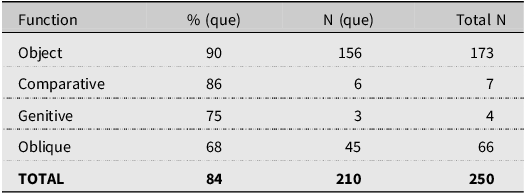
The analysis of non-subject relatives focuses on the alternation between que (including qu’) and dont; other relativizers are marginal and therefore excluded (Table 4). The resulting dataset contains 250 tokens, with que dominant overall at 84% (210/250) and dont at 16% (40/250), consistent with descriptions of generalized que as favoured outside the subject domain while specialized markers remain comparatively restricted (Gadet, Reference Gadet1995: 145; Neumann-Holzschuh and Mitko, Reference Neumann-Holzschuh and Mitko2018: 513, 542–548). We begin by locating where que is favoured across syntactic functions (object, oblique, genitive, comparative) (Table 5).
Distribution of que according to the syntactic function in non-subject relative clauses, in decreasing order of que rate

Table 5. Long description
The table presents the distribution of que according to syntactic function in non-subject relative clauses, ordered by decreasing que rate. It has four rows and four columns. The columns are labeled Function, % (que), N (que), and Total N. The rows are labeled Object, Comparative, Genitive, Oblique, and TOTAL. Row 1: Function, Object; % (que), 90 percent; N (que), 156; Total N, 173. Row 2: Function, Comparative; % (que), 86 percent; N (que), 6; Total N, 7. Row 3: Function, Genitive; % (que), 75 percent; N (que), 3; Total N, 4. Row 4: Function, Oblique; % (que), 68 percent; N (que), 45; Total N, 66. Row 5: Function, TOTAL; % (que), 84 percent; N (que), 210; Total N, 250.
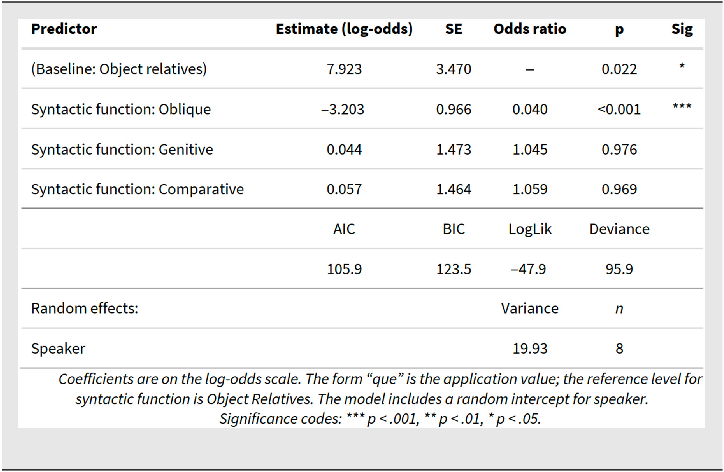
Table 5 reveals a strong distributional split: object relatives strongly favour que (90%), whereas obliques show the lowest rate (68%), making them the domain where dont is most productive, in line with previous research on generalized que and specialized oblique relativizers (Gadet, Reference Gadet1989, Reference Gadet1995: 145; Neumann-Holzschuh and Mitko, Reference Neumann-Holzschuh and Mitko2018: 542–548). Genitives (75%) also fall below the overall rate, while comparatives (86%) pattern near the baseline; both are low-frequency and therefore rate-unstable. A mixed-effects logistic regression with a random intercept for speaker confirms that obliqueness is the only syntactic-function distinction with a robust independent effect on relativizer choice (Table 6).
Mixed-effects logistic regression predicting the selection of que as a function of syntactic function (reference level: object relatives), with random intercepts for speaker

Table 6. Long description
The model predicts que with object relatives as the reference and speaker random intercepts. Columns report log-odds estimates, standard errors (SE), odds ratios (OR), p-values and significance codes. The intercept is 7.923 (SE 3.470, p = 0.022). For oblique relatives, the estimate is -3.203, SE 0.966, OR 0.040 and p < 0.001. For genitive relatives, the estimate is 0.044, SE 1.473, OR 1.045 and p = 0.976. For comparative relatives, the estimate is 0.057, SE 1.464, OR 1.059 and p = 0.969. Oblique relatives have lower odds of que than object relatives. The other contrasts show little difference. Model statistics are AIC 105.9, BIC 123.5, log-likelihood -47.9 and deviance 95.9. Speaker random-intercept variance is 19.93 across eight speakers. Significance symbols mark p-values below 0.05, 0.01 and 0.001.
Positive estimates indicate higher odds of selecting que relative to the object-relative baseline, whereas negative estimates indicate lower odds. The estimated coefficients (or log-odds) for comparative (≈0.06, p = .969) and genitive relatives (≈0.04, p = .976) are close to zero and non-significant, indicating no detectable difference from object relatives. By contrast, oblique function strongly disfavours que (estimate ≈ −3.20, OR ≈0.04, p < .001), with odds approximately 96% lower than in object relatives and a corresponding increase in dont. Syntactic function is therefore recoded as Oblique vs. Non-oblique in the main regression model (§5.5), preserving the relevant contrast while avoiding sparse-cell distributions.
5.1. Processing-related Conditioning
Processing-related conditioning is assessed using four measures of, or proxies for, processing demands: dependency length, adjacency, clause complexity, and animacy.
Dependency length, measured as the number of words separating the antecedent from the relativized position, is normalized by centring on the sample mean (3.79), yielding a continuous predictor. As in previous variationist work (e.g., Tagliamonte et al., Reference Tagliamonte, Smith and Lawrence2005), its distribution is skewed toward shorter dependencies. Figure 1 plots the monotonic decline in the predicted probability of que as dependency length increases, with a corresponding increase in dont.
Effect of dependency length on the probability of selecting que in non-subject relative clauses.

Figure 1. Long description
The horizontal axis shows normalized mean dependency length, and the vertical axis shows the predicted probability of selecting que. Dots represent individual observations of que or dont. A blue logistic regression curve slopes downward as dependency length increases. The grey shaded band represents the 95% confidence interval and widens at longer dependency lengths. The curve is an unadjusted descriptive fit using dependency length alone, without adjustment for other predictors or speaker differences.
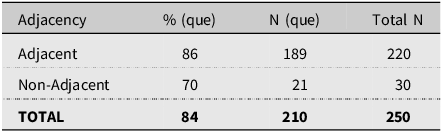
Non-adjacent configurations show a similar descriptive pattern, with que declining from 86% in adjacent contexts to 70% in non-adjacent ones (Table 7).
Distribution of que according to adjacency in non-subject relative clauses

Table 7. Long description
The table has four rows and four columns. The columns are labeled Syntactic Complexity, % (que), N (que), and Total N. The rows are labeled Simple, Complex, and TOTAL. Row 1: Syntactic Complexity, Simple; % (que), 85 percent; N (que), 157; Total N, 185. Row 2: Syntactic Complexity, Complex; % (que), 82 percent; N (que), 53; Total N, 65. Row 3: Syntactic Complexity, TOTAL; % (que), 84 percent; N (que), 210; Total N, 250.
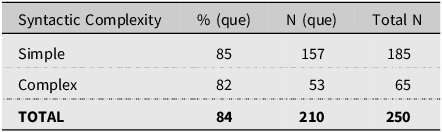
Clause complexity shows a weak but directionally coherent pattern (Table 8): simple relatives favour que slightly more than complex ones (85% vs. 82%), but both rates remain close to the overall baseline (84%), suggesting that complexity is, at most, a modest constraint.
Distribution of que according to the syntactic complexity of non-subject relative clauses

Table 8. Long description
A table with three rows and four columns. The columns are labeled Syntactic Complexity, % (que), N (que), and Total N. The rows are labeled Simple, Complex, and TOTAL. For Simple, the values are 85%, 157, and 185. For Complex, the values are 82%, 53, and 65. For TOTAL, the values are 84%, 210, and 250.
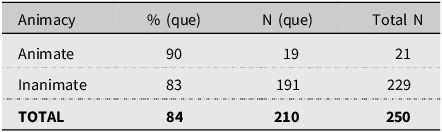
Experimental work shows that animacy interacts with relative-clause structure during processing, with lower processing costs in object relatives involving inanimate relativized objects and animate subjects (Baudiffier et al., Reference Baudiffier, Caplan, Gaonac’h and Chesnet2011). If this facilitation generalizes to non-subject relativization more broadly, inanimate antecedents may favour the less specified relativizer que. The descriptive pattern does not support this prediction: animate antecedents favour que more strongly than inanimate ones (Table 9).
Distribution of que according to animacy of the antecedent in non-subject relative clauses

Table 9. Long description
A table with four rows and four columns. The columns are labeled Animacy, % (que), N (que), and Total N. The rows are labeled Animate, Inanimate, and TOTAL. The values in the table are as follows: Row 1: Animacy, Animate; % (que), 90 percent; N (que), 19; Total N, 21. Row 2: Animacy, Inanimate; % (que), 83 percent; N (que), 191; Total N, 229. Row 3: Animacy, TOTAL; % (que), 84 percent; N (que), 210; Total N, 250.
Taken together, these distributions provide limited support for processing-related conditioning. As structural demands increase – most clearly as a result of greater linear distance, and, more weakly, as a result of non-adjacency – the likelihood of selecting que decreases, with dont correspondingly increasing. Among these predictors, dependency length emerges as the clearest processing signal; clause complexity is comparatively weak, while animacy shows a modest contrast, albeit one that runs counter to prediction.
5.2. Profile of the Antecedent
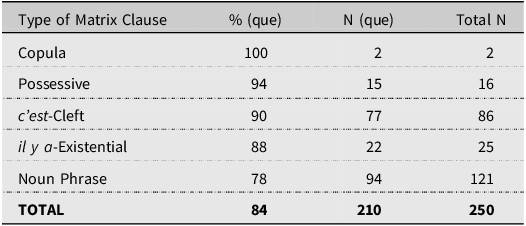
We next consider predictors associated with the matrix-clause construction type, as well as ones relating to the head NP post-modified by the relative clause, including type and lexical specificity of the antecedent. Construction type shows a coherent distribution (Table 10), with que favoured across all construction types except NP-only configurations.
Distribution of que according to the type of matrix construction in non-subject relative clauses, in decreasing order of que rate

Table 10. Long description
A table comparing the distribution of que according to the type of matrix construction in non-subject relative clauses. The table has four rows and four columns. Column headers are Type of Matrix Clause, % (que), N (que), and Total N. Row labels are Copula, Possessive, c’est-Cleft, il y a-Existential, Noun Phrase, and TOTAL. Row 1: Copula, 100 percent, 2, 2. Row 2: Possessive, 94 percent, 15, 16. Row 3: c’est-Cleft, 90 percent, 77, 86. Row 4: il y a-Existential, 88 percent, 22, 25. Row 5: Noun Phrase, 78 percent, 94, 121. Row 6: TOTAL, 84 percent, 210, 250.
Copular constructions are categorically realized with que (100%), although this result is based on only two tokens. Among construction types with larger token counts, possessives show the highest rate of que (94%), followed by clefts (90%) and existentials (88%). Such construction types all converge in favouring que, consistent with previous claims linking generalized relativization to presentational frames and weakly lexicalized antecedents (Wiesmath, Reference Wiesmath2006: 191–192; Blanche-Benveniste and Martin, Reference Blanche-Benveniste and Martin2010; Larrivée and Skrovec, Reference Larrivée and Skrovec2016). By contrast, NP-only constructions disfavour que (78%) and show the highest concentration of dont (22% vs. 16% overall).
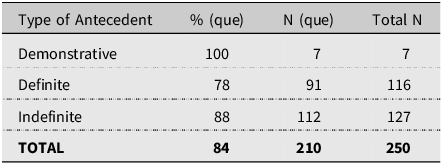
Antecedent type shows an asymmetric effect (Table 11): indefinite antecedents favour que (88%), whereas definite nominal antecedents disfavour it (78%). Demonstratives, by contrast, select que categorically, though the small N (7) necessitates cautious interpretation.
Distribution of que according to the type of antecedent in non-subject relative clauses

Table 11. Long description
The table presents the distribution of que according to the type of antecedent in non-subject relative clauses. It has four rows and four columns. The columns are labeled Type of Antecedent, % (que), N (que), and Total N. The rows are labeled Demonstrative, Definite, Indefinite, and TOTAL. Row 1: Demonstrative, 100 percent, 7, 7. Row 2: Definite, 78 percent, 91, 116. Row 3: Indefinite, 88 percent, 112, 127. Row 4: TOTAL, 84 percent, 210, 250.
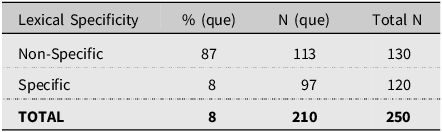
Lexical specificity yields a weak but directionally consistent effect (Table 12): non-specific antecedents favour que (87%), whereas lexically specific antecedents slightly disfavour it (81%) relative to the overall baseline (84%). The magnitude is modest (≈6 points), but the direction aligns with the expectation that reduced lexical specification favours generalized marking.
Distribution of que according to lexical specificity of the antecedent in non-subject relative clauses

Table 12. Long description
A table comparing the distribution of que according to lexical specificity of the antecedent in non-subject relative clauses. The table has four rows and four columns. Column headers are Lexical Specificity, % (que), N (que), and Total N. Row labels are Non-Specific, Specific, and TOTAL. Row 1: Non-Specific, 87 percent, 113, 130. Row 2: Specific, 81 percent, 97, 120. Row 3: TOTAL, 84 percent, 210, 250.
5.3. Stylistic and Social Factors
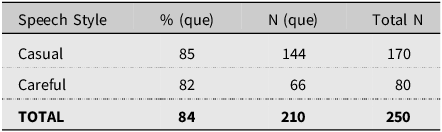
Style shows only a modest effect (Table 13). The rate of que is slightly higher in casual contexts (85%) than in careful ones (82%), in line with our hypothesis.
Distribution of que according to speech style in non-psubject relative clauses

Table 13. Long description
The table has four rows and four columns. The columns are labeled Speech Style, % (que), N (que), and Total N. The rows are labeled Casual, Careful, and TOTAL. Row 1: Casual, 85 percent, 144, 170. Row 2: Careful, 82 percent, 66, 80. Row 3: TOTAL, 84 percent, 210, 250.
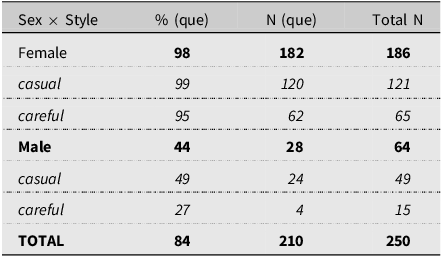
Raw distributions by sex suggest an asymmetry (Table 14), but interpretation is limited by sample imbalance. Female speakers contribute most tokens and overwhelmingly favour que overall (98%), with a small shift toward dont in careful speech (5% vs. 1%). Male speakers show the opposite distribution (dont > que), but this pattern is largely driven by one speaker who produces a substantial share of the dont tokens and extends the marker into object relatives. This behaviour is best interpreted as hypercorrection, given its normative salience (e.g., Auger, Reference Auger and Andersen1995: 21; Gadet, Reference Gadet1995: 144–145; Tellier and Valois, Reference Tellier and Valois2006: 74; Fiorentino, Reference Fiorentino2007: 268; Digesto and Berlinck, Reference Digesto, Berlinck, Digesto and Berlinckforthcoming). Controlling for individual speaker behaviour, the apparent sex effect is not stable.
Distribution of que according to sex and speech style in non-subject relative clauses

Table 14. Long description
A table comparing the distribution of que according to sex and speech style in non-subject relative clauses. The table has 4 rows and 3 columns. Column headers are Sex x Style, % (que), N (que), and Total N. Row labels include Female, Male, and TOTAL, with subcategories for casual and careful styles. Row 1: Female, 98%, 182, 186. Row 2: Female casual, 99%, 120, 121. Row 3: Female careful, 95%, 62, 65. Row 4: Male, 44%, 28, 64. Row 5: Male casual, 49%, 24, 49. Row 6: Male careful, 27%, 4, 15. Row 7: TOTAL, 84%, 210, 250.
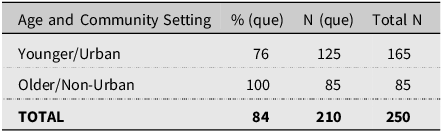
Age and community setting overlap substantially: all speakers under 30 grew up in Halifax, while all older speakers grew up in Chéticamp. Nonetheless, the distribution is highly polarized despite robust data in both groups (Table 15): younger/urban speakers produce dont at 24% and account for most tokens (165/250), whereas older/non-urban speakers select que categorically (100%).
Distribution of que according to age and community setting of the speakers in non-subject relative clauses

Table 15. Long description
The table has four rows and four columns. The columns are labeled Age and Community Setting, % (que), N (que), and Total N. The rows are labeled Younger/Urban, Older/Non-Urban, and TOTAL. Row 1: Younger/Urban, 76 percent, 125, 165. Row 2: Older/Non-Urban, 100 percent, 85, 85. Row 3: TOTAL, 84 percent, 210, 250. The table shows that younger/urban speakers produce dont at 24 percent and account for most tokens (165/250), whereas older/non-urban speakers select que categorically (100 percent).
This pattern does not straightforwardly reflect differences in exposure to standard French, since the speakers are generally highly educated and several older participants – including two teachers – have worked in institutional settings where standard usage is expected. Their categorical use of que is instead consistent with a locally anchored vernacular grammar.
5.4. Two Marginal Non-Standard Strategies
Two non-standard strategies are attested in non-subject position but remain highly marginal: preposition stranding and resumptive pronouns.
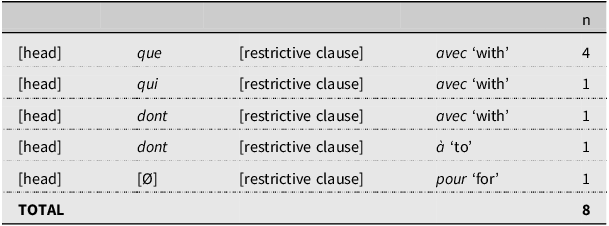
Only eight tokens of preposition stranding occur in the corpus (Table 16), confirming its highly circumscribed status, possibly attesting to its social salience and stigmatization in Canadian French (e.g., Péronnet and Kasparian, Reference Péronnet, Kasparian and Brasseur1998; Digesto and Berlinck, Reference Digesto, Berlinck, Digesto and Berlinckforthcoming).
Distribution of structural patterns of preposition stranding strategies by relativizer type in oblique relative clauses

Table 16. Long description
A table showing the distribution of structural patterns of preposition stranding strategies by relativizer type in oblique relative clauses. The table has 8 rows and 4 columns. The columns are labeled [head], restrictive clause, avec ‘with’, and n. The rows are as follows: Row 1: [head] que, [restrictive clause] avec ‘with’, 4. Row 2: [head] qui, [restrictive clause] avec ‘with’, 1. Row 3: [head] dont, [restrictive clause] avec ‘with’, 1. Row 4: [head] dont, [restrictive clause] à ‘to’, 1. Row 5: [head] [Ø], [restrictive clause] pour ‘for’, 1. Row 6: Total, 8.
The eight stranding tokens involve mainly avec, but also à and pour, and are produced almost exclusively by younger Halifax-raised speakers. This limited distribution is compatible with previous observations that PP-chopping has expanded in Acadian French as an alternative strategy to clause-final prepositions (Péronnet and Kasparian, Reference Péronnet, Kasparian and Brasseur1998). The single token with à (24) is consistent with reports that stranding may extend to weaker prepositions in Acadian French (Wiesmath, Reference Wiesmath2006: 214; Giancarli, Reference Giancarli2017: 56; Neumann-Holzschuh and Mitko, Reference Neumann-Holzschuh and Mitko2018: 550) and, more generally, Laurentian French (Poplack et al., Reference Poplack, Zentz and Dion2012: 210; Levey et al., Reference Levey, Rochon and Kastronic2025). Even so, stranding remains rare in the corpus relative to its prominence in normative discourse.
(24)
Je parle vraiment des concerts dont j’ai assisté à. [1/9]
‘I’m really talking about the concerts that I attended to.’
Resumptive pronouns are likewise rare (2%; 5/250): three occur in object relatives and two in genitives, with none in obliques or comparatives. This is consistent with previous descriptions of resumptive relatives as available but limited in Acadian French, while que c’est and related que + resumptive configurations are primarily associated with subject relatives and quasi-fixed expressions (e.g., Péronnet and Kasparian, Reference Péronnet, Kasparian and Brasseur1998; Wiesmath, Reference Wiesmath2006: 189). Despite typological expectations that resumptives increase in lower-accessibility environments (Stark, Reference Stark2009) and may co-occur with generalized que under increased processing demands (Su and Donati, Reference Su and Donati2023), the present data provide little support for this scenario. We return to this point in the discussion after examining resumptives in subject relatives.
5.5. Regression Model for Non-Subject Relative Clauses
To assess the simultaneous contribution of multiple predictors to relativizer choice, we fit a binomial mixed-effects logistic regression in R (Baayen, Reference Baayen2008; R Core Team, 2025; Tagliamonte, Reference Tagliamonte2025) implemented with the lme4 package (Bates et al., Reference Bates, Mächler, Bolker and Walker2015). Model selection follows Zuur et al. (Reference Zuur, Ieno, Walker, Saveiliev and Smith2009: 121), beginning with a maximal model and simplifying to a statistically stable minimal model. Predictors were selected based on the descriptive analysis: syntactic function (oblique vs. non-oblique), normalized dependency length, matrix construction type (NP-only vs. other), antecedent type (definite vs. indefinite), lexical specificity, animacy, clause complexity, adjacency, and style. Demonstratives were excluded because of categorical behaviour and preposition stranding because of its rarity and restriction to oblique contexts. Social factors were not included as fixed effects because age and community overlap in the sample and sex is highly imbalanced; speaker was included as a random intercept. The final dataset comprised 243 tokens. Positive coefficients (Estimate) indicate that a factor favours que and negative coefficients dont; odds ratios above 1 increase the odds of que, whereas values below 1 reduce them relative to the reference level (dont).
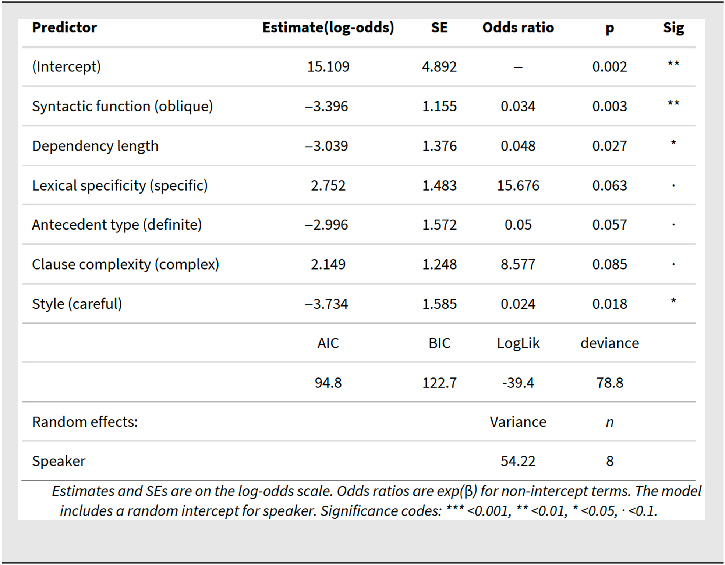
The final model (Table 17) identifies syntactic function as the strongest linguistic constraint: oblique relatives strongly disfavour que. Dependency length also significantly reduces the odds of que, confirming a gradient distance effect. Style remains significant, with careful speech favouring dont, consistent with its association with more monitored and formal usage (Gadet, Reference Gadet1995: 145; Neumann-Holzschuh and Mitko, Reference Neumann-Holzschuh and Mitko2018: 513). Definite antecedents, lexical specificity, and clause complexity pattern in the predicted direction but do not reach conventional significance. Adjacency and animacy make no appreciable independent contribution to variant selection and are eliminated early in the regression analysis. The random intercept indicates substantial residual inter-speaker variability.
Mixed-effects logistic regression predicting the selection of que (as opposed to the reference level: dont), with random intercepts for speaker in non-subject relative clauses

Table 17. Long description
The model predicts que rather than dont in non-subject relatives, with speaker random intercepts. Columns show log-odds estimates, standard errors, odds ratios (OR), p-values and significance codes. The intercept is 15.109 (SE 4.892, p = 0.002). Oblique function has OR 0.034 (p = 0.003), dependency length OR 0.048 (p = 0.027), and careful style OR 0.024 (p = 0.018), indicating lower odds of que. Specific antecedents have OR 15.676 (p = 0.063), definite antecedents OR 0.050 (p = 0.057), and complex clauses OR 8.577 (p = 0.085). These three effects have p-values above 0.05. Model statistics are AIC 94.8, BIC 122.7, log-likelihood -39.4 and deviance 78.8. Speaker random-intercept variance is 54.22 across eight speakers. Stars mark p-values below 0.05, 0.01 and 0.001; a dot marks p < 0.10.
Distribution of relative markers in subject relative clauses

Table 18. Long description
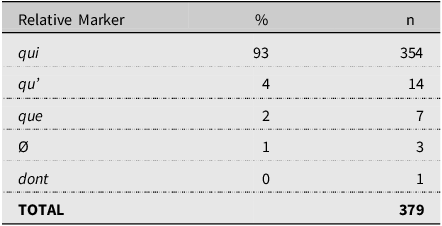
The table presents the distribution of relative markers in subject relative clauses. It has five rows and three columns. The columns are labeled ‘Relative Marker’, ‘%’, and ‘n’. The rows list the relative markers ‘qui’, ‘qu’, ‘que’, ‘Ø’, and ‘dont’ along with their respective percentages and counts. The data shows that ‘qui’ has the highest percentage at 93% with 354 counts, followed by ‘qu’ at 4% with 14 counts, ‘que’ at 2% with 7 counts, ‘Ø’ at 1% with 3 counts, and ‘dont’ at 0% with 1 count. The total number of instances is 379.
6. Subject Relative Clauses
Subject relative clauses are overwhelmingly realized with qui, which accounts for 93% of all tokens, confirming the well-established stability of the canonical subject relativizer in this position (e.g., Wiesmath, Reference Wiesmath2006: 189; Larrivée and Skrovec, Reference Larrivée and Skrovec2016: 7). Non-canonical alternatives are rare: qu’ (4%), que (2%), the zero variant (1%), and a single token of dont. Excluding marginal zero and dont forms, qu’ and que together account for just under 6% of the data (Table 18). This distribution aligns with the widely acknowledged fact that subject relatives occupy the most accessible position on the Accessibility Hierarchy (Comrie and Keenan, Reference Comrie and Keenan1979) and therefore display minimal variability, given the structural and processing proximity of the subject gap to the head noun.
Despite this overall stability, an outstanding issue concerns whether the marginal variation in subject relatives is grammatically constrained or instead reflects unstructured fluctuation or performance-related error. The low frequency of non-canonical forms precludes a full multinomial regression contrasting qui, que, and qu’, which would afford an empirical test of whether qu’ patterns with que or qui. This question is non-trivial because qu’ is orthographically ambiguous between the two and is therefore treated here as a distinct surface form for operational reasons. To assess whether collapsing qu’ with que in a binomial analysis (qu(e) vs. qui) is empirically defensible, we adopt an exploratory distributional approach, comparing the three forms across key predictors by their deviations from each variant’s overall rate. Deviations are calculated as the difference between a variant’s proportion in a given context and its overall proportion. Positive values indicate favouring effects and negative values disfavouring effects, with the vertical dashed line at zero representing the overall rate.
As shown in Figure 2, qu’ and que exhibit closely parallel distributional behaviour. Both are disfavoured in careful speech and longer dependency configurations, and favoured with lexically light, demonstrative, and pronominal antecedents, as well as in non-adjacent configurations. These converging patterns provide clear evidence that qu’ aligns closely with que across the major structural and discourse-related dimensions examined here.
Comparative distributional profiles of qui, que, and qu’ across predictors in subject relative clauses.

Figure 2. Long description
The horizontal axis shows deviations from each relativizer’s overall rate in percentage points. A dashed vertical line marks zero. Points to the right indicate higher rates, and points to the left indicate lower rates. The nine rows show careful style, specific antecedents, long dependencies, NP-only constructions, complex clauses, definite noun-phrase antecedents, anaphoric/deictic antecedents, inanimate antecedents, and non-adjacent clauses. Grey squares represent qui, blue triangles que, and orange crosses qu’. Anaphoric/deictic antecedents show the largest departures: que and qu’ occur above their overall rates, while qui occurs below its overall rate. Non-adjacent clauses show smaller departures in the same direction. The remaining contexts show comparatively small deviations. These are descriptive comparisons of observed rates.
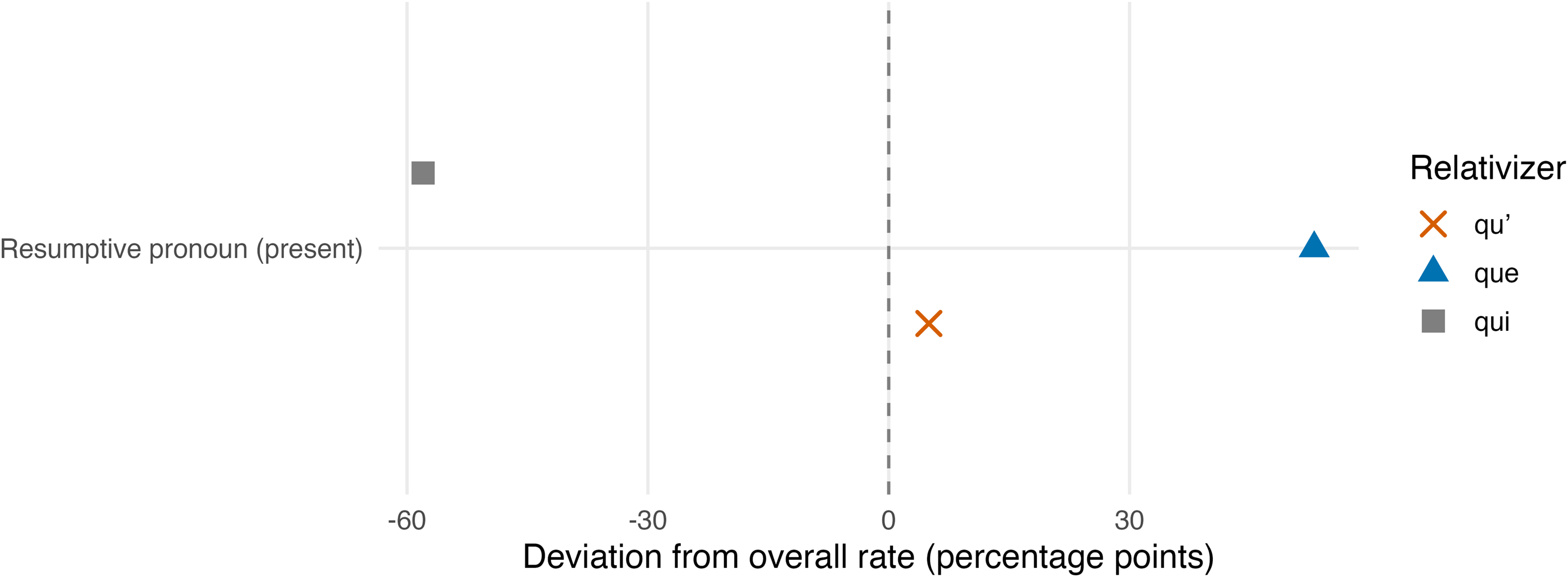
The principal exception is matrix construction type: NP-only constructions favour qu’ but disfavour que, whereas qui, for its part, shows no clear sensitivity to this factor. Because the effect associated with the presence of resumptive pronouns is considerably larger than the others and would compromise readability, it is shown separately in Figure 3, where both qu’ and que are favoured when a resumptive pronoun is present, though the magnitude of the effect differs.
Comparative distributional profiles of qui, que, and qu’ by presence of a resumptive pronoun in subject relative clauses.

Figure 3. Long description
A horizontal dot plot shows deviations from each relativizer’s overall rate in subject relative clauses containing a resumptive pronoun. The horizontal axis measures percentage-point differences, and a dashed vertical line marks zero. Grey squares represent qui, blue triangles que, and orange crosses qu’. The blue triangle for que lies substantially to the right of zero, indicating a higher rate than its overall rate. The orange cross for qu’ lies slightly to the right. The grey square for qui lies substantially to the left, indicating a lower rate than its overall rate. These are descriptive comparisons of observed rates, rather than adjusted regression effects.
Viewed in the aggregate, the comparative evidence reveals substantial convergence between the two non-canonical forms: across nine predictors, qu’ and que pattern identically in six and differ only with respect to matrix construction type. Overall, these results suggest that the two forms behave in largely parallel ways and are best understood as alternative non-canonical strategies in opposition to the dominant standard variant qui. This interpretation finds independent support in Blanche-Benveniste’s analysis of spoken French. As she notes, “the overt formal contrast found in spoken French supports a distinction between two syntactic behaviours that orthography obscures by presenting them as identical” (our translation; Blanche-Benveniste, Reference Blanche-Benveniste1997: 95). Building on a generative distinction, she treats qu(i) with unstable -i as a simple complementizer, whereas qui is analysed as a true pronoun. The present results align with this view: distributionally, qu’ patterns with the generalized que rather than with pronominal qui. In other words, qu’ participates in the same non-canonical relativization strategy as que in spontaneous speech. While the regression model below isolates the structure of variation more precisely, Figure 3 already points to a particularly strong role for resumptive pronouns in licensing non-canonical marking in relative clauses.
6.1. The Regression Model for Subject Relative Clauses
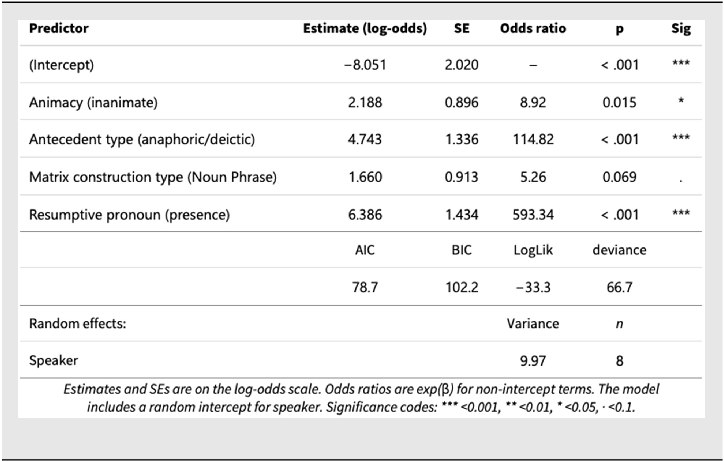
The mixed-effects regression model for subject relative clauses (Table 19) reveals a sharply stratified constraint hierarchy dominated by a small number of highly influential predictors. The intercept indicates an extremely low baseline probability of selecting a non-canonical relativizer (≈0.03%), confirming that qui is effectively categorical in the absence of factors facilitating the choice of a non-canonical relativizer.
Mixed-effects logistic regression predicting the selection of non-canonical qu(e) (as opposed to the reference level: qui), with random intercepts for speaker in subject relative clauses

Table 19. Long description
The model predicts non-canonical qu(e) rather than qui in subject relatives, with speaker random intercepts. Columns show log-odds estimates, standard errors (SE), odds ratios (OR), p-values and significance codes. The intercept is -8.051 (SE 2.020, p < 0.001). Inanimate antecedents have estimate 2.188, SE 0.896, OR 8.92 and p = 0.015. Anaphoric/deictic antecedents have estimate 4.743, SE 1.336, OR 114.82 and p < 0.001. Noun-phrase matrix constructions have estimate 1.660, SE 0.913, OR 5.26 and p = 0.069. Resumptive pronouns have estimate 6.386, SE 1.434, OR 593.34 and p < 0.001. All four estimates indicate higher odds of qu(e), with the largest odds ratio for resumptive pronouns. Model statistics are AIC 78.7, BIC 102.2, log-likelihood -33.3 and deviance 66.7. Speaker random-intercept variance is 9.97 across eight speakers. Stars mark p-values below 0.05, 0.01 and 0.001; a dot marks p < 0.10.
The presence of a resumptive pronoun exerts by far the strongest effect: when a resumptive is present, the odds of selecting a non-canonical relativizer are nearly 600 times higher (OR ≈ 594). This corroborates the distributional pattern in Figure 3 and aligns with previous descriptions of que + resumptive subject relatives in Acadian French. Closely following is antecedent type: demonstrative and pronominal antecedents strongly favour non-canonical forms. Together, these two predictors account for the strongest systematic effects in the model. Inanimate antecedents exert a much weaker but significantly effect, while NP-only constructions remain only marginally associated with non-canonical relativizers. All remaining predictors fail to contribute independent effects, underscoring the limited role of processing-related and sociostylistic constraints relative to resumptive pronouns and properties of the antecedent head NP. Although the model captures residual inter-speaker variability, the lower variance points to substantially more limited variability than in the non-subject model, reinforcing the characterization of subject relativization as a comparatively stable domain.
6.2. Subject-Verb (Non-)Agreement in Subject Relatives
Owing to structural and empirical constraints on the envelope of variation, subject–verb agreement in subject relatives is treated descriptively rather than as a component of the inferential statistical modelling of the data. Non-agreement is observable only with plural antecedent heads and verbs displaying overt number morphology, severely limiting the number of tokens eligible for analysis. With this limitation in mind, 139 subject relatives headed by a plural noun phrase were identified. Only three tokens headed by a plural noun phrase exhibit unambiguous singular verb morphology, confirming that default singular agreement is extremely rare in the dataset. This is consistent with earlier observations that Chéticamp maintains relatively robust plural agreement in subject relatives, contrasting with Île Madame and Newfoundland French, where default singular marking is reported to be far more common (Flikeid, Reference Flikeid, Mougeon and Beniak1989b: 194–195; Flikeid and Péronnet, Reference Flikeid and Péronnet1989: 230; King, Reference King1994: 242, 244, 250–251; King, Reference King2013: 71).
(25)
J’aime cuisiner des choses
[3PL] santé qui va
[3SG] me donner de l’énergie pour faire plus de travail. [3/260]
‘I like cooking healthy things.3PL that gives.3SG me energy to do more work.’
Although the extremely limited number of tokens precludes any definitive conclusions, the infinitesimally low rate of non-agreement is striking. In a dataset otherwise rich in non-standard relativization strategies, subject–verb non-agreement emerges as a distinctly peripheral phenomenon at best.
7. Discussion and Concluding Observations
Variation in restrictive relative clauses in Acadian French is systematic and multi-dimensional, rather than random or attributable to a single explanatory factor. Relativizer choice emerges from the interaction of multiple constraints that are differentially weighted: syntactic structure exerts the strongest effect, processing-related factors play a secondary role, and stylistic or social constraints exert a generally weak influence. While inter-speaker variability shows that individual speakers may occasionally select socially marked relativizers, this does not alter the underlying grammatical system, which remains highly structured and internally constrained. Crucially, these constraints do not operate uniformly across contexts: subject and non-subject relatives display distinct internal patterning, even when they share surface options such as qu(e).
One of the clearest outcomes concerns the status of que as a generalized subordinator. Across much of the non-subject domain, que functions as the unmarked relativizer, supporting longstanding descriptions of it as a generalized or passe-partout marker in spoken French; the complex prepositional relativizers prescribed in many of these contexts are absent. Yet this generalization is neither uniform nor unrestricted: dont remains a productive component of the probabilistic grammar, while subject relatives continue to be organized overwhelmingly around qui. Que therefore plays a pivotal role in the organization of this system, but rather than emerging as a universal default, it operates as a flexible, relatively low-cost resource whose distribution is delimited by syntactic accessibility, processing demands, and social meaning.
The principal structural asymmetry lies between subject and non-subject relatives. Whereas non-subject relatives permit genuine probabilistic competition between generalized and specialized strategies, subject relatives remain remarkably stable, with non-canonical forms concentrated in contexts involving resumptive pronouns and weakly specified antecedents. This asymmetry reinforces the central role of syntactic function in organizing relativization, showing that non-standard strategies are selectively licensed rather than extending freely across the grammar.
Processing-related conditioning is comparatively limited. Among the processing-related predictors, only dependency length supports the expectation that greater processing load favours more explicit marking (Rohdenburg, Reference Rohdenburg2020); clause complexity, adjacency, and animacy contribute little independently. Resumptives likewise do not cluster in the most structurally demanding contexts, as would be expected if they primarily served as general processing repair strategies. Processing therefore conditions variant choice selectively rather than constituting the system’s primary organizing principle.
The behaviour of dont illustrates particularly clearly the interaction between grammatical structure and normative pressure. Although generalized que constitutes the vernacular default across much of the non-subject domain, dont remains productive, becoming more frequent in monitored speech and occasionally extending beyond its canonical domain through hypercorrection. Preposition stranding provides converging evidence: its rarity relative to PP-chopping is consistent with the negative social evaluation of clause-final prepositions, while its attestation lends scant support to categorical claims that stranding is ungrammatical in French. On balance, these patterns point to a selective role for normative pressure. In the Acadian sociolinguistic context, where local vernacular forms are socially evaluated against standard French and speakers may themselves monitor their usage against that standard (Boudreau, Reference Boudreau2009: 441–442, 455; Boudreau, Reference Boudreau2014: 180–181), this normative influence is reflected in variant choice.
These findings also help situate Chéticamp within the broader Acadian grammatical landscape. The near absence of default singular agreement in subject relatives places the present data at the conservative end of the spectrum, consistent with earlier work showing robust plural agreement in Chéticamp compared with Île Madame and Newfoundland French, where default singular marking is much more frequent (see Flikeid, Reference Flikeid, Mougeon and Beniak1989b: 194–195; Flikeid and Péronnet, Reference Flikeid and Péronnet1989: 230; King, Reference King, Cornips and Corrigan2005: 214; King, Reference King2013: 71). Yet the persistence of generalized que in non-subject relatives shows that Chéticamp’s strong francophone vitality and longer tradition of French-language schooling do not simply entail convergence on the standard relative system. Instead, conservative agreement patterns coexist with a vernacular relativization system in which generalized que remains central.
Taken together, these findings argue against polarized interpretations of the French relativization system. It is neither characterized by rampant decay driven by popular speech nor by a rigid grammar occasionally perturbed by “performance errors” (Larrivée and Skrovec, Reference Larrivée and Skrovec2016: 7). Rather, the evidence reveals a highly structured probabilistic grammar in which non-canonical variants constitute systematically conditioned options rather than exceptions to the system. This underscores the value of empirically grounded, accountable analysis: approaches rooted in prescriptive expectations or categorical judgements risk equating structured variability with error, particularly in minority varieties where normative pressures may be acutely felt. In this light, the longstanding portrayal of French relative clauses as a subordonnée problème reflects less a failure of speakers than a fundamental misalignment between prescriptive ideals and the organization of the grammar of speech.
Acknowledgements
This research was in part supported by Dalhousie University’s Research and Innovation International Seed Fund.
Competing interests
The author declares no competing interests.




 Open access

