1 INTRODUCTION
Standard French (SF) has two front unrounded oral mid-vowels, open-mid /ε/ and close-mid /e/, which are distinctive in word-final open syllables, although not in closed syllables (Rey, Reference Rey1989; Fougeron and Smith, Reference Fougeron and Smith1999; Grevisse and Goosse, Reference Grevisse and Goosse2016).Footnote 1 However, many regional varieties of France neutralise these two phonemes in a tendency known as the ‘Law of Position’ (Loi de Position / LdP): Séguy, Reference Séguy1950; J. Durand, Reference Durand1976), which mnemonically prescribes ‘open vowels in closed syllables and close vowels in open syllables’. This is most famously true of the French of the South of France, but accounts as far back as Martinet (Reference Martinet1945) show that it is also true of areas of the North, chiefly Normandy (Hall and Lyche, Reference Hall, Lyche, Detey, Durand, Laks and Lyche2010, and §2.4 below), Nord and Pas-de-Calais (Scherrer et al., Reference Scherrer, Boula de Mareüil and Goldman2015).
This study investigates variation in the phonetics and phonology of /ɛ/ and /e/ in the Regional French of Normandy (RFN). The variable will be referred to as (e), following the Labovian tradition of denoting linguistic variables with round brackets; (e) is defined as ‘the variable neutralisation of Intonational Phrase-final (IP-final) /ε/ and /e/ in open syllables’. We examine the following questions:
1. Which social variables may condition the neutralisation of IP-final /ε e/ in open syllables?
2a. If a speaker neutralises IP-final /ε e/, where in the vowel space is the neutralised phoneme?
2b. If a speaker distinguishes IP-final /ε e/, where in the vowel space are the separate phonemes?
The question of the neutralisation of IP-final /ε e/ in RFN is of interest because, despite the ongoing neutralisation of these vowels in open syllables even in northern France, there has not yet been a detailed cross-speaker investigation of the phonetic configuration of vowel-spaces for speakers of any variety where the neutralisation is in progress. Given that IP-final /ε e/ configurations vary between speakers – some speakers neutralise the two, some speakers bring them closer together in the vowel space without neutralising them, and some speakers keep them apart – the question deserves attention. For these cases of ongoing neutralisation in the community, where the community on average seems to be changing the configuration of its vowel-space, we offer some reasons why they may be changing it in the ways observed. We adduce these reasons both from the contemporary phonetics of the French vowel-space and from historical developments seen cross-linguistically.
2 LINGUISTIC BACKGROUND
2.1 /ɛ/ and /e/ in Standard French
SF, as described in grammars and phonological surveys (Delattre, Reference Delattre1951; Tranel, Reference Tranel1987; Walker, Reference Walker2001; Grevisse and Goosse, Reference Grevisse and Goosse2016), distinguishes /ε e/ syllable-initially, and in open syllables, but not in closed syllables (where only /ɛ/ is permitted). This modern normative distinction arises along the etymological lines which are well-documented in such classic sources as Pope (Reference Pope1952). These etymological lines give rise to the different /ε e/ distinctions of SF (see below) and its sister variety Norman (§2.2).
A broad generalisation about the etymology of the modern SF /ε e/ distinction is that, if Latin / Gallo-Romance ĭ, ē or a Footnote 2 appears in stressed position in a word-ending, the SF reflex ends in /e/; otherwise, the reflex ends in /ε/. As the distinction of /ε e/ is etymological, all normative grammars make prescriptions about the pronunciation of each individual ending. In most cases, for any given ending, all grammars agree – for example, -é(e)(s) is always /e/, and -ais, -ait etc are always /ɛ/ – though this is not true for all endings. For example, while all grammars agree that the verb ending -ai is /e/, some say that the noun ending -ai should be /-ɛ/ (Hall, Reference Hall2008: 167).
Whatever the fine details of the distribution of /ε e/ in modern SF, the distinction has at least the potential to be prominent and observed, as it follows a recognisable orthographic pattern. Most SF endings including a letter <e> with an accent are pronounced [e], and most endings including <ai> (followed by other letters or not) are pronounced [ɛ]. This generalisation about the letter <e> when accented holds because most accented <e>s are <é>; clearly, <è> is prescriptively [ε], but endings including <è> are comparatively rare. Therefore, the main division speakers could make is between endings with <é> on the one hand, and endings with <ai> on the other. The recognisability of this pattern may help to explain the fact that some varieties of RFN seem to reverse the SF pronunciations of /ε e/ (§2.4). For RFN speakers who reverse SF /ε e/, we speculate that, in order to gain prestige (Labov et al. Reference Labov, Cohen, Robins and Lewis1968) as a careful speaker, the important thing would be to observe some distinction based on a linguistic pattern, even if the distinction was not necessarily the standard one. Such speakers could therefore feasibly bid for prestige by being seen to use the ‘<é> vs <ai>’ division. Even if they in fact used it the other way around from SF, they would still be making their distinctions in the ‘right’ etymological places.
2.2 /ε/ and /e/ in Norman
Some Norman varieties distinguish IP-final /ɛ e/, while others observe the LdP for open syllables and therefore do not make the distinction. We can infer this from examples in grammars, even though (for mainland varieties) explicit statements on pronunciation are surprisingly scant. Most linguistic descriptions of mainland Norman have been done in an older tradition, which concentrates more on morphology and syntax, with only brief descriptions of pronunciation. Even descriptions from more modern traditions usually do not have explicit statements about theoretical constructs like the LdP, but confine themselves to describing pronunciation features which contrast with SF, since they are written in French and mostly for a French audience.
Jones (Reference Jones2014) and Lepelley (Reference Lepelley1999, especially p. 63) are the most theoretically informed recent linguistic descriptions of mainland Norman. Jones (Reference Jones2014: 84, 94, 97) has some examples which show that not all Mainland Norman observes the LdP in open syllables. On the other hand, Lepelley (Reference Lepelley1999)’s examples of open syllables with a mid-vowel all have a close-mid vowel, whether it is [e(ː)] as opposed to [ε(ː)] or [o(ː)] as opposed to [ɔ(ː)]. Examples given in shorter descriptions of the pronunciation of Western / Lower Normandy varieties of Norman (UPNC, 1995: 6, Marie, Reference Marie2012: xx) also suggest that they observe the LdP.
In varieties outside the Western mainland, the situation is more complicated. FDFRSM ([1985]: 5ff), Schortz (Reference Schortz1998: 64–65) and Jones (Reference Jones2014) show that the Pays de Caux (Eastern / Upper NormandyFootnote 3) distinguishes /ε e/ in open syllables. Spence (Reference Spence1985) and Jones (Reference Jones2014) also note that Channel Island Norman varieties make this distinction. (Note that this article does not discuss vowel quantity, which is contrastive in Norman but not in SF, and which can also have an effect on vowel quality.) Finally, a crucial recent resource on pronunciation of the autochthonous regional varieties of France is Boula de Mareüil, Rilliard and Vernier (Reference Boula de Mareüil, Rilliard and Vernier2018 to appear), a collection of retellings of The North Wind and the Sun. Auditory analysis of the Norman texts in this resource shows that the presence of [ɛ] in open syllables in Norman increases from West to East, though there is only one Channel Islands recording there (Jersey), so the full range of variation in Channel Islands Norman is not covered.
This study is of /ε e/ in open syllables, but we complete the picture by mentioning the Norman treatment of /ε e/ in closed syllables, as it can differ from the SF treatment. SF is described as not following the LdP because it contrasts /ε e/ in open syllables, but it does partially follow it to the extent that it prohibits open-mid /e/ in closed syllables. Lower Normandy varieties of Norman also seem to prohibit (short) open-mid /e/ in closed syllables (from examples in UPNC, 1995 and Marie, Reference Marie2012). For Jersey Norman, Spence (Reference Spence1985) notes the occurrence of /-ɛC/ and not */-eC/, though Jones (Reference Jones2014: 85) does have some examples of /-eC/ from Jersey.
Lepelley (Reference Lepelley1999: 55) also mentions that the infinitive ‘see’, cognate with SF voir, can be pronounced [vεʁ] or [veʁ] in Norman. He does not say where in Normandy [veʁ] is found, but the foregoing descriptions suggest that it could be the Channel Islands. Our experience also suggests that it could be Upper Normandy, though again we have not been able to find explicit published descriptions of the phenomenon. At least certain varieties of Picard, adjacent to Upper Normandy, also permit open-mid /e/ in syllables closed by /ʁ/ and other consonants (Armstrong and Pooley, Reference Armstrong and Pooley2010: 173; Carton and Lebègue, Reference Carton and Lebègue1989, e.g. Maps, 237, 333, 335, 336, 347, 403; though the evidence in Flutre, Reference Flutre1977: 26–27 is mixed). As there are Picard varieties which permit /-eC/, it is unsurprising that Upper Normandy Norman would also permit it.
2.3 /ɛ/ and /e/ in vernacular French in France
The /ɛ e/ distinction has long been found to be unstable in research which deals with non-normative French pronunciation in general, but not with specific regional varieties (Martinet and Walter, Reference Martinet and Walter1973; Walter, Reference Walter1976; Lefebvre, Reference Lefebvre1988). Recently, Armstrong and Pooley (Reference Armstrong and Pooley2010: 123ff) have reviewed much evidence. Southern French accents stereotypically feature the LdP (e.g. Taylor, Reference Taylor1996: 193 on Aix-en-Provence); as the stereotype includes the LdP, prestige may well also be associated with using the LdP, which would tend to reinforce it. J. Durand and Lyche (Reference Durand, Lyche, Coveney, Hintze and Sanders2004) also point out that the LdP operates in Grenoble, where the local French has elements of both Northern and Southern pronunciations. As has been noted, however, the LdP, or at least aspects of it, is not restricted to the South of France. At least one self-report survey of pronunciation throughout francophone Europe (Avanzi, Reference Avanzi2017: 54–55) finds that /ε e/ neutralisation is widespread in the North of France for piquet (SF /pikɛ/, widely [pike]) and poulet (SF /pulɛ/, often [pule]). The atlas presented in Boula de Mareüil, Rilliard and Vernier (Reference Boula de Mareüil, Rilliard and Vernier2018 to appear) also finds IP-final /ɛ e/ neutralisation in several parts of the North of France, and especially in Normandy (Scherrer et al., Reference Scherrer, Boula de Mareüil and Goldman2015).
It is worth dwelling in particular on studies of the /ɛ e/ distinction in Paris, because the evidence is contradictory. Martinet (Reference Martinet1945) already details self-reported neutralising of IP-final /ε e/ in several regions of Northern France; and seventy years later, the self-reports of Scherrer et al. (Reference Scherrer, Boula de Mareüil and Goldman2015) show the same. Lennig (Reference Lennig1978), an acoustic phonetic study, also finds (pp. 78–79) that the overall distributions of IP-final /ε e/ for his Parisian subjects do not differ significantly – in other words, a neutralisation. Many other studies, though, have the opposite result. Deyhime (Reference Deyhime1967a, b), Léon (Reference Léon and Valdman1972) and Walter (Reference Walter1992) do not find appreciable levels of IP-final /ε e/ neutralisation in Paris. Finally, other authors say simply that the opposition is unstable (Peretz, Reference Peretz and Walter1977; Landick, Reference Landick1995).
On balance, then, the literature contains more evidence of an IP-final /ε e/ distinction in Paris than of a neutralisation. But there are recent reports (Hansen and Juillard, Reference Hansen and Juillard2011; Hansen, Reference Hansen, Gess, Lyche and Meisenburg2013) that the neutralisation may be progressing in Paris, and Fagyal et al. (Reference Fagyal, Hassa and Ngom2002) has preliminary results pointing in the same direction. These findings are reviewed in detail in §5.2.
2.4 Previous studies of the Regional French of Normandy
The literature has no consensus regarding RFN's treatment of /ε e/ in IP-final open syllables. The following points of view are all attested.
• /ε/ → [e] and /e/ → [ε] (‘switching’ the realisations of /ε e/): Lepelley (Reference Lepelley1975), on Lower Normandy, gives the examples
couché (SF /kuʃe/) → [kuʃε]
couchait (SF /kuʃε/) → [kuʃe]
• Contrast between /ε e/ not systematically maintained: for example, Walter's (Reference Walter1982) speaker from Gréville-Hague, Manche (pp. 131–132) has an ‘opposition très instable’, with ‘réalisations le plus souvent intermédiaires’, though the realisation after /ʁ/ is always [ε], and many imperfect endings are also pronounced with [ε], as in SF. Gréville-Hague is a rural, isolated site 32 miles / 52km from La Bonneville, our Lower Normandy site (see §2.5).
• Contrast between /ε e/ maintained (apparently in the same way as SF): Walter (Reference Walter1982: 134) for Le Vaudreuil, a semi-rural site in the same Norman dialect area as Darnétal/Rouen, our Upper Normandy site.
• /ε e/ neutralised to [e]: Tyne (Reference Tyne2003), for Cherbourg (a medium-sized town in the Manche department), and Montreuil (Reference Montreuil, Delais and Durand2003) for Lower Normandy (not further specified, but this is also the location of Cherbourg).
• /ε e/ neutralised to [ε]: attested in the Norman dialect areas covering both sites for this study: Schortz (Reference Schortz1998) for Senneville-sur-Fécamp (rural Seine-Maritime), and Carton et al. (Reference Carton, Rossi, Autesserre and Léon1983) for Écoquenéauville (rural Manche). Senneville-sur-Fécamp and Darnétal are both in the Pays de Caux dialect area; Écoquenéauville, in the Cotentin dialect area, is also in the rural sample area for this study, though no speakers in this study are actually from there. Carton et al. (Reference Carton, Rossi, Autesserre and Léon1983)’s speaker was recorded in 1956 at the age of 60, so she is a generation older than the oldest speakers in this study (the oldest speaker analysed here was born in 1918).
This seems a lot of uncertainty for something that is often assumed to be a single variety, but (based on our experience) speakers in some previous studies may have been confused about which variety researchers were asking them about. The previous studies themselves are also not always clear about this. They all say they are describing the French of their area, but it seems likely that in some instances the speakers were actually speaking Norman. §2.7 discusses this possible difficulty in relation to the present study's sample.
2.5 Sites for the present study
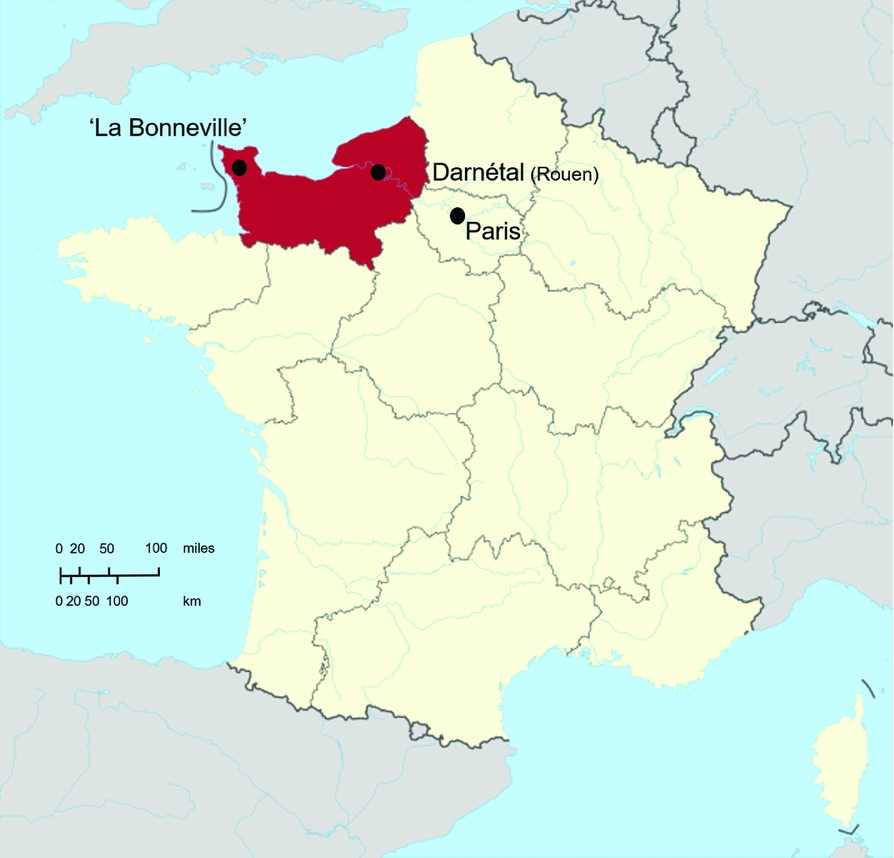
The two sites for this study (Figure 1) were chosen because they are very different socially and demographically, and yet natives of both could be said to speak Regional French of Normandy (RFN), simply because of their location. The sites are:
• La Bonneville: the villages around the rural towns of Saint-Sauveur-le-Vicomte and Sainte-Mère-Église (Manche). The site is called ‘La Bonneville’ in this study because almost half of the rural interviewees lived in that village.
• Darnétal: an urban commune immediately adjacent to Rouen (Seine-Maritime).
Location of study sites within France
Attribution of base map: By TUBS [CC BY -SA 3.0 de ( http://creativecommons.org/licenses/by-sa/3.0/de/deed.en )], via Wikimedia Commons
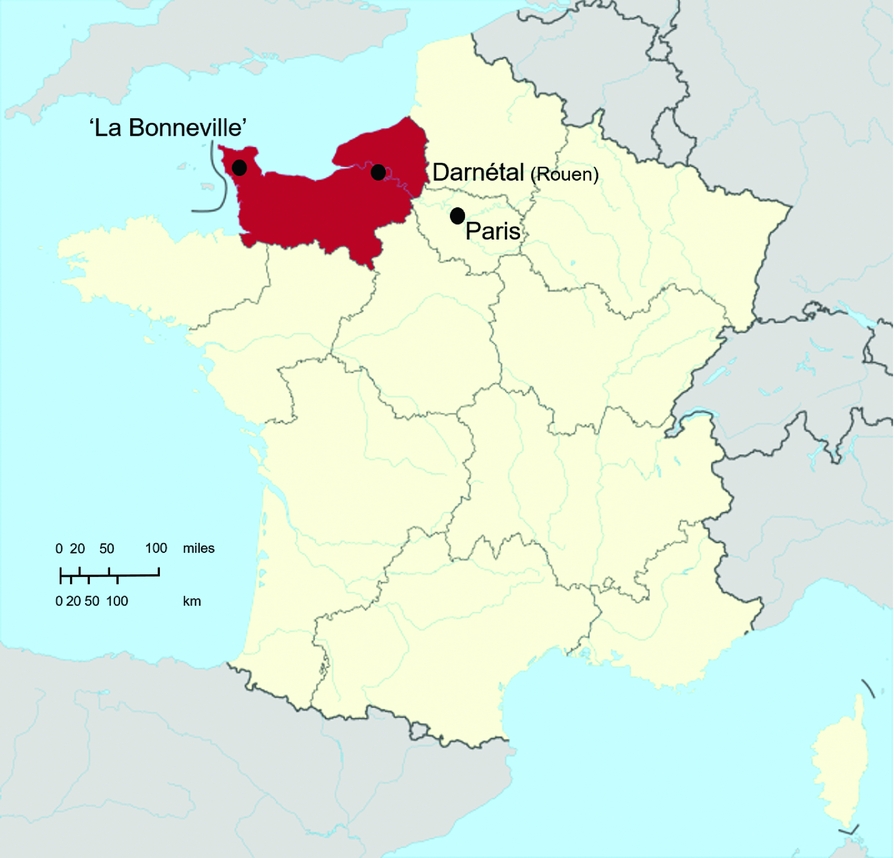
These sites are about 140 miles / 240 km apart; Darnétal is in fact closer to Paris than to La Bonneville, and shares many non-linguistic features with working-class parts of Paris. Darnétal and Paris are also both in the Seine valley, a major commuting route (a fact which was commented upon by several informants in this study).
2.6 Social distribution of the sample
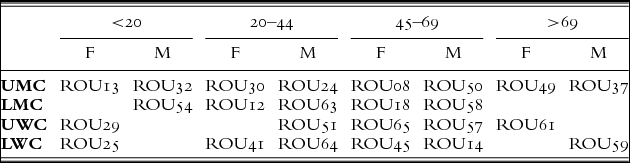
Twenty-four speakers were sampled in each location, using sample-grids based on sex, age group and socioeconomic status (SES). Speakers were recruited by friend-of-a-friend / snowball sampling, as is common in sociolinguistic studies which wish to take account of the makeup of the local population (Meyerhoff et al., Reference Meyerhoff, Schleef and MacKenzie2015: 36). Age groups and SES groups were also constructed using locally-relevant criteria. A summary of these criteria follows; for more detail, see Hall (Reference Hall2008: ch. 2).
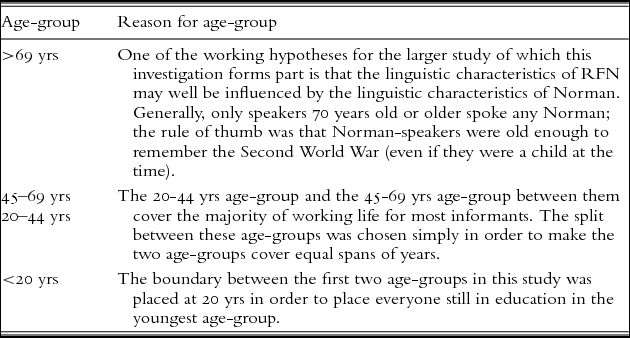
For age, see Table 1.
Age groups

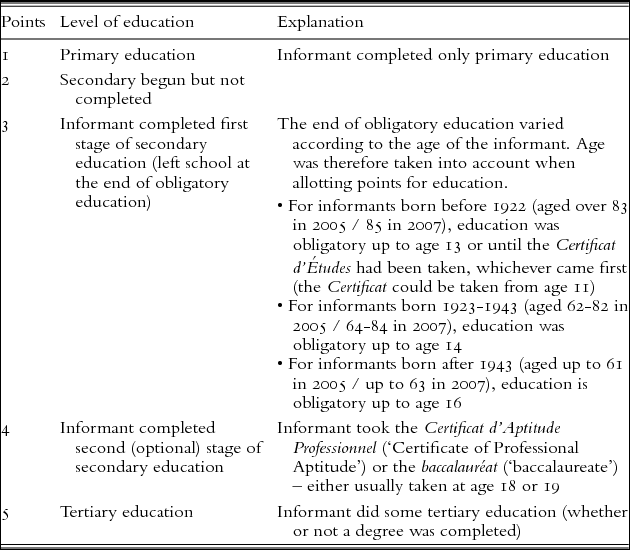
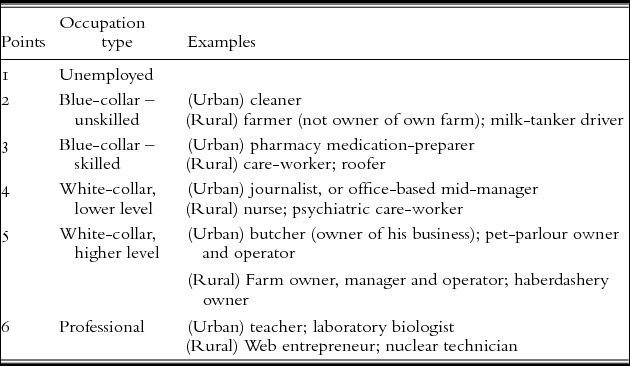
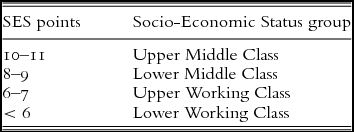
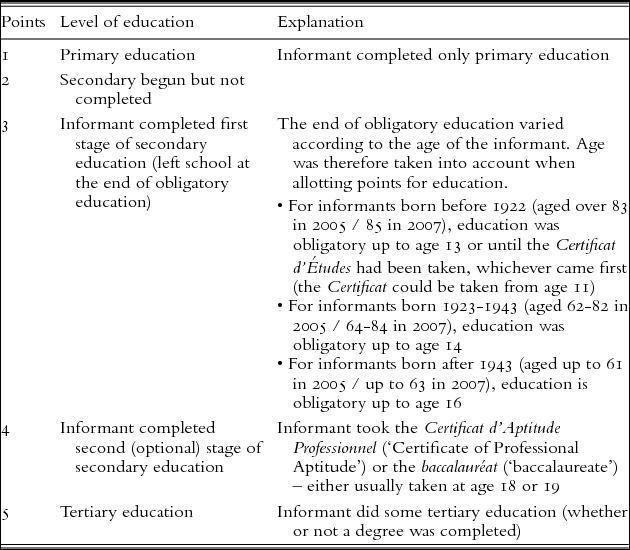
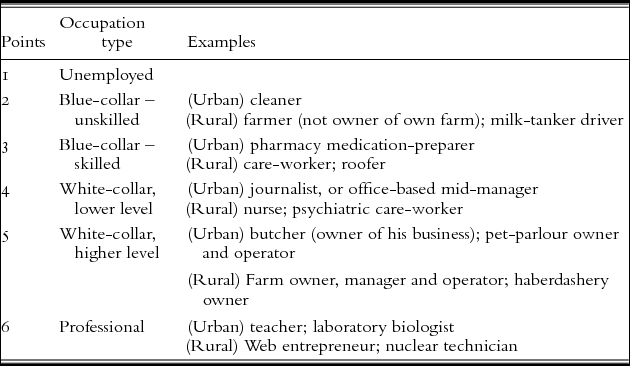
For SES, speakers were scored on two attributes, education (Table 2) and occupation (Table 3). Their scores were added, and SES groups were constructed on this basis (Table 4). Speakers in the <20 age group (they were aged 13 to 18) who had not yet had a job were judged to be in the same SES group as their parents, as they all still lived at home.
Education scores
Occupation scores
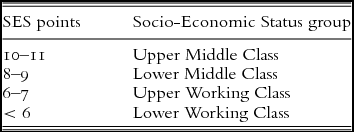
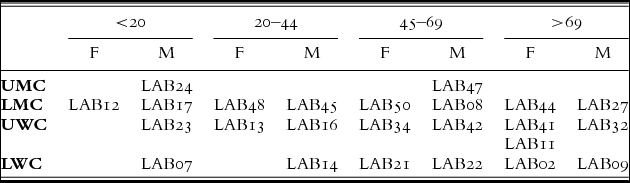
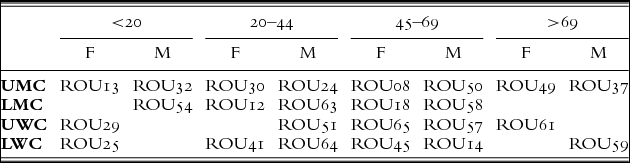
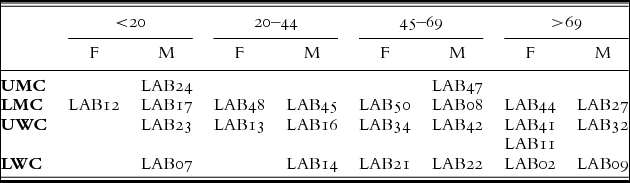
The final sample grids are Table 5 (La Bonneville) and Table 6 (Darnétal). Each cell was filled with one speaker; the speaker numbers appear in the grids (LAB=La Bonneville; ROU=Rouen, as Darnétal is taken by the people of Rouen as representative of the Rouen accent). As is evident, the final sample grids were not entirely full, and were not entirely evenly distributed between age groups and social classes.Footnote 4 This uneven distribution was not corrected for, as it was taken as a reflection of the social constitution of the two study-sites.
Rural sample grid
Urban sample grid
2.7 Language in the study-sites
As §2.4 notes, in some previous studies claiming to be of the Regional French of Normandy, it is not actually clear whether speakers made a clear distinction between Norman and their local variety of French. Tackling this at an early stage in a sociolinguistic interview is not generally recommended (Meyerhoff et al., Reference Meyerhoff, Schleef and MacKenzie2015: 48), but it was done in this study (as discreetly as possible) if the interviewer thought it was necessary. This was in order to make it clear to speakers that they should speak in a relaxed, informal way if possible, and thereby speak RFN rather than SF. To further mitigate the possible difficulty, selection of vowel tokens for analysis also began after about 7 minutes of conversation (to try to avoid the initial period of high consciousness of being recorded).
It seemed that this precaution was necessary, because some speakers’ responses to explicit questions about language (not covered in this article) did show that they did not necessarily see a difference between non-formal French and Norman. Regardless of their answers to those questions, speakers have still been included in this study if the speech analysed here did not show other attributes of Norman (and so they could reasonably be said to be speaking French). Some telltale attributes of Norman would be:
• most tellingly, morphosyntactic (e.g. use of the simple past tense, now almost unused in French)
• certain phonological elisions (Norman sav-ous /savu/ for the common tag-question ‘Know what I mean?’, cf SF savez-vous)
• many lexical items, especially concerning farming, very prominent given that La Bonneville is agricultural.
See also Tyne (Reference Tyne2003) on some speakers’ difficulty in telling the difference between Norman and regional French.
3 LINGUISTIC METHODOLOGY
3.1 Vowels investigated
This study investigates the phonology and phonetics of /ε e/ in IP-final stressed open syllables. Away from this position, any French vowel is more likely to be realised in a less canonical way. In this case in particular, since /ε e/ are neutralised by many speakers – and can be hard to distinguish even if they are not neutralised – it was especially important that the prosodic environment of tokens should not lead to ambiguity in their pronunciation. The comparative emphasis and stability of phrase-final syllables in French was considered the best way to achieve this. Not all tokens examined were sentence-final, but all were at least IP-final (judged by ear).
3.2 Material analysed
Our material is taken from recordings of sociolinguistic interviews carried out between 2003 and 2007. Interviews comprised a conversational section (labelled IV for ‘interview’ in the analysis), of at least 30 minutes (though sometimes much longer); and a formal linguistic task section (FM for ‘formal methods’). Interviews were digitally recorded, using a tie-clip microphone for a single speaker, or a microphone placed between the speakers if there was more than one. The FM tasks comprised a word-list and a reading-passage. In the present study, these two tasks are analysed together as representative of a style where more attention is paid to speech; future research could profitably compare them to one another.
3.3 Phonetic analysis methods
As the basic analysis of vowels involves at least two sets of data – F1 for height and F2 for anteriorityFootnote 5 – we have the possibility of charting their progress in at least two dimensions. While the possibility of independent F1 and F2 change is (at least implicitly) recognised in much phonological and sociophonetic work on English, it has been acknowledged much less frequently in work on French or other languages. It can be argued that changes in a vowel's position in the vowel-space are only truly meaningful when both height and anteriority are taken into account. Certainly, it is clear that two phonemes cannot be said to be merged or neutralised unless neither their heights nor their anteriorities are significantly different. Nevertheless, changes in only one dimension – either height or anteriority but not both – are still potentially meaningful when they bring one phoneme closer to another and so change the configuration of the vowel-space, even if they do not change the total number of phonemes in it, as a complete merger or neutralisation would.
Given that height and anteriority can be independently interesting, this study analyses movements in F1 and F2 separately. It is not the first sociolinguistic study to take the instrumental approach to French, of course: Lennig (Reference Lennig1978) and a few other studies since then are instrumental, and the approach is becoming more common. It is, though, the first to take this approach to Normandy French as a regional variety separate from SF. The first instrumental study including Normandy French that we are aware of is Boula de Mareüil et al. (Reference Boula de Mareüil, Woehrling and Adda-Decker2013), but that study does not analyse Normandy French on its own terms, as a regional variety. Rather, the recordings from Brécey which form part of the ‘Programme “Phonologie du Français Contemporain”’ corpus are treated as Standard French (Boula de Mareüil et al., Reference Boula de Mareüil, Woehrling and Adda-Decker2013: 76).
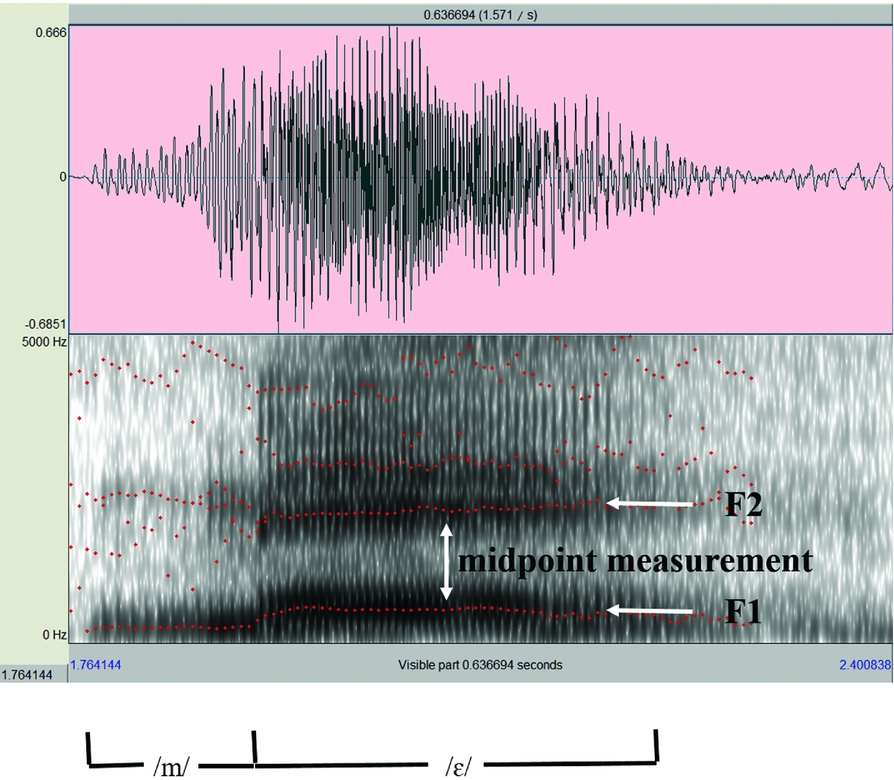
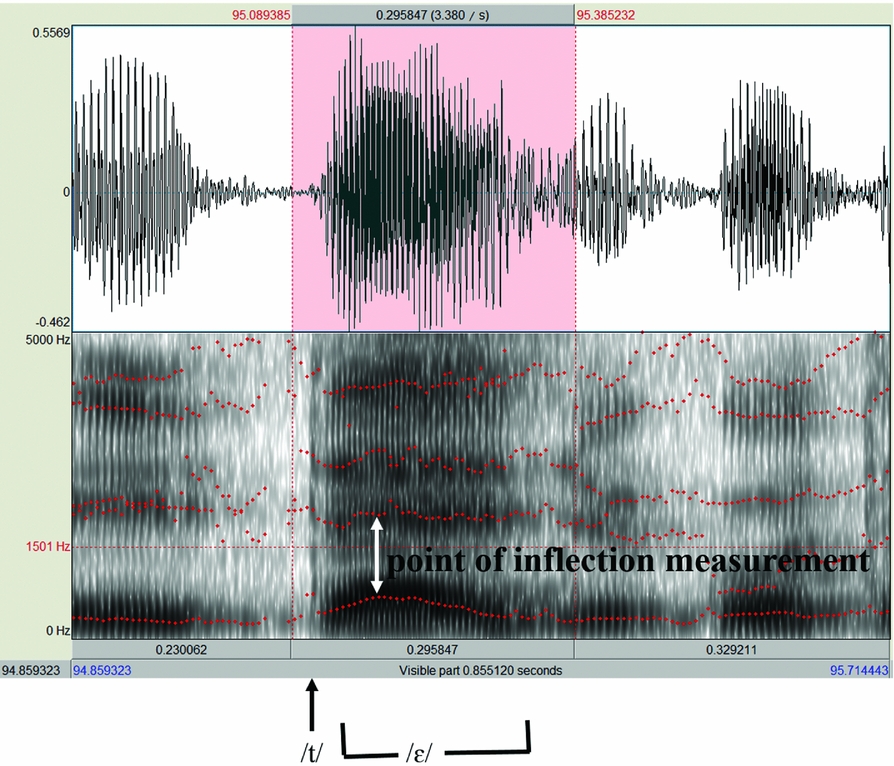
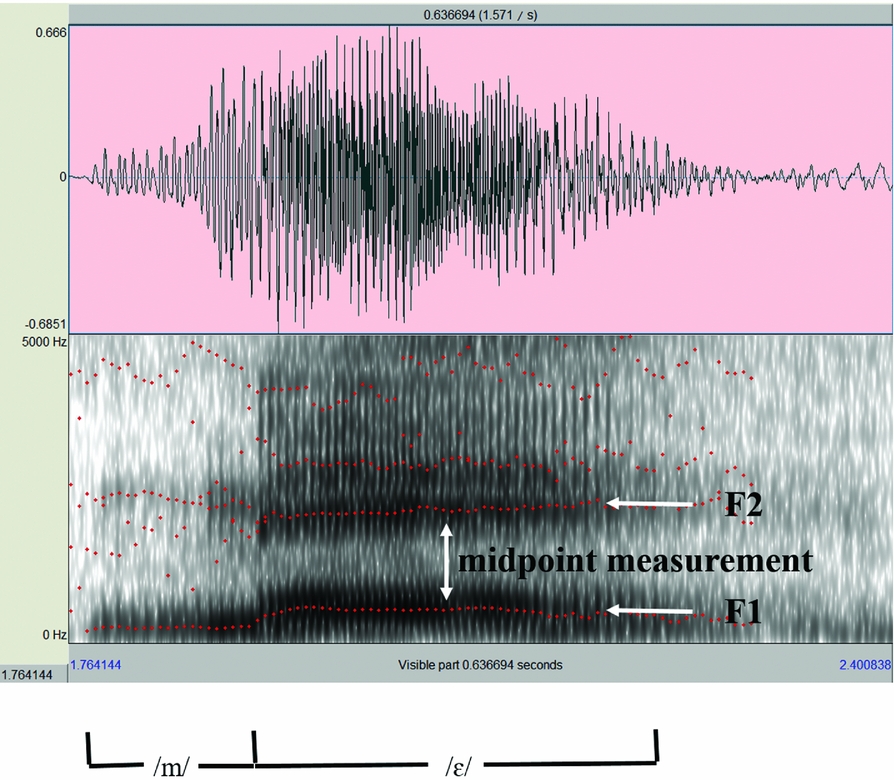
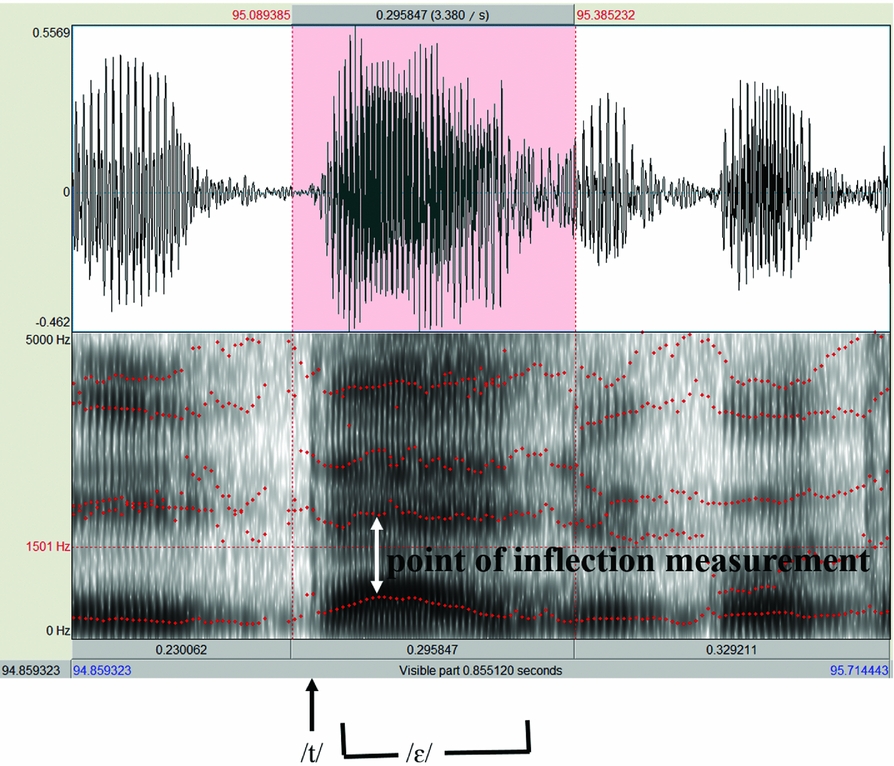
Praat version 5.0 (Boersma and Weenink, Reference Boersma and Weenink1992–Reference Boersma and Weenink2017) was used to measure F1, F2 and F3 in each vowel token: F1 and F2 for comparison of their normalised values, and F3 because Bark Difference Metric normalisation requires it. For tokens where visual inspection showed that the phonetic quality of the vowel did not vary (i.e. F1 and F2 each maintained the same frequency throughout the token), a measurement was taken at the midpoint of the vowel (Figure 2). For tokens where F1 changed direction during the token, a measurement was taken at the point where the change happened (the ‘point of inflection’: Figure 3). This point is taken to represent the target towards which the speaker was unconsciously aiming, or their closest approach to that target within the time of the token (Labov et al., Reference Labov, Ash and Boberg2006: 38). Points of inflection in F1 are privileged over those in F2 because of the general finding that ‘in chain shifts, long vowels rise’ (Labov, Reference Labov1994: 116; vowel movements in the height dimension are characterised by movements in F1). Labov (Reference Labov1994: 116) also adduces an F2-related principle: ‘In chain shifts, back vowels move to the front’. As the two vowels considered here are already front vowels, however (so they cannot move much further to the front), and F1 points of inflection were also the landmarks used by Labov et al., Reference Labov, Ash and Boberg2006, it seemed that F1 landmarks would be generally more important in this case. Measurement was by hand.
Midpoint measurement of the vowel in mais, spoken by LAB01. Measurement taken at double-headed arrow: F1 542Hz, F2 2186Hz.
Point of inflection measurement of the vowel in (é)taient, spoken by LAB01. Measurement taken at double-headed arrow: F1 691Hz, F2 2037Hz.
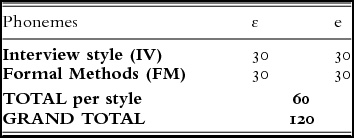
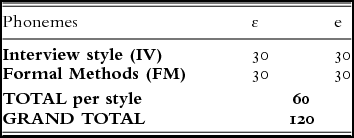
A total of 5,078 tokens of (e) were measured (approximately half /ε/ and half /e/), made up approximately as in Table 7. Table 7 shows that, ideally, the sample should have included (120 tokens × 48 speakers =) 5,760 tokens; however, some speakers were recorded in only one of the styles (IV or FM), and other speakers completed both, but did not produce 30 tokens per phoneme in both. For the majority of speakers, who produced more than 60 tokens per phoneme, the study includes the first 30 tokens per style in which Praat detected clear F1, F2 and F3 tracks.
Approximate number and distribution of tokens per speaker
Formants were detected using Linear Predictive Coding analysis, usually with Praat's default setting of 5 formants (10 poles) in the relevant frequency range, though the number of poles was decreased to 9 or 8 poles if too few clear formants were detected at the 10-pole setting. The ‘relevant frequency range’ was 0–5,000Hz for males and 0–5,500Hz for females (Boersma and Weenink, Reference Boersma and Weenink1992–Reference Boersma and Weenink2017: Manual, Frequently Asked Questions on Formant Analysis).
In order to reduce speech differences due solely to physiology (in particular male-female differences), all vowel tokens were normalised before analysis. Normalisation was carried out using the Bark Difference Metric (BDM), as implemented in NORM (Thomas and Kendall, Reference Thomas and Kendall2007–Reference Thomas and Kendall2015). BDM was chosen as opposed to other common normalisation methods because, unlike many other methods, BDM normalisation of any given vowel token does not depend on any other tokens—not on other tokens of the same vowel by the same speaker or on tokens of different vowels by the same speaker. These qualities make this normalisation method suitable for studies where only tokens of certain phonemes have been measured (and not a representative sample of all vowel phonemes for every speaker).
Speakers were classed as having a neutralisation of IP-final /ɛ/ and /e/ in a given speech style if the heights of their /ɛ/ tokens and their /e/ tokens in that speech style were not significantly different, and the anteriorities of their /ɛ/ tokens and their /e/ tokens in that speech style were not significantly different. A non-significant difference between means in only one dimension but not the other is termed a ‘(height or anteriority) alignment’. Thus, speakers with both a height and an anteriority alignment for (e) in a given speech style had a neutralisation in that style.
Differences and their significance were judged as follows. For each speaker in each style, F1, F2 and F3 were measured for 30 tokens of SF normative IP-final /ɛ/ and 30 tokens of SF normative IP-final /e/. The tokens selected for analysis were those in which the software detected the clearest formant tracks, so as to maximise the reliability of the normalisation. Welch's t-test (a variant of the t-test which does not assume equality of variance between the samples) was performed between these two sets of measurements for each formant. If the probability associated with the resulting t-value was ≥ 0.05, the difference was not deemed significant. That is, p ≥ 0.05 for F1 meant that that speaker's /ɛ/ and /e/ could be considered to be at the same height, so they had a height alignment in (e); in the same way, p ≥ 0.05 for F2 meant an anteriority alignment.
4 RESULTS AND DISCUSSION
4.1 /ɛ/ and /e/ in our data
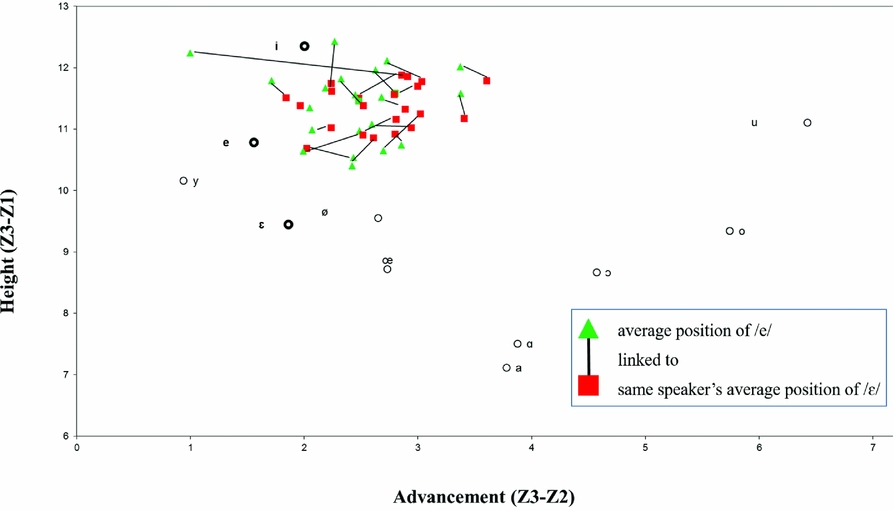
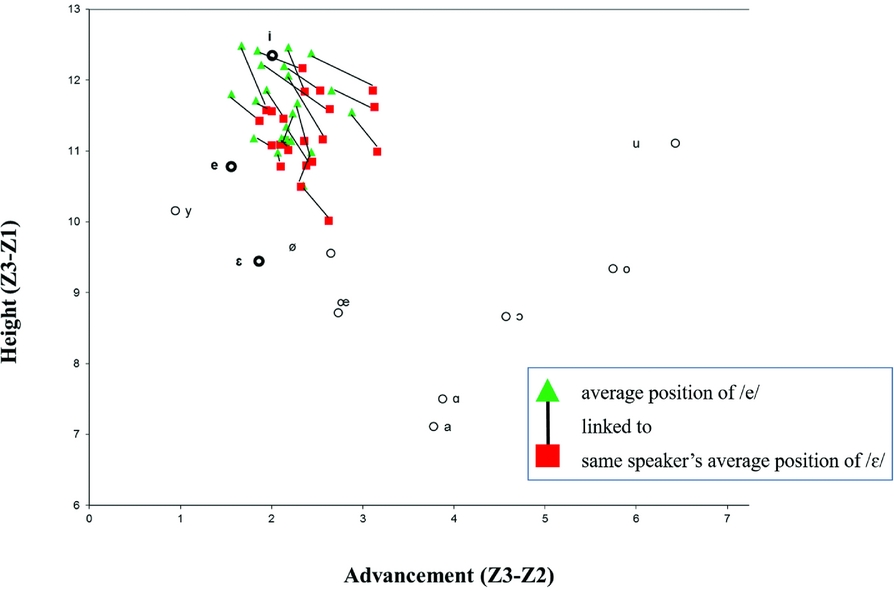
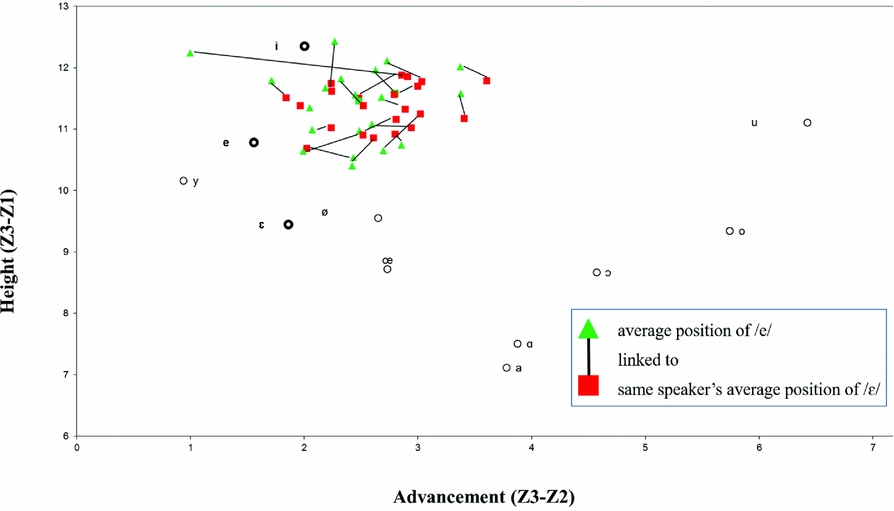
As a guide to the general situation in both our sites, Figure 4 and Figure 5 show normalised speaker-by-speaker averages for data from interviews, with P. Durand (Reference Durand1985)’s set of reference vowels for comparison.Footnote 6 Unfilled circles represent the reference vowels. Speakers in this study are represented by two linked points: red squares for their mean realisation of IP-final /ɛ/, and green triangles for /e/. Summary per-speaker data (means and standard deviations for F1 and F2 of /ɛ/ and /e/, in both IV and FM styles) is available at https://doi.org/10.5281/zenodo.1066036.
Bark Difference Metric-normalised average French vowel values, interview style, La Bonneville
Bark Difference Metric-normalised average French vowel values, interview style, Darnétal
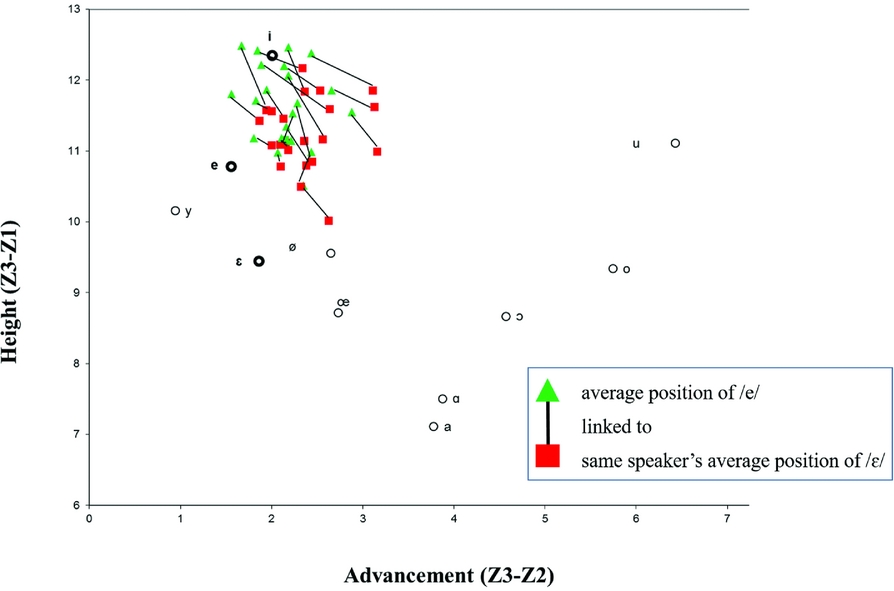
P. Durand (Reference Durand1985: 104) gives per-speaker average values for F1, F2 and F3, for all French vowel phonemes, from two Parisian speakers. P. Durand takes these speakers as representative of non-regionally-marked French because their variety of French is the one which has resulted from the ‘slow levelling of different provincial varieties’ (Walter, Reference Walter1977: 17, quoted by P. Durand, Reference Durand1985: 20) which is found all over France, but most often in Paris. No other details of these speakers are given (age, sex etc). Each reference vowel plotted here is the average of P. Durand (Reference Durand1985)’s two speakers’ F1–F2 measurements for that vowel, normalised with the Bark Difference Metric.
The length of the line linking each speaker's pairs of points represent the Euclidean Distance (ED) between that speaker's /ɛ e/ means. The ED can be taken as a rough guide to how close each speaker is to neutralising /ɛ/ and /e/ in this position: the smaller the ED, the more similar that speaker's mean realisations of /ɛ/ and /e/ are, so the closer that speaker is to neutralising IP-final /ɛ e/.
The EDs for our two sites show that La Bonneville speakers are generally much closer to neutralising IP-final /ɛ e/ than Darnétal speakers are. La Bonneville speakers have mean ED 0.374 Bark difference units, standard deviation 0.194 units, coefficient of variation 0.518; Darnétal speakers have mean ED 0.517 units, s.d. 0.274 units, c.v. 0.529. The c.v. (=s.d. divided by mean) gives an idea of how well the mean summarises the whole data-set. Interpretations of it vary but, for sciences where data-sets with greater dispersion may be tolerable (i.e. sciences other than medicine), a rule of thumb is that a c.v. of under 1 shows that variance is relatively small (Kaufmann, n.d.; Feinstein, Reference Feinstein2002: 65–66). In both our sites, the c.v. of speaker EDs between /ɛ/ and /e/ is under 1. Therefore, the mean EDs in our sites – La Bonneville 0.374 Bark difference units, Darnétal 0.517 units – are a reasonable representation of their extent of neutralisation.
These site EDs should be compared with the ED for P. Durand (Reference Durand1985)’s reference /ɛ e/, which is 1.371 units. It is striking that even in Darnétal, the site in this study where speakers are relatively further from IP-final /ɛ e/ neutralisation, the mean ED is still only just over a third of the ED for Durand (Reference Durand1985)’s reference /ɛ e/. Two fully-merged vowels would have an ED of 0 between their mean values. Therefore, as 0.517 units is closer to 0 than it is to 1.371 units, even Darnétal speakers are still closer to neutralising than to maintaining a full distinction. La Bonneville is even closer to full neutralisation than Darnétal is.
EDs therefore give us a good idea of how far apart our sites’ mean realisations for /ɛ/ and /e/ are. To characterise the relationship more fully, we should also describe the degree of overlap between the clouds of speaker mean values for /ɛ/ and /e/ in each site. Statistical measures are also available for this (Nycz and Hall-Lew, Reference Nycz and Hall-Lew2014), though time pressure has prevented us from applying them to this dataset. Doing so would certainly be desirable in future research. Visual inspection of the data shows the following. In La Bonneville taken as a whole, speaker average /ɛ/ and /e/ points are thoroughly mixed with each other, so that the impression of the community as a whole would be one where no consistent distinction between IP-final /ɛ/ and /e/ was made: a community-wide neutralisation. In Darnétal, most speaker averages for /ɛ/ are lower than most speaker averages for /e/, so the community-wide neutralisation is less prominent, but there is still not separation between the cloud of points showing speaker averages for /ɛ/ and the cloud of points showing speaker averages for /e/.
4.2 Phonetic unity?
In both sites for this study, the cloud of tokens is high in the vowel-space (Figure 4 and Figure 5), occupying a space mostly between P. Durand (Reference Durand1985)’s reference /e/ and /i/. Few speakers, even those who do not neutralise /ε e/, have an /ε/ as open as P. Durand (Reference Durand1985)’s /ε/. We can therefore say that both /ε/ and /e/ are raised in both Normandy sites, to realisations that are at least as close as canonical [e]: phonetic unity of a sort.
4.3 Phonological and sociolinguistic disparity
At a deeper level, however, Figure 4 and Figure 5 show that our sites behave differently on average with regard to (e).Footnote 7 In La Bonneville, it is clear that most speakers have neutralised /ε e/ in the relevant position, so that their one IP-final realisation is [e]. In Darnétal, on the other hand, the largest number of individual speakers have separate IP-final /ε e/ – though exactly how the two phonemes are distinguished by speakers is a question we will address later (§5). The F2 / anteriority dimension seems more important than F1 / height.
Within each site, rates of neutralisation differ according to sociolinguistic variables which have been found useful in many Western urban studies: socio-economic status (SES), age-groups within the SES groups, and levels of formality. There was no clear pattern of gender differentiation for this neutralisation in either site.
4.3.1 Neutralisations by socio-economic status
Sociolinguistic investigations in unstudied communities should start with few or no a priori expectations about which social factors will condition variation. Therefore, they often begin with the ‘big four’ (Preston, Reference Preston1986): gender, age, SES and race. Race is not investigated here, since all the interviewees in the present study were Caucasian, like the vast majority of inhabitants of Normandy. It is difficult to support this contention with demographic data, since it is illegal to ask questions about race or ethnicity in the official census in France (INSEE, 2016: 11), but personal experience confirms it.
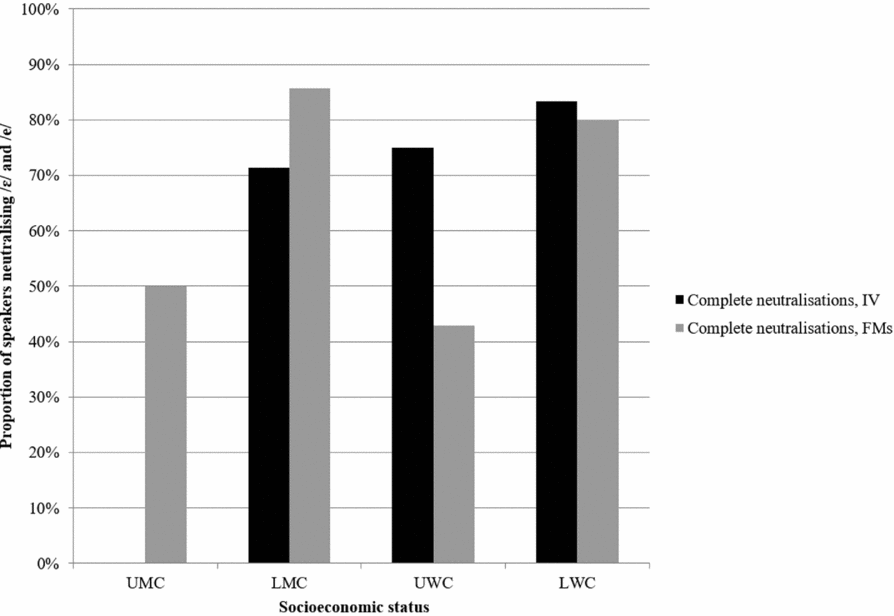
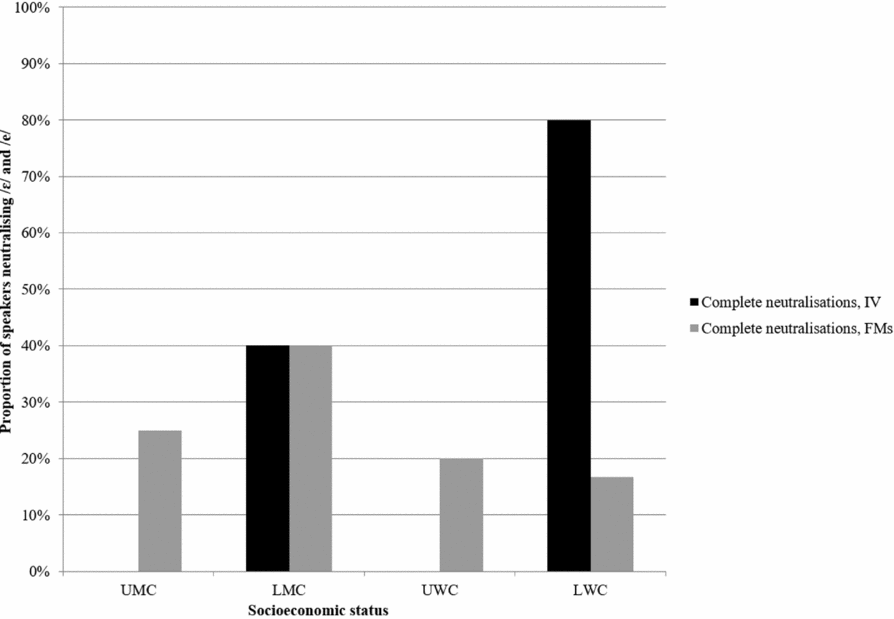
Of the remaining three major social variables, in Normandy SES shows the most canonical division for (e), at least in interview speech. Figure 6 shows the proportion of speakers with neutralisations in La Bonneville, and Figure 7 that in Darnétal (total N per site = 24; data is in Table 8 and Table 9 respectively). In both study-sites, but particularly in La Bonneville, visual inspection shows that rates of neutralisation in interview speech increase with decreasing SES.Footnote 8
(e): proportion of speakers with neutralisations, by SES, La Bonneville. N = 24.

(e): proportion of speakers with neutralisations, by SES, Darnétal. N = 24.

(e): number of speakers with neutralisations, by SES, La Bonneville

(e): number of speakers with neutralisations, by SES, Darnétal

4.3.2 Neutralisations by age
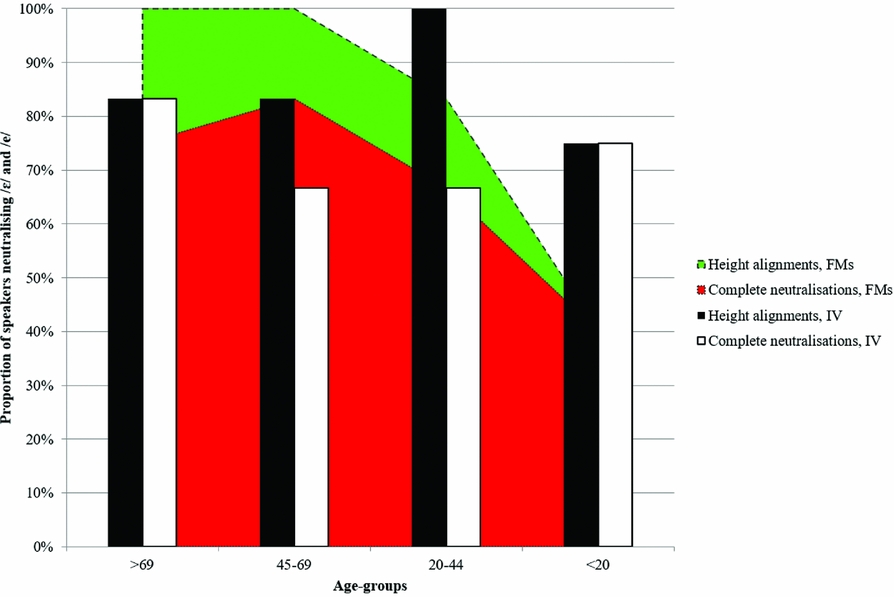
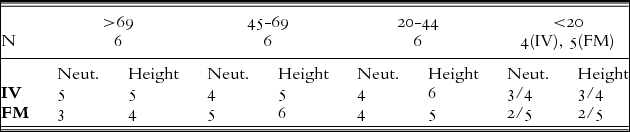
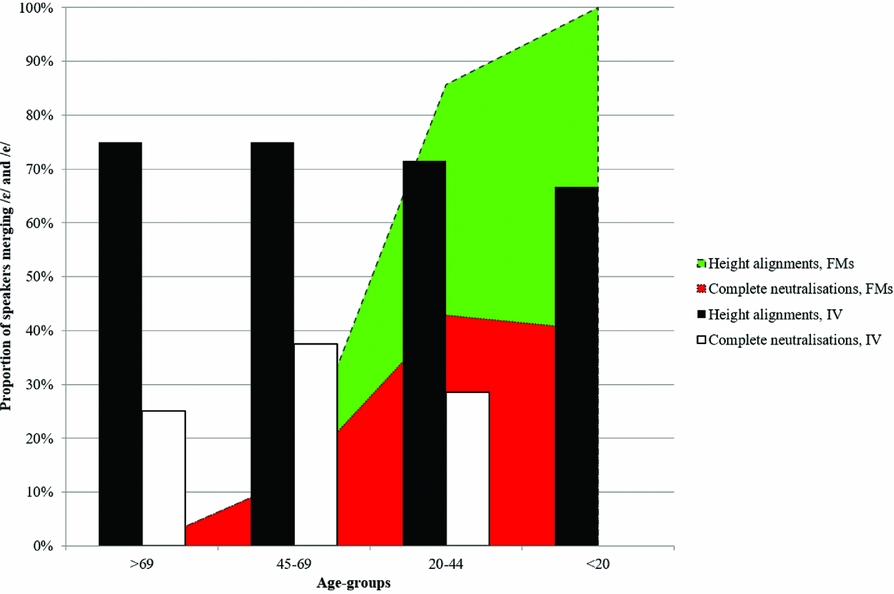
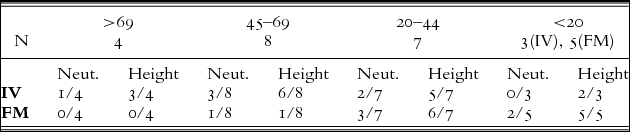
In La Bonneville (Figure 8 / Table 10), rates of neutralisation in formal tasks are high in the >69 age-group but peak in the 45–69 age-group and decline in speakers younger than that. In interview speech, rates of neutralisation are uniformly high. In Darnétal (Figure 9 / Table 11), on the other hand, rates of neutralisation in formal tasks and interview speech interact to create a pattern which reflects what we argue to be the changing social evaluation of neutralised /ε e/ in that site.
(e): proportion of speakers with complete neutralisations and height alignments, by age-group, La Bonneville. N = 24.
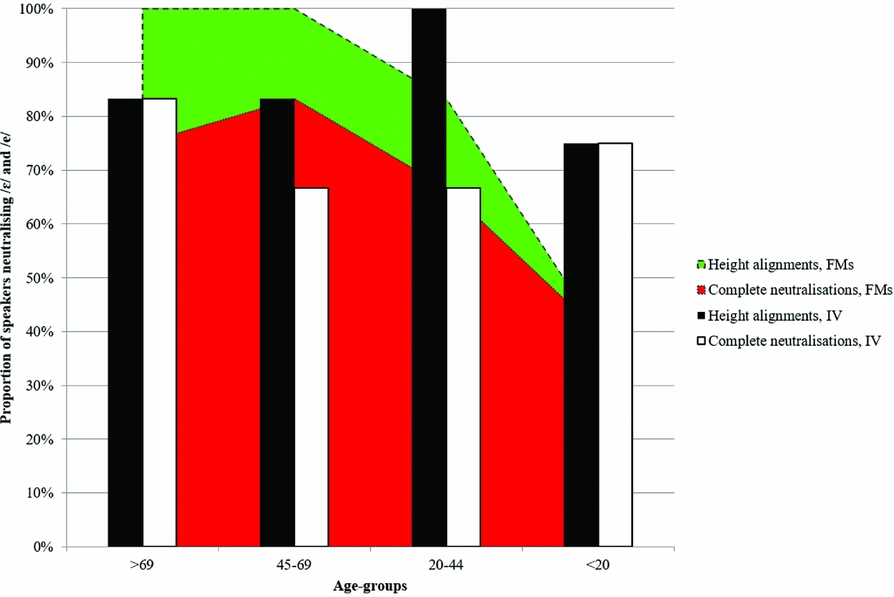
(e): number of speakers with complete neutralisations and height alignments, by age-group, La Bonneville

Neut. = Neutralisations
Height = Height alignments
(e): proportion of speakers with complete neutralisations and height alignments, by age-group, Darnétal. N = 24.
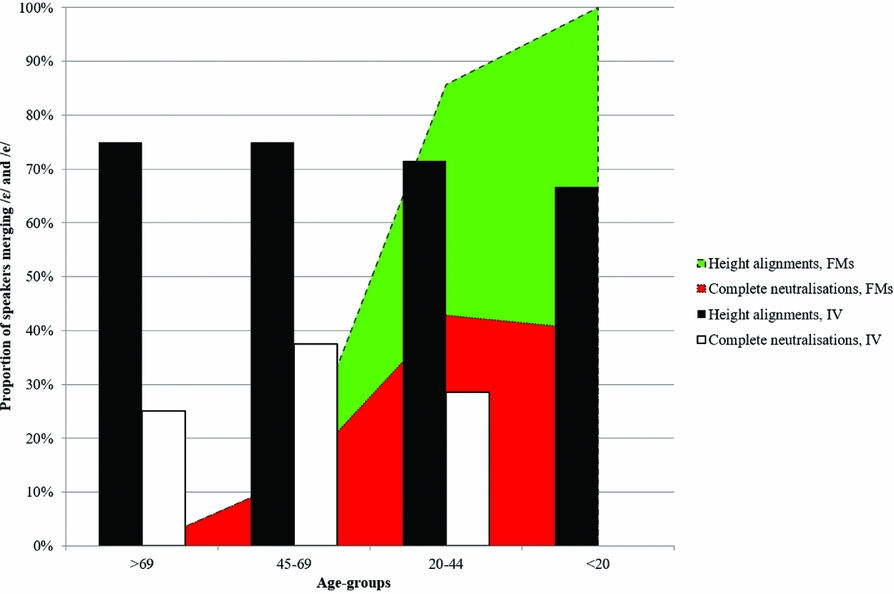
(e): number of speakers with complete neutralisations and height alignments, by age-group, Darnétal

Neut. = Neutralisations
Height = Height alignments
The gross pattern of (e) neutralisations in Darnétal is that only the oldest three age-groups (>69, 45–69 and 20–44) have any neutralisation in interview style, while only the youngest three age-groups (45–69, 20–44 and <20) have any neutralisation in formal tasks. As the youngest age-group have relatively high rates of neutralisation in formal style, we may infer that they think of neutralisation as having overt prestige, as situations of language change usually show that overtly prestigious variants are preferred when speakers are paying more attention to their speech (Labov, Reference Labov2001: 437).
Proposed prestige effects in sociolinguistic studies can be difficult to justify, if the analysed interviews did not include discussion of reasons why speakers might speak the way they do—and, as previously observed, such discussion is usually not advisable. For this reason, like many previous studies, this study does not include systematically-gathered evidence on the prestige of different ways of speaking. To some extent, though, well-known non-linguistic facts about the societies in question can support hypotheses about prestige effects.
For the Darnétal speakers who neutralise IP-final /ɛ e/, their neutralisation may be at least partly motivated by the fact that the same neutralisation is relatively widespread in the prestigious and nearby city of Paris (Fagyal et al., Reference Fagyal, Hassa and Ngom2002; J. Durand and Lyche, Reference Durand, Lyche, Coveney, Hintze and Sanders2004). Darnétal is closer to Paris than to La Bonneville, and Darnétal is connected to Paris by a great deal of travel along the industrialised Seine Valley corridor—and of course Paris is also the prestigious centre of France in many other ways (Armstrong and Pooley, Reference Armstrong and Pooley2010: 12ff). It therefore seems natural that young people might also look to Paris for prestigious linguistic norms.
On the other hand, though, we then have to explain why the oldest age-group have no neutralisation in formal style, but relatively high rates in interview style – the opposite pattern to younger people. It would clearly be untrue to suggest that Paris was not prestigious when they were growing up and forming their speech habits. We therefore should not claim that their social evaluation of this neutralisation is the reverse of the younger people's. But the literature does contain more evidence of IP-final distinction in Paris at the time when our older Darnétal speakers were growing up, than it does of IP-final neutralisation (§2.3). Both older and younger Darnétal speakers therefore seem to be reacting to the prestige of Paris. More of our older speakers distinguish /ɛ e/ in formal speech because that was the Parisian norm when they were growing up, whereas more of our younger speakers neutralise /ɛ e/ in formal speech because neutralised IP-final /ɛ e/ seems to be the incoming norm in Paris now.
The apparent-time patterning of the IP-final /ɛ e/ configuration in formal tasks among younger people is therefore stylistically opposed between our two sites: more distinction in La Bonneville, more neutralisation in Darnétal. Younger people in La Bonneville may be retreating from the neutralisation in formal language, even though it is now present in Paris, because they hear a lot of neutralisation from their parents and grandparents (who often live in the same village). Therefore, La Bonneville younger people actually see neutralisation as a rural, stigmatised feature. The stigma attached to /ɛ e/ neutralisation would therefore override any prestige effect coming from Paris. On the other hand, in Darnétal young people are adopting the neutralisation; perhaps they see it as a prestigious feature because they hear it in Paris. Many Darnétalais pointed out the closeness of Paris when asked to comment on their local accent and when doing the map-task for this study. Also, like the rural young people, young Darnétalais may be motivated by moving away from their parents’ and grandparents’ treatment of /ɛ e/ (a distinction in their case). Both these possible motivations would result in young Darnétalais moving towards a neutralisation of IP-final /ɛ e/. The difference in how much the current Parisian treatment of (e) matters in our two sites, may be explained by the fact that Paris is further from La Bonneville than it is from Darnétal, and that in fact Darnétal is closer to Paris than it is to La Bonneville.
5 THEORETICAL IMPLICATIONS
5.1 Phonology, sociophonetics and (e): probing the neutralisation more deeply
As §3.3 mentions, complete neutralisation of IP-final /ε e/ is not the only sociophonetic outcome which deserves investigation in our sites. The component dimensions of the neutralisation – vowel height and vowel anteriority – also bear scrutiny individually.
The respective heights of /ε e/ in Normandy are interesting, and particularly in La Bonneville. Unusually (since informal style usually changes first in linguistic change), formal style shows the relevant patterns better than informal interview style does. Figure 8 shows that apparent-time change patterns in height alignment and in complete neutralisation are similar in La Bonneville, except that rates of complete neutralisation are lower than rates of height alignment (formal style data is represented by the filled areas; interview style data is represented by the columns). This might be expected, as a speaker with a complete neutralisation of IP-final /ε e/ by definition has a height alignment and an anteriority alignment for the two phonemes. It is therefore likely (though not inevitable) that there will be fewer speakers with both alignments than speakers with an alignment in one of the two dimensions but not the other. There may also be a ceiling effect on height alignment among the older two age-groups in our sample: as there were already high rates of complete neutralisation in the older two age-groups, the height-alignment rate could not be much higher than this in the younger groups, before it hit the ceiling (100%) and obscured the pattern.
In Darnétal, the apparent-time pattern of height alignments is not as clearly reflected in the complete neutralisation pattern, as the filled areas in Figure 9 show. For both height alignments and neutralisations, there are none in the >69 age-group, a few in the 45–69 age-group and more in the 20–45 age-group. In the youngest age-group, however, the patterns diverge. The <20 age-group in Darnétal has fewer neutralisations than the 20–45 age-group, but the <20 age-group has more height-alignments than the 20–45 age-group. Again, we may find an explanation of this lack of similarity in the general lower proportion of neutralisations in Darnétal.
In both La Bonneville and Darnétal, anteriority alignments show little consistent patterning or, at least, much less than height alignments and complete neutralisations do. It therefore seems legitimate to say that, of these two separate aspects of a complete neutralisation, height alignment is the primary one, that is, the one that responds to social conditioning better. Height alignment may therefore take a greater part in driving the (e) neutralisation process. The more robust social patterning of height alignment, and the much lower rates of anteriority alignments in general, allow us to say that, if a speaker has /ε e/ aligned in anteriority, it is likely that he/she also has them aligned in height – that is, it is likely that he/she has a complete neutralisation. And indeed, this prediction is borne out in both sites for this study.
5.1.1 Separating height and anteriority alignment
The primacy of height alignment over anteriority alignment in RFN allows us two observations about the configuration of phonological space, and the diachronic positioning of phonemes within it.
5.1.1.1 Minimal separation of phonemes in the vowel-space
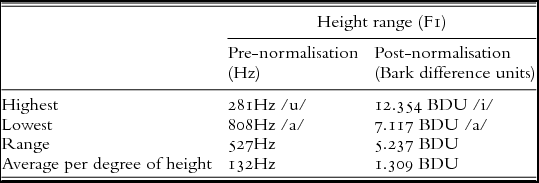
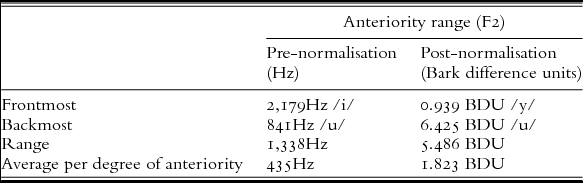
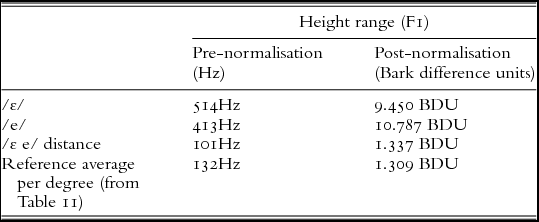
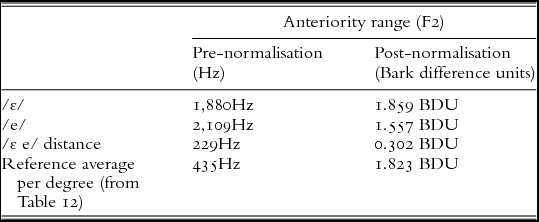
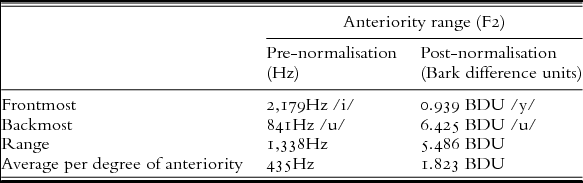
There is less phonetic ‘room for manœuvre’ in the height (F1) dimension of the vowel-space than there is in the anteriority (F2) dimension, whether these are measured in (physical) hertz or (perceptual) Bark difference units. That is, whatever the unit of measurement, the vowel quadrilateral is wider than it is high. The phonetic dimensions of the whole SF vowel system, and the place of /ɛ e/ within it, are summarised in Tables 12–15.
Height in the Standard French vowel system

Anteriority in the Standard French vowel system
Height of /ɛ e/ in the Standard French vowel system

Anteriority of /ɛ e/ in the Standard French vowel system

To interpret these data, note that post-normalisation, perceptual Bark difference units run in a different direction from (pre-normalisation, physical) hertz. The axes of a Bark difference unit plot run in the same direction as those of a conventional x–y plot. Values on the x axis increase from bottom to top (i.e. lower vowels have lower values and higher vowels have higher values), and values on the y axis increase from left to right (i.e. fronter vowels have lower values and backer vowels have higher values). This is the opposite way around from a typical plot in hertz, where lower and fronter vowels have high values, and higher and backer vowels have low values.
We should also bear in mind that normalisation can result in vowel-spaces changing shape, and this is in fact what we see here. Whereas the highest vowels in an unnormalised SF vowel-space are usually /i u/ and the lowest is usually /a/ (Table 12), after BDM normalisation, the single highest vowel in P. Durand (Reference Durand1985)’s reference data is clearly /i/: its BDM-normalised value is substantially higher than that of /u/. Likewise, whereas the frontmost vowel in an unnormalised SF vowel-space is usually /i/, and the backmost is /u/, after BDM normalisation, the frontmost vowel in the same reference data is clearly /y/ (Table 13). This means that the maximal dimensions of the vowel space – the ranges between the highest and lowest vowels and the backmost and frontmost vowels – are not calculated between the same vowels if calculated before BDM normalisation as they are if calculated after BDM normalisation. This has an implication when we compare measurements and distances within the vowel space. Either before or after normalisation, we can still compare total ranges, the size of average degrees of height / anteriority, and the distance between /ɛ/ and /e/ – but we cannot do this between unnormalised and normalised values.
Phonologically, vowel spaces are often divided into four degrees of height (close, close-mid, open-mid, open) and three degrees of anteriority (front, central, back). We may interpret these degrees of height and anteriority as the smallest divisions of the vowel space which speakers of the language in question can potentially use to make contrasts in meaning, though of course this does not mean that all speakers will actually make all the possible contrasts. There are also often conventions about which contrasts are used to describe particular languages’ vowels. French vowels are described using only two degrees of anteriority (front and back) in the majority of scholarly literature and textbooks (e.g. Walter, Reference Walter1977; Battye, Hintze and Rowlett, Reference Battye, Hintze and Rowlett2000; Lyche, Reference Lyche, Detey, Durand, Laks and Lyche2010; Violin-Wigent et al., Reference Violin-Wigent, Miller and Grim2013), though Fougeron and Smith (Reference Fougeron and Smith1999: 78) note that ‘possibly three’ degrees (i.e. including central) could be used.
In phonetics, the analogue to these minimal degrees of separation is the Just Noticeable Difference (JND; Denes and Pinson, Reference Denes and Pinson1993: 105). JND is the phonetic distance (in hertz, Bark or any other scale) beyond which the difference between two sounds is too large to be disregarded. If we do indeed take phonetic JND to be analogous to phonological minimal degrees of separation, the JND between any two phonemes for height should be smaller than the JND for anteriority.
For /ɛ e/ specifically, Tables 14 and 15 show that the distances between reference /ɛ/ and /e/ in both height and anteriority are very close to or smaller than the average distances per degree in the French vowel space, whether these average distances are measured before or after normalisation. This may indicate that, phonetically, a neutralisation of /ɛ e/ would be particularly likely to happen, among all vowel pairs which are candidates for this process. And this is for P. Durand (Reference Durand1985)’s reference French speakers; for our Normandy speakers, it is likely that the distances between /ɛ/ and /e/ would be smaller still, especially in height, given our sample's high rates of height alignment in particular. Therefore, neutralisations might be even more likely. Quantitative confirmation of this fact will await further studies, though, as P. Durand (Reference Durand1985)’s reference figures are presented here only to orient the reader. It would be misleading to make a detailed comparison of the Durand figures with our Normandy speakers’ data, because of the differences in sample size and composition between the two data-sets.
5.1.1.2 Where in the vowel space do merging/neutralising phonemes tend to come together?
Given that the configuration of the vowel space for maximal distinction between phonemes requires tighter organisation in height than in anteriority, there is the further question of where in the vowel space phonemes which are possible candidates for height alignment or complete neutralisation will come together. Will two phonemes align, neutralise or merge nearer to the normative position of the more open of them, or nearer to the position of the more close of them? The overwhelming tendency in such cases seems to be neutralisation, alignment or merger in the more close position: ‘in chain shifts, long vowels rise’ (Labov, Reference Labov1994: 116), pace Schortz (Reference Schortz1998) and Carton et al. (Reference Carton, Rossi, Autesserre and Léon1983). The present finding from two sites in Normandy would therefore be further evidence in the same direction.
5.2 The Loi de Position in RFN and Northern French
The distinction or neutralisation of IP-final /ε e/ in RFN is an interesting case-study of possible social factors in a linguistic change because, for some speakers at least, the social factors here point in the opposite direction from the dominant linguistic factors. Older Darnétalais in particular seem to regard an IP-final /ε e/ distinction as prestigious, whereas the dominant linguistic tendency seems to be neutralisation. The social factors in the change have been discussed in detail in §4; the linguistic factors remain to be explored.Footnote 9
Much of the North of France does not observe the open-syllable element of the LdP, so Northern French, which would include RFN, usually has /ε e/ distinguished in that position. This may be changing, though: there may be an increasing tendency in Paris to neutralise /ε e/, which would amount to an introduction of the full LdP (Hansen, Reference Hansen, Gess, Lyche and Meisenburg2013: 155), and (as previously noted) many speakers in Nord and Pas-de-Calais already do neutralise them (Scherrer et al., Reference Scherrer, Boula de Mareüil and Goldman2015).
How, then, does the present study contribute to our knowledge of the progress of the LdP in France, and the /ε e/ neutralisation in particular (cf §2.3)? In the early- to mid-1970s, at least some Parisian speakers had an /ε e/ neutralisation (Peretz recorded her speakers in 1972–74; Lennig recorded his in 1975 and 1977), and other speakers in Northern France also have a neutralisation. We might therefore reasonably expect the neutralisation to have spread in the time between the 1970s and the time of the results reported here, since usually ‘mergers expand at the expense of distinctions’ (Labov, Reference Labov1994: 313). And indeed, two reasonably recent studies do seem to show an increase in /ε e/ neutralisation in Paris. There are also tantalising hints elsewhere in France of developments of the phonetic relationship between /ε e/ on the same lines as we have described them here for Normandy: height alignment but anteriority distinction.
First, Hansen and Juillard's (Reference Hansen and Juillard2011) re-study of Peretz (Reference Peretz and Walter1977), using distinctions made in possible minimal pairs (e.g. piqué, piquet), does find that young Parisians’ rate of neutralisation of /ε e/ has risen (Hansen and Juillard, Reference Hansen and Juillard2011: 320ff). In 1972–74, 69% of the possible /ε e/ minimal pairs were distinguished, whereas in 2001–4 only 52% of the possible distinctions were made. Hansen and Juillard (Reference Hansen and Juillard2011) also found a reduction in possible distinctions for the other three vowel quality pairs of French (/a ɑ/ /o ɔ/ /ø œ/).
Secondly, Hansen (Reference Hansen, Gess, Lyche and Meisenburg2013), also on young Parisian speakers, has somewhat contradictory (but intriguing) results. She reports (p. 157) that most of the possible /ε e/ minimal pairs examined there were distinguished, but makes two interesting notes. First, in the majority of the distinguished minimal pairs there was only a slight phonetic distinction – clear enough to be audible, but perhaps not enough to be standard. This may be a description of what we also find in Normandy: distinction of /ε e/ by one parameter only, height or anteriority, not height and anteriority. Hansen (Reference Hansen, Gess, Lyche and Meisenburg2013) also reports that for her speakers, it makes no difference whether the words in minimal pairs are presented separately or together. In the protocol used by Hansen (J. Durand et al. Reference Durand, Lyche and Laks2002), the word-list consists of 84 items presented in random order, followed immediately by repetitions of ten of the words in five minimal pairs. Hansen notes that the presentation of the pair épée /epe/ ~ épais /epε/ together at the end of the list ‘provokes no change whatsoever in their pronunciation by the speakers, as compared to their occurrence [separated] in the course of the list. Thus there is apparently no normative pressure forcing speakers to pay special attention to their /E/ quality’.
Fagyal et al. (Reference Fagyal, Hassa and Ngom2002) may find a similar relationship between /ε e/ to that found by Hansen (Reference Hansen, Gess, Lyche and Meisenburg2013). One speaker, Camille M, shows a ‘neutralisation partielle dans la dimension de F1’ (Fagyal et al. Reference Fagyal, Hassa and Ngom2002: 166). The dimension neutralised by Camille M is height, leaving anteriority as the only distinguishing dimension for the words affected. Later, on the basis of all three speakers in the study, Fagyal et al. (Reference Fagyal, Hassa and Ngom2002: 168) go so far as to say that ‘la neutralisation des voyelles [e] et [ε] en syllabes ouvertes de fin de mot est bien avancée dans la parole des jeunes Parisiens cultivés’. As Fagyal et al. (Reference Fagyal, Hassa and Ngom2002) is carefully identified as a pilot study, it would be inappropriate to draw wide-ranging conclusions from it. Suffice it to say, however, that the study does indicate that the French of young Parisian speakers may feature both complete neutralisation of /ε e/ (for some speakers), and height alignment of the phonemes (for others). In the latter speakers, only anteriority would be left to distinguish the two phonemes – like many speakers in the present study of Normandy.
6 CONCLUSION
This article has shown that IP-final /ε e/ in RFN are now more likely to be neutralised than was the case previously; and that, if they are not actually neutralised for a given speaker, they may well be less distinct than they would have been previously. Stated differently, this is evidence of the increasing prevalence of the open-syllable element of the LdP (‘close vowels in open syllables’) in Normandy. It is present in the RFN of both sites investigated here, even though the sociolinguistic conditions in the two sites are different.
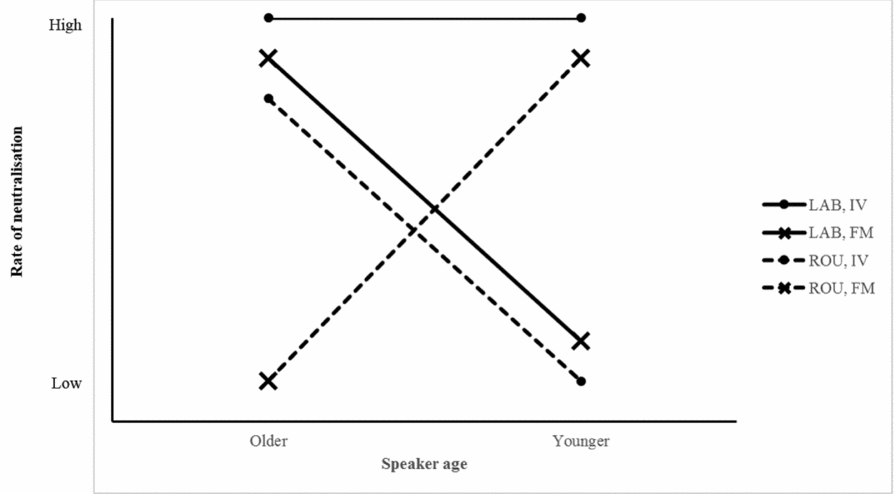
In both La Bonneville and Darnétal, rates of /ε e/ neutralisation in IP-final open syllables in interview style increase with decreasing socio-economic class. The effect of age differs between the two sites: in La Bonneville, neutralisation is uniformly high in interview style, while it decreases with decreasing age in formal style; in Darnétal, younger people neutralise more often in formal style, while older people neutralise more often in interview style. Figure 10, which is schematic only, summarises these effects, using a simplified age categorisation (‘Older’ and ‘Younger’) and a simplified rate of neutralisation (‘High’ and ‘Low’). Vertical position on this chart is only relative. For example, in the Older age-group, the chart simply shows that neutralisation is relatively low in FM style in Darnétal, while it is relatively high in IV style in Darnétal and in both styles in La Bonneville: the data-points in the high position are separated only for display purposes.
(e): depiction of changes in rates of neutralisation, by simplified age-group and style, both sites

The dotted lines representing Darnétal, which cross each other, point to a social evaluation of the neutralisation which is changing over time in that site. We can reasonably infer that both younger and older people there may be reacting to the prestige of Paris, both because it is the capital and because it is relatively close and well-connected. The literature contains more evidence of an /ε e/ separation in Paris at the time when our older speakers were growing up, and so they regard that as prestigious; whereas the more recent trend in the /ε e/ relationship in Paris seems to be a neutralisation, so younger people are neutralising the two phonemes more in IP-final position. The amount of neutralisation in both our sites (whatever the motivation) goes counter to the stereotype that the phonology of Northern France does not include the LdP.
As well as cases of IP-final open-syllable /ε e/ neutralisation, this article has also investigated cases where speakers align /ε e/ only in height or only in anteriority, but not in both. In Darnétal, whereas complete neutralisations drop in the youngest age-group, height alignment rises in that group – so, possibly, younger speakers in Darnétal are not reducing the number of phonemes in their vowel space (which a complete neutralisation would do), but they are at least changing the configuration of their vowel space by raising /ε/ (i.e. moving it towards the height of /e/, while keeping it further back than /e/). Given the dimensions of any vowel quadrilateral (wider than they are high), possibly younger speakers in Normandy are reorganising their vowel space in order to make better use of the available resources, reducing the number of contrasts in the more crowded height dimension, and fully exploiting the less crowded anteriority dimension.
In Martinet's (Reference Martinet1945) self-report study of upper middle class spoken French, Normandy was the only region of France outside the South where an appreciable number of subjects neutralised /ε e/. It is not surprising, therefore, to find that two to three generations later the tendency is confirmed (though Nord and Pas-de-Calais have also joined the tendency in the meantime). In the theory of diachronic phonological change, the upward movement of IP-final /ε e/ in Normandy is also expected, since being IP-final tends to lengthen vowels, as a wealth of evidence in Labov (Reference Labov1994) shows. Labov's evidence mostly concerns vowels involved in chain shifts; full investigation of whether this Normandy movement represents one element of a chain shift will await future research, though the upward movement of /a/ and /ɑ/ in Normandy (Hall, Reference Hall2008, ch. 3) may indicate that it does. In the meantime, we can show at least that the established tendency for the LdP to apply to the French of more and more of France is continuing.