1. INTRODUCTIONFootnote 1
Previous analyses have argued that il y a ‘there is/are’ clefts (1) are prototypically used to express all-focus (Lambrecht, Reference Lambrecht1994, Reference Lambrecht2000a, Reference Lambrecht2001) and can appear as an answer to the question What's happening?
-
(1) Y'a Jean qu'a téléphoné.
there-has Jean that has called
‘Jean called’ (Lambrecht, Reference Lambrecht, Haiman and Thompson1988: 136)
This article presents the results of a corpus analysis of il y a clefts, focusing mainly on their information structure properties. The corpora will be shown to contain three different information structure articulations: regular all-focus, doubly contrastive all-focus and focus-background. These three types of il y a cleft are then compared to different kinds of existential sentences (e.g. Il y a un chat dans le jardin, ‘There's a cat in the garden’),Footnote 2 revealing that existential sentences can express the same information structure articulations.Footnote 3
Furthermore, it has been claimed that the underlying motivation of clefts in general as well as of existential sentences in particular is to prevent the hearer from interpreting the sentence as having a topic-comment articulation (Lambrecht, Reference Lambrecht, Haiman and Thompson1988, Reference Lambrecht1994, Reference Lambrecht2001 about clefts; Breivik, Reference Breivik1981; Breivik and Martínez-Insua, Reference Breivik and Martínez-Insua2008 about existential sentences).Footnote 4 However, this ‘Focus-Marking Hypothesis’ has been discredited with respect to it clefts, c'est clefts and wh-clefts, which have been shown to be able to express a topic-comment articulation (see Prince, Reference Prince1978; Doetjes et al., Reference Doetjes, Rebuschi, Rialland, Corblin and De Swart2004; Hedberg and Fadden, Reference Hedberg, Fadden, Hedberg and Zacharski2007; Dufter, Reference Dufter, Detges and Waltereit2008; Lahousse and Borremans, Reference Lahousse and Borremans2014), as in (2). In this example, speaker A asks for more information about the topic, and speaker B uses a cleft in which the relative clause provides new information about the topic. In other words, the clefted element is a discourse-given aboutness-topic, and the relative clause is the comment.
-
(2)
-
A: – But why is the topic so important?
-
B: – Apparently, it is the topic that enables the listener to compute the intended antecedents of each sentence in the paragraph.
(Prince, Reference Prince1978: 902)
-
The existence of topic-comment it clefts and c'est clefts raises the question whether il y a clefts and existential sentences can also express topic-comment and, hence, whether the Focus-Marking Hypothesis still applies to these two types of sentences.Footnote 5 I will argue, on the basis of the corpus findings, that the Focus-Marking Hypothesis should be retained in the case of il y a clefts, which do not (and cannot) combine with topical NPs. Given that existential sentences also necessarily introduce foci, I argue that it is the existential expression il y a that functions as a focus marker, regardless of whether it introduces a cleft or an existential sentence. This hypothesis is also supported by psycholinguistic studies of related constructions.
The structure of this article is as follows: a brief state of the art (section 2) is followed by a presentation of the corpora and the quantitative results (section 3). Section 4 presents a comparison of the information structure articulations of il y a clefts and existential sentences. The Focus-Marking Hypothesis is evaluated in section 5, and some relevant findings from previous psycholinguistic analyses are presented in section 6.
2. STATE OF THE ART
In section 2.1, I define the information structure notions used in this article and illustrate the three main information structure articulations analyzed in the linguistic literature. This section is followed by a definition of clefts in general (section 2.2). The main information structure related characteristics of il y a clefts are then presented (section 2.3).
2.1 Information structure notions
In the linguistic literature on information structure, a distinction is usually made between three types of articulations that a sentence can have, depending on which parts are topical and which parts are focal. These three articulations are commonly referred to as ‘topic-comment’, ‘focus-background’ and ‘all-focus’ (or predicate-focus, argument-focus and sentence-focus respectively in Lambrecht's [Reference Lambrecht1994, Reference Lambrecht2001] terms).
Topics have been defined in many different ways in the linguistic literature. According to Strawson (Reference Strawson1964); Gundel (Reference Gundel1974); Reinhart (Reference Reinhart1982) and Erteschik-Shir (Reference Erteschik-Shir2007) among others, (aboutness-)topics are ‘what the sentence is about; they are given; and the truth-value of the sentence is established with respect to them’ (Erteschik-Shir, Reference Erteschik-Shir2007: 19). The part of the sentence that is about the topic is often referred to as the comment. The topic-comment articulation is illustrated in (3): due to the preceding question, the NP the children is topical, and the verbal phrase went to school is the comment about the children.
-
(3) (What did the children do next?)
The children went to school.
(Lambrecht, Reference Lambrecht1994: 121)Footnote 6
Aboutness-topics are often regarded as mental locations at which the comment (i.e. the new information expressed by the sentence) is stored by the hearer. In terms of the so-called ‘file-card metaphor’, an aboutness-topic represents a card in a file card system on which the hearer writes the new information that he/she has learned about the particular referent at hand (see e.g. Reinhart, Reference Reinhart1982; Vallduví and Engdahl, Reference Vallduví and Engdahl1996; Erteschik-Shir, Reference Erteschik-Shir2007).
A second crucial notion in information structure is focus, which can be seen as the constituent to which the hearer's attention is drawn (Erteschik-Shir, Reference Erteschik-Shir2007). In sentences with a focus-background articulation, the focal part of the sentence is salient with respect to some background, and it is often discourse-new. For example, in (4), the children is the focus constituent that is discourse-new with respect to the backgrounded, discourse-given verbal phrase (went to school).
-
(4) (Who went to school?) The children went to school.
(Lambrecht, Reference Lambrecht1994: 121)
The third articulation, all-focus (‘sentence-focus’, ‘thetic sentence’, illustrated by [5]), contains neither an aboutness-topic (as in topic-comment sentences) nor a background (as in focus-background sentences). The information in all-focus sentences is presented ‘at one fell swoop, without separating reference to an entity from what is said about the entity’ (Jacobs, Reference Jacobs2001: 646, see also Kuroda, Reference Kuroda1972; Vallduví and Engdahl, Reference Vallduví and Engdahl1996: 471; Choi-Jonin and Lagae, Reference Choi-Jonin, Lagae and Murguía2005).
-
(5) (What happened?) The CHILDREN went to SCHOOL!
(Lambrecht, Reference Lambrecht1994: 121)
If all-focus sentences do not contain an aboutness-topic, where is the new information stored? It has been claimed that such sentences are predicated of a spatio-temporal / ‘stage’ topic: ‘(. . .) thetic sentences are viewed as having implicit ‘stage’ topics indicating the spatio-temporal parameters of the sentence (the here-and-now of the discourse). These are contextually defined’ (Erteschik-Shir, Reference Erteschik-Shir2007: 16, see also Vallduví and Engdahl, Reference Vallduví and Engdahl1996: 471; Pinto, Reference Pinto1997; Tortora, Reference Tortora1997; De Cat, Reference De Cat2007). In other words, the new information expressed by the all-focus sentence in (5) is stored under the ‘time and space information that is either mentioned in the preceding discourse (. . .) or may be inferred from the contextual setting of the conversation’ (Vallduví and Engdahl, Reference Vallduví and Engdahl1996: 471).
2.2 Clefts: a definition
Sentences with a cleft structure (6a,b) have a biclausal syntactic structure, yet they express a single proposition. Their Subject Verb counterpart (6c), although not necessarily interchangeable with the cleft sentence in all discourse contexts, has the same truth values. In other words, in all three sentences in (6), it is true that the individual Sarah had a baby.
-
(6)
-
a. C'est Sarah qui a eu un bébé
‘It's Sarah who had a baby.’
-
b. Il y a Sarah qui a eu un bébé
‘Sarah had a baby’ / ‘There's Sarah who had a baby.’
-
c. Sarah a eu un bébé.
‘Sarah had a baby.’
-
An anonymous reviewer wonders whether sentences such as (6b) should be classified as clefts, since there is apparently no ‘clefting’ on a syntactic or a prosodic level. While it is true that the sentence in (6b) is quite different from the prototypical focus-background c'est cleft in (6a), it does display the key property that has been attributed to clefts by many authors, namely the possibility to be transformed into a Subject Verb equivalent. See also section 4.3 about the distinction between il y a clefts and existential sentences, and Karssenberg (Reference Karssenberg2016c) about the importance of the Suject Verb equivalent for the definition of il y a clefs.
Note that in certain cases, the relative clause in il y a clefts superficially resembles modifying relative clauses (especially when the relative clause is a subject relative clause), and that in those cases, the distinction between the two is context-dependent (Pierrard, Reference Pierrard1985). Thus, the answer in (7a) is a cleft sentence expressing an event, but in (7b), il y a introduces a noun (vase) that is modified by the modifying relative clause qui est cassé ‘that is broken’.Footnote 7
-
(7)
-
a. [What's happening?]
Il y a le vase qui est cassé.
‘The vase is broken.’
-
b. [What's on the table?]
Sur la table, il y a le vase qui est cassé.
‘On the table, there's the vase that is broken.’
(Pierrard, Reference Pierrard1985: 48, my translation)
-
The cleft in (7a), just like those in (6a,b), has a monoclausal equivalent: Le vase est cassé ‘The vase is broken’. It has often been argued that cleft sentences have a different underlying structure than sentences with a modifying relative clause. Thus, while modifying relative clauses and their antecedents form a complex NP, the relative clause in a cleft is said to be a small clause or a pseudo-relative structure (see e.g. Jespersen, Reference Jespersen1937; Lambrecht, Reference Lambrecht1986, Reference Lambrecht, Haiman and Thompson1988, Reference Lambrecht2001; Reeve, Reference Reeve2012; Belletti, Reference Belletti and Shlonsky2013; Davidse, Reference Davidse2014 and many others).Footnote 8
Throughout this article, the term ‘il y a cleft’ will refer to il y a sentences that have a relative clause and can be transformed into a Subject Verb word order equivalent. Il y a sentences that do not contain a relative clause or that do contain a relative clause but cannot be transformed into a Subject Verb equivalent will be referred to as ‘existential sentences’. It should be noted that some authors classify il y a clefts as a subtype of the broader category of existential sentences (e.g. Lyons, Reference Lyons1968; Giry-Schneider, Reference Giry-Schneider1988; Van de Velde, Reference Van de Velde2005; Dobrovie-sorin and Beyssade, Reference Dobrovie-sorin and Beyssade2012; Coy, Reference Coy, Fischer, Kupisch and Rinke2016; ‘presentational sentences’ in Italian: Cruschina, Reference Cruschina, Bianchi and Chesi2012: 97; Bentley et al., Reference Bentley, Ciconte and Cruschina2015: 92). We will get back to this in section 4.3.
Why would the speaker resort to a more complex form (a cleft) when a simpler one (Subject Verb sentence) is also available? Many scholars have argued that the motivation for the use of clefts is that they create a particular information structure articulation. Thus, c'est clefts, for example, have prototypically been argued to create a focus-background articulation (Smits, Reference Smits1989; Kiss, Reference Kiss1998; Lambrecht, Reference Lambrecht2001; Dufter, Reference Dufter, Detges and Waltereit2008; Destruel, Reference Destruel2013). Il y a clefts, on the other hand, are prototypically (though not always) said to express all-focus, as explained in the next section.
2.3 The information structure of il y a clefts
Clefts introduced by il y a are said to be a typical phenomenon of spoken language (e.g. Lambrecht, Reference Lambrecht1986; Blanche-Benveniste, Reference Blanche-Benveniste1997: 93; Choi-Jonin and Lagae, Reference Choi-Jonin, Lagae and Murguía2005; Willems and Meulleman, Reference Willems, Meulleman, Béguelin, Avanzi and Corminboeuf2010).Footnote 9 These clefts are often called ‘presentational’, because many authors argue that their main function is to introduce a new referent or event into the discourse (Lambrecht, Reference Lambrecht1986; Giry-Schneider, Reference Giry-Schneider1988; Lambrecht, Reference Lambrecht, Haiman and Thompson1988, Reference Lambrecht1994; Ashby, Reference Ashby, Amastae, Goodall, Montalbetti and Phinney1995, Reference Ashby1999; Lambrecht, Reference Lambrecht2000a, Reference Lambrecht2000b, Reference Lambrecht2001, Reference Lambrecht, Beyssade, Bok-Bennema, Drijkoningen and Monachesi2002; Jullien, Reference Jullien2007; Secova, Reference Secova2010). As for their information structure potential, most authors follow Lambrecht, according to whom il y a clefts such as (8) express all-new information, i.e. they are all-focus sentences in which neither the clefted element nor the relative clause is given or presupposed:
-
(8) All-focus il y a cleft
Y'a le téléphone qui sonne! ‘The phone's ringing!’
there-has the phone that rings
(Lambrecht, Reference Lambrecht1986: 115)
However, not all il y a clefts express all-new information. The existence of il y a clefts with a focus-background information structure configuration, such as (9), has been acknowledged by Lambrecht (Reference Lambrecht, Haiman and Thompson1988, Reference Lambrecht2001), who calls this type ‘non-exhaustive specificational avoir clefts’ (see also Léard, Reference Léard1992). Lambrecht states that this cleft was uttered in a discourse context in which friends are discussing whether or not to go to the theatre. The fact that some of them want to go is discourse-given in this context, and hence the relative clause qui veut y aller ‘who wants to go there’ is presupposed and constitutes the background, whereas the clefted element Beth is the focus.
-
(9) Focus-background il y a cleft
‘ Y'a Beth qui veut y aller , euh, y'a y'a Jean-Marc, y'a moi, bon.
‘there's Beth who wants to go, uh, there's there's Jean-Marc, there's me, ok.’
(Lambrecht, Reference Lambrecht, Haiman and Thompson1988: 154)
Since the relative clause in this type of cleft expresses a variable (x wants to go to the theatre), for which the clefted element provides a value (x = Beth), they are seen as specificational sentences (see also Collins, Reference Collins1992; Davidse, Reference Davidse2000; Piotrowski, Reference Piotrowski2009; Davidse, Reference Davidse2014 on English there clefts of this type).Footnote 10 It clefts and wh-clefts have also been analyzed as specificational sentences (Higgins, Reference Higgins1973; Declerck, Reference Declerck1983, Reference Declerck1988; Lambrecht, Reference Lambrecht2001; Den Dikken, Reference Den Dikken, Hartmann and Veenstra2013). However, in it clefts and wh-clefts it is usually implied that the clefted element is the only value that holds for this variable, whereas such an exhaustiveness implicature is not present in il y a clefts (see Karssenberg and Lahousse, Reference Karssenberg and Lahousse2016). For example, Beth is not the only person who wants to go to the theatre in (9).
3. CORPUS EXTRACTION AND QUANTITATIVE RESULTS
Three corpora were used for this study: Le Monde (1998), YCCQA and CFPP2000.
Le Monde (1998) consists of newspaper articles published in 1998 in Le Monde and contains approximately 25.7 million lemmatized words (cf. Verlinde and Selva, Reference Verlinde and Selva2001).
YCCQA (Yahoo-based Contrastive Corpus of Questions and Answers, henceforth ‘Yahoo’)Footnote 11 is a corpus of informal written French, English, Spanish and German, based on the Internet forum Yahoo Questions and Answers (2006–2009). On this online forum, people discuss questions about a wide range of subjects, such as software, religion and baby food. The French part consists of approximately 6.1 million words. It should be noted that the very frequent spelling and grammatical errors in the Yahoo corpus examples that were used in this article have not been corrected.
The CFPP2000 corpus (Discours sur la Ville) is a collection of (spoken) interviews with inhabitants of Paris, and is available online in various formats. In each interview the same topics are discussed: changes in the neighbourhood, shops, atmosphere etc. (see Branca-Rosoff et al., Reference Branca-Rosoff, Fleury, Lefeuvre and Pires2012).
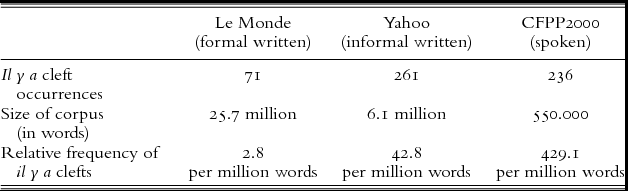
I extracted all instances in which (il) y a is followed by at least one word, followed by qui, que or qu’. The expletive il is optional in the query, because it is often dropped (see Secova, Reference Secova2010: 249), and all tenses of avoir ‘to have’ were included. After the extraction, every occurrence was checked manually in order to distinguish between modifying relative clauses and cleft relative clauses (see section 2.2).Footnote 12 This resulted in a total of 568 clefts. Table 1 visualizes the number of clefts per corpus and their relative frequency with respect to the total number of words in each corpus:

Table 1 shows that the relative frequency of il y a clefts is higher in the spoken corpus than in the journalistic one, with the internet forum being in between the two. The difference is even more obvious given the fact that in Le Monde, no less than 63 of the 71 attested clefts (89%) are actually part of a citation of spoken French within the text.Footnote 13 These quantitative results thus confirm that il y a clefts are a phenomenon that is typical of spoken French (see section 2.3).
4. DIFFERENT INFORMATION STRUCTURE ARTICULATIONS
In section 4.1, I will show that the il y a clefts in our corpora most often express all-focus, and some of those instances display a double contrast. Furthermore, a non-negligible number of il y a clefts have a focus-background articulation. Those three types of il y a cleft are then shown to be on a par with three types of existential sentences (section 4.2). An intermediary conclusion is presented in section 4.3.
4.1 Il y a clefts
4.1.1 All-focus il y a clefts
The consulted corpora contain many examples of all-focus il y a clefts (421 occurrences, i.e. 74% of all il y a clefts). This articulation is illustrated by the il y a clefts in (10):
-
(10)
-
a. [Forum category ‘Jokes’. No prior context.] tu connais l'histoire de Paf le chien? non?!? ben c'est un chien qui traverse la rue. ya une voiture qui passe et. . . . . . Paf le chien!
‘Do you know the story about Bam the dog? no?!? well it's a dog that crosses the street. A car passes by and. . . . Bam! the dog!’ (Yahoo)
-
b. Ceci dit, au moindre doute, je passe un coup de fil, et il y a trois personnes qui descendent dans la seconde .
‘With that said, if there is any doubt I make a call, and three people come down within a second.’ (Le Monde)
-
c. On devrait ouvrir un site (. . .) si il y a quand il y a une personnalité importante qui meurt .
‘They should make a website (. . .) if there's when (there's) someone important (who) dies’ (CFPP2000)
-
In all of these cases, the whole event expressed by the il y a cleft is discourse-new in the context and presented in one block, without a topic-comment partitioning.
The corpora also contain a few cases (five in total, i.e. 1%) that express an all-focus articulation with a double contrast. Thus, in the cleft sentence in boldface presented in (11), toi ‘you’ is contrasted with un pilote ‘a pilot’, and the relative clause qui n'arrive même pas. . . ‘who can't even. . .’ is contrasted with the relative clause qui arrive à poser. . . ‘who manages to land. . .’.
-
(11)
-
A: Atterissage de l'airbus à New-York? [video link] Le co-pilote n'etait t-il pas un arabe (lol) et traiter les arabes de terroriste.
-
B: il y'a un pilote qui arrive a poser un avion sur l'eau et évite la perte de 160 personne, et d'un autre coté il y'a toi qui n'arrive même pas a faire une phrase compréhensible!!! (Yahoo)
-
A: ‘Landing of the airbus in NY? [video link] Wasn't the co-pilot an Arab (lol), and to treat Arabs like terrorists!’
-
B: ‘There's a pilot who manages to land a plane on the water and avoid the deaths of 160 people, and on the other hand there's you who can't even write a comprehensible sentence!!!’
-
Similarly, in (12) le peuple ‘the people’ is contrasted with l'establishment ‘the establishment’ and tous ces salopards ‘all those assholes’ and the relative clause qui a toujours été. . . ‘who have always been. . .’ is contrasted with the two immediately preceding relative clauses (qui me déteste ‘that hates me’ and qui pensent que. . . ‘who think that. . .’). The contrast is further reinforced by the stressed pronoun lui ‘him’.Footnote 14
-
(12) [Salman Rushdy and the writer of the article are walking down the street. A man in the street recognizes Salman and says something encouraging to them.]
Et Salman: ‘Je suis content que vous voyez ça. . . Il y a l'establishment qui me déteste. Il y a tous ces salopards qui pensent que je me suis fait de la pub avec la fatwa. Mais il y a le peuple qui, lui, a toujours été formidable avec moi .’
(Le Monde – citation in the text)
‘And Salman says: ‘I'm happy that you see that [the stranger being friendly to Salman]. . . There's the establishment that hates me. There's all those assholes who think I just made publicity with the fatwa. But there's the people who, them, have always been fantastic to me.’
In these tokens, a contrast is created across the boundaries of the sentence and the il y a cleft can thus be seen as a means to structure the text. It does so by establishing an effect of symmetry between two referents and two relative clauses.Footnote 15
4.1.2 Focus-background il y a clefts
Although focus-background il y a clefts have not received much attention in the linguistic literature of il y a clefts, no less than 24% of the il y a clefts in my corpora express this information structure articulation. This type is illustrated in (13)–(15):
-
(13)
-
A: Je recherche des modèles de voiture à acheter neuve moins de 10 000 euros, ou aller!?
-
B: bonjours. il y a la citroen c1 qui est a moins de 10 000 euros .
-
A: ‘I'm looking for new car models that cost less than €10.000, where should I go?’
-
B: ‘Hello. There's the Citroën C1 that costs less than €10.000.’ (Yahoo)
-
-
(14)
-
A: Avec quels logiciels libres et gratuits puis-je lire des fichiers vidéos encodés en MP4?
-
B: La meilleure sources de logiciel libre est http://www.framasoft.net. En ce qui concerne la lecture de mp4 il y a VLC qui les ouvrent très bien .
-
A: ‘With which freeware programs can I open video files encoded in MP4?’
-
B: ‘The best source for freeware programs is http://www.framasoft.net. As for opening mp4 files, there's VLC that opens them very well. (Yahoo)
-
-
(15) C'est pas les jeunes les gens jeunes qui du quartier qui viennent au conseil, c'est toutes les personnes âgées (. . .) c'est les personnes âgées alors comme y a madame Blumenthal qui vient .
‘It's not the young the young people who from the neighborhood who go to the neighborhood meeting, it's all the old people (. . .) it's the old people so like there's Mrs. Blumenthal who goes there. (CFPP)
In (13), the relative clause expresses a variable – cars cheaper than €10.000 – which is given in the preceding question. The clefted element is the focus of the sentence and specifies a value for this variable – the Citroen c1. Similarly, in (14), the relative clause expresses the variable free software programs that can open mp4, and the clefted element specifies the value VLC. In (15), the variable expressed by the relative clause is (old) people who go to neighborhood meetings, and the clefted element provides the value Mrs. Blumenthal.
To conclude, the il y a clefts in the corpora consulted for the present study can express three information structure articulations: regular all-focus, all-focus with a double contrast and focus-background. These articulations will now be compared with different types of existential sentences.
4.2 Existential sentences
In this section, it will be shown that there are significant parallelisms between the three information structure articulations that il y a clefts can express on the one hand, and three types of existential sentences on the other: (i) regular existential sentences (16a), (ii) existential sentences that introduce a double contrast (16b) and (iii) list reading existential sentences (16c).
-
(16)
-
a. ‘Attention! Il y a un chat sur l'aile de l'avion! ’ (www)
-
b. L'incroyable positive attitude des américains: J'ai tout de suite été frappée par le fait de voir à quel point ils sont positifs et enthousiastes pour tout. Tout est ‘AWSOME’, ‘AMAZING’, ‘GREEEAAT’. Ca donne souvent des situations du genre ‘vous avez 5 pages à rendre pour demain’ les autres: ‘GREAT!’ et puis il y a moi ‘Aaargh’.(www)
-
c. Parmi les décisions prises par l'Union Européenne que tu puisses facilement observer, il y a par exemple la création de l'Euro .
-
4.2.1 Regular existential sentences and existential sentences with a double contrast
As argued for by several authors, existential sentences introduced by il y a and its equivalents across languages introduce focal referents that have not yet been mentioned in the discourse context, and which are not topical (e.g. Breivik, Reference Breivik1981; Abbott, Reference Abbott1993; Francez, Reference Francez2007; Breivik and Martínez-Insua, Reference Breivik and Martínez-Insua2008; Bentley, Reference Bentley2013; Bentley et al., Reference Bentley, Ciconte and Cruschina2015). Consider the example in (17): the first line of this example is the title of an online article about a video that had just gone viral, featuring a cat on the wing of a small airplane. Il y a introduces un chat ‘a cat’, a NP that is discourse-new.
-
(17) VIDEO. Excusez-moi, je crois qu’il y a un chat sur votre ULM Footnote 16
Surprise pour ce pilote d'ULM et sa passagère qui effectuait son baptême de l'air. Un chat, mascotte du club d'aviation guyanais, s'est glissé sur l'aile de l'appareil. (www)
‘VIDEO. Excuse me, I think there's a cat on your aircraft
A surprise for the pilot of the ultralight aircraft and his passenger, who was on her maiden flight. A cat, the mascot of the Guyanese aviation club, slipped onto the wing of the aircraft.’
Note furthermore that the whole sentence expresses a surprising fact, something il y a clefts are also reported to do (e.g. Lambrecht, Reference Lambrecht, Haiman and Thompson1988). Similarly, in an English description of the same video, an existential sentence is again used to describe the surprisal of the pilot (18):
-
(18) All appears well and cat-free as the aircraft accelerates on the runway and begins its takeoff. (. . .) Just after a minute has passed, the pilot's shock is clear as he notices windswept stowaway. Never before has a man's face said ‘ there's a cat on the wing of my plane ’ with such unequivocal clarity. (www)
In such existential sentences, the whole sentence is presented as discourse-new in an ‘out-of-the-blue’ context (Abbott, Reference Abbott1993). In this sense, they thus have the same information structure articulation as all-focus il y a clefts such as the ones discussed in section 4.1.1. Furthermore, both existential sentences and il y a clefts have been argued to be predicated of a stage topic (19) (e.g. De Cat, Reference De Cat2007: 90; Erteschik-Shir, Reference Erteschik-Shir2007; Francez, Reference Francez2007; Leonetti, Reference Leonetti, Fischer, Kupisch and Rinke2016 about stage topics in existential sentences).
-
(19)
-
a. stage topic [Il y a un chien dans le jardin]FOCUS
‘There's a dog in the garden.’
-
b. stage topic [Il y a un chien qui aboie]FOCUS
‘A dog is barking.’
(De Cat, Reference De Cat2007: 90)
-
In terms of the file card metaphor, this means that the information that a dog is in the garden (19a) or that a dog is barking (19b) is added as new information on a topic card designating the here-and-now of the discourse context.
Recall that apart from the regular all-focus articulation and the focus-background articulation, all-focus il y a clefts were also shown to be able to express a double contrast on the clefted element and the relative clause (section 4.1.1). Again, a very similar type of existential sentence can be found, illustrated in (20). In all three cases, two or more referents are contrasted with each other (les oiseaux ‘the birds’, les hiboux ‘the owls’ etc. – moi ‘me’; toi ‘you’ – eux ‘them’; les autres ‘the others’ – moi ‘me’).Footnote 17
-
(20)
-
a. A cette heure ci les oiseaux dorment, les hiboux hibernent, les pingoins dorment aussi, les humain(e)s dorment aussi <3 Et puis ya moi: Allonger dans mon lit les cheveux tel Aicha Kendicha en #train de manger des fraises ^^
‘At this hour the birds are sleeping, the owls are hibernating, the pinguins are also sleeping, human beings are also sleeping <3 And then there's me: lying in my bed, my hair like Aichi Kendicha's, eating strawberries’.
-
b. [No prior context, introducing a picture of three people and a dog with pancake masks on their faces].
Y'a toi qui fête la chandeleur normalement , puis y'a eux . . .
‘There's you who celebrates Candlemas in a normal way, then there's them . . .
-
c. L'incroyable positive attitude des américains: J'ai tout de suite été frappée par le fait de voir à quel point ils sont positifs et enthousiastes pour tout. Tout est « AWSOME », « AMAZING », « GREEEAAT ». Ca donne souvent des situations du genre « vous avez 5 pages à rendre pour demain » les autres: « GREAT! » et puis il y a moi « Aaargh ».
‘The incredibly positive attitude of the Americans: I was immediately struck by the fact that they are so positive and enthusiastic about everything. Everything is ‘AWESOME’, ‘AMAZING’, ‘GREEAAT’. That often leads to situation like ‘you've got 5 pages to hand in for tomorrow’ the others: ‘GREAT!’ and then there's me ‘Aaargh’.(www)
-
Just like the il y a clefts in (11–12), all the existential sentences in (20) either explicitly or implicitly express a second contrast, namely the property that sets the contrasted referents apart from each other: sleeping versus eating strawberries in (20a), celebrating Candlemas in a normal way versus not celebrating it in a normal way in (20b) (the picture above this message shows why they are not ‘normal’: the people have pancakes on their faces) and saying ‘GREAT’ versus saying ‘Aaargh’ in (20c). The two contrasts reach across sentence boundaries, as is the case in double contrast il y a clefts.Footnote 18
The difference between the existential sentences in (20) on the one hand and the doubly contrastive all-focus il y a clefts such as (11–12) is the way in which the second contrast is expressed: in (11–12), the second contrast is encoded by the relative clause, in (20a), it is encoded by a participial clause, in (20b) it is not encoded linguistically and has to be inferred by the reader, and in (20c), it is encoded by the quote ‘Aargh’.
4.2.2 List reading existentials
Not all existentials introduce a discourse-new indefinite NP in an ‘out-of-the-blue’ context. In (21), il y a refers to the immediately preceding decisions taken by the EU that you can easily observe.
-
(21) Tu entends peut-être beaucoup parler en ce moment de l'Europe, ou plus exactement de l'Union Européenne. Sais-tu pourquoi? (. . .) Parmi les décisions prises par l'Union Européenne que tu puisses facilement observer , il y a par exemple la création de l'Euro . Une monnaie unique pour tous les pays faisant partie de cette union, afin de simplifier entre eux les échanges commerciaux.
‘You may hear a lot about Europe lately, or more exactly about the European Union. Do you know why? Among the decisions taken by the European Union that you can easily observe, there is for example the creation of the Euro. A single currency for all the countries that are part of this union, in order to simplify commercial exchanges between them.’ (www)
Sentences such as (21) are often called ‘list reading existentials’Footnote 19 and have been discussed extensively in light of the so-called Definiteness Effect (see for example Rando and Napoli, Reference Rando and Napoli1978; Abbott, Reference Abbott1993; Beaver et al., Reference Beaver, Francez and Levinson2006; Francez, Reference Francez2007; Leonetti, Reference Leonetti, Müller and Klinge2008; Cruschina, Reference Cruschina, Bianchi and Chesi2012; Meulleman, Reference Meulleman2012; Bentley, Reference Bentley2013; Coy, Reference Coy, Fischer, Kupisch and Rinke2016). The existential sentence in (21) is specificational: it introduces a value (the creation of the Euro) for a discourse-given variable (observable decisions made by the EU). Similarly, in (22), the expressions chez Renault Dacia la Logan ‘at Renault Dacia the Logan’ and the other car brands provide values for the discourse-given variable introduced by speaker A, namely ‘cars that cost less than €10.000’.
-
(22)
-
- A: Je recherche des modèles de voiture à acheter neuve moins de 10 000 euros, ou aller!?
‘I'm looking for new car models that cost less than €10.000, where should I go?’
-
- B: A moins de 10 000 euros , il y a chez RENAULT DACIA la Logan; chez CITROEN la C1, chez PEUGEOT la 107 et chez TOYOTA la Aygo . Je pense qu'il en existe d'autres. (Yahoo)
at less than 10.000 euro, there is at Renault Dacia the Logan; at Citroen the C1, at Peugeot the 107 and at Toyota the Aygo. I think that.it of.it exists of.others
‘For less than €10.000, Renault Dacia has the Logan; Citroen has the C1, Peugeot has the 107 and Toyota has the Aygo. I think there exists others too.’
-
List reading existential sentences are very similar to the focus-background il y a clefts discussed in section 4.1.2. One of the il y a clefts discussed in that section ([13], repeated here as [23]) is in fact a reply to the same question asked by speaker A in (22).
-
(23) [Same preceding question as in (22)]
-
– bonjours. il y a la citroen c1 qui est a moins de 10 000 euros.
-
– ‘Hello. There's the Citroën C1 that costs less than €10.000.’ (Yahoo)
-
Both list reading existentials and focus-background il y a clefts use the existential expression il y a to introduce a value for a discourse-given variable. The difference between the two is that the variable ‘(cars that) cost less than €10.000’ is repeated as a sentence-initial prepositional phrase in the list reading existential in (22), while it is encoded in the relative clause in the il y a cleft in (23).Footnote 20
On an information structural level, the variable can be seen as a topic introduced by person A that the other interlocuters express a comment about by specifying a value (see Furukawa, Reference Furukawa1996; Lambrecht and Michaelis, Reference Lambrecht and Michaelis1998; Hartmann, Reference Hartmann2006; Francez, Reference Francez2007 for similar analyses). In terms of the file card metaphor (see section 2.1), the value introduced by il y a in list reading existentials and focus-background clefts (the Citroen C1) is added as new information on the topic card ‘cars that cost less than €10.000’. This distinguishes them from the regular existentials and all-focus il y a clefts discussed in the previous section, which are claimed to be predicated of a spatio-temporal stage topic.
4.3 Intermediate conclusion
In the previous sections it was shown that clefts and existential sentences introduced by il y a can express the same information structure articulations and appear in the same types of discourse contexts: out-of-the-blue, contrastive and specificational contexts. In many instances, the cleft relative clause has a function that can also be performed by a different linguistic form (e.g. the citation in [20c] and the preposed NPs in [21–22]). I therefore argue that the il y a cleft should be seen as closely related to existential sentences and should not be analyzed as a completely separate construction with unique discourse functions that existential sentences cannot perform. In other words, it is more useful to see il y a clefts as a subtype of the broader category of existential sentences (e.g. Lyons, Reference Lyons1968; Van de Velde, Reference Van de Velde2005; Dobrovie-sorin and Beyssade, Reference Dobrovie-sorin and Beyssade2012) than to treat them as a separate category, as is common in the linguistic literature on il y a clefts (e.g. Lambrecht, Reference Lambrecht1986, Reference Declerck1988, Reference Lambrecht2001).Footnote 21
5. THE FOCUS-MARKING HYPOTHESIS
In this section, I will argue that the corpus analysis of il y a clefts constitutes evidence in favour of the Focus-Marking Hypothesis. It has been claimed that clefts and existential sentences alike have a deeper motivation apart from creating a certain information structure articulation. According to Lambrecht (Reference Lambrecht1986, Reference Lambrecht1994, Reference Lambrecht2001), clefts should be seen as focus-marking devices that are ‘used to prevent unintended predicate-focus [= topic-comment] construal of a proposition. Clefts serve to mark as focus an argument that might otherwise be construed as nonfocal (. . .).’ (Lambrecht, Reference Lambrecht2001: 489; see also Erteschik-Shir, Reference Erteschik-Shir2007: 119; Piotrowski, Reference Piotrowski2009; Cruschina, Reference Cruschina2014) The same is stated about existential sentences, in which the introduced noun phrase is always focal according to Lambrecht and others (e.g. Breivik, Reference Breivik1981; Abbott, Reference Abbott1993; Francez, Reference Francez2007; Breivik and Martínez-Insua, Reference Breivik and Martínez-Insua2008; Bentley, Reference Bentley2013; Bentley et al., Reference Bentley, Ciconte and Cruschina2015).
However, as explained in the introduction, the Focus-Marking Hypothesis has been discredited in the linguistic literature on the English it cleft and its French equivalent, because these clefts do not always mark the clefted element as focal and they are able to express a topic-comment articulation (e.g. Prince, Reference Prince1978; Hedberg, Reference Hedberg1990; Collins, Reference Collins1991; Doetjes et al., Reference Doetjes, Rebuschi, Rialland, Corblin and De Swart2004; Dufter, Reference Dufter2006, Reference Dufter, Detges and Waltereit2008, Reference Dufter, Dufter and Jacob2009; Lahousse and Borremans, Reference Lahousse and Borremans2014; Jacob, Reference Jacob, Adam, Jacob and Schecker2015). Thus, the clefted element in (24) is discourse-given and the relative clause is a comment about the clefted element.
-
(24)
-
A: – But why is the topic so important?
-
-
(=[2])
-
B: – Apparently, it is the topic that enables the listener to compute the intended antecedents of each sentence in the paragraph.
(Prince, Reference Prince1978: 902)
-
This raises the question whether il y a clefts and existential sentences can also introduce topics and, hence, whether the Focus-Marking Hypothesis still applies to these two types of sentences or whether it should be abandoned. I argue that the Focus-Marking Hypothesis should be retained for existential sentences and il y a clefts. Firstly, the corpus data contain no instances of il y a clefts with discourse-given topical clefted elements (see section 3), and secondly, it is very difficult if not impossible to construe an il y a cleft or an il y a existential with a discourse-given topic. This last point is made by Bentley (Reference Bentley2013), who claims that it is impossible for Romance existential sentences to have a topical noun phrase, as illustrated by (25). The question in (25a) makes the towels topical. If one wishes to answer this question, it is infelicitous to use an existential sentence such as (25b). Instead, a canonical subject verb sentence must be used (25c).
-
(25)


The translation in (26) shows that a French existential introduced by il y a is equally infelicitous in the same context (as is the English translation).
-
(26) French
-
a. Où sont les serviettes?
‘Where are the towels?’
-
b. # Il y a les serviettes dans le tiroir.
‘There are the towels in the drawer.’
-
As for il y a clefts, it is equally difficult to construe an il y a cleft with a topical constituent, as in (27).Footnote 22
-
(27)
-
A: – Que fait le chat? / Qu'en est-il du chat?
‘What is the cat doing? / What about the cat?’
-
B: – # Il y a le chat qui s'est caché dans l'avion.
‘There's the cat that hid itself on the airplane.’
-
Given that both existential sentences and il y a clefts always introduce foci, I argue that it is the existential expression il y a that functions as a focus marker, regardless of whether it introduces an il y a cleft or an existential sentence. Concretely, I hypothesize that il y a encodes the processing instruction that the hearer should not expect a discourse-given topic.Footnote 23 In other words, while it clefts such as (24) can introduce topics, and are therefore not pure focus marking devices, il y a clefts cannot introduce topics, and can be considered as focus marking devices.
In the following section, I will present some psycholinguistic studies that may further support this hypothesis.
6. PSYCHOLINGUISTIC SUPPORT
The link between information structure and processing is relatively recent and under-researched (see e.g. Reichle, Reference Reichle2014 for an overview), but several studies have confirmed that (in)felicitous focus marking has an effect on sentence processing. Cowles (Reference Cowles2003), for instance, presents the so-called Information Structure Processing Hypothesis (ISHP): ‘[A]s a separate component in the grammar, information structure is used during sentence processing by both speakers and comprehenders to facilitate language processing’ (Cowles, Reference Cowles2003: 36). She provides results from several experimental designs to support this hypothesis. Other studies also confirm that unexpected or illicit focus structures evoke the same processing signatures in the brain as syntactic and semantic anomalies (cf. Cowles et al., Reference Cowles, Kluender, Kutas and Polinsky2007; Stohlterfoht et al., Reference Stohlterfoht, Friederici, Alter and Steube2007; Reichle, Reference Reichle, Chandlee, Franchini, Lord and Rheiner2009). Furthermore, overt (prosodic or syntactic) focus marking has processing benefits for speech perception, memory and attention (see Sauermann et al., Reference Sauermann, Filik and Paterson2013 for an overview).
Two studies are particularly relevant for the purposes of this article, because they investigate expressions that are closely related to il y a in Dutch (er ‘there’) and in English (there is). Grondelaers et al. (Reference Grondelaers, Brysbaert, Speelman and Geeraerts2002), using corpus data and psycholinguistic findings from two self-paced reading experiments, show that Dutch er functions as a so-called accessibility marker (cf. Ariel, Reference Ariel1990) whose insertion in a sentence depends on how predictable the following NP is (see also Grondelaers et al., Reference Grondelaers, Speelman, Drieghe, Brysbaert and Geeraerts2009).Footnote 24 The experiment features two pairs of parameters (28): firstly, the expression er is either present or absent (it is syntactically optional in all test sentences), and secondly, the NP is either predictable or unpredictable with respect to the prior context. The context sentence preceding the target sentence states that the luggage of a famous actrice contains cosmetics. This context sentence is followed by the prepositional phrase in the beautycase (and, depending on the condition, by er), and the following target NP is either a lipstick (28a,b) or a headset (28c,d). Since a lipstick is a type of cosmetics product, this NP is predictable or ‘congruent’, whereas a headset is unpredictable or ‘incongruent’.
-
(28) Context sentence preceding target sentence:
De bagage van de beroemde actrice bevatte heel wat cosmetica.
the luggage of the famous actrice contained whole some cosmetics
‘The famous actrice's luggage contained quite a bit of cosmetics.’
-
a. Predictable, + ER
In de beautycase zat ER een lippenstift en in een koffer zat ook wat rouge.
in the beautycase sat THERE a lipstick and in a suitcase sat also some rouge
‘In the beautycase there was a lipstick and in a suitcase there was also some rouge.’
-
b. Predictable, no ER
In de beautycase zat een lippenstift en in een koffer zat ook wat rouge.
in the beautycase sat a lipstick and in a suitcase sat also some rouge
‘In the beautycase there was a lipstick and in a suitcase there was also some rouge.’
-
c. Unpredictable, + ER
In de beautycase zat ER een koptelefoon en in een koffer zat ook wat rouge.
in the beautycase sat THERE a headphone and in a suitcase sat also some rouge
‘In the beautycase there was a headphone and in a suitcase there was also some rouge.’
-
d. Unpredictable, no ER
In de beautycase zat een koptelefoon en in een koffer zat ook wat rouge.
in the beautycase sat a headphone and in a suitcase sat also some rouge
‘In the beautycase there was a headphone and in a suitcase there was also some rouge.’
(Grondelaers et al., Reference Grondelaers, Brysbaert, Speelman and Geeraerts2002: 17, my translation and capitalization).
-
The findings of the experiment show that when the NP is unpredictable (a headset, [28c,d]), reading times are significantly faster when er is present than when it is absent. The authors therefore state that er has a facilitating effect on reading times in the unpredictable condition. In sentences with predictable NPs (a lipstick [28a,b]), there is no statistically significant effect between sentences with er or without er. The authors conclude from this that er is best seen as a ‘warning sign’ that the speaker uses ‘because [he] knows that the hearer constantly generates hypotheses about possible sentence continuations, and because he fears that the hearer will not (or not sufficiently) be able to infer or preconceive the subject in those sentences on the basis of the available contextual cues’ (Grondelaers et al., Reference Grondelaers, Brysbaert, Speelman and Geeraerts2002: 19).Footnote 25 The parallel with the Focus-Marking Hypothesis is obvious: foci are most often new – i.e. unpredictable – and topics vary in their degree of givenness (explicit mention in prior discourse, inferable from a hypertheme etc., see e.g. Ariel, Reference Ariel1990; Gundel et al., Reference Gundel, Hedberg and Zacharski1993) and, crucially, are predictable.
The second study that is relevant is the visual-world eye-tracking experiment performed by Besserman (Reference Besserman2014) (also reported in Besserman et al., Reference Besserman, Love and Shapiro2015), which investigates English existentials and subject verb sentences such as the ones in (29).
-
(29) Context sentence: A nurse was discussing new procedures with the doctor.
-
a. Existential condition: there was
There was a sad patient with a broken leg in the reception area, waiting for her turn.
-
b. Control condition: subject verb word order
That day a sad patient with a broken leg was in the reception area, waiting for her turn.
(Besserman, Reference Besserman2014: 18)
-
The procedure goes as follows: the test subjects look at a picture with the three characters that appear in the auditory stimulus. They hear the context sentence over their headphones, followed by the target sentence of either the existential condition (29a) or the control condition (29b). The context sentence always introduces two of the three characters in the picture, in this case a nurse and a doctor. The target sentence introduces the third character (the girl with the broken leg, i.e. the patient), which is the only hearer-new character. The authors measure the proportion of looks to the discourse-new entity (the girl with the broken leg). They conclude that there is a significant effect of sentence type (existential or subject verb word order) on the proportion of looks to the new entity: ‘participants were significantly more likely to look at the unmentioned entity in the Existential condition than in the Control condition’ (Besserman et al., Reference Besserman, Love and Shapiro2015: 1) and therefore they state that existential sentences function as indicators of newness during language processing. Again, this conclusion is in favour of the Focus-Marking Hypothesis: newness is normally associated with foci, whereas topics are prototypically discoursegiven.
To summarize, several studies confirm that information structure has an influence on processing. More specifically, Grondelaers et al. (Reference Grondelaers, Brysbaert, Speelman and Geeraerts2002) show that sentences with unpredictable subjects have faster reading times when er (the Dutch equivalent of French y ‘there’) is inserted than when er is left out, and Besserman et al. (Reference Besserman, Love and Shapiro2015) conclude that English existential sentences function as indicators of newness, a property that is highly related to the notion of ‘focus’. In other words, both studies are in line with the Focus-Marking Hypothesis, according to which existential expressions are used to facilitate processing by warning the hearer that something unexpected is coming. The connection between il y a clefts and existential sentences on the one hand and online sentence processing on the other is a pertinent and promising subject for future psycholinguistic research.
7. CONCLUSION
The main goal of this article was to investigate the information structure properties of il y a clefts and existential sentences. An analysis of 568 il y a clefts throughout three different corpora has revealed that, as expected, il y a clefts indeed mainly express all-focus, followed by the lesser-known focus-background articulation. Moreover, a third configuration was found in which all-focus il y a clefts display a double contrast. I showed that existential sentences can have the same information structure articulations as il y a clefts: regular existential sentences and list reading existential sentences closely resemble all-focus il y a clefts and focus-background il y a clefts respectively. Furthermore, existential sentences can introduce a double contrast just like il y a clefts. In this sense, the two sentence types are closely related, which calls into question the clear-cut boundaries that are often drawn between il y a clefts on the one hand and existential sentences on the other.
Furthermore, I have evaluated the Focus-Marking Hypothesis, according to which clefts and existential sentences signal to the hearer that he/she should not expect a topic and thereby facilitate language processing. This hypothesis has been criticized in the literature on it / c'est clefts, but I have argued that it should not be rejected in the case of existentials and il y a clefts. Firstly, the corpus data contain no instances of il y a clefts with a topical clefted element. Secondly, neither existential sentences nor il y a clefts can introduce a discourse-given NP in a context where more information is demanded about this NP. Hence, I argue that the Focus-Marking Hypothesis is fundamentally correct, especially because my findings seem to be independently confirmed by psycholinguistic evidence involving online sentence processing of related constructions.