1. INTRODUCTION
Like many other languages, French encodes a distinction between singular and plural reference. This distinction is expressed redundantly, resulting in grammatical number agreement. However, the agreement patterns in spoken and written French are very different. Whereas number marking and agreement are partial and heterogeneous in spoken language, they are systematic and transparent in written language. This discrepancy is illustrated in (1) and (2) below, where one number cue in the spoken language (1) contrasts with four number cues in the written equivalent (2).
(1)

(2)


When the subject consists of a noun phrase (NP), as in (1), only the determiner constitutes a reliable number cue in the spoken language. If the NP is replaced by a subject pronoun, e.g. il/ils ‘he/they’, the singular/plural distinction of the subject is completely neutralized. As far as the verb is concerned, number agreement in spoken French is overtly marked in some (groups of) verbs and in some specific phonological contexts. By contrast, in written French determiners, nouns, pronouns, adjectives and verbs are consistently marked for number by means of suffixes (-s in NP, -nt in VP). This study focuses on the expression of subject-verb (SV-) agreement in number on the verb. We concentrate on the alternation of 3rd-person singular (3sg) and 3rd-person plural (3pl), which corresponds to the most frequent and unambiguous number alternation in FrenchFootnote 1 (Dubois, 1967).
The aim of our investigation was two-fold. First we wanted to investigate the frequency relation of singular and plural verb forms and agreement patterns in spoken and written French input. The second aim was to analyse the production of these forms and patterns in different groups of child learners. The empirical data were collected from 32 children, aged five to ten years, belonging to three different learner groups: monolinguals (L1), simultaneous bilinguals (2L1) and successive bilinguals (L2). The analysis of these three groups of children enables a focus on the role of input in the acquisition of number agreement. Even though L1 and 2L1 children have a similar age of onset of acquisition, the 2L1 children differ from the L1 children in that they receive less input (Gathercole, Reference Gathercole2007). Furthermore, the L2 children differ from both L1 and 2L1 children in these two dimensions. In their case, French is acquired after their L1 (Swedish) and with even smaller amounts of input than the 2L1 children. In this study, the acquisition of SV-agreement in number was approached from a usage-based perspective, focusing on the frequency of grammatical forms and patterns in the input (Ellis, Reference Ellis2008a; Bybee, Reference Bybee, Robinson and Ellis2008). A hypothesis that derives from this approach, tested in this study, is that the acquisition of number agreement on the verb in spoken and written French is predictable on the basis of the characteristics of the French input in this particular domain.
2. THEORETICAL BACKGROUND
2.1 Input, frequency of use and language acquisition
According to a usage-based approach to first or second language acquisition (Bybee, Reference Bybee, Robinson and Ellis2008; Lieven and Tomasello, Reference Lieven, Tomasello, Robinson and Ellis2008), repeated exposure and practice of the language is essential to the development of cognitive structures in the learner: in short, usage impacts grammar. In this perspective, ‘grammar is seen as the cognitive organization of one's experience with language’ (Bybee, Reference Bybee, Robinson and Ellis2008: 216). Thus, the learner is sensitive to the use of structures and patterns in the language that s/he is exposed to (Ellis, Reference Ellis2008a). Based on the experience of the input, the learner will categorize the tokens of language at varying degrees of abstractness and create vast networks of phonological, semantic and pragmatic associations that range over lexicon and grammar. Importantly, these networks are sensitive to repetition, that is, frequency of use. According to Ellis (Reference Ellis2008b), a usage-based (or constructivist, input-based) theory of language analyses ‘how frequency and repetition affect, and ultimately bring about, form in language, and how this knowledge affects language comprehension and production’ (Ellis, Reference Ellis2008b: 376, see also Bybee and Hopper, Reference Bybee and Hopper2001).
From a usage-based perspective, the basic units of grammar are constructions, which constitute a continuum from lexicon to grammar. Constructions range from simple lexical words and grammatical morphemes to fully abstract constructions (see Bybee, Reference Bybee, Robinson and Ellis2008: 217). These constructions are direct form-meaning pairings that range from very specific to more general and from very small units (words with affixes) to clause-level or even discourse-level units. From this theoretical point of view, language users’ sensitivity to frequency of constructions and patterns in the language input relates to two different forms of frequency, as outlined in Bybee (Reference Bybee, Robinson and Ellis2008):
• Token frequency corresponds to the number of times a linguistic unit appears in the input. These units can be of different nature: a consonant [s], a syllable [ba], a word (dog), a phrase (take a break), or even a sentence (You know what I mean).
• Type frequency corresponds to the number of items that are represented by a specific pattern. Importantly, only patterns of language can have a type frequency. This notion may apply to very different levels of language, such as phonotactic sequences and morphological or syntactic patterns.
In this study, token frequency is operationalized as the number of times individual verb forms appear in the input (e.g. est ‘is’, sont ‘are’, veut ‘wants’, veulent ‘want’, etc.). Type frequency relates to how many times a specific verb agreement pattern appears in the input. If many different verbs belong to a specific pattern, its type frequency is high. Similarly, if only a few verbs follow a certain pattern, its type frequency is low. The different agreement patterns analysed in this study are further described in section 2.2.
The two notions of frequency do not have the same effect on linguistic representations of the learner. A high token frequency has a conserving effect, since repetition strengthens different forms’ memory representations and makes them more accessible. In addition, high-frequency tokens resist regularization on the basis of analogy with other forms. On the other hand, high type frequency of a linguistic pattern also leads to strong representations in memory, resulting in great accessibility, high productivity on novel items and even overgeneralizations during certain phases of the acquisition process. As underlined by Bybee (Reference Bybee, Robinson and Ellis2008: 221) ‘a certain degree of type frequency is needed to uncover the structure of words and phrases’. Thus, productivity is not a result of high token frequency of a particular item, but of high type frequency of a linguistic pattern. The distinction of these two concepts of frequency is important to the analysis of SV-agreement in spoken and written French, as described in the next section.
2.2 Subject-verb agreement in number in French and Swedish
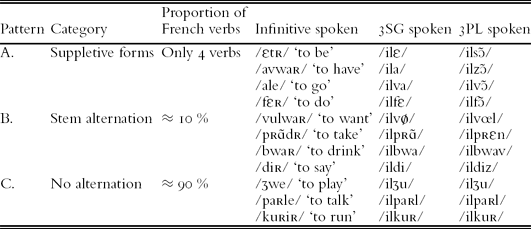
Due to important phonological reduction over time, verbal morphology in modern spoken French is poor and the distinction between singular and plural verb forms is often ‘silent’. However, several groups of verbs remain that indicate number in distinct ways. Dubois (1967: 190) underlines that the notion of verbal stem is crucial to the opposition of singular and plural verb forms in spoken French, a fact that is reflected in our presentation of different number agreement patterns in Table 1.
Subject-verb agreement patterns in spoken French: 3rd-singular versus 3rd-plural

In pattern A, we distinguish four frequent verbs: être ‘to be’, avoir ‘to have’, aller ‘to go’ and faire ‘to do’. These verbs are distinguishable from other verbs in that they include the highest number of different stems (Dubois, 1967). In the following, the notion suppletive form will be used to refer to these verbs where the singular/plural distinction is expressed by totally (est/sont ‘is/are’) or partially (fait/font ‘does/do’) different morphemes, with no or little connection to the base form (Prévost, Reference Prévost2009, for French; Spencer, Reference Spencer1991). As illustrated in Table 1, the singular/plural alternation in these verbs is based on a vowel shift, i.e. /ɛ/ or /a/ in singular versus / / in plural and they do not have plural forms ending in a consonant (cf. pattern B below). With the exception of faire ‘to do’, these verbs are used as both lexical verbs and auxiliary/modal verbs, which increases their token frequency in both spoken and written French.
In pattern B, another group of verbs distinguishes plural from singular by means of stem alternation. This alternation consists of the addition of a verb-final consonant in coda position, as in dire ‘to say’: /ildi/ - /ildiz/ ‘he/they say(s)’, sometimes in combination with a vowel shift, as in /ilpʀ / - /ilpʀɛn/ ‘he/they take(s)’. This alternation can indeed be difficult to perceive in spoken language since word-final consonants are not always clearly articulated. Furthermore, the added consonants are varying from verb to verb. Hence, this agreement is clearly irregular in spoken French, even if some sub-groups can be distinguished (e.g. –ir verbs like finir ‘to finish’).
In pattern C, we include verbs without an audible number distinction on the verb in 3rd person, i.e. /ilpaʀl/ ‘he/they speak(s)’ or /ilkuʀ/ ‘he/they run(s)’. These verbs have one single stem and therefore belong to the last conjugation in Dubois’ classification system. This pattern includes approximately 90% of French verb types, which gives pattern C a very high type frequency. In this pattern, a sub-group of verbs can be distinguished where a liaison phenomenon appears in 3pl. Liaison corresponds to a phonological fusion of the subject pronoun (ils/elles ‘they’) and a vowel-initial verb, which results in distinct phonological forms in singular and plural, i.e. /ilɛkut/ ‘he listens’ versus /ilzɛkut/ ‘they listen’. However, Legendre, Barrière, Goyet and Nazzi (Reference Legendre, Barrière, Goyet and Nazzi2010) found that liaison contexts in 3rd-plural constitute an infrequent morphological subclass in the input directed to children. In addition, the children studied here used very few liaisons in their spoken narratives. For these two reasons, liaison will not be further addressed in this study.
To summarize, SV-agreement in number in spoken French is best described as partial and heterogeneous. As far as type frequency is concerned, we consider pattern C, where the singular/plural distinction is neutralized, as a high type frequency pattern. According to Bybee (Reference Bybee, Robinson and Ellis2008), there is a strong correlation between high type frequency and productivity. However, in patterns A and B, the number distinction is expressed by means of suppletive forms or stem alternations. From a usage-based perspective, the learning of these forms will depend on their token frequency in the input. Accordingly, frequent forms will be acquired earlier and produced more correctly than infrequent forms.
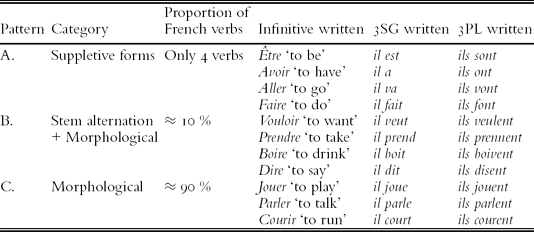
As opposed to spoken French, the expression of number in written French has remained relatively stable over the centuries (Barra-Jover, 2009). In general terms, French orthography is deep, with a large gap between phonology and orthography. In particular, written French includes morphological units deprived of a phonetic counterpart, which often play an important grammatical role (Fayol and Jaffré, Reference Fayol and Jaffré2008). One of these mainly silent grammatical notions is number. Thus, in the written mode, number distinctions are indicated morphologically on nouns, pronouns, determiners, adjectives and verbs by means of suffixes (see example 2 in Section 1). Despite its often inaudible nature, number agreement in written French is consistent and reliable (Fayol, Reference Fayol2003). Hence, all verbs agree with their subject in number. As illustrated in Table 2, written SV-agreement in number is expressed in three different ways: 1) suppletive forms (pattern A), 2) stem alternations in combination with the morpheme –nt (pattern B), and 3) addition of the silent morpheme –nt in plural contexts (pattern C). Henceforth, we will refer to the –nt morpheme as a grapheme (see Cook and Bassetti, Reference Cook and Bassetti2005: 4; Fayol and Jaffré, Reference Fayol and Jaffré2008: 230).
Subject-verb agreement patterns in written French: 3rd-singular versus 3rd-plural

To summarize, the dominating pattern in written French is that of an unmarked form in 3sg versus a morphologically distinct form in 3pl. Again, from a usage-based perspective, the type frequency of this pattern is indeed very high. However, just as in the spoken language, the acquisition of suppletive forms and stem alternations in patterns A and B will depend on their individual token frequency.
Finally, the other language in the bilingual children studied here is Swedish, a language which no longer expresses SV-agreement in person or number on the verb. Hence, in Swedish, all persons in singular and plural share the same verb ending, e.g. att lyssna ‘to listen’: jag/du/han/hon/vi/ni/dom lyssnar ‘I/you/he/she/we/you/they listen’ or att springa ‘to run’ jag/du/han/hon/vi/ni/dom springer ‘I/you/he/she/we/you/they run’. Moreover, in Swedish there is no difference between spoken and written language in this domain.
2.3 Previous findings on the acquisition of number agreement in French
Previous research has shown that the heterogeneous nature of number agreement in spoken French has an impact on the acquisition of this agreement. According to Legendre et al. (Reference Legendre, Barrière, Goyet and Nazzi2010), children acquire the semantic notion related to singular/plural, i.e. one/more than one, at an age of approximately two years. The first signs of number marking appear on quantifiers and determiners. However, Legendre et al. (Reference Legendre, Barrière, Goyet and Nazzi2010: 1860) claim that ‘studies of language production fail to find evidence that 2-year-olds have knowledge of subject-verb agreement’. This finding is also underlined by Rasetti (Reference Rasetti2003) who followed the linguistic development of three French-speaking monolingual children between two and three years. At this age, French-speaking children tend to overgeneralize the singular form to plural contexts (Rasetti, Reference Rasetti2003: 35). Prévost (Reference Prévost2009: 28) claims that the substitution of plural verb forms by singular forms is found in French-speaking monolingual children up to the age of seven years. Studies in adult L2 learning of spoken French confirm that also these learners overuse singular verb forms in plural contexts. The acquisition of SV-agreement in number is a long and gradual process in adult spoken L2 French (Bartning and Schlyter, Reference Bartning and Schlyter2004).
In written French, L1 children need considerable time and effort to automatize number agreement (Fayol, Reference Fayol2003; Fayol and Jaffré, Reference Fayol and Jaffré2008). They start out with a written language that lacks all sorts of silent number markings on nouns and pronouns as well as agreement within NP and between the subject and the verb (Totereau et al., Reference Totereau, Thevenin, Fayol, Rieben, Fayol and Perfetti1997). Very gradually, starting in NP (–s), French-speaking children learn to operationalize the morphology of the written language. However, difficulties with the morphological number agreement in writing persist even at later stages of written development and omissions of number graphemes occur also in adult writers (Ågren, Reference Ågren2008; Barra-Jover, 2009; Jaffré and Fayol, Reference Fayol and Jaffré2008). In contrast, a number of studies show that adolescents learning French in a typical L2 classroom in their home country follow a partly different path towards the written language system compared to L1 children (Ågren, Reference Ågren2008; Granget, Reference Granget, Granfeldt and Schlyter2005). These L2 writers are less influenced by the spoken language than L1 children. In fact, they show facilitation for the kind of morphology that is only expressed in writing (ibid.). Even at initial levels, L2 learners produce nouns and verbs that are inflected for plural, even though the number agreement does not always correspond to that of the target language.
2.4 Research questions and hypotheses
To the best of our knowledge, no study has investigated the interaction of SV-agreement in the acquisition of spoken and written French in the same learners, nor has the impact of different input situations been investigated in relation to the acquisition of this agreement. Therefore, the important discrepancy between the spoken and the written language systems in this domain are further investigated in this study.
The following research questions are addressed:
1. How frequent are singular as compared to plural verb forms in spoken and written French input?
2. To what extent is the correct production of singular/plural SV-agreement in child learners predictable on the basis of type frequency of patterns and token frequency of forms found in spoken and written French input?
From a usage-based perspective, we formulated the following predictions to be tested in the spoken and written data of French-speaking children:
• Agreement patterns with high type frequency are highly productive in both spoken and written French.
• Verb forms with high token frequency, characterized by an important ‘lexical strength’, are produced early and correctly in both spoken and written French.
Research question 1 is addressed in Study A (section 3) whereas research question 2 is the focus of Study B (section 4). The results of the two studies are discussed in section 5.
3. STUDY A: NUMBER AGREEMENT IN SPOKEN AND WRITTEN FRENCH INPUT
3.1 Method
To the best of our knowledge, there is no available corpus of the daily spoken input to which five-to-ten-year-old French school children are exposed. Therefore, the input study of spoken French was based on two corpora that reflect spoken French in adult L1 language use, C-ORAL-ROM (Cresti and Moneglia, Reference Cresti and Moneglia2005), and in spoken language addressed to younger French-speaking children, the CHILDES corpus (MacWhinney, Reference MacWhinney2000). C-ORAL-ROM includes 164 recordings of spoken French in France, corresponding to approximately 300 000 words. This material reflects spoken French as it occurs in both public and private adult language use. This corpus illustrates one part of the spoken language that French-speaking children are exposed to, for example on TV and in other media. As a complement, we analyzed data from four adult interlocutors in the CHILDES corpus, approximately 190 000 words (Leveille's 26 recordings with Philippe (2;1–3.3 years) and Champaud's 33 recordings with Grégoire (1;9–2;5 years)). This material illustrates the spoken language addressed directly to young children in one-to-one conversations. Taken together, we believe that these two corpora inform us of the frequency of verb forms in 3sg and 3pl in spoken French. In the corpus analysis, we focus on verbs with an audible alternation between 3sg and 3pl. Only verb forms in the present tense indicative were retained for further analysis.Footnote 2 In these verbs, three different frequency measures were noted: 1) the frequency of 3sg forms, 2) the frequency of the equivalent 3pl form, and 3) the percentage of 3pl forms out of all forms in the 3rd person.
In order to investigate the frequency of verb forms in the written input, two different corpora were examined: 1) Lexique (New, Pallier, Ferrand and Matos, Reference New, Pallier, Ferrand and Matos2001), which is a database of written French available on the Internet (www.lexique.org), including a text base of 15 million words, and 2) Manulex (Lété, Sprenger-Charolles and Colé, Reference Lété, Sprenger-Charolles and Colé2004), based on texts from school manuals for children learning to read in French. Manulex provides grade level frequency lists of orthographic forms and lemmatized words computed from 1.9 million words in 54 French elementary school readers. These manuals are representative for texts that children are exposed to during their first school years. The database provides frequency counts for three different levels: 1st grade, 2nd grade and 3rd to 5th grades, as well as a cumulative count based on an average of all levels taken together. The latter is the frequency count referred to in this study. We compared frequency counts of 3sg and 3pl verb forms in these two written corpora. The same verbs as in spoken French (above) were analyzed. In addition, six verbs from pattern C (–er verbs), used by the children in this study, were added to the list of analysed verbs.
3.2 Results
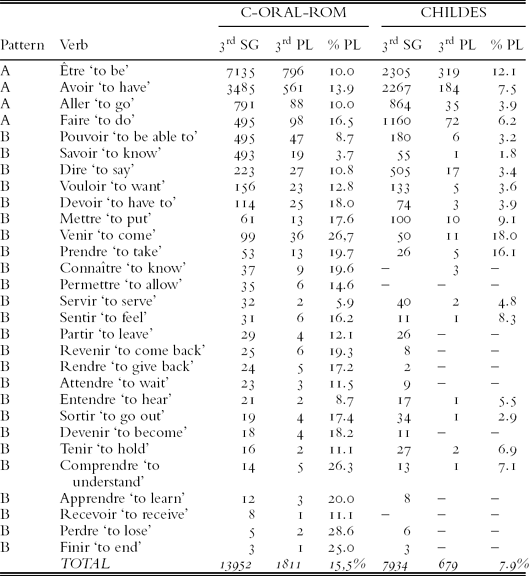
The results from the two oral corpora are presented in Table 3. Due to space limitations, Table 3 includes only verbs from C-ORAL-ROM with a lemma frequency above 50. In C-ORAL-ROM, 66 verbs were found that make an audible distinction between 3sg and 3pl, going from the most frequent être ‘to be’ and avoir ‘to have’ to less frequent verbs like apprendre ‘to learn’ and perdre ‘to lose’. Taken together, 16,169 verb forms in 3rd-person present indicative were found. Out of these forms, 14,286 were singular forms and only 1,883 plural forms. Thus, singular is clearly the predominant pattern. This observed ‘singular bias’ confirms previous findings in this domain (Legendre et al., Reference Legendre, Barrière, Goyet and Nazzi2010). An analysis of the same verb forms in CHILDES reveals that the use of audible plural verb forms was even more limited in language addressed to small children (mean 7.9% compared to 15.5% in C-ORAL-ROM). As illustrated in Table 3, in more than half of the verbs investigated, 3pl forms occurred between two and zero times in all 58 recordings from CHILDES. These data suggest that in this type of face-to-face conversation with young children, adults most often refer to singular subjects and therefore plural verb forms are very infrequent.
Token frequency of verb forms in 3sg - 3pl in spoken French according to C-ORAL-ROM and CHILDES
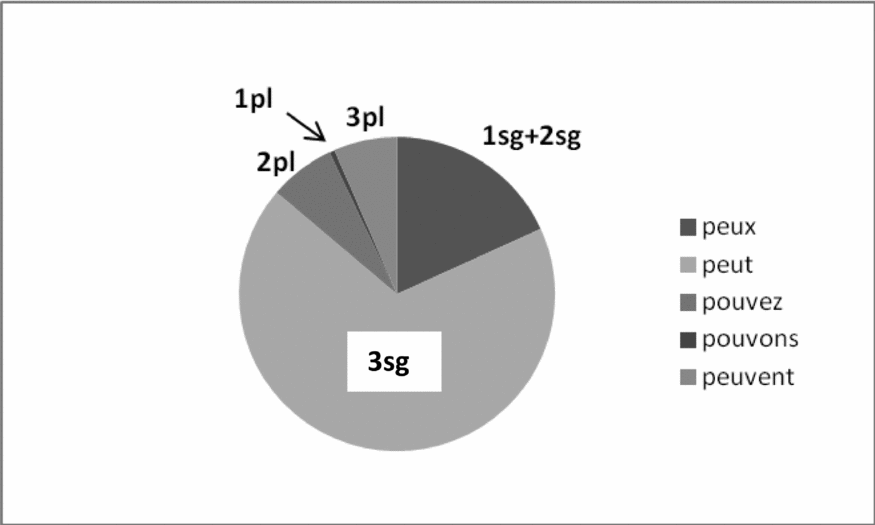
All in all, three main conclusions can be drawn from the corpus analysis of spoken French: First, être ‘to be’ and avoir ‘to have’ are by far the most frequent verbs in the 3rd person. Indeed, these verbs constitute a group of their own as far as their token frequency is concerned. This result is in part explained by their double function as lexical and auxiliary verbs. Second, the token frequency of other forms is varying but only aller ‘to go’ and faire ‘to do’ reach more than 50 occurrences in 3pl and in most other verbs we find less than 20 plural forms in the total material. Thus, 3pl forms are very often low-frequency items in spoken French. Finally, the relationship between 3sg and 3pl is rather stable across verbs, varying from approximately 10 to 20% (mean 15.5) plural forms in C-ORAL-ROM and mainly under 10% (mean 7.9%) in the CHILDES recordings. This finding is exemplified in Figure 1 above, showing the proportion of different forms of the verb pouvoir ‘to be able to’ in present tense indicative.
The verb POUVOIR ‘to be able to’: proportions of forms in present tense (C-ORAL-ROM)
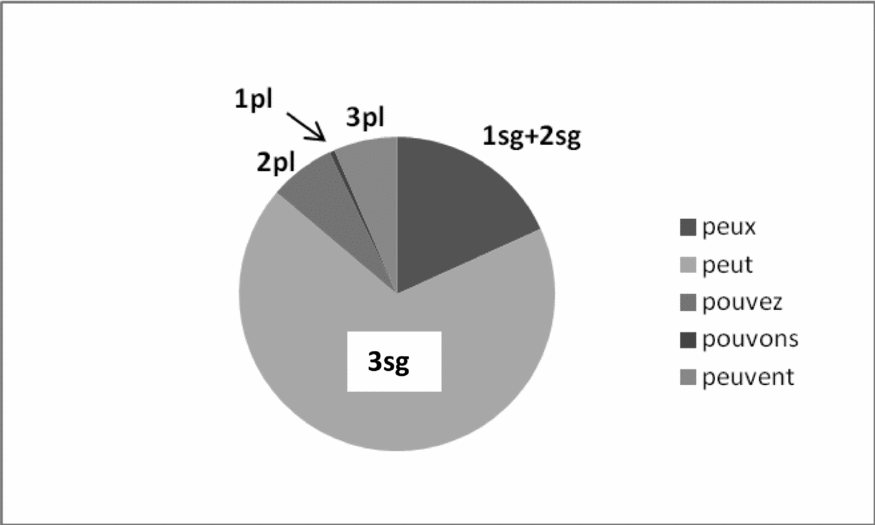
It should be noted that in the verb pouvoir ‘to be able to’, as well as in other verbs in pattern B, the forms of 1st, 2nd and 3rd person singular are homophones, in this case /pø/, which contribute to the singular dominance in the input. Taken together, singular contexts correspond to more than 85% of the verb forms in present tense. As illustrated in Figure 1, the plural forms are clearly less frequent in the input than the corresponding singular forms.
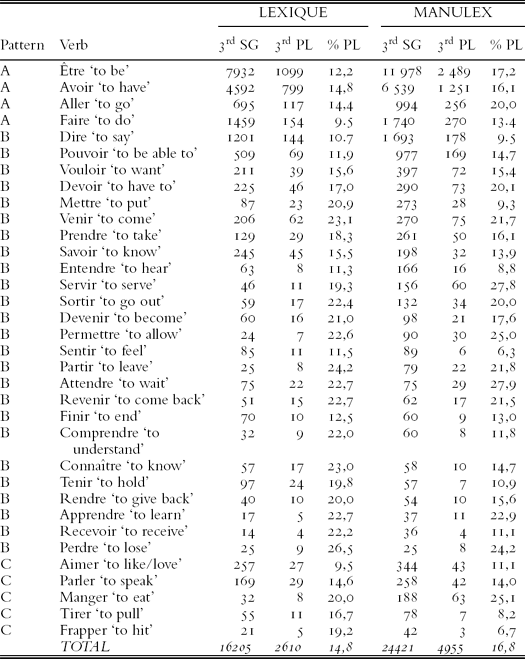
The results of the two written databases are rather homogeneous (see Table 4) and can be summarized as follows: first, just as in spoken French, être ‘to be’ and avoir ‘to have’ constitute a group of their own because of their very high token frequency. Due to their function as copula/auxiliary verbs, these two verbs clearly outnumber faire ‘to do’ and aller ‘to go’ in pattern A. Second, the token frequency of other verb forms varies substantially, some being relatively frequent and others very infrequent. Furthermore, the proportion of singular versus plural verb forms is rather stable across verbs in both corpora, again corresponding to approximately 10–20% plural forms out of all 3rd-person contexts (mean 14.8 in Lexique and 16.8 in Manulex). In addition, as far as the token frequency of forms is concerned, the verbs from pattern C in the bottom of Table 4 do not differ significantly from verbs in pattern B. The relation between 3sg and 3pl is very similar within all patterns, with the singular form clearly dominating. Note that in written French, the high frequency of the 3sg verb form in pattern C is even further reinforced by its homograph in 1st person singular (je parle ‘I speak’ and il parle ‘he speaks’).
Token frequency of verb forms in 3sg - 3pl in written French according to MANULEX and LEXIQUE
Legend: LEXIQUE indicate an estimated frequency per million words and MANULEX indicate an average from the 1st to the 5th grade material.
3.3 Summary of input study
Study A of the French input reveals that there is a clear singular-bias in both spoken and written input. The data analyzed suggest that French-speaking children are exposed to five to ten times more singular than plural verb forms, be it in the written or the spoken language directed to them. Furthermore, the token frequency of different verb forms varies considerably. Être ‘to be’ and avoir ‘to have’ clearly outnumber other verbs in token frequency. Many verbs in pattern B are rare and seldom encountered in the input, either in spoken or written French. The results of study A emphasize that many plural verb forms do indeed correspond to low frequency items in the input.
The most important difference in SV-agreement between spoken and written French concerns type frequencies of patterns. The dominating pattern in spoken French is homophony of singular and plural verb forms whereas, in written French, the morphological differentiation of plural from singular is indeed an equally strong pattern.
4. STUDY B: PRODUCTION OF NUMBER AGREEMENT IN SPOKEN AND WRITTEN FRENCH
4.1 Method
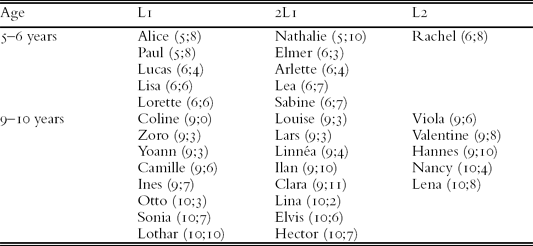
The participating children were recruited from a French school in Sweden. The majority of children at this school are simultaneous bilinguals (2L1) whereas only smaller numbers of Swedish-speaking (L2) children and monolingual (L1) French-speaking children are enrolled. The school has a French monolingual orientation and follows the curriculum of the French school system. This study has a cross-sectional design and compares the language production of the three groups of children in one specific task (see below). Table 5 presents the 32 children included in the study.
Participants in the empirical study
The children studied are divided into two different age groups: 5/6 years versus 9/10 years. The younger children (mean age 6.3 years) have just started school and they are at an age where monolingual French-speaking children still omit number agreement to some extent (Prévost, Reference Prévost2009). They represent children who have not yet automatized reading and writing. The 5/6-year-olds are exposed to written language at school but the literacy learning has only just started. Consequently, only spoken data were collected from these children. It should be noted that there is only one L2 child in the younger group. This is because she is the only L2 child enrolled at the school in this age range. At the time of testing, she had approximately three years of exposure to French. The children from the older group, aged 9–10 years (mean age 9.8 years), read and write in French. Their teaching is to a large extent focused on written language, and the morphological distinctions of written French are stressed during these years of intermediate schooling. In addition, the older group has passed the age where monolingual children have problems with number agreement in the spoken language (Prévost, Reference Prévost2009). These children performed the same narrative task in spoken and written French.
An elicited production task, La fête ‘The party’, was used to collect data from the children. The task is a narrative based on a picture story including 23 coloured pictures. The children performed the spoken narrative first and approximately two months later the written narrative. The spoken narrative was recorded in the presence of a member of the research team and/or a school teacher. The children wrote their written narratives using paper and pencil. In both tasks, the children were instructed to tell their stories in as much detail as possible. The narrative elicits both singular and plural contexts. Special attention was paid to create contexts for particular verbs so that all agreement patterns (described in Tables 1 and 2) could be used by the children. The picture story serves as an important support to the analysis, since it gives the context (singular or plural) that the children refer to in their texts. The comparison of the children's utterances with the pictures of the narrative becomes particularly important when they use subject pronouns, e.g. il/ils ‘he/they’, where the number of the subject is neutralized in spoken French. In these contexts, a careful analysis of the pictures, as well as the child's interaction with the interviewer, reveals whether the child is referring to one or to several persons.
In the analysis of spoken data, all verbs with an audible distinction between 3sg and 3pl, i.e. patterns A and B, were analysed as being either correctly or incorrectly produced. We focused on the production of verb forms in clearly singular and plural contexts, but attention was also paid to different types of subjects, i.e. NPs or pronouns. We were interested in seeing if non-agreeing verb forms were more or less frequent with NP-subjects, e.g. les petits moutons font le ménage ‘the small sheep do the cleaning’, than with pronominal subjects, e.g. ils font le ménage ‘they do the cleaning’. Whereas NP-subjects include an audible number cue (the determiner) with which the verb agrees, the pronominal subject lacks an audible number cue (except in the case of liaison, which is not studied here) and therefore the production of the agreeing verb form is depending on the preceding context. In the analysis of spoken data, we will distinguish agreement errors in the case of NP-subjects from production errors in the case of pronominal subjects.
In the written narratives, we analysed all verb forms in 3sg and 3pl as being either correctly or incorrectly produced. In the written data, verbs from all three agreement patterns A, B and C were analysed. This analysis differs somewhat from that of the spoken language. First, both NP-subjects and pronominal subjects include clear number cues (the grapheme –s) with which the verb agrees. Therefore, number agreement occurs in both contexts. Second, another dimension comes into play in written data: spelling problems that are due to the deep orthography of written French. Therefore we needed to distinguish agreement errors, e.g. il mettent ‘he-SG put-PL’ or ils met ‘they-PL put-SG’ from spelling errors, e.g. il mets/me/mais ‘he puts’. In this study, we focused on number agreement in the children's narratives and spelling errors were not taken into account.
4.2 Results
4.2.1 Spoken narratives
A total of 767 verb forms in third person were produced by the children, 334 in singular, and 433 in plural. All but one of the forms in singular was produced correctly. Consequently, singular forms are not considered any further in the analysis. There were more agreement errors for the plural forms.
We analysed the proportions of correct plural forms using a multilevel logistic regression, with verb and participant as random factors, and group (L1, 2L1, L2), age (young, old), type of subject (NP, pronoun), and verb pattern (A, B) as fixed factors. The dependent variable was plural form (correct, incorrect). For the groups, we chose the 2L1 group as the reference group to which the other two groups were compared, since we expected this group to perform at an intermediate level between the L1 and the L2 children. The results showed that the L1 group had a significantly higher accuracy than the 2L1 group (B = −2.2271, SE = 0.4708, z = −4.730, p < 0.01). Similarly, the 2L1 group performed significantly better than the L2 group (B = −3.9711, SE = 0.6283, z = −6.320, p < 0.01). The difference between the two age groups was also significant (B = 2.3978, SE = 0.4504, z = 5.323, p < 0.01). Concerning the difference between verb patterns, pattern A was significantly more correct than pattern B (B = 2.5513, SE = 0.6181, z = 4.128, p < 0.01). Type of subject, finally, did not have a significant effect on the dependent variable (B = 0.2027, SE = 0.4414, z = 0.459, p > .05).
Given the results of the analysis, the following patterns emerge in Table 6. The fewest errors were found in the L1 group, followed by the 2L1 group, and finally the L2 group. Within the three groups, the older group always performed better than the younger group. Furthermore, fewer errors were observed in verbs from pattern A compared to pattern B. Although the latter finding was not observed in the young L2 group, it should be remembered that this ‘group’ consisted of a single person only and consequently the result is less reliable than that for the other groups. As for the type of subject, there was a non-significant difference between subjects that were NPs, with an audible number cue, and subjects that were pronouns, where the number distinction is neutralized. Across all groups, the children produced 24% agreement errors when the subject was a NP, compared to 31% production errors when the subject was a pronoun. This result suggests that the nature of the subject does not result in a significantly different production of plural verb forms in the spoken narratives.
Counts and percentages correctly produced plural forms in the spoken narratives
The error analysis reveals that the non-target verb forms produced in plural contexts are of the same type in all groups of children and in both patterns A and B: the 3sg form is overgeneralized to plural contexts, as exemplified in (3).
(3)
The use of singular verb forms in plural contexts is significantly more frequent in 2L1 children than in L1 children, in both age-groups, and most frequent in the L2 children. We can therefore conclude that children with more input in French produce significantly more agreeing verb forms than children with less input, as predicted by the usage-based approach adopted in this study. It should be noted that the youngest L2 child does not produce a single plural verb form in obligatory contexts. These data suggest that three years of input in a French-speaking school is insufficient to uncover the ambiguous number agreement system of spoken French.
Furthermore, the statistical analysis shows a more correct production of plural verb forms in pattern A than in pattern B. However, within pattern A, we observe a clear difference between the verbs être/avoir ‘to be/have’, on the one hand, and aller/faire ‘to go/do’ on the other hand. Out of 22 omissions, only two omissions appear with the verbs être/avoir ‘to be/have’ and they are produced by L2 children. The 20 omissions remaining appear with aller/faire ‘to go/do’ and they are produced by all groups of children. This observation is consistent with the results of the corpus analysis (above).
4.2.2 Written narratives
A total of 707 verb forms in third person were produced by the children in the written narratives, 367 in singular, and 340 in plural. We analysed the proportions of correct responses statistically with a mixed effects logistic regression with participant and verb as random factors, and group (L1, 2L1, L2), verb pattern (A, B, C), subject type (NP, pronoun) and number (singular, plural) as fixed factors. As in the analysis of spoken narratives, we chose the 2L1 group as the reference for the learner groups. Furthermore, we chose pattern C as the reference for the verb patterns. The results showed that the difference between the L1 group and the 2L1 group was not significant (B = 0.7608, SE = 0.4582, z = 1.660, p > 0.05), nor was the difference between the L2 group and the 2L1 group (B = −0.3773, SE = 0.4932, z = −0.765, p > 0.05). Compared to verb pattern C, there were significantly fewer errors in pattern B (B = 0.9542, SE = 0.3222, z = 2.962, p < .05), and there were significantly fewer errors in pattern A (B = 3.5798, SE = 0.5481, z = 6.531, p < 0.01). There was no significant effect of subject type (B = 0.4646, SE = 0.2903, z = 1.600, p > .05) which means that there were not significantly more or fewer errors when the subject was a NP compared to a pronoun. Finally, there were significantly fewer errors for the singular forms than for the plural forms (B = −3.1553, SE = 0.3296, z = −9.574, p < 0.01).
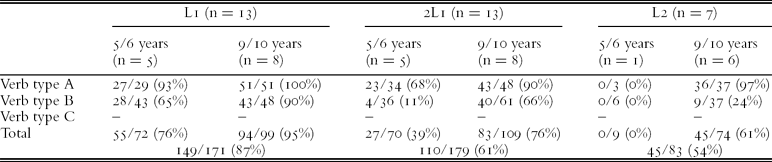
The written narratives of the 9/10-year-olds revealed patterns that were different from those observed for the spoken narratives. The results are summarized in Table 7. Recall that in this analysis, we do not take spelling errors into consideration but concentrate on agreement. First of all, in contrast to the spoken narratives, there were more agreement errors for singular forms in the written narratives. In fact, we found agreement errors in both singular and plural contexts, as illustrated in (4) and (5). However, the former were significantly less frequent than the latter.
(4)
(5)
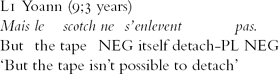
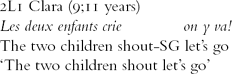
Second, the differences between groups were less outspoken in the written narratives than in the spoken narratives. Note that we did not find a significant difference between the groups L1 and 2L1, nor between 2L1 and L2. However, the difference between the L1 and the L2 group was significant (B = −1.1381, SE = 0.5119, z = −2.223, p < .05). This result underlines that we have to compare learners who are at the two extremes of the input continuum (L1>2L1>L2) in order to find significant differences in written French. We return to this observation below.
Counts and percentages correctly produced verb forms (singular and plural) in the written narratives
Third, there were fewer agreement errors in verbs from patterns A and B than for verbs in pattern C. This finding reveals that the production of number agreement in written French is strongly influenced by the audible number cue of the verb form. A suppletive form or a plural stem alternation signals the presence of overt number agreement to the writer. In pattern C, verbal agreement is ‘silent’ and therefore the grapheme –nt runs a higher risk of being omitted. This contrast is clearly visible in (6) where the singular form is used with the verb fermer ‘to close’ but the plural form appears with mettre ‘to put’. Indeed, the morphological agreement (-nt) in pattern C is often omitted in all groups of children (see Table 7).
(6)

These results underline that all children learning to write in French encounter the same difficulty, namely a great discrepancy between the spoken and the written language systems, a fact that causes problems in both singular and plural contexts and to a large extent in all groups of children. This difficulty is of course also seen in the numerous spelling errors of different verb forms (that were not included in the statistical analysis). The spelling errors have in common that they sound correct if they are read out aloud. However, they do not correspond to the written equivalent of the target language (e.g. il met ‘he puts’ transcribed as il mes, il mais or il me). The error analysis reveals another difference between L1 children, on the one hand, and 2L1/L2 children on the other, which is linked to the audible nature of plural forms. Whereas 2L1/L2 children overgeneralize the 3sg form to plural contexts in all patterns (as in their spoken data), L1 children sometimes produce a written plural stem in pattern B in absence of the plural grapheme –nt, as illustrated in (7).
(7)
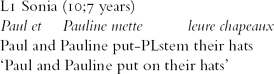
Note that these early signs of written number agreement were analysed as agreeing verb forms, even if the morphological dimension of the number agreement was not respected. These forms are precursors to the silent morphological agreement and they were only produced by the L1 children, that is, by the children exposed to the largest amounts of spoken input. If these non-target-like forms are analysed as erroneous, due to the omission of the grapheme –nt, no significant differences remain between L1, 2L1 and L2 children.
5. DISCUSSION
French-speaking children are exposed to a number agreement system that is ambiguous and complex. This applies to both spoken and written language, but for different reasons. According to a usage-based approach, the learners are sensitive to the use of forms and patterns in the ambient language. In other words, their language comprehension and production is affected by frequency and repetition of forms and patterns in the input. This study was designed to investigate the characteristics of SV-agreement in number in the spoken and written input and to consider the effects of these characteristics on the acquisition process in French-speaking children. More precisely, we wanted to investigate the extent to which the production of verbal singular/plural agreement in French-speaking children was predictable on the basis of token frequency of forms and type frequency of patterns found in spoken and written French.
Our corpus analysis of spoken and written French confirmed that there is a clear singular-bias in the input (Legendre et al., Reference Legendre, Barrière, Goyet and Nazzi2010). The response to our first research question is therefore that children are exposed to many more contexts for SV-agreement in singular than in plural. The study of spoken French in C-ORAL-ROM (Cresti and Moneglia, Reference Cresti and Moneglia2005) and CHILDES (MacWhinney, Reference MacWhinney2000), in combination with Lexique (New et al., Reference New, Pallier, Ferrand and Matos2001) and Manulex (Lété et al., Reference Lété, Sprenger-Charolles and Colé2004) in written French, showed that many plural verb forms indeed correspond to low token frequency items in the French input. In fact, there were only two evident exceptions to this rule of low token frequency of plural forms: the verbs être/avoir ‘to be/have’, which benefit from a double function as lexical and auxiliary verbs. In addition, this part of our study underlined that the pattern with the highest type frequency in spoken French is the one where the number distinctions on the verb is neutralized (pattern C), that is, where one and the same verb form is used with both singular and plural subjects. By contrast, the opposite tendency dominates in written language, characterized by a consistent morphological distinction of singular/plural on the verb. Our second research question addressed how these characteristics of the language input influence the production of SV-agreement in different groups of child learners. We will discuss the spoken and written results in turn.
As expected from a usage-based perspective (Bybee, Reference Bybee, Robinson and Ellis2008; Ellis, Reference Ellis2008; Lieven and Tomasello, Reference Lieven, Tomasello, Robinson and Ellis2008), the children's spoken language production revealed an almost perfect fit between the heterogeneous and partial nature of number agreement in the spoken input and the production errors found in French-speaking children. First of all, no child in this study had any agreement problems in singular (cf. Prévost, Reference Prévost2009). However, they all overgeneralized singular forms to plural contexts in verbs from patterns A and B, just as predicted by the very high type frequency of pattern C. The overuse of singular verb forms in plural contexts was particularly frequent in pattern B, due to the generally low token frequency and lack of lexical strength of plural forms from this pattern. The only verbs that resist this regularization phenomenon are être/avoir ‘to be/have’ which, according to the corpus analysis, correspond to verbs with a high token frequency also in plural. In line with our predictions, hardly any agreement errors were produced in these two verbs.
Furthermore, the spoken data showed significant effects of both learner group and of age on the accuracy of number agreement on the verb. These results suggest that children exposed to more input, i.e. L1 children and/or older children, produce comparably more plural forms than children exposed to smaller amounts of input, i.e. bilingual children and/or younger children. It seems that all children need to reach a certain threshold of input (Gathercole, Reference Gathercole2007) in order to automatize the partial and heterogeneous number agreement of spoken French. However, even in L1 children, the adaptation to the target language is considerably slow. Large amounts of spoken input are needed in order to assure a systematic use of plural verb forms in plural contexts. At the age of 9–10 years, the L1 children's production of number agreement in spoken French is target-like. Age-matched 2L1 children, who by definition have been exposed to smaller amounts of French input, need even more time to reach a systematic use of these verb forms. In light of these results, then, it is not surprising that L2 children, with between three and five years of exposure to spoken French at school, are delayed as compared to their (2)L1 peers. In fact, the strong variability in the input might initially cause these learners, who do not have SV-agreement in their L1, to assume a different grammar from the target language system and this for a considerable period of time.
If the spoken data were consistent with the characteristics of the input of SV-agreement in number, this was not true for the written data produced by the older children. In particular, the pattern with the highest type frequency (pattern C), characterized by a clear morphological distinction of singular/plural forms, was not frequently produced, nor overgeneralized, in the children's written narratives. However, this result is not due to the frequency patterns of the input, but to the inherent morphological nature of written French. According to Fayol and Jaffré (Reference Fayol and Jaffré2008: 156) many morphological distinctions in written French are either silent or ambiguous in spoken French. In particular, some parts of French orthography, such as number, are linked to grammar and not to phonology, a fact that calls for great metalinguistic awareness. As a consequence, children learning to write in French do not benefit from their previous knowledge of spoken language to the same extent as children learning more transparent orthographic systems. The lack of phonological cues has a negative impact on the written production of SV-agreement in French-speaking children, despite the very high type frequency and consistency of this agreement in the written input. As illustrated in this study, verbs with an audible number cue (patterns A and B) agree in number significantly more often than verbs where this agreement is silent (pattern C). Obviously, it is not the high type frequency of the morphological pattern that is decisive for the learning of number agreement in written French at initial stages. This factor is clearly overridden by the lack of phonological cues of the morphological number distinction. Even 9/10-year-old French-speaking children tend to ‘write as they speak’ in this respect (see Dickinson et al., Reference Dickinson, Wolf, Stotsky and Gleason1993; Fayol and Jaffré, Reference Fayol and Jaffré2008: 155–181). Finally, the statistical analysis of the written narratives showed only small differences in number agreement between learner groups (L1, 2L1 and L2) and if we focused on the morphological distinction on the verb (-nt), these differences were eliminated. This means that all groups of children learning to write in French are equally confronted to this complicated morphological system. A large amount of written input, as well as teaching, are obviously needed in order for these children to notice and to automatize the reliable and consistent number agreement patterns of written French.
We conclude that French-speaking children have to acquire two different systems of verbal number agreement that are opposed to, and even competing with, each other. We have shown that the frequency of forms and patterns in the respective language system do indeed influence the language learner in decisive ways. We have also illustrated how the dominating patterns of the spoken language interfere with the development of the written language system during the early school years. Above all, the comparison of French-speaking children of different ages, and with varying amounts of exposure to the target language, reveals that a rich and continuous exposure to spoken and written language is a prerequisite for a successful acquisition of these complex aspects of the French language.