




1. Introduction
It is very common in productions from French speakers to observe the use of the verb être ‘to be’ in contexts where the intended meaning is aller ‘to go’. The attested examples in (1) illustrate this alternation: in both sentences, the conveyed meaning is “going somewhere”, with a directional prepositional phrase, and in (1a) aller is used, whereas in (1b) it is être. All examples are extracted from our study corpus: the oral part of Corpus d’Etude pour le Français Contemporain (CEFC, cf. Section 3).
(1)
a.
on était allés jusqu’à Montmartre
‘We’d gone all the way to Montmartre.’
b.
on a été jusqu’à Porte d’Italie
‘We went all the way to Porte d’Italie.’
The general aim of this article is to document and explain the competition between these forms. We postulate that in periphrastic tenses, the ÊTRE forms are part of the paradigm of ALLER, in that they are able to convey the exact same meaning of “going somewhere”, and that they can be used in every context in which the verb ALLER is required (see below). Therefore, we assume that the paradigm of ALLER displays overabundance in periphrastic tenses, as defined by Thornton (Reference Thornton, Maiden, Smith, Goldbach and Hinzelin2011): “the general phenomenon of having two or more forms that realize the same cell in an inflectional paradigm”. In sociolinguistic terms, the compound forms of ÊTRE are competing variants of the compound forms of ALLER.
The scientific contribution of this article is to complement existing studies on this alternation (Sammons et al. Reference Sammons, Nadasdi and Mougeon2015; Glikman & Patard Reference Glikman and Patard2022) by expanding the geographical span (Belgium, France, Switzerland) and by including all contexts in which either form could be used, with no restriction to specific syntactic configurations. This approach is crucial to capturing the full scope of the rivalry between the competing forms.
We also aim at incorporating the study of morphological forms rivalry into a probabilistic approach to grammar (Bresnan et al. Reference Bresnan, Cueni, Nikitina, Baayen., Bouma, Kraemer and Zwarts2007; Bresnan & Ford Reference Bresnan and Ford2010; Szmrecsanyi et al. Reference Szmrecsanyi, Grafmiller, Bresnan, Rosenbach, Tagliamonte and Todd2017; a.o). According to this approach, speakers’ linguistic productions are not only driven by categorical rules, but also by probabilistic choices depending on information of different levels. In this view, the choice between inflectional competitors that the speaker makes when producing a sentence is the result of a set of factors that together determine the probability of each possible competing variant in the given context.
This article is organized as follows. In the next section, we discuss the paradigm of the ALLER (‘to go’) verb in French and the incursion of the verb ÊTRE (‘to be’) into it. Then, we present the dataset we explored and how we annotated it. After this, we describe the relationship between the occurrence of either form of the paradigm and several sentence-level (linguistic), speaker-level (social) and interaction-level variables, before running inferential analyses in the following section, by using both random forests and Bayesian modeling. Before the conclusion, we discuss our findings and, taking a step back, we compare them to previous studies on the alternation. In particular, we show how social, interaction-level and linguistic factors are intertwined and how it is necessary to study them in combination rather than in isolation to grasp the whole extent of the fine-grained influences over the realization of competing forms from the ALLER paradigm.
2. The competition between être allé and avoir été
In periphrastic tenses, the alternation between être and aller is possible in all contexts where the verb ALLER is required: not only for locative meaning as in (1), but also for more abstract meanings as in (2), as well as when the verb takes an infinitive complement (3) or for the locution ça va (‘it’s okay’) (4).
(2)
a.
je suis allée sur Google
‘I went on Google.’
b.
ils ont été sur internet
‘They went online.’
(3)
a.
on est beaucoup allé voir les films asiatiques
‘We went to see Asian movies a lot.’
b.
qui a été voir le film de Michael Jackson
‘Who went to see the Michael Jackson movie?’
(4)
a.
c’est le seul moment où c’est allé mieux
‘That’s the only time it got better.’
b.
et ça a été beaucoup mieux
‘And it got a lot better.’
This incursion of BE into the domain of GO is not new, nor is it restricted to French. It is attested for example in other Romance languages, such as Ibero-Romance (Juge Reference Juge1999) or Gallo-Romance (Bach Reference Bach2022). As formulated by Vandeloise (Reference Vandeloise2007), the interpretation of GO and BE in the past tense “leads to the same result but by opposite paths Footnote 1 ”: GO describes the change of location and anticipates the final location, while BE suggests the change of location and focuses on the final location. The sentences where BE has a locative complement are ambiguous (1b)-(2b): the static and dynamic interpretations are very close to each other and the context does not always allow one to choose an interpretation. However, with an infinitive complement as in (3b), there is no more ambiguity: the form BE is used instead of GO, with the exact same meaning. Thus, in the compound tenses that we are interested in, Footnote 2 we observe that each regular verbal form, consisting of the auxiliary être (‘be’) and the past participle, competes with a suppletive form, made up of the auxiliary avoir (‘have’) and the past participle of the verb ÊTRE (‘be’).
Previous research on this alternation focused on the occurrences of être allé and avoir été with locative PP and infinitive complement and confirmed that the alternation is well attested in usage. In Sammons et al. (Reference Sammons, Nadasdi and Mougeon2015)’s study about Ontario French, the data were extracted from Corpus of Ontario French (Mougeon et al. Reference Mougeon, Nadasdi and Rehner2005), with 50.1% (570 occ./1137) of être allé forms. Glikman and Patard (Reference Glikman and Patard2022)’s work about European French in synchrony relied on attestations extracted from three oral corpora of Corpus d’Etude pour le Français Contemporain (Benzitoun et al. Reference Benzitoun, Debaisieux and Deulofeu2016), with 47% (238 occ./507) of être allé. Regarding the factors conditioning the use of the competing forms, the two studies give insight on the grammatical and extra-grammatical parameters at play. Both agree on the fact that the distribution is not affected by the type of complement (PP or infinitive), suggesting that the potential ambiguous contexts do not lead to exclude or favour one form over the other. Sammons et al. (Reference Sammons, Nadasdi and Mougeon2015) also observe that the choice between the forms is conditioned by the polarity of the clause (negation attracts avoir été), and the number of the verb form (singular attracts avoir été), in Ontario French. From a sociolinguistic point of view, Sammons et al. (Reference Sammons, Nadasdi and Mougeon2015)’s study emphasizes that the choice between competing forms relies on the following speaker-related factors: socioeconomic status (more avoir été for speakers belonging to the working class, than the middle class), locality of residence (the locality with the strongest majority francophone community favours avoir été), gender (women slightly favour avoir été over the men) and the category of French speaker in the bilingual context of Ontario (restricted speakers favour être allé, compared to unrestricted and semi-restricted speakers). The oral corpus data of Glikman and Patard (Reference Glikman and Patard2022) suggest that competition may be influenced by a geographical factor in Europe (avoir été is used more often in Belgium than in France and Switzerland), but the number of occurrences is very low. They also explain the alternation as a register-based phenomenon, based on the result of a questionnaire pointing out that a number of speakers consider themselves to be sensitive to prescriptivism in the use of the competing forms: avoir été forms are perceived as informal (and even incorrect to some speakers) and être allé forms as formal.
A large-scale corpus study focusing on the competition between compound forms of ALLER in European French is lacking. Such a study would examine social and linguistic factors, as Sammons et al. (Reference Sammons, Nadasdi and Mougeon2015) did for Ontario French.
3. Corpus constitution and annotation
Our study aims at better describing the constraints at play in the competition between être allé and avoir été, in speakers’ usage. Unlike previous corpus-based studies of this phenomenon (Glikman and Patard Reference Glikman and Patard2022; Sammons et al. Reference Sammons, Nadasdi and Mougeon2015) that limited their data to contexts where the verb was followed by a complement (PP or infinitive), we did not restrict our data to specific syntactic contexts. This “inclusive approach” implies very careful manual selection of the data, as explained below.
In accordance with probabilistic grammar approaches (e.g. Szmrecsanyi et al. Reference Szmrecsanyi, Grafmiller, Bresnan, Rosenbach, Tagliamonte and Todd2017) and in order to take into account diatopic variation, we focus on spoken data. We used the oral part of Corpus d’Etude pour le Français Contemporain Footnote 3 (CEFC) corpus (Benzitoun et al. Reference Benzitoun, Debaisieux and Deulofeu2016; Debaisieux and Benzitoun Reference Debaisieux and Benzitoun2020; Bérard Reference Bérard2020), which contains approximately 3 million tokens representing a variety of speech in a variety of situations. As it aggregates various sub-corpora created in different teams with different scientific purposes, it is a highly heterogeneous resource containing the following data:
-
- CFPP2000 (Branca-Rosoff et al. Reference Branca-Rosoff, Fleury, Lefeuvre and Pires2000): interviews about Paris districts and suburb in the 2000s;
-
- CFPB (Dister and Labeau Reference Dister and Labeau2017): interviews about Bruxelles, recorded in 2013-2015;
-
- C-Oral-Rom (Moneglia and Martin Reference Moneglia, Martin, Cresti and Moneglia2008; Deulofeu and Blanche-Benveniste Reference Deulofeu, Blanche-Benveniste, Kawaguchi, Zaima and Takagaki2006): monologues, conversations and professional interactions, recorded between 1980 and 2000;
-
- CRFP (Delic 2004): private conversations but also includes professional and public speech;
-
- French Oral Narrative corpus (Carruthers Reference Carruthers2013): stories presented in public between 1998 and 2005;
-
- OFROM (Avanzi et al. Reference Avanzi, Béguelin and Diémoz2016): Swiss guided interviews recorded in 2008-2012;
-
- TCOF (André and Canut Reference André and Canut2010): informal conversations between students, interviews, public and professional speech;
-
- TUFS (Kawaguchi Reference Kawaguchi2011): casual conversations recorded by French students in 2005-2011;
-
- VALIBEL (Francard et al. Reference Francard, Geron, Wilmet, Pusch and Raible2002): interviews about linguistic representations of Belgian French speakers, recorded between 1988 and 2008.
3.1. Extracting and selecting the data
We relied on the automatic annotation (Part Of Speech and syntactic dependency) of the corpus (Nasr et al. Reference Nasr, Dary, Béchet and Fabre2020) to extract competing forms. We searched for ÊTRE and AVOIR lemmas that have an auxiliary relation with respectively the past participle forms allé and été. Given that periphrastic tenses of ÊTRE are not only possible competing forms of ALLER (‘to go’), but also compound tenses of the verb ÊTRE (‘to be’), we refined our query to automatically exclude the avoir été occurrences that could not have the GO meaning. In particular, we excluded the cases where avoir été had a past participle dependent, because, in those cases, the avoir été form functions as an auxiliary for the following verb. For example, in sentence (5), a été gravée is the past passive voice of the verb GRAVER.
(5)
je vais vous montrer une croix qui a été gravée
‘I’m going to show you a cross that has been engraved’
The automatic extraction gave us 2,830 sentences, which we manually filtered to get only the avoir été occurrences that can alternate with être allé. Two different annotators read each occurrence to determine whether alternation with the être allé counterpart was possible in the given context. We kept the occurrences positively annotated by both annotators, and the annotation team discussed each non-congruent decision. Our guidelines were to exclude aborted sentences if they did not allow the identification of the verb complement (6), and to pick out only the instances where avoir été could be substituted for être allé in the exact same context, without altering the meaning of the sentence.
(6)
j’aurais été j’aurais f
‘I would have I would f[aborted].’
In some ambiguous cases where both stative and dynamic meanings were available, substitution was possible at the expense of the selection of one meaning. For example, in (7), the context is compatible with dynamic reading because the speaker explains the different places he went to during his time in the army. However, a stative reading is also possible insofar as he could have stayed in the city for a period of time before visiting other places. We decided to keep these ambiguous cases because the alternation with être allé is fine, even though we are unsure of the speaker’s intended meaning.
(7)
il y avait donc toutes les tous les folklores français réunis dans l’armée et euh bon ça se passait bien j’ai été à Bourg-en-Bresse dans le matériel, du matériel on m’a envoyé à Kiel dans une compagnie de livraison par air de Kiel on m’a envoyé à Pau en stage parachutiste bon j’ai sauté en parachute euh huit fois je crois ensuite je suis revenu en Allemagne et puis d’Allemagne on m’a envoyé en Algérie alors à Blida
‘So there were all kinds of French folklore gathered together in the army, and, well, things were going well. I went to/have been in Bourg-en-Bresse for equipment. From there, I was sent to Kiel to an air delivery company. From Kiel, I was sent to Pau for parachute training. I jumped out of a plane eight times, I think, then I came back to Germany, and from Germany I was sent to Algeria, to Blida.’
This manual selection process required systematically going back to the original context, because some cases that seemed ambiguous at first were discarded based on careful listening. In example (8), the speaker explains that he took a photo of the oil tanker from very close up, but that his camera allowed him to take the photo as if he had been positioned 50 meters away from the tanker. Given that the topic is photography, it is clear that the speaker is referring to the stative meaning of avoir été and not to the dynamic one.
(8)
vingt-huit c’est bon pour prendre comme moi j’ai pris le pétrolier j’étais à trois mètres et j’ai le pétrolier en entier […] on voit que c’est un grand angle parce que il y a le le bord du quai qui est un peu arrondi comme s’il était rond […] ça c’est la déformation d’un grand angle mais si il y avait pas eu ce bord de quai là le pétrolier je l’ai pris comme si j’avais été à à cinquante mètres alors que j’étais à quatre ou cinq mètres
‘twenty-eight is good for taking pictures like I did with the oil tanker. I was three meters away and I got the whole oil tanker in the shot, and you can see that it’s a wide angle because the edge of the dock is a little rounded, as if it were round. Oh yeah, that’s the distortion of a wide angle, but if there hadn’t been that edge of the dock there, I would have captured the oil tanker as if I had been fifty meters away, when in fact I was four or five meters away’
As we study different varieties of European French, we included all cases where the alternation was acceptable in at least one variety. For example, in periphrastic tenses, Swiss French speakers might use the locution ça va with the forms of ALLER (e.g., C’est allé ? ‘How did it go?’), whereas other European French-speakers overwhelmingly use the forms of ÊTRE (e.g., Ça a été ? ‘How did it go?’). Moreover, the verb ALLER is used for expressions like ça va long (‘it takes time’) in Swiss French, and their past versions can be either (9b) or (9a). Thus, both structures in (9) qualify for inclusion in the dataset, even though (9a) is strongly preferred in the other French-speaking European regions.
(9)
a.
ça a été long
‘It took a long time’ (Standard French)
b.
c’est allé long
‘It took a long time’ (Swiss-French)
In the end, we discarded 772 sentences and had a final number of 2,058 occurrences with 61.9% of être allé.
3.2. Annotation
The study by Sammons et al. (Reference Sammons, Nadasdi and Mougeon2015) suggests that the choice between competing forms is related to the sociolinguistic profile of the speaker. We aimed to extract as much speaker- and interaction-related information as possible on our data, by using the corpus metadata. However, the research teams that made up each of the nine oral subcorpora of CEFC had different goals and strategies when annotating transcriptions, resulting in a very composite set of metadata (Benzitoun and Etienne Reference Benzitoun and Etienne2020). Therefore, we ensured that we had the maximum amount of speaker-related information by filtering out all CEFC files that did not provide information on the following metadata: gender, age, country/region of origin, and number of speakers. This conservative approach left us with 1,157 observations, which form our dataset for the remainder of this article, and ensures good comparability across observations and thus robust statistical inferences. The proportion of être allé is 57.4% in the selected subset.
In the present study, gender is a binary variable (F, M), as delineated in the metadata. The age variable is categorized into three levels (16-20, 21-60, 61 and more). As for the region of origin, we separated the three French speaking European countries (Switzerland (CH), Belgium (BE) and France). Speakers from continental France were then divided into three groups to ensure balance in terms of number of observations while maintaining geographical contiguity: Northern and Eastern France (F–NE); the area around Paris, Île-de-France (F–IDF); and a large part of metropolitan France encompassing the southern and western parts of the country (F–S&W). The three main French ‘subregions’ were determined by aggregating different administrative subdivision levels available in the metadata (‘département’, ‘région’, etc.). For the interaction-level variables, the information was very sparse and not systematized across subcorpora and transcriptions, and we could only keep the number of speakers in the interaction (1, 2 or 2+).
The annotation of linguistic factors was a two-step process. First, we automatically annotated the morphological categories (person, number, tense) on the basis of the form of the auxiliary. The second step corresponds to the annotation of syntactic information, with an automatic pre-annotation, followed by a manual verification.
The first variable is the type of complement. Previous corpus studies agree that the distribution of the alternates is not affected by the distinction between infinitive or PP complement. To ensure that our data are consistent with these previous conclusions, we systematically checked whether the complement was an infinitive (3) or a PP (1) (2). Given that we did not restrict ourselves to these contexts, we also annotated whether the complement was the clitic proform y (10),
Footnote 4
or whether it was absent, because recoverable from the context, as in (11) or (12). The ‘Other’ category gathers complements that are sparsely represented in the data: adverbs (4), NPs (13) or even adjectives (9).
(10)
a.
on y est allées avec NAME
‘We went there with NAME’
b.
on y a été avec ton père avec maman
Footnote 5
‘We went there with you father, with mommy.’
(11)
tu vas sur la Canebière à Marseille tu peux pas marcher tu es déjà allée
‘You go on the Canebière in Marseille, you can’t walk. Have you ever been there?’(litt. ‘You ever went?’)
(12)
on a de la famille en Floride mon frère a été cette année
Footnote 6
‘We have family in Florida. My brother went this year.’
(13)
a.
on est allés euh Place Stan ‘We went to Place Stan’
b.
on avait été rue Tillemont ‘We’d been on Tillemont street’.
We also annotated the presence or absence of negation because it is mentioned in Sammons et al. (Reference Sammons, Nadasdi and Mougeon2015) as a relevant factor. The negative polarity items found with the verbs are pas, jamais and plus. In most contexts, the expletive ne is absent, because the corpus mainly contains spoken colloquial French. However, it still appears in 26 sentences (out of 114 negation contexts), as in je n’y suis jamais allée (‘I’ve never been there.’).
In line with previous works on alternation showing the importance of the referent animacy as an explanatory parameter (Rosenbach Reference Rosenbach2005; Thuilier et al. Reference Thuilier, Grant, Crabbé and Abeillé2021 a.o.), we annotated the animacy of the subject of the verb. Most subjects refer to animate entities, but we encountered inanimate subjects in the form of the demonstrative pronoun ça/c’, not only in the locution ça va (4), but also in contexts like (14). There is also an NP subject that is inanimate in our data (15).
(14)
c’est allé vite quand même ‘It went fast anyway.’
(15)
la caméra n’a pas été dans les douches ‘the camera did not go into the showers.’
Footnote 7
The distribution of each level by annotated variable is presented in the next section (Table 2 and Table 3).
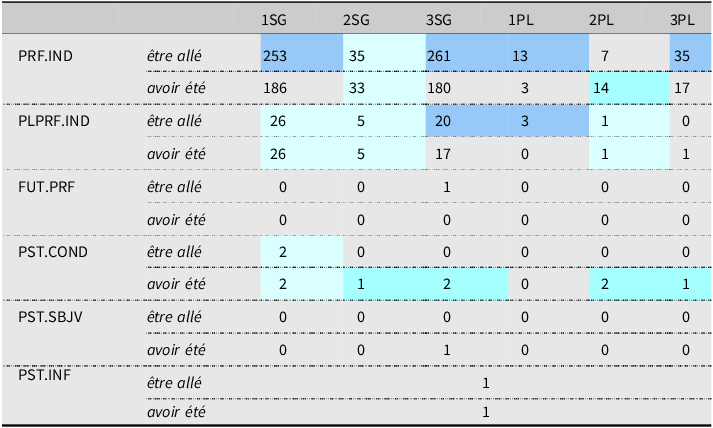
Corpus distribution of competing forms in ALLER paradigm

Table 1 Long description
The table presents the distribution of competing forms in the ALLER paradigm across different grammatical persons and tenses. It has 8 rows and 7 columns. The columns are labeled 1SG, 2SG, 3SG, 1PL, 2PL, and 3PL. The rows are grouped into different tenses and forms: PRF.IND, PLPRF.IND, FUT.PRF, PST.COND, PST.SBJV, and PST.INF. Each row further divides into forms like tre all and avoir t. Row 1: PRF.IND, tre all, 253, 35, 261, 13, 7, 35. Row 2: PRF.IND, avoir t, 186, 33, 180, 3, 14, 17. Row 3: PLPRF.IND, tre all, 26, 5, 20, 3, 1, 0. Row 4: PLPRF.IND, avoir t, 26, 5, 17, 0, 1, 1. Row 5: FUT.PRF, tre all, 0, 0, 1, 0, 0, 0. Row 6: FUT.PRF, avoir t, 0, 0, 0, 0, 0, 0. Row 7: PST.COND, tre all, 2, 0, 0, 0, 0, 0. Row 8: PST.COND, avoir t, 2, 1, 2, 0, 2, 1. Row 9: PST.SBJV, tre all, 0, 0, 0, 0, 0, 0. Row 10: PST.SBJV, avoir t, 0, 0, 1, 0, 0, 0. Row 11: PST.INF, tre all, 1. Row 12: PST.INF, avoir t, 1.
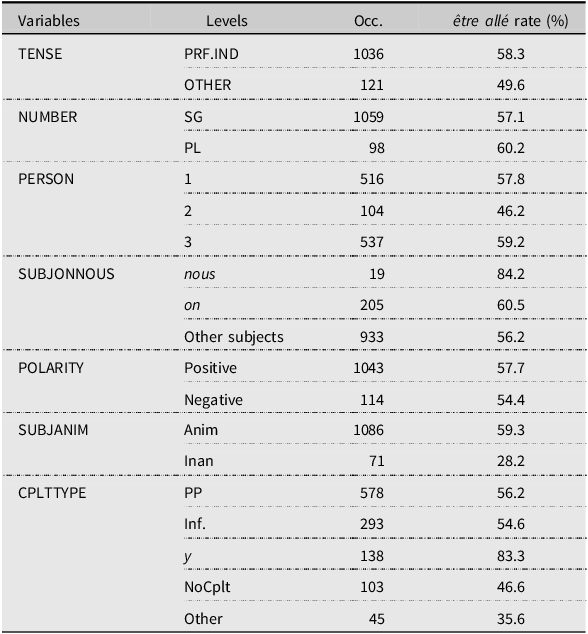
Linguistic factors and the use of être allé vs. avoir été

Table 2 Long description
A table comparing linguistic factors and the use of être allé vs. avoir été. The table has 8 rows and 4 columns. Column headers are Variables, Levels, Occ., and être allé rate (%). Row labels include TENSE, NUMBER, PERSON, SUBJONNOUS, POLARITY, SUBJANIM, and CPLTTYPE. Each row lists different levels, occurrences, and être allé rates. For example, TENSE has levels PRF.IND and OTHER with occurrences 1036 and 121, and être allé rates 58.3 percent and 49.6 percent respectively. The table provides detailed data on how different linguistic variables affect the use of être allé vs. avoir été.
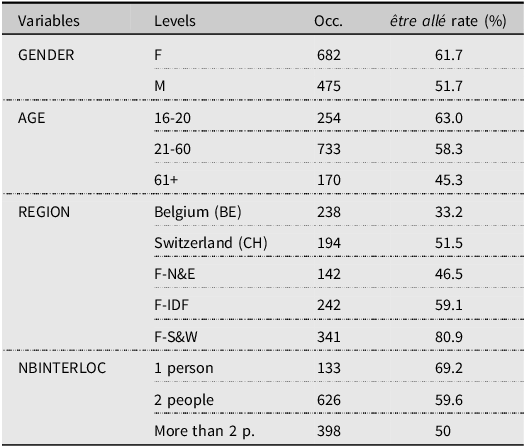
Speaker-level factors and the use of être allé vs. avoir été

Table 3 Long description
A table comparing speaker-level factors and the use of être allé vs. avoir été. The table has 4 rows and 3 columns. The columns are labeled Variables, Levels, Occ., and être allé rate (%). The rows are grouped by variables: GENDER, AGE, REGION, and NBINTERLOC. For GENDER, there are two levels: F with 682 occurrences and 61.7 percent, M with 475 occurrences and 51.7 percent. For AGE, the levels are 16-20 with 254 occurrences and 63.0 percent, 21-60 with 733 occurrences and 58.3 percent, and 61+ with 170 occurrences and 45.3 percent. For REGION, the levels are Belgium (BE) with 238 occurrences and 33.2 percent, Switzerland (CH) with 194 occurrences and 51.5 percent, F-N&E with 142 occurrences and 46.5 percent, F-IDF with 242 occurrences and 59.1 percent, and F-S&W with 341 occurrences and 80.9 percent. For NBINTERLOC, the levels are 1 person with 133 occurrences and 69.2 percent, 2 people with 626 occurrences and 59.6 percent, and More than 2 people with 398 occurrences and 50 percent.
4. Results: Descriptive approach
In this section, we present the distribution of the competing forms: first, in the paradigm of ALLER, and second, for each annotated variable.
4.1. Distribution in the paradigm of ALLER
The statistical distribution of être allé and avoir été for each cell of the paradigm is shown in Table 1. The perfect and pluperfect tenses are the most represented, as well as the 1SG and the 3SG. With proportions ranging from 81% to 57%, the être allé forms are in the majority for 1SG, 3SG, 1PL, and 3PL of the periphrastic perfect. Cell 2SG displays a more balanced distribution with 51.5% (35/68) of être allé, and there is a majority of avoir été for 2PL. For the pluperfect tense, the distribution is more balanced with exactly the same number of occurrences for 1SG, 2SG and 2PL, and a majority of être allé only for 3SG and 1PL. Despite the sparsely populated cells in the rest of the paradigm, it seems that the past conditional favours avoir été (8/10), except for cell 1SG. This is consistent with the data of Sammons et al. (Reference Sammons, Nadasdi and Mougeon2015) that show exactly the same distribution (8 avoir été/10). Given the very unbalanced distribution of the different tenses in our dataset, we henceforth consider only two levels for the variable TENSE: Perfect Indicative vs. Other.
The distribution presented in Table 1 suggests that the rivalry is not strongly influenced by the structure of the paradigm: each cell appears to be a potential candidate for the rivalry between the two competing forms. Therefore, there is room for other conditioning factors, both linguistic and extralinguistic, which are the focus of the following two sections.
4.2. Linguistic variables
Table 2 presents the proportion of être allé as a function of the linguistic variables. As mentioned above, the periphrastic perfect tense seems to favour the use of être allé, but the number of observations is not sufficient to have a significant effect (χ 2 = 3.02, df = 1, p = .08). The first and third persons are preferentially associated with être allé, and the second with avoir été. The distribution of the variable NUMBER is consistent with what Sammons et al. (Reference Sammons, Nadasdi and Mougeon2015) reported. However, there is no statistically significant effect for this variable (χ 2 = 0.23, df = 1, p = .63). Thus, we decided to merge the information on person and number into a single variable, called PERSNB, for statistical modeling (Section 5). Regarding person and number, we also annotated the distinction between the two possible pronouns that carry the first-person plural value: formal nous and informal on (variable SUBJONNOUS). As pointed out by Glikman and Patard (Reference Glikman and Patard2022), the alternation is sensitive to the register and we expect avoir été to be inserted in informal sequences and être allé in more formal ones. In our data, first-person plural pronouns seem to attract être allé verb forms (χ 2 = 6.97, df = 2, p = .03), with a stronger effect indeed for the nous pronoun, although the number of occurrences is very low.
At the level of the sentence, the negation seems to slightly reduce the overall preference for être allé. This trend is less strong than in the study of Sammons et al. (Reference Sammons, Nadasdi and Mougeon2015) where the negative polarity increases significantly the proportion of avoir été to 67.7% in Ontario French. The presence of an inanimate subject clearly favours the use of avoir été, but this observation relies on a small number of observations (71/1157). Finally, the distribution of the type of verbal complement shows that the proform y seems to strongly favour être allé, and that the absence of an overt complement favours avoir été to a lesser extent. In contrast, there is no significant difference in the choice of the competing form with infinitive and PP complements (χ 2 = 0.15, df = 1, p = .7). This observation is fully consistent with the findings of previous studies (Sammons et al. Reference Sammons, Nadasdi and Mougeon2015; Glikman and Patard Reference Glikman and Patard2022). Based on these figures, we have merged the infinitive and PP levels within the category “Other” for the rest of the article.
4.3. Speaker-level (sociolinguistic) and interaction-level variables
Table 3 gives an overview of the proportions of être allé depending on the different speaker-level variables identified from the metadata. We observe that gender seems to affect the use of the forms: women appear to use significantly more être allé than men (χ 2 = 12.369, df = 1, p < .001). Regarding age, while younger groups (16-20 and 21-60 y.o.) seem to favour être allé uses, speakers aged 61 and more seem to favour avoir été (χ 2 = 13.66, df = 2, p < .01). For the last speaker-level variable, country/region, an interesting sociolectal pattern, statistically significant (χ 2 = 144.22, df = 4, p < .001), emerges, with speakers from Belgium and Northern and Eastern France using more avoir été, speakers from Southern and Western France, as well as from Île-de-France, using more être allé, and speakers from Switzerland using a balanced mix of the two alternatives.
Finally, at the interaction level, Table 3 provides an overview of how different contexts involving either one person, two people, or more than two people affect the production of the competing forms. The more frequent use of être allé appears to come from interactions with only one and two speakers, while interactions with more than two speakers show a more balanced pattern (χ 2 = 17.67, df = 2, p < .001).
5. Generalizing over the results: Conditional inferential trees and conditional random forest
To investigate the robustness of the associations between the use of être allé or avoir été and variables from our dataset, we used conditional inference trees and random forests (Levshina Reference Levshina, Paquot and Gries2020). This NLP-inspired inferential technique is best suited for a dataset such as ours, where there are many predictors of interest, with high heterogeneity in the number of observations by predictor and possible problems of predictor correlation. It is a robust approach to get a comprehensive view of alternation phenomenon, that is commonly used in probabilistic approach to grammar (Szmrecsanyi et al. Reference Szmrecsanyi, Grafmiller, Bresnan, Rosenbach, Tagliamonte and Todd2017). On the contrary, classic analyses such as frequentist inferential models, and in particular logistic regressions would be ill-suited here, because of this high-variability and the high number of predictors. First, we will present the overall results from a conditional random forest calculated with all the predictors isolated in the previous sections, then we will do a more in-depth analysis of the interactions between predictors.
5.1. Trees, random forest and overall results
Conditional inference trees operate a recursive (here, binary) partition of the data: they recursively split the data according to the predictors they are fed, to maximize the difference between the possible values of the dependent variable. The splits create bins of data (subsets) according to one predictor, Footnote 8 across which the difference in value for the dependent variable is maximal. In each bin, further binning is then operated with the remaining predictors, until no more meaningful differences can be found. Figure 1 gives a visual representation of a lone tree fit with the partykit package (Hothorn et al. Reference Hothorn, Hornik and Zeileis2006; Hothorn and Zeileis Reference Hothorn and Zeileis2015), within the R framework (R Core Team 2024) and the RStudio software (Posit Team 2024).
Random tree predicting être allé vs. avoir été uses.

Figure 1 Long description
A diagram representing the probabilistic approach to grammar, showing the factors influencing the choice between inflectional competitors in linguistic production. The diagram is structured as a tree with various nodes and branches. Each node represents a factor such as region, gender, age, and type of complement, with associated p-values indicating statistical significance. The branches show the different possible outcomes or choices based on these factors. The diagram includes specific age groups, types of interlocutors, and sub-animacy distinctions. The nodes are connected by lines indicating the flow of influence from one factor to another. The bottom of the diagram includes bar graphs showing the distribution of data for each node.
To give an example on how this can be read, in this tree, it is calculated that the split that is most accurately predictive of the dependent variable values is made according to the REGION predictor, with speakers from Southern and Western France producing a higher proportion of être allé than speakers from all the other areas. Then, for these speakers from Southern and Western France, the predictor that entails the most meaningful split of the data, as regards predictive accuracy of the dependent variable, is SUBJANIMACY, with inanimate subjects (produced by the speakers from this subset) being linked to less être allé observations than animate subjects. For the speakers from other areas however, the most accurate predictor of the dependent variable values is a refined definition of region, opposing people from Belgium to others. For these other regions (Île-de-France, Northern and Eastern France and Switzerland), the next most meaningful variable is GENDER. In observations from male speakers of this subset, the most important predictor is then the COMPLEMENTTYPE variable (proform y, no complement or any other complement), while for observations from female speakers of this subset, the following most important predictor is NBINTERLOC. And so on.
These results from the conditional inference tree are illustrative only, and other trees could give different splits depending on which observation the algorithms would have used as a starting point for the splits, and on many other parameters such as the minimal number of observations per final nodes, the maximal number of nodes, and so on. As an example, neither the TENSE nor the SUBJONNOUS predictors are present in the random example tree above. To mitigate this variability in the results, conditional random forests are a useful expansion. They operate with the same approach, but generate (grow) a specified number of trees, over which predictions for each considered predictor of the dependent variable are averaged. In the end, it allows for a more accurate prediction of the dependent variable values. By averaging over all predictions from the individual conditional trees, random forests also allow the predictors to be ranked in terms of how well they predict the dependent variable values (i.e., variable importance).
Here, we used the ranger package (Wright & Ziegler Reference Wright and Ziegler2017), to grow a forest of 2,000 conditional inferential trees. The maximal number of predictor permutations per split (mtry parameter, which sets how many randomly selected predictors are tested at each split) was set to 3 after fine-tuning to see which number yielded the best overall predictive accuracy. The forest terminal node minimal size was 10 observations. The dependent variable was the form produced, either avoir été or être allé. Ten predictors were fed to the forest, with three speaker-specific predictors (GENDER, AGE and REGION), one interaction-level predictor (NBINTERLOC), and six sentence-internal linguistic predictors (NEGATION, SUBJANIMACY, TENSE, COMPLEMENTTYPE, SUBJONNOUS, PERSNB).
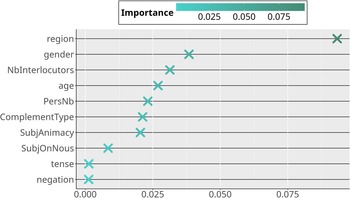
Various measures help characterize the predictive power of this forest. The Brier Score (Brier Reference Brier1950) or mean squared error highlights the proportion of prediction errors by the forest, 0 reflecting perfect accuracy and 1 total inaccuracy. Here, we get an OOB Footnote 9 Brier Score of .168. Conversely, with a 10-fold cross-validation procedure, we can also estimate the mean proportion of correctly classified observations, which here amounts to .835 (calculated with the rsample (Frick et al. Reference Frick, Chow, Kuhn, Mahoney, Silge and Wickham2024) and yardstick (Kuhn et al. Reference Kuhn, Vaughan and Hvitfeldt2025) packages). Finally, the pROC package (Robin et al. Reference Robin, Turck, Hainard, Tiberti, Lisacek, Sanchez and Müller2011) helped us calculate the Area Under the receiver operating characteristic (AUC), which compares true positives and true negatives in predictions. An AUC of .5 would characterize an uninformative classifier, while 1 would mean a perfect one. Here, we get an AUC of .912. All in all, all measures point to a reliable predictive capacity for our forest. In this forest, Figure 2 illustrates how the different predictors rank in terms of how important they are in refining the prediction accuracy for être allé over avoir été uses. The absolute ‘importance’ numeric values on the x-axis are here less important than the ordering of variables itself, and the order of magnitude of the differences between them.
Relative variable importance in predicting être allé vs. avoir été uses.

It appears that across all trees within the forest, the variable most reliably and most accurately predictive of the dependent variable values is REGION. Other speaker-specific predictors such as GENDER and AGE, as well as the interaction-level predictor NBINTERLOC are next. All sentence-internal predictors appear to be lower in the importance ranking. NEGATION and TENSE appear to have less importance when compared to the others. This analysis may be linked to a difference in nature between the sociointeractional predictors and the more linguistic ones.
Even though the linguistic predictors create important descriptive contrasts in the use of either alternative form, this variation phenomenon seems to be primarily sociolectal and interaction-driven. Taken together, the descriptive results from the previous sections and the results from this random forest approach call for a more in-depth analysis, where interactions between predictors are also accounted for.
5.2. Disentangling the relative weighs of linguistic and sociolinguistic factors
The predictiveMargins R package (Grafmiller and Sönning Reference Grafmiller and Sönning2022) allows the forest predictions to be explored further. More precisely, it allows an extraction of all predicted values for all trees within the forest, and for all combinations of the predictors that can be found in all these trees. With these predictions, it is possible to calculate the mean prediction for each different level of the target predictor variables, and thus to better understand in what direction a specific predictor influences the overall predictions from the forest. We used the avg_predictions() function of the package to extract these for the predictors identified above and plot them. Importantly, different schemes can be applied to weigh the other predictors with this function, and we chose the default ‘isolated’ scheme here, which takes into account the overall distributions of these predictors and their levels in the data (Sönning and Grafmiller Reference Sönning and Grafmiller2024). In the following sections, we present only meaningful results.
5.2.1. Linguistic factors in isolation
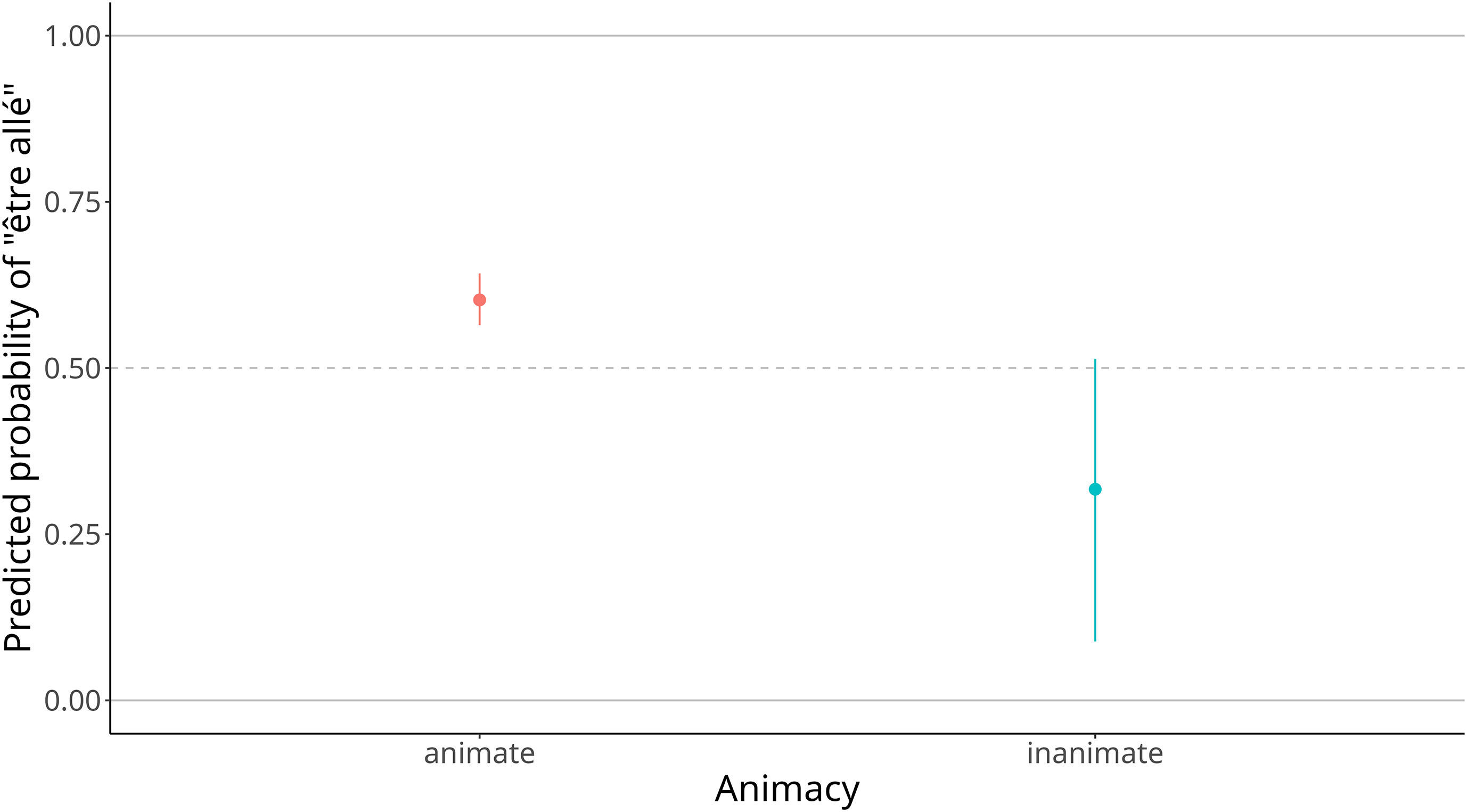
Figure 3 illustrates the output of such a manipulation with the SUBJANIMACY predictor, where inanimate and animate subjects are contrasted. The dotted line represents a .5 predicted probability of être allé production. It appears that, all other predictors being weighed according to their distribution in the overall data, the presence of animate subjects in a sentence is linked to a higher predicted probability of être allé productions (.60), compared to inanimate subjects (.32). Here and in all subsequent graphs of this type, error bars represent 90% intervals around the mean predicted value.
Predictions for “être allé” depending on SUBJANIMACY.

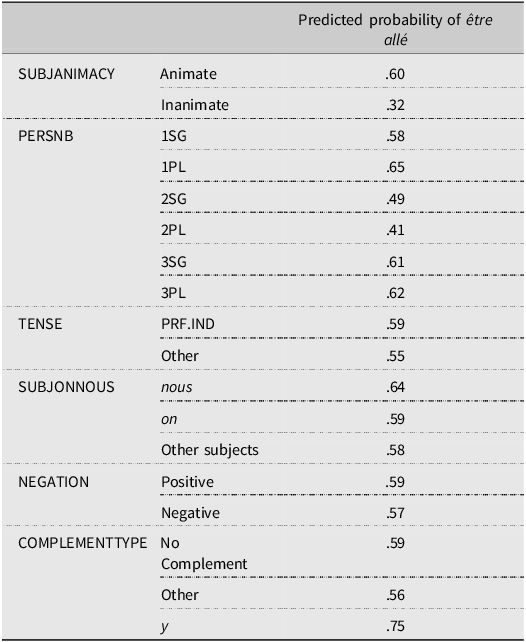
Table 4 recaps the weighted predicted means for être allé productions depending on all levels of all the linguistic variables that were fed to the forest. The type of complement also shows meaningful differences, with the ‘y’ proform being associated with a higher predicted probability than when there is either no complement to the verb or any other complement.
Respective predictive weights for all levels of the linguistic predictors

Table 4 Long description
A table with 8 rows and 3 columns. The columns are labeled SUBJANIMACY, PERSNB, TENSE, SUBJONNOUS, NEGATION, and COMPLEMENTTYPE, and Predicted probability of être allé. The table presents the predicted probabilities for different levels of linguistic predictors. For SUBJANIMACY, animate has a probability of .60 and inanimate has .32. For PERSNB, 1SG has .58, 1PL has .65, 2SG has .49, 2PL has .41, 3SG has .61, and 3PL has .62. For TENSE, PRF.IND has .59 and Other has .55. For SUBJONNOUS, nous has .64, on has .59, and Other has .58. For NEGATION, Positive has .59 and Negative has .57. For COMPLEMENTTYPE, No Complement has .59, Other has .56, and y has .75.
5.2.2. Sociolinguistic and interaction-level factors in isolation
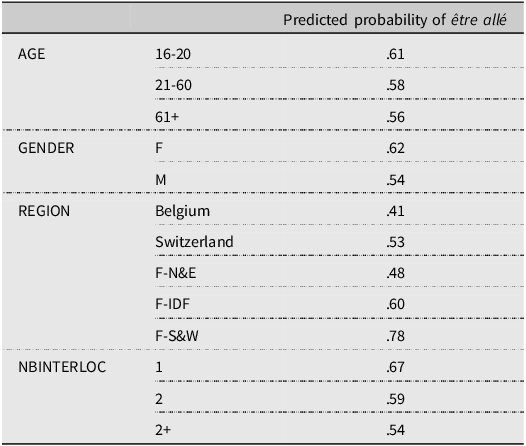
As shown in Table 5, the extra-linguistic factors that exhibit the biggest contrasts are: GENDER, REGION and NBINTERLOC. The GENDER variable shows a pattern similar to that identified in the descriptive section, with higher predicted values for speakers identified as females in the recordings metadata than for speakers identified as males.
Respective predictive weights for all levels of the extralinguistic predictors

Table 5 Long description
A table with four columns and eight rows, including row headers. The columns are labeled AGE, GENDER, REGION, and NBINTERLOC, with corresponding predicted probabilities of être allée. The AGE row includes age groups 16-20, 21-60, and 61+, with probabilities of .61, .58, and .56 respectively. The GENDER row includes F and M, with probabilities of .62 and .54 respectively. The REGION row includes Belgium, Switzerland, F-N&E, F-IDF, and F-S&W, with probabilities of .41, .53, .48, .60, and .78 respectively. The NBINTERLOC row includes 1, 2, and 2+, with probabilities of .67, .59, and .54 respectively.
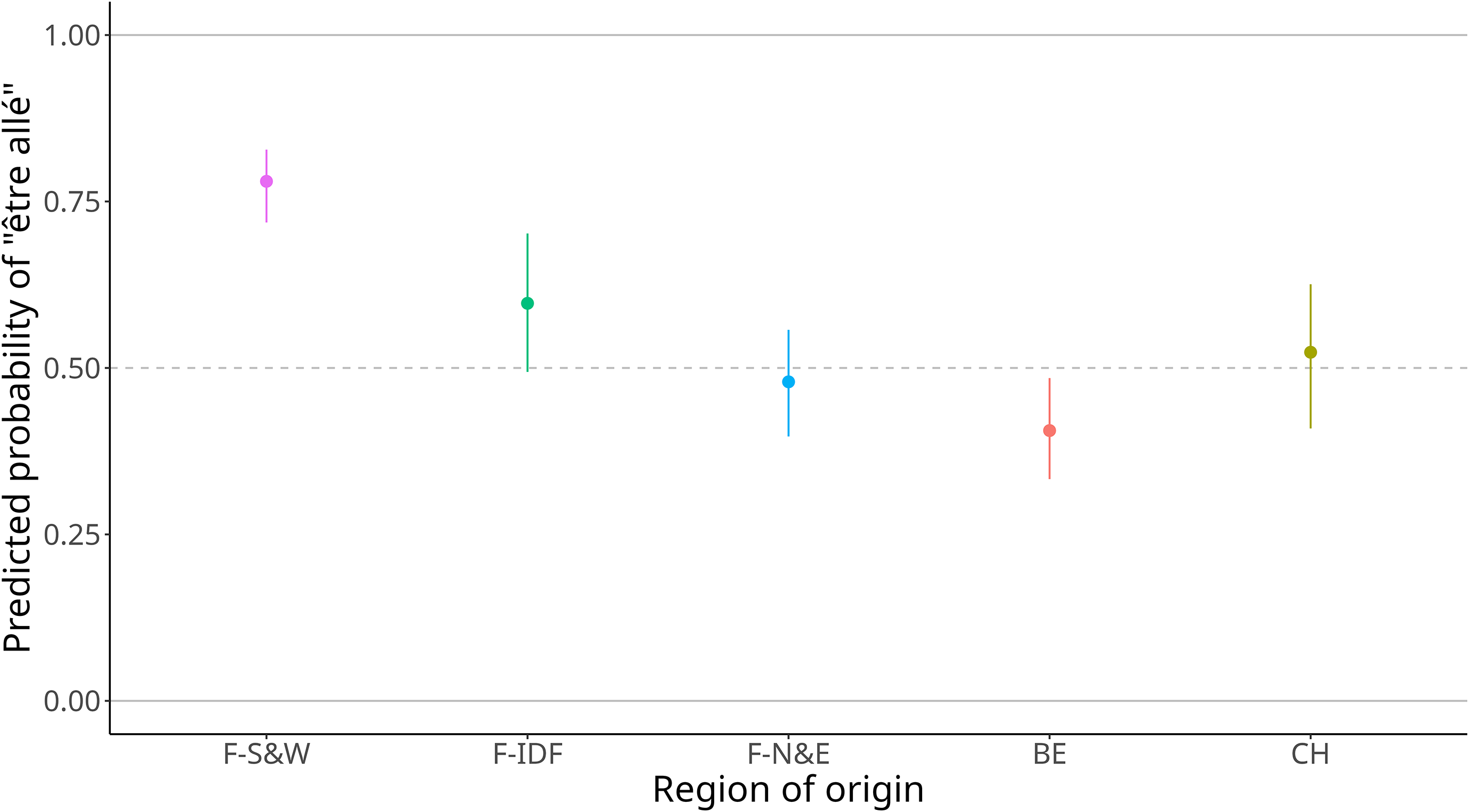
As for the speaker’s region of origin, an interesting pattern emerges (Figure 4): the lowest predicted probability of être allé production is associated with speakers from Belgium, close to neighboring speakers from Northern and Eastern France and Switzerland, while speakers from Southern and Western France are associated with the highest predicted values, with speakers from the central metropolitan region of Paris in between. Moreover, this variable is the one with the highest relative importance in all predictors included in the forest calculation (Figure 2). This makes a strong case for diatopic variation, where French speakers from the geographical area comprising Belgium, Switzerland and the Northern and Eastern parts of continental France make use of less être allé and more avoir été, compared to speakers from the rest of France.
Predictions for “être allé” depending on REGION.

Finally, the interaction-level predictor is also informative, with situations with only one speaker yielding higher predicted probabilities for the production of être allé than situations with exactly two interlocutors, which in turn yield higher predicted values than situations with more than two speakers. This gradient pattern might be correlated to the type of speech produced depending on the number of participants in the corpus, since, for instance, observations with only one speaker are mostly situations where the speaker is telling a story, with a type of speech that may mimic a written, more normatively-constrained version of the language. But the difference that is also visible between situations with either only two or more-than-two speakers is telling, in that it suggests a different use of the competing forms être allé and avoir été depending on the interaction setting and on the social dynamics between participants.
5.2.3. Mixing predictors
The results we presented above point to a network of variables influencing the production of either être allé or avoir été. To go a bit deeper than the variable relative importance values from Figure 2, we used the predictiveMargins package and its avg_predictions function to characterize the interactions between some variables. Three-way interactions would be too ambitious with the amount of data we extracted from the corpus, but some two-way interactions allow for some informative observations over the respective importance of linguistic (SUBJANIMACY, COMPLEMENTTYPE, NEGATION), sociolinguistic (REGION, GENDER, AGE) and interaction-level (NBINTERLOC) variables.
To ensure these interactions remain meaningful, the calculations of average predictions from the random forest were confronted with Bayesian logistic regressions. Bayesian models are well-suited for analysing data from small or unbalanced data (Sorensen et al. Reference Sorensen, Hohenstein and Vasishth2016), and we believe they are a good complement to the NLP-inspired approach with inferential trees and random forests. While inferential trees and random forests feed from the data to shed light on the many relationships between variables within said data, Bayesian regressions more directly allow for a broader assessment of how robust and, as such, how generalizable these findings are, by directly quantifying the probability of a predictor (or interaction of predictors) of having an effect on the dependent variable. The combination of both methods of analysis ensures in our view the robustness of the results we present. These Bayesian inferential models are run over the exact same dataset than the random forest (N = 1157 observations), with a binary dependent variable corresponding to the verb that was produced (être allé, coded 1, or avoir été, coded 0). All models were run in R and RStudio with the brms package (Carpenter et al. Reference Carpenter, Gelman, Hoffman, Lee, Goodrich, Betancourt, Brubaker, Guo, Li and Riddell2017; Bürkner Reference Bürkner2017; Bürkner Reference Bürkner2018). For each model, the independent variables in interaction correspond to those the average predictions from the forest are calculated upon. They are mean-centered coded all the time, to ensure a good interpretation of the results (Brehm and Alday Reference Brehm and Alday2022). For clarity, we will only report for each model the estimated coefficient and the probability of having a meaningful effect of the combination of the two variables under consideration, and not the effects from isolated predictors. The estimated coefficient (β̂) is a numerical characterization of the effect of the interaction of independent variables on the dependent variable, while the probability associated with it corresponds to the posterior distribution calculated by the model, which characterizes the probability for the real coefficient to be either greater (P(β>0)) or smaller (P(β<0)) than 0 (which would mean no meaningful interaction of the variables). Footnote 10
5.2.4. Sociolinguistic factors and animacy
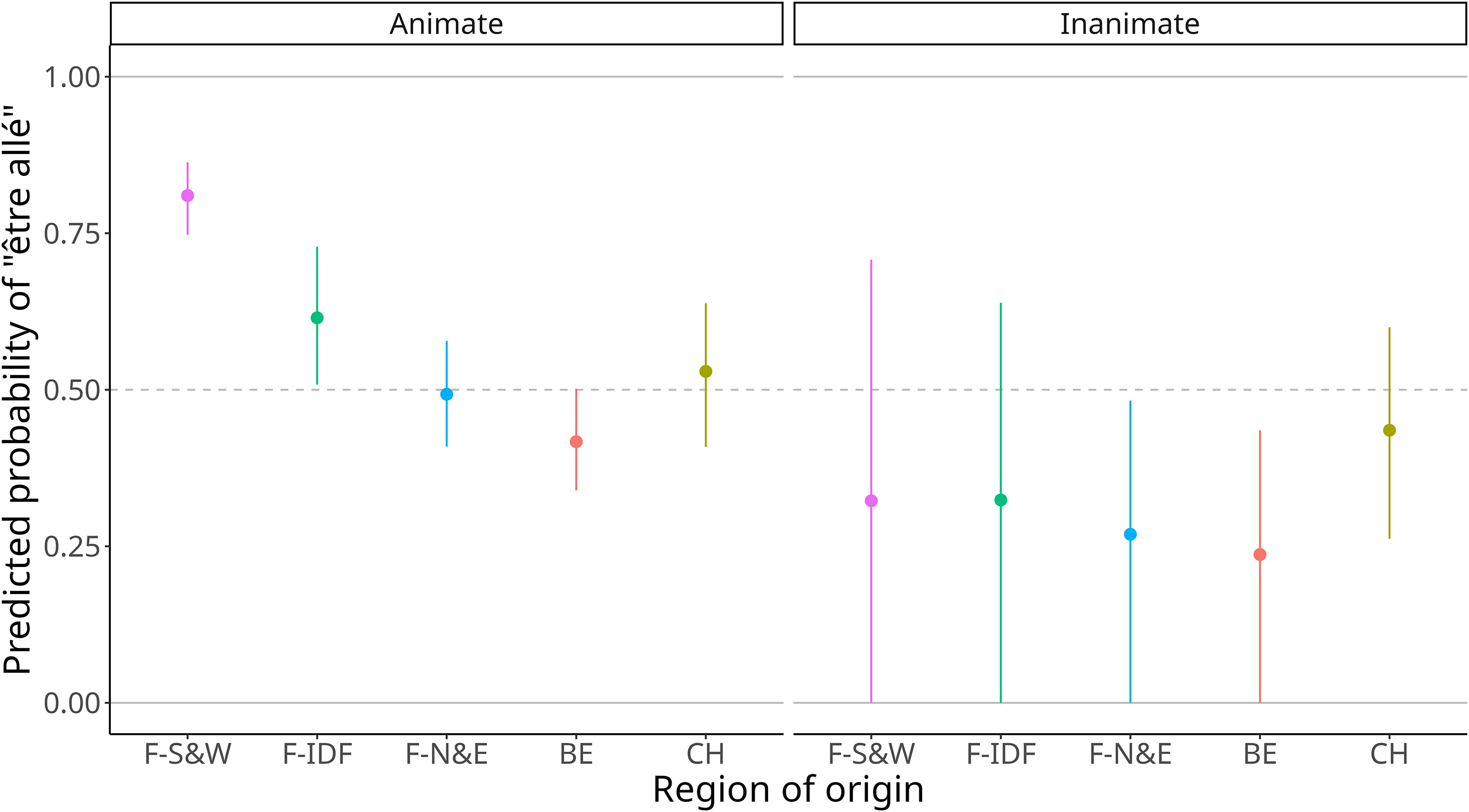
Figure 5 illustrates the predicted probabilities for être allé production depending on region of origin of the speakers and on animacy of the subject. The left panel is reminiscent of results from Figure 4, with a gradient pattern where speakers from Belgium yield the lowest predicted probability (.42), close to speakers from Northern and Eastern France (.49) and speakers from Switzerland (.53), while speakers from Southern and Western France show the highest predicted probability (.81) and speakers from the Île-de-France region show intermediate values (.61). Generally, the animate vs. inanimate opposition also resembles that from Figure 3, with higher predicted probabilities for sentences with animate subjects than for sentences with inanimate subjects. However, for sentences with inanimate subjects, the differences between regions seems to be ‘neutralized’ (granted, with wide margins), with consistent means across all geographical areas (F–S&W: .32, F–IDF: .32, F–N&E: .27, Belgium: .24). Speakers from Switzerland seem less affected by this variable (.44), which is consistent with a regional use of idiomatic ‘c’est allé’ constructions in places where speakers from other locations might say ‘ça a été’ (cf. examples (9)). A Bayesian logistic regression run for this interaction indeed yields evidence for a difference between animate and inanimate conditions when contrasting for example speakers from Southern and Western France and from Belgium (β̂ = 4.26, P(β>0) = .82), or speakers from Switzerland and from Belgium (β̂ = 8.22, P(β>0) = 1).
Predictions for “être allé” depending on REGION and SUBJANIMACY.

Subject animacy also seems to interact in a noticeable way with gender, as supported by Bayesian analysis (β̂ = –0.80, P (β<0) = .92). For sentences with an animate subject, speakers identified as female are linked to higher predicted probabilities (.64) than speakers identified as male (.55), following the overall pattern for gender effects (Table 5). In sentences with inanimate subjects, this difference between genders seems to disappear (albeit with high prediction margins due to the low number of observations), with roughly equivalent mean predicted probabilities (.31 for F, .33 for M).
5.2.5. Sociolinguistic factors and complement type
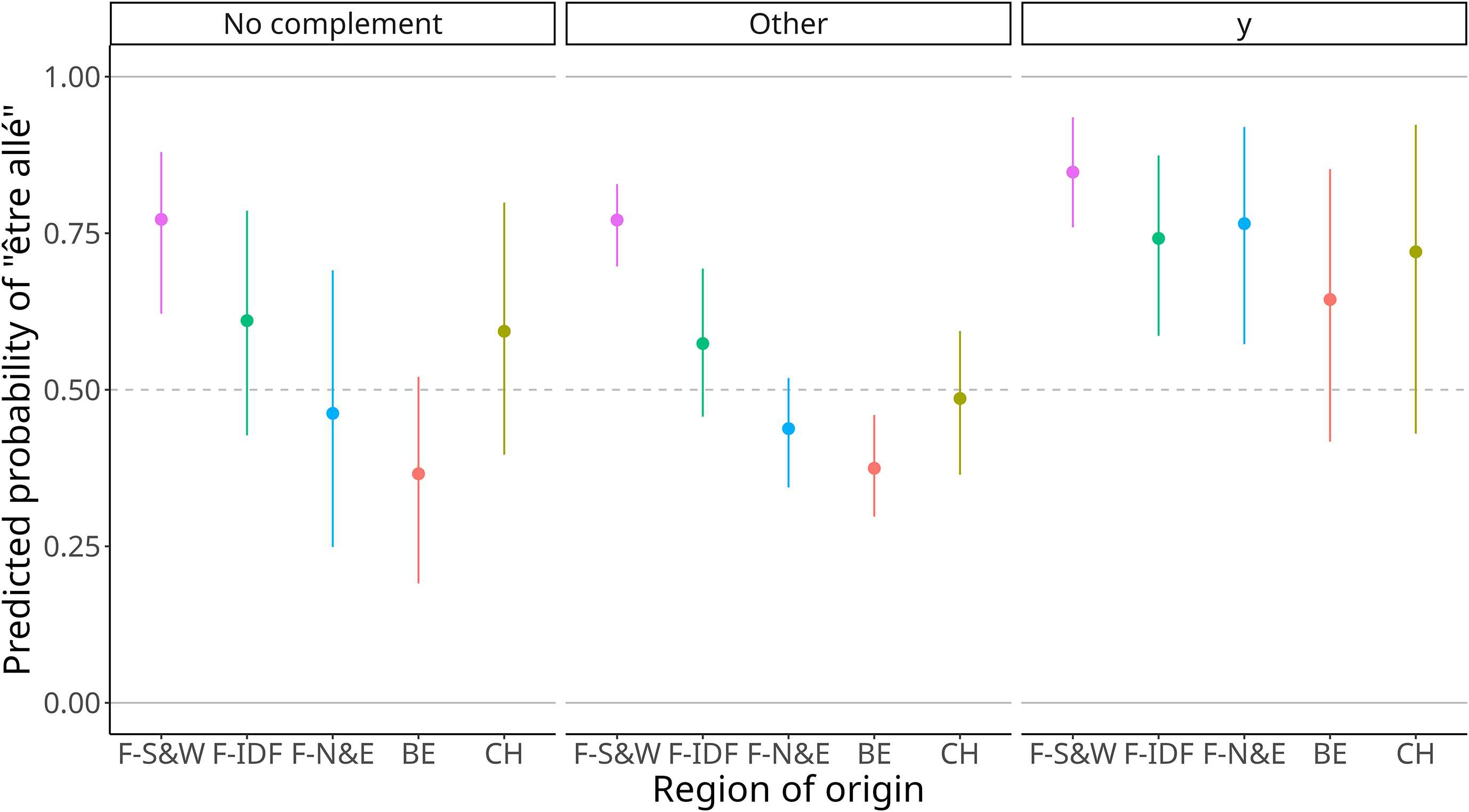
The complement type seems to interact only with REGION. Figure 6 gives an overview of how the regional differences hold, depending on whether there is no complement (left panel), whether the complement is the proform y (right panel), or whether there is any other complement (center). The left and center panels show a pattern similar to that from Figure 4, with predicted probabilities for être allé productions lowest for speakers from Belgium, Northern and Easter France, and highest for speakers from Southern and Western France, with speakers from Île-de-France and Switzerland somewhere in between. This contrasted pattern does not totally wear off in the right panel, but it seems to be reduced.
Predictions for “être allé” depending on REGION and COMPLEMENTTYPE.

A Bayesian logistic regression yields evidence for a difference between the ‘other complement’ and ‘y’ conditions when contrasting for example speakers from Belgium on one hand and, on the other hand, speakers from Northern and Eastern France (β̂ = 0.88, P (β>0) = .84) or from Île-de-France (β̂ = –1.04, P (β<0) = .93).
5.2.6. Sociolinguistic factors and negation
The influence of NEGATION over regional differences is less noticeable than the influence of subject animacy, but it is still meaningful. The presence of negation seems to widen the differences in predicted probabilities across geographical areas, with lower values in sentences with negation than in sentences without it, especially for speakers from Northern and Eastern France and from Belgium (evidence for this when comparing the latter group to speakers from Southern and Western France (β̂ = 0.71, P (β>0) = .86), to speakers from Île-de-France (β̂ = 0.94, P (β>0) = .93), and also to speakers from Switzerland (β̂ = 1.84, P (β>0) = .96)).
This effect of NEGATION seems to be of a different nature than that of SUBJANIMACY or COMPLEMENTTYPE, in that it does not apply to all groups of people as defined, e.g., by region or gender, with reduced differences between groups. Rather, only people from some regions (Northern and Eastern France and Belgium) seem to be sensitive to the effect of negation, which on the contrary widens the difference in linguistic behaviour across groups. Given the distribution of our dataset across regions (238/1157 observations from Belgium, and 142 from N&E France) and the relatively small number of negative sentences overall (114/1157), this in fact might be a reason why negation is so low on the variable importance ranking (Figure 2), to be investigated further with better control over the number of observations from all regions.
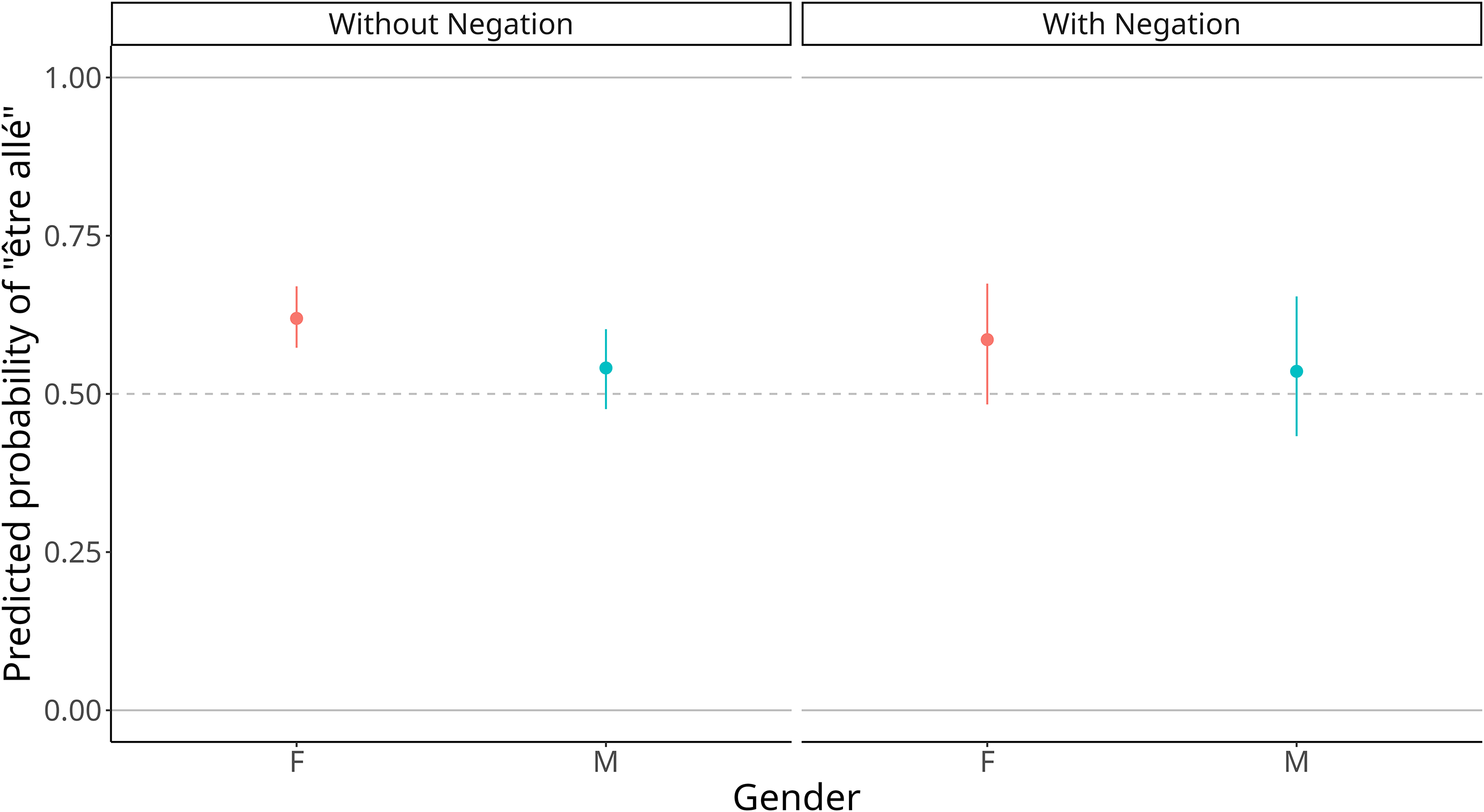
When considering the GENDER and NEGATION variables together (Figure 7), only women appear to be sensitive to the polarity of the sentence, as supported by Bayesian analysis (β̂ = –0.61, P (β<0) = .93). In fact, the predicted probability for women to produce être allé is higher in sentences that do not contain negation (.62) than in those containing negation (.59), while for men, the predicted probabilities are identical regardless of polarity (.54).
Predictions for “être allé” depending on GENDER and NEGATION.

5.2.7. Number of interlocutors
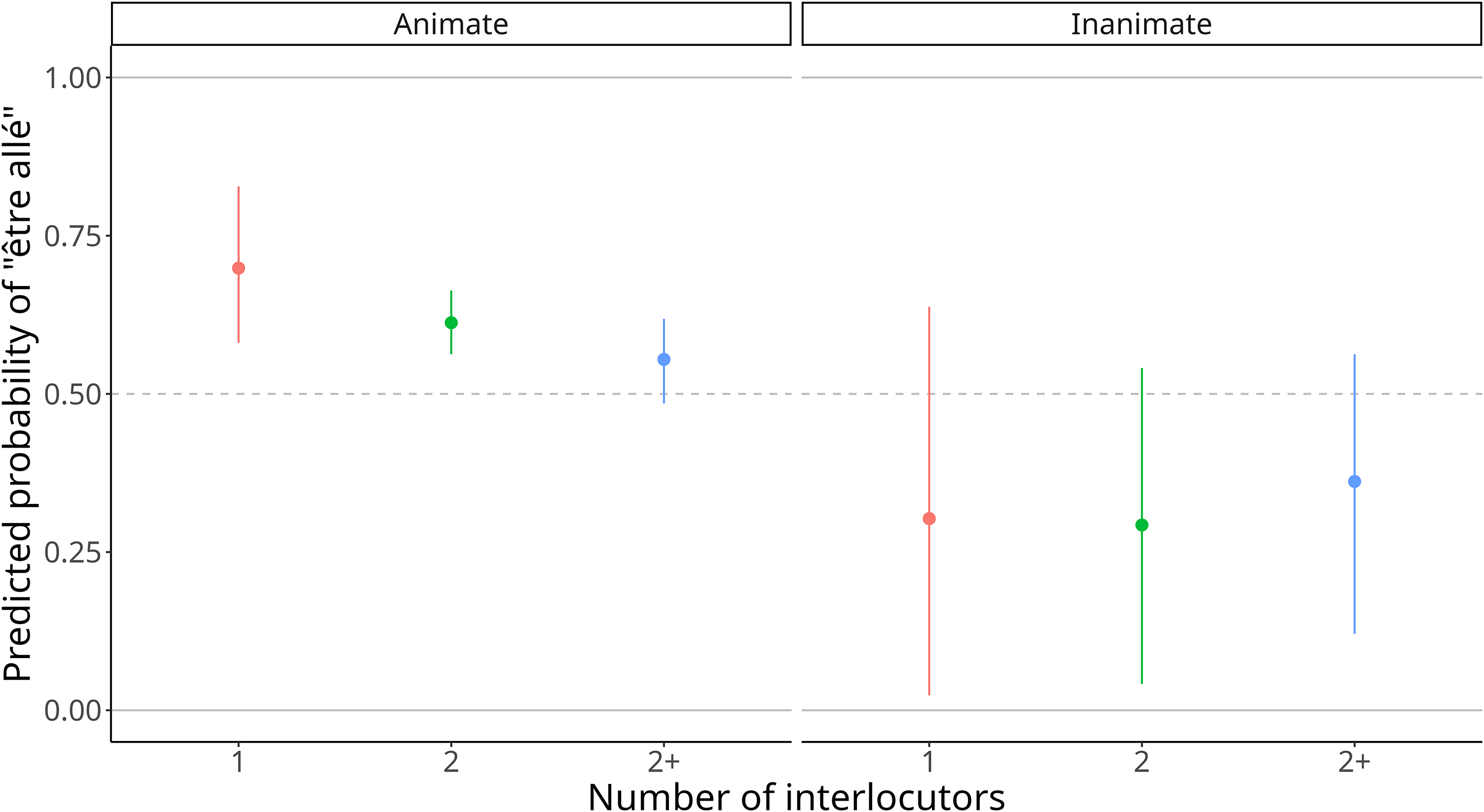
The interaction-level variable NBINTERLOC interacts with SUBJANIMACY (Figure 8): while sentences with animate subjects follow the gradient overall pattern, sentences with inanimate subjects are associated with roughly similar predicted probabilities whatever the number of interlocutors. The predictive margins are important again, but a Bayesian logistic regression provides evidence for an interaction when contrasting between ‘one speaker’ and both ‘two speakers’ (β̂ = 1.36, P (β>0) = .85) and ‘more than two speakers’ (β̂ = 3.71, P (β>0) = 1).
Predictions for “être allé” depending on NBINTERLOC and SUBJANIMACY.

Another interaction links NBINTERLOC and COMPLEMENTTYPE, with an apparent reduction of the differences between number of interlocutors in the predicted probabilities for être allé productions when the complement is ‘y’ and not any other complement (or no complement). A Bayesian analysis provides evidence for the contrast between one speaker and more than two speakers (β̂ = –5.24, P (β<0) = .89).
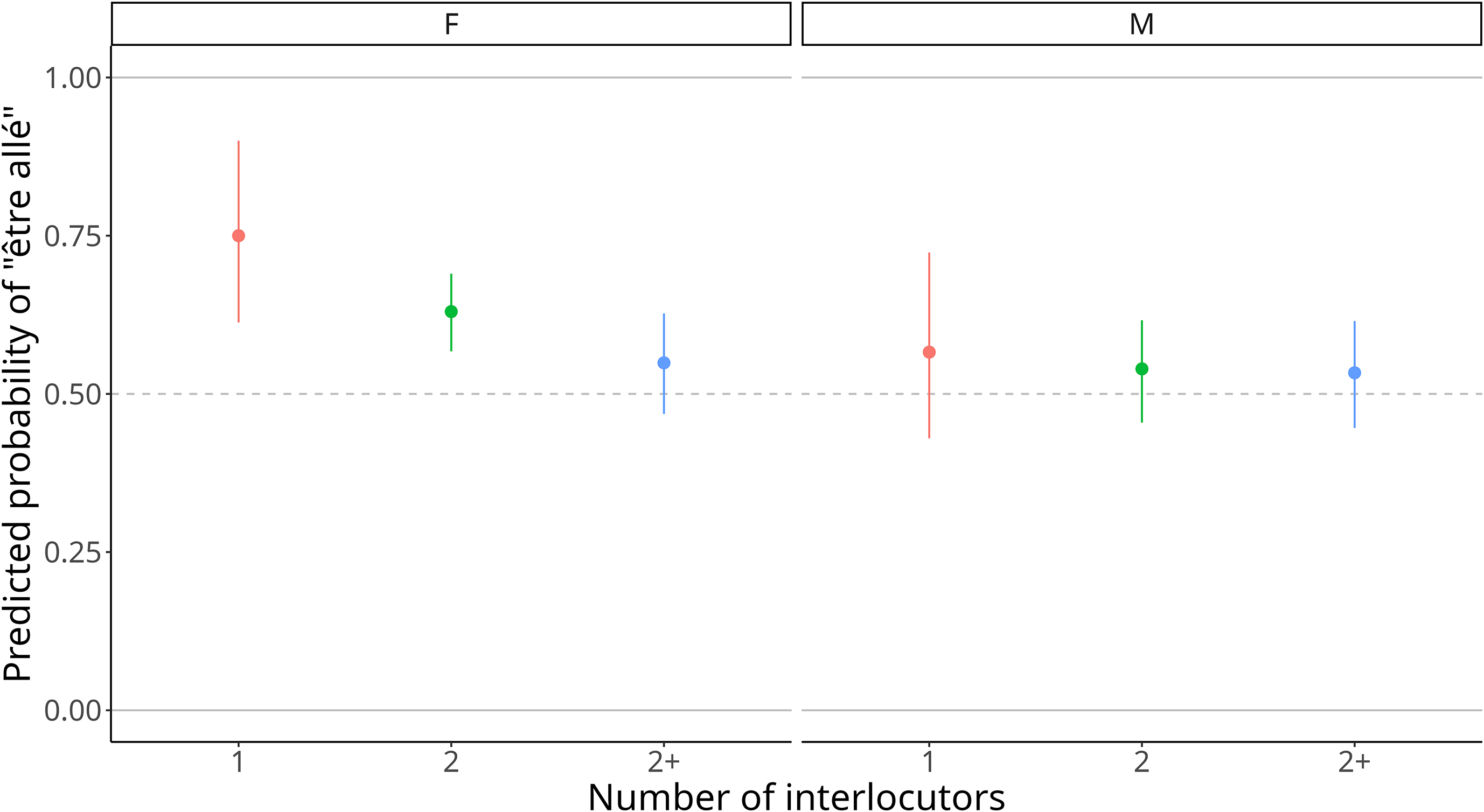
A clear-cut pattern emerges for the interaction with GENDER (Figure 9). Only for speakers identified as female is a gradient difference in predicted probabilities visible across numbers of speakers, while speakers identified as males are associated with virtually no difference in predicted probabilities for être allé productions (respectively .57, .54, .53 for 1/2/2+ speakers). Bayesian modelling provides evidence for these interactions (β̂ = –1.98, P (β<0) = 1 for the contrast between one- and two-speaker observations when comparing female to male speakers, and β̂ = –2.10, P (β<0) = 1 for the contrast between one- and more-than-two-speaker observations).
Predictions for “être allé” depending on NBINTERLOC and GENDER.

All in all, these results nonetheless make this predictor a particularly interesting one. On its own, it ranks third on the variable importance continuum (Figure 2), behind REGION and GENDER only. As a variable weighing at the situation level, it interacts meaningfully with both sentence-internal linguistic predictors such as subject animacy and speaker-level variables such as gender.
6. Discussion
The factors conditioning the use of the competing forms that we identified have to do with linguistic properties and extralinguistic properties related to the speaker and the interaction.
6.1. On linguistic factors
The linguistic conditioning of the competing forms is less significant than the social conditioning. This is consistent with previous findings in the literature. Both Glikman and Patard (Reference Glikman and Patard2022) and Sammons et al. (Reference Sammons, Nadasdi and Mougeon2015) conclude that the type of postverbal complement (PP or infinitive) does not affect the choice between the two forms of the verb ALLER. Our results go in the same direction: the proportion of être allé is roughly the same with both kinds of complement. Nevertheless, since we chose to study the alternation in its entirety, we found that certain types of complement affect the verb’s form. Specifically, we demonstrate that when the complement is realized as the proform y, the être allé variant is more likely to occur. In the same vein, expanding the scope of the cases examined revealed that the type of subject influences production choices. Avoir été forms are strongly favoured with inanimate subjects, which mainly appear in the context of the idiomatic construction ça va (‘it’s okay’) and its variants. This result suggests that, more than an effect of animacy, the observed trend reflects the role of the meaning conveyed by the verb in specific contexts. The non-spatial use of the verb ALLER would favour the use of the form that do not directly convey the GO meaning (avoir été). However, it seems difficult to draw a definitive conclusion on that specific case, since other contexts that also convey non-spatial meaning, such as the ones with infinitive complement (cf. examples (3)), do not favour clearly one form over the other. Future research on this alternation should explore further the idea that interpretations drawing away from the concrete moving meaning favour the use of avoir été.
In the study from Sammons et al. (Reference Sammons, Nadasdi and Mougeon2015), only two linguistic factors are significant: number (plural favours être allé) and polarity (negation favours avoir été). In our study, the polarity effect has a very low importance in the random forest, compared to the other factors considered (cf. section 5.1), and number has no statistically significant effect (cf. section 4.2). Moreover, rather than considering person and number as two independent dimensions, we treated them as features that define cells of the paradigm. We concluded that cells with values of 2SG and 2PL favour the avoir été forms, whereas 1PL cells more often entail the other variant. Therefore, the lack of number effect in the random forest is crucially related to how we encoded the morphosyntactic features of person and number.
As the results of Glikman and Patard (Reference Glikman and Patard2022)’s questionnaire emphasize, linguistic prescriptivism could influence the choice between the competing forms, avoir été being informal register and être allé being formal. This dimension appears to be helpful for understanding the effect of the variable SUBJONNOUS. The morphosyntactic value of the first-person plural can be expressed with the pronouns nous and on, but only the former triggers 1PL agreement of the verb, the latter triggering 3SG agreement. Given that nous is more formal than on, the fact that nous attracts the être allé forms finds a suitable explanation in the tendency to use words belonging to the same register.
The attraction of être allé for y complement falls under properties of the ALLER morphological paradigm, as do the trends observed for cells 2SG and 2PL. In fact, there is a body of evidence in favour of an analysis of the complement proforms (en, la, le, lui, y, etc.) as verbal prefixes. This hypothesis has been proposed initially by Miller (Reference Miller1992) and established recently in the Grande Grammaire du Français (Abeillé & Godard Reference Abeillé and Godard2021). From a probabilistic point of view, our results suggest that some cells of the paradigm are more likely to be used by speakers for certain morpho-syntactic properties and the associated morphological exponences (person 2, prefix y…). Additionally, the inanimate subject ça is an impersonal subject that is part of an ALLER-based construction stored as a unit that can be inflected. All in all, the observed effects of PERSNB, COMPLEMENTTYPE and SUBJANIMACY variables can be viewed as very local parameters in that they concern the verb’s morphology or an idiomatic construction based on the verb.
The polarity effect is intriguing, albeit weak. To our knowledge, no one has attempted to explain the attraction of avoir été by negative polarity. In our view, two hypotheses are worth considering. The first is based on a naïve, and perhaps overly simplistic, view of phonetics and hiatus. In periphrastic tenses, the negative polarity item appears between the auxiliary and the past participle (est pas allé, a pas été ‘did not go’) and both past participles begin with a vowel. Thus, in most cases, the presence of a negative polarity item implies a hiatus: pas allé [paale] and pas été [paete]. Footnote 11 Depending on the negative polarity item, the hiatus is not the same. Pas implies a hiatus of two identical vowels with allé, whereas jamais implies a succession of two similar vowels with été ([ʒamεete] or [ʒameete] depending on the regional accent). Therefore, if speakers tend to avoid hiatus (Storme Reference Storme2024) with identical or similar vowels, pas should be combined with the avoir été forms, and jamais with the être allé forms. In our data, 96 negative polarity items (pas, jamais) occur directly before the past participle with hiatus: pas with été in 51.6% of the cases (33/64), and jamais with allé in 68.8% of the cases (22/32). The trend goes in the expected direction, even if the number of observations is low.
However, the difference between negative polarity item pas and jamais is not only phonological, but also semantic: jamais (‘never’) is specialized in universal negation, not pas (‘not’). So, our second hypothesis is that the alternation may be affected by the different values of the negation. More precisely, the avoir été forms acquired a motion meaning by inference: the fact that “I was somewhere” implies in a lot of contexts that “I went somewhere”. With negation, the inference remains: if “I was not somewhere” then “I did not go somewhere”. However, depending on the value of the negation, the inference could be more or less strong. In fact, the negation of a unique event as in (16) strongly implies motion meaning, while, with universal negation as in (17), the inference is less strong: the fact that there does not exist any state “to be somewhere” in the considered interval is less directly connected with the fact that there does not exist any event “to go somewhere”.
(16)
[la locutrice raconte que deux jeunes ont fait part de leur intention de fuguer]
allez-y […] de toute manière il fait moins dix vous allez bien vite revenir
ben en effet ils ont pas été plus loin que la voiture de NAME
‘[The speaker relates that two young people shared their intention to run away.] Go ahead. It’s minus ten degrees anyway, so you’ll be back in no time. And indeed, they didn’t go any further than NAME’s car.’
(17)
j’ai jamais été à Liège
‘I have never been to Liège.’
If we postulate that the difference in inference strength with negation is real, then the use of avoir été with universal negation could be disfavoured as it less clearly conveys the meaning GO, and could instead be interpreted as conveying the meaning BE. This raises the possibility that universal negation favours être allé forms in order to ensure that the GO meaning is communicated. Conversely, episodic negation could favour avoir été. We annotated 91 occurrences of our data according to the distinction between episodic and universal negation. Footnote 12 The former negates the existence of one event in the past, while the latter negates the existential quantification of an event within a given time interval. With episodic negation, the avoir été forms occur in 60.9% of the cases (14/23), whereas, with universal negation, it occurs only in 38.2% of the cases (26/68). These figures go in the right direction again, but the number of observations is low, especially for episodic negation.
In sum, the preliminary data we gathered show that our hypotheses are promising, but further exploration is indubitably needed to confirm and disentangle them.
6.2. On extra-linguistic factors
The importance of geographical variation confirms the trends suggested by the corpus data from Glikman and Patard (Reference Glikman and Patard2022). It is also consistent with the results from Sammons et al. (Reference Sammons, Nadasdi and Mougeon2015), who observe statistically significant different distributions between four localities of Ontario. Thus, the broad trends that we document here for European French would probably deserve to be studied in narrower geographical areas, in order to detect more fine-grained distribution differences.
The observed effects of the other two speaker-related factors (GENDER, AGE) do not align entirely with Sammons et al. (Reference Sammons, Nadasdi and Mougeon2015)’s results. First, it is difficult to compare the observation concerning the age of the speaker with Sammons et al.’s results because they studied a homogeneous age group (adolescents). However, the authors compared their results, which were based on data collected in 2005, with the results of a previous study, based on data collected in 1978 in the same four localities with the same age group (Alexandre Reference Alexandre2004). If we compare the productions of the two groups and apply our general observation that the older the people are, the more avoir été forms they produce, we might expect that the 1978 group uses more avoir été than the 2005 group. This is indeed the case: 69.9% vs. 40.4% of avoir été in the 1978 and 2005 groups, respectively. Trends seem to converge in Europe and Canada.
Second, based on their 2005 data, Sammons et al. (Reference Sammons, Nadasdi and Mougeon2015) indicate that women tend to use the être allé variant slightly less than men do (43% vs. 54.8%) and that the gender effect is in flux, given that the opposite trend was observed in data from the 1978 group. According to the authors, this evolution suggests that the avoir été forms are not “overly stigmatized” (p. 414). The gender effect in our data appears to be statistically robust and consistent with that found in the 1978 group. However, we were unable to document a potential evolution over time because of the structure of our corpus metadata. As the authors of the Ontario study suggest, if the gender effect is understood, at least partially, with regard to the speaker’s relationship to the norm, then we can hypothesize that the difference in direction of the gender effect is due to differences in linguistic norms on both sides of the Atlantic Ocean (Bigot Reference Bigot2021). In other words, the avoir été variant may be less stigmatized in Ontario, or more generally in Canada, than in Europe.
The observed trend for GENDER could be interpreted as women tending to stick to the norm-driven use of competing forms. This is consistent with sociolinguistic research showing some gender-based differences in the use of standard versus non-standard linguistic forms, with ‘women’ using more standard forms (Trudgill Reference Trudgill1972) – or at least being more careful in their use of non-prestigious forms so as to not threaten their (relatively precarious) social position (Eckert Reference Eckert1989). The weight of prescriptivism may also help to explain the gradient pattern associated with the number of people in the interaction. In the corpus that we used here, the number of interlocutors is broadly linked to the participants’ use of colloquial/informal language: one-speaker interactions are mostly public speaking extracted from the French Oral Narrative sub corpus, two-speaker interactions are often interviews, with two people who do not know each other, and more-than-two-speaker interactions are usually casual or professional conversations between people who know each other. Then, given our results, we could hypothesize that the more casual the interaction, the less prescriptive forms (avoir été) are used. However, given the interaction between gender and number of interlocutors, our results suggest that women productions are more sensitive to the context of interaction (here the number of interlocutors) than men productions. This is consistent with Wodak and Benke (Reference Wodak, Benke and Coulmas2017), who offer a more nuanced perspective on the relationship between gender and language use. There, norm-abiding variants are used depending on the situational context of interaction, which the speakers assess differently based on their “community of practice” (Eckert and McConnell-Ginet Reference Eckert and McConnell-Ginet1992) and on their identity taken as a whole (gender identity being only one dimension of it). If the gradient pattern linked to the participants’ level of (in)formality is valid only for women, then our results confirm that women exhibit more norm-driven linguistic behaviours and are more sensitive to the situational context than men.
6.3. On the interactions
We provided evidence for meaningful interactions between linguistic and sociolinguistic properties in two different scenarios. In the first scenario, a linguistic property cancels out the effect of a speaker-related factor. In other words, the linguistic property has the same effect regardless of the speaker’s profile. Thus, the pronominal subject ça attracts avoir été forms regardless of region or gender, while with animate subjects we observe differentiated distributions linked to region and gender. Similarly, the proform y uniformly attracts être allé variants, as opposed to other types of complement. Similar patterns emerge with the number of interlocutors: the differentiated patterns observed according to this interaction-related factor tend to be flattened by the pronominal subject ça or the complement y. The second scenario corresponds to cases where a linguistic property affects only a subgroup of speakers. In other words, the effect of the linguistic property depends on the speaker’s profile. The polarity effect belongs to this second case scenario: the negative polarity only attracts the avoir été forms for women and speakers from Belgium, and Northern and Eastern France. The production of the other subgroups of speakers remains more or less the same regardless of the polarity of the sentence.
In terms of probabilistic grammars, the first scenario corresponds to the common probabilistic grammar shared by French speakers in Europe. Regardless of the speaker’s profile, the subject ça and the complement y trigger a similar probability of using the être allé forms. These two soft constraints are both very “local” in that they concern the verb’s morphology or an idiomatic construction based on the verb. In other words, what is shared in the grammar of French speakers is local information stored with the verb ALLER.
The second scenario resembles other cases of variation documented in probabilistic grammar works, such as those on English varieties (Bresnan & Hay Reference Bresnan and Hay2008; Bresnan & Ford Reference Bresnan and Ford2010; Szmrecsanyi et al. Reference Szmrecsanyi, Grafmiller, Bresnan, Rosenbach, Tagliamonte and Todd2017). For instance, Bresnan and Hay (Reference Bresnan and Hay2008) examined the dative alternation with the verb give in two varieties of English and discovered that the animacy of the recipient exerts a stronger influence in New Zealand English than in American English. In our case, the attraction of negative polarity for avoir été is stronger in the varieties of French spoken in Northern and Eastern France and Belgium. The fact that only women seem to be sensitive to negative polarity in their use of the competing forms would mean that probabilistic grammars are not only geographically modulated but also socially. However, this effect is quite small and must first be confirmed with more data. Moreover, gender-based variation is also highly contextualized (e.g., by power dynamics, Eckert Reference Eckert1989), so this should also be examined to better understand this potentially socially conditioned effect. It should also be considered in light of the hypotheses on the negation effect formulated above.
7. Conclusion
Our corpus study documents the rivalry between the competing forms of the periphrastic tenses in the ALLER’s paradigm. The competition appears to be widespread and no regularizing force leading to its reduction can be detected. We further documented the conditioning of the alternation, by expanding the scope of the cases previously examined in the literature. This led us to discover two new linguistic conditions: the idiomatic use of ALLER with the pronominal subjects ça favour the avoir été variant, and the y complement the être allé variant. Our quantitative study showed that the choice of the form is strongly influenced by speaker- and situation-related variables. There appears to be a geographical distribution and the effect of other extralinguistic conditions (gender, number of interlocutors) can be interpreted as the manifestation of prescriptivism-driven behaviours. Linguistic conditions are less likely to affect the probability of one variant occurring, but interestingly, their effects are consistent with those found in the literature and interact with speaker-related variables.
Our results also suggest that each speaker’s probabilistic grammar is either conditioned by their individual profile (e.g., effect of negation according to the region), or is common to the speaking-community (e.g., effect of the y proform). Finally, it is worth noting that, despite the coarse-grained annotation of extralinguistic properties, we get very specific results, in line with the literature. A larger sample size would certainly allow more robust results to be achieved and further probabilistic grammars of French to be explored.
Data availability/Supplementary files
Our dataset and the script we used for analysis are available at https://doi.org/10.34847/nkl.9bb61m5n.
Acknowledgements
We would like to thank Fabio Del Prete for the highly insightful discussions on the potential role of negation in the choice between the two verbal forms, as well as the participants at the LLcD conference (Paris, 9–11 September 2024) for their constructive feedback and discussions. We also wish to thank the three anonymous reviewers for their valuable comments and suggestions, which helped us improve the quality and clarity of this article.
Funding
This work was supported by the French National Research Agency (ANR) through the PULCO project (ANR-22-C28-0017-01).
Declaration of competing interests
The authors declare no competing interests.


 Open access

