


1 PRÉSENTATION
Ce volume thématique accueille des contributions d'auteurs faisant l'hypothèse d'une diglossie au sein du débat général sur la variation grammaticale diaphasique (intra-locuteur, intra-idiolectale) en français. Notre principal but était de donner à voir ces travaux sous la forme d'un programme autour d'un objectif commun: explorer l'hypothèse d'une diglossie en France pour en évaluer les intérêts par les intuitions qu'elle satisfait, les problèmes qu'elle résout et ceux dans lesquels elle peut s'immiscer pour les faire avancer, les difficultés auxquelles elle s'expose, et le champ des questionnements nouveaux qu'elle ouvre et découvre. Ces articles traitent non de sujets similaires mais plutôt de différentes facettes (différents corrélats) d'une entreprise commune que cette introduction tente de cerner.
Historiquement, cette entreprise est l'aboutissement de l'observation sys-tématique des données non-standard et/ou orales/parlées depuis au moins Damourette et Pichon (Reference Damourette and Pichon1911), Bauche (Reference Bauche1920), et à toujours plus grande échelle depuis les années 60 (par exemple Rigault, dir. Reference Rigault1971). Et au moins depuis Frei (Reference Frei1929), on accorde un vrai statut grammatical à ces faits, au point que, les différences d'avec le standard étant tellement systématiques et parfois fondamentales (voir Bauche, Reference Bauche1920, Frei, Reference Frei1929, Koch et Oesterreicher, Reference Koch and Oesterreicher1990/2011, Gadet, Reference Gadet1989/1997, Ball, Reference Ball2000, Zribi-Hertz, Reference Zribi-Hertz2011, pour des listes de faits non-standard), la question s'est posée petit à petit: est-ce qu'on a à faire à une autre grammaire? Footnote 1 La question s'est trouvée mélangée avec l'idée que cette différence soit réductible ou assimilable à une question de canal (oral au lieu d'écrit), et l'étiquette «français parlé» de l'œuvre de Blanche-Benveniste (entre autres Reference Blanche-Benveniste1983; Reference Blanche-Benveniste1997; Reference Blanche-Benveniste and Yaguello2010; Blanche-Benveniste et al., Reference Blanche-Benveniste, Bilger, Rouget and Van den Eynde1990) n'est peut-être pas étrangère à ses réflexions initiales sur l'orthographe (Blanche-Benveniste et Chervel, Reference Blanche-Benveniste and Chervel1969/1978). En Allemagne, la tradition initiée par Söll (Reference Söll1974) a été reprise par Koch et Oesterreicher (Reference Koch and Oesterreicher1985) qui ont théorisé le lien intuitif entre expression familière, grammaire non-standard, et oral, pour ajouter aux étiquettes oral/écrit (dans le sens du support médial), les étiquettes oralité/scripturalité (comme ordre de conception du message), puis proximité/distance (comme marque de rapport social d'un message). Leur influence outre-Rhin ne se dément pas depuis 25 ans, et ils ont publié une 2e édition revue et augmentée en 2011 de leur ouvrage de 1990.
Si Lambrecht (Reference Lambrecht1981) plaidait déjà pour la reconnaissance d'une double-grammaire, reprendre systématiquement le concept global de diglossie (cf. section 2) pour caractériser le français a attendu les années 1990, avec par exemple Lodge (Reference Lodge1993: 257–60), qui se pose sérieusement la question mais ne reconnait que «the possibility of diglossia in the long run», et Koch (Reference Koch and Engler1997) qui y voit une hypothèse partiellement satisfaisante (justement principalement sur le plan de la grammaire). Ensuite, on trouve un ensemble d'auteurs qui argumentent pour cette hypothèse ou la postulent simplement pour (pouvoir) justifier de ne décrire que la grammaire du non-standard: Zribi-Hertz (Reference Zribi-Hertz, Cinque, Koster, Pollock, Rizzi and Zanuttini1994; Reference Zribi-Hertz2011), Barra-Jover (Reference Barra-Jover and Barra-Jover2004; Reference Barra-Jover2010a), Massot (Reference Massot2008; Reference Massot2010), Palasis (Reference Palasis2010), Legendre et al. (Reference Legendre, Culbertson, Barrière, Nazzi, Goyet, Torrens, Escobar, Gavarro and Mangado2010), Culbertson (Reference Culbertson2010), Hamlaoui (2011).
Face aux diglossistes, des auteurs issus de la tradition du français parlé (principalement le Groupe Aixois de Recherche en Syntaxe autour de C. Blanche-Benveniste) ou de l'école sociolinguistique variationniste française se réclamant de Labov (Reference Labov1972), et travaillant dans le cadre de ce que Barra-Jover (Reference Barra-Jover2010a; ce volume) appelle les thèses distributionnelles, s'affichent ouvertement anti-diglossistes (Blanche-Benveniste et al., Reference Blanche-Benveniste, Bilger, Rouget and Van den Eynde1990; Coveney, Reference Coveney, Martineau and Nadasdi2011) ou au moins argumentent régulièrement contre un traitement de la variation posant entre des variétés des frontières qu'ils conçoivent comme artificielles (Gadet, Reference Gadet2007).
Le sujet et le débat sont présentés ici dans toute leur variété, puisque le volume comprend des contributions sur différents aspects de la langue (acquisition pour Palasis, formation et vie du standard pour Zribi-Hertz, modélisation grammaticale pour Rowlett, enseignement du standard pour Barra-Jover, rapport entre français et dialecte d'oïl pour Villeneuve et Auger, représentations et pratiques langagières pour Billiez et Buson) et intègre des articles de «diglossistes» convaincus et engagés (les quatre premiers), un article d'auteurs plus distants quant à la question mais méthodologiquement proches des diglossistes (Villeneuve et Auger), et enfin un article de l'école variationniste, et en l'occurrence anti-diglossiste (Billiez et Buson).
La section 2 présente le concept de diglossie et la version qui en est retenue dans ce volume. La section 3 présente les convictions grandement partagées par les diglossistes sur la situation française en particulier et sur un plan plus large sur la variation diaphasique en général. La section 4 suggèrera que le débat entre les diglossistes et les anti-diglossistes ne se cristallise peut-être pas tant à cause de ses enjeux scientifiques, que par ses aspects politiques et moraux.Footnote 2 Enfin, la section 5 présente les articles individuellement en les positionnant au sein de l'entreprise d'ensemble.
2 L'HYPOTHÈSE DIGLOSSIQUE, DE FERGUSON (Reference Ferguson1959) À AUJOURD'HUI
En 1959, Ferguson popularise le concept sociolinguistique de diglossie. Il reprend ce terme de Psichari (Reference Psichari1928) et Marçais (Reference Marçais1930) qui l'avaient appliqué respectivement à la situation grecque et à la situation du monde arabophone, et présente ces deux cas ainsi que celui de la Suisse alémanique et du créole haïtien comme définitoires (le cas du créole sera contesté par la suite, et est aujourd'hui rangé dans les situations de continuums créoles). L'apport de Ferguson est au moins double. D'une part, il élève le concept au rang d'hypothèse sociolinguistique globale, c'est-à-dire ayant des corrélats dans tous les domaines de la linguistique et de la sociologie du langage. Et d'autre part, Ferguson précise explicitement quelles sont les propriétés des situations diglossiques qui en font un type en soi dans une typologie des situations langagières, notamment ce en quoi la diglossie n'est pas un équivalent du bilinguisme.Footnote 3
Parmi les caractéristiques de la diglossie, celle qui a eu le plus de succès et a concouru peut-être le plus crucialement à la diffusion du concept, c'est sans doute la spécialisation fonctionnelle des deux variétés de langue en jeu (Ferguson, Reference Ferguson1959: 328ss). En effet, la diglossie suppose qu'une variété H (High, acquise par l'éducation formelle) et une variété L (Low, acquise «sur les genoux de la mère») cohabitent dans une communauté linguistique au sein même des locuteurs (chaque locuteur peut s'exprimer en L, et, s'il a eu l'occasion de l'apprendre, en H) tout en gardant chacune ses territoires d'emploi, H étant employée pour remplir les fonctions langagières les plus valorisées (les discours publics, la haute littérature, les documents officiels, les écrits scientifiques, etc.) et L étant employée pour remplir les fonctions langagières moins formelles (typiquement la conversation courante et tout ce qui peut s'y ramener) (ibid.: 329). H et L s'opposent ainsi quant au prestige qui leur est respectivement accordé dans la communauté.
L'opposition H−L a retenu l'attention d'autres linguistes et sociologues du langage au point de devenir le seul critère de reconnaissance d'une diglossie. Ainsi, et dans de nombreux cas similaires, l'espagnol et le guaraní au Paraguay ont été caractérisés comme H et L, et la situation bilingue espagnol/guaraní était considérée abusivement comme une diglossie. De nombreux auteurs, dont Ferguson lui-même (1991/1996), ont regretté cette confusion car elle néglige les autres caractéristiques principales de la diglossie. Nous n'allons pas lister ici toutes les caractéristiques énoncées par Ferguson (Reference Ferguson1959), mais plutôt présenter une synthèse de quelques réflexions sur ce concept. En particulier, toutes les caractéristiques énoncées originalement n'ont pas le même poids (Ferguson Reference Ferguson and Elgibali1991/1996 précise bien que toutes ne s'appliquent pas systématiquement à toutes les situations qu'il a voulu caractériser comme diglossiques). Qu'est-ce qui fait la particularité d'une diglossie comme type de situation langagière?
Dans sa théorisation du concept de diglossie, Hudson (Reference Hudson2002: 15) estime que «the linguistic arrangement characterized by Ferguson for Greece, Switzerland, and the Arab world is fundamentally a sociological rather than a grammatical one». Selon lui, «[the] conceptual unity [between these situations] inheres in a quite specific set of relationships between functional compartmentalization of codes, the lack of opportunity for the acquisition of H as a native variety, the resulting absence of native speakers of H, and the stability in the use of L for vernacular purposes» (ibid: 40). Il précise que cette configuration a encore ceci de particulier qu'elle offre les conditions d'une dissolution de la diglossie «par le bas» (comme en Grèce après 1976): «Short of stability, then shift from H to L in formal domains of interaction, or shift from H to a new vernacular-based standard, is to be anticipated, as opposed to shift from L to H in informal domains» (ibid.: 8).
Là où la théorisation de Hudson diffère des intentions de Ferguson, c'est quand il voit dans la fréquente proximité linguistique entre H et L le simple résultat d'un biais induit par la situation, qui n'exclut pas que H et L soient des langues sans rapport génétique au départ: «it is the very nature of a diglossic accommodation between codes that the linguistic varieties involved tend more often than not to bear a relatively close linguistic relationship to one another» (ibid.: 15). Nous suivrons ici au contraire Ferguson (Reference Ferguson and Elgibali1991/1996: 57): «[m]y first intention was that the users view the two as the same language», et nous tentons de formuler ceci par l'idée que ce qui fait de la diglossie un type particulier (et en un sens si épatant), c'est qu'elle peut amener les locuteurs à devenir comme bilingues à leur insu. C'est également la proximité entre H et L qui assure la similitude dans l'évolution et les fins potentielles des diglossies: «if you have two varieties in this H−L relationship that are fairly closely related to one another, one kind of outcome will result [. . .], if the H and L varieties are unrelated languages, then the outcome will ultimately be quite different [. . .] and the overall history of the language situation will be different» (ibid.: 57).
Ce en quoi la diglossie est une hypothèse sociolinguistique au sens premier du terme, c'est que «individual users of the language have the H−L variation as part of their repertoire of variation» (ibid.: 56): une situation sociale donnée, ici l'opposition H−L, amène à une situation linguistique donnée, celle d'une variation diaphasique particulière. Et Ferguson «happen[s] to think that the study of register variation is more critical than the study of dialect variation» (ibid.: 56), ce en quoi il est suivi par de nombreux linguistes, comme Gadet (Reference Gadet1998), Dufter et al. (Reference Dufter, Fleischer, Seiler, Dufter, Fleischer and Seiler2009), et les diglossistes réunis ici.Footnote 4
Le défi pour les grammairiens dans le cas d'une diglossie, c'est alors bien de se demander à quoi ressemble la grammaire englobant tous les registres d'un locuteur, en particulier les deux «super-register[s]» H et L (Ferguson, Reference Ferguson and Elgibali1991/1996: 56), et comment modéliser cette compétence linguistique.Footnote 5
Pour résumer, nous dirons que la diglossie est une hypothèse sociolinguistique globale radicale dont le volet couvrant la variation linguistique concerne en premier lieu la variation diaphasique (c'est-à-dire stylistique, de registre, intralocuteur, intra-idiolectale), laquelle variation est garantie par un «communicative arrangement» particulier (Hudson, Reference Hudson2002: 14) assurant l'opposition stricte H−L, l'acquisition fondamentalement distincte de H et de L, leur proximité linguistique au point d'y voir une seule langue, et l'improbabilité de voir H «gagner» si la situation diglossique venait à se dissoudre.
3 QU'EST-CE QUE FAIRE L'HYPOTHÈSE D'UNE DIGLOSSIE POUR LA FRANCE?
Dans cette section, nous proposons de peindre l'image de ces linguistes du français plus ou moins ouvertement diglossistes telle qu'elle nous semble apparaitre au travers (i) de ce que nous avons exposé à la section précédente et (ii) des publications diglossistes comme celles non ou anti-diglossistes dans ce volume et ailleurs dans la littérature. Nous exposerons en particulier une série d'intuitions et parfois leurs contre-intuitions. Nous espérons que ce volume montrera qu'il y a bien là une entreprise commune dépassant les points de désaccord et les éventuelles contradictions entre les auteurs.
Puisqu'il s'agira de désigner deux variétés de français,Footnote 6 réglons la question terminologique pour le temps de cette introduction: qu'il nous soit permis ici de suivre Massot (Reference Massot2008; Reference Massot2010), repris par Rowlett (ce volume), et de désigner la variété H ciblée par l'hypothèse le français classique tardif (ci-après FCT), et celle L le français démotique (ci-après FD).
(i) Supposer que la France est en situation de diglossie, c'est d'abord croire que les conditions sont réunies pour qu'il y ait diglossie, c'est-à-dire croire au volet sociologique de l'hypothèse. Ainsi:
a) Il y a lieu de parler d'une opposition H−L entre FCT et FD et des attitudes qui vont avec cette opposition.
b) Le FCT n'est acquis «sur les genoux de la mère» par personne.
c) Le FCT ne pénètre pas les lieux de parole informelle; la tendance est au contraire à l'inverse, le FD prenant ici et là la place du FCT dans des situations formelles.
Il y aurait à ajouter la stigmatisation jusqu'à la négation du FD, la codification du FCT, etc. (cf. Ferguson, Reference Ferguson1959).
Les diglossistes ne sont que rarement explicites sur ces aspects sociologiques. Nous relèverons Zribi-Hertz (Reference Zribi-Hertz2011) qui illustre entre autres l'opposition H−L et Massot (Reference Massot2008: 114–8) qui cite Ferguson (Reference Ferguson1959) en longueur en laissant ouvertement le soin au lecteur d'avoir comme lui-même l'intuition que Ferguson aurait très bien pu être en train de parler de la France contemporaine.
Il faut remarquer ici que les diglossistes ne se préoccupent que peu de caractériser directement la situation sociolinguistique de la France, mais sont en fait intéressés par les questions linguistiques qui suivent: si les conditions sont bien réunies pour qu'il y ait diglossie, est-ce qu'il y a diglossie en effet (c'est-à-dire ces deux variétés se côtoient-elles chez les locuteurs)? Quelles sont toutes les conséquences et tous les corrélats à en attendre pour la description linguistique «du» français?
(ii) La variation diaphasique en français est bipolaire et est ressentie comme telle. Les diglossistes distinguent bien toujours deux variétés: standard vs. dialectal/non-standard/parlé, ou normé vs. spontané, ou écrit (normé) vs. oral informel, ou académique vs. spontané, et d'autres encore, dont notre classique tardif vs. démotique. Nous pensons que «the analyst finds two poles in terms of which the intermediate varieties can be described, there is no third pole» (Ferguson, Reference Ferguson and Elgibali1991/1996: 59). Sur le plan des attitudes des locuteurs, les diglossistes s'en remettent là-aussi surtout à leurs intuitions (les locuteurs perçoivent ces deux pôles et seulement eux deux), tandis que Billiez et Buson (ce volume) recueillent quelques-uns de ces jugements bipolarisants, tout en rappelant que ce que croient les locuteurs ne doit pas dicter ce que croient les sociolinguistes.
(iii) Il est légitime de décrire la grammaire du FD seul, c'est-à-dire d'exclure les variantes de FCT des faits étudiés, voire de les considérer comme des données négatives (agrammaticales). C'est ainsi que Hamlaoui (2011: 131) décide que «wh-questions exhibiting a Subject–Verb/Aux inversion will be left out of the present discussion, as they do not belong to the investigated dialect».
(iv) Le FCT peut être acquis suffisamment pour constituer une compétence active et «vivante». En ce sens, la vie du FCT ne se réduit pas à la lutte entre norme et fautes.
(v) Hétérogénéité et variation diaphasique ne sont pas synonymes.
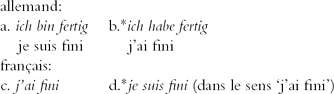
Selon Coveney (Reference Coveney, Martineau and Nadasdi2011: 56), «Zribi-Hertz (Reference Zribi-Hertz2006, 2010) acknowledges the reality of grammatical variation, but argues that the fundamental generativist notion of an internal grammar is incompatible with the idea of heterogeneity (i.e. variation), since a heterogeneous grammar would be incoherent and unlearnable». Il nous semble qu'il y a là une incompréhension. L'hétérogénéité dont parle Zribi-Hertz n'est pas synonyme de variation pour tout le monde. Pour clarifier: les locuteurs bilingues ont grandi face à des stimuli linguistiques hétérogènes au point de développer plusieurs grammaires/langues rétablissant chacune une homogénéité. Ainsi, devant la tâche d'acquérir une compétence capable de produire (2),
(2)

L'intuition qui sous-tend l'hypothèse est donc qu'il existe un mécanisme cohérent (sans règle d'inversion) qui produit (3a) et (3b) face à un mécanisme cohérent (avec règle d'inversion) qui produit (3c) et (3b), mais qu'ajouter (3c) à la grammaire démotique sous-tendant (3a, b) n'est pas apprenable (cf. Rowlett, Zribi-Hertz, ce volume):
- (3)
a. Qui tu vois? (FD/*FCT)
b. Qui est-ce que tu vois? (FD/FCT)
c. Qui vois-tu? (*FD/FCT)
(vi) Les diglossistes ne sont pas forcément interpelés par l'intuition d'incohérence de Zribi-Hertz. Ils sont en revanche convaincus que le FD et le FCT constituent au minimum deux ensembles inductibles des faits de covariation en français. Zribi-Hertz (Reference Zribi-Hertz2011) expose ces faits, Massot (Reference Massot2008; Reference Massot2010) en délimite les contours méthodologiques, Palasis (Reference Palasis2010; ce volume) et Rowlett (ce volume) les explorent ou les exploitent, tandis que Coveney (Reference Coveney, Martineau and Nadasdi2011) et Villeneuve et Auger (ce volume) contestent leur existence comme covariation catégorielle.
L'acceptation de certains faits catégoriels de covariation amène les diglossistes à adopter le modèle des zones zribi-hertziennes (voir Zribi-Hertz, Reference Zribi-Hertz2011 et ce volume pour une présentation détaillée du modèle) pour représenter la compétence linguistique des Français, en particulier parce qu'il prédit que certaines formes grammaticales n'apparaissent jamais ensemble: le FD et le FCT sont deux ensembles avec une intersection et chacun un sous-ensemble de formes grammaticales exclusives. Introduire la possibilité d'une intersection peut d'ailleurs être vu comme un assouplissement de l'hypothèse de la diglossie, tout en continuant d'exiger la présence significative de parties strictement disjointes entre les deux variétés.
Les anti-diglossistes ont au contraire l'intuition que ce patron de variation est sans conséquences (cf. Coveney, Reference Coveney, Martineau and Nadasdi2011; Billiez et Buson, ce volume):
a) Le patron n'est pas catégoriel mais seulement corrélationnel. Il n'est qu'un corollaire de la tendance à apparaitre ensemble des variantes dont la marque sociolinguistique est similaire.
b) Chercher la limite entre style-shifting et code-switching est vain.
(vii) Fondamentalement, les diglossistes sont à la recherche de limites, et ce malgré l'indéfini des données:
a) limites internes: est-ce qu'il existe seulement un locuteur qui produise le continuum complet entre FD et FCT? est-ce que ce continuum éventuel, et même s'il est partiel, est autre chose que le résultat d'interférences, de problèmes de performance, voire de jeu linguistique volontaire?Footnote 7
b) limites externes: que faire du risque que quelqu'un, un jour, produise ou ait produit un énoncé susceptible de remettre en cause les données (notamment négatives) sur lesquelles s'appuie une analyse?
(viii) Si l'écrit est universellement différent, sur certains aspects, de l'oral sur lequel il est basé, pour des raisons de différence de canal, alors les diglossistes qui utilisent les étiquettes d'écrit et d'oral sont d'abord préoccupés par ce qui n'est justement pas universellement distinct. Au contraire, on peut opposer FD et FCT strictement à l'oral. La langue orale à la base du français écrit formel n'est simplement pas le FD, mais le FCT.Footnote 9 Ce n'est par exemple pas le fait de passer à l'écrit qui fait ajouter plus de ne aux négations, c'est que passer à l'écrit provoque souvent le réflexe de passer au FCT. De façon inverse, ce qui «ne s'entend pas (ou très peu)», comme les interrogations avec inversion, n'est pas lié à une difficulté inhérente à l'oral et à la production spontanée et en direct,Footnote 10 mais à la difficulté inhérente aux conditions d'acquisition du FCT pour les locuteurs d'en acquérir une compétence parfaitement courante.
(ix) Au centre de la compétence linguistique des Français, il y a le FD. Le FCT est périphérique (alors qu'il semble clair que socialement ce soit le FCT qui soit au centre, et le FD en périphérie). Si les grammaires et les analyses linguistiques ont lentement daigné intégrer les données non-FCT (systématiquement depuis au moins Damourette et Pichon), il a fallu encore un effort pour que toutes les données soient traitées sur le même plan, au moins dans l'intention (citons Blanche-Benveniste et Gadet, et les linguistes chez lesquels elles ont fait école). Les diglossistes partagent l'intuition qu'il faut aller plus loin, et que les analyses doivent le refléter: le FD doit passer au premier plan, ensuite seulement vient le FCT (dans ce volume, Palasis le constate dans l'acquisition, Rowlett le met en œuvre dans sa modélisation, et Barra-Jover le postule dans son programme de recherche pour l'école), dans un souci d'homologie avec l'expérience des locuteurs (d'abord en contact avec le FD, puis avec le FCT).
Ce volume reflète par ailleurs une opposition entre les auteurs qui désignent par la variété H la compétence active effectivement acquise par les locuteurs dits éduqués (Palasis, Rowlett, le français standard de Zribi-Hertz et de Villeneuve et Auger), et les auteurs qui désignent ainsi le français académique idéalisé, externe aux locuteurs, et qui reste un objectif lointain (la Norme Académique de Zribi-Hertz, la grammaire académique de Barra-Jover, et le «written/hyper-formal French» de Villeneuve et Auger). Est-ce qu'on parle de la variété H comme d'une langue figée (en un sens morte) ou encore bien vivante?
(x) Découvrir et étudier toujours plus de tours (notamment passés inaperçus) n'est pas une chasse gardée de la sociolinguistique; ça regarde aussi la linguistique, même formelle et théorique! C'est même souvent par ce biais que des formalistes en viennent à s'intéresser à ce débat.
(xi) Une volonté politique d'accès égalitaire à la langue légitime aurait intérêt à s'appuyer sur une expertise diglossiste, ce dont débattent ici Barra-Jover et Billiez et Buson.
(xii) Les variétés H et L sont décrites par Ferguson comme distinctes sur tous les plans, pas seulement grammatical, mais aussi quant au lexique et éventuellement à la phonologie. Comme Lodge (Reference Lodge1989) et Koch (Reference Koch and Engler1997) l'ont constaté, le FD et le FCT partagent trop grandement leur lexique pour pouvoir conclure dans ce domaine que les forces poussant à la diglossie ont un effet suffisamment notable. Les diglossistes, sans forcément négliger cette faiblesse pour l'hypothèse d'une diglossie en France, restent convaincus que les corrélats grammaticaux des forces diglossisantes (celles de (i)) suffisent à en faire une hypothèse viable et explorable.
4 L'ENJEU POLITIQUE DERRIÈRE LA CRISTALLISATION THÉORIQUE
On l'a vu, les chercheurs en linguistique et sociolinguistique du français sont engagés dans ce débat sur la nature de la variation diaphasique française, entre style-shifting et code-switching. Ces positions sont parfois renforcées plus ou moins explicitement par une opposition théorique, pour le dire simplement, entre les générativistes et les sociolinguistes variationnistes, ce que Coveney (Reference Coveney, Martineau and Nadasdi2011: 53) formule ainsi: «Clearly the Diglossic Model advocated by Zribi-Hertz and others represents a viewpoint of syntactic theorists whose principal preoccupations are with formal generativist theory rather than with the concrete reality of spoken language.»Footnote 11
Nous proposons qu'il soit intéressant d'imaginer que l'enjeu est peut-être ailleurs également, dans une dimension politique et morale. En séparant strictement savoir scientifique (objectif, stable, universel) et opinions morales (subjectives, instables, particulières), on constate pourtant le parallèle entre les deux questionnements: quelle attitude scientifique (respectivement morale) réserver à la présence de faits langagiers non-standard? Ce parallèle nous amène à proposer que les linguistes sont peut-être attirés par la force que représenterait une homologie entre les réponses à ces deux questions, voire que la réponse au questionnement scientifique soit simplement projetable comme réponse à la question morale. Le débat linguistique prend alors un autre enjeu. Si l'on suppose, a minima il nous semble,Footnote 12 que (i) les linguistes en général sont pour l'accès actif du plus grand nombre au français standard, et que (ii) ils se sentent engagés à réhabiliter les Français comme locuteurs «normaux» face à la violence symbolique faite à un peuple qui «parle mal», alors ils sont intéressés à produire des descriptions et des théories de la compétence linguistique des Français (i) qui renvoient des Français l'image la plus valorisante, et (ii) qui correspondent le mieux aux solutions qu'eux-mêmes privilégient ou souhaitent dans l'enseignement du français standard. Mais c'est peut-être seulement une fois les souhaits formulés que l'expertise linguistique peut intervenir dans l'élaboration des solutions pratiques, et non l'expertise linguistique qui guiderait la posture morale, les choix de société.Footnote 13
Bref, s'il est clair que les générativistes trouvent regrettables les réticences des sociolinguistes quant aux données négatives et à l'idée de poser des frontières, ils sont peut-être plus encore sensibles à l'hypothèse d'une compétence globale du français parce qu'elle leur renvoie l'idée que le FD privé du FCT (par exemple chez un locuteur qui ne l'aurait pas acquis) serait un objet grammatical incomplet, défectueux, défectif. De l'autre côté, s'il est compréhensible que les sociolinguistes s'énervent devant les difficultés des générativistes face à la variation en général, c'est peut-être plus encore le fait que le modèle diglossique renvoie le FCT au rang de compétence supplémentaire, de luxe, qui leur fait craindre d'y voir un modèle abandonnant la bataille de l'accès au standard.Footnote 14 Notons pour appuyer cette position que les chercheurs étrangers semblent bien en faire un strict enjeu scientifique (voir l'égal détachement de Ball, Reference Ball2000 et Rowlett, Reference Rowlett2007, d'opinions pourtant opposées, ou la facilité de Coveney, Reference Coveney1996, pourtant anti-diglossiste, à affirmer que ne n'est plus transmis par le vernaculaire, affirmation à rapprocher du point (iii) de la section 3).
5 PRÉSENTATION DES CONTRIBUTIONS DANS LE CONTEXTE DE CE VOLUME
Dans les lignes qui suivent, nous emploierons les étiquettes utilisées par les auteurs eux-mêmes en lieu et place de FD et FCT.
Parmi tous les corrélats à l'hypothèse d'une diglossie, Palasis se confronte à celui de l'acquisition d'une double grammaire. Elle cherche dans le développement des traits grammaticaux spontanés et normés chez les enfants (ici de 2;3 à 4 ans) l'émergence du patron attendu de l'exclusion mutuelle des traits supposés incompatibles par l'hypothèse. Et ses premiers résultats sont plus qu'encourageants, puisque plusieurs variantes covarient dès leur apparition: en particulier, l'apparition de la variante avec ne de la négation provoque («triggers») dans la même proposition le non-redoublement du sujet lexical comme le non-effacement du [l] du pronom il. Ces observations fines laissent entrevoir, malgré une recherche encore en cours, des suites prometteuses puisque l'auteure poursuit déjà ses analyses avec la suite de son étude longitudinale (les productions des mêmes enfants entre 4 et 6 ans).
Acceptant l'idée du patron diglossique du français de Massot (Reference Massot2008; Reference Massot2010), Rowlett se demande comment le modéliser au mieux, en interrogeant certains aspects du modèle des zones zribi-hertziennes. Il aboutit à la conclusion que, plutôt que d'invoquer une autre grammaire, il est plus commode de «patcher» un énoncé comme conservateur pour que le redoublement du sujet n'ait pas lieu, ni la négation sans ne, etc. Un grand avantage de cette modélisation, c'est que le «patch» («grammatical bolt on», c'est-à-dire la compétence périphérique) devient le FCT, et non plus le FD, qui devient central et non plus rejeté aux extérieurs: une modélisation grammaticale où le FD est l'objet initial de la description, où le FCT apparait ensuite seulement, et qui décrit le FCT par ce en quoi il diffère du FD, et non l'inverse, est forcément la bienvenue dans le monde des diglossistes, malgré le rejet d'une modélisation à deux grammaires autonomes de ce modèle.
Dans l'hypothèse diglossique comme défendue par Zribi-Hertz, les deux compétences grammaticales sont bien autonomes (contra Rowlett). Une conséquence particulière est que la grammaire standard GS d'un locuteur diglosse a sa propre cohérence, et partant sa propre évolution cognitive à côté de celle de la grammaire dialectale GD. Les accroches à la norme (ici celle légiférant les groupes nominaux sans nom, DPSN) ne sont pas toutes à réduire à une interférence avec GD ou à un mauvais apprentissage de GS. Il y a possiblement un processus de régulation, par économie globale de la GS, dès lors qu'un locuteur acquiert une compétence active et vivante en français standard. Ainsi, les DPSN qui ne respectent manifestement pas la norme le font à cause de la vie de GS, qui impose sa puissance génératrice à la norme lorsque cette dernière est incohérente et ainsi inapprenable. Ce n'est pas par la faute de GD, mais grâce à GS, que la norme est enfreinte là où elle abuse les locuteurs (qui ne se laissent donc pas faire).
Barra-Jover se confronte à l'action: comment l'hypothèse d'une diglossie peut jouer son rôle d'expertise dans un objectif politique d'accès maximal au français académique? Sa réponse est la suivante. Les enfants, en possession d'une grammaire première (GrPr) à leur arrivée à l'école, vont devoir vivre deux évolutions cognitives de nature foncièrement distincte, et ce par hypothèse diglossique. D'une part, cette GrPr vivra sa vie de grammaire native vernaculaire et se développera sans intervention nécessaire en une grammaire adulte spontanée (GrSp). D'autre part, les enfants vont devoir développer une compétence distincte, et guidée par un apprentissage, qui voudra s'approcher au mieux de la grammaire académique (GrAc, comprenant également les règles de l'orthographe grammaticale). Barra-Jover propose une typologie de l'état d'acquisition des fonctions grammaticales académiques dans la GrPr, ainsi que des tests concrets pour accéder à cette GrPr. Ses premiers résultats ne manqueront pas d'intéresser de par le champ des interprétations ouvert. Est-ce que les enfants (tous, certains seulement?) comprennent (c'est-à-dire capturent les traits formels exprimés au lieu de n'y entendre qu'un «bruit») la négation avec ne, l'interrogation avec inversion, etc.? Et rien n'est moins sûr. . .
Villeneuve et Auger, tout en prenant leurs distances avec l'hypothèse d'une diglossie en français, exploitent le propos des diglossistes à la recherche d'une frontière pour appliquer la méthode des patrons de covariation à la situation qui les intéresse, à savoir la situation de contact entre le picard et le français, à travers la question de savoir si l'on peut qualifier certains locuteurs de bilingues français-picard. Leur réponse est clairement oui: on peut établir une frontière malgré les points communs entre les deux langues et les phénomènes de contact. Et au-delà, ces auteures plaident pour la reconnaissance des patrons de covariation comme étant des propriétés des grammaires, et comme rendant compatibles la modélisation variationniste et la recherche de frontières, dans l'espoir avoué de favoriser le dialogue.
La contribution de Billiez et Buson porte ici la voix des chercheurs pour qui ni l'idée d'une discontinuité grammaticale ni celle d'une dichotomie H−L ne sont des intuitions satisfaisantes pour le français. Elles considèrent aussi bien les représentations langagières que les productions observées dans les travaux variationnistes, et mettent en cause l'hypothèse d'une diglossie pour les inexactitudes qu'elle amène à supposer de la situation française, tant sur le plan linguistique que social. Sur le plan linguistique parce que l'hypothèse se heurte notamment au continuum d'usage, et sur le plan social parce que la dichotomie H−L simplifie trop l'espace sociolinguistique français (par exemple en négligeant les espaces de contre-normes inversant les traits valorisés et stigmatisés). Enfin, et en écho à la contribution de Barra-Jover, les auteures abordent la problématique de l'enseignement de la variation stylistique dans le contexte aigu de la France.


