


INTRODUCTION
Between text messages, chat rooms, e-mails and social media, our writing practices have changed significantly since the end of the twentieth century. The emergence of these new information and communication technologies has led to the development of writing that has been freed from the shackles of traditional spelling and grammar rules: truncation, agglutination, numerals and symbols are now in common use and are indeed prolific in the new technologies. They have even begun to creep into traditional writing. This phenomenon is particularly prevalent among the younger members of society, who learn to use a mobile phone or smartphone while they are still assimilating the spelling and grammar rules of their first language – or even before they have done so. As a result, parents and teachers have quickly become concerned that young people's use of text messaging – or SMS – and social media will have an adverse effect on their spelling ability.
These questions are often heard and debated in the information media but the science world has yet to come up with a precise response. Various studies (including Cougnon and François, Reference Cougnon, François, Bolasco, Chiari and Giuliano2011; Cougnon, Reference Cougnon2008; Fairon et al., Reference Fairon, Klein and Paumier2006; Panckhurst, Reference Panckhurst1997) investigating these language practices reveal that far from being a simple hotchpotch of spelling ‘errors’, computer-mediated communication (CMC)Footnote 1 does in fact have its own specific characteristics that make it a graphic code in its own right, separate from conventional writing. Based on these observations, some researchers have formulated the hypothesis that young people are dual-skilled (Cougnon, 2002) or digraphic (David and Goncalves, Reference David and Goncalves2007) – or even multi-skilled or plurigraphic – which enables them to switch between conventional writing and CMC as easily as they change register (David and Goncalves, Reference David and Goncalves2007). Several studies comparing formal and informal writing have revealed that young people can use a number of spelling variations in their text messages or other written CMC without repeating them in more formal situations such as dictations or university work (Aziz et al., Reference Aziz, Shamim, Aziz and Avais2013; Kemp and Bushnell, Reference Kemp and Bushnell2011; Asmaak Shafie et al., Reference Asmaak Shafie, Azida Darus and Osman2010; Drouin and Davis, Reference Drouin and Davis2009; Spooren, Reference Spooren, Spooren and Onrust2009; Volckaert-Legrier et al., Reference Volckaert-Legrier, Bernicot and Bert-Erboul2009). These different observations can be paralleled with the studies conducted by (Millet et al., Reference Millet, Lucci and Billiez1990) and (Leporcq, Reference Leporcq2012) on attitudes and representations, which indicate that the attention that students pay to spelling differs according to the communication situation.
This is the hypothesis we shall be investigating in the light of new data: we decided to analyse the written output of people communicating in different situations in order to see how this diaphasic variationFootnote 2 works and what it reveals about spelling behaviour. We surveyed a population of young people aged between 14 and 15 and obtained three types of material: social media conversations, spontaneous writing and dictations. This study showed us how the behaviour of the same subjects varied according to the medium (electronic/paper) and communication situation (dictation/classroom/Facebook).
This article describes the different approaches we used to reach this finding. First, we will examine the existing literature on the subject (section 1), specifically linguistic representations related to spelling (1.1) and possible and established links between the new information and communication technologies and spelling (1.2). We will then embark on an in-depth analysis of this data and will present what the dictations revealed about the students’ spelling levels (2.2.1). Next, we will examine the possible link between the use of CMC and spelling ability (2.2.2.). We will then look at the diaphasic variation of the forms (2.2.3) and, using a dual quantitative and qualitative approach, ascertain whether one and the same student can master the rules of writing and also adapt his or her language to the communication situation. This section will also help us to understand the linguistic representations of the teenagers (2.2.3.4) taking part in the study.
1. SPELLING: A THEORETICAL APPROACH
1.1. How spelling levels have evolved
Each time the topic of spelling in the new information and communication technologies is mentioned, the debate always turns to the role these have to play in the persistent decline in spelling levels among the youngest members of the population. Spelling levels, particularly those of young people, have long been a hot topic of debate in the scientific community and the information media (Dottrens, Reference Dottrens1921; Binet, Reference Binet1909; Montalivet, 1829, cited by Chervel, Reference Chervel2008, for example). However, the methodology of these early studies was unclear and the samples unrepresentative, so the results must be treated with caution.
The first study that permitted a more rigorous evaluation of spelling levels was that of (Chervel and Manesse, Reference Chervel and Manesse1989). In this instance, the authors took a dictation exercise that had been used between 1873 and 1877 and set it for students of the same age (10 to 15 years) between 1986 and 1987. The results show that young people's spelling ability had improved significantly between 1873–77 and 1986–87. The type of ‘errors’ also appeared to be different. There were considerably fewer errors linked to the general understanding of the text (for example, confusing two words to produce nonsense, indicating that the student does not understand the text), while grammatical and lexical errors had increased; it was the total number of errors that was proportionally higher in 1873–77.
A second study, commissioned by the French Ministry of Education in 1995 (Thélot, Reference Thélot1996) adopted a similar approach, comparing 1923–25 data with 1995 data. Unlike the (Chervel and Manesse, Reference Chervel and Manesse1989) study, the results showed a ‘marked decline in spelling levels’ (Thélot, Reference Thélot1996: 1). However, the students tested at the end of the twentieth century demonstrated a better understanding of the texts and a better ability to use language as a communication tool than their predecessors, which is in line with the 1986–87 results (Chervel and Manesse, Reference Chervel and Manesse1989) and changes in the school curriculum. (Thélot, Reference Thélot1996) also observed a significant increase in grammatical and lexical errors (an average of 4.5 grammatical errors in 1995 compared with 1.6 in the 1920s, and an average of 3.4 lexical errors in 1995 versus 1.1 in the 1920s), which also tallies with the results of (Chervel and Manesse, Reference Chervel and Manesse1989). However, caution is advised when comparing the two study groups because we have very little information about the study conditions and the sample used either in 1923–25 or in 1995.
In 2005, (Manesse et al., Reference Manesse, Cogis, Dorgans and Tallet2007) repeated the 1986–87 study (Chervel and Manesse, Reference Chervel and Manesse1989). The new results were compared with those of 1986–87 and this time demonstrated a considerable decline in spelling levels over the 20-year period. The 2005 students made on average four serious errors (for example, agreement errors) more than their 1986–87 predecessors (13 mistakes in 2005 versus eight in 1986–87). In terms of the type of error made, vocabulary and grammar continued to pose problems but the most problematic area appeared to be grammatical spelling. While 40% of the errors in 1986–87 were grammatical, this figure reached 52% in 2005 (Manesse et al., Reference Manesse, Cogis, Dorgans and Tallet2007). Given that this study employed a similar team using the same methodology, the comparison is more reliable. There may, however, be several limiting factors. First, the 2005 students were on average five months younger (Manesse et al., Reference Manesse, Cogis, Dorgans and Tallet2007), because a smaller number of them had repeated a year and more had been directed towards vocational or special needs areas. The difference would therefore be less marked if the comparison had been made between students of the same age. Secondly, as (Manesse et al., Reference Manesse, Cogis, Dorgans and Tallet2007) reminded us, between 1986–87 and 2005 the time devoted to spelling lessons in schools had been further reduced.
In Belgium, there has been only one study (Fairon and Simon, Reference Fairon, Simon and Willems2009) investigating the changes in the spelling ability of young French-speakers. It was based on a corpus of 605 dictations given by Michèle Lenoble-Pinson to first-year students at Saint-Louis University in Brussels between 1969 and 2006. Levels appear to have progressively fallen: from the initial six to 12 errors made between 1969 and 1985, the number of errors in each dictation increased to an average of 20 in 1986–87 and then continued to rise slightly until it peaked in 2001 at 36, where it remained until 2006. The majority were lexical spelling errors (42.2% of the total number), closely followed by grammatical spelling errors (32.7%). Although these results confirm the conclusions of previous studies, there are some limitations: in particular, the study population (first-year students at a specific university), which differs from that of our own study (fourth-year secondary school students) and of the aforementioned studies (students in primary and secondary education). Note that the authors also stressed that the population examined changed significantly over the study period (wider access to further education, student mobility, etc.).
A report by (Borsus, Reference Borsus2009) also noted a fall in spelling levels. This report does not, however, appear to be based on any study. Its conclusions are in fact based merely on statements from ‘enthusiasts [. . .] whose passion for language, writing, education and imparting knowledge has often been an essential part of their lives’ (Borsus, Reference Borsus2009: 4). The only contributor cited is Liliane Balfroid (a former teacher who became famous after organising an important spelling competition) in the section about the ‘decline’ in spelling levels. Consequently, this study does not permit us to assess the spelling situation in Belgium.
Although we cannot draw direct comparisons between the dictation scores of the students mentioned in the different studies and those of our own sample, there do appear to be some basic trends. So we think it is important to investigate whether, as was the case in most of the studies, the errors that appear most frequently in our dictation corpus are grammatical and lexical in nature.
1.2. Links between CMC and spelling: the current position
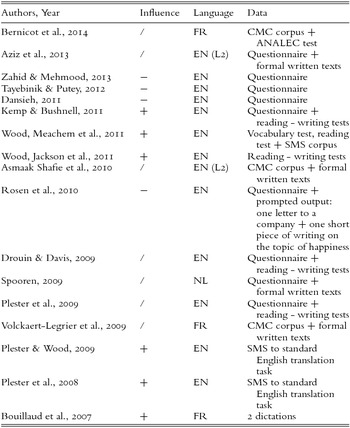
From the outset, the linguistic variations employed by CMC users have caused (and continue to cause) concern among parents, teachers and, through the media, society as a whole. In fact, CMC is accused of causing a decline in conventional writing standards by bringing what are considered to be ‘irregular’ written forms into widespread use (Goumi and Bernicot, Reference Goumi and Bernicot2012; Thurlow, Reference Thurlow2006). However, this conclusion does not appear to find unanimous support in the scientific studies conducted in this area. Table 1 summarises the general findings (/ = no influence; + = positive influence; − = negative influence) of some of the main studies on the topic (in reverse chronological order).
CMC and spelling: bibliography

2. DATA ANALYSIS
2.1. Methodology and corpora
This study investigates written texts that range from the most formal, i.e. dictations (referred to as DC below: dictation corpus), through what we will call spontaneous-prompted conversations (SPC: the triggering of the conversation is controlled but not the resulting written output) to the most informal represented by Facebook conversations (FBC). These three datasets were gathered using a methodology that is explained in detail in Maskens et al. (Reference Maskens, Cougnon, Roekhaut and Fairon2015) and is outlined below. The population is made of 80 students aged 14–15 years, in the fourth year of secondary school in southern Belgium, from seven schools and 11 different classes. Ten students took part in all three activities:
-
• DC (2013–14): two French dictations, 500 distinct words tested, 54 students did both dictations;
-
• SPC (2013–14): French exercise based on a written conversation between two students silently preparing for an oral presentation,Footnote 3 80 students produced 6,700 tokens;
-
• FBC (2013–14): students’ actual French Facebook unidirectional conversations (from messenger) downloaded from their private accounts, ten students, transcription into conventional writing using a protocol described by (Cougnon, Reference Cougnon2015: 97–100) with care taken to adhere as closely as possible to the vocabulary and syntax of the original message but in terms of spelling, to aim towards a norm.
Qualitative, exploratory analysis was supplemented by quantitative, automated analysis using Unitex (to identify syntactical structures), Lexico 3 (to identify lexical data), mkAlign (University of Paris III), STD_align (Beaufort et al., Reference Beaufort, Roekhaut, Cougnon and Fairon2010) (for transcription alignment) and SPSS (for analysing correlations between variables).
2.2. Analysis of the variations
We are now going to investigate a possible link between the use of CMC and spelling ability. First we will take a look at the students’ spelling levels: number and types of errors encountered in the dictations. We will then focus on the ten students whose Facebook conversations we received and who also did the two dictations to see if there is, for each student, a possible correlation between spelling level in the DC and ‘CMC density’ (we will come back to this latter concept) in the FBC. Finally, we will examine the diaphasic variation of the forms, i.e. how they vary according to the communication situation: beginning with the communication medium, then the person being addressed, the topic and the time of day of the communication.
2.2.1. General spelling level of the students
The students made a considerable number of errors in the dictation exercises: approximately one error every five words in the first dictation and one every six words in the second. This average is very close to that found by (Manesse et al., Reference Manesse, Cogis, Dorgans and Tallet2007), which was 4.74 for the Year 4 classes. However, a comparison of these results is meaningless if the degree of difficulty of the dictation is not taken into account. If this is calculated based on frequency (cf. Maskens et al., Reference Maskens, Cougnon, Roekhaut and Fairon2015), we observe that our dictation was easier than the one set by (Manesse et al., Reference Manesse, Cogis, Dorgans and Tallet2007), which means that the performance of our students fell below that of the 2005 French students. However, on closer analysis, there is a marked difference in the use of verb tenses and moods between the two dictation texts: our text has a greater variety of conjugations (simple future and future perfect, past perfect, imperative, present participles) and also several past participles with the auxiliary verb avoir – to have (participle agreement is considered to be one of the most difficult aspects of the French language). So it would appear that the apparent simplicity of the vocabulary in our texts compared with the one used by (Manesse et al., Reference Manesse, Cogis, Dorgans and Tallet2007) is relative.
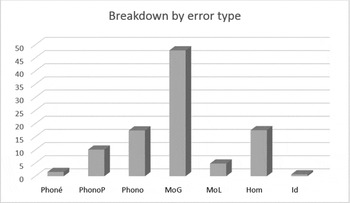
We are now going to investigate the types of errors the students made in the two dictations. The participants in our study used the PlatON system to do the dictation. Available online,Footnote 4 PlatON is an automatic dictation tool to help students practise dictation exercises independently. This system automatically detects any errors made and assigns them different markers; we have grouped these types of errors into seven main categories according to the (Catach, Reference Catach1980) classification, which is already used and described elsewhere (Cougnon et al., Reference Cougnon, Roekhaut, Beaufort, Baddeley, Jejcic and Martinez2013): predominantly phonetic errors (Phoné), predominantly phonogrammic errors that change the phonic value (PhonoP), predominantly phonogrammic errors that do not change the phonic value (Phono), predominantly morphogrammic errors (grammatical morphemes) (MoG), predominantly morphogrammic errors (lexical morphemes) (MoL), homophone-related errors (Hom) and ideogram errors (punctuation and case) (Id).
The results of the error classification, shown in Figure 1, confirm the findings of other studies, i.e. that the students struggle most with grammatical and lexical concepts. As was the case in previous studies, grammar came out on top with 48%. Let us now take a look at the most common types of errors in each category:
-
• type 1 (the student does not hear or pronounce a sound correctly): a missing letter is the most common error (e.g. conscencieusement instead of consc i encieusement);
-
• type 2 (the student knows the sounds but does not know how to transcribe them and this changes the phonic value): omitting the accent was the most common error in this case ( e tre instead of ê tre);
-
• type 3 (the student knows the sounds but does not know how to transcribe them and this does not change the phonic value): the most common error in this case is the omission of a consonant (exellent instead of ex c ellent);
-
• type 4 relates to grammatical morphemes. Here we observed mainly singular/plural agreement errors between a determiner and a noun (29%), between subject and verb (23%) and between a noun and an adjective (13%), closely followed by incorrect past participle agreement (12%);
-
• type 5 are lexical morphemes, most often associated with a lack of awareness about rule-governed final letters (quotidien t instead of quotidien);
-
• type 6 (homophones): essentially grammatical confusion (à/a) and confusion between spoken homophones ( em portent instead of en portent);
-
• type 7 (ideogram errors): primarily missing apostrophes (dabord instead of d ’ abord). This last category occurs the least frequently in the dictation corpora.
Breakdown of the students’ errors according to the Catach typology of errors (1980).Footnote 5

2.2.2. The link between spelling ability and CMC use
We will now focus on the ten students whose Facebook conversations we received and who completed the two dictation exercises. Using the method explained in (Bernicot et al., Reference Bernicot, Goumi, Bert-Erboul and Volckaert-Legrier2014), we will identify the ‘density of textisms’, which we will rename CMC density. CMC density takes account of a number of phenomena (listed in Maskens et al., Reference Maskens, Cougnon, Roekhaut and Fairon2015), essentially echo characters (heeeeello), expressive function of upper case (TELL ME now) and punctuation (tell me now!!!!!!!), emoticons, graphic abbreviations with (tk you) or without phonic impact (tel me now), specialisation (open your @!) and phoneticisation of characters (than u) and deletion of blank spaces (thankyou).
The FBC analysis for each student is limited to 5,000 tokens (which corresponds to the size of the smallest FBC). To obtain the CMC density, we divide the number of forms that were modified by the phenomena by the total number of linguistic forms in a student's Facebook conversation. The results show a maximum CMC density of 30%, which means that the typical CMC variations in fact occur in less than one-third of the linguistic forms. The picture is therefore very different from the impression of ‘contamination’ we might get from a superficial analysis of what the young people write in the new media. What is more, these types of CMC have only a limited range, essentially comprising common abbreviations (the usual phoneticisations and syncopes: bcp (for beaucoup), bjr (for bonjour), etc.), smileys and echo characters.
We then calculated the Pearson correlationFootnote 6 by comparing each student's CMC usage rate and their spelling ability in the two dictations to ascertain whether there is any correlation between these two variables. The result r of the Pearson test (r = 0.577, p = 0.081) demonstrated a strong correlation between the two variables (0.5<r>0.8). However, result p told us whether or not this correlation is significant; in this case, p>0.5, so the null hypothesis had to be accepted: the correlation between the two variables (r) was due to chance. The test indicated that there is no link between CMC density and spelling level for the ten students investigated, but this result would need to be confirmed by testing a larger sample.
2.2.3. Diaphasic variation in the forms
2.2.3.1. Variation across the three corpora
The hypothesis of a dual spelling ability can be investigated in our dataset by analysing the variation in the linguistic forms that are common to all three corpora. Unfortunately, this produced a relatively short list of around 30 forms that featured in all of the written output. From an analysis of the forms common to all three corpora it can be seen that variations of some of these forms appear in the Facebook conversations and, to a lesser extent, in the SPC of each of the students and yet they are spelled entirely correctly in the dictations. Among the non-grammatical variations we found quelqu'un (spelled qqn as often as quelqu'un), vraiment (both vrm and vraiment were found), école and âge (spelled with and without their accents); in terms of grammatical forms, we noted c'est (spelled c as often as it is spelled c'est), j’ (found as j, ch and j’), parce que (written pck as often as parce que) and pas (pa, ps and pas). Based on this data, it would appear that in at least oneFootnote 7 corpus (if not several), all the forms common to the three corpora, both lexical and grammatical, have traditional spelling in the writing of all the students. This tends to confirm the hypothesis that the students adapt their writing to the communication medium they are using. This observation must, however, be put into context: we only found a small number of forms common to all three corpora, the forms found were not particularly complex and the corpus was small.
2.2.3.2. Variation in the FBC alone
To obtain a longer list of form variations, we analysed how the forms varied within a single corpus (FBC) according to the communication situation: person addressed, discussion topic, time of day, people present, emotion levels, etc.Footnote 8
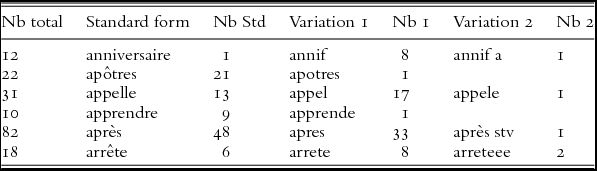
As previously explained, for each of the ten students investigated, the first 1,000 lines of their Facebook conversation were transcribed into standard written form using a semi-automatic transcription method. The aforementioned STD_align system (Beaufort et al., Reference Beaufort, Roekhaut, Cougnon and Fairon2010) was then used to compile a dictionary of 1,825 forms (types). This dictionary of standard forms/FBC variations is composed as follows: the dictionary entry gives the standard form and the number of its occurrences, followed by the variations and their respective occurrences. The total number of forms found (standard + variations) is also shown (at the start of the line). Table 2 shows a few FBC examples from the dictionary of forms.
FBC extract from the dictionary of forms

So, for example, the verb apprendre appears ten times in the corpus, but only once as apprende and nine times in its standard form. Similarly, arrête (imperative) appears 18 times in the corpus, but only six times with its circumflex accent.
Table 3 sets out the key figures from the dictionary of FB forms. The 1,825 types should be compared with the 66,295 tokens: the type/token ratio (TTR) is 2.75%, which is particularly low given the small size of the corpus; for example, a similar-sized corpus of SMS messages (Cougnon, 2012) contains 60,809 tokens and 7,056 types. This equates to a ratio of 11.6%, which is higher than the Facebook corpus. We therefore note a relatively low lexical range in the FBC.
Key figures from the dictionary of forms for the FBC

The standard form/total form ratio shows that standard spelling is used in 17.7% of the total FBC linguistic forms. We also note that in the dictionary as a whole, 976 of the 1,825 entries contain at least 50% standard forms in the FBC; if we look at the number that contain at least 75% standard forms, the figure is 572. This is the equivalent of saying that for 53.5% of the dictionary entries, at least half of the forms contained in the corpus are standard. The standard form figure is as high as 88% (480 out of 545) if we limit ourselves to the recurrent forms (occurring ten times or more). These results seem rather high in the informal context of the FBC: they mean that the students master both the standard form and its variations in 88% of the common linguistic forms used.
We also note that 37% of the forms (676/1,825) show no standard variation (the adjective acharné or the verb accueillir, for example). However, if we disregard the hapax (‘words that occur only once’), the figure falls to 7.5% (93/1,242), and 0% is achieved if we ignore the words that appear ten times or more (recurrent words). For 545 forms, all instances show at least one standard variation; this tends to confirm the theory we touched on briefly when we observed that only a small number of forms appeared in all three corpora.
The standard form/FBC variation dictionary also allows us to make one final interesting calculation: the contraction ratio of the FBC forms, i.e. the number of characters left out in the variations. This was in fact analysed earlier for the forms occurring in SMS messages (Cougnon, 2012). It makes sense in this context to analyse the difference in word length between the raw corpus and the transcribed corpus because it gives an accurate picture of the participants’ tendency to use CMC contractions; in other words, the classic issue of the use of truncation in the new information and communication technologies.
We then calculated that the average length (number of characters) of variations is 3.62 in the raw corpus (with reduced forms), compared with 3.82 in the standard corpus (normalised). This led us to the conclusion that there is no great difference between the two groups of units.
The FBC figures are as follows: the average (in number of characters) of a standard form in the normalised FBC is 6.43, versus 6.18 for the variations in the raw corpus. We can draw two conclusions from these new results: first, the words used in an FBC are significantly longer than those used in an SMS message. This must be due to the additional properties of text messaging (cost, habit of being short in SMS communication versus habit of being talkative in Facebook conversations, etc.). Secondly, when the students use a variation in an FBC (as in the SMS corpus), they do not reduce the length of the words very much (by a mere 3.8%); contrary to what we might expect, the vast majority of linguistic forms are written out in full or reduced by a single character.
2.2.3.3. Qualitative analysis by type of student
By adopting a qualitative approach to the different corpora, we can obtain, after a manual analysis of the productions, two main profiles for the ten students who were analysed in depth. The first relates to five students whose writing contained relatively few lexical variations from the standard form. Their Facebook conversations had a very low CMC density but contained a large number of emoticons and expressive punctuation. The five students in the second group used a greater number of lexical variations, particularly in their Facebook conversations. These students often made clever use of contractions and phonetic spelling. However, very few of these variations were to be found in their dictations or SPC. They also had a greater tendency to use CMC-type forms than their peers in the first group. And so, of the ten students whose writing was studied in closer detail, it would appear that half tended to vary their spelling to fit the communication context, but that the other half almost never departed from the standard spelling, regardless of the context. In order to avoid too much repetition, we have decided to describe in greater detail our analysis of the writing of three students who we consider to be representative of the sample. We therefore selected Writer 9 and Writer 29 (two girls) to exemplify the two student profiles, and Writer 45 to describe the writing of at least one boy.
Writer 9, representing group 1, is an exceptionally good speller and, at first glance, does not appear to use CMC very frequently. When we analysed her SPC we found only one variation from the norm: omission of the s that marks the second person singular of the verb avoir in the present indicative (tu as) (1).
-
(1) J'ai l'impression que tu n' a jamais vécu un rêve commun alors. [SPC09]
All 11 verbs conjugated in the second person singular in the first dictation contain the final s, which indicates that Writer 9 understands this conjugation rule. Yet in her Facebook conversations, we notice that she almost systematically omits the final s when she uses the second person singular of avoir in the present indicative, as she did in her SPC. The systematic nature of this omission suggests that it is a conscious decision and that it could be part of a different code she uses in certain situations, while returning to the standard rules when she deems it necessary to do so. To investigate this hypothesis, we attempted to ascertain whether other CMC-related graphic forms also displayed this virtually systematic variation in the FBC, while following the standard rules in at least one of the other datasets. Of the different lexemes we analysed, very few seem to regularly depart from the norm. In fact, the conjunction parce que is only reduced to its skeletal form (pck) five times in the whole corpus, whereas the standard form is encountered 14 times. Similarly, c'est appears 79 times in the corpus and is phonetically represented as c on only three of these occasions. The only lexeme that seems to vary frequently is the adverb toujours, which is written mostly as tjrs. The standard spelling of these three lexemes is used in the other corpora. When all of Writer 9’s written output was analysed, which we did at the time of transcription, there was no significant difference found between the different corpora. Writer 9 seems to prefer to use the standard rules in most cases, including in her SPC and Facebook conversations. The only clear indication of the use of CMC is the very frequent occurrence of emoticons, which account for over half of the graphic variations that appear in the FBC, and her tendency to omit the morpheme s from the second person singular, which we also saw in the SPC. It would appear, therefore, that on the occasions when Writer 9 does use CMC code, she uses it without restraint and favours non-lexical graphic variations (e.g. emoticons) that do not constitute a direct misuse of vocabulary or grammar.
Writer 29 (representing group 2) does not adhere as closely to standard spelling as her classmate, whose written output we have just described. In the SPC, however, she does not stray from the norm to a much greater extent than the previous student. In fact, there is only one capital letter without an accent ( E tudes instead of É tudes) and a tendency to contract tu es to tes (2).
-
(2) Allo quoi ? Tes une gamine et tu dors avec un mec ? [SPC29]
Analysis of these forms in the dictations suggests that failure to use accents with capital letters could indeed represent a deficiency in her spelling ability given that none of the capital letters in the dictations have an accent. However, we do not observe any variations of the pronoun tu or the use of the apostrophe, which could indicate the use of a CMC-related graphic variation. If we look at the Facebook conversations, we notice that Writer 29 uses this graphic variation very frequently, i.e. removes the final vowel from the personal pronoun and merges it with the verb that follows. This occurs particularly often with the subject pronoun je, reflecting how it sounds in spoken language. Another common occurrence is the omission of the s that marks the second person singular of the present indicative of the verb avoir (3), which was also found in the written output of Writer 9.
-
(3) ahahahhaah ta vu ahahah [FB29]
-
(4) nan hein enft j comprend rien aha [FB29]
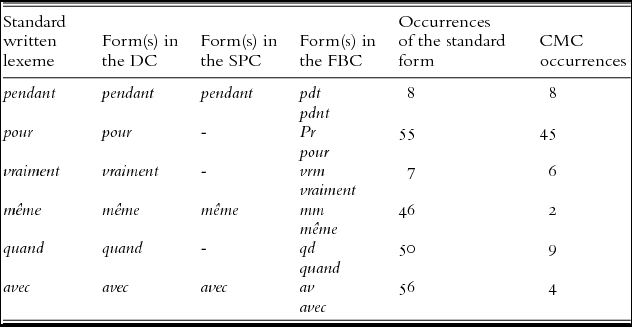
Next, we identified CMC-related graphic variations that were present in at least two of the corpora. From the results we can see that Writer 29 consistently used more CMC-type variations than Writer 9. Even though standard spelling is used in the other corpora, a large number of lexemes such as vraiment, non, pour and seulement appear in most cases in their skeletal consonant form in Writer 29’s Facebook conversations (Table 4). The preposition pendant on the other hand is only used in this form in the FBC.
Writer 29’s words variation (excerpt)

The frequent use of CMC-related graphic variations in the Facebook conversations and the use of their standard equivalents in the other corpora confirm the hypothesis that we are looking at two different codes and not simply random variations. In fact, we think it is unlikely that the systematic, or almost systematic, omission of the majority of the graphemes of the lexemes pendant, vraiment, pour and seulement is random but rather reflects the use of a written code with its own specific characteristics, which are quite distinct from those of French spelling. It is nevertheless interesting to note that, contrary to this, Writer 29 varies her lexicon considerably and yet uses hardly any emoticons or expressive punctuation. She seems to prefer to play with the language itself.
2.2.3.4. Linguistic representations and attitudes
According to (Jodelet, 1993, cited by Moreau, Reference Moreau1997: 246), linguistic representations are ‘une forme courante (et non savante) de connaissance, socialement partagée, qui contribue à une vision de la réalité commune à des ensembles sociaux et culturels’.Footnote 9 They have long been confused with linguistic attitudes that relate to the way speakers evaluate linguistic practices (Moreau, Reference Moreau1997). The representations are a sort of ‘mental image’ of the language, whereas the attitudes are the judgements that arise from that image (Bulot and Blanchet, Reference Bulot and Blanchet2011).
The profile of Writer 45, a boy, is similar to that of Writer 9 above: this student uses relatively few variations from standard writing in both the dictations and the other two datasets. His Facebook conversations contain very few lexical variations and the few that do appear are always significantly outnumbered by the standard form. For instance, the adverb pas varies only once in the corpus and the non-standard form of the personal pronoun je is used 10 times out of a total of 290 occurrences in Writer 45’s FBC (examples 5 and 6). As is the case for Writer 9, this student much prefers emoticons and expressive punctuation over the other CMC-related graphic variations.
-
(5) J'aiiiiiiiii paaaaaaaaaas enviiiiiiie . . . (‘J'ai pas envie’) [FB45]
-
(6) chuis content de te l'avoir dit (‘je suis content de te l'avoir dit’) [FB45]
One thing that stands out with Writer 45 is the fact that he explicitly refers to spelling in his Facebook conversations. As can be seen in the following extract, the writer apologises for the mistake he made in his previous contribution to the conversation.Footnote 10 He is referring to the simplification of the double n in the adjective passionnant.
-
(7) Nan c'est passionant !
pardon pour l'orthographe j'ai honte
je suis crevé [FB45]
Not only did he apologise and say he was ashamed of what he had written; Writer 45 also tries to justify this slip by explaining he is tired, which implies that he would not have used this variation in normal circumstances. The attempt to justify his mistake and the shame that he feels indicates that Writer 45, like the students interviewed by (Millet et al., Reference Millet, Lucci and Billiez1990) and (Leporcq, Reference Leporcq2012), sees spelling as an indication of social status and he fears he will not be seen in a good light by the person with whom he is communicating. This sparseness of lexical variations in his conversations and his attitude towards spelling also lead us to draw a comparison with the students in the study of (Leporcq, Reference Leporcq2012) who explained that they wished to detach themselves from certain CMC-related graphic variations in order to adopt more adult behaviour.
The adolescents seem to be split between a desire for freedom and group identity, on the one hand, and the social prestige they associate with spelling (Leporcq et al., Reference Leporcq, Siroux and Draelants2013), on the other. Writers 9 and 45, in using non-lexical graphic variations – e.g. emoticons and expressive punctuation – that do not constitute a direct misuse of vocabulary or grammar could have found a compromise: in their Facebook conversations they opt for graphic variations that allow them to use the same code as their peers while changing lexical and grammatical spelling as little as possible. This allows them to be part of the CMC user group but at the same time minimises the risk of losing social credibility.
Moreover, the importance that Writer 45 places on standard spelling can be seen in his correction of his non-standard output. In fact, this student corrects his deviations from the norm on several occasions by rewriting them using standard spelling in his next contribution to the conversation, as can be seen in examples (8) and (9). It is interesting to note that some of his corrections are indicated by an asterisk placed before or after the standard form (9). This occurs in the Facebook conversations of most of the students, which indicates that it may be a phenomenon specific to CMC that has not yet been observed in any other studies, either because its use is new or because it is specific to Facebook communications and therefore does not occur in any other types of CMC, such as text messaging, which has been examined more closely by the scientific community.
-
(8) ok :) c'est gntil
gentil [FB45]
-
(9) Peut être parce que 15 c'est plus rand que 14 ??? [. . .]
grand * [FB45]
It is interesting to note that the self-corrections and apologies are not systematic. So we need to move on to study the context in which they occur. Perhaps Writer 45 is in a specific situation and is talking to a girl he is hoping to impress. This could, for example, explain his wish to adhere more closely to the norm, which he believes will show him in a better light.
CONCLUSIONS AND NEXT STEPS
Recent research (Cougnon, 2012; Volckaert-Legrier et al., Reference Volckaert-Legrier, Bernicot and Bert-Erboul2009; David and Goncalves, Reference David and Goncalves2007) tends to confirm the hypothesis that young people are multi-skilled, in that they adapt their spelling to the communication situation rather than display signs of an inability to spell. This study tends to support this hypothesis.
From the point of view of spelling levels, we have seen that the young people tested in the two dictations made an average of one error every five words in the first dictation and every six words in the second. This might lead us to believe that their performance fell below that of the French students in 2005 (Manesse et al., Reference Manesse, Cogis, Dorgans and Tallet2007). However, the type of text set for the dictation exercises (specifically the number of past participle agreements) seems to play a part in this difference, which would lead us to the conclusion that spelling levels have not declined since 2005. It would therefore be interesting to repeat the dictation exercise using the 2005 texts.
The most frequent errors in the dictation are, unsurprisingly, grammatical (48%) and lexical, which are the two areas the students find most difficult. If we break down the recurrent errors, we see the omission of letters and accents, incorrect singular/plural agreement between determiner and noun and between subject and verb, a lack of awareness about rule-governed final letters, grammatical confusion between à and a, confusion between spoken homophones, and use of the apostrophe.
In terms of the density of textisms in the students’ written output, if we divide the CMC density by the total number of linguistic forms in a student's Facebook conversation, we find that a maximum of 30% of the forms are affected by typical text-message usage. The picture is therefore very different from the impression of ‘contamination’ we might get from the young peoples’ writing. If we then calculate the Pearson correlation, we can ascertain that there is no link between this CMC density and spelling level for the 10 students investigated. In other words, we do not find that the students who use the most CMC variations on Facebook make the most mistakes in the dictations.
Our study also allows us to highlight that there is at least one standard form in all the forms (both lexical and grammatical) that appear in all three corpora and this was found in the writing of all the students. This tends to confirm the hypothesis that they are playing with the language rather than demonstrating a lack of spelling ability.
The type/token ratio in the Facebook corpus is 2.75%, which is particularly low given the small size of the corpus. This demonstrates a limited lexical range in the Facebook conversations.
Of the 10 students who were analysed in greater depth, it appears that half of them tend to adapt their spelling to the communication context but the other half almost never move away from the standard, regardless of the situation. This demonstrates a wide diversity of practices among the students observed. One group favours non-lexical graphic variations (e.g. emoticons) that do not constitute a direct misuse of vocabulary or grammar. The second group, on the other hand, varies its vocabulary considerably but uses practically no emoticons or expressive punctuation. Consequently, the second group seems to prefer playing with the language itself, while the first group, which uses graphic variations and thereby avoids a direct misuse of vocabulary or grammar, appears to have found a compromise: by punctuating their conversations with graphic variations, they are using the same code as their peers, which gives them social credibility, while changing lexical and grammatical spelling as little as possible. This allows them to be part of the CMC user group while minimising their risk of fulfilling the prophecy that they are ‘changing the language’.
Finally, the study has revealed an interesting phenomenon linked to self-correction: nearly all students highlighted the self-correction in their Facebook pages by putting an asterisk before or after the standard form. This phenomenon, of which we cannot find any trace elsewhere, is either new or specific to Facebook communications. Moreover, since this asterisk does not appear systematically for every self-correction, it would be interesting to identify the situations in which it is found and those in which it is not.
Our corpus is further-reaching than the previous studies, which were all based on samples of students who were either too old to have been really affected by the new information and communication technologies or too young to be able to draw a distinction between the influence of CMC and ignorance of spelling rules. However, the sample remains fairly small and the conclusions are unfortunately valid only for the survey itself. So the most appropriate next step would be to repeat the survey on a larger scale in order to validate these initial results, ensuring, for instance, that there are a greater number of forms that appear in both the dictation exercises and the FBC.