




1. Introduction
The problem of Umlaut in German is often discussed in the field of historical linguistics. It often serves as a prototypical example of morphologization (as in Joseph & Janda Reference Joseph, Janda, Hammond and Noonan1988 and Janda Reference Janda, Joseph and Janda2003), where a phonologically conditioned sound alternation pattern develops into a morphologically conditioned one.Footnote 1 Umlaut initially occurs as a vowel alternation in Old High German (OHG) that is completely conditioned by its phonological contexts – when vowels such as a, u, o (/a/, /u/, /o/) are followed by an unstressed syllable containing i, î, or j (/i/, /iː/ or /j/), they are fronted to e/ä, ü, ö([e/ɛ], [y], [oe]), respectively. As many inflectional and derivational suffixes associated with certain morphological categories contain the segments i, î, or j that can trigger Umlaut, the umlauted vowels are more frequently found in those morphological categories than in others, causing an overlapping between the phonological and the morphological conditions. During the period of Middle High German (MHG), however, the phonological triggers of Umlaut begin to disappear: The glide j is dropped, and the vowels i, î are weakened into a schwa. The phonological conditions of Umlaut thus become obscured, and the condition of Umlaut is reassociated with the morphological categories of the forms in question.
The problem of Umlaut in German (as well as in other Germanic languages) has been studied for decades from various perspectives. A central question concerns the relationship between the orthographic representation and the periodization of Umlaut. Umlaut is first attested in early OHG texts affecting short a in specific phonological environments, termed Primary Umlaut. The umlauted forms of other vowels as well as the short as in other environments, are not systematically attested until the loss of the triggering phonetic contexts in MHG, termed Secondary Umlaut. It has long been debated whether Secondary Umlaut actually occurs at the same time as Primary Umlaut before being orthographically represented centuries later (Twaddell Reference Twaddell1938, Penzl Reference Penzl1949, Voyles Reference Voyles1976, Reference Voyles1991, Reference Voyles, Rauch, Carr and Kyes1992, Fertig Reference Fertig and Salmons1996, Schulze Reference Schulze2010). Other problems of Umlaut are also discussed in more recent works. For instance, Iverson and colleagues (Reference Iverson, Davis and Salmons1994) and Howell & Salmons (Reference Howell and Salmons1997) focus on the phonological contexts that are potentially related to the occurrence of Umlaut besides the triggering vowel in the following syllable. From a more general perspective, Janda (Reference Janda, Joseph and Janda2003) discusses the phonologization of Umlaut and other sound changes of similar types, namely, how changes in phonetics develop into phonological entities, and Buccini (Reference Buccini1992) emphasizes the influence of language contact when explaining the limited development of i-Umlaut in Dutch compared to other Germanic languages.
The current article deals with phonologicality, morphologicality, and morpholexicality of Umlaut throughout its diachronic development and its interaction with the lexicon. Early generative approaches often assume the morphologization of Umlaut as a shift in the conditions of Umlaut from phonological factors to morphological factors and have provided several explanations under the framework of transformational rules (Dressler Reference Dressler, Juilland, Devine and Stephens1976, Hooper Reference Hooper1976, Klausenburger Reference Klausenburger1979, Wurzel Reference Wurzel and Fisiak1980). More recently, some studies suggest that German Umlaut might simultaneously exhibit features of phonological alternations and morpholexical ones. As sections 1.1 and 1.2 show, on the one hand, features of phonological alternations persist even in Modern High German (NHG), when the original phonological triggers of Umlaut are entirely lost; on the other hand, Umlaut is not completely phonologically regular in OHG, but does show a certain degree of morpholexicality. The cooccurrence of phonologicality and morpholexicality is already assumed for German Umlaut in studies such as Boutilier Reference Boutilier2019 and Hansson & Wiese Reference Hansson, Wiese, Ritter and van der Hulst2024. The morphologization process might thus be better described as a process where features of phonological alternations in German Umlaut gradually decrease, and features of morphological or morpholexical alternations gradually increase. A typological comparison of Umlaut across Germanic languages shows there are two types of morphologization for Umlaut: It is either reassociated with a morphological category in general and has the potential to create new forms, or becomes fossilized in the inflected or the derived forms of specific lexemes and might be eliminated in later changes. The former indicates the dominance of morphologicality in morphologization, and the latter the dominance of morpholexicality.
It is noteworthy that the morphologization of Umlaut does not only involve forms that are umlauted but also interacts with forms that are not directly subject to Umlaut. The role of frequency in morphological problems such as regularity, productivity, and analogy has long been discussed, for example, Hare et al. Reference Hare, Ford, Marslen-Wilson, Bybee and Hopper2001, Bybee Reference Bybee1995, Reference Bybee and Bybee2007, Haspelmath & Sims Reference Haspelmath, Sims, Haspelmath and Sims2010, and more recently, Krause-Lerche Reference Krause-Lerche2022, Dattner et al. Reference Dattner, Ashkenazi, Ravid and Levie2023. Moreover, in some constructionist theories in morphology including Construction Morphology (Booij Reference Booij2010) and Relational Morphology (Jackendoff & Audring Reference Jackendoff and Audring2019, Audring Reference Audring2022), morphological patterns are schemas generalized over the existing words in the lexicon. The proportion of forms that are subject to Umlaut might thus influence the development of Umlaut by changing its relative frequency. For example, though some forms in German have e umlauted from Proto-Germanic (PG) *a, there are also numerous forms containing a that are never umlauted or e inherited from PG.Footnote 2 The higher the frequency of the latter, the less frequent the Umlaut alternation occurs. The current study also questions how influential the forms not subject to Umlaut might be on the morphologization of Umlaut.
1.1. Phonologicality of Umlaut in ENHG and NHG
While the phonological trigger of Umlaut has long been lost and the Umlaut alternation in NHG is no longer considered as phonologically conditioned, some studies in the field of phonology, such as Wiese Reference Wiese1996a, Reference Wiese1996b, Hansson & Wiese Reference Hansson, Wiese, Ritter and van der Hulst2024, point out that a certain degree of phonological regularity can still be found in NHG Umlaut. Most umlautable vowels in NHG share exactly the same values of phonological features with their umlauted alternants except the feature of fronting. These vowels include /uː u oː o aː a/ (pronounced as [uː ʊ oː ɔ aː a]), which are fronted to /üː ü öː ö äː ä/ (pronounced as [yː ʏ øː œ ɛː ɛ]) when Umlaut occurs. Given the phonological transparency between the umlauted and the unumlauted vowels, the Umlaut alternation can be conveniently assumed as a phonological process of assigning the feature [+front] to the umlautable vowels. The process can be compared with other vowel alternation processes in NHG that are more prototypically morphological, such as Ablaut (Wiese Reference Wiese1996a).
The systematic phonological transparency among Umlaut alternants often serves as evidence that NHG Umlaut might be considered a lexically conditioned phonological process. From a diachronic perspective, however, the historical development of Umlaut also sees a gradual loss in such phonologicality, particularly the phonological transparency between the Umlaut alternants. While the Umlaut alternation for all other vowels in NHG can be generalized as a vowel fronting process, there is one exception: the Umlaut alternation from the unumlauted diphthong [aʊ] to the umlauted one [ɔʏ], developed from the MHG umlauting pair [uː] ∼ [yː] since Early Modern High German (ENHG) time (Philipp Reference Philipp1980:40). Though Wiese (Reference Wiese1996b:182) argues that the change from [aʊ] to [ɔʏ] can still be explained as the assignment of the [+front] feature to the second component in the diphthong, the phonological transparency in the pair [aʊ] ∼ [ɔʏ] is far lower than its MHG antecedent [uː] ∼ [yː], which is a regular fronting process. In other words, the phonological association between MHG [uː] and [yː] is made opaque after the ENHG time by the diphthongization of MHG [uː] and [yː], and the phonological regularity of Umlaut in general, albeit not completely lost due to the regularity among other alternants, gradually decreases in this way.
The loss of phonologicality in Umlaut is not only found in the phonological transparency among Umlaut alternants, but also in the frequency of cooccurrence between umlauted alternants and the phonological triggers. The attestations in corpora from different periods of German show that the loss of the Umlaut trigger is a gradual process that lasts from OHG to ENHG. Even at the period of ENHG, unweakened i as the Umlaut trigger is still sporadically attested in the corpora, for example, <sprechin> (sbjv pret 3 pl of sprechen) ‘speak’, <hetti> (sbjv pret 1 sg of haben) ‘have’. As the following corpus study shows, there is a continuous decrease in the occurrence of i in the syllable following the stem vowel among verb forms from OHG to ENHG, which can be better explained as a gradual loss of phonologicality instead of an abrupt shift of Umlaut from a phonological alternation to a morphological or a morpholexical one.
1.2. Morpholexicality of Umlaut in OHG
The Umlaut alternation in OHG is usually described as an alternation that cooccurs with the phonological trigger i, î, or j in the following syllable. However, Janda (Reference Janda1998) points out several sporadic exceptions to the described phonological conditions of OHG Umlaut. In OHG, the vowel a is fronted to e in attested forms when Umlaut occurs. On the one hand, there are attested examples where a is fronted to e via Umlaut without the existence of the phonological trigger i, î or j, as shown in (1); on the other hand, examples where a remains unumlauted despite the presence of the phonological trigger are also found, as shown in (2).
(1)
OHG cases of Umlaut occurring in the absence of phonological triggers
kempf-en (< inf *kampf-jan ‘battle’), derived from kampf ‘battle’
werm-en (< inf *warm-jan ‘warm’), derived from warm ‘warm’
(2)
OHG cases of phonological triggers failing to cause Umlaut
nan-ti (sbjv.pret.3.sg) for nemnen ‘name’
kan-ti (sbjv.pret.3.sg) for kennen ‘know’
In (1), the Umlaut trigger *j in the derivational suffix is assumed to exist at the pre-OHG period and causes the fronting of the stem vowels in kempfen and wermen. While the *j has been dropped before the earliest attestation of OHG, the umlauted e survives in OHG despite the absence of the phonological trigger. On the other hand, Umlaut fails to be triggered, even when its phonological conditions are perfectly fulfilled by the subjunctive suffix -ti in (2). Such a failure to trigger Umlaut is very rare in OHG and is mostly found in a small morphological group: the subjunctive preterit forms of Weak Class I verbs. Examples (1) and (2) are both evidence that even if Umlaut is initiated as a phonologically conditioned alternation to a strict sense before any attestation of the German language, it is subject to certain morpholexical conditions in OHG.
1.3. The goal of the quantitative study
Sections 1.1 and 1.2 show that the Umlaut alternation in German is influenced by both phonological and morpholexical conditions throughout its development from OHG to ENHG, though the importance of one condition in comparison to the other changes gradually over time: at the period of OHG, the conditioning effect of phonological factors on Umlaut is dominant, but not unique; as the language develops from OHG to ENHG, it is the morphological or morpholexical factors that become dominant, while phonological factors still play a minor role. Fertig (Reference Fertig and Salmons1996) points out that variation between umlauted and unumlauted alternants might be a possible way of solving the Umlaut puzzle, and a corpus-based investigation is therefore particularly appropriate for studying the gradualness of change, because synchronic variations that are potentially associated with the changes in the next stage of development are broadly attested in the corpora. According to the theory of Lexical diffusion (Wang Reference Wang1969, Chen & Wang Reference Chen and Wang1975), sound changes gradually spread throughout the lexicon until all forms that can potentially affected are transformed. This assumption is supported by many empirical studies, such as Phillips Reference Phillips2006, and is also applied in the study of diachronic changes in High German (Barrack Reference Barrack1976, Vergeiner et al. Reference Vergeiner, Luttenberger, Bülow, Wallner and Britain2023). There are also synchronic variations related to Umlaut across the corpora, even within the same inflected form of the same lexeme. For example, the ind prs 3 sg form for the lemma tragen ‘carry’ in the MHG corpus is sometimes attested with an umlauted stem vowel, and sometimes with an unumlauted one. The coexistence of umlauted and unumlauted alternants is especially beneficial for investigating the gradualness of language change.
(3)
Some of the attested ind.prs.3.sg forms for the lemma tragen ‘carry’
unumlauted: <dragit>, <traget>, etc.
umlauted: <dreget>, <treget>, <tregit>, <tregt>, etc.
On the other hand, the corpus study also helps distinguish two different types of morphologization that can be quantitatively distinguished. In many previous studies that discuss the morphologization of German Umlaut (e.g. Wurzel Reference Wurzel and Fisiak1980, Janda Reference Janda1998, Reference Janda, Joseph and Janda2003), the results of morphologization are often described as a reassociation of Umlaut occurrence with morpholexical factors, in that information of lexical groups is included as the condition of Umlaut after its morphologization. However, as the comparison of Umlaut developments across different Germanic languages in section 2 shows, reassociation of conditioning factors with certain morphological categories in general or fossilization of Umlaut alternants in the paradigm cells of specific lexemes can lead to different patterns of morphologization. The difference in the two types of morphologization can also be indicated by quantitative criteria based on attestations in corpora.
This article focuses on the change in the distribution of a and e among the stem vowels of verb forms attested in corpora of German from different periods ranging from OHG to ENHG, which presents a complicated interaction with the development of Umlaut. An entropy-based method is first proposed to evaluate the phonological, morphological, and morpholexical predictability of the a ∼ e distribution in the stem vowels of verb forms. And by scrutinizing the interaction between Umlaut and the a ∼ e distribution in the main inflectional categories, the study points out that depending on the proportion of forms in an inflectional category affected by Umlaut, Umlaut can be morphologized in different ways: When the majority of forms in an inflectional category are subject to Umlaut, the umlauted vowel tends to become a marker of the inflectional category in general; and when only a limited number of forms in a category are affected by Umlaut, the Umlaut alternation presented in that category shows a tighter relationship to specific lexemes. In this article, the former way of morphologization is termed reassociation, and the latter is termed fossilization.
The article is structured as follows: Section 2 makes a distinction between reassociation and fossilization as two different types of Umlaut morphologization in Germanic languages, and section 3 proposes an entropy-based method of quantifying phonologicality, morphologicality, and morpholexicality of the a ∼ e distribution. Section 4 verifies the effectiveness of the entropy-based method with preliminary examinations using simulation data, and section 5 gives an introduction of the corpora and some details of data processing. Section 6 is a discussion on the results, including the evaluation of the overall distribution of a ∼ e using the entropy-based method, and the interaction between Umlaut morphologization and the a ∼ e distribution in three verb inflectional categories. The conclusion is given in section 7.
2. Reassociation and fossilization as two types of morphologization
Umlaut as a phonological alternation is broadly found in most Germanic languages, and it shows different patterns of development when entering the morphological and the lexical system of different languages. Some of the previous studies provide a typological comparison of Umlaut alternations among different Germanic languages, particularly their degrees of morphologization. For instance, Thráinsson (Reference Thráinsson, Bowern, Horn and Zanuttini2017) compares the synchronic status of u-Umlaut in Icelandic and Faroese, the rounding assimilation of the vowel a when followed by a syllable with u. He argues that u-Umlaut in Icelandic can still be considered as a phonological process, but is analogical and morphological in nature in Faroese. The comparison supports the idea in this article that Umlaut in Germanic might vary in its phonologicality and morphologicality.
Another typological comparison of Umlaut across Germanic languages is made by Iverson and Salmons (Reference Iverson and Salmons2012) in their discussion on the diachronic development of Old Norse i-Umlaut, which suggests that the morphologization of Umlaut might have different types. To account for the different distribution of i-Umlaut alternants between forms with long stems and forms with short stems, they propose two patterns of development for i-Umlaut that can finally lead to allomorphical uniformity in paradigm: restructuring and reversion. Restructuring preserves the umlauted alternants with altered underlying representations or morphologized Umlaut rules after the loss of phonetic Umlaut, and thus umlauted alternants might occur in contexts where the original phonetic Umlaut rule does not apply. By contrast, reversion undoes a sound change, in that an umlauted alternant is changed back to its unumlauted form after the loss of the phonetic Umlaut rule. The status of Old Norse i-Umlaut at the final stage of its development reflects the result of the interaction between restructuring and reversion: Short stem verbs have umlauted alternants associated with particular morphological categories, and certain umlauted alternants in short stem nouns are changed back to their unumlauted forms after the loss of phonetic Umlaut. Iverson & Salmons (Reference Iverson and Salmons2012:127) view the situation as an intermediate status between two extremes represented by Umlaut in German and Umlaut in English, respectively.
A similar distinction is also made by Wurzel (Reference Wurzel, Booij, Lehmann, Mugdan and Skopeteas2004:1608) in his typological comparison among morphologized phonological alternations, where the morphologization processes are categorized as Beibehaltung ‘maintenance’ or Inversion ‘inversion’ based on whether the direction of the transformational rules is reversed. While approaches such as Iverson & Salmons (Reference Iverson and Salmons2012) and Wurzel (Reference Wurzel, Booij, Lehmann, Mugdan and Skopeteas2004) focus on the change in the underlying forms or the direction of transformational rules, the distinction in their effects on the outcome surface forms is crucial as well. It can be observed from their examples that a change in the underlying form, especially when with reversion of the direction of transformational rules, often allows the possibility of extending umlauted alternants to contexts where they are not phonologically triggered. On the contrary, when an Umlaut rule simply ceases to apply without involving changes in the underlying form or the rule itself, the umlauted alternants are often replaced with unumlauted ones, hence eliminating the remnants of phonological Umlaut. For instance, OHG Rückumlaut verbs are considered as examples of Inversion in Wurzel (Reference Wurzel, Booij, Lehmann, Mugdan and Skopeteas2004:1608). The present and the infinitive forms of OHG Rückumlaut verbs have umlauted stem vowels, while the preterit forms contain unumlauted ones. According to Wurzel (Reference Wurzel, Booij, Lehmann, Mugdan and Skopeteas2004), the original Umlaut rule a → e is reversed to e → a among Rückumlaut verbs, which is the determining characteristics of Inversion.
(4)
inf
pret.1.sg
gloss
brennen
branta
‘to burn’
stellen
stalta
‘to put’
The reversion of the rule direction is followed by the rebuilding of the paradigms of most OHG Rückumlaut verbs in NHG, with the umlauted e spread throughout the paradigm. Only a small number of the Rückumlaut verbs like brennen preserve the unumlauted a in their preterit forms in NHG.
A similar rebuilding of inflectional paradigms with analogical leveling can also be found among some Faroese nouns with u-Umlaut. As mentioned in Thráinsson (Reference Thráinsson, Bowern, Horn and Zanuttini2017), while u-Umlaut in Modern Icelandic maintains a relatively high degree of phonological regularity, spread of umlauted alternants across a paradigm is common in Faroese.Footnote
3
A comparison of u-Umlaut distribution between Icelandic and Faroese (cited from Árnason Reference Árnason2011:244, 249) is provided in (5). Note that u-Umlaut is initiated as a rounding assimilation process. The vowel a becomes ö in Modern Icelandic and in ø Modern Faroese.Footnote
4
(5)
u-Umlaut distribution in Icelandic saga and stjarna (without spread of Umlaut)
nom.sg
obl.sg
gloss
saga
sögu
‘story’
stjarna
stjörnu
‘star’
u-Umlaut distribution in Faroese søga and stjørna (with spread of Umlaut)
nom.sg
obl.sg
nom.pl
gloss
søga
søgu
søgur
‘story’
stjørna
stjørnu
stjørnur
‘star’
From a generative perspective, the analogical extension of the umlauted vowel ø in Faroese can be explained as a reanalysis of ø as the underlying stem vowel and a subsequent loss of alternation rule.
Although there is an overlapping between cases of analogical extension of umlauted alternants and cases of change in the underlying forms or the direction of rule application, it is not always the case that analogical extensions of umlauted alternants are motivated by a change in the underlying forms. In Old Nordic languages, i-Umlaut is phonetically triggered at the ind prs 2/3 sg forms of a group of strong verbs in Old Nordic languages, as in OHG. But unlike OHG, the 1 sg forms in Old Nordic, whose original inflectional ending cannot phonetically trigger Umlaut, also show umlauted stem vowels under the analogical influence from other singular forms. The development in the paradigm of Old Islandic blóta ‘to sacrifice’ (cited from Wurzel Reference Wurzel, Booij, Lehmann, Mugdan and Skopeteas2004:1604) shows the analogical extension of Old Nordic i-Umlaut.
(6)
inf
prs.1.sg
prs.2.sg
prs.1.pl
Proto-Nordic
*blōta(n)
*blōtu
*blø̄tiR
*blōtum
Old Islandic
blóta
blǿt
blǿtr
blótum
Since the unumlauted stem vowel in the infinitive and the plural forms remain unaffected by i-Umlaut, the spread of the umlauted ǿ to the prs 1 sg form cannot be attributed to a change in the underlying stem vowel or a reversion of rule direction. Rather, it should simply be explained as a reanalysis of Umlaut as a marker for singular. Wurzel (Reference Wurzel, Booij, Lehmann, Mugdan and Skopeteas2004:1605) classifies the development of Old Nordic i-Umlaut as morphologisch initiierten Morphologisierungen ‘morphologically initiated morphologization’.
Reanalysis of Umlaut as morphological markers also makes it possible to create umlauted forms among lexemes where Umlaut cannot be phonologically triggered previously. Robinson (Reference Robinson1975) mentions several a-stem and n-stem nouns in Roermond, whose inflectional suffixes never phonologically trigger Umlaut of the stem vowels. Nevertheless, the umlauted stem vowels are introduced as plural markers for these forms under the influence of i-stem nouns. Examples are given in (7) (cited from Robinson Reference Robinson1975:14, 17; phonetic transcription in original).
(7)
sg
pl
gloss
a-stem nouns
wolf
wölːf
‘wolf’
n-stem nouns
baoch
bäöch
‘bow’ (<ao> = [ɔ̄], <äö> = [ɔ̈̄])
The spread of Umlaut to a-stem and n-stem nouns as plural markers in Roermond, according to Robinson (Reference Robinson1975), is an extension of scope of rules. The morphological conditions of the Umlaut rule are modified, so that the rule can apply to lexemes to which it is previously not applicable.
Although (4)–(7) are accounted for with different mechanisms under the generative framework, they share one crucial common result: The umlauted alternants spread to contexts where they are not phonologically expected, because they are reassociated with some general morphological functions via morphologization. For (4) OHG Rückumlaut verbs and (5) Faroese søga ‘story’ and stjørna ‘star’, umlauted vowels become the unmarked stem vowel. For (6) Old Islandic blóta ‘to sacrifice’, Umlaut serves as a marker for singular, and for (7) Roermond a-stem and n-stem nouns, Umlaut becomes a marker for plural.
Therefore, in addition to the set of parameters proposed in Wurzel (Reference Wurzel, Booij, Lehmann, Mugdan and Skopeteas2004:1604) for classifying different types of developments from phonological alternations to morphological ones like Umlaut, it is necessary to consider a new parameter that relies on surface outcomes instead of underlying representations or transformational rules. As for Umlaut (and possibly for other morphologization processes of phonological patterns as well), a distinction might be made between two tendencies of developments: reassociation and fossilization. Reassociation refers to developments where the umlauted alternants spread beyond the original phonological environment to a broader scope of contexts via a reassociation with specific morphological categories, and fossilization refers to developments where the remnants of phonological Umlaut are lexically fossilized in the inflectional (or possibly derivational) paradigms after the triggering phonological conditions become obscured, potentially subject to elimination under the analogical pressure from the unumlauted alternants.
It is noteworthy that, in comparison to other Germanic languages, English stands at an extreme position of lexically fossilizing the outcomes of phonological i-Umlaut, and gradually driving them out from the paradigms. In Old English, there are a considerable number of umlauted forms in various morphological categories, as in many other Germanic languages, such as the umlauted nom pl forms fēt and bēc for fōt ‘foot’ and bōc ‘book’. However, reassociation of umlauted alternants is rare (if it exists at all) in the later development of English. Instead, the number of forms with Umlaut alternation has greatly reduced, and only a small number of the umlauted alternants are preserved in Modern English, with many others replaced by the unumlauted forms.
3. An entropy-based method
3.1. The use of entropy in evaluating the effect of Umlaut upon the lexicon
The distinction in reassociation and fossilization as different types of morphologization is important, because they have statistical characteristics that can be investigated and discussed quantitatively directly based on corpus data without the necessities of assuming underlying forms and transformational rules that are not directly observable. Shannon Entropy (Shannon Reference Shannon1948), an information-theoretic concept that is widely used in the field of morphology (Baayen Reference Baayen, Bod, Hay and Jannedy2003, Milin et al. Reference Milin, Kuperman, Kostić, Baayen, Blevins and Blevins2009, Ackerman & Malouf Reference Ackerman and Malouf2013, Reference Ackerman and Malouf2016, and many others), is beneficial for studying the mutual influence between Umlaut and the lexicon, as it serves as a good indicator of the general predictability of a vowel distribution under various conditions. Therefore, the entropy-based criteria can be used for determining whether the phonological, the morphological, or the morpholexical factors are dominant in conditioning an overall distribution of sounds across the lexicon.
While German Umlaut occurs in various lexical categories including nominal, verbal, and adjectival ones and involves multiple vowels, the current study focuses on the distribution of a and e in the stem vowel position of verb forms. On the one hand, including multiple umlauting pairs in the data could lead to an unnecessary increase in the unpredictability of vowel distribution, because the results also reflect the distribution of unumlauted a, o, u, etc. This can be avoided by concentrating on only one umlauting pair, and the pair a ∼ e is the best target. It has a token frequency that is much higher than other umlauting pairs in the data, and its phonetic values are most accurately recorded in the orthographical forms, especially in the OHG corpora (for further discussion on the accuracy of orthographic forms see section 5 below). On the other hand, the umlauting of a to e among verb forms lasts from pre-OHG to MHG and involves multiple inflectional categories in various ways, presenting a sufficiently high complexity in typology. For instance, the a ∼ e Umlaut has affected the present forms (and others) of Rückumlaut verbs since pre-OHG times, but does not have dominant influence on the subjunctive preterit forms until all long and short as are umlauted by Secondary Umlaut. The proportions of forms affected by the a ∼ e Umlaut are also different in these categories. As the results in section 6 show, the a ∼ e Umlaut in past participle (among Rückumlaut) verbs and in subjunctive preterit is morphologized in different ways.
The computational method is developed specifically for studying verb forms. The stem vowel of each token across the corpora is considered as a categorical random variable V over a space of the vowel inventory of a given language stage υ = {v
1
, v
2
, … v
n
}. The probability of the vowel v
i
occurring as the stem vowel is p(V = v
i
). The entropy of V, that is, H(V), is given by (8).
(8)
 $H \left( V \right) = - \mathop \sum \nolimits_{v \in {\rm{\upsilon }}} p\left( v \right)\log p\left( v \right)$
H(V) shows the predictability of the distribution of possible values in a given position. The higher the entropy, the more evenly the probability of each possible value is distributed, and the harder it is for speakers to be able to tell which vowel might occur.
3.2. Conditions affecting sound distributions and conditional entropy
The distribution of probability can be affected by different conditions, resulting in a change in the entropy values. Based on the typological comparison of Umlaut across various Germanic languages in section 2, three conditions that exert an influence on the predictability of Umlaut are discussed: phonological condition, morphological condition, and morpholexical condition.
Phonological conditions. In previous studies, the phonologicality of Umlaut is mainly argued in two ways: the featural systematicity between the alternants, and the phonological regularity in the context. The former refers to the systematic consistency in the phonological features between each pair of Umlaut alternants except for one feature (often [+front] in the case of i-Umlaut). While featural systematicity is important evidence for the phonologicality of Umlaut (Wiese Reference Wiese1996a), it plays little role in the distribution of Umlaut and is relatively hard to be quantified using the entropy-based method. On the other hand, the phonological regularity, that is, the cooccurrence between the umlauted alternant and the context that triggers it, is also a crucial criterion for determining the phonologicality of Umlaut in studies like Thráinsson (Reference Thráinsson, Bowern, Horn and Zanuttini2017). Phonological regularity directly shows the distribution of Umlaut in different phonological contexts, and therefore serves as an indicator of phonologicality in the current quantitative study. Since German Umlaut is initiated as a sound change triggered by /i/, /iː/ or /j/ in the following syllable, the phonological condition is defined as the vocalic nucleus of the syllable following the stem vowel.Footnote 5 The space of the variable for the phonological condition P is thus the union of the vowel inventory of a given language stage and an empty set (in case the stem vowel is not followed by any syllables) π, that is, p i ∈π.
The conditional entropy under the phonological condition H(V|P) is given by (9)
(9)
 $H\left( {V{\rm{|}}P} \right) = - \mathop \sum \nolimits_{v{\rm{\;}} \in {\rm{\upsilon }}} \mathop \sum \nolimits_{p{\rm{\;}} \in {\rm{\pi }}} p\left( {v,p} \right)\log p\left( {v{\rm{|}}p} \right)$
Morphological conditions. Section 2 proposes reassociation and fossilization as two patterns of Umlaut morphologization across Germanic languages. In cases of reassociation, the association between the occurrence of umlauted alternants and certain morphological categories is so strong that an analogical extension of the umlauted alternants within those morphological categories can be caused. Therefore, a strong tendency of cooccurrence between the umlauted alternants and the morphological categories they are associated with is expected. The morphological categories of the inflectional paradigms of German finite verbs include mood, tense, number, and person, and Umlaut might be associated with one or some of these categories in morphologization. Therefore, the morphological condition in the current study is defined as the combination of mood, tense, number, and person of the tokens, that is, their morphosyntactic property.Footnote 6 The categories of infinite verbs, including infinitive, present participle and past participle, are also considered as possible morphological conditions. The space of the variable for the morphological condition M is the morphosyntactic property set for verbs μ, that is, m i ∈μ.
The conditional entropy under the morphological condition H(V|M) is given in a similar way as H(V|P) by (10).
(10)
 $H\left( {V{\rm{|}}M} \right) = - \mathop \sum \nolimits_{v{\rm{\;}} \in {\rm{\upsilon }}} \mathop \sum \nolimits_{m{\rm{\;}} \in {\rm{\mu }}} p\left( {v,m} \right)\log p\left( {v{\rm{|}}m} \right)$
Morpholexical conditions. In comparison to association, fossilization refers to cases where the umlauted alternants are fossilized in one or multiple paradigm cell(s) of a lexeme, with the risk of being eliminated under the analogical pressure from the unumlauted alternants in other paradigm cells. The development of i-Umlaut in English is a prototypical example of fossilization: After the phonological contexts that initially trigger Umlaut become obscured, the umlauted stem vowels in Old English nouns such as fēt and bēc, which are the plural forms for fōt ‘foot’ and bōc ‘book’, are not reassociated with the category of nom pl in general, but fossilized as a part of the nom pl forms for the lexemes fōt and bōc. Though conveying the same morphosyntactic function, the umlauted alternants in the paradigms of different lexemes are relatively independent of each other in comparison to cases of reassociation. This independence is also supported by the different fates of the umlauted alternants as a nominative plural marker in Modern English: Most of them are driven out of the paradigm in favor of the unumlauted stem vowels, but few of them survive.
The actual cases of Umlaut fossilization in English suggest that, for a quantitative investigation of fossilization, it is not enough to consider lexemes as the only condition that influences the distribution of Umlaut, since the consistent occurrence of umlauted alternants across the inflectional paradigms of a lexeme is rare in Germanic. Rather, the morpholexical condition, that is, the combination of the lexeme and the morphosyntactic property of the token, is studied as a factor that could influence the predictability of Umlaut.
The space of the variable for the lexical condition L is the lexicon of a given language stage λ., that is, l i ∈λ. As there is always the possibility of adding new members to the lexicon of a language via various productive word formation processes, the size of λ could be infinite. Methods of estimating entropy values over a distribution with an unlimited number of possible elements are proposed in previous literature on computational linguistics (e.g. Brown et al. Reference Brown, Della Pietra, Della Pietra, Lai and Mercer1992, Pimentel et al. Reference Pimentel, McCarthy, Blasi, Roark, Cotterell, Korhonen, Traum and Màrquez2019, Williams et al. Reference Williams, Pimentel, Blix, McCarthy, Chodroff, Cotterell, Jurafsky, Chai, Schluter and Tetreault2020, and many others), and in particular, several works such as Paninski (Reference Paninski2003) and Arora et al. (Reference Arora, Meister, Cotterell, Muresan, Nakov and Villavicencio2022) provide scrutinized evaluations of these entropy estimators. However, since forms with higher token frequency enjoy greater autonomy in the lexicon (Bybee Reference Bybee1985:119, 133, Reference Bybee1995), it is more probable for lexical fossilization to occur among forms with high frequency. When the corpora involved in the study are sufficiently large and contain most of the forms with high frequency, a plug-in estimation of the entropy values could be reliably used for determining whether the morphologization of Umlaut shows a tendency toward fossilization.
In this study, the effects of morpholexical conditions on the distribution of Umlaut are quantified with the entropy values under the joint conditions of M and L, that is, H(V|M, L), which is given in (11).
(11)
 $H\left( {V{\rm{|}}M,L} \right) = - \mathop \sum \nolimits_{v{\rm{\;}} \in {\rm{\upsilon }}} \mathop \sum \nolimits_{m{\rm{\;}} \in {\rm{\mu }}} \mathop \sum \nolimits_{l{\rm{\;}} \in {\rm{\lambda }}} p\left( {v,m,l} \right)\log p\left( {v{\rm{|}}m,l} \right)$
Since L serves as an additional condition that might affect the predictability of V, H(V|M, L) is always smaller than H(V|M).
3.3. Mutual Information and Normalized Mutual Information
As in many other entropy-based studies (Pimentel et al. Reference Pimentel, McCarthy, Blasi, Roark, Cotterell, Korhonen, Traum and Màrquez2019, Williams et al. Reference Williams, Pimentel, Blix, McCarthy, Chodroff, Cotterell, Jurafsky, Chai, Schluter and Tetreault2020, etc.), the current study uses Mutual Information and Normalized Mutual Information for the interpretation of the results. Mutual Information (MI) is often used as a measurement of the amount of information shared by two or multiple variables in many entropy-based quantitative studies. The MI values under phonological, morphological and morpholexical conditions are given in (12).
(12)
 $MI( {V;} P) = H(V ) - H( {V{\rm{|}}P} )$
 $MI\left( {V;M} \right) = H\left( V \right) - H\left( {V{\rm{|}}M} \right)$
 $MI\left( {V;M,L} \right) = H\left( V \right) - H\left( {V{\rm{|}}M,L} \right)$
Higher MI values under a condition indicate greater influence of that condition upon the entropy in general. For instance, the higher the values for MI(V; P), the more influence phonological conditions have upon the general predictability of the alternation. For the comparison among different language stages, the MI values are often normalized for each language stage. The normalization is done by using Normalized Mutual Information (NMI, also called Uncertainty Coefficient), the ratio of mutual information to the unconditional entropy of the stem vowel.
(13)
 $NMI\left( {V;P} \right) = {{MI\left( {V; P} \right)} \over {H\left( V \right)}}$
 $NMI\left( {V;M} \right) = {{MI\left( {V; M} \right)} \over {H\left( V \right)}}$
 $NMI\left( {V;M,L} \right) = {{MI\left( {V; M, L} \right)} \over {H\left( V \right)}}$
Because H(V|M, L) cannot be greater than H(V|M), MI(V; M, L) and NMI(V; M, L) are always greater than MI(V; M) and NMI(V; M), respectively.
4. A preliminary examination on the entropy-based method
4.1. An illustration of entropy measurement via toy data
A set of toy data is constructed to illustrate how entropy, MI, and NMI are calculated. The toy dataset includes the infinitive and the indicative present 3 singular forms of OHG faran ‘to drive’, tragan ‘to carry’ and brennen ‘to burn’ (> MHG varn, tragen, brennen). Although OHG and MHG forms are treated separately in the actual corpus study, they are mixed in the toy data to show the effects of phonological and morphological conditions. Moreover, the umlauted e occurs only in the ind prs 3 sg forms of faran, but in both forms of brennen. The distribution of a and e is hence also influenced by morpholexical conditions. Each form occurs with various token frequency values (see table 1).
The distribution of a ∼ e in the toy data

Table 1 Long description
A table with six columns and eleven rows. The columns are labeled Form, Stem vowel (V), Vowel of the following syllable (P), Morphological category (M), Lemma (L), and Frequency. The table lists different forms of Old High German verbs faran, tragan, and brennen, along with their stem vowels, following syllable vowels, morphological categories, lemmas, and frequencies. Each row provides specific values for these categories. For example, the first row shows the form ߢfaranߣ with stem vowel ߢaߣ, following syllable vowel ߢaߣ, morphological category ߢINFߣ, lemma ߢfaranߣ, and frequency 1. The table captures the distribution of vowels ߢaߣ and ߢeߣ in these verb forms.
Considering the token frequency values, H(V) are given in (14):
(14)
 $H\left( V \right) = - \left( {{8 \over {30}}\log {8 \over {30}} + {{22} \over {30}}\log {{22} \over {30}}\;} \right) = 0.580$
The distribution of a and e is influenced under various conditions. Table 2 shows their distribution under different phonological conditions.
The distribution of a and e under different values of P in the toy dataset

Table 2 Long description
A table with four rows and three columns showing the distribution of variables a and e under different values of P. The columns are labeled P, a, and e. The rows are labeled with different values of P: P, a, e, and i. Row 1: P, a, e. Row 2: a, 4, 0. Row 3: e, 4, 13. Row 4: i, 0, 9.
The values for entropy, MI, and NMI conditioned by P are given in (15).
(15)
 $H\left( {V|P} \right) = - \left( {{4 \over {30}}\log {4 \over 4} + {4 \over {30}}\log {4 \over {17}} + {{13} \over {30}}\log {{13} \over {17}} + {9 \over {30}}\log {9 \over 9}\;} \right) = 0.309$
 $MI\left( {V;P} \right) = H\left( V \right) - H\left( {V|P} \right) = 0.580 \ - $
 $0.309 = 0.271$
 $NMI\left( {V;P} \right) = {{MI\left( {V; P} \right)} \over {H\left( V \right)}} = {{0.271} \over {0.580}} = 0.467$
The values for entropy, MI, and NMI under the morphological and the morpholexical conditions can be measured in a similar way, respectively.
(16)
 $H\left( {V|M} \right) = - \left( {{{18} \over {30}}\log {{18} \over {18}} + {8 \over {30}}\log {8 \over {12}} + {4 \over {30}}\log {4 \over {12}}\;} \right) = 0.255$
 $MI\left( {V;M} \right) = H\left( V \right) - H\left( {V|M} \right) = 0.580 \ - $
 $0.255 = 0.325$
 $NMI\left( {V;M} \right) = {{I\left( {V; M} \right)} \over {H\left( V \right)}} = {{0.325} \over {0.580}} = 0.561$
(17)
 $H\left( {V|M,L} \right) = - \left( {{6 \over {30}}\log {6 \over 6} {\times} 3 + {4 \over {30}}\log {4 \over 4} \times 3} \right) = 0$
 $MI\left( {V;M,L} \right) = H\left( V \right) - H\left( {V|M,L} \right) = 0.580\ - $
 $0 = 0.580$
 $NMI\left( {V;M,L} \right) = {{MI\left( {V; M, L} \right)} \over {H\left( V \right)}} = {{0.580} \over {0.580}} = 1$
It is noteworthy that, given the morphosyntactic properties and the lexeme of a token in the toy dataset, the distribution of the umlauting pair a ∼ e is completely predictable. The NMI value hence reaches 1, the maximum possible value for NMI values. It indicates that there is no variation within tokens belonging to the same lexemes and sharing the same morphosyntactic properties in the toy dataset. However, if an a ∼ e variation occurs among tokens under the same morpholexical conditions, the corresponding NMI values will not be 1.
4.2. Prototypical NMI patterns of various alternations
This section shows how a sound distribution can be identified as phonologically, morphologically, or morpholexically conditioned by their NMI values. These questions can be investigated via simulation. For this purpose, a hypothetical language is constructed. As a simplification of German Umlaut, the hypothetical language has an umlauting pair a ∼ e. The language has 4 possible values as the vocalic nucleus of the following syllable, 10 inflectional categories and a lexicon with 21 lexemes (see Appendix).
Three corpora were constructed for simulation, and each of the corpora contains 10,000 tokens. The first one is to simulate a distribution that is purely phonologically conditioned. The umlauted e in the corpus only occurs in the Umlaut-triggering phonological contexts, and the unumlauted a only in other phonological contexts. On the other hand, the probabilities of a and e occurring in all morphological and morpholexical contexts are consistently 50 percent.
The second corpus was constructed for simulating a distribution that is purely morphologically conditioned. The umlauted e only occurs in the Umlaut-triggering morphological categories, and the unumlauted a only in other morphological categories. By contrast, the probabilities of a and e occurring in other conditions are equally 50 percent. Importantly, umlauted and unumlauted alternants are evenly assigned to each lexeme, without distinguishing regular or irregular word classes. The distribution of Umlaut is hence unaffected by lexical conditions.
The creation of a purely morpholexically conditioned Umlaut distribution is slightly different, in that the Umlaut-triggering contexts are restricted to certain inflected forms of irregular lexemes. In this corpus, the umlauted e only occurs in the Umlaut-triggering morpholexical contexts, and the unumlauted a only in other contexts. Given that some morphological categories (e.g. ind prs 3 sg; see Appendix) are more frequently involved in the triggering morpholexical contexts, the distribution of Umlaut alternants across the morphological categories is inevitably uneven (see table 3).
The NMI values in the simulation of alternations that are purely phonologically, morphologically, and morpholexically conditioned, respectively

Table 3 Long description
A table comparing NMI values for purely phonologically, morphologically, and morpholexically conditioned alternations. The table has three rows and four columns. The columns are labeled as Alternation type, NMI(V/P), NMI(V/M), and NMI(V/M/L). Row 1: purely phonologically conditioned, 1, 0.001, 0.014. Row 2: purely morphologically conditioned, 0, 1, 1. Row 3: purely morpholexically conditioned, 0, 0.521, 1.
An alternation that is purely phonologically conditioned can be identified by high values in NMI(V;P), as expected. An alternation that is purely morphologically conditioned has high values in both NMI(V;M) and NMI(V;M,L), because the calculation of the latter also includes the information of morphological categories. By contrast, though a purely morpholexical alternation has nonzero values for NMI(V;M), the values are far lower than NMI(V;M,L), because the alternation can be predicted by morphological categories only partially, when the information of lexemes is absent.
In the actual corpora, a distribution of umlauted and unumlauted alternants can hardly be perfectly predictable under a given condition, and thus an NMI value of 1 is rare. However, the simulation provides some hints for quantifying the phonologicality, the morphologicality, and the morpholexicality of a distribution in a diachronic change (see table 4): The more dominant a single conditional factor becomes, the closer the NMI values are to the prototypical patterns shown in table 3.
NMI Criteria for determining an increase in phonologicality, morphologicality, and morpholexicality of a distribution

Table 4 Long description
A table with three rows and three columns. The columns are labeled ߢincrease in phonologicalityߣ, ߢincrease in morphologicalityߣ, and ߢincrease in morpholexicalityߣ. The rows are labeled with the characteristics in NMI values. Row 1: increase in phonologicality, increase in NMI(V;P). Row 2: increase in morphologicality, increase in NMI(V; M) and NMI(V,M,L). Row 3: increase in morpholexicality, slight increase in NMI(V;M), large increase in NMI(V;M,L).
5. Corpora and data processing
Data for the current study were collected from three different historical periods of the development of High German: the periods of OHG, MHG, and ENHG, based respectively on Referenzkorpus Altdeutsch (Donhauser et al. Reference Donhauser, Gippert and Lühr2018) ‘the Reference Corpus of Old German’, Referenzkorpus Mittelhochdeutsch (Klein et al. Reference Klein, Wegera, Dipper and Wich-Reif2016) ‘the Reference Corpus of Middle High German’ and Referenzkorpus Frühneuhochdeutsch (Wegera et al. Reference Wegera, Solms, Demske and Dipper2021) ‘the Reference Corpus of Early New High German’. The corpora are structured and annotated in a very similar and consistent way, thus facilitating the diachronic comparison. The corpora include texts from different text types and regional varieties, and the morphosyntactic information of each token is annotated.
It is still controversial whether vowels other than a, such as u and o, start to be umlauted in vernacular languages during the period of OHG before they are orthographically represented (Twaddell Reference Twaddell1938, Penzl Reference Penzl1949, Schulze Reference Schulze2010:37-44). However, the attestation for the Umlaut of a in OHG is much more reliable, because the umlauted alternant of a is phonetically similar to the sound represented by the letter <e> that is already available in the alphabet. The reliability of the orthographic forms in representing the Umlaut of a is further supported by the fact that OHG orthographic representations preserve phonetic details that are nonphonemic, such as the use of <g> in <fisg> and <k> in <kuning> for distinguishing aspiration, and the use of <oa>, <ua>, and <uo> for representing the phonetic values of different phases throughout the diphthongization process from PG */oː/ to OHG uo (Schulze Reference Schulze2010:42).
Therefore, this study focuses on the distribution of a and e throughout the development of Umlaut based on their orthographical representation. Although vowel length is contrastive over a long period of the German language, especially in OHG and MHG, it is not always orthographically represented (Paul Reference Paul1939:9, Braune & Heidermanns Reference Braune and Heidermanns2018:26). Vowel length is thus neutralized in the input data. Also, the OHG and the MHG e, represented under a variety of orthographic forms including <e>, <ae>, <æ>, etc., might either be an open [ɛ] or a close [e]. The exact phonetic values of e are related not only to its historical source (whether it is inherited or results from a via Primary Umlaut or Secondary Umlaut), but also to the dialect region (Mettke Reference Mettke1967:35–36, Braune & Heidermanns Reference Braune and Heidermanns2018:48). The determination should be discussed on a case-by-case basis, and the current study does not distinguish open [ɛ] or close [e] to avoid further complication. Therefore, diacritics and other graphemic variations in the original corpora are simply categorized into a and e. As the results in section 6 show, the neutralization of vowel length, the merge of open [ɛ] and close [e] as well as the removal of diacritic information in data processing have little impact on the findings and the general conclusion, once the development of Umlaut within a given inflectional category or a given group of lexemes is discussed, since information such as vowel length can be restored by the etymology of the lexemes.
The input data sets include verb tokens exclusively, as explained in section 3.1. The categorical random variable V where the a ∼ e distribution in question occurs is defined as the quality of the stem vowel (the vowel of the right-most syllable if the stem is multisyllabic),Footnote 7 because Umlaut at this position is triggered by the Umlaut-trigger contained in the inflectional suffix and might be subject to morphologization at the later stage of language development. Verb tokens with a or e as the stem vowel are included in the data, even if the e is original instead of being caused by the Umlaut alternation of a, so that their influence on the development of the a ∼ e Umlaut can be studied (see section 1 above). Table 5 shows the number of verb tokens with a or e as the stem vowels in the OHG, MHG, and ENHG corpora, respectively
Number of verb tokens with a or e as the stem vowels in the OHG, MHG, and ENHG corpora, respectively

Table 5 Long description
A table titled ߢNumber of verb tokens with a or e as the stem vowels in the OHG, MHG, and ENHG corpora, respectivelyߣ presents data on the number of tokens in three different language corpora. The table has two rows and four columns. The columns are labeled ߢCorporaߣ, ߢOHGߣ, ߢMHGߣ, and ߢENHGߣ. The row labels are ߢNumber of tokensߣ. Row 1: Corpora, OHG, MHG, ENHG. Row 2: Number of tokens, 18092, 185647, 210821.
Since prefixes have little impact on German verb stems in most cases, verbs with the same stem but different prefixes are considered as belonging to the same lexeme. For example, the lexemes of MHG mit-haben ‘have with’, vor-haben ‘have on’, be-haben ‘obtain’, etc., are all labeled as haben in the data.
6. The results
6.1. The change in the NMI values as an overall evaluation
The overall distributions of a and e as the stem vowel of the verb forms in the OHG, the MHG, and the ENHG corpora are evaluated by three criteria: NMI(V; P), NMI(V; M), and NMI(V; M, L) (see table 6). As introduced in section 3.3, they measure the influence of phonological, morphological, and morpholexical conditions upon the general predictability of the a ∼ e distribution, respectively. The higher the values for NMI(V; P), NMI(V; M), and NMI(V; M, L), the greater the contributions made by phonological, morphological, and morpholexical conditions to the general predictability of the a ∼ e distribution, respectively.
The NMI values for the a ∼ e distribution across OHG, MHG, and ENHG

Table 6 Long description
A table with three rows and three columns comparing NMI values for the a e distribution across OHG, MHG, and ENHG. The columns are labeled NMI(V; P), NMI(V; M), and NMI(V; M, L). The rows are labeled OHG, MHG, and ENHG. Row 1: OHG, NMI(V; P) 0.131, NMI(V; M) 0.173, NMI(V; M, L) 0.932. Row 2: MHG, NMI(V; P) 0.126, NMI(V; M) 0.242, NMI(V; M, L) 0.855. Row 3: ENHG, NMI(V; P) 0.070, NMI(V; M) 0.171, NMI(V; M, L) 0.831.
The data are bootstrapped 10,000 times using the boot package in R (Davison & Hinkley Reference Davison and Hinkley1997, Canty & Ripley Reference Canty and Ripley2022), and Student’s t-tests are performed on the bootstrapped data, showing that the changes in NMI under different conditions from OHG to MHG and from MHG to ENHG are all significant (p < 0.05).
The NMI(V; M) values are generally higher than NMI(V; P), suggesting morphological conditions make more contributions to the general predictability of the a ∼ e distribution than the phonological conditions in any given periods. But to investigate the diachronic change in phonologicality, morphologicality, and morpholexicality of Umlaut throughout its development, the comparison of the NMI values under the same condition across different historical stages is more important. The results see a continuous decrease in NMI(V; P) and NMI(V; M, L), suggesting that the overall distribution of a and e at the stem vowel position of verb forms becomes more and more unpredictable under the phonological conditions (i.e. the vowel in the syllable following the stem) and the morpholexical conditions (i.e. the combination of the morphosyntactic properties and the lexeme of the form). While there is a considerable decrease in NMI(V; P) from MHG to ENHG, the reduce in NMI(V; M, L) is larger from OHG to MHG than from MHG to ENHG. The NMI(V; M) values show a different pattern of change. They increase from OHG to MHG, and decrease from MHG to ENHG.
The NMI values only provide an overall evaluation of the a ∼ e distribution in the lexicon, and only a part of them are influenced by the development of Umlaut. Section 6.2 scrutinizes the development of Umlaut in various phonological contexts and morphological categories, which might help interpret the change in the NMI values and reveal the mutual influence between the development of Umlaut and the lexicon.
6.2. The interaction of Umlaut and the a ∼ e distribution
This section investigates how the morphologization of Umlaut interacts with the a ∼ e distribution in different phonological contexts and morphological categories. The investigation of the distribution in phonological contexts is rather simple. A comparison of a ∼ e distribution can be made among three phonological contexts that are related to Umlaut: contexts followed by syllables containing i or e, as well as those not followed by any syllables. However, it is not practical to compare the a ∼ e distribution across all morphological categories. The comparison thus involves three main categories with sufficiently high frequency in the data that trigger Umlaut in different ways: the subjunctive preterit 3 singular, the indicative present 3 singular, and the past participle.
The stem vowel of the sbjv pret might be umlauted by the i in the inflectional ending, as the development of OHG nëman ‘take’ shows. Because the stem vowel a in sbjv pret is often long, Umlaut is not fully in effect in this category until the completion of Secondary Umlaut in MHG. The category of 3 sg is the most frequent among sbjv pret, and is chosen for comparison.
(18)
The sbjv.pret.1/3.sg of nëman (> nëmen) in OHG and MHG
OHG nāmi
>
MHG næme
The stem vowel of the ind prs can also be umlauted by the inflectional ending. It is already widely attested in OHG, cooccurring with the Umlaut-trigger i in the ending, and only affects the 2/3 sg forms. Because the 3 sg forms are more frequent than 2 sg, they are selected for comparison.
(19)
The ind.prs of faran (> varn) in OHG and MHG
OHG faru (1.sg), feris, ferit (2/3.sg)
>
MHG var, verst, vert
The stem vowels of the Rückumlaut verbs are umlauted in their present forms by the Germanic suffix *-jan, and the Umlaut-trigger *j is only partially preserved as i in the OHG forms. While the prs and the inf forms of Rückumlaut verbs often show umlauted e, the unumlauted a is occasionally attested in their pret and pst ptcp forms.
(20)
The inflected forms of zellen ‘count’ in OHG
zellen (inf), zalta/zelita (pret.ind.1.sg), gizalt/gizelit (pst.ptcp)
While the ind pret 3 sg and the pst ptcp are among the most frequent inflectional categories, the pst ptcp forms contain a greater variety of Rückumlaut verbs and are therefore selected for comparison. It is noteworthy that the stem vowel of the pst ptcp forms for Rückumlaut verbs is influenced by whether the forms are inflected or uninflected in both OHG and MHG, but analogical leveling between inflected and uninflected forms is also attested in MHG (Paul Reference Paul1939:130, Braune & Heidermanns Reference Braune and Heidermanns2018:415-416).
The phonological distribution. The tendencies of change in the a ∼ e distribution are consistent from OHG to MHG and from MHG to ENHG.
Two tendencies of change are observed in table 7, and they are consistent with our expectations based on our knowledge of the history of Umlaut. On the one hand, the percentage of umlauted e among the stem vowels continuously increases in each phonological context. On the other hand, the percentage of tokens with i in the syllable following the stem vowel in the data keeps reducing in the data, especially in the development from MHG to ENHG.
Percentage of a and e, the number of tokens, and their percentage under each Umlaut-related phonological context in OHG, MHG and ENHG

Table 7 Long description
A table comparing the percentage of vowels a and e, the number of tokens, and their percentage under each Umlaut-related phonological context in Old High German (OHG), Middle High German (MHG), and Early New High German (ENHG). The table has 3 rows and 5 columns. Column headers are Vowel in the following syllable, a, e, Total number of tokens, and Percentage in the data. Row labels are i, e, and no following syllable. Row 1: Vowel in the following syllable, i; a, 52.2 percent OHG, 47.8 percent OHG, 46 percent MHG, 54 percent MHG, 32.4 percent ENHG, 67.6 percent ENHG; e, 47.8 percent OHG, 52.2 percent OHG, 54 percent MHG, 46 percent MHG, 67.6 percent ENHG, 32.4 percent ENHG; Total number of tokens, 1,915 OHG, 10,010 MHG, 361 ENHG; Percentage in the data, 10.6 percent OHG, 5.4 percent MHG, 0.2 percent ENHG. Row 2: Vowel in the following syllable, e; a, 52 percent OHG, 48 percent OHG, 46.8 percent MHG, 53.2 percent MHG, 42.5 percent ENHG, 57.5 percent ENHG; e, 48 percent OHG, 52 percent OHG, 53.2 percent MHG, 46.8 percent MHG, 57.5 percent ENHG, 42.5 percent ENHG; Total number of tokens, 6,315 OHG, 88,101 MHG, 100,900 ENHG; Percentage in the data, 34.9 percent OHG, 47.5 percent MHG, 47.9 percent ENHG. Row 3: Vowel in the following syllable, no following syllable; a, 90.8 percent OHG, 9.2 percent OHG, 84.6 percent MHG, 15.4 percent MHG, 72.7 percent ENHG, 27.3 percent ENHG; e, 9.2 percent OHG, 90.8 percent OHG, 15.4 percent MHG, 84.6 percent MHG, 27.3 percent ENHG, 72.7 percent ENHG; Total number of tokens, 5,295 OHG, 85,479 MHG, 10,9464 ENHG; Percentage in the data, 29.3 percent OHG, 46 percent MHG, 51.9 percent ENHG.
It is commonly believed that a starts to be umlauted phonologically in OHG, but the ratio of tokens where the stem vowel a is followed by a syllable with i is unexpectedly high. In OHG, the majority of them are sbjv pret 3 sg forms, with a context that blocks Primary Umlaut.
(21)
OHG forms with a as the stem vowel followed by a syllable containing i.
Umlaut blocked by long a: <dati> (inf tuon) ‘do’, <wari> (inf wësan), ‘be’
Umlaut blocked by clusters: <máhti> (inf magan) ‘want’
In MHG and ENHG, i is often not etymologically expected, and might occur in various morphological categories. Their occurrence might involve a certain degree of analogical rebuilding.
(22)
MHG forms with a as the stem vowel followed by a syllable containing i
ind.pret.3.pl: <warin> (inf wësen) ‘be’
pst.ptcp: <gemachit> (inf machen) ‘make’
ind.prs.3.sg: <sagit> (inf sagen) ‘say’
(23)
ENHG forms with a as the stem vowel followed by a syllable containing i
ind.prs.3.pl: <habind>, <habin> (inf haben) ‘have’
sbjv.pret.3.pl: <machtind> (inf machen) ‘make’, <sagtind> (inf sagen) ‘say’
The distribution among subjunctive preterit 3 sg forms. The percentage of e as the stem vowel increases continuously from OHG to ENHG, especially in the development from OHG to MHG (see table 8).
The number of tokens in sbjv.pret.3.sg and its percentage in the data, as well as the percentages of a and e in sbjv.pret.3.sg from OHG to ENHG

Table 8 Long description
A table with three rows and four columns. The columns are labeled Number of tokens, Percentage in all tokens, a, and e. The rows are labeled OHG, MHG, and ENHG. Row 1: OHG, 767, 4.2 percent, 90.1 percent, 9.9 percent. Row 2: MHG, 6256, 3.4 percent, 18.6 percent, 81.4 percent. Row 3: ENHG, 11281, 5.4 percent, 15.8 percent, 84.2 percent.
The development of Umlaut is dominantly influential upon the a ∼ e distribution in the stem vowel of sbjv pret 3 sg forms. In OHG, sbjv pret 3 sg forms often have a as the stem vowel in OHG, and most of them are phonologically expected because of a phonological context that blocks Primary Umlaut or the lack of Umlaut-trigger i. Note that the vowel length of a is often not orthographically represented, but is restored based on the lexeme.
(24)
OHG sbjv.pret.3.sg forms with a as the stem vowel
Umlaut blocked by long a: <wari> (inf wësan) ‘be’, <quami> (inf quëman) ‘come’
Umlaut blocked by clusters: <máhti> (inf magan) ‘want’
Absence of phonological trigger: <hábeti> (inf habēn)‘have’
On the other hand, a great number of sbjv pret 3 sg forms in OHG that have e as the stem vowel are Rückumlaut verbs, with an Umlaut-triggering phonological context.
(25)
OHG sbjv.pret.3.sg forms with e as the stem vowel
<gizéliti> (inf zellen) ‘count’, <irwéliti> (inf wellen) ‘choose’
The considerable increase in the percentage of e from OHG to MHG results from Secondary Umlaut. Many forms that have a as the stem vowel in OHG show an e in MHG.
(26)
MHG sbjv.pret.3.sg forms with e as the stem vowel
<were> (inf wësen) ‘be’, <hete> (inf haben) ‘have’, <queme> (inf komen) ‘come’
The most frequent forms that contains a as their stem vowels and the forms containing e generally belong to the same lexeme in both MHG and ENHG, suggesting that the development from MHG to ENHG in sbjv pret 3 sg mainly concerns a change in the ratio of e.
The change in the a ∼ e distribution is consistent across the sbjv pret 3 sg forms of the most frequent lexemes, especially the lexemes affected by Secondary Umlaut, including tuon ‘do’, quëman ‘come’, wësan ‘be’, gëban ‘give’ (see table 9).
The distribution of a and e in the sbjv.pret.3.sg forms of tuon and quëman

Table 9 Long description
The table presents the distribution of a and e in the sbjv.pret.3.sg forms of the lexemes tuon and quman across different historical German periods. It has 2 rows and 6 columns. The columns are labeled Lexeme, OHG, MHG, and ENHG. Each period is further divided into Percentage and Example. Row 1: Lexeme: tuon; OHG: Percentage 100 percent, Example <dati>; MHG: Percentage 17.5 percent, Example <tate>, 82.5 percent, <tete>; ENHG: Percentage 1.1 percent, Example <tat>, 98.9 percent, <thete>. Row 2: Lexeme: quman; OHG: Percentage 100 percent, Example <quami>; MHG: Percentage 7.1 percent, Example <chame>, 92.9 percent, <queme>; ENHG: Percentage 12.2 percent, Example <kame>, 87.8 percent, <kem>.
The umlauted e achieves dominance as the stem vowel of sbjv pret 3 sg after the period of MHG for most of the frequent lexemes, although there is some fluctuation in the change of its percentage from MHG to ENHG.
The umlauted e also spread to forms where Umlaut is not expected to occur. The regular sbjv pret 3 sg form for habēn ‘have’ is habēti, where Umlaut cannot be triggered because of the lack of phonological trigger. They start to be rebuilt in analogy to Rückumlaut verbs, and show umlauted stem verbs (Braune & Heidermanns Reference Braune and Heidermanns2018:418). Forms with umlauted stem vowels are relatively infrequent in the OHG data, but become dominant after the period of MHG. The spread of umlauted e is also attested in the sbjv pret 3 sg forms of mahhōn ‘make’ (see table 10).
The distribution of a and e in the sbjv.pret.3.sg forms of habēn and mahhōn

Table 10 Long description
A table comparing the distribution of a and e in the sbjv.pret.3.sg forms of habn and mahhn across different periods. The table has 2 rows and 3 columns. The columns are labeled Lexame, OHG, MHG, and ENHG. The rows are labeled habn and mahhn. Each period is divided into Percentage and Example. For habn, in OHG, the percentage for a is 96.2% and for e is 3.8%, with examples <habeti> and <hebiti>. In MHG, the percentage for a is 6.9% and for e is 93.1%, with examples <habete> and <hete>. In ENHG, the percentage for a is 0.7% and for e is 99.3%, with examples <hate> and <hette>. For mahhn, in OHG, the percentage for a is 100% and for e is 0%, with the example <machoti>. In MHG, the percentage for a is 96% and for e is 4%, with examples <machte> and <mechte>. In ENHG, the percentage for a is 87.9% and for e is 12.1%, with examples <machte> and <mechten>.
The dominance of umlauted e in the sbjv pret 3 sg forms across most lexemes and its spread to habēn and mahhōn suggest that the umlauted e becomes a marker of sbjv pret 3 sg in general, instead of being associated with any particular lexemes.
The distribution among indicative present 3 sg forms. In comparison to sbjv pret 3 sg, most of the ind prs 3 sg forms have not undergone the shift in the stem vowel after OHG, as forms that have Umlaut-triggering contexts are already umlauted in OHG. The percentage of a as the stem vowel is far higher than e and even increases continuously from OHG to ENHG (see table 11).
The number of tokens in ind.prs.3.sg and its percentage in the data, as well as the percentages of a and e in ind.prs.3.sg from OHG to ENHG

Table 11 Long description
A table with three rows and four columns. The columns are labeled Number of tokens, Percentage in all tokens, a, and e. The rows are labeled OHG, MHG, and ENHG. Row 1: OHG, 2516, 13.9 percent, 61.2 percent, 38.8 percent. Row 2: MHG, 20006, 10.8 percent, 72.7 percent, 27.3 percent. Row 3: ENHG, 33213, 15.8 percent, 73.3 percent, 26.7 percent.
The forms with a as the stem vowel in OHG and MHG, especially the ones with the highest frequency, are not expected to be affected by Umlaut because of lack of phonological trigger. Many of them are modal verbs.
(27)
Examples of ind.prs.3.sg forms with a as the stem vowel
OHG: <mag> (inf magan) ‘want’, <scal> (inf skulan) ‘should’
MHG: <sal> (inf soln) ‘should’, <mach> (inf mugen) ‘want’
ENHG: <mag> (inf mogen) ‘want’, <kan> (inf können) ‘can’
A great number of forms with e are umlauted by the inflectional ending in both OHG and MHG, along with forms with e across the present paradigm (either inherited or umlauted by the PG derivational suffix -jan).
(28)
Examples of ind.prs.3.sg forms with e umlauted by the ending
OHG: <uérit> (inf faran) ‘drive’, <fellit> (inf fallan) ‘fall’
MHG: <vert> (inf varn) ‘drive’, <laet> (inf lâʒen) ‘let’
ENHG: <helt> (inf halten) ‘hold’, <lest> (inf lassen) ‘let’
(29)
Examples of ind.prs.3.sg forms with e of other sources
OHG: <lêret> (inf lēren) ‘teach’, <suerit> (inf swerien) ‘swear’
MHG: <leret> (inf lêren)‘teach’, <nennet> (inf nennen) ‘call’
ENHG: <begert> (inf begeren) ‘desire’, <lebt> (inf leben) ‘live’
The shift from a to e caused by Secondary Umlaut is attested in certain forms, for example, OHG <lâzet> (inf lāʒan) ‘let’, <uuânit> (inf wānen) ‘imagine’ but MHG <laet>, <wenet>. But their frequency is much lower than in sbjv pret 3 sg, and cannot reverse the decrease in the percentage of e from OHG to MHG found in table 11, which might result from an increase in the frequency of lexemes containing a as the stem vowel rather than a change in the Umlaut alternation.
Among the most frequent lexemes in the data, many of them are not affected by the Umlaut alternation and show almost no change in the distribution of a and e, for example, OHG magan ‘want’, skulan ‘should’, mahhōn ‘make’. However, the change in the forms of habēn ‘have’, gangan/gān ‘go’, stantan/stān ‘stand’ is especially notable for the study of Umlaut (see table 12).
The distribution of a and e in the ind.prs.3.sg forms of habēn, gangan, and stantan

Table 12 Long description
The table presents the distribution of a and e in the ind.prs.3.sg forms of habn, gangan, and stantan across Old High German (OHG), Middle High German (MHG), and Early New High German (ENHG) periods. It has three main sections, each corresponding to one of the lexemes. Each section is divided into three rows for OHG, MHG, and ENHG, showing the percentage distribution of a and e, along with example forms. For habn, the percentage of a increases from 93.1% in OHG to 99.6% in ENHG, while the percentage of e decreases from 6.9% to 0.4%. For gangan, the percentage of a decreases from 83.1% in OHG to 25.4% in ENHG, while the percentage of e increases from 16.9% to 74.6%. For stantan, the percentage of a decreases from 72.4% in OHG to 14% in ENHG, while the percentage of e increases from 27.6% to 86%.
As mentioned in section 6.2, umlauted forms of habēn are not caused in its original paradigm, but by its innovative forms rebuilt by analogy with Rückumlaut verbs, whose inflectional endings of ind prs 2/3 sg also contain the Umlaut-trigger i. While e becomes dominant in the sbjv pret 3 sg forms, it fails to replace the unumlauted a in the ind prs sg forms. Instead, it is gradually eliminated from OHG to ENHG.
The words gangan and stantan have short forms gān and stān in OHG, which are attested even more frequently in MHG. Both present an alternation between a and e in the stem vowel. However, while the umlauted e is phonologically expected in the ind prs 2/3 sg forms of gangan and stantan, the fluctuation between a and e in the short forms are presumably related to dialectal variation (Paul Reference Paul1939:138-139, Braune & Heidermanns Reference Braune and Heidermanns2018:429-430). Regardless of its source, e becomes more and more frequent in the ind prs 3 sg forms of gangan/gān and stantan/stān, and achieve dominance over the unumlauted a, presenting a tendency different from habēn.
In summary, although there are a considerable number of forms with the umlauted e in the ind prs 3 sg forms, they have little effect on the general distribution of a and e across the category of ind prs 3 sg. Moreover, some lexemes of high frequency show different patterns of development in their distribution of a and e: the unumlauted a becomes more dominant in the ind prs 3 sg form of habēn, but the stem vowels of gangan/gān and stantan/stān are more unpredictable because of an increase in the frequency of e.
Moreover, the changes in the a ∼ e distribution from MHG to ENHG among ind prs 3 sg forms across different lexemes are not consistent. While the distribution of a and e remains stable for most lexemes like tragen ‘convey’, lâʒen ‘let’ and slahen ‘bit’, whose stem vowels are expected to be umlauted, the percentage of unumlauted a unexpectedly increases for certain lexemes, such as halten ‘hold’ and varn ‘drive’ (see table 13), leading to a more evenly distribution of a and e among their ind prs 3 sg forms.
The distribution of a and e in the ind.prs.3.sg forms of halten and varn

Table 13 Long description
A table comparing the distribution of a and e in the ind.prs.3.sg forms of halten and varn. The table has two rows and four columns. The columns are labeled Lexeme, MHG, and ENHG. The rows are labeled hd/ten and varn. For hd/ten, MHG shows 37.6 percent a and 62.4 percent e with examples <haltet> and <hellet>. ENHG shows 56.3 percent a and 43.7 percent e with examples <halt> and <helt>. For varn, MHG shows 1.3 percent a and 98.7 percent e with examples <uaret> and <uert>. ENHG shows 12.3 percent a and 87.7 percent e with examples <fahret> and <fert>.
The different development of the a ∼ e distribution across different lexemes suggests that morpholexical factors play an important role in conditioning the stem vowels of ind prs 3 sg forms.
The distribution among past participle forms. As in ind prs 3 sg, the occurrence of Umlaut in pst ptcp has been finished in OHG, and a shift in the stem vowel driven by Secondary Umlaut is not involved in most forms. The a ∼ e distribution in the stem vowel of pst ptcp forms is relatively even throughout the development from OHG to ENHG (see table 14).
The number of tokens in pst.ptcp and its percentage in the data, as well as the percentages of a and e in pst.ptcp forms from OHG to ENHG

Table 14 Long description
A table with three rows and four columns. The columns are labeled Number of tokens, Percentage in all tokens, a, and e. The rows are labeled OHG, MHG, and ENHG. Row 1: OHG, 1544, 8.5 percent, 58.8 percent, 41.2 percent. Row 2: MHG, 23204, 12.5 percent, 61.2 percent, 38.8 percent. Row 3: ENHG, 32534, 15.4 percent, 54.8 percent, 45.2 percent.
The number of pst ptcp forms relevant to Rückumlaut is relatively small compared to other pst ptcp forms. Different from the ind prs 3 sg, both a and e are often attested as the stem vowel of pst ptcp.
(30)
Examples of pst.ptcp forms of Rückumlaut verbs with a as the stem vowel
OHG: <gizált> (inf zellen) ‘count’, <kesazta> (inf sezzen) ‘set’
MHG: <genant> (inf nennen) ‘call’, <gesant> (inf senden) ‘send’
ENHG: <genant> (inf nennen) ‘call’, <bekant> (inf bekennen) ‘admit’
(31)
Examples of pst.ptcp forms of Rückumlaut verbs with e as the stem vowel
OHG: <chisendit> (inf senten) ‘send’, <kesezzit> (inf sezzen) ‘set’
MHG: <gesetzet> (inf setzen) ‘set’, <erwelt> (inf weln) ‘choose’
ENHG: <gesetzt> (inf setzen) ‘set’, <genennet> (inf nennen) ‘call’
Therefore, neither a nor e could be assumed as the pst ptcp marker, and the development of Umlaut should have limited impact on the general distribution of a and e in the stem vowels of pst ptcp forms.
The change in the distribution of a and e among the pst ptcp forms for different lexemes is more complicated than sbjv pret and ind prs. The pst ptcp forms of words irrelevant to Rückumlaut show little fluctuation in the stem vowel in both OHG and MHG. However, the developments in the distribution of a and e are highly inconsistent from lexeme to lexeme, and the changes within the same lexeme from OHG to MHG and from MHG to ENHG can also be different. For instance, e becomes increasingly dominant as the stem vowel of pst ptcp for sezzen ‘set’, but a is more and more preferred for nemnen ‘call’. The forms of zellen frequently show a in MHG but e in ENHG (see table 15).
The distribution of a and e in the pst.ptcp forms of sezzen, nemnen, zellen

Table 15 Long description
The table presents the distribution of a and e in the pst ptcp forms of the lexemes sezzen, nemnen, and zellen across OHG, MHG, and ENHG stages. It has four rows and three columns. The columns are labeled Lexeme, OHG, MHG, and ENHG. Each stage includes the percentage and an example of the form. For sezzen, OHG shows 50 percent for both a and e with examples kesazta and kezesizz. MHG shows 46.1 percent for a with example gesatz and 53.9 percent for e with example gesetzet. ENHG shows 29.7 percent for a with example gesatzt and 70.3 percent for e with example gesetzt. For nemnen, OHG shows 29.4 percent for a with example ginant and 70.6 percent for e with example chinenmit. MHG shows 94.8 percent for a with example genant and 5.2 percent for e with example genennt. ENHG shows 85.3 percent for a with example genannt and 14.7 percent for e with example genennt. For zellen, OHG shows 42.9 percent for a with example gizalt and 57.1 percent for e with example kizelit. MHG shows 81.9 percent for a with example gezalt and 18.1 percent for e with example gezelt. ENHG shows 14.2 percent for a with example gezalt and 85.8 percent for e with example gezelt.
Therefore, neither a nor e as the stem vowels of pst ptcp forms has a strong association with the category of pst ptcp in general. The a ∼ e distribution related to Rückumlaut is fossilized in the inflected forms of individual lexemes, and has very little effect (if any) on other lexemes.
6.3. Summary: a typology of Umlaut morphologization among German verbs
The investigation of the a ∼ e distribution under phonological contexts related to Umlaut shows that the change in the NMI(V; P) rather accurately indicates the influence of Umlaut upon the overall distribution of a and e at the stem vowel position of verb forms. Table 7 shows that the percentage of verb forms presenting i in the syllable following the stem keeps decreasing, and the proportion of e at the stem vowel position increases continuously, leading to an increasing unpredictability of a ∼ e distribution in the lexicon under phonological contexts. This matches the continuous reduce in the NMI(V; P) values in table 6, and serves as evidence that the obscuring of the phonological conditions of Umlaut exerts an important influence upon the overall distribution of a and e across the lexicon.
By contrast, the overall change in the a ∼ e distribution under morphological and morpholexical conditions indicated by the values of NMI(V; M) and NMI(V; M, L) does not perfectly show the influence of Umlaut morphologization upon the lexicon, as the morphologization of Umlaut in different inflectional categories presents different patterns. On the one hand, the umlauted e shows a strong tendency of becoming a marker of sbjv pret 3 sg (probably along with other persons and numbers) in general, and spread to forms that are not expected to be umlauted, such as habēn ‘have’ and mahhōn ‘make’. The morphologization of Umlaut in the category of sbjv pret hence shows characteristics of reassociation. On the other hand, the development of Umlaut in the pst ptcp forms of Rückumlaut verbs varies greatly from lexeme to lexeme. Some lexemes prefer the umlauted e in their pst ptcp, but some prefer the unumlauted a. The development in a lexeme can hardly affect another. When one alternant becomes dominant in the pst ptcp of a lexeme and replaces the other, for example, the umlauted e in the development from OHG sezzen ‘set’ to ENHG setzen in table 15, the morphologization of Umlaut can be considered as fossilization, where e is fossilized as the stem vowel of the pst ptcp form for setzen.
The development in the ind prs 3 sg stands at an intermediate position between reassociation and fossilization. The majority of forms subject to Umlaut have e as the stem vowel, and help increase the proportion of e as the stem vowels of gangan/gān ‘go’ and stantan/stān ‘stand’. However, the umlauted e is replaced by the unumlauted a as the stem vowel of habēn ‘have’. Also, it has little impact on the overall distribution of a and e among the ind prs 3 sg forms. These are evidence that morphological and morpholexical factors are both important in the development of Umlaut in the category of ind prs 3 sg.
The divergence of the morphologization patterns of Umlaut in different inflectional categories might be attributed to the proportion of forms affected by Umlaut in these categories. The sbjv pret 3 sg forms of most lexemes are subject to Umlaut, and dominantly present the umlauted e in their stem vowel position. The umlauted e is hence more likely to be generalized as a general marker of sbjv pret 3 sg (and probably also other persons and numbers). By contrast, the majority of pst ptcp forms have an inherited a or e as their stem vowel that is irrelevant to Umlaut. Forms affected by Rückumlaut belong to a relatively small word group, and their preferences for a or e as their stem vowels are not consistent. Therefore, neither a nor e could be reanalyzed as a general marker of pst ptcp, and the development in the a ∼ e distribution among pst ptcp forms relies on the morpholexical conditions, varying from lexeme to lexeme. Among the ind prs 3 sg forms, the frequency of forms influenced by Umlaut lies between that of the sbjv pret 3 sg and the pst ptcp forms. The development of Umlaut thus occupies a position intermediate between the two extremes, showing features of both reassociation (to a general morphological category) and fossilization (within a morpholexical condition).
The typological differences of the patterns of Umlaut morphologization across different inflectional categories are summarized in table 16.
Characteristics of Umlaut morphologization in the main inflectional categories

Table 16 Long description
A table comparing characteristics of Umlaut morphologization across inflectional categories. The table has four rows and three columns. Column headers are SBV.PRET.3.SG, IND.PRS.3.SG, and PST.PT.CP. Row labels are Proportion of forms affected by Umlaut in the category, Analogical influence on lexemes where Umlaut is not expected, Conditions of Umlaut after morphologization, and Type of Umlaut morphologization. Row 1: SBV.PRET.3.SG, Large; IND.PRS.3.SG, Intermediate; PST.PT.CP, Small. Row 2: SBV.PRET.3.SG, Strong; IND.PRS.3.SG, Intermediate; PST.PT.CP, Weak. Row 3: SBV.PRET.3.SG, Dominantly morphological; IND.PRS.3.SG, Partially morphological, partially morphelical; PST.PT.CP, Dominantly morphelical. Row 4: SBV.PRET.3.SG, Reassociation; IND.PRS.3.SG, Intermediate position between reassociation and fossilization; PST.PT.CP, Fossilization for some lexemes.
The values of NMI(V; M) and NMI(V; M, L), as indicators of the overall distribution of a and e among the verb forms, show a predictability weighted by frequency. The a ∼ e distribution of morphological categories and lexemes with higher frequency has greater influence on the NMI(V; M) and the NMI(V; M, L) values. Although the umlauted e shows a strong tendency of reassociating with the inflectional category of sbjv pret 3 sg, the frequency of sbjv pret 3 sg forms is relatively low in comparison to other inflectional categories (table 17). The high morphological regularity thus has little impact on the NMI values for the overall a ∼ e distribution. On the other hand, ind prs 3 sg and pst ptcp are among the most frequent inflectional categories in the data (table 17), but the majority of forms in these categories are not affected by Umlaut. Moreover, the development of Umlaut in an inflected form of a lexeme might occasionally lead to a more even distribution of a and e, and makes the inflected form of that lexeme more unpredictable, such as the development from MHG to ENHG in the ind prs 3 sg forms of halten ‘hold’ and varn ‘drive’ (table 13). The development of Umlaut among the ind prs 3 sg and the pst ptcp forms has thus limited influence on the values of NMI(V; M) and NMI(V; M, L) for the overall a ∼ e distribution, either.
Percentages of sbjv.pret.3.sg, ind.prs.3.sg, and pst.ptcp forms in the data

Table 17 Long description
The table presents the percentages of three verb forms (sbjv.pret.3.sg, ind.prs.3.sg, and pst.ptcp) across three categories (OHG, MHG, ENHG). It has three columns and four rows. The columns are labeled as sbjv.pret.3.sg, ind.prs.3.sg, and pst.ptcp. The rows are labeled as OHG, MHG, and ENHG. Row 1: OHG, 4.2 percent, 13.9 percent, 8.5 percent. Row 2: MHG, 3.4 percent, 10.8 percent, 12.5 percent. Row 3: ENHG, 5.4 percent, 15.8 percent, 15.4 percent.
6.4. Further discussion on other word groups
The current corpus study mainly involves the inflectional categories of verb forms, especially those with the highest frequencies. But the development of Umlaut in other word groups, including nominal inflectional categories, derivational categories and loanwords, is worth discussing briefly.
The nominal inflectional categories and derivational categories. The conclusion drawn from verbs that different inflectional categories might show different types of Umlaut morphologization should also be applicable to nominal inflectional categories and derivational categories. For instance, the stem vowels of many OHG nouns are also phonologically umlauted by the i in the inflectional endings, but the umlauted stem vowel occurs in different paradigm cells depending on the word classes of the forms.
(32)
A part of the inflectional paradigm of OHG gast ‘guest’ and kraft ‘power’
nom.sg
gen.sg
nom.pl
gast
∼
gastes
∼
gesti
kraft
∼
krefti
∼
krefti
In MHG, the occurrence of umlauted stem vowels reduces among the gen sg forms, for example, there is a fluctuation between kraft and krefte in the gen sg form of kraft (Mettke Reference Mettke1967:151). Nevertheless, umlauted vowels have a stronger tendency to be associated with the category of plural, in that they spread to the nom pl forms of lexemes like zan ‘tooth’, whose OHG ending does not contain Umlaut triggers, as in OHG zan (nom pl) but MHG zene (Mettke Reference Mettke1967:157). The morphologization patterns of Umlaut in different nominal inflectional categories should therefore stand in different positions at the continuum between reassociation and fossilization, a situation very similar to the Umlaut morphologization among German verb forms.
The Umlaut morphologization in derivational categories is more complicated. Even if paradigmatic structures for derivation are assumed (Bauer Reference Bauer, Booij and van Marle1997, Bonami & Strnadová Reference Bonami and Strnadová2019, Bonami & Guzmán Naranjo Reference Bonami, Guzmán Naranjo, Kotowski and Plag2023, etc.), the overall distribution of a and e might need to be studied in a different way. However, once investigated on a category-by-category basis, it is possible that the patterns of Umlaut morphologization might vary in different derivational categories.
The loanwords. In some languages like Japanese, loanwords can have specific properties in their phonology and exert an influence upon the lexicon. Examples and discussions can be found in Ito & Mester (Reference Ito, Mester and Kubozono2015), Kubozono (Reference Kubozono and Kubozono2015b), Pintér (Reference Pintér and Kubozono2015), and many others. However, loanwords might have very little impact on the development of Umlaut among German verb forms. Many of them do not have a stem vowel that can potentially be umlauted by the inflectional ending, for instance, OHG predigōn ‘preach’ (from Latin praedicare), French loanwords suffixed with -ieren in MHG and ENHG, such as MHG turnieren ‘hold a tournament’, buhurdieren ‘hold jousting tournaments’. These forms are not included in the data. Even if they do have such a stem vowel, for example, OHG salzōn ‘dance’, sëganōn ‘bless’ (< Latin saltare, signare), their frequency is low (fewer than 10 occurrences), and their influence on Umlaut should not exceed the native -ōn verbs.
7. Conclusions
While the morphologization of German Umlaut is traditionally assumed as a shift from phonologically conditioned alternation to a morphologically (or morpholexically) conditioned one, this article proposes that the process of Umlaut morphologization might be studied as a decrease in phonologicality and an increase in morphologicality or morpholexicality, because the Umlaut alternation simultaneously presents features of phonological and morphological alternations throughout its development. Depending on whether the conditions of Umlaut are associated with morphological factors, namely, a general morphological category, or morpholexical factors, namely, a derived or inflected form of specific lexemes, two types of Umlaut morphologization can be distinguished. The former can be referred to as reassociation and the latter as fossilization. The umlauted alternants tend to spread to other morphological categories or lexemes in reassociation, but are lexically fossilized as a part of the derived or the inflected forms of specific lexemes and might be replaced by unumlauted alternants in fossilization. Both types of Umlaut morphologization are widely attested across Germanic languages.
The study focuses on whether morphologicality or morpholexicality is dominant in the morphologization of Umlaut in German verb forms. An entropy-based method is first proposed and employed to evalutate the overall distribution of a and e at the stem vowel position of German verb forms, followed by a scrutinized investigation of the change in the a ∼ e distribution among sbjv pret 3 sg, ind prs 3 sg, and pst ptcp. The results suggest that the phonologicality of the a ∼ e distribution is a holistic feature that can be indicated by the NMI(V; P) values in a relatively accurate way. This is because sound changes related to Umlaut, including the fronting of the stem vowels and the obscuring of the Umlaut triggers, are equally applied to the majority of verb forms regardless of the subcategories they belong to. Thus, a continuous decrease in the NMI(V; P) values is observed as expected. By contrast, the morphologization of Umlaut across verb inflectional categories shows a much greater typological variety. The morphologization of Umlaut in sbjv pret 3 sg, ind prs 3 sg, and pst ptcp presents a continuum between reassociation (dominance of morphologicality) and fossilization (dominance of morpholexicality), depending on the proportion of forms affected by the development of Umlaut. The observation suggests that the morphologicality and the morpholexicality of the a ∼ e distribution among verb forms are not holistic features, and an overall evaluation based on the values of NMI(V; M) and NMI(V; M, L) could only provide limited information. Instead, they need to be studied from one category to another, considering at the same time how large the inflectional categories are and how much influence Umlaut could exert upon each of the categories. The study suggests that the more forms in an inflectional category are subject to Umlaut, the stronger the tendency toward reassociation in the morphologization of Umlaut within this category might be.
Appendix: An overview of the conditions related to Umlaut of the hypothetical language constructed for the simulation
Phonological conditions:
Umlaut-triggering: i
non-Umlaut-triggering: a, u, _ (_ means no syllable follows the stem)
Morphological conditions:
Umlaut-triggering: ind.prs.3.sg, subj.pst.1.sg, subj.pst.1.pl
non-Umlaut-triggering: ind.prs.1.sg, ind.prs.1.pl, ind.prs.3.pl, ind.pst.1.sg, ind.pst.1.pl, infinitive, pst.ptcp
Morpholexical conditions:
Umlaut-triggering: ind.prs.3.sg of Lexeme 1, subj.pst.1.sg, subj.pst.1.pl of Lexeme 2, ind.prs.3.sg, subj.pst.1.sg, subj.pst.1.pl of Lexeme 3
non-Umlaut-triggering: other paradigm cells of Lexemes 1-3 and the other 18 lexemes.

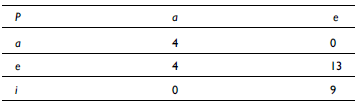




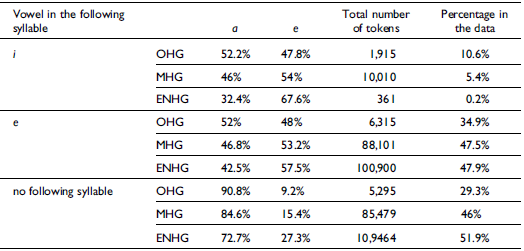

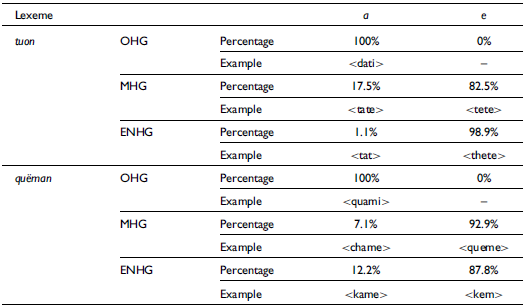


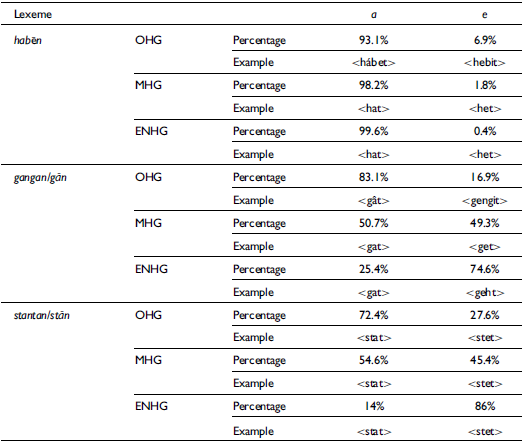
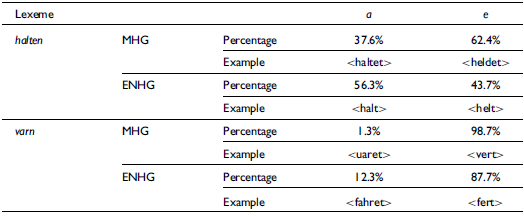


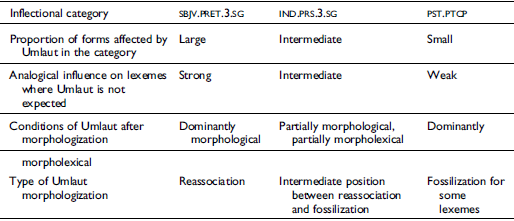


 Open access

