





1. Introduction
Ample research, both synchronic and diachronic, exists about factors influencing the variable order of direct and indirect objects in German (1).
(1)
a.
Ich
gebe
dem
Athleten
den
Ball.
I
give
the-dat.sg
athlete-dat.sg
the-acc.sg
ball-acc.sg
‘I give the athlete the ball.’
b.
Ich
gebe
den
Ball
dem
Athleten.
I
give
the-acc.sg
ball-acc.sg
the-dat.sg
athlete-dat.sg
‘I give the ball to the athlete.’
German speakers can place a nominal dative object (Dat) before a nominal accusative object (Acc), as in (1a). This is the most common, unmarked order (Lenerz Reference Lenerz1977, Hoberg Reference Hoberg, Ágel, Eichinger, Eroms, Hellwig, Heringer, Lobin and Rau2006:867 among others). A preference for Dat>AccFootnote 1 has generally been attested for German from the oldest stages of the language (Behaghel Reference Behaghel1932, Speyer Reference Speyer, Featherston and Vearsley2016); it was present in Middle High German (MHG, 1050–1350; Speyer Reference Speyer, Gippert and Gehrke2015) and Early New High German (ENHG, 1350–1650; Speyer Reference Speyer2011), and is dominant in modern German (Lenerz Reference Lenerz1977). However, speakers can also put the accusative object before the dative object, as in (1b), and thereby create the less common, marked order.
Thus, research has mostly focused on explaining Acc>Dat cases. These explanations center around four areas: syntax, complexity, semantics, and pragmatics. Syntactic explanations often take up case hierarchy (Primus Reference Primus and Siewierska1998). Complexity is linked to Behaghel’s law of increasing constituents (short>long) (Behaghel Reference Behaghel1932). The semantic factors are animacy (animate>inanimate) (Hoberg Reference Hoberg1981) and definiteness (definite>indefinite) (e.g. Engel Reference Engel and Engel1970, Lenerz Reference Lenerz1977). The pragmatic factor of givenness (Prince Reference Prince and Cole1981, Gundel, Hedberg, & Zacharski Reference Gundel, Hedberg and Zacharski1993, Féry & Krifka Reference Féry, Krifka and van Sterkenburg2008 among others) is the most prominent one to explain the marked order. The given object precedes the new object, even if this results in Acc>Dat (e.g. Lenerz Reference Lenerz1977, Zifonun, Hoffmann, & Strecker Reference Zifonun, Hoffmann and Strecker1997, Rauth Reference Rauth2020). Rauth (Reference Rauth2020) has shown that givenness has influenced the object order since the Old High German period (750–1050).
So, why should one write another article about such a well-researched phenomenon? Because previous research has not sufficiently included two factors that can also be relevant to the phenomenon: prediction and processing. This study aims to discover whether the object order is influenced by the position of the lexical verb as an approximation to grammatical prediction and the uniformity of the lexical information profile.
Both the position of the lexical verb (FV-position) and the Uniform Information Density (UID) hypothesis by Levy & Jaeger (Reference Levy, Florian Jaeger, Schölkopf, Platt and Hofmann2007) and earlier ideas by Aylett & Turk (Reference Aylett and Turk2004) are linked to processing. Processing is understood here in terms of information density (Shannon Reference Shannon1948, Fenk-Oczlon Reference Fenk-Oczlon1983, Levy Reference Levy2008 among others). Information theory has been extensively applied to connect the likelihood of linguistic elements appearing in an utterance, the so-called surprisal (Hale Reference Hale2001), with the cognitive effort needed to process that utterance. A low surprisal value, that is very likely content, is linked to less processing effort than a high surprisal value (Hale Reference Hale2001). According to Levy & Jaeger (Reference Levy, Florian Jaeger, Schölkopf, Platt and Hofmann2007), speakers plan their utterances to accommodate an information profile that is as uniform as possible to prevent cognitive capacity from being overloaded. Furthermore, Cuskley and colleagues (Reference Cuskley, Bailes and Wallenberg2021), among others, show that the uniformity of an information profile can also be achieved by changing the word order. They develop a measure of the uniformity of a sentence with DORM (D eviation o f the R olling M ean), which has been applied to the Dat>Acc order problem by Ortmann and colleagues (Reference Ortmann, Voigtmann, Dipper, Speyer, Lemke, Schäfer and Reich2024).
To my knowledge, Ortmann and colleagues (Reference Ortmann, Voigtmann, Dipper, Speyer, Lemke, Schäfer and Reich2024) presented the only study considering UID as an explanation for the object order variation in German so far. They find that the order with the smoothest information profile, compared to an also plausible order, is the one found in corpus data.
The current study uses methods from Ortmann and colleagues (Reference Ortmann, Voigtmann, Dipper, Speyer, Lemke, Schäfer and Reich2024) but extends the scope of their research twofold: First, this is done by also considering the variable position of the lexical verb in German. Placing the lexical verb at the end delays access to the information conveyed by the verb such as its valency. When the verb is, however, placed in the second position, its grammatical information is presented early and the effort to predict its dependents is reduced. This refers to ideas presented by Fenk-Oczlon (Reference Fenk-Oczlon1983), Konieczny (Reference Konieczny1996), Levy (Reference Levy2008), and Ferrer-i-Cancho (Reference Ferrer-i-Cancho2024).
Second, this study includes texts from Early New High German (ENHG) to modern German to account for a possible language change. Rauth (Reference Rauth2020) and Speyer (Reference Speyer2011, Reference Speyer, Gippert and Gehrke2015) showed more object order variability in ENHG, making Acc>Dat more frequent then. Recipients then might have been more sensitive to information-theoretic conditions and chosen the constituent order accordingly. Information density could, however, also be stable over time. Thus, a corpus study was conducted on the Anselm corpus (Dipper & Schultz-Balluff Reference Dipper and Schultz-Balluff2013), the RIDGES corpus (Lüdeling et al. Reference Lüdeling, Odebrecht, Krause, Schnelle and Fischer2011), the GerManC corpus (Bennett et al. Reference Bennett, Durell, Ensslin, Scheible and Whitt2012) for historical German, and the TIGER corpus (Brants et al. Reference Brants, Dipper, Eisenberg, Silvia Hansen-Schirra, Lezius, Rohrer, Smith and Uszkoreit2004), as well as the TüBa-D/Z corpus (Telljohann et al. Reference Telljohann, Hinrichs, Kübler, Zinsmeister and Beck2017) for modern German.
Based on this data, this study aims to answer the following research questions: Is the word order variation in the German middle field connected to UID? Does the position of the lexical verb influence the object order? Do these factors influence the object order independently or are there interactions with other known factors like givenness and length? Is there a change over time?
The structure of this article is as follows: Section 2 presents the concepts of information theory used in this study and the already-known factors that influence the object order. Section 3 portrays the corpus. In section 4, the annotations and factors included in the regression analysis are described. Crucially, section 4 also describes why the position of the lexical verb can influence the object order in more detail. In section 5, the results are presented before they are discussed in section 6. Section 7 summarizes the article.
2. Theoretical background
2.1 Information-theoretic accounts
Surprisal
Shannon (Reference Shannon1948) laid down the foundation of information theory in describing a mathematical theory of communication in terms of the expectancy of words in context. To ensure a successful transfer through a channel with limited capacity, the error rate of a signal can be reduced by adding redundancy in such a way that the channel capacity is optimally utilized (Shannon Reference Shannon1948). This is possible as words (or constituents) are not independent of one another (2).
(2)
a.
I bake a cake.
b.
I see a cake.
On the one hand, cake is highly expected after bake in (2a). See, on the other hand, does not make cake very likely in (2b). Being, thus, less expected in (2b), cake carries more information there than in (2a). The information of an element and its probability are negatively correlated: The more likely an element is, the less information it carries and vice versa. This likelihood can be calculated as the surprisal value (Hale Reference Hale2001):
 $$S\left( {unit} \right) = - {\log _2}p(unit|context)$$
The surprisal value is connected to processing difficulty (Hale Reference Hale2001). High surprisal values indicate more processing effort (e.g. Hale Reference Hale2001, Demberg & Keller Reference Demberg and Keller2008). Accordingly, surprisal has been used as an approximation to and prediction for processing difficulties in both modern (Levy & Jaeger Reference Levy, Florian Jaeger, Schölkopf, Platt and Hofmann2007, Demberg & Keller Reference Demberg and Keller2008, Gibson et al. Reference Gibson, Futrell, Piantadosi, Dautriche, Mahowald, Bergen and Levy2019, Boyce & Levy Reference Boyce and Levy2023 among others) and historical data (e.g. Degaetano-Ortlieb et al. Reference Degaetano-Ortlieb, Kermes, Khamis, Teich, Suhr, Nevalainen and Taavitsainen2018, Degaetano-Ortlieb & Teich Reference Degaetano-Ortlieb and Teich2022).
The surprisal values are, of course, also dependent on the amount of context, described as n-grams. Unigram-models, as used by Cuskley and colleagues (Reference Cuskley, Bailes and Wallenberg2021) and Wallenberg and colleagues (Reference Wallenberg, Bailes, Cuskley and Karl Ingason2021), only consider the frequency of a word. Unigram-surprisal can still be linked to processing as frequent words are easier to process (e.g. Divjak Reference Divjak2019, Díaz-Campos & Balasch Reference Díaz-Campos and Balasch2023).
Furthermore, “[t]here is ample evidence … that sentence comprehension is incremental: we do not wait until we have heard an entire sentence to start disambiguating and comprehending” (Levy Reference Levy2008:1129). Levy (Reference Levy2008) argues that recipients implicitly predict the upcoming word based on the input they have received thus far. After having comprehended only partial input, they keep various options about the sentence continuation in mind. Recipients assign different probabilities to these possible continuations. Cognitive capacity is consumed when a probable continuation is ruled out and the other possible clause continuations obtain a new (higher) probability assignment (Levy Reference Levy2008).
This has implications for word order. Most constituent functions are only assigned once per clause. Accordingly, having seen a subject eliminates the expectation of seeing another subject and the likelihood that any other object is presented next increases. This also holds for the verb in (S)OV-clauses (Levy Reference Levy2008). The more constituents have appeared in the clause, the more likely the verb becomes (Levy Reference Levy2008, Ferrer-i-Cancho Reference Ferrer-i-Cancho2024). However, predicting the verb lexeme is much harder in SOV languages like Japanese (Engelhardt, Filipović, & Hawkins Reference Engelhardt, Filipović and Hawkins2024). Engelhardt and colleagues (Reference Engelhardt, Filipović and Hawkins2024) also show that predicting a certain noun after having seen a verb is more successful.
To summarize: Processing difficulties are linked to the expectancy of words (or constituents) in a clause. The context can change how likely a word is; thus, the likelihood depends on the context, but also on the pure frequency of a specific word. The more likely or frequent a word is, the less cognitive effort is required to understand that word. The likelihood of a word either in a context or without a context can be calculated using the surprisal equation.
The Uniform Information Density hypothesis
Surprisal theory implies that elements differ in informativeness. This idea has been taken up by Aylett & Turk (Reference Aylett and Turk2004) in the Smooth Signal Redundancy hypothesis and Levy & Jaeger (Reference Levy, Florian Jaeger, Schölkopf, Platt and Hofmann2007) in the Uniform Information Density (UID) hypothesis. The two hypotheses basically state that speakers distribute the information in a clause as evenly as possible (see also ideas in, for instance, Fenk-Oczlon Reference Fenk-Oczlon1983). The advantages of UID are described by Collins (Reference Collins2014:656): “By transmitting the signal at a constant rate …, speakers ensure that their message is being communicated as rapidly as possible. At the same time, since every component of the utterance carries roughly the same amount of information, the signal is robust enough to withstand degradation from noise.”
Accordingly, speakers aim to avoid peaks as well as troughs in the information profile. Levy & Jaeger (Reference Levy, Florian Jaeger, Schölkopf, Platt and Hofmann2007) focus on that-omission at the onset of a relative clause. They show that the relative pronoun is omitted when the first word of the relative clause is highly expected (Levy & Jaeger Reference Levy, Florian Jaeger, Schölkopf, Platt and Hofmann2007). In this case, the first word of the relative clause must carry its own meaning and indicate the relative clause. This double task is too much to process when the first word of the relative clause is itself highly informative (Levy & Jaeger Reference Levy, Florian Jaeger, Schölkopf, Platt and Hofmann2007). They claim that an overt or omitted relative pronoun changes the information profile and helps to smooth out the information profile of the whole (relative) clause. The UID hypothesis has been successfully applied in various studies, but there have also been mixed and negative results (see Juzek (Reference Juzek2024) for an overview). Recently, UID has also been employed in studies about word order variation.
Collins (Reference Collins2014:652) “reviews three psycholinguistic models of the relationship between syntactic alternations and processing: Maximum Per Word Surprisal (MPWS) … Uniform Information Density (UID) (Levy & Jaeger Reference Levy, Florian Jaeger, Schölkopf, Platt and Hofmann2007; inter alia), and Dependency Length Minimization (DLM)” using a context-free grammar of English. He hypothesizes that a more uniform word order is preferred over a less frequent one and asks whether this smoother information profile is achieved through “great global variability, but minimal local variability” or a profile “centered globally around a mean” (Collins Reference Collins2014:657). Whether UID in both forms can replicate DLM predictions or explain cases where DLM makes none is tested in a choice experiment. Participants favor the alternative with a more uniform information profile, regardless of its form (Collins Reference Collins2014:672). Meister and colleagues (Reference Meister, Pimentel, Haller, Jäger, Cotterell and Levy2021) come to similar conclusions.
In contrast to Collins (Reference Collins2014), Cuskley and colleagues (Reference Cuskley, Bailes and Wallenberg2021) and Wallenberg and colleagues (Reference Wallenberg, Bailes, Cuskley and Karl Ingason2021) investigate the influence of word order variation on the information profile using word and lemma probability. Cuskley and colleagues (Reference Cuskley, Bailes and Wallenberg2021) state that a uniform information profile is one with as little clustering of low or high surprisal values as possible. They develop DORM to calculate this uniformity. Basically, they “take the arithmetic mean of every adjacent, overlapping pair of information content values (i.e. a rolling mean) … then compute the sample variance of the resulting list of means (an unbiased estimator, using denominator n − 1) and arrive at a single number, the DORM” (Cuskley et al. Reference Cuskley, Bailes and Wallenberg2021:4). The calculation of the DORM is described in section 4.2.
To sum up: The Uniform Information Density hypothesis states that information should be distributed as uniformly as possible over a sentence, that is, one should avoid peaks and troughs. Originally it was used to describe and explain the variation of single words. Lately, word order variations and their influence on the uniformity of a whole sentence have come into focus.
2.2 Factors influencing the object order
Information structure in terms of givenness
One of the most influential factors to cause the Acc>Dat order is information structure (Féry & Krifka Reference Féry, Krifka and van Sterkenburg2008), especially givenness (Lenerz Reference Lenerz1977, Rauth Reference Rauth2020). The given>new constraint states that information that is presumed to be familiar to the recipient is placed before new information. Still, the constraint should not be interpreted as always requiring given information to precede new, but rather as a guideline that can sometimes override the default constituent order of Dat>Acc, as in (3).
(3) Context: Sarah tells her new colleague about the meager carrots in her garden. Originally, she wanted to offer her colleague some carrots. But now, Sarah says: The harvest is so bad…
Ich
kann
die
Karotten
nur
dem
Pferd
geben.
I
can
the-acc.pl
carrots-acc.pl
only
the-dat.sg
horse-dat.sg
give
‘I can give the carrots only to the horse.’Footnote 2
In (3), the carrots have already been mentioned in the context sentence and, thus, are given, while the horse has not been mentioned in the context. It is new information. Placing carrots before horse violates Dat>Acc, but it keeps the preference for given>new.
Following Féry & Krifka (Reference Féry, Krifka and van Sterkenburg2008), Prince (Reference Prince and Cole1981), and Gundel and colleagues (Reference Gundel, Hedberg and Zacharski1993), referents that have not been mentioned in the previous discourse are considered new. Besides given and new referents, there are also inferable referents (e.g. Prince Reference Prince and Cole1981). These referents need not have been mentioned in the discourse, but they relate to other events or referents: For example, every school class has a teacher. Accordingly, the accommodation of a teacher in a school context is expected. Teacher would be annotated as inferable.
While Jachmann and colleagues (Reference Jachmann, Drenhaus, Delogu and Crocker2024) found that inferable referents are regarded more like new referents, Rauth (Reference Rauth2020) describes a similar behavior for inferable and given referents in the way that they are more likely to precede new referents. In general, givenness is described by Rauth (Reference Rauth2020) as one of the most relevant factors for the object order in dialects. When the accusative object is given and the dative object is new, the Acc>Dat order is favored, as in (3). This factor is stable throughout MHG and ENHG. Givenness seems, however, to become less crucial over time (Rauth Reference Rauth2020:314).
Length
Behaghel (Reference Behaghel1932:6) has shown the importance of length in his Gesetz der wachsenden Glieder (‘law of increasing constituents’). If there is a length difference, the longer argument is placed behind the shorter one. In (4), the accusative object has only two words, but the dative object has six words. Therefore, the Acc>Dat order can be used.
(4)
Gestern
erzählte
sie
die
Geschichte
yesterday
told
sie
the-acc.sg
story-acc.sg
dem
unglaublich
netten
und
begeisterten
Zuhörer.
the-dat.sg
incredibly
nice
and
keen
listener-dat.sg
‘Yesterday, she told the story to the incredibly nice and keen listener.’
Heine & König (Reference Heine and König2010) discussed the importance of the constituent length for the deviation from the unmarked constituent order also for other languages with a more restricted word order than German: “Whenever there is a heavy argument then it follows the light one” (Heine & König Reference Heine and König2010:102), but still, they also say that information-structural notions have a stronger influence.
In general, variable object order can be found in many languages. Especially English word order variation is connected to heaviness and offers the possibility to put DOs before IOs (Dative Alternation; see e.g. Bresnan Reference Bresnan, Featherston and Sternefeld2007), which must then be represented as prepositional phrases (PPs). The same type of alternation is also, for example, possible in Dutch (Colleman Reference Colleman2009) and northern languages like Swedish (Valdeson Reference Valdeson2021).
Information Theory
Ortmann and colleagues (Reference Ortmann, Voigtmann, Dipper, Speyer, Lemke, Schäfer and Reich2024) have proposed an information-theoretic account for the variable object order in the German middle field. Their hypothesis is that a specific object order is chosen to create a smooth flow of information while the alternative word order would have led to a more uneven information profile. They conducted a corpus study using the SdeWaC corpus (Faaß & Eckart Reference Faaß, Eckart, Gurevych, Biemann and Zesch2013) from which they automatically extracted more than 13,000 object pairs. These pairs are both located in the same middle field, have the same length, and one definite and one indefinite article. The latter serves as an approximation to givenness (see e.g. Heim (Reference Heim1982) or Hauenschild (Reference Hauenschild, Jacobs, von Stechow, Sternefeld and Vennemann1993) for the connection between givenness and definiteness). Lemma-based bigram models were used to estimate the probability of words. Then, the DORM values for each sentence were calculated on the mean surprisal value of the constituents.
To test their hypothesis, the authors created a variant for each sentence with the reversed object order (Acc>Dat if the original sentence held Dat>Acc and vice versa) and recalculated both the bigram-surprisal values and the DORM values. The DORM values of the variant were subtracted from the DORM values of the original clauses to create “DORMdiff” (Ortmann et al. Reference Ortmann, Voigtmann, Dipper, Speyer, Lemke, Schäfer and Reich2024:71). The authors expected that value to be significantly below zero if the not-produced variant had a less uniform information profile. However, they did not find the expected significant result for the Acc>Dat order, though the DORMdiff was negative on average but not significantly different from zero (Ortmann et al. Reference Ortmann, Voigtmann, Dipper, Speyer, Lemke, Schäfer and Reich2024:73). For the Dat>Acc order, they were able to show the expected results (Ortmann et al. Reference Ortmann, Voigtmann, Dipper, Speyer, Lemke, Schäfer and Reich2024:73).
Next, the authors conducted general logistic regression to predict the object order in the original sentences (Ortmann et al. Reference Ortmann, Voigtmann, Dipper, Speyer, Lemke, Schäfer and Reich2024:75–79). They found: “A higher DORMcase reduces the likelihood of observing DAT > ACC. … Hence, a more uniform, smoother distribution for the order ACC > DAT increases the likelihood of observing this marked order in the sentence” (Ortmann et al. Reference Ortmann, Voigtmann, Dipper, Speyer, Lemke, Schäfer and Reich2024:77). Furthermore, DORMgiv can also predict the order of definite and indefinite objects (Ortmann et al. Reference Ortmann, Voigtmann, Dipper, Speyer, Lemke, Schäfer and Reich2024:79). The known influence of definiteness is also a relevant predictor for the object order (Ortmann et al. Reference Ortmann, Voigtmann, Dipper, Speyer, Lemke, Schäfer and Reich2024:77–79): The authors show that the definite object is mostly placed before the indefinite one.
The current study uses methods from Ortmann and colleagues (Reference Ortmann, Voigtmann, Dipper, Speyer, Lemke, Schäfer and Reich2024), namely the application of DORM and the methods to automatically find dative and accusative objects in the same middle field.
3. Data
3.1 Corpora and preprocessing
The current article presents a corpus study covering the fourteenth to the twenty-first century.Footnote 3 The corpora used are: Anselm (Dipper & Schultz-Balluff Reference Dipper and Schultz-Balluff2013), RIDGES (Lüdeling et al. Reference Lüdeling, Odebrecht, Krause, Schnelle and Fischer2011), GerManC (Bennett et al. Reference Bennett, Durell, Ensslin, Scheible and Whitt2012), TIGER (Brants et al. Reference Brants, Dipper, Eisenberg, Silvia Hansen-Schirra, Lezius, Rohrer, Smith and Uszkoreit2004), and TüBa-D/Z (Telljohann et al. Reference Telljohann, Hinrichs, Kübler, Zinsmeister and Beck2017). All these corpora are at least tokenized, normalized, lemmatized, and POS-tagged.
The corpora were chosen because they have syntactic and/or morphological information that allows one to automatically find sentences with at least one dative and one accusative object in the same middle field, thus speeding up the annotation process. At first, all dative and accusative objects were identified regardless of whether they are both nominal, both pronominal, or one is nominal and one pronominal.Footnote
4
Here, only sentences like (5) are included.
(5)
Der
Kaiser
hat
[dem
Prinzen
von
Conde]
the
emperor
has
[the-dat.sg
prince-dat.sg
of
Conde]
[das
hiesige
ehemalige
Czernechissche
Palais]
geschenkt.
the-acc.sg
local
former
Czernechis
palace-acc.sg]
donated
‘The emperor donated the local former Czernechis palace to the prince of Conde.’ (GerManC, NEWS_P3_NoD_1798_danzig, 2)
The exclusion of pronominal and mixed object pairs was carried out using the POS tags of the dative and accusative phrases’ heads.
The CLASSIG pipeline (Ortmann Reference Ortmann2022) was used for the topological field model and the constituent annotation. Accusative and dative objects were identified as noun phrases (NPs) with Acc or Dat in the morphological annotation or based on the dependency parsing already presented in their corpus. Subsequently, sentences containing at least one middle field span that dominates both an identified accusative token and an identified dative token were selected. The corresponding constituent from the constituency tree was then extracted, and the dominant tokens were pre-annotated. Student research assistants manually checked every automatic annotation and corrected them, if necessary, using INCEpTION (Klie et al. Reference Klie, Bugert, Boullosa, de Castilho and Gurevych2018). The following paragraphs briefly describe the corpora and the relevant information for this study. After every description, an example from each corpus is given.
The Anselm corpus is based on the “Interrogatio Sancti Anselmi de Passione Domini,” a fictional dialog between the Virgin Mary and St. Anselm about the Passion (Dipper & Schultz-Balluff Reference Dipper and Schultz-Balluff2013:29). It comprises about 50 texts from the fourteenth to sixteenth century with more than 405,000 tokens in total, without specifying their publication date. The texts are fully manually annotated and written in various dialects (Dipper & Schultz-Balluff Reference Dipper and Schultz-Balluff2013:29).
(6)
und
danach
sendet
er
seinen
jüngern
and
then
sends
he
his-dat.sg
disciples-dat.sg
den
heiligen
geist.
the-acc.sg
holy-acc.sg
spirit-acc.sg
‘and then, he sends his disciples the holy spirit.’ (Anselm, Ba 501)
The RIDGES corpus consists of 73 herbology texts with 305,056 dipl-tokens from 1482 to 1914 (Odebrecht et al. Reference Odebrecht, Schnelle, Fischer and Perlitz2020:7). Here, only texts before 1650 are included. Furthermore, information about the publication date, location, and author are available.
(7)
Die
Hirten
und
Schäfer
geben
dem
Rind,
Vieh
the
herders
and
shepherds
give
the-dat.sg
cow-dat.sg
cattle-dat.sg
und
Schafen,
gedörrte
zerstoßene
and
sheep-dat.pl
dried-acc.pl
crushed-acc.pl
Wermutblumen
mit
Salz
wider
mancherlei
wormwood.flowers-acc.pl
with
salt
against
various
innerliche
Gebresten.
internal
Ailments
‘The herders and shepherds give the cattle, cows and sheep, dried crushed
wormwood flowers with salt, against various internal ailments.’ (RIDGES, NewKreueterbuch_1563_Handsch, 64)
The GerManC corpus includes texts from 1654 to 1799 and consists of about 800,000 tokens (Bennett et al. Reference Bennett, Durell, Ensslin, Scheible and Whitt2012:2). The genres in the GerManC are drama, humanities, legal texts, letters, narrative prose, newspapers, scientific texts, and sermons (Bennett et al. Reference Bennett, Durell, Ensslin, Scheible and Whitt2012:2). Information about the year of publication of the texts is also provided. The texts contain annotations for the “sentence boundaries …, grammatical function & dependency information” (Bennett et al. Reference Bennett, Durell, Ensslin, Scheible and Whitt2012:7–8). The example is already given in (5).
The TIGER corpus is one of two modern corpora here. It is approximately 900,000 tokens large and contains 50,000 sentences from the newspaper Frankfurter Rundschau. It contains syntactic annotations (Brants et al. Reference Brants, Dipper, Eisenberg, Silvia Hansen-Schirra, Lezius, Rohrer, Smith and Uszkoreit2004).
(8)
Der
Guardian
widmete
dem
Thema
kürzlich
the
Guardian
devoted
the-dat.sg
topic-dat.sg
recently
sechs
Sonderseiten
six-acc.pl
pages-acc.pl
‘The Guardian recently devoted six special pages to the topic’ (TIGER,
1746_0001, 9)
The Tübinger Baumbank des Deutschen/Zeitungskorpus (TüBa-D/Z) is syntactically annotated and based on written language data from the German newspaper Die Tageszeitung (Taz) (Telljohann et al. Reference Telljohann, Hinrichs, Kübler, Zinsmeister and Beck2017). It includes more than 3,000 articles, more than 100,000 sentences, and nearly two million tokens. It is manually annotated. The topological field and a sentence annotation already exist for this corpus.
(9)
Ein
Experte
enthüllt
die
Körpersprache
und
an
expert
reveals
the
body_language
and
gibt
Politikern
gute
Tips.
gives
politicians-dat.pl
good-acc.pl
tips-acc-pl
‘An expert reveals body language and gives politicians good tips.’ (TüBa-D/Z, 2241_tuebadz, 3)
3.2 Data overview
Due to the different corpus sizes, the number of annotated sentences varies between the five corpora (figure 1). Most clauses were taken from TüBa-D/Z (n = 827, Acc>Dat: n = 84), followed by TIGER (n = 494, Acc>Dat: n = 24), GerManC (n = 345, Acc>Dat: n = 35), RIDGES (n = 35, Acc>Dat: n = 4) and Anselm (n = 32, Acc>Dat: n = 6) corpus. In total, 1733 sentences have been included in the analysis. 153 of these sentences have the Acc>Dat order (8.83 percent). The ratio of the object orders is similar to observations made by Røreng (Reference Røreng2011:10).
Number of sentences per corpus.Footnote 5

Since the GerManC covers 145 years, the data was divided into centuries rather than corpora. Data from the fourteenth to sixteenth century was merged and is presented as sixteenth-century data (figure 2) as the exact date of the texts in the Anselm corpus is not given. Even with the merged data, the oldest texts only account for 3.69 percent of all instances. The seventeenth-century texts comprise 5.77 percent of the data, the eighteenth-century texts 14.31 percent, and the modern data accounts for 76.23 percent of all data. Due to the sparsity of data in the historical corpora, dialects are ignored even if the information is given. The different genres are also not considered because the modern data only consists of newspaper articles. Furthermore, no genre-dependent effect is expected.
Number of annotated sentences per century.

For each century, less than 20 percent of all annotated sentences show the Acc>Dat order (figure 3). This number decreases, however, over time. In the ENHG data, 15.62 percent of all sentences place the accusative object before the dative object. That number drops to about 10 percent in the seventeenth and eighteenth centuries and to 8.18 percent in the modern data.
Distribution of the object orders per century.

Despite the uneven distribution of both object orders and centuries, I will not draw a sample from the (modern) texts but interpret the results of the analysis, presented in section 5, with these skewed distributions in mind.
The data was downloaded from INCEpTION (Klie et al. Reference Klie, Bugert, Boullosa, de Castilho and Gurevych2018). For all these sentences, the position of the full verb, the surprisal values for each lemma, and, based on them, the DORMcalib for each sentence as well as the length and the givenness status of both objects were determined, as described in the following section.
4. Annotation
4.1 The position of the lexical verb
The topological field model
Ortmann and colleagues (Reference Ortmann, Voigtmann, Dipper, Speyer, Lemke, Schäfer and Reich2024), Rauth (Reference Rauth2020), and the current study focus on the relative order of the dative and accusative objects in the so-called middle field, the position between the Linke Satzklammer (‘left sentence bracket’, LSB) and the Rechte Satzklammer (‘right sentence bracket’, RSB) (Wöllstein Reference Wöllstein2014). The description of German clauses using the Topologisches Feldermodell ‘topological field model’ captures the difference between the position of the finite and lexical verb best (Haftka Reference Haftka, Jacobs, von Stechow, Sternefeld and Vennemann1993, Wöllstein Reference Wöllstein2014, Telljohann et al. Reference Telljohann, Hinrichs, Kübler, Zinsmeister and Beck2017, Höhle Reference Höhle, Müller, Reis and Richter2019).Footnote 6
There, German clauses are described in terms of the position of the finite verb. This does not, however, suffice with reference to the position of the lexical verb. Only in the synthetic verb forms present and preterit active are the lexical and finite verbs the same and they stand in the LSB in independent main (V2) clauses. All other tenses and passive voice are analytic. Thus, the finite verb can be placed in the LSB, but the lexical verb is in the RSB. Independent of synthetic or analytic tenses and voices, both finite and infinite verbs are in the RSB in subordinate clauses that are opened by a relative, a wh-pronoun, or a subjunction, or that do not have an overt opening, excluding conditional subordinate V1-clauses. Thus, the lexical verb and its valency information are not presented until near the end of these VL-clauses, which can cause processing difficulties in German (e.g. Konieczny Reference Konieczny1996:80–100).
The position of the lexical verb is in all those cases determined by grammar. Variation is possible only in a few cases such as substituting the synthetic preterit with the analytic perfect tense in V2-clauses (Hennig Reference Hennig2000:29–31). Since there is no real variation possible both in V2- and VL-clauses and in both clause types the same principles of prediction should apply, it is possible to count main and subordinate clauses together as is done here.
To describe the position of the lexical verb in the clause that contains the double object construction, as in (10), I apply the notation FV-V2 (‘full verb in V2’), where the full verb occupies the second position, independent of the overtness of the prefield. Clauses with the full verb in the RSB, as in (11), are called FV-VL (‘full verb in VL’). The latter notation is independent of the classical description of the position of the finite verb.
(10)
Der
Kompromiß
[…]
gibt
der
ARD
gerade
fünf
Jahre
Zeit.
the
compromise
[…]
gives-FV
the
ARD
just
five
years
time
‘The compromise […] gives ARD just five years.’ (TüBa-D/Z, 1940_tuebadz, 5)
(11)
Ansonsten
kann
man
die
Entscheidung
über
die
Qualität
otherwise
can
one
the
decision
about
the
quality
der
beiden
Shows
beruhigt
dem
Publikum
überlassen.
the
two
shows
calmly
the
audience
leave-FV
‘Otherwise, the decision about the quality of the two shows can be left
calmlyto the audience.’ (TüBa-D/Z, 0255_tuebadz, 5)
Processing dependent on the verb position
Levy (Reference Levy2008) generally claims that recipients predict upcoming material which implies that a grammatical category like the predicate becomes more expected the more constituents precede it. Konieczny (Reference Konieczny1996) shows these differences in processing and that they depend on the position of the lexical verb. In the case of attachment ambiguities of NPs in German, for example, processing difficulties were smaller for FV-V2 clauses than for FV-VL clauses.
Building on this, I argue that the object order is related to prediction and to the position of the full verb. The full verb crucially carries the valency information. Only in processing it does the recipient know which arguments are needed in the sentences. In FV-VL clauses such as (11), however, this information is delayed. The recipient is left with uncertainty about the arguments in the clause. This uncertainty can be reduced by choosing an object order which reduces the amount of possible full verbs. For German, this object order is the Dat>Acc order.
When the dative object is placed before the accusative object, recipients should discard sentence continuations with a transitive verb and rank those with a ditransitive or intransitive verb higher, following Levy (Reference Levy2008). Since ditransitive or intransitive verbs are less frequent than transitive verbs (e.g. De Knop & Mollica Reference De Knop, Mollica, Ibáñez, Oyón and Pérez Sobrino2017:208), fewer sentence continuations are possible then. This limitation should facilitate the processing of the whole clause. Moreover, it might also be beneficial for the sentence production. Thus, in the VF-VL case, the Dat>Acc order should be (even more) favored.
On the other hand, there are the FV-V2 clauses where the verb valency is known to the recipient early. According to Fenk-Oczlon (Reference Fenk-Oczlon1983:30), who described the SVOFootnote 7 order of simple sentences as the most natural in terms of information distribution, the presentation of the verb before the object “already facilitates the reduction of uncertainty for the recipient to such an extent that further means of generating redundancy can be dispensed with” (translation, S.V.). Thus, if the full verb is presented in the LSB (FV-V2), Acc>Dat should be more possible because the recipients and speakers know that a dative and an accusative object must be placed in the clause at some point. A certain order of the two objects is less crucial to reduce uncertainties.
However, free datives (Mollica Reference Mollica, Schierholz and Giacomini2018), which are not distinguishable from dative objects by their form (De Knop & Mollica Reference De Knop, Mollica, Ibáñez, Oyón and Pérez Sobrino2017), pose a problem for that hypothesis. They are not required for the grammaticality or semantic correctness of a clause and can, hence, be combined with transitive verbs (e.g. Hole Reference Hole, Alexiadou, Kiss and Müller2012).Footnote
8
If my aforementioned assumption is correct, placing a free dative before an accusative object would trigger the prediction of a di-/intransitive verb and its valency structure for the whole clause. Accordingly, processing difficulties would then occur at the latest on the lexical verb in the RSB (12a,b), which should not be the case in the correctly predicted structure. Nonetheless, the processing difficulties on the RSB should also occur in the Acc>Dat order. In this order, difficulties can also already appear on the dative object itself.
(12)
a.
Er
wird
seinem
Bruder
das
Auto
waschen
he
will
his-dat.sg
brother-dat.sg
the-acc.sg
car-acc.sg
wash.
‘He will wash the car for his brother.’
b.
Er
wird
das
Auto
seinem
Bruder
waschen
he
will
the-acc.sg
car-acc.sg
his-dat.sg
brother-dat.sg
wash.
‘He will wash the car for his brother.’
c.
Er
wäscht
das
Auto
seinem
Bruder.
he
washes
the-acc.sg
car-acc.sg
his-dat.sg
brother-dat.sg
‘He washes the car for his brother.’
Following this argumentation, free datives can cause problems with the prediction of the exact verb lexeme in the RSB which cannot easily be solved by a variation in the object order in the FV-VL clauses. A clear prediction for those clauses cannot be given yet. The FV-V2 clauses in (12c) should allow both orders due to the processing advantages of presenting the full verb early.
Annotation of the verb position
The information about whether a clause is FV-V2 or FV-VL is gained using the POS-tags from the corpora and the annotation of the LSB (Ortmann Reference Ortmann2022). If the POS-tag is VVFIN or VVIMP (Schiller et al. Reference Schiller, Teufel, Stöckert and Thielen1999:7), the sentence has a VF-V2 word order, as in (10), and is annotated as such. For all other cases, including empty LSBs, the clause is annotated as FV-VL, as in (11). This includes subordinate clauses.
4.2 Surprisal calculation and DORM
Surprisal calculation
The surprisal values used in this study were computed as unigram surprisal values calculated on a lemma basis as in Wallenberg and colleagues (Reference Wallenberg, Bailes, Cuskley and Karl Ingason2021). This lemma-based calculation and the removal of all punctuation addresses the variability inherent in historical texts. German lacked an orthographic standardization until 1901 (e.g. Wolf Reference Wolf2022:16). That often resulted in significant discrepancies among words. Furthermore, the amount of historical data is too sparse to get good enough results for even normalized data (see section 3.2 and figure 1). Making data more similar, for example by lemmatization, is one way to work with limited resources (Manning & Schütze Reference Manning and Schütze2005, Lemnitzer & Zinsmeister Reference Lemnitzer and Zinsmeister2015 among others).
A further and more crucial advantage of the lemma-based surprisal calculation is that it neutralizes grammatical information, such as case, number, grammatical gender; see (13).
(13)
dass
d-
Kind
d-
Dame
d-
Mann
zeigen
that
the
child
the
lady
the
man
show
A sentence like (13) is the input for the surprisal and for the DORM calculation, described below. Case, number and grammatical gender are even in the ENHG period (already) mostly coded on the article. When the form of the article is kept the same, one cannot be certain about the case of any article. Thus, (13) could be derived from both (14a) and (14b).
(14)
a.
dass
das
Kind
der
Dame
that
the-nom.sg
child-nom.sg
the-dat.sg
lady-dat.sg
den
Mann
zeigt
the-acc.sg
man-acc.sg
show
‘that the child shows the lady the man’
b.
dass
das
Kind
den
Mann
that
the-nom.sg
child-nom.sg
the-acc.sg
man-acc.sg
der
Dame
zeigt
the-dat.sg
lady-dat.sg
show
‘that the child shows the lady to the man.’
Example (14a) is the more likely word order, but the surprisal calculation does not know that and due to the word order freedom, (14b) is also possible.
As a basis for the surprisal value calculation, the different corpora were used. The method of calculating surprisal values across the corpora annotated so far, rather than centuries, was selected primarily for the differing lemmatizations between the corporaFootnote 9 as the sixteenth- and seventeenth-century data and modern data are built by two different corpora each.
Finally, the surprisal values were calculated in the following way: The probability of each lemma in each corpus was determined. All punctuation was removed. The surprisal value, then, equals the negative log2-probability of that lemma probability (Hale Reference Hale2001). Based on these surprisal values, DORMcalib was calculated as described below.
DORM (Cuskley et al. Reference Cuskley, Bailes and Wallenberg2021)
DORM is a statistical value developed by Cuskley and colleagues (Reference Cuskley, Bailes and Wallenberg2021) and applied by Wallenberg and colleagues (Reference Wallenberg, Bailes, Cuskley and Karl Ingason2021) to describe the change from OV to VO order in English and Icelandic. The DORM value gives information about the distribution of high and low surprisal values in a sentence. The less variance there is, the lower the DORM value is. Accordingly, a low DORM value indicates a uniform information profile, while a high DORM value indicates a less uniform information profile. To calculate DORM, one must “take the arithmetic mean of every adjacent, overlapping pair of information content values (i.e. a rolling mean) … then compute the sample variance of the resulting list of means (an unbiased estimator, using denominator n −1) and arrive at a single number, the DORM” (Cuskley et al. Reference Cuskley, Bailes and Wallenberg2021:4). Thus, the DORM calculation needs two steps. First (eq. 1), the rolling mean must be calculated.Footnote 10 Second, then the sample variance of these rolling means (eq. 2) is calculated (Ortmann et al. Reference Ortmann, Voigtmann, Dipper, Speyer, Lemke, Schäfer and Reich2024: 70). Table 1 illustrates the calculation of DORM with an example from the corpus.
 $${\rm{Rolling \ Mean\!\!:}}\,{\rm{for}}\;i\;{\rm{in}}\;\left( {1 \ldots {\rm{n}} - 1} \right)\!\!:\;RM_{i} = \;{{{s_i} + {s_{i + 1}}} \over 2}$$
 $${\rm{DORM\!:}}\ {s^2} = {{\sum\nolimits_{i = 1}^n {{{\left( {R{M_i} - {\overline x}} \right)}^2}} } \over {n - 1}}$$
Example calculation of DORM value for TIGER corpus text 0317_0001, sentence 2

Table 1 Long description
The table presents the calculation of the DORM value for the sentence ‘Bagdad gives UN new information.’ It includes columns for text, lemma, surprisal, rolling mean, DORM, UIDO, and DORM(UIDO). The table has 6 rows and 8 columns. The first row contains the text ‘Bagdad’, ‘übergibt’, ‘UN’, ‘neue’, and ‘Informationen.’ The second row lists the lemma ‘Bagdad’, ‘übergeben’, ‘UN’, ‘neu’, and ‘Information’. The third row shows the surprisal values for each lemma: 15.27, 14.92, 13.92, 9.22, and 12.78. The fourth row presents the rolling mean values: 15.095, 14.42, 11.57, and 11.00. The fifth row displays the DORM value of 4.14. The sixth row lists the UIDO values: 9.22, 14.92, 13.92, 12.78, and 15.27. The seventh row shows the DORM(UIDO) value of 1.06. The final row presents the DORM_calib value of 3.08.
For this sentence from the TIGER corpus (Brants et al. Reference Brants, Dipper, Eisenberg, Silvia Hansen-Schirra, Lezius, Rohrer, Smith and Uszkoreit2004), the unigram lemma-surprisal values of the five words are [15.27, 14.92, 13.92, 9.22, 12.78]. That results in the following four rolling mean values [15.095, 14.42, 11.57, 11.00]. The variance of these values corresponds to the DORM of the whole clause, which is 4.14.
However, DORM values are only directly comparable for sentences with the same number of elements (Cuskley et al. Reference Cuskley, Bailes and Wallenberg2021). To compare the DORM values of different clauses, they must be calibrated using the Uniform Information Density Optimization (UIDO) (Cuskley et al. Reference Cuskley, Bailes and Wallenberg2021). Wallenberg and colleagues (Reference Wallenberg, Bailes, Cuskley and Karl Ingason2021:8) describe the calibration as follows: “For any array of information content values, UIDO systematically reorders them, seeking to minimize the DORM for the whole strings. We output a ‘calibrated’ DORM measure for each sentence, i.e., DORM – DORM(UIDO).”
The application of UIDO is one of main reasons unigram surprisal was chosen, besides the fact that it has been successfully applied in previous studies using DORM (Wallenberg et al. Reference Wallenberg, Bailes, Cuskley and Karl Ingason2021). The UIDO function orders the surprisal value multiple times to check whether this order results in the smallest possible variation between values (Cuskley et al. Reference Cuskley, Bailes and Wallenberg2021). If UIDO were to be calculated with a bigram model, not only would the variance have to be recalculated after each change in the order, but the surprisal value of each word would also have to be recalculated beforehand based on the changing context. This effort exceeds my resources.
The method of calculating UIDO and DORM(UIDO) is shown in the last three lines of table 1; the UIDO results in this order of surprisal values [9.22, 14.92, 13.92, 12.78, 15.27], which corresponds to the word order: new give UN information Bagdad. The example illustrates that the UIDO does not necessarily (or at all) result in a meaningful or grammatical word order, but this is not the point of the UIDO as it is only used for calibration. For the example sentence, the calibrated DORM is 3.08. Since DORM is calculated on the unigram lemma surprisal values, it is possible to say that this type of DORM calculation can only make statements about the lexical information profile.Footnote 11
Whenever the uniformity of a sentence is discussed in the remainder of the article, it refers to the calibrated DORM (DORMcalib), that is, the DORM of the original sentence minus the DORM of this sentence’s UIDO.Footnote 12
4.3 Object length and length difference
The length of the objects was determined using the length function in R (R Core Team 2023) on the tokens that were annotated either as dative or accusative objects after the removal of the punctuation. Based on these numbers and independent of the actual object order, the difference of the length of the dative objects and the accusative objects was calculated:
 $$Length\;difference = Lengt{h_{Dative}} - Lengt{h_{Accusative}}$$
The value is negative when the accusative object is longer than the dative object and positive if the dative object is longer than the accusative object. Note that sentences with a negative length difference should favor the Dat>Acc order as longer constituents are placed behind shorter ones and a sentence’s positive difference should license the Acc>Dat order (Behaghel Reference Behaghel1932).
4.4 Information status
Rauth (Reference Rauth2020) among others has found evidence for a strong influence of information structure on object order. Here, information structure is annotated by student research assistants using INCEpTION (Klie et al. Reference Klie, Bugert, Boullosa, de Castilho and Gurevych2018).
Because this study is part of a larger project, the RefLex scheme (Baumann & Riester Reference Baumann, Riester, Elordieta and Prieto2012, Riester & Baumann Reference Riester and Baumann2017) was used as a fine-grained approach to givenness (see Appendix B for details). I focus only on the referential information status (Riester & Baumann Reference Riester and Baumann2017). Most importantly, a referent is given “if and only if they have a coreferential antecedent, i.e. an expression in the previous discourse that refers to the same entity” (Riester & Baumann Reference Riester and Baumann2017:3). Thus, the annotation abstracts away from ideas and the assumed knowledge about an entity. This is especially helpful for the annotation of historical texts since the mindset and knowledge of people from previous centuries are no longer accessible to modern annotators. However, I deviate from the RefLex scheme in saying that a referent becomes new again if its last mention happened more than ten sentences ago. The boundary of ten sentences was chosen for operational reasons. INCEpTION (Klie et al. Reference Klie, Bugert, Boullosa, de Castilho and Gurevych2018) has a presetting for predefined sentences as displayed units. The total of ten was chosen as an extension to known memory limitations, which are set between five and nine items (Miller Reference Miller1956).
Inferable referents are described as context-dependent expressions (“ r-bridging,” Riester and Baumann Reference Riester and Baumann2017:8). They have a contextual anchor that establishes a scenario or situation with which the referent in question is associated. This anchor does not have to be a single word; text passages are also possible. New referents, on the other hand, do not have any kind of antecedent or anchor (Riester & Baumann Reference Riester and Baumann2017:5).
Despite having a fine-grained annotation for every accusative and every dative object (Appendix B), for the analysis, I fall back on the common distinction of given, inferable, and new to have more data in each category.
5. Analyses
5.1. Expectations
Since both DORMcalib and the position of the lexical verb have so far not been used as variables to explain the object order in the middle field, this study is rather explorative. I use general logistic regression with backward model selection to determine the influence of the annotated factors in comparison to each other. Despite this data-driven approach, I have several expectations regarding the influence of the factors included in the study beforehand.
To avoid temporary ambiguities, I expect Dat>Acc to be preferred in FV-VL clauses while FV-V2 allows a higher amount of Acc>Dat order because the verb valency is known early.
I expect higher DORMcalib to be connected to the Dat>Acc order. To understand that expectation, one must remember two things: DORMcalib is solely based on lemma surprisal without any grammatical information. Thus, the processing difficulty described by the value is lexical. Dat>Acc, on the other hand, is grammatical and independent of the lexical material. Furthermore, Dat>Acc is the more frequent order (figure 3), which implies processing advantages (Díaz-Campos & Balasch Reference Díaz-Campos and Balasch2023 for an overview on frequency effects). So, if a sentence has an uneven lexical information profile, which is described by a high DORMcalib, it should be more beneficial for recipients (and possibly speakers themselves) to utilize the more common order Dat>Acc. This assumption is based on the conclusion drawn in Frank, Trompenaars, & Vasishth (Reference Frank, Trompenaars and Vasishth2016:571), who state that the familiarity with a certain frequent construction can facilitate processing. In this case, the disadvantageous condition is an uneven information profile. However, DORMcalib could also interact with the position of the full verb. In FV-VL sentences with a high DORMcalib, Dat>Acc is frequent as it avoids temporal ambiguities in addition to the processing difficulties of an uneven information profile.
Following previous studies, a given accusative is connected with the Acc>Dat order, and a given dative with the Dat>Acc order. There can be an interaction between the two variables; both being given or new, speakers can fall back on the default Dat>Acc. Another interaction could occur with the position of the full verb in a way that even with a given accusative the Dat>Acc order is preferred in VF-VL clauses.
Furthermore, Behaghel’s (Reference Behaghel1932) law leads to the assumption that longer accusative objects, that is, a negative length difference, favor the Dat>Acc order and vice versa.
For all factors, there might also always be an interaction with the publication period of the text or corpus, which could suggest a change over time.
5.2 Variable description
DORMcalib
A low DORMcalib indicates a smooth information profile while a high DORMcalib suggests an information profile with peaks and troughs. Smooth information profiles are presumably felicitous for sentence processing.
Table 2 shows some descriptive statistics of DORMcalib of the whole data set. The values for the Dat>Acc order vary between 0 (only two sentences, due to rounding) and 18.83, with a median of 7.54 and a mean of 7.81. The variance is 9.74 and the standard error is only 9.74. In the Acc>Dat order, the DORMcalib varies between 1.03 and 16.16, with a mean of 7.07 and a median of 6.91. The variance is smaller than in the Dat>Acc order with only 8.05, but the standard error is higher with 0.23. When all centuries are combined, the DORMcalib of both orders is normally distributed.
Descriptive values of DORMcalib, all data

Table 2 Long description
The table presents descriptive statistics for DORMcalib in two data orders: Dat>Acc and Acc>Dat. It has 11 rows and 2 columns. The rows are labeled as Minimum, 1st quartile, Median, Mean, 3rd quartile, Maximum, Variance, Standard error, and Normal distribution. The columns are labeled DORMcalib Dat>Acc and DORMcalib Acc>Dat. For DORMcalib Dat>Acc, the values are: Minimum 0.00, 1st quartile 5.71, Median 7.54, Mean 7.81, 3rd quartile 9.86, Maximum 18.83, Variance 9.74, Standard error 0.08, Normal distribution W = 0.99. For DORMcalib Acc>Dat, the values are: Minimum 1.03, 1st quartile 5.22, Median 6.91, Mean 7.07, 3rd quartile 8.62, Maximum 16.16, Variance 8.05, Standard error 0.23, Normal distribution W = 0.98.
Interestingly, the information profile of Acc>Dat is smoother than the information profile of Dat>Acc. However, since the data is not equally distributed across all periods under investigation, with the modern data accounting for 76.23 percent of the data, it is worthwhile to split the data per century (figure 4).
DORMcalib per century and object order.

Here, the differences between the centuries become visible. DORMcalib is lowest, only between about 2.5 and 5, in the data built by the Anselm and the RIDGES corpora.Footnote
13
The Anselm corpus consists of theological texts, which might indicate a smaller vocabulary and more repetition of the words used, especially since one lexeme carried more meanings at that time compared to later centuries. In the sixteenth-century corpora, the Dat>Acc order indicates a smoother information profile (
 $${\rm{\overline x}} = {\rm{\;}}3.45$$
) than the Acc>Dat order (
 $${\rm{\overline x}} = {\rm{\;}}4.09$$
).
In the seventeenth century, the DORMcalib is generally higher than in the sixteenth century. This might be due to a larger variation in the content of the RIDGES and GerManC corpora. However, data from both the sixteenth and seventeenth centuries does not behave like modern data. The median of the Acc>Dat order (
 $${\rm{\tilde x}} = $$
8.21) is above the median of the Dat>Acc order (
 $${\rm{\tilde x}} = $$
7.76). The means of the two orders only differ slightly (Dat>Acc
 $${\rm{\overline x}} = 8.296$$
vs. Acc>Dat
 $${\rm{\overline x}} = $$
8.21). However, data sparsity is also still a problem here (n = 100, 90 percent Dat>Acc). In the eighteenth-century data, the Acc>Dat order often has higher DORMcalib values compared to the Dat>Acc order. Figure 4 shows that the median values are rather similar (Acc>Dat:
 $${\rm{\tilde x}} = $$
7.88 vs. Dat>Acc:
 $${\rm{\tilde x}} = $$
7.81). The mean DORMcalib of the Acc>Dat order is 8.27 and the mean DORMcalib of the Dat>Acc order is 7.95. In the modern data (twentieth and twenty-first century), the Acc>Dat order sentences have a smoother information profile (
 $$\bar x = $$
6.96,
 $${\rm{\tilde x}} = $$
6.58) than the Dat>Acc order sentences (
 $$\bar x = $$
7.94,
 $${\rm{\tilde x}} = $$
7.63).
Length difference
The length of both the accusative and dative objects is determined. The dative objects are between 1 and 20 words long with a median of 2 and a mean of 2.92 words. This is expected as most nominal phrases in German have a determiner and their nominal head. The variance of the dative length is 3.8 and the standard error is 0.05. The length of the accusative objects varies between 1 and 36 words with a median of 2 words and a mean of 3.18 words. The variance of the accusative object length is 6.61 and the standard error is 0.06. The sentences with very long objects are sentences in which the accusative or dative object has attributes like adjacent relative clauses.
As described above, I only include the length difference of the two objects in this study. Negative values indicate that the accusative object is longer than the dative object and positive values say that the dative object is longer than the accusative object. Figure 5 shows that the data is normally distributed with some negative outliers. Most values group around 0 indicating that the objects have the same length. The difference values group vary between −34 and 16, the median is 0 and the mean is −0.26. The variance is 10.07 and the standard error is 0.08.
Length difference of dative and accusative objects.

Additionally, there does not seem to be a difference between two object orders regarding the length difference (figure 6). The Dat>Acc order has a length difference between −34 and 16 with a mean of −0.29 and a median of 0. The variance is 10.3 and the standard error 0.08. The Shapiro-Wilk normality test has a W statistic of 0.86 and a p-value below 0.001. The Acc>Dat order sentences show a length difference between −14 and 8, their median being 0 and the mean 0.05. The variance is 7.57 and the standard error 0.22. The Shapiro-Wilk normality test has a W statistic of 0.91 and a p-value below 0.001. I assume normality despite the outliers.
Length difference per object order and century.

The Dat>Acc order generally seems to vary more than the Acc>Dat order, especially in modern data. For the oldest texts (sixteenth century), the length difference for Acc>Dat has a median of −1 and a mean of −0.5. For the Dat>Acc order in the sixteenth century, however, most values cluster around 0 with only a few outliers. In the seventeenth century and in the modern data, there is no visible difference between the two object orders. In the eighteenth century, it seems as if the Acc>Dat order is used when the length difference is positive, which is not in line with Behaghel’s law (Reference Behaghel1932).
Full verb position
Besides the DORMcalib, the position of the full verb is the other previously unconsidered variable that might influence the object order in the middle field.
A total of 449 clauses have FV-V2 and 1,284 clauses have FV-VL. Figure 7 combines all centuries. There is a slight decline of Dat>Acc instances in FV-VL (90.65 percent) compared to FV-V2 clauses (92.65 percent). That is contrary to the idea that Dat>Acc should be preferred in FV-VL clauses, where the verb valency is only known at the end of the sentence. However, the difference is small.
Object order dependent on verb position.

When the data is divided into the four periods (figure 8), some differences can be found. First, the sixteenth-century data behaves like the modern data. Dat>Acc is more frequent in FV-V2 clauses (88.89 percent) compared to FV-VL clauses (73.68 percent). In the modern data, Dat>Acc occurs in 94.79 percent of all FV-V2 clauses but only in 90.85 percent of all FV-VL clauses.
At least descriptively, the expectation that Dat>Acc is less frequent in FV-V2 clauses is met in the seventeenth century. In FV-V2 clauses, one finds 86.96 percent Dat>Acc clauses. In the FV-VL, 90.91 percent of clauses have Dat>Acc. The eighteenth century also aligns with the expectation that Dat>Acc is more frequent in FV-VL clauses (91.19 percent) compared to FV-V2 clauses (85.45 percent).
Givenness status
Figure 9 shows the relative frequency of the Dat>Acc order (y-axis) when the accusative object is given (n = 146), inferable (n = 99) or new (n = 1,488) (x-axis). The relative number of Dat>Acc sentences is smallest when the accusative object is given (58.9 percent) and largest when the accusative object is new (94.69 percent). When the accusative object is given, Acc>Dat is more frequent (41.1 percent) than when the accusative object is inferable (14.14 percent) or new (5.31 percent).
Changes in the object order distribution dependent on the position of the lexical verb.

Share of Dat>Acc and Acc>Dat, dependent on the information status of the accusative object.

The influence of the information status of the accusative object is stable across time (figure 10). The Dat>Acc order is always more frequent when the accusative is new compared to the instances of given accusative objects and the relative frequency of Acc>Dat is highest when the accusative object is given.
Share of Dat>Acc and Acc>Dat, dependent on the information status of the accusative object per century.

Figure 11 shows the relative frequency of the Dat>Acc order (y-axis) when the dative object is given (n = 609), inferable (n = 138), or new (n = 833) (x-axis). The relative number of Dat>Acc sentences is smallest when the dative object is inferable (85.71 percent) and largest when the dative object is given (95.01 percent). When the dative object is new, Dat>Acc occurs in 89.47 percent of sentences.
Share of Dat>Acc and Acc>Dat, dependent on the information status of the dative object.

Compared to the influence of the accusative object’s information status on the object order, the dative object’s givenness annotation does not provide a clear tendency: A given dative precedes the accusative object less often than a new dative in the sixteenth and eighteenth centuries (figure 12). Given datives first holds in the seventeenth and twentieth centuries, but the differences are small. Dat>Acc is least frequent when the dative object is inferable in the modern data, but in the historical data, Dat>Acc occurs always when the dative object is inferable.
Share of Dat>Acc and Acc>Dat, dependent on the information status of the dative object per century.

Figure 12 Long description
Panel A: A bar graph showing the share of object order dependent on the status of the dative object in the 16th century. The horizontal axis represents the information status of the dative object with categories given, inferable, and new. The vertical axis represents the percent. The graph shows two sets of bars for each category, one for Dat>Acc and one for Acc>Dat. The values are 76.19 percent and 23.81 percent for given, 100 percent and 0 percent for inferable, and 87.8 percent and 12.2 percent for new. Panel B: A bar graph showing the share of object order dependent on the status of the dative object in the 17th century. The horizontal axis represents the information status of the dative object with categories given, inferable, and new. The vertical axis represents the percent. The graph shows two sets of bars for each category, one for Dat>Acc and one for Acc>Dat. The values are 94.12 percent and 5.88 percent for given, 100 percent and 0 percent for inferable, and 87.1 percent and 12.9 percent for new. Panel C: A bar graph showing the share of object order dependent on the status of the dative object in the 18th century. The horizontal axis represents the information status of the dative object with categories given, inferable, and new. The vertical axis represents the percent. The graph shows two sets of bars for each category, one for Dat>Acc and one for Acc>Dat. The values are 89.39 percent and 10.61 percent for given, 100 percent and 0 percent for inferable, and 89.89 percent and 10.11 percent for new. Panel D: A bar graph showing the share of object order dependent on the status of the dative object in the 20th and 21st centuries. The horizontal axis represents the information status of the dative object with categories given, inferable, and new. The vertical axis represents the percent. The graph shows two sets of bars for each category, one for Dat>Acc and one for Acc>Dat. The values are 96.54 percent and 3.46 percent for given, 84.77 percent and 15.23 percent for inferable, and 89.69 percent and 10.31 percent for new.
5.3 Regression analyses
As mentioned at the beginning of section 5, I use backward model selection with ANOVA (R Core Team 2023). I started with a full modelFootnote 14 and then reduced the model first by the three-way interaction with the highest p-value, then by the two-way interactions with the highest p-value. After every reduction, I compared the models with the interaction to the model without this interaction to see if the reduction led to a significant change in the suitability of the model.Footnote 15 The significance level is set at 0.05.
The givenness status of the accusative object was sum-coded: Given accusative objects were coded as 0.5, new and inferable accusative objects as −0.5. The same coding applies to the dative objects. This decision to combine new and inferable objects was made because there are no inferable referents in several centuries. Besides this, Jachmann and colleagues (Reference Jachmann, Drenhaus, Delogu and Crocker2024) found in their experiments that inferable referents behave like new ones.Footnote 16 The position of the lexical verb (FV-VL/V2) was also sum-coded: FV-V2 clauses are coded as −0.5, VF-VL clauses as 0.5.
The period was numerically coded: The sixteenth century received the number −1, the seventeenth century 0, the eighteenth century 1, and the modern texts 2. DORMcalib and the length difference are centered. There are no problematic correlations between the independent variables included in the model, as shown by variance inflation factors (VIF, Fox and Weisberg Reference Fox and Weisberg2019) below 10. The continuous variables have been centered.
The dependent variable, the object order, was coded as follows: Acc>Dat is coded 0, Dat>Acc is coded as 1.
The final model after the backward model selection is displayed in table 3.Footnote 17
Final model of the general linguistic regression after the backward model selection

Table 3 Long description
A table with 17 rows and 5 columns displaying the final model of a general linguistic regression after backward model selection. The columns are labeled Estimate, Std. error, z-value, and p-value. The rows include various predictors and their interactions. Row 1: Intercept, Estimate 1.06, Std. error 0.26, z-value 4.07, p-value <0.001***. Row 2: DORM_calib, Estimate -0.09, Std. error 0.07, z-value -1.31, p-value 0.19. Row 3: Length difference, Estimate -0.09, Std. error 0.04, z-value -2.03, p-value 0.04*. Row 4: Acc_Info:Status, Estimate -2.86, Std. error 0.28, z-value -10.15, p-value 0.001***. Row 5: Dat_Info:Status, Estimate 0.41, Std. error 0.42, z-value 0.97, p-value 0.33. Row 6: FV-VL/V2, Estimate 1.17, Std. error 0.50, z-value 2.32, p-value <0.05*. Row 7: Period, Estimate 0.49, Std. error 0.16, z-value 3.18, p-value 0.01**. Row 8: DORM_calib: Length difference, Estimate 0.03, Std. error 0.01, z-value 2.13, p-value <0.05*. Row 9: DORM_calib: FV-VL/V2, Estimate 0.36, Std. error 0.14, z-value 2.67, p-value <0.01**. Row 10: DORM_calib: Period, Estimate 0.09, Std. error 0.04, z-value 2.1, p-value <0.05*. Row 11: Length difference: FV-VL/V2, Estimate 0.19, Std. error 0.09, z-value 2.12, p-value <0.05*. Row 12: Acc_Info:Status: FV-VL/V2, Estimate 1.14, Std. error 0.55, z-value 2.07, p-value <0.05*. Row 13: Dat_Info:Status: Period, Estimate 0.46, Std. error 0.24, z-value 1.94, p-value 0.05. Row 14: FV-VL/V2: Period, Estimate -0.76, Std. error 0.29, z-value -2.60, p-value <0.01**. Row 15: DORM_calib: FV-VL/V2: Period, Estimate -0.17, Std. error 0.08, z-value -2.09, p-value <0.05*.
There is a significant interaction (z = −2.09, p<0.05) between the DORMcalib, the position of the lexical verb and the period (figure 13). The influence of DORMcalib depends on the FV-position and vice versa. Furthermore, the effect depends on the century.
Interaction plot of the variables DORMcalib, position of the full verb and period.Footnote 18

In the sixteenth, seventeenth, and eighteenth centuries, the Dat>Acc is favored in FV-VL clauses (dashed line) when the DORMcalib increases. I claim that the Dat>Acc is preferred in the FV-VL cases as it reduces grammatical uncertainty about the full verb. Dat>Acc occurs in these cases more often with a high DORMcalib because it is the more common word order and familiarity can reduce cognitive strain in unfavorable conditions (Frank et al. Reference Frank, Trompenaars and Vasishth2016, Futrell, Gibson, & Levy Reference Futrell, Gibson and Levy2020). However, this observation does not hold for FV-V2; the likelihood of Dat>Acc order decreases with a high DORMcalib in FV-V2 clauses (solid line). That does not provide evidence for the hypothesis that a high DORMcalib is generally linked to Dat>Acc order. However, there is evidence for the influence of the position of the full verb when the uniformity of the information profile is considered simultaneously. Furthermore, the solid curve (FV-V2) flattens from the sixteenth to the eighteenth century and the modern data shows a different picture.
Here, the preference for Dat>Acc is generally higher and rises slightly with an increasing DORMcalib, nearly independent of the position of the full verb. That would, at least, provide evidence for the hypothesis that informatively uneven sentences relate to the Dat>Acc order. However, the solid line (FV-V2) lies above the dashed line (FV-VL). That provides evidence against the hypothesis that Acc>Dat should be preferred in FV-V2 clauses compared to FV-VL clauses. Thus, the modern data differs from the historical data. The change towards the modern data seems to be gradual, though caution about this statement is warranted due to data sparsity.
Furthermore, the position of the lexical verb interacts with the information status of the accusative object (z = 2.07, p<0.05), as seen in figure 14. A new accusative object is connected with the Dat>Acc order (triangles) and a given accusative object can predict the Acc>Dat order (dots). The highly significant influence of the information status of the accusative object is also indicated by the estimate of the predictor AccInfo-Status (z = −10.15, p<0.001). However, there is an increase in the likelihood of Dat>Acc even when the accusative object is given if the clause is FV-VL (right-hand side of the plot). Accordingly, an influence of the position of the full verb is attested in this condition.
Interaction plot of the position of the full verb and the information status of the accusative object.

This influence is also visible in the significant interaction between the length difference and the position of the lexical verb (z = 2.17, p<0.05). Remember, a positive length difference should indicate Acc>Dat, a negative difference Dat>Acc. FV-VL predicts Dat>Acc and FV-V2 predicts Acc>Dat.
There is nearly no effect of the length difference visible for the FV-VL clauses (dashed line), as indicated by the flat curve (figure 15). When the length difference is negative, Dat>Acc is slightly less likely in FV-VL than in FV-V2. When the length difference is positive, Dat>Acc is preferred for FV-VL clauses, but the likelihood of Acc>Dat increases for FV-V2 clauses. Thus, when both the length difference and the FV-position predict Acc>Dat, Acc>Dat is found more often.
Figure 16 shows the interaction between the length difference and DORMcalib (z = 2.13, p<0.05). Smoother information profiles are linked to the Acc>Dat order and less smooth profiles to the Dat>Acc order when both objects have the same length (dashed line). However, when the length difference is negative (solid line), Dat>Acc is generally favored and a bit more so when the DORMcalib value is low. When the length difference is negative up to a difference of three words (dotted line and supplementary material), Dat>Acc is favored independent of the information profile. When the accusative object is only one word longer than the dative object, DORMcalib seems to be more important than the length difference as Dat>Acc becomes more likely here when DORMcalib rises. When the length difference is positive, the probability of Dat>Acc increases when the information profiles become less smooth. Thus, the smoothness of the information profile seems to be more important than a positive length difference, which provides further evidence for the influence of the information profile.
Interaction plot of the position of the full verb and the length difference.

Interaction plot of the length difference and DORMcalib.

Finally (figure 17), there is a marginally significant interaction between the givenness status of the dative object and the period (z = 1.94, p = 0.5). Whether the dative object is new (dashed line) influences the object order only slightly, but a given dative (solid line) increases the likelihood of observing the Dat>Acc order continually over time. The lines cross in the oldest stages with least data points. Thus, there seems to have been a bit more variability in the ENHG period. However, for both givenness statuses, a slight increase in Dat>Acc is visible in the modern data which aligns with the observation that Dat>Acc is generally more frequent nowadays (figure 3).
Interaction plot of the givenness status of the dative object and the period.

Interestingly, every interaction including the givenness status of the accusative and dative object was excluded; the effect of one givenness status on the object order does not depend on the other.
6. Discussion
This study aimed to answer the following research questions and to find evidence for several claims using a corpus study of texts from Early New High German to modern German:
-
1. Is the word order variation in the German middle field connected to UID? That is, do sentences with a less uniform profile favor the more common object order Dat>Acc?
-
2. Does the position of the lexical verb influence the object order so that Acc>Dat is more frequent when the lexical verb is in verb-second position?
-
3. Do these factors influence the object order individually or are there interactions with other known factors influencing word order such as givenness and length?
-
4. Is there a change over time?
There is no independent evidence for the first claim. Looking at the significant interaction between period, full verb position and DORMcalib, one finds that the likelihood of Dat>Acc in modern data increases when the information profile becomes less smooth, nearly independent of the position of the full verb (figure 13). I will come back to the different results for the historical data later.
The results of the interaction between length difference and DORMcalib show that Dat>Acc is more likely when DORMcalib increases, when both objects are the same length, and when the dative is longer than the accusative regardless of the period. For a negative length difference, that is, long accusative objects, the influence of DORMcalib is marginal. They mostly favor Dat>Acc in line with Behaghel’s law (Reference Behaghel1932). Datives are placed behind accusatives when they are longer and when the overall lexical processing difficulty of the clause is lowest.
I want to interpret this result tentatively as an interplay between grammatical and lexical processing difficulties which is used to keep the general processing effort constant, in line with the UID hypothesis (Levy & Jaeger Reference Levy, Florian Jaeger, Schölkopf, Platt and Hofmann2007). To explain this, one must consider a certain advantage of frequency (e.g. Díaz-Campos & Balasch Reference Díaz-Campos and Balasch2023). If frequent words are easier to process, the same should be true for frequent grammatical phenomena. In all periods under investigation here (figure 3), Dat>Acc is more common than Acc>Dat. Thus, recipients and speakers are used to this object order, which might generally result in a processing advantage of Dat>Acc. If this is true, Acc>Dat should generally be harder to process as, being less frequent, it is less expected. In other words, the harder-to-process object order is more permissible in lexically easier sentences and the easier-to-process object order is more permissible in lexically challenging sentences.
For the historical data, the picture is less clear since there is an interaction between DORMcalib and the position of the lexical verb and the period (figure 13). Here, the preference for Dat>Acc is only visible in FV-VL clauses when DORMcalib increases. This is in line with the argumentation and interpretation above. Furthermore, it provides some evidence for the second research question as two positions of the lexical verb behave differently. In FV-V2 clauses, Acc>Dat becomes more likely when DORMcalib increases.
I assume the verb position to be the key factor for this deviation here. The less frequent Acc>Dat order is possible in sentences with a less smooth information profile only when there is no uncertainty about the verb valency and its arguments. The processing advantage of the early disambiguation of the arguments can facilitate sentence comprehension and allow the deviation from the canonical word order even if the sentence profile is lexically less smooth.
This provides evidence for the second research question; at least in the historical data, Acc>Dat is more likely in FV-V2 clauses when the sentences are lexically harder to process. Nevertheless, the difference becomes less pronounced over time and Dat>Acc becomes overall more likely. This change looks gradual.
However, it is hard to make statements about the reasons for this change between ENHG and modern German as studies about the influence of information theory on the object order in the middle field are scarce. Nevertheless, there used to be more freedom in word order and the influence of information structure was stronger in older stages of German (Speyer Reference Speyer2011, Reference Speyer, Gippert and Gehrke2015, Reference Speyer, Featherston and Vearsley2016). Thus, one can argue that speakers then were more sensitive to (predictive) clues like the verb position. This might have influenced the visible difference between FV-V2 and FV-VL clauses in the ENHG and seventeenth- to eighteenth-century data. The decreasing influence of the FV-position in modern data can be attributed to an increasing preference for a more fixed word order. This change reflects the conceptual advantage of the Dat>Acc order, resulting in a general benefit of dative first as this word order might facilitate expectational processing most.
Still, there are several limitations to these conclusions. First, the conclusion is based on a very small data sample. Second, the changes in likelihood of Dat>Acc and Acc>Dat described and interpreted above are mostly small and Dat>Acc is still very much preferred.
The strongest deviation from Dat>Acc is caused by the givenness status of the accusative object (figure 14). Furthermore, this influence is stable over time. Thus, it confirms previous results (Lenerz Reference Lenerz1977, Rauth Reference Rauth2020 among others) and provides further evidence for the given>new constraint. In this context, I would like to point out that I only distinguish between given and new information. This is the most objective way to code information: Either there is a an antecedent in the previous context (Riester & Baumann Reference Riester and Baumann2017) or there is not. However, through this coding, information is lost. In the RefLex-annotation scheme, there is fine-grained givenness information, but the amount of data is not large enough to use this distinction. There could, however, be differences in the various statuses which are overlooked now. Investigating this is a task for future research.
By including the dative and the accusative object’s givenness status separately and finding only a marginal influence of the information status of the dative object, but a strong influence of the givenness status of the accusative object, this study apparently finds evidence for a different effect of givenness depending on the object. It would go beyond the scope of this study to interpret that difference as meaning that there might be implications for other language variations which are known to be influenced by givenness.
However, the givenness status of the accusative object also interacts with the verb position. Even when the accusative is given, there is a preference for Dat>Acc when the clause is simultaneously FV-VL compared to FV-V2 clauses. Accordingly, there is some evidence for the influence of the position of the lexical verb on the order of the objects.
This is also reflected in the interaction between the verb position and the length difference. Dat>Acc is relatively stable in the FV-VL condition. However, when the valency is known immediately, Acc>Dat increases in frequency with longer dative objects. Again, the differences in the object order are rather small, but the tendency to permit the marked order here are visible. Nevertheless, the two facilitating conditions for the marked object sequence must be present.
For the position of the lexical verb, I offer the following conclusion: There seems to be some influence of the position of the full verb and the valency status coded therein. It seems, nevertheless, mostly to be an additional factor adding to the likelihood of Acc>Dat when other factors come into play at the same time. Being able to disambiguate early which arguments are needed in a clause allows more word order freedom at least for a case-marked language like German. There seems to be an interplay between valency and structural frequency and the lexical challenges. Since there is rarely a choice of where to place the verbal head, other means of making a sentence more predictable and, thus, easier to process are applied.
Still, some issues prevent this study from being fully generalizable. First, there is the small amount of data in the historical texts. Having chosen to find object pairs automatically to speed up the data collection, rather than searching for them manually, makes pre-annotated corpora the optimal source here even if there are not a lot of them available. In the future, there will surely also be models and applications available to gain more (and correct) data from other corpora. The data sparsity in general is a problem for the calculation of surprisal values. I have stated above the advantages of using unigram surprisal to calculate DORM, but already noted there that information is lost due to the mere frequency analysis. Predicting the object order out of more context could be another interesting way to approach the research question here. Also, I would expect DORMdiff to be significant when it can be calculated as in Ortmann and colleagues (Reference Ortmann, Voigtmann, Dipper, Speyer, Lemke, Schäfer and Reich2024).
The uneven distribution of useful sentences per genre is also connected to the small amount of data. However, this issue is less crucial than the general data sparsity as there should not be a genre that is especially prone to ditransitive verbs or free datives. Thus, I do not have an expectation about how the genre should influence the variability in object order. Finally, it might be interesting to see whether the dialect a historical text adheres to could influence the results, maybe due to case syncretism (Rauth Reference Rauth2020). Still, this would no longer be a concern in the modern data and the information is not available for all corpora used here.
7. Summary
The current corpus study investigates whether the relative order of dative and accusative objects in German is influenced by the position of the lexical verb, which is firstly described here, and the uniformity of the lexical information profile of the sentence and whether there is a change from the Early New High German period to modern data. Instances of dative and accusative objects were automatically searched and (semi-)manually annotated for givenness, length difference, the smoothness of the information profile calculated using DORM, and the position of the lexical verb.
Evidence is found for a change over time regarding an interaction between the verb position and the information profile. From the sixteenth to the eighteenth century, the Acc>Dat order is more frequent when the lexical verb is in second position and the lexical information profile is less smooth. When the verb is at the clause end, Dat>Acc is more frequent and even more so in unsmooth information profiles. The effect of the verb position is related to more word order variation in older stages of German. When more variation is generally possible, speakers and recipients seem to pay more attention to using all available means to facilitate processing. In modern data, Dat>Acc is more frequent independent of the verb position and increases slightly when DORM increases.
Dat>Acc also becomes more frequent with an increase in DORM when both objects are the same length, or the dative is longer than the accusative. This is interpreted as an interplay between grammatical frequency and lexical smoothness. When the information profile is hard to process, the difficulty is cushioned by using the more frequent and generally advantageous Dat>Acc order. When the information profile is smooth, the less frequent Acc>Dat order is more likely. The general processing effort is, thus, kept constant for every lexical information profile.
This study also confirms the influence of the givenness of the accusative object: When it is new, Acc>Dat is more likely. However, even there, an influence of the verb position is found. Thus, word order is also used to facilitate the prediction of upcoming material or the verb.
Appendix A: Topological Field Model
In (Ac) the finite verb is in the second position of the topological field model after an overtly filled prefield (PF) resulting in V2-clauses (Wöllstein Reference Wöllstein2014). When the prefield is empty as in (Ad), but the LSB is filled with a finite verb, the clause type is V1. (Ae) has the finite verb in the RSB and is called a VL-clause (‘verb-last’ clause); the LSB is occupied by a subordinate conjunction.
(A)
Notation
PF
LSB
Middle field
RSB
a.
V2
Ich
gebe
dem
KindDat/IO
den
TeddyAcc/DO.
FV-V2
I
give
the
childIO
the
teddy DO
‘I give the child the teddy.’
b.
V2
Ich
habe
dem
KindDat/IO
den
TeddyAcc/DO
gegeben.
FV-VL
I
have
the
childIO
the
teddyDO
given
‘I have given the child the teddy.’
c.
V2
Ich
muss
dem
KindDat/IO
den
TeddyAcc/DO
geben.
FV-VL
I
must
the
childIO
the
teddyDO
give
‘I must give the child the teddy.’
d.
V1
Gib
dem
KindDat/IO
den
TeddyAcc/DO.
FV-V2
give
the
childIO
the
teddyDO.
‘Give the child the teddy.’
e.
VL
… dass
ich
dem
KindDat/IO
den
TeddyAcc/DO
gebe.
FV-VL
… that
I
the
childIO.
the
teddyDO
give
‘… that I give the child the teddy.’
Appendix B: RefLex-Givenness Annotation
The RefLex scheme differs between given and displaced referents. A referent is given if the antecedent was mentioned within the last five sentences. It is displaced if the antecedent has last been mentioned more than five but less than ten sentences ago. That differs from the definition in Riester & Baumann (Reference Riester and Baumann2017:8). They do not have the ten-sentence boundary I use to indicate that a referent can be remembered less well.
To be given, the referent can be taken up by a pronoun, the same expression, a “[r]epetition in a reduced, abbreviated or otherwise modified form … [r]hetorical devices expressing coreference … [a]bstract anaphors” or epithets (Riester & Baumann Reference Riester and Baumann2017:7).
The annotation of new referents is divided into the categories context-dependent and context-independent expressions. Both have not been used in the previous discourse. The context-dependent expressions are called bridging and cataphor (Riester & Baumann Reference Riester and Baumann2017:8). The latter is just a cataphoric function (Dabóczi Reference Dabóczi, Schierholz and Giacomini2020). A bridging referent must have a contextual anchor that establishes a scenario or situation with which the referent in question is associated. This anchor does not have to be a single word; text passages are also possible. It is strongly correlated with the classical inferable category (Prince Reference Prince and Cole1981).
The context-independent new expressions are split into new, idiom, unknown, and known (Riester & Baumann Reference Riester and Baumann2017:5). I modified them slightly. Expressions that are not clearly and not uniquely identifiable are classified as new. They are typically characterized by indefinite articles or the omission of the article. Idioms are fixed expressions that have a figurative meaning and therefore do not necessarily introduce a referent. They differ, however, from light verb constructions and are, thus, not excluded from the analysis. The unknown category describes discourse-new expressions that are clearly identifiable by their own linguistic description, although they are not generally known. The speaker of the utterance, therefore, assumes that the listener does not know the referent but that they can identify it uniquely and unambiguously based on the description, for instance a relative clause. A known referent is a discourse-new expression that is generally known, such as the pope or the president of the USA. There does not have to be any reference to the current discourse.
Table A1 sums up the number of objects per information status following the RefLex scheme (Riester & Baumann Reference Riester and Baumann2017) and their share of all objects.
DORMdiff.

Count and relative frequency of RefLex-annotations

Table A1 Long description
A table comparing the count and relative frequency of RefLex-annotations. The table has two columns: Dative object and Accusative object. It contains 12 rows and 2 columns. Row 1: Bridging, 155, 8.94 percent, 96, 5.54 percent. Row 2: Cataphor, 0, 0 percent, 4, 0.23 percent. Row 3: Contained, 6, 0.35 percent, 3, 0.17 percent. Row 4: Displaced, 87, 5.02 percent, 18, 1.04 percent. Row 5: Expletive, 1, 0.06 percent, 1, 0.06 percent. Row 6: Given, 552, 31.85 percent, 128, 7.39 percent. Row 7: Idiom, 9, 0.52 percent, 333, 19.22 percent. Row 8: Known, 97, 5.60 percent, 23, 1.33 percent. Row 9: New, 432, 24.93 percent, 788, 45.47 percent. Row 10: Sit, 4, 0.23 percent, 1, 0.06 percent. Row 11: Unknown, 390, 22.5 percent, 338, 19.50 percent. Row 12: Sum, 1733, 100 percent, 1733, 100 percent.
t-Test results of DORMdiff (t.test(Object.Order$DORM.Diff, mu = 0, alternative = “two.sided”))

Table A2 Long description
The table presents t-test results of object order across different centuries. It has 8 rows and 6 columns. The columns are labeled Object order, Century, t, df, p, and Cohen’s D. The rows are grouped by object order and century. Row 1: Dat>Acc, 16th, 1.76, 53, 0.08. Row 2: Acc>Dat, 16th, 0.19, 9, 0.08. Row 3: Dat>Acc, 17th, 1.42, 89, 0.16. Row 4: Acc>Dat, 17th, 1.28, 9, 0.23. Row 5: Dat>Acc, 18th, 2.37, 222, 0.02*, 0.16. Row 6: Acc>Dat, 18th, 0.56, 24, 0.58. Row 7: Dat>Acc, modern, 4.22, 1212, <0.001***, 0.12. Row 8: Acc>Dat, modern, 0.75, 107, 0.46. Row 9: Dat>Acc, all, 4.63, 1579, <0.001***, 0.12. Row 10: Acc>Acc, all, 0.65, 152, 0.52.
Appendix C: DORMdiff
DORMdiff is calculated by firstly creating a variant of the sentence found in the corpus (Ortmann et al. Reference Ortmann, Voigtmann, Dipper, Speyer, Lemke, Schäfer and Reich2024). When this sentence has Dat>Acc order, one creates Acc>Dat order. For both orders, DORMcalib is calculated. Then, DORMcalib of the variant is subtracted from DORMcalib of the original. Original sentences are expected to be significantly more uniform than the variants. This is assessed by testing whether DORMdiff is significantly different from and below zero using t-tests (table A2). DORMdiff is basically never significant and, if so, the difference is positive and the effect size (Cohen’s D) is below 1.
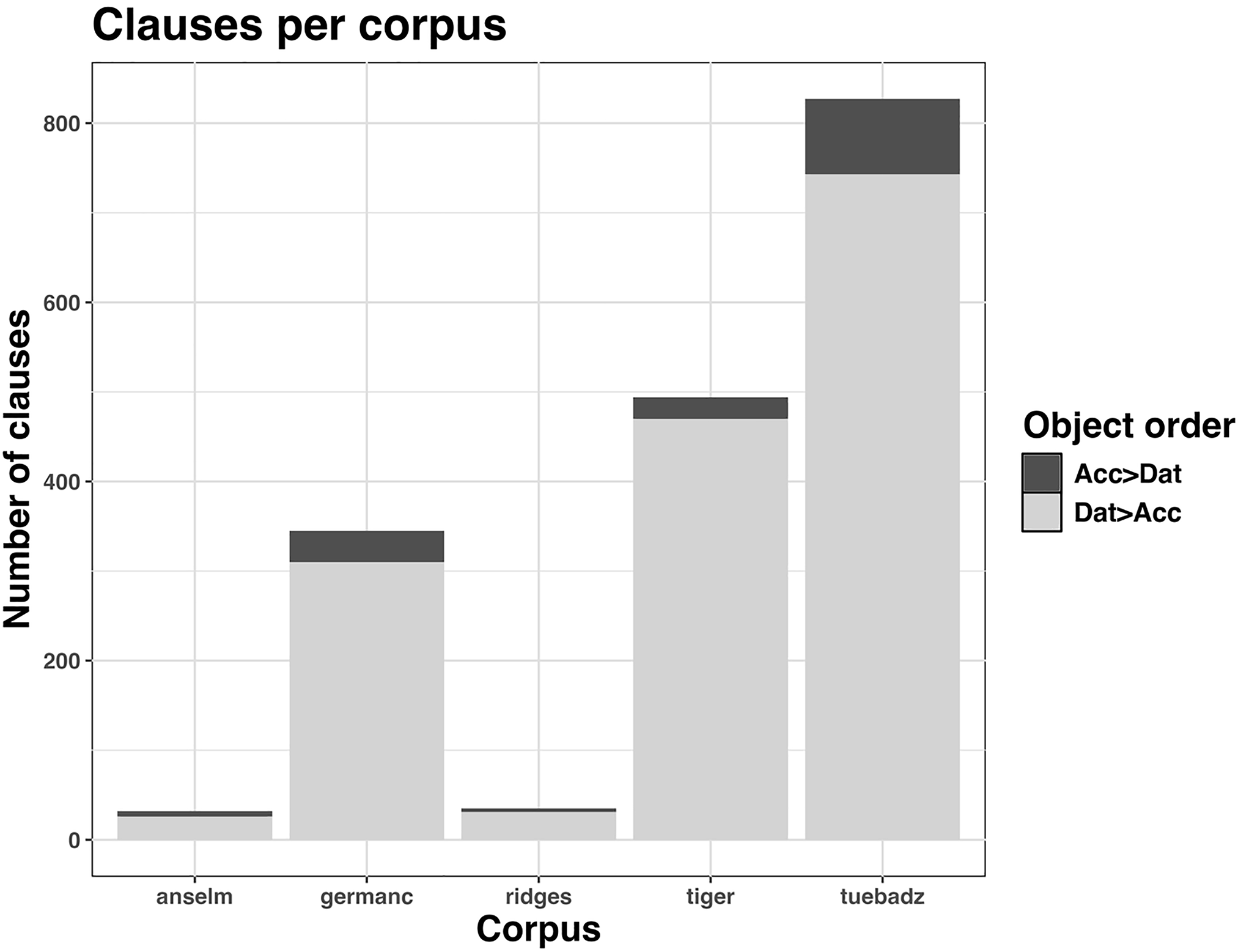
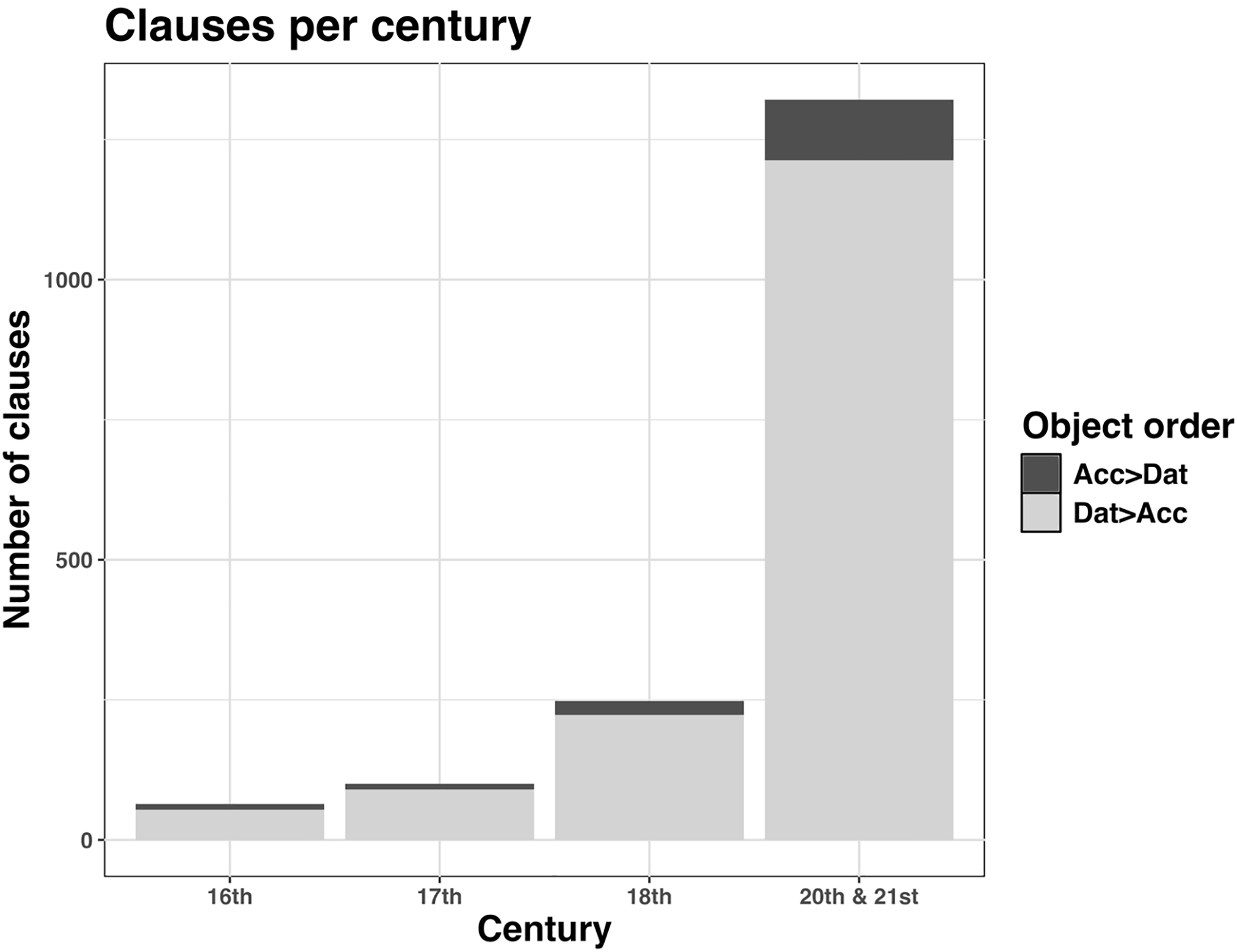
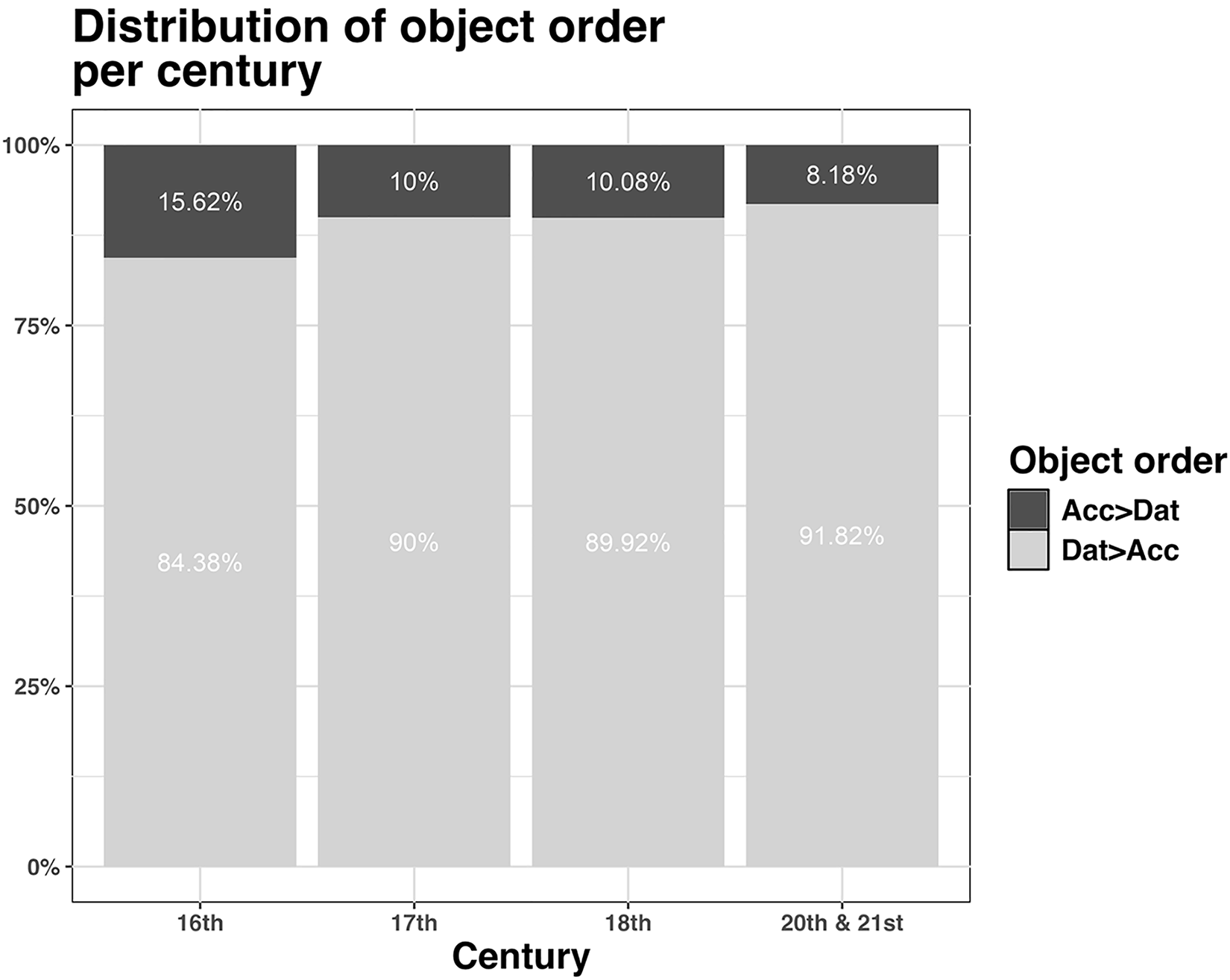
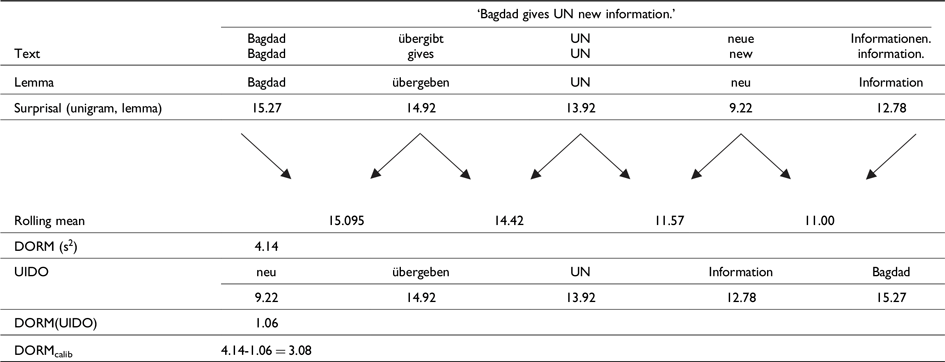
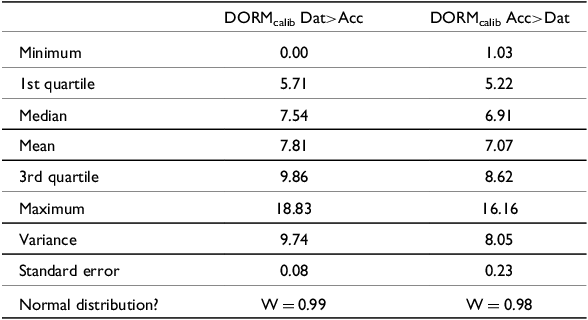
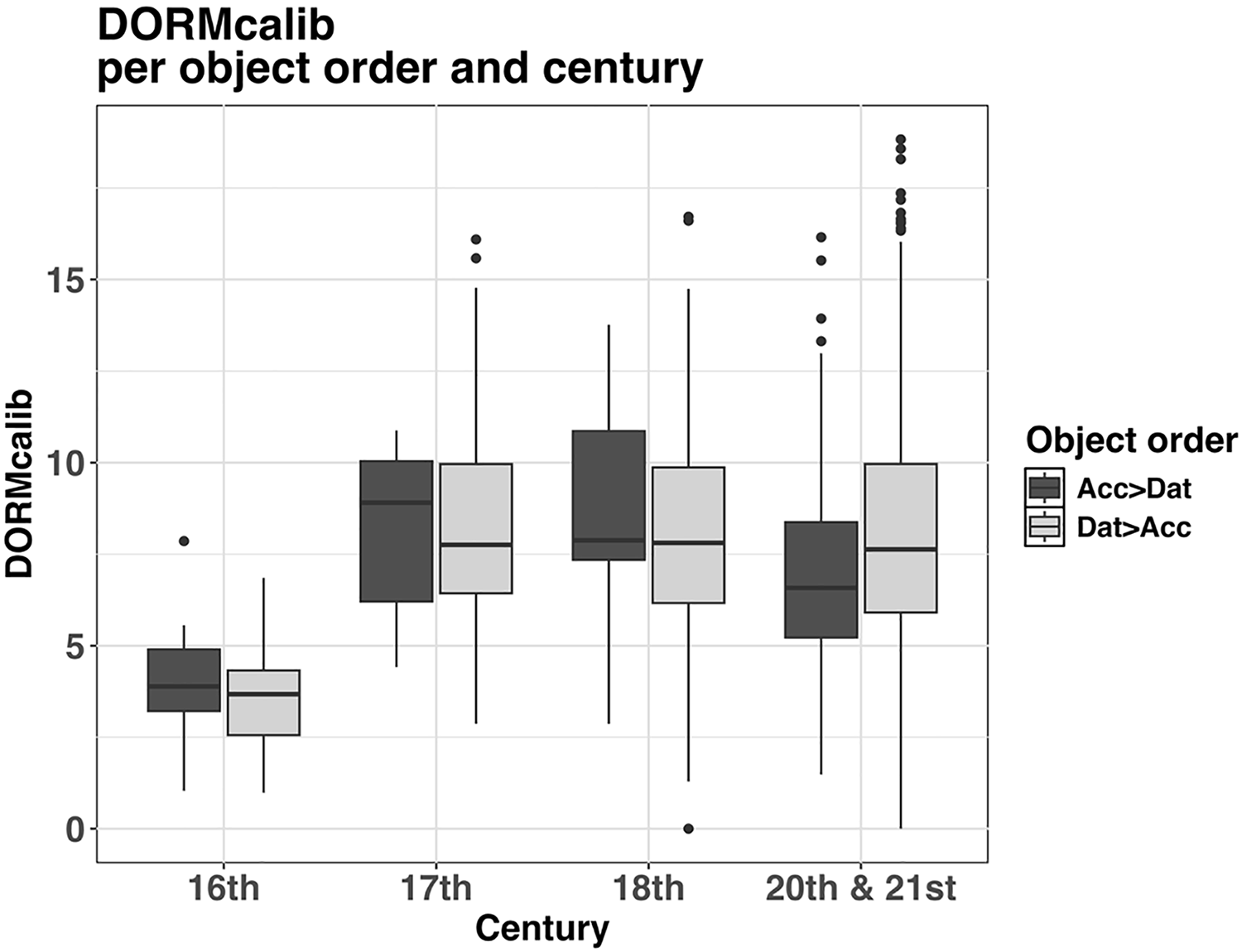
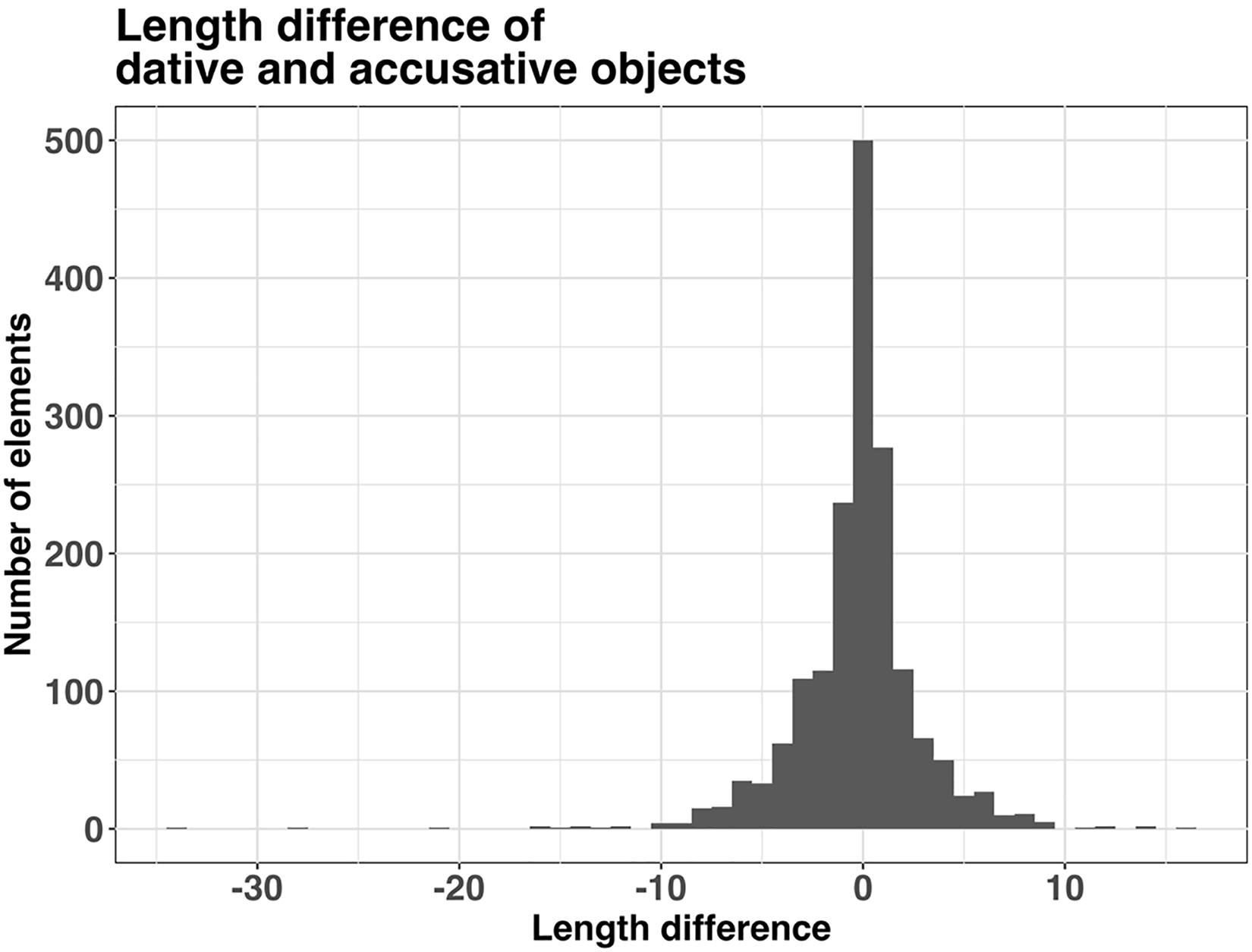
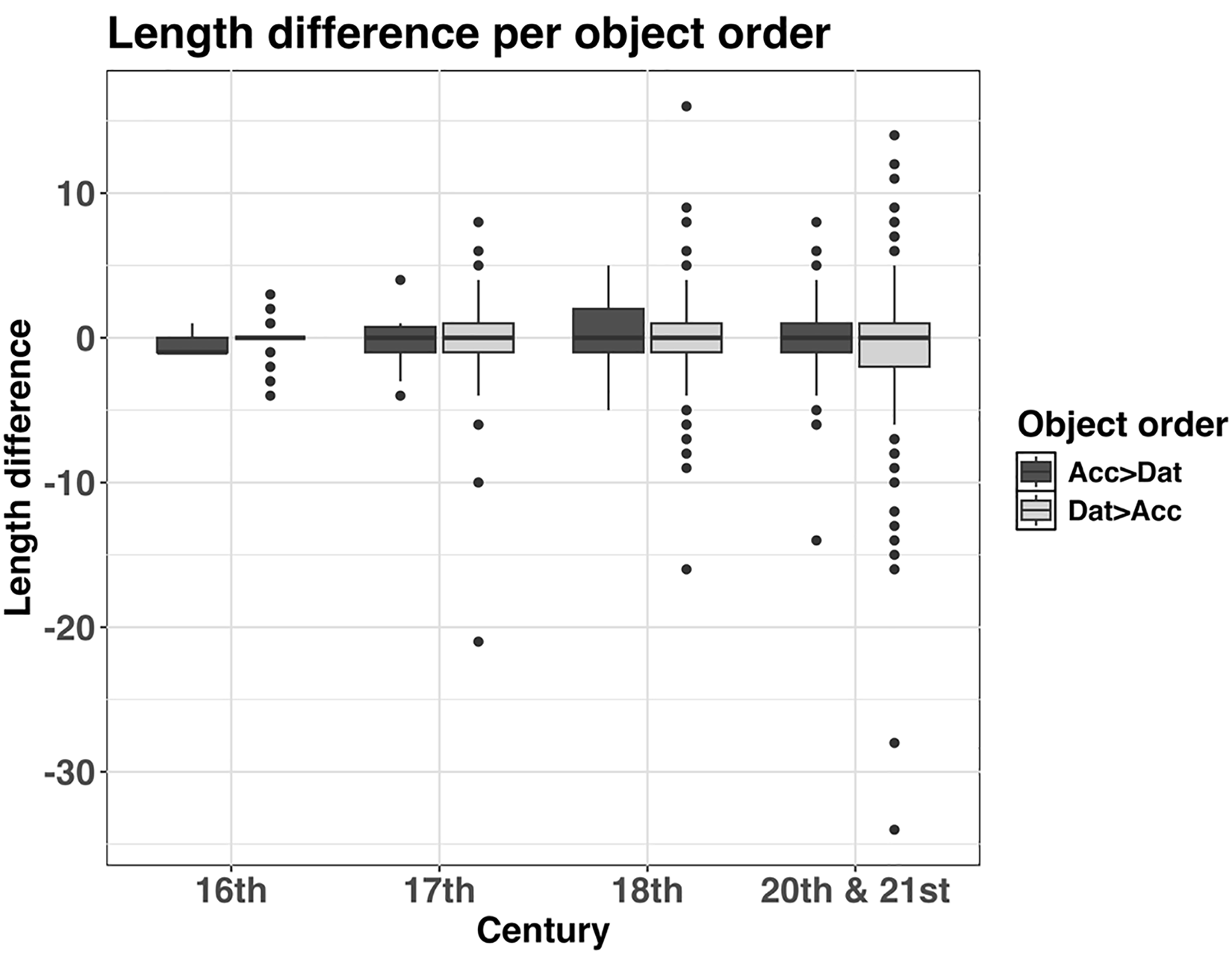
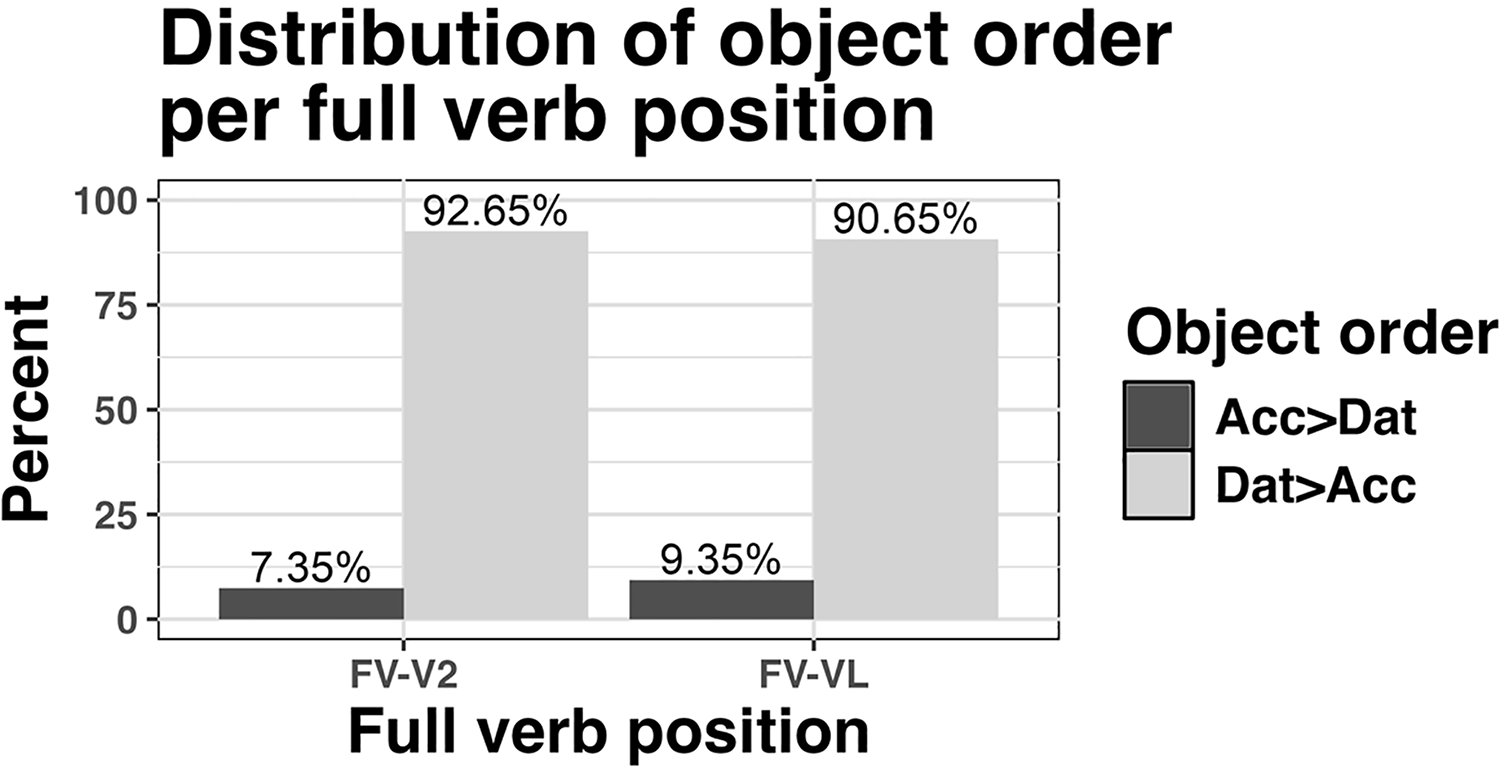
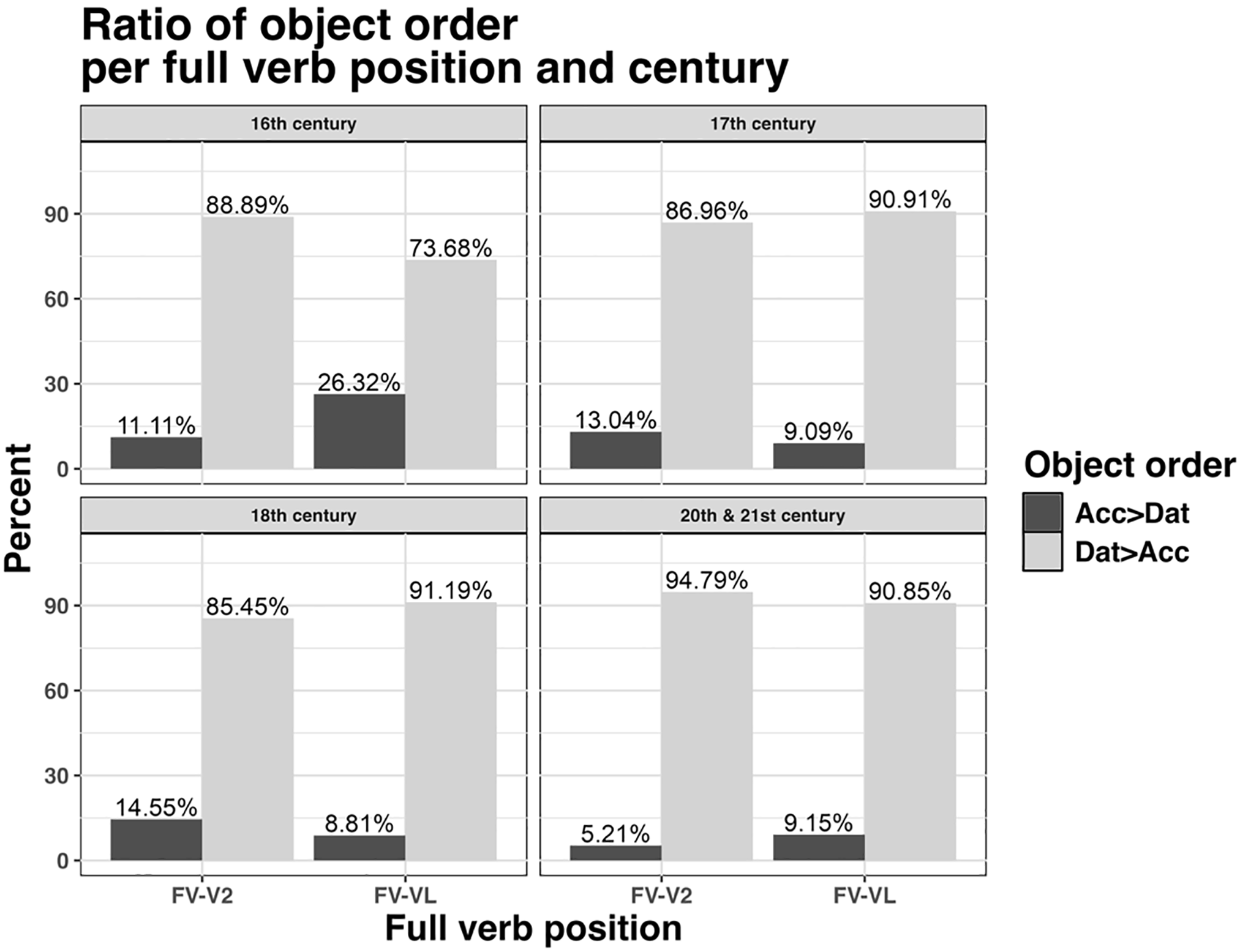
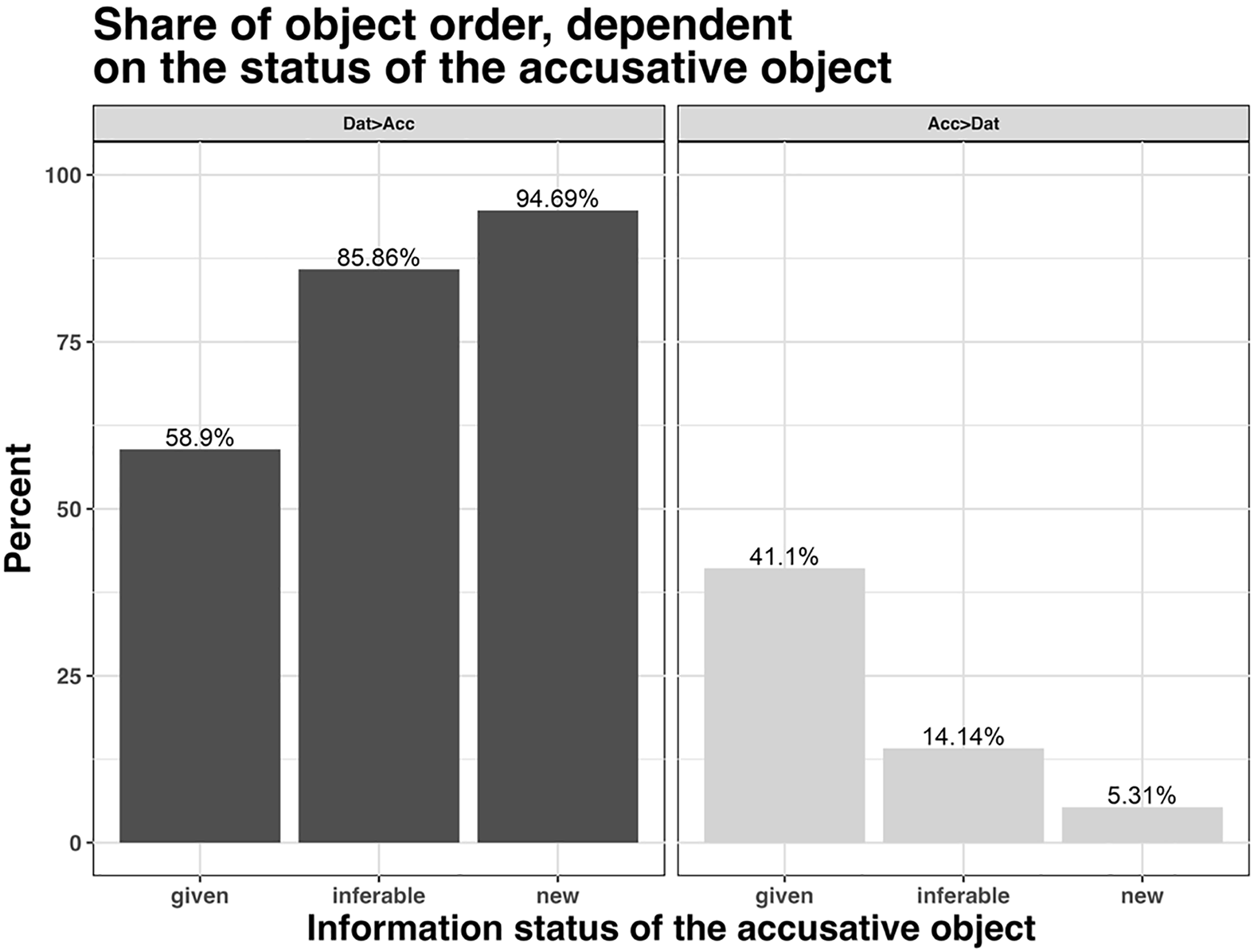

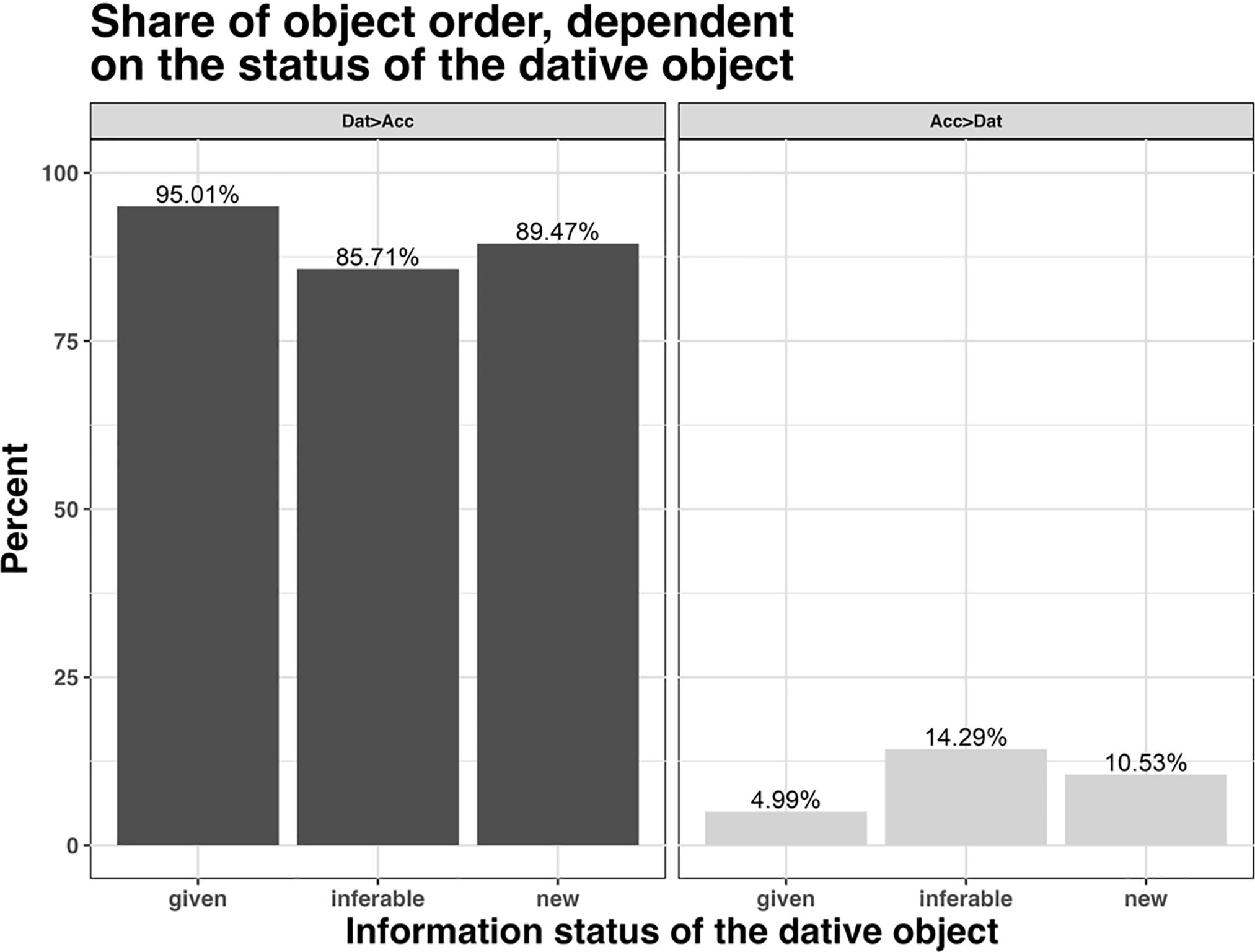

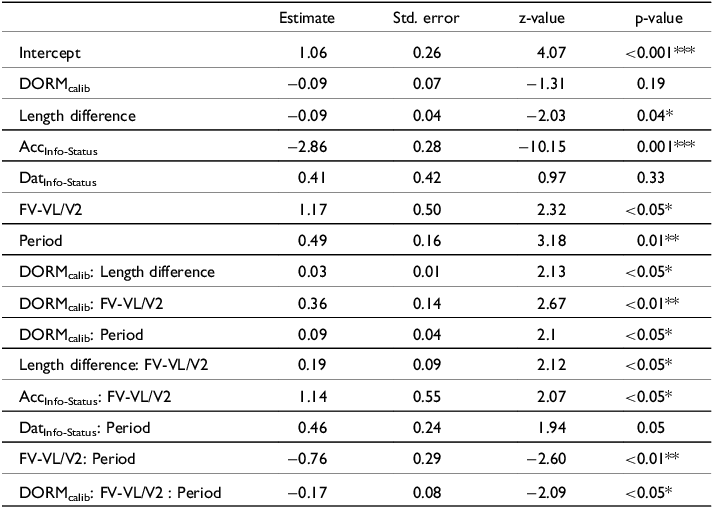

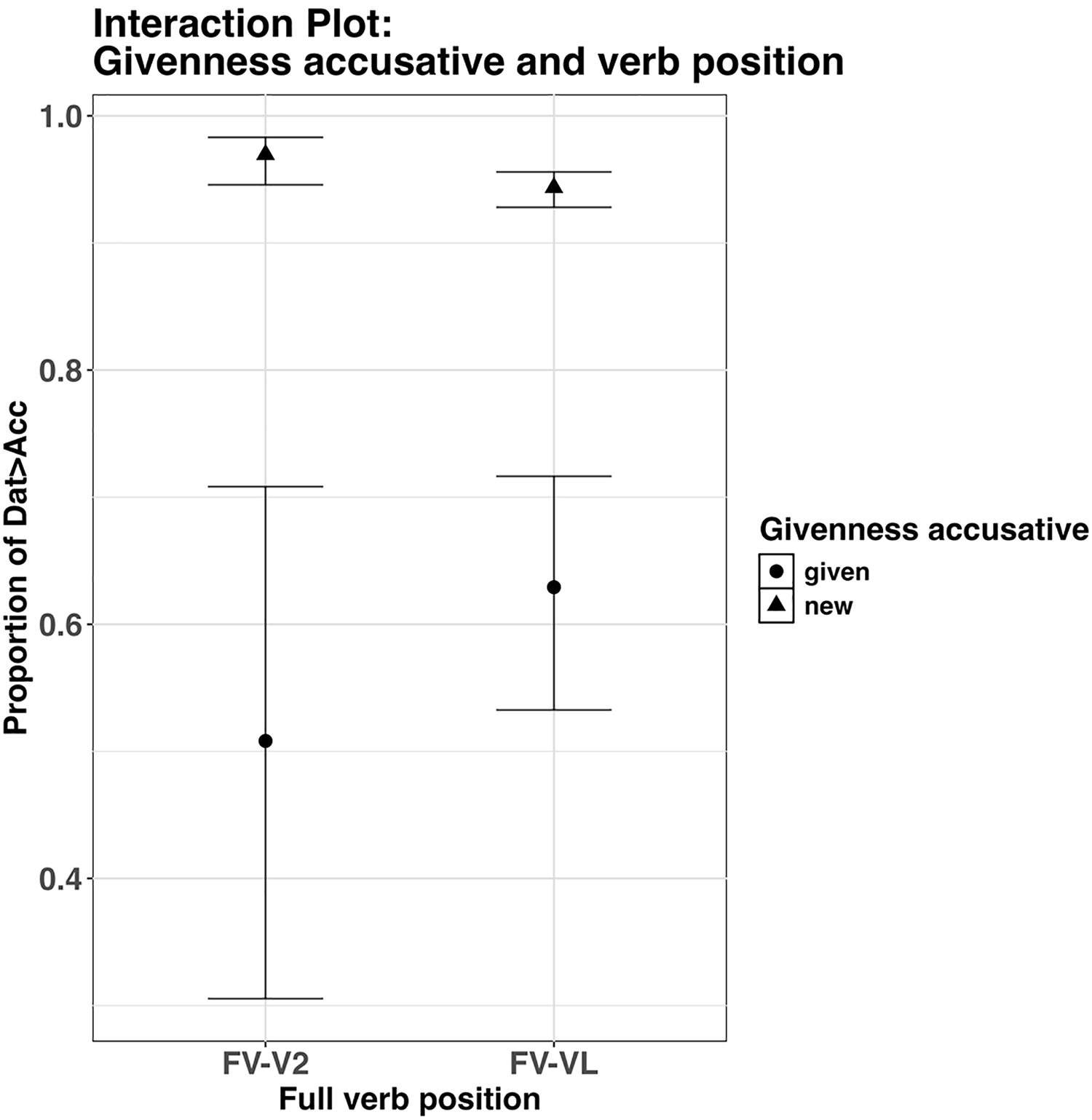
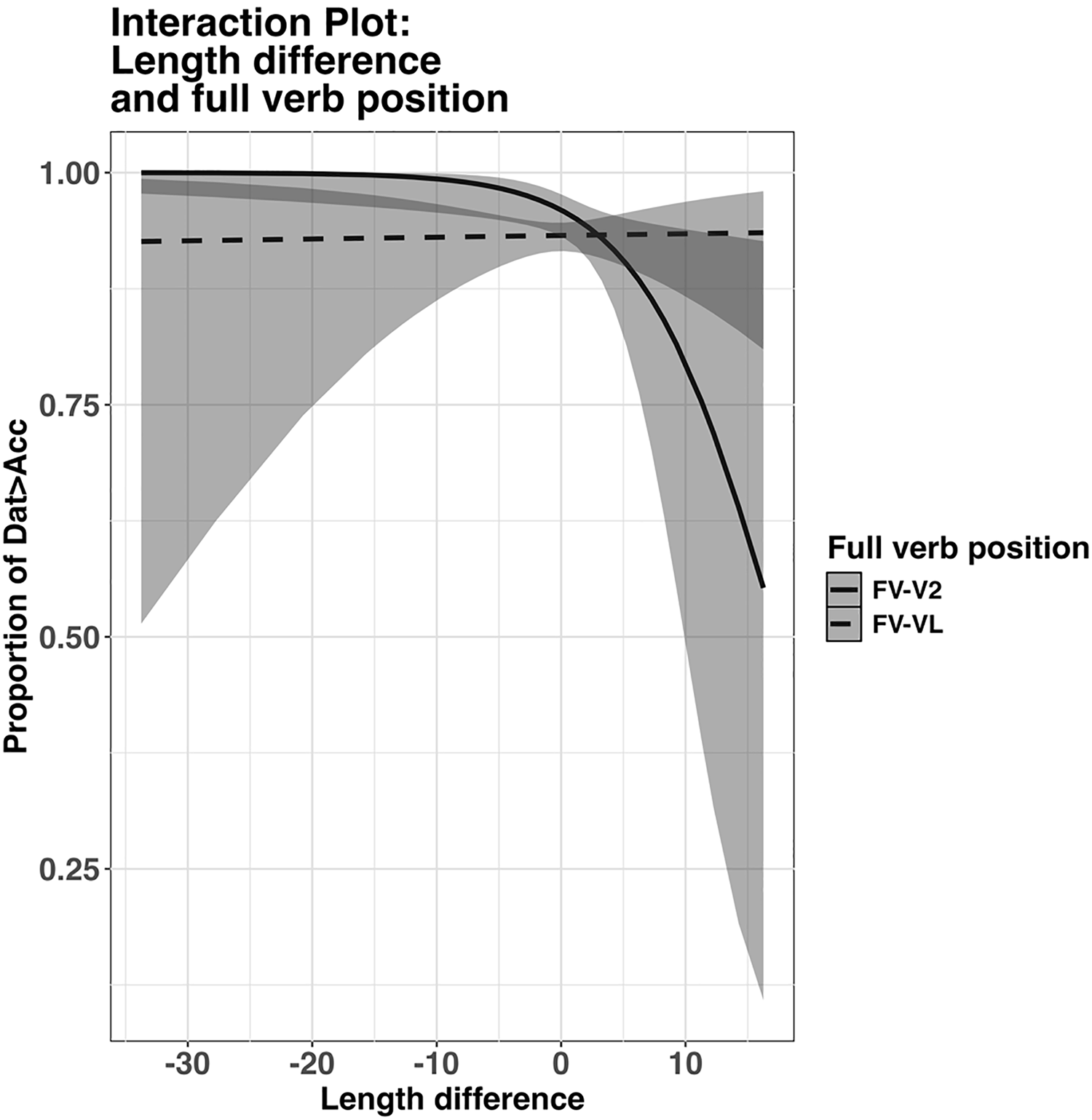
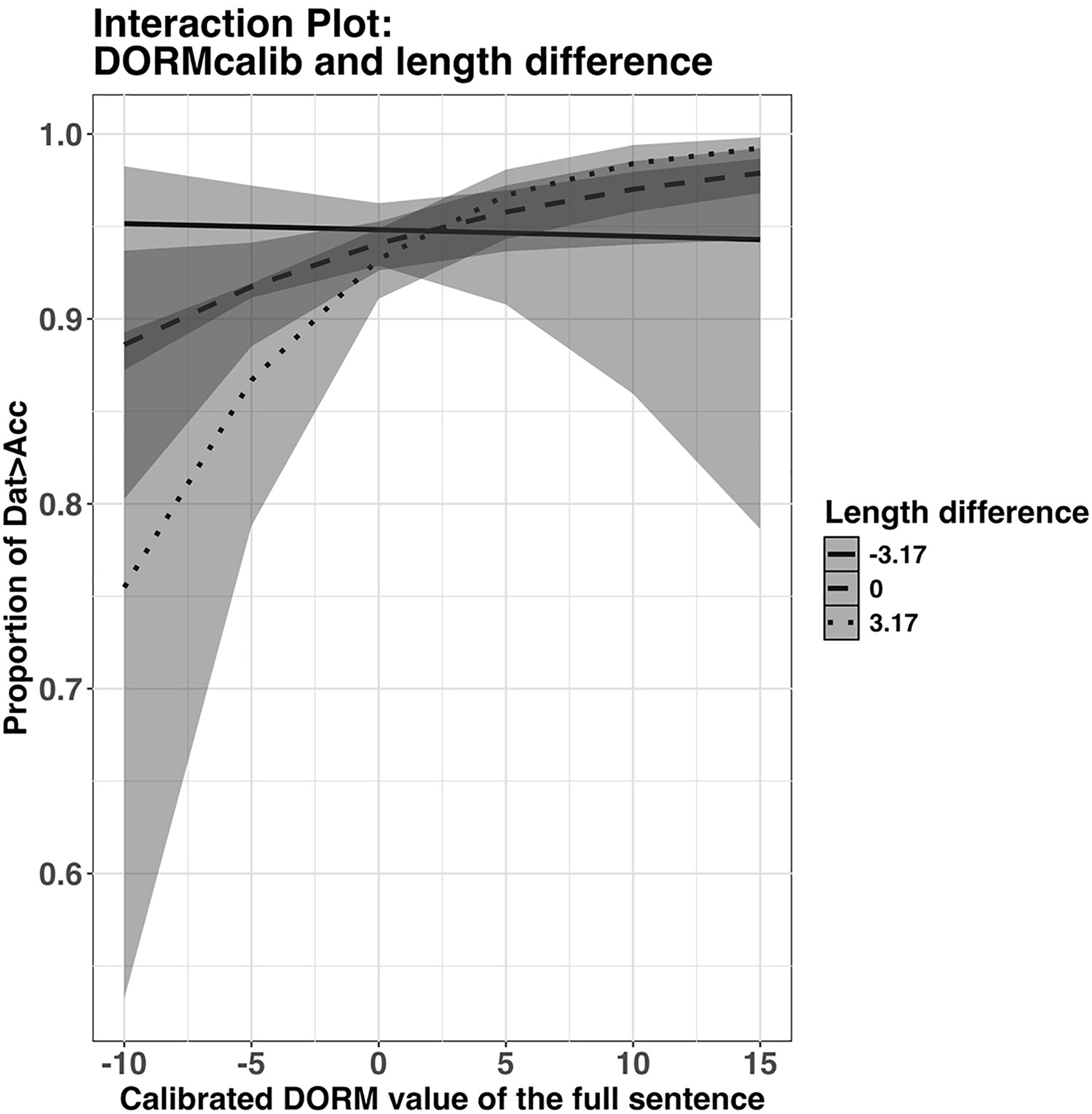
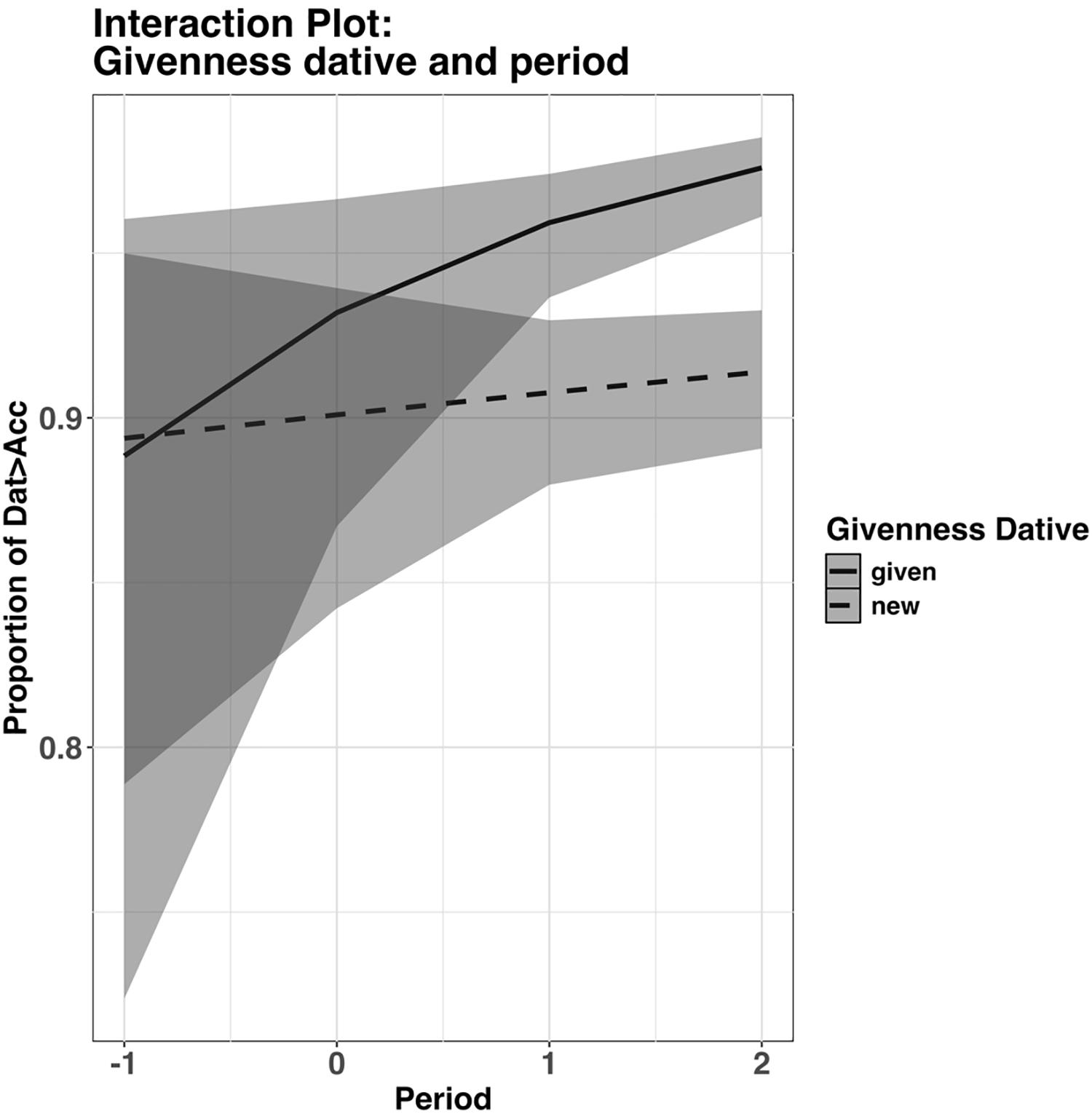
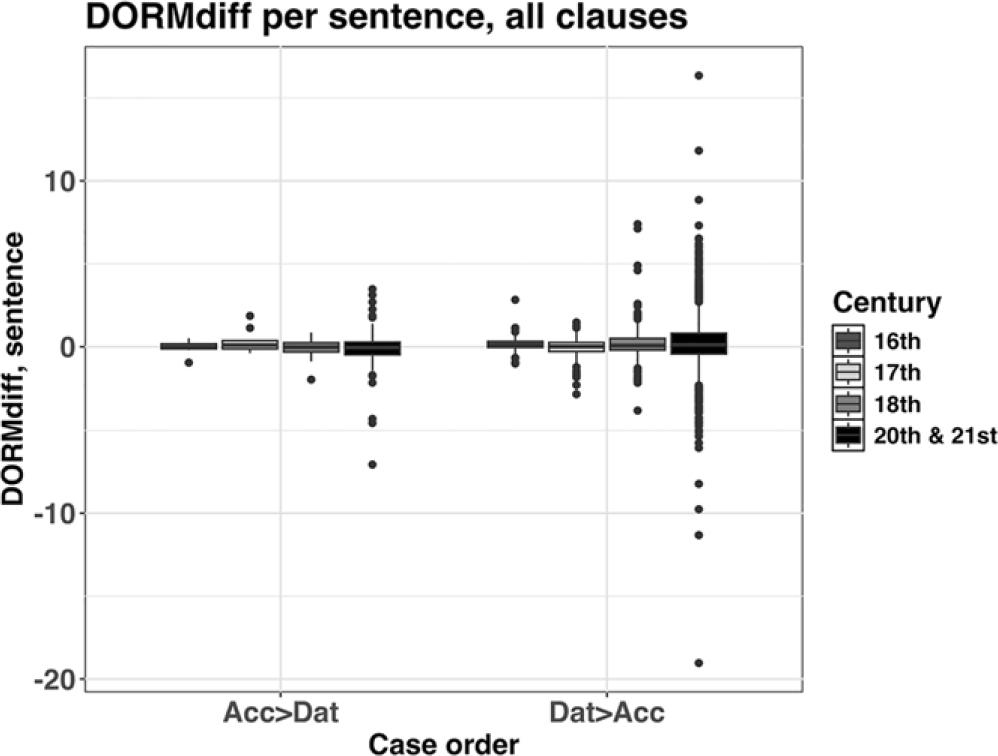
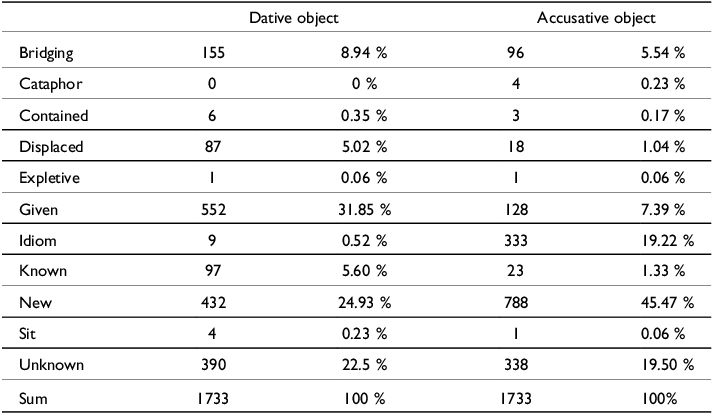
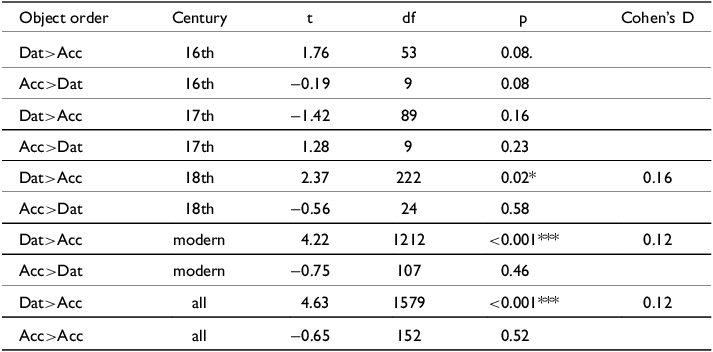

 Open access

