





1. Introduction
In northern Italy, we encounter the unique situation in which there are several territorially limited, historically grown linguistic islands with speakers of Upper German varieties. Until a few years ago, these small communities or speaker groups were still quite isolated in the mountains and over several centuries had little or no contact with the German-speaking area. In a way, the speakers of these linguistic islands are similar to the so-called “heritage speakers” in a broad sense as they are both “exposed naturalistically to the heritage language [… and] this language is by definition a nonhegemonic minority language within a majority-language environment” (Rothmann Reference Rothmann2007:359). Furthermore, the societal majority language can be learned simultaneously or successively, and the heritage speaker does not need to be completely fluent in the heritage language (Rothmann Reference Rothmann2007:359). However, the notion of heritage language/speakers is usually associated with migrant communities such as Italians and Spaniards in the United States, Poles in Norway, Germans in Australia, Friulians in Argentina and Brazil etc. In contrast, the linguistic islands under scrutiny differ from such communities sociolinguistically: These communities were established during the Middle Ages through migrations from neighboring Austria and Switzerland, and their settlements in mountainous or remote valleys enabled the German dialects to survive in a Romance-speaking environment for such a long time (see section 2.2 for details).
In our study, we focus on subject clitics and subject pronouns in speakers of Zahre German and Walser German, both with an Upper German dialect as L1 and with Italian as the surrounding majority language and L2. Note, however, that other varieties – especially in the past, less so today – have also had the status of being the dominant surrounding language(s): In the region of Friuli-Venezia Giulia the surrounding Romance varieties include Friulian, while in the Aosta Valley they comprise Franco-Provençal, Piedmontese, and French (the latter primarily in educational contexts; see Zürrer Reference Zürrer1999: 83–99, Protto Reference Protto, Heller, Prader and Prezzi2009, Costantini Reference Costantini2023, Moser Reference Moser2025).Footnote 1 German – including spoken or dialectal varieties of German – requires an explicit subject, while in Italian it is typically omitted (null-subject language). The Romance contact varieties, on the other hand, usually display subject clitics (see sections 2.4 and 2.5 for details). In our study, we focus on (affirmative) declarative clauses and test the use of subject clitics in different persons and contexts. In contrast to previous studies, which were limited to one or two speech communities (of the same idiom) (cf. e.g. Zürrer Reference Zürrer1999, Dal Negro Reference Dal Negro2004, Kolmer Reference Kolmer2012, Bidese & Tomaselli Reference Bidese, Tomaselli, Cognola and Casalicchio2018), we compare three speech communities with two different idioms: (Highest) Alemannic Walser varieties spoken in Gressoney and Issime and Zahre German, a Bavarian idiom spoken in Sauris. The comparison of different but typologically closely related idioms allows us to refine previous statements about the extent of dialectal variation and language attrition. The three communities are indeed very similar in terms of their sociolinguistic history and background, but they had and have no (or very limited) contact with each other. In this respect, they represent an ideal laboratory for demonstrating the range and limits of dialectal variation and morphosyntactic change in a context of language shift. Comparing three different yet very similar groups of speakers enables us to draw conclusions about the direction of language change. Rothmann (Reference Rothmann2007:359) in fact points out that “heritage speaker grammars are a good source for testing dialectal variation and language change proposals.” Heritage speakers, and of course our speakers in the linguistic islands, can also serve as valuable test cases for evaluating the predictions of linguistic theory (Rothmann Reference Rothmann2007:360). For instance, they can reveal areas of grammar that are particularly susceptible to change or to cross-linguistic influence (Lohndal et al. Reference Lohndal, Rothman, Kupisch and Westergaard2019:4). This aspect is also dealt with in language acquisition research as bilingual speakers of language islands or heritage speakers acquire language “under reduced input conditions or under pressure from another language in a bilingual environment” (Benmamoun et al. Reference Benmamoun, Montrul and Polinsky2013:131). Furthermore, data from such speakers can be used as a test case for questions related to language typology, such as the extent of contact-induced change in the linguistic structure of the minority language (cf. Abraham Reference Abraham and Putnam2011; for a case study on this topic, see Moser Reference Moser2025). Of course, these speakers may also help us to get a more comprehensive picture of (bilingual) grammars as they “are largely unaffected by any enforced prescriptive norms” (D’Alessandro et al. Reference D’Alessandro, Natvig and Putnam2021:8). Last but not least, due to the restricted input those speakers may also provide us with new information about the poverty of stimulus argument (Lohndal et al. Reference Lohndal, Rothman, Kupisch and Westergaard2019:4).
In our article, we address the question of whether or not the different but comparable speech communities of Sauris, Gressoney, and Issime have developed in the same direction in a context of language shift. We are interested in the question of whether and to what extent language contact affects language structure and whether language change goes in the same direction in all three varieties independently of each other. The article is organized as follows: In section 2 we first discuss the background and purpose of the article. This includes a description of the sociolinguistic situation in the present and the past (sections 2.1 and 2.2, respectively), information on language contact and language attrition (section 2.3), and the theoretical (typological) background as regards form and function of pronominal subjects and subject clitics as well as word order in the varieties involved (sections 2.4–2.6). In section 3 we present the research questions, section 4 details the design and methodology of our study. Finally, in section 5 we present and discuss the results.
2. Background and purpose
2.1. Brief description of the current language situation
In our study, we concentrate on three German linguistic islands in northern Italy: Sauris as well as Gressoney and Issime. The speakers of Sauris and Gressoney/Issime have no contact with each other because of the geographical distance, the former located in the easternmost part of northern Italy and the latter in the westernmost part. In all three communities, an Upper German dialect is spoken: in Sauris this is a Bavarian one, while in Gressoney and Issime it is an Alemannic one (Walser German).
Sauris, or “Zahre” in the local dialect, is the highest municipality in the Friuli-Venezia Giulia region (Province of Udine) (with Sauris di Sopra at 1,400 meters) and is situated in an isolated valley of the Carnic Alps (see e.g. Geyer Reference Geyer, Eller-Wildfeuer, Rössler and Wildfeuer2018). Today, it is a very well-kept village, famous for its bacon and popular among hikers. Sauris nowadays has around 400 inhabitants, of whom about 200 speak and use Zahre German (see Rabanus et al. Reference Rabanus, Kruijt, Alber, Bidese, Gaeta and Raimondi2023–). According to a survey conducted in 2018, 77.8% of the inhabitants always speak Zahre German with their parents, 52.4% with their peers, 13% with their children, 41.4% with their neighbors, and 33.3% with their colleagues at work (Costantini Reference Costantini2023:79).
Gressoney and Issime are in the Lys Valley, in Valle d’Aosta, close to Monte Rosa. Located at the end of the valley, Gressoney consists of two separate municipalities (though, in this case, one speech community), Gressoney-Saint-Jean and Gressoney-La-Trinité, at an altitude of 1,385 meters and 1,630 meters respectively; Issime is lower at 953 meters (Zürrer Reference Zürrer1999: 25). Today, Gressoney is a well-known ski resort, while Issime is largely unknown when it comes to winter tourism (Zürrer Reference Zürrer1999:28). According to Zürrer (Reference Zürrer1999:386), there are about 500 active German speakers in Gressoney (56% of the total population of Gressoney-Saint-Jean and Gressoney-La-Trinité) and 240 in Issime (65% of the total population of Issime). However, this estimate dates back to 1992 and it can be assumed that the number of speakers has declined even further since then, especially in Gressoney, whose ski resort mainly attracts Italian visitors (see Vicquery Reference Vicquery2006:127–129).
Today, the dialects of all three communities (Sauris, Gressoney, Issime) are on the verge of extinction (see Dal Negro Reference Dal Negro2004:42–45). Although efforts are being made to preserve their idioms (i.e. teaching the dialect in elementary school), current figures show that the dialect is hardly being passed on to the next generation (see Vicquery Reference Vicquery2006:131–133, Costantini Reference Costantini2023:79).
2.2. Historical bi- and multilingualism: a (short) overview
Sauris, settled in the thirteenth century from neighboring, Bavarian-speaking Austria, has been bilingual with Friulian and the German idiom since at least the mid-nineteenth century (Geyer Reference Geyer, Eller-Wildfeuer, Rössler and Wildfeuer2018:97–98, Moser Reference Moser2025:47–50). Compulsory education was introduced in the nineteenth century, which meant that Italian was learnt as an official and standard language and was used in formal contexts (Protto Reference Protto, Heller, Prader and Prezzi2009:280). In the first half of the twentieth century, Zahre German was spoken in the family and among the inhabitants of Sauris, while Friulian was used in contact with neighboring communities, and Italian was necessary in official and formal contexts (Denison Reference Denison and Sture Ureland1979:28–29). In the twentieth century, Zahre German lost much of its prestige; however, since the 1970s, the dialect has regained prestige, and there are efforts to preserve the culture and the dialect (Protto Reference Protto, Heller, Prader and Prezzi2009:269–271).
Although the dialect of both Gressoney and Issime is called “Walser German” and although the two communities are located in the same valley, it is important to note that they differ from each other in terms of their (historical) language contact situation (see below). This difference has also had consequences for the linguistic structure today: The dialects of Gressoney and Issime are quite distant – Gressoney is indeed more similar to Formazza or to other Walser dialects than to Issime – and people from Gressoney speak Italian with people from Issime.Footnote 2 For this reason, they are also treated as two different speech communities in this article.
The population of Gressoney was, from 1400 until the twentieth century, monolingual in the German idiom; there was no permanent settlement when the first settlers from the Valais in Switzerland arrived in the Middle Ages (cf. Zürrer Reference Zürrer2009:87–91, 97; see also Giacalone Ramat Reference Giacalone Ramat1979). Issime, however, was a mixed group of settlers, with two coexisting groups speaking different idioms: Walser German and Francoprovençal (cf. Zürrer Reference Zürrer2009:86–92). In contrast to Gressoney, Issime was settled before the arrival of German settlers. Thus, since the colonialization of this area, Issime has consisted of two different groups of speakers; it was not until the eighteenth century that the Francoprovençal part of the population joined with the German-speaking part (Zürrer Reference Zürrer2009:96). In the nineteenth century, in formal contexts, written (Standard) German was used in Gressoney and written (Standard) French in Issime (Zürrer Reference Zürrer2009:88). From the 1920s onwards, however, written German and written French were gradually replaced by (written) Italian (Zürrer Reference Zürrer2009:99-100). Furthermore, since the end of the nineteenth century, Piedmontese has also been used as a lingua franca (e.g. in contact with local traders) (Zürrer Reference Zürrer2009:98–99). Italian, on the other hand, has become an everyday language in Gressoney for the first time among speakers born in the early 1950s (Zürrer Reference Zürrer1999:33, Dal Negro Reference Dal Negro2004:55).
2.3. Language contact and language attrition
We define language contact as “a bilingual practice reflecting the processing/use of language in a bilingual speaker’s repertoire” (Riehl Reference Riehl, Schmid and Köpke2019:314). The contact situation in Gressoney, Issime, and Sauris is characterized by a long-standing bi- or multilingualism for generations: the speakers use the German dialect side by side with Italian, the official language, which is present in education, the media, and in administration. The dialect is used in the domestic context and, depending on the language skills of the interlocutor, in further oral interactions as well (e.g. with friends or with colleagues at work) (see Zürrer Reference Zürrer2009:100–117, Costantini Reference Costantini2023). In the past, many speakers also spoke a local Romance variety (Friulian, Piedmontese, or Francoprovençal), but our survey indicates that this is hardly the case today or for our speakers (see section 4.1). In terms of language structure, the Romance contact varieties require a lexical subject pronoun (in contrast to standard Italian); they differ from each other with regard to the degree of obligatoriness/optionality of the subject clitic and in relation to the grammatical person in which the subject clitic is used.
The bi- or multilingualism attested in both Zahre German and Walser German has grown historically, that is, the speakers have been in close contact with the surrounding Romance varieties for several generations. It is therefore likely that these varieties are susceptible to contact-induced language change: “intense contact is more likely than casual contact to result in typological restructuring of the receiving language” (Thomason Reference Thomason, Haspelmath, König, Osterreicher and Raible2001:1640). It is also possible that the typological proximity or distance of the languages in contact play a role. If the languages/varieties are too similar, typological change cannot occur: “Clearly, not all contact-induced changes alter the typology of the receiving language. Some of them are typologically inert: either they fit neatly into the typological patterns of the receiving language, or they are too minor to constitute a significant typological change” (Thomason Reference Thomason, Haspelmath, König, Osterreicher and Raible2001:1640). Note that while the Germanic varieties under scrutiny and Standard Italian are typologically distant (null-subject language vs. subject language), other Romance contact varieties are somewhere in between, as they do have subject clitics (see sections 2.4 and 2.5). Instead of using the term of contact-induced typological change (which entails the difficulty of defining when precisely typological change has taken place), Matras & Sakel (Reference Matras and Sakel2007) prefer to speak of “grammatical borrowing” to describe language contact phenomena. Part of this is the borrowing of words and morphemes as well as the change of structures on the morphological and syntactic level. Grammatical borrowing is triggered by “the need to reduce the cognitive load when handling a complex linguistic repertoire” (Matras Reference Matras, Matras and Sakel2007:67). As far as changes in syntax are concerned, it is particularly important to ascertain whether the change is contact-induced or if internal factors may have played a role (see Bidese Reference Bidese2023:1–68). Word order changes, for instance, are susceptible to language contact (cf. Heine & Kuteva Reference Heine, Kuteva, Aikhenvald and Dixon2001:395–396 for African languages; see also section 2.5). Conversely, there are (morpho)syntactic phenomena that are more resistant to language change. An illustrative example is that of subject clitics in speakers of linguistic islands in northern Italy (see Poletto & Tomaselli Reference Poletto and Tomaselli2018, Rabanus & Tomaselli Reference Rabanus, Tomaselli, Christen, Gilles and Purschke2017).
The language attrition approach is closely linked to research in language contact: Both “investigate the impact of a second language (L2) on the first (L1)” and “the linguistic features found in individual attrition and typical language contact settings are similar” (Riehl Reference Riehl, Schmid and Köpke2019:315). The two usually differ in terms of the speaker populations: “Whereas typical attrition research analyses first generation migrants in an L2 environment, language contact research focuses more on the use of languages in multilingual speech communities” (Riehl Reference Riehl, Schmid and Köpke2019:315).
Changes taking place in small communities like those mentioned above can be triggered not only by mechanisms linked to language contact and language attrition but also by second language acquisition strategies (see Kolmer Reference Kolmer2010:148). The interface hypothesis is known from second language acquisition research (see Sorace Reference Sorace2011). According to Sorace (Reference Sorace2011), phenomena at the syntax–pragmatics interface (so-called phenomena with interpretable features) are more prone to language change than other, for example, purely syntactic, phenomena. In their study, Tsimpli et al. (Reference Tsimpli, Sorace, Heycock and Filiaci2004) examined subject pronouns in multilingual speakers of languages that differ in the pro-drop parameter: The study encompassed Italian and Greek speakers (L1) and near-native speakers of English (L2) and yielded evidence for attrition in L1 in interpretable features of subjects, among others in topic continuation vs. topic shift. No attrition was observed in noninterpretable, syntactic features, such as pro-drop and non-pro-drop. In the context of L1 attrition, the interface hypothesis predicts that after processes of generational transmission “there may be changes that concern the whole pronominal system and/or structures that involve different interface conditions” (Sorace Reference Sorace2011:26). Studies in the field of language acquisition (L2) but also in the field of language contact and diachronic change indicate that overt subject pronouns, in contrast to null subjects, enjoy an “unmarked default status” (Sorace Reference Sorace2011:20).
2.4. Pronominal subjects
Standard Italian and German (with its varieties) differ in the way they express pronominal subjects. German is a language “in which simple sentences with pronominal subjects normally if not obligatorily contain a pronoun in subject position. … [S]ubject position is defined as the position in the sentence in which nominal subjects appear” (Dryer Reference Dryer, Dryer and Haspelmath2013). In the following examples from Standard German, the pronoun is obligatory. Moreover, in both (1a) and (1b) the subject is in the first position because it is a topic. Note that the structural position of the subject (i.e. the position in which it gets the agreement with the finite verb) is the postverbal one for both the nominal and the pronominal subject:
(1)
German
a.
Der
Junge
singt
ein
Lied.
def.m.nom.sg
boy.nom.sg
sing.3sg.prs
indf.m.acc.sg
song.acc.sg
‘The child sings/is singing a song.’
b.
Er
singt
ein
Lied.
he.3sg.nom
sing.3sg.prs
indf.m.acc.sg
song.acc.sg
‘He sings/is singing a song.’
In certain registers of German (e.g. computer-assisted communication) and under certain extra-linguistic contextual conditions (familiarity of the interlocutors, informal context), sentences without a subject are grammatical as well: The subject can thus be omitted if it can be reconstructed from the conversational/discourse context (see Helmer Reference Helmer2016). Note, however, that this type of V1 sentence (with a null subject in initial position) does not represent the phenomenon of Topic-drop (at least for V2 varieties).
Italian, on the other hand, is a language “in which the normal expression of pronominal subjects is by means of affixes on the verb” (Dryer Reference Dryer, Dryer and Haspelmath2013). In theoretical terms, Italian is a null-subject language (cf. e.g. Dryer Reference Dryer, Dryer and Haspelmath2013) or a pro-drop language (cf. Chomsky Reference Chomsky1981:240–242). Example (2b) illustrates the dropping of the pronominal subject (“pro” refers to the null subject); as in example (1), the structural position of the subject is the postverbal one for both the nominal and the pronominal subject:
(2)
Italian
a.
Il
ragazzo
canta
una
canzone.
def.m.sg
boy(m)
sing.3sg.prs
indf.f.sg
song(f)
‘The boy sings/is singing a song.’
b.
pro
canta
una
canzone.
pro
sing.3sg.prs
indf.f.sg
song(f)
‘He sings/is singing a song.’
Put simply, the subject can be omitted in Italian if it can be inferred from the context, whereas “[t]he pronoun is more likely to be overtly expressed in sentences where there is a shift in topic with respect to the previous discourse” (Frasson et al. Reference Frasson, D’Alessandro and van Osch2021: 6). This difference is illustrated by Frasson et al. (Reference Frasson, D’Alessandro and van Osch2021:6–7) with the following examples from Spanish (which has pro-drop as well). Example (3) shows topic continuation: “the topic of the second sentence is the same as in the first sentence, which makes a null subject the most felicitous option”; by contrast, example (4) shows topic shift: “the subject changes from the 1st person to a 3rd person, thus requiring an overt pronoun (or a full DP)” (Frasson et al. Reference Frasson, D’Alessandro and van Osch2021:6–7):
(3)
Spanish
Pepe
no
vino
hoy
a
trabajar.
*Pepe / ?Él / pro
Pepe
neg
come.3sg.pret
today
to
work
Pepe / 3sg.m / pro
estará
enfermo.
be-3sg.fut
sick.sg.m.
‘Pepe did not come to work today. He must be sick.’
(4)
Spanish
Hoy
no
fui
a
trabajar.
Pepe / Él /* pro
Today
neg
go.1sg.pret
to
work
Pepe / 3sg.m / pro
pensó
que
estaba
enferma.
think.3sg.pret that
be-1.sg.fut
sick.sg.f
‘Today I did not go to work. Pepe/he thought I was sick.’
In Upper German dialects – including our linguistic islands in northern Italy – as well as in spoken German the subject pronoun can be realized in the form of a clitic. This is possible in a context of subject–verb inversion where the subject clitic sticks to the finite verb (see e.g. Lessiak Reference Lessiak1963, Merkle Reference Merkle1993, Zürrer Reference Zürrer1999, Cattarin Reference Cattarin2020). The subject–verb inversion is found in interrogative sentences (see example (5)) and in sentences with an XVS word order (with scl for “subject clitic”):
(5)
Bavarian
Trinkmr
ans?
drink.1pl.scl
one.acc.sg
‘Do we drink one (=a beer)?’
(Lessiak Reference Lessiak1963:194)
(6)
Bavarian
Jezan
wer.mä
esn
now
want.1pl.scl
eat.inf
‘Let’s eat now’
(Wratil Reference Wratil, Ramat, Mauri and Molinelli2013:206)
Unstressed pronominal forms in German (and in general in Germanic varieties) are realized in the so-called Wackernagelposition, which is on the top of the so-called Mittelfeld. Wackernagelposition is “right-adjacent to the finite verb in main clauses and to the complementizer in embedded clauses” (Bidese Reference Bidese and Putnam2011: 363). Germanic varieties (and all Germanic linguistic islands) have not developed proclisis at all, that is, a subject clitic is expected just in the inversion context X Vfin+clitic.Footnote 3 Object clitics cannot appear as proclitic to the finite verb either (see Bidese Reference Bidese and Putnam2011). Furthermore, the linguistic islands in northern Italy all have structural V2 (see Bidese et al. Reference Bidese, Padovan, Tomaselli, Woods and Wolfe2020), i.e. subject–verb inversion is still possible even if the linear restriction is lost.Footnote 4 In order to obtain a declarative clause, at least one position before the finite verb must be realized (see, e.g., Tomaselli & Bidese Reference Tomaselli, Bidese, Bidese, Casalicchio and Caterina Moroni2019:52–53). In the following example from Cimbrian, we have a context of subject–verb inversion, and the position before the finite verb is filled (X Vfin+clitic):
(7)
Cimbrian
Dena
gea.bar
ka
Tria
then
go.1pl.scl
to
Trento
‘Then we go to Trento’
(Tomaselli & Bidese Reference Tomaselli, Bidese, Bidese, Casalicchio and Caterina Moroni2019:48)
On the other hand, the Romance contact varieties of interest – Friulian, Piedmontese, and Francoprovençal – are characterized by (optional) subject clitics occurring in proclisis to the finite verb in declarative clauses (not so, however, in certain other contexts such as interrogative clauses, where they appear in enclisis; for a comprehensive account of Romance subject clitics in general see, e.g., Poletto & Tortora Reference Poletto, Tortora, Ledgeway and Maiden2016).
Friulian displays a complete paradigm of subject clitics that occur in all syntactic contexts, in addition to the inflected verb (Benincà Reference Benincà and Mucignat2014:44–45; for (a few) exceptions, see Benincà & Vanelli Reference Benincà, Vanelli, Ledgeway and Maiden2016; see also Hack & Gaglia Reference Hack, Gaglia, Kaiser and Remberger2009:157). According to Benincà (Reference Benincà and Mucignat2014:43), Friulian “has evolved more than any other [northern Italian] dialect and has removed practically all restrictions to the appearance of subject clitics.” For instance, in Friulian a subject clitic is almost always obligatory in main clauses, even when the sentence already has a lexical subject (see (9c); Benincà Reference Benincà and Mucignat2014:43–44; Benincà & Vanelli Reference Benincà, Vanelli, Ledgeway and Maiden2016:150). In this case, one could also speak of subject doubling (see section 2.4). The following examples illustrate the obligatory use of the subject clitic (here third person singular) in main clauses in Friulian:
(8)
Friulian
a.
**Rive
arrive.3sg.prs
‘Arrives’
b.
Al
rive
3sg.m.scl
arrive.3sg.prs
‘He arrives’
c.
Toni al rive
Toni 3sg.m.scl arrive.3sg.prs
‘Toni arrives’
(Benincà Reference Benincà and Mucignat2014:44)
Also in Piedmontese subject clitics usually precede the finite verb in declarative sentences (see example (9)): they are “mandatory in the written language (except perhaps in poetry for prosodic reasons) and in many varieties in main clauses … and tensed dependent clauses” (Tosco et al. Reference Tosco, Miola and Duberti2023:177). However, first-person subject clitics in particular may be absent in local varieties and are often omitted in allegro speech (Tosco et al. Reference Tosco, Miola and Duberti2023:177–80; see also Parry Reference Parry1993 for a diachronic account of subject clitics in Piedmontese).
(9)
Piedmontese
a.
it
lo
vëdde
2sg.scl
obj.3sg.m
see.2sg.prs
‘You see it’
b.
i
andoma
1pl.scl
go.1pl.prs
‘we go/are going’
(Tosco et al. Reference Tosco, Miola and Duberti2023:178–9)
As for Francoprovençal, the usage of subject clitics varies considerably from one variety to another (Kristol Reference Kristol, Ledgeway and Maiden2016; see also Kristol Reference Kristol2009). In Val d’Aosta, subject clitics are always obligatory for the second person singular but may be optional or absent in the remainder (cf. Diémoz Reference Diémoz2008).
Note, in conclusion, that in all these varieties subject clitics for the second person singular are always compulsory; see, in this respect, the generalizations on the different systems of subject clitics in Romance varieties formulated by Renzi & Vanelli (Reference Renzi and Vanelli1983).
2.5. Pleonastic occurrence of subject clitic and subject pronoun
Standard Italian shows no subject doubling because of the lack of a subject clitic paradigm (Tomaselli & Bidese Reference Tomaselli, Bidese, Bidese, Casalicchio and Caterina Moroni2019:49). In Germanic and Northern Italo-Romance varieties, however, a clitic subject can also appear in a declarative sentence, together with a full subject pronoun. If the co-presence of a subject clitic and overt subject (either in the form of a personal pronoun or a lexical NP) is not pragmatically motivated, one can speak of “pleonastic occurrence.” Consider, for instance, the following example from Walser German:
(11)
Walser German
Wir
tieber
tringe
as
beer.
we.1pl.nom
do.1pl.scl
drink.inf
def.n.acc.sg
beer.nom.sg
‘We drink beer.’
(Wratil Reference Wratil, Ramat, Mauri and Molinelli2013:215)
This pattern is not restricted to German linguistic islands in northern Italy but is possible also in other Germanic varieties such as Bavarian (see e.g. Bayer Reference Bayer1984) or Dutch dialects (e.g. West Flemish or the dialect of Wambeek, cf. Haegeman Reference Haegeman, van Riemsdijk and Rizzi1991; van Craenenbroeck & van Koppen Reference van Craenenbroeck, van Koppen, van Koppen, Thrift, van der Torre and Zimmermann2002):
(12)
Bavarian
Heit
bleima
(mia)
daham.
today
stay.1pl.scl
(we.1pl.nom)
at home
‘Today we stay at home.’
(Fuss & Wratil Reference Fuss, Wratil, Fleischer and Simon2013:183)
(13)
Wambeek
Mergen
komde
gou.
tomorrow
come.2sg.scl
you.2sg.nom
‘Tomorrow you will come.’
(van Craenenbroeck & van Koppen Reference van Craenenbroeck, van Koppen, van Koppen, Thrift, van der Torre and Zimmermann2002:58)
The pleonastic occurrence of two subjects in Zahre German is briefly mentioned by Denison (1988:29–30), who ascribes it to the influence of Friulian (but see Moser Reference Moser2025:71–73, who argues in favor of a convergence process). In Zahre German, the pleonastic occurrence is almost exclusively attested in context of subject–verb inversion, mainly in interrogative sentences and not in declarative sentences with XVO:
(14)
Zahre German
Tueste
du
a
reidn
de
zahrar
sproche?
do.2sg.scl
you.2sg.nom
too
speak.inf
def.f.acc.sg
zahre
language.acc.sg
‘Do you also speak Zahre German?’
(Cattarin Reference Cattarin2020: 54)
In Bavarian, as well as in Cimbrian, a Bavarian-speaking linguistic island in northern Italy, a lexical subject or a subject pronoun that occurs to the left of the finite verb cannot be doubled (Tomaselli & Bidese Reference Tomaselli, Bidese, Bidese, Casalicchio and Caterina Moroni2019:50). Consider the following example:
(15)
Cimbrian
*Dar
Gianni/Er
singtar
def.m.nom.sg
John/he.3sg.nom
sing.3sg.scl
‘John sings/is singing’
(Tomaselli & Bidese Reference Tomaselli, Bidese, Bidese, Casalicchio and Caterina Moroni2019:50)
We speak of “subject doubling” provided the case that there are some pragmatics involved (pragmatic strengthening). In the example in (15) we find subject doubling as endschandre ‘WE’ is a stressed pronoun, which occurs together with a clitic subject pronoun -wer (see Bauen Reference Bauen1978: 69):
(16)
Walser German
Und
enschandre
häwer
käst
bröd
und
cheesch
and
we.1pl.nom
have.1pl.scl
eat.inf
bread.acc.sg
and
cheese.acc.sg
‘And WE ate bread and cheese’
(Bauen Reference Bauen1978:69)
In northern Italian varieties, on the other hand, subject clitics occur in proclisis and may occur together with a subject pronoun/lexical NP that is left to the verb. In Friulian or Piedmontese, for instance, the occurrence of a subject clitic that agrees in number and person with the full subject is possible or, depending on the variety, even obligatory. The word order in declaratives is S + Sclitic + Vfin (D’Alessandro Reference D’Alessandro2009:1).
(17)
Friulian
Marie
e
rive
Mary
3sg.scl
arrive.3sg.prs
‘Mary arrives’
(D’Alessandro Reference D’Alessandro2009:1)
(18)
Piedmontese
Marta
a
riva
Mary
3sg.scl
come.3sg.prs
‘Marta comes’
(Tosco et al. Reference Tosco, Miola and Duberti2023:495)
Full pronouns can be doubled as well, but only under certain pragmatic conditions: In the following example, the full subject pronoun jo ‘I’ is only placed under emphasis, and is otherwise omitted (cf. Haiman Reference Haiman, Traugott and Heine1991:138):
(19)
Friulian
Jo
o
feveli
furlan.
1sg
1sg.scl
speak.inf
friulian
‘I speak Friulian.’
(Frasson et al. Reference Frasson, D’Alessandro and van Osch2021:8)
In summary, our speakers could possibly realize the pleonastic occurrence of a subject and subject clitic in two different ways: (i) the Romance pattern with (S) + Sclitic + Vfin and/or (ii) the Germanic pattern with (X) + Vfin + Sclitic + (S). The results are discussed in section 5.
2.6. Theoretical status of subject clitics
In the literature, the status of subject clitics has been repeatedly discussed, as they are somewhere between (independent) words and morphologically bound affixes (see, e.g., Zwicky & Pullum Reference Zwicky and Pullum1983, Spencer Reference Spencer1991:350–392, Nübling Reference Nübling1992:56–86). Subject clitics in German dialects (including in German linguistic islands in northern Italy) are so-called “special clitics” as “the clitics do not have the same distribution as the corresponding full forms” (Zwicky & Pullum Reference Zwicky and Pullum1983:510). The clitics usually represent a phonologically reduced form of the full form, as exemplified in table 1 (for the sake of clarity, we have not included all the variants for each form, but have instead opted for one or a maximum of two variants per form; an overview of all variants can be found in Zürrer Reference Zürrer1999:207–208 for Walser German and Cattarin Reference Cattarin2020:50–51 for Zahre German).
Full forms and clitic forms of subject pronouns

Table 1 Long description
A table comparing full forms and clitic forms of subject pronouns in Walser German and Zahre German. The table has four rows and four columns. The columns are labeled ‘Walser German full’, ‘Walser German clitic’, ‘Zahre German full’, and ‘Zahre German clitic’. The rows are labeled with singular and plural pronouns. Row 1: 1.ps. iich, i, i, -i. Row 2: 2.ps. dou, de, t, ø, du, -te. Row 3: 3.ps.m./f./n. eer/dschi/ääs, er/dschi/äs, ar/si/is, -ar/-se/-is. Row 4: 1.ps. wiir, wir, ber, bier, -ber. Row 5: 2.ps. iir, ir, der, ier, -er. Row 6: 3.ps. dschii, dsch, si, -se.
Subject clitics in German dialects are usually regarded as subject clitics and not as verbal affixes (Kolmer Reference Kolmer2012:74–79). The two types of clitics differ in their distribution (Kolmer Reference Kolmer2012:74–79): subject clitics have a certain position in the sentence and are therefore syntactically distributed (second-position clitics); verbal affixes, on the other hand, are morphologically distributed, that is, bound to a certain part of speech (verbal clitics). Clitics in northern Italian dialects (and in Romance varieties in general) are referred to in this way (Kolmer Reference Kolmer2012:74–79; certain subject clitics are even obligatory in some varieties, see Benincà et al. Reference Benincà, Parry, Pescarini, Ledgeway and Maiden2016:195–196). Word order changes from V2 to SVO in German linguistic islands in northern Italy have led to a discussion regarding the extent to which these clitics are still syntactically distributed or, conversely, whether their distribution is rather morphologically governed (Kolmer Reference Kolmer2012:223). The pleonastic occurrence of subject pronouns is interpreted as an indication of the clitic element approaching the status of an inflectional affix, i.e. the clitic is getting more grammaticalized, fulfilling agreement functions rather than referential functions (see Giacalone Ramat Reference Giacalone Ramat, Kastovsky and Szwedek1986:324, Reference Giacalone Ramat and Rizzi1989:42–43, Reference Giacalone Ramat and Spinozzi Monai1990:88, Reference Giacalone Ramat, Gerritsen and Stein1992:327 for Walser German dialects; following Giacalone Ramat, see e.g. Dal Negro Reference Dal Negro2004:165, Kolmer Reference Kolmer2012:79–80, 223–226). According to Kolmer (Reference Kolmer2012:203), the grammaticalization status of the clitic is more advanced in Walser German than in German linguistic islands of Bavarian origin (Cimbrian in particular). She therefore suggests that in Walser German, in contrast to Cimbrian, subject clitics will evolve into morphological markers (see Kolmer Reference Kolmer, Bidese, Dow and Stolz2005, Reference Kolmer2012: 203). This is evidenced by the obligatoriness of subject clitic pleonastic forms in contexts where the full pronoun is doubled by a subject clitic.
A similar, quantitative study on the grammaticalization of the enclitic subject pronoun in linguistic islands in northern Italy, namely in Walser German spoken in Formazza, has been carried out by Dal Negro (Reference Dal Negro2004:159–180). Remember that, as mentioned in section 2.2 (note 2), Gressoney is more similar to Formazza or to other Walser dialects than to Issime. The study was based on freely structured interviews, with a total of 23 informants (see Dal Negro Reference Dal Negro2004:103–105). According to this study, third-person plural enclitic pronouns “present the highest percentage values of grammaticalized forms” (Dal Negro Reference Dal Negro2004:176). Three types of verb–subject clitic sequences were counted as grammaticalized forms: “verb initial utterances, cases of pleonastic subject pronouns and cases of inversion after a coordinative or subordinative conjunction” (Dal Negro Reference Dal Negro2004:172). Cases in which subject–verb inversion was syntactically motivated (see section 2.7) were not included, since they are “particularly ambiguous in that it is not possible to decide whether the inversion is triggered by the syntactic context of whether it conceals a reanalysis of the pronoun” (Dal Negro Reference Dal Negro2004:172). According to Dal Negro (Reference Dal Negro2004:176), the high number of evidence in third-person plural enclitic pronouns can be attributed to the fact that third-person subjects can often be full nouns which helps “to mask the pronominal nature of grammaticalized clitics and to favour the occurrence of pleonastic forms.” Dal Negro (Reference Dal Negro2004:176–178) also observes that grammaticalized forms are used more frequently by less traditional dialect speakers (younger speakers born between 1970 and 1979) as well as in informal contexts with friends or at work.
Therefore, Dal Negro’s (Reference Dal Negro2004) study suggests that the entry point for the enclitic pronouns as grammaticalized affixes is the third person plural. By contrast, according to other authors such as Hotzenköcherle (Reference Hotzenköcherle, Bindschedler, Hotzenköcherle and Kohlschmidt1971:93), second-person plural pronouns can be seen as an entry point to the grammaticalization process, followed by first-person plural pronouns (note that this assumption is not based on a quantitative study).
2.7. Word order
German (including its dialects) is a strict V2-language, that is, the finite verb always appears in second position in a declarative clause. If a constituent other than the subject appears in the first position of the clause, German creates a XVS word order, with the verb appearing in second position. This subject–verb inversion avoids ungrammatical V3. Strictly speaking, German is an asymmetrical V2-language in that in subordinate clauses the verbal complex (including the finite verb) appears in last position (SOV).
In German dialects spoken in northern Italy, word order is more variable, most likely due to language contact: From a typological point of view, these dialects can be classified as standing between German (word order with V2 and non-null-subject language) and Italian (word order without V2 and null-subject language) (see Bidese & Tomaselli Reference Bidese, Tomaselli, Cognola and Casalicchio2018). In these dialects, the first position in a declarative sentence can indeed be occupied by more than one constituent, and there is no V2-effect; this word order is known from the Romance contact varieties. In the following example, both an AP and a NP appear before the finite verb. It is also noteworthy that, as illustrated in this example, the German bracket construction is missing in these dialects: the finite verb hatt and the part participle gisek are not separated (i.e. they do not form a bracket), but appear next to each other:
(20)
Cimbrian
[AP Gestarn]
[NP dar
pua]
hatt
gisek
yesterday
def.m.nom.sg
boy
have.3sg.prs
see.pst.ptcp
in
has.
def.m.acc.sg
hare.acc.sg
‘Yesterday, the boy saw the hare.’
(Panieri et al. 2006: 310, cited in Bidese & Tomaselli Reference Bidese, Tomaselli, Cognola and Casalicchio2018:54)
3. Research questions
The overarching question is whether a comparison of these two dialects (Walser German and Zahre German), divided into three different speech communities (Gressoney, Issime, Zahre/Sauris), yields the same results or whether there are differences between these idioms. We would like to explore the range and the limits of dialectal variation and examine whether language change/language attrition is going in a certain direction. To this end, we look at the use of subject pronouns/subject clitics in declarative sentences. Specifically, we are interested in the following research questions:
-
1. How frequent is the use of subject clitics in declarative sentences and what are further attested forms? Are there differences in terms of person and context? We assume that the enclitic pronoun mainly occurs in contexts of subject–verb inversion (i.e. in a sequence XP/adverb V S). Other forms can be described as pleonastic, in that the enclitic pronoun is doubled with a full pronoun. As for grammatical persons, based on the literature we assume that in a context of pleonastic doubling the second- and third-person plural pronoun clitic is attested more frequently than other grammatical persons. One possible interpretation of these results would be that these persons are more susceptible to grammaticalization processes (in this case from a clitic with referential function to a verbal affix with agreement function) compared to other grammatical persons.
-
2. Are there similarities and/or differences between the speech communities and among the speakers of one community? As mentioned in section 2.1, the three speech communities have never really been in contact with each other – in the case of Gressoney and Issime there is only limited contact, occurring primarily in Italian – but are otherwise very similar in terms of their historical and sociolinguistic profile: They are linguistic islands, settled in the Middle Ages, had long-standing language contact with the surrounding Romance varieties, but not with the German-speaking area until recently, and are in stage of language shift/language death. Dal Negro (Reference Dal Negro2004:180) suggests that, in the context of subject clitics in German linguistic islands in northern Italy, “[i]t appears, indeed, that German-speaking islands within an Italian surdomain tend to develop parallel features in a context of language shift, though these dialects have no kind of contact whatsoever with one another.” Following Dal Negro, we assume that the speakers have developed similar features in their use of grammatical subjects. We also suggest that there is some variation among speakers of one community, namely, that younger speakers show more signs of language attrition than older speakers.
-
3. Can we draw conclusions about the range and limits of contact-induced language change or language attrition? Studies on subject clitics in German speakers of linguistic islands in northern Italy (Zürrer Reference Zürrer1999, Dal Negro Reference Dal Negro2004, Kolmer Reference Kolmer2012, Rabanus & Tomaselli Reference Rabanus, Tomaselli, Christen, Gilles and Purschke2017, Poletto & Tomaselli Reference Poletto and Tomaselli2018, Tomaselli & Bidese Reference Tomaselli, Bidese, Bidese, Casalicchio and Caterina Moroni2019) have shown that subject clitics and subject pronouns are more resistant to contact-induced language change than changes in word order. Approaches in the context of bilingual (L2) language acquisition predict that attrition effects in the L1 may be expected in the distribution of overt pronominal subjects in the syntactic structure, provided that the syntax–pragmatics interface puts some restrictions on the dropping of these subjects.Footnote 5 We thus assume that the domain of pronominal subjects is hardly susceptible to contact-induced change if these appear in a context which is governed by syntax only. Furthermore, it is assumed that overt subjects are the default (and the L1 of our speakers has overt subjects). That is, we expect that contexts with pleonastic doubling or contexts without a full subject pronoun hardly occur in a declarative sentence without an inversion context. It is possible that an additional subject clitic occurs more frequently in contexts at the syntax–pragmatics interface (continuation topic vs. topic shift).
4. Methodology
Previous research on linguistic islands in northern Italy was mostly based on a corpus of naturally occurring language, possibly supplemented by data gathered by some kind of experimental method (questionnaire) (see Bauen Reference Bauen1978, Zürrer Reference Zürrer1999, Dal Negro Reference Dal Negro2004, Rowley Reference Rowley2010); also, entire grammars or comprehensive linguistic descriptions were written (see Zürrer Reference Zürrer1999, Rowley Reference Rowley2010). However, the creation and analysis of a corpus of naturally occurring language is very time-consuming, especially in the case of (morpho)syntactic variation (Milroy Reference Milroy1989:146–147). Furthermore, when analyzing syntactic variation, “it can never be guaranteed that a sufficient quantity of tokens of a given type of construction will ever appear in a piece of spontaneous discourse” (Milroy Reference Milroy1989:144). At the same time, the use of experimental methods requires a prior understanding of the structure in question, which may stem from observational methods such as spontaneous speech. In fact, Milroy (Reference Milroy1989:149) points out that “basic information about syntactic structure cannot be derived from experimentation in the absence of prior knowledge derived from observational methods.” Since we can already draw on results from spontaneous language data, we have opted for an experimental method (“experimental” in Milroy’s sense). The data were collected in loco (Gressoney/Issime and Sauris) in September 2023, with a questionnaire consisting of a total of 38 tasks (see section 4.2 for examples) carried out by two interviewers. In the case of German linguistic islands in northern Italy, a further challenge regards the question of the language to be used by the interviewer. The researchers cited above (Bauen Reference Bauen1978, Zürrer Reference Zürrer1999, Dal Negro Reference Dal Negro2004, Rowley Reference Rowley2010) typically resided in the linguistic islands for an extended period of time and acquired the dialect. Another approach, however, adopted in more recent research, is to conduct the interviews in Italian (see Tomaselli et al. Reference Tomaselli, Kruijt and Alber2022). Since neither interviewer is a native speaker of one of the languages of the linguistic islands, we as well opted for Italian as the interview language. This allowed us to create the most natural context possible; moreover, using a local dialect could have led to accommodation effects of our informants (see Dal Negro Reference Dal Negro2004:105). Also the stimuli were presented in Italian (and not, for instance, in Standard German), not least based on the experiences described by Dal Negro (Reference Dal Negro2004:106), who reports that attempts to translate from Standard German have been unsuccessful. Moreover, using Italian in all speech communities should ensure that the interview conditions – with regard to this specific contact language – were as comparable as possible. These stimuli in Italian were fully comprehensible and were accepted by the speakers without any objections. Further information was provided in Italian on request. In addition, all interviews have been recorded.
The questionnaire/structured interview was prepared beforehand in the form of a written question book. As already mentioned, the instructions and the stimuli were provided in Italian; the different options to be ticked off, on the other hand, were given in the respective German idiom (Zahre German and Walser German; in the latter case, also phonetic differences between Gressoney and Issime were taken into account). Some of the possible answers were drawn from the literature (especially in the case of Walser German), others were created by us (in particular for Zahre German, based on the grammar by Cattarin Reference Cattarin2020 as well as on language data). Each task was embedded into a context (stimuli) from which the pragmatic status of the subject pronoun in the task (continuation topic, topic shift, strengthening context) clearly emerged. Note that the different options to select were rarely ticked by the informants themselves; on the contrary, most of them formulated their answer independently of the given option. The various options for ticking the boxes therefore mainly served as an orientation and comprehension aid for us interviewers.
To keep the atmosphere as relaxed as possible, the speakers could choose whether they wanted to answer the questions together with their friends (group discussion with us) or individually. In both constellations (group discussion or individual interview), spontaneous discussions arose on numerous occasions. At the beginning, we pointed out that the interviewees should imagine themselves in an everyday situation in which they would use the German dialect. They should take as much time as they needed for the answers. We emphasized that we had made suggestions for each question, and that they should select the answer that seemed most appropriate to them. In case none of our suggestions were deemed suitable, they were encouraged to propose an alternative. We also indicated that a word might be spelled incorrectly or that it might not sound natural. In such cases, respondents were invited to provide feedback, as they were the experts of their dialect and any advice, suggestions or corrections were welcome.
We are aware that these numerous, uncontrolled (and in some cases difficult to control) factors in data collection also influence our results. Nevertheless, we hope that our data are reliable, at least to a certain extent, and can serve as a first orientation. Of course, follow-up studies would be necessary to verify our results (provided that there are still enough speakers available).
4.1. Participants
Our study involves 32 speakers: 16 speakers for Sauris, 9 for Gressoney, and 7 for Issime (= 16 for Walser German in total). The speakers were provided by our local contacts (native dialect speakers who live there and know the community). Sauris nowadays has around 400 inhabitants, of which about 200 speak and use Zahre German (see Rabanus et al. Reference Rabanus, Kruijt, Alber, Bidese, Gaeta and Raimondi2023–). Our speakers thus represent 8 percent of the population. Unfortunately, there are no current figures for Walser German. Zürrer (Reference Zürrer1999:386) states that 740 people actively speak Walser German: 240 people speak the dialect of Issime (65 percent of the population of Issime) and 500 the dialect of Gressoney (56 percent of the population of Gressoney). According to this, the number of speakers of our study would therefore represent 3.3 percent of the Walser German speaking population of Issime (with 240 speakers of Walser German in Issime as 100 percent) and 1.6 percent of the Walser German speaking population of Gressoney (with 500 speakers of Walser German in Gressoney as 100 percent) Nevertheless, it can be assumed that the number of speakers has continued to decline since that time: In fact, a study from 2006 on the active dialect competence of primary school children revealed that only three children out of a total of 53 spoke the German dialect (Vicquery Reference Vicquery2006: 131–132). This is due to numerous mixed marriages in the 1970s and 1980s, in which the dialect was not passed on (Vicquery Reference Vicquery2006:129). Thus, we suggest that 16 speakers of Walser German should represent about 8 percent of the population as well.
Each speaker had to provide information on his/her sociolinguistic background; see tables 2–4 for an overview. All of them have acquired the dialect as L1 (with their parents being native dialect speakers) and learned Italian as a surrounding language (as L1 too), or at the latest as L2 at primary school (see table 2). One person from Sauris also indicated Friulian as L1 in addition to Zahre German and Italian.
Language acquisition

Table 2 Long description
A table comparing three dialect communities – Gressoney G., Issime German, and Zahre German – each with two sub-columns: L1 (first language) and L1 parents. Rows show: ‘dialect only’ L1 speakers numbering 5, 5, and 8 respectively; ‘dialect and Italian’ L1 speakers numbering 4, 2, and 8; ‘both parents native dialect speakers’ numbering 8, 7, and 11; and ‘one parent native dialect speaker’ numbering 1, 0, and 5.
Language usea (with I = Issime, G = Gressoney, S = Sauris)

Table 3 Long description
The table has 9 rows and 6 columns. The columns are labeled ‘With the family’ and ‘With friends’, each with sub-columns ‘G’, ‘I’, and ‘S’. The rows are labeled with different language groups. Row 1: Walser/Zahre G., G 2, I 3, S 8, G 0, I 1, S 4. Row 2: Italian, G 2, I 0, S 2, G 1, I 0, S 1. Row 3: Walser/Zahre G. and Italian, G 5, I 3, S 6, G 5, I 3, S 7. Row 4: Walser/Zahre G., Italian, Francoprovençal/Friulian, G 0, I 1, S 0, G 0, I 1, S 2. Row 5: Walser G., Italian, Piedmontese, G 0, I 0, S 0, G 0, I 0, S 2. Row 6: Walser G., Italian, German, English, G 0, I 0, S 1. Row 7: Walser G., Italian, French, G 0, I 0, S 1. Row 8: Italian, Friulian, G 0, I 0, S 1. Row 9: NA, G 0, I 0, S 1, G 0, I 1, S 1.
a We also asked about the language(s) used with colleagues at work. However, we received hardly any feedback in this respect (presumably because they were either already retired, self-employed in their own company, or only marginally employed).
Level of education

Table 4 Long description
A table comparing levels of education across three locations: Gressoney, Issime, and Sauris. The table has five rows and four columns. The columns are labeled Gressoney, Issime, and Sauris. The rows are labeled Primary school, Secondary school, Further education, University, and NA. Row 1: Primary school, Gressoney 0, Issime 3, Sauris 4. Row 2: Secondary school, Gressoney 1, Issime 1, Sauris 3. Row 3: Further education, Gressoney 7, Issime 3, Sauris 8. Row 4: University, Gressoney 1, Issime 0, Sauris 0. Row 5: NA, Gressoney 0, Issime 0, Sauris 1.
Frequency of enclitic pronouns in declarative sentences in the three communities (with I = Issime German, G = Gressoney German, Z = Zahre German)

Table 5 Long description
The table presents the frequency of enclitic pronouns in declarative sentences across three communities: Issime German, Gressoney German, and Zahre German. It has 5 rows and 12 columns. The columns are grouped into three sections: to (do) drink, to go, and can/may, each with sub-columns for Z, G, and I. The rows are labeled as enclitic only, pleonastic, full subject pronoun only, finite verb only, and total. Each cell contains a value representing the frequency and percentage of occurrences. For example, in the to (do) drink section, the enclitic only row shows 11 (9 percent) for Z, 11 (16 percent) for G, and 0 for I. The table provides a detailed breakdown of how different types of pronouns are used in declarative sentences across the three communities.
The great majority of our speakers is older than 60 years and less than a third is younger than 60. Only three speakers (two from Sauris and one from Gressoney) are 40 years old or younger. On average, the speakers of Issime German are somewhat older than the speakers of Zahre German and of Gressoney German: the mean age is 72 years for speakers of Issime German, 68 years for those of Zahre German and 59 years for those of Gressoney German. In both populations we interviewed 13 female speakers and three male speakers. Among the speakers of Walser German, two men and seven women were interviewed in Gressoney, and one man and six women in Issime.
The German idiom is mainly spoken within the family, especially in the case of Zahre German (see table 3). In contact with friends, either the dialect or Italian is spoken, depending on the conversation partner; here, too, more speakers from Sauris claim to speak the dialect only. As far as the use of Romance varieties (Friulian, Piedmontese, and Francoprovençal) is concerned, the data show that very few speakers use them in everyday life (with the family or with friends). Note that one speaker from Gressoney and one speaker from Sauris did not answer the question about the language(s) used with friends.
As far as education/schooling in the three speech communities is concerned (see table 4), approximately one-fifth of the speakers only attended primary school (elementari); slightly fewer went on to secondary school (scuola media). More than half of the interviewees have completed further education, that is, practical training, apprenticeship or technical college (istituto professionale, liceo), while only one person from Gressoney attended university. Altogether, the educational level of the interviewees is highest in Gressoney, followed by Sauris and Issime. Note that one person from Sauris did not wish to provide any personal details in relation to this question (“NA” in table 4).
4.2. Experimental design
The goal of our experiment was to test the use of enclitic subject pronouns and full subject pronouns. Note that our elicitation method tends to elicit speakers’ competence and their interiorized norm, while free speech, as analyzed by Dal Negro (see section 2.6), elicits performance. Possible differences in the results could therefore also be related to the design of our survey.
The questionnaire consisted of different text types. To begin with, we tested the presence/absence of subject clitics in affirmative declarative sentences (see examples (21)–(23)). Importantly, the stimuli were embedded in a context and the subject of the stimuli represented a continuation topic and not a topic shift: In (21), for instance, the friends in question are already introduced in the preceding sentence. The stimulus itself then contains the subject pronoun. For this type, we asked different grammatical persons (n = 7, with third person singular masculine and feminine). Four possible options are known from the literature (cf. Zürrer Reference Zürrer1999, Dal Negro Reference Dal Negro2004), which in the following are called (i) “enclitic only,” that is, the subject pronoun is realised in the form of an enclitic pronoun; (ii) “pleonastic,” that is, there are both a full subject pronoun and an enclitic one; (iii) “full subject pronoun only”; (iv) “finite verb only”. Remember that both (i) and (ii) are counted as grammaticalized forms.Footnote 6 As illustrated by the following examples, these options were tested with different verb types (auxiliary, modal verb, short verb), in order to determine whether the use of subject clitics is influenced by different verb types.
(21) with auxiliary verb tun + trinken ‘to do + drink’
You are comfortably seated in a pub with friends. An acquaintance approaches the table and asks what you are doing. You reply: We are having/drinking a beer.Footnote 7
□
Tringje=wer
as
bier.
[option i]
drink.1pl.scl
def.m.acc.sg
beer.sg.acc
□
Wir
tie=ber
tringjen
as
bier.
[option ii]
we.1pl.nom
do.1pl.scl
drink.inf
def.m.acc.sg
beer.sg.acc
□
Wir
tien
tringjen
as
bier.
[option iii]
we.1pl.nom
do.1pl.prs
drink.inf
def.m.acc.sg
beer.sg.acc
□
Tringje
as
bier.
[option iv]
drink.1pl.prs
def.m.acc.sg
beer.sg.acc
□
______________________________________
(22) with modal verb können ‘to be able to’
You are talking with friends you met on the street about an upcoming party. Since you will also be going with your family, you say: We will come (lit. We can come). Footnote 8
□
Wir
channe=ber/mia=wer/mei=ber
chiemen.
[option ii]
we.1pl.nom
can.1pl.scl
come.inf
□
Channe=ber/mia=wer/mei=ber
chiemen.
[option i]
can.1pl.scl
come.inf
□
Wir
channe/mian/mein
chiemen.
[option iii]
we.1pl.nom
can.1pl.prs
come.inf
□
Channe/mian/mein
chiemen.
[option iv]
can.1pl.prs
come.inf
□
______________________________________
(23) with short verb gehen
You are talking with friends about your upcoming vacation and say: I am going to Rome. Footnote 9
□
I
gein
z
rom.
[option iii]
I.1sg.nom
go.1sg.prs
to
Rome
□
I
gein=i
z
rom.
[option ii]
I.1sg.nom
go.1sg.scl
to
Rome
□
Gein
z
rom.
[option iv]
go.1sg.prs
to
Rome
□
Gein=i
z
rom.
[option i]
go.1sg.scl
to
Rome
□
______________________________________
A further question type was designed to test whether a subject doubling form occurs more often in the context of topicalization and emphasis on the subject or not. This could then be interpreted as an indication that the pleonastic occurrence of two (pronominal) subjects has an emphasizing or reinforcing function. This sentence type was tested in two versions, both of which are documented in a very similar form in the literature (see Zürrer Reference Zürrer1999:335, 341):
(24) subject doubling: full pronoun + enclitic pronoun
You are having dinner with your wife and some friends. Talking about your travel plans you realize that you are all going away at the same time: You and your wife are going to Rome with your family, while they are going to Milan with their family. The waiter at the restaurant, a friend of yours, has overheard your conversation. He approaches the table to ask who is going where and with whom. You point first to yourself and your wife, then to your friends and say: We are going to Rome and you are going to Milan. Footnote 10
□
Wiir
gein/goan
z
rom,
und
iir
geit/gangit
z
meiland.
we.1pl.nom
go.1pl.prs
to
Rome
and
you.2pl.nom
go.2pl.prs
to
Milan
□
Wiir
gam=ber/goa=wer
z
rom,
und
iir
we.1pl.nom
go.1pl.scl
to
Rome
and
you.2pl.nom
geid=er/ganged=er
z
meiland.
[+ subject doubling]
go.2pl.prs
to
Milan
□
______________________________________
(25) subject doubling: lexical NP + enclitic pronoun
Your friends ask you if you will visit your cousin Giulia when you are in Rome. Actually, it is your cousin Francesco who is from Rome, not Giulia. Your friends are confused, so you say: No, Francesco is from Rome and not Giulia. Footnote 11
□
Nai,
Francesco
isch=ter
van
rom
un
nit Giulia.
[+ subject doubling]
neg
Francesco
is.3sg.scl
from
Rome
and
neg Giulia
□
Nai,
Francesco
ischt
van
rom
un
nit
Giulia.
neg
Francesco
is.3sg.prs
from
Rome
and
neg
Giulia
□
______________________________________
Finally, we wanted to test the participants’ use of enclitic subject pronouns, depending on the word order. In all cases there was a continuation topic, that is, the subject was already known from the context (previous sentence). The test consisted of one sentence type, presented in two variants, each covering all grammatical persons. In variant 1, the sequence was S (pronoun) V O (see example (23) above), while in variant 2 the sequence was X V S (pronoun), as in the following example:
(26) with inversion (XVS word order) and short verb gehen ‘to go’
You tell some friends about an old friend from the village who now lives in Milan and has returned to visit his parents. You say: Sunday evening he goes back to Milan. Footnote 12
□
Sunta
z
nacht
eer
geit=er/goat=er
zrugg
z
meiland.
[option ii]
sunday
to
night
he.3sg.nom
go.3sg.scl
back
to
Milan
□
Sunta
z
nacht
eer
geit/goat
zrugg
z
meiland.
[option iii]
sunday
to
night
he.3sg.nom
go.3sg.prs
back
to
Milan
□
Sunta
z
nacht
geit=er/goat=er
zrugg
z
meiland.
[option i]
sunday
to
night
go.3sg.scl
back
to
Milan
□
Sunta
z
nacht
geit/goat
zrugg
z
meiland.
[option iv]
Sunday
to
night
go.3sg.prs
back
to
Milan
□
______________________________________
5. Results and discussion
A comparison of the three speech communities reveals major similarities in the frequency of enclitic pronouns in declarative sentences (see table 5): The German structure with the full subject pronoun clearly dominates only in Walser German and Zahre German; Zahre German is always in the middle between Gressoney and Issime (except for the modal verb, where the German structure with the full subject pronoun is used somewhat less frequently only in Zahre German), and Issime has the highest percentage. This is followed by the pleonastic form in all three communities. Except for the modal verb, the values for Zahre German are always lower than those for Gressoney and Issime. As for variation among the three communities, it can be observed that Issime exhibits only two structures: “pleonastic” and “full subject pronoun only.” Gressoney and Zahre, on the other hand, show more variation, as there is evidence also for “enclitic only” and “finite verb only.” The percentages for “enclitic only” and “pleonastic” are very similar (except for the modal verb können/mögen ‘can/may’ in Zahre German).
As for contexts with/without inversion, there is a higher frequency of enclitic pronouns in contexts with inversion than in contexts without inversion, in both Walser German communities and in Zahre German (see table 6). In Zahre German, structural V2 (i.e. the movement of the finite verb in the left periphery without linear restriction; see section 2.4 and Bidese et al. Reference Bidese, Padovan, Tomaselli, Woods and Wolfe2020) is less respected than in Walser German, with Gressoney and Issime behaving in a similar way in this regard. This suggests that language attrition and the influence of the Italian language (regarding word order) is more advanced in Zahre German than in Walser German.
Frequency of inversion with to go (with I = Issime German, G = Gressoney German, Z = Zahre German)

Table 6 Long description
A table comparing the frequency of inversion with ‘to go’ across different German dialects. The table has 4 rows and 8 columns. The columns are labeled ‘to go (XVO) Z’, ‘to go (XVO) G’, ‘to go (XVO) I’, ‘to go (SVO) Z’, ‘to go (SVO) G’, and ‘to go (SVO) I’. The rows are labeled ‘enclitic only’, ‘pleonastic’, ‘full subject pronoun only’, ‘finite verb only’, and ‘total’. Row 1: enclitic only, 31 (28 percent), 39 (57 percent), 32 (65 percent), 3 (3 percent), 6 (8 percent), 0. Row 2: pleonastic, 10 (9 percent), 3 (4 percent), 3 (6 percent), 5 (4 percent), 8 (11 percent), 4 (8 percent). Row 3: full subject pronoun only, 64 (58 percent), 20 (30 percent), 12 (25 percent), 102 (90 percent), 56 (77 percent), 45 (92 percent). Row 4: finite verb only, 6 (5 percent), 6 (9 percent), 2 (4 percent), 3 (3 percent), 3 (4 percent), 0. Row 5: total, 111 (100 percent), 68 (100 percent), 49 (100 percent), 113 (100 percent), 73 (100 percent), 49 (100 percent).
Table 7 illustrates the frequency of grammaticalized forms in relation to the grammatical person and its accessibility for enclitic pronouns. Only the results for grammaticalized forms occurring in declarative sentences (SVO only, excluding XVO) were counted: As mentioned above, by “grammaticalized forms” we refer to those forms that we classified as “enclitic only,” that is, the subject pronoun is realized in the form of an enclitic pronoun or as “pleonastic,” with both a full subject pronoun and an enclitic one.
Frequency of grammaticalized forms

Table 7 Long description
A table comparing the frequency of grammaticalized forms across Zahre German, Gressoney German, and Issime German. The table has 8 rows and 4 columns. The columns are labeled Zahre German, Gressoney German, and Issime German. The rows are labeled with grammatical persons: 1.sg., 2.sg., 3.sg.m., 3.sg.f., 1.pl., 2.pl., and 3.pl. Each cell contains the frequency count and percentage of grammaticalized forms for each grammatical person in the respective dialects. Row 1: 1.sg., Zahre German: 19 (35 percent), Gressoney German: 9 (19 percent), Issime German: 5 (31 percent). Row 2: 2.sg., Zahre German: 8 (14 percent), Gressoney German: 0, Issime German: 0. Row 3: 3.sg.m., Zahre German: 4 (7 percent), Gressoney German: 5 (11 percent), Issime German: 0. Row 4: 3.sg.f., Zahre German: 5 (9 percent), Gressoney German: 6 (13 percent), Issime German: 0. Row 5: 1.pl., Zahre German: 7 (13 percent), Gressoney German: 12 (26 percent), Issime German: 4 (25 percent). Row 6: 2.pl., Zahre German: 6 (11 percent), Gressoney German: 10 (22 percent), Issime German: 6 (38 percent). Row 7: 3.pl., Zahre German: 6 (11 percent), Gressoney German: 4 (9 percent), Issime German: 1 (6 percent). Row 8: Totals, Zahre German: 55 (100 percent), Gressoney German: 46 (100 percent), Issime German: 16 (100 percent).
Walser German of both Gressoney and Issime exhibits the highest values in the first and second person plural and first person singular. In Zahre German, the highest values are found in the first person singular, while the percentages for the second person singular and all persons in the plural are similar to each other. Interestingly, only in Zahre are German grammaticalized forms for the second person singular attested. Note, however, that the value of 0 percent in the second person singular in both Gressoney and Issime is due to the fact that the grammatical ending and the enclitic subject pronoun have the same form, so that forms with the full subject only (e.g. du tuescht ‘you do’) cannot be distinguished from pleonastic forms (e.g. du tuescht=0) (Zürrrer Reference Zürrer1999:320). The results thus partly confirm the assumptions from the literature: They provide evidence in support of Hotzenköcherle’s (Reference Hotzenköcherle, Bindschedler, Hotzenköcherle and Kohlschmidt1971:93) suggestion that second-person plural pronouns can be seen as an entry point to the grammaticalization process, followed by first-person plural pronouns (see section 2.6). On the contrary, Dal Negro’s (Reference Dal Negro2004) assumption that third person plural is the gateway to grammaticalization cannot be substantiated (see section 2.6). Note, however, that in free speech, as analyzed by Dal Negro, third-person verb forms are predominant in the majority of contexts; consequently, the potential for the occurrence of clitics is also greater. Thus, the discrepancy between Dal Negro’s and our findings might well depend on the kind of data elicitation. What is more, the elicitation method employed in our study tends to elicit speakers’ competence and their interiorized form, whereas free speech elicits performance. Furthermore, with regard to the use of pleonastic forms, our findings appear to challenge some conclusions of Kolmer (Reference Kolmer2012:203; see section 2.6), in so far as they do not confirm the assumption that the grammaticalization status of the clitic is more advanced in Walser German than in German linguistic islands of Bavarian origin. On the contrary, our results show that in Zahre German the pleonastic construction is attested in all persons, while it is not in Walser German (at least in Issime).
Moreover, our results are consistent with the animacy hierarchy as formulated, for instance, by Corbett (Reference Corbett2000:56): The further to the left a noun is classified, the more “animated” the noun’s referent is and the higher its rank in the hierarchy. According to the hierarchy in (27), thus, first-person pronouns are on the far left, followed by second-person pronouns, third-person pronouns, kinship, human, animate, and, finally, inanimate nouns.
(27) Animacy hierarchy (Corbett Reference Corbett2000:56)
speaker (1st person pronouns) > addressee (2nd person pronouns) > 3rd person > kin > human > animate > inanimate
Typological studies have shown that the animacy hierarchy (AH) exerts considerable influence on grammatical phenomena such as agreement, case, number, voice, or syntactic order (Corbett Reference Corbett2000, Aissen Reference Aissen2003, Comrie Reference Comrie1989, Jelinek & Demers Reference Jelinek and Demers1983, Oshima Reference Oshima2007). The AH may be interpreted as strict rule or as “soft” preference, that is, the constraints of the AH “prevail in human languages as either grammatical rules or linguistic preferences (Bianchi, Reference Bianchi2006, Bresnan et al. Reference Bresnan, Dingare, Manning, Butt and Holloway King2001, Rosenbach Reference Rosenbach2008)” (Ji & Liang Reference Ji and Liang2018:71). We tested the effects of animacy in a simple SVO-type sentence, including three variants: In variant 1, the subject was a pronoun in the third person singular masculine, in variant 2 it was a masculine proper name, and in variant 3 an inanimate object. However, we were only able to detect minimal differences. In Zahre German, three speakers used a pleonastic construction in variant 1, while the remaining speakers in Zahre German and all speakers in Walser German opted for the form without an enclitic pronoun. In variants 2 and 3, no differences were observed between the speech communities, with nearly all speakers using the option that does not feature an enclitic pronoun.
Furthermore, we analyzed whether pleonastic doubling is employed more often in contexts of emphasis (see examples (24)–(25)). Our results do not provide clear evidence in favor of this hypothesis (see table 8). Compared to the use of pleonastic constructions in declarative sentences without pragmatic strengthening, however, the absolute frequency is higher in contexts of emphasis: In Zahre German, for instance, in the first person plural and third person singular masculine (with the verb to drink) we observe only a total of three instances of pleonastic forms (first person plural and third person singular masculine because we used these forms in the pleonastic context as well). Thus, the interface hypothesis would be supported.
Frequency of pleonastic doubling in contexts of emphasis

Table 8 Long description
A table comparing the frequency of pleonastic doubling in different German dialects. The table has three columns and three rows, including a header row. The columns are labeled ‘Zahre German’, ‘Gressoney German’, and ‘Issime German’. The rows are labeled ‘with pleonastic doubling’ and ‘without pleonastic doubling’. The table shows the number and percentage of instances with and without pleonastic doubling for each dialect. For Zahre German, there are 5 instances (16 percent) with pleonastic doubling and 27 instances (84 percent) without. For Gressoney German, there are 3 instances (17 percent) with pleonastic doubling and 15 instances (83 percent) without. For Issime German, there are 3 instances (19 percent) with pleonastic doubling and 13 instances (81 percent) without.
Finally, we were interested in age-related variation: As mentioned in section 2.6, Dal Negro (Reference Dal Negro2004:176–178) observed that in Walser German spoken in Formazza grammaticalized forms are more frequently used by younger speakers. In order to assess whether similar tendencies can be identified in our varieties as well, the speakers were divided into three age groups (see table 9 for details). As far as Sauris is concerned, there are no remarkable and consistent differences across the various generations. However, as shown in table 10, younger speakers (especially Gen 2) tend to recur to grammaticalized forms a little more often than older speakers (Gen 3). Moreover, the use of finite verb forms only, without any subject pronoun or clitic, is confined to speakers born after 1953 (Gen 1 and 2). The two Walser German-speaking communities, on the other hand, yield more intriguing results. Here, indeed, the different age groups reveal major differences with regard to the use of grammaticalized forms. In both Gressoney and Issime, the eldest generation (born before 1953) proves to be the most conservative, as they show considerably fewer grammaticalized forms than younger speakers (see table 10; Gen. 1 has not been reported for Issime, since none of the interviewed speakers is younger than 40 years). As far as Gressoney is concerned, grammaticalized, that is enclitic only and pleonastic forms, are clearly more frequent in speakers under 70 years (Gen 1 and Gen 2), whereas those born before 1953 almost exclusively resort to the use of the full subject pronoun only (91 percent). Moreover, the segregation of the youngest speaker (Gen 1) shows a preference for pleonastic forms over those with an enclitic subject clitic only, while the opposite is the case for speakers belonging to Gen 2. As far as Issime is concerned, “enclitic only” forms are not attested in declarative sentences with SVO (see table 5 above); pleonastic forms, on the other hand, occur considerably more frequently in younger speakers and are mainly found in one person (born in 1953).Footnote 13 Interestingly, this person is the only speaker from Issime who works in Gressoney. We cannot exclude the possibility that the increased occurrence of pleonastic forms is due to contact with Walser German in Gressoney. In conclusion, in Walser German, in particular in Gressoney, we observe a tendency analogous to that observed by Dal Negro for Formazza whereby grammaticalized forms occur more frequently in younger speakers.
Number of interviewed speakers by age group

Table 9 Long description
The table presents the number of interviewed speakers categorized by age groups and locations. It has three rows and four columns. The columns are labeled Sauris, Gressoney, and Issime. The rows are labeled Gen. 1: born before 1953 (older than 70 years), Gen. 2: born between 1953 and 1983 (between 40 and 70 years), and Gen. 3: born after 1983 (younger than 40 years). Row 1: Sauris, 8; Gressoney, 4; Issime, 4. Row 2: Sauris, 6; Gressoney, 4; Issime, 3. Row 3: Sauris, 2; Gressoney, 1; Issime, 0.
Variation across different age groups

Table 10 Long description
The table presents data on language use across different age groups in Sauris, Gressoney, and Issime. It has 5 rows and 10 columns. The columns are labeled by region and generation: Sauris Gen 1 (n=2), Sauris Gen 2 (n=6), Sauris Gen 3 (n=8), Gressoney Gen 1 (n=1), Gressoney Gen 2 (n=4), Gressoney Gen 3 (n=4), Issime Gen 2 (n=3), and Issime Gen 3 (n=4). The rows are labeled with different language use categories: enclitic only, pleonastic, full subject pronoun only, finite verb only, and total. Each cell contains the count and percentage of language use for the respective category and generation. Notable trends include the higher use of full subject pronouns across all generations and regions, and the absence of finite verb only forms in the oldest generation of Sauris and Issime.
6. Summary
In our study, we focused on subject clitics and subject pronouns in speakers in German linguistic islands in northern Italy (Walser German in Gressoney and Issime as well as Zahre German), with an Upper German dialect as L1 and with Italian as the surrounding majority language and L2. Apart from Italian as the surrounding majority language, further contact varieties – especially in the last centuries up to the middle of the twentieth century – include Friulian in Friuli-Venezia Giulia region (for Zahre German) and Piedmontese, Francoprovençal and French (at school) in Aosta Valley (the Gallo-Romance varieties in particular for Walser German in Issime, Piedmontese for both Gressoney and Issime). German – including spoken or dialectal varieties of German – requires an explicit subject, while in Standard Italian the explicit subject is typically omitted (null-subject language). The other Romance contact varieties in question usually have an (obligatory) subject clitic. We concentrated on affirmative declarative clauses and tested the frequency of subject clitics in different persons and contexts. In contrast to previous studies that focused on only one linguistic island, we compared data from three different speech communities, with two varieties of Alemannic and one of Bavarian origin. The three communities are very similar in terms of their sociolinguistic history and background, but they had and have no (or very limited) contact with each other. This comparative approach allowed us to gain a deeper understanding of the extent of dialectal variation and language attrition.
Our results show that speakers in all three communities prefer to use the full subject pronoun only in declarative sentences with SVO: most frequently in Issime German, followed by Zahre German and Gressoney German. Pleonastic occurrences are very rarely attested and occur more often in Walser German than in Zahre German (except for the modal verb können). Patterns with the enclitic pronoun are mainly found in constructions with XVO: In Zahre German, this pattern is attested less frequently than in Walser German. Enclitic pronouns are mainly used in the first person singular and plural, which is consistent with the predictions of the animacy hierarchy. According to our data, the grammaticalization status of the clitic is more advanced in Zahre German than in Walser German (at least than in Issime German) as grammaticalized patterns (enclitic and pleonastic) are attested in all grammatical persons. Unsurprisingly, the oldest generation of speakers proves to be more conservative in language use than the younger generations, in so far as the former, especially in Walser German, show considerably fewer grammaticalized forms than the latter.
In summary, our study confirms assumptions for which to date there was no direct evidence. The findings show that both linguistic islands in northern Italy of Bavarian and of Alemannic origin develop in the same direction, independently of each other. As expected, the analysis revealed notable differences between Issime and Gressoney – even though both are Walser German language islands. Gressoney German in some respects behaves indeed more similarly to Zahre German, due to its different language contact situation (long-standing contact with Italian) as compared to Issime German. In general, however, as regards grammatical subjects, all three speech communities have shown to be quite resistant to contact-induced change. In other words, even in typologically distant languages and even in a situation of language shift and intensive language contact with the surrounding majority variety, language change does not necessarily take place (thus challenging Thomason’s Reference Thomason, Haspelmath, König, Osterreicher and Raible2001 approach). This might be attributed to the fact that not every phenomenon is susceptible to contact-induced change. Alternatively, it could be due to the fact that all other surrounding varieties (Francoprovençal, Friulian, Piedmontese) display grammatical subjects – and at least in the past the linguistic islands analyzed in the present article have been in close contact with them.
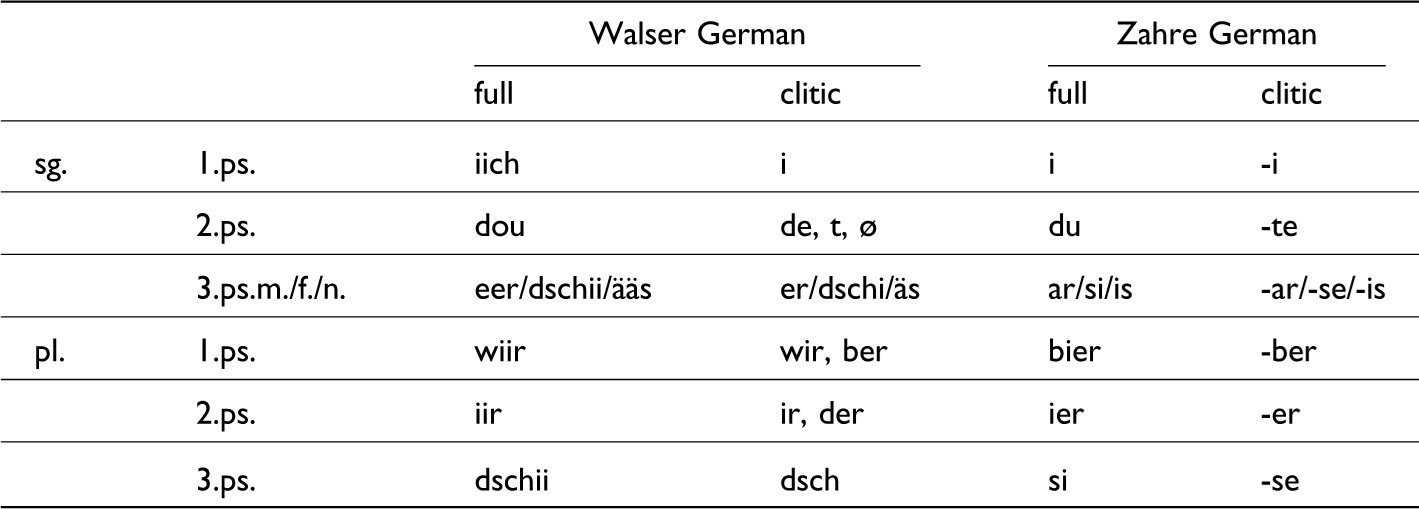
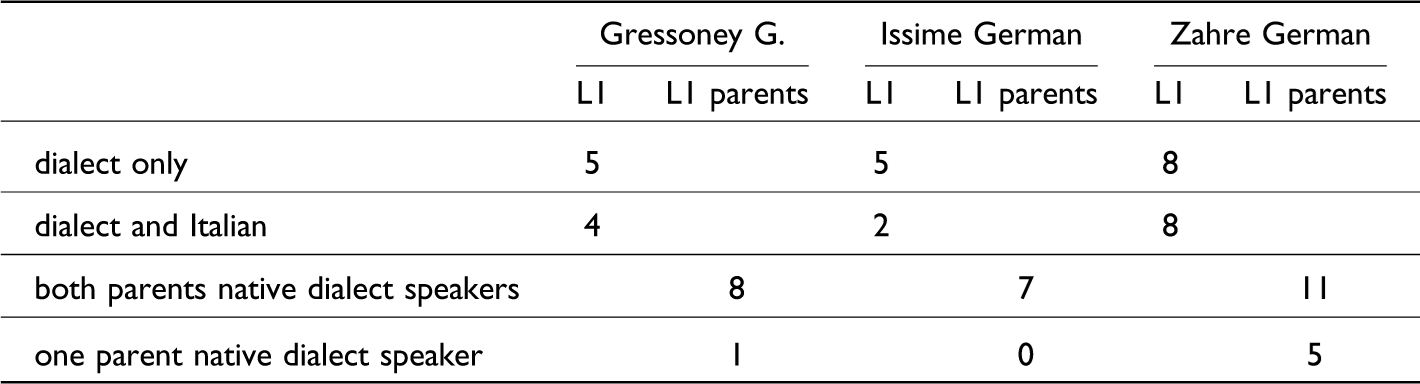
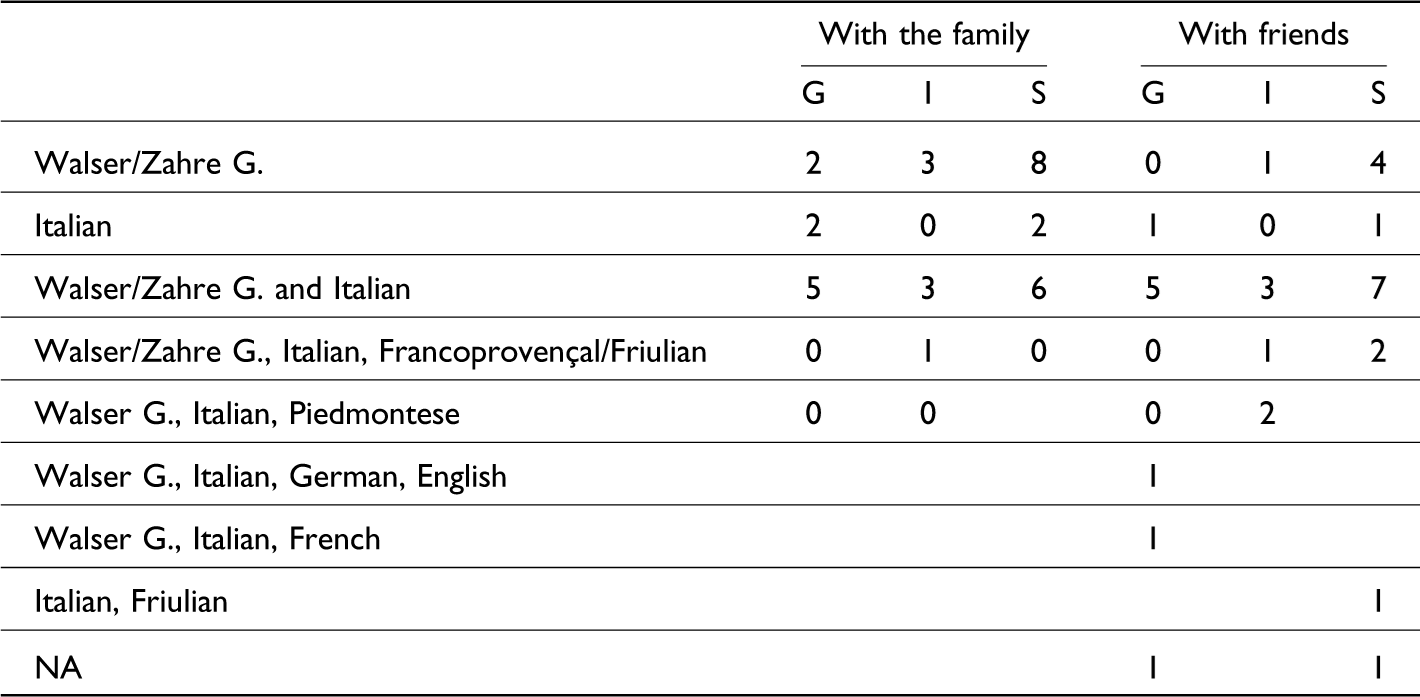
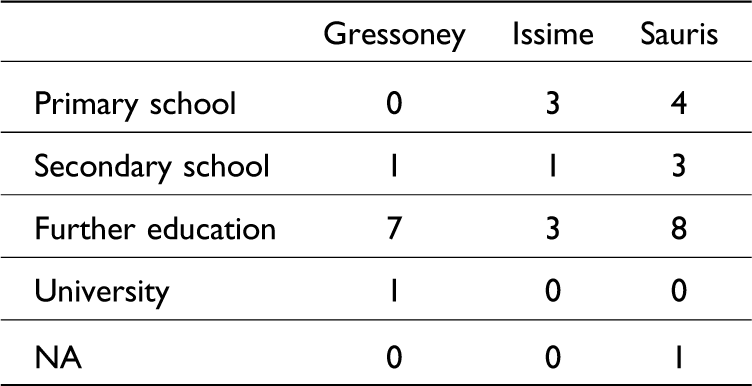

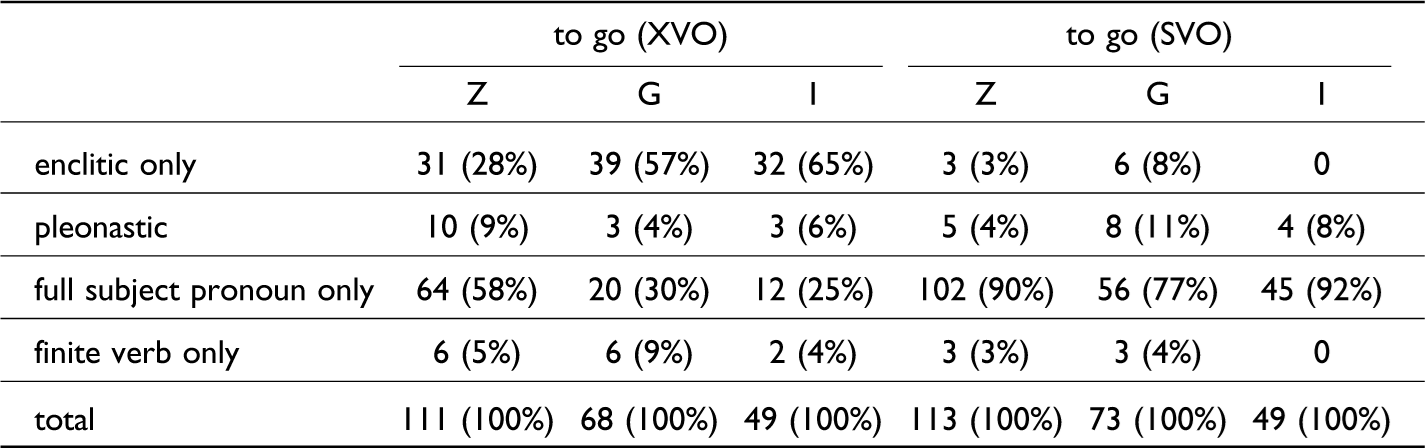
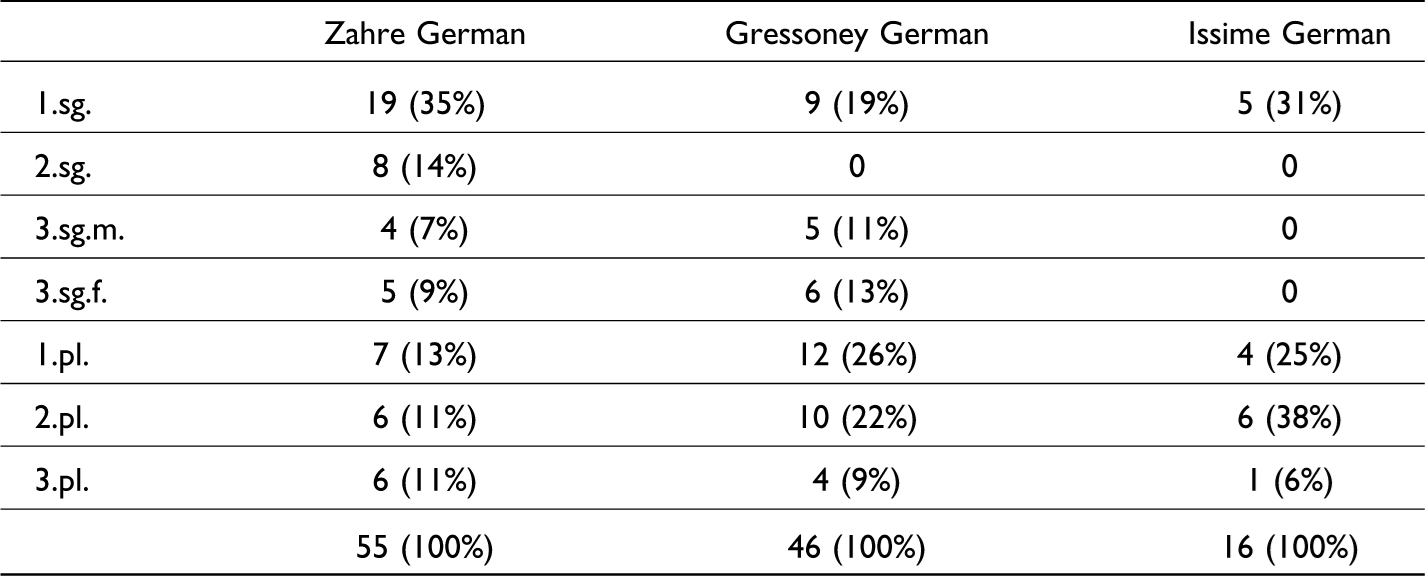




 Open access

