1. Introduction
The so-called verba pura constitute a well-defined group of verbs whose reflexes in the older Germanic dialects have the form (C)C  - (C)C j- and possibly (C)C w-. The widely attested etymon sow is typical: Gothic saian (probably [sɛːan]), ON sā < +sāa, OE sāwan, Old Frisian (OF) part. esēn, OS sāian, and OHG sāen beside occasional sāien, sāwen. The same PIE root, traditionally reconstructed as +sē- or +sēi-, underlies Lt. sēmen, Lith. sėklà ‘seed’, perhaps also Skt. sī́ra- ‘plow’, sī́tā ‘furrow’. Similarly, ON róa, OE rōwan, MHG rüe(j)en ‘row’ were thought to reflect +rō-, the o-grade of +rē- seen in Lt. rēmus ‘oar’.
Such roots were understandably regarded as aberrant: While most PIE roots ended in consonants, PIE +sē(i)- and many similar roots seemed to end in a long vowel or a long diphthong and were thus fundamentally different. With the advent of the laryngeal theory, it was seen that most long vowels reflected VH, where H represents a “laryn-geal” consonant.Footnote 1 The ancestral form of saian must have been PIE +seE- (a CVC-root) or perhaps +seEi-, where i (/j/) might be an extension or stem-formant. Similarly, rōa must reflect PIE +EroE-; compare Lt. rēmus < +EreE-, Skt. arítra- ‘rudder’, Gk. erétēs ‘oarsman’, eréssō ‘row’ < +EereE-t-, Lith. ìrti ‘row’ < +Er̥E-. Several other verba pura clearly have ē1 < eE or ō < oE. Other verba pura containing A or O rather than E are considered in section 5 of this paper.
In a few instances where proto-forms with -ēu- or -ōu- had been posited (OE flōwan ‘flow’, OHG flouwen ‘wash out, rinse’, compare Lith. pláuti ‘rinse’, Gk. plṓō beside plé(w)ō, fut. pleúsomai ‘sail’), proto-forms with -eHu- or -oHu- now seemed indicated. Oddly, Go. bauan, ON búa, OHG būan ‘dwell’ are often not counted among the verba pura, though this group too is traditionally derived from +bhēu- or +bhōu-.
2. Did the Thematic Verba Pura All Have PG j?
2.1. The Standard Theory
With a few exceptions, such as OE dōn, OHG tuon ‘do’, OHG stān, stēn ‘stand’, and OHG gēn, gēn ‘go’, the verba pura show thematic inflection in all Gmc. dialects. Ever since the nineteenth century, most scholars have maintained that the thematic verba pura contained PG j, that is, PG +sē1jana- and so on, probably also +būjan, and even +flōjan.Footnote 2 Even the most recent treatments by Lindeman (1966), Meid (1971), Matzel (1987), and Thórhallsdóttir (1993) assert uniform PG j. Citing M⊘ller (1880b:469), Burghauser (1887:45f.), Streitberg (1896:76), Hirt (1905: 281f.), van Helten (1909:278f.), and Kluge (1910:106ff.), Lindeman (1966:48) summarizes this position as follows:
Die Verba pura scheinen urgermanisch ein j-Präsens gebildet zu haben. Man nimmt im allgemeinen an, dass eine ursprünglich nur für einige Verba charakteristische, altererbte j-Präsensbildung im Germanischen frühzeitig produktiv wurde und später auf alle anderen Verba desselben Typus analogisch übertragen worden ist […].Footnote 3
2.2. Evidence Against Original j
The evidence of the attested verba pura strongly suggests that the PG forms did not have j. In several dialects, the verba pura were largely homogenized. For example, OE thematic verba pura have strong present stems containing w and preterites in -ēow, while in OS they are Class I weak verbs. The reflexes of +sē1- ‘sow’ < +seE- are typical. Five of the six major dialects suggest PG forms without j:
(i) Go. saian was apparently [sɛː.an] or possibly (we do not know whether Gothic possessed distinctive vowel length) [sɛ.an]; written <ai> because <e> was reserved for close [ẹː] ([ẹ]). In a few instances, 3.sg. saiiÞ is written as saijiÞ and pres.part. saiands appears as saijands. Lindeman (1966:49) rightly comments: “Die Form saijiÞ stellt doch wohl nichts Ursprüngliches dar. Das -j- kann ja einfach dem folgenden ‑i- seinen Ursprung verdanken […].Footnote 4 Lindeman nevertheless posits PG j for this and all other thematic verba pura.
(ii) ON sā < +sā-a shows no trace of earlier j. Nevertheless, Lindeman (166:49f.) says:
Instead of +sæja, we find only sā, suggesting that the present did not contain PG j (but see below for Thórhallsdóttir's (1993) explanation of this absence).Es unterliegt m.E. keinem Zweifel, dass z.B. das aisl. Verbum sá ‘säen’ letzten Endes ein urgerm. j-Präsens +sē-ja/i- voraussetzt […]. Die aisl. Flexion dieses Verbums lässt sich aber kaum auf rein lautgesetzlichem Wege erklären […]. Der urgerm. Infinitiv +sē-jan-, sowie die 3.Plur. +sē-janÞ hätten aber, soviel ich sehe, lautgesetzlich aisl. +sæja ergeben müssen.Footnote 5
(iii) OE sāwan again shows no sign of j. There is no reason to think that the w (which Lindeman, following M⊘ller 1880b and Hirt 1905, believes developed originally in the preterite) is ancient; it is almost certainly a Hiattilger.
(iv) The only attested OF form of ‘sow’ is the past participle esēn. The parallel forms waja (wia) ‘blow’ and mīa ‘mow’ suggest a present EFris. +si̯ā according to Lindeman (1966:63), but apparently WFris. sīa(n). Lindeman believes these confusing forms originally paralleled those of OE: “Man nimmt […] wohl mit Recht an, dass die Verba pura im Vor-friesischen -w- zwischen Wurzelvokal und Endung hatten.”Footnote 6 In effect, Lindeman proposes a development PG j > Ø > w > OF Ø, even though Frisian offers no evidence, direct or indirect, for either j or w.
(v) Old Saxon normally has present sāian, indicating j.
(vi) Old High German presents a wide variety of forms. In earlier OHG, beside occasional sāien, we more frequently find sāen, as well as sāhen, sāwen, and even contracted sān. Otfrid offers sāan, which looks like a j-less (strong) infinitive. j (written <i> or <g>) appears more commonly from the eleventh century on and clearly became the norm, as shown by the consistent umlaut of MHG and NHG forms (sæjen > säen). In other words, the j-forms increase during the OHG period, suggesting that they are an innovation rather than a retention. This was already noticed by Bremer (1886:69):
This indicates that OHG was finally beginning to homogenize the verba pura as other dialects had done earlier, and the process was completed by MHG.Diese zusammenstellung zeigt, dass wir als paradigma für das ahd. nicht sâjan oder sâjen sondern sâen (bezüglich sâhen) anzusetzen haben, ebenso muo(h)en und nicht muojan. Von der ältesten zeit bis gegen ausgang des ahd. sind dies in allen dialekten die regulären formen. Erst seit der zweiten hälfte des 11. jhdts. werden die j-formen häufiger.Footnote 7
If at some point in Proto-Germanic all thematic verba pura contained j (the standard theory), we might expect that j would be well attested in the older dialects. Instead, j is non-existent in ON, OE, and OF; it is very scarce in older OHG, where it competes with other Hiattilger such as w and h (though <h> may have served rather to indicate hiatus). In Gothic, it is confined to a few forms such as stojan ‘judge’, which are not generally considered verba pura. Only in Old Saxon do the verba pura consistently show j. Confronted with these facts, if we were reconstructing Proto-Germanic from scratch, we would undoubtedly construct the thematic verba pura without j and assume that uniform OS j (like OE w) is an innovation, as it seems to be in OHG.
2.3. Alternative Views
In fact, some scholars, beginning with van Helten (1909:278f.), have suggested that some thematic verba pura contained PG j, while others did not:
Vielmehr haben wir hier den umstand ins auge zu fassen, dass nach aksl. vějetĭ ‘weht’, sějetĭ ‘sät’, lett. déju ‘sauge’, aksl. znajetĭ ‘erkennt’, aid. jn̑āyatē noscitur, aksl. grajetĭ ‘krächzt’, aksl. spějetĭ ‘hat erfolg’ die möglichkeit anzunehmen [ist] von agerm. -i ̯o-stämmen (-i ̯o- nach vocal, nicht -io-) wā ei̯o-, sāei̯o-, dāei̯o-, knāei̯o-, krāei̯o- (die germ. formen beider verba mit ā e aus alten [sic] ē a gegenüber aksl. auf ō a hinweisendem a), spōi ̯o- […]: zu solchen stämmen stehende verbal-formen konnten zu reinem stamm stehende [… he mentions OHG “bāan, blāan, … bluoen” etc.] gelegentlich in ihre kategorie hinüber-ziehen, während umgekehrt auch zur -i ̯o-kategorie gehörende verba ohne -i ̯- oder daraus hervorgegangenes (spirantisches) -j- gesprochen wurden […].Footnote 8
Van Helten (1909:285) cites Go. saian, ON sá as j-less forms. More recently, Thórhallsdóttir (1993:50), although she writes all PG thematic verba pura with j, concedes that this may not be correct:
Proto-Germanic must be assumed to have generalized j-presents, a productive formation in Germanic, as the normal present stems of vowel-final roots. Some scholars have apparently understood the generalization to have been absolute and have projected every Ger-manic verbum purum directly back to a present in +-i̯e/o- which need not be PIE. It is likely, however, that some of the verbs which pattern as verba pura in the attested languages did not originate as j-presents of roots of the shape PIE +Cehx- but joined the group from other sources. One candidate is the verb OE flōwan[…]. In such cases it is doubtful that a j-present […] ever existed.Footnote 9
One scholar seems to have denied that any verba pura had PG j. Bremer (1886:57ff.) suggested instead that older athematic forms such as +(si)-sē-mi were replaced by j-less thematic forms, as in +sē-e/o- > PG +sē1-e/a-. Balto-Slavic j-presents formed from such roots do not impress him:
Nun legt es aber ein kurzer hinblick auf die lit. und slav. präsens-bildungen ausserordentlich nahe, nichts ursprüngliches in formen wie sė́ju, [ksl.] sěją zu suchen. Die j-bildungen sind in diesen sprachen so zahlreich gegenüber denen der anderen sprachen, dass die annahme kaum abzuweisen sein dürfte, diese j-bildungen haben das gebiet, welches ihnen ursprünglich zukam, überschritten und ihre herrschaft über viele, früher nicht zugehörige verben ausgebreitet […]. Es ist kein zwingender grund vorhanden zur annahme einer idg. präsensbildung +sēˊiōˋ. Footnote 10
Bremer is quite correct here: relatively few verba pura have cognates with j outside Balto-Slavic, and even these could conceivably be inde-pendent developments.
2.4. Why is the Standard Theory Still Standard?
Despite these considerations, most scholars still believe that all thematic verba pura had PG j and seem to assume that this j, if not necessarily PIE, is at least very old. Part of the reason must be that earlier scholars derived +sē1- from PIE +sē(i)-, where ē is the full grade of an “original long vowel” (weak grade ə); thematic forms such as PIE or pre-Gmc. +sē.e/o- with hiatus were then almost unthinkable. Kluge (1910:106) summarizes this view neatly:
Unsere grammatischen Hilfsmittel für das Gotische scheinen darin einig zu sein, dass in got. saia waia für urgerm. sêô wêô ein Lautgesetz für den Hiatus vorliegt. Diesen Standpunkt habe ich nie teilen können, weil ich mit Möller, Beitr. VII [1880b] 469 schon lange der Meinung bin, dass vielmehr sêjô wêjô mit jo-Präsens (des Typus asächs. biddian sittian liggian) als urgerm. und indogerm. Grundformen anzusetzen sind. Man darf Zweifel darüber hegen, ob Hiatusformen wie sêô sêesi sêeti sich überhaupt als indogerm. erweisen lassen; denn Kontraktionen waren für solche Fälle doch sehr früh unvermeidlich gewesen, und aus keiner indogerm. Sprache hat man noch den Beweis erbracht, dass eine solche Singularflexion für die gemeinsame Grundsprache und somit auch für das Germanische vorauszusetzen wäre.Footnote 11
Kluge can hardly have meant that hiatus always and everywhere leads to contraction, since even he presumably maintained hiatus in NHG säen [zɛː.ən], not to mention sehen [zeː.ən] ‘see’. However, it is true that many older IE languages, and apparently PIE itself, did not readily tolerate hiatus. Bremer's PIE +sēe/o- is unthinkable not because it is in-herently implausible (the NHG forms would be aberrations, but they are not), but simply because such forms seem not to have existed in PIE. In contrast, a PIE +sē1-je/o- (which is not demonstrable—Balto-Slavic j-forms need not be original—but plausible because some parallel forms are known to have existed in later PIE) could have been maintained for millennia without contracting.
3. The Verba Pura and Laryngeals
It is now acknowledged that while the lengthened grade of PIE e was ē, so-called original ē was actually eE, a short vowel plus laryngeal: ‘sow’ was not +sē- but +seE‑. Kluge's argument then loses its force, since a j-less +seE-e/o- would have had no hiatus and hence no contraction as long as the laryngeal was maintained. Even though it seems that PIE did not yet possess verbs of the form CVH-e/o- (see Thórhallsdóttir 1993:51), this tells us nothing about later developments.Footnote 12 As it happens, verbs in CVH-je/o- are at best poorly represented in PIE. Even if all thematic verba pura really did have PG j, there is not even one that certainly had PIE -je/o-. Even OHG nāen ‘sew’ < +(s)neH- ‘spin’ may have received its j through reshaping, as Rix et al. (2001:571f.) suggest, despite appar-ent j in Gk. nô < +nḗō (not +néō) ‘sew’ and Lt. neō ‘spin’ < PIE +snē̆H-je/o-; see also Jasanoff 2003, who posits +snēA- rather than the obvious +sneE-.Footnote 13
3.1. Verschärfung
In a few positions, laryngeal loss has often been associated with the peculiarly Gmc. process known as Verschärfung, in which j and w are replaced by jj and ww, respectively, which appear as Go. ddj and ggw, ON ggj and ggv. Beginning with Smith (1941), various scholars have claimed, in effect, that in many sequences containing intervocalic i̯H u̯H Hj Hw, the laryngeal is assimilated to the neighboring glide: i̯H Hj > jj, u̯H Hw > ww. However, most scholars deny that all four sequences underwent Verschärfung, and some have maintained that the process was limited to certain accentual conditions. Jasanoff (1978) gives a useful summary of earlier laryngeal and non-laryngeal explanations of Ver-schärfung before presenting his own analysis.
Jasanoff's (1978) observations on Verschärfung have been widely accepted. He rightly emphasizes that not all instances of Verschärfung involved laryngeals and thus accepts Cowgill's (1960) claim that Go. 1/3.sg. iddja ‘went’ owes its Verschärfung to a former 3.pl +iddjun (attested iddjedun) < +ijjun < +ījun < +eii̯n̥t, which had replaced +ei̯n̥t (more probably +Eei̯n̥t). However, most of his other claims are at least questionable, and some are simply false. Although he posits PIE +bheuA-eje/o- as the ancestral form of ON byggva, byggja (compare Skt. bhavati ‘is’), Jasanoff (1978:80) calls the usual assumption that uA became ww through assimilation “gratuitous” and insists that PIE +bheu.Ae.je- (the dot indicates syllable boundary), after laryngeal loss, was +bheu.e.je- with hiatus rather than +bhe.we.je- and thus yielded Gmc. +beu.ī-. Eventually, a “euphonic glide” w filled the hiatus, after which “inter-vocalic +-uw- could have been reinterpreted as a phonological geminate, and +beuwī- would have assumed the shape +bewwī- (> +biwwi- > OI byggvi-).” Jasanoff (1978:87) explains that this is better than direct assimilation:
by assuming that laryngeals were lost without directly causing gemination in Germanic we have been able to account for cases like +dajjan, +Frijjō- [deity ON Frigg, OE Frīg] and +uwwalōn- [ON ugla, OHG ûwila ‘owl’] with no loss of generality […].
He derives these three etyma from +daijan < +daijijan < +dai.i.ja- > +dhoiE-eje/o-, Gmc. +frījō- < PIE +priH-je/o- (or +preEijeA-) and pre-Gmc. +ūwa/ilōn- (with original onomatopoetic ū-), respectively.
The most plausible of these three is the last: we need only accept that ū was at some point (re)analyzed as /uw/ rather than /ū/, which is particularly likely if ū was a diphthong [ʊu̯] (as, for example, in many American English pronunciations). Jasanoff posits a parallel (re)analysis of ī ([ɪi̯]?) as /ij/ to explain +Frijjō-, where ī is not original but reflects preconsonantal iH. Why not derive +Frijjō- directly from +priHjeA? Because Jasanoff (1978:79) has already noted: “We may begin by ob-serving that sequences of the type +-VHi̯- and +-VHu̯- apparently yielded +-i̯- and +-u̯- in Germanic, as elsewhere in Indo-European.” As examples he cites Gmc. +sē1jan < +seE-je/o-, +dē1jan < +dheE-je/o- or +dheEj-e/o-, +stōwijan ‘judge’ < +stoAw-eje/o-, and +laigōn ‘lick’ (Go. bi-laigon) < +loigh-eAje/o-. Go. bi-laigon proves nothing: Verschärfung is found only at the boundary between the first two syllables of a Gmc. base, thus its absence in bi-laigon and other ō-verbs is hardly surprising. Moreover, Go. stojan, whatever its proto-form, must not be separated from OHG stūēn ‘judge’, which cannot reflect +stoAw-eje/o-. Jasanoff's remaining examples, both verba pura, reveal his assumption that this class contained post-PIE j. Certainly, -eEje/o- seems to yield -ē1ji/a- in ON glær ‘bright’ to the PIE root +ghleE-, and +seEje/o- +dheEje/o-, after j is deleted by Thórhallsdóttir's (1993) rule, would then yield Go. saian, OHG tāen, and other such forms.
However, many forms continuing PIE [o a] (= ablaut o, or /e/ colored by O A) before Hj Hw show Verschärfung rather than Gmc. ō: Go. daddjan to a base dhoE-i/j-, ON hǫggva ‘hew’ to +keAu/w-. That these laryngeals stood before the glide is demonstrated by ē in Gk. thḗsato ‘he sucked’, Lt. fēlāre ‘suck’, and Skt. dhā́yas- ‘sucking’ (with with ā < ē), and by a-vocalism in reflexes of ‘hew’. Despite this, since Jasanoff believes +dhoE-je/o- +keAw-e/o- would become Gmc. +dōjan +hōwan, he is forced to derive daddjan and hǫggva from secondary full grades +dhoiE-eje/o- and +kauA-, respectively, which he says were formed from metathesized zero-grades +dhiE- +kuA-. Jasanoff (1978:81) explains:
Noting the frequency with which reflexes of *-ī- and *-ū- appear in the daughter languages as zero-grades to full-grade sequences of the type *-eHi- and *-eHu-, Winter [1965:192] conjectured that an IE meta-thesis rule converted inherited *-Hi- and *-Hu- to *-iH- and *-uH- before a following consonant. Indo-European would thus have had roots, or root-like complexes, of the form *TeHi-, *TeHu-, with zero-grades *TiH- and *TuH-. This situation, naturally unstable, could easily have led to the analogical replacement of *TeHi-, *TeHu-, by new full grades of the type *TeiH-, *TeuH-.
Although Winter was concerned primarily with Tocharian forms, he clearly believed mandatory laryngeal metathesis occurred throughout IE.Footnote 14 However, a general PIE laryngeal metathesis rule is out of the question. As pointed out in Connolly 1989, ī ū < preconsonantal Hi Hu is far more common in Indo-Iranic than elsewhere; it is notably less com-mon (though still frequent) even in Balto-Slavic. In Germanic, Italic, Celtic, and Greek, short-vowel reflexes are the norm. Beside Skt. vīrá- and Lith. výras ‘man’, we find Lt. vir, OIr. fer, and OE OHG wer, ON verr.Footnote 15 We cannot reconstruct PIE +wīro- or +wiHro-, for then the western languages must also exhibit ī. This leaves unmetathesized +/wHjro-/, however realized.Footnote 16
While rejecting a PIE laryngeal metathesis, in Connolly 1989 I argued that it is likely that Hi Hi > Indo-Iranic ī ū through a specifically “Aryan” metathesis rule; a similar rule likely applied optionally in Balto-Slavic. In Gmc. and other western IE branches, the few instances of ī ū are best derived from eHi eHu (as explained in note 1 above); there is no need to invoke metathesis. Thus, Jasanoff's secondary full grades with eiH auH have no place in Gmc. The forms daddjan hǫggva will then straightforwardly reflect +dhoE-je/o- +keAw-e/o-.
3.2. Lack of Verschärfung Means Verba Pura Had No j
If all this is so, then Gmc. +rō- ‘row’ and +spō- ‘proceed, succeed’ cannot be derived from +EroE-je/o- +spoH-je/o-, or else we should find not ON rōa, OHG spuoen but rather Gmc. +rajjan +spajjan > ON +reggja, OHG +spei(i)en. It then follows that the first thematic forms of róa and spuoen can only have been +EroE-e/o- and +spoH-e/o-. Further, since thematic verba pura in ō and ē1 seem entirely parallel, one should also derive ē1-verbs from j-less forms: as in Go. saian < +seE-e/o- rather than +seE-je/o‑. Jasanoff's unified explanation of all Verschärfung through glide insertion is then untenable despite its “generality.”
Note that I am not positing PIE +seE-e/o- +EroE-e/o- +spoH-e/o- as such forms seem not to have existed then. Rather, I assume they were formed sometime in Pre-Gmc. while intervocalic laryngeals were still maintained, presumably as replacements for older athematic forms.Footnote 17 Their further development is discussed below. However, first we must consider when intervocalic laryngeals (and indeed, all laryngeals) were lost in pre-Gmc.
3.3. When Were the Laryngeals Lost?
Unfortunately, even some scholars who fully accept and use the laryn-geal theory speak blithely of “the loss of the laryngeals,” as if all laryngeals were lost simultaneously in all positions in any given language. The reality is quite different. In Hittite, E seems always to have been lost.Footnote 18 By contrast, A and presumably O are lost only in a few well-defined environments. Loss of A O in these few environments could hardly have occurred together with or been connected to the general loss of E in all environments. However, since the different coloring effects of laryngeals strongly suggest at least three distinct points of articulation, this is hardly surprising: phonetically and phonologically different sounds might be expected to have been lost separately.
Most modern scholars have realized that laryngeal reflexes in IE dialects are so diverse that they can only have been lost in a dialectal period of IE (Lindeman 1982, 1987) or, more probably, in the individual languages after the breakup of PIE (Beekes 1969). If the laryngeals were lost separately in the various Indo-European dialects, our default assumption must be that different dialects lost them at different times. Moreover, as Hittite reminds us, even in a single dialect we cannot assume that all laryngeals in all positions were lost simultaneously. In final position and before consonants, VH > V ̄ almost everywhere by compensatory lengthening. However, even this development has exceptions indicating that it must be post-PIE. Beekes (1969:159) points out that Gk. pótniă beside Skt. pátnī ‘lady’ < PIE +pot-niA must contain a vocalized laryngeal, which can only have developed within (Pre)-Greek (unless we assume an unlikely PIE +potnjeA beside +potniA). Beekes (1969:166) is surely right when he says that forms such as Hitt. pa-aḫ-ḫa-aŝ-mi, that is, paḫŝmi ‘protect’ < +peA- show that preconsonantal laryn-geals were still maintained in PIE.
Lindeman (1982:70, 1987:118) claims than laryngeals were first lost before vowels, by which he apparently means in the environment C__V. This too cannot be PIE: laryngeals seem to have affected the timbre of neighboring i only in Gmc., where Hi yields a PG vowel ɨ (> OHG OS ON OE e beside i) rather than i (> OHG OS ON OE i); see note 15 above. Further, in Indo-Iranic we see that laryngeals—probably only A—sometimes aspirated a preceding stop, as in Skt. tiṣṭhati ‘stands’ < +sti-stA-e-ti, duhitā ‘daughter’ < +dhugA-tēr beside Gk. hístēmi, thygátēr (not +ísthēmi, +tykhátēr). However, a laryngeal may have caused aspiration in other Greek forms such as skházō ‘let go, slit open’, skhízō ‘split’ < +sk(e)A-.Footnote 19
Furthermore, Lindeman (1982), following Bomhard (1976), believes that all PIE laryngeals merged into a single H in later PIE before drop-ping. Szemerényi (1990) and Bammesberger (1984) went even further, claiming that PIE always had only one laryngeal. However, then we should expect that any laryngeal might cause aspiration in Skt. Further, vocalized laryngeals often retain their color in Greek: although assimi-lation and analogy have since leveled many forms, it is clear that normally E > e, A > a, O > o, especially initially (“prothetic vowels;” compare Beekes 1969:18–97, Connolly 1983, pace Bammesberger 1989). Lindeman, Bomhard, and Szemerényi are thus refuted.
For the most part, it is not possible to state with precision when a laryngeal dropped in pre-Gmc. Before and after obstruents, it is clear only that laryngeals must have been lost before the Gmc. consonant shift, since obstruents which originally stood before or after laryngeals were shifted exactly like those in non-laryngeal environments.Footnote 20 We have even less idea of when Verschärfung occurred, except that it cannot have been Common IE as Lindeman thought. Even these vague statements tell us nothing about intervocalic laryngeals such as those I am suggesting for +seE-e/o- +EroE-e/o-.
However, a somewhat different case of intervocalic laryngeal loss can be dated approximately. In Connolly 1980, it is argued that NWGmc. strong verbs of Classes I, II, and III, as well as diphthongal reduplicating (Class VII) verbs, tend to exhibit regular “grammatischer Wechsel” in old non-laryngeal bases reflecting CeiC-, CeuC-, and CeRC- (R = m, n, l, r), while in laryngeal bases of the types CeHiC-, CeHuC-, and CeHR̥C- (as well as CeiHC- CeuHC- CeRHC-), grammatischer Wechsel is irregular or lacking. (One may call these future diphthongal bases.) Thus, teuhan ‘pull’ < PIE +deuḱ- shows regular grammatischer Wechsel in all NWGmc. dialects (but also leveling to h in OS): OHG ziohan zōh zugun gizogan is typical. In contrast, +wīsan ‘wilt’ < +weEi-s- (compare Lt. vīrus, Gk. īós ‘poison’ < +weHiso-, OHG wesan ‘crumbling’ < +wEisonó-) has only s in ON and OHG (the only dialects where it is attested), and its derivatives (OE wisnian beside weornian ‘dry up, wither’, for-weoren ‘decayed’ but ON vesall ‘wretched’) show both s and r < z without pattern.
In Connolly 1980, the disruption of grammatischer Wechsel in old laryngeal bases was attributed to the loss of laryngeals as Verner's Law was operating, that is, while it was still phonetically conditioned by the PIE accent. The regular development is seen in non-laryngeal PIE +déuḱ-e/o- and perfect singular +de-dóuḱ- (+dóuḱ-?) > Gmc. +/teuh- tauh-/ (presumably [tʰeux- tʰaux-]); preterite plural and the past participle +(de)-duḱ-mé, +duḱ-onó- > Gmc. +/tugum tugana-/ [tʰuɣum tʰoɣana-]. How-ever, verbs that originally contained laryngeals do not usually show this pattern. Go. skaidan, OE scādan ‘separate’ point to Gmc. +skaid-, while OHG sceidan reflects Gmc. +skaiÞ-. It is clear that this form contained a PIE laryngeal, probably A; compare Gk. skházō ‘slit open’, Lith. skíedžiu, skíesti ‘separate’. If the laryngeal dropped before voicing through Verner's Law occurred, we should expect Gmc.+skaiÞ- to follow the normal pattern for grammatischer Wechsel: present +/skéAjt-/ [skáAit-] > +skáit- > +skaiÞ-, participle +/skAjt-onó-/ [skAitonó-] > +skɨÞonó- > +skɨðaná- > +/skɨdana-/.Footnote 21 If instead voicing by Verner's Law began while the present stem was still +skáΑɨÞ-, this should have developed to +skáΑɨð- and eventually Gmc. +skaid-, since the closest preceding syllabic, ɨ, was unstressed in PIE.
However, if the laryngeal in this form dropped as Verner's Law was switching from (original) phonological conditioning to morphological conditioning, as was necessary to maintain the rule in NWGmc. once the PIE free accent was replaced by the Gmc. root stress, the new diphthon-gal present (where Gmc. [f θ h s] was normal, compare OE sēoÞan, OHG siodan ‘boil’ < +seuÞ- < +séut- but part. soden resp. gisotan < +suðana- < +sutonó-) may well have led to phonetic restoration of [θ] for some speakers, while other speakers retained [ð] by restructuring the under-lying form to +/skaid-/. Since confusion is rampant in roots reflecting PIE CVHi-C- CVHu-C- (probably also CeiH-C- CeuH-C-, though this is difficult to understand), loss of these laryngeals during the last few centuries BCE seems likely.Footnote 22
The argument just presented is somewhat inexact, since the relevant change for Verner's Law is not the laryngeal loss per se, but the change in the number of syllables when the formation of diphthongs eliminated hiatus. As long as hiatus was maintained, by Verner's Law we would expect +[ˈska.ɨð-]. However, such forms were probably short-lived. Gmc. 3.sg. +[ˈska.ɨ.ðið (ˈska.ɨ.ði.ði)] would be a prime candidate for contraction, having root-internal hiatus and thus being a syllable longer than other-wise similar diphthongal strong verbs, such as +[ˈbeu.ðið (ˈbeu.ði.ði)] < +bheudh-e-ti ‘offers’. Contraction of disyllabic [a.ɨ] to a diphthong [ai] would at once eliminate an awkward root-internal sequence and bring verbs such as +ska.ɨÞ/d- into line with diphthongal strong verbs such as +beud-.
In the thematic verba pura, however, the hiatus stood at a morpheme boundary, where paradigmatic pressure to maintain the desinence as a separate syllable would certainly have discouraged contraction.Footnote 23 Fur-thermore, contraction would have made the verba pura quite unlike other thematic verbs: OHG sāit ‘sows’ (1.sg. sāu) patterns like lāzit ‘lets’ (1.sg. lāzu), whereas the occasional contracted form sāt resembles rather athematic stāt ‘stands’ (1.sg. stān). Small wonder then that in the older Gmc. dialects, thematic verba pura are overwhelmingly disyllabic. Laryngeal loss in the verba pura could hardly have occurred earlier than in future diphthongal bases; I therefore also date their loss to the last few centuries BCE.
3.4. Hiatus After Laryngeal Loss
We must remember that +seE-e/o- +EroE-e/o- would not directly yield +sē1-e/a- +rō-e/a-. Tautosyllabic VH yields by compensatory lengthening: when a consonant in the syllable coda is lost, lengthening the syllable nucleus permits the long (heavy) syllable to remain long (heavy). Gk. eimí [ẹːmi] ‘I am’ < +Ees-mi shows compensatory lengthening after loss of tautosyllabic h < s; numerous forms in other languages could be cited. However, in +seEe/o- +EroEe/o-, the laryngeals formed the syllable onset, [se.Ee/o- Ero.Ee/o-]. Because the laryngeal belonged to the next syllable, its loss would not cause compensatory lengthening, just as loss of intervocalic h < s did not cause lengthening in Greek: PIE gen.sg. +ǵenE-es-os > pre-Gk. +genesos ‘family, stock’ > +génehos > géneos, later contracted to génous [ɡenọːs]. Accordingly, immediately after laryngeal loss, these verba pura would have been [se.e/o- ro.e/o-], with short vowels in hiatus.
Laryngealists, of course, have long assumed VHV > V̆V, for example Kuryłowicz (1935:28f.):
Quand l'élément ə̯ [that is, any laryngeal] se trouve entre voyelles (ce qui arrive dans le cas d'un suffixe vocalique ou d'une désinence vocalique s'ajoutant à une racine ou à un thème en voyelle longue originaire), il disparait (phénomène appelé vocalis ante vocalem corripitur [‘one vowel before another is shortened’]).Footnote 24
Kuryłowicz explains this obscure statement obscurely: “Mais āx+ax n'est en réalité que axə̯+ax > ax+ə̯ax > ax+ax.” [But āx+ax is in reality simply axə̯+ax > ax+ə̯ax > ax+ax.] A possible interpretation of this is that traditional +V was morphologically VH+V but phonetically V.HV, which should yield a sequence of two short vowels. The apparent short-ening of long vowels before other vowels is then an illusion.
4. Hiatus and Vowel Lengthening
Kuryłowicz (1935:28f.) expected intervocalic laryngeal loss to lead to contraction: “Les voyelles en hiatus subissent ensuite la contraction.” [The vowels in hiatus subsequently undergo contraction.] Contraction did occur in certain language groups (notably Indo-Iranic), but other ancient languages often maintained hiatus. In Latin, vocalis ante vocalem corripitur was a synchronic rule that, with a few lexical exceptions (for instance, gen.sg. alīus beside nom.sg. alĭus ‘other’), applied to all under-lying long vowels in hiatus. Thus, gen.sg. /fidē+ī/ ‘trust’ is realized as fidĕī, though gen.sg. /diē+ī/ ‘day’ is diēī. It is noteworthy that /fidē+ī/ and /diē+ī/ were formed in Italic when the genitive ending -ī of the o-stem (second) declension was introduced into the ē-stem (fifth) declension. The Latin rule then is much more than the PIE mirage envisioned by Kuryłowicz.
If Latin maintained hiatus by (or, at least, while) shortening vowels, other languages preferred to lengthen short vowels in hiatus. Vennemann (1994)—perhaps wrongly—linked this difference to the presence and relevance of Silbenschnitt (‘syllable cut’) of the sort found in modern Gmc. and some Romance languages (see 1).
(1) Preference Laws for Hiatus (Vennemann 1994:25)
“In klassischen Quantitätssprachen: Vocalis ante vocalem corripitur. In Silbenschnittsprachen: Vocalis ante vocalem elongatur [‘one vowel before another is lengthened’].”Footnote 25
Although Vennemann (1994:25f.) believes that PG and (for a time) the older Gmc. dialects were classical quantity languages because they had distinctive quantity, with Silbenschnitt either irrelevant or lacking, the introduction of the Gmc. root accent—the reason for the morphologi-zation of Verner's Law and hence earlier than laryngeal loss in the verba pura—must have changed this situation. Certainly, shortening of a strongly stressed syllable as a way of preserving hiatus seems counter-intuitive; if anything, a short, strongly stressed vowel in hiatus is more stable if lengthened, Silbenschnitt or no.
4.1. Hiatus Lengthening in the Verba Pura
I, therefore, propose PIE +se.Ee/o- +Ero.Ee/o- > +se.e/o- +ro.e/o- > Gmc. +sē1.e/o +rō.e/o-, and so on. This proposal relies on the assumption that existing ē1 was still [eː] or [ɛː] rather than later [æː aː], and that PIE o had not yet become Gmc. a. Oddly, however, once these changes had oc-curred and e had become i in many desinences, hiatus was easier to maintain. Restle & Vennemann (2001:1318) remark: “Ein Hiat ist disfavorisiert, und zwar umso mehr, je geringer die Zahl der Merkmale ist, in denen sich die beiden Hiatvokale unterscheiden […].”Footnote 26 Lengthening certainly helped: originally differing only in stress, the vowels of +sē.eð(i) now also differed in length. However, once +sē.eð(i) has become +sā.ið, the two vowels differ in five features [stress, long, high, low, back]. Even in forms such as 3.pl. +rō.and < +ro.ond(i) < +EroE-o-nti, the seemingly unimportant development of o to a caused the hiatus vowels to differ in height and roundness as well as stress and length.
4.2. Traditional Views on Hiatus Are Untenable
The traditional objection to hiatus rather than j in the verba pura is based on two misconceptions, namely, that any hiatus must be very old, possibly existing since PIE, and that it could not possibly be maintained into PG and beyond without undergoing contraction. I believe I have demonstrated that hiatus could have come only with the loss of inter-vocalic laryngeals in the last few centuries BCE, and that other phonetic changes occurring shortly afterwards made it much easier to maintain hiatus in the verba pura. Further, I believe I have shown that despite Jasanoff 1978, pre-Gmc. oEjV would have yielded ajjV through Verschärfung, hence for róa and parallel forms, j-less forms with PG hiatus must be assumed. While forms such as saian could perfectly well reflect either +seE-e/o- or +seEj-e/o-, the obvious parallelism of ō- and ē1-verbs, such as ON rōa and sā < +sāa with preterites rera (r⊘ra) and sera (s⊘ra), indicates that Pre-Gmc. +seE-e/o- is much to be preferred.
It would be well to point out here that the theory that I am proposing is not incompatible with the claim of Fulk (1993) that certain OE verba pura show evidence of vowel shortening rather than lengthening. In OE (especially Anglian) verse, the mainly athematic verb dōn ‘do’ must often be scanned as two short syllables, effectively as +dŏan or perhaps +dŭan. He believes the same is true of OF, OS, and possibly OHG, where spellings sometimes indicate dissyllabic pronunciation, though he presents no evidence for ŏ rather than ō in these dialects. Fulk (1993: 245) believes that earlier ō (and ā in rare OE gān ‘go’) was shortened in such forms, so that “it is necessary to assume a process of shortening for antevocalic long vowels.” This rule must have been optional and/or confined to certain dialects. Fulk (1993:246) adds: “If there was such a shortening rule, OF and OS duan indicate that it must have applied no later than the Ingvaeonic period; and the Old High German evidence does not preclude an even earlier date.”
Since ON shows no sign of shortening, it could only have occurred after the NWGmc. period, whereas the lengthening I have proposed is Late PG or possibly Common Gmc., that is, several centuries earlier. It is then possible to accept both Fulk's analysis of dōn/+dŏan and the theory of vowel lengthening after laryngeal loss presented here. I would only add that since dōn and gān are old athematic verbs (and still are in OHG), the shortening (or resolution?) of long vowels in a few OE, OF, and OS forms may have been triggered by the change from athematic to thematic inflection, the much more numerous thematic verba pura then not being affected.
5. Why do Verba Pura in PIE A O Appear with Gmc. ē1 and not ō?
I have until now considered almost entirely verba pura which once contained E. Verbs with A or O will require separate treatment to explain why several of them appear with Gmc. ē1 rather than ō, the normal Gmc. reflex of eA eO (for example, OE mōdor, OHG muotar ‘mother < +meA-tḗr). I again remind the reader that these verbs show j-presents only in OS and late OHG, and that if they had contained PG j, they would show Verschärfung. However, while the j-lessness of these forms is no sur-prise, the same cannot be said of their vocalism.
Consider OE crāwan, OHG krāen ‘crow’ < PIE +kreA- [kraA-] (compare Lt. grāculus ‘jackdaw’, Lith. gróti ‘croak’), and OE cnāwan, OHG knāen ‘know’ < PIE +ǵneO- (compare Lt. cognōscō ‘recognize’, nōvī ‘know’, Gk. gignṓskō, égnōn ‘know’, Skt. jānā́mi, jajñā́u ‘know, recognize’). Athematic OHG stān beside stēn ‘stand’ from PIE steA- is equally puzzling, but once again I concentrate here on thematic forms.
5.1. Standard Theories
Traditional scholars have never satisfactorily explained the vocalism of +krē1- and +knē1-, which have what I call “unexpected ē1.” Matzel (1987) simply notes that expected Gmc. forms with +knō- and +krō- were re-made or replaced, but since ō was acceptable in verba pura, he offers no reason for the change. Meid (1971:83) had already said, noting the lack of ē outside Germanic: “germ. +knē- ist daher Rückbildung aus +knō-” [“Gmc. +knē- is therefore a back formation from +knō-”], which explains nothing. On the next page he suggests that +krē1- may reflect an other-wise unattested PIE +grē- used of a rooster's crowing, but finds this unsatisfactory because of the obvious (though deceptive) similarity of ON krákr ‘raven’, kráka ‘crow’, and Lt. grāculus. He then presents a mechanism for deriving +krē1- from +grā- after all:
In diesem besonderen Fall eines Naturlautes widersteht ā jedoch der Verdumpfung zu ō. Es kann als ā jedoch nicht bestehen bleiben, da dieser Laut als Phonem dem Germanischen zu einer bestimmten Zeit fremd ist. Der Laut wird daher nach der anderen Seite verschoben und dem helleren Phonem ē (phonet. ǣ) zugeteilt, d.h. +krā- (so nach der Verschiebung g > k) wird phonologisch als +krē- behandelt […].Footnote 27
Already Porkorny (1959:384) derives these words from “wgerm. nord. +krā- (mit nicht zu ō gewandeltem alten ā durch neuerliche Nachahmung des a-farbigen Rabengekrächzes).”Footnote 28 However, the croak of the common raven (Corvus corax) is not more ā-like than ɔ̄-like, and forms such as OE hrōc, ON hrókr ‘rook’ (Corvus frugilegus) < +kreA- or +kroH- (com-pare Gk. krôzō, krṓzō ‘croak’) precisely do not have ā. The Meid-Pokorny explanation is an unconvincing Notlösung, which even if right could not be extended to +knē1-, +stē1- < +steA- ‘stand’, or other verba pura that once contained A or O.
5.2. Narten Ablaut: Gmc. ē1 < PIE ēA ēO
A novel solution was proposed by Jasanoff (1989), who pointed out that Hitt. ganeŝzi ‘finds, recognizes’ and Toch. A kñasäṣtu = kñasäṣt tu ‘you know your way around’ seem to reflect PIE lengthened-grade +ǵnēO-. Jasanoff suggested that just as ē was apparently not colored by A (Eichner 1972), it was also preserved next to O. Jasanoff (2003) asserts that ē in this and certain other forms reflects a recently discovered acros-tatic or Narten ablaut type, with ḗ in stronger forms, ĕ́ in weaker ones. Though weaker +ǵneO- would have been realized as [ɟnoE-] and even-tually yielded +ǵnō- (Gmc. +knō-), stronger +ǵnēO- [ɟneːO-] would produce +ǵnē- (Gmc. +knē1-).
Both the concept of acrostatic/Narten ablaut and Jasanoff's extension of “lex Eichner” have been widely accepted, but in some cases they have been applied rather too enthusiastically. For instance, Jasanoff (2003: 108) remarks that although such forms as OE spōwan are usually derived from +spoE- (for instance, by Thórhallsdóttir 1993:59), “it is hard to find a rationale for the appearance of o-grade in a i̯e/o-present and the associ-ated noun in -ti.” He therefore suggests that the Gmc. forms reflect +speA-, while Lith. spė́ti ‘be capable’, Latv. spḕks ‘strength, power’ derive from +spēA-. However, several other verba pura with ō seem to have o-grade, while clear-cut cases of Narten ablaut outside Anatolian are remarkably few. It is therefore better to posit E and hence o in the ancestral form of spō-, following Rix et al. (2001:584).Footnote 29
5.3. ē1< PIE /eA eO/ [aA oO]?
However, a Narten present is not the only way to explain unexpected ē1. Certainly, it might be possible to derive +krē1- from +grēA-, as Thórhallsdóttir (1993:56) tentatively proposes—yet with no non-Gmc. evidence for ē in this root, it would be irresponsible to do so. Fortunately, another explanation is possible. Recall my proposal for +seE-e/o- and +EroE-e/o-: after E dropped, the initial result was not ē1 ō, but rather ĕ ŏ; lengthening occurred later. Similarly, +greA-e/o- [ɡraAe/o-] would at first yield +kra-e/o-, with later lengthening, while +ǵneO-e/o- [ɟnoOe/o-] would initially also not have lengthened the root vowel.Footnote 30
Now let us suppose ex hypothesi that A and O in the verba pura dropped after the characteristic Gmc. developments o > a and ā > ō had taken place rather than before, as with E. Then for ‘crow’, we would expect +greA-e/o- [ɡraAe/o-] > +kraAe/o- > +kraAe/a- > +kra.e/a- and eventually +krā.e/a-. Similarly, +ǵneO-e/o- [ɟnoOe/o-] > +knoOe/o- > +knaOe/a- > +kna.e/a- > +knā.e/a-. Note that older ā < preconsonantal eA had already become ō, while /ē1/ may already have been realized as [aː]. Once that stage was attained, new [aː] would have been reanalyzed as (formerly: “merged with”) /ē1/; until then it would have been rather a positional variant of /a/ synchronically generated by Vennemann's vocalis ante vocalem elongatur. In this way, PIE eA eO [aA oO] will yield /ē1/ even if oE had earlier become Gmc. ō in the verba pura as before consonants.
5.4. Verba Pura with PIE eE oE eA eO Compared
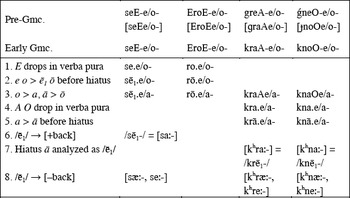
The vocalic development of the thematic verba pura is shown in table 1. It should be noted that only the first four steps need apply to Gothic: though bauan ‘dwell’ may reflect +bhuA-e/o-, Gothic has no verba pura with Gmc. ē1 or ō < PIE eA eO. The backing of /ē1/ to [aː], shown as step 6, may have occurred somewhat earlier, but only after step 3. Finally, the refronting of /ē1/ (step 8) may be only Anglo-Frisian. Despite OE sāwan, māwan, and so on, OF mīa ‘mow’ suggests that /ē1/ was at first refronted in the verba pura as in other morphological categories, only to be backed again in OE after the Hiattilger w was inserted (yet sǣwan is also attested).
Vocalic development of the thematic verba pura.

6. Evaluating the Proposed Theory
On the one hand, my hypothesis that intervocalic E was lost earlier than A O can be considered arbitrary and ad hoc.Footnote 31 On the other hand, the other points of my argument, if surprising, are anything but arbitrary: all agree that laryngeals were lost in the verba pura and that preceding vowels were lengthened as a result. Evidence for surprisingly late loss of intervocalic laryngeals in Gmc. has been presented. In sections 2.2–4, I have endeavored to show that the verba pura did not universally (or even usually) contain j. If so, it follows that the lengthening in thematic verba pura can only have occurred in hiatus. It is also widely accepted that at least in pre-NWGmc., /ē1/ at one point became [aː]; it would then have been natural to analyze any new [aː] of whatever origin as /ē1/. Later, we believe, /ē1/ [aː] was refronted in Anglo-Frisian.Footnote 32 Ideally, it would be possible to provide independent, that is, additional evidence for the set of processes outlined in table 1; but since there are no parallel classes of nomina vel adjectiva pura, this is not possible. I suggest, then, that for argument's sake the reader tentatively accept my chronology and con-sider an evaluation of its adequacy.
Arbitrary or not, dating the loss of E in verba pura earlier than the loss of A O has a certain plausibility. We need only look at Hittite, where E is always lost while A and O mostly remain. Further, if E was [ʔ] or perhaps [h] while A and O were noisy, “throaty” sounds, as one might suppose because of their coloring action, earlier loss of E is phonetically plausible.Footnote 33 However, Connolly (1980), in explaining why grammatischer Wechsel is absent or irregular in many verbs originally containing laryn-geals, assumed that laryngeals of any color were lost while Verner's Law was still phonetically conditioned, since disruptions in grammatischer Wechsel occur regardless of which laryngeal was involved (principally E in Classes I, II, and III, where the stem has e-vocalism, A in the reduplicating verbs that later became NWGmc. Class VII). However, since Verner's Law did not immediately become morphologically con-ditioned, this does not entail that all laryngeals were lost simultaneously in the future diphthongal verbs. In any event, the relevant change for the future diphthongal verbs was not laryngeal loss but the elimination of the resulting hiatus, which in the verba pura was rather maintained and strengthened. My claim that E dropped earlier than A and O in the verba pura then does not contradict Connolly 1980.
6.1. Etymological Data for Verba Pura in ē1
It is plain that the development that I have outlined works for all verba pura in ē1, regardless of the proto-form. Verbs with PIE eE and Narten ēE should both yield ē1; I can think of no way to separate them. Similarly, eA and eO will yield ē1 under the assumed development, but so would ēA and ēO. Nevertheless, it is appropriate to summarize briefly which laryngeal occurred in the proto-form of each ē1-verb. The verba pura in ē1 group as follows:
(i) PIE eE or ēE.
PG +dē1- ‘suck’, +Þrē1- ‘turn’, +wē1- ‘blow’, and probably +nē1- ‘sew’, which Jasanoff (2003:110) derives rather from +(s)nēA-.
(ii) PIE eA or ēA.
Of the two verbs certainly in this group, +krē1- was discussed above. Note that ON krákr ‘crow’ and kráka ‘raven’ (literally ‘croaker’) must have been formed from Gmc. +krē1-; if ancient, they could only have ō < preconsonantal eA. Otherwise we find only +mē1- ‘mow’ (OE māwan, OHG māen). The only close non-Gmc. cognates, Gk. amáō ‘mow, cut’, ámētos ‘harvesting’, suggest PIE +AmeA- [AmaA-]. Rix et al. (2001:279) propose rather +AmeE-, assuming either an unmotivated “Assimilation von +h2…h1 > +h2…h2 bzw. +a…ē̆ > +a…ā̆; oder späte Umbildung von +amē(i̯)e-.”Footnote 34 It is possible that +nē1- listed in the preceding group also belongs here.
(iii) PIE eO or ēO.
The only certain member of this class is +knē 1-, discussed above. Note that if +knē1- reflects +ǵneO- rather than a Narten +ǵnēO-, OHG urchnāt ‘recognition’ can only have been formed from Gmc. +knē1- rather than +ǵneO-.
(iv) PIE eH or ēH (non-Gmc. evidence for laryngeal color uncertain or lacking).
PG +bē1- ‘warm’, +blē1- ‘bleat’, +brē1- ‘give off a smell; steam’, +fē1- ‘reproach’, +lē1- (if not rather +lō-) ‘reproach’, +skrē1- and +sprē1- ‘spray’, and +swē1- ‘sway’.
6.2. Etymological Data for Verba Pura in ō
While verba pura with Gmc ē1 cause no difficulties, some in ō are problematic. One disconcerting feature of my explanation is that if eA and eO yield ē1 rather than ō in the verba pura, then attested ō in verba pura of PIE origin can only reflect oE. We must therefore examine etymologies and proto-forms of all verba pura in ō to determine whether this limitation is reasonable:
(2) PIE oE
a. +rō- and +spō- were discussed above.
b. +dō- ‘do’ (OE dōn beside athematic OHG tuon) < +dhoE-; compare Gk. títhēmi ‘put’ < +dheE-.
c. +glō- ‘glow’ (ON glóa, OE glōwan) beside ē1 in ON glær ‘bright’, glámr ‘moon’ suggests +ǵhloE-; compare Gk. khlōrós ‘pale green’, Lith. žlėjà ‘twilight’ < +ǵhleE-.
d. +hlō- ‘roar’ (OE hlōwan) belongs with Gk. kaléō (Aeolic kálēmi) ‘call’. Rix et al. (2001:361) rightly posit +kleE-; Lt. clāmor ‘noise’ can reflect +kl̥E-m-.
e. +brō- ‘make broth, brew’, as o-grade to +brē1-, would naturally reflect +bhroE- if the formation was already PIE, in which case +brē1- < +bhreE-; but probably related forms such as Lt. ferveō ‘boil; be boiling hot’ and fer-mentum ‘yeast’ do not show long vowels and need not contain a laryngeal.
f. +sprō- ‘spray’ (o-grade to +sprē1-) similarly could reflect +sproE-, in which case +sprē1- < +spreE-; but this is mere speculation.
(3) Other verba pura with ō
a. +blō- ‘bloom’ (OE blōwan, OHG bluoen) has no similar verb forms outside Gmc., though nouns (and denominative verbs) in ō are found in Italic and Celtic (Lt. flō-s, MIr. bláth, Welsh blawd ‘flower’). Rix et al. (2001:88) propose +bhleO-; Thórhallsdóttir (1993:53) suggests +bhleA- but provides no evidence.
b. +flō- flow’ (OE flōwan, OHG flouwen ‘wash out, rinse’) is tradition-ally derived from +plēu- or +plōu-, which translates as +pleEo- +ploEu- (Lith. pláuti ‘rinse’). Rix et al. (2001:485), citing Gk. plṓō ‘sail’, derives +flō- rather from +pleO-, a “Parallelwurzel” (parallel root) lacking u/w. However, this is highly questionable. Gk. plé(w)ō (fut. pleúsomai) ‘sail’ supports a proto-form with u/w even in Gk.
c. +grō- ‘grow’ beside OE grǣd ‘grass’ with ē1 would suggest +ghroE- but the root is very poorly attested outside Gmc.
d. +hnō- ‘scrape smooth, fit together precisely’ (OHG nuoen, MHG nüejen) seems related to Attic Gk. knên (Ionic knân) ‘scrape, scratch’, Lith. knóju, knóti ‘peel off (bark)’; Rix et al. (2001:365) suggest +kneA‑.
e. +mō- ‘torment’ (OHG muoen ‘trouble’, Go. af-mojan ‘debilitate’) has many non-Gmc. cognates with ō or o (Gk. môlos ‘toil and moil (of war)’, Lt. mŏlestus ‘bothersome’, Russ. máju ‘plagen, erschöpfen’; Rix et al. (2001:425) therefore propose +meO-.
f. +sō- ‘sacrifice’ (ON sōa) has no good etymology.
g. +Þrō- ‘suffer’ (OE Þrōwian) is hardly the o-grade of +Þrē1- ‘turn’ (Meid and Matzel) and clearly contains u/w (OHG drawa ‘threat’); it is then not a verbum purum. Not listed in Rix et al. 2001; Thórhallsdóttir (1993:60) suggests PIE +treO- because of Gk. ti-trṓ-skō ‘wound, damage’.
Of this group, only +blō-, +hnō-, and +mō- might be verba pura in A or O. +blō- (OHG bluoen, NHG blühen ‘bloom’) is short and at first glance looks like a primary verb, yet this is unlikely. Though all nouns formed from this root have suffixes such as PIE -s- (flōs), -t- (bláth, blawd, NHG Blüte ‘blossom’), or -mōn- (OHG bluoma), it is these nouns that are first in speakers’ and learners’ minds. That is, a flower is not ‘the thing produced by blooming’ but simply a common object found in woods, fields, and gardens, while the verb can only be defined as ‘bring forth a flower’. If +blō- is of PIE origin, as seems likely despite its strictly Western IE distribution, an o-grade PIE +bhloE- in a primary noun would be no less acceptable than e-grade +bleO- and would natur-ally be extended to any denominative verb. However, since +blō- has no parallels in other branches and is semantically secondary, I suggest it is a back formation created by removing the suffix from one of the ‘flower’ etyma. If this was done after preconsonantal oE or eO had become ō in the ancestral forms of bluoma and OE blōstma ‘flower, blossom’, the resulting verb +b(h)lō- need never have contained a laryngeal even though the ancestral nouns once did.
Similarly, the Gk. and Lt. relatives of +mō- are all formed with -l-; beside môlos (glossed by Porkorny (1959:746) as ‘Anstrengung, Mühe’) with its denominative mōléō and molestus, we may cite Lt. mōlēs ‘burden’, its derivative mōlior ‘set in motion, displace’, and Lith. pri-si-muolėti ‘struggle with’.Footnote 35 Of the few l-less forms, only +mō- and Russ. máju have the look of primary verbs, though like +blō- they are not semantically primary. Again, the nominal forms might reflect +moE- rather than +meO-. It will not do to make +mō- a back-formation from a now lost (pre)-Gmc. +mōl-; however, the (pre)-Gmc. adjective +mōÞja- ‘tired’ (OE mēðe, OHG muodi, NHG müde) beside +mōÞa- (ON móðr) < +móH-t(ej)o- might be a viable source.
Although Porkorny (1959:560) derives +hnō- and Attic Gk. knên from a “schwere Basis kenə-, knē-” (“heavy base kenə-, knē-”), that is, +kenE- : +kneE-, Ionic Gk. knân and Lith. knóju ‘remove the bark (from a tree)’ (not mentioned by Pokorny) seem to point rather to +knā- < +kneA‑, as proposed by Rix et al. (2001:365). The Gk. and Lith. forms are not entirely clear. Dictionaries typically list Gk. knên, knân under 1st.sg. knáō, but both dialects normally have contracted forms: Attic 1st, 2nd, and 3rd singular forms knô knê̜s knê̜, Ionic knô knâ̜s knâ̜. The Ionic forms are particularly difficult. Common Gk. ā, preserved as such in Doric and Aeolic dialects, essentially always appears as Ionic ē. In the very similar Attic, this ā becomes ē (Attic Ionic mḗtēr, Doric mātēr ‘mother’ < PIE +meA-tḗr) except after e i r (Ionic hṓrē, Attic Doric hṓrā ‘season; hour’ < PIE +joEr-eA, compare OHG jâr ‘year’ < +jē1ra- < +jeEr-o-). Yet, Ionic shows ā in knân, while Attic, despite its greater tolerance for ā, has ē. Though ā in knân certainly suggests PIE +kneA-, the odd distribution of ā and ē does not inspire confidence. Lith. knóti is also more complicated than first appears. Lith. o < Baltic ā can correspond to PIE ō, that is, ō, oE, or eO. Stang (1966:43) explains many such instances by adapting an explanation first given by J. Endzelin (Studia Baltica 4. 135f.): while Baltic ō is old, ā arose in original weak-grade forms when inherited ə was lengthened by some Baltic process. Although +doE- > Lith. dúoti ‘give’, Baltic ā also occurs, especially in derivatives, because “Im Balt. ist a (< ə3) verlängert worden, weil kurzer Vokal unmittelbar vor dem -t- des Infinitivs nicht vorkam.”Footnote 36 Thus weak-grade PIE +deO- led to a new Baltic inf. +dāti, which was generalized in OPruss. (where ā often corresponds to Lith. Latv. uo) and used for derivations in Lith. and Latv.
6.3. A Final Evaluation
My intent in the preceding paragraph was to show that Gmc. +hnō- possibly may not reflect +kneA-. Nevertheless, I concede that it probably does, and hence it would be a counterexample to my claim that the expected Gmc. reflex of prevocalic eA is ē1 rather than ō. In neogram-marian theory, even this single counterexample would have invalidated my explanation of unexpected ē1 < eA eO. However, since we no longer believe that sound laws always operate without exception, I regard the isolated form OHG nuoen, where eA may have yielded ō rather than ē1 as in +krē1- and +mē1‑, as a difficulty that requires further study but not (yet) as a reason to reject my proposal.
Those who judge my theory plausible must also consider whether it is more satisfactory than the current practice of positing Narten present forms in ē not only for Gmc. +knē1-, where there is Hittite and Tocharian B evidence for ē, but also in +krē1- and +mē1-, where there is none. I suspect that individual scholars will answer this question differently, but I can only hope that my proposed explanation is fairly considered and thoroughly discussed before being accepted or rejected.
In conclusion, I would note that accepting my proposal does not entail rejecting Narten present formations in Gmc. Even if my expla-nation is generally correct, it is still possible that in some instances, ē1 is rather the reflex of uncolored Narten ē before A or O. In particular, one might derive +knē1- from +ǵnēO- and yet claim that +krē1- and +mē1- reflect +grĕA- and +AmĕA-.