1. Introduction
It was Max Weinreich who first suggested in 1960 a kadmen-skheme fun yidishn vokalizm (‘proto-schema of Yiddish vowels’), that is, the Proto-Yiddish system of vowels and diphthongs. In his posthumous magnum opus (Weinreich Reference Guggenheim-Grünberg1973.2:321–382), every Yiddish (stressed) proto-vowel is designated by two characters: an upper case vowel (A, E, I, O, and U) that roughly characterizes its original quality and a digit indicating one of the following cases:
1 = vowels that were short and remained short
2 = vowels that were long and remained long
3 = vowels that were short and became lengthened in open syllables
4 = nucleus of an original diphthong whose first element was a short vowel
5 = special type of short vowel, existing only for the E-quality.
The analysis of the correspondences between reflexes of the same proto-vowels in various modern Yiddish dialects shows, however, that no difference can be discerned between E2 and E3, I2 and I3, O2 and O3, or U2 and U3. Weinreich was well aware of this fact, but he kept all these proto-vowels separate—most likely because the whole system looked more symmetrical—preferring not to treat the A-quality apart from others. Initially, the schema consisted of twenty elements: (a) no proto-vowel with digit 5 was postulated except for E5; (b) A4 was lacking; and (c) the digits 1, 2, and 3 were valid for all five qualities. Katz (Reference Katz and Katz1987:51) removed from this schema the proto-vowels E3, I3, O3, and U3 as redun-dant in the presence of E2, I2, O2, and U2, respectively. In the resulting schema of sixteen elements, two, A3 and E5, were treated separately: no other element with the same digit was found. To explain these anomalies in the otherwise symmetrical system, Katz (Reference Katz and Glinert1993a:50) conjectured that both elements were not present among the actual vowels of Proto-Yiddish but resulted from two splits that occurred during a later period, that of early Yiddish, under the influence of German. During that period, in High German dialects the short vowels were lengthened in open syllables.Footnote 1 For Weinreich, at some point during the history of Yiddish this process was responsible for the creation of all proto-vowels with digit 3. For Katz, on the contrary, only two proto-vowels met the conditions of this German phonetic process, namely A1 and E1. In open syllables, the former gave birth to A3 and the latter to E5.
Another change suggested by Katz concerns the attachment of vowels in words from the Hebrew component of Yiddish to various proto-vowels.Footnote 2 Weinreich (Reference Guggenheim-Grünberg1973.2:328) postulated that all these vowels were short during the Proto-Yiddish period. Consequently, he linked Hebrew vowels in open syllables to the series of proto-vowels with 3 as the digit. Katz (Reference Katz and Katz1987:51) demonstrated the internal incoherence of Weinreich’s solution. Indeed, if one takes into account the modern reflexes in Western Yiddish of qamets in open syllables, one can see that they belong to the proto-vowel A2, not to A3. Katz suggested using 2 as the second digit for qamets, tsere, hireq, holem, and shureq in open syllables.
Currently, the schema suggested by Weinreich, with or without Katz’s amendments, is universally accepted. It includes two groups of tables. The first one (heuristics) treats proto-vowels as diaphonemes and shows their reflexes in modern Yiddish dialects. The second one (historical linguistics) presents correspondence rules between these proto-vowels and two main source languages of Yiddish, medieval German and Hebrew. Weinreich himself took a very cautious attitude regarding the historical reality of his Proto-Yiddish vowel system. In particular, he rejected the idea of the proto-language and contrasted kadmen-yiddish (Proto-Yiddish) with breyshes-yidish (Earliest Yiddish); he refused to recognize the former as a real historical entity and treated it as a logical conventional construction.Footnote 3 For this reason, he introduced basic tables of correspondences instead of positing rules that would show the derivation between the vowels and the diphthongs of the following linguistic systems: (a) from source languages for Yiddish to Proto-Yiddish and (b) from the latter to modern Yiddish dialects.
This approach of correspondences rather than derivations is particularly visible when one considers the Yiddish proto-vowels and their modern realizations. For that part Weinreich suggests no derivational rules at all. On the one hand, this purely heuristic approach is natural if we take into account his reluctance to accept the idea of the real existence of Proto-Yiddish. On the other hand, it seems to contradict certain basic definitions present in his logical construction. Indeed, his whole schema is based on the concept of short and long vowels, and the changes of length in open syllables. The notions “short/long vowels” and “open/closed syllables”are not purely conventional: they make reference to phonetic reality.Footnote 4
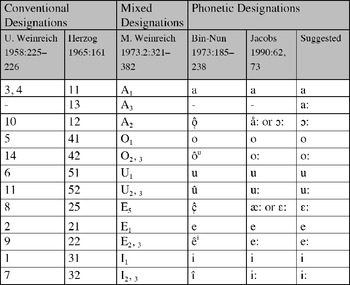
In Yiddish linguistics, Uriel Weinreich (Reference Weinreich1958:251–254) was the first scholar who suggested reconstruction of the phonetic values of proto-vowels of various Eastern Yiddish dialects and listed the main shifts that lead to modern reflexes. His analysis covered 15 phonemes, which he conventionally numbered 1 to 15. (To account for one specific development in the Yiddish of Courland, he also postulated the pos-sibility of an additional, 16th, proto-vowel.) His pioneering study was published before the theoretical schema of Yiddish proto-vowels was proposed by his father, Max Weinreich. Herzog (Reference Herzog1965:161–205) devel-oped the ideas of U. Weinreich, proposing a series of more detailed derivational rules and incorporating M. Weinreich's new concepts. He also suggested a system of designations that represented a compromise of those used by U. and M. Weinreich: Herzog replaced M. Weinreich's letters A, E, I, O, and U by digits 1, 2, 3, 4, and 5, respectively. Consequently, following his conventional designations the proto-vowel 11 is equivalent to Weinreich’s A1, 12 is just another formal way to describe Weinreich’s A2, etc. Jacobs (Reference Jacobs1990:62–90) was the third scholar to deal with a similar topic. In schemas he presented, he suggested several amendments to those by Herzog (phonetic values of vowels 12 and 25 in Proto-Yiddish and 42 in Proto-Northeastern Yiddish) and provided numerous additional details concerning shortening and lengthening of stressed vowels in specific environments and various other phonological processes.
The purpose of the present paper is to complete the existing schemas suggesting:
(i) derivational rules between the vowels of the German donor language and Yiddish proto-vowels;Footnote 5
(ii) derivational rules for Proto-Western Yiddish and its sub-dialects;Footnote 6
(iii) regions and approximate time period of the inception of Proto-Yiddish stressed vocalism.
This approach allows for the elimination of elements from the Weinreich system that still appear to be conventional (mnemonic/heuristic) “corre-spondences.”
2. Main Tables of Correspondences
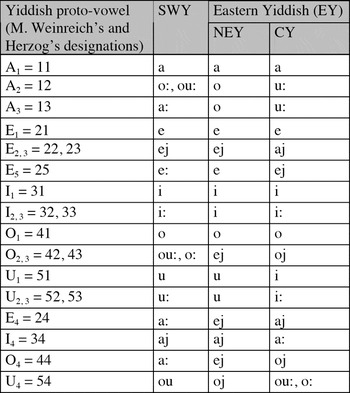
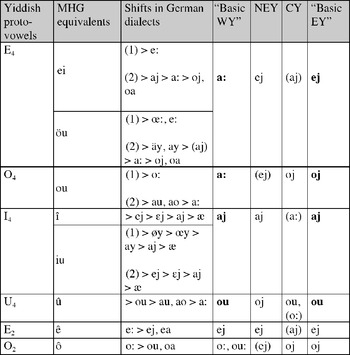
As explained above, the schema of proto-vowels proposed by M. Weinreich includes tables of two types. The first one gives the reflexes of proto-vowels in modern Yiddish dialects. Table 1 illustrates this for a sample of three modern dialects of Yiddish:
Northeastern Yiddish (NEY), generally referred to as Lithuanian Yiddish, characteristic in Lithuania, Latvia, Belarus, northern Ukraine and a part of northeastern Poland;Footnote 7
Central Yiddish (CY), generally referred to as Polish Yiddish, which is proper to most of Poland, western Ukraine (formerly Galicia), eastern parts of Hungary and Slovakia;
Southwestern Yiddish (SWY), which once characterized the speech of Jews from southern Germany, Alsace, and Switzerland.
The first two are sub-dialects of Eastern Yiddish (EY), while the last one is part of Western Yiddish (WY).Footnote 8
Modern reflexes of Yiddish proto-vowels.

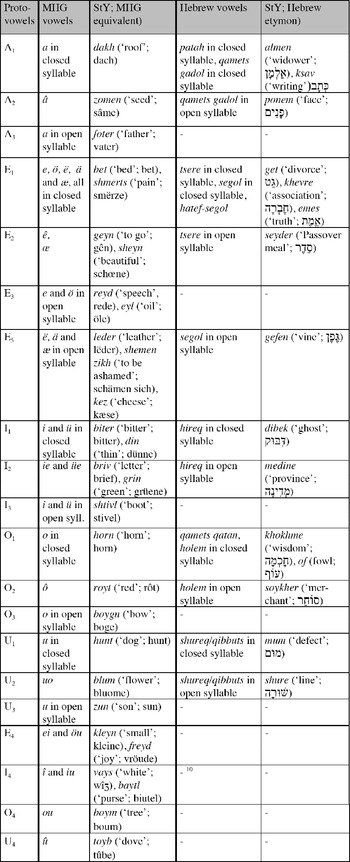
The second type of table under Weinreich’s approach presents main rules of correspondences for Yiddish proto-vowels:
• for words from the German component: to the vowels present in the Middle High German (MHG) forms related to these words
• for words from the Hebrew component: to the vowels of their Hebrew etymons.
Table 2 presents these general correspondences. If one knows the corresponding word in Middle High German or Hebrew, one can deduce from this table the proto-vowel to which the stressed vowel should be attached. Once one knows this proto-vowel, one can identify the reflex of this vowel in various modern Yiddish dialects using information similar to that presented in table 1. Table 2 includes examples from Standard Yiddish (StY), a standardized language formally created by Yiddish linguists during the 20th century. Its stressed vocalism is mainly based on the modern pronunciation peculiar to NEY: only the reflex for O2,3,4 is taken from modern CY. All StY forms are quoted in this paper following the transliteration conventions established by the YIVO Institute for Jewish Research, New York.
The second column is directly taken from the information present in Weinreich Reference Guggenheim-Grünberg1973. Indirectly, it can also be deduced from Bin-Nun (Reference Bin-Nun1973: 185–238), with similar results. The situation with the fourth column is more complex. First, it ignores patah in open syllables and hatef-patah. For them, it is difficult to decide what correspondences should be really called “main.” For patah, we have cases where this vowel corresponds to A2 such as kadokhes (‘ague’;  ), tokhes (‘buttocks’;
 ) or A1 such as lakhesh (‘magic speech’;
 ), nakhes (‘pleasure’;
 ), pakhed (‘fear’;
 ). A similar situation can be observed for hatef-patah, namely: A2 in khotse (‘half’;
 ), kholem (‘dream’;
 ), oder (‘Adar’ (a month of Jewish calendar);
 ) and hodes (‘myrtle’, and feminine given name;
 or
 ); A1 in khazer (‘swine’;
 ), khamer (‘ass’;
 ), khanike (‘Hanukkah’;
 ) and khasene (‘wedding’;
 ). These reflexes deserve a separate discussion that is beyond the scope of the present paper.Footnote 9 Second, table 2 ignores hatef-qamets: it appears that for this vowel, there are no stressed examples in Yiddish. Third, it should be noted that in several aspects the fourth column deviates from Weinreich’s concepts.
Main correspondences between Yiddish proto-vowels and MHG or Hebrew vowels.

It follows Katz’s attribution of the digit 2 (“originally long”)—instead of 3 (“lengthened in open syllable”) suggested by Weinreich—for vowels of the Hebrew component of Yiddish that are present in open syllable. Another difference concerns the treatment of Hebrew vowels in closed syllables. Birnbaum (Reference Birnbaum1922:21–29) is the first author to suggest the shortness of all Hebrew vowels in this context. If one translates his statements into Weinreich’s more recent terms, Birnbaum postulates the following proto-vowels for closed syllables: A1 for qamets in mono-syllabic words and patah, E1 for segol and tsere, I1 for hireq, O1 for qamets in polysyllabic words, and holem, U1 for shureq and qibbuts. In his last work, Birnbaum (Reference Birnbaum1979:61–65) advocates the idea that in the Hebrew component of Proto-Yiddish, all vowels were short in all positions.Footnote 11 As discussed at the beginning of this paper, this opinion is also shared by Weinreich (Reference Weinreich1973:41–44). Nevertheless, Weinreich writes that the opposition open ∼ closed syllables induces the opposition long ∼ short vowels for hireq and shureq/qibbuts and can also explain a number of modern reflexes of patah, qamets, segol, and tsere. For closed syllables, he suggests correspondences identical to those present in table 2 with one exception: for qamets he refers to O1, while table 2 attaches it to A1. Actually, Weinreich himself provides a large list of forms where qamets in a closed syllable corresponds to A1. Among them are dag (‘fish’;  ), dam (‘blood’;
 ), gmar (‘conclusion’;
 ), khshad (‘suspicion’;
 ), khshash (‘apprehension’;
 ), klal (‘public’, ‘rule’;
 ), ksav (‘writing’;
 ), prat (‘detail’;
 ), m(e)khak (‘shortage’;
 ), nedan (‘dowry’;
 ), pshat (‘meaning’;
 ), shlal (‘a great deal’;
 ), skhar (‘reward’;
 ), vlad (‘fetus’;
 ), yad (‘pointer’;
 ), and yam (‘sea’;
 ). Nevertheless, he considered these forms to be exceptional taking them for remnants of archaic pronunciation. Actually, the number of A1 reflexes for qamets in closed syllable is significantly larger than the number of O1 reflexes postulated by Weinreich to represent the main rule. Among a few examples of O1 are biblical masculine names god (‘Gad’;
 ) and don (‘Dan’;
 ). Even in these cases, nevertheless, we are likely to deal with a late renorming of the pronunciation influenced by Whole Hebrew in which qamets in closed syllable is pronounced [o].Footnote 12 Indeed, the appellations in question were rarely used in the Middle Ages and the oldest references to the forms with [o] known to us date from the 18th century only.Footnote 13 As a result, it seems to be more appropriate to assign qamets in closed syllable to A1 rather than to O1.Footnote 14
The approach by Bin-Nun (Reference Bin-Nun1973) involves several steps. First, he postulates general correspondences between Hebrew and MHG vowels: (a) long: qamets gadol = â; tsere = ê; hireq with yod = ie; holem = ô; shureq = uo; (b) short: patah = a; segol = ë; hireq without yod = i; qamets qatan = o; qibbuts = u (pp. 267–268).Footnote 15 Second, his detailed analysis of the stressed vocalism of the Hebrew component of Yiddish reveals numerous exceptions to these correspondences and generally suggests the exact environments in which these exceptions occur (pp. 270–278). Finally, Bin-Nun explicitly formulates two additional general rules, both of which, according to him, are due to the similar phenomena in early New High German (NHG): (1) the shortening of long vowels in closed syllables that redefined the correspondences to the MHG vowels in another way: qamets gadol = a; tsere = e; hireq with yod = i; holem = o; shureq = u; (2) the lengthening of short vowels in open syllables (pp. 281–282). Bin-Nun’s approach was the basis for preparing the fourth column of table 2.Footnote 16
Table 2 lists main correspondences for which an explanation is suggested in the following sections. These correspondences characterize the phonetics of a large majority of words from the German and Hebrew components of Yiddish. They are not exhaustive, however: a number of exceptions to these rules can be discerned. For example, in a series of forms with segol instead of E5 postulated in table 2 we observe the presence of E2: keyfl (‘multiplication’;  ), keyver (‘grave’;
 ), kheyder (‘room’, ‘traditional Jewish school’;
 ), meylekh (‘king’, masculine given name;
 ), peyger (‘carcass’;
 ), peyrek (‘chapter’;
 ), peysekh (‘Passover’, masculine given name;
 ), sheyker (‘lie’;
 ), tsedeykes (‘pious woman’;
 ), tseylem (‘cross’;
 ). We also find forms with:
• E2 instead of E1 for tsere in the closed syllable such as kheyn (‘grace’;
 )
• A1 instead of A2 for qamets in the formerly open syllable: khokhmanis (‘wise woman’;
), malakhe (‘angel Malachi’; ), khaver (‘friend’; ), nefashes (‘persons’; ), and khasanim (‘bridegrooms’; )• A2,3 instead of A1 for patah in the formerly closed syllable: CY [mu:nƎfʃex] (‘either way’;
), [tselu:xƎs] (‘in spite’; from German prefix and Hebrew ), and [u:mƎt] (‘pulpit’; )• U1 instead of U2 for shureq/qibbuts in the open syllable: CY [mezizƎ] (‘a small tube containing an inscribed strip of parchment, attached to the doorpost’;
), [metsidƎ] (‘castle’; ), [mitƎf] (‘better’; ), [misƎr] (‘moralizing’; ), [misƎf] (‘extension of the morning prayer recited on the Sabbath and on holidays’; ), [lilƎf] (‘the palm branch which is carried and waved in the synagogue during the Sukkoth holiday’; ), [mexilƎ] (‘spoiled’; ), and [nisƎx] (‘version’; ).
 )
 ), malakhe (‘angel Malachi’;
 ), khaver (‘friend’;
 ), nefashes (‘persons’;
 ), and khasanim (‘bridegrooms’;
 )
 ), [tselu:xƎs] (‘in spite’; from German prefix and Hebrew
 ), and [u:mƎt] (‘pulpit’;
 )
 ), [metsidƎ] (‘castle’;
 ), [mitƎf] (‘better’;
 ), [misƎr] (‘moralizing’;
 ), [misƎf] (‘extension of the morning prayer recited on the Sabbath and on holidays’;
 ), [lilƎf] (‘the palm branch which is carried and waved in the synagogue during the Sukkoth holiday’;
 ), [mexilƎ] (‘spoiled’;
 ), and [nisƎx] (‘version’;
 ).
A large number of exceptions exist for the German component. Among them are EY [tsvontsik] and WY [tsvantsik] (‘twenty’; MHG zweinzec), CY [tse:n] (‘ten’; MHG zehen), [pojps] (‘pope’; MHG bâbes), [nemƎn] (‘to take’; MHG n'men), [lejrƎr] (‘teacher’; MHG lêrer, lêrœre), [kejrƎn] (‘sweep’; MHG keren). In numerous words from the German component, the stressed vowel does not conform to the correspondences presented in table 2, but in the NHG equivalents of these words, we find exactly the same deviation from the general rules. Some of these cases will be discussed in section 3.2. The explanation of exceptions is beyond the scope of the present paper.Footnote 17
3. Pre-Yiddish Stressed Vocalism
3.1. The Term Proto-Yiddish as Used in This Paper
In linguistic literature, there is no standard definition of the word “Yiddish” when speaking of the language used many centuries ago. One can distinguish two significantly different approaches. The first one sees Yiddish as a fusion language par excellence. In this language, medieval German dialectal features, Semitic, to a lesser degree Romance, and, perhaps, also some Slavic elements fused during the initial period of the Jewish presence on the territories where the non-Jewish population spoke German. Since in historical literature the term “Ashkenazic Jew” is generally understood as referring to a Jew living in a German-speaking province, for the representatives of this school—including, among others, M. and U. Weinreich, Birnbaum, Herzog, Katz, and Jacobs—there is no real distinction between Pre-Yiddish and Pre-Ashkenazic. For them, Yiddish was born about one thousand years ago when Jewish communities started using in their daily life words borrowed from their German Christian neighbors.Footnote 18 Scholars who adhere to this point of view usually state that Yiddish was very selective in borrowing elements from its different components (including the German, that is, by far the largest one). Consequently, the Jewish vernacular idiom was never a “pure” or “correct” German. Max Weinreich (Reference Weinreich1967, Reference Weinreich1973.2:261–320) presents the most detailed theoretical arguments advocating this approach.
According to the alternative approach, Jews in German-speaking provinces used the German dialect of their Christian neighbors in their daily life (if we judge from its grammar, phonetics, and the main part of the lexicon), with the addition of certain words of Semitic, Romance, and hybrid origin specific to Jewish speech. Only when the Jewish dialect becomes different from the local German one can we really speak about (Proto-)Yiddish. One can, for example, speak about Yiddish from the moment that the Jewish vernacular language does not follow some phonetic, grammatical, or semantic shift that takes place in the German dialect of the same geographic area. Alternatively, the innovation can be internal, when some phenomenon that appears in the Jewish language is unknown in surrounding German. The separation of Yiddish from German may also be postulated as the moment when in some German-speaking region we discover, inside the vernacular language used by Jews, a set of traits peculiar to a German dialect from another area where Jews dwelled at an earlier period. This means that the German component of the Jewish vernacular language ceases to be identical to the local German dialect. It should also be made clear that to establish the separation of a Jewish language from German, the non-German lexical or onomastic elements are the least important. Indeed, the introduction of new words or names does not create a new language. In contrast, specifically Jewish phonetic shifts or new grammatical rules, or the use of non-German morphologic elements (for instance, Hebrew endings for making the plural forms) in words with German roots, or any other examples of the fusion character of the Jewish vernacular language, can serve as significantly less arbitrary criteria. The most detailed description of this approach was offered by Nathan Süsskind (Reference Süsskind1953); additional information can be found in Beider Reference Beider2004. Jechiel Bin-Nun (Reference Bin-Nun1973) adopts a similar approach. If one follows these lines of argument, Yiddish becomes several centuries younger than its “birth date” cal-culated under the first approach. Süsskind suggests 1350–1500, and Bin-Nun points to the 13th–14th centuries. For those who adhere to this latter approach, the creation of Yiddish was preceeded by a pre-Yiddish period in the Ashkenazic history.
I do not think that the two approaches presented above are incom-patible. To eliminate any ambiguity concerning the conventional use of the same global terms—such as Yiddish—according to different definitions used (explicitly or implicitly) by various authors, one could focus on specific aspects of a language, that is, orthography, phonetics, semantics, onomastics, morphology, and the lexicon. One can discuss the questions of the fusion of components and differences (if any) from neighboring German for each aspect separately. For orthography, the situation is clear: by using the Hebrew characters, Jews separated their language from German. A similar situation is found with given names: they have always been different from those used by Christians. If we take the lexicon, one can easily imagine the presence of some Hebrew and Romance words in the Jewish vernacular used in German lands from the earliest times too. These domains are, however, among the least important for a definition of a language. The domains of semantics and morphology are significantly more important. The most detailed semantic and morphological data are collected by Timm (Reference Timm2005), who shows that numerous, specifically Jewish, semantic shifts that occurred in German words can already be found in manuscripts compiled circa 1400. In the same texts, a significant number of German suffixes show a peculiar behavior too: they are not added to the same roots as in German dialects. Documents studied by Timm are biblical translations for whose specific needs these semantic and morphologic peculiarities seem to be developed. It is also during the turn of the 14th–15th centuries that several hybrid elements appear in available sources. Examples are (a) the verbal form vermassert (an ancestor of the modern Yiddish verb farmasern, ‘to betray’), with a Hebrew root and Germanic affixes, (b) the verb shekhtn (‘to slaughter according to the Jewish ritual’), with a root from the Hebrew component and a typical Germanic ending, (c) expressions combining a Hebrew word with the Yiddish verb zayn (compare NHG sein, ‘to be’) (Timm Reference Timm1987:369). The first known hybrid elements appear in a document from the Cologne area compiled in 1290: (a) several plural forms of German nouns ending in the element -s, a pattern that is unlikely to be of German origin and present in modern Yiddish too (see its detailed discussion in Timm Reference Timm2005:100–108); (b) the gloss viren  (‘to line, to rule’) that is likely to have a (Judeo-) French root and a German ending.Footnote 19 The above information shows that at least at the end of the 14th century (and likely even one century before), Yiddish peculiarities existed even in such fundamental domains for a definition of a language as semantics and morphology. Still, even for the periods in question, no information is available that would demonstrate that Jewish speech was not following any shift in the local German dialect. Also, we do not find, until the 15th century, any feature of one German dialect that would be used by Jews in another German dialectal area: several illustrations can be found in Timm Reference Timm2005:317, 344.
Phonology appears to be one of domains in which the separation between Yiddish and local German dialects, and the fusion phenomena are the most recent.Footnote 20 In this paper, I would like to explore a possibility of a purely phonological definition of the term “Proto-Yiddish.” During the last centuries, various shifts that occurred in Yiddish dialects clearly applied to words of different origins. For example, when at the turn of the 17th–18th centuries in CY [o:] raised to [u:], it equally concerned words from German, such as [o:tƎm] (‘breath’; MHG âtem], and from Hebrew, such as [zo:xƎr] (‘male’;  ).Footnote 21 This factor necessarily implies the total fusion—at some moment in history that will conventionally be called in this paper the birth of (Proto-)Yiddish phonology—of the phonemic systems that characterized the pronunciation by Jews of the vernacular words of German and Hebrew origin. This process repre-sented a major element in the creation of a new, specifically Jewish language accelerating the development of its fusion character.
In the discussion below, the following premise applies: before the fusion of the vocalisms of two components yielded the (Proto-)Yiddish vocalism, the phonology of the German component was similar to that of the vernacular speech of neighboring Christian Germans. In principle, this idea is not self-evident and should be considered as a working hypothesis. Indeed, formally speaking, one could imagine a scenario in which Jews developed their specific dialect of German even before the fusion of this dialect with the Hebrew component. Its most plausible reason would be the creation of the German component of Proto-Yiddish as a mixture of elements coming, after Jewish migrations, from various German-speaking regions. This theory requires, however, one additional independent hypothesis and is, therefore, less simple (and hence, less plausible) than the idea of the conformity of the vocalism of the German component of the Jewish dialect to the speech of local German Christians before its fusion with that of the Hebrew component. One would need to come up with additional conjectures only if our working hypothesis contradicts some facts, and, for example, no specific medieval German dialect can be found that could be the source of Proto-Yiddish. Section 4.4 deals with this topic.
The two following sections deal with the vocalic systems that are likely to have existed in German and Hebrew used by Ashkenazic Jews in pre-Yiddish period. As explained above in this section, the sense of the terms Pre-Ashkenazic and Pre-Yiddish depends on the approach. For the advocates of the first approach, in the linguistic context the two terms are equivalent. In contrast, the advocates of the second approach distin-guish between Pre-Ashkenazic and (Ashkenazic) Pre-Yiddish. In the text below—dealing with the stressed vocalism only—I always follow this distinction.
3.2. Pre-Yiddish German
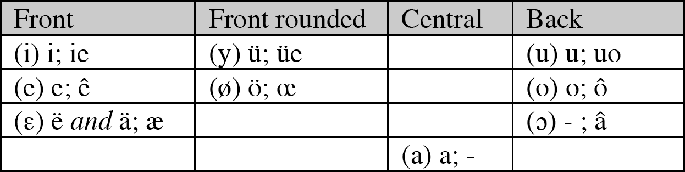
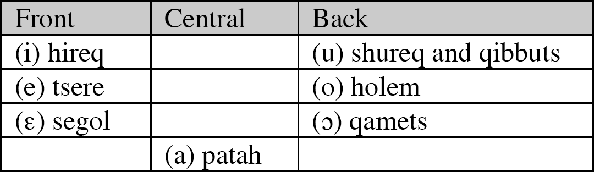
Several scholars consider the vocalism of the German component of Yiddish to be ultimately related to that of Middle High German (MHG).Footnote 22 I see no objection to this position and therefore, for the specific purposes of this paper, it is necessary to present the classical schema of stressed vowels and diphthongs of MHG (see table 3).Footnote 23
MHG stressed vocalism.

The following conventions are used in table 3:
• The columns dealing with vowels list a short vowel followed (after a semicolon) by its long equivalent.
• The sign “-” is used to indicate that a vowel of such quality/ quantity combination is absent from the system.
• The lower the line, the more open the quality of its vowels is. For example, ë designates the [e]-colored short sound that is more open than the one expressed by e.
The MHG vocalic system underlies the vocalic systems of all High German dialects, that is, both Upper German and Central German. The passage from MHG to NHG is characterized by several phonetic pro-cesses that took place in various dialects of High German. Of particular interest for the history of Yiddish are the following ones:Footnote 24
(i) Raising of MHG â from [a:] to [ɔ:]
(ii) Diphthongization of former MHG long vowels î and Û
(iii) Monophthongization of former MHG diphthongs: ie > [i:] and uo > [u:]
(iv) Unrounding of formerly rounded front vowels.
All four are clearly applicable to a large majority of words from the German component of modern Yiddish dialects. For several reasons, at least the first three processes should be placed in the pre-history of Yiddish phonology. In all Yiddish dialects, the reflexes corresponding to the MHG â have [o] or [u]-qualities. The Yiddish words whose ancestors had î or Û in MHG generally have diphthongs. It is in CY that one finds monophthongs [a:] and [o:], respectively, but their quality is different and, moreover, the historical documents show that both of them are recent enough and result from former diphthongs. One also finds not a single trace of diphthongs corresponding to MHG ie and uo in both modern Yiddish and historical documents dealing with early stages of that language. In principle, taking into consideration only the facts listed above (which deal exclusively with the German component) does not preclude the possibility that the diphthongization and the mono-phthongization in question could occur during the early Yiddish period when the German component could still be under the influence of phonetic shifts in the neighboring German Christian dialects. The consideration of the Hebrew component, however, rules out this possibility. One cannot observe in the Hebrew component any trace of the diphthongization of hireq or shureq/qibbuts, a phenomenon we would expect if the fusion of the vocalisms of the German and Hebrew components ook place before the diphthongization of MHG î and Û (compare Bin-Nun Reference Bin-Nun1973:36, 268). On the contrary, the long Yiddish reflexes of hireq and shureq/qibbuts are identical to those of German vowels descending from MHG diphthongs ie and uo, respectively, which implies the monophthongization of these diphthongs already during the pre-Yiddish period.
The situation with rounded vowels is more complex. The con-sideration of the Hebrew component can neither corroborate, nor refute the absence of rounded vowels in Proto-Yiddish: in Hebrew we find no equivalent for these sounds. In modern times, the only occurrences of rounded vowels in Yiddish correspond to (a) the sound [y], equivalent to that expressed by the German grapheme ü, in Yiddish spoken on the Czech lands and in Alsace, and (b) the diphthong [⊘y] in Courland. Both are more likely to result from an innovation peculiar to these dialects than to represent relics of earliest Yiddish. (See details in section 5.1.) Consequently, the phonology of modern Yiddish does not preclude the possibility that no rounded vowels existed in Proto-Yiddish. Com-binations of Hebrew letters that are likely to correspond to front rounded vowels are amply attested, however, in WY sources of the 15th and the first half of the 16th century. All of these correspond to high and middle vowels. (See details in Weinreich Reference Weinreich1973.2:121–123, 4:167–168, Timm Reference Timm1987:174–185, 206–213, and Timm Reference Timm, Liliane and Shmeruk1996:305.) On the other hand, nothing indicates the roundness of the descendants of MHG ultra-open ä and its long equivalent ӕ. At this point, I will take their unrounding as a working hypothesis. Table 3 shows that only for these two vowels no direct unrounded equivalent existed in the chart of MHG vowels and only two possibilities were offered for them:
(i) merging with MHG vowels a and â, respectively
(ii) raising to the same quality as MHG ë.
Some High German dialects that underwent unrounding chose the first possibility, others realized the second one. (For modern reflexes of MHG ӕ, see Wiesinger Reference Wiesinger1970, map 11.) The analysis of Yiddish words whose ancestors had MHG vowels ä and ӕ shows that in Yiddish the raising took place. It is also possible that during the same period /a/ was also displaced from its back position to the center.
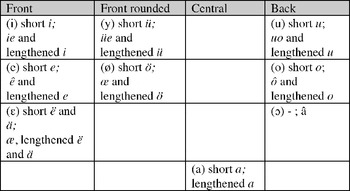
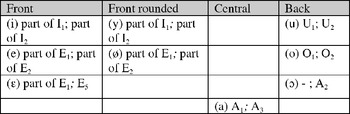
Taking into account these results and applying them to data in table 3, we can present the following schema of German vowels prior to Proto-Yiddish.
MHG stressed vowels underlying Proto-Yiddish (without lengthening).
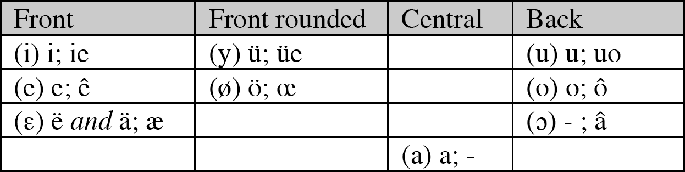
This table requires several important remarks. First, it ignores diphthongs: I return to these in section 4.2. Second, it is a theoretical construction that serves to illustrate certain ideas. It is quite possible that it does not correspond to any historical reality. Indeed, this table was constructed from the schema of MHG stressed vocalism taking into account only four phonetic shifts: diphthongization of two former mono-phthongs, monophthongization of two former diphthongs, unrounding of ultra-open front vowels, and raising of â. This list is, however, not exhaustive. From the history of German we know that numerous initially short vowels were lengthened in open syllables (and some other environ-ments) during the passage from Middle High German to New High German. Table 4 ignores this lengthening, although in principle, it could be older than some of the four phonetic shifts enumerated above. As a result, this table could correspond to some historic reality only if the lengthening occurred after all of them. If, however, one of them was more recent than the lengthening, table 4 does not reflect any synchronic reality. One small but important amendment can, nevertheless, yield a realistic schema: it suffices to add in table 4 the lengthened former short vowels to the column dealing with long vowels. For example, the long [e:] would result not only from former MHG long vowel ê (as in table 4), but also from the lengthened descendant of MHG e. In contrast, the short [e] would result only from one part of MHG e, namely the one that remained short. The lengthening would also create one additional vowel, the long [a:], absent from table 4. Its ancestor was MHG short a present in open syllables. The phonetic values of all elements of the resulting schema are presented in table 5.
MHG stressed vowels underlying Proto-Yiddish (after lengthening).

The analysis of the German component of Yiddish shows that the lengthening in question characterized its development too. Among the examples are StY trogn (‘to carry’, MHG/NHG tragen) and zogn (‘to say’, MHG/NHG sagen), eydl (‘noble’, MHG/NHG edel) and heyvn (‘yeast’, MHG heven, NHG Hefen), oybn (‘above’, MHG/NHG oben) and voynen (‘to dwell’, MHG wonen, NHG wohnen), CY [lejbƎr] (‘liver’, MHG l'ber, NHG Leber) and [fejdƎr] (feather, MHG vëder, NHG Feder). For that reason, in Weinreich's schema the reflexes of proto-vowels E3, I3, O3, and U3 for short vowels that became lengthened are identical to those of E2, I2, O2, and U2, respectively. The difference exists only in the treatment of A2 and A3. The same kind of difference is found, nevertheless, in various High German dialects. Indeed, the raising from [a:] to [ɔ:] for MHG â (to which A2 is related) in a large set of High German words occurred before the lengthening of MHG short a (to which A3 is related). This way the lengthened [a:] underwent no raising. In a large set of Yiddish words whose stressed vowel is derived from one of MHG short vowels, one finds the same rules of lengthening or non-lengthening as in High German dialects.Footnote 25 In German, the lengthening did not occur before sch and ch because these letter combinations are derived from early combinations of two consonants, sk and hh, respectively. In conformity to this rule, in the German component of Yiddish we also do not find traces of lengthened vowels before [ʃ] and [x], see StY vashn (‘to wash’, MHG waschen) and makhn (‘to do’, MHG machen). In German, one finds numerous cases of non-lengthening before [m] or [t], especially when these consonants are followed by er or el. Yiddish shows similar developments: hamer (‘hammer’, MHG hamer, NHG Hammer) and himl (‘sky’, MHG himel, NHG Himmel). Numerous cases of lengthening are known in both German and Yiddish for closed syllables. Some correspond to specific environments such as [a] before [r] followed by another consonant, mainly [d] or [t], rarely [m] or [n]: compare StY bord (‘beard’, MHG/NHG bart), orem (‘poor’, MHG/NHG arm), and gortn (‘garden’; MHG garte, NHG Garten), all with A3 reflexes.Footnote 26 Others appeared in German by analogy with the lengthening in open syllables that took place in inflected forms: compare StY tog (‘day’; MHG tac, NHG Tag), gloz (‘glass’, MHG glas), rod (‘wheel’; MHG rat, NHG Rad), and hoyf (‘court’, MHG hof). In monosyllabic words, the vowel generally remained short before [m] or [t]: compare got (‘God’; MHG got, NHG Gott), blat (‘leaf’; MHG blat, NHG Blatt), glat (‘smooth’; MHG glat, NHG glatt), and frum (‘pious’; MHG vrum, NHG fromm). Jacobs (Reference Jacobs1993:204) noted another important factor: we do not find any cases of lengthening by analogy in the Hebrew component. He gives the following example: CY [din] ‘law’ (and not **[di:n]) vs. [di:nƎm], the plural form of the same noun. The above information implies that the lengthening influenced by German was most likely pre-historical to Proto-Yiddish phonology: the German component of Yiddish inherited ready-made lengthened forms from its German donor. As a result, table 5 is a better candidate than table 4 to represent the distribution of vowels of the German component of the Jewish vernacular speech at the end of the pre-Yiddish period.
3.3. Pre-Yiddish Hebrew
Before Katz, in Yiddish historical linguistics it was mainly assumed that—since Semitic languages were not used in Jewish vernacular speech for centuries—the pronunciation of Hebrew-Aramaic underlying Yiddish essentially corresponded to the system of diacritics used for vocalization (pointing) of available texts.Footnote 27 Katz (Reference Katz and Fishman1985) showed that such an approach is in many aspects unacceptable and suggested that the pronunciation of words from the Hebrew component comes from the oral tradition brought to Europe by the ancestors of Ashkenazic Jews whose colloquial language was Judeo-Aramaic. I do not consider the latter idea to be adequate: between the two extremes—texts and colloquial language—numerous intermediary oral contexts also exist, such as discussions of the religious subjects in the synagogue or various religious schools. Nevertheless, Katz's general emphasis on the non-textual but, rather, oral origin appears to be correct. We know from massive amounts of manuscripts and published material that Hebrew was used for various types of written communication, including letters, court documents, treatises, and books on various topics. The range of topics is particularly evident from the Responsa literature, since the rabbis could, in principle, be asked to express their opinion on any subject, and from the frequent lengthy moral lessons contained in last wills, in which the testators expressed such opinions unbidden.Footnote 28 It is inconceivable that people who could write in Hebrew fluently on any and all possible aspects of life could not have been able to pronounce what they were writing. More-over, one needs to keep in mind that only certain texts were available in pointed form (that is, with diacritical signs for vowels): for example, the Talmud (including the Hebrew language Mishnah) was not ever pamong traditional Jews, and yet it was read and discussed far more than the Bible. This correlates with the fact that various communities have distinct traditions of the Mishnah reading issued from distinct oral traditions that necessarily existed (see Morag Reference Morag1971:1121–1122). It is also important to note that the pointing system uses the same graphemes for two kinds of qamets (gadol and qatan) and shewa (mobile and quiescent), and yet, one observes some important differences in the pronunciation of the members of these pairs.Footnote 29 These differences could originate only in oral context. Finally, there are numerous words whose phonetics cannot be deduced directly from the pointing (see exceptions cited in section 2 after table 2) and in many cases should be due to the oral tradition.
In the linguistic literature there is no consensus regarding the derivation of the pronunciation of Hebrew vowels underlying Yiddish. Several scholars such as M. Weinreich and Bin-Nun point to the system known to Hebraists as Tiberian. Table 6 presents its full vowels. The signs in the parentheses correspond to their quality.
Tiberian full vowels.
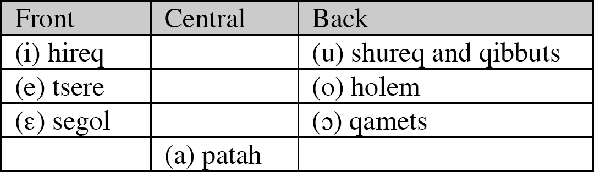
The classical Tiberian schema treats in the same way two kinds of qamets, distinguished in other systems and generally called qamets gadol and qamets qatan. It also includes four reduced vowels: mobile shewa and three hatef-vowels: hatef-patah, hatef-qamets, and hatef-segol. The word accent never falls, however, on any of them, and generally all of them are considered to be ultra-short. Scholars disagree about the quantities of seven full Hebrew vowels. Bin-Nun (Reference Bin-Nun1973:279) points out that the schema distinguishes only qualities, not quantities. Weinreich shares this opinion and considers—as already stated in section 1—all seven Tiberian vowels to be short in all positions in the Hebrew pronunciation of early Ashkenazic communities.
Another classical schema—underlying the Sephardic and modern Israeli pronunciation—is (southern) Palestinian. It uses the Tiberian pointing rules but distinguishes only five different vocalic qualities: in comparison to the Tiberian pronunciation, here (a) both segol and tsere designate the same sound /e/, (b) both patah and qamets gadol express /a/, (c) the quality of qamets qatan is equivalent to holem.
The most well known theory of the quantitative distinctions among Hebrew vowels was developed by the Qimhis, the family of grammar-ians who dwelled in southern France in the 12th–13th centuries. Following their theoretical conclusions, one distinguishes five short vowels (patah, segol, hireq, qamets qatan, qibbuts), their five long equivalents (qamets, tsere, hireq with yod [ ], holem, shureq, respectively), and ultra-short reduced vowels, namely mobile shewa and hatef-vowels. It should be stressed that there is no proof of the existence of any Jewish community whose pronunciation of Hebrew would conform to the Qimhi schema. Among the major contributors to Yiddish historical linguistics, Katz (Reference Katz and Katz1987:51–52) is one of the rare supporters of the idea that the Qimhi schema was not contrived but reflected a phonetic reality. He suggests two following principal traits of the Hebrew pronunciation underlying Proto-Yiddish:
• in open syllables, the ten vowels of the Qimhi schema (five short and five long)
• in closed syllables, only five short vowels resulting from the pre-Ashkenazic shortening of formerly long vowels and their merging with their short counterparts: qamets with patah, tsere with segol, and holem with qamets qatan.
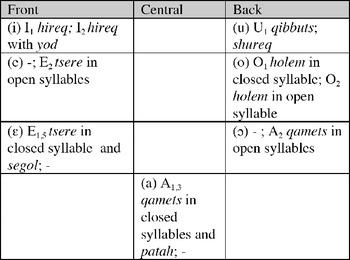
The acceptance by Katz of the basic Qimhi schema seems to contradict several important characteristics of the Yiddish vocalism. First, when analyzing modern Yiddish reflexes of words of Hebrew origin one cannot discern any differences in treatment of (a) two kinds of hireq, with or without yod, and (b) shureq and qibbuts, which suggests that the nature of the differences between the elements of these two pairs is orthographic rather than phonetic, exactly as in the case of holem, with or without vav [ ]. Second, the classical schema of ten vowels implies only five different qualities. As a result, by itself it cannot provide any explanation for the arising of the qualitative distinctions between (a) tsere and segol, (b) qamets and patah, while these distinctions are observable in Yiddish. To compensate for this, Katz introduces additional hypotheses, absent from the standard Qimhi schema. In the Hebrew in question, the quality of long and shortened tsere was different. The former corresponded to [e:], while the latter (as well as all reflexes of segol) corresponded to [ε]. According to Katz, similar qualitative differences between long and shortened qamets existed as well. The former corresponded to [ɔ:], while the latter (as well as all reflexes of patah) corresponded to [a]. Katz's global schema of Hebrew vowels underlying Yiddish is presented in table 7.Footnote 30
Katz's schema of Pre-Ashkenazic Hebrew vowels.

Table 7 uses the same conventions as table 3, but in addition to qualities and quantities of various Hebrew letters, every existing phoneme is preceded by the designation of the Yiddish proto-vowel (from Weinreich's schema) to which it corresponds.
According to Katz (Reference Katz and Glinert1993a:50), during the period of Pre-Yiddish phonology short vowels in open syllables underwent lengthening under the influence of the similar process in German.Footnote 31 As can be seen from table 7, only two vowels were really concerned: segol (E5) and patah (A3). Several aspects of Katz's approach are questionable. First, Katz combines Tiberian seven qualities with Qimhi's schema proposed for Sephardic-like pronunciation with only five qualities. Second, it is asym-metrical in several places. Third, the difference between the qualities of the same letters in open and closed syllables (for tsere and qamets) seems to be ad hoc. Finally, it is difficult to find any example that would conform to his assignment of patah in open syllable to A3: as discussed in section 2, we find only A1 and A2 reflexes.
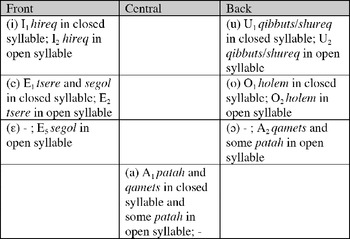
Jacobs (Reference Jacobs1990:46–48, Reference Jacobs1993:203–204) shares Katz's idea about the Pre-Ashkenazic character of shortening in closed syllables and its independence from a similar process in German. Indeed, one can observe that in the Hebrew component, a single consonant is generally enough to close a syllable, while in the German component two consonants are needed. For example, we have CY [sod] (‘secret’, Hebrew  ), not **[so:d]; but [brojt] (‘bread’, MHG brôt), not **[brot]. In contrast to Katz, Jacobs (a) makes no use of Qimhi's schema and (b) suggests that in Hebrew, the vowel lengthening in open syllables could also be Pre-Ashkenazic and independent of a similar process in German. He considers the example of StY tokhes (‘buttocks’, ). If in this noun the lengthening of patah were of German origin we would normally obtain **[a:] in WY, while the Alsatian Yiddish form of this word has [o:]. In other terms, we would have A3 and not A2. Table 8 summarizes Jacobs’ views.Footnote 32
Jacobs' schema of Pre-Ashkenazic Hebrew vowels.

Jacobs’ arguments seem correct. The symmetry of the obtained schema makes it particularly attractive. I would like to introduce only one amendment to it. Jacobs posits that this schema was valid at the end of the Pre-Ashkenazic period.Footnote 33 He explicitly states that it became valid before the lengthening in the German component. As suggested in this paper, the phonologies of the German and Hebrew components were (at least partially) autonomous until their fusion during what is called here the Proto-Yiddish period. I would like to posit that Jacobs’schema was valid immediately before this fusion took place, that is, several centuries later in comparison to Jacobs’ considerations. Was it valid already at the end of the Pre-Ashkenazic period? For the topics covered in this paper—dealing with Yiddish immediately before and after its phonology became really separated from German—this question is of secondary interest: its detailed discussion is beyond our scope. One should, nevertheless, be reminded of M. Weinreich's idea about the development of a new normative system with seven qualities from the previous one with only five qualities (with tsere and qamets equivalent to segol and patah, respectively), that seems to take place during the Ashkenazic history.Footnote 34 This idea would provide an explanation for the E2-forms (instead of E5) for a number of words with segol and for the A2-forms (instead of A1) for words with patah or hatef-patah whose examples were given in section 2. Indeed, these words could be commonly used in the vernacular language already before the renorming took place and for this reason they could escape the renorming.Footnote 35 The consideration of qamets qatan can serve as another argument in favor of the validity of the system with only five qualities during the early Ashkenazic history. This vowel is short and present only in closed syllables. Various classical schemas of Hebrew treat its quality in different ways. On the one hand, in the Tiberian schema it is indistinguishable from qamets gadol. On the other hand, in the Palestinian schema (and the Qimhi principles established for it) it has the same quality as holem. The last rule is valid for the Hebrew component of Yiddish: qamets qatan always corresponds to O1 (with short [o] in all dialects), independently of the dialect. Among the examples are StY khokhme (‘wisdom’,  ) and korbm(‘sacrifice’,
 ).
4. Proto-Yiddish Stressed Vocalism
4.1. Proto-Yiddish Monophthongs
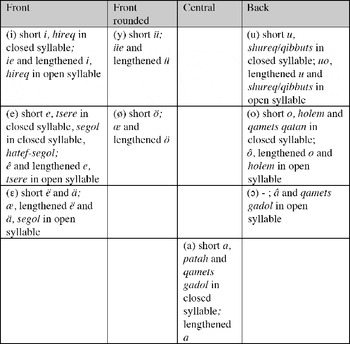
The previous two sections discussed the stressed monophthongs of German and Hebrew at the end of the Pre-Yiddish period. If we compare tables 5 (Pre-Yiddish German) and 8 (Pre-Yiddish Hebrew), we can observe the similarity of their structures. These schemas have seven (Tiberian) qualities in common. Moreover, neither has a short equivalent for [ɔ:]. These shared fundamental phonological features could be important elements for allowing (or even provoking) the fusion of the German and Hebrew pronunciation. The vocalic system of the German component (covering by far the largest part of the vernacular language) is likely to represent the basis during the fusion. In this situation, the fact that the vocalism of the Hebrew component did not contain a single phoneme unknown in the German component was also important. If we (a) combine tables 5 and 8, (b) take into account the special development of qamets qatan (described at the end of the previous section), and (c) add the [e]-reflex for hatef-segol forms, we obtain table 9.Footnote 36
P-Y vowels (expressed via their MHG and Hebrew ancestors).

The information in table 9 can be presented in another way, using the conventional designations of Yiddish proto-vowels. For this, it suffices to compare tables 9 and 2. The results of this comparison appear in table 10.
Proto-Yiddish vowels (using conventional designations).

4.2. Proto-Yiddish Diphthongs
To facilitate the discussion, I first combine in table 11 (see above) the information from tables 1 and 2 that concern Yiddish proto-diphthongs E4, I4, O4, and U4. The last two lines correspond to the original mono-phthongs that became diphthongized during the history of Yiddish in dialects of EY and also have the diphthongal reflexes in the dialects of WY.
In this table, only the third and the last columns are original, the others are directly taken from tables 1 and 2. Instead of treating SWY, this table refers to “basic WY.” This substitution is based on the assumption that the reflexes of SWY reveal the most ancient features of WY, generally speaking. (I return to the discussion of this assumption in section 5.2.) From the history of the development of NEY and CY we know that several reflexes result from the relatively recent shifts in EY. In table 11 they appear in parentheses: for these cases, the reflexes from another dialect of EY, without parentheses, are older and more closely related to Proto-Yiddish vocalism.Footnote 37 That consideration allowed con-structing the last column.
Diphthongs.

The comparison of reflexes of the proto-vowel U4 in various EY dialects implies that in old EY its realization was either [ou] or [oj]. However, the last possibility is ruled out since in this case there would have to be a merge of U4 and O4 that never took place. For that reason, only [ou] is kept in the last column of table 11 (see also Weinreich Reference Weinreich1958). The third column shows the phonetic shifts that occurred in (non-Jewish) dialects of German during the late MHG and NHG periods for the vowels/diphthongs whose MHG ancestors were those enumerated in the second column. This information was obtained from classical works on the vocalism of Middle High German, early New High German, and that of modern dialects: Moser Reference Moser1929:148–52, 158–59, 167–82; Paul Reference Paul1982:54–55, 131; Wiesinger Reference Wiesinger1970, maps 1, 3, 7, 8, 15–17. The reflexes whose analysis is particularly important for the construction of the schema of Proto-Yiddish diphthongs appear in bold. To follow the main idea developed in section 3.1—before the fusion of Hebrew and German components took place to yield (Proto-)Yiddish, the vocalism of the German component was similar to that of the vernacular speech of neighboring Christian Germans—the reflexes in bold should be ex-plained using the data from the third column.
Table 11 shows that the phonetic value of the proto-vowel I4 could be any element of the chain of shifts that took place in various German dialects: î > [ej] > [aj] > [ӕ]. As was discussed above, the first of these shifts, î > [ej], necessarily occurred in the pre-history of Yiddish phono-logy. Since proto-vowels E4 and I4 never merged in any Yiddish dialect, when this shift took place in the local German dialect the descendant of MHG ei could not have still corresponded to its initial value of [ej]. Data in table 11 imply only one of two possibilities:
[e:]: This development characterizes East Central dialects of Ger-man.
[aj] or its derivation [a:]: Both these reflexes were peculiar to Upper German and West Central dialects of German.Footnote 38
On the one hand, the [ej] realization of proto-vowel E4 in EY is clearly related to the first of the above possibilities. The fact that in EY vowel E4 merged with the vowel E2 (derived from MHG ê) corroborates this statement. On the other hand, the WY [a:] for proto-vowel E4 is necessarily related to the second one.
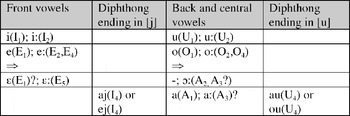
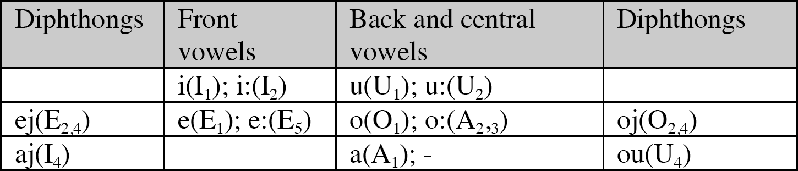
These conclusions are important for drawing two separate schemas: one for EY and another for WY. First, we proceed to that of Proto-EY. In the East Central German dialects, the former MHG diphthongs ei and ou underwent monophthongization to [e:] and [o:] during the same period (see details in section 4.4). As was shown above, [e:] characterizes Proto-EY vowel E4. Consequently, we should postulate [o:] for the Proto-EY vowel O4.Footnote 39 No specific constraint can be formulated for possible reflexes of Proto-EY vowels I4 and U4, apart from the fact that both should already be diphthongs. As can be seen in table 11, they could be either ([ej] and [ou]), or ([aj] and [au]), respectively. No data available to us force us to postulate the existence of front rounded vowels in Proto-EY. As a result, the reflexes of the descendants of both MHG öu and ei can be treated together as the proto-diphthong E4, while both MHG iu and î can be considered as a single I4.
Table 12 summarizes these results. (In this and the following tables, the phonetic values are followed—in the parentheses—by the indication of the corresponding Yiddish proto-vowel. For example, “e:(E4)” should be read as the “[e:]-reflex of the proto-vowel E4.”)
Proto-EY values of E4, I4, O4, and U4.

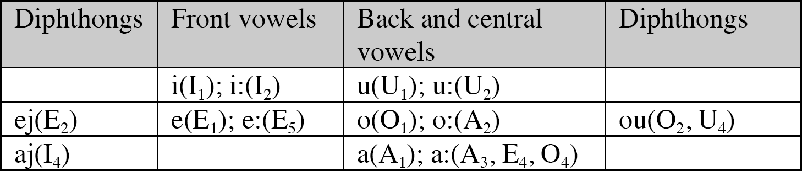
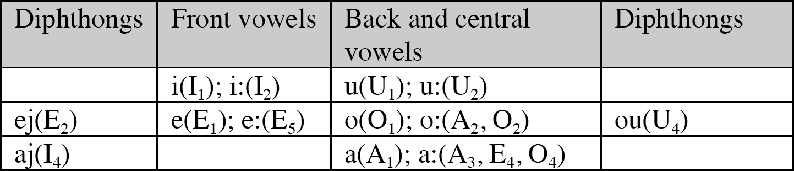
Now we return to WY. As shown above, in the area where Proto-WY arose, MHG ei (proto-vowel E4) necessarily went through the [aj]-stage. From table 11 it can be seen that at the same time period the most plausible realization of the proto-diphthong I4 was [ej]. If it were [aj], it would have merged with E4, while no merging between I4 and E4 occurred in WY. Table 11 also shows that among various candidates for the reflex of Proto-WY U4 (namely [ou], [au], [ao], and [a:]) the first one is the most plausible. This statement can be corroborated by several arguments. First, [ou] represents the modern reflex for U4. Second, we know that U4 and O2 partly merged in WY. Since O2 comes from MHG ô, the merging with any [a]-colored sound would be unlikely. The comparison of modern WY reflexes of proto-vowel O4 with the potential candidates for its proto-value shows that in the German dialects from which Proto-WY is derived, the MHG ou (the ancestor of proto-vowel O4) necessarily came through the [au] or [ao] realization. Later, this made possible the merging between E4 and O4 in WY.
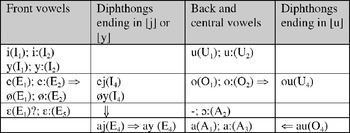
In certain early WY sources, the diphthongs whose ancestors were MHG î and iu are written in a different way and the spelling of the second one (either vav + yod, or vav + double yod) implies the rounded character of its first vowel. (The most detailed discussion of MHG iu and öu in WY sources can be found in Timm Reference Timm1987:206–207.) From the history of German dialects, we know that in the areas where unrounding did not occur, when MHG î became [ej] MHG iu became [⊘y]. Therefore, the latter diphthong is the most plausible candidate for the reflex of MHG iu in Proto-WY. The situation with MHG öu is less clear. The sources from the 16th century use the same spelling—double vav—for both MHG öu and ei. This does not necessarily mean that the WY descendants of these two MHG diphthongs were pronounced identically: note that the same spelling was also used for MHG î whose phonetic realization was different. Taking into account the information present for MHG öu in the third column of table 11 and the fact, discussed above, that the most plausible Proto-WY reflex of MHG ei is [aj], we must conclude that the MHG öu was pronounced in Proto-WY either [ay] (where [y] is an open high front rounded vowel) if the unrounding was not valid yet, or [aj]. Table 13 summarizes these ideas.
Proto-WY diphthongs.

In addition to the arguments provided above there is a supplementary factor speaking in favor of our conclusions. The phonetic developments of former MHG long monophthongs î and Û have many parallels. For both, the diphthongization started in the same Bavarian dialect area during the same time period (12th century), and during the following four centuries it was gradually spreading to other areas almost simultaneously for both phonemes. Their first discernable diphthongal stages were [ej] and [ou]. As can be seen from tables 12 and 13, this situation characterizes in our schema the phonetic value of corresponding proto-vowels, I4 and U4, for Proto-WY and for one of the possible realization sets of Proto-EY. As can be seen in table 11, in the next stage both received the [a]-coloring. We find both of these reflexes as another possible set of values for Proto-EY (table 12).
Simplicity and symmetry are other positive features of these schemas. Both of them include only reflexes that are not ad hoc theoretical constructions invented in the frame of Yiddish linguistics to support my theory but were actually found in some dialects of German spoken by the Christian population. The WY schema also includes two diphthongs with [j] as the second element and two diphthongs with [u] as the second element. Two of its diphthongs start with the most open (central) vowel [a], while the two others start with front [e] and back [o], symmetrical elements of the classical phonetic triangle. Symmetry also characterizes the EY schema, with its two long monophthongs and two diphthongs.
Each schema suggested in tables 12 and 13 is synchronic, that is, the various phonemes present correspond to the same time period. Yet, since they have been reconstructed independently of each other they could, in principle, correspond to different periods. In this situation, the important question is: could one of them be the ancestor of the other? In the frame of our approach, the answer is negative. This can be easily demonstrated taking into account the reflexes of proto-vowel E4: in Proto-WY it is [aj], while in Proto-EY the same proto-vowel never came through the [a]-colored stage. Consequently, the development of Proto-WY and Proto-EY diphthongs clearly took place in different geographic regions and, as a result, no general Proto-Yiddish phonetic system ever existed. Only Proto-EY and Proto-WY could represent historical realities. To cor-roborate the hypothesis of their real existence one needs to identify the region and the time period when their creation could occur. Section 4.4 covers this topic.
4.3. Proto-Yiddish
On the one hand, the analysis of diphthongs in the previous section shows the necessity of presenting two independent schemas: one for Proto-EY and another for Proto-WY. On the other hand, the chart of short and long vowels in table 10 is common for both main sub-divisions of Yiddish. Still, an adaptation concerning the short [ε] is needed for both. In some stage of the development of EY and WY, merging of short [ε] and [e] took place. We do not know the exact chronology of this event: it could already be valid at the period for which table 8 was drawn. For EY, table 10 requires two additional adjustments. First, we do not have a single piece of evidence for the existence of front rounded vowels in EY. As a result, it is quite likely that in Proto-EY, both [y] and [⊘] qualities were already merged with [i] and [e], respectively. This implies the fusion of the first two columns of table 10. Second, since in modern EY dialects no difference can be discerned between A2 and A3, the existence of A3 in the system of Proto-EY cannot be taken for granted: it is possible that at the end of the Pre-Yiddish period, in the area where the Proto-EY was born, MHG a that lengthened in open syllables had already raised to [ɔ:] merging with the reflexes of MHG â. The result of the combination of table 12 and the amended table 10 appears in table 14. The question mark near ε(E1) means that this vowel could be absent from the presented system of stressed vowels since it could have already shifted to e(E1). Its absence would make the whole schema more symmetrical. Since the exact quality of A3 is unclear, this proto-vowel appears twice in table 14, in both cases with the question mark: only one of these placements could actually be valid.
Proto-EY vocalism.

Table 15 presents a global schema for Proto-WY. It was obtained after combining table 13 and the amended table 10 (taking into account the possibility of the early merging of short [e] and [ε]).
Proto-WY vocalism.

In both these schemas, the arrows show the tendencies of phonetic shifts that lead from Proto-Yiddish to Middle Yiddish (see the discussion below).
The next stages of the phonetic development of EY were:
• e:(E2, E4) > [ej]
• o:(O2, O4) > [oj]
• a:(A3) > [ɔ:] (if it was not already changed before).
Additionally, if there was au(U4) in the previous stage, then this diphthong was to shift to ou(U4). Since all these four shifts concerned only unrelated vowels, it is difficult to tell anything about their relative chronology. If Proto-EY had ej(I4) in the previous stage, then the shift ej(I4) > aj(I4) would have taken place too. It would necessarily predate the shift e:(E2, E4) > [ej] since otherwise the latter shift would have affected both E2 and E4.
For Proto-WY the next stages were:
• unroundings [y] > [i], [y:] > [i:], [⊘] > [e], [⊘:] > [e:], [⊘y] > [ej], [ay] > [aj]
• au(O4) or ao(O4) > [a:]
• aj(E4) > [a:]Footnote 40
• ej(I4) > [aj] because [aj] was no longer present after the previous stage
• e:(E2) > [ej] because the place of this diphthong became vacant after the previous stage
In part of WY, o:(O2) > [ou] and therefore O2 merged with U4.
In the list above, all processes except for the first and the last ones are given in chronological order. The last process and the first three unroundings of the first process are totally independent from other processes and, therefore, we can say nothing about their relative chronol-ogy. In contrast, the unroundings [⊘y] > [ej] and [⊘:] > [e:] should predate the shifts ej(I4) > [aj] and e:(E2) > [ej], respectively. The situation is most complex with the proto-diphthong [ay]. In most of WY sub-dialects it yielded [a:]. Consequently, there was either the unrounding of its second element [ay] > [aj] before the monophthongization of aj(E4) > [a:] or the direct shift from [ay] to [a:], without the intermediate [aj] stage. In Swiss Yiddish, however, it never became [a:] but was realized as [aj] and merged with the reflexes of I4 (Guggenheim-Grünberg Reference Guggenheim-Grünberg and Weinreich1965:152). This means that in this area, the unrounding [ay] > [aj] is likely to take place after the monophthongization aj(E4) > [a:].Footnote 41
The final steps, common to both Proto-EY and Proto-WY, could be:
• Merge into a single phoneme of ε and e. In the areas where former [e:] was already diphthongized at that time, the merging occurred only for short vowels (if it was not already valid for them before).
• Merge into a single phoneme of ɔ and o. Since no short [ɔ] was found in both schemas, actually no short proto-vowels merged here; the merging concerned only the long proto-vowels. In the area of WY where neither O2 nor A2 became diphthongized, these two proto-vowels merged to [o:].
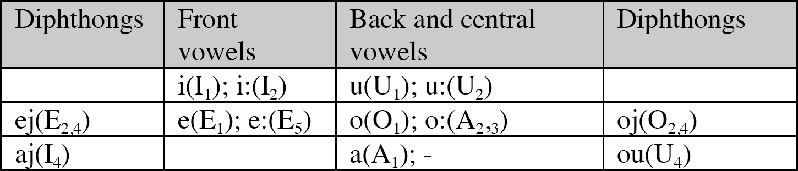
The above results are summarized in tables 16 and 17. Note that in that stage, WY was already split into several sub-dialects.
Middle EY.
Middle WY1.
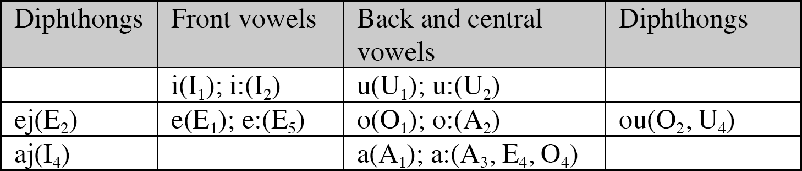
Middle WY2.
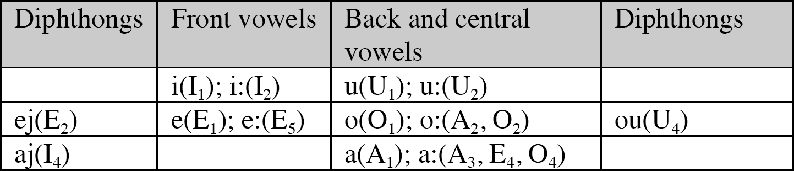
Tables 17a and 17b can explain the stressed vowels in most sub-dialects of modern WY. Yet, they ignore the Swiss Yiddish [aj] for the descendants of MHG öu that was discussed above. The adaptation to a schema appropriate for Swiss Yiddish is simple: aj(I4) should be replaced with aj(I4, MHG öu). A sub-dialect of WY in which the poem Paris un’ Viena was written in northern Italy during the first half of the 16th century also shows vocalic features that cannot be explained by these tables. Indeed, as shown by Timm & Gehlen (Reference Timm, Liliane and Shmeruk1996:313), that poem contains 35 unequivocal rhymes of E4 with I4; most likely, both were pronounced [aj]. In general, for the author of this poem, the vocalic chart could be that of table 17b (because of the merging of A2 and O2) with one amendment: merging of E4 not with A3 ([a:]) but with I4 ([aj]).
The peculiarities found in modern Switzerland and 16th-century Italy can also be interpreted in another way, without making ad hoc adaptations of the tables. Indeed, as shown in the next section, the genesis of Proto-WY stressed vocalism is likely to correspond to one specific region of Germany. It was relatively late: at that moment, Ashkenazic communities existed already in other regions of West and Central Europe. Gradually, this system became dominant over a large territory, due to migrations and other, much more subjective reasons. As a result, at some point this new system became prestigious and introduced a new pronunciation norm (see Manaster Ramer Reference Manaster Ramer, Hegedus, Michalove and Manaster Ramer1997:210–212, partly based on views by Beranek and M. Weinreich). The above “anomalies,” in principle, could be related in some way to older vocalic systems.
4.4. Where and When did Proto-Yiddish Vocalism Arise
The schemas in the previous section were drawn based on the following hypothesis: at the time when and in the areas where the merging of German and Hebrew components took place yielding Proto-WY and Proto-EY, the vocalism of the German components was similar to that of neighboring German (Christian) dialects. In this section, I identify the most plausible Christian donor dialects. For both Proto-WY and Proto-EY, these German dialects should be characterized by the following features:
• raising of MHG â to [ɔ:]
• diphthongization of MHG î and Û
• monophthongization of MHG ie and uo
• lengthening in open syllables realized already or still in progress
• tendency to diphthongize MHG ê and ô.
Some features are specific to Proto-EY:
• no front rounded vowels
• [e:]-reflex of MHG ei; [o:]-reflex of MHG ou
• raising of lengthened MHG a to [ɔ:].
The following features of the Christian donor are specific to WY:
• existence of front rounded vowels
• [a]-colored reflexes of MHG ei and ou
• [ej]-reflex of MHG î; the reflex of MHG Û close to [ou].
In principle, some of the above features—and, more precisely, the diphthongization of ê and ô as well as the raising of lengthened MHG a—could be due to internal Yiddish development, without any German analogue.
Main High German dialects are usually classified as follows:
• West Central German dialects: Ripuarian, Moselle Franconian, Hessian, the dialect of Rhine Palatinate
• East Central German dialects: Thuringian, Upper Saxon, Lusatian, Bohemian, Silesian
• East Franconian. This Upper German dialect reveals some features of Central German
• Bavarian [eastern Upper German dialects]: North Bavarian, Central Bavarian, South Bavarian
• Alemannic [western Upper German dialects]: Swabian, Low Alemannic, High Alemannic.
Classical works on the historical development of German phonetics in various High German dialects show the following chronologies for different phonetic phenomena enumerated in the previous section:Footnote 42
(i) The unrounding of former rounded vowels in Bavarian dialects can be discerned already in the 12th century. During the next two cen-turies, it spread to the whole area of High German except for Ripuarian, East Franconian, and High Alemannic.
(ii) The raising of MHG â initially took place in Bavarian, during the 12th century. During the next century, this shift reached Low Alemannic, Bohemian, East Franconian, and later other parts of Central German too. It was in Bavarian that MHG a shifted to [ɔ] or even to [o] during the 14th century.
(iii) The diphthongization of MHG î and Û appeared before the end of the 13th century in Bavarian. During the next centuries, it spread northward and westward reaching Bohemia and the south of East Franconian during the first half of the 14th century, the north of East Franconian and Silesian during the second half of the same century, Swabian in the second half of the 15th century, and the dialect of Rhine Palatinate at the turn of 15th–16th centuries. In Hessian and Moselle Franconian, the diphthongization occurred only during the 16th century. In Ripuarian, High and Low Alemannic it never took place.
(iv) The monophthongization of MHG ie and uo had started in Central German already in the MHG period. It also occurred in the eastern part of East Franconian, while diphthongs were kept in Aleman-nic, Bavarian and the western part of East Franconian.
(v) The lengthening of stressed vowels in open syllables is known in Central German dialects from the end of the 12th century. During the next two centuries, it reached such Upper German dialects as North Swabian, Low Alemannic, Bavarian, and East Franconian. No lengthening occurred in South Swabian and High Alemannic.
(vi) MHG ei shifted to [e:] in the western part of East Franconian during the 12th century. In the next century, the same shift took place in East Central German, while Alemannic retained [ej] until the end of 14th century. However, in Bavarian, during the 12th–13th centuries, MHG ei yielded [aj] that rapidly turned to [a:]. The last realization characterized the eastern and southern parts of East Franconian already in the mid-13th century.
(vii) MHG ou became [o:] in Ripuarian and Moselle Franconian already during the MHG period. In East Central German, the same shift occurred during the 13th century. In Bavarian, MHG ou turned to [au] during the 12th–13th centuries; later it shifted to [a:]. In East Franconian, Hessian, and the dialect of the Rhine Palatinate, the last realization has been observed since the 14th century.
(viii) MHG ê became a diphthong in Swabian (14th century), North Bavarian, and East Franconian.
(ix) MHG ô was diphthongized in North Bavarian (12th century), part of Central Bavarian, West Swabian, East Franconian, the dialect of Rhine Palatinate, southern part of Hessian, and parts of Silesia.
Taking into account the information presented in the previous section, from that list of potential donors we should first exclude Alemannic and West Central German dialects on the basis of the diphthongization of MHG î and Û criterion. In these areas, the diphthongization occurred either rather recently or never took place. This exclusion is strict because the diphthongization plays a structural role in Proto-Yiddish phonology. The remaining parts of High German are all compatible with the lengthening and raising of MHG â criteria. Bavarian and western East Franconian should be excluded on the basis of the monophthongization of MHG ie and the uo criterion. As a result, only the eastern part of East Franconian and East Central German still remain on our list. According to the diphthongization criterion, the first one could be a donor only since the 14th century. Initially, here we can expect MHG î > [ej] and MHG Û > [ou]. At the same time and in the same area, the reflexes of MHG ei and ou were both [a]-colored, this feature not being valid for East Central German. East Franconian also had the tendency to diphthongize both MHG ê and ô and possessed front rounded vowels. Consequently, during the 14th century only the eastern part of this dialect shows all features needed for Proto-WY.
Consider now East Central German. The diphthongization criterion immediately defines the 14th century as the earliest time period when the dialects of this group could contribute to Proto-Yiddish. At that time, local reflexes of MHG ei and ou were [e:] and [o:], respectively, while no front rounded vowels existed anymore. We also know about the raising of lengthened MHG a to [ɔ:] in these dialects (see detailed analysis and the bibliography in Weinreich Reference Weinreich1973.4:156). As a result, they show all major characteristics required for the Christian dialect that underlies Proto-EY. For demographic reasons, among various East Central German dialects Bohemian and Silesian deserve particular attention: in the Middle Ages, in all other areas the Jewish population was small. Several factors make Bohemian the best candidate. First, we know that even in recent times, in parts of Bohemia the descendants of MHG ei and ou were [ej] and [ou], respectively: these reflexes are very close to those postulated above for early EY (compare reflexes in North-central Bohemia in Wiesinger Reference Wiesinger1970, maps 15, 16). Second, Bohemian was the East Central colonial dialect of German in which the influence of Bavarian (and more specifically, North and Central Bavarian) was particularly strong. For this reason, several Bavarian features were found in Bohemia too. For example, it could be the case for the diphthong-ization of MHG ô and ê, well known for North Bavarian. (The studies of medieval German do not mention these features for Bohemian, though they do not state their absence either.) Consequently, during the 14th century, the Bohemian dialect is likely to possess all the features needed to be the potential donor for Proto-EY.
Some other factors provide additional corroboration for the above conclusions:
(i) In both East Franconian and Bohemian, the apocope of the final unstressed vowel took place in the 14th century. This phenomenon first arose in the 13th century in Bavarian. Note that it never reached most of the Silesian territory.
(ii) East Central German dialects (excluding large parts of Silesian) show exactly the same distribution of consonants [p] and [f] as EY, that is, initial [f] and [p] in gemination and word finally (compare Fund, Appel, and Kop to their EY cognates fund, epl, and kop).Footnote 43 East Franconian has [pf] in all these positions (Pfund, Apfel, Kopf) exactly as in the southeastern part of SWY, while in the Rhineland (the northwestern part of SWY; see Beranek Reference Beranek1965, maps 28, 29) one finds [p], exactly as in the surrounding Rhine Palatinate and Hessian dialects.
(iii) In the late Middle Ages, the prefix der- was commonly used in East Franconian, East Central German, and Bavarian instead of er- peculiar to other German dialects (and modern German). The prefix der- characterizes both WY and EY (see Timm Reference Timm1987:325).
(iv) A document compiled in Frankfurt in 1392 by a rabbi named Meir shows phonetic features that are more typical of East Franconian than of the dialects spoken by German Christians in Frankfurt or Erfurt (the native town of the rabbi; see Guggenheim-Grünberg Reference Guggenheim-Grünberg1956:242–243).
(v) Historical and onomastic data show the demographic importance of Bohemia/Moravia for the medieval settlement of the area of EY (see Beider Reference Beider2001:208–213, Reference Beider2004:229–233). In the history of Jewish com-munities in West Germany, those from East Franconian territory (such as Würzburg, Rothenburg, Bamberg) played an important role mainly before the Black Death (mid-14th century), while Nürnberg, in the area intermediary between East Franconian and North Bavarian, was of particular importance until 1499.
Both Weinreich (Reference Weinreich1973.2:109) and Birnbaum (Reference Birnbaum1979:72–75) point out that Yiddish represents a synthesis of elements originating in Upper German and Central German dialects. Positing East Franconian and Bohemian dialects as basic for the phonology of various Yiddish dialects provides an alternative explanation. Both these German dialects possess a mix of features that are generally considered idiosyncrasies of Upper German or Central German. As a result, an important part of the syn-thesis in question could be realized not in Yiddish itself (as Weinreich and Birnbaum thought), but already in the two donor German dialects in question.
So far, I have established the earliest possible period during which the Proto-WY and Proto-EY phonology could have been created, namely, the 14th century. It is also important to evaluate the latest possible dates for the same processes. This can be done by analyzing the chronology of the references to forms that attest to some processes that took place after the proto-period. For qamets in the open syllable, one finds examples with the letter o during the 14th century, while during the 15th century this reflex is likely to be completely stabilized and is unlikely to be the graphic representation of the sound [ɔ]. In the mid-16th century, a mention of the diphthong [ej] for the proto-vowel E2 is present in sources of the Grand Duchy Lithuania (see Beider Reference Beider2001:121). In WY, O4 is [a:] already at the end of the 15th century, while the monophthongization of E4 was stabilized only during the 16th century (see note 40). Documents from Austria from the 15th century mention given names in which E2 is already realized as a diphthong (see Beider Reference Beider2001:121–122). These data imply that the schemas in tables 16 and 17 could be valid for the 16th century. On the other hand, the phonology of Proto-WY and Proto-EY appeared clearly before the 16th century and most likely during the 14th century or the first half of the 15th century. This would be the approximate validity period for the schemas in tables 14 and 15.
5. Derivation of Modern Dialects
In section 4.3, the vocalic systems of what I refer to as Middle Yiddish were discussed. This section shows the derivation of the phonetics of modern Yiddish dialects from the systems proposed earlier in this paper. For the dialects of EY, the initial schema corresponds to that of table 16.Footnote 44 WY starts with the schemas in tables 17a, b.
5.1. Sub-dialects of Eastern Yiddish
Very few additional developments occurred in Northeastern Yiddish (NEY). The first changes concerned the diphthongs with [o] as their first element. The merged proto-vowels O2 and O4 shifted from [oj] to [⊘y]. (It is unclear whether Courland German was of any influence here; see also an explanation suggested in Jacobs Reference Jacobs1990:65.) This diphthong, whose first element is a front rounded vowel, survived in Courland. In western Lithuania (Samogitia), it gave rise to [eu].Footnote 45 In the remaining part of NEY area it turned to [ej]. The oldest onomastic evidence of a form with [ej] dates back to the beginning of the 18th century (Beider Reference Beider2001:124). On the other hand, once the place of [oj] became vacant, outside of Courland and Samogitia it was taken by U4, whose previous reflex was [ou]. The second change, the most dramatic one, was the loss of the vowel length causing mergers of all long and short vowels that had the same quality: it affected the whole area except for Courland. The resulting vowel chart of NEY (outside of Courland) includes the following elements:
• monophthongs: i(I1,2); u(U1,2); e(E1,5); o(A2,3, O1); a(A1)
• diphthongs: ej(E2,4, O2,4 [mainly]); eu(O2,4) [Samogitia]; aj(I4); oj(U4) [mainly]; ou(U4) [Samogitia].
In Courland, one finds:
• short monophthongs: i(I1); u(U1); e(E1); o(O1); a(A1)
• long monophthongs: i(I2); u(U2); e(E5); o(A2,3)
• diphthongs: ej(E2,4); ⊘y(O2,4); aj(I4); au(U4).
Central Yiddish (CY) underwent entirely different changes. On a global scale, one can identify two independent series of shifts, both of which had dramatic consequences. The first one started with the fronting [u] > [i]. This qualitative shift applied to both short and long vowels. In the next stage, the merged proto-vowels A2 and A3—whose previous reflex was [o:]—were raised and took the now vacant place of [u:]. This was partly followed by the monophthongization of [ou] to [o:] for the proto-vowel U4, filling the place that became vacant.
The second series was initiated by the monophthongization [aj] > [a:] for the proto-vowel I4. Its reason is clear: before that shift, there was no [a:] in CY making the vocalic system incomplete. As a consequence of this monophthongization, [ej] was lowered to [aj] taking the place that became vacant. The resulting vacant position of [ej] was later taken by E5 that underwent diphthongization. It was only in one specific region of eastern Poland, the one near the border with Ukraine, that the same proto-vowel shifted from [e:] to [i:]. The resulting vowel chart of CY includes the following elements:
• short monophthongs: i(I1, U1); e(E1); a(A1); o(O1)
• long monophthongs: i:(I2, U2, E5 [regionally]); a:(I4); o:(U4) [partly]; u:(A2,3)
• diphthongs: ej(E5) [mainly], aj(E2,4); oj(O2,4); ou(U4) [partly].
Southeastern Yiddish (SEY, mainly spoken in Ukraine) and CY have the same ancestor. In linguistic literature, it is usually referred to as Proto-Southern Yiddish. From it, SEY inherited the fronting [u] > [i], the raising [o:] > [u:], the monophthongization [aj] > [a:] (only in the southern part), and the changes of [e:] either to [ej] (in the majority of regions) or to [i:] (only in the northern Ukraine) (see details in Weinreich Reference Weinreich1958). All these shifts occurred after the Lublin Union (1569), when the territories populated mainly by Ukrainian Orthodox peasants were given to Polish Catholic nobles. As known from numerous historical sources, often these nobles encouraged Jews to become intermediaries between them and the peasants as managers of their lands and houses. This privileged position attracted numerous Polish Jews who migrated eastward, to Ukraine. After the Cossacks’ wars of mid-17th century, migrations were more often oriented from Ukraine westward. For this reason, from the mid-16th century and until the partitions of Poland during the last third of the 18th century, numerous linguistic processes were the same for CY and SEY (see Herzog Reference Herzog, Herzog, Ravid and Weinreich1969:68–69). The diphthong [ou] for U4, inherited from Proto-Southern Yiddish, gave rise in SEY to three regional variants: [ou], [oj], and [u] (see Herzog Reference Herzog, Herzog, Ravid and Weinreich1969:74). On the other hand, modern SEY shares one important feature with NEY too: at some point in its history, SEY lost the distinction between long and short vowels. This loss in SEY is, however, more recent than in NEY. For several reasons, it did not cause any merging. On the one hand, some of the potential mergings were prevented by shifts that already occurred in Proto-Southern Yiddish. On the other hand, the phonemic difference between [i:] and [i] present in Proto-Southern Yiddish (and kept in CY) was maintaned in SEY on the level of qualitative difference: before [i:] lost its length, its short equivalent shifted from front [i] to near-front [ɪ]: compare /zin/ ‘sons’ and /zɪn/ ‘sun’. Note that /ɪ/ (Cyrillic letter  ) and /i/ (letter i) are two different phonemes in Ukrainian. The regional raising [a] > [o] is unique to SEY. It affected only the sub-dialect spoken in Podolia, Bessarabia, and northern Romania (Moldavia).Footnote 46
The resulting vowel chart of SEY includes the following elements:
• monophthongs: ɪ(I1, U1); e(E1); i(I2, U2, E5 [northern part]); a(A1 [northern part], I4 [southern part]); o(A1 [southern part], O1); u(A2,3, U4 [regionally])
• diphthongs: ej(E2,4, E5 [southern part]); oj(O2,4, U4 [regionally]); ou(U4) [regionally]; aj(I4) [northern part].
5.2. Sub-dialects of Western Yiddish
As discussed in section 2, the term Southwestern Yiddish (SWY) characterizes the speech of Jews from Southern Germany (Rhineland, Franconia, Bavaria), Alsace, and Switzerland. Its modern reflexes can be drawn from table 17b, with the early merging of A2 and O2. Several developments characterize this dialect. First, except for the northern part of this region (namely, the territories north to Main river), the vowel resulting from the merging in question became diphthongized to [ou] and therefore merged with U4 too.Footnote 47 Second, in SWY we find three reflexes of the proto-vowel E2: the diphthong [ej] valid for all regions, [εj] common to Alsace, and [e:], the initial value of this proto-vowel, in the Rhineland. This does not necessarily mean that during the period between Proto-WY and Middle WY—contrary to the data in table 17b—the diphthongization of E2 was only partial. It is more plausible that the reflex [e:] is not the relic of the oldest realization of E2 but rather an innovation resulting from the regional monophthongization of [ej]. The reflex [εj] is surely an innovation. The third process concerns the proto-vowel I1. In Alsace, it was lowered from [i] to [ɪ], following the dialectal development of the local German dialect that has [e] in this position.Footnote 48 In the same region, one also finds the [ʊ]-reflex for the proto-vowel U1 and the fronting from [u:] to [y:] for the proto-vowel U2 (see Zuckerman Reference Zuckerman, Herzog, Ravid and Weinreich1969:43–45). In Württemberg we sometimes find the shift [e:] > [i:] for E5 (see Beranek Reference Beranek1965:32–33, map 14). Finally, in Swiss Yiddish, as discussed at the end of section 4.3, not all E4 are realized as [a:] because those whose ancestor was MHG öu gave rise to [aj].
The resulting vowel chart of SWY includes the following elements:
• short monophthongs: i(I1) [outside of Alsace]; ɪ(I1) [Alsace]; e(E1); a(A1); o(O1), ʊ(U1 [Alsace]), u(U1) [outside of Alsace]
• long monophthongs: i:(I2, E5 [regionally]); e:(E5 [mainly], E2 [regionally]); a:(A3, E4 [mainly], O4); o:(A2 [regionally], O2 [regionally]); u:(U2 [mainly]); y:(U2 [in Alsace])
• diphthongs: ej(E2) [mainly]; εj(E2) [Alsace]; aj(I4, part of E4 [Switzerland]); ou(U4, A2 [mainly], O2 [mainly]).
The Northwestern Yiddish (NWY), spoken in the Netherlands and the northern part of West Germany, is closely related to SWY in some aspects. For example, in the Netherlands we find several Alsatian peculi-arities: e(I1) as well as the existence of two kinds of short [o], the open one for O1 and the close one for U1.Footnote 49 Several developments are specific to NWY. The first peculiarity consists in the [εj]-reflex of the proto-vowel I4 instead of the [aj] found in both Middle WY and Middle EY (see tables 16 and 17). Phonetically, the NWY diphthong εj(I4) is situated between [ej] (the reflex of the same proto-diphthong that existed during the Proto-WY period, see table 15) and [aj]. As a result, one could suppose that, unlike other dialects, NWY retains the value of the intermediate stage of the phonetic shift from [ej] to [aj]. This is, however, rather unlikely. First, during the passage from Proto-Yiddish to Middle Yiddish, the Ashkenazic population in the region in question was small and it is implausible that the modern reflex could correspond to some archaic form unknown in other dialects. Second, in the Netherlands the [εj]-reflex is also found in the Hebrew combination patah + ayin + hatef-patah, whose reflexes were merged with those of I4 in the German component (see Beranek Reference Beranek1965:18–21, maps 7, 8). This merger is pan-Yiddish, and since Proto-EY had already had aj(I4) it must have taken place during the period when the proto-diphthong I4 had already been realized as [aj] in both WY and EY. These factors imply that the modern NWY reflex [εj] is an innovation, most likely, related to the fact that there is no contrast [ej] ∼ [aj] in Dutch, where only the diphthong [εj] is found.Footnote 50 For the same reason, the NWY reflex of E2 is [εj] and not [ej], though, as noted above, this feature is also found in Alsatian Yiddish and, therefore, it could be of southern origin.
The second peculiarity of NWY in comparison to other WY dialects concerns the proto-vowel A3: it merged with the proto-vowel A2. The last development is typical of the Czech sub-dialect of WY (see below) and of the whole EY. This fact implies that NWY could be a dialect resulting from a mixture of features of several other dialects, from both WY and EY. This hypothesis is supported by historical evidence. During the last centuries, the two most populous Ashkenazic communities of the area in question were Hamburg and Amsterdam. Both emerged as a result of recent migrations from various other Jewish communities including not only Frankfurt (typical WY community) but also Prague.
Unlike in SWY, in NWY we do not observe the merging of A2 and O2/U4. As a result, here NWY follows the schema in table 17a. We have, nevertheless, some indication that the vowel chart of Dutch Yiddish may have been different in the past. Indeed, as noted by Beem (Reference Beem1959:16), if the modern form of Hebrew  is [ko:ʃƎr], the archaic one was [kouʃƎr], exactly as in SWY.Footnote 51 As a result, it is possible that in its early stages, NWY followed the same development path as SWY, while the reflexes of A2 changed from [ou] to [o:] later, due to the influence of immigrants from Central and Eastern Europe and, in the case of words from the Hebrew component, following the Whole Hebrew rules. Beem (Reference Beem1959:17–18) states that in modern Dutch Yiddish, in the diphthong corresponding to O2/U4 the first vowel is open and, therefore, it is more appropriate to use the sign [ɔu] instead of [ou]. In North Germany, as noted by Weinberg (Reference Weinberg1969) and Beranek (Reference Beranek1965), the diphthong corre-sponding to O2 is sometimes realized as [au]. In this case it is unclear whether we are dealing with an innovation due to the influence of German that has no [ou] or with a diphthong whose actual phonetic value is somewhere between [ou] and [au], that is, [ɔu], exactly as in the Netherlands.
The vowel chart of NWY includes the following elements:
• short monophthongs: i(I1) [North Germany]; e(I1 [Netherlands], E1); a(A1); ɔ(O1); o(U1 [Netherlands]), u(U1 [North Germany])
• long monophthongs: i:(I2); e:(E5); a:(E4, O4); o:(A2,3); u:(U2)
• diphthongs: εj(E2, I4); ɔu(O2, U4).
The Yiddish dialects spoken in Central Europe (Bohemia-Moravia, West Hungary, and East Germany) are in some aspects transitional between WY and EY. In principle, their vocalism can be derived in its entirety from that of Proto-WY too. On the one hand, unlike in Proto-EY, in these dialects one does not observe any merging of E2 and E4 as well as O2 and O4. On the other hand, the merging of A2 and A3, though typical of EY, does not contradict the schema of Proto-WY either (see table 15): it suffices to assume that the raising of a:(A3) took place before the monophthongization of aj(E4) and au(O4) to [a:]. Once merged, the proto-vowels A2 and A3 went through the [o:] stage and in Czech lands partly raised to [u:]; that is, they followed a development path typical of CY.
Another peculiarity, valid for the whole area except East Germany, consists in fronting to [y] that affected short [u], long [u:], and the second element of the diphthong [ou]. This process is related to the Central Yiddish fronting from [u] to [i]. As in SWY, we find regional (central Bohemian) reflex [i:] for E5. In East Germany we also find [aj]-reflexes for E2, exactly as in CY. The resulting vowel chart of these dialects includes the following elements:
• short monophthongs: i(I1); y(U1 [mainly]); e(E1); a(A1); o(O1); u(U1 [East Germany])
• long monophthongs: i:(E5 [central Bohemia], I2); y:(U2 [mainly]); e:(E5 [mainly]); a:(E4, O4); o:(A2, 3) [mainly]; u:(A2,3 [partly in Bohemia-Moravia], U2 [East Germany])
• diphthongs: ej(E2 [mainly]); aj(I4; E2 [partly in East Germany]); au(U4), oy(O2 [mainly], ou(O2) [East Germany].
The fact that the stressed vocalism of Yiddish spoken in Czech lands can, in principle, be derived from that of Middle WY does not contradict the idea that Bohemia may be the cradle for Proto-EY. In the scenario suggested in this paper, this implies that due to the migrational waves from the west, in Bohemia the EY dialect was gradually replaced by WY. The local merging of A2 and A3 could be one of the traces of the Proto-EY substratum. It was, however, before the WY stressed vocalism was brought to Bohemia that migrants from this area came to Eastern Europe spreading EY features. This purely hypothetical statement can be corroborated by the results of the philological analysis of Yiddish documents written before mid-17th century in Prague that show close links between local Yiddish and (modern) EY. The [a:]-reflex for E4 and O4 that normally serves as the formal criterion for the differentiation between WY and EY was almost unknown in Prague before mid-17th century.Footnote 52 Timm (Reference Timm1987:98, 113) compiled two detailed statistical tables concerning the spelling used to express the stressed vowels that corresponded to MHG â in open syllable, o in closed syllable, and a in both positions. In both of them, one can observe an evident separation between the zones “west” (covering West Germany and North Italy) and “east” (including Prague and Poland). In the first zone, MHG a has no sign independently of the syllable, while the letter vav () corresponds to MHG â and o. In the second zone, MHG a is regularly expressed via the letter alef ( ) in open syllables, and—depending on the author—its orthographic representation in closed syllables can be either alef or nothing. Alef is used for both MHG â in open syllables and MHG o in closed syllables. In Prague Yiddish sources from the end of the 16th century and the first half of the 17th century one finds numerous other phonological features typical of EY.Footnote 53 According to numerous (mainly lexical) isoglosses separating WY from EY, Bohemia should be treated together with EY rather than with WY; see Manaster Ramer Reference Manaster Ramer, Hegedus, Michalove and Manaster Ramer1997:209–210 and maps 23, 29, 30, 36, 39, 46, 47, 63–67, 69, 74, 75, 77–80, 89–91, 101 in Beranek Reference Beranek1965.
5.3. Changes Before [r] and [x]
The vowel charts presented for modern Yiddish dialects in two previous sections are incomplete because they do not take into account special development of various vowels before [r] and [x]. In this environment, the short vowels that descend from the proto-vowels I1, E1, and U1 shifted, in certain regions, to more open vowels [e], [a], and [o], respectively. The detailed description of this phenomenon is offered by M. Weinreich (Reference Weinreich1973.2:362–373). The most detailed maps established for EY show that two shifts, [i] > [e] and [e] > [a], characterize SEY and all of CY except for its northeastern part (see LCAAJ I.58–59, maps 9–10): compare, for example, CY [herʃ] (‘stag’, NEY [hirʃ]), [lext] (‘light, candle’, NEY [lixt]) and [fartsik] (‘forty’, NEY [fertsik]). We also find some examples in WY: the word [tirxƎ] (‘trouble’;  ) has a variant [terxƎ]. On the other hand, the shift [u] > [o] is found in the EY area for CY only, as in [korts] (‘short’, NEY [kurts]). In WY, we find [u] > [ɔ] before [r] and [x] in Alsace (Zuckerman Reference Zuckerman, Herzog, Ravid and Weinreich1969:43). In the same area, A1 has an allophonic variant [a:] in the same environment (Zuckerman Reference Zuckerman, Herzog, Ravid and Weinreich1969:47). The lengthening of [a] before [r] in CY mentioned in Bin-Nun Reference Bin-Nun1973:186 and Weinreich Reference Weinreich1973.2:330–331 could be due to the same phenomenon.
The history of lowering is complex. The existence of pan-Yiddish forms with O1 before [r] in words whose MHG and modern German cognates have [u]—such as StY vortsl ‘root’, vorem ‘worm’, gorgl ‘throat’, and dorsht ‘thirst’—implies that their [o]-variant was most likely borrowed during the Pre-Yiddish period from some regional German dialects. For example, Weinreich (Reference Weinreich1973.2:137) found that the lowering [er] > [ar] was peculiar to the Central German dialects, especially those spoken in Franconia. In MHG dictionaries, along with standard forms wurzel and wurm we find the variant forms worzel and worm, with worm explicitly characterized as Central German. In other cases, the lowering necessarily took place during the Yiddish history because it affects the words from both the German and the Hebrew components and is specific to Jews. The earliest examples of the shift [i] > [e] before [r] and [x] in the Hebrew component are of medieval origin. Their existence was observed in prayer books from the Rhineland: Eldar (Reference Eldar1978:46–48) notes the use of segol instead of hireq. The form kharpe (‘shame’,  ), with [ar] < [er], is found in both EY and WY. Yet, some of the processes in question are relatively recent. For example, in SEY and the northeastern-most strip of CY, the proto-vowel U1 before [r] and [x] gave rise neither to [o] (as in all other parts of CY) nor to [u] (as in NEY), but to [e], compare [kerts] (‘short’, NEY [kurts]). The only plausible explanation involves the following chain shift: [u] > [i] > [e]. This means that the lowering [i] > [e] took place after the fronting [u] > [i], the process that occurred after the separation of NEY and Southern Yiddish (the ancestor of both CY and SEY).
In the same environment, specific phonetic development is less common for long vowel or diphthongs. Still, we find that in Alsace [o:]—developed from A2—has an allophonic variant [å] (Zuckerman Reference Zuckerman, Herzog, Ravid and Weinreich1969:47). In the northern part of SEY, E4 before [x] gave rise not to the usual [ej] but to [e]. As a result, we find forms such as [vex] and [tsexn] instead of StY veykh (‘soft’, MHG weich) and tseykhn (‘sign’, MHG zeichen), respectively. In the same area, some words whose stressed vowel corresponds to O2 or O4 also contain the [e]-reflex. For example, [ex] is cognate to two StY words: hoykh (‘high’, MHG hôch) and oykh (‘also’, MHG ouch). In these cases, we can be sure that this result was obtained via the intermediary stage of [ej], the NEY reflex of both O2 and O4 (Weinreich Reference Weinreich1973.2:331).
6. Comparison with Other Theories
As described at the beginning of this paper, the only derivational schemas available in the linguistic literature for various Yiddish dialects are those initially suggested by U. Weinreich (Reference Weinreich1958), significantly devel-oped by Herzog (Reference Herzog1965), and later amended by Jacobs (Reference Jacobs1990). If one compares tables suggested earlier in this paper to those proposed in the studies in question, one can observe the following, quite understandable, regularity: the older the period covered, the bigger the difference. Indeed, for modern EY dialects the results are evidently the same: they are based on factual materials and do not represent a theoretical historical recon-struction.
For the period conventionally designated here as Middle EY (table 16) and referred to as Proto-EY by Herzog (Reference Herzog1965:163), there are only two differences and both of them concern the diphthongal reflexes of (1) O2,4 and (2) U4. For the first one, Herzog suggests [⊘y], while table 16 uses [oj]. Herzog admits that to have assumed [oj] rather than [⊘y] would have simplified the subsequent development significantly; but he adds that it would have required positing a more recent sub-regional fronting-rounding [oj] > [⊘y] in NEY, an unlikely sound change in the absence of a distinctive front rounding elsewhere in the vowel system. The above argument is respectable though it can also be turned against Herzog. Indeed, if one accepts his general idea, one would need to explain the shift [ou] > [⊘y] during a previous period, before EY split to NEY and Proto-Southern Yiddish. This fronting-rounding would be problematic for exactly the same reason: the absence of fronting-rounding elsewhere in the vowel system. Moreover, note that for CY, we actually do not have a single hint of the existence of the diphthong [⊘y] in any time period, while the acceptance of Herzog's theoretical construction implies that this diphthong would appear in the vowel system of the ancestor of CY and later disappear. As a result, a diphthong whose nucleus would not be a rounded vowel appears to be much simpler.
Jacobs (Reference Jacobs1990:64–65) suggests additional arguments against [⊘y] posited by Herzog for Proto-EY. However, he posits [ou] rather than [oj] as in table 16. The direct shift from [ou] to [⊘y] is impossible and Jacobs himself speaks about the chain [ou] > [oj] > [⊘j] > [⊘y]. In other words, for NEY his schema also needs the [oj]-stage. For Proto-Southern Yiddish, Jacobs (Reference Jacobs1990:70) refers to a shift from [ou] to [oj] for O2,4. The idea that the same shift from [ou] to [oj] occurred independently in NEY and Southern Yiddish appears to be more complex (and hence less plausible) than the conjecture that [oj] was already present in the ancestor of both dialects (whose vowel chart is presented in table 16). For similar reasons, the [ou]-reflex for U4 (as in table 16) seems to be preferable to the [au]-reflex suggested by Herzog (and accepted by Jacobs). As discussed in section 5.1, in both Southern Yiddish and the main part of NEY, the reflexes of U4 went through the [ou]-stage.Footnote 54 Consequently, if we accept Herzog's idea we would need to postulate the same shift from [au] to [ou] that took place in NEY and Southern Yiddish independently of one another.Footnote 55
The biggest differences between the two approaches exist with respect to the Proto-Yiddish stage, for which Herzog adopts his schema from Weinreich Reference Weinreich1960. As a result:
(i) Herzog does not propose any phonetic value for E5that would be compatible with its later development. The sound [ӕ:] or [ε:] suggested by Jacobs (Reference Jacobs1990:62, 73) and resuggested in this paper as [ε:] appears to be a better solution.
(ii) Herzog suggests the same phonetic value of [a:] for both A2 and A3, which is incompatible with distinct development of these proto-vowels in WY. In this paper, I propose to solve this problem by suggesting the sound [ɔ:] for A2. Jacobs (Reference Jacobs1990:62, 73) also suggests either [å] or [ɔ:] for A2. However, WY is beyond the scope of his analysis (this is true for Herzog too) and as a result, he does not distin-guish between A3 and A2.
(iii) Both Herzog and Jacobs posit [uu] and [ij] for U4 and I4, respectively. It is unclear how these reflexes were different from [u:] of U2 and [i:] for I2, respectively. This paper suggests [ou] (or [au]) for U4 and [ej] (or [aj]) for E4 (see table 14).
(iv) Herzog and Jacobs refer to proto-diphthongs common for WY and EY. The discussion in section 4.2 shows that at least the reflexes of O4 and E4 are likely to be distinct in WY and EY. Under the approach adopted in this paper, their reflexes—[ou] for O4 and [ej] for E4 following Herzog—are valid for WY only (see table 15), while in EY, the reflexes of these proto-vowels are more likely to be [o:] and [e:], respectively (see table 14).
(v) Perhaps, the most important difference between the two ap-proaches concerns the dimensions of time and place. Herzog and Jacobs never approach these topics when they speak about Proto-Yiddish. Yet, some of their phonetic constructions—such as [uu] for U4 and [ij] for I4—are likely to point to the period of MHG because they make one think of MHG Û and î, respectively. The diphthongs in question are limited to the German component. However, we do not find any mention of [uu] or [ij] in the history of German dialects. This can mean either that in Herzog and Jacobs's opinion, Jews created these sounds themselves or that their approach to the phonology of Proto-Yiddish was in terms of correspondences rather than derivation. The present paper suggests an approximate time period and regions in which Proto-WY and Proto-EY stressed vocalisms could have originated. For both Yiddish dialects, it suggests not correspondences to the elements in MHG schema, but a derivation from the phonology of local German dialects.
The comparison with Bin-Nun Reference Bin-Nun1973 provides different results. Bin-Nun does not present any synthetic table or schema, neither synchronic (vowel systems at various periods) nor diachronic (derivational rules between these systems). One can, nevertheless, extract from his text (pp. 185–233) the list of all vowels and diphthongs that, according to his concepts, were present in Proto-Yiddish. This list is identical in many aspects to the data in tables 14 and 15. If one omits
(i) the differences in conventional designations for various sounds,
(ii) the fact that Bin-Nun often does not distinguish explicitly between general rules and exceptions,
(iii) the presence of two alternative variants suggested in table 12 for the reflexes of certain Proto-EY diphthongs, while Bin-Nun postulates only one among these possibilities,
the only major difference would be the absence in Bin-Nun's analysis of any distinction between A2 and A3, fundamental at least for WY. In all other aspects, Bin-Nun's results are similar to those proposed in this paper, including the necessity—due to the analysis of diphthongs using arguments close to those presented here—of constructing independent schemas for the phonology of Proto-EY and Proto-WY and the impos-sibility of assigning to both of them a single Jewish ancestor. Bin-Nun also faced the question of where these two systems of proto-vowels could appear and he designated larger areas than those proposed in this paper. He states (p. 229) that according to the reflexes of MHG Û and ou, WY is related to Bavarian (understood as including Northwestern Bohemian and East Franconian, both heavily influenced by Bavarian), while CY is mainly related to East Central German. He states further (p. 209) that according to the reflexes of the equivalents of MHG ei and î, WY is related to Bavarian, while EY—to East Central German. Bin-Nun defined the period of the existence of these two Yiddish proto-dialects as the 14th–16th centuries (p. 62). As for the derivation of the phonology of modern dialects from Proto-Yiddish, he just pointed to main tendencies, without providing any comprehensive list of phonetic shifts that did occur.
Another attempt to establish the areas of the origins of WY and EY is due to Blosen (Reference Blosen, Debus and Dittmer1986). He based his analysis on the consideration of the geographic distribution of several phonetic features (monophthongization of MHG ie and uo, diphthongization of MHG î and Û, unrounding, [a:]-reflex in WY for MHG ei, the consonants [p], [f], or the affricate [pf] in various word environments) and one morphological element (diminutive suffix). Despite the similarity of Blosen's approach to that applied in this paper, he came to rather different conclusions: for him, WY appeared in the Hessian area, while EY is related to Silesian colonial German. Nevertheless, some elements of his analysis seem problematic. Blosen anachronistically relies upon modern isoglosses and excludes the factor of time from his analysis. As a result, he does not take Bohemian into consideration for EY. For WY, not taking into account the fact that in Hessian the diphthongization of MHG î and Û occurred rather late, he first comes to two potential sources—Hessian and East Franconian—and then chooses the former on an extra-linguistic basis, simply because of the importance of the Frankfurt and neighboring Rhenish communities for Jewish history.
7. Conclusion
Contrary to what fashionable philosophers of science claim, I believe that scholarship is largely cumulative, and that one tends to under-estimate the extent to which even “revolutionary” discoveries and shifts in “paradigm” are rooted in the theories and practices of the scholars who came before. The general ideas of Kuhn or Quine are certainly correct, but the role of these authors’ discoveries is often greatly exaggerated. Surely, the development of linguistics, like that of any intellectual domain, is not linear; certain important results may not be used for decades, but on a large chronological scale, the progress—based on ideas of previous researchers—becomes more and more visible.Footnote 56 The story of the reconstruction of the Proto-Yiddish sound system is a perfect example. The most important ideas presented in this paper are to a great extent due to the work of my predecessors, primarily M. and U. Weinreich, Herzog, Katz, Jacobs, and Bin-Nun. M. Weinreich created the first theoretical schema of Yiddish proto-vowels, suggested large lists of exceptions to basic rules, and offered the most detailed description of various aspects of Yiddish. U. Weinreich and Herzog provided the first derivational schemas for modern Eastern Yiddish dialects and played an important role in collecting and systematizing the materials for LCAAJ. Katz's contribution to Yiddish historical linguistics—focused on the Hebrew component—is also fundamental. He corrects a number of errors in Weinreich's schema of proto-vowels and introduces the idea that in closed syllables, Hebrew vowels became short already in Pre-Ashkenazic period. Jacobs completes this theory with an important hypothesis about the Pre-Ashkenazic character of the lengthening of Hebrew vowels in open syllables. He also makes several amendments to Herzog's schemas that appear attractive.
Bin-Nun proposes the exact phonetic values for proto-vowels, compiles comprehensive lists of words whose phonetics shows some peculiarity, and attempts to explain its origin. His analysis of the links between Yiddish and various German dialects is exemplary and it yields schemas of stressed vowels of Proto-WY and Proto-EY that in a number of aspects are similar to those suggested in this paper. Bin-Nun's explanations of the reflexes of several Hebrew vowels are superior to those of M. Weinreich and they were used in this paper. This is particularly true for qamets in closed syllables and segol in open syllables (in Weinreich's terms: A1 and E5, respectively). His exemplary study of Yiddish was prepared—under his original name Fischer—in Nazi Germany in the mid-1930s. Its first, historical, part was published as a thesis at Heidelberg University in 1936. The second part, with the detailed phonetic analysis, was completed as a manuscript before World War II and was not published until 1973. For various reasons, his work never received the attention it really deserves, while it appears, in my opinion, to be the best analysis of phonetic aspects of Yiddish ever written.
This paper introduces a theory of the origins of the stressed vocalism of Yiddish. It implies the existence of a pre-Yiddish period of several centuries during which the phonetics of the German component of the vernacular speech of Ashkenazic Jews closely followed that of the neighboring Christian population. It was during the 14th century and/or the first half of the 15th century that in two neighboring regions, East Franconia and Bohemia, the phonetics of the Hebrew component merged with that of the German component to create the phonetics of Proto-Western Yiddish and Proto-Eastern Yiddish, respectively. Although these systems of stressed vocalism were close, some important differences existed in their treatment of diphthongs.
The problematic aspect of currently accepted conventional designations for the Yiddish proto-vowels is M. Weinreich's consideration of what he referred to as E5 and (to a lesser extent) A3. In order to remove this drawback, I would like to suggest new designations. Any new proposal of this kind should, in my opinion, obey the following constraints:
• avoid any confusion by not using the same designations as the existing schema unless the meaning in both schemas is the same
• reflect the actual hypothesized phonetic value during the Proto-Yiddish period (for this reason, M. Weinreich's approach using letters appears to be preferable to those with numbers, introduced by Herzog and U. Weinreich)Footnote 57
• be simple enough to allow for easy memorization.
In the last column in table 18, I have tried to meet all of the above conditions.
Designations for Yiddish proto-vowels.

As can be seen in the above table, there is no substantial difference between the suggested designations and those used by Bin-Nun and Jacobs. Neither of these scholars mentions, however, any equivalent for M. Weinreich's A3. As discussed in section 4.3, this proto-vowel could actually be absent from Proto-EY and limited to Proto-WY.Footnote 58
Table 18 is incomplete. First, it does not cover all the proto-monophthongs of Proto-WY: the front rounded vowels [y], [y:], [⊘], and [⊘:] are lacking because they are absent from M. Weinreich's system. As a result, it would be appropriate to introduce these four additional proto-vowels, applicable for WY only. Second, this table does not include any diphthongs. This was done on purpose. As was shown in this paper, although the diphthongs in Proto-WY and Proto-EY developed from the same MHG ancestors they are likely to have different phonetic values. As a result, it would be inappropriate to include them in the schema of pan-Yiddish proto-vowels: the designations introduced for them by Weinreich describe heuristic diaphonemes, useful to find correspon-dences in various dialects even if within Yiddish their ancestors were different. Moreover, even the number of diphthongs is not the same. On the one hand, the classical M. Weinreich schema includes four of them: E4, I4, O4, and U4.Footnote 59 On the other hand, table 12 mentions only two diphthongs in Proto-EY: [aj] or [ej]; [au] or [ou]. They have the same MHG ancestors as Weinreich's E4 and U4, respectively. Table 13 mentions six diphthongs in Proto-WY: [au] for O4; [ou] for U4; [ej] and [⊘y] for I4; [aj] and [ay] for E4. In these conditions, the introduction of specific designations common to EY and WY, even the mnemonic ones, would only be misleading, and it seems to be more appropriate to abandon any mention of Weinreich's series with the subscript 4.
In this paper, the term “Proto-Yiddish” was used to designate the phonology of a Jewish language in which the total fusion of the phonetic systems of the vernacular words of German and Hebrew origin was achieved. According to this conventional definition, one needs to refer to two different systems of proto-vowels—those of Proto-WY and Proto-EY—that had no common Jewish ancestor. However, this conclusion does not preclude the possibility that important parts of WY and EY could have common origins. Indeed, the present paper deals only with the stressed vocalism of Yiddish dialects. As discussed in section 3.1, the phonology represents the domain in which the separation from the neighboring German dialects and the fusion of the German and Hebrew components seem to be the most recent. At the moment of this fusion, numerous specifically Jewish semantic, morphological, and lexical elements already existed in the vernacular speech. EY and WY share a large number of non-phonological features. Many of them cannot be explained via borrowing between the two dialects but necessarily imply the common roots of both (see Manaster Ramer Reference Manaster Ramer, Hegedus, Michalove and Manaster Ramer1997, Timm Reference Timm1987:360ff). Future research—in particular, a more detailed analysis of the exceptions in the German and Hebrew components, consonantal issues, morpho-logical, syntactic, and lexical peculiarities—should shed more light on that part of Yiddish history.
If one accepts the arguments suggested in this paper, one can try to identify reasons for why the two systems of proto-vowels that appeared in East Franconia and Bohemia only during the 14th–15th centuries could become the sources for the vocalism of all modern Yiddish dialects spoken at the beginning of the 20th century across a very large area, from Alsace to eastern Ukraine. Indeed, at the inception of the two proto-systems conjectured here, Ashkenazic Jews were living in various other areas, where the phonetics of their language was most likely similar to the phonetics of the language spoken by neighboring Christians. There-fore, their language was phonetically distinct from the language of East Franconian and Bohemian Germans. Gradually, however, all other systems disappeared, ceding their place to the two systems in question. Most likely, for WY the stressed vocalism used in the speech of migrants from East Franconian communities (Würzburg, Bamberg, Rothenburg, etc.) and Nürnberg (from an area where the Christian population uses a dialect intermediary between East Franconian and North Bavarian) at some point became prestigious and introduced a new pronunciation norm. The Proto-EY stressed vocalism, once created in Bohemia, gradually spread eastward. Its propagation could be partly due to numerous Jewish migrants from Czech lands. The vocalic features of the speech of German colonists in Silesia and in Polish towns (where numerous Christians spoke a dialect close to Silesian before the 16th century) could be another factor of great importance. Indeed, as discussed in this paper, numerous vocalic features of Silesian German are similar to those of Bohemian German.Footnote 60 Consequently, the vocalic features acquired in Bohemia could be strengthened in these eastern territories and receive further development. Considerations suggested here are obviously no more than rather general conjectures and much more detailed research is needed to describe the processes of the spread of the vowel systems of WY and EY more adequately.
 ),
heftoyre/haftoyre (‘a lesson from the Prophets read in the synagogue’,
 ),
hoyrek (‘killed person’,
 ), given name Shoyel (Saul,
 ).
Bin-Nun (
 (‘wealth’),
one of many examples of a Hebrew abstract noun becoming a concrete noun or adjective describing someone having the property in question (personal communication, Alexis Manaster Ramer, 2006). Note also that the choice of the editors of LCAAJ III of the word khatan
 (‘bridegroom’) for the illustration of typical reflexes of A2 in WY (map 1) does not seem to be appropriate. In a large area of WY during the Proto-Yiddish period, the vowel in the word in question was not A2 but an [e]-colored vowel, which was due to the specific phonetic development in the environment of
heth. For this reason, one finds the spellings :
 and
 in the WY documents from the 16th century and chesan in Latin characters documents of the same area dating from the mid-18th century (Timm