

 In Greek and Roman belief the birthday was the day when the daimon was strongest. See

 to

 we find these words:


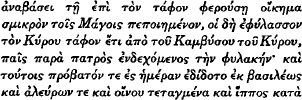


 The oath is a private one and does not correspond to the official form. It is therefore all the more important as an indication of popular belief that it was by the king's daimon that men swore. See also Aegyptische Urkunden aus den Museen zu Berlin, Griechische Urkunden, v. 1264, 10 (quoted by Preisigke, Wörterbuch der griechischen Papyrusurkunden, s.v.
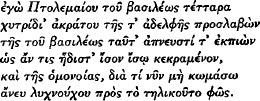
 ):


 and

 Berve's attempt to prove that Arrian's account of the second version of the proskynesis is nearer to Chares's original than Plutarch's is not convincing. See Schnabel's reply to
 Further references will be found in

 out of the mouth of the other, a man about to pour a libation, come the words
 This is evidently a representation of the other common libation at banquets, that of diluted wine to Zeus Soter. See
 mentioned in the inscriptions of Rhodes and other places. The whole subject of Greek household cult needs careful investigation.
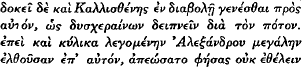
 Cf.

 The use of πιόν with the genitive, the regular case for the drink taken, indicates that Alexander and the drink were identical. The ceremony seems to be a form of communion service.


Crossref Citations

This article has been cited by the following publications. This list is generated based on data provided by Crossref.
1927.
III. Abteilung..
Byzantinische Zeitschrift,
Vol. 27,
Issue. 1,
Yarshater, E.
1983.
The Cambridge History of Iran.
2014.
2017.
Rung, Eduard V.
2020.
The Gestures ofproskynēsisin the Achaemenid Empire.
Klio,
Vol. 102,
Issue. 2,
p.
405.
2022.
TERAMAN HEPDİNÇLER, Özel
2022.
Yönetici Kültünün Antik Yakın Doğu ve Yunan Uygarlıklarındaki Gelişimi.
Anadolu Üniversitesi Sosyal Bilimler Dergisi,
Vol. 22,
Issue. 3,
p.
761.
Matney, Mark
2025.
The star that stopped: The Star of Bethlehem & the comet of 5 BCE.
Journal of the British Astronomical Association,
Vol. 135,
Issue. 6,
p.
387.
Paoletti, Lorenzo
2025.
Heroisation or divinisation of men? Some remarks on the Greek interpretation of the ancient Iranian cults of the frauuaši.
Mythos,
Vol. 19,
Issue. ,
Spoelstra, Joshua Joel
2026.
Courts, Banquets, and Bedchambers: Mapping (Sub-)Genre Distinctions in Biblical Narratives Set in Foreign Imperia.
Religions,
Vol. 17,
Issue. 2,
p.
243.