


 114, Φ 319, π 47). There is little resemblance to water in the heaped bodies of geese and sheep (τ 539, Ε 141), still less in a wooden breastwork (ε 257). So in Ο 364 and 473 συνέχευε is used both of knocking down sand-castles and of breaking a bow. The use of περιχεύεται does not mean that the poet had in mind the pouring of liquid gold. Blümner suggests that χρυσοχόος, used in γ 425 with χαλκεύς as an alternative, means either ‘gilder’ on the analogy of περιχεύεται or ‘gold-melter,’ because the goldsmith would generally use gold scrap which had to be melted down; it does not mean that ‘gold-pourer’ was the way to describe a ‘gilder.’
 Schol, κραίνω in Homer means ‘carry out’ a promise, threat, etc., once ‘hold sway,’ but the use here is appropriate, especially if the word is connected, by true or false etymology, with κάρα, cf. Soph. O.C. 473. So Bechtel, Lexilogus. Even if it were part of κεράννυμι, it could hardly mean more than a combination of two metals. The verb in Homer is always used of mixing drink or bathwater. It would be the exact term for ‘alloy’ and means ‘adulterate’ in
 (Dem. XXIV. 214). Quicksilver produces a thin layer of alloy between the base and the outer skin, but the poet could not be supposed to know this.
 of H 41 is not in its context likely to be a genuine reminiscence of the Bronze Age. It is more probable that it appeared at a time when hoplite greaves were taken for granted and that it replaced a word which was metrically objectionable; perhaps
 since
 very rarely retains its natural quantity in hiatus (
 I, 273, fig. 40) and probably those with heavy crests (Olympia IV, Pl. 16, no. 242–3, JdI 14. 84 fig. 42 and 85. fig. 44) or offset contours (A.M. 17. 211–15, fig. 2, 3 and 4 and Pl. X. 2. Α.ζ. 1884. Pl. 9. 1, 1885. p. 131 and 139) are bronze, and that many others may be. That would take bronze helmets well back into the eighth century. The descendants of the types are clear in the seventh, stove pipe, stilted, Corinthian and conical (BSA XL. Pl. 31. 17, Pl. 28. 31, Pl. 32. 23, Matz, op. cit. Pl. 38. a, and the archaistic ribbed helmet,

 and the non-Greek άσττίς the Minoan 8-shield,
 and
 What survives is a small group of phrases and details which vary the narrative without altering its course. In their duel, Aias outdoes Hector at each stage, but his actions are the same.
 24, so with Argives and Trojans 2 each, Epeians and Boeotians 1 each,

 694,
 287. N 439–40 may be a solitary survival of the same tradition; it sounds more like an adaptation of
 to the pattern of Η 371–2 = 397–8.
 may also belong here, and
 which is put with it for consistency in Table C but seems in the poems to mean ‘with bronze helmet’; it is used 8 times out of 9 of Hector, cf. κορυθαίολος and Ζ 469.
 Il. 31, Od. 5, έταῑροι Od. 5. κνημῑδες appear in arming scenes with θώρηξ, sword, helmet, and one (Γ 330–8, Τ 369–91) or two (Λ 17–46, Π 131–44) spears, but not in those with shield, helmet and single spear (E 736–47, 0 125–7, 479–82). This in fact agrees with their introduction in Myc. III, though it is unexpected in passages so easily compounded of a series of formulae.
 (Δ 133 = Y 415) may be a misunderstood formula.
 are too obscure to be used as evidence.
 252 Agamemnon cuts off hair with the μάχαιρα which he carries beside his sword. Perhaps Ψ 412, where horses are to be butchered, should go with them, but it has been grouped as ‘unspecified’, a class which consists almost entirely of the weapons in such phrases as
 and therefore in fact mainly refers to spears. T 222 is a good example of ambiguity, since χαλκός is equally appropriate to the weapon in battle or to the sickle with which it is compared.
 is unnecessarily translated ‘by the pitiless weight of their armour.’
 (Π 739) is a nice adaptation.

 or

 and
 are strict. Generally the use is freer, e.g. άτειρής (of bronze 7: of fighters and their strength, once compared to an axe, 3: of voice 3. The entry in L. and S. (1925) needs correction). It comes in three patterns and one individual line:
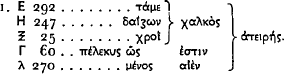
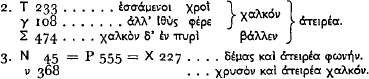
 Rare epithets are


Crossref Citations

This article has been cited by the following publications. This list is generated based on data provided by Crossref.
Hopper, R. J.
1968.
The Laurion Mines: A Reconsideration.
The Annual of the British School at Athens,
Vol. 63,
Issue. ,
p.
293.
Kirk, G. S.
1975.
The Cambridge Ancient History.
p.
820.
Edwards, I. E. S.
Gadd, C. J.
Hammond, N. G. L.
and
Sollberger, E.
1975.
The Cambridge Ancient History.
De Jesus, Prentiss S.
1978.
Metal Resources in Ancient Anatolia.
Anatolian Studies,
Vol. 28,
Issue. ,
p.
97.
Boardman, John
Edwards, I. E. S.
Hammond, N. G. L.
and
Sollberger, E.
1982.
The Cambridge Ancient History.
Boardman, John
1982.
The Cambridge Ancient History.
p.
779.
Sherratt, E. S.
1990.
‘Reading the texts’: archaeology and the Homeric question.
Antiquity,
Vol. 64,
Issue. 245,
p.
807.
Brown, Adam
1998.
Homeric Talents and the Ethics of Exchange.
The Journal of Hellenic Studies,
Vol. 118,
Issue. ,
p.
165.
2005.
A Companion to Ancient Epic.
p.
589.
Purves, Alex
2006.
Falling into Time in Homer'sIliad.
Classical Antiquity,
Vol. 25,
Issue. 1,
p.
179.
Grethlein, Jonas
2009.
Epic and History.
p.
122.
2014.
Gebildete Steine.
p.
372.
Pache, Corinne Ondine
Dué, Casey
Lupack, Susan
and
Lamberton, Robert
2020.
The Cambridge Guide to Homer.
2021.
Heymans, Elon D.
2021.
The Origins of Money in the Iron Age Mediterranean World.
Bykh, Viktor
2024.
OVER THE TRADITION OF THE HEROIC AGE: EXIT FROM THE HOMERIC ONTOLOGICAL MODEL.
The Journal of V. N. Karazin Kharkiv National University, Series "The Theory of Culture and Philosophy of Science",
p.
64.
Murray, Sarah C
2026.
Heavy Metals.