


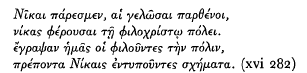
 (or. xviii 178). Themistius quotes the Old Testament as λόγος τῶν Ἀσσνρίων (


 Libanius complained that they ate ‘more than elephants’ (or. xxx 8), and Eunapius likened them to pigs (Vit. Soph. 472).

 The poem was probably written between the destruction of the Sarapeum and the erection of the church on its site (

Crossref Citations

This article has been cited by the following publications. This list is generated based on data provided by Crossref.
1965.
III. ABTEILUNG.
Byzantinische Zeitschrift,
Vol. 58,
Issue. 1,
Wilkinson, Kevin W.
2010.
Palladas and the Foundation of Constantinople.
Journal of Roman Studies,
Vol. 100,
Issue. ,
p.
179.
2013.
Constantine.
p.
226.
Woods, David
2015.
Palladas, Constantinople, and the Power of Money (ap 16.282).
Mnemosyne,
Vol. 68,
Issue. 5,
p.
836.
Wilkinson, Kevin W.
2026.
Palladas, Praxiteles’ Parian Eros and Constantine’s transformation of pagan images in Constantinople.
Journal of Roman Studies,
p.
1.