


Introduction
This paper examines the role of remittance flows in shaping political outcomes across countries. Specifically, we argue that the democratic origin of remittances, rather than their aggregate levels, can significantly influence political institutions. This perspective helps reconcile contradictory findings in the existing literature on the relationship between remittances and political institutions (see, for example, Abdih et al. (Reference Abdih, Chami, Dagher and Montiel2012) and Williams (Reference Williams2017), for two conflicting views).
The case of Gambia provides an illustrative example. Until 2016, Gambia was ruled by the authoritarian regime of Yahya Jammeh. Nevertheless, on 1 December 2016, opposition leader Adama Barrow unexpectedly won the presidential elections by a large margin. This outcome was surprising given the African strongman tradition of maintaining power through constitutional manipulation, electoral delays, or outright repression. Jammeh had been in power since 1994, and elections during his tenure were characterised by violence, repression, bans on opposition parties, and severe restrictions on political campaigning, leading most observers to classify the regime as dictatorial (Hultin et al., Reference Hultin, Jallow, Lawrance and Sarr2017).
Under these circumstances, the electoral upset required extensive opposition mobilisation, an inherently difficult task in autocracies, where both financial resources and persuasion are essential. In this respect, the Gambian diaspora played a critical role. Since the 1990s, substantial emigration led nearly 4% of the population to reside abroad by 2010, primarily in Western democracies or neighbouring African countries (Escribà-Folch et al., Reference Escribà-Folch, Meseguer and Wright2015). These migrants maintained close ties with their local communities, sending back sizable remittances amounting to more than 11% of Gross Domestic Product (GDP) by 2015.Footnote 1 According to Escribà-Folch et al. (Reference Escribà-Folch, Meseguer and Wright2015), these funds were used to finance government opposition. At the same time, immigrants used resources, such as smartphones, to inform their families about the regime’s abuses, influencing their votes (Escribà-Folch et al., Reference Escribà-Folch, Meseguer and Wright2015: 185).
However, high remittance inflows alone do not appear to be sufficient to account for such political change. Countries such as Pakistan, Egypt, Yemen, and Bangladesh also experienced high remittance levels, averaging more than 7% of GDP over the 1990–2020 period. Notably, the V-Dem Polyarchy Index remained consistently below the sample median for these countries, with no corresponding improvement in democratic institutions over time. A key distinction between these cases and Gambia lies in the origin of remittances: while Gambia received most of its remittances from democratic countries, remittances from democracies in the other cases averaged less than 1.2% of GDP. This contrast motivates our focus on the origin of remittance flows rather than their aggregate value.
Several papers have examined the impact of remittances on home political institutions with mixed results, often treating remittances as a homogeneous flow. For example, Escribà-Folch et al. (Reference Escribà-Folch, Meseguer and Wright2022) argue that remittances increase political protest in autocratic countries, inducing political reforms. Others, e.g., Ahmed (Reference Ahmed2012), consider remittances as external rents that stabilise autocracies, similar to natural resources or aid. Remittances are not just financial transfers; they are deeply tied to the close bonds migrants maintain with their families back home. These connections enable the flow of money and the exchange of norms, values, and ideas. In this way, remittances become a mechanism for influencing social and political attitudes in the recipient country.
Immigrants living in democratic countries will then be exposed to the values, norms, and practices that define those societies. Following the logic above, when they keep close ties with their communities and send remittances back home, these financial flows will be accompanied by the transmission of democratic ideals. A high influx of remittances from democratic countries can then serve as a channel for introducing and reinforcing democratic norms and ideals in the home country. As a result, we should expect that high remittances from democratic countries may foster improvements in political institutions in the home country. Moreover, the above argument does not imply that we should expect a positive impact of the aggregate remittances on democracy.
To examine our hypothesis, we follow Ratha and Shaw (Reference Ratha and Shaw2007) to estimate bilateral remittance flows for a large sample of countries and then aggregate the flows originating in democratic source countries. Our main independent variable is the resulting amount of remittances from democratic countries expressed as a percentage of recipient-country GDP. Our main dependent variable is the V-Dem Polyarchy index, although we also examine the robustness of our results using alternative measures of democracy. To deal with reverse causality, measurement error, and omitted variable bias, we use an instrumental-variable (IV) approach to estimate a causal relationship between our two main variables of interest.
As an instrument for remittances, we use the linguistic similarity of a remittance-recipient country with democratic countries, weighted by geographical distance, and interact with global trade openness. Our justification is that linguistic similarity reduces migration barriers by facilitating communication and cultural integration, while geographic distance captures migration and transaction cost, both of which influence remittance flows. Accordingly, we expect remittances from democratic countries to be larger when linguistic proximity is higher and geographic distance is lower. By focusing only on democratic countries, the instrument captures variation associated with democratic contexts. Interacting this measure with global trade openness incorporates broader trends in economic integration, ensuring the instrument reflects long-term cultural and global factors rather than short-term political or economic conditions.Footnote 2 In addition to the theoretical justification presented in section `Data and empirical methodology’, we assess the relevance and plausibility of the identification strategy through first-stage diagnostics, alternative instrument constructions, overidentification tests, and auxiliary evidence on observable alternative channels.Footnote 3
Our empirical findings indicate a robust positive effect of remittances from democratic countries on the V-Dem Polyarchy index. Specifically, a four-percentage-point increase in remittances from democratic countries as a share of GDP is associated, ceteris paribus, with an increase in the V-Dem index comparable in magnitude to the average observed difference between the average African and European country.Footnote 4 Using the same IV approach, we also show that remittances from democratic countries, expressed as a share of GDP, are significantly associated with all V-Dem dimensions of democracy, i.e., electoral, liberal, participatory, deliberative, and egalitarian indices. These results remain consistent across alternative measures of democracy and robustness checks, underscoring the significant role of remittances in promoting democratic institutions. While the analysis covers a global sample of 156 countries, the findings are particularly relevant to debates on political change in autocratic and weakly democratic regimes.
The present paper is related to a vast literature that links remittances to institutional change (see, for example, Abdih et al., Reference Abdih, Chami, Dagher and Montiel2012; Escribà-Folch et al., Reference Escribà-Folch, Meseguer and Wright2015; Williams, Reference Williams2017), yet our analysis differs in several dimensions. First, unlike previous work that analyses total remittances, we disaggregate remittance flows by the political regime of the sending country and find a positive effect for remittances from democratic countries, whereas aggregate remittances have no statistically detectable effect. This distinction has received limited attention before. This also connects our analysis to the migration-and-democracy literature, which shows that migration to democratic destinations can shape institutions in origin countries (Docquier et al., Reference Docquier, Lodigiani, Rapoport and Schiff2016). We complement this literature by examining the monetary intensity of these transnational links, since remittance flows capture not only migrant exposure but also the magnitude of resources transferred and the strength of migrants’ continuing ties with home communities. Second, we estimate this effect through an IV design that interacts linguistic and geographic proximity to democracies with global trade openness, generating variation in remittances from democratic source countries. Our results may help explain why earlier studies reached conflicting conclusions: by aggregating remittance flows originating in different political environments, previous analyses may have obscured effects that are specific to remittances from democratic countries.
The paper is structured as follows. The next section provides a literature review and the theoretical considerations underlying our testable hypothesis. Section ‘Data and empirical methodology’ presents the data and empirical methodology and discusses the instrument used in the empirical analysis. Section ‘Results’ reports the empirical results and robustness tests. Finally, section ‘Conclusions’ concludes.
Literature review and testable hypothesis
How remittances affect the institutional environment
The relationship between remittances and political institutions has garnered increasing attention in recent years, particularly regarding how these financial flows affect recipient countries. One strand of the literature examines the economic consequences of remittances. Remittances may reduce labour supply and generate Dutch disease effects (Acosta et al., Reference Acosta, Lartey and Mandelman2009; Azam and Gubert, Reference Azam and Gubert2008), but they may also alleviate poverty, promote financial development, and modestly increase economic growth (Cazachevici et al., Reference Cazachevici, Havranek and Horvath2020; Gupta et al., Reference Gupta, Pattillo and Wagh2009).
With respect to political institutions, the relationship between remittances and the quality of political institutions has yielded mixed findings. Abdih et al. (Reference Abdih, Chami, Dagher and Montiel2012) discuss whether remittances act as a ‘curse’ by potentially undermining local institutions due to increased dependency on external funds. Their findings show that access to remittance inflows makes government corruption less costly for households, enabling corrupt activities that weaken political institutions. Similarly, Berdiev et al. (Reference Berdiev, Kim and Chang2013) find that remittances tend to increase corruption, while Ahmed (Reference Ahmed2013) shows that this effect is present when democratic institutions are weak, since remittances provide rents that autocrats can exploit. Tyburski (Reference Tyburski2014) also reports that remittances raise corruption in closed regimes but reduce it in more open democratic political systems. In contrast, other studies document beneficial effects: Tyburski (Reference Tyburski2012) argues that remittances can enhance government accountability and create incentives for reform, and Ajide and Olayiwola (Reference Ajide and Olayiwola2020) find that remittances have improved control of corruption in Nigeria. At the same time, Ahmed (Reference Ahmed2012) finds that remittances increase the likelihood of survival for autocratic governments.
Recent research highlights a more complex connection between remittances and democratic institutions. Escribà-Folch et al. (Reference Escribà-Folch, Meseguer and Wright2015, Reference Escribà-Folch, Meseguer and Wright2022) argue that remittances differ from other foreign income flows. Unlike foreign aid and natural resources, remittances accrue directly to domestic households. Even though they increase household income, the limited income tax collection capacity in many developing countries means that only a small part of these funds translates into government revenues. Their empirical findings show that remittances strengthen democratic movements by financially empowering civil society and fostering political participation. Similarly, Islam and Lee (Reference Islam and Lee2023); Williams (Reference Williams2017); and Anaman et al. (Reference Anaman, Allor and Kuffuor2023) provide evidence that remittances foster democratic institutions in developing nations. Williams (Reference Williams2018) notes that remittances only positively affect democratic institutions when they exceed 22% of GDP.
Related literature examines how migration affects political institutions in migrants’ countries of origin and shows that the institutional characteristics of destination countries matter. Spilimbergo (Reference Spilimbergo2009) finds that foreign education promotes democracy primarily when individuals are educated in democratic countries, while Docquier et al. (Reference Docquier, Lodigiani, Rapoport and Schiff2016) provide cross-country evidence that emigration to democratic destinations can improve political institutions at home. Barsbai et al. (Reference Barsbai, Rapoport, Steinmayr and Trebesch2017) similarly show that migration from Moldova to Western Europe, rather than to Russia, affected political preferences and electoral outcomes through the transmission of information and norms. Lodigiani (Reference Lodigiani2016) reviews these mechanisms more broadly, including social remittances, return migration, and diaspora networks. These studies establish that exposure to democratic destination countries can shape political attitudes and institutions in origin countries. Our paper builds on this insight by examining whether the same distinction is reflected in monetary flows: specifically, whether remittances originating from democratic countries have different institutional consequences from aggregate remittances. This allows us to connect the remittances literature with the broader migration-and-democracy literature while focusing on the political origin of remittance flows.
Why the origin of remittances matters
Building on the literature reviewed above, we argue that the political consequences of remittances depend not only on their volume but also on their origin. Remittances from democratic countries may have different institutional effects than remittances originating from autocratic regimes because migrants are embedded in different political and social environments abroad. We discuss three mechanisms through which remittances may influence political institutions and explain why some of these channels are likely to be stronger when remittances originate from democratic countries.
The first mechanism operates through household income. As long as migrants maintain close ties with their families, they are more likely to send remittances back home, providing crucial financial support to the recipient households. By relaxing liquidity constraints, remittances may increase the bargaining power of citizens vis-à-vis political elites (Acemoglu and Robinson, Reference Acemoglu and Robinson2005). Building on Escribà-Folch et al. (Reference Escribà-Folch, Meseguer and Wright2022), remittances reduce households’ dependence on state-controlled resources and patronage networks, thereby weakening one of the key mechanisms through which authoritarian regimes maintain political support. In patronage-based regimes, access to remittance income may reduce the electoral support of autocratic incumbents and increase citizens’ autonomy from the state (Miller and Peters, Reference Miller and Peters2020). More generally, remittances can alter the balance of power between citizens and political elites by providing economic resources that operate outside government control.
The income effect applies to remittances regardless of the political regime of the sending country. By itself, therefore, it does not distinguish between remittances originating from democratic and autocratic countries. However, there are reasons to expect remittances from democratic countries to have additional institutional consequences. In particular, migrants may transmit not only financial resources but also ideas, norms, and political attitudes acquired abroad. This insight is captured by Levitt’s (Reference Levitt1998) ‘social remittances hypothesis,’ which emphasises that migrants transmit not only money but also ideas, behaviours, and identities back to their home countries through sustained ties. This flow of social capital from democratic destination countries, particularly when accompanied by financial remittances, can foster democratic norms and practices among recipients, potentially enabling them to challenge authoritarian governance.
A key implication of the social remittances hypothesis is that the transmission of ideas and norms does not require permanent return migration. Through sustained communication with relatives and communities at home, migrants can influence political attitudes, expectations, and behaviour even while residing abroad. This is consistent with Hirschman’s (Reference Hirschman1970) ‘exit versus voice’ framework. In authoritarian settings, individuals who face limited opportunities for political participation may choose exit rather than voice by emigrating. However, exit does not necessarily imply political disengagement from the home country. Migrants who leave because of political repression or dissatisfaction with governance may retain strong social and political ties with their countries of origin and continue to express opposition to the regime from abroad.
Recent work suggests that emigration can generate political feedback even in the absence of return migration by shaping patterns of political contestation and political behaviour in origin countries (Peters and Miller, Reference Peters and Miller2022). These effects may be particularly pronounced when migrants settle in democratic destination countries. Exposure to democratic institutions can shape migrants’ expectations regarding political accountability, participation, and civic engagement (Miller and Peters, Reference Miller and Peters2020). Through continued interactions with family members and local communities, they may transmit these norms, thereby extending the influence of democratic institutions beyond national borders.
In addition, remittances from democracies can affect organisational capacity. Migrants residing in democratic countries are more likely to be exposed to organisations and networks that promote political participation, civic engagement, accountability, and government transparency. Through continued ties with their home communities, these experiences may translate into financial and organisational support for NGOs, civic groups, and opposition movements in their countries of origin. Remittance flows and diaspora networks often serve as the primary channels through which such support is transmitted across borders. By providing resources outside government control, these flows enhance the financial autonomy of organisations that promote political participation and accountability. In this way, democratic remittances can contribute not only to changes in individual political attitudes but also to the development of organisational structures that support collective action and institutional reform. Under favourable conditions, these processes may create opportunities for broader democratic change by empowering actors capable of challenging existing political arrangements.
On the other hand, remittances originating from autocratic countries are less likely to foster similar institutional effects. Migrants residing in authoritarian regimes are exposed to institutional environments that place greater restrictions on political participation, civic engagement, and freedom of expression. Consequently, opportunities for the transmission of democratic norms and participatory practices are more limited (Naufal, Reference Naufal, Chiswick and Miller2015). While remittances from autocratic countries may still generate income effects by increasing household resources, they are less likely to be accompanied by the social remittances and organisational spillovers that constitute the second and third mechanisms discussed above. The institutional impact of remittances, therefore, is expected to depend not only on their volume but also on the political environment in which migrants are embedded.
Despite extensive research on the effects of remittances on political institutions, previous studies have largely treated remittances as a homogeneous financial flow. The discussion above suggests that this assumption may overlook important differences arising from the political environment in which migrants are embedded. While the income effect should operate regardless of the origin of remittances, the social remittances and organisational capacity channels are expected to depend on the institutional characteristics of destination countries. Consequently, aggregating remittance flows from heterogeneous source countries may obscure effects that operate only under specific political conditions. Overall, we expect remittances from democratic countries to contribute more to improvements in political institutions, whereas remittances originating from autocratic countries are less likely to generate comparable effects. This reasoning leads to the following hypothesis:
Testable Hypothesis: Remittances from democratic countries positively influence the quality of political institutions in recipient countries.
Data and empirical methodology
This section describes the data sources, key variables, and empirical strategy used to assess the relationship between remittances from democratic countries and the quality of political institutions in recipient countries. It also explains the use of an IV estimator to address potential endogeneity concerns.
Data sources and sample
Our empirical analysis uses a panel dataset covering 156 countries from 1970 to 2023.Footnote 5 As data for the source of remittances are unavailable annually, we use 5-year averages for all variables in our analysis.
The primary dependent variable is the quality of political institutions. To proxy the quality of political institutions, we mainly use the Polyarchy measure of Democracy provided by the V-DEM project (Coppedge et al., Reference Coppedge, Gerring, Knutsen, Lindberg, Teorell, Altman, Angiolillo, Bernhard, Cornell, Fish, Fox, Gastaldi, Gjerløw, Glynn, Good God, Grahn, Hicken, Kinzelbach, Krusell, Marquardt, McMann, Mechkova, Medzihorsky, Natsika, Neundorf, Paxton, Pemstein, von Römer, Seim, Sigman, Skaaning, Staton, Sundström, Tannenberg, Tzelgov, Wang, Wiebrecht, Wig, Wilson and Ziblatt2025), which includes multiple dimensions of democracy based on Dahl’s (Reference Dahl1972) definition. The index represents a maximalist measure of democracy, measuring five regime dimensions, namely, the extent to which government officials are elected through free and fair elections, the integrity of the electoral processes, the extent of the freedom of association, the extent of the freedom of expression, and the extent to which all individuals have equal rights and opportunities to participate in the political process. The index is based on expert evaluations and provides a comprehensive measure that captures multiple dimensions of the regime characteristics. Democracy is, of course, a qualitative concept; however, this does not imply that any quantitative variation has no meaning. Changes in the index represent movements along a well-defined institutional scale that is widely used in the literature, reflecting improvements or deteriorations in core democratic attributes (see e.g., Berggren and Bjørnskov, Reference Berggren and Bjørnskov2024).Footnote 6
We prefer the V-DEM index over alternative democracy measures (e.g., Freedom House, Polity IV) as it provides higher time and country coverage. Moreover, it has the advantage of being continuous in the [0, 1] range with no censored observations. Finally, it considers more dimensions of the political institutions compared to a minimalist measure (e.g., Bjørnskov and Rode Reference Bjørnskov and Rode2020), which serves to test the hypothesis as set out in section ‘Literature review and testable hypothesis’. However, as a robustness check, we also use alternative measures of democracy to assess whether the results depend on the choice of outcome variable.
The main independent variable of interest is remittances from democratic countries as a percentage of GDP. Data on remittance flows are obtained from the World Bank Development Indicators, which are World Bank staff estimates based on IMF balance of payments data and World Bank and OECD GDP estimates. Remittances consist of two items: personal transfers and compensation of employees. Both components are theoretically relevant, as temporary or cross-border workers are exposed to similar institutional environments abroad and transmit not only income but also social norms and information to their home communities. As we are interested in the remittances from democratic countries, we need a measure capturing bilateral remittances. For this reason, we follow the World Bank’s standard methodology of estimating bilateral remittances, as developed by Ratha and Shaw (Reference Ratha and Shaw2007), and model remittances as the product of (1) the number of migrants from country i residing in country j, (2) the earning capacity of these migrants proxied by the host country’s per capita GDP, and (3) the propensity to remit captured by the ratio of total remittances to GDP in the sending country. More specifically, we compute the remittances from country j to country i at time t as:
 ${{Remittances}}_{{ijt}}={{M}_{{ijt}}{Y}_{{jt}} \over \sum _{{jt}}{M}_{{ijt}}{Y}_{{jt}}}{R}_{{it}}$
where M ijt is the number of migrants from i to j at t, Y jt is the per capita GDP of migrant-receiving country j, and R it is the share of remittances to GDP in country i at t. GDP data are taken from the World Bank’s World Development Indicators. Bilateral migration data are taken from the World Bank Migration and Remittances Database. Because prior to 2000 these data are reported at ten-year intervals, migration stocks for the intermediate five-year observations are constructed using linear interpolation.
Using this bilateral allocation procedure, we construct remittances originating from democratic countries by summing bilateral remittance flows from all source countries classified as democracies according to Bjørnskov and Rode (Reference Bjørnskov and Rode2020) in a given year. Formally, remittances from democratic countries are calculated as the sum of bilateral remittance flows (Remittances ijt ) for all source countries with (Democracy jt = 1). This procedure allows the composition of remittance inflows to vary over time as both migration patterns and the democratic status of source countries evolve.
Our empirical strategy focuses on remittances originating from democratic source countries; consistent with this focus, the instrument is constructed to shift remittance flows from this subset of countries rather than overall remittance or migration proximity. This reflects the theoretical mechanism of interest, which concerns exposure to financial flows and associated information and norms originating in democratic institutional environments. In specifications that include remittances from both democratic and autocratic source countries, we construct separate interaction-based instruments for the two remittance variables.
The rest of the control variables in our model include only the main variables that are expected to affect the quality of political institutions. These include (the log of) GDP per capita, (the log of) total population, trade openness, defined as exports plus imports over GDP, population density, and the gross secondary school enrolment. All variables are from the World Bank Development Indicators. Finally, we include country-fixed effects to capture institutional and time-invariant variables (e.g., fractionalisation, colonial background, cultural factors, geography, etc.).Footnote 7
Addressing endogeneity concerns
A central challenge in estimating the causal effect of remittances on political institutions is the potential for endogeneity. In the present setting, this issue might arise from several sources. First, reverse causality might be an issue for the problem at hand. Political repression or weak institutional conditions may encourage emigration, particularly toward democratic destinations, thereby influencing subsequent remittance inflows from these countries.
Second, systematic measurement error bias presents a significant challenge in analysing remittance data. The extent to which remittance flows are recorded in official statistics depends on administrative capacity, the prevalence of informal transfer channels, and the development of financial and ICT infrastructures across countries. In practice, even legal immigrants often avoid contact with authorities due to fears of deportation, detention, or other legal repercussions. Furthermore, low administrative capacity leads to insufficient resources or expertise to adequately measure remittance flows. Many of these transactions go through informal transfer systems, bypassing formal reporting (see, for example, the Hawala networks or other low-cost alternatives of transferring money through friends, taxi drivers, etc. – see Freund and Spatafora (Reference Freund and Spatafora2008)). The problem is more acute if we consider that remittances in conflict-stricken or sanctioned regions are typically routed through informal networks.Footnote 8
Third, unobserved cultural, geographical, or historical characteristics could influence remittance flows and institutional quality, creating omitted variable bias. For example, cultural norms surrounding familial obligations may determine how much migrants send home (Cox et al., Reference Cox, Eser and Jimenez1998; Stark and Lucas, Reference Stark and Lucas1988). At the same time, culture affects the quality of political institutions (Barro, Reference Barro1999; Driessen, Reference Driessen and Driessen2014). Similarly, historical factors such as colonial legacies may shape recipient countries’ institutional structures and migration and remittance patterns. Geographical considerations, such as proximity to high-income countries or shared borders, can also affect remittance volumes while simultaneously influencing the evolution of political institutions through regional waves in transitions to and away from democracy (Acemoglu et al., Reference Acemoglu, Naidu, Restrepo and Robinson2019; Brinks and Coppedge, Reference Brinks and Coppedge2006; Persson and Tabellini, Reference Persson and Tabellini2009). Country-fixed effects may alleviate some of these problems, yet they cannot capture all possible biases. Failure to control for such unobserved factors may lead to spurious associations, rendering the OLS biased.
We employ an IV estimator to address these concerns. This identification strategy relies on an external instrument that generates variation in remittances from democratic countries across countries and over time. This strategy differs from designs based on treatment timing, such as staggered difference-in-differences, which exploit variation in treatment adoption and compare treated and untreated units before and after treatment occurs. In our setting, the variable of interest is a continuous endogenous regressor, and identification instead arises from the first-stage relationship between the external instrument and remittances from democratic countries.
The instrument we use is the linguistic similarity weighted by inverse bilateral distance, interacted with global trade openness.Footnote 9 The language component is a bilateral indicator equal to one when the recipient and source countries share a common official language. Bilateral distance is measured between the countries’ most populous cities. We expect linguistic similarity to reduce migration barriers by facilitating communication, easing cultural integration, and enhancing economic opportunities in the destination countries. More importantly, we argue that linguistic closeness helps migrants maintain stronger emotional and social ties with their families and communities back home. Speaking a similar language fosters frequent contact, a sense of belonging, and cultural continuity, all of which are likely to increase remittance flows. Consistent with the construction of the remittance variable, the bilateral exposure measure is aggregated over source countries classified as democracies in each period. However, the financial and real cost of migration increases with geographic distance. Weighting linguistic similarity by inverse bilateral distance gives greater weight to linguistically linked democratic source countries that are geographically closer to the recipient country. Shorter distances translate to lower migration and financial transaction costs. In comparison, longer distances tend to increase transaction costs, influencing the mode and magnitude of remittances. This weighted adjustment reflects the spatial dimension of migration and remittance behaviour. Finally, we interact this exposure measure with global trade openness, defined as world trade as a share of world GDP. This country-invariant time-series component captures changes in global economic integration that may facilitate cross-border financial flows, including remittances. It therefore provides the common temporal variation in the instrument rather than measuring the policies or infrastructure of any individual recipient country.
The instrument combines time-invariant bilateral characteristics with the contemporaneous classification of source countries as democracies. For each recipient country and period, common-language exposure, weighted by inverse bilateral distance, is aggregated over countries classified as democracies in that period and interacted with global trade openness. Country-fixed effects absorb permanent recipient-country characteristics, while period fixed effects absorb shocks common to all countries. Identification therefore arises from within-country variation in the resulting interaction-based instrument.Footnote 10
Given this construction, the relevant exclusion restriction applies to the interaction-based instrument as constructed: conditional on country and period fixed effects and the included covariates, it affects political institutions only through remittances from democratic countries. Because the baseline specification relies on the composite instrument, we do not use its individual components as the sole source of identification. We nevertheless enter the two exposure components jointly in a Lewbel-augmented specification to assess the corresponding overidentifying restrictions. Moreover, we examine alternative constructions and observable direct channels as robustness exercises. In particular, Appendix Table C1 considers whether the instrument predicts trade-related outcomes and other country characteristics, while section ‘Migration as an alternative explanation’ reports specifications that control explicitly for total migration and migration to democratic destinations. None of these associations is statistically significant. These results lessen the concern that the instrument primarily operates through changing migration or trade relationships, although they do not constitute formal tests of the exclusion restriction.Footnote 11
Additionally, all equations include country-fixed effects, which absorb level differences associated with persistent historical characteristics, including colonial relationships, geography, and long-standing linguistic connections. They do not, however, eliminate the possibility that these characteristics generate differential responses to global changes over time. To reduce the dependence of the results on official-language relationships that may partly reflect colonial history, we also estimate the model using an alternative measure based on common native language. The results remain qualitatively similar. We interpret this exercise as supporting evidence rather than as proof that all historically mediated channels have been eliminated.Footnote 12
It is important to note that, as with any instrumental-variable strategy, our estimates should be interpreted as a Local Average Treatment Effect (LATE) rather than the average effect of democratic remittances for all countries (Imbens and Angrist, Reference Imbens and Angrist1994). The relevant compliers are country-period observations for which remittances from democratic source countries respond positively to variation in the interaction-based instrument. In substantive terms, these are country-period observations whose remittance inflows from democratic source countries respond to variation in the constructed instrument. Consequently, our estimates identify the causal effect of democratic remittances for this subset of observations. While this interpretation cautions against viewing the estimates as universally applicable to all remittance-receiving countries, it is closely aligned with the theoretical mechanism of interest, namely the transmission of resources, norms, and organisational influences from democratic institutional environments.
Empirical model specification
The baseline equation that we estimate is specified as follows:
 ${Y_{i,t}} = {\mu _i} + {\lambda _t} + \beta \cdot RemitDe{m_{i,t}} + {{{\boldsymbol X^\prime}}_{i,t}}\gamma + {\varepsilon _{i,t}}$
where, Y i, t is the quality of political institutions in country i at time t, RemitDem i, t denotes remittances from democratic countries expressed as a percentage of GDP, X i, t is a vector of control variables, μ i denotes country-fixed effects, and λ t denotes time-fixed effects that absorb global shocks. Finally, ϵ i, t is the error term. RemitDem i, t is treated as endogenous and is modelled in the first stage as
 $RemitDe{m_{i,t}} = {\mu _i} + {\lambda _t} + a \cdot instrumen{t_{i,t}} + {{{\boldsymbol X^\prime}}_{i,t}}\delta + {v_{i,t}}$
where the same set of country and time-fixed effects and control variables is included in both stages. The equation is estimated using IV. The identifying assumption is that, conditional on the included covariates and country and period fixed effects, the instrument affects institutional quality only through its impact on remittances from democratic countries. In the tables that follow, heteroskedasticity-robust standard errors are reported. Appendix B summarises the key variables used in the empirical analysis, their definition, and sources.
Results
Main results
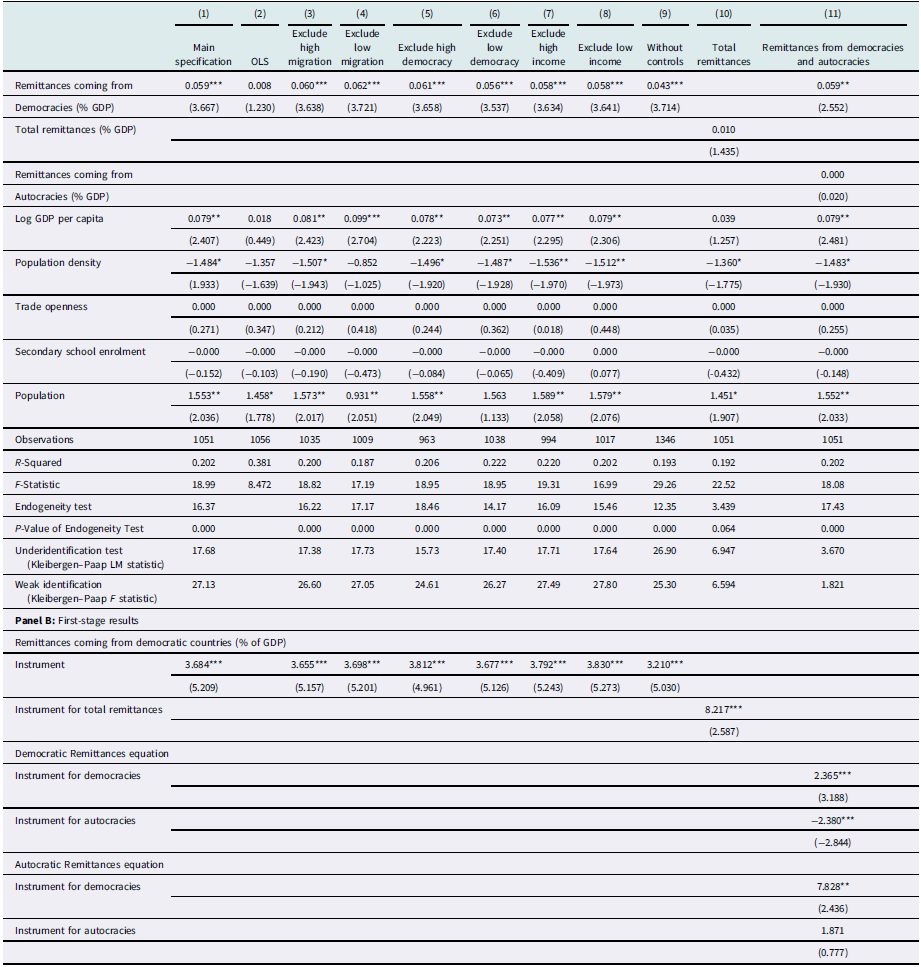
This section presents the baseline IV estimate and a set of robustness specifications, using the V-Dem Polyarchy Index as the main dependent variable. We examine the effect of remittances from democratic countries on political institutions in recipient countries. Table 1 reports the baseline 2SLS estimate in column (1), the corresponding OLS benchmark in column (2), and a series of IV robustness specifications in the remaining columns.
Main results

Table 1. Long description
A table with 11 columns and 30 rows comparing the effects of remittances from democratic countries on political institutions in recipient countries. The columns are labeled as follows: (1) Main specification, (2) OLS, (3) Exclude high migration, (4) Exclude low migration, (5) Exclude high democracy, (6) Exclude low democracy, (7) Exclude high income, (8) Exclude low income, (9) Without controls, (10) Total remittances, (11) Remittances from democracies and autocracies. The rows include various variables such as Remittances coming from Democracies (% GDP), Total remittances (% GDP), Remittances coming from Autocracies (% GDP), Log GDP per capita, Population density, Trade openness, Secondary school enrolment, Population, Observations, R-Squared, F-Statistic, Endogeneity test, P-Value of Endogeneity Test, Underidentification test, Weak identification, and Panel B: First-stage results. Each row provides specific values for each column, indicating the results of different specifications and robustness checks. The table also includes statistical values such as standard errors in parentheses, significance levels indicated by asterisks, and various test statistics.
Notes: The dependent variable is the V-Dem Polyarchy Index. Column (1) reports the baseline IV specification and column (2) the corresponding OLS estimate. Columns (3)–(8) exclude observations at the upper and lower tails of the migration, democracy, and income distributions. Column (9) excludes time-varying controls. Column (10) uses total remittances, while column (11) jointly includes remittances from democratic and autocratic countries, instrumented separately. Panel B reports first-stage estimates. Robust t-statistics are in parentheses. ***, **, and * denote significance at the 1%, 5%, and 10% levels. All regressions include country and period fixed effects. The Kleibergen–Paap LM test examines underidentification, while the Kleibergen–Paap Wald F statistic assesses weak identification.
In the baseline 2SLS specification reported in column (1), the excluded instrument is the recipient country’s common-language exposure to democratic source countries, weighted by inverse bilateral distance and interacted with global trade openness. Panel B reports a positive first-stage coefficient that is statistically significant at the 1% level, consistent with the expected relationship between the instrument and remittances from democratic countries.
The estimated coefficient is 3.68, implying that a one-unit increase in the instrument is associated with a 3.68%-point increase in remittances from democratic countries as a share of GDP. Because the instrument is a constructed index, the magnitude of this coefficient does not have a particularly intuitive standalone interpretation; its primary relevance is for assessing the direction and strength of the first-stage relationship.
The first-stage diagnostics support the relevance of the baseline instrument. The Kleibergen–Paap LM statistic is 17.68, allowing us to reject the null hypothesis of underidentification at conventional significance levels. The Kleibergen–Paap Wald F statistic is 27.13, indicating a comparatively strong first-stage relationship in the baseline specification. These diagnostics provide evidence on instrument relevance and strength but do not test the exclusion restriction. Appendix C reports auxiliary evidence on observable alternative channels relevant to the plausibility of that assumption.
The endogeneity test reported in Table 1 rejects the null hypothesis that remittances from democratic countries can be treated as exogenous. Because conventional versions of this test may rely on restrictive assumptions concerning the error structure, we also follow Joshi and Wooldridge (Reference Joshi and Wooldridge2019) and implement a robust control-function test of exogeneity. The coefficient on the first-stage residual is statistically significant at the 5% level (t = −2.53, p = 0.013), providing additional evidence against the exogeneity of remittances and supporting the use of an IV estimator.
The second-stage results, presented in column (1) of Table 1, indicate that remittances from democratic countries positively affect political institutions, as measured by the V-Dem Polyarchy Index. This relationship is statistically significant at the 1% level, supporting our testable hypothesis. Specifically, a 4%-point increase in remittances as a share of GDP from democratic countries is associated with a 0.24-point increase in the Democracy Index, equivalent approximately to 0.83 standard deviations of the outcome. As a benchmark for interpreting the magnitude of the estimated effect, the average V-Dem Polyarchy index in 2023 was 0.37 in Africa and 0.65 in Europe.
The remaining columns of Table 1 report robustness checks based on alternative samples, control sets, and remittance measures. First, in column (2), we treat remittances from democratic countries as exogenous and estimate the baseline specification by OLS. The estimated coefficient is positive, substantially smaller than the corresponding IV estimate, and not statistically significant. We therefore interpret this result as evidence of a positive conditional association, rather than a causal effect, between remittances from democratic countries and the quality of political institutions.Footnote 13
Then, in columns (3)–(8), we exclude observations in the top and bottom five percentiles of migration intensity, democracy scores, and income per capita. More specifically, columns (3) and (4) exclude observations in the upper and lower five percentiles of the migration-intensity distribution, respectively, assessing whether the baseline estimate is driven by observations with unusually high or low migration intensity. In columns (5) and (6), we similarly exclude observations in the upper and lower five percentiles of the democracy distribution to assess whether the estimated effects are driven by institutional dynamics at the extremes of that distribution. Across all specifications, the estimated coefficient on remittances from democratic countries remains stable in magnitude and statistical significance.
Columns (7) and (8) focus on income heterogeneity by excluding countries in the top and bottom five percentiles of the GDP per capita distribution. This directly addresses concerns that the estimated effects may be driven by either very rich or very poor countries. The results remain qualitatively unchanged, indicating that the baseline findings are not driven by countries at the extremes of the income distribution.
Then, column (9) presents estimates from a specification that includes only country and time-fixed effects, excluding all time-varying covariates. The estimated effect remains statistically significant, albeit slightly smaller in magnitude, reflecting the larger sample size and the absence of conditioning variables.Footnote 14
Finally, in columns (10) and (11), we provide alternative specifications. In column (10), we examine the effect of total remittances, i.e., remittances originating from both democratic and autocratic countries, on democratic institutions. The corresponding instrument is constructed as the sum of linguistic similarity indices between a recipient country and all potential source countries, weighted by geographic distance, and interacted with global trade openness to capture time-varying global integration. This specification allows us to assess whether remittances per se, independent of their political origin, influence institutional outcomes. We find no statistically significant effect of total remittances on democracy. This contrasts with our baseline results, where conditioning remittance flows on democratic origin yields a robust and statistically significant effect. Taken together, these findings indicate that the relationship between remittances and democracy is not symmetric and that conditioning remittance flows on their political origin is central to uncovering their institutional effects.
As a further robustness check, we jointly include remittances from democratic and autocratic source countries. This specification allows us to assess whether the effect attributed to democratic remittances is absorbed or altered once remittances from autocratic countries are accounted for. As shown in column (11), the estimated coefficient on remittances from democratic countries remains positive and statistically significant, while remittances originating from autocratic countries are not statistically different from zero. Overall, columns (10) and (11) indicate that the main result is not driven by aggregate remittance inflows. Rather, they show that conditioning remittance flows on their political origin is crucial for identifying their relationship with democratic institutions.
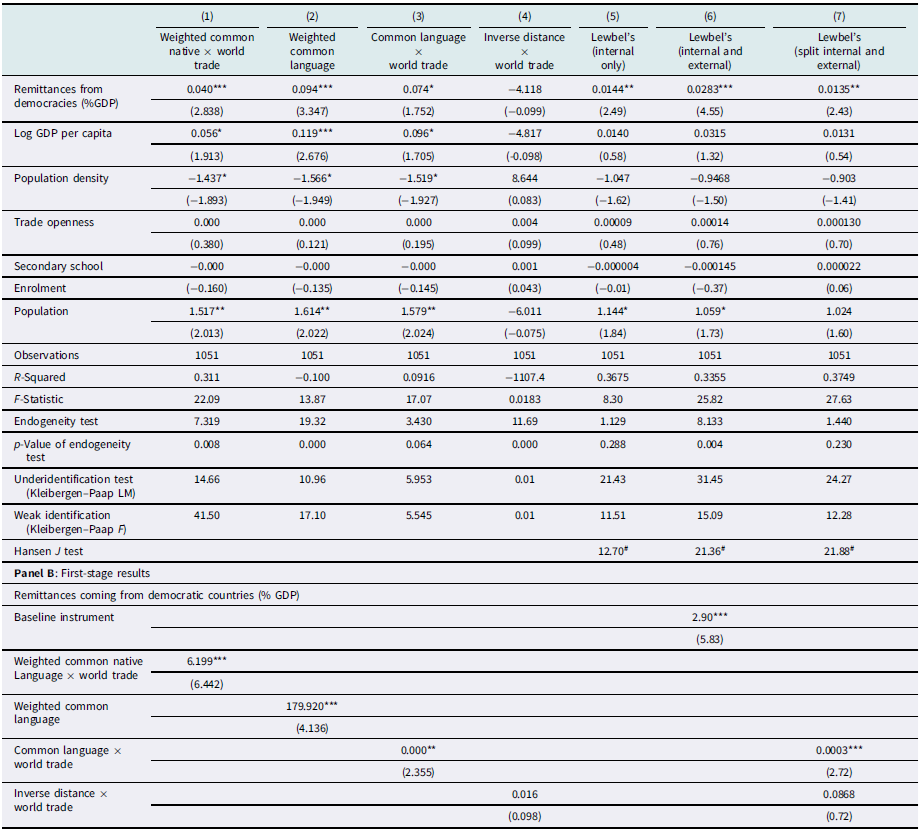
Table 2 examines the robustness of the results to alternative instrument constructions and to instruments generated following Lewbel (Reference Lewbel2012). In column (1), we replace common official language with common native language.Footnote 15 Columns (2) to (4) modify or omit individual elements of the baseline instrument, while columns (5)–(7) report specifications using internally generated Lewbel instruments, either alone or combined with external instruments.
Robustness – alternative instruments

Table 2. Long description
A table with seven columns and eleven rows comparing the robustness of results using alternative instrument constructions and Lewbel instruments. Column headers include Weighted common native x world trade, Weighted common language, Common language x world trade, Inverse distance x world trade, Lewbel’s (internal only), Lewbel’s (internal and external), and Lewbel’s (split internal and external). Row labels include Remittances from democracies (%GDP), Log GDP per capita, Population density, Trade openness, Secondary school enrolment, Population, Observations, R-Squared, F-Statistic, Endogeneity test, and p-Value of endogeneity test. Panel B includes first-stage results for remittances coming from democratic countries (% GDP) with baseline instrument and various weighted common language and world trade measures.
Notes: The Hansen J test examines the null hypothesis that the overidentifying restrictions are valid, meaning that the instruments are jointly uncorrelated with the structural error term. # indicates that the null hypothesis cannot be rejected at the 10% level of statistical significance. Failure to reject the null is consistent with instrument validity but does not constitute proof that the exclusion restrictions hold. See also the notes on Table 1.
In column (2), the instrument we use does not interact with the share of world trade.Footnote 16 The results remain robust, with a slightly larger coefficient than the baseline results, indicating that while world trade adds value, its exclusion does not fundamentally affect the relationship. In column (3), we test the instrument without geographic distance as a weighting factor, and in column (4), we use geographic distance alone without the language similarity proxy. In column (3), the estimated coefficient remains positive but is statistically significant only at the 10% level, while in column (4) it is imprecisely estimated. In both cases, the weak-identification diagnostics indicate that these alternative instruments provide substantially weaker first-stage variation than the baseline instrument. Overall, the results suggest that combining linguistic similarity with inverse geographic distance produces a more informative first stage than relying on either component separately.
In columns (5)–(7), we employ the IV estimator using instruments generated following Lewbel (Reference Lewbel2012). The internal instruments are constructed from the residuals of the auxiliary equation interacted with the mean-centred exogenous variables. Column (5) uses only the internally generated instruments, while the remaining specifications combine them with alternative external instruments. In column (6), the internal instruments are combined with the baseline composite instrument, whereas column (7) combines them with the two separate external components used in columns (3) and (4). The coefficients remain positive and statistically significant across all three specifications. The estimate based only on the internally generated Lewbel instruments is smaller than the estimate obtained when they are combined with the baseline external instrument but remains statistically significant at the 5% level. The Hansen J tests fail to reject the null of jointly valid overidentifying restrictions in columns (5)–(7), with p-values of 0.549, 0.126, and 0.147, respectively. We interpret these results cautiously: non-rejection indicates that the overidentifying restrictions are jointly consistent with the data, but it does not establish the validity of any individual instrument or prove the exclusion restriction.
Migration as an alternative explanation
An important concern is that the estimated effect of remittances from democratic countries may partly reflect the broader effect of migration to democratic destinations. Migrants can influence political institutions in their home countries through the transmission of information, norms, political attitudes, and organisational practices, even when these effects do not operate through remittances. Communication with family members, return visits, political advocacy, and diaspora networks may all affect political outcomes in the origin country.
However, migration stocks and remittance flows capture different aspects of this relationship. Migration stocks measure the number of migrants living abroad relative to the origin-country population, while remittance flows measure the monetary value of transfers and may also proxy the intensity of the continuing links migrants maintain with their home countries. Countries with similar migrant stocks may receive very different amounts of remittances and may also differ in the strength of their diaspora networks and the frequency of their cross-border interactions.Footnote 17
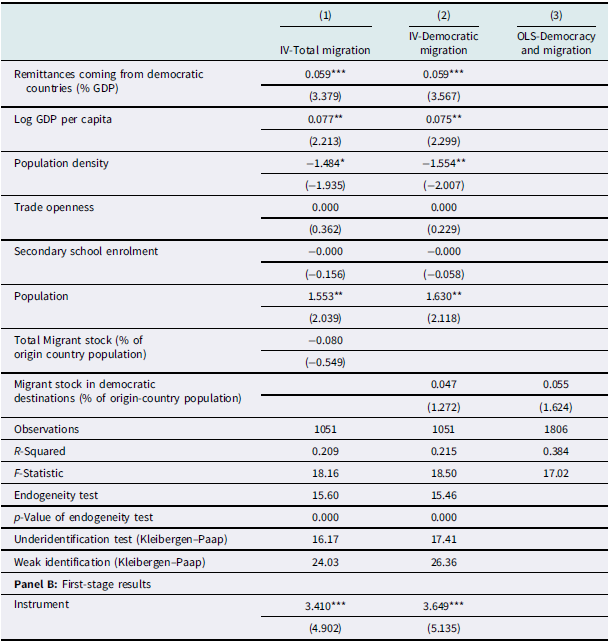
Table 3 presents three exercises examining whether migration accounts for our main result. In columns (1) and (2), we add total migration and migration to democratic countries, respectively, to the baseline IV specification. Total migration is measured as the stock of individuals born in the origin country and residing abroad, expressed as a percentage of the origin country’s population. Migration to democratic destinations is constructed analogously but includes only migrants residing in countries classified as democracies in the corresponding period. Both measures are matched to the same five-year country-period observations and estimation sample used in the baseline specification.Footnote 18
Robustness-migration

Table 3. Long description
A table comparing migration and economic indicators across different specifications. The table has 13 rows and 3 columns. Column headers are IV-Total migration, IV-Democratic migration, and OLS-Democracy and migration. Row labels include Remittances coming from democratic countries (% GDP), Log GDP per capita, Population density, Trade openness, Secondary school enrolment, Population, Total Migrant stock (% of origin country population), Migrant stock in democratic destinations (% of origin-country population), Observations, R-Squared, F-Statistic, Endogeneity test, p-Value of endogeneity test, Underidentification test (Kleibergen–Paap), Weak identification (Kleibergen–Paap), and Instrument. Panel B: First-stage results. Row 1: Remittances coming from democratic countries (% GDP), 0.059***, 0.059***, 0.059***. Row 2: Log GDP per capita, 0.077**, 0.075**, 0.075**. Row 3: Population density, -1.484*, -1.554**, -1.554**. Row 4: Trade openness, 0.000, 0.000, 0.000. Row 5: Secondary school enrolment, -0.000, -0.000, -0.000. Row 6: Population, 1.553**, 1.630**, 1.630**. Row 7: Total Migrant stock (% of origin country population), -0.080, -0.080, -0.080. Row 8: Migrant stock in democratic destinations (% of origin-country population), 0.047, 0.055, 0.055. Row 9: Observations, 1051, 1051, 1806. Row 10: R-Squared, 0.209, 0.215, 0.384. Row 11: F-Statistic, 18.16, 18.50, 17.02. Row 12: Endogeneity test, 15.60, 15.46, 15.46. Row 13: p-Value of endogeneity test, 0.000, 0.000, 0.000. Row 14: Underidentification test (Kleibergen–Paap), 16.17, 17.41, 17.41. Row 15: Weak identification (Kleibergen–Paap), 24.03, 26.36, 26.36. Panel B: First-stage results. Row 1: Instrument, 3.410***, 3.649***, 3.649***.
See the notes on Table 1.
In both specifications, the coefficient on remittances from democratic countries remains equal to 0.059 and statistically significant at the 1% level. Neither migration variable is statistically significant. The coefficient on total migration is negative, while the coefficient on migration to democracies is positive, but both estimates are imprecise. We therefore cannot draw strong conclusions about the independent effect of migration from these regressions.
Column (3) examines the OLS relationship between migration to democratic countries and the V-Dem Polyarchy Index. The estimated coefficient is positive, in line with the migration-and-democracy literature (e.g., Barsbai et al., Reference Barsbai, Rapoport, Steinmayr and Trebesch2017; Docquier et al., Reference Docquier, Lodigiani, Rapoport and Schiff2016; Spilimbergo, Reference Spilimbergo2009), but is not statistically significant. The relatively large standard error does not allow us to conclude that migration has no effect on democratic institutions. What matters for our analysis is that controlling for migration to democratic countries does not reduce the magnitude or statistical significance of the remittance coefficient.
These results should not be interpreted as showing that migration is politically irrelevant or that migration and remittance effects can be completely separated. Rather, they suggest that migrant stocks alone do not account for our main finding. Remittances appear to capture an additional dimension of the relationship between migrants and their home countries: the monetary value and intensity of the continuing cross-border connection through which resources, information, and political ideas may be transmitted. Our results are therefore consistent with remittances operating within a broader migration-related process, while suggesting that the political origin and monetary value of remittance flows contain information beyond migrant stocks alone.
Suggestive evidence on potential channels
This section examines whether remittances from democratic countries are associated with outcomes related to political views and behaviour, as discussed in section ‘Literature review and testable hypothesis’. To provide some suggestive evidence of the underlying mechanisms, we examine the effect of remittances on two sets of outcomes: first, political values and orientations derived from the World Values Survey (Inglehart et al., Reference Inglehart, Haerpfer, Moreno, Welzel, Kizilova, Diez-Medrano, Lagos, Norris, Ponarin and Puranen2022); and second, measures of political behaviour, such as voter turnout, taken from Vanhanen (Reference Vanhanen2019).
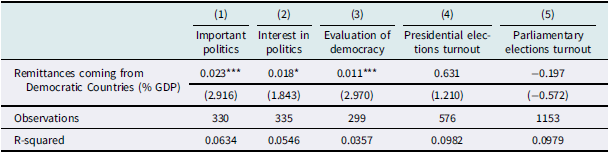
The results are presented in Table 4. Column (1) investigates the relationship between remittances from democratic countries and the country-period average on how important individuals perceive politics to be in their daily lives. Column (2) uses the country-level of political interest, while column (3) focuses on the average evaluation of democracy as a political system. Columns (4) and (5) then examine the relationship between remittances from democracies and voter turnout in presidential and parliamentary elections, respectively.
Mechanisms

Table 4. Long description
The table presents data on the relationship between remittances from democratic countries and various political engagement metrics. It has five columns and five rows, including the header row. The columns are labeled as follows: (1) Important politics, (2) Interest in politics, (3) Evaluation of democracy, (4) Presidential elections turnout, and (5) Parliamentary elections turnout. The row labels are Remittances coming from Democratic Countries (% GDP) and Observations. The values for Remittances coming from Democratic Countries (% GDP) are: 0.023***, 0.018*, 0.011***, 0.631, -0.197. The values in parentheses are: (2.916), (1.843), (2.970), (1.210), (-0.572). The Observations row contains the following values: 330, 335, 299, 576, 1153. The R-squared values are: 0.0634, 0.0546, 0.0357, 0.0982, 0.0979.
See the notes on Table 1.
The estimates provide suggestive evidence for a channel operating through political interest and views about democracy, but not through electoral participation. Remittances from democratic countries are positively associated with the three WVS outcomes, while the coefficients for presidential and parliamentary turnout are not statistically significant. Since the WVS does not identify which respondents receive remittances, these findings should not be interpreted as evidence that remittance-recipient individuals hold more democratic views. Rather, respondents living in country periods with higher remittances from democratic countries report greater political interest and more favourable views of democracy. These results are consistent with one of the mechanisms discussed in section ‘Literature review and testable hypothesis’.
Taken together, the results suggest that remittances from democratic countries are more closely associated with political interest and views about democracy than with immediate electoral participation. This pattern is consistent with the argument that their political effects may first appear in citizens’ views and expectations before translating into observable political behaviour.
Overall, these findings can be interpreted in light of theories of institutional change that emphasise the role of beliefs and information in shaping political behaviour (Greif, Reference Greif1998; North, Reference North1990). In this view, institutions evolve when incentives and beliefs shift, altering the constraints that guide political action. From this perspective, remittances from democratic countries may transmit experiences and information that challenge prevailing norms and affect political preferences in recipient countries, thereby providing a possible link between our empirical findings and broader theories of institutional change.
Conclusions
In this paper, we have examined the impact of remittances on democracy. We find that remittances from democratic countries positively affect domestic political institutions, whereas aggregate remittances have no statistically detectable effect. This distinction may help explain the conflicting evidence in the existing literature.
Our results suggest that, by facilitating financial flows from democratic countries to low-income and low-institutional-quality countries, globalisation may lead to the diffusion of democratic norms and ideas, creating a positive domino effect toward democracy. At the same time, our findings highlight the selective impact of economic integration, with interactions involving democratic countries being particularly valuable for fostering institutional improvements where institutional quality is low. In contrast, interactions with non-democratic countries may not lead to such positive effects. More broadly, our analysis provides a clearer perspective on the conflicting evidence in the literature regarding globalisation’s impact on democracy (see Eichengreen and Leblang Reference Eichengreen and Leblang2008 and Funke and Zhong Reference Funke and Zhong2024). By focusing on the role of remittances, we demonstrate that the source of economic interactions, specifically the nature of the countries involved, matters more than the mere presence of such interactions, offering a new perspective on how globalisation influences democratic development.
Finally, our analysis offers several policy implications. Our findings suggest that governments and international organisations should facilitate remittance flows from democratic countries to strengthen democratic institutions in recipient countries. They can do so by creating legal frameworks for diaspora engagement, strengthening financial inclusion mechanisms that integrate remittance flows into formal banking systems, and supporting community-level governance structures, such as participatory budgeting or local monitoring committees. Furthermore, democratic countries themselves can play an active role in fostering institutional development abroad: migrants who are integrated into their host societies and exposed to democratic norms and practices are more likely to transfer financial resources and democratic values to their home countries. Overall, these arrangements might be highly effective in channelling remittance flows towards institutional improvements by lowering the transaction costs of civic participation and amplifying the accountability effects of remittances.
Acknowledgements
We would like to thank Jeffrey Wooldridge, Thomas Stratmann, Vanessa Boese-Schlosser, Pedro Sant’Anna, Vassilis Sarantides, and the participants of the 8th Political Economy of Democracy and Dictatorship Conference, as well as those at the 2025 AMEF Conference, for their valuable comments and suggestions. We would also like to thank the seminar participants at the Department of Economics, University of Patras, the Department of Economics, University of Ioannina, and the Faculty of Business and Economics, TU Dresden. Finally, we are grateful to the editors and the anonymous reviewers for their constructive feedback.

 Open access

