

Introduction
The study of welfare regimes has been productive since Esping-Andersen’s account of three worlds of welfare capitalism (1990). Successive contributions extended the framework across regions while preserving its architecture. Ferrera (Reference Ferrera1996) identified a Southern European model; Holliday (Reference Holliday2000) identified a productivist East Asian variant; Barrientos (Reference Barrientos, Gough and Wood2004) identified a liberal-informal Latin American type; and Gough and Wood (Reference Gough and Wood2004) developed a broader account of welfare regimes in developing contexts, distinguishing welfare-state regimes from informal-security and insecurity regimes. More recent work has continued in the same direction. Abu Sharkh and Gough (Reference Abu Sharkh and Gough2010) grouped developing countries into regime families through cluster analysis, and Brown and Brik (Reference Brown and Brik2024) proposed a six-type global typology incorporating dimensions of social inclusion. Alongside this body of work, scholars have noted the difficulty of classifying non-OECD systems, identifying hybridisation and indeterminate classification as recurring problems (Caridi-Ross and Mumtaz, Reference Caridi-Ross and Mumtaz2025; Mumtaz and Nakray, Reference Mumtaz and Nakray2025), and Johnson (Reference Johnson2025) has argued that cross-national welfare-state research has reached a theoretical impasse.
This article situates the Middle East and North Africa (MENA) region within that debate, with a twofold aim. The principal contribution is empirical and configurational: the analysis maps how welfare is organised across 21 MENA states and identifies the recurring configurations that structure provision. The secondary and more interpretive contribution is theoretical: the configurations make visible a set of background assumptions that the inherited typology has carried without stating them, and they support an argument that comparative analysis travels more reliably when organised around mechanisms of exclusion rather than around decommodification alone. The stronger claim, that a single region can establish the scope conditions of established theories, is not advanced. Establishing scope conditions in any strict sense would require comparison cases drawn from outside the region, and sub-Saharan African, Central Asian, and South Asian configurations would each introduce additional variation. The MENA evidence is presented as a concentrated analytical setting in which boundary conditions become visible, not as an adjudication of power-resources, path-dependence, or varieties-of-capitalism accounts, whose authors were explicit that their cases were the advanced capitalist democracies (Esping-Andersen Reference Esping-Andersen1990; Korpi and Palme, Reference Korpi and Palme1998). The comparative anchor adopted in the analysis is accordingly not the OECD typology but the developmental welfare-regime tradition of Gough and Wood (Reference Gough and Wood2004), whose distinction among welfare-state, informal-security, and insecurity regimes was constructed for the conditions, namely large informal sectors, contested sovereignty, and ascriptive stratification, that characterise the cases under examination. The canonical OECD framework enters only as the source of the background assumptions whose limits the MENA evidence makes visible.
Two bodies of scholarship inform the analysis. The political economy of the Arab and wider MENA states supplies the substantive conditions under examination. Work on the authoritarian social contract and its restructuring (Heydemann, Reference Heydemann2004; Hinnebusch, Reference Hinnebusch2020), on rentierism and its fiscal logic (Beblawi and Luciani, Reference Beblawi and Luciani1987; Herb, Reference Herb2014), and on the recent turn to social protection and the role of religious welfare in the region (Jawad, Reference Jawad2019; Jawad et al., Reference Jawad, Jones and Messkoub2019; Loewe and Schüring, Reference Loewe, Schüring, Schüring and Loewe2020) frames the six conditions under calibration. The post-colonial critique of social-scientific universalism supplies the theoretical register. Merton (Reference Merton1968) argued that middle-range theory should specify its scope conditions rather than present historically specific patterns as universal laws, and Connell (Reference Connell2007), Bhambra (Reference Bhambra2014), and Go (Reference Go2016) show how frameworks developed in wealthy Northern societies come to function as universal benchmarks. The contribution of this article lies at the intersection of these literatures: MENA configurations are read through regional political economy to specify where the inherited typology applies and what it tends not to capture.
The six conditions draw directly on regional political-economy scholarship. Work on networks of privilege and authoritarian upgrading (Heydemann, Reference Heydemann2004) informs the analysis of authoritarianism and capacity conditions, since the administrative apparatus in much of the region was constructed to manage privileged constituencies rather than to deliver universal provision. The account of a populist social contract and its erosion (Hinnebusch, Reference Hinnebusch2020) underpins the trajectory of the eroded-corporatist configuration, in which the post-independence bargain of public employment and subsidy contracted under adjustment. Analysis of the fragmentation of social protection between formal insurance and informal exclusion (Loewe and Schüring, Reference Loewe, Schüring, Schüring and Loewe2020) grounds the formality mechanism, and the study of religious welfare and the moral economy of provision (Jawad, Reference Jawad2019; Jawad et al., Reference Jawad, Jones and Messkoub2019) grounds the treatment of communal and confessional providers as instances of welfare governance rather than as residual charity. The configurational findings extend this scholarship by specifying the exclusion mechanism that distinguishes each pattern.
The article proceeds as follows. The next section sets out the five background assumptions and the bearing of MENA cases on them, framed as boundary conditions rather than refutations. A definition of welfare for the analysis follows, after which the case universe, data, calibration, and methods are presented, including an account of the limitations of the cross-national indices on which calibration partly rests. The results report the configurational analysis. A subsequent section develops the exclusion-mechanisms argument; a further section considers authoritarianism and welfare provision; and the discussion and conclusion follow.
Defining welfare for a cross-regional analysis
Because the analysis ranges across rentier transfers, contributory insurance, confessional and communal provision, and revolutionary-foundation networks, it requires an explicit and deliberately provider-neutral definition of its object. Welfare is defined as the institutionalised provision of protection against social risk, namely income loss, ill health, old age, incapacity, and a lack of subsistence, irrespective of whether the provider is the central state, a sub-national or communal body, a religious institution, or a hybrid arrangement. Two boundary conditions attach to the definition. Provision must be institutionalised, resting on an articulated entitlement logic and a degree of regularity, however exclusionary that logic may be; purely discretionary or charitable giving falls outside the definition. The provider need not be the state. The provider-neutral definition forms part of the argument, since the implicit equation of welfare with central-state provision renders Gulf rentier distribution, confessional services in Lebanon, and the Iranian bonyad networks invisible or anomalous, and recovering them as instances of welfare governance is what a cross-regional analysis requires. The definition is broad but bounded, and it renders the comparison across institutional forms coherent.
Five background assumptions as boundary conditions
This section identifies five assumptions embedded in canonical welfare-regime scholarship, notes that they are rarely stated because they were rarely violated in the cases from which the theory was built, and shows how MENA configurations bring them into view. The intent is clarificatory rather than polemical, since making the preconditions of a framework explicit specifies its domain of applicability and strengthens it, in the spirit of the injunction by Merton (Reference Merton1968) to bound middle-range theory. The inherited theories are not held to be in error within their domain, nor can a single region fix their limits; the claim is only that MENA renders the boundaries unusually visible. The assumptions are examined as features of the OECD framework rather than adopted as premises of the analysis, which is built instead on the developmental welfare-regime tradition.
The population assumption
The typological apparatus of Esping-Andersen (Reference Esping-Andersen1990, p. 23) is organised around effects on “the citizenry,” used interchangeably with “the population.” In the democracies from which the theory was derived, citizenship and residence overlapped enough that the distinction could be treated as background. The Gulf states render the distinction unavoidable. Citizens constitute a demographic minority in several of them, and the kafala sponsorship system ties residence to employment, producing a non-citizen majority with sharply curtailed entitlements (Gardner, Reference Gardner2011; Khalaf et al., Reference Khalaf, AlShehabi and Hanieh2014). Stateless residents, the Bidoon of Kuwait and the UAE, fall outside both categories that the typology assumes. The analytical point is not that immigrant exclusion is unknown in the OECD; Sainsbury (Reference Sainsbury2012) shows that it strains welfare states in that setting as well. The point is that the relationship is inverted in the Gulf: provision is designed for a politically defined minority, and the demographic majority is excluded by construction. The boundary of the welfare community is therefore a political variable rather than a demographic given, a consideration that returns when the demographic-exclusion condition is reconceptualised below.
In Qatar, citizens comprise roughly 12% of the resident population, in the United Arab Emirates about 13%, and in Kuwait approximately 30% (Hanieh, Reference Hanieh2011). The scale of the resulting entitlement gap is considerable: the Kuwaiti system transferred on the order of 22,000 dollars per citizen in 2014 (Al-Nakib, Reference Al-Nakib2016), with no comparable transfer reaching non-citizens.
The fiscal assumption
Canonical theory presupposes that welfare is financed through taxation or contributory insurance, thereby creating a fiscal contract between the state and the contributing population (Tilly, Reference Tilly1992; Timmons, Reference Timmons2005). In rentier states, the link is attenuated, since a large share of government revenue derives from hydrocarbon extraction rather than domestic taxation. Beblawi and Luciani (Reference Beblawi and Luciani1987) and Herb (Reference Herb2014) argue that the reciprocal relationship between taxation, representation, and welfare that shaped OECD development did not form in the same manner. Provision becomes, in part, an instrument of political management rather than a product of fiscal bargaining (Bayat, Reference Bayat2013), a logic with parallels in non-rentier settings as well (Buğra and Keyder, Reference Buğra and Keyder2006). The fiscal assumption is contingent rather than constitutive.
The sovereignty assumption
Welfare typologies presuppose sovereign states with territorial control and policy autonomy. Palestine is the clearest case in which the presupposition fails. Under occupation, fiscal autonomy is absent, clearance revenues are collected by another state and periodically withheld, and provision depends substantially on external donors and on UNRWA (Roy, Reference Roy2006). The conflict-affected states present a different departure: Yemen, Syria, Libya, and Sudan retain nominal sovereignty that has fragmented across competing authorities (Salisbury, Reference Salisbury2017; Lacher, Reference Lacher2020). Sovereignty is best treated as a scalar rather than a binary concept, with structural-adjustment conditionality representing a milder constraint on autonomy elsewhere.
The stratification assumption
Comparative welfare analysis is organised around class, occupational, or market position as the primary axis of stratification (Esping-Andersen Reference Esping-Andersen1990; Leibfried, Reference Leibfried, Pierson and Castles2002). Several MENA configurations stratify along different axes. Citizenship constitutes the primary boundary in the Gulf. Confessional identity structures access through muhasasa in Lebanon and Iraq (Cammett, Reference Cammett2014; Dodge, Reference Dodge2017). Descent-based caste hierarchy shapes provision in Mauritania (Salem, Reference Salem2013). Sectarian status differentiates citizens in Bahrain (Gengler, Reference Gengler2015). These axes are largely orthogonal to class, since two workers in the same occupational position may face different entitlements depending on their citizenship or sect. The typology is not thereby rendered inapplicable, but a class-organised apparatus will under-describe systems whose primary cleavage is ascriptive.
The trajectory assumption
The canonical narrative is expansionary, with retrenchment treated as the exception requiring explanation (Pierson Reference Pierson1994, Reference Pierson2001). Several MENA republics display the opposite pattern. Egypt is the clearest instance: the social contract of public employment, subsidised consumption, and formal-sector insurance contracted sharply under adjustment, and formal employment fell as a share of the labour force while informality expanded (Assaad and Krafft, Reference Assaad and Krafft2015; ILO, 2024). The result is less a fall in benefit levels than institutional hollowing, in which formal structures persist while their functional reach narrows. Jawad (Reference Jawad2019) and Loewe and Schüring (Reference Loewe, Schüring, Schüring and Loewe2020) document related dynamics across the region. Expansion is contingent on a particular political-economic moment rather than an inevitability.
The canonical narrative of expansion, running from the account of citizenship development by Marshall and Bottomore (Reference Marshall and Bottomore1987) to the power-resources analysis of working-class strength and welfare growth (Korpi and Palme, Reference Korpi and Palme1998), moves in the opposite direction to the MENA republics. In Egypt, public employment fell from roughly 23% of the labour force in 1980 to about 5% by 2015, and informal employment expanded to around 60% (Assaad and Krafft, Reference Assaad and Krafft2015; ILO, 2024).
Case universe, data, and methods
The case universe
The analysis covers Algeria, Bahrain, Egypt, Iran, Iraq, Jordan, Kuwait, Lebanon, Libya, Mauritania, Morocco, Oman, Palestine, Qatar, Saudi Arabia, Sudan, Syria, Tunisia, Turkey, the United Arab Emirates, and Yemen. The grouping rests on substantive grounds: a broadly shared trajectory of twentieth-century state formation, intertwined labour markets and migration systems linking the Gulf to the Levant and North Africa, and a distinct literature on the regional social contract that gives the comparison conceptual coherence (Heydemann, Reference Heydemann2004; Hinnebusch, Reference Hinnebusch2020; Loewe and Schüring, Reference Loewe, Schüring, Schüring and Loewe2020). The three features sometimes used to characterise the region, namely rentier income, conflict exposure, and authoritarian governance, are overlapping rather than independent, and they are treated as conditions analysed within the region rather than as criteria defining its membership. The regional unit is preferred over broader alternatives such as the set of all non-OECD states or the set of all rentier economies. A grouping defined by rentier income would exclude the contributory republics and the conflict-affected states, whose comparison is central to the argument, and a grouping of all non-OECD states would be too heterogeneous in terms of state-formation history to render the boundary conditions legible. The regional unit retains variation across conditions while holding the broad twentieth-century trajectory of state formation approximately constant.
Djibouti is omitted for want of adequate data.
Country reports and the expert protocol
The empirical base consists of structured country reports prepared according to a standard template, reproduced in Supplementary Material A. Each country was assessed through independent reports prepared by two country experts. Every expert held an academic appointment, reported no governmental employment, and declared no political affiliation. Eligibility was restricted to academics with established records in political science, sociology, economics, or cognate social sciences, each with more than 20 years of research experience and publications in leading journals of the field.
The procedure for each country ran as follows. Two experts independently prepared a full report on the same country, working to the reporting template and supplying documentary evidence for substantive claims, including statistical series, legislation, government and agency documents, and peer-reviewed studies. The two reports were collated and compared to identify discrepancies in description or in scoring. Where the reports diverged on a substantive point or on a calibration value, a further country expert of equivalent standing, subject to the same eligibility conditions, conducted an independent peer review of the contested item and assigned the resolving score. The experts associated with any given country remained anonymous to one another throughout, so that adjudication operated on the documentary record rather than on the standing of any contributor. Contributors were compensated for their participation. Calibrated values and configurational assignments were returned to contributors for confirmation against the documentary evidence. An anonymised contributor roster appears in Supplementary Material A.
Conditions, sources, and calibration
Six conditions were calibrated as fuzzy sets ranging from 0 (fully out) to 1 (fully in). The calibration combined cross-national indicators with qualitative anchoring from the country reports, and the analysis is a fuzzy-set study in which case-based qualitative knowledge anchors the cross-national indicators, because the quantitative indicators perform substantial work and their limitations require acknowledgement. RENT captures hydrocarbon rents, anchored in World Bank oil rents as a percentage of GDP (NY.GDP.PETR.RT.ZS, 2015–2020 mean), with a documented upward adjustment for gas-dominated economies whose oil-rent figures understate total hydrocarbon dependence, namely Qatar, the United Arab Emirates, and Bahrain. AUTH is the inverse of the V-Dem Liberal Democracy Index (v2x_libdem, Core v16, 2015–2020 mean), such that higher values denote greater authoritarianism. BISM captures Bismarckian contributory heritage, coded from the country reports. CONF captures conflict and state fragility, combining UCDP battle-related deaths with the Fragile States Index, taking the higher of the two calibrated scores so that either acute violence or severe chronic fragility can register. DEMG is reconceptualised below. CAPC is state capacity, anchored on the World Bank Government Effectiveness percentile rank (2015–2020 mean). Sources and anchors are presented in Table 1, and the full case-by-condition matrix, documenting every value, vintage, and adjustment, appears in Supplementary Material B.
Conditions, data sources, and fuzzy-set calibration anchors

Table 1. Long description
The table consists of three columns and six rows of data.
1. R E N T: Operationalised as Oil rents as percentage of G D P (World Bank N Y dot G D P dot P E T R dot R T dot Z S), 2015 to 2020 mean, with hydrocarbon adjustment for gas economies. Anchors are greater than or equal to 30, 15, and less than or equal to 5.
2. A U T H: Operationalised as 1 minus V-Dem Liberal Democracy Index (v 2 x underscore libdem, Core v 16), 2015 to 2020 mean. Anchors are greater than or equal to 0.90, 0.70, and less than or equal to 0.40.
3. B I S M: Operationalised as Contributory (Bismarckian) heritage, coded from country reports. Anchors are primary, mixed, and absent.
4. C O N F: Operationalised as the higher of U C D P battle-related deaths and Fragile States Index, 2015 to 2020. Anchors are war, significant, and none.
5. D E M G: Operationalised as U N migrant-stock share adjusted for report-based entitlement-gap evidence. Anchors are greater than or equal to 60, 30, and less than or equal to 10.
6. C A P C: Operationalised as W G I Government Effectiveness percentile rank, 2015 to 2020 mean. Anchors are greater than or equal to 70, 50, and less than or equal to 30.
Note: Conditions are calibrated to fuzzy-set membership between 0 and 1. The hydrocarbon adjustment applies to Qatar, the United Arab Emirates, and Bahrain, whose oil-rent figures understate gas-based dependence. The full case-by-condition matrix appears in Supplementary Material B.
Two measurement decisions warrant comment. The demographic-exclusion condition (DEMG) was reconceptualised. The non-citizen share of the resident population measures how internationalised a society is, not the extent to which non-citizens are excluded from entitlements, since non-citizens may, in principle, hold substantial rights. DEMG is therefore treated as a structural-precondition measure: a large non-citizen population is the condition that renders citizenship-based exclusion demographically consequential, not a direct measure of exclusion. The condition is anchored on the United Nations international migrant-stock share and adjusted using report-based evidence of the gap in entitlement between citizens and non-citizens across social insurance, public employment, health, and housing, and the status of stateless populations such as the Bidoon. Where non-citizens demonstrably hold substantial entitlements, the score is reduced; where exclusion approaches the total, as in the Gulf, it is not. The migrant-stock measure counts the foreign-born and therefore understates Gulf exclusion, as it omits non-citizens born in the country; the report-based adjustment mitigates this limitation.
Calibration relies on indices with documented limitations in MENA, and these indices are not treated as ground truth. The expert-coded democracy indices of V-Dem are contested for several authoritarian cases and differ across releases; the Worldwide Governance Indicators are perception-based and volatile, and were re-released on a revised methodology after extraction, so the version and access date are recorded in the replication file; the battle-death thresholds of UCDP capture acute violence but omit chronic low-intensity fragility, which motivates the pairing of UCDP with the Fragile States Index; and oil-rent accounting choices affect the rent measure, which motivates the documented hydrocarbon adjustment. The qualitative anchoring from the country reports compensates for these weaknesses, and the matrix in Supplementary Material B allows inspection of every calibration decision.
The outcome is membership in a functioning welfare regime, a continuous fuzzy set built from four sub-components coded from the reports: institutional coherence, coverage breadth, benefit consistency, and administrative implementation capacity. Per-case outcome scores and sub-components appear in Supplementary Material B, so that the difference between, for instance, Lebanon and Iraq is traceable to documented evidence rather than asserted. A degree of conceptual overlap between the outcome and the CONF and CAPC conditions is acknowledged, since a functioning regime is partly defined through administrative functioning; the interpretation of the conflict configuration below treats this overlap directly rather than presenting the association as a purely empirical discovery.
Analytical strategy
The analysis uses fuzzy-set Qualitative Comparative Analysis (Ragin, Reference Ragin2008; Schneider and Wagemann, Reference Schneider and Wagemann2012). Necessity analysis examines whether any condition or its negation is consistently present across cases displaying the outcome, with consistency reported alongside coverage and explicit attention to trivialness, since a condition that approaches universality across the region can appear necessary without carrying substantive meaning. Sufficiency analysis uses truth-table reduction to identify configurations associated with the outcome and its negation. The configurational method suits the theoretical question because a single condition can operate differently depending on the conditions accompanying it, and configurational analysis makes that context-dependence visible in a way that additive regression does not.
Results
Necessity
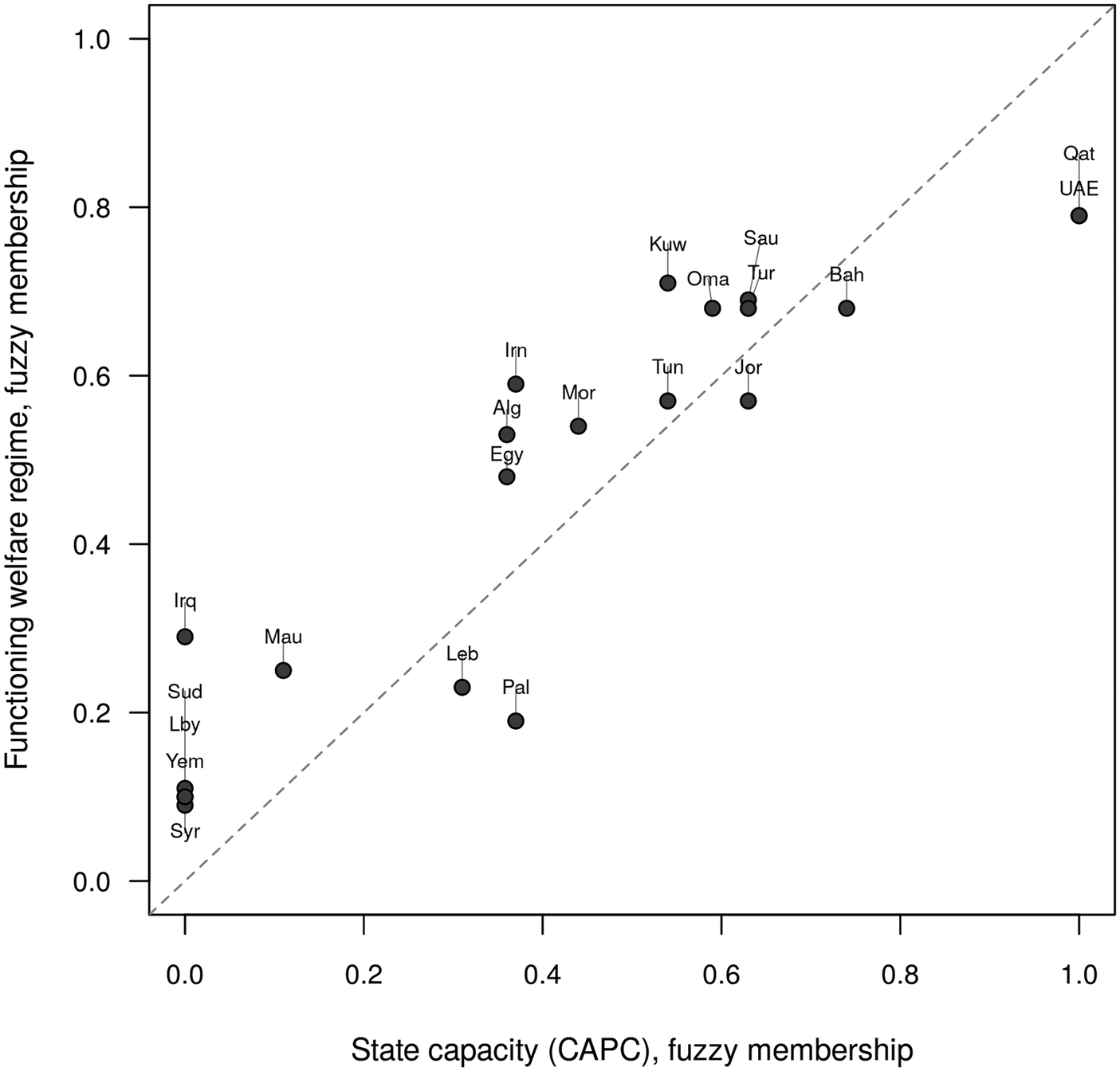
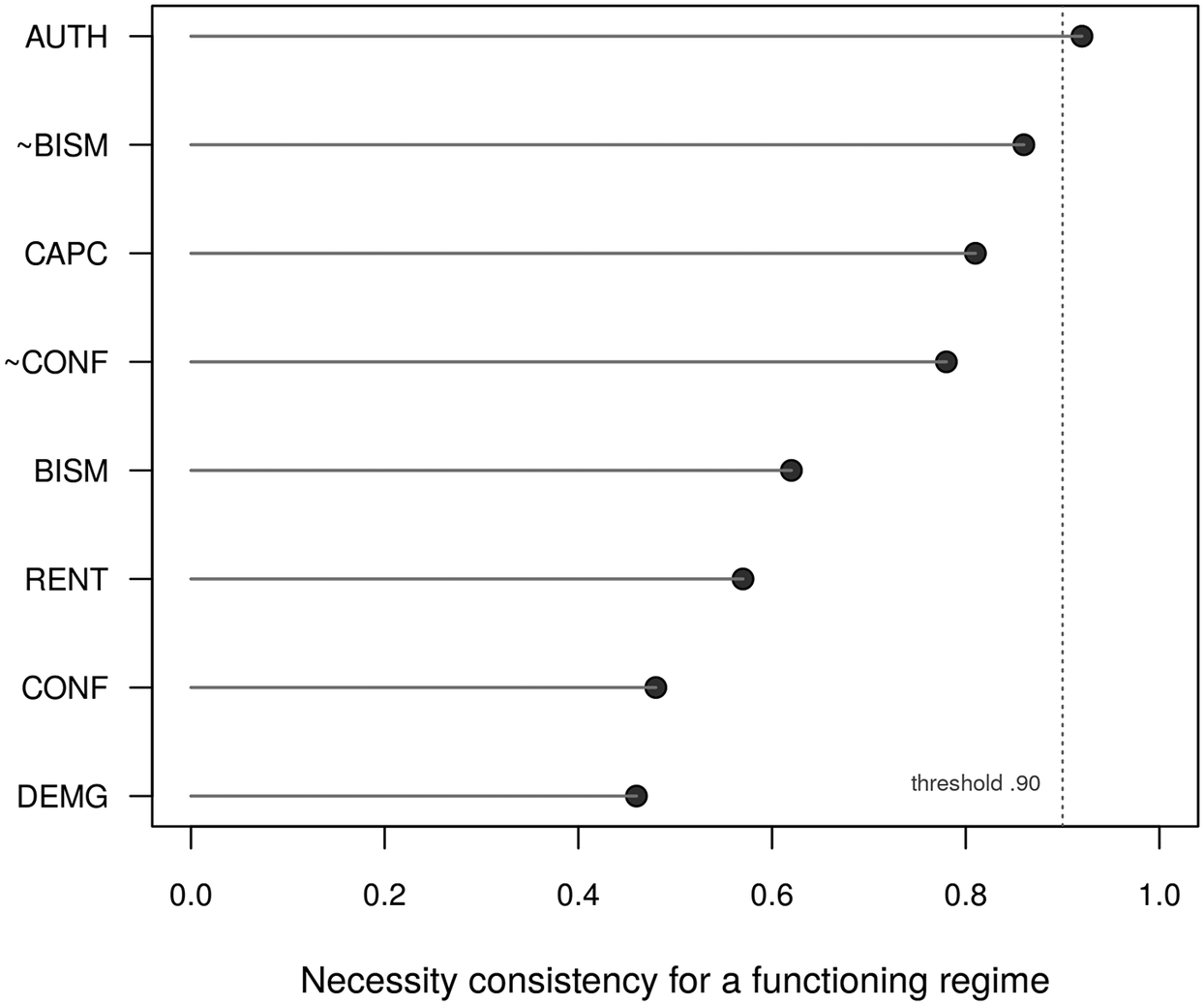
No condition is necessary for a functioning welfare regime in the strong sense once trivialness is taken into account. State capacity (CAPC) records the most substantively meaningful association, with a consistency of 0.81 and a coverage of 0.91, indicating that functioning regimes are largely confined to states with measurable administrative capacity. The absence of large-scale conflict (~CONF) is also associated with functioning, with a consistency of 0.78. Authoritarianism (AUTH) yields a high level of necessity consistency (0.91). However, the result is trivial rather than substantive, because nearly every state in the region scores high on the condition, approaching a constant and appearing necessary for almost any regional outcome. The claim that authoritarianism is required for welfare provision is therefore not advanced; the substantive finding is the centrality of state capacity and the rarity of functioning provision under acute conflict. As shown in Figure 1, the cases lie close to or below the diagonal, as expected for a near-necessary condition. Figure 2 reports necessity consistency across conditions; no condition, except the trivial case of authoritarianism, approaches the conventional necessity threshold. The full necessity table appears in Supplementary Material B.
Necessity of state capacity for a functioning welfare regime. Note: Fuzzy-set membership in state capacity (x-axis) against membership in the functioning outcome (y-axis); n = 21. Consistency = 0.81, coverage = 0.91. Country abbreviations are used. Figure generated in R.

Figure 1. Long description
The x-axis represents State capacity C A P C fuzzy membership, and the y-axis represents Functioning welfare regime fuzzy membership, both scaled from 0.0 to 1.0. A dashed diagonal line extends from the origin 0,0 to the top-right corner 1,1.
Data points are distributed as follows:
* Near the origin (0,0), a vertical cluster includes Syr, Yem, Lby, Sud, and Irq, with state capacity near zero but varying welfare functioning up to 0.3.
* In the lower-middle section, Mau, Leb, and Pal are positioned between 0.1 and 0.4 on the x-axis and below 0.3 on the y-axis.
* A central cluster above the diagonal line includes Egy, Alg, Irn, and Mor, with state capacity between 0.35 and 0.45 and welfare functioning between 0.5 and 0.6.
* In the upper-right quadrant, Tun, Jor, Kuw, Oma, Sau, Tur, and Bah are clustered between 0.5 and 0.8 on the x-axis and 0.55 to 0.75 on the y-axis.
* At the far top-right, U A E and Qat are positioned near 1.0 on the x-axis and 0.8 on the y-axis, notably falling slightly below the diagonal line.
Overall, the majority of countries are located above the diagonal line, indicating that their membership in the functioning welfare outcome is generally higher than their membership in state capacity.
Necessity consistency by condition for a functioning welfare regime. Note: Necessity consistency of each condition and selected negations for the functioning outcome. The dotted line marks the conventional 0.90 threshold. Figure generated in R.

Figure 2. Long description
The X-axis represents Necessity consistency for a functioning regime, ranging from 0.0 to 1.0. A vertical dotted line marks the 0.90 threshold. Eight horizontal lines with terminal dots represent different conditions, listed from top to bottom:
* A U T H is the only condition exceeding the threshold, positioned at approximately 0.92.
* tilde B I S M is just below the threshold at approximately 0.86.
* C A P C is at approximately 0.81.
* tilde C O N F is at approximately 0.78.
* B I S M is at approximately 0.62.
* R E N T is at approximately 0.57.
* C O N F is at approximately 0.48.
* D E M G is the lowest at approximately 0.46.
Sufficiency: configurations of provision
Several configurations describe how provision is organised across the region. A sufficient consistency for the functioning outcome is reported, with a multi-case solution term supporting it (the rentier-citizenship and eroded-corporatist configurations); the single-case and two-case configurations are reported as case descriptions. One parsimonious configuration is associated with non-functioning. The configurations and their member cases are shown in Table 2, and the full solution terms, consistency, and coverage are shown in Supplementary Material B.
Configurations associated with welfare-regime functioning

Table 2. Long description
The table consists of four columns: Configuration, Solution term, Member cases, and Consistency.
* Row 1: Rentier-citizenship. Solution term: R E N T asterisk A U T H asterisk D E M G asterisk tilde C O N F asterisk C A P C asterisk tilde B I S M. Member cases: Qatar, U A E, Kuwait, Saudi Arabia, Bahrain, Oman. Consistency: 0.93.
* Row 2: Eroded-corporatist. Solution term: tilde R E N T asterisk A U T H asterisk B I S M asterisk tilde C O N F. Member cases: Tunisia, Algeria, Morocco, Turkey. Consistency: 0.87.
* Row 3: Theocratic-hybrid. Solution term: R E N T asterisk A U T H asterisk parallel institutions. Member cases: Iran. Consistency: n equals 1.
* Row 4: Confessional-fragmented. Solution term: ascriptive asterisk tilde B I S M asterisk low C A P C. Member cases: Lebanon, Iraq. Consistency: n equals 2.
* Row 5: Monarchical-patronage. Solution term: monarchy asterisk moderate C A P C. Member cases: Jordan. Consistency: n equals 1.
* Row 6: Non-functioning conflict. Solution term: C O N F asterisk tilde C A P C. Member cases: Yemen, Syria, Sudan, Libya, Iraq, Palestine, Egypt. Consistency: 0.88.
Note: Consistency is reported for the multi-case solution terms reproducible from the replication file: the rentier-citizenship and eroded-corporatist paths (functioning outcome) and the conflict path (non-functioning outcome). The single-case and two-case configurations are reported as case descriptions. Egypt shares the eroded-corporatist heritage but falls below the functioning threshold.
The rentier-citizenship configuration (high RENT, high AUTH, large DEMG, absence of conflict, high capacity, absence of Bismarckian heritage) comprises the Gulf monarchies: Qatar, the UAE, Kuwait, Saudi Arabia, Bahrain, and Oman. Rents are converted into a provision for a citizen minority, while the non-citizen majority is excluded by design, with a sufficient consistency of 0.93 for the full rentier path. On the oil-rent indicator alone, Qatar, the UAE, and Bahrain score below the threshold because their wealth is gas-based; the documented hydrocarbon adjustment sustains their membership, and the adjustment is reported transparently in Table 1 and Supplementary Material B rather than left implicit.
The eroded-corporatist configuration (low RENT, high AUTH, Bismarckian heritage, low conflict) comprises the republics with contributory heritage, Tunisia, Algeria, Morocco, and Turkey, at a consistency of 0.87. Egypt shares the contributory heritage of this configuration. However, the erosion of formal-sector provision has carried its functioning score below the membership threshold, and elevated conflict exposure removes it from the parsimonious solution term. Turkey is classified in this configuration on the evidence that contributory social insurance forms the core of provision, organised through a unified general health-insurance scheme. In contrast, social assistance constitutes approximately one tenth of welfare effort and operates on a largely rules-based footing, so that patronage is subordinate rather than defining. The shared welfare logic of the configuration is institutional hollowing, as formal entitlements persist while their reach narrows.
A theocratic-hybrid configuration is represented by Iran alone. With a single member, it constitutes a case description rather than a solution term, and no sufficient consistency is reported for it. The defining feature of the configuration, a revolutionary parallel architecture controlling a substantial share of the non-oil economy (Harris, Reference Harris2017), is shared by no other case, so the configuration cannot be placed on the same evidential footing as the multi-case configurations and is read as indicative rather than as an established type.
A confessional-fragmented configuration comprises Lebanon and Iraq, in which provision is organised through sectarian institutions (muhasasa), Bismarckian heritage is weak to moderate, capacity is low, and conflict is institutionalised rather than wholly anarchic. The confessional-fragmented cases score below the functioning threshold on the outcome and are therefore organised configurations of provision rather than functioning regimes. A monarchical-patronage configuration rests on Jordan as its single primary case, with Morocco and Oman entering in secondary terms; as a configuration resting on a single primary case, it is reported as the least secure and most provisional, and no stable solution consistency is claimed for it.
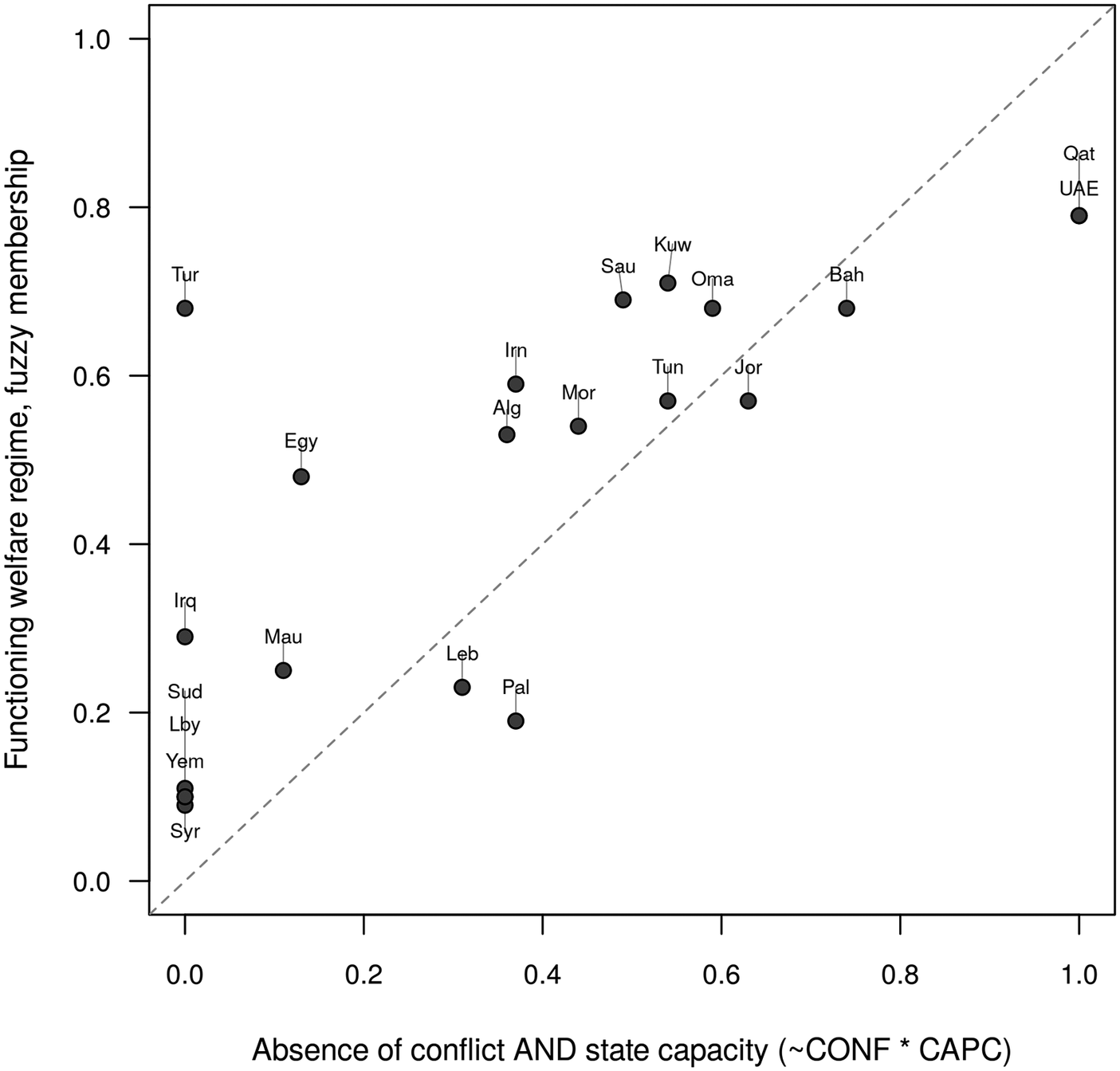
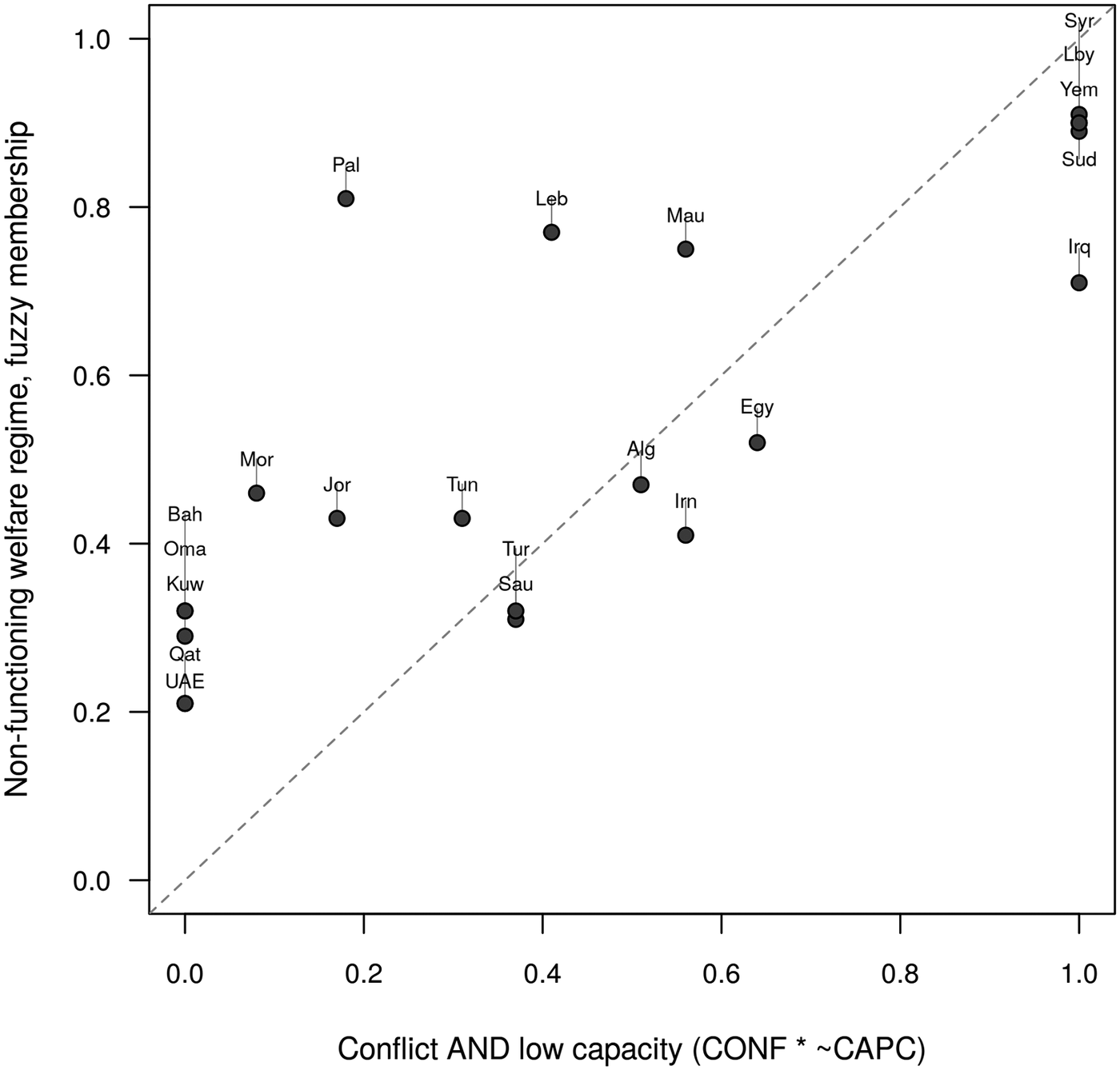
A single parsimonious configuration is associated with non-functioning provision: the conjunction of conflict and low state capacity (CONF ∗ ~CAPC), sufficient for non-functioning at a consistency of 0.88 and a coverage of 0.71. Yemen, Syria, Sudan, Libya, Iraq, and Palestine are the clearest members. The configuration and the asymmetry between it and the multi-condition functioning configurations are interpreted in the next section. As shown in Figure 3, cases consistent with peace and capacity lie on or above the diagonal, a pattern consistent with a sufficient condition; Figure 4 shows the equivalent plot for the conjunction of conflict and low capacity against non-functioning. The truth table and full solution terms appear in Supplementary Material B.
Sufficiency of peace combined with the state’s capacity for functioning. Note: Membership in the conjunction of absence of conflict and state capacity (x-axis) against membership in the functioning outcome (y-axis); n = 21. Consistency = 0.90. Country abbreviations are used. Figure generated in R.

Figure 3. Long description
A scatter plot with an x-axis labeled Absence of conflict AND state capacity (~C O N F * C A P C) and a y-axis labeled Functioning welfare regime, fuzzy membership. Both axes range from 0.0 to 1.0. A dashed diagonal line bisects the plot from the origin (0,0) to the top-right corner (1,1).
Data points representing countries are distributed as follows:
* At x equals 0.0, a vertical cluster includes S y r, Y e m, L b y, S u d, and I r q between y equals 0.1 and 0.3, with T u r higher at y equals 0.68.
* At x equals 0.1, M a u is at y equals 0.25 and E g y is at y equals 0.48.
* Between x equals 0.3 and 0.4, L e b and P a l are below the diagonal line, while A l g and I r n are above it.
* Between x equals 0.4 and 0.6, a dense cluster above the diagonal includes M o r, S a u, T u n, K u w, and O m a.
* Between x equals 0.6 and 0.8, J o r and B a h sit near or on the diagonal line.
* At x equals 1.0, Q a t and U A E are clustered together at y equals 0.8, below the diagonal line.
The majority of the 21 countries are positioned in the upper-left triangle of the plot, indicating high consistency for the sufficiency condition.
Sufficiency of conflict combined with low capacity for non-functioning. Note: Membership in the conjunction of conflict and low capacity (x-axis) against membership in the non-functioning outcome (y-axis); n = 21. Consistency = 0.88. Country abbreviations are used. Figure generated in R.

Figure 4. Long description
The x-axis represents Conflict AND low capacity C O N F asterisk tilde C A P C with values from 0.0 to 1.0. The y-axis represents Non-functioning welfare regime, fuzzy membership with values from 0.0 to 1.0. A dashed diagonal line bisects the plot from the origin 0,0 to the top-right corner 1,1.
Data points are distributed as follows:
* At x-value 0.0, a vertical cluster includes B a h, O m a, K u w, Q a t, and U A E, ranging from y-values 0.2 to 0.4.
* Between x-values 0.1 and 0.2 are M o r, J o r, and P a l, with P a l positioned high at y-value 0.8.
* Near x-value 0.4 are T u n, T u r, S a u, and L e b, with L e b high at y-value 0.78.
* Between x-values 0.5 and 0.7 are A l g, M a u, I r n, and E g y. M a u is high at y-value 0.75, while the others are near the diagonal line.
* At x-value 1.0, a dense vertical cluster includes S y r, L b y, Y e m, and S u d near the top y-value 0.9, with I r q lower at y-value 0.7.
Most points lie above the diagonal line, indicating that the membership in the causal condition is generally less than or equal to the membership in the outcome.
Exclusion mechanisms as an organising principle
Existing typologies classify systems according to what they provide. The central theoretical proposal of this article holds that comparative welfare analysis is often better served through attention to how systems exclude. The mechanism of exclusion is more discriminating than a catalogue of benefits, because two systems offering superficially similar provision may exclude through different mechanisms, and the mechanism reveals more about the underlying political economy than the benefit schedule does. Five mechanisms are identified.
Citizenship exclusion
The citizen-non-citizen boundary is constitutive rather than secondary in the Gulf. Provision is designed for a minority, and the exclusion of the majority is a precondition of fiscal sustainability rather than an incidental restriction (Hanieh, Reference Hanieh2011). The reconceptualised DEMG condition captures this mechanism: not the degree to which a society is internationalised, but the degree to which the citizenship boundary governs entitlement, with stateless populations such as the Bidoon excluded from both sides of it.
Formality exclusion
The operative boundary in the republics is formal against informal employment. Contributory institutions built for a formal labour force exclude the informal majority not through an explicit rule but through design, as the formal sector contracts and informality grows (Assaad and Krafft, Reference Assaad and Krafft2015; Jawad, Reference Jawad2019). The exclusion is a structural mismatch between institutional design and labour-force composition.
Ascriptive exclusion
Where sectarian, ethnic, or caste identity is the primary axis, access is allocated according to ascriptive status: through muhasasa in Lebanon and Iraq (Cammett, Reference Cammett2014; Dodge, Reference Dodge2017), descent-based hierarchy in Mauritania (Salem, Reference Salem2013), intra-citizen sectarian differentiation in Bahrain (Gengler, Reference Gengler2015), and ideological proximity to the revolutionary state in Iran (Harris, Reference Harris2017). A class-organised apparatus renders this mechanism largely invisible.
Sovereignty deprivation
External constraint on provision operates most starkly in Palestine, where occupation, dependence on withheld clearance revenues, and donor conditionality leave little fiscal autonomy (Roy, Reference Roy2006), and more mildly through structural-adjustment conditionality elsewhere (Kaufman and Segura-Ubiergo, Reference Kaufman and Segura-Ubiergo2001). Sovereignty deprivation is scalar.
Institutional disruption
Provisions can be disrupted when institutions cease to function despite formal persistence, as in conflict-affected states. This mechanism underlies the CONF ∗ ~CAPC configuration and requires the most careful qualification, addressed in the following section.
The transition from a functioning to a non-functioning regime corresponds to none of the established mechanisms of institutional change catalogued by Mahoney and Thelen (Reference Mahoney and Thelen2010), namely drift, layering, conversion, and displacement, each of which presupposes institutional continuity. The conflict cases instead exhibit catastrophic destruction, in which the administrative infrastructure on which provision depends is physically dismantled, a mode that has drawn less theoretical attention because the cases from which institutional theory was built did not experience it.
Conflict, collapse, and hybrid provision
The conflict configuration invites three considerations, concerning conceptual overlap, hybrid provision, and the placement of Lebanon. Conceptual overlap is the immediate concern. Because the outcome is partly defined through administrative functioning, and because CONF and CAPC approach that idea, the association between conflict, low capacity, and non-functioning is partly built into the calibration rather than discovered independently of it. The substantive content of the result is therefore framed not as the proposition that conflict destroys welfare, which approaches tautology, but as a configurational asymmetry: a functioning regime requires the conjunction of several conditions, whereas the breakdown of provision is associated with a parsimonious two-condition conjunction. The asymmetry is consistent with accounts of increasing returns and institutional complexity (Pierson, Reference Pierson2000), which hold that complex arrangements are costly to construct and comparatively easy to disrupt.
Hybrid provision qualifies the result. A substantial literature on welfare in fragile states shows that provision does not cease when the central state collapses. Hybrid governance arrangements involving non-state armed actors, faith-based providers, diaspora networks, and international agencies substitute for or supplement collapsed central states (Cammett and MacLean, Reference Cammett and MacLean2014). Several MENA cases display state-welfare collapse with hybrid substitution rather than welfare absence: levies and services administered by Houthi authorities in northern Yemen, provision through confessional institutions in Lebanon, provision through local councils and aid agencies in parts of Syria, and the role of UNRWA as the de facto welfare infrastructure for Palestinian refugees. The non-functioning cases are accordingly understood as cases of central-state collapse with varying degrees of hybrid substitution, and the sufficiency claim is reported at 0.88 rather than at a near-deterministic level.
Lebanon requires separate treatment. Lebanon resembles a case of conflict combined with low capacity, but it is not assigned to the collapse configuration. The battle-death count for Lebanon across the window is very low, at or below 100 at its highest, whereas its Fragile States Index score is high. Fragility in Lebanon is chronic and communalised rather than acute and territorial, and the conflict signal is carried by the fragility index rather than by battle deaths. Lebanon, therefore, belongs with the confessional-fragmented configuration. That the distinction turns on the divergence between two indices is a finding about the indices: reliance on battle deaths alone would render Lebanon peaceful, and reliance on fragility alone would render it comparable to Yemen. The pairing of UCDP with the Fragile States Index and the documentation of the split make the placement defensible. A converse limitation applies to Palestine, which neither indicator captures cleanly, since UCDP records little for the window and the Fragile States Index reports the territory only in a composite entry, so that the placement of Palestine rests on sovereignty deprivation rather than on the conflict indicators.
Authoritarianism and welfare provision
Because authoritarianism approaches universality across the region, regime type cannot serve as the lever that explains welfare outcomes, and the more productive question concerns the form that authoritarian welfare takes under different coalitional and fiscal conditions. Selectorate theory (Bueno de Mesquita et al., Reference Bueno de Mesquita, Smith, Siverson and Morrow2003) offers a framework in which rulers provide goods to the coalition that sustains them. The citizen body functions as a broad coalition in the Gulf relative to the excluded non-citizen majority, and benefits for citizens are correspondingly generous. A narrower military-commercial coalition in Egypt is associated with a provision calibrated to contain mobilisation among the excluded majority (Sayigh, Reference Sayigh2021). The bonyad networks of Iran deliver to ideologically defined constituencies alongside a thinner general system (Harris, Reference Harris2017). Coalition structure and fiscal instruments, rather than regime type as such, shape what is provided, a reading consistent with findings outside the region that authoritarian and welfare arrangements coexist in varied ways (Albertus and Menaldo, Reference Albertus and Menaldo2018). The account is interpretive rather than a tested causal claim.
A fourfold typology of authoritarian welfare follows from the coalitional reading. Distributive authoritarianism, found in the Gulf, supplies broad provision to the citizen coalition that sustains the regime. Consolidating authoritarianism, found in Egypt, supplies minimal provision calibrated to contain mobilisation among the excluded majority. Extractive authoritarianism, expressed in the Iranian parallel system, supplies provision to selected constituencies while extracting rents from others. Ideological authoritarianism, expressed in the Iranian state system, allocates provision according to ideological proximity. These patterns are read as expressions of an authoritarian logic applied to welfare rather than as deviations from a single authoritarian norm.
Discussion
The five mechanisms are not specific to MENA, since each operates elsewhere, from citizenship exclusion in high-migration economies to formality exclusion across Latin America and sub-Saharan Africa, ascriptive exclusion in deeply divided societies, sovereignty deprivation under occupation or conditionality, and institutional disruption in fragile states across regions. The region offers a setting in which mechanisms are concentrated and co-present across a wide range of development, rendering the boundary conditions of the inherited typology visible. The strength of the resulting claim warrants caution. A single region cannot establish the scope conditions of comparative welfare theory; it can demonstrate that such conditions exist and that they bind. Other regions would add further configurations, sub-Saharan African and Central Asian systems prominent among them, and this acknowledgement is stated once and treated as a limit on the claims rather than as an extension of them.
The analytical value of the region lies partly in its range. The cases span the full development spectrum, from a GDP per capita of about 1,929 dollars in Yemen to about 112,283 dollars in Qatar, so that the assumptions are violated across the entire income range rather than at one end of it. Citizenship exclusion, to take one mechanism, operates wherever migration produces excluded populations, from high-migration economies such as Singapore, where roughly a quarter of residents are non-citizens outside the social-insurance system, to OECD states facing pressure over immigrant access (Sainsbury, Reference Sainsbury2012). The prior question that the Gulf configurations force into view, in the terms of Walzer (Reference Walzer1983), concerns who is admitted to the welfare community at all, rather than how generous provision is for those already inside it.
Read against the regional political economy literature, the configurational findings are continuous with established work rather than a departure from it. The eroded-corporatist configuration corresponds closely to what Gough and Wood (Reference Gough and Wood2004) treat as informal-security regimes, in which large parts of the labour force were never commodified, and decommodification becomes the wrong yardstick; the conflict-affected cases approach the insecurity-regime category of the same framework; and the rentier configuration extends the rentier-state tradition (Beblawi and Luciani, Reference Beblawi and Luciani1987; Herb, Reference Herb2014) into the welfare domain. The Gough and Wood framework is accurately characterised as a tripartite distinction among welfare-state, informal-security, and insecurity regimes, not as a claim that most MENA states occupy any single one of these. The contribution of the analysis lies in specifying the exclusion mechanisms that define each configuration and in connecting these mechanisms to a single organising principle.
That principle constitutes the central proposal of the article: that comparative welfare analysis gains from organising itself around exclusion. Decommodification measures generosity for those already inside a system and remains silent about those never admitted. An exclusion-centred analysis asks who is excluded and through which mechanism, and in doing so connects welfare scholarship to migration studies (Walzer, Reference Walzer1983), labour economics, the comparative politics of divided societies (Lijphart, Reference Lijphart1977; Horowitz, Reference Horowitz1985), international relations, and state-formation theory (Tilly, Reference Tilly1992). The reorientation is advanced as productive rather than as a wholesale replacement of existing categories, since decommodification remains informative within the domain where the population, fiscal, sovereignty, stratification, and trajectory assumptions hold.
The five assumptions are not errors of reasoning but features of the context in which the theory was produced: wealthy democracies with formal labour markets, settled sovereignty, and largely class-organised politics. Making the assumptions explicit specifies the domain of the theory rather than discrediting it, in the sense intended by Merton (Reference Merton1968) in the distinction between bounded middle-range theory and grand theory.
Conclusions
Drawing on 21 MENA states and a configurational analysis, the article offers a regional account of how welfare is organised and uses that account to make visible the boundary conditions of the inherited typology and to argue for an exclusion-centred reorientation of comparative welfare analysis. The configurational results identify rentier-citizenship, eroded-corporatist, monarchical-patronage, confessional-fragmented, and conflict-disrupted patterns, with state capacity the condition most strongly and non-trivially associated with functioning provision and the conjunction of conflict and low capacity associated with its breakdown, framed as a configurational asymmetry rather than an invariant law, and qualified through recognition of the hybrid arrangements that provide where central states have collapsed. The five exclusion mechanisms, namely citizenship, formality, ascriptive identity, sovereignty deprivation, and institutional disruption, operate well beyond the region but have been obscured by the OECD-centred foundations of the inherited framework.
For the many people excluded from social protection according to where they were born, the kind of work they perform, the community to which they belong, whether their state is sovereign, or whether its institutions still function, the salient question is not which typological category their country occupies, but what would shift the boundary of inclusion. An analysis organised around exclusion mechanisms and a specification of the conditions under which the inherited categories apply constitutes a step towards a comparative social policy adequate to that question.
Supplementary material
The supplementary material for this article can be found at http://doi.org/10.1017/ics.2026.10107.




 Open access

