


1. Introduction
Legitimacy indicates both normative claims about the rightful exercise of authority as well as a set of “belief[s] that existing political institutions are the most appropriate or proper ones for the society” (Lipset Reference Lipset1959, p. 86).Footnote 1 Proposed foundations for normative theories of legitimacy range widely – including, inter alia, the divine right of kings (Figgis Reference Figgis1922), social contracts (Locke Reference Locke1961), and institutions’ fulfillment of certain ethical obligations to their constituents (Rawls Reference Rawls1971). Positive theories of behavioral legitimacy are also varied, connecting expressions of support for institutions’ authority to political values commitments (Caldeira and Gibson Reference Caldeira and Gibson1992), adherence to procedural regularities or norms (Tyler Reference Tyler1990; Tyler and Rasinski Reference Tyler and Rasinski1991), status conferred by respected actors (Scott Reference Scott1995), or the delivery of preferred policy outcomes (for example, Bartels and Johnston Reference Bartels and Johnston2020).
Positive theories of individuals’ sense of institutions’ legitimacy are especially well developed in relation to the Supreme Court of the United States. Scholars – led by James Gibson, Gregory Caldeira, and their collaborators – have elaborated Easton’s (Reference Easton1965) concept of “diffuse support” into a broader paradigm concerning Americans’ abiding commitments to the Supreme Court (e.g., Gibson Reference Gibson1989; Caldeira and Gibson Reference Caldeira and Gibson1992; Gibson, Caldeira, and Baird Reference Gibson, Caldeira and Baird1998; Gibson, Caldeira, and Spence Reference Gibson, Caldeira and Spence2003a,b; Gibson and Nelson Reference Gibson and Nelson2014; Nelson and Gibson Reference Nelson and Gibson2019; Gibson Reference Gibson2024a). Their work develops a comprehensive theoretical perspective addressing Americans’ acceptance of the Supreme Court’s authority. Within this conventional legitimacy theory, diffuse support and legitimacy are understood to be equivalent terms, reflecting a durable institutional loyalty that is not easily undermined by a single disfavored decision or isolated information about the Court or its members (Gibson and Nelson Reference Gibson and Nelson2014).
Over the last decade or so, a growing body of research has interrogated that canonical perspective, presenting evidence that expressions of Supreme Court legitimacy may be affected by disfavored decisions (Bartels and Johnston Reference Bartels and Johnston2013; Christenson and Glick Reference Christenson and Glick2015; Boston and Krewson Reference Boston and Krewson2024), irregular procedures (Smart Reference Smart2024; Davis Reference Davis2025), judicial reasoning (Farganis Reference Farganis2012; Bonneau et al. Reference Bonneau, Kelly, Pronin, Redman and Zarit2017), external criticisms (Clark and Kastellec Reference Clark and Kastellec2015; Armaly Reference Armaly2016, Reference Armaly2018; Nelson and Gibson Reference Nelson and Gibson2019), the composition of the Court (Carrington and French Reference Carrington and French2021; Rogowski and Stone Reference Rogowski and Stone2021), and other factors. Yet these studies themselves are rarely in direct conversation with one another, separately indicating legitimacy is malleable in a range of contexts but typically without acknowledging the cumulative evidence they offer about the stability of legitimacy attitudes or their implications for theories of institutional loyalty to the Supreme Court more broadly.
Here, we draw out connections among this emerging set of heterodox studies and sketch the contours of an alternative legitimacy framework they support. We also conduct a systematic review of published experimental studies of influences on diffuse support for the U.S. Supreme Court, identifying and synthesizing results from 55 experiments drawn from 39 articles (every experimental study addressing Americans’ views of the Supreme Court’s legitimacy published in 13 prominent political science journals from the time each journal began online indexing to April 2025). Each of the included experiments (including 25 published since 2022) involves a one-shot, low-dose treatment; that is, the introduction or manipulation of a single, brief text sharing information related to the Supreme Court or its decisions in a stand-alone experimental setting with no over-time amplification or reinforcement (Gaines, Kuklinski, and Quirk Reference Gaines, Kuklinski and Quirk2007; Barabas and Jerit Reference Barabas and Jerit2010).Footnote 2 Conventional and alternative perspectives on Supreme Court legitimacy support crisply different expectations for these kinds of experiments – conventional wisdom suggests stability, while the developing alternative predicts change.
We find that the body of experimental evidence weighs against the conventional view. While some experiments report null effects consistent with stable, enduring legitimacy, a large preponderance of reviewed studies find significant treatment effects – typically conditional on subjects’ partisan, ideological, or affective orientations. Specifically, across the 55 experiments we review, roughly 85% find that a single dose of ordinary political information significantly shifts expressed legitimacy, whether on its own or in interaction with subjects’ political orientations. These results indicate that the Supreme Court’s legitimacy, as conventionally measured in political science, is less than enduring and is vulnerable to disruption from ordinary political stimuli. Conventional theories of judicial legitimacy alone cannot explain the range and frequency of significant causal effects these low-dose treatments produce.
These findings have important implications for politics and political science. Most broadly, they show that the political foundations of judicial independence in the United States are shakier than many accounts of American constitutional politics and political development suggest. Our summary of experimental studies also suggests a preferred reading of observational data showing stability in Americans’ expressions of legitimacy attitudes (e.g., Nelson and Tucker Reference Nelson and Tucker2021). Historically steady levels of diffuse support for the Supreme Court are best understood as evidence that aggregate legitimacy attitudes were unmoved for some time in the survey record, not that the distribution of legitimacy sentiment was ever unmovable. Lastly, our work illustrates the merit of periodic systematic evaluations of cumulative empirical evidence in a maturing scientific enterprise. The literature on judicial legitimacy is well into its fourth decade and remains active. Yet taken seriatim, these disparate investigations leave us without a firm sense of the aggregate evidence they have produced or their collective significance for theory.
2. Legitimacy as an antecedent to judicial authority
Though the problems of obedience to authority and institutional integrity are universal, they have a special resonance in American judicial politics. Federal judges in the United States are appointed, not elected, and federal courts have no authority to make law nor power to enforce their decisions. Nevertheless, federal courts’ warrant to decide cases arising under the nation’s laws and Constitution has evolved into the wide-ranging practice of judicial review – a practice encompassing authority to invalidate laws enacted by Congress and state legislatures judged to violate the Constitution (e.g., Kramer Reference Kramer2004; Friedman Reference Friedman2009).
A political implication of the “countermajoritarian difficulty” is the persistent threat that Congress and the president will undermine independent judicial authority or ignore disfavored judicial decisions (Bickel Reference Bickel1986, pp. 16–18). However, a number of political scientists and other scholars argue that Americans’ abiding loyalty to the Supreme Court is a protective barrier against court curbingFootnote 3 and noncompliance. Vanberg (Reference Vanberg2001), for example, explains judicial legitimacy constrains elected legislatures and executives “to respect judicial decisions as well as the institutional integrity of a court [by t]he fear of
$ \dots $
 a public backlash” against court-curbing activity or evading judicial decisions (p. 347; see also Segal and Spaeth Reference Segal and Spaeth2002; Rogers and Ura Reference Rogers and Ura2020). These arguments echo Justice Frankfurter’s famous pronouncement: “[t]he Court’s authority – possessed of neither the purse nor the sword – ultimately rests on sustained public confidence in its moral sanction” (Baker v. Carr 1962).
3. Diffuse support and conventional legitimacy theory
Theories of externally induced congressional and presidential respect for the judiciary’s institutional integrity naturally suggest questions about how public sentiment bolsters the authority of the courts in general and the Supreme Court in particular. Easton’s (Reference Easton1965) concept of “diffuse support” is foundational to a comprehensive, canonical view of institutional legitimacy – individuals’ loyalty to an institution and opposition to changing it or evading its authority – that is understood to play this part in the politics of judicial independence (see, e.g., Caldeira and Gibson Reference Caldeira and Gibson1992; Gibson and Caldeira Reference Gibson and Caldeira2009a; Gibson and Nelson Reference Gibson and Nelson2014, Reference Gibson and Nelson2015). Components of this conventional legitimacy theory (CLT) include: institutional legitimacy and diffuse support are equivalent; they reflect enduring loyalties to an institution, its authority, and its form; legitimacy is a latent attitude observable in survey responses indicating resistance to reductions in an institution’s power or independence; Americans’ sense of courts’ legitimacy develops in early political socialization and is connected to core values commitments; and, therefore, diffuse support is stable over time and unlikely to be disturbed by individual, disagreeable institutional outputs or contextual changes. Below, we briefly elaborate each of these aspects of CLT.
3.1. The meaning and measuring of judicial legitimacy
Building on the work of Lipset (Reference Lipset1959) and others, Easton defines diffuse support as a “reservoir of … goodwill that helps members [of a community] to accept or tolerate [policy] outputs to which they are opposed” (1965, p. 273; see also Tyler Reference Tyler1990). Gibson, Caldeira, and Spence (Reference Gibson, Caldeira and Spence2003a) cast diffuse support as a kind of “loyalty,” and specifically equate it with the notion of “legitimacy” (see also Caldeira and Gibson Reference Caldeira and Gibson1992; Gibson Reference Gibson2024a). In the context of American judicial politics, Gibson and Caldeira (Reference Gibson and Caldeira2009a) further explain that “legitimacy” is a belief that the Supreme Court is “worthy of … respect, deference, and obedience” (p. 142).
This understanding of legitimacy as diffuse support developed hand in glove with approaches to measuring Americans’ attachments to the Supreme Court (Bartels Reference Bartels and Rudolph2022). In a foundational paper, Caldeira and Gibson (Reference Caldeira and Gibson1992) write, “[t]o capture the enduring components of the public’s evaluations of the Court, we need to pose respondents with tough questions about their willingness to accept, make, or countenance major changes in the fundamental attributes of how the high bench functions” (p. 638). They propose a five-item index probing subjects’ willingness to accept limits on the Supreme Court’s power or to “do away with the Court altogether.”
A decade later, Gibson, Caldeira, and Spence (Reference Gibson, Caldeira and Spence2003a) more explicitly link diffuse support with legitimacy and suggest a six-item support measure, combining court-curbing items with questions about trust and procedural propriety.
-
1. If the Supreme Court continually makes decisions that the people disagree with, it might be better to do away with the Court altogether.
-
2. The right of the Supreme Court to decide certain types of controversial issues should be reduced.
-
3. The U.S. Supreme Court should have the right to say what the Constitution means, even when the majority of the people disagree with the Court’s decision.
-
4. The Supreme Court can usually be trusted to make decisions that are right for the country as a whole.
-
5. The decisions of the U.S. Supreme Court favor some groups more than others.
-
6. The U.S. Supreme Court gets too mixed up in politics.
This approach to operationalizing legitimacy has since been widely applied in studies of diffuse support for the Supreme Court (e.g., Bartels and Johnston Reference Bartels and Johnston2013; Armaly Reference Armaly2016; Nelson and Gibson Reference Nelson and Gibson2019; Montgomery and Rogol Reference Montgomery and Rogol2023; Giallouri and Menounou Reference Giallouri and Menounou2024; Smart Reference Smart2024).
3.2. Socialization and stability
Within CLT, loyalty to the Supreme Court is understood to be a stable, individual commitment that is largely resilient against disagreements with individual decisions (e.g., Gibson Reference Gibson1991; Mondak Reference Mondak1993; Gibson, Caldeira, and Baird Reference Gibson, Caldeira and Baird1998; Baird Reference Baird2001; Gibson and Nelson Reference Gibson and Nelson2014). Perhaps the most well-known evidence for this perspective is from Gibson, Caldeira, and Spence’s (Reference Gibson, Caldeira and Spence2003b) account of Americans’ expressions of Supreme Court legitimacy before and after Bush v. Gore (2000). That study evaluated whether the Court’s intervention in Florida’s 2000 presidential election recount, handing victory to George W. Bush by a 5–4, party-line vote, damaged Americans’ sense of its legitimacy. In a matched pair of national surveys, they find either consistent or increasing levels of diffuse support for the Court from 1995 (predecision) to 2001 (postdecision). Gibson, Caldeira, and Spence write, “from these data it is impossible to conclude that loyalty towards the Supreme Court plummeted after the presidential election of 2000” (Reference Gibson, Caldeira and Spence2003b, p. 545).
Further supporting this view, Gibson and Caldeira (Reference Gibson and Caldeira1992) find evidence that Black Americans born shortly before the Warren Court’s major civil rights decisions reliably expressed higher levels of diffuse support for the Supreme Court than Blacks born in earlier or later periods. This pattern, they argue, indicates that early learning about the Supreme Court and its decisions establishes a baseline orientation toward judicial legitimacy that can be dislodged later only under the weight of substantial contradictory evidence, if at all. Gibson and Caldeira’s (Reference Gibson and Caldeira2009b) finding that individuals’ knowledge of the Supreme Court is significantly associated with their expressed loyalty to the Supreme Court likewise suggests that political socialization anchors Americans’ diffuse support for the Supreme Court (see also Pedraza and Ura Reference Pedraza and Ura2021). More recently, Nelson and Tucker’s (Reference Nelson and Tucker2021) four-year panel study, carried out from 2012 to 2016, finds substantial stability in individual-level diffuse support for the Supreme Court, consistent with CLT.
4. Challenges to the conventional legitimacy theory and an alternative legitimacy framework
Scholars, especially recently, have found space to interrogate elements of CLT, despite its firm theoretical and empirical foundations. One prominent heterodox view is that diffuse support for the Supreme Court is grounded in approval of its decisions – what Easton (Reference Easton1965) called “specific support”: “favorable attitudes” toward an institution that follow from perceptions that its “outputs … meet their demands” (p. 273).Footnote 4 Bartels and Johnston (Reference Bartels and Johnston2013) show that subjective ideological disagreement with the Supreme Court’s decision-making is associated with diminished expressions of Supreme Court legitimacy in survey data and that disagreement with a single, salient decision reduces diffuse support for the Supreme Court in a survey experiment (but see Gibson and Nelson Reference Gibson and Nelson2015). Likewise, Christenson and Glick (Reference Christenson and Glick2015) find that individual-level agreement or disagreement with the Supreme Court’s 2012 decision upholding core provisions of the Affordable Care Act is associated with greater and lesser diffuse support for the Court, respectively, among those who are informed about the case (see also Christenson and Glick Reference Christenson and Glick2019). Recent research on mass political responses to Dobbs v. Jackson Women’s Health Organization (2022) offers fresh, observational evidence that a single disagreeable decision of sufficient salience can significantly reduce diffuse support for the Supreme Court (Gibson Reference Gibson2024a; Levendusky et al. Reference Levendusky, Patterson, Margolis, Pasek, Winneg and Jamieson2024; Gibson Reference Gibson2025). Boston and Krewson’s (Reference Boston and Krewson2024) recent 11-year panel study specifically elaborates a theory of performance-based legitimacy and finds evidence of ongoing, dynamic connections between diffuse support and specific support (see also Malhotra and Jessee Reference Malhotra and Jessee2014; Badas Reference Badas2019; Davis and Hitt Reference Davis and HittForthcoming).
In addition to arguments for legitimacy grounded in performance approval, scholars have proposed a variety of other factors that may also influence judicial legitimacy. Some of these address how exposure to information about procedural, legal, and political factors in Supreme Court decision-making might bear on expressions of institutional loyalty (e.g., Mondak Reference Mondak1990, Reference Mondak1991, Reference Mondak1994; Farganis Reference Farganis2012; Bonneau et al. Reference Bonneau, Kelly, Pronin, Redman and Zarit2017). Others theorize that exposure to symbols representing courts’ procedural fairness (Gibson, Lodge, and Woodson Reference Gibson, Lodge and Woodson2014), politicians’ criticisms of the Court (Armaly Reference Armaly2016, Reference Armaly2018; Nelson and Gibson Reference Nelson and Gibson2019), interest groups’ actions surrounding judicial nominations (Gibson and Caldeira Reference Gibson and Caldeira2009a; Krewson Reference Krewson2023), or other factors may increase or reduce expressed judicial legitimacy. The preponderance of these studies focus on claims about particular faults or vulnerabilities in diffuse support for the Supreme Court – essentially arguing for various exceptions or limitations to a rule of stable diffuse support.
Together, though, they suggest that Americans’ loyalty to the Supreme Court is elastic in a range of political outcomes and information that does not easily square with CLT. This incongruity appears all the more sharp considering that many findings of flexible diffuse support involve experimental research designs delivering one-shot treatments containing information about the Court, its decisions, or its surroundings. These often show that individuals’ sense of the Court’s legitimacy can be manipulated in the short term by relatively modest stimuli. Indeed, the variety of influences on expressions of judicial legitimacy begins to suggest an emerging alternative to CLT rather than so many anomalies – a forest, not just trees.
This pattern is not entirely new to observers of the Court. Writing over a decade ago, Clark and Kastellec (Reference Clark and Kastellec2015, pp. 525–526) described a “revisionist” account of judicial legitimacy taking shape, in which support for the Court “appears to be conditioned on the political context in which such issues are framed” rather than drawn from an enduring reservoir of goodwill. In the intervening years, numerous scholars have continued to study a growing range and variety of factors appearing to influence expressions of judicial legitimacy – pointing to a wider reconsideration of Americans’ sense of their Supreme Court’s legitimacy.
The architecture of this emerging alternative legitimacy framework (ALF) remains diffuse, but some of its basic structural elements have become evident: legitimacy attitudes may be somewhat sticky, but they are more like other kinds of institutional evaluations than like an enduring identity or values commitment; they can be reshaped in the near term by policy disagreements, partisan cues, and symbolic associations; these factors may have greater or lesser effects depending on the context in which they are encountered. The extent to which this perspective adds to an improved understanding of legitimacy attitudes beyond CLT depends, of course, on the empirical question of whether the cumulative evidence on factors that shape (or do not shape) legitimacy attitudes is consistent with CLT.
5. CLT v. ALF: Common ground and disputed territory
CLT and ALF are not wholly at odds with one another. There is substantial overlap in the two perspectives’ sense of public sentiment protecting the judiciary from court curbing and other political interference (e.g., Clark Reference Clark2009; Friedman Reference Friedman2009; Ura and Wohlfarth Reference Ura and Wohlfarth2010). Likewise, the canonical account of measuring judicial legitimacy acknowledges there is meaningful shared variance in individuals’ responses to survey questions thought to indicate specific support and those indicating diffuse support (Gibson, Caldeira, and Spence Reference Gibson, Caldeira and Spence2003a). Further, there has recently been some acknowledgment among advocates of conventional legitimacy theories that tectonic legal-political events, such as the Supreme Court’s decision in Dobbs v. Jackson Women’s Health Organization (2022), may drive changes in Supreme Court legitimacy (Gibson Reference Gibson2024a). Together, these findings suggest the possibility that specific support and diffuse support may be reciprocally connected.
The broader study of political behavior offers evidence that attitudes can be connected to both ordinary politics and lasting identities and values-like commitments. Layman and Carsey (Reference Layman and Carsey2002), for example, find that some individuals adjusted their partisanship to match their views on abortion when the issue was sufficiently salient for them. To complicate matters, though, there is evidence that connections among values commitments, ideology, and partisanship have changed over time, becoming strong in recent decades (Lupton, Smallpage, and Enders Reference Lupton, Smallpage and Enders2020). Returning to attitudes about the judiciary in particular, Haglin et al. (Reference Haglin, Jordan, Merrill and Ura2021) show that ideologically charged values commitments moderate the translation of subjective ideological disagreement with Supreme Court decision-making and Supreme Court approval. Together, these suggest there may be room for a both/and approach to CLT and ALF that is sensitive to macro-level changes in political context and shifts in the correspondence between values commitments and contemporary political questions.
However, CLT and ALF diverge on at least one key point – whether expressed judicial legitimacy can be significantly altered in the short run by small doses of ordinary political information. Within CLT, diffuse support for the Supreme Court is a deeply rooted commitment, reliably observable in a standard measurement framework. A single ordinarily disagreeable decision, bit of negative commentary, or piece of unflattering information significantly affecting an individual’s sense of the Supreme Court’s legitimacy is something akin to a single disagreeable policy stance causing an established partisan to change his or her party identification in the Michigan model of voting (Campbell et al. Reference Campbell, Converse, Miller and Stokes1960) – a BB gun rocking a battleship. In contrast, within ALF, low doses of information can relatively easily alter the ways that people respond to survey questions meant to reveal diffuse support for the Supreme Court – a BB gun knocking over a soda can. These competing perspectives suggest a question: Does expressed judicial legitimacy respond to “ordinary” political information and cues – individual bits of information that are reasonably indicative of typically encountered political news and commentary?
Of course, no single empirical test could dispositively answer this, or any, broad theoretical question. Fortunately, as we discussed above, judicial legitimacy has been a focus of much empirical research, addressing questions about a range of potential influences on expressed judicial legitimacy and utilizing a variety of research designs. These studies include a number of experimental studies utilizing treatments amounting to a single dose of information, argument, or context bearing on the Court and, therefore, offer an opportunity to evaluate the competing predictions of CLT and ALF. Individually, the bulk of these experiments address focused theoretical questions; for example: Is diffuse support for the Supreme Court undermined by criticism from a national political figure (Armaly Reference Armaly2016, Reference Armaly2018; Nelson and Gibson Reference Nelson and Gibson2019) or by the Court using its “shadow docket” procedures (Smart Reference Smart2024; Davis Reference Davis2025)? While the results of any individual experiment bear on the broader problem of the roots and structure of judicial legitimacy, none alone support particularly broad conclusions. Collectively, though, existing judicial legitimacy experiments may support an assessment of the viability of ALF against CLT. Here, we implement that strategy, carrying out a systematic review of experimental studies of influences on diffuse support for the U.S. Supreme Court to determine the balance of existing evidence for and against stability in judicial legitimacy.
6. A systematic review of published legitimacy experiments
A systematic review is a formalized method for comprehensively summarizing research on a particular topic by synthesizing results from discrete studies meeting specific “inclusion criteria” while avoiding those with explicit “exclusion criteria” (Aromataris and Pearson Reference Aromataris and Pearson2014; Dacombe Reference Dacombe2018). Like a quantitative meta-analysis, systematic reviews integrate results from a defined set or sample of studies into an overall judgment about the cumulative weight of evidence on particular questions. Unlike a quantitative meta-analysis, though, systematic reviews focus on studies’ substantive conclusions rather than specific quantities of interest in statistical models. Systematic reviews are most useful for summarizing scholarship in which variance in research designs, estimation, reporting, measurement, or other factors makes integration of quantitative results difficult to implement, and they are widely used in health sciences (e.g. Biessels, Jan, Staekenborg, Brunner, Brayne, and Scheltens Reference Biessels, Staekenborg, Brunner, Brayne and Scheltens2006); Hall et al. Reference Hall, Johnson, Watt, Tsipa and O’Connor2016; Ludvigsson Reference Ludvigsson2020), education (e.g. Bowers, Kirby, and Deacon Reference Bowers, Kirby and Deacon2010; Donnelly and Patrinos Reference Donnelly and Patrinos2022; Welsh and Little Reference Welsh and Little2018), and other fields (Littell, Corcoran, and Pillai Reference Littell, Corcoran and Pillai2008). Additional details about the systematic review process and the workflow undertaken in this study are reported in the Supplemental Materials.
6.1. Experimental focus
Our first inclusion criterion is an experimental research design. We focus on projects involving experimental designs for two related reasons. First, experimental treatments are typically a single vignette or contrived news article offered to subjects with little or no further contextual information. Also, in contrast to observational studies, controlled experiments support clear causal inferences about influences on judicial legitimacy.
6.2. Identifying candidate studies
To assemble a preliminary corpus of studies, we identified published research articles available on the Web of Science database that included the term “Supreme Court” plus any of the following additional search terms: legitimacy, diffuse support, specific support, approval (in its various stem forms), confidence, trust, feeling thermometer, court curbing, acquiescence, or acceptance. We conducted supplementary searches in 19 English-language, peer-reviewed political science journals, including the American Journal of Political Science, American Political Science Review, American Politics Research, Journal of Law and Courts, and Journal of Politics. These article scans were conducted on April 11, 2025.Footnote 5
Removing duplicates, these searches returned 295 articles, which we sorted according to various inclusion and exclusion criteria. In addition to limiting our analysis to peer-reviewed studies published in English-language journals, our inclusion criteria required a study to employ a randomized experiment using U.S. Supreme Court legitimacy, a cognate concept (like diffuse support), or a concept commonly included among index-based measures of judicial legitimacy (e.g., support for restricting the Supreme Court’s jurisdiction) as a dependent variable. Of the initial corpus, 190 did not report results from a randomized experiment. A further 18 did not address legitimacy (or a close cousin) as a dependent variable; 14 addressed attitudes about a U.S. court other than the Supreme Court, 9 addressed attitudes about courts outside the United States, and 7 did not randomly assign their treatment conditions or employed quasi-experimental designs, leaving 57 articles containing studies for possible inclusion.
Each of the remaining 57 articles was assigned to two coders to identify individual experimental tests. For each study, each coder completed a form every time they identified a unique experiment–dependent variable combination (i.e., a treatment was applied and its effect on some attitude toward the Court was assessed). For example, if a study estimated the effect of a single treatment on both diffuse support for the Supreme Court and acquiescence to a specific decision, each coder could have identified two treatment–dependent variable pairs. This type of setup was common in the retained studies. Likewise, we reviewed some studies that applied the same treatment and measured the same dependent variable among multiple independent samples. In these cases, each implementation of the experiment was also counted as a unique treatment–dependent variable pair. We identified 126 possible experiment–dependent variable pairs from the 57 published articles.
A different pair of coders then reviewed these 126 identified experiment–dependent variable pairs, this time focusing on whether the dependent variable met criteria for inclusion or exclusion. Our inclusion criteria were intended to accept studies that measured legitimacy, diffuse support, or other attitudes or sentiments related to “opposition to basic structural and functional change in the institution” or a “basic commitment to support the institution” (Caldeira and Gibson Reference Caldeira and Gibson1992, p. 639). These include “broadly targeted court curbing” (Bartels and Johnston Reference Bartels and Johnston2020) and “applied court curbing” (Badas Reference Badas2019). We also included studies addressing sentiment about “narrowly targeted court curbing,” which are proposals to “minimize the consequences of a small number of decisions – perhaps only one” (Bartels and Johnston Reference Bartels and Johnston2020, p. 53), so long as the concept was operationalized through questions dealing with institutional efforts to overturn or abrogate Supreme Court decisions or limit the Court’s relevant jurisdiction. (In our analysis, we sort studies according to dependent variable types to determine whether experimental results vary across various measurement approaches.) Though by definition more limited than broad court-curbing measures, questions about narrow court-curbing measures probe attitudes about judicial independence and the Supreme Court’s place in the separation-of-powers system that amount to important changes in its ability to decide cases (see, for example, Clark Reference Clark2009, Reference Clark2011, on court-curbing bills in Congress as signals of the Supreme Court’s flagging public standing). Each of these dependent variables adjudicates between the predictions of CLT and ALF.
Our measurement-focused exclusion criteria set aside experiment–dependent variable pairs that addressed personal policy attitudes (i.e., “do you like the decision”) or individual actions or intentions, as opposed to institutional actions or reforms. We therefore excluded studies with dependent variables addressing subjects’ acceptance of or agreement with specific decisions or their policy implications as well as those involving indicators of specific support, such as “approval.” We also excluded studies that focus on summary affective evaluations of an institution, such as those interrogating confidence or trust or making use of feeling thermometers or indicators of subjective closeness.
With these criteria in mind, each experiment–dependent variable pair was independently double-coded.Footnote 6 All instances of intercoder disagreement were resolved by the en banc panel of the author team. Of the 126 experiment–dependent variable pairs, 55, drawn from 39 articles, met inclusion criteria and avoided exclusion criteria.Footnote 7
6.3 Measures of “legitimacy” and cognate dependent variables
With the experiment–dependent variable pairs identified, we used an inductive, open-coding process to classify the various measures of legitimacy and its cognate concepts into three categories.Footnote 8
-
1. Standard diffuse support. The first is conventional measures of diffuse support styled on Gibson, Caldeira, and Spence’s (Reference Gibson, Caldeira and Spence2003a) approach. These were multi-item indices including a mix of questions probing support for court curbing, e.g., “The right of the Supreme Court to decide certain types of controversial issues should be reduced,” plus at least one other aspect of generalized attitudes about the Supreme Court. These additional aspects might include overall trust, e.g., “The Supreme Court can usually be trusted to make decisions that are right for the country as a whole,” or “procedural propriety,” e.g., “The U.S. Supreme Court gets too mixed up in politics” (Bartels and Johnston Reference Bartels and Johnston2020, p. 51). This category includes nearly half (27, 49%) of the 55 retained experiment–dependent variable pairs.
-
2. Broad court curbing. The second includes measures of legitimacy that are multi-item batteries or individual questions probing support for changing institutional features of the Supreme Court or reducing its overall political power or efficacy – broad court-curbing sentiment (Bartels and Johnston Reference Bartels and Johnston2020). “Justices on the U.S. Supreme Court who consistently make decisions at odds with what a majority of the people want should be removed from their position as judge” is an item of this type.Footnote 9 We also included measures of support for candidates and officeholders (approval, vote intention) who advocate court-curbing measures. Nine (16%) of the 55 retained experiments fell into this category.
-
3. Narrow court curbing. The final category includes multi-item batteries or individual questions probing support for actions designed to overturn one or a small set of Supreme Court decisions rather than alter the structure of the Court as an institution – narrow court-curbing sentiment. These include supporting noncompliance with a Supreme Court decision by the president or other actors (including the “government” or states), passing legislation or a constitutional amendment to abrogate a Supreme Court decision’s effects, or stripping the Court’s jurisdiction over a specific issue area or defined set of cases. We also include here measures of support for candidates and officeholders (approval, vote intention) who advocate for narrow court-curbing measures. Questions that posed a choice between accepting “the” decision – i.e., the result of a specific case – and seeking its reversal through some institutional mechanism were also included in this category if the object of the reversal efforts was clear from the context of the experiment’s design.Footnote 10
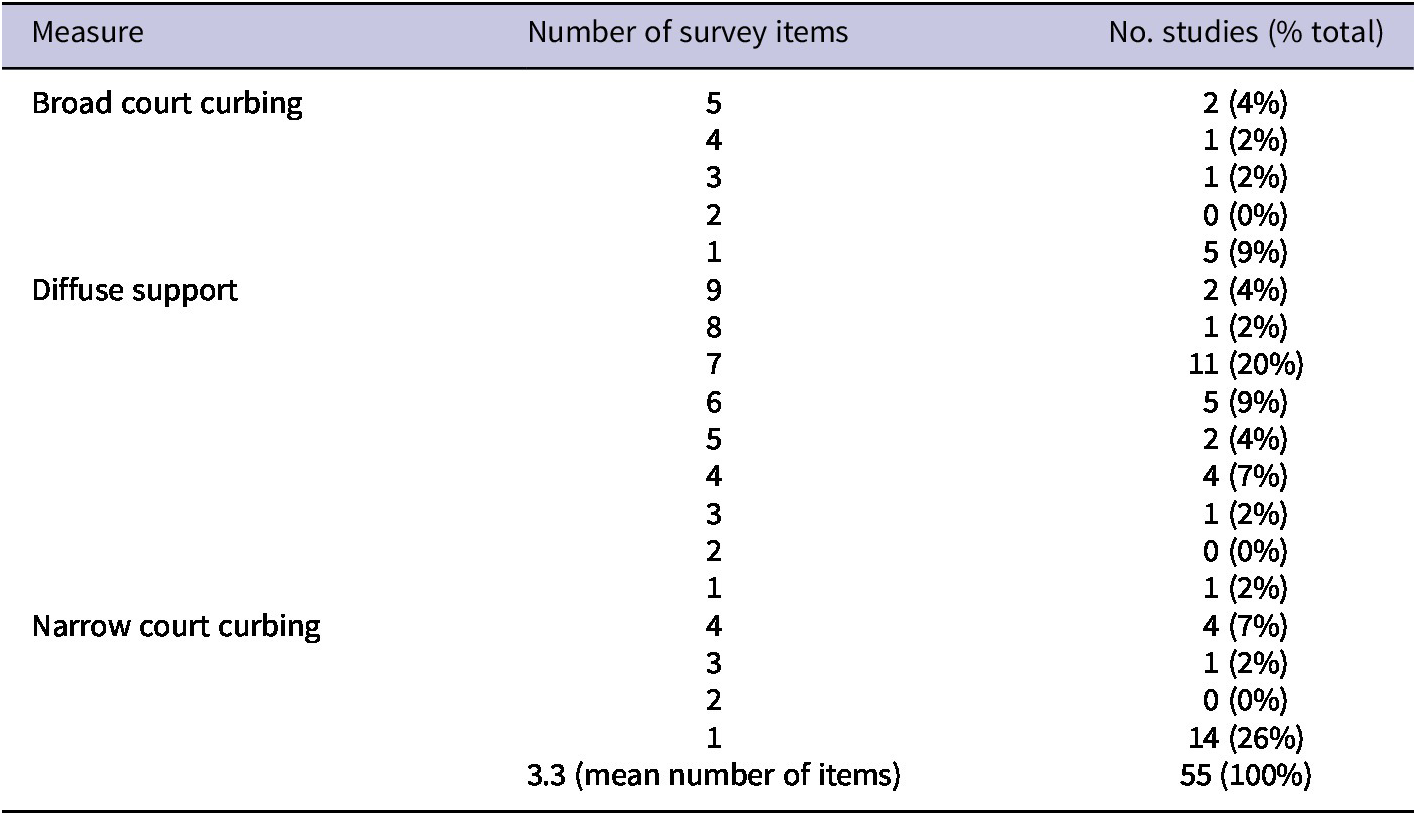
Table 1 summarizes the dependent variables addressed by the retained experiments and the measurement strategies they employ.
Distribution of Dependent Variable Measures

Table 1. Long description
The table consists of three columns: Measure, Number of survey items, and No. studies (percent total).
* Broad court curbing:
- 5 items: 2 studies (4 percent)
- 4 items: 1 study (2 percent)
- 3 items: 1 study (2 percent)
- 2 items: 0 studies (0 percent)
- 1 item: 5 studies (9 percent)
* Diffuse support:
- 9 items: 2 studies (4 percent)
- 8 items: 1 study (2 percent)
- 7 items: 11 studies (20 percent)
- 6 items: 5 studies (9 percent)
- 5 items: 2 studies (4 percent)
- 4 items: 4 studies (7 percent)
- 3 items: 1 study (2 percent)
- 2 items: 0 studies (0 percent)
- 1 item: 1 study (2 percent)
* Narrow court curbing:
- 4 items: 4 studies (7 percent)
- 3 items: 1 study (2 percent)
- 2 items: 0 studies (0 percent)
- 1 item: 14 studies (26 percent)
* Totals:
- Mean number of items: 3.3
- Total studies: 55 (100 percent)
6.4. Treatment doses and types
We next turn to categorizing the primary treatment for each experiment–dependent variable pair.Footnote 11 Again, all of the experiments we identified delivered their experimental manipulations as a one-shot, text-based treatment, i.e., a written vignette or contrived news article. Applying an inductive, open-coding process, we identified four thematic categories of primary experimental treatments, categorizing experiment–dependent variable pairs by their primary treatment. These were:
-
1. Specific support, decision agreement or disagreement. These are treatments related to agreement with particular Supreme Court decisions, partisan or ideological alignment between respondents and the Court, evaluations of the substance of the Court’s outputs or their policy or distributional implications, or general approval of the Court or its membership. This set includes, for example, treatments involving specific case outcomes (e.g., Bartels and Johnston Reference Bartels and Johnston2013) as well as subjects’ identification with groups benefiting from Supreme Court decisions (Zilis Reference Zilis2022). This set includes 13 experiments (24%).
-
2. Cues, frames, or context. This category represents treatments that provide an external perspective on the Court, such as criticism by politicians or experts, media frames used to report decisions or other Court business, or information or ideas about the political, social, or economic context surrounding the Court or its decisions. A few examples of this set include treatments representing criticisms of the Court attributed to political leaders (e.g., Armaly Reference Armaly2018), symbols accompanying news about Supreme Court decisions (Gibson, Lodge, and Woodson Reference Gibson, Lodge and Woodson2014), and representations of overall levels of Supreme Court support (Montgomery and Rogol Reference Montgomery and Rogol2023). This set includes 18 experiments (33%).
-
3. External political influences. These include treatments related to outside influences on judicial decisions, such as the executive branch, interest groups, or other amici. This category also includes illicit influences, such as bribery or personal persuasion by friends or supporters. For example, some vignettes investigate the causal effects of a candidate for executive office threatening court curbing (Driscoll and Nelson Reference Driscoll and Nelson2023), while others determine the effects on legitimacy if prospective, politicized justices were to take the bench (Armaly and Lane Reference Armaly and Lane2023). This category includes 6 experiments (11%).
-
4. Internal methods, motives, processes, or reasoning. These treatments include information or perspectives about the internal mechanisms, processes, methods of reasoning, decision-making, and collegial influence that occur within the Court to reach decisions, including justices’ legal philosophies. This category includes broad manipulations related to the fairness of the Court’s procedures. It also includes treatments regarding the composition of the Court related to justices’ jurisprudential approach, professional qualifications, or aspects of their personal background related to their reasoning. Davis’s (Reference Davis2025) shadow docket experiment and Farganis’s (Reference Farganis2012) experiment comparing reactions to legal, political, and religious bases for decisions are typical of this category. This set includes 18 experiments (33% of the total).
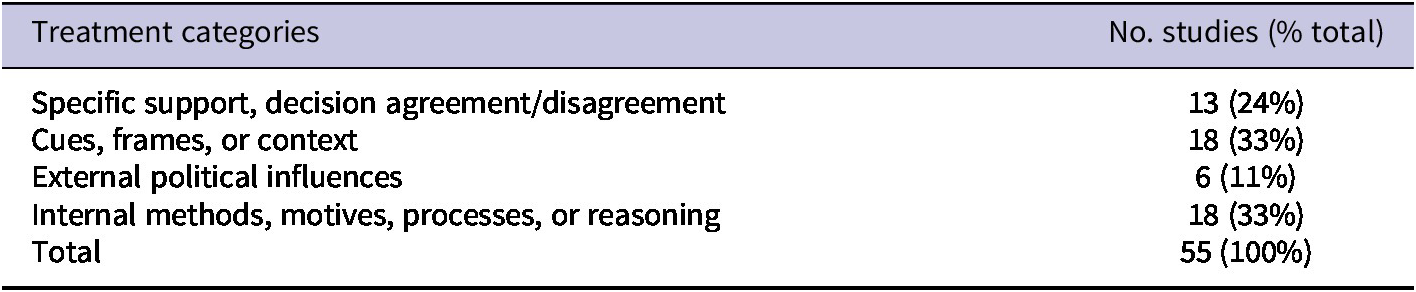
Each treatment was categorized into one of these four types using the same double-coding procedure described above.Footnote 12 Table 2 shows counts of experiments by treatment type.
Distribution of Treatment Types

Table 2. Long description
The table consists of two columns: Treatment categories and No. studies (percent total).
* Specific support, decision agreement/disagreement: 13 (24 percent)
* Cues, frames, or context: 18 (33 percent)
* External political influences: 6 (11 percent)
* Internal methods, motives, processes, or reasoning: 18 (33 percent)
* Total: 55 (100 percent)
6.4.1. Moderators and control groups
A number of the retained studies involve designs in which the principal independent variable is operationalized essentially as an interaction term between subjects’ responses to a pretreatment question and their exposure (or not) to the treatment. Rogowski and Stone’s (Reference Rogowski and Stone2021) study is indicative of this approach. Their study randomizes exposure to commentary attributed to President Trump and imputes subjects’ co- or out-partisanship with him based on responses to a pretreatment question. The study’s key test is an assessment of the (randomized) treatment effect conditional on the (observed) partisan alignment with the source of the polarizing remarks. Other studies implement similar approaches, using ex ante policy preferences interacted with exposure to a treatment sharing details about a Supreme Court decision to construct an indicator of subjects’ alignment with a Supreme Court decision described in a randomized treatment (e.g., Bonneau et al. Reference Bonneau, Kelly, Pronin, Redman and Zarit2017; Armaly Reference Armaly2021).
Additionally, fewer than half of the retained experiments (45%) include a formal control group; rather, all subjects received some substantive treatment on their primary experimental factor. For example, Farganis (Reference Farganis2012) implements a
$ 3\times 1 $
 factorial experiment that provides subjects with a vignette ascribing various types of reasoning to a Supreme Court decision: legal principles, popular sentiment, and religious principles. The study’s analysis hinges on a comparison among the treatment effects, with the legal principles treatment used as a baseline for comparison. However, none of the subjects were excused from reading a vignette at all or asked to read material unrelated to the Court as a strict control.
6.5. Classifying experimental outcomes
All of the retained experiments were analyzed in quantitative frameworks using common estimation techniques (e.g., ordinary least squares), and all authors reported conclusions based on standard, frequentist inferential conventions. We extracted and coded authors’ reported inferences about the statistical significance of primary treatment effects into three categories: No, Yes (Unconditional), and Yes (Conditional). Experiments coded No produced no convincing evidence of a primary treatment effect on legitimacy – null results in which the principal treatment had no significant effect on expressed legitimacy. Experiments coded Yes (Unconditional) produced consistent evidence of a significant treatment effect with no interaction or moderation required to detect it. Experiments coded Yes (Conditional) produced significant treatment effects conditional on a moderating variable, supporting an inference that the conditional treatment effect represented a substantively significant influence on expressed legitimacy. By and large, studies in this final Yes (Conditional) category revealed treatment effects significant for respondents with more extreme partisan, ideological, or affective orientations toward the treatment stimulus (e.g., the source of a criticism of the Court or the ideological direction of a decision) (see, for example, Bonneau et al. Reference Bonneau, Kelly, Pronin, Redman and Zarit2017; Armaly Reference Armaly2021; Rogowski and Stone Reference Rogowski and Stone2021). Our supplementary material reports the code we assigned to each experiment–dependent variable pair along with its included measure of legitimacy, treatment type, and other study details.
7. Results
We consider first the cumulative weight of the results of the 55 experiment–dependent variable pairs included in this study. Next, we parse these results by treatment type and dependent variable measure, to determine whether inferences about the robustness of Americans’ expressions of the Supreme Court’s legitimacy are related to either the type of stimulus applied to experimental subjects or how attitudes about the Court were measured. Finally, we consider whether there has been change over time in the distribution of legitimacy experiment results, comparing the conclusions of studies based on data collected in 2021 or earlier with those based on more recent evidence.
The 55 experiments we reviewed include evidence for both CLT and ALF. However, the greater weight of reported results shows that expressions of legitimacy are elastic in the kinds of ordinary political information represented by the studies’ treatments, especially among Americans with more intense partisan, ideological, or affective political orientations. This general pattern holds for various approaches to measuring judicial legitimacy and over time. However, there was some variance in studies’ results associated with treatment type. Experimental manipulations focused on “cues, frames, or context” or “external political influences” return the clearest evidence for malleable judicial legitimacy; treatments addressing the Court’s decisions or decision-making processes return more mixed results. On balance, though, the studies together provide more support for ALF than for CLT and, in particular, point toward salient political identities or established feelings about political objects as effective catalysts for changing legitimacy sentiment.
7.1. Overall evaluation and synthesis
As a starting point, we consider evidence for CLT. A sizable fraction of the reviewed experiments find no significant change in expressed legitimacy from their randomly assigned treatments (Table 3). Authors report no significant treatment effect from 8 out of 55 experiment–dependent variable pairs (14.5%), results broadly consistent with CLT. Equating the 14.5% frequency of No results with something like a
$ p $
 -value, the cumulative weight of published experiments tends to support an inference of “failing to reject the null hypothesis” that one-shot, low-dose experiments have no effect on subjects’ expressions of Supreme Court legitimacy. Seen from this perspective, the evidence reported from the pool of experiments we analyze tilts toward a conventional perspective on Supreme Court legitimacy, unmoved by isolated bits of information about the Court or its decisions, members, and practices.
Distribution of Results

Table 3. Long description
The table consists of two columns: Results and Number of studies (percent total).
* Row 1: No: generally insignificant; 8 (15 percent).
* Row 2: Yes (Unconditional): significant unmoderated treatment effects; 8 (15 percent).
* Row 3: Yes (Conditional): significant moderated treatment effects; 39 (70 percent).
* Row 4: Total; 55 (100 percent).
However, CLT does not just imply a broad null hypothesis against treatment effects on legitimacy attitudes; it supports an affirmative argument for negligible effects from the kinds and doses of information delivered in the included studies’ experimental treatments (see, e.g., Rainey Reference Rainey2014). In other words, conventional wisdom about Americans’ loyalty to the Supreme Court argues for low doses of information about the Court to have little or no effect on individuals’ expressed sense of its legitimacy. From that perspective, the evidence for ALF is at least as strong as the evidence for CLT.
Indeed, the same number of studies report significant, unmoderated treatment effects on an expression of Supreme Court legitimacy (8, 14.5%) as report no significant treatment effect. These findings support the view that Americans’ sense of the Supreme Court’s legitimacy is malleable under even pedestrian political stresses. The case for ALF, however, is bolstered by the large majority of results falling into the Yes (Conditional) category. Results indicating a significant treatment effect moderated by some other variable were, by far, the most common outcome type among the 55 experiment–dependent variable combinations we analyzed (39, 70.1%). Moderators featured in these studies typically concern partisan identity, ideological or issue orientation, and affective alignment with the source of the experimental stimulus. Results in the Yes (Conditional) category predominantly reflect treatment effects that are significant for respondents with more extreme partisan, ideological, or issue orientations toward the stimulating element in the treatment condition – such as the partisanship of a Supreme Court critic or the ideological direction of a decision – and insignificant for those with more moderate orientations.
Nelson and Gibson’s (Reference Nelson and Gibson2019) study of “hyperpoliticized” rhetoric for Supreme Court legitimacy produced typical moderated results. They report that the effects of criticism of the Supreme Court on expressions of judicial legitimacy are conditional on subjects’ ex ante affective orientation toward the critical remarks’ source. Among other things, subjects who were confident in President Trump expressed significantly less diffuse support for the Supreme Court following exposure to criticism of the Court attributed to him. Subjects who felt very low levels of confidence in Trump expressed significantly higher diffuse support for the Court after the Trump-criticism treatment. Diffuse support for the Supreme Court was unaffected by Trump’s purported criticism of it among those with less polarized views of him. The experiment shows that expressions of Supreme Court legitimacy can be affected by a low-dose, one-shot treatment – indicative of commonly circulating political news and information – if respondents’ political orientations add sufficient affective charge to the information it conveys.
Overall, combining the 39 Yes (Conditional) results with the 8 Yes (Unconditional) findings, 85.5% of the experiments we reviewed reveal that low-dose treatments significantly affected expressed legitimacy – whether directly or in interaction with subjects’ political orientations. Only 14.5% report null results. The balance of evidence shows that expressions of Supreme Court legitimacy attitudes can be altered by reasonably modest amounts of relevant political information. The preponderance of evidence showing conditional treatment effects, though, suggests that other salient political identities and orientations may be important, perhaps even necessary, catalysts for these reactions. The accumulated experimental evidence points past the question of whether legitimacy attitudes are, on average, obdurate or malleable, and toward new questions about the individual-level factors and sociotropic conditions that make information about the Court more or less likely to affect them.
7.2. Differences in results by treatment type, legitimacy measure, sample type, or over time?
We consider whether the distribution of results we observe overall varies as a function of studies’ treatment type (Specific Support or Decision-Agreement; Cues, Frames, or Context; External Political Influences; or Internal Methods, Processes, Motives, or Reasoning) or legitimacy measure (Diffuse Support, Broad Court Curbing, or Narrow Court Curbing) using simple
$ {\chi}^2 $
 tests of independence. We likewise evaluate whether experiments conducted using nationally representative samples tends to produce different outcomes patterns than those using convenience samples as well as whether experiments fielded through 2021 produce a different distribution of treatment types than those conducted afterward.Footnote 13, Footnote 14
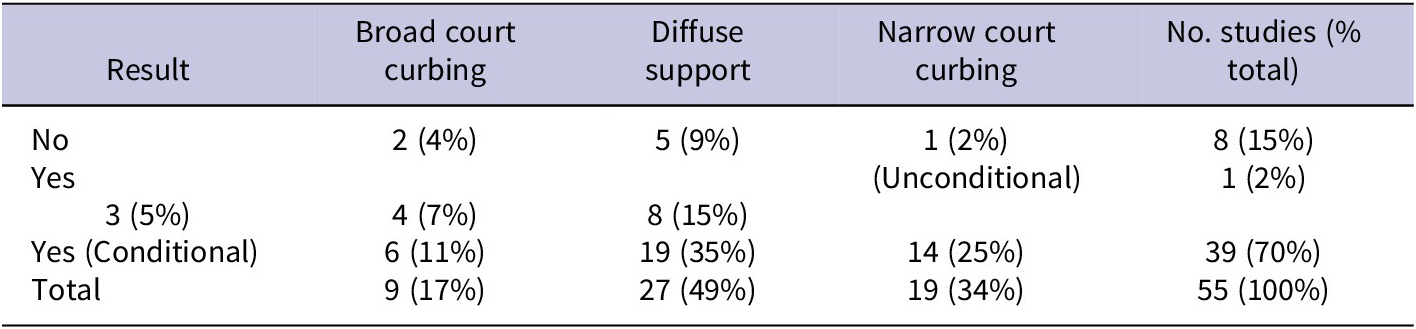
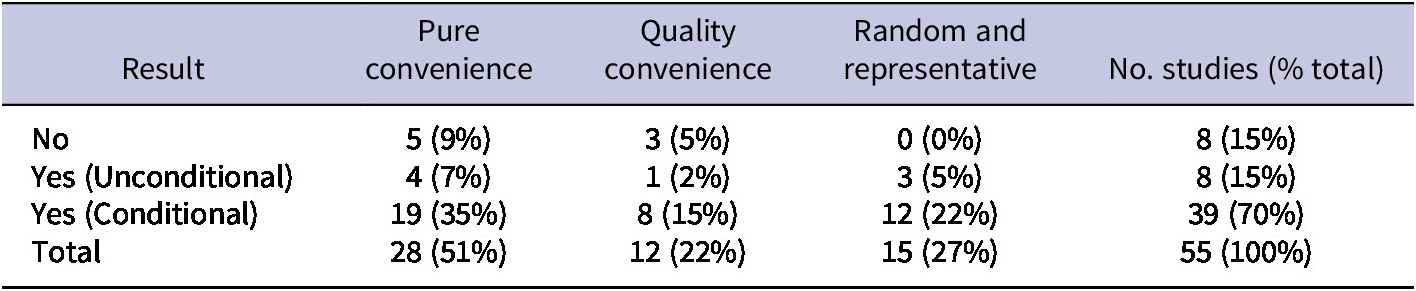
We find that the distribution of results categories is not significantly affected by the dependent variable measure type deployed in various studies (Table 4), nor do we find evidence of significant differences in the distribution of results associated with sample type (Table 5) or timing (Table 6). Along all three dimensions, we fail to reject the null hypothesis of a significant association between the various study categories (dependent variable type and time) and the distribution of results among the No, Yes (Unconditional), and Yes (Conditional) categories. In other words, it does not appear that there is any significant association between the flavor of legitimacy measure employed in an experiment-dependent variable pair and its propensity to produce evidence of no treatment effects, unmoderated treatment effects, or moderated treatment effects. There is also no significant association between studies’ participant recruitment – those employing pure convenience samples, higher-quality, screened convenience samples, or nationally representative samples – and the outcomes they support. Further, patterns of results among earlier experiments (those conducted through 2021) are not significantly different than results among later experiments (those conducted since 2021).
Distribution of Results by Dependent Variable Measures

Table 4. Long description
The table consists of four columns and four data rows.
Columns from left to right are:
1. Result category (No, Yes Unconditional, Yes Conditional, and Total).
2. Broad court curbing.
3. Diffuse support.
4. Narrow court curbing.
5. Total.
Data breakdown by row:
- No: Broad court curbing 2 (4 percent); Diffuse support 5 (9 percent); Narrow court curbing 1 (2 percent); Total 8 (15 percent).
- Yes (Unconditional): Broad court curbing 1 (2 percent); Diffuse support 3 (5 percent); Narrow court curbing 4 (7 percent); Total 8 (15 percent).
- Yes (Conditional): Broad court curbing 6 (11 percent); Diffuse support 19 (35 percent); Narrow court curbing 14 (25 percent); Total 39 (70 percent).
- Total: Broad court curbing 9 (17 percent); Diffuse support 27 (49 percent); Narrow court curbing 19 (34 percent); Total 55 (100 percent).
Statistical note: Chi-squared equals 2.673, p equals 0.614.
Note: Test for independence of dependent variable measures by results:
$ {\chi}^2 $
 = 2.673,
$ p $
 = 0.614.
Distribution of Results by Quality of Sample

Table 5. Long description
The table consists of four columns of data and a total row.
Columns from left to right:
1. Result status (No, Yes Unconditional, Yes Conditional, and Total).
2. Pure convenience.
3. Quality convenience.
4. Random and representative.
5. Total.
Data rows:
- No: 5 (9 percent) Pure convenience; 3 (5 percent) Quality convenience; 0 (0 percent) Random and representative; Total 8 (15 percent).
- Yes (Unconditional): 4 (7 percent) Pure convenience; 1 (2 percent) Quality convenience; 3 (5 percent) Random and representative; Total 8 (15 percent).
- Yes (Conditional): 19 (35 percent) Pure convenience; 8 (15 percent) Quality convenience; 12 (22 percent) Random and representative; Total 39 (70 percent).
- Total: 28 (51 percent) Pure convenience; 12 (22 percent) Quality convenience; 15 (27 percent) Random and representative; Grand Total 55 (100 percent).
A note below the table indicates a chi-squared test for independence with a value of 4.1632 and a p-value of 0.384.
Note: Test for independence of time period of study by results:
$ {\chi}^2 $
 = 4.1632,
$ p $
 = 0.384.
Distribution of Results by Time of Study

Table 6. Long description
The table consists of four columns and five rows.
Columns are labeled: Result Category, Pre-Dobbs, Post-Dobbs, and Total.
Row 1: No. Pre-Dobbs: 5 (9 percent). Post-Dobbs: 3 (5 percent). Total: 8 (15 percent).
Row 2: Yes (Unconditional). Pre-Dobbs: 3 (5 percent). Post-Dobbs: 5 (9 percent). Total: 8 (15 percent).
Row 3: Yes (Conditional). Pre-Dobbs: 22 (40 percent). Post-Dobbs: 17 (31 percent). Total: 39 (70 percent).
Row 4: Total. Pre-Dobbs: 30 (55 percent). Post-Dobbs: 25 (45 percent). Total: 55 (100 percent).
A note below the table indicates a test for independence of time period by results with chi-squared equal to 1.196 and p equal to 0.550.
Note: Test for independence of time period of study by results:
$ {\chi}^2 $
 = 1.196,
$ p $
 = 0.550.
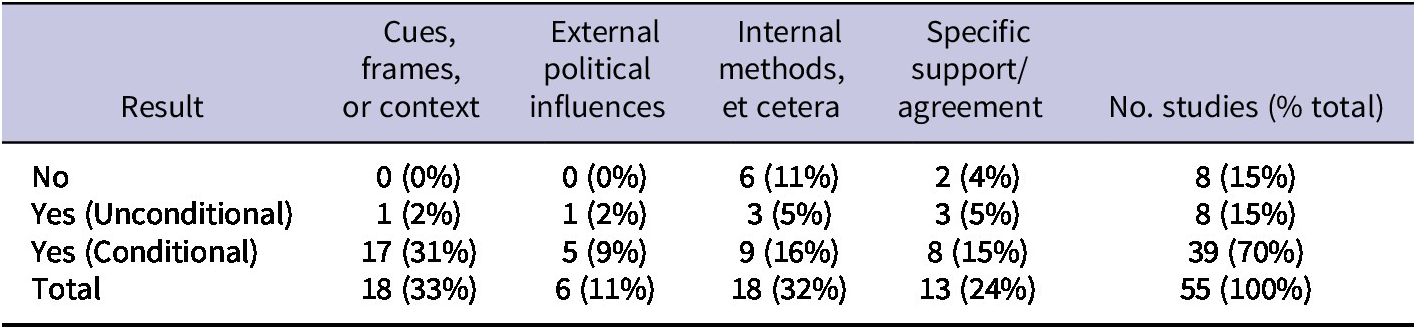
The case is less clear for treatment types (Table 7). In particular, studies testing manipulations of “cues, frames, or context” or “external political influences” overwhelmingly return evidence of treatments connecting a political stimulus external to the Supreme Court to diffuse support for the Court moderated by subjects’ partisanship, ideological predispositions, or affective orientation toward the external stimulus. Results from experiments focusing on the Court’s decision-making processes and its decisions were more mixed. While we cannot reject the null hypothesis of independence between treatment types and studies’ conclusions (
$ {\chi}^2 $
 = 12.398,
$ p $
 = 0.054), the statistical evidence is marginal. We take the distribution of results across treatment types as suggestive evidence that judicial legitimacy is somewhat more vulnerable to manipulations that load partisan identities, ideological values, or emotional charge and related considerations into subjects’ political cognition and somewhat less elastic in manipulations focused on narrow policy considerations and issues of judicial procedure. In contrast, the evidence that Supreme Court legitimacy is vulnerable to information about the Court’s processes or its justices’ methods of decision-making is more mixed.
Distribution of Results by Treatment Types

Table 7. Long description
The table consists of 4 rows and 6 columns.
Columns from left to right: Result Category, Cues, frames, or context, External political influences, Internal methods, et cetera, Specific support/agreement, and Total.
Row 1: No.
- Cues: 0 (0 percent)
- External: 0 (0 percent)
- Internal: 6 (11 percent)
- Specific: 2 (4 percent)
- Total: 8 (15 percent)
Row 2: Yes (Unconditional).
- Cues: 1 (2 percent)
- External: 1 (2 percent)
- Internal: 3 (5 percent)
- Specific: 3 (5 percent)
- Total: 8 (15 percent)
Row 3: Yes (Conditional).
- Cues: 17 (31 percent)
- External: 5 (9 percent)
- Internal: 9 (16 percent)
- Specific: 8 (15 percent)
- Total: 39 (70 percent)
Row 4: Total.
- Cues: 18 (33 percent)
- External: 6 (11 percent)
- Internal: 18 (32 percent)
- Specific: 13 (24 percent)
- Grand Total: 55 (100 percent)
Note: Test for independence of treatment types by results: chi-squared equals 12.398, p equals 0.054.
Note: Test for independence of treatment types by results:
$ {\chi}^2 $
 = 12.398,
$ p $
 = 0.054.
7.3. Assessing CLT and ALF
The balance of published experimental studies of Supreme Court legitimacy attitudes shows that expressions of institutional loyalty can be influenced by stimuli representing reasonably ordinary information about the Court, the political context in which it operates, how it conducts business, or its decisions. This body of evidence is inconsistent with the conventional view of expressed Supreme Court legitimacy as stable, institutional loyalty. To revisit a metaphor, responses to questions conventionally understood to represent views on institutional legitimacy are more like soda cans than battleships.
Taking a step back, the corpus of experiments we review provides support to an emerging theoretical alternative that casts expressions of legitimacy as something more like an ordinary political attitude – reasonably responsive to information, cues, and frames, especially when these are charged by salient political identities or attitudes. Though some experiments produce evidence consistent with CLT, it is nevertheless evident that CLT alone does not adequately account for the volume of significant causal effects on expressed legitimacy observed from a wide range of low-dose experimental treatments. By extension, these studies support the continued development of an alternative theoretical framework for understanding Americans’ diffuse support for the Supreme Court.
However, this conclusion should not be over-read. Reasonably responsive is not utterly elastic, and values commitments, identities, and other anchors of political behavior may provide a measure of stability to legitimacy attitudes as individuals are bombarded with new information about the Court (Gibson Reference Gibson2024b). The preponderant result from the published experiment–dependent variable pairs is for treatment effects conditional on alignment between a stimulus and a salient political identity. Criticism of the Supreme Court, for example, undermines legitimacy but only when it comes from a co-partisan or favored figure (e.g., Armaly Reference Armaly2016, Reference Armaly2018; Nelson and Gibson Reference Nelson and Gibson2019). These studies show that stimuli can act (negatively) on legitimacy attitudes when there is a tension between loyalty to the Court and some other important identity or commitment held by the subject. Their findings together suggest the possibility that cross-pressure between values (conventionally understood to anchor legitimacy) and salient identities or orientations (like partisanship or ideology) creates space for legitimacy attitudes to bend in ways they would not when those cross-pressures were absent (see Clark and Kastellec Reference Clark and Kastellec2015). More prospectively, these results point to the possibility of an integrated theory of legitimacy that synthesizes Eastonian notions of generalized goodwill and values-based institutional allegiance (Easton Reference Easton1965; Caldeira and Gibson Reference Caldeira and Gibson1992; Gibson, Caldeira, and Spence Reference Gibson, Caldeira and Spence2003a,Reference Gibson, Caldeira and Spence b) with broad models of political attitudes and survey response such as those proposed by Alvarez and Brehm (Reference Alvarez and Brehm1995) or Zaller (Reference Zaller1992).
8. Cautions
We sound a few notes of caution about this analysis before proceeding to summarize our conclusions. First, this study is an analysis of published experimental results. Any systematic bias in the research or publication enterprises producing the component studies would affect the results of our systematic review. For example, a publication environment net biased in favor of an established scientific consensus against novel alternatives would create a corpus of studies tilted toward CLT against new alternatives. Or, reviewers or editors preferring to publish significant statistical results over null findings might lead to a set of findings biased toward ALF against a conventional view associated with a case for negligible effects. It is difficult to reason deductively toward a most likely scenario for overall bias in the literature, though previous studies demonstrate an overwhelming bias against publishing null results (Rosenthal Reference Rosenthal1979; Franco, Malhotra, and Simonovits Reference Franco, Malhotra and Simonovits2014; Bueno de Mesquita and Fowler Reference Bueno de Mesquita and Fowler2021). For now, we note that our study relies on the collective wisdom of previously published research, but adjudicating between the two perspectives ultimately would benefit from a broad, disciplinary commitment to publication practices that do not privilege statistical significance or consistency with established theory (e.g., results-blind review and registered reports).
We are also conscious that this study relies on a stack of qualitative judgments, ranging from our inclusion and exclusion criteria to our judgments about the “dosing” involved in the included studies’ experimental treatments to the weight of scientific evidence and their implications for an adjudication between CLT and ALF. This is not to say that these decisions and judgments have been capricious or are categorically different from the kinds of research design choices all scholars make. However, the systematic review process foregrounds these judgments. Others later reapproaching the literature may formulate a review study differently and reach differing conclusions.
Lastly, and building on the preceding point, our analysis did not reevaluate findings or research designs from the underlying studies in this analysis. Across the included studies, authors attached substantive importance to the results they observed. However, it is possible that estimates of insignificant treatment effects taken as evidence for CLT, in fact, span a range of nonnegligible effects that muddle inferences for stable legitimacy. Conversely, significant treatment effects offered as evidence for flexible Supreme Court legitimacy may be substantively small and more consistent with stable diffuse than its alternative. Our study, again, relies on scholars’ judgments about the implications of data collected from their experimental studies, and it inherits any biases present in those studies.
9. Discussion and conclusions
The cumulative weight of published experimental evidence demonstrates that CLT alone is insufficient to explain the structure and dynamics of Americans’ diffuse support for the Supreme Court. Continued development of ALF is an important frontier for understanding Americans’ views on the independence and authority of the nation’s Supreme Court. This finding has several implications for judicial politics and the political science of legitimacy attitudes and institutional evaluations.
First, scholars have advanced a range of theoretical claims explaining how public support for the Supreme Court creates disincentives for Congress or the president to engage in court-curbing activities (e.g., Vanberg Reference Vanberg2001; Segal and Spaeth Reference Segal and Spaeth2002; Clark Reference Clark2009; Ura and Wohlfarth Reference Ura and Wohlfarth2010; Rogers and Ura Reference Rogers and Ura2020). If Americans’ sense of the Supreme Court’s legitimacy is more transactional than essential, the political space in which the judiciary may effectively “protect the rights of minorities,” “check the elected branches of government,” or “issue decisions that counter the wishes of a majority of Americans” may be smaller and more fragile than scholars and ordinary citizens appreciate (Nelson and Gibson Reference Nelson and Gibson2019, p. 206). In other words, Americans’ support for judicial independence against political opposition from legislative and executive opponents is more “narrow-run … [and] contingent than the romantic picture of judicial countermajoritarianism portrays it to be” (Rogers and Ura Reference Rogers and Ura2020, p. 436) – perhaps especially when judgments about the Court arise in contexts charged by partisanship or ideology (Davis and Hitt Reference Davis and HittForthcoming). This dynamic – at home in ALF but unfamiliar within CLT – is particularly important in a contemporary American politics characterized by polarized partisanship and strong affect and where, for example, loyalty to a Supreme Court enforcing boundaries on executive power could be strained by countervailing attachments to a president or his party. These findings also hint that the legitimacy of other counter- or nonmajoritarian institutions in American national government – such as the Electoral College and equal state suffrage in the Senate – may also be fragile and a risk to Americans’ faith in our larger constitutional order.
Additionally, these results give context to evidence of stability in aggregate diffuse support for the Supreme Court. In particular, stable macro-level legitimacy sentiment should not be taken as evidence that diffuse support for the Supreme Court is immovable, only that it did not move for a period of time (Gibson Reference Gibson1989; Caldeira and Gibson Reference Caldeira and Gibson1992; Gibson, Caldeira, and Spence Reference Gibson, Caldeira and Spence2003b; Gibson and Caldeira Reference Gibson and Caldeira2009b; Nelson and Tucker Reference Nelson and Tucker2021). Nelson and Gibson (Reference Nelson and Gibson2019) suggest a feasible mechanism for this previous period of stability: an ideologically balanced Supreme Court “giving everyone – regardless of their ideology – some decisions to disagree with and about the same number to like” (p. 208). In the aggregate, a pattern like this would allow some ideological or partisan considerations in Americans’ diffuse support for the Supreme Court to cancel out, leaving legitimacy sentiment to float on other considerations, like the Court’s adherence to desirable decision-making norms, without rapid ups and downs. However, diffuse support for a more ideologically imbalanced Supreme Court might exhibit less stability.
Our analysis also suggests at least two sets of important theoretical questions related to individual-level attitudes about the Supreme Court’s legitimacy. The first is about persistence: Do the effects of new considerations, of the type represented by experimental treatments we identified, persist or decay? If they endure, are specific considerations stored in long-term memory and, perhaps, later “sampled” to inform an expressed attitude (e.g., Zaller Reference Zaller1992), or are specific facts forgotten while their affective imprints aggregate into rolling, summary judgments (see Lodge, McGraw, and Stroh Reference Lodge, McGraw and Stroh1989; Lodge, Steenbergen, and Brau Reference Lodge, Steenbergen and Brau1995)?
A second set of related questions involves aggregation: How do these effects add up and change over time? Is macro-level diffuse support more like an integrated running tally (Baird Reference Baird2001; Gibson Reference Gibson2024b) or a stationary process in which shocks decay (Mondak and Smithey Reference Mondak and Smithey1997)? Future research on diffuse support for the Supreme Court should address both the cognitive mechanics of legitimacy attitudes and emergent properties of individual attitudes toward the Supreme Court in the aggregate and over time.
Our analysis also highlights a quiet dissensus around the issue of measuring judicial legitimacy evident in the studies we reviewed. Gibson, Caldeira, and Spence’s (Reference Gibson, Caldeira and Spence2003a) suggested approach to measuring diffuse support for the Supreme Court has been a cornerstone of judicial legitimacy research for more than two decades, establishing a conventional measure of legitimacy attitudes (see also Caldeira and Gibson Reference Caldeira and Gibson1992). More recently, though, Bartels and Johnston (Reference Bartels and Johnston2020) argue that some Gibson, Caldeira, and Spence–style (Reference Gibson, Caldeira and Spence2003a) indices contain questions relating to the Court’s performance (i.e., specific support) rather than only questions about support for upending the Court’s structures or authority (see also Bartels Reference Bartels and Rudolph2022, Reference Bartels, Fix and Montgomery2024). They argue for attention to separate views on “broad court curbing” and “narrow court curbing,” rather than “legitimacy,” in an effort to anchor studies of public sentiment about the Supreme Court in the parallel literature on public opinion’s part in securing judicial independence and refereeing the federal separation of powers (e.g., Stephenson Reference Stephenson2004; Rogers and Ura Reference Rogers and Ura2020).
Badas (Reference Badas2019) suggests a further consideration, arguing that legitimacy is best measured as an “applied” concept by probing respondents’ support for specific alternatives for reforming or restructuring the Court. Conventional measures of diffuse support, measures of broad court curbing, and measures of narrow court curbing were all present among the studies we reviewed, and each general approach was reflected in a range of question sets, utilizing differing forms and numbers of questions. Taken as a whole, though, the literature remains unclear about whether and how these measures reveal distinct latent concepts or different facets of the same underlying dimension of Supreme Court legitimacy, which presents some difficulties in attempting to identify what the literature shows about Americans’ dispositions toward their Supreme Court. Continued efforts to clarify the meaning and measure of various legitimacy attitudes and their relationship to one another are vital.
Lastly, we emphasize this study is a preliminary step in a larger and longer effort to synthesize findings in a developing area of research. Research on judicial legitimacy – inspired by the foundational contributions of Lipset (Reference Lipset1959), Easton (Reference Easton1965), Caldeira and Gibson (Caldeira and Gibson Reference Caldeira and Gibson1992; Gibson, Caldeira, and Spence Reference Gibson, Caldeira and Spence2003a,Reference Gibson, Caldeira and Spence b; Gibson and Caldeira Reference Gibson and Caldeira2009a; Gibson and Nelson Reference Gibson and Nelson2014), and others – is more active than ever. Indeed, about half of the studies included in our analysis have been published since 2022. Ongoing systematic review of experimental legitimacy studies (and their observational counterparts) and quantitative meta-analyses are vital to drawing out the general theoretical implications of this maturing area of research. Of course, the accumulation of additional experimental research may alter the balance of available evidence and suggest new substantive conclusions. However, such work should be an ongoing enterprise in this area, and others in political science, ensuring that evolving theoretical understandings of important political processes remain grounded in the cumulative empirical record.
Supplementary material
The supplementary material for this article can be found at http://doi.org/10.1017/jlc.2026.10036.
Acknowledgments
We are grateful to the many scholars whose research contributes to this systematic review and with whom we have discussed judicial legitimacy, and we thank Miles Armaly, Brandon Bartels, Jim Gibson, Elizabeth Lane, and participants at the 2025 Midwest Political Science Association annual meeting for feedback on earlier iterations of this paper.
Data availability statement
All scripts and data necessary to reproduce the findings are available in the Journal of Law and Courts Dataverse at https://doi.org/10.7910/DVN/3NXPXN.






 Open access

