


Introduction
How judges are selected is widely thought to shape how they decide. This proposition is central to scholarship on courts, yet the empirical evidence overwhelmingly comes from a single institutional context: variation in selection methods across US state courts.Footnote 1 Outside the United States, the comparative judiciary literature has theorized the distinction between career judiciaries, where judges enter through examination and rise through a hierarchy, and recognition judiciaries, where judges are appointed from legal practice on the basis of professional reputation.Footnote 2 Few studies have tested whether this distinction is associated with case outcomes within a court where both types coexist.
This gap matters because hybrid appointment systems are not rare institutional curiosities. France, Germany, Japan, and numerous Commonwealth jurisdictions all combine career and recognition tracks in various configurations. If the track through which a judge reaches the bench is associated with systematically different discretionary outcomes, then appointment design may be a question of substantive, not merely procedural, interest. The comparative prediction is straightforward: career-pathway judges, socialized within hierarchical institutions, may exercise discretion differently from recognition-pathway judges, whose formative experience lies in adversarial advocacy. That prediction has rarely been examined in a setting where both types sit on the same bench, apply the same law, and hear cases assigned through the same system.
India offers a rare institutional setting for such a test. Under Article 217 of the Constitution, High Court judges are appointed either directly from the practicing Bar (the recognition model) or by promotion from the subordinate judicial service (the career model). Both types sit on the same bench, apply the same Supreme Court precedents, and hear cases assigned through the Delhi High Court’s roster system. This dual-pathway design creates a framework for examining whether professional formation is associated with judicial behavior within a shared institutional and doctrinal environment.
We study 4,459 bail applications registered in the Delhi High Court in 2023 and 2024 and subsequently disposed of, decided by 34 judges; because inclusion is defined by registration year, some applications were decided in 2025. Bail is an apt domain because the Supreme Court has repeatedly affirmed that it involves substantial judicial discretion, operating within an open-textured framework where judges weigh nonexhaustive factors.Footnote 3 If bail were formulaic, professional background should be irrelevant; the discretionary latitude inherent in bail adjudication is what makes pathway-linked differences plausible.
We find a negative correlation between the pathway and bail grant rates. This pattern is large and robust to various model specifications. When each judge is weighted equally, Service judges grant bail about 19 percentage points less often than Bar judges (one vote per judge). The association is negative and significant in every leave-one-judge-out sample, with the case-level average marginal effect ranging from about –0.14 to –0.28 across those samples. The caseload-weighted, case-level estimate is larger but is a secondary, magnitude-sensitive summary, because it is influenced by a small number of high-caseload judges. The association is robust across multiple inference strategies, sample restrictions, Oster sensitivity bounds under conventional R-max assumptions, and sensitivity analyses detailed in the Robustness section.
Beyond the conditional gap, the association responds systematically to case characteristics. It widens in cases involving a deceased victim (from 23.6 to 33.9 percentage points) and narrows following a prior bail rejection (from 26.0 to 12.6 percentage points). These patterns indicate that the pathway association varies across case contexts rather than appearing as a uniform level difference, though they do not by themselves identify why the difference arises.
Our setting also lets us engage a growing empirical literature on the Indian judiciary. Recent work documents the Supreme Court’s caseload and workload (Robinson Reference Robinson2013) and how it exercises its discretionary jurisdiction (Chandra, Hubbard, and Kalantry Reference Chandra, William and Kalantry2017) and tests for in-group bias across millions of criminal cases (Ash et al. Reference Ash, Asher, Bhowmick, Bhupatiraju, Chen, Devi, Goessmann, Novosad and Siddiqi2025). Qualitative and institutional accounts, including Das Acevedo’s (Reference Das Acevedo2020) comparative analysis of how court structure and judicial role shape behavior, reinforce that Indian judicial conduct reflects institutional setting and role, not formal doctrine alone. Most directly, Bharti and Roy (Reference Bharti and Roy2023) show, in Indian district courts, that judges’ formative experiences are associated with measurable differences in bail stringency. We position our contribution alongside this body of work and return to it in the Institutional setting and theoretical framework section.
We are explicit about what the design can and cannot support. This is an observational study in which the treatment of interest, pathway, varies at the judge level across 34 judges, only 12 of whom are Service judges. Pathway is likely determined by unobserved heterogeneity capturing the judges’ appointment process, their career preferences, or their biographical background and is thus not randomly assigned. We therefore interpret the results as a robust descriptive association rather than a clean causal effect, and we do not adjudicate among competing mechanisms. With that framing, the convergence of multiple inference methods, the contextual heterogeneity, and the stability of the estimate across demanding specifications make a strong case that professional pathway is a robust correlate of discretionary bail outcomes, with implications for any jurisdiction combining career and recognition tracks.
Institutional setting and theoretical framework
India’s dual-pathway system
India’s Constitution creates two routes to the High Court bench. Under Article 217(2), a person may be appointed who has been a High Court advocate for at least ten years (the Bar pathway) or has held judicial office for at least ten years (the Service pathway). The Bar pathway selects from practitioners whose formative careers were in adversarial litigation. The Service pathway draws from judges who entered through competitive examination and progressed through the district-court hierarchy under a system of promotions, seniority, and performance evaluations.
In the Garoupa–Ginsburg framework, Bar-appointed judges exemplify the recognition model: selected later in life on the basis of professional reputation and oriented toward external audiences. Service-promoted judges exemplify the career model: entering early, socialized within a hierarchical structure, and oriented toward collective institutional norms and internal accountability. India’s system is thus a paradigmatic hybrid, housing both ideal types on the same bench. Throughout, we use Bar and Service to denote the empirical coding of a judge’s appointment route, and reserve recognition and career for the Garoupa–Ginsburg ideal types in the theoretical framework; because India’s Bar and Service pathways instantiate the recognition and career models respectively, the labels align, but we keep the empirical and theoretical vocabularies distinct so that results statements refer to Bar versus Service.
In our sample, 34 judges decided the sampled applications: 22 appointed from the Bar and 12 promoted from the judicial service. Among the 12 Service judges, 9 entered through direct competitive examination and 3 through lateral entry. This sample represents approximately 85 percent of the Court’s working strength.
Bail as a discretionary domain
Bail decisions in India combine constitutional imperatives with substantial discretion. Article 21 guarantees personal liberty, and the Supreme Court has held that bail is the rule and jail the exception.Footnote 4 The substantive framework is deliberately open-textured: courts weigh the nature of the accusation, severity of punishment, risk of tampering, and prima facie strength, among other nonexhaustive factors.Footnote 5 No statutory formula dictates how these are balanced. This discretionary latitude is what makes pathway-linked differences plausible: if bail were algorithmic, professional background should not matter.
Theoretical framework and predictions
Two literatures generate predictions about how professional pathway might relate to bail outcomes. The first concerns professional experience. Evidence from the United States suggests that judges’ prior professional experience, including service as public defenders, can be associated with case outcomes.Footnote 6 Bar-appointed judges bring years of adversarial practice, which, depending on their prior careers, may include criminal defense, government-side advocacy, constitutional, commercial, or other litigation; our data do not record which strand each judge brings. To the extent that adversarial practice cultivates familiarity with rights-based argument, it may be associated with greater receptivity to liberty claims.
The second literature concerns the institutional sociology of career judiciaries, which emphasize collective reputation, internal audiences, and hierarchical accountability, as against the individual reputation and external audiences of recognition systems.Footnote 7 Service-pathway judges, socialized within a hierarchical structure with sustained exposure to oversight, may be associated with a more cautious approach to discretionary decisions. Recent work on Indian district judges documents heavy workload, subordination to higher courts, and fear of vigilance complaints as significant occupational stressors.Footnote 8 Both literatures point to the same reduced-form prediction – lower bail grant rates among career-pathway judges – but through different channels.
A direct Indian precedent for the broader proposition that judges’ formative experiences can be associated with bail outcomes comes from district-court research. Bharti and Roy (Reference Bharti and Roy2023) study 668 judges deciding 323,380 bail cases in Uttar Pradesh and find that judges exposed to communal violence in early childhood (ages 0–6) are about 16 percent more prone to deny bail than the average judge, an effect they identify using an exogenous judicial rotation policy and concentrate in exposure between ages 3 and 6. They interpret the pattern through judges’ relative trust in individuals versus state institutions, and they rule out a religious in-group channel. Their finding establishes, in the Indian context, that judges’ formative experiences are associated with bail stringency. Our setting differs in an important way: their treatment is randomly assigned childhood exposure, whereas our pathway variable is a career-length attribute that is not randomly assigned.Footnote 9 We therefore treat their work as substantive support for the plausibility of a formative-experience class of mechanism, not as a template for causal identification in our setting.
Crucially, our design cannot separate the adversarial-experience and institutional-socialization channels: both are consistent with the conditional gap we document, and observable features of our data cannot adjudicate between them. We therefore treat the two as observationally equivalent and do not rank them. What our data can examine is whether the pathway-outcome association persists after adjustment and whether it varies across case contexts.
We state six predictions. P1: Bar judges grant bail at higher rates than Service judges, conditional on case characteristics. P2: The association persists after controlling for offense type and case complexity. P3 (null): Shared legal training and constitutional norms dominate professional background, producing no pathway association. P4 (exploratory): Lateral-entry Service judges may grant bail at intermediate rates, though with only 3 such judges this is severely underpowered. P5: The pathway gap widens in cases involving a deceased victim. P6: The pathway gap narrows following a prior bail rejection. P5 and P6 do not individually identify a mechanism; they test whether the association varies across case contexts rather than appearing as a uniform level difference.
Data and methods
Data collection and variable extraction
Data were collected from the Delhi High Court website (delhihighcourt.nic.in) for all cases registered as BAIL APPLN in 2023–2024; the registration year defines inclusion, the underlying matter may have been filed earlier, and disposal extends into 2025. For each disposed case, we collected structured case-history data and the unstructured text of orders and judgments. Each order was independently coded by two architecturally distinct large language models.Footnote 10 Variables were retained only where cross-model agreement exceeded 95 percent; eight variables met this threshold (agreement 96.0 to 100 percent). Manual validation was conducted at the field level using 150 manually coded cases. Across eight manually coded fields, this produced 1,199 comparable case-field observations because bail type was available for 149 of the 150 cases. One field, chargesheet_filed, was included as an auxiliary validation field but was not among the eight variables used to construct the exact-match analytic sample. Across the seven retained nonjudge variables for which manual codes were available, judge name was not separately recoded; there were 1,049 comparable case-field observations. The two models agreed on 1,034 of these observations, and every one of those agreements matched the manual coding (100 percent; one-sided 95 percent exact binomial lower bound: 99.7 percent).Footnote 11
Sample construction
The analytic sample proceeds through four stages: (1) a dual-model overlap universe (N = 8,219 disposed cases with documents present); (2) retention of merits-based outcomes where both models agree (N = 4,916 after excluding withdrawals, infructuous dispositions, and disagreements); (3) a perfect match on all eight retained variables (N = 4,483); and (4) listwise deletion for missing bail type, yielding 4,459 cases. Judge fixed-effects models use 4,441 cases after dropping 5 judges with no within-judge outcome variation. Full sample-flow tables are in the supplementary materials.
Identification and balance
This is an observational study. Under the Delhi High Court’s roster system, the Chief Justice allocates subject-matter rosters and cases are assigned to available benches. We are cautious about treating this as random assignment. A coarse balance specification using the case-level controls in our main model explains only a small share of pathway assignment (R-squared = 0.016). However, when we expand the balance model to include the finer covariates the analysis below uses – decision month, filing month, roster period, police-station origin, offense category, and custody-linked filing proxies – observables jointly explain a materially larger share of pathway assignment (R-squared = 0.174). We do not, therefore, rest our interpretation on an as-good-as-random claim. The most consequential imbalances are in decision timing, custody-linked filing activity, and prior-rejection history (Service judges hear more repeat applications, 19.7 percent vs. 12.5 percent). Our strategy is instead to show that the pathway association survives direct adjustment for these imbalances, including a restriction to first-time applications that removes the rejection-history imbalance by construction.
To address roster-based assignment concerns directly, we constructed roster-period indicators from the Delhi High Court’s public roster orders and amendments, matching each bail order to the roster order in force on its decision date. All 4,459 main-analysis cases matched a public roster period. The roster structure shows substantial contemporaneous exposure rather than sequential segregation by pathway: Bar and Service judges both heard bail matters in 38 of the 45 roster periods represented in the sample (4,440 of 4,459 cases) and in 35 of 36 decision months; both pathways co-occur in 84 of 118 roster-period-by-bail-type cells and 168 of 284 roster-period-by-offense cells. Because inclusion is defined by registration year, some 2023–2024 applications were decided in 2025, so the roster construction extends to the public roster periods in force on those 2025 decision dates. The roster-period fixed-effect specifications therefore compare Bar and Service outcomes within public roster regimes, not only across the full study period. Appendix Table A7 summarizes roster contemporaneity and reports the largest roster periods by case volume; the full 45-period construction table, with dates, pathway composition, case counts, and public-roster notes (including amendments routing particular bail categories to specified judges), is provided in the construction workbook.
Estimation
We estimate logistic regressions with progressive specifications. Model 1 includes case-level controls only (bail type, victim deceased, prior rejection, section count, senior advocate). Model 2 adds the binary Service-pathway indicator (Service = 1). Model 3 replaces the indicator with judge fixed effects (diagnostic, not intended to identify the pathway effect). For specifications with high-dimensional fixed effects, we report linear probability models, because the logit maximum-likelihood estimator did not reliably converge with that many indicators.Footnote 12 All non–fixed-effects models report standard errors clustered at the judge level (34 clusters); average marginal effects are reported for interpretation. We supplement asymptotic inference with the wild cluster bootstrap and with randomization inference. In the stratified randomization inference described in the Robustness section, pathway labels are permuted across the 34 judges, preserving the observed 22 Bar and 12 Service judges, and each permuted label is assigned to all of that judge’s cases before the stratified statistic is recomputed; because a judge’s cases span several strata, the common-support strata are recomputed under each draw. Throughout, average marginal effects describe effect size on the probability scale, while the clustered, bootstrap, and randomization p-values test the underlying logit coefficient or the corresponding grant-rate statistic, and the two scales should not be read interchangeably. For binary regressors, reported marginal effects are discrete changes in predicted probability from 0 to 1 rather than derivatives with respect to the regressor.
Results
Descriptive statistics
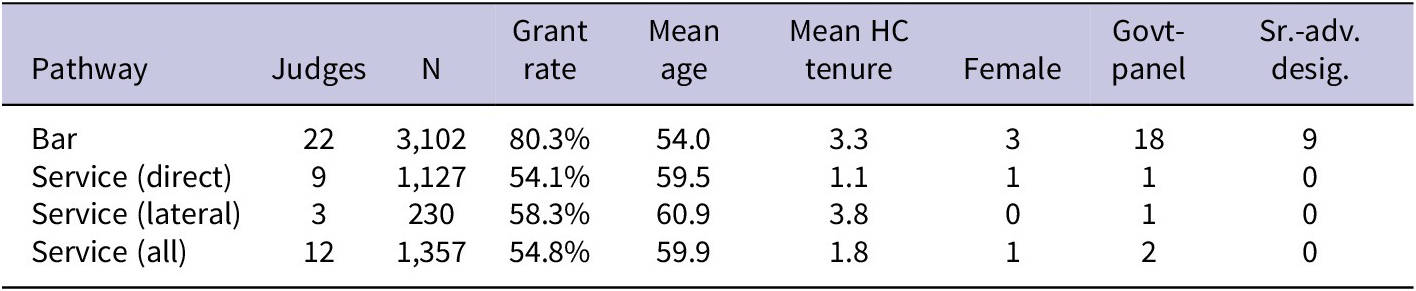
The sample comprises 4,459 applications decided by 34 judges; 3,235 were granted and 1,224 denied (72.5 percent grant rate). Bar judges decided 3,102 applications with an 80.3 percent grant rate; Service judges decided 1,357 with a 54.8 percent grant rate, a raw gap of 25.5 percentage points. The two groups also differ on observable judge attributes, which is consistent with pathway being a bundled variable: Service judges are on average older, have shorter High Court tenure, have no senior-advocate designations, and have fewer prior government-panel backgrounds (Table 1). We use these attributes diagnostically in the Robustness section rather than as clean controls.
Descriptive Statistics by Pathway (Regression Sample, N = 4,459)

Table 1. Long description
The table consists of nine columns: Pathway, Judges, N, Grant rate, Mean age, Mean H C tenure, Female, Govt-panel, and Sr.-adv. desig.
* Bar pathway: 22 judges, N of 3,102, grant rate of 80.3 percent, mean age of 54.0, mean H C tenure of 3.3 years, 3 female judges, 18 government-panel judges, and 9 with senior-advocate designation.
* Service (direct) pathway: 9 judges, N of 1,127, grant rate of 54.1 percent, mean age of 59.5, mean H C tenure of 1.1 years, 1 female judge, 1 government-panel judge, and 0 with senior-advocate designation.
* Service (lateral) pathway: 3 judges, N of 230, grant rate of 58.3 percent, mean age of 60.9, mean H C tenure of 3.8 years, 0 female judges, 1 government-panel judge, and 0 with senior-advocate designation.
* Service (all) pathway: 12 judges, N of 1,357, grant rate of 54.8 percent, mean age of 59.9, mean H C tenure of 1.8 years, 1 female judge, 2 government-panel judges, and 0 with senior-advocate designation.
Note: Age and tenure are judge-weighted means. Female, government-panel, and senior-advocate columns report judge counts.
Note: Age and tenure are judge-weighted means in years. Female, government-panel, and senior-advocate designation cells report judge counts. Service (direct) and service (lateral) are subcategories of Service (all). Bail-type composition by pathway (regular/anticipatory/interim/default) is Bar: 1,944/866/285/7; Service: 811/404/139/3. Full judge-level table in supplementary materials.
Main regression results
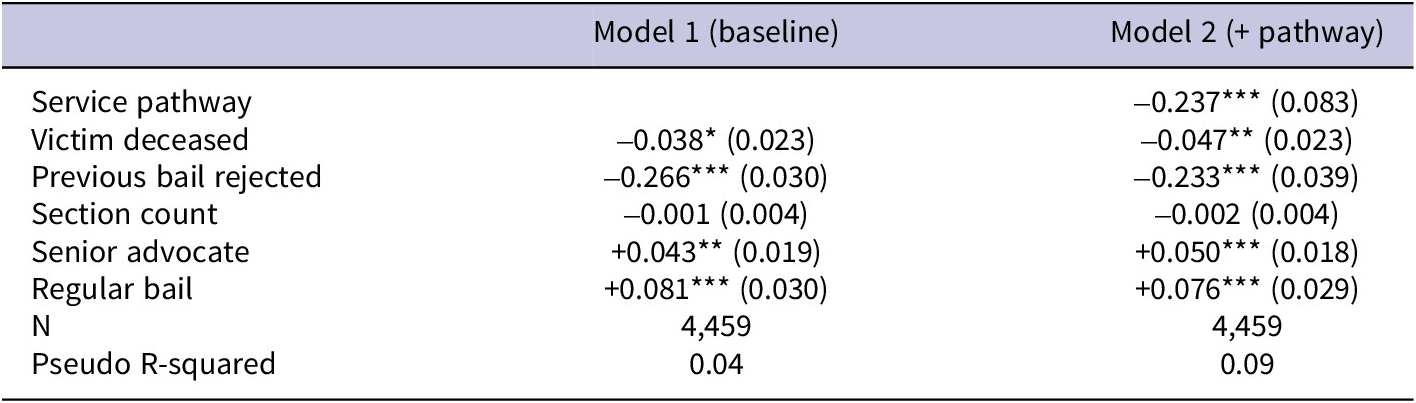
Table 2 presents the main results. In Model 1 (case controls only), prior rejection is the strongest predictor of denial (AME = –0.266, p < 0.001); victim death is associated with lower grant probability (AME = –0.038, p = 0.094); senior-advocate representation is positively associated with grants (AME = +0.043, p = 0.020).
Main Regression Results: Average Marginal Effects

Table 2. Long description
The table compares Model 1 (baseline) and Model 2 (plus pathway).
* Service pathway: Not applicable in Model 1; -0.237 (p < 0.01) in Model 2.
* Victim deceased: -0.038 (p < 0.10) in Model 1; -0.047 (p < 0.05) in Model 2.
* Previous bail rejected: -0.266 (p < 0.01) in Model 1; -0.233 (p < 0.01) in Model 2.
* Section count: -0.001 in Model 1; -0.002 in Model 2.
* Senior advocate: +0.043 (p < 0.05) in Model 1; +0.050 (p < 0.01) in Model 2.
* Regular bail: +0.081 (p < 0.01) in Model 1; +0.076 (p < 0.01) in Model 2.
* N: 4,459 for both models.
* Pseudo R-squared: 0.04 for Model 1; 0.09 for Model 2.
Standard errors are provided in parentheses. Significance levels are indicated by asterisks: three for p < 0.01, two for p < 0.05, and one for p < 0.10.
Note: Average marginal effects from logistic regression; judge-clustered delta-method SEs (34 clusters) in parentheses. Reference categories: anticipatory bail, Bar pathway. *** p < 0.01, ** p < 0.05, * p < 0.10. Full table in supplementary materials.
In Model 2, our preferred specification, Service judges are associated with a 24-percentage-point lower probability of granting bail than Bar judges, conditional on case characteristics (AME = –0.237, judge-clustered delta-method SE = 0.083, p = 0.004, two-sided; 95% CI [–0.399, –0.075]). The magnitude is comparable to having a prior bail application rejected (AME = –0.233), the strongest case-level predictor. Adding offense-category controls leaves the coefficient essentially unchanged (AME range –0.237 to –0.240), so differential offense composition does not account for the association.
Judge fixed-effects diagnostics
Model 3 replaces the pathway indicator with individual judge fixed effects, which absorb pathway by construction. It is diagnostic. First, judge identity explains substantial outcome variation (pseudo R-squared = 0.17, vs. 0.04 for case controls only). Second, among the 29 judges with estimable fixed effects, this variation aligns with the pathway. As a descriptive summary, the precision-weighted mean fixed effect is 1.309 logit units for Bar judges and 0.281 for Service judges, a precision-weighted difference of 1.029. Inference relies instead on the separate unweighted comparison of judge fixed effects across pathways: the unweighted Bar-minus-Service mean fixed-effect difference (about 0.67 logit units) yields Mann–Whitney p = 0.025 and permutation p = 0.031. These two tests apply to the unweighted comparison and should not be read as testing the precision-weighted means. Bail outcomes are strongly judge-dependent, and that judge-level variation is systematically related to pathway.
Contextual heterogeneity
If the pathway association were a constant level difference, it should not vary with case type. We test whether it varies with two case characteristics.
Pathway and victim deceased. When the victim is not deceased, the predicted gap is 23.6 percentage points (Bar 80.7 percent, Service 57.1 percent). When the victim is deceased, it widens to 33.9 percentage points (Bar 79.0 percent, Service 45.0 percent, from unrounded predictions), an increase of 10.4 points (interaction AME = –0.071, p = 0.026). The pattern survives offense controls and is consistent with P5.
Pathway and prior rejection. With no prior rejection, the gap is 26.0 percentage points; with a prior rejection, it narrows to 12.6 points (interaction AME = +0.147, p < 0.001). The drop in predicted grant probability following a prior rejection is 29.0 points for Bar judges but only 15.5 for Service judges. The pattern survives offense controls (interaction p = 0.005) and is consistent with P6.
These results indicate that the pathway association varies across case contexts: it responds systematically to case-specific information rather than functioning as a uniform shift. We read this as descriptive evidence about heterogeneity in the association, not as identification of an underlying mechanism. These patterns remain consistent with several distinct accounts.
Withdrawal analysis
If applicants before Service judges withdrew at higher rates, the lower grant rate could reflect differential selection rather than adjudication. Using a broader sample (N = 7,727), withdrawal rates do not differ significantly by pathway (Bar 34.9 percent, Service 36.9 percent, p = 0.669). The association is concentrated in adjudicated merits decisions.
Postgrant release conditions
Postgrant release conditions may have an impact on judges’ decision to grant bail. For instance, a Service judge may be more lenient towards granting bail if they impose stricter postgrant conditions. We remain agnostic about this mechanism. Nonetheless, we attempt to shed some light on this question by examining this in the granted-only sample using condition fields that clear the same 95 percent dual-model agreement gate applied throughout; the free-text condition list itself is too low in agreement to model and is excluded. The evidence is mixed rather than uniformly pro-caution. On the two co-primary financial-condition outcomes, Service grants are slightly more likely to carry a surety requirement (LPM coefficient = +0.014, p = 0.013) and a combined surety-and-bond package (+0.018, p = 0.090). On discretionary mobility restrictions, the direction reverses: Service grants are substantially less likely to carry a travel or passport condition (–0.237, p = 0.017), with the same negative direction for jurisdiction-leaving (–0.131, p = 0.072) and passport-surrender (–0.115, p = 0.152) conditions. The travel/passport gap is not an offense-composition artifact: it is negative in all seven nontrivial offense categories (within-category gaps from –0.31 to –0.15).
The data do not show that Service judges consistently impose harsher conditions on the bail they grant; if anything, the pathway difference appears concentrated at the grant/deny margin rather than in postgrant severity. Therefore, we treat these results as descriptive of the granted margin, not as identification of a mechanism. Full coefficients and within-offense detail are in Table A6.
Robustness
We subject the central association to a battery of tests, several added in response to review. Further analyses, including tenure controls and coefficient-stability tables, are in the supplementary materials.
First-time and regular-bail applications. Restricting to first-time applications (N = 3,805) removes the prior-rejection imbalance by design; the pathway AME is −0.262 (p < 0.001). Restricting to regular-bail applications, the category in which the discretionary stakes are highest, leaves the association essentially unchanged (AME = −0.235, p = 0.008; with offense controls AME = −0.238, p = 0.007).
Timing, roster, custody, and origin. The association is stable when we add decision-month and filing-month fixed effects, police-station-origin controls, custody-linked filing proxies,Footnote 13 offense-by-quarter fixed effects, and public Delhi High Court roster-period fixed effects (construction in the Identification and balance section and Table A7). All 4,459 cases match a roster period; in linear-probability specifications the Service coefficient is −0.240 with roster-period fixed effects, virtually identical to specifications without them. The estimate is also unchanged when restricted literally to roster periods in which both Bar and Service judges heard bail matters. Table 3 summarizes.
Robustness of the Service-Pathway Association (logit AME unless noted)

Table 3. Long description
The table consists of four columns: Specification, Service A M E / coef, Cluster p, and N.
* Model 2 (main): -0.237, 0.002, 4,459.
* + custody proxies: -0.234, 0.001, 4,459.
* + filing-month F E: -0.238, 0.002, 4,459.
* + filing-month + police origin: -0.242, 0.001, 4,459.
* + filing-month + police + custody: -0.237, 0.001, 4,459.
* First-time applications: -0.262, <0.001, 3,805.
* Regular bail only: -0.235, 0.008, 2,755.
* Decision-month F E (L P M coef): -0.242, 0.003, 4,459.
* Roster-period F E (L P M coef): -0.240, 0.003, 4,459.
* Roster-period F E + offense + custody (L P M): -0.237, 0.002, 4,459.
* Both-pathway roster periods only: -0.238, 0.001, 4,440.
* Offense times quarter F E (L P M coef): -0.235, 0.004, 4,459.
The Service A M E / coef values remain consistently negative, ranging from -0.234 to -0.262, indicating a stable association across various controls and subsets.
Note: High-dimensional fixed-effects rows report linear-probability coefficients (see note 12). Custody proxies are metadata fields, not custody status (note 13).
Judge-covariate diagnostics. Adding observable judge attributes – age, High Court tenure, gender, prior government-panel service, senior-advocate designation, and Delhi alma mater – individually or jointly, does not move the association toward zero. Across these specifications, the Service AME ranges from about −0.18 to −0.42 and remains significant at conventional levels; several specifications produce a larger gap because these attributes are themselves correlated with pathway.Footnote 14 We therefore present them as diagnostics rather than identifying controls, but the direction is informative: observable judge demographics do not account for the association.
Small-cluster and stratified inference. With only 34 judicial clusters, asymptotic inference may over-reject, so we supplement it with finite-sample procedures. The wild cluster bootstrap (Cameron, Gelbach, and Miller Reference Cameron, Gelbach and Miller2008; Webb six-point weights https://onlinelibrary.wiley.com/doi/epdf/10.1111/caje.12661, 9,999 iterations) yields p = 0.015. For randomization inference (Young Reference Young2019), we permute pathway labels across the 34 judges while preserving the observed 22:12 Bar-Service ratio, assign each permuted label to all of that judge’s cases, and recompute the case-weighted within-stratum grant-rate statistic, recomputing the common-support strata under each draw. The decision-month-by-bail-type-by-offense version yields a two-sided p-value of 0.010; a roster-period-stratified counterpart yields p = 0.012 (Table A5). These exercises preserve the judge-level treatment structure and are reported as robustness checks, not as evidence of random pathway assignment.
Roster-period-by-offense common support. As a direct common-support check, we restrict the sample to public-roster-period-by-offense-category cells in which both Bar and Service judges decided at least one application. Both pathways appear in 168 of 284 such cells. The restriction retains 4,218 applications and all 34 judges. Re-estimating the main specification yields a Service-pathway average marginal effect of −0.240 (underlying logit coefficient = −1.202; judge-clustered p = 0.002), nearly identical to the full-sample estimate. This restriction narrows the comparison to overlapping cells but does not establish random assignment within them.
LLM exclusion sensitivity. Because the strict matched sample drops cases on which the two models disagree, we check whether retention differs by pathway and whether single-model coding changes the result. Pathway-differential retention into the final sample is not statistically significant (Service minus Bar = −0.014, p = 0.25). Re-estimating with each model’s own coding adds 432 (DeepSeek-only) and 484 (Claude-only) cases beyond the matched sample; the Service AME remains close in magnitude and significant (DeepSeek-only −0.235; Claude-only −0.236). The association is not an artifact of excluding disagreement cases.
Effect-size stability. Because the pathway varies at the judge level, our preferred summary weights each judge equally: collapsing the data to one row per judge, Service judges grant bail about 19.4 percentage points less often than Bar judges (p < 0.001, one vote per judge; the caseload-weighted judge-level counterpart is 25.5 points). Figure 1 shows the underlying judge-level grant-rate distributions. We then re-estimate Model 2 thirty-four times, each dropping one judge: the association is negative and significant at p < 0.05 in all 34 samples, with the case-level average marginal effect ranging from −0.281 to −0.144 (median −0.237). The magnitude is not anchored at a single value; the attenuation is driven by one high-caseload Service judge (401 cases, 33.4 percent grant rate), whose exclusion moves the case-level AME to −0.144 (p = 0.004). We therefore report the result as robustly negative, leading with the equal-weight judge-level estimate of about 19 points and treating the caseload-weighted case-level estimate (on the order of 14 to 28 points) as a corroborating but magnitude-sensitive summary.
Judge-level bail grant rates by professional pathway. Each point represents one judge and receives equal visual weight, irrespective of caseload. Diamonds and horizontal lines show the pathway means. The ring identifies the highest-volume Service judge discussed in the leave-one-judge-out analysis. The figure shows the distributions and their overlap; it is descriptive and does not adjust for case characteristics.

Figure 1. Long description
The Y-axis represents Bail grant rate from 0% to 100% in 10% increments. The X-axis categorizes two groups: Bar (n = 22 judges) and Service (n = 12 judges).
* Bar Pathway (Left): Data points are blue circles. The distribution is concentrated in the upper half of the chart, ranging from approximately 19% to 100%. A black diamond and horizontal line indicate a Mean of 78.3%. Five judges are clustered at the 100% mark.
* Service Pathway (Right): Data points are orange squares. The distribution is lower and more compact than the Bar group, ranging from approximately 33% to 80%. A black diamond and horizontal line indicate a Mean of 58.9%.
* Specific Outlier: In the Service group, the lowest data point at approximately 33% is enclosed in a black ring. An arrow points to this square with the label: Highest-volume Service judge (n = 401).
Selection on unobservables. Because expanding the balance model raises the share of pathway assignment explained by observables (see the Identification and balance section), we assess sensitivity to unobserved confounding directly using the Oster (Reference Oster2019) coefficient-stability method, applied to the linear specification. Controls move the linear coefficient only slightly, from –0.255 with no controls to –0.240 with the full set, while R-squared rises from 0.069 to 0.116. Under Oster’s recommended bound (R-max = 1.3 × R-squared with full controls), the bias-adjusted coefficient remains negative at −0.230 and delta-star is 22.7; under a more conservative bound (R-max = 2.0 × R-squared with full controls), the bias-adjusted coefficient remains negative at −0.205 and delta-star is 6.8. At the theoretical maximum (R-max = 1.0), however, the identified set includes zero and delta-star is 0.90, below the conventional |delta-star| ≥ 1 benchmark (Table 4). We therefore treat the Oster exercise as supportive sensitivity evidence under the recommended and conservative bounds, but not as decisive at the theoretical maximum, and not as proof of no confounding.
Oster (Reference Oster2019) Bounds for Selection on Unobservables (linear coefficient)

Table 4. Long description
The table contains five columns: R-max assumption, Controlled coef, Bias-adj. coef (delta = 1), delta*, and Set excludes 0?
* Row 1: R-max assumption is 1.3 times R-sq (recommended). Controlled coef is -0.240. Bias-adj. coef is -0.230. delta* is 22.7. Set excludes 0 is Yes.
* Row 2: R-max assumption is 2.0 times R-sq (conservative). Controlled coef is -0.240. Bias-adj. coef is -0.205. delta* is 6.8. Set excludes 0 is Yes.
* Row 3: R-max assumption is 1.0 (theoretical max). Controlled coef is -0.240. Bias-adj. coef is +0.028. delta* is 0.90. Set excludes 0 is No.
Footnote data: Uncontrolled coef is -0.255 (R-sq 0.069). Full-control coef is -0.240 (R-sq 0.116). The conventional robustness cutoff is the absolute value of delta* greater than or equal to 1.
Note: Uncontrolled coef = −0.255 (R-sq 0.069); full-control coef = −0.240 (R-sq 0.116). The delta* is computed from the pathway-only and full-control linear specifications and is the proportional selection on unobservables, relative to observables, that would drive the coefficient to zero. Conventional robustness cutoff: |delta*| ≥ 1.
Discussion
The evidence supports the central hypothesis as an association: professional pathway is a robust correlate of discretionary bail outcomes. The conditional gap is large in the main specification and remains robustly negative across demanding specifications, and it is heterogeneous across case contexts. The null hypothesis that shared legal training and constitutional norms dominate professional background (P3) is not supported.
The heterogeneity carries interpretive weight but not identifying power. That the association responds to severity cues and procedural signals indicates it is not a constant level difference. We resist reading the interaction patterns as proof of a particular mechanism, because patterns of this kind are consistent with several accounts.
Mechanisms
Three candidate channels remain observationally equivalent in our data; we describe two here and a third below. The adversarial-experience account emphasizes what recognition-pathway judges may acquire through years of practice: familiarity with adversarial presentation and rights-based argument, and for some judges, criminal-defense or liberty-oriented work. The institutional-socialization account emphasizes what career-pathway judges internalized through years within hierarchical structures: caution developed through exposure to oversight and collective-accountability norms. These accounts predict lower career-pathway grant rates, and our design cannot distinguish them. We do not claim that any one is more plausible than the others; doing so would outrun what the data can support.
A third account concerns ongoing career incentives. Career-pathway judges reach the High Court later in their professional lives and may remain attentive to elevation, prestigious assignments, or postretirement appointments. Comparative work on Japan shows how posting, location, administrative responsibility, promotion, publication, and pay-scale incentives can structure behavior within a career judiciary (Ramseyer Reference Ramseyer2009). The Delhi descriptives are consistent with different career timing: Service judges in the sample were appointed to the High Court later and sat closer to the constitutional retirement age than Bar judges. These facts do not show that career incentives caused the bail-outcome association. The data contain no direct measure of promotion expectations or postretirement opportunities, so this account remains observationally equivalent to professional-experience, institutional-socialization, selection, and other pathway-correlated explanations.
We can, however, locate our result within the Indian empirical literature. Bharti and Roy (Reference Bharti and Roy2023) provide causal evidence that judges’ formative experiences are associated with bail stringency, interpreting it through judges’ relative trust in individuals versus state institutions; they further show that current, adult exposure does not generate the same persistent effect, which is consistent with the broader claim that formative rather than contemporaneous factors shape bail behavior. Ash et al. (Reference Ash, Asher, Bhowmick, Bhupatiraju, Chen, Devi, Goessmann, Novosad and Siddiqi2025), by contrast, find tight zero in-group bias on gender and religion across millions of cases, suggesting that not every judge attribute maps onto outcomes. Read together, this literature makes a pathway-linked association plausible while underscoring that the specific channel is an open question. Distinguishing the channels in our setting would require judge-level biographical data on prior practice area and government-counsel experience, and validated textual analysis of reasoning, which we flag as the natural next step rather than something the present design resolves.
We did, however, test the most concrete mechanism-oriented question the reviews raised: whether Service judges impose stricter conditions on the bail they grant. The evidence is mixed rather than uniformly consistent with a stricter-conditions account. Service grants are marginally more likely to include financial conditions, but discretionary mobility restrictions are markedly less common within the Service-judge sample. We therefore do not read the granted-margin evidence as showing that Service judges compensate for lower grant rates by imposing consistently harsher release terms. If anything, the observable pathway difference appears more clearly at the grant/deny margin than in postgrant severity. We treat these results as descriptive only. We do not extend the analysis to the reasoning channel, including whether the two groups invoke different considerations or rely differentially on caution- versus liberty-oriented precedents. The relevant order-level fields, including named-precedent flags, appear in only 1 to 5 percent of orders, too rarely to support a powered comparison; pursuing it would mean over-reading sparse text. We leave the reasoning channel to future work and retain the agnostic stance throughout.
The lateral-entry comparison (P4) is inconclusive. Only 3 lateral-entry judges contribute 230 cases, below conventional power thresholds (minimum detectable effect = 10.1 percentage points). Their grant rate (58.3 percent) falls between Bar and direct-entry Service judges, but the difference is not significant (p = 0.249).
Limitations
Several limitations bound our interpretation. First and most important, the design is observational and the treatment varies at the judge level across only 34 judges, 12 of them Service judges. Pathway is bundled with age, tenure, prior specialization, and other attributes; although the correlation between bail grant rates and pathway is robust to the inclusion of observable judge and case characteristics, unobserved judge-level confounding cannot be excluded, and we do not claim a causal pathway effect. Second, we do not identify the mechanism through which pathway is associated with lower Service-judge grant rates; in particular, we do not observe promotion expectations, prospects of elevation or administrative appointment, or postretirement opportunities, so ongoing career incentives cannot be separated from the other pathway-correlated channels. Third, custody is captured only by case-history filing proxies, not a clean in-custody field, and lower-court disposition is not available in machine-readable form; the timing, roster-period, and stratified-inference checks address assignment and timing concerns but do not supply the missing custody or lower-court-disposition covariates. Fourth, variables are extracted by large language models; validation shows predominantly conservative (attenuating) error, but nonclassical measurement error cannot be fully ruled out. Fifth, the study examines one court, one case type, and a two-year registration cohort.
Implications for comparative judicial politics
To the extent this association reflects pathway rather than a correlated attribute, several implications follow for hybrid systems worldwide, including France, Germany, Japan, and Commonwealth jurisdictions that combine promotion from the magistracy with appointment from practice. First, the choice between career and recognition tracks may be associated with systematic differences in discretionary outcomes rather than being merely procedural. Second, pathway composition and roster design are best treated as empirically relevant features of court organization rather than background administrative detail. Third, the constitutional assumption of functional equivalence between appointment pathways, implicit in Article 217 and analogous provisions, warrants empirical scrutiny. We frame these implications as agenda-setting rather than prescriptive, because they depend on an interpretation our design supports but cannot prove.
Conclusion
This paper provides new empirical evidence that professional pathway is associated with judicial outcomes in a hybrid appointment system. Using 4,459 bail applications registered in 2023–2024 and subsequently disposed of, decided by 34 judges of the Delhi High Court, we find that Service judges grant bail at substantially lower rates than Bar judges, on the order of 19 percentage points when each judge is weighted equally and, as a magnitude-sensitive secondary summary, about 24 points in the caseload-weighted case-level estimate. The association is large, robust across demanding specifications, and heterogeneous across case contexts, varying systematically with case severity and procedural signals. Because the design is observational and the treatment is a nonrandomly assigned judge-level attribute, we interpret the result as a robust association rather than a causal effect, and we leave the mechanism open among professional experience, institutional socialization, ongoing career incentives, selection, and other pathway-correlated channels.
Future research should pursue replication across other courts and jurisdictions with hybrid systems; extension to other discretionary domains such as sentencing and administrative review; adequately powered lateral-entry comparisons; collection of judge-level career histories; and validated textual analysis of judicial reasoning to illuminate the dispositions that quantitative analysis identifies but cannot, on its own, explain.
Supplementary material
The supplementary material for this article can be found at http://doi.org/10.1017/jlc.2026.10034.
Data availability statement
Replication materials for this article are available in the Journal of Law and Courts Dataverse at https://doi.org/10.7910/DVN/0YPFCE.
Acknowledgments
We are grateful to Rohan Aloor, Advocate at the High Court for the State of Telangana, whose observations from legal practice first motivated us to examine the hypothesis tested in this article and whose subsequent insights helped us refine it. We also thank Suranjali Tandon, Associate Professor at the National Institute of Public Finance and Policy, for her detailed and constructive comments on an earlier version of the manuscript. We also thank Professor Clark and the anonymous reviewers for their careful reading of the manuscript and constructive suggestions, which helped us strengthen the paper’s analysis, presentation, and interpretation.
Financial support
This research received no specific grant from any funding agency in the public, commercial, or not-for-profit sectors.
Competing interests
The authors declare none.
Generative-AI assistance
During preparation of the manuscript and replication materials, the authors used Claude Sonnet 4.6 and Claude Opus 4.6 (Anthropic) and GPT-5.5 (OpenAI) during January–August 2026 to assist with drafting and debugging analysis code and with language proofreading. The authors reviewed and, where necessary, revised all AI-assisted text; ran and checked the analysis code and outputs; and take full responsibility for the final manuscript, code, and results.





 Open access

