


Introduction
When democracies erode, constitutional courts are among the first institutions to be contested, captured, or curbed, and the comparative literature has placed them at the center of analyses of backsliding and executive aggrandizement (Ginsburg and Huq Reference Ginsburg and Huq2018; Scheppele Reference Scheppele2018; Sadurski Reference Sadurski2019; Haggard and Kaufman Reference Haggard and Kaufman2021). The supporting empirical infrastructure has not kept pace. Comparative judicial behavior databases remain scarce, and the field is still dominated by single-country studies built on bespoke, non-shared datasets (Engst and Gschwend Reference Engst, Gschwend, Epstein, Grendstad, Šadl and Weinshall2024). Yet backsliding is only the most visible occasion for a broader question. How do constitutional courts behave across the full range of political conditions they face – when do they divide, when do they defer, when do they avoid? Answering that requires measuring judicial behavior at scale and over time, and courts under stress are exactly those for which such data is most valuable and least likely to exist.
The Turkish Constitutional Court (Türk Anayasa Mahkemesi, hereafter AYM) has operated continuously since 1962 and exercises two distinct review functions: abstract and concrete review of legislation under the norm denetimi jurisdiction (in place since 1962), and the individual constitutional complaint mechanism (bireysel başvuru, introduced in 2012 to align the Turkish system with the European Convention on Human Rights (ECHR)). The AYM has experienced repeated institutional turbulence, punctuated by four constitutional junctures – the 1971 military memorandum and the amendments that followed, the 1980 coup and the 1982 constitution it produced, the 2010 referendum that restructured the Court, and the 2016 coup attempt, followed by emergency rule and the 2017 amendments that introduced the presidential system – that reshaped its composition and powers and that this paper uses as analytic breakpoints. Across these junctures, the Court has continued to issue decisions in large volumes.
Turkey figures prominently in the comparative backsliding literature (Varol Reference Varol2015; Bermeo Reference Bermeo2016; Esen and Gümüşçü Reference Esen and Gümüşçü2016; Haggard and Kaufman Reference Haggard and Kaufman2021), and the erosion ran substantially through the legal system itself (Över Reference Över2026). The steps are identifiable. The 2010 referendum restructured the Court and the council governing judicial careers (Özbudun Reference Özbudun2015); executive pressure on the judiciary intensified after 2013; the two-year state of emergency that followed the July 2016 coup attempt saw thousands of judges and prosecutors dismissed and two sitting AYM justices detained (Göztepe Reference Göztepe2021; Turkut Reference Turkut2022; Hazama Reference Hazama2023); and the 2017 amendments concentrated executive authority in the presidency and restructured the Council of Judges and Prosecutors, increasing presidential influence over judicial careers (Oder Reference Oder2021, Reference Oder2024). The earlier junctures of 1971 and 1980 were military interventions of a different character – precursors rather than instances of this erosion.
The dataset delivers population-scale measurement of the two behavioral quantities at the center of comparative judicial politics, disagreement and avoidance, across the Court’s full history. It enables the identified designs that causal questions require, but does not itself perform them (Section “A Research Agenda”).
Despite a growing empirical literature on the AYM, no systematic database integrates norm review and individual application in a single resource. An inferential tradition in comparative judicial politics has long read the Court through state-elite alignment and hegemonic preservation (Shambayati and Kirdiş Reference Shambayati and Kirdiş2009; Tezcür Reference Tezcür2009), and a more recent strand has built bespoke datasets to test such claims (Belge Reference Belge2006; Hazama Reference Hazama2012; Varol et al. Reference Varol, Pellegrina and Garoupa2017; Aydin-Cakir Reference Aydin-Cakir2018; Hazama Reference Hazama2023). These efforts share a common ceiling; each rests on a partial sample rather than the full corpus, often excluding procedural rejections and the 1962–1983 period, and each was a one-off dataset, not multi-user infrastructure (Epstein and Martin Reference Epstein and Martin2014). Even the most comprehensive treatment, von Steinsdorff et al.’s (Reference von Steinsdorff, Göztepe, Andrade and Petersen2024) book-length study, analyzes fifty key decisions from over fifteen thousand and releases no dataset; and the most recent quantitative work measures judicial independence from country-year indicators rather than from the Court’s own decisions (Garoupa and Spruk Reference Garoupa and Spruk2025). None of the decision-level datasets behind this literature has been released for independent replication.
A second, more recent line of research, emerging since 2021, applies natural language processing (NLP) to AYM decision prediction (Mumcuoğlu et al. Reference Mumcuoğlu, Öztürk, Ozaktas and Koç2021; Sert et al. Reference Sert, Yıldırım and Haşlak2022; Aydemir Reference Aydemir2023). It performs well within scope but works from post-2012 individual application alone, excluding norm review as “not well-structured” (Sert et al. Reference Sert, Yıldırım and Haşlak2022, 1418) and often merging admissibility with non-violation outcomes.
Both lines of research run into the same gap. No publicly accessible dataset spans the Court’s six-decade record, integrates its two jurisdictions in one relational structure, or separates admissibility from merits dispositions in a form others can extend. Adjacent jurisdictions show what closing that gap makes possible, from the Israeli Supreme Court Database (Weinshall and Epstein Reference Weinshall and Epstein2020) and the CJEU Database Platform (Brekke et al. Reference Brekke, Fjelstul, Hermansen and Naurin2023; Naurin et al. Reference Naurin, Lindholm, Šadl, Ghavanini, Naurin, Šadl and Zglinski2026; Šadl et al. Reference Šadl, Brekke, Zurita and Kim2025) to the ICJ–PCIJ twin corpora (Fobbe Reference Fobbe2022, whose framing I follow most closely), and comparable efforts in Germany, the Czech Republic, and the United States (Hamann Reference Hamann2019; Paulík Reference Paulík2025; Kastellec and Taboni Reference Kastellec and Taboni2026). This dataset extends that approach to a court whose six decades across recurring junctures have remained largely opaque to systematic scrutiny.
I build the dataset in this multi-user tradition (Epstein and Martin Reference Epstein and Martin2014); it makes three contributions. First, it provides the first publicly accessible resource covering both AYM jurisdictions, released for independent replication: 5,513 norm review decisions from 1962 to 2025 and 16,626 individual application decisions from 2012 to 2025, decomposed to claim-level granularity across 29,248 right-by-disposition rows. Second, it makes two behavioral quantities central to comparative judicial politics – disagreement and avoidance – observable at population scale: a validated dissenting-opinion flag on every decision yields parallel dissent series in both jurisdictions, and decision-level procedural-disposition labels measure how much of the docket the Court resolves without reaching the merits, connecting the data to the comparative literatures on judicial dissent and docket control taken up in Section “What the Dataset Enables.” Third, the database offers a portable architecture for apex courts whose public records combine structured fields with unstructured text; every variable is tagged as authority-derived (retrieved from the Court’s structured publication) or parser-derived (inferred from decision text), and the validation strategy is matched to each layer (Sections “Data Collection and Schema,” “Transportability and Linkage to Comparative Infrastructures,” and “Validation”).
To show what the dataset makes possible, I present in Section “What the Dataset Enables” two demonstrations and a descriptive profile that connect it to standing questions in comparative judicial politics. The first measures judicial disagreement. The dissent rate rises from 6% in the Court’s five-member sections to 47% in its plenary. The second measures judicial avoidance. The share of cases the Court filters out on procedural grounds shifts in different directions around the junctures, rising sharply after the 1971 intervention and collapsing with the docket after 1980, with no significant difference in the 2010 and 2016 comparisons.
These are demonstrations of measurement, not causal tests. Section “A Research Agenda” sets out the agenda the infrastructure opens up, from judge-level analysis and event-study designs to text-as-data measurement of how judicial reasoning itself shifts across the four junctures.
These demonstrations are bounded by the limits of the public record. The AYM does not publish majority votes, and panel composition is not yet parsed into structured form. Section “Limitations” returns to these limitations. The remainder of the paper documents the institutional background, the data and schema, the classification and validation behind the measurements, and the demonstrations and agenda in full, before the limitations and the conclusion.
Institutional background
This section provides the institutional context necessary to interpret the dataset.
Court structure
The AYM was established under the 1961 constitution and began operations in 1962, modeled on the centralized European tradition of constitutional review developed by Hans Kelsen and embodied in the Austrian and German constitutional courts (for a comprehensive institutional history, see von Steinsdorff et al. Reference von Steinsdorff, Göztepe, Andrade and Petersen2024). The Court’s composition has changed across the two constitutional regimes. The original 1961 design provided fifteen permanent and five substitute members. The 1982 constitution restructured this to eleven and four. The 2010 amendment package, the most consequential institutional reform in the Court’s operational history, expanded membership to seventeen and introduced the individual application jurisdiction (Bâli Reference Bâli2013; Yıldırım and Gülener Reference Yıldırım and Gülener2016). The 2017 amendments, which accompanied the transition to the presidential system, reduced membership to fifteen. Members are appointed through a multi-channel system combining judicial-body nominations, presidential appointment, and parliamentary appointment; appointment-channel composition for all 138 justices is documented in the companion AYM Members Dataset (Sections “Relational Schema” and “A Research Agenda”).
The AYM operates through three decisional bodies: two sections (Birinci Bölüm, İkinci Bölüm) responsible primarily for individual application decisions, and the Plenary (Genel Kurul), which decides the most institutionally important cases, including all norm review decisions. The sections were established as part of the 2010 reforms; section assignments are preserved through the chamber_normalized field in ia_decisions.
Norm review jurisdiction
The norm denetimi (norm review) jurisdiction has operated continuously since 1962 and covers constitutional review of legislation: statutes (kanun), parliamentary by-laws (içtüzük), and presidential decrees (Cumhurbaşkanlığı kararnamesi under the 2017 amendments). Two procedural channels are active under the current regime: iptal davası (abstract review action; 21.1% of the corpus), initiated by direct petition with constitutionally restricted standing: the president, the parliamentary groups of the governing and main-opposition parties (since the 2017 amendments, the two largest party groups), and at least one-fifth of all members of parliament; and somut norm denetimi (concrete review referral; 66.2%), under which constitutional questions are referred by ordinary courts encountering them in specific cases.
Standing for the abstract action was substantially broader under the 1961 constitution – political parties could file directly, as could designated institutions such as the High Council of Judges, the high courts, and universities, alongside petitions by one-sixth of the members of either chamber – before the 1982 constitution narrowed it to its present form; the applicant layer released with the data records the standing category and, where the decision states it, the party identity for every abstract review decision (Section “Transportability and Linkage to Comparative Infrastructures”).
A third source category, legacy petitions, consists of direct submissions – overwhelmingly by private individuals, who had standing under neither constitution – that the Court nonetheless docketed under an İSTEMDE BULUNAN (petitioner) heading, decided, and published, dismissing almost all of them for lack of standing. Concentrated in the Court’s first two years and tapering off by the late 1980s, they are not an authorized review channel but a record of who attempted to reach the Court directly. The channel distinction matters politically as well as procedurally; standing rules determine who can activate constitutional review, so the mix of channels in the docket is itself a measure of where challenges to legislation originate – a property Section “Procedural Filtration Around Constitutional Junctures” exploits. The machine label for this category is legacy_petition, which distinguishes it from the structurally distinct individual-application mechanism introduced in 2012; these submissions account for 8.4% of the corpus, overwhelmingly concentrated in the 1960s.
Norm review decisions take several substantive forms: annulment of one or more provisions (iptal); rejection on the merits without finding constitutional infirmity (ret); mixed dispositions; declination on procedural or jurisdictional grounds (usuli ret); file return for procedural deficiencies (ön inceleme iadesi); or determination that no decision is required. The longitudinal trajectory of these dispositions, and the systematic identification of procedural rejections as a distinct category occupying approximately 20% of the caseload, are documented in Section “Classification and Labeling” and Section “What the Dataset Enables.”
Individual application jurisdiction
The bireysel başvuru (individual application) jurisdiction was introduced through the 2010 amendments and operationalized in September 2012, drawing on the German Verfassungsbeschwerde model and the ECHR system (Yıldırım and Gülener Reference Yıldırım and Gülener2016) and adopted in part to reduce Turkey’s substantial caseload before the European Court of Human Rights (Çalı and Durmuş Reference Çalı and Durmuş2018). It has reshaped the AYM’s docket; as the caseload volumes in Section “A Descriptive Profile of Six Decades” reflect, it now accounts for the overwhelming majority of the Court’s annual docket.
Individual application review proceeds in two stages. The Court first examines applications for admissibility (kabul edilebilirlik), assessing procedural prerequisites, exhaustion of domestic remedies, time limits, and prima facie constitutional character. Applications failing this stage are dismissed as inadmissible (kabul edilemezlik). Admissibility is thus the individual-application counterpart of the gate-keeping that procedural rejection performs in norm review (Section “Category Correspondence Across Corpora”). Like most apex courts, the AYM filters a large share of cases out on procedural or jurisdictional grounds – for lack of standing, missed deadlines, unexhausted remedies, or file deficiencies – before reaching any judgment on the merits, dismissing them as inadmissible in the individual application jurisdiction and as procedural rejections in norm review. Distinguishing these gate-keeping dispositions from genuine merits decisions is central to this paper’s procedural-filtration analysis (Section “Procedural Filtration Around Constitutional Junctures”). It is the same court managing two doors with two gate-keeping technologies. Applications surviving proceed to merits review, taking the form of either a violation finding (ihlal) or non-violation finding (ihlal olmadığı). The two-stage architecture distinguishes individual application structurally from norm review; norm review decisions operate at the level of statutory provisions, individual application decisions at the level of individual right-claims.
A defining structural feature of individual application is its multi-claim character. Applications routinely allege violations of multiple constitutional rights with distinct dispositions for each, which is what motivates the claim-level decomposition implemented in ia_outcomes (Section “Relational Schema”), where one decision can generate several outcome rows.
Data collection and schema
I construct the dataset from two distinct AYM web portals, each corresponding to one of the Court’s two jurisdictions: normkararlarbilgibankasi.anayasa.gov.tr for norm denetimi decisions and kararlarbilgibankasi.anayasa.gov.tr for bireysel başvuru decisions. Both portals are maintained by the Court, are publicly accessible, and serve as the authoritative source for the decisions they publish. I treat the two corpora separately throughout the pipeline because they differ in their underlying data structure, in the retrieval strategy they require, and in the epistemic status of the variables that can be derived from them – a distinction I develop below.
The norm review corpus comprises 5,513 decisions issued between 1962 and 2025,Footnote 1 spanning both the 1961 and 1982 constitutional regimes. The Court’s own repository is the single source. It carries digital-native text for the entire period, requires no optical character recognition, and preserves unambiguous provenance, avoiding the version discrepancies that Ovádek (Reference Ovádek2024) documents for CJEU databases.
Decisions are retrieved as rendered HTML. A pre-release audit corrected identifier-extraction errors and removed duplicates, and restricting the corpus to complete calendar years through 2025 gives the 5,513 decisions reported here; retrieval infrastructure, procedure, and logs are documented in Appendix H.
The corpus covers six decades during which the Court’s institutional context and decision-writing conventions varied considerably. Decisions from the 1961-constitution period are formatted differently and run substantially shorter than post-1982 decisions, and the immediate post-1980 reconstruction introduces further idiosyncrasies tied to the transitional military-civilian context. These structural variations posed the principal classification challenge for the parsing pipeline (Section “Norm Review: Rule-Based Pipeline”) and motivate the period-stratified validation reported in Section “Validation.”
The individual application corpus comprises 16,626 decisions issued between September 2012, the month in which the bireysel başvuru mechanism became operational, and 2025. The corpus represents the population of individual application decisions published on the AYM’s portal at the time of retrieval; it is not a sample. The present corpus retains all admissibility decisions, all other-result dispositions, and all cases with multi-rights structure, leaving such filtration as an explicit analytical choice for downstream users (Section “Introduction”). The portal publishes each decision’s outcome as a structured table with one row per right-claim adjudicated, a structure preserved in the ia_outcomes table (Section “Relational Schema”); retrieval mechanics are documented in Appendix H.
The two corpora differ in the epistemic status of their variables, which shapes both the schema and the validation strategy (Sections “Classification and Labeling”–“Validation”; Brekke et al. Reference Brekke, Fjelstul, Hermansen and Naurin2023). Individual application is overwhelmingly authority-derived, its fields retrieved from the Court’s structured publication; norm review is overwhelmingly parser-derived, its classifications inferred from decision text. Every variable is tagged with its layer in the codebook, so users can weight parser-derived classifications by their measured reliability or restrict analysis to the authority-derived layer.
Relational schema
The dataset comprises seven tables organized into two corpus-specific clusters. The schema adheres to the three tidy data principles articulated by Wickham (Reference Wickham2014); each variable occupies a column, each observation a row, and each type of observational unit its own table. The third principle has particular force here; individual constitutional complaints routinely raise multiple distinct rights claims and receive distinct dispositions for each, motivating the separation of decisions from outcomes through a foreign-key relationship. Table 1 presents the inventory; full column listings, data types, and value ranges are provided in Appendix A and the codebook.
Overview of the AYM Dataset Tables

Table 1. Long description
The table consists of five columns: Table, Corpus, Observation level, Rows, and Columns.
* Row 1: Table nr_decisions; Corpus Norm review; Observation level Decision; 5,513 Rows; 29 Columns.
* Row 2: Table nr_texts; Corpus Norm review; Observation level Text; 5,513 Rows; 5 Columns.
* Row 3: Table nr_applicants; Corpus Norm review; Observation level Applicant record; 1,163 Rows; 8 Columns.
* Row 4: Table ia_decisions; Corpus Individual application; Observation level Decision; 16,626 Rows; 32 Columns.
* Row 5: Table ia_outcomes; Corpus Individual application; Observation level Right-by-disposition; 29,248 Rows; 16 Columns.
* Row 6: Table ia_texts; Corpus Individual application; Observation level Text; 16,626 Rows; 13 Columns.
* Row 7: Table ia_opinion_flags; Corpus Individual application; Observation level Opinion-flag record; 16,626 Rows; 8 Columns.
The seven tables join through two keys – the application number on the individual application side, the decision identifier on the norm review side – and Figure 1 maps the full relational architecture. The schema does not include a judges table linking individual justices to decisions; the AYM does not publish panel-composition metadata in structured form, and parsing justice names from decision texts into panel records is deferred to subsequent work (Section “A Research Agenda”).
Relational Schema of the AYM Dual-Corpus Dataset. Seven tables in two corpus-specific clusters, each table one observational unit (Wickham Reference Wickham2014); arrows show foreign keys. The 1:N link between ia_decisions and ia_outcomes reflects the multi-claim structure of individual applications.

Figure 1. Long description
The diagram is divided into two main clusters.
1. N O R M Review Corpus (Blue, Left side):
* Top table: nr_decisions. Primary Key (P K) is decision_id. Contains 30 columns including docket_no, decision_date_iso, and various boolean flags like has_annulment and has_rejection.
* Bottom-left table: nr_texts. P K and Foreign Key (F K) is decision_id. Connects to nr_decisions via a 1 to 1 link. Contains 5 columns including text and schema_version.
* Bottom-right table: nr_applicants. F K is decision_id. Connects to nr_decisions via a 1 to 1 link. Contains 8 columns including applicant_category and applicant_party.
2. Individual Application Corpus (Orange, Right side):
* Top table: ia_decisions. P K is application_number. Contains 32 columns including chamber_normalized, decision_type_raw, and extraction fields.
* Bottom-left table: ia_outcomes. F K is application_number and P K is outcome_index. Connects to ia_decisions via a 1 to N link. Contains 16 columns including right_raw and result_raw.
* Bottom-center table: ia_texts. P K and F K is app_number. Connects to ia_decisions via a 1 to 1 link. Contains 13 columns including text_content.
* Bottom-right table: ia_opinion_flags. P K and F K is app_number. Connects to ia_decisions via a 1 to 1 link. Contains 8 columns including has_separate_opinion.
A companion AYM Members Dataset documenting all 138 justices who have served on the Court through the appointments of 2024 (release v1.1) – including two dismissed by emergency decree in August 2016, whose biographies were removed from the Court’s website and reconstructed from triangulated public sources – is released alongside this paper. The full release, comprising the seven tables, the codebook, the validation samples, and the version-tagged pipeline and replication code, is released for long-term archival and independent replication (deposit venues and timing in the Data Availability Statement), and is built for periodic updates following the sustainability principle of Weinshall and Epstein (Reference Weinshall and Epstein2020).
Classification and labeling
The two corpora are labeled differently, reflecting the two-layer architecture (Section “Data Collection and Schema”): norm review through a rule-based pipeline that infers categorical labels from decision text, individual application through structured extraction from the portal’s pre-structured fields. This section reports the design and validated accuracy; regular-expression patterns, marker listings, and the full iteration history are in Appendices B and C.
Norm review: Rule-based pipeline
The norm review pipeline produces three sets of categorical labels for each of the 5,513 decisions in the corpus: a source classification identifying the procedural origin of the constitutional review action, a form classification identifying the substantive shape of the Court’s disposition, and five binary outcome flags capturing specific dispositive features. All are parser-derived and validated against gold-standard manual coding re-verified from complete decision texts (Section “Validation”). Table 2 presents the category systems and their corpus shares.
Norm Review Classification Categories (n = 5,513)

Table 2. Long description
The table is divided into two main label sets: Source and Form.
Source categories include:
* concrete_review: 66.2 percent. Referral by an ordinary court that encountered a constitutional question in a pending case.
* abstract_review: 21.1 percent. Abstract review petition by the president, the parliamentary party groups with standing, or one-fifth of members of parliament.
* legacy_petition: 8.4 percent. Unauthorized direct petitions, chiefly by private individuals (1962–1989); distinct from the post–2012 individual application.
* unknown: 4.3 percent. Header text insufficient for reliable classification; concentrated pre–1980.
Form categories include:
* merits_rejection: 28.0 percent. Merits examined; no constitutional infirmity found.
* merits_annulment: 17.4 percent. At least one provision annulled and no provision rejected on the merits.
* procedural_rejection: 20.0 percent. Rejected on jurisdictional, technical, or competence grounds without reaching the merits.
* unknown: 9.8 percent. Form not reliably classifiable; concentrated in pre–1970 non-standard formats.
* preliminary_return: 9.2 percent. File returned for procedural completion before substantive consideration.
* merits_mixed: 8.8 percent. Dispositive section contains both an annulment and a rejection on the merits.
* no_decision_needed: 6.9 percent. A parallel ruling had already addressed the same provision.
Each decision receives exactly one category per label set. Where a text could plausibly support two – a procedural bar alongside merits language – the coding rule set out in the codebook decides, so assignments are reproducible rather than judgment calls. The substantive significance of the 20.0% procedural-rejection rate is developed in Sections “Introduction” and “What the Dataset Enables.”
Binary flags record what the Court did in each decision, derived from specific dispositive expressions independently of the broader form classification. Five are released with this version: has_rejection, has_procedural, has_no_decision, has_reference_annulment, and has_dissent (written dissent, karşı oy, appended to the decision). Definitions are in Appendix A and corpus shares in the codebook. A sixth flag, has_annulment, is withheld from this version pending re-validation of its textual basis (Section “Limitations,” Appendix K). Among those released, has_dissent is the most reliable, since it is read from opinion headings rather than from disposition language; the others are a complement to the form label rather than a more reliable substitute for it.
Individual application: Authority-derived extraction
The individual application corpus is processed through a structurally simpler pipeline because almost all of its categorical content is rendered by the portal as discrete fields and table cells. The decision-level metadata stored in ia_decisions (section, decision date, gazette information, application number, decision type) is retrieved directly from labeled HTML fields and normalized where appropriate (raw dates to ISO-8601, section names to a canonical set). Because these variables are authority-derived, they are validated through extraction-accuracy procedures (Section “Validation”), not classification-accuracy procedures.
Individual application outcomes are recorded claim by claim rather than case by case, and these records too are authority-derived. The portal renders each decision’s outcome as a table with one row per right-claim adjudicated – the right asserted, the alleged intervention, the result, and any remedy – and the pipeline preserves this structure, generating one ia_outcomes row per source row. The 16,626 decisions produce 29,248 outcome rows, an average of 1.76 per decision.
A small number of individual application variables are parser-derived. Opinion detection (ia_opinion_flags) requires textual inference because the portal does not expose opinion presence as a metadata field; the pipeline identifies opinion headings by type, distinguishing dissents (karşı oy) from concurrences (farklı gerekçe), with full agreement against a 60-decision manual sample (Section “Validation”). It finds at least one separate opinion in 1,232 of the 16,626 decisions (7.4%); the breakdown of the dissent rate by bench size is taken up as a demonstration in Section “Dissent at Two Bench Sizes.”
Category correspondence across corpora
The two classification systems share a purpose – capturing the shape of the Court’s disposition – but operate at different levels: norm review form summarizes a whole decision, which may dispose of several provisions differently, while individual application outcomes are recorded claim by claim. Direct category equivalence is therefore not possible. What Table 3 documents instead is a correspondence of analogous procedural functions, most importantly the shared gate-keeping role of procedural rejection and inadmissibility. Three norm review categories have functional analogs, one (merits_mixed) a partial analog, and two (preliminary_return, no_decision_needed) none, since the individual application architecture does not produce these dispositions. The correspondence supports cross-corpus comparison without inviting mergers that would conflate the two procedural logics.
Category Correspondence Across the Norm Review and Individual Application Corpora

Table 3. Long description
Fallback
Note: The pairings establish analogous procedural functions across two structurally different review jurisdictions; they do not assert category-level equivalence.
Transportability and linkage to comparative infrastructures
Three design components of the dataset travel beyond the Turkish case: the two-layer architecture that tags each variable as authority-derived or parser-derived, the validation design (diagnostic stratified sampling, period-stratified accuracy, full-text re-verification against a frozen gold sample), and the tidy decisions/outcomes relational schema (Wickham Reference Wickham2014). What does not travel are the patterns themselves – the dispositive expressions, section markers, and dissent headings specific to Turkish legal drafting – but the method, not the patterns, is the transportable contribution; a researcher building a comparable resource elsewhere keeps the architecture and re-derives the patterns.
The dataset preserves case numbers, decision and gazette dates, and reviewed-statute identifiers, which support linkage to external resources such as legislative databases for researchers working on specific policy domains. Because every decision carries an exact date, the tables also merge directly with country-level time series – election results, government composition, public opinion, institutional trust, economic conditions, or democracy indicators such as V-Dem – supporting designs that track judicial behavior across political contexts.
V-Dem provides annual expert-coded judicial indicators – high court independence, compliance with high court rulings, judicial review, judicial purges, court packing, and government attacks on the judiciary – alongside its aggregate democracy indices (Coppedge et al. Reference Coppedge, Gerring, Knutsen, Lindberg, Teorell, Altman and Angiolillo2026). These are perception measures, built from expert judgments; the series in this dataset are behavioral, built from what the Court did. The join is a country-year merge on the same Correlates of War identifier used by the Comparative Constitutions Project (CCP), and the judicial indicators are coded for Turkey without gaps, so the merged series runs the full six decades. The open question is whether the dissent and filtration movements documented in Section “What the Dataset Enables” track the expert-coded erosion, lead it, or diverge from it; the expert series move sharply in 2016–2017, which makes that window the natural first test.
Constitutional-design linkage runs through the same dates. CCP releases two country-year datasets keyed to Correlates of War country codes: the Chronology of Constitutional Events, which records for every year the constitutional system then in force and the type of any event that year, and the Characteristics of National Constitutions, which codes the provisions of each system, among them the appointment, tenure, removal, and review rules that define a constitutional court (Elkins and Ginsburg Reference Elkins and Ginsburg2025, Reference Elkins and Ginsburg2026). Both are already interpolated to annual observations, so linkage is a single join. Attach to each decision the year of its decision date and merge. The chronology confirms that the junctures used here are recognized constitutional events rather than analyst-chosen dates – 1971, 1980, 2010, and 2016 are each coded as amendments, and 1961 and 1982 as new constitutions.
The two CCP datasets differ in their coverage of Turkey. The chronology covers Turkey continuously from 1789 through 2019, so the system-in-force variable is available for nearly the whole period of this dataset. The characteristics data are coded selectively. For Turkey, the provision-level variables are populated for 1961–1968 and 1982–2015 and are absent for 1969–1981 and after 2015, which means that the design parameters in force at the 1971 and 2016 junctures are not directly coded. A researcher wanting provision-level covariates across all four junctures would therefore need to code the missing years from the constitutional texts, which CCP itself makes available through Constitute.
Standardized topic codes, by contrast, do not yet exist; the portal’s konu (subject) field is unstandardized free text recorded for only 39% of norm review decisions, with near-total uniqueness across entries (0.94), so I release it as raw text rather than force a premature mapping. A Comparative Agendas Project–coded topic layer is identified as a priority for the dataset’s first scheduled update (Section “A Research Agenda”).
Party-level linkage is supported by an applicant layer released with the data. The layer records, for each of the 1,163 abstract review decisions, who brought the case: the president, the main-opposition group, a deputies’ petition, or – under the broader 1961 rules – a party or institution filing directly. Where the decision text names the party, the layer records that as well; party names appear in 1961-era party petitions and in post-1982 main-opposition filings and map onto Manifesto Project (CMP/MARPOR) codes. Deputies’ petitions name individual legislators rather than parties and can be resolved through legislator rosters. Concretely, the layer (nr_applicants; Table 1) records the standing category, the named party where the text names one, its MARPOR code where available, an extraction confidence and assignment source, and the raw applicant block from the decision text so that every row can be audited; the full eight-column schema is in Appendix A. Standing-category coverage is complete – 1,163 of 1,163 decisions, rule-based for 99.6% with the remainder manually classified and flagged as such.
An explicit party name appears in the decision text for 343 decisions (30%), including the 1961-era party petitions and post-1982 main-opposition filings; the marpor_party_id column carries the Manifesto Project (CMP/MARPOR) code for the parties MARPOR covers – ten parties accounting for 285 of the 343 named-party decisions; parties outside MARPOR’s coverage, chiefly the Workers’ Party of Turkey (TİP) and the small parties of the 1961 era, are left null rather than forced onto neighboring codes. The manifesto series themselves reach back far enough to be useful here. The Manifesto Project codes Turkish elections from 1950 onward, so the parties that dominate the abstract-review docket – the Justice Party (1961–1977), the Republican People’s Party (1950–2018), and the Nationalist Action Party (1961–2018) among them – are covered for the periods in which they were litigating. Which manifesto observation to attach is a design choice the researcher must make; a natural default is the manifesto from the most recent election preceding the decision date.
Legislative-debate linkage is a further possibility for the recent period. The ParlaMint corpora provide TEI-encoded, time-stamped transcripts of twenty-nine European parliaments, the Turkish Grand National Assembly among them, with speaker metadata recording party affiliation and government or opposition status (Erjavec et al. Reference Erjavec, Ogrodniczuk, Osenova, Ljubešic, Simov, Pancur and Rudolf2023, Reference Erjavec, Kopp, Ljubešić, Kuzman, Rayson, Osenova and Ogrodniczuk2025). The components mostly begin in 2015 and run to mid-2022, so the overlap with this dataset is a recent window rather than the full six decades. Within it, decision dates and reviewed-statute identifiers allow debates on a contested statute to be matched to the decision reviewing it. Two features make the match more useful than a date join alone. Speeches carry automatically assigned Comparative Agendas Project topic codes through the ParlaCAP layer built on ParlaMint (Kuzman Pungeršek et al. Reference Kuzman Pungeršek, Rupnik, Širinić and Ljubešić2026) – the same taxonomy proposed above for the decisions – and the government-opposition marking on speakers parallels the standing categories in the applicant layer.
Validation
The two corpora need different validation strategies because their variables are produced differently (Section “Data Collection and Schema”). Norm review is parser-derived and requires classification-accuracy validation against manually coded gold labels; individual application is authority-derived and requires extraction-accuracy validation, with classification checks only for its few parser-derived variables. Both follow Weinshall and Epstein (Reference Weinshall and Epstein2020) and are built to be re-executed as the corpus is refreshed.
Reliability rests on two independent double-coding exercises. A second coder and I independently coded the same blind sample of 78 norm review decisions, first for the binary outcome flags and then for the source and form taxonomies. Agreement was almost perfect on the flags (Cohen’s κ = 0.95) and high on source classification (κ = 0.90). Form classification, which carries the procedural/merits distinction and is the most demanding judgment in the dataset, reached κ = 0.81, with the residual disagreements concentrated at that boundary rather than scattered. The κ values come from those independent codings; disagreements were then resolved to produce the reference labels against which the pipeline is scored (Appendix D). I release both coders’ labels alongside the reference, so readers can recompute these figures or re-validate against alternatives.
The pipeline is validated against a stratified sample of 80 decisions, 72 of which carry verifiable form labels. The sampling was diagnostic rather than blind random: five strata oversampled cases where the pipeline was expected to fail (strata in Appendix D). Form classification is correct for 66 of those 72 (91.7%), and source classification for 64 of the 66 decisions the pipeline labels (97.0%), abstaining on the rest. These figures describe a sample built from hard cases, and the released data with the corrections in Appendix K, rather than corpus-wide accuracy or the unassisted parser.
The structure of the remaining error is informative (Table 4). On pre-1970 decisions, the pipeline abstains rather than guesses, so every pre-1970 failure is an explicit unknown label rather than a wrong one; genuine misclassifications concentrate in the modern period and are documented in Appendix F. In the abstract-review channel, through which politically salient challenges typically reach the Court, every decision the pipeline labels is labeled correctly (16/16); one further decision in that channel is left unclassified.
Agreement Between the Pipeline and the Reference Labels, by Period (n = 72; raw counts where cell n < 10)

Table 4. Long description
The table consists of four columns: Period, n, Correct, and Accuracy.
* Row 1: Pre-1970. n is 6. Correct is 3. Accuracy is 3/6 (raw).
* Row 2: 1970-1982. n is 10. Correct is 10. Accuracy is 100%.
* Row 3: 1983-2009. n is 32. Correct is 30. Accuracy is 94%.
* Row 4: 2010-2025. n is 24. Correct is 23. Accuracy is 96%.
The total sample size n is 72.
Note: This is parser–reference agreement on the diagnostic sample, not the intercoder agreement reported above. Part of the sample informed the corrections in Appendix K, so it checks them rather than testing them independently.
Six form disagreements remain, and in four of them the pipeline abstains rather than assigns a wrong label: it is more often silent than mistaken. The pre-1970 figure rests on six decisions and should be read as an indication rather than a rate. This profile supports the aggregate analyses in Section “What the Dataset Enables” but not case-level inference, particularly before 1970; users needing that precision should read the decision text, which is released with the corpus. The pipeline’s iteration to v4.4, including the classification corrections, is documented in Appendices C, E, and K.
Individual application validation has two components, reflecting the corpus’s authority-derived character. An automated suite of 46 checks – key integrity, type conformance, missingness, date sanity, cross-table consistency, and outlier detection – runs across all 16,626 decisions and 29,248 outcome rows and returns zero failures, with three informational notices reflecting expected long-tail features (protocol in Appendix G). The same suite now covers the norm review tables as well.
The manual audit covered a stratified sample of 60 decisions (design in Appendix D) and focused on opinion detection, the one variable inferred from the decision text rather than read from portal metadata (Section “Individual Application: Authority-Derived Extraction”). Inspecting each sampled portal page against the extracted flag returned full agreement (60/60). The remaining variables are read from the portal’s structured fields rather than inferred from text; the automated suite checks them for key integrity and internal consistency, though not against the portal’s own accuracy. Appendix I summarizes both tracks side by side.
What the dataset enables: Two demonstrations and a descriptive profile
This section illustrates the analytical reach of the dataset for comparative judicial politics. Two demonstrations connect it to standing questions in the field. The first (dissenting opinions across bench sizes, Section “Dissent at Two Bench Sizes”) establishes the dataset’s reach on a well-understood behavioral quantity, confirming a known pattern. The second (procedural filtration around constitutional junctures, Section “Procedural Filtration Around Constitutional Junctures”) turns to the dataset’s distinctive contribution, a disposition category (procedural rejection) that the principal quantitative studies of the Court have excluded from analysis, and through which the data document heterogeneous shifts in filtration around the four junctures. Both are demonstrations rather than tests. They show what the data measure and what research designs they support, and they flag explicitly the additional data or identification work that a causal interpretation would require. A descriptive profile of the corpus (Section “A Descriptive Profile of Six Decades”) and a research agenda (Section “A Research Agenda”) complete the section. All analyses use decisions through 2025 (norm review n = 5,513; individual application n = 16,626).
Dissent at two bench sizes
A long literature treats dissenting opinions as costly public acts through which judges register disagreement with the majority, and whose incidence reveals how a court manages internal disagreement. Epstein, Landes, and Posner (Reference Epstein, Landes and Posner2011) model dissent as a trade-off between effort and collegiality costs on one side and expressive benefits on the other; comparative work documents enormous variation in where courts settle, from the near-unanimity of consensus-oriented European constitutional tribunals to routine division on common-law supreme courts (Garoupa and Ginsburg Reference Garoupa and Ginsburg2015). Bench size enters this literature through two channels: mechanically, because more judges mean more draws from the distribution of disagreement; and strategically, because larger and more visible benches hear weightier cases, raising the expressive payoff of going on record. A court’s control over its own docket enters through the same strategic channel; in the closest European analog, Bentsen (Reference Bentsen2018) shows that the Norwegian Supreme Court’s dissent rate rose sharply after a discretionary-docket reform let the justices replace routine cases with the more contentious, principled disputes over which they were likelier to divide – evidence that the composition of what a court agrees to hear, not only the size of the panel hearing it, shapes how often it splits.
Bench size is only one of the determinants this literature studies. A parallel body of comparative work relates dissent rates to a court’s political environment rather than its internal structure; Garoupa and Grajzl (Reference Garoupa and Grajzl2020) trace separate-opinion rates to party fractionalization across Slovenia and Croatia, Tiede (Reference Tiede2015) links dissent on the Chilean Constitutional Tribunal to periods of heightened partisanship, and Devins and Baum (Reference Devins and Baum2019) connect the rise of patterned disagreement on the US Supreme Court to elite polarization; Kelemen (Reference Kelemen2018) sets these dynamics in the broader context of dissent practice across European constitutional courts. A related strand traces separate-opinion writing back to the agenda-setting stage and to external pressure on the court; Abi-Hassan, Box-Steffensmeier, and Christenson (Reference Abi-Hassan, Box-Steffensmeier and Christenson2025) find that how a case enters the docket, together with the breadth of organized interests engaged by it, shapes whether a justice later writes separately.
Because the dataset carries a validated dissent flag on every decision in both jurisdictions, it yields a decision-level dissent series spanning six decades – and a parallel series for the post-2012 individual application docket – that can be aligned with external, country-level measures of polarization and party-system fragmentation, allowing the political-context account of dissent to be examined across regime changes and across two jurisdictions of a single court. That examination is left to future work (Section “A Research Agenda”).
Every one of the 16,626 decisions through 2025 carries a validated opinion flag that distinguishes dissents (karşı oy) from concurrences (farklı gerekçe) (Section “Validation”); among the 1,232 decisions through 2025 with any separate opinion, 1,173 contain a dissent, 96 a concurrence, and 37 both, so 95.2% of decisions with a separate opinion contain a dissent; the analysis below uses the dissent measure.
In the Court’s two sections, each convening with five members (a section president and four members), at least one dissent appears in 5.6% of decisions (n = 16,054). In the plenary (Genel Kurul), which convenes with the Court’s full bench – seventeen members for most of the individual-application period, reduced to fifteen by the 2017 amendments – under a quorum of twelve members, ten since the post-2017 restructuring,Footnote 2 and hears the applications the sections refer to it as raising questions of constitutional importance or inter-section divergence, the dissent rate is 46.9% (n = 572) – a 41.2-point gap (z = 37.8, p < .001).
The two sections themselves are statistically indistinguishable (5.5% vs. 5.8%). Concurrences are far rarer than dissents and do not drive this result; the broader separate-opinion measure produces the same substantive pattern, but the dataset’s opinion-type coding lets the analysis isolate disagreement over the outcome (dissent) from separate reasoning (concurrence) – a distinction databases that flag separate opinions without type cannot draw.
The gap is consistent with both theoretical channels, and the comparative magnitudes are themselves informative; the sections’ baseline of roughly 6% sits in the neighborhood reported for consensus-oriented European constitutional courts, while the plenary’s near-47% approaches common-law levels – two regimes of collegial behavior coexisting within a single court, separated by bench size and docket composition. What the current release cannot do is separate the two channels. The dataset does not yet record which justices sat on each panel – the AYM does not publish panel composition in structured form, and parsing it from decision texts is the priority extension described in Section “A Research Agenda” – nor does it contain case-importance controls beyond the outcome structure itself. The demonstration should accordingly be read as measurement, not identification; it establishes the phenomenon, its scale, and its stability across sections, and it shows where the identification work would begin. Once the panel-composition layer is added, the companion Members Dataset already supplies the justice-level covariates (appointment cohort, appointing authority, career background) that a selection-versus-size design would require; in the meantime, researchers can condition plenary rates on outcome type and over time, for which the tables provide direct support.
Seen over time rather than across bench sizes, the written-dissent rate in norm review is not historically exceptional today. Across the five institutional periods it runs 32.4%, 48.1%, 37.2%, 39.6%, and 35.2%; the high-water mark of open disagreement is 1971–1982 – the Court’s most embattled early period – not the present.
The series does contract in the most recent window: using the same years as Table 5, the share of norm review decisions carrying at least one written dissent falls from 36.5% (n = 411) in 2013–2015 to 25.8% (n = 337) in 2017–2019, a decline of nearly eleven points (z = 3.12, p = .002). The measure is unaffected by the disposition labels, since the dissent flag is read directly from opinion headings (Section “Validation”), but the contraction is not separable at this resolution from the change in membership over the same years: the 2016 dismissals and the appointments that followed are documented in the companion Members Dataset, and whether the pattern reflects compositional turnover or behavioral convergence among continuing justices is the question the panel-composition layer (Section “A Research Agenda”) is designed to answer. The contraction unfolds against a baseline that remains within the Court’s historical range.
Non-Merits Share of Classified Norm Review Decisions Around Four Constitutional Junctures

Table 5. Long description
The table consists of eight columns: Rupture, Pre-window, Post-window, Pre-share, Post-share, Delta, z, and p.
* Rupture 1971: Pre-window 1967 to 1970; Post-window 1972 to 1975. Pre-share is 26.7 percent (n equals 131); Post-share is 43.3 percent (n equals 326). Delta is plus 16.5 percentage points. z equals 3.28 and p equals .001.
* Rupture 1980: Pre-window 1977 to 1980; Post-window 1983 to 1986. Pre-share is 64.6 percent (n equals 268); Post-share is 33.3 percent (n equals 66). Delta is minus 31.2 percentage points. z equals 4.61 and p is less than .001.
* Rupture 2010: Pre-window 2006 to 2009; Post-window 2011 to 2014. Pre-share is 25.1 percent (n equals 370); Post-share is 27.2 percent (n equals 573). Delta is plus 2.1 percentage points. z equals 0.71 and p equals .477.
* Rupture 2016: Pre-window 2013 to 2015; Post-window 2017 to 2019. Pre-share is 36.8 percent (n equals 391); Post-share is 42.8 percent (n equals 318). Delta is plus 5.9 percentage points. z equals 1.61 and p equals .108.
Note: Denominator excludes decisions with unknown form labels; juncture years excluded from windows, with one exception: the pre-window for 1980 extends through the coup year itself, because the September 12, 1980, coup falls late in the year and the preceding months belong to the pre-coup order. Bonferroni threshold α = .0125 for four comparisons. These are descriptive comparisons of the periods named, not estimates of a juncture effect. They are sensitive to the choice of window: shifting both windows together by a single year changes the significance of the 1971 and 1980 contrasts and reverses the sign of the 2010 contrast. Appendix J reports the full set of window variants.
Figure 2 plots the annual series for both jurisdictions; individual application dissent has gradually increased from a low baseline, and the sections-only series in Panel B indicates that this increase is not reducible to a shift in the mix of plenary referrals.
Dissenting Opinions Over Time. Panel A reports the annual share of norm review decisions containing at least one written dissent (karşı oy), with a centered five-year moving average. Panel B reports the annual share of individual application decisions containing at least one dissent through 2025; the dashed line shows section decisions only, since plenary referrals carry a much higher baseline dissent rate. The two panels use different vertical scales, reflecting the courts’ different institutional baselines. Vertical dotted lines mark major constitutional junctures.

Figure 2. Long description
Panel A: Norm review decisions, 1962 to 2025. The X-axis represents years from 1962 to 2025. The Y-axis represents the percentage of decisions with greater than or equal to 1 dissent, ranging from 0 to 80 percent. A light blue line shows the annual share, which fluctuates significantly between 10 and 70 percent. A thick dark blue line shows the 5-year moving average, which peaks near 55 percent in the late 1980s, drops to a low of 20 percent around 2002, and stabilizes near 40 percent by 2025. Vertical dotted lines mark the years 1971, 1980, 2010, and 2016.
Panel B: Individual application decisions, 2012 to 2025. The X-axis represents years from 2012 to 2025. The Y-axis represents the percentage of decisions with greater than or equal to 1 dissent, ranging from 0 to 20 percent. A thin light red line shows the annual share for all decisions, trending upward from 0 to 12 percent. A thick solid red line shows the 5-year average for all decisions, rising steadily from 2.5 to approximately 8 percent. A dashed dark green line shows the 5-year average for sections only, following a similar upward trend but at a lower baseline, ending near 7 percent. A vertical dotted line marks the year 2016.
Procedural filtration around constitutional junctures
Procedural dispositions record when the Court resolves a case without reaching its merits. A comparative literature treats such gate-keeping not as passivity but as a strategic resource – the power to decline to decide lets a court time its interventions and protect the legitimacy that deciding a polarizing case would spend (Fontana Reference Fontana, Ginsburg and Dixon2011) – a strategy that travels across regime types, operating through admissibility at the European Court of Human Rights under state pressure (Jackson Reference Jackson2022) and through the diversion of charged disputes even in authoritarian settings (Wang Reference Wang2025).
A smaller empirical literature treats filtration as a measurable behavioral series. Dyevre, Lampach, and Glavina (Reference Dyevre, Lampach and Glavina2022) show the disposition record registering a shift in gate-keeping policy at the European Court of Justice; Skiple, Bentsen, and McKenzie (Reference Skiple, Bentsen and McKenzie2021) tie discretionary versus mandatory dockets to downstream disagreement and reversal; and Abi-Hassan and colleagues (Reference Abi-Hassan, Box-Steffensmeier, Christenson, Srivastava and Carder2026) demonstrate the payoff of measuring the full certiorari pool rather than the decided docket alone. What none has had is a population-scale disposition series tracking filtration across regime change within a single court; the labels released here supply exactly that, and because the dataset carries both dissent and filtration measures across both AYM jurisdictions, the two series can be observed side by side.
The Turkish case offers four moments of regime stress within one court’s history: the 1971 military memorandum and its amendments, the 1980 coup and 1982 constitution, the 2010 referendum that restructured the Court, and the 2016 coup attempt and ensuing emergency rule.
The form classification (Section “Norm Review: Rule-Based Pipeline”) measures filtration directly. The non-merits share is the proportion of classified decisions resolved without reaching the merits – procedural rejections, preliminary returns, and no-decision-needed dispositions – with unknown form labels excluded from the denominator. Throughout, the junctures are dated by the precipitating institutional shock – the 1971 memorandum, the 1980 coup, the 2010 referendum, and the 2016 emergency – rather than by the constitutional texts that two of them later produced (the 1982 constitution and the 2017 amendments), so the windows bracket the moment of rupture itself. Table 5 reports this share in symmetric windows before and after each juncture, excluding the juncture years themselves (with the one exception for 1980 noted beneath Table 5); windows are four years where the spacing of events permits and three years around 2016, where the pre-window is bounded by the 2010 juncture and the post-window is closed before the pandemic-era docket disruption of 2020, with a Bonferroni correction for the four comparisons (α = .0125). Figure 3 plots the annual non-merits series across the full period, with the four junctures marked.
Non-Merits Share of Norm Review Decisions, 1962–2025. Thin lines show annual values, thick lines five-year moving averages; dotted lines mark the 1971, 1980, 2010, and 2016 junctures. The series extends the descriptive record in Hazama (Reference Hazama2023) backward to 1962 and forward to 2025.

Figure 3. Long description
The X-axis represents the Year from 1962 to 2025. The Y-axis represents the Percentage of classified decisions % from 0 to 80.
Two orange lines represent the data. A thin line shows annual values, which exhibit high volatility, and a thick line shows a five-year moving average.
Key temporal junctures are marked by vertical dotted lines at 1971, 1980, 2010, and 2016.
Data trends include:
* 1962 to 1970: A sharp initial decline from over 70% to approximately 25%.
* 1970 to 1980: A gradual increase peaking near 60% around 1978 before dipping at the 1980 juncture.
* 1980 to 2010: A long-term fluctuating decline reaching its lowest point of approximately 18% at the 2010 juncture.
* 2010 to 2025: A moderate recovery peaking around 45% at the 2016 juncture, followed by a stabilization between 30% and 40% through 2025.
Two of the four contrasts clear the corrected threshold, and the more instructive finding is that the signatures are heterogeneous rather than uniform. After 1971, filtration rises sharply – consistent with a court reaching the merits less often under military pressure, though the 1971–1973 constitutional amendments also rewrote the procedural rules themselves, so behavior and rule change are confounded by design. After 1980, filtration collapses along with the docket; only 66 classified decisions fall in the post-coup window, and most of the decisions that do arrive are resolved on the merits – a pattern consistent with the military regime controlling what reached the Court at the point of entry. Around 2010 the main-window comparison shows no significant difference, although moving both windows together by a year produces significant differences in both directions (Appendix J), so this is an absence of evidence in one specification rather than evidence of continuity. Around 2016 the share is higher after the emergency than before, but the difference does not reach the corrected threshold in the three-year window, and it is sensitive to how the window is drawn; no behavioral reading is proposed here.
The 2016 window also illustrates a limit of the measure itself. In 2016 the Court declined to review emergency decree-laws as a class (Oder Reference Oder2024), removing a category of dispute from the docket at the threshold rather than filtering individual cases within it. A per-decision non-merits share registers such a withdrawal only partially: the published decisions declining jurisdiction enter the denominator, but the disputes that were never filed, or never produced a published decision, do not. Whatever the aggregate series shows for these years, it describes the disposition of what the Court retained, not the boundary of what it agreed to hear. The distinction matters beyond this case, since any measure built on published decisions shares this blind spot.
The demonstration is hypothesis-generating, for two reasons specific to these data. The shares condition on decided cases, and the composition of what reached the Court changed at precisely these moments – most visibly in 1980 – so behavioral and docket-selection accounts cannot be separated without case-level covariates; and the form labels carry period-specific error (Section “Validation”), with unknown labels concentrated before 1980, which is why the unknown-exclusion rule is stated in the table note. The dataset contributes the measurement, the explicit windows, and the released decision-level labels from which researchers can build identified designs – interrupted time series with docket controls, or comparisons across the source channels (Section “Norm Review: Rule-Based Pipeline”) through which cases arrive.
A descriptive profile of six decades
Decisions have grown roughly ninefold in length. Median decision length rises monotonically across the Court’s five institutional periods, from about 2,000 characters in the founding decade to about 18,500 in 2016–2025 – a trajectory consistent with the comparative literature on opinion inflation and the rising legitimation burden of constitutional review. This interpretation is consistent with author interviews; a sitting justice, interviewed in 2019, attributed the lengthening of decisions to a felt need to make rulings more persuasive and harder to contest in the post-2016 environment. Around the junctures, length moves with the regime; post-1980 decisions triple in median length (+231%, p = .001) even as their number collapses, and the 2010 restructuring is followed by a 24% increase (p = .002).
Decision length also tracks disposition type in the order the institutional logic predicts; preliminary returns are the shortest documents in the corpus (median 942 characters), procedural rejections and no-decision-needed dispositions run near 5,000, single-outcome merits decisions 12,000–18,000, and mixed merits decisions – which must reason through both annulled and upheld provisions – exceed 62,000. The monotone gradient is a descriptive regularity in the expected direction; because length and form are both derived from the same decision texts, it is a consistency check rather than an independent validation.
Figures 4, 5, and 6 complete the profile: norm review volume by source channel across the full period, individual application volume and violation rates, and the transformation of the Court’s combined docket after 2012.
Norm Review Decision Volume by Year and Source Type, 1962–2025. Concrete review dominates from the 1970s onward; the legacy petitions, concentrated in the early 1960s, taper off after the 1982 regime change.

Figure 4. Long description
The X axis represents Year from 1962 to 2025. The Y axis represents Number of decisions from 0 to 250. A legend at the top left identifies four categories: Concrete review (blue), Abstract review (orange), Pre-1982 petition (green), and Unclassified (red).
* 1962 to 1982: Volume is volatile. A major peak occurs in the mid-1960s reaching 250 decisions, dominated by green Pre-1982 petitions. Another sharp peak occurs around 1975, primarily blue Concrete reviews. Green segments disappear entirely after 1982.
* 1983 to 2000: Volume remains relatively low, mostly under 50 decisions per year, with a gradual upward trend starting in the late 1990s. Blue Concrete review is the primary component.
* 2001 to 2020: Volume fluctuates between 50 and 150 decisions. Orange Abstract review segments become more prominent and consistent during this period.
* 2021 to 2025: There is a rapid surge in volume, with the final bar in 2025 reaching the 250 mark. This growth is driven by a significant increase in both blue Concrete review and orange Abstract review decisions.
Individual Application Decision Volume (bars, left axis) and Violation Rate (line, right axis), 2012–2025. The violation rate is the share of merits claims decided as violations; it reaches its lowest point in 2019 and is above 80% in every other year.

Figure 5. Long description
The X-axis represents the Year from 2012 to 2025. The left Y-axis measures the Number of decisions from 0 to 2000. The right Y-axis measures the Violation rate percent from 0 to 100.
Total decisions (blue bars) show a general upward trend. Starting near zero in 2012, volume rises to approximately 1400 in 2017, dips to 1100 in 2019, peaks at nearly 2000 in 2020, and stabilizes between 1600 and 1800 from 2022 to 2025.
Violation rate (orange line with markers) begins in 2013 at approximately 85 percent. It remains relatively flat until 2017, where it peaks near 95 percent. A significant trough occurs in 2019, dropping to roughly 78 percent. Following this dip, the rate climbs back to a peak of approximately 96 percent in 2022 and remains stable above 85 percent through 2025.
Combined AYM Decision Volume by Jurisdiction, 1962–2025 (stacked: norm review below, individual application above). From 2014 onward individual application dominates by an order of magnitude or more.

Figure 6. Long description
The x-axis represents the Year from 1962 to 2025. The y-axis represents the Number of decisions, ranging from 0 to 2000 in increments of 250.
From 1962 until approximately 2013, the data consists almost exclusively of Norm review, shown as blue bars. During this period, the volume remains relatively low, generally fluctuating below 250 decisions per year, with a notable dip in the mid-1980s.
Starting in 2014, Individual application, shown as orange bars stacked on top of the blue Norm review bars, begins to grow exponentially. While the blue Norm review base remains stable between 100 and 250 decisions, the orange Individual application section rises sharply, reaching peaks over 2000 total decisions around 2020 and again near 2024. By the end of the timeline, individual applications constitute the vast majority of the total volume.
A research agenda
Neither demonstration identifies a causal effect, and neither is meant to. Five extensions follow directly from the infrastructure described in this paper.
A standardized topic layer. A Comparative Agendas Project (CAP) topic layer is the priority item on the dataset’s development agenda, and the building blocks for it are already in place. CAP classifies political texts into a common scheme of 21 major policy topics and more than 200 subtopics (Bevan Reference Bevan, Baumgartner, Breunig and Grossman2019), and the scheme has been extended to constitutional-court agendas; Rosenthal and Meydani (Reference Rosenthal and Meydani2025) recode Israeli High Court of Justice decisions into CAP categories to study judicial agenda structure, using the CAP infrastructure built for Israel by Cavari, Shpaizman, and Rosenthal (Reference Cavari, Shpaizman and Rosenthal2022). Turkey already has a national CAP node – the Turkish Policy Agendas Project codes parliamentary bills, speeches, and party manifestos into the same scheme (Bulut and Yildirim Reference Bulut, Yildirim, by, Breunig and Grossman2019) – so an AYM topic layer would slot directly into an existing comparative and domestic coding ecosystem rather than starting from scratch.
The natural bridge is the portal’s konu (subject) field, which, where present, names the statute under review and can be mapped by a supervised classifier to a CAP major topic. The constraint is coverage; konu carries substantive text for roughly 39% of norm review decisions (Section “Transportability and Linkage to Comparative Infrastructures”), and that text is concentrated in the modern docket – it is essentially absent from the legacy petitions but present for a plurality of modern abstract- and concrete-review decisions, the population most relevant to post-2010 agenda dynamics. The first scheduled update will add a cap_major_topic column for the covered subset, released with its own reliability assessment in the manner of the source and form classifications (Section “Validation”), placing judicial review in the same agenda space as the legislative and media attention already coded for Turkey on the same scheme.
The applicant layer (Section “Transportability and Linkage to Comparative Infrastructures”) extends the same logic to party positions, though only for abstract review. Concrete-review referrals come from ordinary courts, which have no manifesto to match.
Panel composition. Parsing justice names from decision texts into structured panel records – joined to the companion Members Dataset’s appointment cohorts and career covariates – would convert Section “Dissent at Two Bench Sizes” measurement into a selection-versus-size design and open justice-level analysis of the post-2016 appointments. Once panel composition is added, the same data can begin to distinguish whether shifts in dissent reflect bench composition, docket selection, or behavioral convergence among continuing justices, and findings established on other courts – the correlates of dissent that Epstein, Landes, and Posner (Reference Epstein, Landes and Posner2011) document for the US Supreme Court, or the fragmentation link that Garoupa and Grajzl (Reference Garoupa and Grajzl2020) trace across Slovenia and Croatia – can be re-estimated on a record spanning six decades and both of the Court’s jurisdictions.
Three properties of the extracted texts warrant caution in any judge-level attribution built from them. Final decision texts embed earlier interim rulings, such as suspension and first-examination orders, together with their own dissent lists, so text-based attribution can date an interim dissent to the final decision; the participation lists rendered in the decisions typically reflect the first-examination bench rather than the final one, so membership changes between the two stages are invisible in the list; and the signature block of the final bench, a three-column grid in the source layout, does not survive text extraction.
Cross-corpus designs. The aggregate co-movement between norm review filtration and individual application inadmissibility is weak in these data (r = .19, p = .55 over the thirteen full calendar years 2013–2025; Figure 7), which is precisely why case-level linkage matters; the same statute can travel both jurisdictions, and the dataset’s preserved statute identifiers and dates support tracing it. Whether the two gates substitute for or complement each other is an open question the linked corpora can address.
Gate-Keeping Rates Across Jurisdictions, 2012–2025: norm review non-merits share (squares) and individual application inadmissibility share (circles), with the 2016 emergency marked. The two operate at different procedural levels (decisions vs. rights claims). The inadmissibility share is the inadmissible fraction of claims resolved on admissibility or the merits. The correlation reported in the text uses 2013–2025; 2012 is a partial start-up year with four decisions.

Figure 7. Long description
A line graph with a horizontal X-axis representing years from 2012 to 2025 and a vertical Y-axis labeled Share (%) ranging from 0 to 100. A vertical dotted line marks the year 2016, labeled 2016 emergency.
Two data series are plotted:
* Norm review: non-merits share of classified decisions (solid line with black squares): Starts at approximately 15% in 2012, rises steadily to a peak of about 55% in 2017, then fluctuates between 20% and 40% through 2025.
* Individual application: inadmissible share of resolved claims (dashed line with open circles): Starts at 100% in 2012, drops sharply to about 63% by 2014, remains stable until 2017, peaks again at roughly 72% in 2019, and then trends downward to approximately 50% by 2025.
The two lines converge toward the 2016-2017 period before diverging again, with the individual application share consistently remaining higher than the norm review share after 2012.
Judicial reasoning under stress. Because the norm review corpus carries full texts across all six decades, it enables diachronic measurement of reasoning style and legal language across regime changes – whether formalist engagement intensifies after authoritarian interventions, and whether individual application imported European human-rights vocabulary into norm review reasoning (cf. Jakab, Dyevre, and Itzcovich Reference Jakab, Dyevre and Itzcovich2017). The dataset’s distinctive affordance here is its sequence of discrete, precisely datable institutional shocks – 1971, 1980, 2010, and 2016 – which suit event-study and interrupted-time-series designs that gradual-realignment settings cannot support (Rodman Reference Rodman2020; Schwartz Reference Schwartz2022).
Re-validation on update. The validation architecture (Section “Validation”) is built to be re-executed: the gold sample is released with identifiers, the audit suite now covers both corpora, and accuracy figures can be recomputed against each corpus refresh. A second-coder reliability exercise on the gold sample, reporting intercoder agreement (Cohen’s κ) alongside the rule-based reliability defended in Section “Validation,” has been completed and is reported in Section “Validation”; it will be re-run against each scheduled corpus update.
Limitations
Three sets of limitations bound the dataset’s scope. The first is the boundary of the public record. The AYM does not publish full voting records for either jurisdiction; the karşı oy sections identify minority positions but not majority composition, so Martin–Quinn-style ideal-point estimation (Martin and Quinn Reference Martin and Quinn2002) is not directly possible, though the dissent flags support the partial reconstruction Varol et al. (Reference Varol, Pellegrina and Garoupa2017) demonstrate. This is a feature of the Court, shared with most European constitutional courts (Brekke et al. Reference Brekke, Fjelstul, Hermansen and Naurin2023), not of the pipeline. Nor does the corpus yet link justices to specific decisions, since the AYM does not publish panel composition in structured form; parsing it from decision texts is the single most consequential next step and is deferred to subsequent work (Section “A Research Agenda”).
The second concerns what the validation does and does not establish. Intercoder reliability was assessed on the norm review gold sample through an independent double-coding exercise (Cohen’s κ = 0.95 on the binary outcome flags, 0.90 and 0.81 on the source and form taxonomies; Section “Validation”), and the released sample lets any reader recompute these statistics; the figures nonetheless rest on a single diagnostic sample and two coders, with the residual disagreement concentrated at the procedural/merits boundary. Because that sample was selected diagnostically rather than randomly, the reported 91.7% form agreement describes performance on that sample and on the released version of the data, incorporating the corrections in Appendix K; it is not an estimate of corpus-wide accuracy, and not a measure of what the parser achieves unassisted. The pipeline retains one known regression on a pre-standardized 1966 decision, where it abstains rather than misclassifies (Appendix E).
The third is residual classification error, and the withholding of one flag. Multi-clause rulings, in which the Court disposes of several provisions in a single decision, were misread by the pipeline in a way that no general rule captures; the targeted reviews documented in Appendix K corrected the errors they found, but they do not amount to a manual verification of the corpus. For the same reason, the has_annulment flag is withheld from this release pending re-validation of its textual basis (Appendix K); annulments remain identifiable through the form label, within the validation bounds reported in Section “Validation.”
Conclusion
This paper introduces a dual-corpus dataset of Turkish Constitutional Court decisions spanning the Court’s full operational history: 5,513 norm review decisions (1962–2025) and 16,626 individual application decisions (2012–2025), organized through seven relational tables and 29,248 outcome rows. Its two-layer architecture separates parser-derived classifications from authority-derived extractions, with validation matched to each layer, the full pipeline iteration history published alongside the data, and a companion dataset extending the infrastructure to all 138 justices.
The dataset documents a feature of the AYM caseload that prior quantitative work had set aside; procedural rejections account for approximately 20% of norm review decisions over six decades, varying systematically across institutional periods and not constituting a behaviorally inert residual. The principal inferential studies of AYM behavior have explicitly excluded this category from analysis (Hazama Reference Hazama2012; Aydin-Cakir Reference Aydin-Cakir2018), and the principal NLP studies have confined themselves to thematic subsets and merged admissibility with non-violation outcomes (Mumcuoğlu et al. Reference Mumcuoğlu, Öztürk, Ozaktas and Koç2021; Sert et al. Reference Sert, Yıldırım and Haşlak2022). The dataset removes these constraints not by replacing the existing lines of research but by providing the infrastructure on which both can extend their reach. The dataset opens the Court’s institutional complexity to the kind of cumulative, replicable, and extensible analysis that the field requires.
Supplementary material
The supplementary material for this article can be found at https://doi.org/10.1017/jlc.2026.10035.
Financial support
This work was supported by the European Union’s Horizon Europe research and innovation programme under the Marie Skłodowska-Curie grant agreement No. 101211885. Views and opinions expressed are those of the author only and do not necessarily reflect those of the European Union or the granting authority. Neither the European Union nor the granting authority can be held responsible for them.
AI Tools Disclosure
AI tools were used in two components of this project. First, the English translations of Turkish-language justice biographies in the companion AYM Members Dataset were produced using Anthropic Claude Sonnet 4.6 (accessed via API, April 2026, temperature=0) with a curated 106-term domain-specific glossary; the translation methodology is documented in the companion dataset’s methodology report. Second, Anthropic Claude (accessed via claude.ai, November 2025–January 2026) was used for code generation assistance during the development of scraping scripts, the classification pipeline, and data processing routines. All research design decisions, classification logic, validation procedures, and analytical interpretations were made by the author. The AI tools were not used to generate substantive prose, theoretical arguments, or analytical content in the manuscript.
Data availability statement
The complete dataset, including all seven relational tables (nr_decisions, nr_texts, nr_applicants, ia_decisions, ia_outcomes, ia_texts, ia_opinion_flags), the codebook, validation samples, parsing pipeline, and companion AYM Members Dataset, is openly available for replication and reuse. The replication package is deposited in the Journal of Law and Courts Dataverse, hosted on Harvard Dataverse, in accordance with the journal’s replication policy (https://doi.org/10.7910/DVN/VF9YGU). The full deposit is also maintained as an Open Science Framework (OSF) project, and a Hugging Face Hub mirror is planned to support NLP research. All materials are released under CC BY 4.0. The authoritative source data remain publicly available on the AYM portals at normkararlarbilgibankasi.anayasa.gov.tr and kararlarbilgibankasi.anayasa.gov.tr; the raw HTML snapshots retrieved on the dates documented in Section “Data Collection and Schema” are preserved by the author, and every released row carries the source URL from which it was parsed, so any decision can be re-retrieved from the Court’s decision banks.
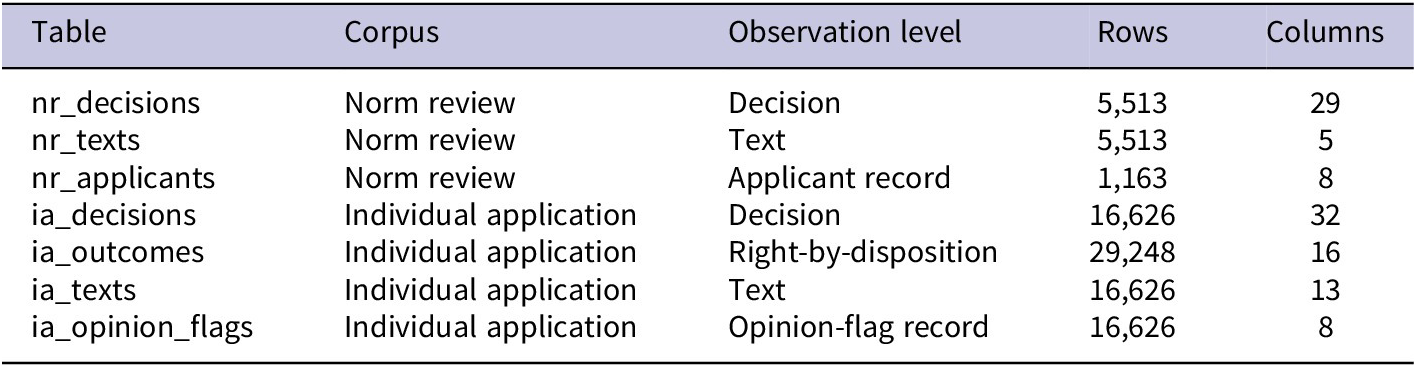



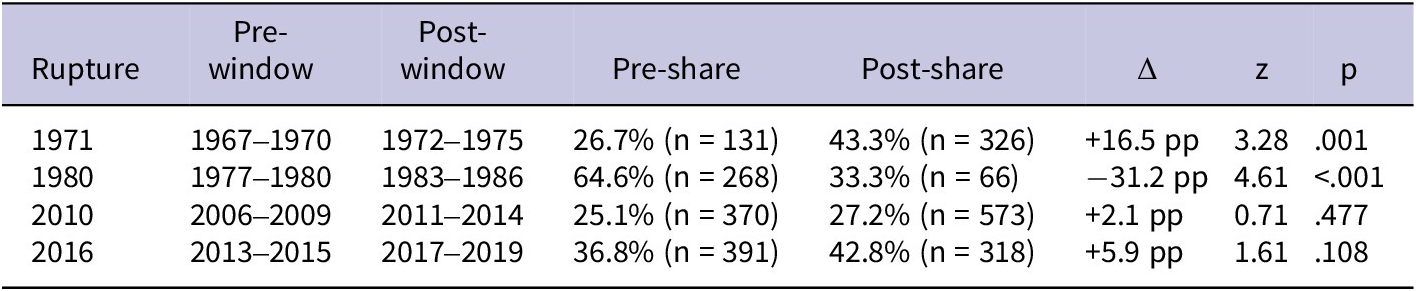

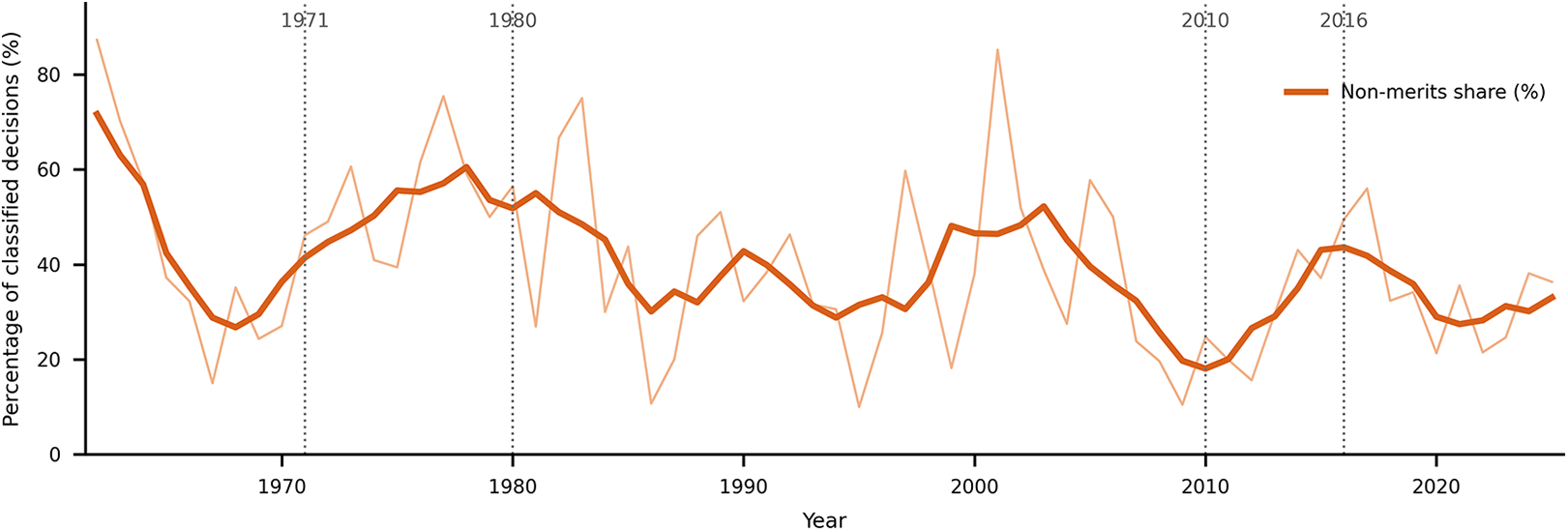

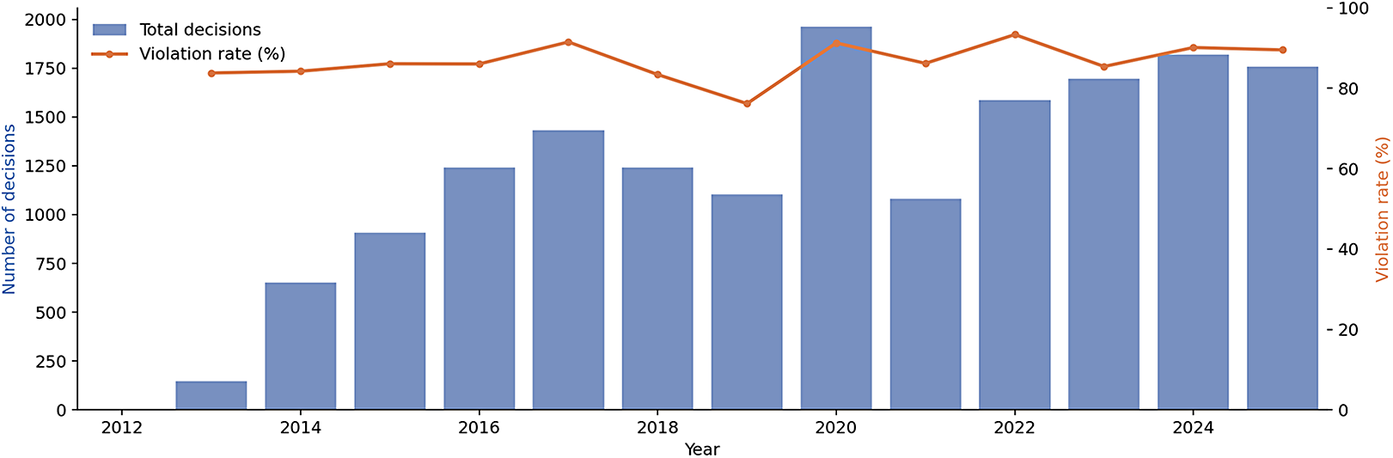

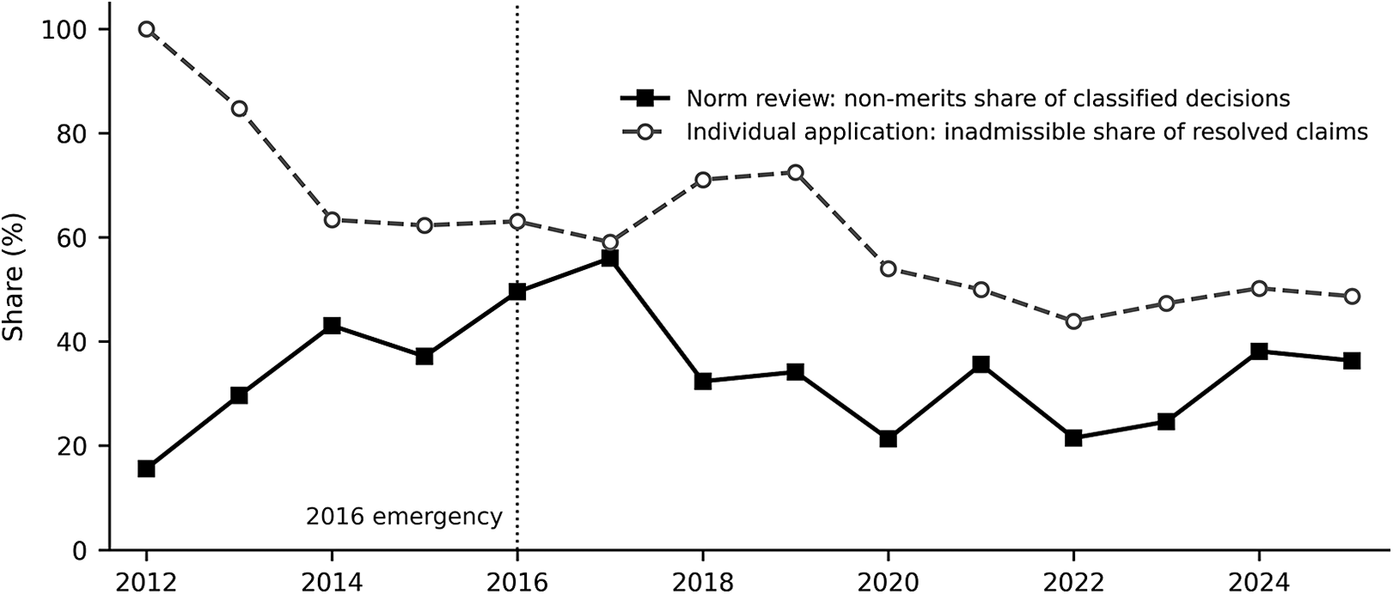


 Open access

