





1. The issue
The Camuno dialect of Val Camonica, northern Italy provides a rare example of the use of ‘do’-support within a Romance language (Benincà & Poletto, Reference Benincà and Poletto2004; Swinburne, 2021). Syntactically, ‘do’-support consists of a support verb fa (a reflex of Latin FACERE ‘do, make’) with subject enclitic, followed by an infinitival supported verb (1).Footnote 1 The construction, referred to here as fa-support, or FS, exists only in the interrogative.

Within the valley dialects there are some where FS is obligatory, and others where its use is optional and lexically restricted. If this synchronic dialectal variation is reconstructed into a diachronic sequence, what emerges is a typical grammaticalization chain (Swinburne, 2025). FS begins its path as a construction where a lexically rich ‘do’ is used in conjunction with a semantically similar verb: an activity verb with agentive subject. It ends this journey as the obligatory form used with all verbs, and auxiliary ‘do’ as a bleached shell.
Along with this process comes an increase in frequency. In the first stage, it increases within its core group of agentive-subject activity verbs until it is almost categorical. This propels its expansion to less compatible verbal types: first to non-active eventive, theme-subject verbs, and then to stative verbs with experiencer subjects. Thus the frequency increase involves a feedback mechanism: it is both the cause and the consequence of the grammaticalization (Bybee, Reference Bybee, Joseph and Janda2017).
What drives the frequency increase in the first place is the particular meanings of the lexically restricted ‘do’-support construction. Compared to the old main-verb construction, the new ‘do’-support construction is found to be more engaging, expressive, and “extravagant” (sensu Haspelmath, Reference Haspelmath, Fischer, Norde and Perridon2004), and is also used to show respect to neighbors (Swinburne, 2024b). It becomes indexical to the valley.
If those were the only forces operating, and so FS was found to be advantageous in all communicative situations, complete generalization and grammaticalization of the form would presumably be inevitable. In some Camuno varieties, such as the dialect of the isolated community of Monno in Upper Val Camonica (Benincà & Poletto, Reference Benincà and Poletto2004), this has happened. Here ‘do’-support is essentially obligatory, and the alternative—the regional form based on the main verb alone—has been effectively eliminated. The more interesting question is then why, in communities lower in the valley which are more open to the outside, such as Esine in Middle Val Camonica, the construction has failed to generalize much beyond activity verbs and remains highly optional.
In this particular case of grammaticalization, it is apparently the more advanced form—the obligatory Monno construction—that is found in the isolated location. The seemingly more primitive form—the optional, lexically restricted Esine construction—comes from the contact zone between valley and non-valley dialects. What appears to have happened is that the continual reintroduction of the regional form, and so dilution of FS, has prevented its cascading through the different verbal classes and restrained any runaway grammaticalization. The example then seems to run counter to what dialectologists normally expect: that the archaic forms are preserved in the most isolated locations (e.g. Chambers & Trudgill, Reference Chambers and Trudgill1998:168). In fact, both forms—when the layer of more recent dialect leveling has been stripped away—are archaic, but the form from the contact zone is the less developed.
The explanation for the relative degree of grammaticalization, as this paper will demonstrate, lies in the social meaning of the ‘do’-support form and the different social networks of the speakers. More isolated communities tend to have internally orientated social networks. Speakers from these communities have embraced ‘do’-support as the valley “insider” form and had little need for the alternative. In the more open communities, speakers needed both an “insider” and “outsider” form. This kept the frequency of ‘do’-support low so there was no impetus for grammaticalization.
The Monno and Esine ‘do’-support constructions are shown here to represent two extremes of a sequence along the main valley, with dialects in between representing intermediate stages of generalization. Furthermore, there is not just one sequence within the valley system: besides the main valley sequence, there are two quite separate progressions within side valleys. In all instances, the more grammaticalized, “advanced” form is found in the isolated location, but the more lexically restricted “primitive” form is found in the dialect contact zone.
The following discussion begins in Section 2 with a brief description of the ‘do’-support form and its alternative, including its special semantic–pragmatic meanings and their social significance. Section 3 describes the experimental methodology used to measure the degree of grammaticalization of the form. Section 4 presents a map of the valley showing the degrees of optionality of FS in the different community dialects. Section 5 first puts Camuno in the general context of northern Italian dialects then describes geographically the different community dialects and the speakers’ attitudes towards use of the ‘do’-support form. Section 6 sums up the factors which, in this system, propel or restrain the grammaticalization.
2. The phenomenon of fa ‘do’-support in Camuno
Following Benincà & Poletto’s (Reference Benincà and Poletto2004) paper on the Monno dialect, Manzini & Savoia (Reference Manzini and Maria Savoia2005:Vol.1, Ch.3:602–604) also included ‘do’-support examples from Incudine and Vezza d’Oglio, other Upper Valley locations in which its use is essentially obligatory.Footnote 2 Later, in 2017–2024, Swinburne charted its presence within the Middle and Upper Valley, including in many dialects where its use was optional. That work led to a thesis (Swinburne, 2021), and several specialized papers on different aspects of the construction (Swinburne, 2024a,b, 2025, in review).
FS is used in yes/no and wh-questions, and in all tenses that otherwise lack an auxiliary, i.e. the present, future, conditional, and imperfect. When used as a support verb in the declarative, fa is recognized as a different, causative verb, even though fa ‘do’ and fa ‘cause’ are synonymous in most dialects. They are however clearly distinguished by the position of non-subject clitics and the absence/presence of a causee (see arguments in Swinburne, 2025).
The alternative to FS is the regional Lombard method of interrogation using the main verb and subject clitic, known as subject–clitic inversion, or SCI, because the order is the reverse of the corresponding declarative. The examples below are from the Monno dialect (2, 5) (only FS possible) and Esine dialect (3, 4, 6) (FS and SCI usually possible).Footnote 3
Interrogatives

In the Monno dialect, FS is obligatory with all verbs except ‘be’ and ‘have’, with which it is never used, and ‘know’ and ‘want’, with which it is optional. With other stative verbs however, such as ‘think’, FS is the only possible form (5a), and speakers judge SCI (5b) as ungrammatical, or not belonging to their dialect. In contrast, in the Esine dialect, where FS is little used with stative verbs, SCI (6b) is the normal form. However, FS (6a) proves to be possible for some speakers, so it is not ungrammatical, just rare and strongly marked.

Using the elicitation experiment to be described in Section 3 below, Swinburne (2024a) measured which interrogative form was used with different types of supported verb, ranking verbs in order of most to least likely to take FS. The sequences were then compared between groups of speakers who had generalized FS use to varying degrees, to demonstrate the pattern of FS extension across the different verbal classes.
In addition to the semantic preferences of supported verb, when both FS and SCI are available to a speaker, FS is associated with special meanings. Logically, FS is presuppositional, and the speaker is indicating that they already have an idea of the answer to their question (Swinburne, 2025, in review). FS is therefore more likely to be used with another valley “insider” where speaker and addressee share a good deal of common ground. Expressively, FS is subjective, engages the addressee in conversation, and is more polite, appropriate for neighbors and family elders (Swinburne, 2024b). Between two valley “insiders” who are close friends or relatives of similar age, when there is no need for this additional ceremony or further discussion, SCI, as the shorter form, may be preferred.Footnote 4
Combining the two types of information: the lexical preferences of supported verb, and the special meanings to the FS question, Swinburne (2025) characterized the types of FS in the different valley communities in three ways. In dialects where FS is most optional, used at lowest frequency, and least grammaticalized, it was labeled as pragmatic, implying that even with agentive-subject activity verbs, its use is determined primarily by the context. In more grammaticalized dialects, where FS is used at greater frequency and almost categorically with activity verbs, FS is agentive: the type of supported verb is most important, although pragmatics remains relevant for non-activity verbs. Finally, in the most grammaticalized dialects, FS use is generalized, and essentially obligatory apart from with a few remaining stative verbs.
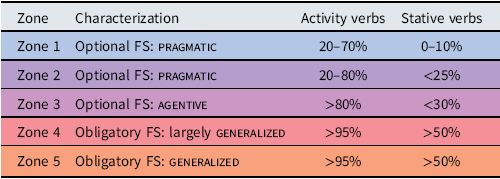
While Swinburne (2025) reconstructed the sequence of grammaticalization by combining speakers from different communities and different dialects with a similar type of use of FS (to increase the number of tokens and so chart the pattern by verbal type), this paper is instead focused on describing and explaining the geographic pattern by community. The three degrees of grammaticalization (pragmatic, agentive, and generalized) are here split into five and their distribution plotted on a map as a series of zones. Zones 1 and 2 have pragmatic FS (Zone 1 with almost no use with aspectuals and causative fa compared to Zone 2); Zone 3 is agentive. Zones 4 and 5 have generalized FS (Zone 4 with stative verb restrictions with ‘can, could’, and Zone 5 without). This is summarized in Table 2 in Section 3 below.
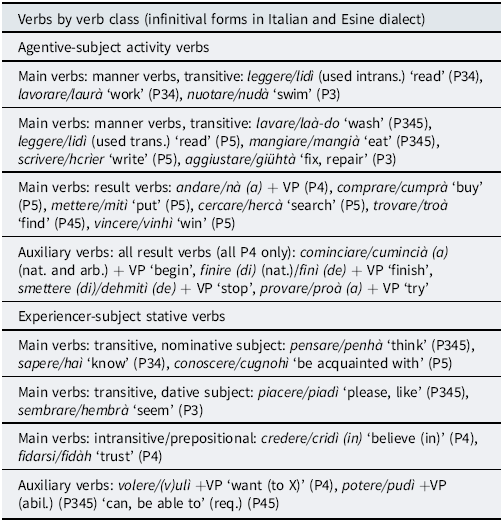
Activity and stative verbs used to characterize FS optionality

Table 1 Long description
A table categorizing verbs by verb class in Italian and Esine dialect. The table is divided into two main sections: Agentive-subject activity verbs and Experiencer-subject stative verbs. Each section is further divided into subcategories. Agentive-subject activity verbs include Main verbs: manner verbs, transitive, Main verbs: manner verbs, intransitive, Main verbs: result verbs, and Auxiliary verbs: all result verbs. Experiencer-subject stative verbs include Main verbs: transitive, nominative subject, Main verbs: transitive, dative subject, Main verbs: intransitive/prepositional, and Auxiliary verbs. Each subcategory lists specific verbs with their translations and associated parameters. For example, under Main verbs: manner verbs, transitive, the verbs listed are leggere/lid (read), lavorare/laur (work), and nuotare/nud (swim) with their respective parameters. The table provides a comprehensive overview of the verb classes and their usage in both Italian and Esine dialect.
Although the final maps (Maps 1 and 2) show a relatively simple pattern clearly related to the geography, producing them has not been a simple matter. It has involved understanding the social uses of the form, setting up the experiment to reduce interviewer effects, and using strong informant selection criteria. This was necessary in order to “strip away” the largely post-1960s effects of dialect leveling (described in detail in the narrative of Section 4 although not the main focus, to reveal the underlying pattern. That this represents a pattern of grammaticalization (extension across the verbs), which is the terminology used in the following account to refer to these diffusive changes, rather than one degrammaticalization (retraction in the range of possibilities—an argument already made in Swinburne, 2025), is returned to in the conclusions).
The following section summarizes the elicitation experiment methodology before a presentation of the detailed findings by community.
3. Methodology of elicitation experiment
The experiment required the participant to listen to a dialect recording of an imagined situation which prompted them to ask a question of one of the participants in the scene, so rephrasing a declarative form as an interrogative. The participant was told they were having a conversation with a valley friend and were encouraged to make their question sound “real” by using appropriate intonation (i.e. to focus on what they were trying to say, distracting them from the form they produced). An English translation of a context, with question request also in the original Breno dialect, is provided in (7).

In general, contexts described situations both participant and interviewer could relate to: people catching trains, going shopping, looking after grandchildren and elderly relatives, gossiping about neighbors, watching television, etc. The purpose was to engage speakers in the 60–85 age range, men and women, and from a range of occupations and educational levels: agricultural workers, factory and utility workers, shopkeepers and business people, housewives, school teachers, and librarians. Some had a very local circle of acquaintances, others mixed more widely.
In the main questionnaires for each of the three phases of the elicitation experiment (referred to here as P3, P4, P5) the aim was to measure the probability of FS use by semantic type of verb, as the syntax was shown not to be important (see Swinburne, 2021:Appendix A6c). Tokens were in the present tense, mostly with a habitual–generic meaning for non-stative verbs (to prevent use of a continuous tense with a ‘be’ auxiliary and adverb), and were yes/no questions. Other than with theme-subject verbs, elicited questions used the second-person singular form. P3 had three tokens per verb, and P4 and P5 had four, which helped average out any effect from the context pragmatics. In any case, by recording the context, all participants were presented with exactly the same situation allowing direct comparison of their FS/SCI usage irrespective of the question (This is a strong argument for using anelicitation method rather than a corpus, where the context is unique for each token.). In total, there have been six phases of data gathering yielding around 15,000 examples from around 200 speakers. Of these, P3, P4, P5 used this elicitation method, and of that, a subselection of 5213 tokens from 50 speakers is reported here.
A different selection of verbs was chosen for each experimental phase, although there was considerable overlap between phases (Table 1). This provided reasonable consistency in the characterization of FS use by individual speaker even though the actual verbs varied between the phases.
In most communities there is only minor variation between speakers so the community as a whole can be characterized; in others there are two types of FS (and the division will be shown to be predictable, given the different social roles of the speakers). The five-point scale used to characterize each community dialect is shown in Table 2, and related to the tripartite division by speaker of Swinburne (2025). It is colored in the same way as the maps presented in this paper. For full results of FS by speaker and community for each experimental phase, see the Appendix.
Definition of geographic zones of FS based on degree of optionality with activity and stative verbs

Table 2 Long description
A table categorizing geographic zones based on the use of full stop (FS) with activity and stative verbs. The table has five rows and four columns. The columns are labeled Zone, Characterization, Activity verbs, and Stative verbs. The rows are labeled with Zone numbers from 1 to 5. Row 1: Zone 1, Optional FS: pragmatic, Activity verbs: 20-70 percent, Stative verbs: 0-10 percent. Row 2: Zone 2, Optional FS: pragmatic, Activity verbs: 20-80 percent, Stative verbs: less than 25 percent. Row 3: Zone 3, Optional FS: agentive, Activity verbs: greater than 80 percent, Stative verbs: less than 30 percent. Row 4: Zone 4, Obligatory FS: largely generalized, Activity verbs: greater than 95 percent, Stative verbs: greater than 50 percent. Row 5: Zone 5, Obligatory FS: generalized, Activity verbs: greater than 95 percent, Stative verbs: greater than 50 percent.
Note. Zone 1 is distinguished from Zone 2 by lower use with aspectuals and causative fa (see Swinburne, 2021:Fig. 8.9, p. 235), and Zone 4 from Zone 5 by optional use with modal verb ‘can, could’. The cutoff of >50% use with stative verbs is relatively low due to the inclusion of tokens of each of three meanings/uses of this verb in P4, and of ‘know’ in P3, P4.
As will become clear below, it was essential to have strong selection criteria for speakers who participated in the elicitation experiment. They declared themselves to have dialect as their first language, having grown up speaking it with family and friends (at least outside school), and were mostly born 1927–1962Footnote 5. Although they were almost all fluent bilinguals and used many Italian lexemes, they did not mix the grammar, for example by using Italian verbal endings and dropping the subject clitics. Within this group of speakers, there was no obvious correlation with age (so it is not possible to chart any continuing grammaticalization of FS by using the apparent time method).
The next section presents the results of FS degree of generalization by community and its relationship to the valley geography.
4. Geographic pattern of FS grammaticalization
Map 1 is a simplified map of the valley with the FS area colored according to the degree to which FS has generalized. It neatly demonstrates the main point: that FS is at its lowest degree of grammaticalization in the south near Esine in the Middle (Oglio) Valley (MV) and steadily increases north towards Monno (and Vezza d’Oglio) in the Upper Valley (UV). A separate sequence is present up the Grigna valley towards Bienno (and Prestine), and down the Ogliolo valley from Corteno Golgi towards (Edolo and) Monno. In addition, several communities in the upper MV show generalization within different sections of the community.
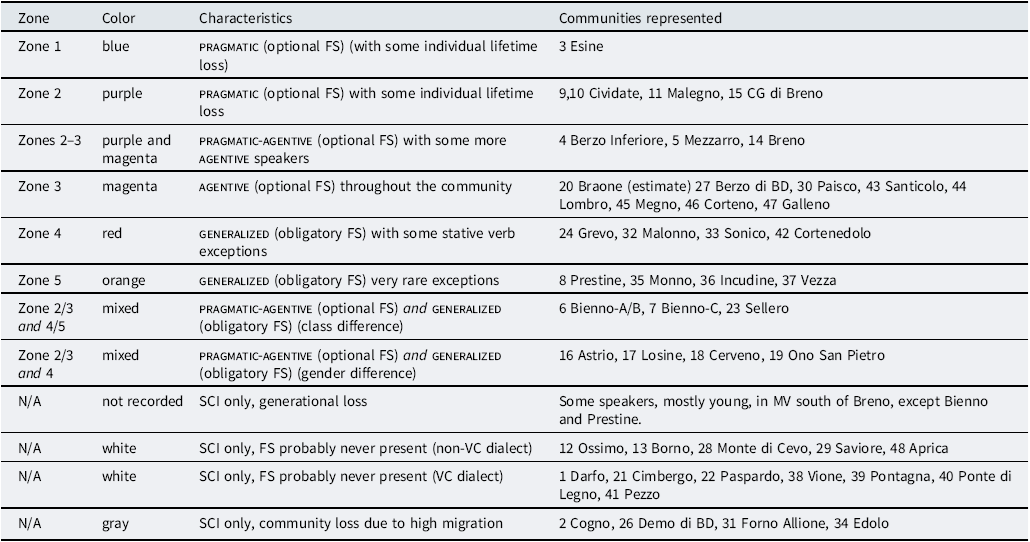
The picture is shown in more detail in Map 2 and Table 3, which includes all the datapoints used to compile Map 1.
Communities sampled and their degree of optionality of FS

Table 3 Long description
A table categorizing communities by zones, colors, characteristics, and specific communities represented. The table has four columns: Zone, Color, Characteristics, and Communities represented. It contains 15 rows, each detailing specific zones, their associated colors, characteristics, and the communities within those zones. Row 1: Zone 1, blue, PRAGMATIC (optional FS) (with some individual lifetime loss), 3 Esine. Row 2: Zone 2, purple, PRAGMATIC (optional FS) with some individual lifetime loss, 9,10 Cividate, 11 Malegno, 15 CG di Brenno. Row 3: Zones 2-3, purple and magenta, PRAGMATIC-AGENTIVE (optional FS) with some more AGENTIVE speakers, 4 Berzo Inferiore, 5 Mezzarro, 14 Brenno. Row 4: Zone 3, magenta, AGENTIVE (optional FS) throughout the community, 20 Braone (estimate) 27 Berzo di BD, 30 Paisco, 43 Santicolo, 44 Lombro, 45 Megno, 46 Corteno, 47 Galleno. Row 5: Zone 4, red, GENERALIZED (obligatory FS) with some stative verb exceptions, 24 Grevo, 32 Malonno, 33 Sonico, 42 Cortenedolo. Row 6: Zone 5, orange, GENERALIZED (obligatory FS) very rare exceptions, 8 Prestine, 35 Monno, 36 Incudine, 37 Vezza. Row 7: Zone 2/3 and 4/5, mixed, PRAGMATIC-AGENTIVE (optional FS) and GENERALIZED (obligatory FS) (class difference), 6 Bienno-A/B, 7 Bienno-C, 23 Seller. Row 8: Zone 2/3 and 4, mixed, PRAGMATIC-AGENTIVE (optional FS) and GENERALIZED (obligatory FS) (gender difference), 16 Astrio, 17 Losine, 18 Cerneno, 19 Ono San Pietro. Row 9: N/A, not recorded, SCI only, generational loss, Some speakers, mostly young, in MV south of Brenno, except Bienno and Prestine. Row 10: N/A, white, SCI only, FS probably never present (non-VC dialect), 12 Ossimo, 13 Borno, 28 Monte di Cevo, 29 Saviore, 48 Africa. Row 11: N/A, white, SCI only, FS probably never present (VC dialect), 1 Darfo, 21 Cimbergo, 22 Paspardo, 38 Vione, 39 Pontagna, 40 Ponte di Legno, 41 Pezzo. Row 12: N/A, gray, SCI only, community loss due to high migration, 2 Cogno, 26 Demo di BD, 31 Forno Allione, 34 Edolo.
One further linguistic point to note is that the junction of the MV and UV at Berzo Demo, besides marking the change from optional FS (Zone 3) to obligatory FS (Zone 4), coincides with a major phonological change which also affects adjacent Bergamasco dialects. Known locally as the s-aspirata, what in the UV is an /s/ (from either Latin /s/ or /k/) is pronounced as /h/, e.g. MV/UV/Ital. sul/hul/sole ‘sun’, sena/hena/cena ‘dinner’ (see Rohlfs (Reference Rohlfs2021 [Reference Rohlfs1966]: §152, 200–203; §165, 224–227). Note in addition that this regional /s/>/h/ should not be confused with an /f/>/h/ change in the pronunciation of the support verb fa in the Bienno area.
The following section looks at FS use by community. The reader is also invited to follow the description while using Google Maps (satellite view), to assess for themselves the extent of connections between communities. The detailed discussion is preceded by a general introduction on northern Italian dialects.
5. Detailed pattern of FS variation within
the Camuno dialect
5.1. Camuno within the northern Italian dialect system
Italy is known for the diversity of its dialectal system. This is due in part to its mountainous terrain, but also because it was only after unification in 1861 that it adopted a standard language (originally a Tuscan dialect). Its dialects are the direct descendants of Latin, and most, like Camuno, are primarily spoken and without significant literature. Camuno is a local variety of Bresciano, an eastern Lombard dialect (see Sanga, Reference Sanga1984:9), and part of the Gallo-Italic family of Pellegrini (Reference Pellegrini1977). Although each valley dialect has its own specific traits, together they form a dialect continuum, as evidenced in atlases such as the Atlante Italo-Svizzero (AIS) (Jaberg & Jud, Reference Jaberg and Jud1928–1940). For general reviews of the Italian dialect system, see Benincà, Parry & Pescarini (Reference Benincà, Parry, Pescarini, Ledgeway and Maiden2016), Berruto (Reference Berruto, Auer, Hinskens and Kerswill2005), and Loporcaro (Reference Loporcaro2009).
Within Camuno, although all varieties are mutually intelligible today (they were not necessarily so 50 years ago) and morphosyntactically almost identicalFootnote 6, each is distinct in terms of phonology, lexis, and idiomatic expressions. The dialect uniqueness is a consequence of the strong local affiliation of the people, as reflected in the family names. Because most men, and to a lesser extent the women, have stayed within their community of origin, some villages are composed of only a few extended families. They still mostly inhabit large multi-generational houses, which helped (until recently) to pass on the family language from grandparents to grandchildren. The local language is part of the cultural heritage and there is a flourishing circle of dialect poets, playwrights, and dialect students.Footnote 7 A desire to remain within their community of origin remains strong, and even though many people go away to work (by day, by week, or for longer periods), many eventually return.
In comparison to the urban areas of the Po Plain, despite its high mountains, Val Camonica has never been cut off from the outside. During the Venetian empire (1428–1797), where the valley formed the northwestern frontier, it flourished due to its rich timber, iron ore reserves, and hydropower. In most towns and villages the grandest houses and church restorations date from the late fifteenth century. From at least this time on, speakers with more extensive social circles have been diglossic with at least one H-variety (a dialectal koiné and/or Italian) in addition to the local dialect, the L-variety (Trumper, Reference Trumper, Simone and Vignuzzi1977:263–265; Sanga, Reference Sanga1984:10–13; Benincà et al., Reference Benincà, Parry, Pescarini, Ledgeway and Maiden2016:185–187). In today’s dialect, for some more middle-class speakers, diglossia is apparent through a separate regional dialect “outsider” register within the local dialect.Footnote 8
In the late nineteenth century, development and industrialization resulted in a steadily growing population for the Provincia di Brescia, as recorded in census records (Figure 1). In the south of the MV this increase has continued to the present day despite the interruption of two world wars, the rate increasing after the Second World War (WWII) (e.g. Esine and Cividate). In the UV, although some communities grew in the early years of the Italian Republic, many have subsequently declined (e.g. Berzo Demo and Corteno Golgi). Furthermore, throughout the valley, almost all the smaller communities (e.g. Monno), have been consistently losing population. In fact, Monno’s population today of around 500 is half of what it was, both in 1861 and at the height of the Venetian empire.Footnote 9 In the following account, the population of key places for the years 1861 and 2021 is indicated after the place name.
Population 1861–2021 in various Middle and Upper Val Camonica communities. Data from https://www.tuttitalia.it/lombardia/provincia-di-brescia/statistiche/censimenti-popolazione/ (March 25, 2024).

The post-WWII development had significant effects on the intricate dialectal pattern all over Italy (e.g. see Pellegrini, Reference Pellegrini1960; Sobrero, Reference Sobrero1996; Berruto, Reference Berruto, Auer, Hinskens and Kerswill2005), due to gradual loss of the rural economy and the contadino lifestyle. Traditionally each family had their orto ‘vegetable garden’ and kept animals in a barn within the main house with a hay loft to feed them. The lifestyle was physically tough, particularly in winter, and when opportunities arose for other kinds of work, many took them willingly.
New industries sprouted along the rivers and there were significant road improvements. In the MV north of Esine, the main phase of industrialization began in the late 1950s but peaked in the early 1960s. People came from further afield to work in the valley, and more locals traveled south to jobs in Brescia and Milan. This resulted in a substantial increase in dialect mixing and koinéization with other Bresciano dialects as well as Italian (effects often very difficult to distinguish: see Berruto, Reference Berruto, Auer, Hinskens and Kerswill2005:84), and a gradual breakdown of the previously stable diglossic system.
Linguistically, many people found the more modern, cosmopolitan way of speaking attractive, and less associated with the isolation of former times. They dropped the characteristically local features—FS is one of these—and simplified their dialect. Others who embraced the traditional contadino lifestyle rejected the regional koiné as an unwanted “foreign” influence and kept their dialect as it had been. These speakers maintained either a complex and refined dual FS-SCI system, or FS as the only form. The timing of industrialization is evident in the history of FS and is the reason why many MV speakers (except in Bienno-Prestine) born before around 1962 have usually lost FS.
Starting in the 1970s, the spread of mass media, particularly television, as well as longer schooling in Italian, has also directly Italianized the dialect. Today most conversations between locals involve intricate code-mixing and switching between Italianized dialect and dialectally influenced Italian. The grammar, however, is usually quite distinct: either dialect or Italian. One exception to this may be in dropping SCI for a declarative order of subject proclitic and main verb, (Benincà & Poletto, Reference Benincà and Poletto1997:7; Poletto, Reference Poletto2000:42) referred to here as QDec. With QDec, question and statement are then, as in Italian, distinguished solely on the basis of intonation. Finally, after the 1980s, most parents began to speak only Italian to their children, fearing that speaking dialect would hinder them in later life. Today dialect use is stigmatized, often seen as a marker of lower educational levels, and it has been almost entirely lost within the youngest generations.
Due to these influences, most speakers have changed their dialects to a greater or lesser extent during their lifetime. The contrast is evident with speakers who have preserved their dialects because they moved away from the valley as young adults, rarely speaking dialect until they returned much later. There is widespread recognition that the dialect spoken today isn’t what it used to be. People look back wistfully to a time when, they imagined, there was a pure, original dialect. Yet to some extent they are deceiving themselves: dialect has always been changing; what is different is that recently it has been changing more rapidly, and with this has come a leveling and loss of dialectal diversity.
Despite all the recent changes, FS is still alive and well within the speech of most dialect Camuno speakers born before the early 1960s. Taken together, their dialects demonstrate a regularity in the degree of extension and grammaticalization of the form which reaches its height in the more isolated areas. It is contended that this pattern is an old one. Only in more isolated rural areas has FS been allowed to generalize and grammaticalize into a relatively “advanced” form. In contrast, in the more open areas of the valley, there has always been dialect contact, preventing the generalization of FS, and maintaining a “primitive” type.
The underlying pattern of grammaticalization of FS and its spread through the verbal types was likely a relatively slow process taking place over hundreds of years. In contrast, the dialect leveling which brought about wholesale replacement of FS by SCI has occurred quickly, and in those places when there has been a sudden influx of outsiders. In the last 50 years, this leveling has affected most of the lower MV to various extents, some sections of the populace more than others, and has led to change within the lifetime of some individuals. The intent here has been to see through this more recent overprint.Footnote 10 The important point is that the dialect leveling has not changed FS use with respect to the verbal classes, a process which would be called lexicalization (or even reverse grammaticalization/degrammaticalization); it has left them unaffected. This issue will be returned to in the conclusions.
In the following narrative, these effects will become apparent through details of the communities and speaker attitudes towards the local dialect, regional dialect, and Italian.
5.2. Lower Oglio Valley
5.2.1. South of Pianborno-Esine: Darfo (1) and Cogno (2)
As is apparent from Maps 1 and 2, the small town of Esine marks the most southerly limit of FS in today’s dialects. South of Esine the area is now densely developed, and communities such as Darfo or Boario, which were once separate, have become fused into one conurbation. South of Pianborno, which is slightly south of Esine, there is no evidence for FS in the present-day dialects, or within living memory.
Adjacent to Esine on the western side of the river, and south of the western part of Cividate, is the community of Cogno. Here FS has not been present since the 1920s at least (judging by the age of the participant and extrapolating to the parents’ generation). From the early 1900s, Cogno was the site of the large Olcese textile factory, a major regional employer, so even if FS had once been present, it was likely dropped in favor of SCI to make the dialect more “user-friendly.”
5.2.2. Esine (3)
Esine (pop. 1477/5118), the southernmost community at which FS is found today, also marks the northernmost end of what was historically the navigable portion of the river. This is an indication that a degree of isolation has been required for its preservation, and perhaps also the initial development of this particular valley form. In Esine, I heard FS used in casual conversation in the street and the bars, mostly between men aged around 55 or older. Younger speakers from Esine and other lower MV communities told me that FS is regarded as an archaic form characteristic of their parents’ or grandparents’ generations. They recognize it but don’t use it themselves, except perhaps in certain fossilized idioms.
Despite the widespread use of FS among the older Esine speakers, many either did not produce it at all in the experiment or failed to produce enough for its properties to be statistically measurable. In several instances a speaker had acknowledged in a prior interview that they used it, and had even discussed its use. This lack of its production was then a reaction to the experimental conditions, and particularly a feeling towards the interviewer, who was too much of a community “outsider” for its use to be considered appropriate under these circumstances.
Other older speakers, although they recognized FS, acknowledged they no longer used it (even with community “insiders”). A fine example of this modernization of the dialect is in the contrast within six members of one extended Esine family. In their early 20s, two brothers took jobs working for the railway in Brescia and adopted a modified Bresciano dialect to speak to their co-workers, who mostly came from adjacent mountain valleys. Their sister moved south in the valley, out of the zone of FS. A third brother (a linguist), and two female first cousins, stopped speaking dialect because they left the valley for study and/or marriage and switched entirely to Italian. When interviewed, the three who had continued to speak dialect rarely produced FS spontaneously, but those with their “fossilized” dialect produced considerable FS, allowing its use by verb to be measured.Footnote 11 The linguist brother viewed the dialect of his two railway-worker brothers as typical of the changes that had happened to the Esine dialect during his lifetime.
Lifetime change due to strong Italian influence was also evident in an Esine speaker aged 92 at the time of the interview (b. 1927), but still mentally very sharp, and who had been a schoolteacher. Although he rarely used FS in the experiment (preferring SCI probably because it is more similar to Italian), he attributed this to the many years spent in the school environment where dialect was not tolerated. He remembered FS as having been very common in the Esine dialect when he had been a boy in the 1930s and 1940s. He recounted how, in his youth, dialect was the normal community language and even used at town hall meetings.
FS use by verb was measured in five Esine speakers, four with fossilized dialects (the three from that family, and an unrelated man) and a fifth woman from a contadino family and who had always remained in Esine. From those measurements the Esine dialect is assigned to Zone 1, the lowest zone of grammaticalization and the one where there is strongest preference for an agentive subject. The “youthful” dialects of the four Esine speakers are good evidence that both SCI and FS were present in the dialect in the 1950s before the main phase of industrialization, and that there was a strong preference for FS use with agentive-subject activity verbs.
5.2.3. Cividate (9, 10), Malegno (11), Berzo Inferiore (4), Mezzaro di Breno (5), and Breno (14, 15)
The richest area of optional FS dialects is a relatively open area between the main Oglio valley and the valley of the River Grigna. The terrain is one of gently rolling hills bordered by forested mountains. Historically, although communities were geographically separate from each other, there was always some travel between them, even prior to the late 1960s road improvements and later widespread use of family cars.
In places such as Cividate (772/2655), Malegno (981/1960), and the different frazioni (satellite villages) of Breno (2838/4632), dialect thrives among the older population and each community’s dialect is distinct. As regards FS, communities north and west of the Oglio, such as Malegno (most speakersFootnote 12), the adjacent part of Cividate, Breno, Campogrande di Breno, and Astrio di Breno (see below), use the standard fa pronunciation. The main part of Cividate, which is south and east of the Oglio, Mezzarro di Breno, and Berzo (between the Oglio and Grigna valleys) have a ha pronunciation typical of the Bienno area (on the River Grigna), indicating the connections to Bienno were stronger than to Breno or Esine.
In all these central MV communities, FS is always optional and I found no speakers who had generalized the form, although there were many who used it little (including speakers over 90), or who had apparently dropped it entirely. The strong optionality is probably because this part of the valley is, and always has been, in contact with SCI-only Lombard dialects to the south so all sections of the community have needed a means to make questions that “outsiders” could understand. Numerous speakers also attested to the particular pragmatic properties of FS, including showing politeness and respect to neighbors (Swinburne, 2024b).
These dialects are placed in Zone 2, or Zone 2–3, there being no relevant differences between dialects with the fa pronunciation and those with ha.
5.2.4. Ossimo (12) and Borno (13)
On the western side of this area adjacent to Cogno-Cividate-Malegno are sheer rock walls, and only in places do roads wind upwards with numerous hairpin bends. This abrupt difference in relief accounts for the sharp dialect boundary between Malegno, with its optional-FS valley dialect, and the non-FS Bergamasco-like dialects of the hillside communities of Ossimo and Borno. There is also a major phonological difference between the valley dialects with /s/>/h/ and those of Ossimo and Borno (part of the Val di Scalve) where instead there is general /f/>/h/ (see discussion in Swinburne, 2021:250–253). It is possible that this general /f/>/h/ has influenced the production of fa in the Bienno area, resulting in ha.
5.3. Upper Grigna Valley (and rural Oglio)
5.3.1. Bienno (6, 7), Prestine (8), and Astrio di Breno (16)
The Grigna valley, which meets the Oglio valley at Esine, runs up river through Berzo Inferiore to the small town of Bienno and then the village of Prestine. The Grigna valley communities all use a ha pronunciation to FS, regardless of whether FS is optional or obligatory. This makes it clearly distinct from causative fa although then similar to the paradigm for ‘be’ (Swinburne, 2021:Ch. 9).
Bienno (1726/3760) holds an important place in the history of FS (as recorded in the dialect continuum), because within its populace it preserves the stages of the final generalization. Bienno is an extremely dense medieval city with clustered buildings, which both reflects—and perhaps is also responsible for—fostering a strong internal sense of community, as well as social stratification. Historically a regional center, the town is recognized for its iron industry and strong artisan traditions.Footnote 13 Within the population of Bienno are recognized at least two groups (which some people even associate with different accents): the agricultural workers (i contadini), and the iron furnace workers (i fabbri). Socially, the contadini and fabbri were sufficiently well defined in Bienno society that the main church had (and still has) two entrances with these titles over the doors. Another speaker, who provided data for all phases of this study, came from a wealthy land-owning family representing what may be a third population, the owners (i proprietari). The three groups of Bienno speakers are assigned here different names: Bienno A (proprietari); Bienno B (fabbri); and Bienno C (contadini). The Bienno A/B speakers have optional FS; the Bienno C speakers have obligatory FS. FS is so strongly a part of the Bienno dialect that, unlike in the central MV dialects, I found no dialect speakers who used only SCI.
The one Bienno A speaker, a retired schoolteacher, was, on occasion, highly selective in her use of FS, both according to the supported verb and the context. She also provided reasons for her pragmatic choices, exploiting the expressive and interrelational qualities of FS when SCI is a possible alternative, citing the same criteria as speakers from Cividate and Malegno. The Bienno B speakers (a postal worker and a bartender), who were less selective, also tended to use the declarative form with question intonation (QDec) as commonly as SCI, which is probably a sign of Italian influence. Thus the more middle-class Bienno A/B speakers, who presumably have the greater need to communicate with non-valley outsiders, can use SCI/QDec for this purpose. Bienno C speakers (measured in father and son, artisans and agricultural workers, and an unrelated retired schoolteacher from upper Bienno), whose communication is strongly internal to the community and surrounding rural areas, have only FS for making all questions.
The optional FS of Bienno A/B speakers is placed in Zone 3; the largely obligatory FS of Bienno C speakers in Zone 4.
In the neighboring community of Prestine farther up the Grigna valley, the generalization of FS has proceeded to an even higher degree (Zone 5, on a par with Monno). In former times Prestine was separate from Bienno. Above Prestine, the road passes through a long uninhabited stretch to the high mountain pass of Passo di Crocedomini (1892 m), and historically there was only limited, seasonal traffic. The former isolation of Prestine is evident in the unique pronunciation, where the /h/ sound of all words with an underlying /s/, as well as the /h/ of ha with its underlying /f/, is often dropped, both in dialect and in Italian. In addition, there is an uvular /r/. The pronunciation is because, for many generations, Prestine families migrated to France for work, and for some older speakers French is their first language.Footnote 14
The neighboring community of Astrio di Breno, although it is in the Oglio watershed, is included in this section only because it also has an obligatory FS generalized to at least Zone 4. The village is particularly isolated, deep in the forest, and reached by winding mountain roads from Prestine or Breno, but its primary affinity with Breno is indicated in the dialect by the fa pronunciation to FS.
5.4. Middle Oglio Valley and Allione Valley
5.4.1. West of the Oglio: Losine (17), Cerveno (18), and Ono San Pietro (19)
Immediately north of Breno on the west side of the river flood plain, nestled at the base of the mountains and surrounded by forest, comes a chain of three historic villages, Losine, Cerveno (648/657), and Ono San Pietro, all of which have FS dialects. In contrast to the Cividate-Malegno area, where almost all occurrences of /s/ and /tʃ/ can be heavily aspirated, in this area the s-aspirata is used selectively, according to the phonological environment.
In these three communities, the characteristics of FS differ between the genders as a result of their different roles in the community: the men, who mostly went out to work, having optional FS, but the women, who were housewives and shopkeepers and stayed within the community, with a more generalized FS. In Losine, which is the closest of the three to Breno, the two speakers interviewed (brother and sister close in age) had optional FS: he, Zone 2, and she, Zone 3. In Cerveno, which is much more cut off, the difference between genders was more pronounced: men with some optionality and Zone 3, women completely generalized and Zone 5. A man (b. 1973) produced reasons for the choice of FS identical to other optional FS users.
Again some of oldest speakers, including a man, a farm worker and manual labourer, aged 92 (b. 1930), used considerable SCI. Although to some extent original, this likely intensified during his lifetime, much of which was spent working in other mountain valleys interacting with other dialect speakers.
5.4.2. East of the Oglio: Braone (20), Cimbergo (21), and Paspardo (22)
On the eastern side of the river, FS is present in the dialect of places such as Braone and Capo di Ponte (1897/2327) on the Oglio, but absent in smaller communities higher on the valley sides such as Cimbergo (869/543) or neighboring Paspardo. Lack of FS seems the only significant morphosyntactic trait in which the Cimbergo-Paspardo dialects differ, and they are otherwise relatively archaic (see Liloni, Reference Liloni2009). The best conclusion is that FS was never adopted in locations farther from the river.
5.4.3. South of Cedegalo: Sellero (23) and Grevo (24)
The communities of Grevo, on the river’s eastern side, and Sellero (795/1400), on the western side, both have a fairly generalized FS, and a selective s-aspirata. In addition, in Sellero, there seem to be diastratal differences as in Bienno. The two speakers interviewed were cousins: the younger cousin (b. 1966), a schoolteacher, maintaining reasonable optionality in FS use (Zone 3), the older one (b. 1936), an agricultural worker, with a generalized, obligatory FS (Zone 4). The younger Sellero speaker also provided explanations for the meaning of FS very similar to speakers in the Esine-Breno area. Unusually, he also used the ha form, characteristic of the Bienno dialect, which suggests possible dialect borrowing.
5.4.4. Val Saviore: Berzo (27), Monte di Cevo (28),
and Saviore (29)
At the junction of the MV and the UV at Berzo Demo (1115/1525), the Oglio river makes a sharp bend. Here the valley is very narrow, surrounded by high mountains, and passage along the river tightly constrained. The deeply incised Val Saviore comes in from the east and the straighter and shallower Val Allione (see below), from the west. In Val Saviore, FS is absent and likely never acquired. The FS boundary can be precisely located between Berzo (the upper part of Berzo Demo) and Monte di Cevo, less than 3 km apart, but with a sharp difference in relief. Local people recognize that Monte, which has a non-FS dialect, is a part of Cevo and Val Saviore, but Berzo, with its strong FS dialect, although institutionally part of Val Saviore, is more connected with Val Oglio. FS in the Berzo dialect is optional and best placed in Zone 3.
5.4.5. Allione Valley: Paisco (30)
Paisco (Paisco-Loveno: 922/176), 5 km down Val Allione west of the Oglio, is a community connected to the commerce in the Oglio valley (particularly Forno Allione—see below) yet also somewhat removed from it. It has always received a little through-traffic from the Val di Scalve. Its relative isolation is evident from the many unique lexical items in the dialect. Historically, Paisco was reliant on the connection to the south and Cedegalo for the weekly market—which accounts for the presence of a selective s-aspirata in the dialect—even if nowadays it is more closely connected to Malonno to the north. It has optional FS, placed in Zone 3 (and one speaker in Zone 2–3).
5.4.6. Communities on the river: Cedegalo (25), Demo (26), and Forno Allione (31)
The riverside communities of Cedegalo, Demo, and Forno Allione all have a high through-traffic and have been subject to various waves of migration into the area. They lack both FS and the s-aspirata, as if it had been “washed away” by outside influences.
Cedegalo (900/1098), a regional center next to the river, is the modern replacement for the less accessible, older community of Grevo on the valley side. Immediately north of Cedegalo is Demo (of Berzo Demo). While Demo, on the valley floor, lacks both FS and the s-aspirata, Berzo, on the hillside, has both.
Forno Allione is the site of significant employment since the 1800s due to mineral extraction and, subsequently, from 1928 until the 1960s, charcoal production. The factory brought in people from all over the area, likely producing a regional dialect koiné.
5.5. Upper Oglio Valley
5.5.1. External connections
At least since the end of the Venetian empire, the more closed off UV has not prospered in the same way as the MV (as shown in the population figures). The relative isolation is considered to have triggered the generalization of FS in all areas except the western arm of the UV, the Ogliolo valley, which is described separately in Section 5.6.
The UV terminates in the north in the Alpine foothills with egress only possible via several high mountain passes. Passo d’Aprica (1181 m), at the end of the Ogliolo valley, is the shortest and the only one also accessible in winter (although historically it was plagued by bandits). Next shortest and most feasible is the Passo di Mortirolo (1852 m) north of Monno, preferable to the much higher Passo del Gavia (2618 m) at Ponte di Legno. All these routes eventually lead west into neighboring Val Tellina and from there north into parts of Switzerland.Footnote 15 On the eastern side past Ponte di Legno, Passo del Tonale (1884 m) connects south to Italian-speaking Trentino, and north to historically German-speaking South Tyrol (now Italian Alto Adige) and then the Austrian North Tyrol.
During the time of the Venetian empire (1428–1797) when the boundary with Val Tellina formed the frontier, the route from Venice was relatively well-traveled. This brought traders and travelers from Brescia up the valley to Edolo then over the Passo d’Aprica or Passo di Mortirolo (early sixteenth century) or the Passo di Gavia (late sixteenth century) (Bundi, Reference Bundi1996:169; Bundi & Collenberg, Reference Bundi and Collenberg2016:270) into Val Tellina.
A possible connection to German-speaking areas was explored in some detail in this research. This is because an analogous ‘do’-support verb tun with semantic restrictions on combinations with stative verbs is present in Swiss German (Schönenberger & Penner, Reference Schönenberger, Penner, Haider, Olsen and Vikner1995), Tyrolean (Casalicchio & Perna, Reference Casalicchio and Perna2012), and German dialects (Maienborn, Reference Maienborn2003:62; Schwarz, Reference Schwarz2004); see the discussion in Swinburne (2021:§10.4).
Despite the year-round traffic over Passo d’Aprica and seasonal traffic over Passo di Mortirolo, historical records from Edolo note no major influxes of people from Switzerland even during the Protestant reformation of the early 1600s (Isonni, Reference Isonni2018). Passing up through Tirano, Poschiavo and over the Bernina pass, although the closest Germanic dialects are in the Engadiner valley near San Moritz, this is a relatively recent migration, and historically the closest were at Chur/Coira, which is at a considerable distance. Moreover, in the graveyard in Monno there are almost no German names, indicating that intermarriage was rare. Similarly, although it is possible to exit the valley to the east over Passo di Tonale and north into Austria, even prior to the First World War there was animosity between the Italian and German speakers, and this is an unlikely influence on the Italian dialects of Val Camonica. Feasible, though, is an influence from temporary employment of valley dialect speakers in Switzerland and Germany, who then learned German.
Also worth a passing mention are the itinerant herders who ranged throughout the valley, bringing their sheep and goats to high pastures in the summer but migrating south along the river in winter. This includes the group known as the Gaì (see Goldaniga, 1997 for an overview). The Gaì invented a lingua franca (a kind of pidgin) to communicate with speakers of different valley dialects. Despite this, the Gaì are unlikely to be the source of the spread of FS: the various local dictionaries of the Gaì language contain no record of it, and the one Gaì speaker I interviewed also produced only SCI, not FS.
5.5.2. Malonno (32), Sonico (33), and Edolo (34)
Going north from Berzo Demo, the first community in the south of the UV is Malonno (2242/3030), a small town with numerous frazioni. In Malonno, although FS is essentially obligatory, there are some additional stative verbs with which it is rarely used (and may almost be considered ungrammatical), notably podè ‘can, could’, and partial use with pensà ‘think’, so the dialect is placed in Zone 4. FS is generally missing today from Edolo (3264/4211), the regional center at the junction of the Oglio and Ogliolo valley with considerable through-traffic.
5.5.2. Monno (35)
The small community of Monno (940/515), from which FS was first described by Benincà & Poletto (Reference Benincà and Poletto2004), is located in the UV just north of Edolo. Here FS is at its most obligatory, placed in Zone 5. Monno is the archetypal isolated community where the dialect has been relatively unaffected by the influences of recent years. Prior to around 1970, there were no paved roads and people traveled to Edolo or Incudine along forest trails, on foot or mule cart. Children attended school in Monno until they were 11 and then most stayed in the community and worked for the family. Women made occasional trips to the weekly market in Edolo, but other than that there was little contact with outsiders.Footnote 16
5.5.3. Incudine (36), Vezza d’Oglio (37), and east of Vezza (38–41)
In the eastern arm of the UV as far as and including Vezza d’Oglio (1803/1473), FS is obligatory to the same highest degree as at Monno. East of Vezza d’Oglio, from Stadolina and Vione eastwards, FS was not found, and has not been present since at least 1910 (judging by the age of the oldest participant, b. 1934, and extrapolating to the parents’ generation). This is despite the fact the gradient is gradual and the route to the regional market town of Ponte di Legno (1809/1747) is fairly well traveled. FS was likely not carried up into this area at a sufficient frequency and/or encountered too much competition from SCI forms arriving from Trento to the east.
5.6. Ogliolo Valley
5.6.1. Cortenedolo to Corteno Golgi (42–47) and Aprica (48)
The passage from Edolo to Aprica, as it is accessible in winter, has always had a continuous trickle of through-traffic which is almost certainly responsible for maintaining the optionality of FS in the Ogliolo valley. This presents a grammaticalization cline of FS which, as shown in Map 1, is geographically quite separate from the one in the lower MV. The western extent of FS is at the last small community, Galleno, a frazione of Corteno Golgi. West of Galleno is an area of largely uninhabited forested land, and west of that the town of Aprica, which has a dialect similar to those of Val Tellina (Stefanini, Reference Stefanini2008).
Summary map of Val Camonica showing the different zones of FS.

In the Ogliolo cline the least generalized forms are found at Galleno (placed in Zone 3, although with strong stative-verb restrictions more characteristic of Zone 2), and slightly more generalized ones at Corteno Golgi (2037/1922), Lombro, and Megno di Lombro (Zone 3), including at Santicolo on the other side of the river. One speaker from Megno showed the same context-dependent, pragmatic reasons for choosing FS over SCI, as with optional FS speakers in the MV. In Cortenedolo FS is generalized except for with podè ‘can, could’, so it is best placed in Zone 4.
6. Conclusions
The interpretation of these dialectal patterns are that there have been two separate processes of language change: a recent, rapid change affecting the proportion of variants SCI and FS in some speakers of some communities, due to the reintroduction of SCI—part of “dialect leveling”; and a slower, long-term increase in range of verbs with which FS is used—what is referred to here as “grammaticalization.” These conclusions bring out certain features of the patterns asking if they apply not only to FS but are true of language change in general: Section 6.1, that an individual may change their frequency of use of different variants during their lifetime; and there is no reason why they might not also expand the contexts of variant use; Section 6.2, that although changes in variant frequencies can be rapid (a few tens of years), expansion across semantic contexts is probably relatively slow (hundreds of years); Section 6.3, that, given the evidence for the direction of background change, Camuno FS is a case of grammaticalization, not lexicalization or degrammaticalization; and it questions whether there is ever degrammaticalization of an auxiliary verb; Section 6.4, that the grammaticalization of the form in the isolated areas, but non-grammaticalization in the dialect contact areas, is a consequence of the different types of social networks, and that in general internally oriented social networks accentuate and develop “local” variants; and finally Section 6.5 warns that, given the role of strong internally orientated social networks, the assumption that the oldest forms are always found in the most isolated locations is in some instances wrong, and that as a consequence, other instances of grammaticalization clines could have been missed.
6.1. An individual may change (at least) their frequency of use of different variants during their lifetime
Considerable evidence has been presented that MV dialects with optional FS (Zones 1–3) have been progressively losing FS since the early 1960s, to the extent that FS is now regarded by the younger, SCI-only generations as an “archaic form.” The effect is attributed to the increasing influx of non-dialect speaking outsiders into the more developed parts of the valley, and the greater mixing of local dialect speakers with speakers of other valley dialects. The process does not however seem to have affected dialects where FS had too strong a hold, such as the Bienno-Prestine dialects (Zones 4–5), as FS is regarded as an essential part of the dialect.
Where there has been community loss of FS to the dialect, this is also reflected in the changing speech of individuals over the course of their lifetime. This was revealed in the interviews with speakers about how the dialects have been becoming less locally distinct and how many words had been adopted from Italian. Dialect leveling was best exemplified in the differences in speech between members of the same family, between those who had continued to speak dialect and those who had stopped, so maintaining a fossilized dialect.
That many people have altered their dialect during their lifetime should no longer be a surprising finding (even though it contradicts the traditional generative picture of parameter change through reanalysis occurring between the generations: see Norde, Reference Norde2009:94–100), as in recent years the evidence for lifespan change has been mounting (see discussion in Fonteyn & Petré, Reference Fonteyn and Petré2022:81). However, most of these studies of lifespan change document the changing proportions of variants, and there are fewer that refer to a diffusive change of a variable across semantic contexts (which is harder to measure). When measured, some studies have found such change only between the generations (e.g. use of quotative be like in English, Tagliamonte & D’Arcy, Reference Tagliamonte and D'arcy2007:210). This could be because diffusive semantic change is slower so requiring more than one generation to become apparent, or the reanalysis of the form is really only likely from the child’s fresh perspective (so the generativists are right on this).
Other studies however, have produced evidence that semantic change across contexts does occur within the individual during their lifetime (e.g. English quotative be like, Buchstaller, Krause-Lerche & Mechler, Reference Buchstaller, Krause-Lerche, Mechler, Beaman and Buchstaller2021; use of two types of -ing nominals in seventeenth century English, Fonteyn & Petré, Reference Fonteyn and Petré2022). It therefore seems to depend on exactly what type of change is taking place and on the social circumstances of that change, but such lifespan change is apparently possible. There is therefore no reason to rule out a component of lifespan change in the grammaticalization of Camuno ‘do’-support even though (see the arguments in Section 6.2) it is probably a relatively slow change. However, in the absence of data from speakers who differ only in age but have identical social roles (so allowing an apparent time comparison), this study can provide no direct evidence for it.
6.2. Although changes in variant frequencies can
be rapid, expansion across semantic contexts is probably relatively slow
Elimination of FS from the speech of certain Esine speakers through dialect leveling has taken around 30 years to complete. In contrast, it is much harder to estimate how long it has taken to grammaticalize an Esine-type optional, lexically restricted FS, into a Monno-type obligatory FS (which of course requires the assumption that this has been the direction of change: see the arguments in Section 6.3).
Firstly, in the absence of historical written records, we cannot know when FS was first used in the valley and the intricate FS-SCI communication system established. From the oldest living speakers and extrapolating to their parents’ generations, we can infer that it was already in existence by about 1910. It may even date from the height of the Venetian empire (1430–1650), which was a time when trade was prospering (so there was constant through-travel) and the population expanding, even in isolated locations such as Monno.
Once introduced, the long-term survival of FS in an incompletely grammaticalized state can be attributed to diglossia and the presence of an H-language or regional dialect helping to protect the L-language from the effects of change; see Braunmüller (Reference Braunmüller, Baechler and Seiler2016:53), and specifically for the Veneto-Lombardia dialects, Trumper (Reference Trumper, Simone and Vignuzzi1977), as reported in Benincà et al. (Reference Benincà, Parry, Pescarini, Ledgeway and Maiden2016:187). Possibly as early as Medieval times, at least the middle classes would have had within their dialect a separate register of regional Lombardo-Veneto koiné alongside the local dialect for this interaction (Benincà et al., Reference Benincà, Parry, Pescarini, Ledgeway and Maiden2016:185–188, citing Mustafia, 1864). The point at which the valley’s prosperity gradually started to decline and as Venetian influence waned (mid-seventeenth century) would then presumably have left speakers in less accessible communities with only the local FS-containing dialect, so triggering its grammaticalization.
6.3. Camuno FS is a case of grammaticalization, not lexicalization (or degrammaticalization)
In using synchronic data, the diachronic progression is necessarily a reconstruction and the direction of change cannot be assumed; see discussion in Newmeyer (Reference Newmeyer2001) and Haspelmath (Reference Haspelmath, Fischer, Norde and Perridon2004). Therefore, theoretically, there are two possible interpretations for the pattern shown in Maps 1 and 2.
A. Grammaticalization (preferred hypothesis). Going up the valley towards areas of increasing isolation, not only is FS is more frequently used over SCI, but support verb fa ‘do’ shows semantic attrition, which is a sign of grammaticalization of the construction. Obligatory FS (as in the north at Monno) is therefore a subsequent development in the more isolated areas while optional FS (such as in the south at Esine) is the older form and one which was originally present throughout the valley. This runs counter to expectations that the more archaic form would be found in the isolated location. Elimination of FS and replacement by SCI, in certain areas of the valley and particularly concentrated in the south, is a separate process of recent dialect leveling.
B. Lexicalization due to dialect leveling (rejected hypothesis). Going down the valley towards the dialect contact zone, the non-valley SCI form is used more frequently over FS and support verb ‘do’ becomes semantically more contentful. (Strictly, it should not be called “degrammaticalization” because that requires the existence of a previous stage of grammaticalization and that process later ran in reverse—a more complicated hypothesis: see the discussion below.) Obligatory FS (e.g. Monno dialect) is then the older form (in line with expectations) once present throughout the valley, and optional FS (e.g. Esine) is the newer one. The entire pattern (of lexicalization) can then be explained by dialect leveling.
Map of Val Camonica showing the degree of optionality of FS by community.

The case for the underlying pattern being A, grammaticalization, and dialect leveling being a separate more recent process, was argued in Swinburne (2025) and is largely repeated below.
If this were a simple one-step process of dialect leveling, it is obviously not enough to suggest it results from dialect mixing of a fully grammaticalized FS dialect (Monno) with an “outsider” SCI-only dialect (regional Bresciano). Although this could explain the FS-SCI optionality (in the Esine dialect), it would not account for the restriction of FS mostly to activity verbs in these dialects regardless of their overall use of FS. A further modification of the suggestion is required: that increasing use of SCI within a community somehow caused modification of the type of FS, introducing the lexical qualities of fa ‘do’ and so causing the restrictions in use of the construction.
The first problem with the lexicalization from dialect leveling is that the timing is wrong. In the MV the loss of FS to the dialect (along with other particularly local vocabulary and idioms) has occurred mostly since the 1970s and beginning in the early 1960s. Speakers whose dialects reflect prior years (such as those who moved out of the valley and have “fossilized” dialects) have a mixed FS-SCI system. These people still choose the form according to the message they are communicating, expressively (presupposition, empathy) and socially (insider vs. outsiderFootnote 17), the latter a reflection of the fact that communities such as Esine always have been, to some extent, in a dialect contact zone.
The main problem, however, with a lexicalization scenario for FS is that, as this is a constructive process, the end result cannot be predicted, and is unlikely to have produced the same result in all corners of the valley network. Not only would it require consistent reconstruction of a lexical content to a bleached auxiliary ‘do’ ending with the same sequence of lexical preferences but also development of the identical set of pragmatic meanings in the FS construction.Footnote 18 Furthermore, geographically, the lexicalization would also have had to have occurred multiple times: once emanating in the south and affecting the Middle Oglio Valley to varying degrees, separately in the Ogliolo tributary valley to the northwest, as well as in the more mobile male speakers in communities such as Cerveno, and more cosmopolitan speakers in Bienno. It is therefore no less complicated than the grammaticalization scenario, which also requires several separate instances of grammaticalization.
That being said, it is still possible there has been limited dialect borrowing (of which several instances have been cited in the text above), which gives the superfical appearance of grammaticalization running in reverse. For instance, younger more mobile speakers may have brought back a SCI/lexical-FS system into communities that had previously generalized FS and simplified their system. Alternatively, these speakers have picked up on the remnants within their community of a never completely grammaticalized form.
The following additional arguments for the grammaticalization hypothesis being far more likely are based on observations from the literature on the grammaticalization process drawing on the discussion in Norde (Reference Norde2009).
We know that in Val Camonica a morpheme identical to main verb ‘do’, and with the same inflectional paradigm, was at some point co-opted as a support verb. Yet we do not know whether or not it had the semantic content of ‘do’. If it did, then the stages of language change are:
1. main verb > support verb (syntactic change),
2. lexical support verb > bleached support verb (semantic change).
Under this scenario, there is first a weakening of the self-standing, independent character of the verb (1) followed by a loosening of the restrictions of its possible combinations (2), a sign of its “abstraction,” “weakening,” “bleaching,” or “fading” (see Hopper & Traugott, Reference Hopper and Closs Traugott2003:94 and references therein), both of which are typical parts of the grammaticalization process (see definitions by Heine & Reh, Reference Heine and Reh1984:15).
If, alternatively, in its first uses the ‘do’-support verb was semantically null, serving some purely syntactic function (as assumed by Benincà & Poletto, Reference Benincà and Poletto2004 by analogy to modern English), the second stage would be one of lexicalization (2’):
2’. bleached support verb > lexical support verb.
With the lexicalization scenario the syntactic (1) and semantic changes (2’) would then be two entirely separate processes, running in different directions: firstly a syntactic weakening, and secondly a semantic strengthening.
It could still be argued that the progression of dialects in the valley does represent a degrammaticalization scenario, and with processes of 1, 2, then 2’ (despite the fact that the lexical ‘do’ that starts 2 and the one produced by 2’ are very unlikely to be the same). That suggestion meets with the objection that lexicalization of a bleached support verb (2’), and so progressive restriction of semantic contexts, is rarely, if ever, attested in the literature. There are however several examples of grammaticalization by expansion across semantic contexts (the “secondary grammaticalization” of Traugott, Reference Traugott, Minkova and Stockwell2002:26–27). The most comparable examples come from historical English, in the future uses of the be-going-to construction with its gradual extension to verbs which have less and less connection to motion (see Eckardt, Reference Eckardt2003:Ch. 4); or that of complementation types of De Smet (Reference De Smet2013) where the incoming -ing gerund becomes used with an increasing semantic range of verbs in a logical order (predictable at least with the benefit of hindsight!).
In conclusion, overall the simpler hypothesis, and the one most in accordance with what is generally known about language change, is that Maps 1 and 2 represent a pattern of FS grammaticalization: up the Oglio (Esine-Berzo Demo-Monno/Vezza), up the Grigna (Berzo Inferiore-Bienno-Prestine), and down the Ogliolo (Corteno Golgi-Cortenedolo-MonnoFootnote 19), as well as within certain sections of society in the upper MV communities. Within each community the type of FS in use today is a product of the forces promoting its grammaticalization, and those restraining it (see Section 6.4).
6.4. Internally oriented social networks can accentuate and develop “local” variants
Whether, in a given community, FS grammaticalized or remained in its primitive lexical state, depended on a delicate balance between the degree of interaction internal and external to the community. With more internal interaction, as FS was found to be engaging, conversational, and indicated politeness (Swinburne, 2024b), there was a tendency to exaggerate its use, eventually resulting in its equal application to all verbs, and local extinction of the SCI alternative. With more external interaction, the overall frequency of FS within the dialect was kept low so there was no push for its extension beyond the core group of activity verbs.
The external–internal communication patterns are reflected in the different social networks of the speakers. As demonstrated by the Milroys through their work in Belfast, Northern Ireland in the 1970s (e.g. Milroy & Milroy, Reference Milroy and Milroy1992), dense, multiplex social networks tend to be norm-enforcing, but less dense, more open networks in cosmopolitan communities are more likely to embrace linguistic traits from outside. Thus in the smaller rural communities of Val Camonica, once the local form, FS, was present at over a threshold frequency, it would naturally tend to increase. The opposite is true for dialects of what were always the better-connected communities. Here FS was used only in certain situations to contrast with SCI, so its frequency always remained low and its range of uses was not extended. Thus the relative isolation of the community seems to have led to what other authors have termed “polarization” (see Hinskens, Auer & Kerswill, Reference Hinskens, Auer, Kerswill, Auer, Hinskens and Kerswill2005:9; Taeldeman, Reference Taeldeman, Auer, Hinskens and Kerswill2005:279–280), with local traits being exaggerated, in this case resulting in generalization and grammaticalization. Instead, a location in the contact zone brought about constant dialect mixing, and prevented the development of extremes, maintaining a lexically restricted form.
It has also been argued, as expressed through a simple algorithm, that any community tends to become more culturally conservative with time (Acerbi, Ghirlanda & Enquist, Reference Acerbi, Ghirlanda and Enquist2014). Taking language as another cultural trait, this means that under most circumstances, a non-local “outsider” variant would tend to be extinguished from a community dialect and the local “insider” form would entirely replace it. The premise is that if a relatively “liberal” person (who is more accepting of others’ views) and a “conservative” person (who is more rigid and sticks to their own) interact and come to some cultural compromise, the result is always in favor of the more conservative person. Applied many times over, the effect is to reduce the number of variants in use by the community. In the case of the grammaticalization of FS, it would also require that what was most important to the conservative person was their ownership of (only) the FS form, and they had no “objection” to its use in a slightly novel way and extending its use across the semantic contexts.
6.5. Isolated locations may have the more advanced forms
If the account of the distribution of the different varieties of FS is correct, then it challenges a basic assumption of dialectologists: that the older form is to be found in the more isolated location (e.g. Chambers & Trudgill, Reference Chambers and Trudgill1998:168). It is true that urban areas, particularly fast-growing newly industrialized areas, which are places of large-scale dialect and language contact, are often the locus of rapid (and particularly of recent) language change (see discussion in Britain, Reference Britain, Boberg, Nerbonne and Watt2018). Yet this effect can mask underlying patterns which may have existed at near-equilibrium over the centuries. In locations that have always experienced limited dialect contact there has been continual introduction of the non-local form, keeping the local form at low frequency. In contrast, in communities with much less external interaction, the local form, facing less competition, has increased in frequency, so spurring its own development. Internal feedback loops such as these reach their height in the more remote communities. In these circumstances it is instead the advanced form which is found in the more isolated location.
Acknowledgments
With special thanks to DPhil supervisor Sandra Paoli, and to the Philological Society Martin Burr Fund for a fieldwork grant.
Competing interests
The author declares none.
Appendix
Results for all informants from the P3, P4, P5 elicitation experiments (and some additional qualitative information on speaker usage)

Note1. Numerical results provided only for speakers who produced more than 20% of FS in the experiment.
Note2. P7 was carried out in Spring of 2024 but only qualitative results for use by verb are available.
Key
white = SCI only, FS not present
grey = SCI only for that speaker during the experiment (even though FS may be present in the community)
blue = Optional FS Zone 1, ‘pragmatic’ use
purple = Optional FS Zone 2, ‘pragmatic’ use
magenta = Optional FS Zone 3, ‘agentive’ use
red = Obligatory FS Zone 4 largely ‘generalised’ use
orange = Obligatory Zone 5 ‘generalised’ use


 Open access

