

1. Introduction
This paper investigates parallel linguistic developments in the long vowel system of the discontiguous Plautdietsch (Pdt) speech community. Developments in the systems of Old and New World Mennonites follow a nearly identical trajectory despite about 140 years passing since the two communities first split. An analysis of the Pdt shift within the framework of Labov’s typology of vowel shifts (1994) reveals an overall trajectory which is related to the settlement patterns of the trans-statal group; as settlement continues, long vowels advance along the trajectory of the shift.Footnote 1
Analysis of Pdt within the framework of Labov’s principles of vowel shifts raises two issues regarding the current state of documentation of the language. The first issue regards the analytical significance of the shift in a trans-statal community. Reflexes of shifts are important in historical dialectology because they, along with other isoglosses, are used to define differences between dialects, languages, and language periods; but other features not associated with the shift traditionally classify the two dialects of the language—Chortitza and Molotschna. This traditional division has come under scrutiny (see Nieuwoboer, 1998), and in light of the criticism, different linguistic developments should be used to supplement the delimitation of modern dialect zones.
The second issue is whether scholars have overlooked a development in the long vowel system: the centralization of [oː] to either [öː] or [ɵː].Footnote 2 Within Pdt there is structural evidence that this segment developed relatively early in the shift, and there is acoustic evidence that at one point, it had a monophthongal quality.Footnote 3 I propose that centralization of [oː] of the Hoot class predates the 19th century breakup of the Ukrainian community as this word class never develops the phonetic value [uː], although raising to [uː] is seen with the [oː] (<[ɔː]) of the Hos class.
This paper is organized as follows. The rest of Section 1 discusses descriptive typologies of chain shifts, migration background of the speech community under investigation, and background of a previously undocumented field site in southern (S.) Mexico.Footnote 4 Section 2 provides a survey of the previous work on Pdt dialect divisions and vowel inventories. Section 3 outlines an acoustic investigation of Pdt in S. Mexico. This section provides social information about participants in the study, the methodology of the study, and findings. Finally, Section 4 concludes with the overall findings of the study and areas of future research.
1.1. Labovian Typology of Vowel Shifts
Labov’s vowel shift typology classifies the direction of movement in acoustic space of different types of vowels (1994:116).Footnote 5 Long (or tense/peripheral) vowels tend to rise, while short (or lax/non-peripheral) vowels fall along the interior of the vowel space (Labov, Reference Labov1994:116, 176, 262). The three acoustic principles are summarized in (1).
(1) Acoustic Principles of Vowel Shifts
I. Long vowels rise
II. Short vowels fall
IIa. Nuclei of [closing] diphthongs fall
III. Back vowels front
Although the overall focus of this paper is the development of the long vowel system, the Pdt vowel shift exhibits examples of all three principles as shown in (2).
(2) Acoustic Principles of Vowel Shifts found in the Pdt shift
I. Hos ‘rabbit’ [ɔː]>[oː]
II. Hett ‘heat’[ɛ]>[æ];Witt ‘white’ [ɪ]>[ɛ]
IIa. heet ‘hot’ [əɪ]>[ɔɪ];Weit ‘wheat’ [ɛɪ]>[aɪ]
III. Frü ‘woman’[uː]>[ʉː], [yː]
The one development in the shift which is not addressed in the typology is monophthongization, e.g. Weit ‘wheat’ [ɛɪ]>[ɛː].Footnote 6 Regardless, the most important movement in the long vowel system is the fronting of Middle Low German [uː]>[ʉː], [yː] (cf. Frü ‘woman’ [fɾyː]<MLG vrouwe) which left a gap in the back vowel system. This gap in the high back vowel space is present in all early documentation of Pdt and set the trajectory of the shift in motion (see Section 2.2).
Vowel shifts can be classified by one of three shift patterns. The patterns consist of different combinations of the three acoustic principles. Some shifts are simplex and involve just one pattern, but others are complex and involve a combination. The patterns which are relevant for this shift are patterns 1 and 3 which are modeled in example (3).
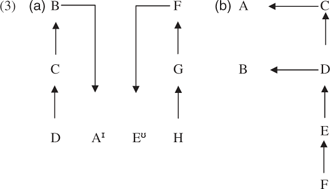
(3a) represents Pattern 1 where raising applies and higher vowels in the system leap out of the way, becoming closing diphthongs. The nuclei of the closing diphthongs then lower.Footnote 7 (3b) represents Pattern 3 wherein back vowels move forward and then lower back vowels raise, filling the vacated spaces.Footnote 8 All of the examples given of Pattern 3 which involve mid vowels fronting also contain high vowels which have fronted (e.g. Albanian and Akha; Labov, Reference Labov1994:131-3). Pdt has a mixture of Patterns 1 and 3. In this paper, I propose that one of the most commonly overlooked developments of the Pdt vowel system is Pattern 3 fronting/centralization which altered the mid-high back vowel before the other back vowels began to raise. Pattern 1 is most visible in the front vowel space, starting with the breaking of the mid-high front vowel. It is impossible to determine whether back vowel raising is the result of either Pattern 1 or 3 as both have this characteristic.
Generalizations which I draw about the Pdt shift conform to these three acoustic principles. Developments which do not conform to these principles serve as important clues for both relative chronology and dating of the shift as they conform to commonly observed analogical movements. Movement of tense vowels to the front along a non-peripheral track, like Pattern 3 fronting of mid vowels, is a generalization of how the mid vowel should behave based on the high vowel’s behavior (Labov, Reference Labov1994:208).Footnote 9 Because this generalization is based on the high vowel, the mid vowel lags behind the frontness of the high vowel (Labov, Reference Labov1994:208). A similar and more frequent process is front/back parallelism, whereby front vowels mimic the behavior of back vowels or vice versa. In the Southern Vowel Shift for example, the lowering of [oʊ]>[ɔʊ] in ‘boat’ is based on the behavior of [eɪ]>[æɪ] in ‘say’ (Labov, Reference Labov1994:208). In the Pdt shift, these types of parallelisms can be seen in the development of the mid-high front vowel as will be discussed in Section 2.3.Footnote 10
1.2. Speech Community Migrations
Pdt is a variety of West Prussian Low German from Poland. Prussian Low German was first acquired in the Mennonite community in the mid-1500s by refugees seeking the safeguard of the Vistula Delta (Epp, Reference Epp1993). In 1789, Mennonites began moving into present day Ukraine to develop Russian border territories in exchange for religious freedom (Krahn et al., Reference Krahn, Bender and Friesen1989; Krahn & Sawatsky, 2011; Sawatzky, Reference Sawatzky1971). These “Russian Mennonites” formed two major colonies in Ukraine: the Chortitza Colony (Old Colony), founded in 1789, and the Molotschna Colony (New Colony), founded in 1804. These two colonies are recognized as having different linguistic traits which will be described in Section 2.1, but possibly just as important, they were economically different. The Old Colony was founded by mostly landless Mennonites, whereas the New Colony was founded by landowners who had the chance to learn from the mistakes of the Old Colony (Dyck, 1993:170-174). Literature about the language produced by native speakers often lists these two colonies’ traits as representative of the two main dialects of the language (e.g. Epp, Reference Epp1993; Rempel, Reference Rempel1995).
As Russian and German state relationships began to sour in the series of events leading to World War I, pressure increased on Mennonites to integrate with the local population. Russian Mennonites who did not want to integrate began moving from Ukraine into the prairie provinces of Canada and the Great Plains of the US in 1874 (Krahn et al., Reference Krahn, Bender and Friesen1989; Sawatzky, Reference Sawatzky1971). The settlements in both regions involved Chortitza and Molotschna groups, but settlements in the US had more immigrants affiliated with the Molotschna colony and settlements in Manitoba had more immigrants affiliated with the Chortitza colony (see Appendix A). As the events leading up to World War I continued to heat up, the new host governments kept a keen eye of suspicion on settlers who spoke anything identifiable as “German” and implemented policies targeted at assimilating them into mainstream culture (Sawatzky, Reference Sawatzky1971).
In 1922, conservative Mennonites from Manitoba began moving into Chihuahua, Mexico, marking the beginning of their southward expansion into Latin America (Krahn et al., Reference Krahn, Bender and Friesen1989; Sawatzky, Reference Sawatzky1971). These settlers were predominantly from the more conservative Chortitza groups (Francis & Bender, Reference Francis and Bender1955). Land shortages and ideology disputes quickly became a problem for the rapidly expanding Mexican Mennonite community. In 1958, communities from northern (N.) Mexico headed south into neighboring Belize where they developed the Orange Walk region. Land shortages continued to be a problem in N. Mexico and in 1983, N. Mexican groups began to move into southern (S.) Mexico. Initially the move involved 88 families from the state of Durango, but later, they were joined by communities from Chihuahua, Zacatecas, and Tamaulipas.
Russian Mennonites remaining in Europe were of both Molotschna and Chortiza affiliation. Both groups began moving into the Altai region of Siberia in 1907 and later, those who remained in Ukraine were forcibly moved to Siberia and Central Asia (Moesley, Reference Moesley2004; Krahn & Klippenstein, Reference Krahn and Klippenstein1989; Krahn, Reference Krahn1959b). The period from 1923 to 1930 saw some of the remaining Russian Mennonites immigrating to Canada to avoid persecution (Krahn, Reference Krahn1959a). 1943 marks the beginning of Mennonites trying to escape Russia en masse with the goal of settling in Germany, although successful immigration into Germany didn’t pick up substantially until the late 1980s (Krahn, Reference Krahn1959b; Nieuweboer, Reference Nieuweboer1998:7). While some Mennonites integrated into modern German society and lost the language, my time in Nordrhein-Westfalen revealed that there were still quite a few elderly people who could be found chatting comfortably in Pdt, Standard High German, and Russian.Footnote 11 This region also had a few Canadian Pdt Mennonites working with the Eastern European group.
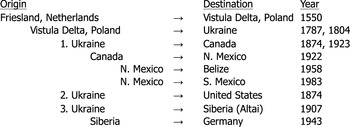
A summary of the broad migratory patterns that will be relevant to this study are presented in Figure 1. In this figure, there is a specified point of origin, a destination, and a year representing the beginning of settlement in that destination. An indented point of origin indicates that speakers from the lower level’s point of origin continued their migration from the raised level’s destination.
This figure shows that there were three different Ukrainian migration goals: Canada and the US were the earliest destinations; Siberia was one of the latest.
The dialect continuum that develops along the settlement path shows innovations in the vowel systems not only as time progresses, but also as migration continues. “Innovations” in this sense refers to differences in the quality of vowel classes consistent with the principles of vowel shifts. Whether or not an innovation has occurred is judged on the basis of the reported IPA values of the studies outlined in Table 2 of Section 2.2. Innovation is only assessed quantitatively in Section 3. Intuitively, one might expect that if a change is underway, all communities should progress at roughly the same rate, regardless of the relative sequencing of settlement time in a speech community’s migration history. Despite this intuition, age of settlement correlated with innovation has been observed previously by Ross (Reference Ross1991:433). Settlements in S. Mexico and Belize show the most advanced developments along the trajectory of the vowel shift in North America in comparison with the more conservative speech patterns found in present day Canada. Documentation of Siberian communities by Jedig (Reference Jedig1966) shows innovations not found in earlier documentation of Russian Mennonites in Ukraine by Quiring (Reference Quiring1928), but within Europe, the most advanced developments are found in the newer settlement of Russian and German communities investigated by Nieuweboer (Reference Nieuweboer1998).
There are some sub-migrations which occur within Canada, the US, and across the US-Mexico border. The British Columbia Mennonite populations came from the prairie provinces in 1928 and from Russia in the 1940s (Klassen et al., Reference Klassen, Klassen and Thiessen2010). The Reedley, CA Mennonite community was first settled in the early 1900s by Midwestern US Mennonites of the General conference (Bender, Reference Bender1959; Bender & Enns-Rempel, Reference Bender and Enns-Rempel2010; Ruth, Reference Ruth2013). Subsequently, the most significant growth to the region was from the settlement of US Midwesterners which happened in the first few years (Bender and Enns-Rempel Reference Bender and Enns-Rempel2010). Pdt speaking Mennonites in Texas are members of the N. Mexican groups that crossed the border from Chihuahua in the late 1970s (Krahn et al., Reference Krahn, Bender and Friesen1989).Footnote 13 As far as I know, these sub-migrations do not correspond to differences in pronunciation from the parent Canadian, US, and N. Mexican populations, but lack of documentation of these communities complicates any assessment of them. I should stress that even though Figure 1 is a generalized version of what is actually quite a complex migration pattern (shown in Appendix A), there are clear community norms which can be systematically analyzed in terms of a community-wide vowel shift.
1.3. Field Site Background
As this study presents variation data for a relatively recently settled, linguistically undocumented community, the following provides basic background in order to contextualize language use in the area. The S. Mexican field site is in the state of Campeche. It is difficult to say how many speakers are in the region (or the country as a whole). The Instituto Nacional de Estadística y Geografía’s (INEGI) 2010 census records documented 2,907 people as self-declared Anabaptist or Mennonite, but the very same census recorded around 6,583 people living in Mennonite villages of the state. The latter number is much closer to the rough estimate of 6,000 given to me by Amish aid-relief missionaries with close ties to the Mennonites of the region. Mennonite migration to this region mainly began in the early 80s with Old Colony Mennonites from N. Mexico. All communities in the region ultimately come from the N. Mexican states of Durango, Zacatecas, and Chihuahua (some via Tamaulipas). Recently, a group of speakers from Belize moved into the region. This group also traces its ancestry to Canada and entered Latin America via the N. Mexican states listed above.
Most speakers in the region belong to the highly conservative Old Colony denomination, but there are also speakers of less conservative Kleine Gemeinde, EMC, and Sommerfelder denominations (some of whom are ex-members of the Old Colony church of the region). Old Colony members tend to be protective of their traditions and do not like outsiders interfering in any way with their way of life (e.g., outsiders publishing exact information about where they live). While the Sommerfelder and Old Colony have a distinctive dress code, the Kleine Gemeinde and EMC tend to have a mixture of styles from other denominations and from what is worn by locals. The Old Colony has the strictest technology bans of the region, but some Old Colony villages allow certain types of technology to be used for work purposes. The Sommerfelder abstain from many types of technology not directly related to work or staying in contact with their families, but they do own motor vehicles. The Kleine Gemeinde and EMC do not have technology bans and can be seen using technology for recreational purposes (e.g., setting up amplifiers and loudspeakers for concerts).
The school system of the Old Colony and Sommerfeld communities is known as Darpschool ‘village school’ which teaches students to about a fourth grade level of Standard German reading, writing, and arithmetic before they graduate (Frey & Hildebrand, Reference Frey and Hildebrand1995). The school system of the Kleine Gemeinde and EMC communities is much closer to the Mexican school system and even makes use of textbooks in Spanish.
Almost all native speakers of Pdt live in settlements that are physically separated from the ethnic Mayan majority of the region. Speakers from outside the main town frequently travel into town for business, leisure, and to maintain otherwise long distance social ties. It usually takes less than three hours to get from the most remote village to town via taxi. The largest Old Colony villages have taxi service Monday through Friday while smaller ones have taxi service on restricted days or on special request. It is commonly the case that Old Colony members will visit relatives in other villages by hiring a taxi driver whenever they feel like visiting. While all villagers and outsiders have access to all the Mennonite villages of the region, usually physical distance and social relationships play a major role in supporting or deterring travel between villages.
The most common second language learned by Pdt speakers is Spanish, the socially dominant language of the region, while the least common is Yucatec Maya. Speakers who are from Belize are often more dominant in English than in Spanish. Many members of the speech community who were raised speaking both Pdt and English in the household speak a variety of Canadian English rather than British English or Kriyol.
Non-native Pdt speakers who reach conversational fluency tend to be from an Evangelical door-to-door missionary group. The door-to-door missionary group is expected to reach fluency in order to read and teach the Plautdietsch Bible according to their views. The first time I arrived in Mexico, there were approximately eight fluent non-native speakers from this group, but the actual number fluctuates as they are reassigned to other parts of Mexico and more people fly in from Germany to train and take their place. Other non-native speakers are ethnically Mayan taxi drivers, vendors, and day laborers who travel to Mennonite villages and have picked up words and phrases, but do not reach full conversational fluency.
2. Survey of Previous Dialect Research
2.1. Traditional Dialect Variation
The most widely recognized dialect division of Pdt in scholarly literature is the line between the Molotschna and Chortitza groups. In the historical sense, Chortitza refers to the Old Colony members who first settled in the Zaporizhia Oblast of Russia and their dialect (Bergmann & Krahn, Reference Bergmann and Krahn1955; Krahn & Sawatsky, 1990). Molotschna refers to the New Colony which settled near the Molotschna River of the same region and their dialect (Bender, 1956; Krahn, Reference Krahn1957).
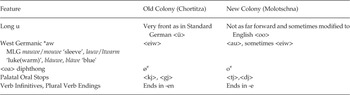
The dialect division between these two regions is normally drawn on the basis of phonological and morphological traits. Early scholarship discusses the difference between Chortitza and Molotschna as qualitative, but it is clear from some accounts that this difference is actually related to frequency of use of the different forms (see Epp, Reference Epp1993). The traditional dialect traits are shown in Table 1 below (Epp, Reference Epp1993; Rempel, Reference Rempel1995).
Phonological and Morphological traits of Chortitza and Molotschna varieties.

Although all communities make a binary distinction between two speech patterns, it is not immediately clear how informative the traditional divide is in today’s global speech community. The traditional features are recognized by native speakers in the US and Canada as either Chortitza or Molotschna forms, but in some regions of Mexico, speakers are not aware that some features listed in Table 1 are Pdt forms.Footnote 14
Sometimes features of both dialects are found within a single settlement because many settlements are of mixed affiliation (Nieuweboer, Reference Nieuweboer1998:127, 132). Epp (Reference Epp1993) asserts that -n is associated with the Old Colony and final -ə with the New Colony, but Rempel asserts the reverse (Epp, Reference Epp1993:78,80,95; Rempel, Reference Rempel1995:xi). Epp’s introduction to Rempel’s dictionary reveals that Rempel lived in a region of mixed influence (Rempel, Reference Rempel1995:v). This leads to a bigger problem for researchers: defining which affiliation a speaker has. Brandt’s study of Cuactemoc, Chihuahua identifies Sommerfelder Mennonites as being associated with the Molotschna dialect, although they are historically Chortitza (Brandt, Reference Brandt1992:29, 31; Friesen et al., Reference Friesen, Dyck, Gerbrandt and Doell1990).
In Mexico, the Chortitza groups employ some Molotschna forms, e.g. [lɒ] lau- “luke-” which should have been [læ] had it been the Chortitza form (Moelleken, Reference Moelleken1966,Reference Moelleken1987). Brandt consulted with two Molotschna and two Chortitza speakers (1992:29). Regardless of the affiliation, all of his consultants produce Chortitza reflexes of the long u and <oa> diphthong. Two Chortitza consultants use the Molotschna form lau- “luke-[warm]” rather than the Chortitza lei-, but in all other instances of West Germanic *aw, all consultants use the Chortitza <eiw>. One Molotschna consultant also consistently uses the Chortitza reflexes of final -n.
Also of concern for the traditional division is reinterpretation of the dialect division and use of features not listed in Table 1. In S. Mexico, where people generally do not know of the Chortitza-Molotschna division, active affiliation with the Old Colony is signaled by use of different linguistic forms. Final -n is viewed as Old Colony and not Sommerfelder despite the fact that they are both Chortitza groups. Old Colony groups in the region also refuse to pronounce Standard High German <au> as [au] as a marker of humbleness.Footnote 15
The third complication for the traditional divide is that some speakers consciously avoid certain forms. Some Mexicans who originate from the Old Colony try to abandon the use of final -n if they no longer identify with the Old Colony. Conscious manipulation of Molotschna and Chortitza forms has even been noted by Nieuweboer who writes:
It is known from several descriptions that certain so-called Chortitza features were considered less refined by both the speakers who used them and the ones who used the ‘Molotschna’ allophones. This is corroborated by informants who claim to have shifted from a ‘Chortitza’ to a ‘Molotschna’ variety because of this. (1998:127-128).
Given that features of the two major dialect divisions do not line up in a consistent way with the categories they should describe, and that speakers can consciously manipulate the features, the next question we should ask is: what do these labels truly refer to in modern day communities? Is there another feature which better defines either regional or historical regional affiliation?
2.2. Long Vowel Variation
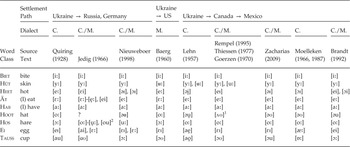
All dialectal documentation of Pdt began after Mennonites had already begun settlement in Latin America, 54 years after the breakup of the Ukrainian community. In the early stages of research, seven studies were surveyed for Pdt vowel phonemes: Quiring (Reference Quiring1928), Baerg (Reference Baerg1960), Rempel (Reference Rempel1995), Thiessen (Reference Thiessen1977), Moelleken (Reference Moelleken1966, Reference Moelleken1987), and Nieuweboer (Reference Nieuweboer1998). A correspondence chart was constructed matching lexical items across the texts surveyed. The vowel phonemes associated with the lexical items were then compared across the texts surveyed. The seven texts were then grouped according to region: Ukraine (Quiring, Reference Quiring1928), Russia-Germany (Nieweboer, 1998), the United States (Barig, 1960), Canada (Rempel, Reference Rempel1995), and Mexico (Moelleken, Reference Moelleken1966, Reference Moelleken1987). Language internal consistency served as the basis for the development of the nine long vowel classes rather than seeking to define them on the basis of Proto-Germanic, Old Saxon, or Middle Low German. In total, nine classes were detected to be linked to long vowels and non-centralizing diphthongs across the texts: Biet ‘bite’, Hüt ‘skin’, Heet ‘hot’, Ät ‘eat’, Hab ‘have’, Hoot ‘hat’, Hos ‘hare’, Ei ‘egg’, and Tauss ‘cup’.Footnote 16 Reflexes of West-Germanic *aw are associated with the Ei class in the traditional Chortitza dialect and the Tauss class in the traditional Molotschna dialect. Five texts were analyzed after the initial survey and had the same word classes as the initial survey: Brandt (Reference Brandt1992), Goerzen (Reference Goerzen1970), Jedig (Reference Jedig1966), Lehn (Reference Lehn1957), and Zacharias (2009).Footnote 17
Quiring (Reference Quiring1928) is recognized by Pdt scholars to be the oldest record of Pdt in Mennonite communities and is a study of the Chortitza group. His is one of two early studies which documented Russian Mennonites, the other being Mitzka (Reference Mitzka1930). Both of these studies are associated with the late moving third Ukrainian group of Figure 1. Also belonging to the third group are Jedig (Reference Jedig1966) and Nieuweboer (Reference Nieuweboer1998), both of which record speakers from the Altai region of Russia. The Altai region is of mixed Chortitza and Molotschna affiliation. Some of Nieuweboer’s Altai Pdt consultants discuss moving to Germany and some of the previously recorded material which he analyzes comes from Siberian exiles living in Germany (1998:109, 251). Baerg (Reference Baerg1960) documented a group of Molotschna Mennonites living in Kansas who are associated with the second Ukrainian group of Figure 1. Rempel (Reference Rempel1995), Thiessen (Reference Thiessen1977), Goerzen (Reference Goerzen1970), and Zacharias (2009) all documented Canadian varieties of Pdt which are associated with the first Ukrainian group of Figure 1 and are of mixed affiliation. Lehn (Reference Lehn1957) documents a Chortitza variety from a later migration of Russian Mennonites who came to Canada in the 1920’s and 1940’s. Moelleken (Reference Moelleken1966, Reference Moelleken1987) is the first documentation of Mennonites in Latin America which only focuses on N. Mexico Chortitza-affiliated groups.Footnote 18 Brandt (Reference Brandt1992) recorded speakers from the Cuauctémoc area of N. Mexico and has speakers of both Chortitza and Molotschna affiliation.
Table 2 shows a simplified aggregate of vowel quality across the studies that were surveyed.Footnote 19 Columns are organized by regional settlement paths and the source text. Each source text has dialect affiliation of either Chortitza (C.), Molotschna (M.), or both as determined by the source text and information from the Global Anabaptist Mennonite Online Encyclopedia. Texts clustered under the same “Settlement Path” are presented with the earlier settled documentation site to the left. In the case that two texts are from the same region, the earlier source is listed to the left.Footnote 20 Under the heading “Word Class,” rows are organized by the nine word classes mentioned above. The individual cells corresponding to each source text column and the word class row represent the phonetic quality of that word class in the source as could be determined by the description in the source. All IPA values were assigned based on the source’s description except Nieuweboer (Reference Nieuweboer1998), Moelleken (Reference Moelleken1966), and Zacharias (2009) which provide IPA transcriptions. Only primary allophones of Nieuweboer (Reference Nieuweboer1998) are listed.Footnote 21
Vowel Phoneme Quality Across Texts.

1 Canadian authors tend to write this as English ou in qualitative pronunciation guides. Often this does not mean IPA [ou] as the Canadian pronunciation guides often write it before a voiceless plosive. This means it is realized as [ʌʊ] in Canadian English. Goerzen writes [ou] as an IPA value corresponding to British “no” (1970:82). According to the OED, British pronunciation of this word is [nəʊ]. Central variants of the phoneme /oʊ/ British English are fairly common (see Trudgill Reference Trudgill1972, Kerswill Reference Kerswill1996).
2 The long closed [uː] in Jedig (Reference Jedig1966) developed from the loss of the off-glides in the [uɐ] centralizing diphthong set. I am not tracing the development of these diphthongs and will not discuss reflexes of centralizing diphthongs within the long vowel shift.
This table reveals that there are two relatively stable anchors in the Pdt vowel system over time and space, the Biet and Hab classes. To some extent the Hüt class is stable as its reflexes are overwhelmingly [-back]. The Hoot class has many records citing a [-back, -front] diphthong, even though it was once a [+back] monophthong.
There is some uncertainty regarding the actual realization of the front closing diphthongs in Brandt (Reference Brandt1992). According to this source, tokens of both the Heet and Ei class are pronounced with the diphthong [ei], but no tokens of the Ei class are ever realized with the diphthong [ɔɪ]. Tokens of the Heet class almost always have variable pronunciation with [ɔɪ]. The largest source of ambiguity in Table 2 comes from Jedig (Reference Jedig1966). This text is acknowledged in the literature to represent an older stage of the Russian Altai variety, but is also notoriously difficult to interpret (Niuweboer, 1998:124). This makes it more difficult to assess whether the system in Jedig (Reference Jedig1966) represents a completely different set of vowel classes or a sub-pattern that is not a part of the broader vowel shift. Jedig (Reference Jedig1966) lists any and all phonetic variation in the Hos and Ät classes, but does not provide examples proving this variation is phonemically contrastive. Given that, in aggregate, the phonetic variation maps onto the classes detectable across the other sources, this can be taken as a case of different members of the class shifting at different rates. I have left the Hoot class blank for this source as many members of this class are found in the Tauss class in words like Koop ‘purchase’ <kåup> and doop ‘deaf’ <dåuf>, but others are found in the Hos class in root ‘red’ <rout>, Poot ‘paw’ <pout>, woo ‘how’ <vou> (cf. Tauss class: Gauns ‘goose’ <gåuns>; Hos class: Schlop ‘sleep’ <ʃloup>, Notel ‘needle’ <noutəl>). The Hoot class might have merged with other classes in the Altai variety (åu<oː, oʊ<oː), but there is also the possibility that Jedig misclassified the difference between these classes. Even though in some cases, the Hoot class is found with members of the Hos class, tokens of the Hoot class are never listed under variations that raise to <u̜:> (Jedig, Reference Jedig1966:29). Nieuweboer (Reference Nieuweboer1998) sampled speakers of the same variety as Jedig and distinguishes the Hoot class from the Tauss and Hos classes. Additionally, there is a clear correspondence between Nieuweboer (Reference Nieuweboer1998) and Quiring (Reference Quiring1928) in the Hoot, Tauss, and Hos classes. If merger of the Hoot class into Tauss and Hos classes had occurred in the Altai region, Nieuweboer’s Hoot class should have had reflexes which overlapped with Quiring’s Hos and Tauss classes.
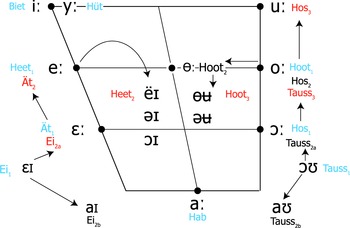
Figure 2 gives a representative schema of the movement of the vowel classes over time starting from the system of Quiring (Reference Quiring1928) in cyan. Word classes in cyan are marked with a subscript 1 if the original quality of the vowel has since shifted. Subsequent stages of the vowel class are marked with sequential subscript numerals. Vowel classes in red represent the furthest progression of shifting classes, and is representative of variation found in the speech of S. Mexican Pdt speakers. Divergent developments are listed as forked developments and share the same subscript numeral, but are differentiated by a subscript a and b.
Early records across the three Ukrainian migration paths are similar except for the early Canadian records which show that the original mid-high vowels had already broken into diphthongs and the original mid-low vowels rose to fill the gap.Footnote 23 By 1966, the group which was still in the Soviet Union exhibited reflexes of the original mid-high vowels which broke and the original mid-low vowels which were rising, similar to the groups which immigrated to Canada. The nucleus of the Ei class had started to drop in some groups (2b) and some of the original diphthongs had begun to monophthongize (2a) and fill in the gaps vacated by the mid-low vowels. By the time the final records of Pdt were recorded in Russia-Germany and Mexico (via Canada), many of the original diphthongs had developed into monophthongs (2a) that filled the mid-low long vowel gaps left open by earlier mid vowel movement. Although the Canadian group was sampled at different points in time, there is no [uː] which can be traced to [oː], meaning that the gap left by the fronting of [uː]>[yː] was not filled by the shift.
The two parts of Figure 2 which are not found in the previous data presented in Table 2 are the full developments of the Tauss class to [oː] and tokens of the Hoot class as [ɵː]. Movement of the Tauss class to [oː] was vanishingly rare in N. Mexico in Brandt’s study, but it is the norm among some S. Mexican consultants as I will show in Section 3.3.2. Some tokens of the Hoot class are a monophthong [ɵː] in stressed monosyllabic words of North American speakers as presented in Section 3.3.1.
2.3. Variation Discussion
As discussed in Section 2.1, many of the features that once used to be either “Molotschna” or “Chortitza” are now mixed across the different populations and tend to be at the conscious level of the speaker. In Mexico, Chortitza features are present even if speakers are associated with the Molotschna dialect. The vowel system, on the other hand, offers a more reliable cue with respect to geo-spatial variation. Changes in the vowel system tend to develop only as new regions are settled, regardless of traditional dialect affiliation.
The overall pattern of the shift’s chain is Pattern 3, the back vowel space, where Hüt and Hoot front before the Hos class rises and then the Tauss class monophthongizes and rises. Pattern 1 is observable in the front vowel space where the mid-high vowel of the Heet class break before the Ät class rises and the Ei class monopthongizes. I posit that centralization of the Hoot class occurred before outward migration from Ukraine for three reasons:
(1) Plautdietsch sources show one of three patterns with the Hoot and Heet class. Either both have peripheral nuclei, both have central nuclei, or Hoot has a central nucleus while Heet has a peripheral nucleus. It is never the case in the literature that the Heet class has a central nucleus while the Hoot class has a peripheral nucleus. As evinced by the Spanish loan word peso [pəɪzo] (Spanish [peːso]) belonging to the Heet class, centralization of the Heet vowel post-dated migration into Latin America in some communities.
The centralization of [oː] is structurally congruent with Pattern 3 mid vowel generalization after the development of Hüt class fronting [yː]<[uː] which was a very early development in the shift. The diphthongization of [e]>[eɪ] is a Pattern 1 development, but the centralization of [eɪ] is not. Centralization of Heet is best understood as front/back parallelism based on the already central Hoot class which is observable in the asymmetrical patterning of central reflexes Heet and Hoot nuclei.Footnote 24
(2) If centralization of the Hoot class developed independently in different communities after migration out of Ukraine had commenced, one would expect to find some communities in which reflexes of the Hoot class rise without centralizing, as back vowels tend to rise in this shift. Although Hoot is found as [hoːt] in the earliest stages of the shift, in the more than 140 years since the Ukrainian dissolution, *[huːt] failed to develop. Post-migration development, however, is a contributing factor to variation in reflexes of the Ei class. In communities in the central US, the nucleus of the Ei class fell to [aɪ] whereas in S. Mexican communities Ei monphthongized to [ɛː] across the board.
(3) Dialectal admixture should have reintroduced more non-centralized forms of the class to other communities. The complicated nature of the Chortitza vs Molotschna features is direct evidence of heavy dialectal admixture; regardless, the Hoot class never rises. Lehn’s (Reference Lehn1957) Ukranian-born consultants use a lower nucleus in the Ei class than most other Canadians do, but none of his consultants use a back realization of the Hoot class. Five of his six consultants were born in Ukraine shortly after the first outward migration to North America in 1874. These consultants moved to Canada when they were middle-aged (28 to 41) and settled in communities close to other people from their region. This is indirect evidence that Hoot had already centralized in Ukraine near the time of the first outward migration if not prior.Footnote 25
In contrast to the traditional dialect forms, relative regional homogeneity of reflexes and a cogent trajectory of the shift give scholars a platform to better understand the analytical merit of the shift. The most striking feature of Table 2 is the similarity between the Mexican documentation (Moelleken, Reference Moelleken1966,Reference Moelleken1987; Brandt, Reference Brandt1992) and the Siberian-German documentation (Nieuweboer, Reference Nieuweboer1998), even though they represent the latest settlements along their respective migration paths. Nonetheless, they are the most innovative systems for their regional groupings.Footnote 26 Early records across the three Ukrainian migration paths are the most conservative for their regional groupings. Even though documentation of the Ukraine → Germany path is chronologically sequenced in the same order as settlement formation, this is not the case for the Ukraine → Mexico path. The pattern of linguistic conservatism appears not to be generational because the Canadian group, which was sampled at different points in time, never developed [uː] (<[oː]). Most reflexes of the linguistically innovative group that entered Canada at a later date appear to have lost out to the more linguistically conservative groups who entered Canada at an earlier date.
3. Acoustic Investigation of North American Varieties of Plautdietsch
This section provides an account of the S. Mexican and Belizean Pdt long vowel variation andSectionoutlines the acoustic study’s participants, methodology, and findings with the goal of adding additional comparative points of reference for Table 2. Recordings from fieldwork in the United States were added to the survey to provide comparative data for acoustic variation.
3.1. Mexican Study Participants
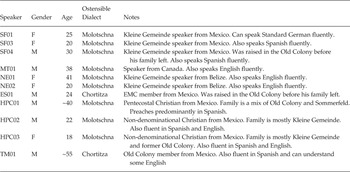
Table 3 provides information about the consultants from the Mexican fieldwork sites. All speakers interviewed are native Plautdietsch speakers. Not all speakers wanted to give personal information aside from the word elicitation itself, but frequent interactions with the speakers and their social networks allowed the researcher to estimate data that was not directly given. The “Ostensible Dialect” column represents how speakers fit within the Chortitza/Molotschna divide of their local community. In some regions, even if a speaker uses many of the Chortitza features of Table 1, they will only be viewed socially as users of the Chortitza variety if they use all of the Chortitza features.
Participant Information.
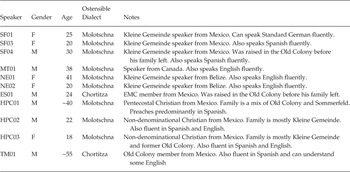
Of note in this table are the people who come from the Old Colony. The Mexican Old Colony retains all of the traditional Chortitza features of Table 1. All of the people surveyed who had left the Old Colony have picked up the main feature which the local community associates with the Molotschna speech pattern (i.e., use of the final -e). ES01 fluctuates in his usage of final -e and final -n, but SF04 consistently used the final -e instead of the final -n.Footnote 27
3.2. Investigation Methodology
A list of 129 words was developed based on the regularity of correspondences by using Rempel (Reference Rempel1995). This list was designed to elicit all major phoneme categories identified by Rempel, including, but not limited to, the nine vowels which are the focus of this study. Following Hagiwara (Reference Hagiwara1997), this list framed vowels in a Glottal_Alveolar context, but additional contexts of Labial_Alveolar and Alveolar_Dorsal were added. The list served as the stimuli of a translation task designed to elicit careful speech. In this word list, the target word was always written in Pdt, Standard German, English, and Spanish.Footnote 28
Individual elicitation sessions were conducted in S. Mexico in several Pdt communities over the course of four and a half months in 2011 and 2012 during the summer rainy seasons. During this time, a total of 12 native speakers participated. One participant’s results are not included because the microphone was not fully engaged and no recording could be recovered. Together, the speakers included in the study represent 3 countries (Belize=2, Canada=1, and Mexico=8) and two genders (M=6, F=5).Footnote 29 The Belizean and Canadian consultants were fluent in English and most of the Mexican consultants were fluent in Spanish.
Speakers were asked to translate a target word into Pdt for the elicitation task. The prompt to translate the target word was spoken out loud by the researcher in the language that the participant felt most comfortable translating from, with occasional code switching by polyglot consultants. If the consultant did not give the target translation, the researcher asked the consultant if there was another word. As there is a high degree of regional variation, if the consultant still did not give the target word, the researcher gave several pronunciations of the word in Pdt and asked whether the speaker was familiar with the target word. If the consultant recognized the target word, they were asked to give a clarification of what it meant and how it differed from the previous word given. In the case of a target word that was given to the speaker in Pdt, only a token of the word in the clarification was selected for analysis.
Consultants wore a Nady Hm-20u unidirectional headset microphone and recordings were made on a Zoom H4n digital recorder in wav format at a 44.4 kHz sample rate. Recorded samples were first transferred into WaveSurfer in order to clip the file to reduce disc size without loss. The files were then transferred to Praat, where they were annotated. The researcher annotated a three-tier Text Grid consisting of a segment tier, the Pdt translation, and the English translation. The segment tier only delimits vowels to be used in the final analysis. Tokens of diphthongs and word classes which have diphthong variants were all split into two even segments.
Once the Praat files had been annotated, an automatic formant extracting script was run on the files. The script takes a measurement at seven equal intervals throughout the vowel and extracts the fundamental frequency and first four formants.Footnote 30 The fourth measurements were extracted and the frequencies of F1-F3 were then cross-checked for accuracy and aggregated into a single spreadsheet.
After the acoustic data was collected from Praat, the information was transferred into R and analyzed using the Package Vowels. The nine vowel classes were normalized using the Labov normalization method included in this package. This method is a speaker extrinsic, vowel extrinsic, and formant extrinsic method. Methods of normalization which are vowel extrinsic tend to preserve the most socio-linguistically relevant data while reducing physical differences between speakers, even in the case of vowel shifts (Adank et al., Reference Adank, Van Hout and Smits2004:3106; Clopper, Reference Clopper2009; Clopper et al., Reference Clopper, Pisoni and De Jong2005; Fabricius et al., Reference Fabricius, Watt and Johnson2009; Flynn, Reference Flynn2011).Footnote 31
After preliminary annotations were made in Mexico, the researcher incorporated previously elicited data from Fresno County, CA from 2010 to the extent possible. The study in California had been designed to investigate environments of palatalization and primarily focused on dorsal consonants before front vowels. Although controls of back vowels were collected, unfortunately, there are many more tokens of front vowels than back. The tokens were elicited in a similar fashion to the stimuli for the current study. Spanish and High German stimuli were not presented to consultants as all speakers from this region are English dominant.
Tokens were collected in five group elicitation sessions (12 consultants total) rather than in individual recording sessions due to concern that the consultants had not spoken Pdt since their youth (which many of them told me directly). At times this proved to be useful, since when a consultant forgot a word, another consultant would sometimes jog their memory. The speakers were from different regions of the midwestern part of the US and affiliated with the Molotschna group. Only one individual session was run, and the speaker claimed to still speak Pdt almost every day. As this speaker received some education in Canada, they are not included in any of the country specific generalizations. The elicitation sessions in California were recorded using a unidirectional hand held microphone with a desk stand.Footnote 32 The microphone was connected to the researcher’s computer where mono sound files were recorded directly to WaveSurfer at a 44.4 kHz sample rate. Analysis of the data from California consisted of annotation in Praat and saving spectral images as there were not enough tokens to actually run normalization.
Additional recordings from the late Herman Rempel (author of Rempel, Reference Rempel1995) were found online at Mennolink.org and incorporated into the study. Although he sought to base his dictionary off of his pronunciation, Old Colony (Chortitza), he has socially and linguistically mixed affiliations (Epp, Reference Epp1993:78,80,95; Rempel, Reference Rempel1995:v, xi). These recordings consist of Herman Rempel going through his dictionary and saying almost every word in it. Although the researcher does not know when the recordings were made, they were included for five reasons. (1) Herman Rempel created the first edition of his dictionary in 1979 and died in 2008 (Stoesz, Reference Stoesz2013). Although we do not know exactly when the recordings were made, they were made within this 29-year span. (2) The recordings were clean enough to use and were already in digital format. (3) The production of the tokens is careful speech and mirrors the task that was designed for the S. Mexican speakers. (4) This fairly exhaustive list provides enough tokens to normalize the vowels with respect to other speakers recorded in S. Mexico. (5) These tokens serve as a very good control for the S. Mexican elicitation. As Herman Rempel wrote the pronunciation guide for his dictionary, the target pronunciation is known.
The researcher went through the raw recordings and created a file with the stimuli that corresponded closest to the categories created for the S. Mexican elicitation. The researcher then annotated and analyzed the files according to the methods described for the S. Mexican group.
3.3. Investigation Results
This section presents findings of both the 2012 survey in S. Mexico and the additional data that were added for analysis. Section 3.3.1 presents the spectral realization of the original mid-high vowels (Hoot and Heet) providing evidence of early centralization of the original mid-high back vowel, and a later front-back parallelism of the original mid-high front vowel. Reflexes of Heet range from a front monophthong to either central or back diphthong, but never a central monophthong. All reflexes of Hoot are central and include both monophthongs and diphthongs. Some instances of the Hos class are compared to the Hoot class in order to highlight the difference in F2 between the two segments. Tokens of the Hoot class are compared with each other to show the difference between the monophthong and diphthong variant.Footnote 33 Some of the Hoot monophthongs do move a little bit, but they are still monophthongs in the same way that members of the Hos class belong to a commonly accepted monophthong phoneme in all records of Pdt with acoustic analysis (Nieuweboer, Reference Nieuweboer1998; Cox, Driedger, & Tucker, Reference Cox, Driedger and Tucker2013).Footnote 34
Section 3.3.2 presents individual speaker and group data as further evidence that reflexes of the vowel shift are closely linked to the age of settlement and do not just progress at a steady rate across the whole community as time progresses.
3.3.1. Spectral Findings of the Diphthongs of the Hoot and Heet Class
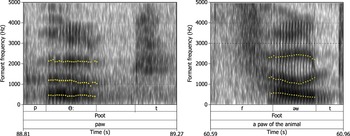
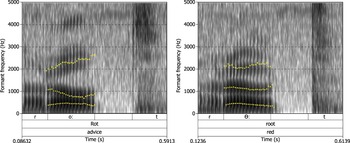
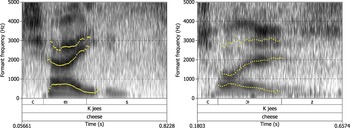
There is robust attestation of central reflexes of the Hoot class in elicited data. Surprisingly, for some Mexican, Belizean, and Canadian speakers, this vowel had a relatively long steady state like a monophthong [ɵː]. The monophthong pronunciation of the Hoot class was first perceived by the investigator as a non-back diphthong. Herman Rempel, a linguistically-attuned native speaker, reported himself as pronouncing the diphthong akin to that found in the Canadian raised pronunciation of out [ʌʊt] for this word class, when in fact, he frequently produced a vowel closer to a monophthong. The left side of Figure 3 shows Canadian speaker Herman Rempel’s pronunciation of the Hoot class. The right side shows HPC01’s production of a diphthong.
The monophthong [ɵː] to the left stabilizes after coming out of its consonant co-articulatory transition and moves slightly before heading into another co-articulatory transition. The diphthong [əʊ] is always in a state of movement. One of the fluent non-native speaking missionaries reported hearing a qualitative difference between the monophthong and diphthong versions of the Hoot class after hearing Rempel’s long monophthong tokens.
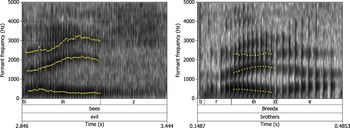
A central quality to the Hoot class was also produced by American speakers recorded in California, most of whom produced a diphthong.
Once again it is possible to see in the speech of these speakers a high F2 going into the vowel that continues to move throughout its production.
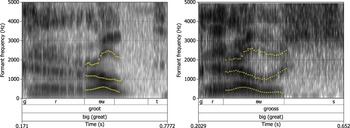
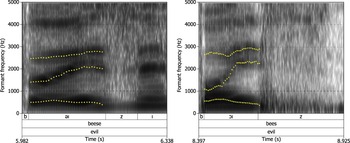
Tokens of the Hoot class contrast with the Hos class primarily in terms of F2 for speakers without [uː]. Figure 4 shows this contrast produced by the Californian-Canadian speaker.
As can be seen in this consultant’s speech, even though there is lowering of F2 for both vowels, the lowered F2 of the Hoot class never dips as low as the lowered F2 of the Hos class. Additionally, the lowered F2 of the Hos class is much more dynamic than the lowered F2 of the Hoot class. Figure 5 shows two American speakers with diphthong realizations of the HOOT class. Both of these speakers start with a vowel that is very centralized, like in Figure 5, but all of these speakers produce this vowel class with a closing off-glide.
The difference between the Hoot and Hos class can be difficult for non-native speakers to detect aurally. The researcher presented this information with sound files at several talks and other non-native speakers reported only clearly hearing qualitative differences between the Hos class and Hoot class after tokens were presented multiple times.
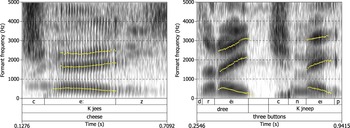
The Heet class varies by country with respect to its realization. While some speakers pronounce [eɪ], others pronounce [ëɪ].
As can be seen in the right-hand spectrogram of Figure 6, the second formant begins with a considerably lower spectral center of gravity than expected for [e]. At the same time, the distribution of the first three formants is not characteristic of [ə] either. The actual diphthong is closer to [ëɪ] than it is to [eɪ], but Pdt scholars tend to classify the diphthong as [eɪ] due to the qualitative similarity between the two and the membership of [ëɪ] in the front vowel phoneme category.
Mexican and Belizean speakers tend to have a realization of the Heet class as a diphthong, either [əɪ] or [ɔɪ].
While the difference between SF03 (Figure 7, right) and the two speakers in Figure 6 is quite clear, this difference is more subtle for SF01 (Figure 7, left). The first three formants of SF01 start off evenly dispersed from each other before moving to the second target position. This produces a sound that is qualitatively similar to the [əɪ] of Canadian raising.
The American speakers surveyed had a range of variation in the Heet class. Figure 8 shows a comparison of the monophthong [eː] pronunciation to the diphthong [eɪ] pronunciation of two male speakers.
American speakers also produced two variants of Heet’s diphthong. Figure 9 shows a comparison of a female speaker’s lowered centralized [eɪ] pronunciation and a male speaker’s [ɔɪ].
These spectral findings taken together provide further evidence of front-back parallelism in the original mid-high vowels wherein the Hoot class centralized prior to the Heet class in groups in the US. The front vowel, which for some speakers is still a monophthong, began to break into a front closing diphthong before the nucleus started to centralize based on the behavior of the [-front] closing diphthong. It was only after the nucleus of the front closing diphthong underwent centralization that it traveled independently along a non-peripheral path and lowered to [ɔɪ].
3.3.2. Normalized Findings
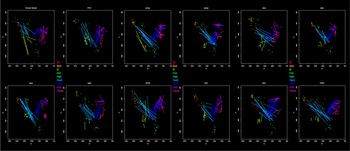
This section presents the findings of the normalized long monophthongs of the consultants outlined in Section 3.1 and Herman Rempel. Figure 10 shows all speaker’s normalized values of the 9 vowel classes under investigation in this study.
Both Canadian speakers (Herman Rempel and MT01) have a Hos class which is a mid vowel. It is often lower than the mid vowel of the Heet class. These findings are consistent with the findings of Cox et al. (Reference Cox, Driedger and Tucker2013) whose study showed the lack of a high back vowel in the Canadian Plautdietsch vowel space. The speakers with the highest vowels in the Hos class are HPC01, HPC02, ES01, and TMP01, all of whom come from Mexico.
The Tauss class is a diphthong for both of the Canadian speakers, but they also alternate between the diphthong and a monophthong. The two Belizean speakers, NE01 and NE02, mostly use a monophthong variant of the class in the mid-low vowel space (although NE02’s Tauss class is rising). Many of the Mexican speakers use a monophthong variant of the Tauss class. Notably, many of the Mexican speakers, with the exception of ES01, have Tauss classes which have risen to a mid-high position in the back vowel space, or are in the process of rising to that position.
The Hoot class is a central vowel in all communities, but some speakers produce tokens in this class with small change in F1 which represent the monophthong category discussed above (Herman Rempel has 4 tokens of this type). Some Latin American speakers also produce the monophthong variant of the Hoot class (see SF03, SF04), but most speakers from this group have a fully developed diphthong.
The Heet class is in the process of centralizing and falling. Herman Rempel has a front closing diphthong while many of the speakers in Latin America have central closing diphthongs. Some nuclei of the Heet class of HPC01, HPC02, HPC03, SF03, ES01, and TMP01 have moved into the back vowel space.
The Ei class is mostly monophthongizing across all of the Latin American groups. Herman Rempel has the low nucleus variant of the Ei class like that described in Lehn (Reference Lehn1957). Nearly all other speakers exhibit nuclei of the Ei class which are in the low front vowel space.
One point of variation which is not frequently observed in individuals is the production of a truly central Hüt class. Although there are one or two tokens of the Hüt class which are produced as back vowels, speakers overall have a high F2 when producing this vowel. Herman Rempel is the only speaker who produces central variants of the Hüt class, but he also produces many front variants too.
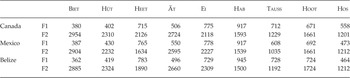
Table 4 shows mean normalized F1 and F2 values by country for North American speakers. Columns are organized by the word classes and rows are organized by country. Each country row has a shaded and unshaded row. The shaded row contains the mean normalized F1 for that country’s word class and the unshaded row the mean normalized F2. The reported F1 and F2 for word classes with two measurements represents what would be the nucleus of the diphthong.
F1 and F2 Frequencies of North American Vowel Nuclei.Footnote 35

The lowest frequency vowel in the back vowel space belongs to the Hos class across all groups. The Canadian average for the Hos class is noticeably higher than the Mexican and Belizean averages for the same class. The Canadian Hos class is qualitatively a clear [oː]-like vowel whereas the Mexican and Belizean groups have something which is qualitatively between [oː] and [uː].
The highest frequency averages of the Tauss class nucleus are found in the Belizean and Canadian groups while the lowest average is found in the Mexican group. Although the Belizean group appears to be close to the Canadian group, as can be seen in the data of NE02, there is some variation in the production of lower and higher nuclei of words in this class. Her speech has an audible difference between tokens with [oː]-like pronunciation and those with a more [ɔː]-like pronunciation. Although there is variation in the Ei class which is shown in Figure 10, the most notable distinction among the groups (length of the F1 and F2 of the off-glide) is not shown in this chart. Differences in the realization of the Ät class formants are largely inaudible due to the role that F3 plays in differentiating this vowel from others near it (i.e., the Biet and Hüt classes).
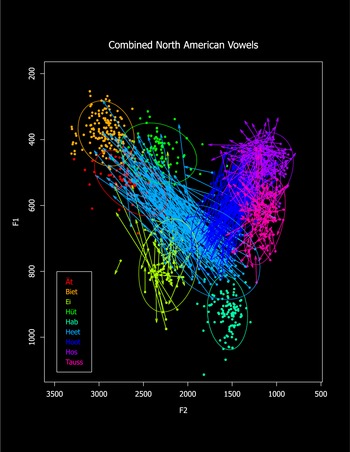
Figure 11 shows an F1xF2 plot of all twelve speakers. The legend to the left shows the color coded word classes (types). Each token for that type is represented by a dot in the corresponding color for the type. A dashed circle around the word class is the estimated vowel space of all North American speakers aggregated together as determined by R.
As can be seen in this figure, word classes which are “encroaching” into each other’s space tend to be associated with back vowels.Footnote 36 This is true in particular of the Tauss class and the Hos class. As mentioned above, the Ei class is somewhat active, but its acoustic overlap is not as perceptible as acoustic overlaps in the back vowel space.Footnote 37
3.4. Investigation Discussion
Until now, evidence that the Hoot class fronted relatively early came from structural relative chronology and the pervasiveness of the [əʊ] along two of the three migration paths. Even though previous documentation of Mennonites in the US suggested a back [oː] pronunciation to the Hoot class, American speakers of the same regional affiliation in this sample have a central vowel. A central quality to this word class was also found in the S. Mexican, Belizean, and Canadian groups surveyed. If it is the case that this segment really did not begin centralizing before the breakup of the Ukrainian community, we would expect that subsequent migrations could have introduced a monophthong [oː] to regions like Canada and Mexico, thus making it possible to find speakers who pronounce Hoot *[uː] and Hos [oː]. Instead of this pattern, however, we find Hoot [ɵː], [əʊ] and Hos [oː], [uː].
Further evidence to support the view that centralization of Heet occurred after centralization of Hoot in a case of front/back parallelism comes from the reflexes of the two classes. Although there is a central monophthong [ɵː] that exists alongside [əʊ] for the Hoot class, the researcher found no evidence of a central monophthong [ɘː] in the Heet class. This suggests that while both mid-high vowels started as monophthongs, when the Heet class broke, the nucleus of the diphthong followed the behavior of the Hoot class and centralized.
Mexico and Belize are in the process of filling the back vowel space as the Hos class has risen to [uː] and the Tauss class has risen to [oː]. Despite the fact that Canadians have had the same gap in the back vowel space, their vowels are not in the process of rising to fill the gap.
An alternative analysis of the results proposed by a reviewer is that regional variation is epiphenomenal. According to this view, variation is actually generational.
Common wisdom would suggest that speakers in Canada and the US are older because the language is moribund, unlike in Mexico. Therefore, the speech from the US and Canada would reflect mid-20th century speech patterns while in Mexico there should be a range of pronunciations. While this is a fair hypothesis, it is unlikely to be the case. MT01 was a 38-year-old speaker from Canada at the time of the study and used the [oː] variant of the Hos class. He is not alone in this behavior. I have encountered other middle-aged speakers from Canada in Southern Mexico who recognize that the Mexican speech patterns differ from what they learned at home in a way that is consistent with the findings of this study and Cox et al. (Reference Cox, Driedger and Tucker2013).
My research in Mexico also involved many casual conversations with older members of the Mexican speech community who told me that they had never left the country. A 2011 conversation with an elderly member of one of the Old Colony villages revealed that the speaker believed that he and his children and his grandchildren all had similar speech patterns. I spent the entire day with this speaker’s family in their village and it was during this time that I realized that words listed as /oː/ in most sources were pronounced as [uː]. In 2014, I had a casual conversation with a 95-year-old woman in southern Mexico. This speaker had been raised in the Old Colony and her children moved her out only after they were adults. Her production of the Hos class was much closer to the [uː] variant.
The appeal of the Generational Hypothesis is fueled by cultural differences among Mennonite groups in different countries. Many older speakers in Mexico were raised with severe technology restrictions. Some who are open to helping researchers and who openly use technology will refuse to participate in the study because they do not understand how voice recorders function and how it could inform a study of language variation.
My observations from casual conversations in southern Mexico indicate that either the innovations took hold quickly after settlement of Mexico, or that older speakers have leveled some of the differences between their speech patterns and those of their children. The latter possibility, known as lifelong learning, has been demonstrated to occur in some speech communities (e.g. Sankoff and Blondeau’s, Reference Sankoff and Blondeau2007, longitudinal study of Montreal French).
4. Conclusion
The Pdt vowel shift is a combined Pattern 1 and 3 chain which is occurring along the Mennonite migration path, usually as newer settlements are formed. This shift seems to occur irrespective of whether the community in question is associated with the traditional Chortitza and Molotschna dialects, but this is difficult to assess given the complex nature of Chortitza and Molotschna dialect admixture and the way that some speakers consciously manipulate some of the forms. Many of the innovations which have occurred in this shift appear to be independent innovations between the Old World group and the New World groups, yet they mostly mirror each other, which is unexpected given the complexity of the extended chain’s pattern and the length of time since the communities in Ukraine dissolved. The only way to succinctly explain the similarity in the developments of the back vowel system without having to appeal to teleology is to posit the shared innovation of the Hoot class centralization before the Ukrainian outward migration process began. Only after centralization of Hoot did the rest of the Pattern 1 and 3 raising take place.
Previous descriptions of Plautdietsch provide evidence that the Hoot class had centralized in Ukraine around the outward migration period. However, these descriptions are problematic since it appears that the Heet class had also centralized prior to outward migration (e.g. Lehn, Reference Lehn1957). The speakers sampled in this present survey all had centralized Hoot classes while only some had centralized Heet classes, indicating that centralization of the Heet class could be a parallel independent innovation whereas centralization of the Hoot class is more likely to be a shared innovation. If centralization of the Hoot class predates the outward migration period, it raises the question as to whether the Hoot class’s reported quality in Quiring (Reference Quiring1928) and Baerg (Reference Baerg1960) were also slightly centralized but not perceptible to the documenter.
One area of future investigation would be to incorporate recordings of South American groups who are known to be linked to late migration out of Russia. If it is the case that these groups also have a central quality to the members of the Hoot class, this would support the general hypothesis of a common community-wide development of centralization.
Mennonite Migration Summary.Footnote 12

Trajectory of the Plautdietsch Vowel Shift.Footnote 22

Monopthong [ɵ] vs. Diphthong [əʉ] pronunciation of HOOT class.

American Speaker Production of HOOT Class.

Back vs Central Distinction between HOS and HOOT.

Canadian Speaker Pronunciations of HEET Class.

Mexican Pronunciation of HEET Class.

American Speaker Pronunciation of HEET Class.

American Speakers' Diphthongs of the HEET Class.

Individual Vowel Charts.

North American Vowels.

Appendix A
Settlement Table. This table provides extended information about settlement patterns of Mennonites including initial numbers of settlers and subsequent migrations when known. Information in the table comes from (Bergmann & Krahn, 1955; Giesbrecht & Klassen, 2011:92-106; Gingerich & Loewen, 2013; Krahn, 1957, 1959a, 1959b, 1959c; Krahn & Haury, 2009; Miller & Troyer, 1990; Nieuweboer, 1998:4-8; Regher & Thiessen, 2011; Rempel & Dreidger, 1990; Sawatzky, 1971: 55-66, 86-97; Sawatzky, 1989)