





1. Introduction
In many languages, regular agreement markers on an agreeing element are replaced or dropped if the target of the agreement relation is moved for, among others, focus, topicalization or wh-questioning. The example in (1) illustrates this for Seereer (Atlantic, Senegal).Footnote 1 In (2), I show this with data from Kinande (Bantu). The Seereer sentence in (1a) is affirmative, and the verb must take the 3rd person agreement marker a-, which is syncretic with the final vowel that is suffixal to the verb root. When the subject DP okoor oxe ‘the man’ is wh-questioned (1b), this marker is dropped, and the final vowel is replaced by the focus particle u (Baier, Reference Baier2018).
(1)
Anti-agreement in Seereer
(a)
okoor
oxe
a-jaw-a
maalo
fe
man
the
3-cook.sg-fv
rice
det
‘The man cooked rice.’
(b)
an
(*a)-jaw-u
maalo?
who
3-cook.sg-foc
rice
‘Who cooked rice?’
(Seereer: Baier Reference Baier2018: 29)
In Kinande (2), the canonical subject-verb agreement marker with the subject DP Kambale is a- (2a). When this subject DP is wh-questioned, a- becomes u- (2b).
(2)
Anti-agreement in Kinande
(a)
Kambale
a-alangira
Marya
Kambale
agr-saw
Mary
‘Kambale saw Mary.’
(b)
iyondi
yo
✘a/✔u-alangira
Marya
who
that
agr/anti.agr-saw
Mary
‘Who saw Mary?’
(Kinande: Schneider-Zioga Reference Schneider-Zioga2007: 404)
Baier (Reference Baier2018) discusses a typology of these kinds of effects and argues that they can uniformly be accounted for in a system where information structure features such as [wh] (for wh-questions) and [foc] (for focalization) trigger partial or full impoverishment of φ-features (number, person and gender) on the agreeing element.Footnote 2 In other words, what these constructions have in common is that they all involve information-structure-related movement, hence the presence of an information structure (here and henceforth IS) feature. That agreement markers may change or disappear completely is a purely morphological phenomenon. Specifically, agreement with a target that has φ-features (person, gender and/or number) and IS-features ([wh] and/or [foc]) works such that both types of features are transferred to the agreeing head. The IS-features can then trigger full or partial deletion of the φ-features, leading to the insertion of default exponents, exponents with limited φ-distinctions, or the total absence of exponents. An instance of such a rule is given in (3). The rule in (3) fully removes φ-features in the presence of the IS-feature [wh]. (3) reads ‘phi (φ) becomes null (ø) in the context where [wh] is present’.
(3)
[φ] → ø / [__, wh]
(Baier Reference Baier2018: 3)
These kinds of effects are generally studied in contexts where it is the target of agreement that has moved and not, to my knowledge, in situations where what is moved is the agreeing head itself. In this paper, I show that similar effects are visible within Eastern Grassfields Bantu determiner phrases when the agreeing head is moved to be marked for focus. I propose an account of these effects in the system developed by Baier (Reference Baier2018). The paper – empirically – shows that anti-agreement-like effects can be visible within the nominal domain, and in contexts where it is the agreeing element, and not the agreement target, that is focus-moved. On the theoretical side, the paper provides further arguments in favour of Baier (Reference Baier2018)’s theory, and the idea that IS-features can trigger impoverishment rules.
The paper is organized as follows: Section 2 discusses possessive pronoun focus in three Eastern Grassfields Bantu languages and shows that it can have an effect on the form of the noun class marker. In Section 3 I demonstrate that possessive pronoun focus is achieved by movement in the languages under study. Section 4 derives the order of the relevant modifiers in the three languages and discusses the grammar of gender in Eastern Grassfields Bantu. Section 5 proposes an analysis of the class marking asymmetry, and Section 6 concludes.
2. Possessive Pronoun Focus can Affect the form of the Class Marker in Eastern Grassfields Bantu
In Ngemba, Medumba and Shupamem, possessive pronouns follow the head in IS-neutral contexts and agree in noun class with it.Footnote 3 The examples in (4)–(9) illustrate this. The Ngemba nouns pùmá ‘orange’ and sú(n) ‘friend’ belong to class 5 (4a) and 1 (5a), respectively. They form their plurals in class 6 (4b) and 2 (5b). Class distinctions in the examples in (4) and (5) are encoded on the agreeing modifiers.Footnote 4
(4)
(a)
ø-pùmá
n-á
5-orange
5-poss.1sg
‘my orange’
(b)
mə-pùmá
m-á
6-orange
6-poss.1sg
‘my oranges’
(5)
(a)
ø-sú(n)
ø-à
1-friend
1-poss.1sg
‘my friend’
(b)
mə-sù(m)
p-á
2-friend
2-poss.1sg
‘my friends’
(Ngemba)
The Medumba nouns m-έn ‘child’ (6a) and sò ‘tooth’ (7a) also belong to class 1 and 5, respectively. They form their plurals in class 2 (6b) and class 4 (7b).Footnote 5
(6)
(a)
m-έn
ø-ɑ̀m
1-child
1-poss.1sg
‘my child’
(b)
b-ún
tʃ-ɑ́m
2-child
2-poss.1sg
‘my children’
(Medumba; Kouankem Reference Kouankem2013: 63)
(7)
(a)
ø-sò
s-ɑ́m
5-tooth
5-poss.1sg
‘my tooth’
(b)
n-sò
m-ɑ́m
4-tooth
4-poss.1sg
‘my teeth’
(Medumba; Chow et al. Reference Chow, Daniel, Keupdjio, Mac-Deh and Ontkean2015: 8)
In (8) and (9), I show this with data from Shupamem. m-ɔ́n ‘child’ (8a) and pàm ‘bag’ (9a) are, respectively, class 1 and class 3 nouns. They form their plurals in class 2 (8b) and class 4 (9b), respectively.
(8)
(a)
m-ɔ́n
ø-à
1-child
1-poss.1sg
‘my child’
(b)
p-ɔ̀n
p-á
2-child
2-poss.1sg
‘my children’
(9)
(a)
ø-pàm
ø-à
3-bag
3-poss.1sg
‘my bag’
(b)
ø-pàm
ʃ-á
4-bag
4-poss.1sg
‘my bags’
(Shupamem: Nchare Reference Nchare2011: 153)
Interestingly, the possessive pronouns in (4)–(9) can be contrastively focused, in which case they precede the head noun on the surface. When this happens, the three languages behave differently with regard to the realization of agreement markers. In Ngemba, regular class exponents on the agreeing possessive pronouns are replaced by two glides, each of which tracks the animacy specification of the head noun. Specifically, the glides w- or j- replace regular class markers on the possessive pronoun root depending on whether the head noun is animate or inanimate. This, crucially, only happens in singular contexts. In plurals, the agreement prefixes do not change. These facts are shown in (10) and (11) below.
CONTEXT: There is an open argument about ‘friends’ or ‘oranges’ in a conversation. An event E has happened that affected a ‘friend/orange’ or many of them (a falling event, for example). (10a) and (11a) restrict the understanding of ‘falling’ to X’s ‘friend/orange’, to the detriment of all the other ‘friends/oranges’ that are present in the context of the conversation or that the speakers know about.
(10)
(a)
✘n-/✘w-/✔j-àà
ø-pùmá
5-/anim-/inan-poss.1sg.foc
5-orange
‘MY orange (as opposed to X’s)’
(b)
✘j-/✘w-/✔m-àà
mə-pùmá
inan-/anim-/6-poss.1sg.foc
6-orange
‘MY oranges (as opposed to X’s)’
(11)
(a)
✘ø-/✘j-/✔w-àà
ø-sú(n)
1-/inan-/anim-poss.1sg.foc
1-friend
‘MY friend (as opposed to X’s)’
(b)
✘j-/✘w-/✔p-àà
mə-sú(n)
inan-/anim-/2-poss.1sg.foc
2-friend
‘MY friends (as opposed to X’s)’
(Ngemba)
In Medumba, the class 1 ((12a) and (13a)) agreement prefix is replaced by the single glide j-. Animacy does not play any role, as is the case in Ngemba. Agreement prefixes in other classes (class 2 (12b), class 4 (13b) and (14b), and class 5 (14a)) never change.Footnote 6
(12)
(a)
✘ø-/✔j-ɑ̀ɑ̀m
m-έn
1-/glide-poss.1sg.foc
1-child
‘MY child(as opposed to X’s)’
(b)
✘j-/✔tʃ-ɑ́ɑ̀m
b-ún
glide-/2-poss.1sg.foc
2-child
‘MY children (as opposed to X’s)’
(13)
(a)
✘ø-/✔j-ɑ́ɑ̀m
ø-bú
1-/glide-poss.1sg.foc
1-hand
‘MY hand (as opposed to X’s)’
(b)
✘j-/✔m-ɑ́ɑ̀m
m-bú
glide-/4-poss.1sg.foc
4-hand
‘MY hands (as opposed to X’s)’
(14)
(a)
✘j-/✔s-ɑ́ɑ̀m
ø-sò
glide-/5-poss.1sg.foc
5-tooth
‘MY tooth (as opposed to X’s)’
(b)
✘j-/✔m-ɑ́ɑ̀m
n-sò
glide-/4-poss.1sg.foc
4-tooth
‘MY teeth (as opposed to X’s)’
(Medumba)
In Shupamem (15)–(16), agreement prefixes in all the different classes of the language (singular and plural) are replaced by the single glide j-.
(15)
(a)
✘n-/✔j-àà
m-ɔ́n
1-/glide-poss.1sg.foc
1-child
‘MY child (as opposed to X’s)’
(b)
✘p-/✔j-àà
p-ɔ́n
2-/glide-poss.1sg.foc
2-child
‘MY children (as opposed to X’s)’
(16)
(a)
✘ø-/✔j-àà
ø-pàm
3-/glide-poss.1sg.foc
3-bag
‘MY bag (as opposed to X’s)’
(b)
✘ʃ-/✔j-àà
ø-pàm
4-/glide-poss.1sg.foc
4-bag
‘MY bags (as opposed to X’s)’
(Shupamem)
What the three languages have in common are the tonal and segmental changes on the possessive pronoun root. In post-nominal, non-focus, contexts the pronoun root is/has a single vowel and a single tone in all the three languages. In pre-nominal, focus, contexts the vowel of the pronoun root is lengthened, and the tones are uniformly low in Ngemba and Shupamem. In Medumba, the tone of the vowel within the pronoun root alternates between LL and HL.Footnote 7
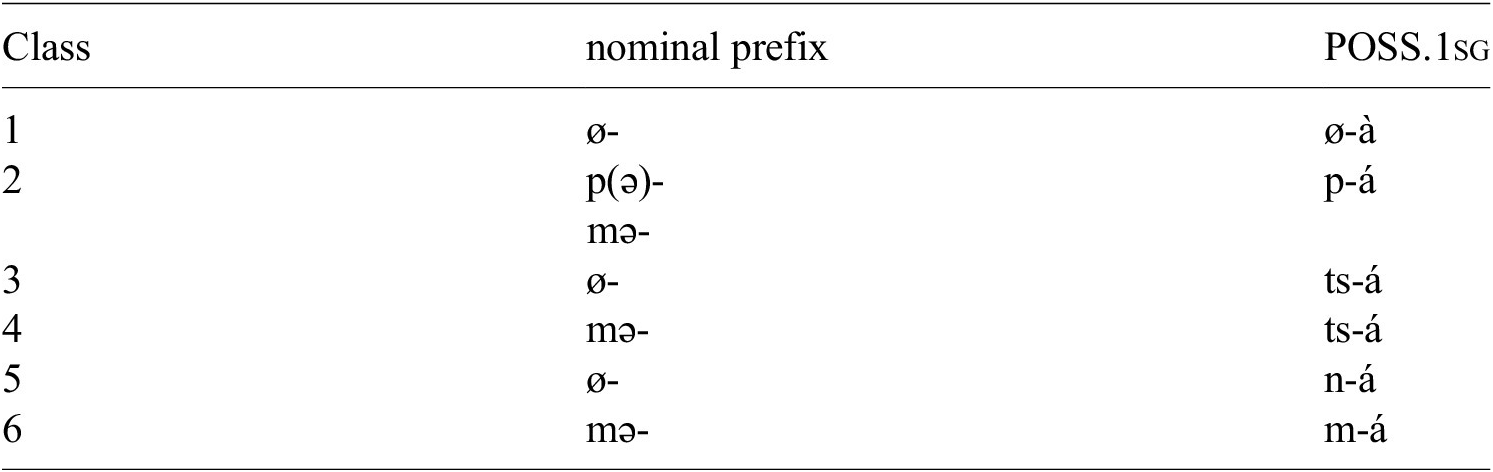
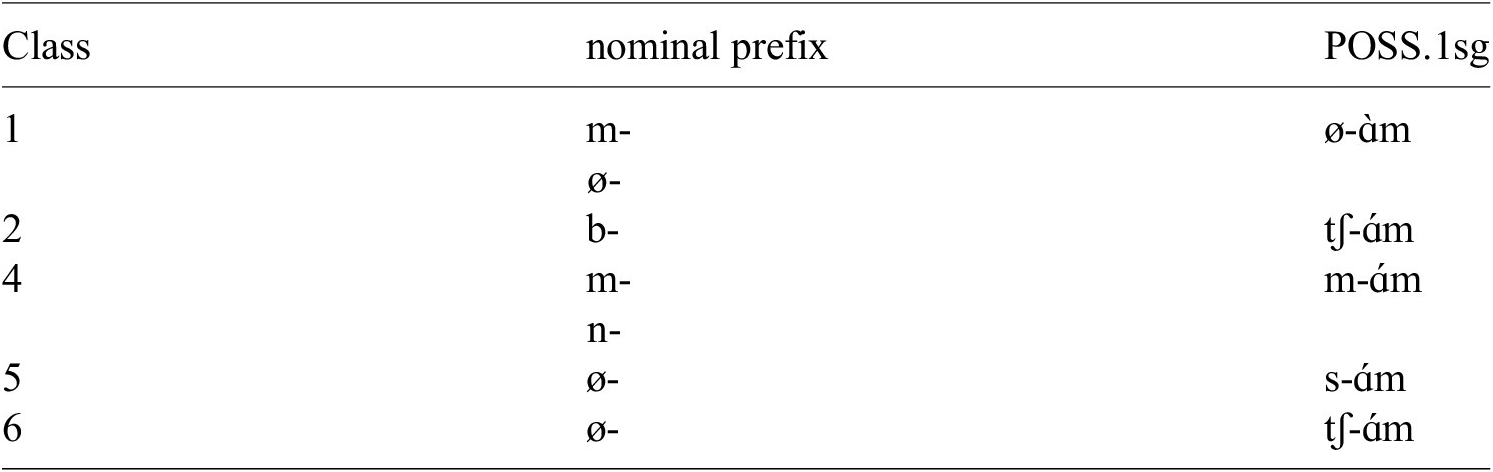
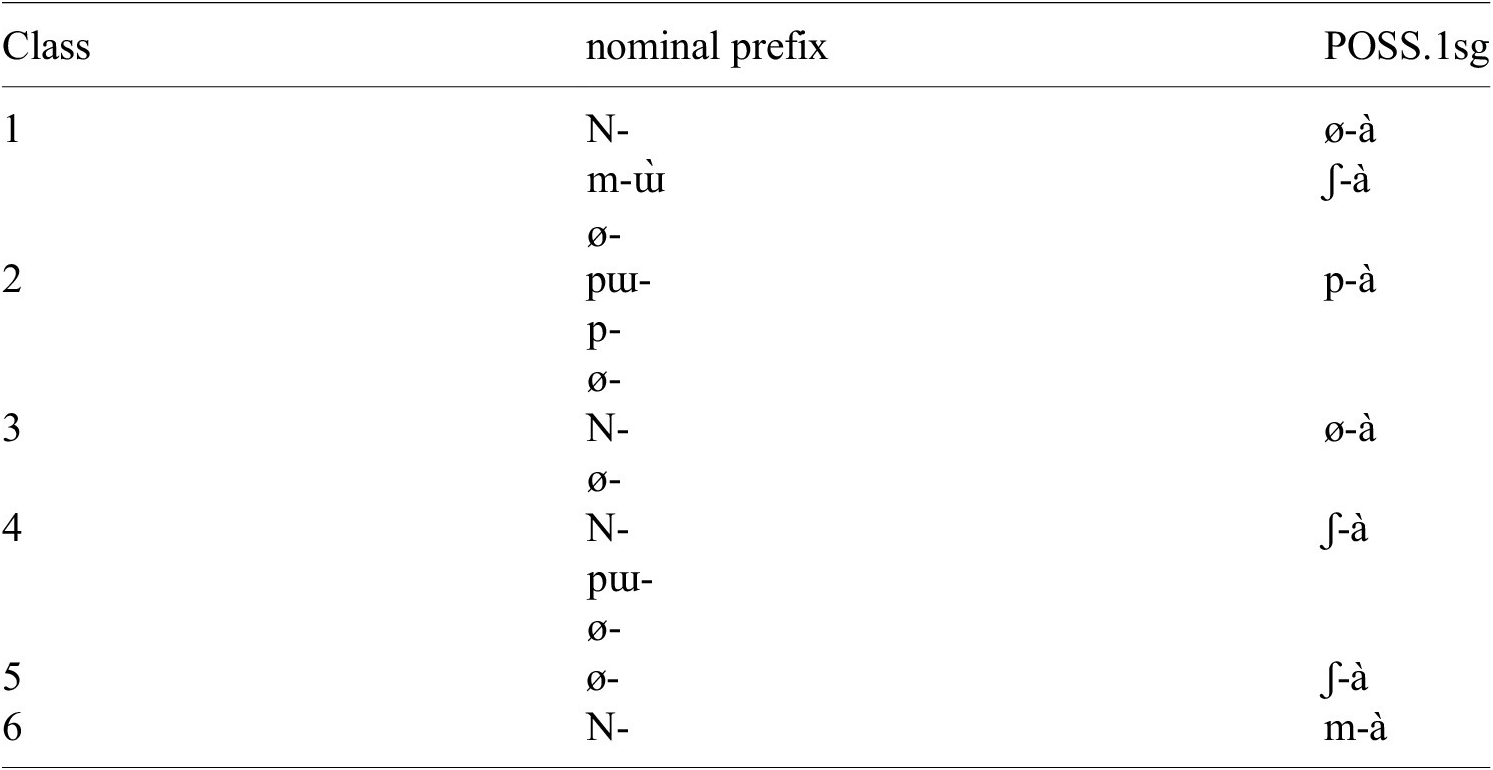
Tables 1, 2 and 3 summarize nominal and agreement prefixes with the first person singular possessive pronoun in the three languages. The tables clearly show that the glides that sometimes appear in POSS > N order do not belong to the group of regular class prefixes with possessive pronouns.
Summary of Ngemba agreement prefixes with the 1sg possessive pronoun

Table 1. Long description
The table consists of three columns: Class, nominal prefix, and P O S S dot 1 S G.
* Class 1: nominal prefix is null; possessive prefix is null-à.
* Class 2: nominal prefix is p(ə)- or mə-; possessive prefix is p-á.
* Class 3: nominal prefix is null; possessive prefix is ts-á.
* Class 4: nominal prefix is mə-; possessive prefix is ts-á.
* Class 5: nominal prefix is null; possessive prefix is n-á.
* Class 6: nominal prefix is mə-; possessive prefix is m-á.
Summary of Medumba class prefixes with 1sg possessive pronoun (adapted from Kouankem Reference Kouankem2012 and Déchaine & Keupdjio Reference Déchaine and Keupdjio2016)

Table 2. Long description
The table consists of three columns: Class, nominal prefix, and P O S S dot 1 s g.
Row 1: Class 1 has nominal prefixes m- or null and possessive null-a-m with a grave accent on the a.
Row 2: Class 2 has nominal prefix b- and possessive t-esh-a-m with an acute accent on the a.
Row 3: Class 4 has nominal prefixes m- or n- and possessive m-a-m with an acute accent on the a.
Row 4: Class 5 has a null nominal prefix and possessive s-a-m with an acute accent on the a.
Row 5: Class 6 has a null nominal prefix and possessive t-esh-a-m with an acute accent on the a.
Summary of Shupamem agreement prefixes with the first person singular possessive pronoun (adapted from Nchare Reference Nchare2011)

Table 3. Long description
The table consists of three columns: Class, nominal prefix, and P O S S dot 1 s g.
* Class 1: Nominal prefixes are N minus, m-u-grave, and null. P O S S dot 1 s g forms are null-a-grave and sh-a-grave.
* Class 2: Nominal prefixes are p-u-minus, p-minus, and null. P O S S dot 1 s g form is p-a-grave.
* Class 3: Nominal prefixes are N minus and null. P O S S dot 1 s g form is null-a-grave.
* Class 4: Nominal prefixes are N minus, p-u-minus, and null. P O S S dot 1 s g form is sh-a-grave.
* Class 5: Nominal prefix is null. P O S S dot 1 s g form is sh-a-grave.
* Class 6: Nominal prefix is N minus. P O S S dot 1 s g form is m-a-grave.
To summarize, possessive pronouns in Ngemba, Medumba and Shupamem follow the head noun in non-focus contexts. They can be contrastively focused, in which case they surface in a position where they precede the head noun. When this happens, the three languages behave differently with respect to the realization of class markers on the focused pronoun. In Ngemba, regular class markers in the singular are replaced by the glides j- or w-, depending on the animacy specification of the head noun. While j- is used when the noun is inanimate, w- is preferred with animates. In Medumba, only the class 1 agreement prefix is affected. It becomes the single glide j-. Agreement markers from other classes (class 2, 4, 5 and 6) never change. In Shupamem, regular class markers (in plural and singular contexts) are always replaced by the single glide j-.
Given the fact that the observed changes only happen in focused contexts, and when one of the participants in the agreement relation is focus-moved (see Section 3 for empirical evidence), I conclude that the relevant puzzles are cases of anti-agreement effects. There are, however, two crucial differences between regular effects of this type and the ones from Ngemba, Medumba and Shupamem. The first is that it happens within the nominal domain. The second is that although it is still the agreeing head (here the possessive pronoun) that is affected, it is not the agreement target (here the noun) that has undergone movement. The paper proposes that despite these differences, the Ngemba, Medumba and Shupamem facts can be analyzed in the system proposed by Baier (Reference Baier2018). Specifically, I propose that the puzzle is purely morphological, and show that, in the syntax, possessive pronouns in both N > POSS and POSS > N orders agree with the noun and copy all the relevant features they need to spell out regular noun classes in the post-syntax. The crucial difference between both orders is that POSS > N involves focus movement, hence the presence of a [foc] feature. This feature is local enough to trigger partial deletion of some φ-features. As a result, less specific affixes are used.
Before I lay out the technicalities of the proposal, there is a need to provide arguments that possessive pronouns surface in pre-nominal position via movement and not base-generation. I do this in the next section of the paper.
3. On the Evidence that Possessive Pronoun Focus in the Three Languages Involves Movement
In this section, I discuss empirical evidence from mainly Ngemba and Medumba that possessive pronouns surface in pre-nominal, focus position via movement.Footnote 8 One of the implications of this, I argue, is that the puzzling Grassfields Bantu data can be thought of in terms of anti-agreement. Two diagnostics are considered, namely idiom reconstruction and tonal reflexes of movement. I discuss each one of them in turn below.
3.1. Idiom reconstruction in Ngemba
The basic assumption underlying this test is that an idiom keeps its meaning if part of it is extracted, but loses it if what looks to be part of it is base-generated in a different position (see, for example, Scott Reference Scott2021, Georgi & Amaechi Reference Georgi and Amaechi2023, Yip & Ahenkorah Reference Yip and Ahenkorah2023 for similar applications of this movement diagnostic). Applying this test to clause-internal topicalization in Ngemba shows that the idiomatic meaning is lost if part of the idiom gets topicalized. Below, I show this with the idiom ŋwɔ́Ɂ shwò (literally ‘bend mouth’) which, in Ngemba, means ‘to be angry’. shwò, in (17b), can undergo topicalization, in which case the only possible reading is one that does not involve being angry, but rather the state of the mouth (bent).
(17)
(a)
Deffo
tsɔ́k
liàɁ
ŋwɔ́Ɂ
shwò
Deffo
spend.pst
today
bend
mouth
✔Lit. Deffo bent the mouth the whole day.’
✔Idiom. ‘Deffo was angry the whole day.’
(b)
shw-ò
á,
Deffo
tsɔ́k
liàɁ
ŋwɔ́Ɂ
mouth
top,
Deffo
spend.pst
today
bend
✔Lit. ‘As for the mouth, Deffo spent the whole day bending it.’
✘Idiom. ‘As for getting angry, Deffo spent the whole day angry.’
Comparing the topicalization example in (17b) to focus (18) demonstrates that, unlike topicalization, focus involves movement. This is so because when
shwò
‘mouth’ is focused, the idiomatic reading is maintained. Under a movement approach, the moved item can be reconstructed for interpretation (whether this involves interpretation of a silent copy is not important). Importantly, this is not an option for base-generation.
(18)
á
shwò
ø-è
ì
tsɔ́k
liàɁ
ŋwɔ́ɔ̀Ɂ
a
foc
mouth
1-rel
1sg.nom
spend.pst
today
bend
det
✔Lit. ‘It is the mouth that he spent the day bending.’
✔Idiom. ‘It is anger that he showed the whole day.’
This diagnostic can be extended to DP-internal contexts. Ngemba allows idioms that must contain a possessive pronoun. An example is given in (19).
(19)
ø-ndúm
ø-à
hó
lá
ø-kә̀lám
ø-ɔ́
1-husband
1-poss.1sg
fut
cook
1-kelam
1-poss.2sg
Lit. ‘My husband will cook your Kelam.’
Idiom. ‘My husband will beat you.’
What is interesting about the idiom in (19) is that in the absence of the possessive pronoun, it is ‘ungrammatical’. In other words, it is ungrammatical to simply say lá ø-kә̀lám ‘cook kelam’ with the idiomatic reading. For the idiomatic interpretation to be possible, the possessive pronoun must be used. Crucially, the possessive pronouns in the two DPs (the subject DP n-dúm ø-à ‘my husband’ and the object DP ø-kә̀lám ø-ɔ́ ‘your kelam’) in (19) can be focused, hence appear in pre-nominal position. When this happens, the idiomatic reading is kept.Footnote 9
(20)
w-àà
n-dúm
hó
lá
j-ɔ̀ɔ̀
ø-kә̀lám
anim-poss.1sg
1-husband
fut
cook
inan-poss.2sg
1-kelam
Lit. ‘My husband, (as opposed to X’s), will cook your Kelam, (as opposed to X’s).’
Idiom. ‘My husband, (as opposed to X’s), will beat you, (and not any other person)’
The fact that the idiomatic reading is maintained when the possessive pronoun surfaces in pre-nominal position provides empirical evidence that it is focus-moved into the focus position, just as is the case for clause-internal focus (18). A silent copy is interpreted in the movement site. I conclude that Poss-focus in Ngemba involves movement of Poss into the left periphery of the DP. There are reasons to think that this extends to the Medumba data. In the section that follows, I present suggestive evidence from tonal reflexes of movement.
3.2. Tonal and segmental reflexes of movement
Ngemba and Medumba instantiate tonal reflexes of clause-internal IS-driven movement (Keupdjio, Reference Keupdjio2020, Fongang, Reference Fongang2025b). In Medumba, as discussed at length in (Keupdjio, Reference Keupdjio2020), the verbal root kέ ‘choose’, for example, has a low tone in non-movement contexts (21).
(21)
Nùŋgὲέ
kὲ
kí
Nuga
choose
c.q
y/n
‘Did Nuga choose?’
(Medumba: Keupdjio Reference Keupdjio2020: 111)
In ex-situ object wh-questions (22a), focus (22b) and topicalization (22c), the (only) vowel of this verb surfaces with a falling tone.Footnote 10
(22)
(a)
á
wú
Nùŋgὲ
kέὲ
á
foc
wh
Nuga
agr.choose
c.q.h
‘Who did Nuga choose?’
(Medumba: Keupdjio Reference Keupdjio2020: 111)
(b)
á
ŋgùn
Nùŋgὲ
kέὲ
lá
foc
girl
Nuga
agr.choose
c.h
‘The girl
foc
(is the one) Nuga chose.’
(Medumba: Keupdjio Reference Keupdjio2020: 111)
(c)
ŋgùn
júùn-ní
kí,
Nùŋgὲ
kέὲ
í
girl
agr-dem
top
Nuga
agr.choose
3sg.anim
‘This girl, Nuga chose her.’
(Medumba: Keupdjio Reference Keupdjio2020: 113)
Keupdjio (Reference Keupdjio2020) uses this and other diagnostics for movement (e.g. sensitivity to islands (23) and reconstruction effects (24)) to come to the conclusion that these changes reflect IS-driven movement in Medumba.
(23)
á
wú
Nùŋgέ
nɔ́ɔ̀Ɂ
nέὲn
ntɔ́n
[káà
Wàtὲέt
tʃɔ́ɔ̀Ɂdә̀
___]
à?
foc
wh
Nuga
agr.aux
go
market
before
Watat
agr.greet
c.q
‘Who did Nuga go to the market before Watat greeted?’
(Keupdjio Reference Keupdjio2020: 50)
(24)
á
jíìt
sә̀v
h
ә̀ә́
t
h
ú-v
ú
dl-í
j
Nùŋgέ
j
tʃúùp
mbù
á
j
vhùú
sí
á?
foc
sg.wh
picture
head-body-3sg
Nuga
agr.say
c
3sg
fall
down
c.q
‘Which picture of himself/herself did Nuga say that [it] fell down?’ (Keupdjio Reference Keupdjio2020: 40)
Ngemba verbs also behave this way and, this has been taken as a diagnostic for movement in the language as well (c.f., Fongang Reference Fongang2025b). In a simple declarative sentence such as (25), the verbal root zhó ‘see’ surfaces with a high tone.
(25)
Fotsing
zhó
Deffo
Fotsing
see.pst
Deffo
‘Fotsing saw Deffo.’
(Ngemba)
In the object focus example in (26), this vowel surfaces with a falling tone.
(26)
á
Deffo
n-è
Fotsing
zhóò
a
foc
Deffo
5-rel
Fotsing
see.pst
det
‘It is DEFFO that Fotsing saw.’
(Ngemba)
What is striking about topicalization is that topic marking does not trigger this type of tonal change (27).
(27)
Deffo
á,
Fotsing
zhó
ní
Deffo
top,
Fotsing
see.pst
3sg.anim.acc
‘As for Deffo, Fotsing saw him.’
(Ngemba)
These facts, coupled with two other tests (e.g. the islands in topicalization (28) and focus (29)), demonstrate that topicalization in Ngemba involves base-generation of an XP in the topic position and binding of a resumptive pronoun. Focus, however, involves movement to the left periphery of the Ngemba clause (c.f., Fongang Reference Fongang2025b).
(28)
mә̀ndɜwí
ø-è
á,
Fotsing
lὲ
[ndìèɁ
Mbah
zhó
*(ní)
a]
wh
1.woman
1-dem
top,
Fotsing
see.pst
when
Mbah
see
3sg.an.acc
det
Lit: ‘As for that woman, Fotsing cried when Mbah saw her.’
(Fongang Reference Fongang2025b: 6)
(29)
*á
[mә̀ndɜwí
ø-è]i
Fotsing
lὲέ
[ndìèɁ
Mbah
zhóò
*(ní)i
a]
wh
foc
1.woman
1-dem
Fotsing
see.pst
when
Mbah
beat
3sg.an.acc
det
Lit: ‘THAT WOMAN Fotsing cried when Mbah was beating (her).’ (Fongang Reference Fongang2025b: 7)
Of the many tests for IS-driven movement that have been proposed in the literature, tonal reflexes can straightforwardly be applied to the DP, under the premise that DPs parallel IPs/TPs in that they also have a CP-like left periphery that can, for example, host focalized DP-internal elements (see, among others, Aboh Reference Aboh2004). In other words, DP-internal material can be moved for focus, topicalization, etc. What is interesting to observe about Ngemba and Medumba is that there is a parallel between the effects of clause-internal movement discussed above and focalized possessive pronouns.
In Medumba and Ngemba, the tone changes of the type in (22) and (26) are not limited to the clausal domain. There is a parallel ‘within’ the DP. As discussed at length in Section 2, possessive pronouns in the two languages follow the head noun in non-focus contexts, as illustrated in (30) for Medumba, and (31) for Ngemba. In the two languages, the first-person possessive pronoun root in N > POSS has a single tone.
(30)
(a)
m-έn
ø-ɑ̀m
1-child
1-poss.1sg
‘my child’
(b)
b-ún
tʃ-ɑ́m
2-child
2-poss.1sg
Lit. ‘my children’
Medumba
(31)
(a)
m-ú(n)
ø-à
1-child
1-poss.1sg
‘my child’
(b)
p-œ̀(m)
p-á
2-children
2-poss.1sg
‘my children’
Ngemba
The pronouns in (30) and (31) can be focus-marked. When this happens, they precede the head noun on the surface. This is shown in (32), for Medumba and (33), for Ngemba. The examples in (32) and (33) are counterparts of (30) and (31), in POSS > N order.
(32)
(a)
j-ɑ̀ɑ̀m
m-έn
glide-poss.1sg.foc
1-child
Lit. ‘MY child (as opposed to X’s)’
(b)
tʃ-ɑ́ɑ̀m
b-ún
2-poss.1sg.foc
2-child
Lit. ‘MY children (as opposed to X’s)’
Medumba
(33)
(a)
w-àà
m-έ(n)
anim-poss.1sg.foc
1-child
‘MY child (as opposed to X’s)’
(b)
p-àà
p-œ́(m)
2-poss.1sg.foc
2-children
‘MY children (as opposed to X’s)’
Ngemba
As (32) and (33) show, the possessive pronoun roots surface with additional tones. Comparing the vowels on verbal roots in the clausal domain in both languages to those on the possessive pronoun roots in (32) and (33) shows that the effects are quasi-similar. In non-movement contexts, the verb roots within the clausal domain, and the possessive pronoun roots within the DP have a single tone. In movement contexts, a new tone is added. I assume that this parallel is not arbitrary, and propose that these effects also track movement from within the DP in these languages (see also Chow et al. Reference Chow, Daniel, Keupdjio, Mac-Deh and Ontkean2015 for a similar conclusion). It follows that tone changes can also track movement from within the DP in Ngemba and Medumba. The conclusion, therefore, is that POSS > N order in Ngemba and Medumba is derived by movement of the possessive pronoun into the DP left periphery. Since the same types of effects are also visible in Shupamem (c.f., Section 2), I suggest that POSS > N also involves movement in the language.Footnote 11
In the section that follows, I propose a derivation of POSS > N and N > POSS in the three languages, and discuss how φ-features (number and gender, in this case) combine in Eastern Grassfields Bantu to spell out noun class.
4. On DP-Internal Word Order and the Grammar of Gender in Eastern Grassfields Bantu
This section proposes a derivation of the orders POSS > N and N > POSS in the three languages, and discusses how φ-features (number and gender) combine in Eastern Grassfields Bantu for the purpose of agreement and the spell out of noun class. Focus is only on the orders that are relevant. For discussions of all the possible word orders in Eastern Grassfields Bantu and how they can be derived, I refer the reader to, for example, Nkemnji (Reference Nkemnji1995), Kouankem (Reference Kouankem2012, Reference Kouankem2013), Fossi (Reference Fossi2015) and Fongang (Reference Fongang2025a).
4.1. Deriving the orders POSS > N and N > POSS
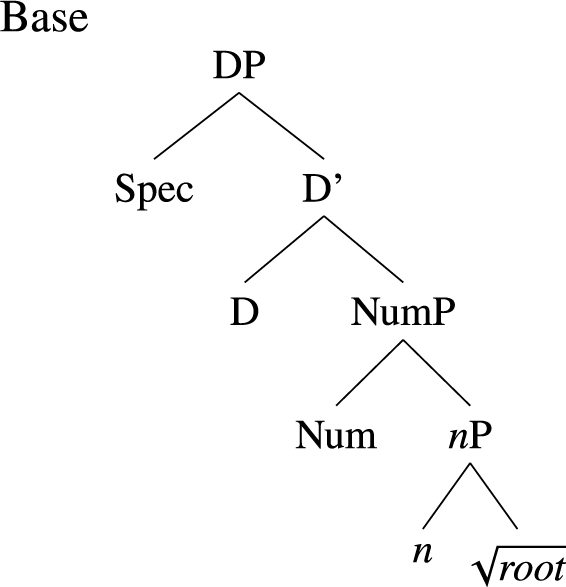
In deriving the relevant orders, I assume the more or less standard DP-structure in (34) and propose that IS-neutral N > POSS is derived by moving nP to SpecDP. This is somewhat in line with the idea that Bantu noun-initial word order can be derived via N-to-D movement (c.f., Carstens Reference Carstens1991, Nkemnji Reference Nkemnji1995, Tamanji Reference Tamanji2006, Carstens Reference Carstens, Everaert and van Riemsdijk2017). Poss is in D, and the functional projection NumP stands in-between D and nP (Ritter, Reference Ritter and Rothstein Susan1991, Preminger, Reference Preminger2020).
(34)
(35)
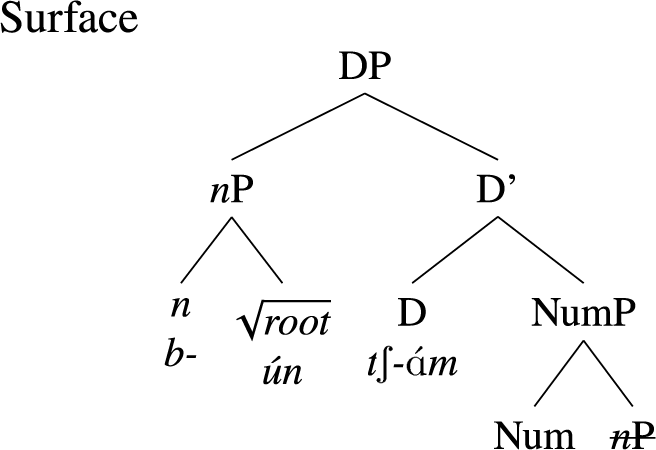
(36)
b-ún
tʃ-ɑ́m
2-child
2-poss.1sg
‘my children’
(Medumba)
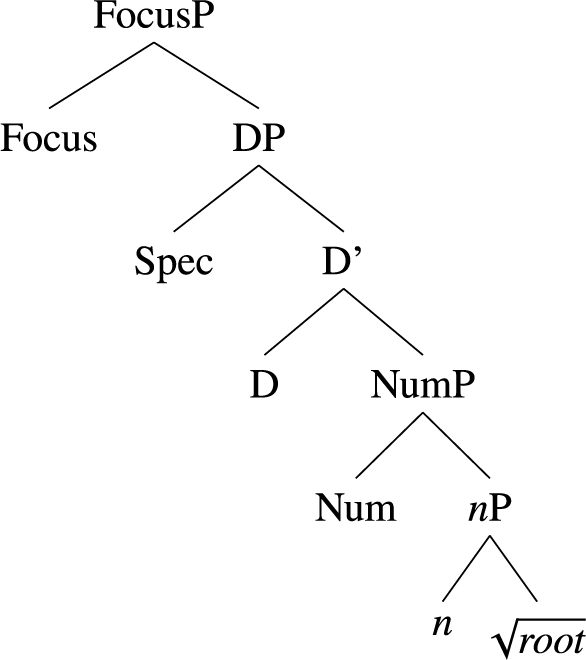
I adopt the view that DPs have a CP-like left periphery that hosts focused elements (see, among others, Aboh Reference Aboh2004). Specifically, modifier focus implies the presence of a FocusP above DP, as schematized in (37). POSS > N is derived by moving D to the Focus head (38).
(37)
(38)
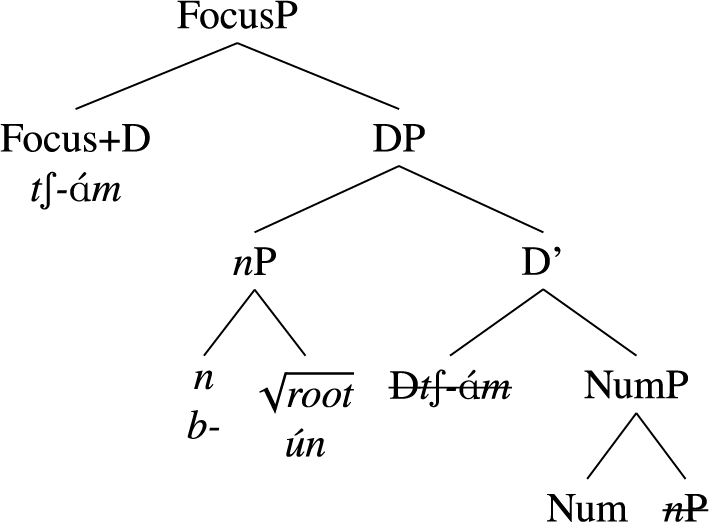
(39)
tʃ-ɑ́ɑ̀m
b-ún
2-poss.1sg.foc
2-child
‘MY children (as opposed to X’s)’
(Medumba)
Having shown how the two relevant orders can be derived, one can turn to how agreement and class exponence operate in the three languages. To do this, I will, in the next section, extend Carstens (Reference Carstens2026)’s grammar of gender in Bantu to Eastern Grassfields Bantu.
4.2. The grammar of gender in Eastern Grassfields Bantu
Certain phenomena in Bantu languages point to the direction that default agreement and/or animacy agreement is formal. One such phenomenon – and which is somewhat related to the Ngemba facts – is ‘animate concord’ (Wald, Reference Wald1975). In Chiyao, for example, the majority of human-referring nominals which, morphologically, fall outside of class 1 (the class that contains human-singular nouns in Proto-Bantu) obligatorily agree in animacy, i.e. they trigger the class 1 agreement marker on the verb. Below are examples from Riedel & Taji (Reference Riedel and Taji2022). Although
chi-lundamisi
‘last.initiate’ is morphologically marked for class 7, the agreeing subject marker must be of class 1 (40a). The expected class 7 subject marker is ungrammatical (40b).
(40)
(a)
Chi-lundamisi
nga-ni-a-lila.
7-last.initiate
neg-pst-1sm-cry
‘The last initiate did not cry.’
(b)
*Chi–lundamisi
nga-ni-chi-lila.
7-last.initiate
neg-pst-7sm-cry
‘The last initiate did not cry.
(Chiyao: Riedel & Taji Reference Riedel and Taji2022: 28)
Xhosa also instantiates conjunct agreement phenomena that point to the direction that [animacy] features need to be grammaticalized. As discussed at length in Taraldsen et al. (Reference Taraldsen, Medová and Langa2018) and Carstens (Reference Carstens2026), a conjunct of class 1 nouns would trigger regular class 2 (human-plural class in Proto-Bantu) agreement, as expected (41).
(41)
U-m-mtwana
no-m-fazi
ba-ya-dlala.
1-1-child
and.1-1-woman
2sm-dj-play
‘The child and the woman are playing.’
(Xhosa: Taraldsen et al. Reference Taraldsen, Medová and Langa2018: 1345)
The empirical puzzle is that some human-referring nouns that also fall outside of class 1 (morphologically) also trigger class 2 agreement. Example (42a) illustrates this for the combination [3 + 3], and (42b) for [5 + 5]. In (42a), the two conjoined nouns are morphologically marked for class 3, and one would expect the class 4 agreement marker on the verb. This is not what we get, as only human-plural
ba-
is grammatical. The simplest explanation for this would be that the agreeing verbs in (42) track the default (semantic) features of the conjoined nouns, and not the features of the classes to which they morphologically belong.
(42)
(a)
Um-gewu
nom-gulukudu
✔ba/✘i-sebenza
ndawonye.
3-criminal
and.3-ganster
2sm/4sm-work
together
‘A criminal and a ganster are working together.’
(b)
I-gqirha
ne-gosa
✔ba/✘a-sebenza
ndawonye.
5-healer
and.5-officer
2sm/6sm-work
together
‘A healer and the officer are working together.’
(Xhosa: Carstens Reference Carstens2024: 4)
In her account of the type of phenomena that precede, Carstens (Reference Carstens2026) proposes a grammar of gender in Bantu, in which she argues for, among other things, the facts that n heads are of different types, and can host interpretable (
I[gender]) and uninterpretable (
U[gender]) gender features. This is meant to capture the empirical observation that human-denoting nouns, for example, can morphologically fall into non-human classes, such that noun class is not always semantically predictable, yet agreeing heads can sometimes track the relevant semantic features. A germane example in Xhosa is
qhawe
; the root for ‘hero’. Although a human-denoting noun (which would, in most cases, warrant the class 1 marker), it is morphologically marked for class 5 which, semantically, is a non-human class (43a). The semantically regular class 1 prefix is ungrammatical (43b).
(43)
(a)
I-qhawe
5-hero
‘Hero’
(b)
*Um-qhawe
1-hero
‘Hero’
(Xhosa: Carstens Reference Carstens2024: 2)
According to Carstens (Reference Carstens2026), the fact that agreeing heads can sometimes target the default semantic class features (rather than the formal class features) of certain nouns follows, if nouns are specified for interpretable (core semantic gender), as well as uninterpretable genders. For the nominal root qhawe ‘hero’, the interpretable gender would be [class 1] (Gender A, in Carstens Reference Carstens2026), and the uninterpretable gender would be [class 5] (Gender C).
That agreeing elements can target any of the two instances of gender follows if, she further assumes, n heads stack within Bantu DPs (see also Kramer Reference Kramer2015 and Fuchs & van der Wal Reference Fuchs and van der Wal2022, i.a.). She, following Kramer (Reference Kramer2015), proposes a structure similar to (44), where nU
[gender] always stacks on top of nI
[gender].
(44)
nU
[gender] stacks on top of nI
[gender]
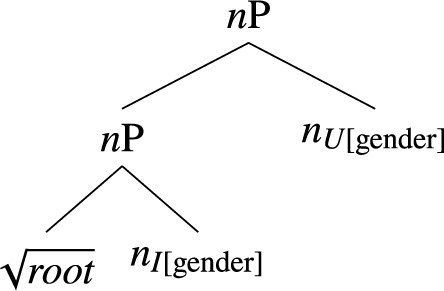
To derive the conjoint asymmetry in Xhosa (c.f., (42)), she argues that the gender and/or number features of conjunct members may clash, thereby forcing deletion of U[gender]. The result is that the I[gender] survives and can participate in agreement. Since the data I am interested in do not involve conjuncts, and since she assumes feature clash in conjunct contexts, I refer the reader to Carstens (Reference Carstens2024, Reference Carstens2026) for details of how deletion works, so as to derive the puzzling conjunct data from Xhosa.
The Eastern Grassfields Bantu data that the paper focuses on do not involve two DPs, hence feature clash of the type discussed in Carstens (Reference Carstens2026) is not expected to occur in the relevant constructions. What is crucial in accounting for the Eastern Grassfields Bantu data is that (a) n heads are of different types, and (b) they can stack. The empirical evidence for having
I[gender] and
U[gender] is even more pronounced in the languages under investigation in this paper, since the three of them only have 5–6 morphologically distinct classes. This presupposes, as discussed in the Grassfields Bantu literature (c.f., among others, Voorhoeve Reference Voorhoeve1968, Hyman et al. Reference Hyman, Voeltz and Tchokokam1970, Nkemnji Reference Nkemnji1994, Reference Nkemnji1995, Maho Reference Maho1999, Nchare Reference Nchare2011, Reference Nchare2012, Kouankem Reference Kouankem2012, Déchaine & Keupdjio Reference Déchaine and Keupdjio2016), that a lot of nouns are re-organized into single classes based on morpho-phonological, rather than semantic factors. Class 1, for example, is not semantically restricted to humans in the three languages (c.f., Kouankem Reference Kouankem2012, Nchare Reference Nchare2012, for relevant examples from Medumba and Shupamem, respectively). In Medumba, the non-human nouns ø-b
ú ‘dog’ and bhú ‘hand’ are morphologically marked for class 1. A relevant example in Shupamem is ø-tέt ‘pot’. In Ngemba, examples include ø-ndә̀ ‘house’, ø-kwɔ̀Ɂ ‘chair’, ø-pŭsì ‘cat’ and ø-tɔ̀ŋ ‘ear’. With this in mind, I adopt Carstens (Reference Carstens2026)’s theory, and propose that the internal structure of each Eastern Grassfields Bantu noun contains two types of n: n
I[gender] and n
U[gender]. In Carstens (Reference Carstens1991)’s theory of noun class exponence, [gender A] equates to class 1/2 (class 1 in the singular, and class 2 in the plural), [gender B] to class 3/4, etc.
(45)
Make-up and loci of gender features within Grassfields Bantu DPs
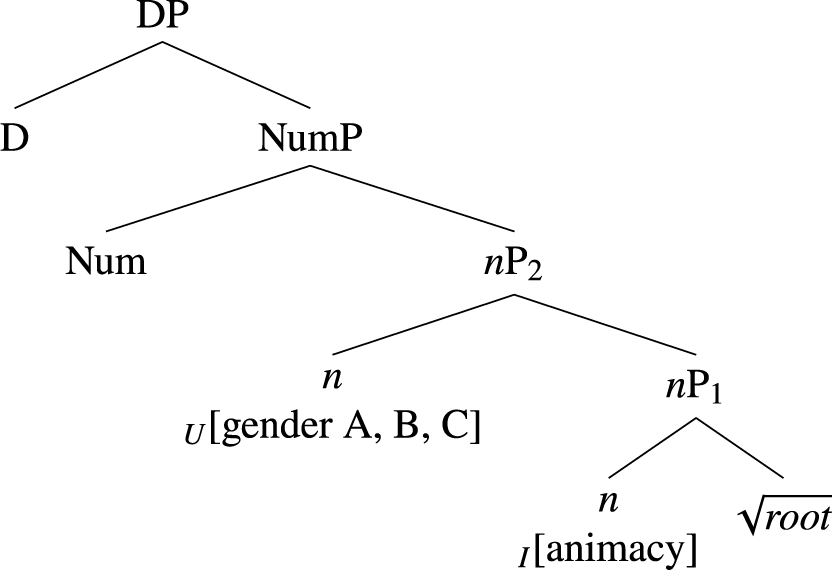
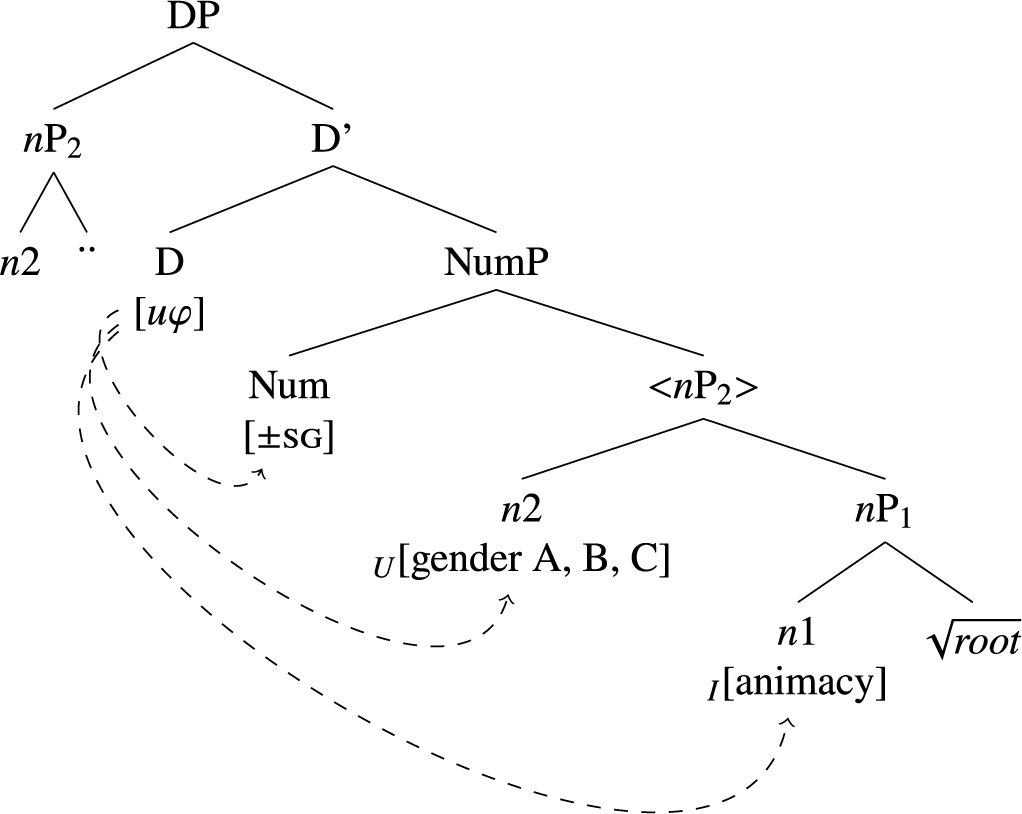
I propose that agreeing elements (in D, for possessive pronouns) always copy the features on the two instances of n, as schematized in (46). As (46) illustrates, the D head copies number features from Num, formal gender features from n2, and semantic gender features from n1.
(46)
Possessive pronoun agreement
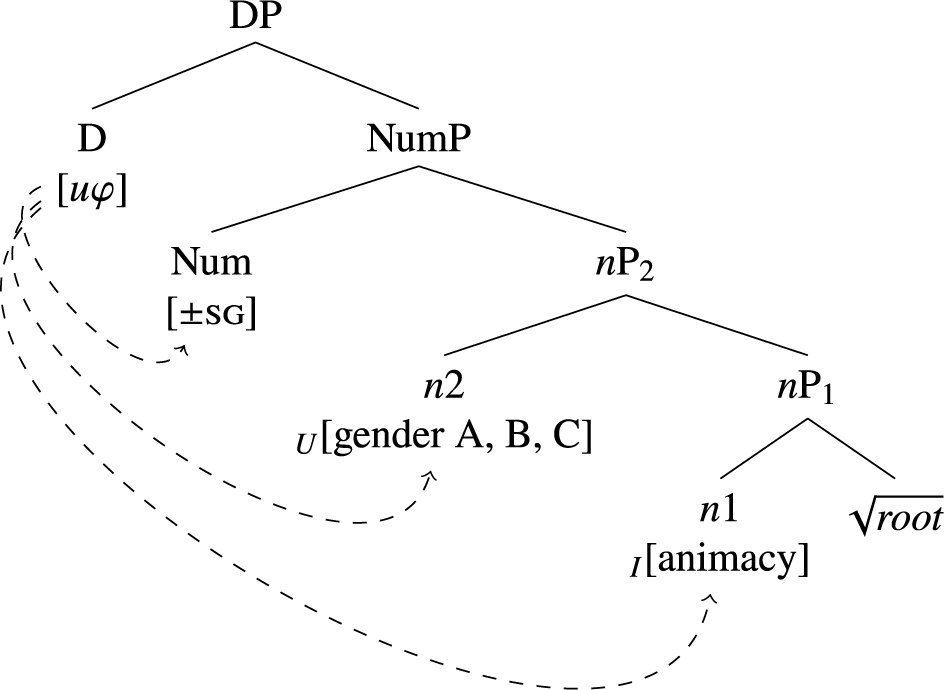
Given (46), and in line with the idea that the n head spells out the nominal prefix in Bantu (Fuchs & van der Wal, Reference Fuchs and van der Wal2022), n1 and n2 compete under the Subset Principle (47), and n2 always wins because it hosts more specific gender features.
(47)
Subset Principle
A vocabulary item V is inserted into a functional morpheme M iff (a) and (b) hold:
(a)
The morpho-syntactic features of V are a subset of the morphosyntactic features of M.
(b)
V is the most specific vocabulary item that satisfies (a).
(Müller Reference Müller2004: 9)
As such, the nominal prefix is the spell out of n2 in Grassfields Bantu. Number information combines with the formal gender features in n2 via allomorphic-like spell out rules of the type in (48) (c.f., Carstens Reference Carstens2026). (48a), for example, reads ‘[gender A] is spelled-out as the prefix /X-/ in singular contexts ([+sg])’. The same feature is spelled out as a different prefix, namely /Y-/, in plural contexts ([-sg]).
(48)
(a)
[Gender A] → /X-/ / [+sg]
(b)
[Gender A] → /Y-/ / [-sg]
The D head in (46) scans its c-command domain for agreement targets, and copies all the φ-features (gender and number) it sees on its way (c.f., (46)). In the morphology, D, in class 2 contexts, looks like (49) below. Since [gender A] and [animacy] are of the same type and can be put in a superset/subset relation ([animacy] is the superset of [gender A]), [animacy] only participates in morphological realization if its subset [gender A] is absent. The result is that only features that refer to formal classes can be inserted in non-focus contexts.
(49)
Spell out of D in non-focus contexts
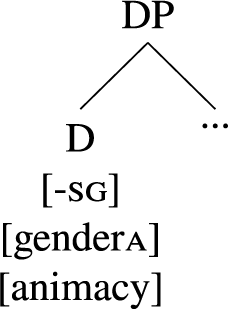
In the section that follows, I propose a derivation of the class exponence asymmetry with focus-marked possessive pronouns.
5. Deriving the Class Marking Asymmetry in the three Languages
This section derives the anti-agreement-like effects that Eastern Grassfields Bantu DPs exhibit. As a reminder from Section 2, possessive pronouns in Ngemba, Medumba and Shupamem follow the head noun in IS-neutral contexts. The pronoun can be contrastively focused, in which case it surfaces in pre-nominal position. When this happens, the three languages behave differently with respect to the realization of class markers on the focused pronoun. In Ngemba, regular class markers in the singular are replaced by the glides j- or w- depending on the animacy specification of the head noun. While j- is used when the head noun is inanimate, w- is preferred with animates. In Medumba, only the class 1 agreement prefix is affected. It becomes the single glide j-. Agreement markers from all the other classes (class 2, 4, 5 and 6) never change. In Shupamem, regular class markers (in plural and singular contexts) are always replaced by the single glide j-. I argue that the class marking differences follow from impoverishment rules that are triggered by the movement feature on the focus head.
I assume that all the three languages under discussion have identical syntax (word order and agreement), as discussed in Section 4. Since D is merged before its specifier, and assuming the Earliness Principle – which requires that operations apply as early as possible in a derivation – agreement takes place as soon as D is merged, hence, before nP-to-SpecDP movement (50).
(50)
Agreement and nP-to-SpecDP movement in non-focused contexts
In focus-marked contexts, [•foc•] triggers focus-movement of D to Focus. D moves with all the features it has agreed with, as structurally illustrated in (51), with a class 2 noun.
(51)
D undergoes focus-movement to Focus
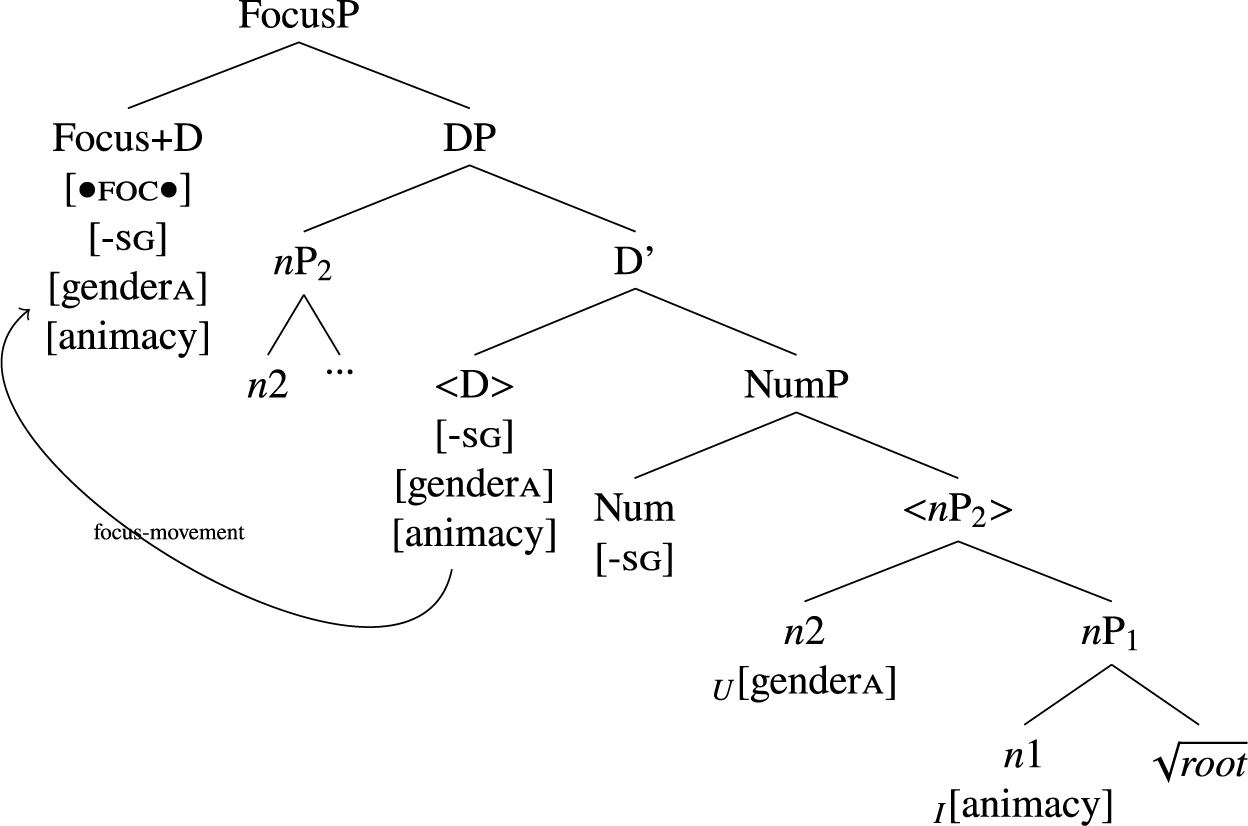
All else being equal, we would expect that regular class markers be inserted throughout, as discussed at the end of the section that precedes. I argue, following Baier (Reference Baier2018), Ershova (Reference Ershova, Kutay and Madeline2024) and Fongang (Reference Fongang2025b) that [•foc•] triggers impoverishment rules that delete number and/or gender features, and which result in the class marking differences we see on the surface in the three languages. The details of each language are presented in turn below.
5.1. Ngemba
Ngemba is peculiar in that it instantiates animacy agreement in singular POSS > N order. The relevant data are repeated in (52)–(55).
(52)
(a)
ø-pùmá
n-á
5-orange
5-poss.1sg
‘my orange’
(b)
mə-pùmá
m-á
6-orange
6-poss.1sg
‘my oranges’
(53)
(a)
ø-sú(n)
ø-à
1-friend
1-poss.1sg
‘my friend’
(b)
mə-sù(m)
p-á
2-friend
2-poss.1sg
‘my friends’
(Ngemba)
(54)
(a)
✘n-/✘w-/✔j-àà
ø-pùmá
5-/anim-/inan-poss.1sg.foc
5-orange
‘MY orange (as opposed to X’s)’
(b)
✘j-/✘w-/✔m-àà
mə-pùmá
inan-/anim-/6-poss.1sg.foc
6-orange
‘MY oranges (as opposed to X’s)’
(55)
(a)
✘ø-/✘j-/✔w-àà
ø-sú(n)
1-/inan-/anim-poss.1sg.foc
1-friend
‘MY friend (as opposed to X’s)’
(b)
✘j-/✘w-/✔p-àà
mə-sú(n)
inan-/anim-/2-poss.1sg.foc
2-friend
‘MY friends (as opposed to X’s)’
(Ngemba)
In deriving the Ngemba puzzle, I propose the impoverishment rule in (56), such that the movement feature [•foc•] always triggers deletion of the feature [gender A, B, C], in singular contexts. (56) reads ‘[gender A, B, C] becomes null (ø) in the context where [•foc•] and [+sg] are present’. The rule in (56) is restricted in the sense that it never applies to non-focused contexts (because [•foc•] is absent) and in plural ([-sg]) contexts. [animacy] survives (c.f., the tree in (51)) because only formal gender features, i.e. [gender A, B, C] are affected by the deletion rule. Recall from (51) that the agreeing head copies both [gender A, B, C] features (on n2) and [animacy] features (on n1). Only [gender A, B, C] features are targeted for deletion, [animacy] is not. As such, it survives, and j- realizes [-animate], and w-; [+animate].
-
(56) Ngemba impoverishment rule
[gender A, B, C] → ø / [•foc•], [+sg]
The rule, as it is formulated, does not apply to plural nouns, both in focused and non-focused contexts. This explains the fact that regular class markers are used throughout in the plural.
5.2. Medumba
The Medumba puzzle is such that only the class 1 agreement marker is replaced by the single glide j-. The empirical facts are repeated in (57) and (58) below.
(57)
m-έn
ø-ɑ̀m
1-child
1-poss.1sg
‘my child’
(58)
✘ø-/✔j-ɑ̀ɑ̀m
m-έn
1-glide-poss.1sg.foc
1-child
‘MY child, as opposed to X’s’
I treat Medumba j- as an elsewhere/default prefix and propose the rule in (59), such that [•foc•] triggers deletion of [gender A] and [animacy] in singular contexts.(59) reads ‘[gender A] and [animacy] become null (ø) in the context where [•foc•] and [+sg] are present’. Recall from the end of Section 4.2 that in Carstens (Reference Carstens1991)’s theory of noun class exponence, [gender A] equates to class 1/2 (class 1 in the singular, and class 2 in the plural), [gender B] to class 3/4, etc. Since only class 1 is affected in Medumba, the impoverishment rule only targets [gender A].
-
(59) Medumba impoverishment rule
[gender A] [animacy] → ø / [•foc•], [+sg]
-
(60) Feature specification of j- in Medumba
/j/ ⟷ [ ]
When (59) applies, only elsewhere j- can be inserted.Footnote 12
5.3. Shupamem
As far as Shupamem is concerned, Section 2 has shown that agreement markers on focus-marked possessive pronoun roots are always replaced by the single glide j-. The empirical details are repeated in (61)–(64) for convenience.
(61)
(a)
m-ɔ́n
ø-à
1-child
1-poss.1sg
‘my child’
(b)
p-ɔ̀n
p-á
2-child
2-poss.1sg
‘my children’
(62)
(a)
ø-pàm
ø-à
3-bag
3-poss.1sg
‘my bag’
(b)
ø-pàm
ʃ-á
4-bag
4-poss.1sg
‘my bags’
(Shupamem: Nchare Reference Nchare2011: 153)
(63)
(a)
✘n-/✔j-àà
m-ɔ́n
1-/glide-poss.1sg.foc
1-child
‘MY child (as opposed to X’s)’
(b)
✘p-/✔j-àà
p-ɔ́n
2-/glide-poss.1sg.foc
2-child
‘MY children (as opposed to X’s)’
(64)
(a)
✘ø-/✔j-àà
ø-pàm
3-/glide-poss.1sg.foc
3-bag
‘MY bag (as opposed to X’s)’
(b)
✘ʃ-/✔j-àà
ø-pàm
4-/glide-poss.1sg.foc
4-bag
‘MY bags (as opposed to X’s)’
(Shupamem)
I assume that Shupamem j- is also an elsewhere/default prefix in this language, and propose that [•foc•] triggers deletion of [gender A, B, C] and [animacy] in singular and plural contexts. (65) reads ‘[gender A, B, C] and [animacy] become null (ø) in the context where [•foc•] and [±sg] are present’.
-
(65) Shupamem impoverishment rule
[gender A, B, C] [animacy] → ø / [•foc•], [±sg]
-
(66) Feature specification of j- in Shupamem
/j/ ⟷ [ ]
The rule in (65) ensures that regular class markers never show up in modifier focus contexts in the language.
5.4. Why gender, but not number
A few questions remain to be answered. The first relates to the fact that all the impoverishment rules that I have so far proposed target gender, but not number. As a quick answer to this question, I propose that φ-features, i.e. gender and number in the case at hand, are hierarchically organized in Eastern Grassfields Bantu, such that impoverishment triggered by a movement feature cannot get to number without first deleting all gender features. The relevant hierarchy – also predicted to be at work in Baier (Reference Baier2018)’s system – is given in (67) below.
-
(67) Feature impoverishment hierarchy in Eastern Grassfields Bantu
[gender] ≺ [number]
The second question relates to why impoverishment has to target [gender A, B, C], but not [animacy] in Ngemba. I propose that this is because [gender A, B, C] is somewhat a subset of [animacy]. Deleting [animacy] automatically deletes [gender A, B, C] under this view, which is not what we expect. Deleting [A, B, C], however, does not automatically delete [animacy]. Note that one can also think of this in terms of a feature hierarchy.Footnote 13
The third question has to do with why the targets of deletion are different in the three languages. As a quick reminder, [gender A, B, C], leaving out number features, are deleted in Ngemba. In Medumba, only [gender A], i.e. class 1, is deleted ([gender B, C] and number features are not affected). In Shupamem, full gender and number features are deleted. My view on this is that these differences reflect stages in an incremental process of gender and/or number deletion in possessive pronoun focus contexts within the Eastern Grassfields Bantu language family. Languages like Yemba (c.f., Fongang Reference Fongang2025a), which do not instantiate the kind of class asymmetry that Ngemba, Medumba and Shupamem do, would be classified in the group of languages in which such deletion processes are yet to take place. Medumba would be at the very early stage of deletion, as only class 1 is affected. Ngemba would be much more advanced than Medumba, as all singular classes are affected. Shupamem would be at the very last stage, as all the relevant features are deleted. Descriptive and typological investigations of Eastern Grassfields Bantu languages are, in this regard, warranted to, on the one hand, check whether other differences exist and, on the other hand, identify and group other languages under the different stages of deletion.
6. Conclusion
The paper has shown that three Eastern Grassfields Bantu languages instantiate DP-internal possessive pronoun focus that, in turn, may affect the form of class markers. I described the phenomenon in Ngemba, Medumba and Shupamem and proposed that, despite the fact that it is the agreeing pronoun that is focus-moved, this phenomenon should be thought of as an instance of anti-agreement effects similar to the ones that have been described in the context of clause-internal IS-driven movement. I argued that the empirical facts from these three languages can be derived using Baier (Reference Baier2018)’s theory of anti-agreement and, as a consequence, provide further empirical evidence for his approach to the phenomenon. The paper – empirically – shows that anti-agreement-like effects can be visible within the nominal domain. On the theoretical side, it provides more arguments for the idea that movement features can trigger impoverishment rules.
Acknowledgements
Most of the data in this paper were provided by native speakers of the languages under investigation. Many thanks to Mysteline Makougoum, Cyrine Nyomy, Simplice Berenger, Enoch Tadjo, Claudine Ngamgueu, Moustapha Njoya and Sandrine Mafeu for sharing their knowledge of Ngemba, Medumba and Shupamem with me. I am also grateful to Gereon Müller, Philipp Weisser, Vicki Carstens and the anonymous Journal of Linguistics reviewers for their thoughtful comments, questions and suggestions. Finally, gratitude to the audience at ACAL 56, and the Morphology and Syntax Colloquium at Uni Leipzig for valuable feedback. The usual disclaimers apply.

 Open access

