1. Introduction
The existence of two sets of pronominal forms, tonic and clitic, is characteristic of the Romance languages. The clitic series has been the subject of extensive descriptive and theoretical work, traditionally focusing on such issues as the nature of clitic forms, clitic placement (specifically, movement versus base-generation), clitic clusters and ordering within them, clitic climbing (and restructuring phenomena), clitic doubling and the pursuit of a unified account of clitic elements in general. This study takes a novel approach to the topic. Through the investigation of defective object clitic paradigms in a number of northern Italian dialects and a comparison with Surselvan (a Raeto-Romance variety), Brazilian Portuguese and contemporary French, this article proposes a reconstruction of the path that has led to the current situation, focusing on the emergence and loss of clitics, and the order by which this happens. The two processes bear an interesting relation to one another: it seems that the order in which clitics are lost is the mirror image of the order in which they emerge. This is reminiscent of a parallel already observed by Jakobson (Reference Jakobson1941) between language in its status nascendi (i.e. first language acquisition) and language in dissolution (i.e. aphasia).
Pronominal clitics differ from tonic pronouns in a number of ways (see Kayne Reference Kayne1975 among many others). Unlike tonic pronouns, clitics do not enjoy syntactic or phonological independence, and their existence is strictly tied to their host; they do not have the same syntactic distribution as full noun phrases or tonic pronouns; furthermore, they cannot be modified (e.g. standard Italian *Proprio la ho vista vs. Ho visto proprio lei ‘I have definitely seen her’) nor coordinated (e.g. standard Italian *Lo e la ho visti vs. Ho visto lui e lei ‘I have seen him and her’). On a pragmatic level, both pronominal forms are used when the referents are already present in the discourse as established topics, but only a clitic can be used to refer to an active referent (in the sense of Chafe Reference Chafe1994: 53–55, i.e. a referent that is the focus of consciousness at a given moment) or an expected referent. With respect to these properties the two types are in complementary distribution. As discussed in Section 3.1 below, a third category of pronouns has been identified, the so-called weak type (Cardinaletti & Starke Reference Cardinaletti, Starke and Riemsdijk1999), which have properties in common with tonic and clitic pronouns but are crucially distinct from both.
Although typical of Romance, clitic pronouns are not present in all Romance languages. For example, partially or totally defective paradigms (within the accusative and dative series) feature in the Raeto-Romance (R-R henceforth) varieties spoken in Switzerland (see Haiman & Benincà Reference Haiman and Benincà1992) and in Brazilian Portuguese (see Lucchesi & Lobo Reference Lucchesi, Lobo, Faria, Pedro, Duarte and Gouveia1996, Galves Reference Galves and Costa2000, among others). In the R-R variety of Zernez (point 19 on the Atlante Italo-Svizzero (AIS), Jaberg & Judd Reference Jaberg and Judd1928–1940), spoken in the Lower Engadin region of Switzerland, there is a set of accusative clitics, as in (1a) below, but no clitic forms for dative, as seen in (1b), partitive, as seen in (1c), or locative, as seen in (1d).Footnote 2 The examples in (1b–d) show how such deficiency is dealt with, by the use of either a tonic pronoun (preceded by a preposition) or a gap.Footnote 3
- (1)
(a) ža tü il vowšt. (Zernez)
if you it.cl want
‘if you want it.’ (AIS VI:i, 1110)
(b) Di at el.
say to him.ton
‘Tell him!’ (AIS VIII:ii, 1659)
(c) Ce fesat vus kun el?
what do you with it.ton
‘What would you do with it?’ (AIS VI:i, 1113), compare:
(c′)
Cosa ne fareste? (Standard Italian)
what of-it.cl would-do
(d) Voleys ca yow ø geya. (Zernez)
want that I go
‘Do you want me to go there?’ (AIS VIII:ii, 1638Footnote 4), compare:
(d′)
Volete che ci vada io? (standard Italian)
want that there.cl go I
Brazilian Portuguese (BP) has a defective clitic paradigm in that the third person forms seem to have disappeared completely. The accusative clitics o, os, a and as do not exist in the spoken language: they are only found in written formal contexts, and are only acquired by children in school (Galves Reference Galves and Costa2000: 147). In those contexts in which a third person clitic pronoun would be expected, speakers resort to either a nominative tonic pronoun (used with accusative function) for [+animate] referents, as in (2a), or leave the object unexpressed (null object) with [−animate] referents, as in (2b) (see Duarte Reference Duarte, Eugênia and Tarallo1989).
- (2)
(a) Amanhã, o meu filho viajará para São Paulo. Eu deixei ele/*ø ir sozinho. (BP)
tomorrow the my son will.travel to São Paulo I let he.ton go alone
‘My son is leaving for São Paulo tomorrow. I am letting him go on his own.’
(b) Eu comprei o dicionário e emprestei ø/*ele ao João.
I bought the dictionary and lent it.ton to.the João
‘I bought the dictionary and lent it to João.’ (Lucchesi & Lobo Reference Lucchesi, Lobo, Faria, Pedro, Duarte and Gouveia1996: 308)
Furthermore, a third person dative object is preferably expressed by para followed by a tonic form: compare (3a) to its European Portuguese (EP) counterpart (3b), which uses the clitic lhe.Footnote 5
- (3)
(a) Vou perguntar para ela. (BP)
go ask to she.ton
(b) Vou-lhe perguntar. (EP)
go-she.cl ask
‘I'll ask her.’ (Azevedo Reference Azevedo2005: 236)
A number of closely related so-called Italian dialects in the valley of Comelico, part of the Veneto region in north-eastern Italy, variously lack cells in the paradigm of accusative and dative atonic pronouns.Footnote 6, Footnote 7 Unlike the R-R variety of Zernez, these dialects have both a dative and an accusative series, but lack forms within both. Their defective paradigm had already been noted by Tagliavini (Reference Tagliavini1926), however, the present paper offers the first detailed account of these facts.
Although traditionally typological studies are carried out on a high number of genetically unrelated languages, conducting research on a small set of closely related varieties with the aim of making a typological contribution has its value and advantages, as eloquently and convincingly argued by Poletto (Reference Poletto2012). Investigating linguistic systems that share the majority of their characteristics and minimally differ from one another in a limited and identifiable number of properties (in a similar fashion to two organisms that share most of their DNA and are differentiated by a few genes), offers the opportunity to zoom in on one variable and observe, without the interference of ‘background noise’, all its possible realisations, and, crucially, only those ones which are admitted by general principles of the faculty of language. Hence, although not in the same spirit as classic Typology, comparative micro-variation research of the type pursued in the present work affords the rare opportunity of observing patterns that can potentially result from general laws of language.Footnote 8
This study has two specific objectives. First, it describes in detail the facts from Comelico on the basis of elicited as well as spontaneously produced data, and compares them to attested cases of clitic loss. Secondly, it relates the patterns with which this morphological defectiveness expresses itself to more general principles, the Referential Hierarchy in particular, which have been traditionally shown to affect the morpho-syntactic organisation of a variety of languages (e.g. number distinctions, differential case marking of transitive [±animate] subjects, and hierarchical verb agreement, as discussed in Comrie Reference Comrie1981). The two aims are reflected in the way the paper is structured. The first part (Sections 2 and 3) consists of a detailed description of the synchronic facts in the Alpine varieties, which are then compared, in the second part, with a reconstruction of the process of emergence of clitic pronouns in (late) Latin (Section 4), and with cases of varying degrees of clitic loss in Surselvan, Brazilian Portuguese and contemporary French (Section 5). The two processes, emergence and loss, are discussed in Section 6 in relation to Jakobson's (Reference Jakobson1941) laws of irreversible solidarity and the Referential Hierarchy. Some concluding remarks and a few points left open for further research are provided in Section 7.
2. The Comelico dialects
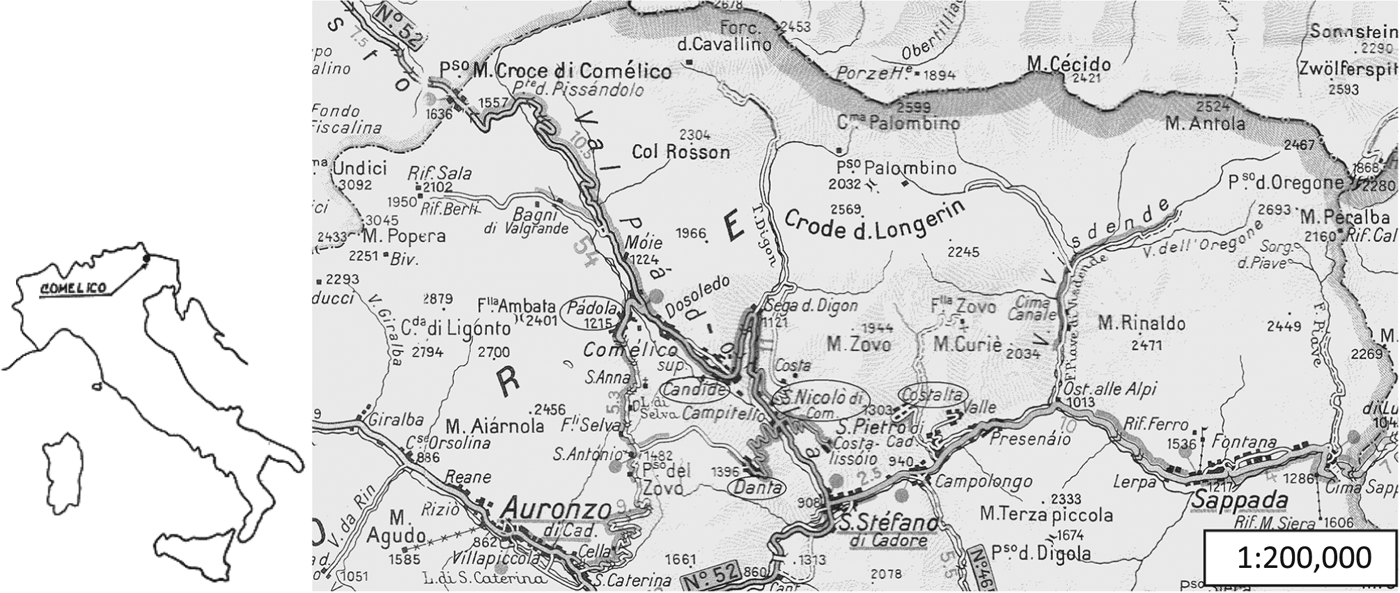
Comelico is the name given to the eastern Cadore, a Dolomitic area in the north-eastern Italian region of Veneto. The valley hosts closely related linguistic varieties that are different from those spoken in the surrounding areas. To the west, in the Sesto Valley, we find a variety of Tyrolean German; to the east, a German linguistic island, Sappada, separates Comelico from the Friulian varieties of Carnia, and to the south we find a number of Venetan dialects. The varieties chosen for this investigation are those spoken in Padola, Candide, Danta, San Nicolò and Costalta (see Figure 1). The phenomenon that is of interest here, empty cells in the object atonic paradigms, was first noticed in Padola and Candide by Tagliavini (Reference Tagliavini1926: 68–69), who recorded the absence in the series of reflexes of Latin accusative nos ‘we’ and dative illi ‘to him’. In subsequent notes (Tagliavini Reference Tagliavini1988: 69–70), he also commented on the fact that the use of the accusative forms for the third person, la/lu ‘her/him/it’ and i/li ‘them’, was in fact extremely rare, and the corresponding tonic forms were preferred instead.
Comelico and the villages in which the language varieties investigated are spoken: Padola, Candide, Danta, San Nicolò and Costalta.

Padola and Candide are the geographical centre of the phenomenon, lacking the highest number of cells; San Nicolò, Danta and Costalta are at the periphery. The data presented throughout this article were collected using three methods: (i) a set of sentences and short dialogues was elicited personally by the present author working with informants (these data served as the basis for the spoken language investigation); (ii) spontaneously produced utterances, both in the dialect and in regional Italian, were observed and recorded; and (iii) written texts, modern and old, were consulted (a list is provided below, before the References section).Footnote 9 We start with the accusative paradigm.
2.1 Accusative pronouns
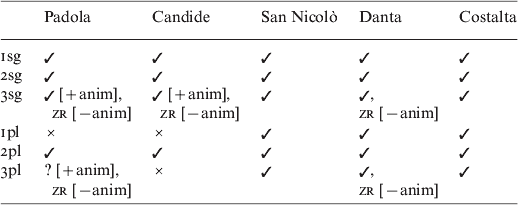
All the varieties investigated have a complete series of accusative tonic pronouns. The atonic paradigm is deficient in the dialects of Padola, illustrated in (4), and Candide, illustrated in (5): both have forms for the first and second person singular and second plural, and both lack a form for the first person plural, see (4c) and (5c), respectively.
- (4)
(a) A: As-t vist Rosa? (Padola)
have-you.scl seen Rosa
‘Have you seen Rosa?’Footnote 10
B: Si, ø ei vistu /?*ei vistu ila / l' ei vista ngeri.
yes have seen have seen her.ton her.cl have seen.fem yesterday
‘Yes, I saw her yesterday.’Footnote 11
(b) A Maria piasi la pasta e ø/*la mangia ogni dì.
to Maria pleases the pasta and it.cl eats every day
‘Maria likes pasta and she eats it every day.’
(c) A: Inú ve ceton?
where you.cl find
‘Where can we find you?’
B: ø Ceted / Ceted noi in piäza.
find find us.ton in square
‘You can find us in the square.’
(d) A: Sas-t algo d Maria e Bepo?
know-you.scl something of Maria and Bepo
‘Do you have any news of Maria and Bepo?’
B: Si, ø ei vist / ?li ei visti / ?*ei vist lueri ngeri e sta benon.
yes have seen them.cl have seen have seen them.ton yesterday and are great
‘Yes, I saw them yesterday and they are doing great.’
(e) A Maria piasi i fonghi e ø / *li mangia sempre d' istiadi.
to Maria please the mushrooms and them.cl eats always of summer
‘Maria likes mushrooms and she always eats them in the summer.’
- (5)
(a) A: As-t vist Rosa? (Candide)
have-you.scl seen Rosa
‘Have you seen Rosa?’
B: Si, ø eiu vist/?*eiu vist vela / l' eiu vista ngeri.
yes have seen have seen her.ton her.cl have seen.fem yesterday
‘Yes, I saw her yesterday.’
(b) A: Che à decisu da fèi col trator e la ceda?
what have decided to do with.the tractor and the house
‘What have they decided to do with the tractor and the house?’
B: Al trator ø / *l' à vandù e la ceda ø/*l' à fitó.
the tractor it.cl have sold and the house it.cl have rented
‘As for the tractor, they have sold it, and as for the house, they have let it.’
(c) A: Che fa i canai d' istiadi?
what do the chidren of summer
‘What are the children doing in the summer?’
B: Luca (?lu) mandon z i noni, Maria (?la) mandon z colonia.
Luca him.cl send to the grandparents Maria her.cl send to summer.camp
‘As for Luca, we are sending him to his grandparents, and as for Maria, we are sending her to a summer camp.’
(d) ø Sentidi? / Sentidi néi?
hear hear us.ton
‘Can you hear us?’
(e) A: E Maria e Bepu?
and Maria and Bepu
‘And what about Maria and Bepu?’
B: ø Eiu ciatad / ?*Eiu ciatad leri / in piäza e sta benon.
have met have met them.ton in square and are great
‘I have met them in the square and they are doing great.’
(f) A Maria piasi i fonghi e ø coi dutu l' istiadi.
to Maria please the mushroom and picks all the summer
‘Maria likes mushrooms and she picks (them) all summer.’
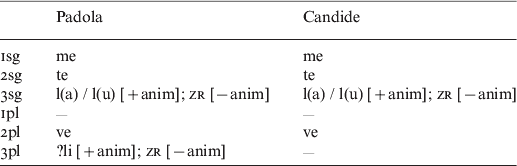
The use of a clitic for the third person, singular and plural, masculine and feminine, is not only restricted to [+animate] referents, as in (4a, b) and (5a, b), but also seems to be infelicitous in the plural, see (4d, e) and (5d, e), for which either a tonic form or a gap is preferred.Footnote 12 It is interesting to note that in (5b, c), from Candide, a left-dislocated [−animate] direct object cannot be resumed by an atonic pronoun, while a [+animate] one (marginally) can (the same holds true for Padola). A summary of the forms in Padola and Candide is given in Table 1. The accusative clitic paradigm is complete in all the other dialects.
Accusative atonic pronouns in Padola and Candide.
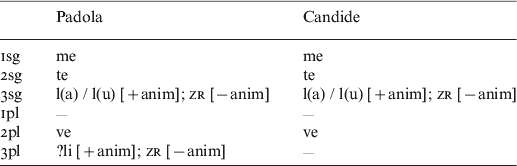
A few points are in order here. First, example (4a) above is interesting as it shows that when a third person clitic is used for a feminine referent, the past participle shows agreement, while with a gap no such agreement is triggered, indicating that the form is not just phonetically unrealised but syntactically inactive, hence totally absent. Secondly, in those cases in which the referent is animate and both a gap and a tonic pronoun can be used (i.e. first person plural and, very marginally, third person), the two forms appear to be in free variation. Thirdly, both a gap and a tonic pronoun can be used for an active/expected referent – thus in (4a) and (5a), allowing for the marked marginality of the tonic pronoun, neither a gap nor a tonic pronoun introduce a change of topic or express a contrast. This suggests that the tonic pronouns are being re-analysed as weak (in the sense of Cardinaletti & Starke Reference Cardinaletti, Starke and Riemsdijk1999); this possibility is investigated and discussed in Section 3.1 below. Finally, it also seems that the animacy feature plays an important role in the realisation of a referent as an atonic form. Crucially, even in those dialects (e.g. the variety spoken in Danta) that have a complete atonic paradigm, a gap is possible with third person [−animate] referents, both in the singular and plural. Some examples of the plural are shown in (6): when the referent of the pronoun is [−animate], as in (6b), a gap is possible, unlike when it is [+animate], as in (6a).
- (6)
(a) A: Sas-to algo d Maria e Giuseppe? (Danta)
know-you.scl something of Maria and Giuseppe
‘Do you have any news of Maria and Giuseppe?’
B: Si, li / ?*ø vedo doman e i sta bén.
yes them.cl see tomorrow and they are well
‘Yes, I am seeing them tomorrow and they are doing well.’
(b) A Maria pias i fonghe e li / ø mangia senpro d'istiade.
to Maria please the mushrooms and them.cl eats always of summer
‘Maria likes mushrooms and she always eats them in the summer.’
The next set of spontaneously produced sentences comes from the varieties of Padola, in (7), and Candide, in (8). They exemplify the strategies that the grammatical system offers to circumvent the lack of an atonic form: either the use of the tonic pronoun for the first person plural as in (7a), or the use of a gap, for both first person plural, as in the regional Italian example in (7c), and third person [−animate], in (7b, d) and (8a, b).
- (7)
(a) [Context. Recalling old traditions in Padola: at the end of a procession, young men would pluck up courage and go and ask the hand of their sweetheart; her father, trying to get to know the young man, would ask him some questions.]
À scumanzeu a dumandà algu e anchi a dì cali ch pudé esi li bravuri e anchi idifeti d'so fie, disendu ‘Leve su bunore, va a mese, iute semper noi zi nosi lavori, sa fei algo cule gusele’.
‘He started to ask something and to say which could be the good and bad sides of his daughter, saying “She gets up early, she goes to Mass, she always helps us.ton in our activities, she can sew”.’
(b) [Recalling how the Regole, the administrative local powers, used to allocate wood to the people in Padola.]
Canc té fore l'avisu che gné dadi fore i legni, la denti s'ingrumà danti la cese dla Regule, parché tanti oti ne n'ere asei par duci e alore vardà da esi i primi par pudé ciapà ø … Can ch'ruà zal pian, li femni ø gné incontre par iuté ø a tire ø a cese. … S disé ch'i i legni s'aude cuater oti: n'ote a fei ø, n'ote a mnà ø, n'ote a pestà ø su e l'ultme a bursé ø.Footnote 13
‘When the notice that the wood (lit. “the woods”) would be distributed was put out, people would gather in front of the town hall, because very often there wasn't enough for everybody and so (one had) to try to be the first in order to be able to receive (it) … When it reached the valley, the women would come to meet (us) to help (us) to drag (it) home … People used to say that wood burns (i.e. it produces heat) four times: one when cutting (it), one when transporting (it), one when breaking (it) up and the last one when burning (it).'
(c) [A lady from Padola, recalling Sundays with her late husband, regional Italian.]
eh, quando Giovanni era vivo lui lavorava sempre. Partiva la mattina presto e tornava sempre tardi tanto che io dicevo ‘È sposato al lavoro’ … ma la domenica era dedicata alla famiglia. Diceva sempre ‘Oggi non si lavora’, e lui ø portava sempre al ristorante, e le figlie erano tutte orgogliose, capirai
‘Ah, when Giovanni was alive he worked all the time. He used to leave early in the morning and come back late, so that I used to say “He's married to his job” … but Sundays were devoted to the family. He used to say: “No work today” and he used to always take (us) to the restaurant and our daughters were all proud, you can imagine …’
(d) [A boy from Padola, telling off a friend who, playing with it, has just broken the aerial on his car.]
Vé mo, t' ø as rotu!
‘See, you have broken (it)!'
- (8)
(a) [From a conversation between two librarians, Candide.]
Da pech tenpu à publicò n libar cu li satiri d carnaval di ani '40 e '50 e '60 de San Nuclò, chestu è neu e l'Istituo ne n ø à ncamò, ei da purtà ø fora io sta stmana ch ion.
‘Recently they have published a book with the Carnival speeches from the Forties, Fifties and Sixties from San Nicolò, this is new and the Institute does not have (it) yet, I have to bring (it) out next week.’
(b) [From the recounting of a pilgrimage to Luggau.]
Cunton da pudé ncamò dì ze sta maniera. È pì d cuaranta chilometri, ma val la pena fèi ø.
‘We are counting on going again like this. It is more than forty kilometres, but it is worth walking (them)\doing (it).’
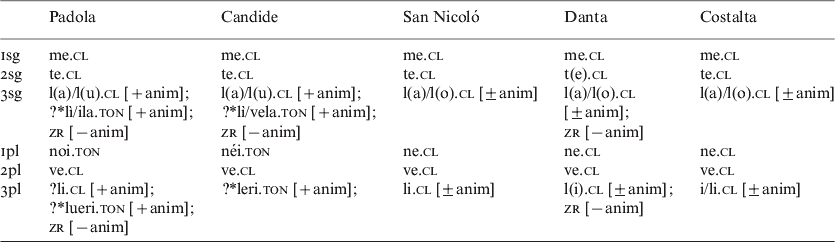
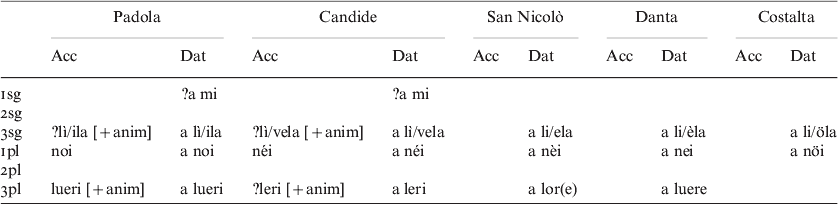
Table 2 (on next page) shows the various forms used as accusative atonic pronouns across the five varieties.
Forms used as accusative atonic pronouns.
Let us now turn to the dative paradigm.
2.2 Dative pronouns
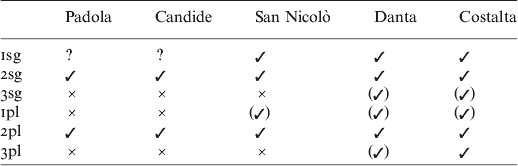
The dative atonic paradigm is defective in three dialects, Padola, Candide and San Nicolò, as illustrated in (9)–(11), respectively. They all lack third person datives (both feminine and masculine, singular and plural), as shown in (9a), (10a) and (11a); in addition, Padola and Candide do not have an atonic form for the first person plural, see (9b) and (10b):
- (9)
(a) N ved mai Maria, ma ø èi telefoneu / èi telefoneu a ila ngeri. (Padola)
neg see never Maria but have phoned have phoned to her.ton yesterday
‘I never see Maria, but I phoned her yesterday.’
(b) ø Das-t / Das-t a nuietar zinc panins?
give-you.scl give-you.scl to us.ton five bread.rolls
‘Could you give us five bread rolls?’
- (10)
(a) A: As-t dò la culazion ai canai? (Candide)
have-you.scl given the snack to.the children
‘Have you given the snack to the children?’
B: Si, ø ei dò / ei dò a lueri ali tre.
yes have given have given to them.ton at.the three
‘Yes, I have given it to them at three o'clock.’
(b) ø Dadedi i panins? / Dadedi i panins a nuietar?
give the bread.rolls give the bread.rolls to us.ton
‘Could you give us the bread rolls?’
- (11)
(a) Par fèi la multa a Mario, la poliziaø è corosta davòi / è corosta davòi a lì par n chilometro. (San Nicolò)
for make the fine to Mario the police is run after is run after to him.ton for one kilometre
‘In order to give Mario a fine, the police chased him for one kilometre.’
(b) Ne das nesche panins? / Das a nèi nesche panins?
to.us.cl give some bread.rolls give to us.ton some bread.rolls
‘Could you give us some bread rolls?’
The following spontaneously produced sentences, (12) from Padola and (13) from Candide, show, respectively, the use of a gap and a preposition followed by a tonic pronoun when an atonic third person form does not exist.
(12) [Recalling old traditions in Padola, as in (8) above: at the end of a procession, young men would pluck up courage and go and ask the hand of their sweetheart, and the young man would be paralysed with fear.]
E intantu che la mari fnì i servisi al pari ciapà z man la situazion. Magari ø dumandà ‘che as-t fatu incui’ e davardé al discorsu. (Padola)
‘And while the mother was finishing the cleaning, the father would take the situation in hand, perhaps asking (him) “What have you been up to today?” and so he would get the conversation going.’
(13) [Recalling the role of the school teacher a few years back.]
Era ancamò al rispetu par la figura dal maestar ch gné vista com na persona nportanti par al peis e a lì se ubdì senza tant lumantassi. (Candide)
‘There was still respect for the teacher, who was seen as an important person for the village, and one would obey (to) him.ton without much complaining.’
In the dialect of Danta, which has a complete set of dative clitics, those for the third and first person plural are in free variation with the tonic pronouns, and for the third person, in addition to these, a gap is also an option:
- (14)
(a) Pr fèi la multa a Mario, la pulizia i / ø é corosta davoi / é corosta davoi a lì pr n chilometro. (Danta)
for make the fine to Mario the police to.him.cl is run after is run after to him.ton for one kilometre
‘In order to give Mario a fine, the police chased him for one kilometre.’
(b) A: À telefonò ai canaie Nani?
has phoned to.the children Nani
‘Has Nani phoned the children?’
B: Si, i / ?ø à telefonò / à telefonò a luere incuei.
yes to.them.cl has phoned has phoned to.them.ton today
‘Yes, he phoned them today.’
(c) N das-to di panins? / Das-to di panins a nèi?
to.us.cl give-you.scl of bread.rolls give-you.scl of bread.rolls to us.ton
‘Could you give us some bread rolls?’
A similar situation is found in Costalta. In spite of a complete dative paradigm, third person and first person plural can be realised by a tonic form (again, in free variation with the atonic pronoun), but not, crucially, by a gap:
- (15)
(a) N / *ø à mandó i libre / À mandó i libre a nöi. (Costalta)
to.us.cl have sent the books have sent the books to us.ton
‘They have sent us the books.’
(b) N' i / N' *ø antaressa nente! / A öla n' antaressa nente!
neg to.her.cl neg interests nothing to her.ton neg interests nothing
‘She is not interested at all!’
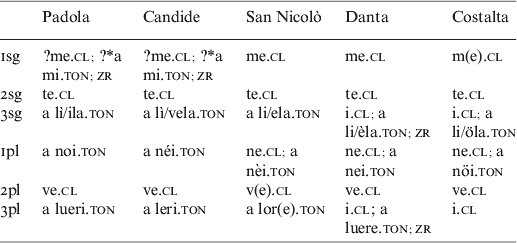
Table 3 presents a summary of the forms used as atonic pronouns in the dative across the five varieties considered above.
Forms used as dative atonic pronouns.
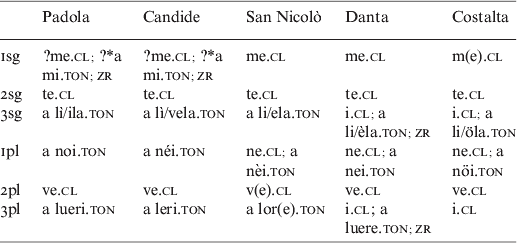
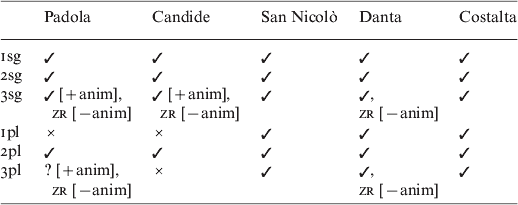
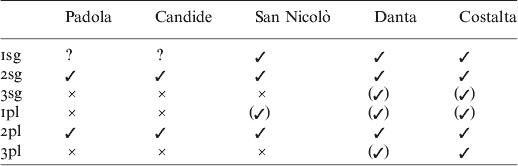
As a final summary, Tables 4 and 5 (next page) present an overview of the existence (indicated with a tick ✓ ) or absence (indicated with a cross ✗ of accusative and dative atonic pronouns across the five varieties. In those cases in which the clitic form is in free variation with the tonic form or a gap, the tick is in parentheses.
Summary of accusative atonic forms.
Summary of dative atonic forms.
3. Discussion of the Comelico facts
The synchronic defective paradigms of the atonic pronouns in the Comelico dialects can be the result of two logically possible diachronic processes. The first, arrested development, accounts for the missing forms by assuming that they never developed. The second, decay, attributes the defectiveness to a process of loss: the paradigm was complete and then at some stage some forms disappeared.
By the very nature of defectiveness, any attempt at reconstructing its diachronic path faces significant challenges. However, one can bring forward the evidence that is available and on that basis make informed speculations and form a plausible reconstruction. This is what this section sets out to do.
In support of the arrested development hypothesis there is the case of incomplete subject clitic paradigms in the northern Italian dialects (NIDs). Vanelli (Reference Vanelli1987) places the emergence of subject clitics in the NIDs between the 15th and 16th centuries, and interprets it as the result of a weakening process of the nominative tonic pronouns. Pescarini (Reference Pescarini2009) observes that in some Medieval Veronese texts there is evidence that this weakening process did not target all persons equally. While some forms clearly developed into clitics, others did not, possibly remaining at an intermediate stage and eventually being lost: this would explain the incomplete series of subject clitics found in some NIDs. Pescarini's observations are perforce inconclusive, since the relevant data are not forthcoming and limited to a few texts. Nevertheless his remarks cast some doubt on the assumption that all NIDs had, at some stage, a complete paradigm of subject clitics which was subsequently eroded in some cases.
The decay hypothesis is supported by attested and well-known examples of loss of atonic forms in Surselvan and Brazilian Portuguese. In both cases there is written evidence of a stage in which atonic pronouns existed alongside tonic pronouns and displayed clear clitic behaviour. Furthermore, from the very restricted and admittedly not totally reliable diachronic evidence that exists for the Comelico dialects, and from the evidence in the peripheral areas, it seems that there is reason to believe that the current defective paradigms in Comelico are the result of a process of decay.Footnote 14, Footnote 15 This is the hypothesis that is pursued and investigated here.
As for the reason behind this decay, given the close proximity to a German-speaking area, the neighbouring Sesto Valley, it could be argued that the synchronic situation in Comelico is the result of language contact/proximity with German varieties. This does not seem immediately plausible for a number of reasons. First, a physical one: the Comelico Valley is separated from the German-speaking area by a mountain pass (Passo Monte Croce di Comelico, Kreuzbergpass), which incidentally also separates two provinces, as well as two regions, Belluno (Veneto) from Bolzano (Trentino Alto Adige), and at the time of the First World War it also marked a national boundary, between Italy and the Austro-Hungarian Empire. Secondly, there is a clear cultural separation between the two valleys: as noted by Vàrvaro (Reference Vàrvaro1984: 143–144), the signs of a close-knit community are visible in their linguistic code even before they affect dress code and behaviour. While the Sesto Valley is clearly ‘German’, Comelico is very much ‘Italian’ (see also Tagliavini Reference Tagliavini1926). It is also hard to imagine any language contact revealing itself in the loss of something of a grammatical nature, such as atonic pronouns, when the lexis, which is the area typically affected first in the contact between two stable linguistic communities, displays no signs of a significant presence of German. Finally, a recent article by Kaiser & Hack (Reference Kaiser, Hack, Fleischer and Simon2013) makes a convincing case against German language contact being the reason behind the loss of object clitics in some R-R varieties. They argue, instead, that the process was naturally happening in these varieties and the contact with German provided the supportive environment needed for the maintenance and the further development of the already existing trends.
If, however, one still finds these arguments unconvincing, the simple fact that the cells within these paradigms have not been affected equally by the process is, in itself, of linguistic and typological relevance and appeal. It seems therefore interesting to investigate the nature of the hierarchy along which such a change is operating and try and place it within the wider context of principles that govern language change. Accordingly, we sketch the possible development, to the extent that it can be plausibly reconstructed, of these defective paradigms.
3.1 The status of the Comelico pronouns
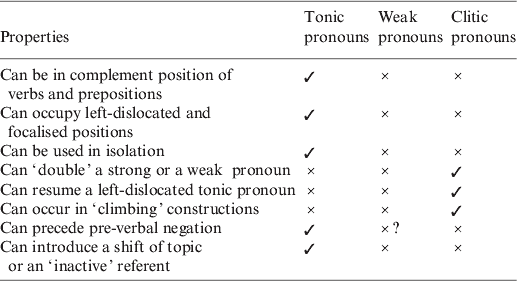
The discussion so far has intentionally remained unspecific about the exact morpho-syntactic status of the pronominal forms in Comelico. It has been recognised (and generally accepted) that the label ‘atonic’ subsumes (at least) two types of pronouns, weak and clitic, as discussed in Cardinaletti & Starke (Reference Cardinaletti, Starke and Riemsdijk1999). While the former are assumed to be maximal (i.e. phrasal) categories, alongside tonic forms, the latter are best analysed as heads. Both weak and clitic pronouns are considered syntactically and pragmatically deficient/dependent. This is reflected in their behaviour. A summary of the properties of all three categories is provided in Table 6. In an attempt to establish the exact nature of both the atonic and tonic pronouns, we focus on doubling, left-dislocation, clitic climbing and pragmatics in the dialect of Padola.
Distribution of pronominal properties in standard Italian.
Only clitic pronouns can ‘double’ a strong or weak pronoun in the so-called doubling construction (Cardinaletti & Starke, Reference Cardinaletti, Starke and Riemsdijk1999: 169). Hence while (16a) works, (16b), in which the doubling of the strong pronoun a loro is done by the weak loro, does not:
- (16)
(a) Gliel' ho dato loro / a loro. (standard Italian)
to.them.it.cl have given them.weak to them.ton
(b) *L' ho dato loro a loro.
it.cl have given them.weak to them.ton
‘I gave it to them.’
Doubling constructions do not feature in the Comelico varieties, even in those cases in which most northern (and southern) varieties require the presence of a clitic. Compare (17a), from Triestino, one of the NIDs, and (17b′) from Padola: even if in Padola the atonic pronoun exists (17b), it cannot co-occur with the tonic pronoun.
- (17)
(a) A ti *(te) piasi le luganighe. (Triestino)
to you.ton to.you.cl please the sausages
‘You like sausages.’
(b) Te pias li luganghi. (Padola)
to.you.cl please the sausages
(b′)
*A ti te pias li luganghi.
to you.ton to.you.cl please the sausages
‘You like sausages.’
The ungrammaticality of (17b′) could be due to the fact that te is not a clitic but a weak pronoun. However, it could also be due to the same constraint that prevents doubling of a strong pronoun in standard Italian (*A te ti piacciono le salsicce ‘You like sausages’). This does not, crucially, depend on the nature of the atonic pronoun (which is clearly a clitic in standard Italian), but on the availability of doubling constructions in general. Since we cannot settle the matter here, we take this piece of evidence as inconclusive and consider further properties. Only clitic pronouns can resume a dislocated strong pronoun, witness the ungrammaticality of (18b):
- (18)
(a) A loro, gli regaliamo un album. (standard Italian)
to them.ton to.them.cl give a photo.album
‘As for them, we can give them a photo album as a present.’
(b) *A loro, regaliamo loro un album.
to them.ton give to.them.weak a photo.album
‘As for them, we can give them a photo album as a present.’
In Padola a left-dislocated accusative tonic pronoun can be resumed by an atonic form. This is only testable for [+animate] referents, since inanimate referents cannot be expressed by tonic forms (see also Cardinaletti & Starke Reference Cardinaletti, Starke and Riemsdijk1999: 145):
- (19)
(a) Te, te ciama alolo. (Padola)
you.ton you.cl call now
‘As for you, they will call you now.’
(b) A: Sas-t algo d Maria e Bepo?
know-you.scl something of Maria and Bepo
‘Do you have any news of Maria and Bepo?’
B: Ila, n la ved mai, e lì, l' ei vistu ngeri.
she.ton neg her.cl see never and he.ton him.cl have seen yesterday
‘As for her, I never see her, and as for him, I saw him yesterday.’
Only clitic pronouns can ‘climb’ to the front of the verbal (quasi)modal-infinitive complex:
- (20)
(a) Voglio vederlo / Lo voglio vedere. (standard Italian)
want to.see.him.cl him.cl want to.see
‘I want to see him.’
(b) Voglio vedere lui / *Lui voglio vedere. (with neutral intonation)
want to.see him.ton him.ton want to.see
‘I want to see him.’
‘Climbing’ constructions are possible in Padola:
- (21)
(a) Maria te vuä vede alolo. (Padola)
Maria you.cl want to.see now
‘Maria wants to see you now.’
(b) Giuani ve vuä vede alolo.
Giuani you.cl want to.see now
‘Giuani wants to see you now.’
Finally, atonic pronouns cannot be used to introduce a pragmatically salient (e.g. contrastively focused, indicated in bold in the examples in (22)) or new referent:
- (22)
(a) *Lueri te scolta, no lì. (Padola)
they.ton you.cl listen.to neg him.ton
(b) Lueri scolta te, no lì.
they.ton listen.to you.ton not him.ton
‘They are listening to you, not him.’
Summarising, these atonic elements can co-occur syntactically with left dislocated tonic pronouns and can ‘climb’ a verb complex; pragmatically, too, they can only refer to active or non-prominent referents, and cannot be contrastive. With respect to these properties, they display clitic behaviour. The impossibility of doubling constructions, even for a person for which the atonic pronoun exists, may be due to unrelated reasons which we do not investigate here.
Tonic pronouns display all properties listed in Table 6 above that are clearly associated with tonic forms. In addition, we have seen that a seemingly tonic form can be used anaphorically in contexts that would require a clitic pronoun in standard Italian. Similar cases have been noted in Old Italian and have been taken to be instances of weak rather than tonic pronouns (see Egerland & Cardinaletti Reference Egerland, Cardinaletti, Renzi and Salvi2010: 414). Thus, tonic and weak forms are morphologically identical but have different properties.
It can be concluded that there are possibly three types of pronominal forms in the Comelico varieties, clitic, tonic and weak. Although tonic and weak pronouns are morphologically identical, they display, as we have seen for Padola, distinct behaviour. A summary of the weak forms in the accusative and dative for all the varieties is given in Table 7.
Weak forms in the Comelico varieties.
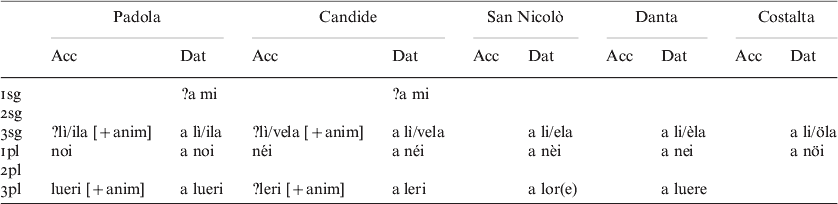
The existence of atonic pronouns with clear clitic behaviour is significant, as it indicates that, at least in the varieties of Padola and Candide, the clitic series has, indeed, developed. This in turns supports the hypothesis that the defective paradigms really are the result of a process of decay. No such conclusion can be drawn for first person plural, which is discussed as a separate case in the next section.
3.2 Identifying hierarchies
The defective paradigms described in the previous section are not all that is interesting about the Comelico varieties. Also of interest are the strategies made available by the linguistic system when dealing with a missing cell, as well as what is optionally available when a linguistic item for a given cell exists, as all of these reveal the morpho-syntactic status of the pronouns. As we have seen, the alternatives used to deal with the lack of a clitic pronoun are mainly two, a gap or the use of the tonic/weak form. The complementary distribution in terms of both pragmatic and syntactic properties between tonic and atonic forms that is typical of other Romance varieties does not seem to hold in Comelico, suggesting that seemingly tonic forms, in fact, subsume both tonic and weak pronouns.
The distribution of the tonic and clitic forms and of the gaps is also interesting in those cases in which the clitic form exists but other alternatives are available. Padola and Candide which, as we have seen, have the highest degree of defectiveness, prefer a gap to the use of the first person singular clitic (the use of the tonic form is felt as unnatural). In San Nicolò, Danta and Costalta, in which a clitic form for the first person plural exists, it is found in free variation with the tonic/weak form. In Danta we find that for the third person all three solutions are used: clitic, tonic/weak and a gap.
In the light of the conclusions reached in Section 3.1, and placing these facts against the wider Romance background, it seems that the Comelico dialects are undergoing a process of loss that has reached different stages in the five varieties. The existence of clitic pronouns, the blurred boundaries in the division of labour between tonic and clitic forms, as well as the presence of gaps, all point in the direction of a situation of loss – loss of specialisation, in that the tonic forms are weakening, and loss of forms, as the clitic pronouns are gradually substituted first by the original tonic pronouns, now weak, and eventually by gaps. Tables 4 and 5 above offer an overview of this pattern of loss and identify the forms that are affected first. The more numerous gaps in the dative paradigm suggest that dative has been affected before accusative (along similar lines to what observed by Benincà & Poletto Reference Benincà, Poletto, Kayne and Cinque2005a) and some grammatical persons before others. The data clearly single out first person plural (which is completely absent in both Padola and Candide and optionally omitted in other dialects), and third person singular and plural. Maintaining that Padola and Candide indeed represent the epicentre of the phenomenon, their ‘optional’ gap for the first person singular in the dative may point to this as the next target of the process.
The consistent absence of the clitic forms for the first person plural suggests that this is the form that was targeted first by the process of decay. This is, from a cross-linguistic perspective, unusual (see Farrell Reference Farrell1990: 329ff.), as a null object pronoun has a default interpretation of third person, which suggests instead that in a process of loss the third person is the first one to disappear. It is possible that the Comelico facts do indeed fall within the more usual pattern and that the behaviour of first person plural is the result of a process unrelated to the one affecting the other forms. It could, for example, have never developed (either accidentally, or as a result of possible homophony with negation, as the Old Italian first person plural clitic form was no), or it could have been lost at an earlier stage for different reasons (possibly being homophonous with either of the two non-argumental partitive or locative clitics, absent in all dialects. As observed by Benincà & Poletto (Reference Benincà, Poletto, Kayne and Cinque2005a) non-argumental clitics are lost before argumental ones. This explanation, however, would not account for the fact that a clitic form does exist for the second person plural, which is subject to very similar syncretism, having developed from a Latin locative).Footnote 16 As pointed out by Benincà & Poletto (Reference Benincà, Poletto, Cornips and Corrigan2005b), who break pronouns down into basic features such as [±hearer], [±speaker], [±there] and [±here], first and second person plural pronouns can express a ‘heavy load’. First person plural, in particular, could have any of the following readings (Benincà & Poletto Reference Benincà, Poletto, Cornips and Corrigan2005b: 280):
- (23)
(a) the speaker and only one hearer
(b) the speaker and more than one hearer
(c) the speaker, one hearer and somebody else who is not present
(d) the speaker, one hearer and several persons who are not present
(e) the speaker, more than one hearer and somebody else who is not present
(f) the speaker, more than one hearer and several persons who are not present
Furthermore, many Italo-Romance dialects have two forms for the first person plural tonic pronoun, the reflexes of Latin nos ‘we’ and nos alter lit. ‘we others’. The two can survive alongside each other and have specialised meanings based on the inclusive/exclusive distinction. Padola and Candide have both forms. With respect to the readings in (23) above, noi and nèi ‘we’ include the speaker, the hearer and various people who are not present; nuietar and nuiétar ‘we others’ exclude the hearer. For the second person plural, on the other hand, there is no such choice, and only the reflexes of vos alter exist, which has come to mean general ‘you’. Interestingly, all the other dialects, which have an atonic form for the first person plural, do not make the n/vos – n/vos alter distinction. It was suggested in Paoli (Reference Paoli2009: 79) that an atonic form, defective in semantic, phonological and syntactic terms, may not have been able to ‘cope’ with the information overload associated with the tonic form in general exemplified in (23), and with the inclusive/exclusive feature specific to Padola and Candide. The result of this inadequacy would have been lack of development (or, at the very least, very early loss). Following this line of reasoning, second person plural would be ‘immune’ from such inadequacy because of the lack of lexicalisation of the inclusive/exclusive distinction by the pronominal forms.
Although these are tentative explanations at this stage, it seems plausible to consider the case of first person plural as separate. Further justification for this choice is also derived from Surselvan and Brazilian Portuguese data in Section 5 below.
If the first person plural is taken out of the equation, the picture that emerges is not only more familiar but also meaningful: the third person is affected first by the process of decay, and it is [−animate] referents that are more readily expressed by a null form (see Padola, Candide and Danta). Providing a rough approximation of the order in which these forms are disappearing, we obtain the hierarchy in (24) based on person features (Person Hierarchy). The ‘>’ symbol is to be understood as representing diachronic precedence.
(24) 3rd sg [−anim >+anim] >3rd pl [−anim >+anim] >1st, 2nd sg >2nd pl
There is also a process of re-analysis of the pronominal forms, as the original tonic pronouns weaken and, together with gaps, substitute the original clitics. The stages of such a process are shown in (25), in which a possible final stage, witnessed in Surselvan, has been added.
(25) tonic and clitic forms in clear-cut domains > tonic and clitic forms in free variation (tonic becoming weak?) > gap alongside clitic and/or tonic (weak?) form > gap preferred > re-introduction of tonic forms?
The discussion of these facts is resumed in Section 5. We now turn to the emergence of object clitic forms in the path from Latin towards Romance.
4. From Latin to Romance
The purpose of this section is to try and reconstruct the developmental path followed by the atonic pronouns in (proto-)Romance.Footnote 17 This will prove necessarily an exercise of informed guessing, as there exists no uncontroversial evidence to attest early signs of the process, nor to show whether it had targeted some forms before others. Written sources do not readily display any early symptoms that a change was under way except in those cases in which metre was clearly affected.Footnote 18 Furthermore, the relevant evidence is not easily available, as Latin was an object-drop as well as a subject-drop language. The presence of an overtly expressed object was required predominantly in those cases in which pragmatic salience made it necessary, and only a subset of these were instances in which this was done through the use of a pronoun. It is not until 800AD, in the early medieval Parody of the Lex Salica, that we find the first attestation of a written third person clitic pronoun in the modern form (Wanner Reference Wanner1987: 68).
It is generally accepted that Latin did not have any pronominal clitics as we know them today. Pronouns in a traditional sense only existed in Latin for the first and second persons and for the third person reflexive (see Wanner Reference Wanner1987: 67), the third person otherwise availing itself of demonstratives of different types.Footnote 19 Although the claim has not been systematically made and independently justified, there is evidence of two prosodically distinct versions of the same forms in Latin, as often the same Latin pronominal form developed into two distinct elements in Romance. Salvi (Reference Salvi2001: 286ff.), drawing on Schwan & Behrens (Reference Schwan and Behrens1913: 13), cites the two Old French forms, tonic and atonic, respectively, mei/moi and me. These, evolved from Latin mē, could only be the result of a respectively stressed and unstressed use of the form, yielding the expected development of tonic [e] into the diphthong ei/oi and of atonic [e] into [ə].
Pragmatically, too, the Latin forms could function contrastively as well as simply refer to an expected/active referent, clearly subsuming the roles that would be taken on in Romance by tonic and clitic pronouns, respectively.Footnote 20 In (26a) the pronoun tibi ‘to you’ is contrasted with the author himself, Cicero, who is referred to with the emphatic pronoun mihimet. In (26b) no such contrast exists, and eum ‘him’ is simply used to refer back to its active antecedent Demetrius: the very presence of the pronoun may indicate that the form is behaving, (at least) pragmatically, in an atonic way.
- (26)
(a) Tibi autem idem consili do quod mihimet ipsi
(Cicero, Epistulae ad familiares, IX.2.2, in Salvi, Reference Salvi2001: 286)
‘I give you the same advice I give to myself’
(b) Demetrius venit ad me … Tu eum videlicet non potuisti videre
(Cicero, Epistulae ad familiares, XVI.17.2, in Salvi, Reference Salvi2001: 286)
‘Demetrius came to visit me … you were evidently not able to see him’.
Thus, on the basis of these facts, it makes sense to assume that the Latin pronominal forms already displayed part of those properties that were going to characterise Romance clitics. As Dieter Wanner points out, the ‘real’ pronouns (i.e. first and second and third reflexive) had the potential to behave in a clitic-like manner from the earliest days:
The I, II and III refl[exive] forms lead without any break into the Romance clitic expressions; any one of them is able to represent a special or simple clitic or non-clitic form in early Late Latin. But the third person non-reflexives (ill-, ips-) are preserved in the texts in their full, bisyllabic form for a long time (at least in writing), so that they appear only in the eighth century in consciously ‘vulgare’ texts with typical apheresis'. (Wanner Reference Wanner1987: 87–88)
Third person pronouns started to display clitic-like behaviour much later in the evolution, as they had ‘to drop from their strong status to simple reference function’ first (Wanner Reference Wanner1987: 76).
Therefore, there seems to be a strong enough case to claim that the (proto-)clitic use of first and second person pronouns preceded that of third person. On this basis we can formulate a first approximation of the hierarchy of the emergence of clitic forms, shown in (27), where ‘>’ is to be understood, as in (24) and (25) above, as diachronic precedence:
(27) 1st and 2nd >3rd
The hierarchy in (27) is also an implicational hierarchy: where the order in (27) holds, it is expected that the presence of a clitic form for the third person will imply the existence of clitic forms for first and second, too.
We can also draw a parallel hierarchy, concerned with the relationship between form and function:
(28) tonic forms used both in a tonic and atonic manner (possibly becoming weak?) > weak/clitic usage restricted to specific positions > gradual phonological and morphological erosion of the forms in their clitic usage > distinct sets of clitic forms with correspondingly distinct functions from tonic forms evolve.
The formulations in (27) and (28) represent the path followed by the development of clitic pronouns from Latin to Romance. The next section turns to the discussion of two attested cases of clitic loss, Surselvan and Brazilian Portuguese, and considers a change in progress in contemporary French.
5. Three cases of clitic loss
5.1 Surselvan
Of the R-R varieties, Surselvan is the only one that lacks a pronominal object clitic series tout court, and uses the tonic pronouns instead. This is the result of a process of loss that has taken place over the last several hundred years. Clitics are still witnessed in the 16th century. The text Vita de Soing Giosaphat. Convertius de Soing Barlaam ‘Life of Saint Josaphat converted by Saint Barlaam’ (Barlaam and Josaphat henceforth) and the 1591 diary Cudisch dilg viadi da Jerusalem ‘Book of the journey to Jerusalem’ (The Diary henceforth) by Decurtins Reference Decurtins1880–1883: 255–296, 151–196, respectively, offer an insight into the process of loss and the path it followed. Barlaam and Josaphat is a legend of Indian origin, although it was an Italian version that served as the model for this translation (Ascoli Reference Ascoli1880–1883: 417). This particular manuscript edited by Decurtins dates from the 17th century, and has some 18th-century amendments (Decurtins Reference Decurtins1880–1883: 255). The Diary was written by Jacob Bundi during his pilgrimage to the Holy Land, although the version available is not the original but a copy that dates from the beginning of the 18th century. The language of both texts is identified as Surselvan.Footnote 21
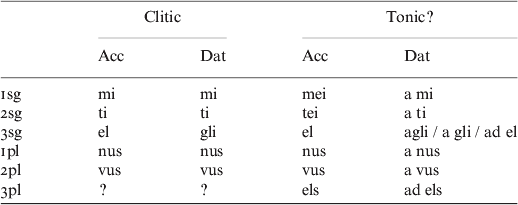
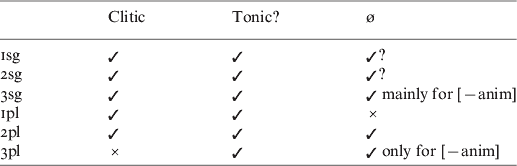
Here we focus on Barlaam and Josaphat, since it contains the complete array of the pronouns, but some data from The Diary is also considered. As in The Diary the narrator is part of a group of pilgrims narrating their adventures, there is an abundance of first person plural pronouns. This makes the text an interesting term of comparison for the dialects of Padola and Candide, and may help to shed some light on whether the absence of first person plural atonic pronouns in Comelico can be considered to be the result of the same process affecting third person or is to be interpreted as a separate phenomenon. In the text, the only two forms that are morphologically distinct (in the orthography) in what appears to be their tonic and atonic usage are first and second person singular accusative. No atonic forms are found for third person plural in either accusative or dative. An inventory is given in Table 8.
Summary of accusative and dative forms in Barlaam and Josaphat.
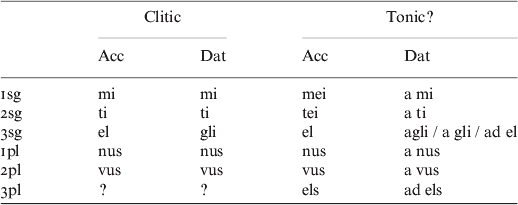
In addition to these pronominal forms, demonstratives are also used for the third person, mainly for [−animate] referents: quel ‘that one (masc)’ and quel(l)a ‘that one (fem)’. Given that the morphological differences between the tonic and atonic types are minimal, and that orthography is itself unreliable, as shown by the frequent inconsistencies in spelling, the only way to identify atonic pronouns is from their syntactic and pragmatic behaviour. The following are the properties that have been taken into consideration:
- (29)
(a) Atonic/Clitic pronouns
• immediately precede finite verbs
• can undergo clitic climbing
• do not express a contrast
• refer to an active referent
(b) Tonic pronouns
• are placed in post-verbal object position (or after a preposition)
• can be coordinated with an NP
• express a contrast
• introduce a new referent
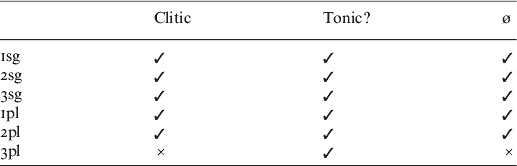
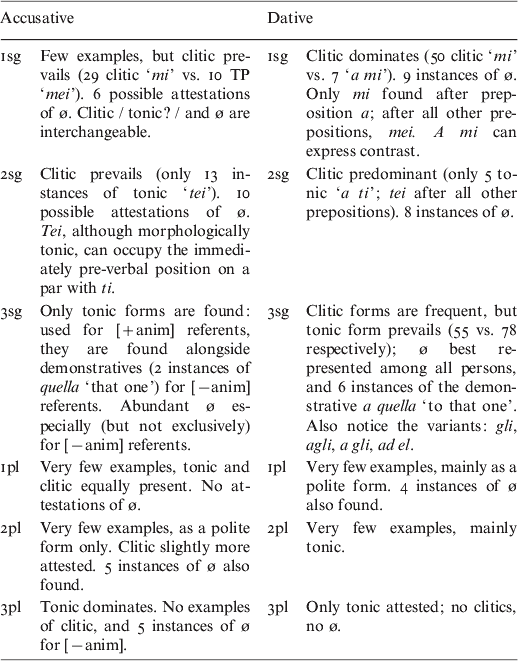
Alongside the two types of pronouns, in the text we also find an abundance of gaps. The breakdown of the variation for each person in both accusative and dative is offered in Tables 9 and 10 (a ✓ for any given cell means that there are attestations of that form used for that cell; a ✗ means that that particular form is not attested for that given cell).
Finally, Table 11 summarises the findings in both accusative and dative organised according to person.Footnote 22
Inventory of forms used in the accusative in Barlaam and Josaphat.
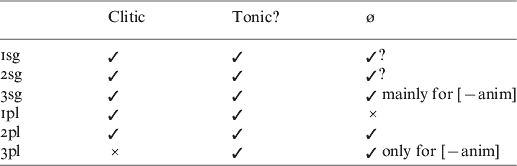
Inventory of forms used in the dative in Barlaam and Josaphat.
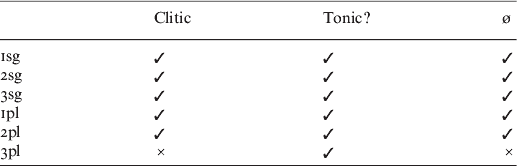
Summary of the findings in Barlaam and Josaphat.
The interchangeability of usage of clitic and tonic pronouns and gaps is of interest. It reveals that the original tonic forms are weakening and the original clitic forms are being substituted by gaps. Representative of this are the examples in (30).
- (30)
(a) Ti mi has giù ed ø has cha saviu tener; ed ussa enqueres ti da pigiar mei (Decurtins Reference Decurtins1880–1883: 274, lines 5–6)
‘You me.cl have had and (me) have not manage to keep; and now you are trying to detain me.ton'
(b) che jau pos mei bucca gidar. (Decurtins Reference Decurtins1880–1883: 287, line 1)
‘that I can me.ton not help (i.e. myself)’
(c) Miu Bab, nua haveis laschau mei aschì persuls?
(Decurtins Reference Decurtins1880–1883: 295, line 9)
‘my Father, where have you left me.ton so alone?’
(d) Ei glei in denter vus, che mi veng ad entardir, a vender als Giedius, … (Decurtins Reference Decurtins1880–1883: 268, line 33)
‘There is one among you, who me.cl comes to betray, to sell to the Jews, …’
Example (30a) shows a case of coordination reduction, and in the same sentence all three forms are found, a clitic, a gap, and a tonic pronoun, all referring to the same individual. Examples (30b, c) show a clitic-like use of a tonic pronoun (i.e. pragmatically non-salient, as determined by the context), indicating that the seemingly tonic form is actually weak. Finally, (30d) shows that mi can occupy a position to the left of the verbal (quasi)modal–infinitive complex, a property typical of clitics.
The same is seen for the second person: tei, although morphologically a seemingly tonic form, can occupy the immediately pre-verbal position on a par with the clitic ti, see (31a, b), as well as its expected, post-verbal canonical object position, as in (31c).Footnote 23
- (31)
(a) O Soing Bab! jau ti rog, che ti veglies laschar vegnir cun tei en il desiert a far penetienzia (Decurtins Reference Decurtins1880–1883: 274, line 27)
‘O Holy Father! I you.cl beg, that you may want to let (me) to come with you in the desert to do penitence.’
(b) E Giosafat di: Jau tei rog, che ti veglies ira a domendar la lubienscha dadel. (Decurtins Reference Decurtins1880–1883: 261, line 28)
‘And Giosafat says: I you.ton beg, that you may want to go to ask the permission from him.’
(c) ad aschia rog jau tei per mia amur (Decurtins Reference Decurtins1880–1883: 260, line 38)
‘and so beg I you.ton for my love (i.e. in the name of (your) love for me).’
There are no attestations of clitics for the third person, and the tonic form is used for [+animate] referents. For [−animate] referents, we find demonstratives and abundant use of gaps, as in the following passage, in which ina pedra custeivla ‘a precious stone’, once introduced into the discourse, is referred to by means of a gap:
(32) E Barlaam gli ha respondiu: Perquei vi jau plidar cun el; jau sun in mercadon, che veng de tiarras jastras, ed hai portau cau ina pedra custeivla, la qualla ha quella vertit, che tgi che ø porta sur sesez cun bien cor, veng mai a murir, e sche el fuss ciogs u leprus u schiraus u zops u autras malatias, sche daventa el bein gleiti sauns e fresgs; ed aschia ø porta jau a tiu Segniur Giosafat, pertgiei jau sai che el ha da basengs; aber sapias, che sche ti mi ø laies bucca portar a tiu Signiur Giosafat, sche ø porta jau tier in auter grond Signiur, il qual veng a comprar ø per in grond scazi. Cura che il Portner ha giu entelleig il mercadon, che el vessi ina pedra pretiusa da tonta vertit ha el deg: Jau ti roga, che ti mi ø veglias laschar ver; a schi mi ø mussas, sche empermetta jau de laschar ira en il Pallaz a plidar cun miu Segniur. E Barlaam ha replicau: Jau vi bucca far quei, pertgiei glei bucca raschun, che ti ø vesias avon tiu Segniur, e lura era po bucca ver ø persuna de quest mund, sche el ei bucca purschals; adaschia non essent ti purschals, poss per quei bucca ver ø. Aber a tiu Segniur Giosafat, che ei purschals, vi jau mussar ø … . (Decurtins Reference Decurtins1880–1883: 265, lines 5–21)
‘And Barlaam tohim.cl has answered: For this reason I want to talk with him.ton;I am a merchant, who comes from foreign lands, and I have brought here a precious stone, that has that power, that who that (it) carries on himself with a good heart, comes never to die, and if he were blind or leprous or lame or (with) other ilnesses, so (he) (would) become instantly healthy and fresh; and so (it) bring I to your lord Giosafat, as I know that he has of need (i.e. he needs it); but bewarned, that if you me (it) let not to take to your lord Giosafat, so (it) take I to another lord, who comes to buy (it) for a great amount of money. When the door keeper has heard the merchant, that he had a precious stone of such powers has he said: I you.cl beg, that you me (it) may want to let to see; if you to me.cl (it) show, so promise I to let (you) to go inside the palace to speak with my lord. And Barlaam has answered: I want not to do this, because there is no reason, that you (it) see before your lord; and then not to see (it) person of this world, if he is not pure (i.e. and nobody in this world can see it unless they are pure); and so not being you pure, can for this (reason) not to see (it) (i.e. and you, not being pure, cannot see it). But to your lord Giosafat, who is pure, want I to show (it).’
It is immediately apparent that gaps are best attested with third person singular [−animate] referents, suggesting that this is the first form to be lost, followed by [+animate], for which tonic forms are used, in turn followed by third person plural. First and second person singular are mainly realised by clitic forms (or else by morphological tonic forms that seem to behave like clitics, i.e. weak forms), with a few attestations of gaps. No definite conclusions can be drawn for first and second plural, due to the scarcity of evidence. Mapping the information along a diachronic sequence, the following partial hierarchy of loss based on person features can be formulated for Surselvan (‘>’ means diachronic precedence, as above):
(33) 3rd sg [−anim >+anim] >3rd pl [?–anim >+anim] >1st, 2nd sg
This partial hierarchy is almost identical to the one identified above for the Comelico varieties (except for first person plural, which has been omitted in (24)), repeated here:
(24) 3rd sg [−anim >+anim] >3rd pl [−anim >+anim] >1st, 2nd sg >2nd pl
It is interesting that in Surselvan there does not seem to be evidence of gaps allowed to express first person plural: this clearly indicates that in this case, the hierarchy ‘third >first and second’ is operative, and the loss of first person plural is not as advanced. A similar result is also offered by The Diary, in which first person plural forms are abundant: in the dative, clitics are clearly dominant followed by gaps, indicating that first person plural is not at the forefront in this process of loss. Finally, in Surselvan too, and to an even larger extent than in Comelico, we can witness a weakening of tonic forms that end up being much more flexible in their usage, and a gradual giving way of the clitic forms to gaps. Bearing in mind that Surselvan represents the complete process of clitic loss, we are now in a position to offer a fuller view of the stages of clitic loss.
- (34)
(a) First stage: clear division of labour between tonic and clitic forms.
(b) Second stage: tonic and clitic forms are in free variation; tonic pronouns still occupy the canonical post-verbal position (in the Comelico varieties) or can occur pre-verbally (in Surselvan), hence showing syntactic weakening; no contrastive interpretation is necessarily associated with tonic form usage.
(c) Third stage: gaps are introduced and used alongside clitics and/or tonic/weak forms.
(d) Fourth stage: tonic/weak forms prevail over clitics, gaps increase in frequency.
(e) Fifth stage: gaps are preferred.
(f) Sixth stage: tonic forms are re-introduced (modern Surselvan), the cycle begins again?
5.2 Brazilian Portuguese and contemporary French
As already mentioned, modern BP has a defective object clitic paradigm in that the third person seems to have disappeared completely, and can be either expressed by a null form (i.e. a null object) or by a tonic pronoun, the choice between the two being determined by the semantic properties of the antecedent. A null object must be either [−animate] or [−specific]. This is a change that has happened over the last few centuries. A diachronic study of plays written between the 16th and the 20th century (Cyrino Reference Cyrino1997) has revealed a decrease in the realisation of a third person direct object as a clitic from 89% in the 16th century to 21% in the 20th century. The first null object to appear referred back to a proposition, i.e. it had a third person, non-referential antecedent. This was followed by a null object that referred to a referential, [−animate] element, i.e. third person, referential and inanimate. Clearly, the process of loss has been driven by features such as referentiality and animacy as well as person, with animacy and person playing the main roles.
Although not classified among the null-object languages, French has revealed, through increasing corpus-based research (see Fónagy Reference Fónagy1985, Lambrecht & Lemoine Reference Lambrecht, Lemoine, Fried and Boas2005, among others), the null realisation of referential direct objects:
- (35)
(a) A: J'ai un truc pour toi si ça t'intéresse.
‘I have something for you if you are interested.’
B: C'est quoi?
‘What is it?’
A: Je crois que t'aimes bien, toi, ce genre de truc. J'ai trouvé hier.
‘I think that you like this sort of thing. I found (it) yesterday.’
(Lambrecht & Lemoine Reference Lambrecht, Lemoine, Chuquet and Fryd1996: 297)
(b) Un jour, je me disais, je mettrais une petite annonce dans Le Provençal: …
Mais je renvoyais toujours à plus tard.
‘One day, I told myself, I would put a classified ad in Le Provençal: … But I kept putting (it) off until later.’
(Larjavaara Reference Larjavaara2000: 63)
Albeit strongly stigmatised, this construction is fully productive in both written and spoken French, and it is constrained by pragmatic, discursive and stylistic factors (see Cummins & Roberge Reference Cummins and Roberge2005, Lambrecht & Lemoine Reference Lambrecht, Lemoine, Fried and Boas2005). The null realisation of the object is favoured by a number of factors, which include person and animacy of the antecedent: third person [−human] referents are those that are expressed as null objects the most frequently.
It may be that French is on its way to becoming a null-object language, although at this stage it is not possible to say. What we can say is that at the beginning of this process (which may be affecting French and other languages/varieties) it is the third person that undergoes deletion first.Footnote 24
All the evidence discussed in this section unanimously identifies third person as the first one targeted by a process of loss. Furthermore, the evidence afforded by The Diary shows that at the stage of clitic loss in which third person pronouns were already affected, first person plural forms with a clear clitic behaviour were still abundant. This supports an interpretation of the absence of first person plural in the atonic series in Comelico as a separate phenomenon. In other words, even if at present we are unable to offer a satisfactory explanation for it, it seems not to be the result of the same process of clitic loss that is affecting the rest of the paradigm.
The next section turns to the possible interpretation of the links between the processes of emergence and loss.
6. Language change, hierarchies and universal laws
The Person Hierarchy of clitic loss suggested for the Comelico varieties seems to follow the same path as the attested case of clitic loss in Surselvan, as well as what we have seen so far for BP and French.Footnote 25 In all cases, it is the third person which is affected first by the process of loss, with [−animate] referents preceding [+animate] ones in the process, followed by first and second person. The reconstruction of the possible developmental path followed by the Latin pronominal forms that eventually became object clitics has suggested that first and second person pronouns had the potential to display clitic-like behaviour much earlier than the forms used for third person. There does not seem to be an indication that a clitic form was used earlier for [+animate] than for [−animate] referents: in the Parody of the Lex Salica example discussed above, the clitic pronoun resumes a [−animate] referent, ipsa cuppa ‘the cup’, underlined in (36):
(36) et ipsa cuppa frangant la tota
‘and the cup, may they break it completely’ (Wanner Reference Wanner1987: 88)
Focusing on the person specification only, it therefore seems that the two developmental paths, emergence and loss, operate along the same hierarchy but in opposite directions. In the process of emergence the first and second person develop first, followed by the third; in the process of loss the third is lost first, followed by first and second.
The foregoing is reminiscent of a parallel already observed by Jakobson (Reference Jakobson1941) between language development (i.e. first language acquisition) and language dissolution (i.e. aphasia): the last elements to have been acquired were lost first (Jakobson Reference Jakobson1941). On this basis Jakobson formulated a principle for language change, the so-called laws of irreversible solidarity:
[O]ne cannot erect the superstructure without having provided the foundation nor can one remove the foundation without having removed the superstructure. … The linguistic progress of the child and the regression of the aphasic are, in essence, direct and particularly concrete consequences of this principle. The stratified structure of language is in this way revealed. (Jakobson Reference Jakobson1941 [1968: 92]; emphasis added)
Although his evidence was largely phonological, he also assumed that this principle would hold for other linguistic levels.
Jakobson's laws have served as the basis for the recapitulation (i.e. parallels between language diachrony and language acquisition) and the regression (i.e. parallels between language acquisition and language loss) hypotheses. They have also found expression in computing science under the name of LIFO, ‘Last In First Out’, an abstract principle used in list processing and temporary storage. A LIFO structure can be illustrated with the example of a stack of cards: the last card to be placed on top is also the first to be removed or evaluated. Indeed the same principle has also been found to determine performance in naming tasks in cases of language deterioration. To mention but two, for both elderly (Hodgson & Ellis Reference Hodgson and Ellis1998) and clinical informants who had undergone anterior temporal labectomy (Bell et al. Reference Bell, Davies, Hermann and Walters2000), those lexical items that had been acquired last were also the first ones to be lost.
Although a last-in-first-out principle makes intuitive sense in those cases that involve memory/storage of lexical items, there does not seem to be an immediately corresponding parallel with the cases of loss/emergence discussed in this paper. The dynamics of such a change show that it is not a simple matter of having ‘lost’ the word for a given clitic. The process is more complex, and involves morpho-syntactic re-analysis of pronominal forms. Yet, the fact that both processes, of emergence and of loss, seem to be following the same path, albeit in reverse order, cannot be just coincidental. This makes sense when taking Jakobson's laws of irreversible solidarity as strictly dependent on (or even the result of) the ‘stratified structure of language’: they are the visible expression of the internal organisation of language, which is structured by and organised around more general principles such as markedness, or putative language universals. In other words, Jakobson's principle is the by-product of the workings of more general hierarchies operative in language.
Cyrino, Duarte & Kato (Reference Cyrino, Eugênia, Duarte, Kato, Kato and Negrão2000) observe that BP is undergoing two processes. On the one hand, it is gradually becoming a non–null-subject language, on the other, a null-object language. Although no link is claimed by the authors to exist between the two, it is clear that both have been/are being guided by the same hierarchy, followed in opposite directions, the Referential Hierarchy (RH henceforth; Silverstein Reference Silverstein and Dixon1976, Comrie Reference Comrie1981, among others). The more referential items (i.e. [+human] and [+specific]) are the first to become a phonetically realised subject; the less referential ones (e.g. expletive pronouns) are still null. Conversely, the less referential objects are almost categorically null.Footnote 26
Referential hierarchies are a standard way of capturing limitations on the morpho-syntactic behaviour of arguments. The cross-linguistic restrictions on the distribution of noun phrases, clitic and tonic pronouns indicate that referentiality is highly relevant to pronominalisation, as well as to the overt or null realisation of forms for those languages that allow such variation. Referentiality is the result of the interplay of a number of features: argumenthood, nature of the nominal phrase, person, animacy, referentiality (understood as the ability or lack of ability to have a referent in the real world) and specificity. The interaction of these properties creates a scale against which linguistic items are evaluated and around which they are organised, the RH. At the lower end, there are non-specific, non-referential, inanimate elements; at the higher end, specific, referential, human elements. Being intrinsically human (and definite), first and second person pronouns score higher than third person and are considered as ‘marked’; within third person, items that are [−human] naturally score lower than [+human] and are the most ‘unmarked’ forms.Footnote 27 It is undeniable that markedness, in spite of the general lack of agreement over what constitutes it, expresses something of linguistic relevance. It seems that it is possibly best interpreted in terms of a hierarchy organised along increasing and decreasing values of a given property.Footnote 28
Referential hierarchies in particular, but hierarchies in general, are the focus of increasing attention by linguists. Preliminary neurolinguistic evidence shows that referential hierarchies play a key role in language processing (see Philipp et al. Reference Philipp, Bornkessel-Schlesewsky, Bisang and Schlesewsky2008, Wang et al. Reference Wang, Schlesewsky, Bickel and Bornkessel-Schlesewsky2009), suggesting that they may hold the key to universal aspects of human cognition.
There are a number of questions regarding both the nature and structure of referential hierarchies that still await an answer. For example, are they to be taken as probabilistic or universal? Is there one universal scale or are there several? Do these hierarchies affect all kinds of grammatical relations or do they only apply to selected morpho-syntactic categories, and if so what determines the choice? Why do referential hierarchies exist in the first place? The increasing amount of research on an ever wider number of languages will undoubtedly cast light on these issues. For the time being it is interesting to notice that referential hierarchies do exist and that their effects are far-reaching.
7. Conclusions
This study has investigated defective paradigms of object clitics in a number of neighbouring Italian dialects, and has compared it to the process of emergence of pronominal clitics in proto-Romance, as well as to established cases of clitic loss, Surselvan and Brazilian Portuguese. In spite of its limitations, among them the unavailability of (reliable) diachronic sources to plot the precise steps of clitic loss in the Comelico varieties, and the complexity and heterogeneous nature of the evidence from Latin and proto-Romance, this research has identified a link between the processes of clitic emergence and clitic loss. The relationship between the two processes has been discussed in relation to Jakobson's structuralist approach and the Referential Hierarchy. It seems that the former may simply be a by-product of a well-identified hierarchy that is operative in cases of language change. It is clear that in order to provide a testing ground for the suggestions made in this article as well as a deeper understanding of the nature and properties of hierarchies more research is needed. In particular, a comparison of the diachronic development with the process of acquisition of clitics in children acquiring their first language may prove particularly insightful, as well as a widening of the languages included in the investigation to offer a more comprehensive, typological comparison.