1. Homophony avoidance
The idea that certain morphological and phonological irregularities can be traced to a desire to avoid homophony has a long history, stretching (at least) from historical grammars of the nineteenth century (e.g. Diez Reference Diez1838: 210)Footnote 2 through to the identity avoidance constraints of Optimality Theory (Crosswhite Reference Crosswhite and Gordon1999, Rebrus & Törkenczy Reference Rebrus, Törkenczy, Downing, Hall and Raffelsiefen2005). But homophony avoidance as an explanatory principle has also has some spirited detractors, most famously Lass (Reference Lass1980).
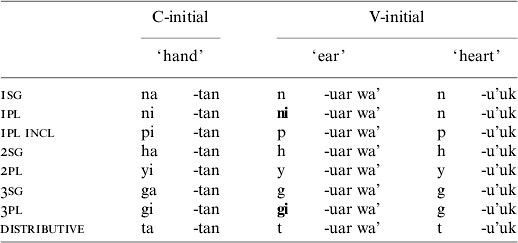
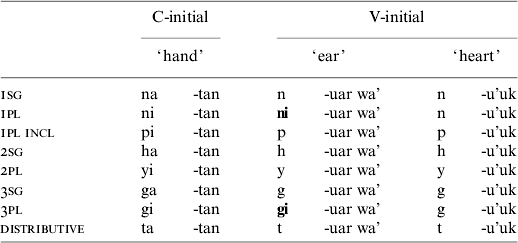
As an illustration of the principle, as well as the difficulties inherent in it, consider the paradigms in Table 1, from Teiwa, a Papuan language of Alor island, Indonesia (see Klamer Reference Klamer2010). Nouns may be prefixed for the person and number of the possessor. As a general rule, the shape of the prefix is CV- with C-initial noun stems, while with V-initial noun stems such as -uar wa' ‘ear’ the vowel of the prefix is deleted. But this vowel-deletion rule is not exceptionless: in the 1pl and 3pl, the vowel is retained. Now it happens that these are also the values for which deletion of the vowel would neutralize the distinction between singular and plural; otherwise, there is nothing phonological, morphological or semantic that sets apart these cells as a class. Therefore, we can say that there is a rule of vowel deletion which is blocked should it lead to homophony of singular and plural. But this irregularity only applies to some nouns; with others, such as -u'uk ‘heart’, vowel deletion applies without exception, leading to homophony.
Teiwa inalienably possessed nouns (Klamer Reference Klamer2010). Exceptional CV- prefixes with V-initial stems shown in boldface.
Thus, while homophony avoidance may provide an explanation, it introduces an additional explanandum: when does it apply, and when not? Further, there is another morphological irregularity without any recoverable explanation that still needs to be accommodated: the sporadically attested alternative form a- of the third person prefix, e.g. ga-tewar or a-tewar ‘his walking’ (Klamer Reference Klamer2010).Footnote 3 In the light of such considerations, homophony avoidance seems neither sufficient nor necessary as an explanation of irregularities. And yet, slippery though the notion might be, there is nothing implausible in the idea that the maintenance of contrast plays some role in the organization of paradigms, and its appeal to linguists is evident by its longevity and frequent invocation.Footnote 4 Any resolution of the status of homophony avoidance is hindered by the fact that the thing which is being avoided is itself a theoretical construct. Thus, in Table 1, the expectation that there are homophonous forms is created by the assumption of a regular rule of vowel deletion. But of course, it could be that there is no such rule, and hence nothing to be avoided: the paradigms are simply irregular, and the grammar need tell us only how, not why.
There may, however, be a way around this difficulty. While language-specific diachronic and synchronic rules may be open to debate, we can safely assume that, barring semantic incompatibility, inflectional rules should produce a complete paradigm for every inflectable lexeme. Where we find instances of defectiveness, that is, gaps in inflectional paradigms, we can be fairly sure that something is being avoided.Footnote 5 Of course, defectiveness as such may be attributable to a number of different causes, such as phonological or morphological constraints, alongside outright stipulation (Hetzron Reference Hetzron1975, Fanselow & Féry Reference Fanselow, Féry, Fanselow and Féry2002, Baerman & Corbett Reference Baerman, Corbett, Baerman, Corbett and Brown2010). But, as I argue below, there are also examples of gaps that can convincingly be correlated with some expected homophony, and that this is evidence that homophony avoidance can play a decisive role in determining the shape of the paradigm. The paper is structured as follows. Section 2 deals with homophony that obtains between (forms of) different lexemes. Section 3 deals with paradigmatic homophony (i.e. syncretism), that obtains between different forms of the same lexeme. In Section 4 I conclude that there is evidence that homophony avoidance may play a role both in diachronic change and in synchronic rule interaction. I should note here that this research was originally undertaken to demonstrate the opposite point.
2. Lexical homophony
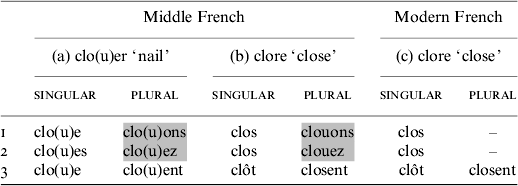
I take it as relatively uncontroversial that we may find instances where an entire lexeme Y is avoided outright due to homophony with some other lexeme X, as occurs with taboo avoidance. But since we are looking for paradigm gaps, we need to find instances where avoidance affects only part of the paradigm. Probably the best-known examples come from French, and for that reason we ought to consider them straight off – if only to lay them aside again, as they are not entirely convincing. In the normative standard, the verb clore ‘close’ is missing considerable chunks of its paradigm, in particular the first and second person plural of the present, and all of the imperfect. According to some sources (e.g. Dauzat Reference Dauzat1944: 116), this was a result of homophony clash with the corresponding forms of clo(u)er ‘nail’, as illustrated in Table 2).
French (homophonous forms shaded).
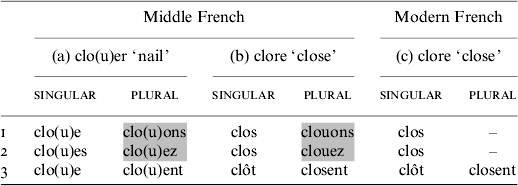
But there is an alternative explanation. Gilliéron (Reference Gilliéron1919) treats this as a case of conventional lexeme loss with subsequent repair. That is, the partial homophony of clo(u)er and clore, as well as a certain degree of semantic overlap (‘nail (shut)’ ≅ ‘close’), led to the extinction of clore, which went out of use by the sixteenth century. However, the past participle of clore, namely clos, remained in adjectival use. The lexeme was then artificially resuscitated by the French Academy, which nevertheless limited itself to recommending those forms which could be deduced from the past participle, according to the usual distribution of stems in the paradigm (see e.g. Maiden Reference Maiden2005). Thus, according to Gilliéron, the pattern of homophony in middle French and the defectiveness of Modern French are unrelated products of the organization of stem alternations characteristic of French verbs; that is, the pattern in Table 2(c) is not the result of the patterns in Table 2(a, b). Gilliéron also provides similar analyses for other putative examples of homophony-avoidance-induced defectiveness, such as frire ‘fry’ and choir ‘fall’. In any event, the reconstruction is largely speculation, so the value of the French examples is uncertain.Footnote 6 But in the following sections I offer what seem to be clearer instances of homophony avoidance.
2.1. Tuvaluan
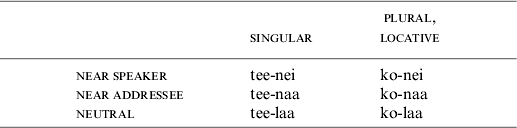
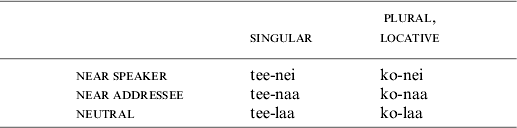
A fairly straightforward example of defectiveness due to lexical homophony avoidance comes from Tuvaluan (Austronesian, Oceanic). There is a demonstrative-cum-relative pronoun/adjective which is suppletive between the singular (tee-) and the plural/locative (ko-). It is inflected for a three-way deictic distinction as in Table 3.
Tuvaluan demonstrative/relative pronoun/adjective.
However, as Besnier (Reference Besnier2000: 419) observes
A few older speakers use two archaic forms kinei and kinaa instead of the plural demonstrative adjectives and locative pronouns konei and konaa. There does not seem to be an archaic form for the third person, corresponding to kolaa. The third-person form would be homophonous with the word kilaa ‘hairless’, which has improprietous undertones, and it is very likely that the incomplete paradigm is due to word tabooing. (Attempts to elicit the missing form were invariably met with embarrassment or guffaws.)
This is a fairly classic taboo-motivated type of homophony avoidance, in this case limited to one form out of a larger paradigm rather than the entire lexeme. Presumably this occurs only because the root itself is obsolescent, and because a ready alternative exists. (Admittedly this does not answer the question of what prior generations did.)
2.2. Russian
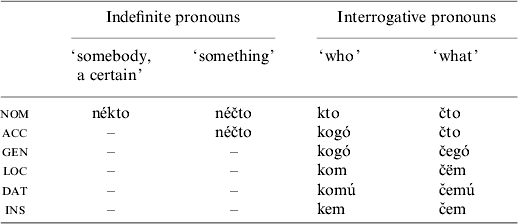
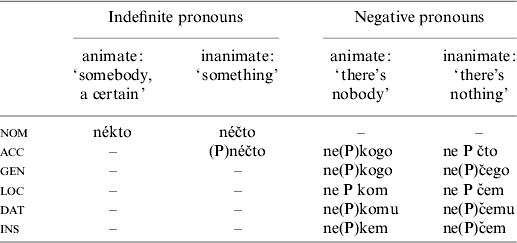
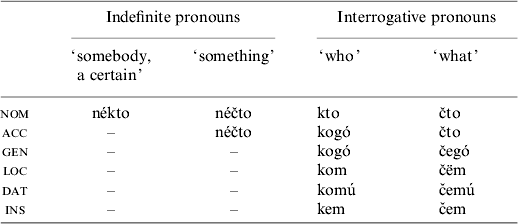
The Russian indefinite pronouns nékto ‘somebody, a certain’ and néčto ‘something’ each have only one form: nékto has only a nominative, as in (1), while néčto has only a nominative/accusative, as in (2). (Most examples are taken from the Russian National Corpus (RNC); exact source details for examples (1)–(11) are provided in Appendix 1.)
(1) Nékto prixódit v kondíterskuju i trébuet sebé tórt …somebody comes into café and asks.for self cake‘Somebody walks into a café and asks for a piece of cake …’
- (2)
(a) Verojátno, néčto podóbnoe proisxodílo …probably something[nom] similar happened‘Probably something similar happened …’
(b) A sočetánie daët néčto nóvoe.and combination gives something[acc] new‘And the combination yields something new.’
Compared to other semantically overlapping words, nékto and néčto are infrequent and largely confined to a literary register; the RNC (queried in February 2009) records 1,902 instances of nékto versus 25,165 of któ-to ‘someone (specific)’ and 6,903 of kto-nibúd′ ‘someone (non-specific)’. But their relative infrequency is no explanation for the lack of oblique case forms, particularly as the other semantically overlapping words have complete case paradigms. From a morphological point of view this restriction is also striking. The words are transparently composed of a prefix ne- plus the interrogative pronouns kto ‘who’ and čto ‘what’,Footnote 7 and these interrogative pronouns by themselves do decline, as shown in Table 4.
Russian indefinite versus interrogative pronouns.
An interesting morphological correlation does emerge when we look at the paradigms of another pair of lexemes, the negative pronouns nékogo ‘there is nobody’ and néčego ‘there is nothing’. These appear to be composed of exactly the same morphological elements: a prefix ne- plus the interrogative pronouns. But they are not used in the nominative (the genitive is conventionally used as the citation form), so their paradigms are at least roughly in complementary distribution with those of indefinite nékto and néčto (Table 5), the only overlap being in the inanimate accusative. In fact, due to certain morphosyntactic details discussed below (section 2.2.1), in particular their contrasting behaviour with respect to prepositions, this overlap is only apparent, and the two sets of paradigms really are complementary.
Russian indefinite versus negative pronouns.
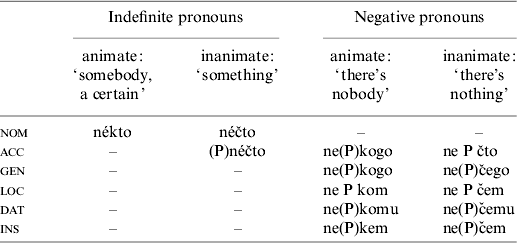
Note: ‘P’ indicates the position of prepositions.
As is shown below (Section 2.2.1), the fact that the negative pronouns lack a nominative has a clear syntactic motivation, so it is the defectiveness of the indefinite pronouns that needs to be accounted for. This is where homophony avoidance may come in as a possible explanation; thus, Zaliznjak (Reference Zaliznjak and Zaliznjak1973: 84, fn. 34) suggests that the oblique forms of indefinite nékto and néčto are blocked because the corresponding forms have already been claimed by negative nékogo and néčego. Strictly speaking, such an analysis ought best to be regarded as poetic licence: the absence of oblique forms of nékto and néčto is quite categorical, and there is none of the variation or uncertainty one would expect if the forms were being avoided. But there is evidence, admittedly indirect, that homophony avoidance in the past led to the state of affairs we have now. The story is a rather complicated one, requiring some background in the morphosyntactic and lexical peculiarities of the main players, as outlined below.
2.2.1. Morphosyntax of nékogo/néčego
The morphosyntax of the negative pronouns nékogo and néčego is such that they are excluded from the nominative entirely, and also from the inanimate accusative in most contexts. The lack of a nominative comes from the fact that they are used in subjectless sentences involving the copula (which is null in the present tense) plus an infinitive.Footnote 8 Otherwise, case behaviour is normal, as illustrated by the various inflected forms of nékogo in examples (3)–(6): genitive/accusative in (3), locative in (4), dative in (5) and instrumental in (6).
(3) Króme sebjá obvinját′ býlo nékogoexcept self.gen blame.inf was.neut.sg nobody.acc/gen‘There was nobody to blame except himself.’
(4) Ne o kom ból′še zabótit′sjano- about -body.loc more worry.inf‘There's nobody to worry about any more.’
(5) Rasskazát′ býlo nékomutell.inf was.neut.sg nobody.dat‘There was nobody to tell it to.’
(6) a zamenít′ ix búdet nékemand replace.inf them.acc will.be nobody.ins‘and there will be nobody to replace them with’
What would normally be a nominative subject in a finite clause may be expressed by the dative, as is typical with infinitives in Russian:
(7) Króme menjá tút dvér′ otkrýt′ nékomubesides me here door[acc] open.inf nobody.dat‘There's nobody here to open the door besides me.’
The use of nékogo and néčego in the accusative is also highly restricted, but the reasons for this are more general in nature. Because the animate accusative is identical to the genitive in any case (see Table 4); this is a general property of most nominals in Russian), we need only consider néčego first. By a general rule, direct objects whose existence is negated outright – which certainly applies to these negative pronouns – take the genitive rather than accusative:
- (8)
(a) Ja vížu risk. (b) Ja ne vížu nikak-ogo risk-a.I see risk[acc] I not see no-gen risk-gen‘I see a risk.’ ‘I don't see any risk.’
This leaves only one context where the accusative might appear, namely when governed by a preposition that takes the accusative. This is then the one area where the paradigms of the indefinite pronouns nékto/nečto and the negative pronouns nékogo/néčego overlap. But significantly, because of their contrasting behaviour with prepositions, they do not coincide morphologically. The indefinite pronoun is treated as an indivisible whole, with the preposition preceding, as in (9), while with the negative pronoun, the preposition intervenes, as in (10).Footnote 9
(9) Tý že sám, navérnoe, prošël čereznéčto podóbnoe …you emph self probably went through something[ACC] similar‘You yourself probably went through something similar …’
(10) Nádo stroít′ nóvye, ináče èksportírovat′ néft′ búdet néčerezčtónecessary build.inf new.pl otherwise export.inf oil will no- through -thing[ACC]‘New ones need to be built, otherwise there will be nothing to export the oil through.’
As a consequence of these various factors, there is no overlap between the paradigms of the indefinite pronouns nékto/néčto and the negative pronouns nékogo/néčego.
2.2.2. Diachrony
Earlier texts show that the indefinite pronouns nékto and néčto used to have non-nominative forms, as in (11), where the verb iskat′ ‘look for’ governs the genitive.
(11) uvíděl ón mnóžestvo žénščin, kotóryja něčegosaw he multitude women.gen.pl who.nom.pl something.geniskáli s velíkim prilěžániem.looked.for.pl with great.ins diligence.ins‘he saw a multitude of women who were looking for something with great diligence’ (Zadig 109)
On this basis we might propose that these forms were lost over time; in particular, that they were driven out in order to avoid homophony with the negative pronouns nékogo/néčego. This is probably the wrong way of looking at it. The indefinite pronouns are in fact borrowed lexemes, and I will suggest that the role homophony avoidance played was as a constraint on borrowing. To make this clear, some background on the history of Russian is in order.
The confrontation of the indefinite and negative pronouns is ultimately an aspect of the confrontation between the two constituent strains of literary Russian, Church Slavonic versus the vernacular. The history of the literary language starts around the tenth century with the adoption of a literary idiom, Church Slavonic, itself originally based on a variety of Balkan Slavonic (presumably that spoken around Thessalonica). Although the differentiation of the various Slavonic languages from each other was at this point still in its early stages, Church Slavonic and vernacular Russian will nonetheless have differed in a number of important points. The subsequent history of the Russian literary language involves a continual interplay between the two, with influences going in both directions. The literary language as finally codified in the 18th century is something of a hybrid, vernacular Russian with countless Church Slavonic elements incorporated into it.
In the case at hand, the indefinite pronouns nékto and néčto were originally Church Slavonic, while the negative pronouns nékogo and néčego were vernacular Russian. The indefinite pronouns form part of a small class of wh-words with the Church Slavonic prefix ne- ‘some…’ (homophonous with the ordinary sentence negator ne ‘not’),Footnote 10 e.g. kotóryj ‘who/which (relative pronoun)’ ~ nékotoryj ‘some, certain’; kogdá ‘when’ ~ nékogda ‘sometime’. In Church Slavonic, nékto and néčto were fully inflected. However, there is no evidence that their oblique forms were ever successfully incorporated into anything that might be described as literary Russian.
Unfortunately, for a number of reasons it is difficult to offer much in the way of concrete evidence that this was really the case. First, the fluidity of the relationship between Church Slavonic and the vernacular means that one can never be too certain about identifying a given text as representing the donor or recipient idiom, especially in earlier periods. In the case of néčto, the evidence provided by Unbegaun (Reference Unbegaun1935: 386) and Cocron (Reference Cocron1962: 173) suggests that it entered the vernacular-based written norm in the 17th century (they do not discuss the possibility of oblique forms). The 18th-century texts available online in the Russian National Corpus and the Russkaja virtual′naja biblioteka (Russian Virtual Library) yield a grand total of one example of an oblique form. Examples such as (11) above are vanishingly rare. All this is congruent with the notion that the emergent modern literary standard simply by-passed the oblique forms.
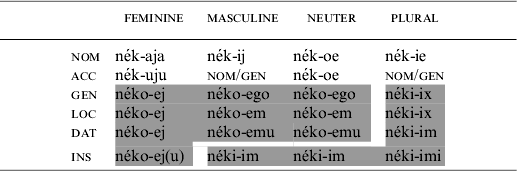
In the case of nékto, the Dictionary of 18th-century Russian reports that it had only a nominative form, which would seem to leave us nothing to work with. However, there is another lexeme, the adjective nékij ‘(a) certain’, some of whose forms correspond to the expected oblique forms of nékto.Footnote 11 It turns out we can fruitfully use nékij as a morphological surrogate for investigating the history of nékto. Before doing this, some explanation of its morphological peculiarities is necessary. Nékij is an adjective, and like all adjectives has a large paradigm, with distinct gender and number forms. What interests us is the behaviour of the oblique forms. As adopted from Church Slavonic, it had what is for Russian a quite unusual paradigm, shown in Table 6. While a normal Russian adjective has a single invariant stem, nékij had three: nék- for the nominative/accusative, and néko- and néki- for the oblique cases.
Archaic paradigm of Russian nékij ‘certain’, with oblique stem forms highlighted (where nom/gen variation is indicated, the form is determined by animacy; animates take the gen form).
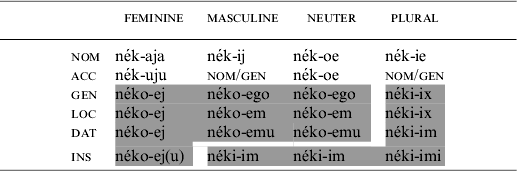
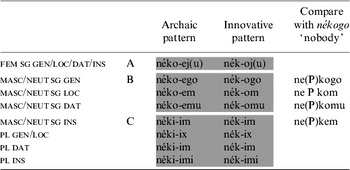
Unsurprisingly, the tendency over time has been to adapt the paradigm of nékij to that of a normal adjective, eliminating the alternation in favour of a single invariant stem, based on the nominative/accusative. One consequence of levelling out the stem alternation is that some of these forms (the dative, genitive and locative of the masculine/neuter singular) should end up identical to the corresponding but missing forms of nékto, as shown in Table 7, where the paradigm is divided into three chunks. ‘C’ corresponds simply to néki-, while ‘A’ and ‘B’ correspond to néko-: ‘A’ where levelling would not bring about homophony with nékogo, and ‘B’ where it would. Now if it is true that the oblique forms of nékto were rejected due to homophony with nékogo, we should equally expect stem levelling of nékij to have been rejected where homophony nékogo would have resulted. And this appears to be not only what happened, but what continues to happen, judging by the data from the RNC, which contains texts from 1700 on (see also Graudina, Ickovič & Katlinskaja Reference Graudina, Ickovič and Katlinskaja1976: 250).
Variation in the oblique forms of Russian nékij ‘certain’; ‘A’, ‘B’ and ‘C’ forms highlighted (see text and Figure 1; note that the alternation between e and o in the inflectional ending is morphophonologically regular).

Note: ‘P’ indicates the position of prepositions.
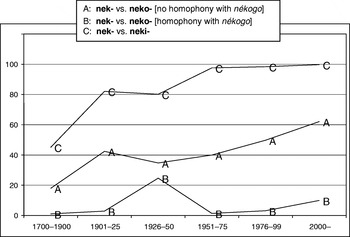
Figure 1 shows the developments over the last three centuries. Levelling of néki- (‘C’) was already well under way in the 18th century, and by the late 20th century it had disappeared completely. The behaviour of the stem néko- differs sharply according to its potential for homophony with nékogo. Where there is no danger of homophony (‘A’), levelling continues over time, till by the beginning of the 21st century the innovative non-alternating stem accounts for more than 60% of the tokens. Where homophony is involved (‘B’), levelling has been resisted, so that in the beginning of the 21st century levelled forms still account for only around 10% of the tokens.
Percentage of innovative (non-alternating) oblique stem forms, per Russian National Corpus (queried in October 2008); raw data are given in Appendix 2.

Thus, although the historical record does not tell us exactly what happened to the oblique forms of nékto, the behaviour of nékij suggests that there is something about the forms themselves that speakers reject. And while there is no direct evidence that homophony avoidance is responsible, nothing else plausibly explains the distinction between ‘A’ and ‘B’ forms seen in Figure 1. Admittedly, the correlation is not perfect: there is no potential homophony in the locative, since the locative is only ever used with a preposition, resulting in a distinct construction (thus o néko(e)m… ‘about a certain …’ versus ne o kom ‘(there's) nobody about whom’), and yet levelling of locative nekoem to nekom appears nonetheless to be resisted to the same extent as with the other ‘B’ forms (see Appendix 2 for precise figures). I leave it to the reader to decide how serious a problem this is for the proposal I have offered. Overall, it does appear to me that the behaviour of nékij suggests that the negative pronoun nékogo is able to exert a repellent force on potentially homophonous forms of other lexemes, and that this provides indirect evidence that homophony avoidance determined which forms of the indefinite pronouns nékto and néčto were ultimately borrowed into Russian from Church Slavonic.
3. Paradigmatic homophony (syncretism)
Just as lexical homophony is common across languages, homophony between different inflectional forms of the same lexeme (or ‘syncretism’) is nothing exceptional (see Baerman, Brown & Corbett Reference Baerman, Brown and Corbett2005). And still, some defectiveness appears to be motivated by avoidance of this homophony.
3.1. Chiquihuitlán Mazatec
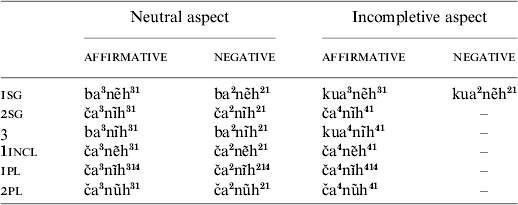
In Chiquihuitlán Mazatec, verbs inflect for subject person-number, aspect (neutral versus incompletive) and polarity (affirmative/negative). Jamieson (Reference Jamieson1982) reports that the transitive verb ba 3nĩh 31 ‘carry’ is defective for all the forms of the incompletive negative except for the 1sg (see Table 8; in the orthography employed here, Vh indicates laryngealized vowel, tone is indicated by superscript numerals, ranging from ‘1’ (high) to ‘4’ (low), and nasalization is indicated by a tilde). There is no apparent semantic reason for this gap. The speaker consulted reported that forms of the (non-defective) intransitive verb yaʔa ‘carry’ are used instead (Carol Capen, p.c.).
Chiquihuitlan Mazatec ‘carry’ (Jamieson 1982: 166).
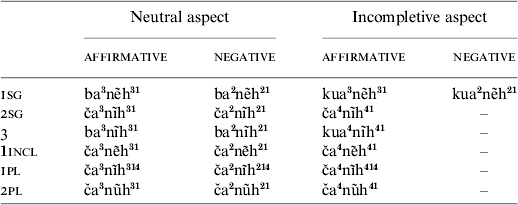
This is quite a striking gap: semantically, it is incoherent, nor does it correspond to any obvious morphological parameter, such as a stem alternation. I suggest it can be interpreted as an instance of homophony avoidance, specifically between the affirmative and negative: the verb ba 3nĩh 31 ‘carry’ has phonological properties that result in the neutralization of polarity distinctions in the incompletive for all values but 1sg.
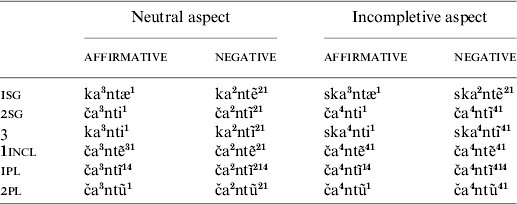
Chiquihuitlán Mazatec inflection involves a complex interaction of morphological processes, so this is not immediately apparent from glancing at the paradigm. Negation is marked partly by (i) a distinct ending, which Jamieson represents as an underlying -ĩ, but which in most instances merges with the subject marker, and partly by (ii) tonal alternations, which varies according to the accentual class of the verb.Footnote 12 These two systems are illustrated in Table 9 by the verb ka 3nti 1 ‘throw away’, which belongs to the same conjugation classFootnote 13 and tonal class (class A) as ba 3nĩh 31.
Chiquihuitlan Mazatec ‘throw out’ (Jamieson 1982: 166–167).
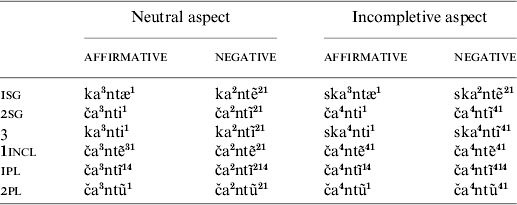
The negative ending here is realized solely as nasalization of the person-number ending (note that by a regular phonological rule, -æ and -e merge under nasalization). Since nasalization is already a secondary feature of the plural endings, negation is contrastively marked by nasalization only in the singular. The tonal alternations are given in (12).Footnote 14 Note that the 1incl incompletive affirmative in Table 9 remains unchanged, because it fails to meet the conditions for the tonal alternation: it has no tone 3 to raise, while the extension of the tone of the penultimate syllable onto the final is already a general characteristic of the 1incl.
(1) Affirmative →negative tone alternations (in tone class A)
(a) any tone 3 in the last two syllables is raised to 2
(b) the tone of the penultimate syllable is extended onto the final (e.g. syll4 syll1→syll4 syll41)
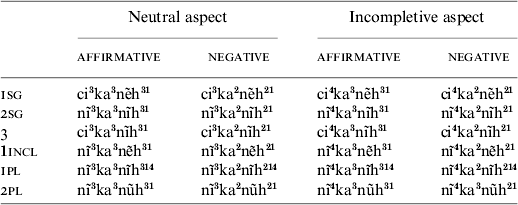
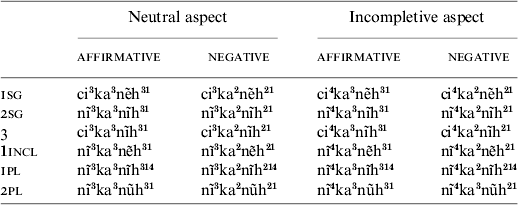
However, the verb ba 3nĩh 31 neutralizes many of the affirmative ~ negative contrasts on account of its phonological characteristics. First, the stem ends in a nasal consonant, and by a regular phonological rule, vowels immediately following a nasal consonant are nasalized. Since the negative endings are distinguished from the affirmative solely by nasalization, the endings themselves fail to mark negation. Second, the final syllable has a laryngealized vowel, which in this accentual class attracts the tone of the preceding syllable (Jamieson Reference Jamieson1982: 147), and so the tonal spread described in (12b) is neutralized. Both these neutralizations are clearly visible in the neutral aspect paradigm in Table 8. As a result, the only way a nasalized, laryngealized stem such as ba 3nĩh 31 has to mark negation is the tonal alternation of 3 to 2 in the last two syllables (12a). This is indeed how negation is realized in the neutral aspect. But in the accentual class that ba 3nĩh 31 belongs to, the incompletive affirmative is characterized by a lowering of an initial tone 3 to 4 in all the non-1sg forms, as seen in both Table 8 and 9. Therefore the conditions for 3→2 tone lowering are not met outside the 1sg, and there are no morphological means to distinguish the negative from the affirmative in the non-1sg incompletive forms. This, I would suggest, accounts for the speaker's reluctance, as the negative forms would be homophonous with the affirmative. As further evidence of this, note that there is a prefixed causative formed from the same root, ci 3ka 3nĩh 31 ‘load’ (i.e. ‘cause to carry’), illustrated in Table 10, which undergoes the same neutralizations associated with nasalized, laryngealized roots, and so can only mark negation by the tone raising rule in (12a). And although it belongs to the same accentual class as ba 3nĩh 31, it is a three syllable verb. That means that the lowering of the initial tone 3 to 4 in the non-1sg incompletive leaves the penultimate syllable unaffected, which is then free to undergo negative tone raising (and, by (12b), the final syllable follows suit). The negative forms are thus distinct from the affirmative, and the paradigm is not defective.
Chiquihuitlan Mazatec ‘load’ (Jamieson 1982: 166).
One question that this account does not resolve is the status of the 1incl incompletive of other verbs of this tonal class; as noted above, and illustrated in Table 9, this form does not distinguish affirmative and negative. Jamieson (1982: 165–167) lists such forms in paradigms given in her article. If the explanation above is correct, why are these paradigms not defective too? I can only speculate; one possibility may be that it is a by-product of elicitation conditions, i.e. the infelicity of affirmative/negative homophony only struck the speaker when larger chunks of the paradigm were being offered.Footnote 15
3.2. Tamashek
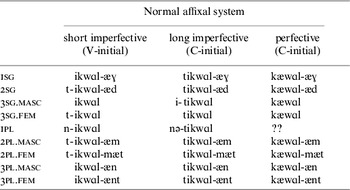
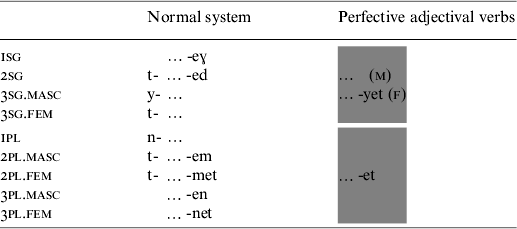
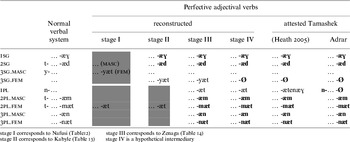
Finite verbs in Tamashek (a Berber language of the Tuareg group) are inflected for person, number and gender of the subject through a combination of prefixes and suffixes. There is a single set of suffixes, while the prefixal paradigm depends on the stem-initial segment (vowel-initial versus consonant-initial). The contrast is shown in the first two columns in Table 11: the vowel-initial set has a prefix t- (second person and the third singular feminine) which the consonant-initial set lacks, while the consonant-initial set has a prefix i- (third singular masculine) which the vowel-initial set lacks. The opposition of vowel- and consonant-initial forms is in turn tied to the system of stem alternations: the short imperfective, the long imperfective and the perfective.Footnote 16 As a general rule, the short imperfective and the perfective are vowel-initial and the long imperfective is consonant-initital. There is one important exception though, namely the class of verbs that Heath (Reference Heath2005) terms ‘adjectival verbs’, such as kæwαl- ‘be black’. Their perfective stem is consonant-initial, but in place of the set of prefixes normally found with consonant-initial stems, they have no prefix at all (see the third column of Table 11). And what is significant for our purposes, the first person plural is defective.
Tamashek adjectival verb (‘be black’), showing the normal set of vowel- and consonant-initial prefixes, alongside the prefixless perfective paradigm (Heath 2005: 388, 431f., 437).

Since the subject inflection of the perfective of adjectival verbs is characterized by complete omission of prefixes, by the logic of this system, the third person singular and the first person plural should then simply be the bare stem. But, as Heath notes, speakers reject the first person plural interpretation of bare stem:
Instead, a circumlocution or a specialized construction was offered to express senses like ‘we became black’ A T-ka (Timbuktu area, Kal Ansar) informant offered kæwαl- te-næγ, a difficult-to-segment morphological oddity that seems to involve an apparent preposition-like-extension -æte- that takes the 1Pl suffix -næγ. There are other prepositions ending in -e- before pronominal suffix [sic], so one could segment kæwαl-t-e-næγ but the only -æt suffix that can occur in such a position is FeSg Participle suffix -æt, so the construction is obscure. Another T-ka speaker, the R (Rharous area) speaker, offered a circumlocution with Reslt[ative] -æmós- ‘be, become’ and a plural relative clause: n-æmós [i kæw
 l-nen] ‘we have become black ones’. (Heath Reference Heath2005: 437f.)
This does look like a fairly straightforward instance of homophony avoidance, assuming blind application of a prefix-deleting rule. But the unexplained alternative form in -æ-te-næγ that Heath cites suggests that there may be other rules lurking beneath the surface. This impression is confirmed when one considers the broader comparative Berber perspective: the perfective paradigm of the adjectival verbs is the product of a series of small-scale analogical developments, and the role of homophony avoidance is best understood in this diachronic context (for an overview of the full range of variation in this class, see Kossmann Reference Kossmann, Chaker and Philipson2009).
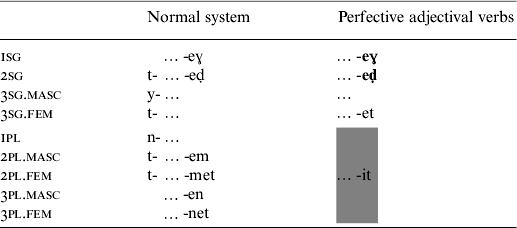
Following Prasse (Reference Prasse1973: 10f.) I assume that in Proto-Berber the normal system of verbal affixes and the perfective paradigm of adjectival verbs were completely distinct from each other. This state of affairs is still found in Nafusi Berber (Beguinot Reference Beguinot1942): the normal system corresponds closely to that found in Tamashek,Footnote 17 while the perfective paradigm of adjectival verbs marks gender and number only (see Table 12).
Nafusi (Beguinot 1942: 45, 66–67). Forms that conflate person distinctions indicated by shading.
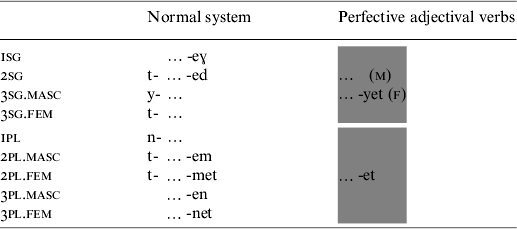
In other Berber languages, the normal system of affixes has been extended to greater or lesser degree to the perfective adjectival verb paradigm. Kabyle (Naït-Zerrad Reference Naït-Zerrad1994) illustrates the minimal adaptation: only overt suffixes have been borrowed, and only in the singular (see Table 13). As a consequence, the original gender-number suffixes are now restricted to 3sg.
Kabyle (Naït-Zerrad 1994: 16, 23). Forms that conflate person distinctions indicated by shading. Affixes borrowed from the normal system indicated by boldface type.
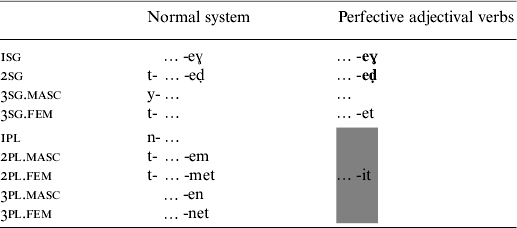
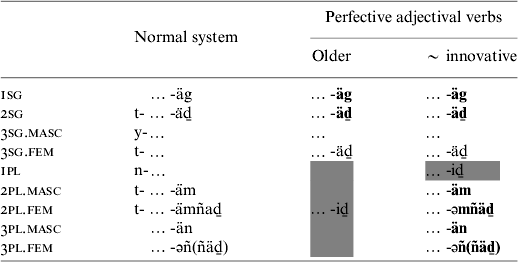
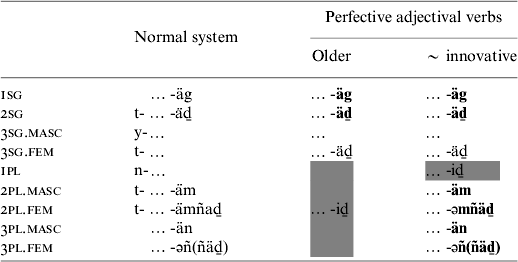
In Zenaga (Table 14), the same strategy is optionally applied to the plural,Footnote 18 with the overt suffixes (second and third person) taken from the normal verbal system, leaving the original plural suffix restricted to the first person.
Zenaga (Taine-Cheikh 2003: 664–665). Forms that conflate person distinctions indicated by shading. Affixes borrowed from the normal system indicated by boldface type.
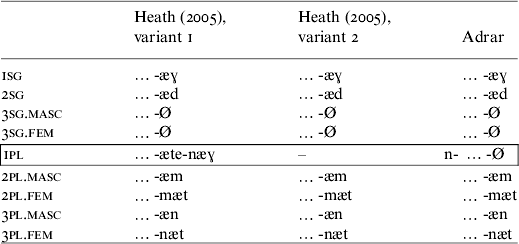
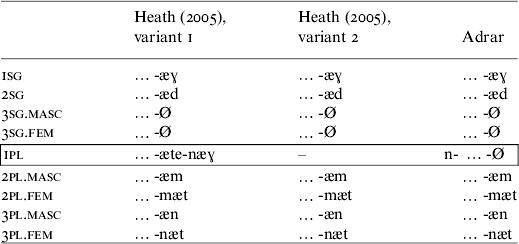
In the various Tamashek dialects, the adaptation of the suffixal system has proceeded one step further, embracing the null suffixes as well. All share the adoption of zero suffixation of the 3sg fem, but differ in the treatment of the 1pl.Footnote 19 Recall that Heath (Reference Heath2005) describes two variants, either the one with the mystery ending-æte-næγ (‘variant 1’ in Table 15), or the form is avoided altogether (‘variant 2’ in Table 15). The dialect of Adrar has both zero suffixation and the prefix n- (final column in Table 15).
Variant 1pl forms for perfective adjectival verbs in Tamashek (Heath 2005 and Prasse & ăgg-Ălbosṭan ăg-Sidiyăn 1985: 24).
I suggest the following scenario to account for this variation, illustrated in (Table 16). The first three reconstructed stages correspond to Nafusi, Kabyle and Zenaga, described above, leading to the adoption of the overt suffixes from the normal verbal system into the paradigm of the perfective adjectival verbs. Stage IV represents a hypothetical stage in which zero suffixation was borrowed in the singular, leaving the 1pl as the sole relic of the older system. (There is no direct evidence for this stage, but a parallel singular ~ plural split can be found in some varieties of Tamajak (another language of the Turareg group), in which the whole paradigm has been normalized except for the 3pl; Prasse, Alojaly & Mohamed Reference Prasse, Alojaly and Mohamed2003: 422.) With this as a point of departure, the attested non-defective varieties of Tamashek represent attempts to normalize the 1pl:
Proposed diachrony for perfective adjectival verbs in Tamashek (non-defective paradigms). Forms that conflate person distinctions indicated by shading. Affixes borrowed from the normal system indicated by boldface type.

• Addition of the 1pl suffix -næγ, yielding Heath's mystery ending æt-e-næγ. This -næγ is drawn from a set of personal suffixes used with prepositions, which are distinct from those used with nouns. (The status of the -e is uncertain, but there is at least one preposition that adds an -e in its plural forms: jer ‘between ~ jere-næγ ‘between us’ (Heath Reference Heath2005: 290), so there is perhaps an analogy here.)Footnote 20 The result is a form which is overtly 1pl, but still anomalous in the context of the verbal system.
• The logical next step in the accommodation of this class to the normal verbal pattern would be adoption of zero suffixation in the 1pl, which would yield 3sg/1pl homophony. In place of this, Adrar has gone one step further, disambiguating the homophony through the adoption of the 1pl prefix as well. (Note that 3sg masculine prefix i- is not borrowed, so this clearly does not represent a wholesale adoption of the normal system of prefixes and suffixes, but rather is limited to the problematic 1pl.)
In this scenario, the defective paradigm described by Heath represents the transitional stage between the system in which morphological traces of the old paradigm are still retained (in the form of the ending -ætenæγ), and the system found in Adrar, where the accommodation to the normal system has moved beyond the suffixes and embraced the prefixes as well. Homophony avoidance plays a crucial role in this account, but it is not the sole motivation: the gap in the paradigm results not just from rejection of the 3sg/1pl homophony, but from rejections of all the available morphological options.Footnote 21
3.3. Icelandic
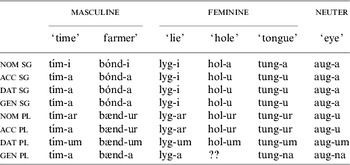
Icelandic has two genitive plural endings, -a and -na. For some nouns neither is felicitous, with homophony avoidance being a possible partial explanation (Jóhannes Gísli Jónsson, Gunnar Ólafur Hansson, p.c.). The ending -a is clearly the default, being found with all classes of strong nouns and most classes of weak nouns.Footnote 22 The ending -na is highly restricted: it is found with the weak neuters (a tiny class with about a dozen members; Thomson Reference Thomson1987: 234) and some weak feminines (Thomson Reference Thomson1987: 142 estimates that they number around 75). The various weak noun paradigm classes are shown in Table 17. It is among the weak feminines whose nominative singular ends in -a that difficulties arise.
Icelandic weak noun classes.

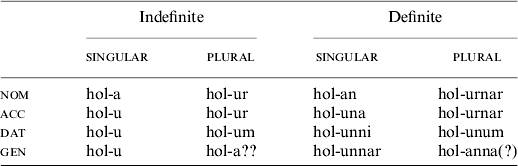
Those such as tunga, which have the lexically specified gen pl -na, are unproblematic. But there are others, such as hola, which for some speakers decidedly do not have the -na ending, but the default -a ending is equally bad. That homophony avoidance may be playing a role is suggested by the fact that the addition of the definite suffix to hola makes it considerably better (Gunnar Ólafur Hansson, p.c.), since in the definite paradigm the nom sg/gen pl homophony is disambiguated (see Table 18).
Icelandic feminine noun ‘hole’.
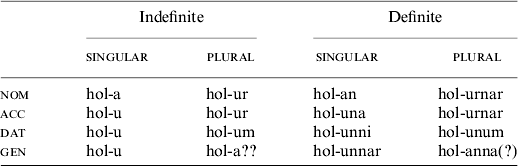
It should also be borne in mind that historically, homophony avoidance looks as if it might have played a role in the distribution of -na. Originally (that is, in Proto-Scandinavian), -na was the ending for all weak nouns. It has since yielded to -a precisely in that class where it is never homophonous with the nom sg, namely the masculines, and retained where it is always homophonous, namely the neuters. The feminines remain a mixed bag; the available evidence shows a great deal of variation among speakers, with few if any generalizations that would help determine which ending a noun ought to follow (Bjarnadóttir Reference Bjarnadóttir2007). It is likely that this uncertainty plays a role in making the genitive plural form problematic.
I will not even try to speculate why this particular homophony is so obnoxious, given the rampant syncretism which otherwise characterizes Icelandic nominal paradigms. I limit myself to pointing out that this is the only class of nouns in which the nominative singular is syncretic with some other case in the plural (except for instances where the nom sg is syncretic with the nompl, and this in turn is syncretic with some other plural case). To sum up, this is an intriguing and understudied phenomenon; aside from a brief mention in Jónsson (Reference Jónsson1927: 16), I am aware of no published work specifically addressing the defectiveness of words of this class. In particular, corpus work may well reveal something interesting, as the words so affected are sufficiently frequent that we may find observable effects. However, such work awaits the production of a disambiguated corpus.
4. Conclusion
The case studies presented in this paper demonstrate that homophony avoidance may play a role in defectiveness, and consequently that homophony avoidance is a principle that can play a role in grammar in general. Whether this principle can be incorporated into a formal theory of grammar is quite another question. There are no solid cross-linguistic generalizations about what constitutes intolerable homophony. Most linguists would probably accept the idea that taboo avoidance, as in Tuvaluan (Section 2.1), is a real phenomenon, but we can hardly characterize taboo in any general way. And the neutralization of the contrast of affirmative and negative, as in Chiquihuitlán Mazatec (Section 3.1), certainly constitutes about as pernicious an example of homophony as one could wish for,Footnote 23 but most putative examples involve neutralizations which are otherwise cross-linguistically common or even found elsewhere within the language itself (as in Teiwa). And yet there does appear to be an observable effect; even more, a remarkably persistent one, if the analysis of Russian offered above (Section 2.2) is correct.
In a recent study, Mondon (Reference Mondon2009) proposes that the only useful constraint we can impose on homophony avoidance is on what it yields: it should be viewed as a condition affecting the choice among variants which are already available. This certainly seems plausible,Footnote 24 but what sort of status does that lend the principle? Another look at Tamashek (Section 3.2) may put it in the proper perspective. In the reconstruction offered above, defectiveness results from the rejection of both of two alternative morphological forms, where homophony avoidance only plays a role with one of them, while the other is objectionable for entirely parochial, paradigm-specific reasons (something on the order of the ‘system congruity’ of Natural Morphology; Wurzel Reference Wurzel1984). This suggests it is a mistake to view homophony avoidance as universal functional principle (however seldom invoked). The term ‘homophony’ as such may lend itself to a universal characterization, just as terms such as ‘prefixation’ or ‘suffixation’ may, but whether or not it is avoided is no more generalizable across languages than whether, say, prefixed or suffixed forms are avoided.
APPENDIX 1
Sources for the Russian examples in the text (all except for (8) and (11) were taken from the Russian National Corpus)
(1) M. V. Musijčuk. 2003. O sxodstve priemov ostroumija i mexanizmov postroenija paradoksal′nyx zadač. Voprosy psixologii 6.
(2a) Vasil′ Bykov. 1998. Bednye ljudi.
(2b) (no author given). 2004. Narodnyj kostjum: arxaika ili sovremennost′? Narodnoe tvorčestvo 1.
(3) Grigor Apojan. 2003. Nairi: triumf i drama. Lebed′ (December 18).
(4) (no author given). 2003. Pomogite nam vstretit′sja. Sel′skaja nov′ (October 7)
(5) Ljudmila Ulickaja. 2000. Putešestvie v sed′muju storonu sveta.
(6) (no author given). 2004. Žizn′, muzyka, studenty. Ural′skij avtomobil′ (February 12)
(7) Andrej Gelasimov. 2001. Foks Malder poxož na svin′ju.
(8) [constructed example]
(9) Oleg Divov. 1998. Molodye i sil′nye vyživut.
(10) Julija Latynina. 2003. Mark Tven i ènergitičeskaja strategija. Eženedel′nyj žurnal (May 27).
(11) I. L. Goleniščevyj-Kutuzovyj. 1765. Translation of Voltaire's Zadig. Citation taken from the Dictionary of 18th-century Russian (entry under néčto).
APPENDIX 2
Stem variation in the oblique case forms of nékij: Raw numbers from the Russian National Corpus (queried in October 2008)

Note: In earlier periods the feminine locative singular had the distinct ending -oju, which eventually yielded to the syncretic ending -oj.