





1. Introduction
Non-canonical agreement in copular clauses is a phenomenon in which the linearly right-hand nominal phrase, KP, controls agreement.Footnote
1 It is widely discussed in recent syntactic literature, most frequently in the context of predicate inversion in so-called specificational copular clauses (Moro Reference Moro1997, den Dikken Reference den Dikken2006, Hartmann & Heycock Reference Hartmann and Heycock2023, among many others), as in the Italian example (1), where the left-hand KP is often treated as the underlying predicate. Otherwise, research focuses on so-called “assumed identity” sentences, which in various languages display person-sensitivity effects (Béjar & Kahnemuyipour Reference Béjar and Kahnemuyipour2017, Keine et al. Reference Keine, Wagner and Coon2019, Coon & Keine Reference Coon and Keine2021, Bhatia & Bhatt Reference Bhatia and Bhatt2023), as in (2) from Eastern Armenian, in which the right-hand KP controls agreement because it has higher person than the left-hand KP.
(1)
La
causa
della
rivolta
{furono
/
*fu}
le
foto
del
muro.
the
cause
of.the
riot
were
/
was
the
pictures
of.the
wall
‘The cause of the riot was the pictures of the wall.’ (Italian, Moro Reference Moro1997: 28)
(2)
Shadi-n
yes
{et
/
*er}.
Shadi
I
was.1sg
/
was.3sg
‘Shadi was me.’
(Eastern Armenian, Béjar & Kahnemuyipour Reference Béjar and Kahnemuyipour2017: 483, glosses modified)
In this paper, we contribute to this extensive body of research on copular clauses by introducing and analysing a fundamentally distinct phenomenon: copular constructions in which the right-hand KP controls agreement despite functioning as a standard
$ \left\langle e,t\right\rangle $
 -type predicate. The constructions under investigation are exemplified in (3)–(5) from Polish.Footnote
2
(3)
Z
Zosi
był
dobry
człowiek.
of
Zosia.sg.f.gen
was.
sg.m
good.sg.m.nom
person.
sg.m
.nom
‘Zosia (lit. of Zosia) was a good person.’ (Hentschel Reference Hentschel, Chrakovskij, Grochowski and Hentschel2001: 166)
(4)
To
był
prawdziwy
skandal.
to
was.
sg.m
real.sg.m.nom
scandal.
sg.m
.nom
‘It was a real scandal.’ (NCP)
(5)
Leki
to
była
ostateczność.
medicines.pl.m.nom
to
was.
sg.f
last.resort.
sg.f
.nom
‘Medicines were a last resort.’ (CCP)
The structure presented in (3) is an extremely understudied type of copular clause containing a prepositional subject of predication and a nominative predicate. The structure in (4) contains a demonstrative word, to, serving as the subject of predication and, again, a nominative predicate. The third structure, shown in (5), has an additional nominal phrase to the left of to. Footnote 3 Although this last structure has been the topic of numerous analyses within generative linguistics (see, e.g., Rutkowski Reference Rutkowski2006, Citko Reference Citko2008, Bondaruk Reference Bondaruk2013), agreement in such constructions has always been analysed in isolation, as an idiosyncratic phenomenon that stands apart in Polish grammar.Footnote 4
The overarching claim of this paper is that, with respect to agreement, such apparently highly idiosyncratic constructions are all accounted for by a single well-known principle, namely, the one proposed in Bobaljik (Reference Bobaljik2008), with the original formulation given in (6).Footnote 5
-
(6) The controller of agreement on the finite verbal complex (Infl+V) is the highest accessible NP in the domain of Infl + V. (Bobaljik Reference Bobaljik2008: 296, emphasis original)
In our terms, (6) implies that in languages in which only nominative or absolutive KPs are possible agreement controllers, it is the highest nominative/absolutive phrase in the domain of T (i.e., within the TP; Bobaljik’s Infl + V) that controls agreement, not necessarily the subject. Support for (6) comes from languages such as Icelandic and Hindi/Urdu, which are well-known for the existence of marked – not nominative or absolutive – subjects. When such marked subjects are accompanied by unmarked – i.e., nominative or absolutive – objects, it is the objects that obligatorily control agreement, since they are the highest accessible KPs in the relevant domain.
In contrast to Icelandic and Hindi/Urdu, Bobaljik (Reference Bobaljik2008: 303) classifies Russian – and, one may hypothesise, Slavic languages in general – as having ‘rather boring morphological case systems, where m-case [morphological case] tracks GF [grammatical function] fairly neatly’, adding that ‘the interest comes from languages in which case and GF do not always line up’. This paper shows that evidence for (6) may also be found in such ‘boring’ languages and, in particular, that – contrary to the common assumption – grammatical function and morphological case do not always line up in the case of Slavic subjects.
Polish constructions exemplified in (3)–(5) provide evidence for Bobaljik’s (Reference Bobaljik2008) generalisation only if the actual subjects are inaccessible and the nominative right-hand predicates happen to be the highest accessible KPs. In order to demonstrate this, the paper makes a number of novel empirical observations and defends a number of theoretical claims concerning subjecthood, the internal structure of demonstrative pronouns and the nature of nominal constituents base-generated high in the syntactic tree, above the basic sentential constituent.
In particular, concerning the understudied constructions exemplified in (3), we refute in Section 2 the view expressed in previous literature that the nominative KP predicate is the grammatical subject; such right-hand predicates control agreement not because they are subjects, but because the higher PP, expressing the subject of predication, is inaccessible, as it is not a nominative KP. Then, in Section 3, we turn to the analysis of constructions exemplified in (4). We present evidence that the word to in (4) is a minimally specified demonstrative, consisting of a referential feature (the root of the widely assumed feature geometry of Harley & Ritter Reference Harley and Ritter2002) combined with a nominaliser, but not projected any further. Hence, in contrast to the word to occurring in typical nominal positions, to in (4) is not a complete nominal phrase, that is, it is not embedded in a case projection; in effect, it is not a nominative KP. This analysis makes it possible to explain intriguing distributional differences between the two kinds of to. Finally, in Section 4, we show that the left-hand nominative KP in (5) is outside the agreement domain, as it is base-generated above the TP. Although this claim has appeared in the prior literature, we provide novel evidence and refute purported counterevidence. This way, the nominative predicates in (3)–(5) remain the only accessible phrases in the agreement domain, so they control agreement even though they are not grammatical subjects.
With the evidence for (6) established, we turn in Section 5 to the formal analysis of constructions exemplified in (3)–(5). First, in Section 5.1, we outline the structural underpinnings of Polish copular clauses and address the important question of why predicates appear in the nominative case in (3)–(5). This fact requires an account, since – in canonical copular clauses – nominal predicates uniformly occur in the instrumental in Polish, as illustrated in (7).
(7)
Leki
były
{ostatecznością
/
*ostateczność}.
medicines.pl.m.nom
were.pl
last.resort.ins
/
last.resort.nom
‘Medicines were a last resort.’
Building on Citko (Reference Citko2008) and Bondaruk (Reference Bondaruk2013) (a.o.), we postulate two Pred(ication) heads; the default PredINS assigns the instrumental case to the predicate, while the defective Pred
$ {}_{\varnothing } $
 does not assign any case. We show that this proposal accounts for the distributional patterns found.
Then, in Section 5.2, we outline the proposed formalisation of agreement, couched in the interaction/satisfaction model of Agree (Deal Reference Deal2024, Clem & Deal Reference Clem and Deal2026), and show that it naturally implements Bobaljik’s generalisation in (6).
The two ensuing subsections present novel phenomena which strikingly support the proposed analysis. In Section 5.3 we provide additional evidence for the claim that the left-hand KP in constructions exemplified in (5) is outside the agreement domain. Perhaps more interestingly, in Section 5.4 we investigate how the relevant structures interact with raising and control verbs. Embedding sentences such as (3)–(5) under raising verbs results in long-distance agreement (to our knowledge, never discussed in the context of Slavic languages before), whereas embedding them under control verbs results in ungrammaticality. This contrasts with canonical copular clauses, such as (7), which can freely be embedded under both raising and control verbs. We show that this pattern is naturally accounted for by the proposed analysis.
While Section 6 concludes the main part of the paper, Appendix A discusses a potential confound, namely, the role of grammatical person in copular agreement.
2. Sentences with prepositional subjects of predication
Consider examples (8)–(9). The preposition z ‘of’ assigns genitive to its dependent. The predicate, which is obligatorily a nominative KP, expresses a property ascribed to the referent of the genitive KP. The verbal copula must agree with the nominative predicate. The PP is often preverbal, as in (8), but in (9) it remains in the postverbal position, which is a common property of pronominal projections in Polish.
(8)
…
[z
Pauliny]PP
był
[niezły
gagatek]KP.
of
Paulina.sg.f.gen
was.
sg.m
not.bad
rascal.
sg.m
.nom
‘Paulina (lit. of Paulina) was quite a rascal.’ (PW2019)
(9)
Kiedyś
była
[z
nas]PP
[niezła
paczka]KP.
once
was.
3sg.f
of
we.pl.gen
not.bad
package.
sg.f
.nom
‘We (lit. of us) used to be a nice bunch.’ (CCP)
The fact that the nominative predicate in such structures is the highest accessible phrase is self-evident: neither the prepositional phrase nor the genitive KP within it is a nominative KP. Hence, Bobaljik’s generalisation in (6) immediately predicts the agreement facts in (8)–(9). However, in order to distinguish between (6) and the usual generalisation that, in Polish, only subjects control verbal agreement, we need to argue that such predicates are not subjects, contrary to the view expressed in Hentschel (Reference Hentschel, Chrakovskij, Grochowski and Hentschel2001) and in apparently the only generative work discussing such constructions so far, Bondaruk (Reference Bondaruk2014).
In traditional Polish linguistics, case and agreement are commonly taken to be the indicators of subjecthood: nominative constituents agreeing with verbs are subjects by definition. In generative linguistics, control and binding are taken to be cross-linguistically more reliable testing grounds for subjecthood, but they do not give clear results in the case of the construction at hand. As discussed below, both control and binding facts are not fully conclusive. Nevertheless, we take it as the default position that, if there is a subject in such constructions, it is the PP or an empty pronoun coreferential with the genitive KP within it, and not the nominative predicate.Footnote 6
One suggestive argument is that, cross-linguistically, subjects typically denote entities (of type
$ e $
 ) or quantifiers (of type
$ \left\langle et,t\right\rangle $
 ), but not predicates (of type
$ \left\langle e,t\right\rangle $
 ). More importantly, in the information-structurally neutral context, the prosodically neutral word order is as in (8)–(9), with the PP adjacent to the verb and the predicate linearly to the right, adhering to the default SVO order in Polish. In contrast, if nominative predicates were subjects, they would reside in Spec,TP, and the default word order would be KPNOM Copula PP, as in (10).
(10)
Pechowiec
jest
z
niego.
unlucky.person.sg.m.nom
is
of
he.sg.m.gen
‘He (lit. of him) is an unlucky person.’ (Bondaruk Reference Bondaruk2014: 44)
In fact, Bondaruk (Reference Bondaruk2014) assumes that (10) illustrates the ‘canonical’ structure of copular constructions with PP subjects of predication and that left-hand PPs in sentences such as (3), (8) and (9) are topics moved to the CP zone.
However, it is precisely (10) that is marked with regard to information structure: it is most natural in the context of contrastive topicalisation of the nominative predicate, as in (11a), or predicate fronting expressing surprise, as in (11b).
(11)
a.
Pechowiec
jest
z
niego,
nie
z
niej.
unlucky.person.nom
is
of
him.gen
not
of
her.gen
‘He is an unlucky person, not her.’
b.
Powiem
ci,
że
pechowiec
jest
z
niego!
tell.1sg
you.dat
that
unlucky.person.nom
is
of
him.gen
‘Let me tell you, unlucky is he!’
This suggests that the word order witnessed in (10)–(11) is the result of KP fronting, and the neutral word order of the constructions at hand is PP Copula KPNOM (or Copula PP KPNOM when the PP contains a pronominal KP), as in (8)–(9), which is not immediately compatible with the claim that KPNOM is the subject.
Given these considerations, the need to demonstrate that such nominative KP predicates are subjects after all is on the shoulders of advocates of this view. Hentschel (Reference Hentschel, Chrakovskij, Grochowski and Hentschel2001) indeed argues for the subjecthood of the nominative KP predicate and against the subjecthood of the PP. Assuming the well-known generalisation that only subjects bind anaphors in Polish, he presents the following Polish examples, with judgements as indicated (Hentschel Reference Hentschel, Chrakovskij, Grochowski and Hentschel2001: 167)Footnote
7:
(12)
a.
U
siebie
i
w
domu
jest
on
i
nieznośny
tyran.
at
self
in
home
is.3sg
he.nom
unbearable
tyrant.nom
‘At home, he is an unbearable tyrant.’
b.
??U
siebie
i
w
domu
jest
z
niego
i
nieznośny
tyran.
at
self
in
home
is.3sg
of
him.gen
unbearable
tyrant.nom
(13)
a.
W
swoim
i
zakładzie
jest
on
i
nieznośnym
pedantem.
in
self’s
workshop
is
he.nom
unbearable
pedant.ins
‘At his workshop, he is an unbearable pedant.’
b.
??W
swoim
i
zakładzie
jest
z
niego
i
nieznośny
pedant.
in
self’s
workshop
is
of
he.gen
unbearable
pedant.nom
Examples (a) are sentences with nominative subjects. (12a) is an infrequent structure (discussed in Section 5.1) with a nominative predicate, i.e., it involves two nominative KPs altogether, and (13a) is a typical Polish copular clause with an instrumental predicate. Examples (b) present analogous structures with PP subjects and nominative predicates. According to Hentschel (Reference Hentschel, Chrakovskij, Grochowski and Hentschel2001), the subject-oriented reflexive pronouns siebie and swoim cannot be bound by the genitive KP in (12b) and (13b) – or, we may add, by the PP (on the assumption that it shares
$ \phi $
 features with the embedded KP; cf. Řezáč Reference Řezáč2008) – although these anaphors can be bound by typical nominative subjects, as shown in (12a) and (13a). Hence, the genitive KP (or the PP) is not a subject, according to this argument.
While we agree that there are acceptability contrasts of the kind illustrated above, they are not related to binding and, hence, they do not say anything about subjecthood. For example, (14a) and (14b) – minimally modified versions of (12b) and (13b) – are similarly degraded, even though they do not involve any binding violations. It seems that the predicates in the structures analysed must express generic, perhaps individual-level properties, with which the locative phrases are not readily compatible (cf. ??John was intelligent in his room); hence the drop in acceptability.
(14)
a.
??U
Marysi
j
w
domu
jest
z
niego
i
nieznośny
tyran.
at
Mary
in
home
is
of
he.gen
unbearable
tyrant.nom
b.
??W
naszym
j+k
zakładzie
jest
z
niego
i
nieznośny
pedant.
in
our
workshop
is
of
he.gen
unbearable
pedant.nom
Therefore, binding does not seem to provide an argument against the subjecthood of PPs. On the contrary, given that acceptability levels of (12b), (13b) and (14a)–(14b) are comparable, i.e., given that binding in (12b)–(13b) does not seem to decrease the acceptability of (14a)–(14b) any further, binding can be argued to provide an argument for the subjecthood of the PPs.Footnote 8
Also the complementary part of Hentschel’s argument – intended to show that the nominative predicate can bind a reflexive pronoun, and hence is the grammatical subject – is invalid. Consider (15) from Hentschel (Reference Hentschel, Chrakovskij, Grochowski and Hentschel2001: 168)Footnote
9:
(15)
Jak
siadł
na
konia,
zdawało
mu
się,
że
z
niego
prawdziwy
when
sit
on
horse
seemed
he.dat
refl
comp
of
he.gen
real
Piłsudski
i
na
swojej
i
Kasztance.
Piłsudski.sg.m.nom
on
self’s
Kasztanka
‘When he got on his horse, he seemed like a real Piłsudski on his Kasztanka.’Footnote
10
Hentschel argues that the fact that the nominative predicate (prawdziwy Piłsudski ‘real Piłsudski’) can bind the reflexive supports its status as the grammatical subject. This, however, is not the case. Consider the attested example (16), where the reflexive pronoun is bound by Piłsudskiego ‘Piłsudski.acc’, even though the whole KP is in the object position of the verb widział ‘saw’.Footnote
11 Despite the fact that objects cannot control reflexives, KP-internal reflexives can be bound by the head of the nominal phrase, regardless of the syntactic function of the whole KP.
(16)
… widział
[Piłsudskiego
i
[na
swojej
i
Kasztance]PP]KP…
saw.3sg.m
Piłsudski.acc
on
self’s.loc
Kasztanka.loc
‘He saw Piłsudski
i on his
i Kasztanka.’ (Google)Footnote
12
In short, assuming that it is the subject status of the right-hand KP in (15) that makes binding possible is incorrect.
The other well-known test for subjecthood, control, is inapplicable here. Nominative predicates occurring in such constructions cannot be controlled as the notion of control makes sense only for referential phrases. The opposite configuration – an attempt to create a control structure with a PP (or, more precisely, pro replacing it) as the controllee – appears to yield a negative result:
(17)
*Chcieli
być
[pro
niezła
paczka].
wanted.3pl
be.inf
not.bad
package.sg.f.nom
Intended: ‘They wanted to be a nice bunch.’
However, as discussed in Section 5.1, (17) is ungrammatical for independent reasons, so it does not provide an argument against the subjecthood of the PP.
Bondaruk (Reference Bondaruk2014) also argues that the nominative predicate is the grammatical subject, adducing two arguments. The first is this: ‘The fact that the copula always assumes the
$ \phi $
 features of the nominative predicate clearly indicates that it is the nominative predicate that serves as a subject in sentences of this type’ (Bondaruk Reference Bondaruk2014: 38). This, however, assumes the traditional position that agreement implies subjecthood, rejected in Bobaljik (Reference Bobaljik2008), in the current paper and in much generative literature.
The second piece of evidence proposed in Bondaruk (Reference Bondaruk2014) concerns the control of the phrase po pijanemu ‘while drunk’, which is assumed to be subject-oriented (Dziwirek Reference Dziwirek1994). Consider (18). This sentence has only one interpretation: the one who was drunk is the referent of the pro-dropped subject, not the referent of the feminine pronoun embedded in the PP z niej ‘of her’. This is meant to demonstrate that po pijanemu can only be controlled by subjects.
(18)
proi
Żartował
z
niej
j
po
pro
i/*j
pijanemu.
joked.3sg.m
of
her.gen
while
drunk
‘He made jokes of her while he was drunk.’ (Bondaruk Reference Bondaruk2014: 41)
According to Bondaruk, when this phrase is within a copular clause with a PP, as in (19), the pro of po pijanemu must be coindexed with the nominative predicate.
(19)
Z
niego
jest
niezły
zbój
i
po
pro
i
pijanemu.
of
he.gen
is.3sg
not.bad
thug.sg.m.nom
while
drunk
‘He is quite a thug while he is drunk.’ (Bondaruk Reference Bondaruk2014: 41; coindexation original)
We find this argument dubious on semantic grounds: only entities may be drunk (as in (18)), not predicates (as claimed about (19)). That is, it must be the referent of the e-type (pronoun within the) PP that is interpreted as drunk in (19), rather than the predicate expressed by the
$ \left\langle e,t\right\rangle $
 -type nominative KP, as the coindexation of po pijanemu’s pro with the predicate would imply.
Moreover, po pijanemu is not a reliable test of subjecthood in any case, as the following examples demonstrate:
(20)
Wszystko
zdarzyło
się
po
pijanemu…
everything
happened
refl
while
drunk
‘Everything happened while one was drunk.’ (Google)Footnote
13
(21)
Mniej
szczęścia
miał
rowerzysta
potrącony
po
pijanemu.
less
luck
had.3sg.m
cyclist.sg.m.nom
hit.ptcp
while
drunk
‘Less fortunate was a cyclist hit by a drunk person.’ (Google)Footnote
14
In (20), the subject is wszystko ‘everything’, and the controller of po pijanemu is unexpressed. In (21), the context clearly indicates that it was the agent of hitting who was drunk, not the hit cyclist, although it is the cyclist that is expressed by the subject. Moreover, given that potrącony ‘hit’ is a passive form, this agent is at best expressed in syntax as a demoted implicit argument (Collins Reference Collins2024), if at all, not as a subject. Hence, po pijanemu seems to be pragmatically controlled by a semantically prominent agent, not necessarily syntactically projected at all.
In partial summary, none of the arguments in Hentschel (Reference Hentschel, Chrakovskij, Grochowski and Hentschel2001) and Bondaruk (Reference Bondaruk2014) for the subjecthood of nominative predicates goes through. Given the suggestive arguments from semantic types and especially word order mentioned at the beginning of this section, as well as binding facts, such nominative predicates should not be considered subjects until convincingly proven otherwise. In the construction at hand, whether the PP is a subject or not, agreement is controlled not by the subject, but by the highest accessible phrase.
Given that this may be the first time Slavic copular clauses with PP subjects have been brought to broader attention, let us also present examples of the relevant structure from Russian, likely overlooked in the generative literature despite extensive research on Russian copular clauses. A key difference between Polish and Russian is that, in Russian, the predicate must be a discontinuous KP consisting of an adjective and a noun. The noun is topicalised and placed in the initial position, while the adjective remains sentence-final. This seems to be the only word order acceptable in Russian, as non-topicalised versions, like those in Polish, are not attested.Footnote
15
(22)
Rabotjaga
iz
menja
byl
ploxoj…
worker.sg.m.nom
of
I.gen
was.sg.m
bad.sg.m.nom
‘I wasn’t a very good worker. (lit. Worker of me was bad.)’ (Russian, RNC)
(23)
… no
kommerčeskij
direktor
iz
nee
byl
but
commercial
director.
sg.m
.nom
of
she.sg.f.gen
was.
sg.m
neploxoj.
not.bad.sg.m.nom
‘But she was a pretty good commercial director.’ (Russian, RNC)
A more detailed analysis of such copular constructions in Russian is left for future research.
3. The word to
Let us now turn to the construction exemplified in (4), repeated below as (24).Footnote
16 Such a sentence can only be used anaphorically, when – in the case of (24) – to must refer to an abstract object, most commonly introduced by a clause.Footnote
17
(24)
To
{był
/
*było}
prawdziwy
skandal.
(ton)
to
was.
sg.m
/
was.sg.n
real.sg.m.nom
scandal.
sg.m
.nom
‘This was a real scandal.’ (NCP)
In the case of copular constructions discussed in the previous section, it is clear that the PP subject of predication is not an accessible phrase in the sense of Bobaljik’s (Reference Bobaljik2008) generalisation, as it is not a nominative KP. However, the preverbal word to in (24) looks suspiciously like the nominative form of the demonstrative pronoun to, so it – rather than the postverbal predicate – should count as the highest accessible phrase and, hence, act as agreement controller.
In this section, we show that the word to used in this construction is not the cased pronoun to, i.e., that it is not a KP, but rather a maximally reduced demonstrative item consisting solely of the base head responsible for its referential property, just nominalised. As it is not a nominative KP, it is not accessible for agreement purposes, and – hence – agreement is controlled by the nominative predicate. To motivate these claims, we analyse the to in (24) in juxtaposition with its full KP counterpart.
3.1. Distributional differences
We show below that, unlike (24), sentences such as (25) and (26) contain the case-bearing to. For convenience, we refer to the structurally reduced variant in (24) – analysed below as an nP – as ton and to the KP variant in (25)–(26) as to
k
.
(25)
To
{było
/
*był}
prawdziwym
skandalem.
(to
k
)
this.nom
was.sg.n
/
was.sg.m
real.sg.m.ins
scandal.sg.m.ins
‘This was a real scandal.’
(26)
To
mnie
zaskoczyło.
(to
k
)
this.nom
I.acc
surprised.sg.n
‘This surprised me.’
At first glance, (24) and (25) differ only in the case of the predicate (nom vs. ins) and in agreement: the right-hand KP obligatorily controls agreement in (24), whereas the copula in (25) takes the third-person singular neuter form, also observed in sentences with to being the subject of lexical verbs (see (26)). However, there are several important differences between to in (24) on the one hand, and to in (25) and (26) on the other.
First, only to
k
is distributionally equivalent to KPs headed by lexical nouns. That is, one can replace to with such a KP in (25) and (26), but – regardless of agreement – not in (24), as shown in (27). (To save space, we do not show examples of to occurring with lexical verbs, as it behaves identically to to with instrumental predicates.)
(27)
a.
*Wczorajsze
wydarzenie
{było
/
był}
prawdziwy
(ton)
yesterday’s
event.sg.n.nom
was.sg.n
/
was.sg.m
real.sg.m.nom
skandal.
scandal.sg.m.nom
b.
Wczorajsze
wydarzenie
było
prawdziwym
skandalem.
(to
k
)
yesterday’s
event.sg.n.nom
was.sg.n
real.sg.m.ins
scandal.sg.m.ins
Intended in both: ‘Yesterday’s event was a real scandal.’
Second, in contrast to to
k
, ton cannot be modified by adjectives, see (28).
(28)
[Polska przegrała kolejny mecz]
i. ‘Poland lost another match.’
a.
(*Samo)
to
i
był
skandal.
(ton)
alone
to
was.3sg.m
scandal.sg.m.nom
b.
(Samo)
to
i
było
skandalem.
(to
k
)
alone
this
was.3sg.n
scandal.sg.m.ins
‘This alone was a scandal.’
Third, only to
k
can act as a nominaliser of a complementiser phrase (CP), see (29).
(29)
a.
*To,
co
powiedział,
był
skandal.
(ton)
to
what
said.3sg.m
was.sg.m
scandal.sg.m.nom
b.
To,
co
powiedział,
było
skandalem.
(to
k
)
this.nom
what
said.3sg.m
was.sg.n
scandal.sg.m.ins
‘What he said was a scandal.’
Finally, when to
k
is used anaphorically, its antecedent must be a
$ \phi $
 -less expression, for instance, a clause. In contrast, ton can refer to any antecedent, including a lexical KP denoting a human; see (30).
(30)
Lubiłem Janka
i. ‘I liked Janek.’
a.
To
i
był
dobry
chłopak.
(ton)
to
was.sg.m
good.sg.m.nom
boy.sg.m.nom
‘He (lit. This) was a good boy.’ (NCP)
b.
#To
i
było
dobrym
chłopakiem.
(to
k
)
this.nom
was.sg.n
good.sg.m.ins
boy.sg.m.ins
The differences are summarised in Table 1.
Differences between ton and to k .

Table 1. Long description
The table consists of four columns. The first column lists the property being compared, the second column describes to sub n, the third column describes to sub K, and the fourth column provides example references.
* Row 1: Property is (to plus N O M predicate) for to sub n and (e.g., to plus I N S predicate) for to sub K.
* Row 2: Distribution of K P. to sub n is marked with a minus sign. to sub K is marked with a plus sign. Example (27).
* Row 3: Modifiability by adjectives. to sub n is marked with a minus sign. to sub K is marked with a plus sign. Example (28).
* Row 4: Can nominalise a C P. to sub n is marked with a minus sign. to sub K is marked with a plus sign. Example (29).
* Row 5: Anaphoric possibilities. to sub n allows any antecedent. to sub K allows phi-less antecedents. Example (30).
In brief, to
k
behaves like a full KP: it is distributionally equivalent to lexical KPs, it can be modified by adjectives and it can nominalise a CP – similarly to certain nouns taking CP dependents (e.g., fakt ‘fact’, myśl ‘thought’). Its distributional equivalence to a KP also explains its behaviour with respect to what antecedents it can refer to. Namely, to
k
competes with other pronominals having KP distribution, that is, personal pronouns. However, in contrast to to
k
, such pronouns have number and gender features (for instance, on ‘pers.sg.m’, ono ‘pers.sg.n’), and therefore outcompete to
k
whenever the antecedent bears the corresponding number and gender features. Consequently, to
k
is an elsewhere option, occurring only when personal pronouns cannot be used, i.e., when the antecedent is
$ \phi $
 -less – for instance, when it is expressed by a CP or an infinitival TP. The other to, ton, is special: it is a strictly referential item, but it does not behave like a KP – it cannot be replaced by KPs, it cannot be modified by adjectives, nor can it nominalise a CP. As it is not distributionally equivalent to KPs (such as personal pronouns), it does not compete with them, so it can refer to any antecedent.
Given that ton and to
k
share the same morphological form and the same primarily demonstrative function, they should not be analysed as unrelated homonyms. We propose that they are closely related and share a referential feature, namely, the root of the feature geometry (Harley & Ritter Reference Harley and Ritter2002), called here
$ \pi $
 . This root is exponed in Polish as t-, as witnessed in various demonstrative forms, such as the adverb t-ak ‘in this manner’ and the numeral t-yle ‘this much’. Apart from the
$ \pi $
 feature, ton and to
k
also share the nominal categoriser, n, exponed as -o; hence the common form to. (We will have more to say on this in the following subsection.) However, distributional differences discussed above indicate that only to
k
projects to a full KP. Overall, we postulate the following structures for ton and to
k
, with the dashed line signalling our agnosticism about projections between nP and KP:
(31)

This analysis, treating to
k
as a full KP projection, predicts that to
k
inflects for case. This is borne out, as shown in (32). Crucially, the case-inflected to matches all the characteristics of to
k
summarised in Table 1.
(32)
a.
Nie
chcę
t-ego.
neg
want.1sg
this-gen
‘I don’t want this.’
b.
Przyglądam
się
t-emu.
look.1sg
refl
this-dat
‘I’m looking at this.’
To summarise, assuming that ton is the nominalised version of the referential feature, which can be embedded in a case projection (forming to k ), explains (i) why the two – to k and ton – are spelled out as the same form, (ii) why to k competes with other case-bearing pronominals while ton does not and (iii) why only to k behaves syntactically like a complete nominal projection: it inflects, combines with adjectives and may nominalise CPs.
3.2. Feature geometry,
$ \boldsymbol{\pi} $
 and
$ \boldsymbol{\phi} $


Following Harley & Ritter (Reference Harley and Ritter2002) and much subsequent work (see, for instance, McGinnis Reference McGinnis2005, Béjar & Řezáč Reference Béjar and Řezáč2009), we assume that features relevant for agreement are organised within a hierarchy (a feature geometry). The hierarchy we assume for Polish is presented in (33). Although simplified in some respects that are irrelevant here,Footnote
18 it explicitly represents the distinction between the feature
$ \pi $
 – responsible for referentiality – and the feature
$ \phi $
 , a strictly grammatical feature present on third-person singular neuter items.
(33)

Distinguishing between [
$ \pi $
 ] and [
$ \pi $
 ,
$ \phi $
 ] makes it possible to capture the difference between
$ \phi $
 -less referential expressions on the one hand (such as infinitival and clausal phrases in argumental positions, as well as to in both its incarnations: ton and to
k
) and third-person singular neuter items on the other (such as the personal pronoun ono ‘sg.n’ and neuter gender nouns such as okno ‘window.sg.n’ or krzesło ‘chair.sg.n’).Footnote
19
There are at least two arguments for the necessity of this distinction in Polish. First, coordination of two singular neuter ([
$ \pi $
 ,
$ \phi $
 ]) items results either in closest conjunct agreement or in plural agreement, as shown in (34). By contrast, coordination of two infinitival phrases or two to
k
s in the position of the subject of a lexical verb obligatorily triggers the so-called ‘default agreement’ (Dziwirek Reference Dziwirek, Dziwirek, Farrell and Mejías-Bikandi1990, Preminger Reference Preminger2014), i.e., a 3sg.n form, which signals the lack of an appropriate agreement controller; see (35)–(36). Note that coordinating two anaphoric uses of to
k
is difficult, as it is then difficult to determine which to refers to which antecedent. However, it is easy to coordinate two deictic uses of to
k
(see (36a)) or two CPs nominalised by to
k
(see (36b)).Footnote
20
(34)
W
tym
pokoju
najładniejsze
{było
/ były}
okno
i
krzesło.
in
this
room
beautiful.sup
was.sg.n
/ were.pl
window.sg.n
and
chair.sg.n
‘The window and the chair were the most beautiful in this room.’
(35)
Najwięcej
problemów
{sprawiło
/ *sprawiły}
mu
[skoczyć
na
most
troubles.gen
made.3sg.n
/ made.pl
he.dat
jump.inf
on
bungee]InfP
i
[wejść
na
Kilimandżaro]InfP.
bungee
and
climb.inf
on
Kilimanjaro
‘Bungee jumping (lit. to bungee-jump) and climbing (lit. to climb) Kilimanjaro posed the greatest challenges for him.’
(36)
a.
{Zaskoczyło
/ *Zaskoczyły}
mnie
to→
i
to→.
surprised.3sg.n
/ surprised.3pl
I.acc
this
and
this
‘This and this surprised me.’ (‘
$ \to $
 ’ = pointing gesture)
b.
Skandalem
{było
/ *były}
[to,
że
Polska
przegrała],
i
scandal.sg.m.ins
was.sg.n
/ were.pl
this
comp
Poland
lost
and
[to,
że
kibice
się
pobili].
this
comp
fans
refl
brawled
‘[That Poland lost]nominalised and [that fans got into a brawl]nominalised was a scandal.’
This syntactic difference between truly neuter nouns in (34) and
$ \phi $
 -less constituents in (35)–(36) is accounted for by assuming that infinitival phrases and the word to (whether ton or to
k
) are not singular neuter, that is, they do not have even the minimal set of
$ \phi $
 features (the feature [
$ \phi $
 ] itself), in contrast to true singular neuter (pro)nouns. Given this lack of
$ \phi $
 features on the conjuncts, the usual feature resolution responsible for the plural in (34) cannot take place, so not only particular conjuncts but the whole coordinations in (35)–(36) remain
$ \phi $
 -less.
The second phenomenon pointing to the same difference – between genuine third-person neuter ([
$ \pi $
 ,
$ \phi $
 ]) and
$ \phi $
 -less ([
$ \pi $
 ]) items – is based on possible antecedents of pronouns. Polish personal pronouns used anaphorically must agree with their antecedents: they presuppose that their antecedents bear corresponding
$ \phi $
 features. In this context, note that the singular neuter pronoun ono cannot refer to an instance of to
k
, as shown in (37).
(37)
A:
To
i
mnie
zaskoczyło.
this
I.acc
surprised.3sg.n
‘It surprised me.’
B:
Mnie
też
{to
i
/ #ono
i}
zaskoczyło.
I.acc
also
this
/ pers.sg.n
surprised.3sg.n
‘It surprised me as well.’
The personal pronoun ono ‘pers.sg.n’ expects its antecedent to have the corresponding features (crucially, [
$ \phi $
 ]), in the same way the pronoun on ‘pers.sg.m’ requires its antecedent to have the feature [masc]. The word to
k
in A’s utterance lacks
$ \phi $
 , and thus ono cannot take it as an antecedent. The elsewhere form – to
k
itself – is used in B’s utterance.
This behaviour of infinitival TPs and to
k
may be contrasted with that of Polish gerund forms, which – just like infinitival TPs – refer to event types, but may be shown to have [
$ \pi $
 ,
$ \phi $
 ]. First, they can trigger plural agreement when coordinated; compare (38) below with (36) above. Second, they may be referred to with the pronoun ono ‘sg.n’; compare (39) with (37).
(38)
Nagradzanie
i
karanie
są
ściśle
powiązane
z
rewarding.sg.n.nom
and
punishing.sg.n.nom
are.pl
strictly
linked
with
procesem
motywowania
pracowników.
process
motivating
employees
‘Rewarding and punishing are closely linked to the process of motivating employees.’ (NCP)
(39)
Jak
rozumieć
uzdrawianie
i
wewnętrznych
zranień?
Na
czym
ono
i
how
understand.inf
healing.sg.n
inner
wounds
on
what
sg.n
polega?
relies
‘How do we understand the healing of inner wounds? What does it involve?’ (NCP)
Another difference between
$ \phi $
 -bearing items and to is that to does not easily bind reflexive pronouns:
(40)
a.
Ono
jest
swoim
najlepszym
obrońcą.
sg.n
is
refl.ins
best.ins
defender.ins
‘It is its own best defender.’
(when said about a child, dziecko.
sg.n in Polish)
b.
??To
jest
swój
najlepszy
obrońca.
to
is
refl.nom
best.nom
defender.nom
While (40a) is fully acceptable, (40b) is considerably worse. This pattern is expected if the reflexive requires a minimal set of
$ \phi $
 features on its binder: ono in (40a) bears the feature [
$ \phi $
 ], while to in (40b) lacks it.Footnote
21
Let us finish this section with some speculations on the
$ \phi $
 -lessness of ton and to
k
. The existence of such
$ \phi $
 -less pronouns should not be particularly surprising. As argued above, personal (on-based) pronouns presuppose a specific set of
$ \phi $
 features on their antecedents – minimally the feature [
$ \phi $
 ] (the singular neuter pronoun ono). However,
$ \phi $
 -less CPs and infinitival TPs also introduce (abstract) objects into the discourse. Accordingly, the existence of
$ \phi $
 -less pronouns is required to refer to such entities.
This is in line both with Déchaine & Wiltschko (Reference Déchaine and Wiltschko2002), where pronouns are argued to come in different sizes, and with Collins (Reference Collins2024), where implicit arguments (e.g., agents in short passives) are argued to be realised by three kinds of caseless pronouns in English – progen (generic), prodef (definite) and proun (existential) – the last of them also lacking
$ \phi $
 features. On this approach, the existence of featurally deficient pronouns ‘is an immediate consequence of a UG that allows for pronouns defined by various sets of features’ (Collins Reference Collins2024: 58). In fact, as shown in the table in (41), to
k
fills a gap in the taxonomy of pronouns implicit in Collins (Reference Collins2024).
(41)

In summary, there are two variants of the Polish pronoun to: a maximal but
$ \phi $
 -less nominal projection (KP) and a reduced structure (nP). We consider this result to be in the spirit of Déchaine & Wiltschko (Reference Déchaine and Wiltschko2002), which proposes that ‘it is necessary to recognize (at least) three pronoun types: pro-DP, pro-
$ \phi $
 P, and pro-NP’ (p. 409). But while to
k
might be an instance of Déchaine & Wiltschko’s (Reference Déchaine and Wiltschko2002) pro-DP (given that for them maximal nominal projections are DPs rather than KPs), ton instantiates a new overt pronoun type, featurally similar to Collins’s (Reference Collins2024) phonetically empty proun.
In any case, regardless of its appropriate place in the taxonomy and typology of pronouns, ton is not a nominative KP, so it is not an accessible agreement controller, which explains why agreement is controlled by the nominative KP predicate lower in the tree.
4. Status of KP1
As mentioned in the introduction, the position of the left-hand KP (henceforth, KP1) in the construction exemplified in (5), repeated below as (42), is a problematic issue. Some analyses, such as Hentschel (Reference Hentschel, Chrakovskij, Grochowski and Hentschel2001) and Rutkowski (Reference Rutkowski2006), assume that KP1 is a left-dislocated topic, so (42) has essentially the same structure as the construction discussed in the previous section, but with an extra constituent in the peripheral position. We schematically present it in (43), but remain agnostic about the category of the relevant projection (hence, the generic XP). Other analyses – including Citko (Reference Citko2008) and Bondaruk (Reference Bondaruk2013) – treat KP1 as the structural subject, Spec,TP. For both authors, to is a special item, distinct from the demonstrative assumed in the previous section: Citko (Reference Citko2008) treats it as a T head, and Bondaruk (Reference Bondaruk2013) as an overt realisation of Pred, a head mediating predication in the small clause. A simplified representation is given in (44).
(42)
Leki
to
była
ostateczność.
medicines.pl.m.nom
to
was.
sg.f
last-resort.
sg.f
.nom
‘Medicines were a last resort.’ (CCP)
(43)

(44)

In this section, we show that the left dislocation analysis is essentially correct. This, in particular, means that to occupies the Spec,TP position, but we additionally assume that it is obligatorily coreferential with KP1.Footnote 22
In Section 4.1, we present a strong argument that KP1 occupies an A′ position above TP: it blocks A′-movement. In Section 4.2, we show that known arguments against treating KP1 as occupying a position above TP are misguided.
4.1. Intervention
The construction at hand does not allow topicalisation and wh-movement, as shown in (45)–(46). (The word to in parentheses in (45) is an optional topic marker, synchronically unrelated to the demonstrative; the two can co-occur, as in (45b).) In the (a) examples, the right-hand predicate is fronted over KP1: in (45a), for information-structural purposes, and in (46a), as an instance of wh-movement. Both examples are clearly ungrammatical. Compare these with examples in (b), which differ from (a) only in lacking KP1. Their full acceptability demonstrates that the intervention effect is triggered precisely by the presence of KP1.Footnote
23 To provide a complete picture, examples in (c) are canonical predicational constructions with instrumental predicates and regular subject-verb agreement. These again permit wh-movement and topicalisation, since the phrase that the predicate moves over is simply the Spec,TP subject.
(45)
a.
*Ostateczność
i
(to)
leki
to
nie
była
ti.
last.resort.
sg.f
.nom
top
medicines
to
neg
was.
sg.f
Intended: ‘Last resort, medicines were not.’
b.
Ostateczność
i
(to)
to
nie
była
ti.
last.resort.
sg.f
.nom
top
to
neg
was.
sg.f
‘Last resort, this was not.’
c.
Ostatecznością
i
(to)
leki
nie
były
ti.
last.resort.sg.f.ins
top
medicines
neg
were
‘Last resort, medicines were not.’
(46)
a.
*Kto
i
Marysia
to
był
z
zawodu
ti?
who.
sg.m
Marysia.sg.f
to
was.
sg.m
by
profession
Intended: ‘Who was Marysia by profession?’
b.
Kto
i
to
był
(z
zawodu)
ti?
who.
sg.m
to
was.
sg.m
by
profession
‘Who was (s)he (lit. this) by profession?’
c.
Kim
i
Marysia
była
z
zawodu
ti?
who.ins
Marysia.
sg.f
was.
sg.f
by
profession?
‘Who was Marysia by profession?’
Crucially, in studies specifically aiming at distinguishing between Spec,TP and positions above Spec,TP, intervening in A′-movement is regarded as an important diagnostic. For instance, Landau (Reference Landau2009), in refuting the ‘broad subject’ analysis of certain phrases in Hebrew – which posits two specifier positions in TP – appeals to this diagnostic and considers it ‘a lethal problem’ (Landau Reference Landau2009: 97) for a TP-internal analysis.Footnote 24 The same reasoning also applies to the Polish construction at hand: KP1 intervenes in A′-movement because it is base-generated in an A′ position itself.Footnote 25
4.2. Refuting counterarguments
Works rejecting the dislocated analysis of Polish KP1 refer to three phenomena suggesting a TP-internal status: (i) KP1 may be realised as a quantifier phrase (Citko Reference Citko2008), (ii) KP1 can control a reflexive pronoun and (iii) KP1 can control the subject of an adversative adjunct clause (Bondaruk Reference Bondaruk2013). We argue that these diagnostics do not provide evidence for a TP-internal status of KP1, because, as will be shown, (i) cross-linguistically quantifiers are attested in dislocated positions, (ii) Polish reflexive pronouns can be controlled from outside the TP in which they are placed and (iii) subjects of adversative adjunct clauses can be bound by items other than Spec,TP subjects.
Firstly, Citko (Reference Citko2008: 263, fn. 1) dismisses the dislocated analysis on the basis of the observation that quantificational constituents can occur as KP1 (see (47)), although they are ‘impossible in left dislocated positions’ (see an attempted hanging topic construction in (48)):
(47)
Każdy
student
to
(jest)
potencjalny
geniusz.
every
student
to
is
potential
genius
‘Every student is a potential genius.’ (Citko Reference Citko2008: 263)
(48)
*Każdy
student,
on
jest
potencjalnym
geniuszem.
every
student
he
is
potential.ins
genius.ins
Intended: ‘Every student, he is a potential genius.’ (Citko Reference Citko2008: 263)
However, quantificational phrases are attested in A′ positions, as in clitic left dislocation constructions best known from Romance languages. Consider the Italian example (49), which contains a left-peripheral phrase co-occurring with a coreferential clitic in the main clause. Similarly, (50) is a Lebanese Arabic sentence containing a left-peripheral quantificational phrase.
(49)
Tutti
i,
non
li
i
ho
visti
ancora.
all
not
them
have.1sg
seen
yet
‘All of them, I haven’t seem them yet.’ (Italian, Cinque Reference Cinque1991: 58, glosses modified)
(50)
kəll
təlmiize
baddun
ylabsuw-a
maryul
every
student.sg.f
want.3pl
dress.3pl-her
uniform
‘Every student, they want her to wear a uniform.’
(Lebanese Arabic, Aoun et al. Reference Aoun, Benmamoun and Choueiri2010: 195, glosses modified)
Hence, (48) is ungrammatical not because A′ constituents cannot be quantifiers, they can, but because hanging topics must be referential rather than quantificational. Crucially, being in a dislocated position is not equal to being a hanging topic. The latter are best analysed as syntactically unintegrated phrases, simply juxtaposed with the main clause and interpreted as connected to this clause only at the discourse level (Shaer & Frey Reference Shaer and Frey2004, Shaer Reference Shaer, Shaer, Cook, Frey and Maienborn2009, Villa-García Reference Villa-García2023). We argue that KP1 occupies a dedicated position in the left periphery, not that it is a hanging topic.
Secondly, Bondaruk (Reference Bondaruk2013, Reference Bondaruk2015) shows that KP1 can control subject-oriented reflexive pronouns, see (51).
(51)
Marek
to
jest
swój
najlepszy
obrońca.
Marek.sg.m.nom
to
is
self’s
best
defender.sg.m.nom
‘Marek is his own best defender.’ (Bondaruk Reference Bondaruk2015: 205)
Importantly, this cannot be attributed to to binding the reflexive and – being coreferential with KP1 – acting as a proxy. As shown in Section 3, such constructions lacking KP1 are degraded; see (40b), repeated as (52). Therefore, we must conclude that KP1 directly binds the reflexive.
(52)
??To
jest
swój
najlepszy
obrońca.
to
is
self’s
best
defender.sg.m.nom
However, in Section 4.1, we presented syntactic evidence that the left-hand KP behaves as a dislocated phrase, in that it gives rise to intervention effects. How, then, can this be reconciled with the ability of KP1 to bind reflexives?
We argue that TP does not constitute a locality domain for binding reflexives, and consequently, a TP-external KP1 can bind a reflexive within that TP. Independent support for the availability of TP-external binders comes from constructions like (53). In this example, the reflexive can be bound not only by pro – controlled by the matrix object Piotrowi ‘Piotr.dat’ – but also by the matrix subject, which clearly lacks any syntactic representation within the infinitival TP.
(53)
Jan
i
kazał
Piotrowi
j
[TP
pro
j
przynieść
swoje
i/j
dokumenty].
Jan.nom
ordered
Piotr.dat
bring.inf
self’s
documents
‘Jan
i ordered Piotr
j to bring his
i/j documents.’
(adapted from Przepiórkowski et al. Reference Przepiórkowski, Kupść, Marciniak and Mykowiecka2002: 178)
The correct generalisation, then, is that the binder of the reflexive must have at least a minimal set of
$ \phi $
 -features (accounting for the degraded acceptability of (52)) and be located within the same CP – rather than the same TP – as the reflexive (which explains the availability of both interpretations in (53)).Footnote
26
Thirdly, Bondaruk (Reference Bondaruk2013) argues that the dislocated analysis of KP1 is wrong because KP1 can control the subject of an adversative adjunct clause (aac) introduced by mimo ‘despite’:
(54)
Mimo
pro
częstego
słuchania
wielu
gatunków
muzyki,
Marek
to
(jest)
despite
frequent
listening.gen
many
types
music
Marek
to
is
zapalony
fan
rocka.
great
fan.nom
rock.gen
‘Despite frequently listening to many types of music, Marek is a great fan of rock.’
(Bondaruk Reference Bondaruk2013: 227; glosses modified)
The argument rests on the assumption that only Spec,TP subjects can control the pro in aac. This assumption, however, is immediately falsified by attested examples such as (55)–(56). In (55), the subject of the aac is controlled by a semantically prominent individual, not syntactically represented in the matrix clause at all. In (56), the controller likewise is not represented syntactically (if the precious metals were provided by, say, the ruler’s servants) or alternatively, it is realised as the dative complement of the impersonal form zwrócono ‘returned.imps’ (if the ruler himself supplied the metals).
(55)
Waga
nie
spada,
mimo
pro
przyjmowania
drastycznie
niskich
weight.nom
neg
drop
despite
consuming
drastically
low
ilości
kalorii…
amounts
calories.gen
‘(One’s) weight isn’t going down despite consuming drastically low amounts of calories.’ (Google)Footnote
27
(56)
Mimo
pro
dostarczenia
kilkunastu
ton
złota
i
srebra,
władcy
despite
delivering
dozen.or.so
tons
gold
and
silver
ruler.dat
Inków
nie
zwrócono
wolności.
Incas.gen
neg
returned.imps
freedom
‘Despite delivering a dozen tons of gold and silver, the ruler of the Incas was not granted his freedom. (lit. to the ruler of Incas was not granted of freedom)’ (Google)Footnote
28
In summary, the assumption that KP1 is base-generated above the TP agreement domain immediately explains intervention effects. Together with the status of ton discussed in the previous section, this assumption also explains why the nominative predicate is the highest accessible phrase and, hence, controls verbal agreement. Known arguments against this assumption either fail entirely (as in the case of quantificational phrases and adversative adjunct clauses) or can be reconciled with the TP-external analysis of KP1 by granting it mixed A/A′ status or by adopting an analysis of binding insensitive to this distinction (as in the case of reflexive binding).
5. Formalisation
5.1. PredP(s) and nominative KP predicates
We adopt the currently standard view on the structure of copular clauses, which holds that there is a functional head mediating nonverbal predication, Pred (see, for instance, Bowers Reference Bowers1993, Reference Bowers, Baltin and Collins2001, Baker Reference Baker2003: Chapter 2, den Dikken Reference den Dikken2006 for general discussion and Citko Reference Citko2008, Bondaruk Reference Bondaruk2013 for its application to Polish copular clauses).Footnote
29 Its maximal projection, PredP, is selected by the copula – whether it is a lexical verb (V), a light verb (v) or simply the Tense head. This last minimal approach, on which the copula (być ‘be’) is an exponent of T in the context of PredP, is also adopted in this work (following, for instance, Baker Reference Baker2003 and Roy Reference Roy2013). In information-structurally neutral contexts, the constituent closest to T, i.e., the subject of predication in Spec,PredP, moves to Spec,TP to satisfy epp. The schematic structure of such copular clauses is presented in (57).
(57)

The first question to be addressed is why predicates in constructions under investigation appear in the nominative case. From the perspective of Polish grammar, this is unexpected. Nominal predicates in canonical clauses – when the subject of predication is a nominative KP – typically take the instrumental case, as shown in (7), repeated below as (58).
(58)
Leki
były
{ostatecznością
/
*ostateczność}.
medicines.pl.m.nom
were.pl
last.resort.ins
/
last.resort.nom
‘Medicines were a last resort.’
Relatedly, why is it the case that non-canonical subjects occurring in the constructions analysed in this paper – PP[z] and ton – cannot occur with instrumental predicates? It is straightforward to show that they cannot in the case of PP[z], see (59). As for ton, see Section 3, where we show that the item occurring with instrumental predicates is to
k
, i.e., a canonical KP subject, rather than ton.
(59)
*Z
Marysi
było
dobrym
człowiekiem.
of
Marysia.sg.f.gen
was.sg.n
good
person.sg.m.ins
Intended: ‘Marysia (lit. of Marysia) was a good person.’
At its core, our proposal follows Citko (Reference Citko2008) and Bondaruk (Reference Bondaruk2013): we assume there are two Pred heads – a ‘canonical’ one, which assigns the instrumental case to its complement (PredINS), and a ‘defective’ one, which does not assign case (Pred
$ {}_{\varnothing } $
 ).Footnote
30 The two differ with regard to selectional restrictions, as shown in (60). The canonical PredINS takes an instrumental predicate and combines with the same kind of specifiers as lexical verbs – typically KPs. By contrast, Pred
$ {}_{\varnothing } $
 is ‘defective’ in the sense that it places no selectional restrictions on its complement and specifier.Footnote
31
(60)
head
specifier
complement
PredINS
KP*
KPINS
Pred
$ {}_{\varnothing } $

—
—
KP* in the table refers to ‘canonical’ subjects, i.e., ones that lexical verbs normally combine with. Besides nominative nominal phrases, these include infinitival phrases and CPs, as shown in the context of PredINS in (61).
(61)
a.
[Wprowadzić
ją
w
błąd]
$ {}_{\mathrm{InfP}} $

było
rzeczą
bardzo
trudną.
lead.inf
she.acc
in
mistake
was.sg.n
thing.ins
very
difficult
‘To mislead her was a very difficult thing (to do).’ (NCP).
b.
[Że
się
od razu
nie
pozabijali]
$ {}_{\mathrm{CP}} $

było
zasługą
comp
refl
immediately
neg
killed
was.sg.n
achievement.ins
matki…
mother.gen
‘That they didn’t kill each other right away was thanks to the mother (lit. the mother’s achievement).’ (NCP)
Given that Pred
$ {}_{\varnothing } $
 has no restrictions on its complement and specifier, the next question is why only non-canonical subjects – PP[z] and ton – can occur with it; for example, why is the Pred
$ {}_{\varnothing } $
 version of (58), with the nominative predicate, unacceptable with the canonical subject? We propose that this is straightforwardly explained in terms of Pāṇinian blocking: since KP subjects have the dedicated PredINS selecting for such items, Pred
$ {}_{\varnothing } $
 (the ‘elsewhere’ Pred) is blocked, as it is less specified for such subjects.
Interestingly, canonical subjects can occasionally occur with nominative predicates, but this structure is rare and requires an expressive predicate, as in (62)–(63).
(62)
Ale
król
był
straszna
świnia,
zepsuł
mu
gitarę!
but
king.
sg.m
.nom
was.
3sg.m
awful
pig.sg.f.nom
broke
he.dat
guitar
‘But the king was a terrible pig, he broke his guitar!’ (Polish comedy song by W. Sikora)Footnote
32
(63)
No,
dziadek
był
kawał
drania
– potaknął
well
grandfather.sg.m.nom
was.3sg.m
piece.sg.m.nom
bastard.gen
nodded
Izzat.
Izzat
‘Well, grandpa was a bit of a bastard – nodded Izzat.’ (CCP)
Paradoxically, this phenomenon confirms the analysis in terms of PredINS and Pred
$ {}_{\varnothing } $
 . It has been reported that violating economy conditions does not necessarily lead to ungrammaticality if it induces a pragmatic effect (Schlenker Reference Schlenker2005, Patel-Grosz & Grosz Reference Patel-Grosz and Grosz2017). This is exactly the case here: using Pred
$ {}_{\varnothing } $
 with a nominative subject, instead of the better match, PredINS, is only licensed when the expression is intended to convey a special interpretive effect, namely, marking the speaker’s expressive attitude towards the assertion.
Importantly, (62) also shows the workings of agreement when two nominative phrases are present in the agreement domain: the highest one controls agreement, precisely as predicted by Bobaljik’s generalisation.
Before we proceed to the formal analysis of agreement, let us show how our minimal inventory of Preds interacts with control facts mentioned in Section 2; see (17), repeated as (64).
(64)
*Chcieli
być
[pro
niezła
paczka].
wanted.3pl
be.inf
not.bad
package.sg.f.nom
Intended: ‘They wanted to be a nice bunch.’
The predicate niezła paczka ‘a nice bunch’ is fine with both to and PP in the finite matrix structure (as illustrated for PP in (9)). However, a control structure cannot be formed. This follows naturally under the assumption that pro bears case (see Chomsky & Lasnik Reference Chomsky, Lasnik, Jacobs, von Stechow, Sternefeld and Vennemann1993, Sigurðsson Reference Sigurðsson2008). Given that case-bearing items have a more specialised Pred available, the defective Pred
$ {}_{\varnothing } $
 is blocked.
Crucially, as shown in (65), strongly expressive nominative predicates can occur in control structures. This directly follows from the analysis proposed for constructions like (62)–(63): once the predicate is sufficiently expressive, a violation of the economy conditions described above is pragmatically licensed. As a result, pro can occur with Pred
$ {}_{\varnothing } $
 despite the availability of the more specified alternative, PredINS.
(65)
a.
Gdyby-m
chciał
być
[pro
kawał
dziada]…
if-1sg
want
be.inf
piece.nom
bastard.gen
‘If I wanted to be a piece of bastard…’ (Google)Footnote
33
b.
Ludzie
myślą,
że
ja
zwyczajnie
[pro
próbuję
być
kozak]…
people
think
comp
I
simply
try.1sg
be.mg
daredevil.nom
‘People think I simply try to be a daredevil…’ (Google)Footnote
34
Having laid out our assumptions regarding the basic structure of copular clauses, we now turn to the formal implementation of the agreement mechanism.
5.2. Agreement
Bobaljik (Reference Bobaljik2008) does not provide a formal derivational analysis of case-dependent Agree. To implement Bobaljik’s generalisation formally, we require a mechanism involving (i) case-discriminating agreement probes which (ii) copy the
$ \phi $
 features of their goal. Under a certain set of assumptions, these can be achieved by any model of Agree, including the classic formulation in Chomsky (Reference Chomsky, Martin, Michaels and Uriagereka2000, Reference Chomsky, Kenstowicz and Hale2001). A central feature of Chomsky’s approach, however, is the claim that agreement and case-valuation proceed in tandem, and the eventually nominative phrase must be ‘active’ – bear an unvalued case (i.e., the [ucase: ] feature) – in order to participate in agreement. This assumption, in turn, runs counter to one of the core insights of Bobaljik (Reference Bobaljik2008): that agreement is dependent on case (see also Preminger Reference Preminger2014).Footnote
35
For concreteness, we adopt the interaction/satisfaction model of Agree (Deal Reference Deal, Bui and Özyldz2015, Reference Deal2024, Clem & Deal Reference Clem and Deal2026, a.o.), as it allows us to present the analysis in the most perspicuous way. We modify this approach in a way directly implementing case-dependent Agree. As specified below, the agreement probe postulated here searches for the nominative case. In this respect, we depart from Clem & Deal (Reference Clem and Deal2026), where case marking is treated as a by-product of agreement.
In the interaction/satisfaction model, agreement probes are specified by two parameters: interaction (which features the probe interacts with) and satisfaction (which features, if any, cause the probe to stop probing further). We propose that Polish T both interacts with and is satisfied by nominative KPs, thus implementing Bobaljik’s generalisation, rather than by some set of
$ \phi $
 features, as is more frequently assumed. That is, the probe on T is specified as [int: nom, sat: nom].
Given this, we adopt the ‘coarse’ approach to feature copying (see, for instance, Grishin Reference Grishin2024, Deal & Royer Reference Deal and Royer2025), which assumes that ‘all features of the goal are copied onto the probe, not just those that entail the interaction feature’ (Grishin Reference Grishin2024: 19).Footnote
36 That is, by saying that the probe T interacts with nom, we imply that it copies all the features present on a phrase bearing nom, including the
$ \phi $
 features, which results in observed agreement.
Let us illustrate this analysis with a structure involving ton (but not KP1), such as (4), repeated again as (66).
(66)
To
{był
/
*było}
prawdziwy
skandal.
(ton)
to
was.
sg.m
/
was.sg.n
real.sg.m.nom
scandal.
sg.m
.nom
‘This was a real scandal.’ (NCP)
The right-hand KP predicate occurs in the nominative case and obligatorily controls agreement. The word to is a reduced demonstrative lacking a case projection, which makes it invisible to the probe, see (67).Footnote
37 The word to moves to Spec,TP for epp reasons (crucially, detached from agreement, as is argued for Slavic in, for instance, Lavine & Freidin Reference Lavine and Freidin2002, Bailyn Reference Bailyn2004).
(67)

Constructions with PP subjects of predication are fully analogous, with PP[z] in place of ton in (67) (cf. (71) in Section 5.4).
Moreover, (67) also illustrates how agreement operates in structures such as (5), repeated below as (68). KP1 is base-generated above TP (and, hence, not shown in (67)) and is therefore fully irrelevant for the T probe.
(68)
[XP
Leki
[TP
to
była
ostateczność]].
medicines.pl.m.nom
to
was.
sg.f
last.resort.
sg.f
.nom
‘Medicines were a last resort.’ (CCP)
Note that under the view that PredP is a phase (see Citko Reference Citko2014: §5.1), a locality issue arises, since the probe would have to enter the phase, thereby violating the Phase Impenetrability Constraint (PIC; Chomsky Reference Chomsky, Martin, Michaels and Uriagereka2000). However, issues concerning the interaction between agreement and PIC are not unique to our analysis and have prompted a range of proposals addressing how such configurations should be handled. One possibility is to weaken the PIC, as proposed in Chomsky (Reference Chomsky, Kenstowicz and Hale2001), who argues that a phase is sent to Spell-Out only after another phase head has been merged. On this view, the structures analysed here do not involve a PIC violation: T probes into PredP immediately, before the next phase head, C, is merged. Other possibilities are that agreement is not restricted by phases (only movement is), as argued in Bošković (Reference Bošković2007), or that Pred (at least Pred
$ {}_{\varnothing } $
 ) is a ‘defective’ phase head – i.e., one lacking a full set of uninterpretable
$ \phi $
 features – and is therefore transparent for agreement (as proposed in Richards Reference Richards, Alexiadou, Kiss and Müller2012: 151 to account for apparent PIC-violating agreement).
Due to space constraints, we do not attempt to adjudicate between these approaches here, focusing instead on additional data in the following two subsections that confirm the analysis postulated in this paper.
5.3. KP1 outside agreement domain
Given the interaction/satisfaction model, especially as presented in Clem & Deal (Reference Clem and Deal2026), one could claim that KP1 is within the agreement domain after all, but the ‘insatiable’ probe interacts with both KP1 and the KP2 predicate, and only expones the features of the last – ‘outermost’ (Grishin Reference Grishin2024, Przepiórkowski Reference Przepiórkowski2025) – item it interacts with, i.e., the features of KP2. This would be compatible with an analysis on which KP1 is base-generated within TP, but not with the analysis proposed above. Dually, if it could be shown that the probe does not interact with KP1 at all, this would be a confirmation of the analysis proposed here.
In this subsection, we demonstrate that KP1 indeed does not interact with the probe: KP1’s features fail to be exponed on the copula even when it is the only nominative phrase equipped with
$ \phi $
 features in the sentence. Consider (69), where the predicate is a
$ \phi $
 -less adverbial phrase.Footnote
38
(69)
a.
[…]
jedna
tabletka
to
{było
/ *była}
za
mało.
one
pill.sg.f.nom
to
was.sg.n
was.sg.f
too
little
‘One pill was not enough (lit. was too little).’ (PW2019)
b.
Przeszło
miesięczna
męka
to
{było
/ *była}
za
dużo…
over
month.long
ordeal.sg.f.nom
to
was.sg.n
was.sg.f
too
much
‘The ordeal of more than a month was too much.’ (PW2019)
There are no nominative KPs in these sentences other than KP1,Footnote 39 so – on the ‘insatiable’ Agree account sketched above – KP1s should control agreement here. But it is clear that they do not: if they did, the copula would expone the feminine gender, which it does not. Instead, only the singular neuter form of the verb is allowed here, resulting from ‘default agreement’ (Dziwirek Reference Dziwirek, Dziwirek, Farrell and Mejías-Bikandi1990, Preminger Reference Preminger2014), i.e., the lack of an actual agreement controller. This confirms that KP1 is base-generated outside the agreement domain.
5.4. Long-distance agreement
Consider (70), with copular constructions embedded under raising verbs.
(70)
a.
Marysia
musiała
[być
dobrym
człowiekiem].
Marysia.
sg.f
.nom
must.
sg.f
be.inf
good
person.sg.m.ins
b.
Z
Marysi
musiał
[być
dobry
człowiek].
of
Marysia.sg.f.gen
must.
sg.m
be.inf
good
person.
sg.m
.nom
c.
Marysia
to
musiał
[być
dobry
człowiek].
Marysia.sg.f.nom
to
must.
sg.m
be.inf
good
person.
sg.m
.nom
‘Marysia must have been a good person.’
In these sentences, the finite modal verb expresses the features of the only nominative phrase in (70a) (canonical copular clause) and (70b) (non-canonical copular clause with a prepositional subject), or of the right-hand nominative phrase in (70c) (non-canonical copular clause with ton and KP1), as might be expected. However, unlike all previous examples, (70b) and (70c) are instances of long-distance agreement, a phenomenon in which a matrix verb exhibits agreement with an argument of an embedded verb. The literature related to such phenomena is abundant,Footnote 40 with various theoretical proposals: from those arguing that such phenomena involve a sequence of cyclic, strictly local agreement processes, with the effect that the non-locality is only apparent (e.g. Haug & Nikitina Reference Haug and Nikitina2016), to those which suggest that agreement is not limited by virtually any locality constraints (Bošković Reference Bošković2007). Although a detailed analysis of how the phenomenon presented in (70b)–(70c) can be understood within the broader theoretical research on long-distance agreement is beyond the scope of the paper, we would like to note that the account offered above captures these patterns immediately.
From the perspective of Bobaljik’s generalisation adopted here, there is nothing special about agreement in (70b)–(70c): the highest accessible phrase controls agreement with the copula, see (71) corresponding to (70b) above.Footnote
41 Once the embedded TP is built and selected by the raising modal verb, the main sentential T merges and probes for a nominative KP, finding it at the very bottom of the tree.
(71)

As expected, control verbs – such as chcieć ‘want’ – cannot occur with such non-canonical structures, although they can occur with a canonical copular clause with an instrumental predicate:
(72)
a.
Marysia
chciała
być
dobrym
człowiekiem.
Marysia.
sg.f
.nom
wanted.
sg.f
be.inf
good
person.sg.m.ins
b.
*Z
Marysi
chciał
być
dobry
człowiek.
of
Marysia.sg.f.gen
wanted.
sg.m
be.inf
good
person.
sg.m
.nom
c.
*Marysia
to
chciał
być
dobry
człowiek.
Marysia.sg.f.nom
to
wanted.
sg.m
be.inf
good
person.
sg.m
.nom
‘Marysia wanted to be a good person.’
The crucial factor here is that control verbs project their own subject (in Spec,vP), which – as in the case of all other lexical verbs – cannot be ‘non-canonical’ (nP, PP[z]). As postulated in Section 5.1, lexical verbs select for KP
$ {}^{\ast } $
 – the shorthand for ‘canonical’ subjects. By contrast, raising verbs do not project their Spec,vP and raise their (possibly non-canonical) subjects from the embedded TP.
Another relevant piece of evidence pointing in the same direction is related to available interpretations of modal verbs. Note that the canonical copular sentences embedded under móc ‘can’ allow for both epistemic and non-epistemic interpretations (cf. Kratzer Reference Kratzer, von Stechow and Wunderlich1991). That is, on the one hand, (73a) can be interpreted so that Janek has the ability or is permitted to be ‘a terrible pig’ (non-epistemic). On the other, it can be interpreted epistemically, i.e., as saying that Janek being ‘a terrible pig’ is compatible with the evidence. In contrast, the non-canonically agreeing sentence (73b) can only be interpreted epistemically: the sentence simply asserts that it is compatible with the evidence that Janek was a terrible pig. For example, it cannot be interpreted deontically, as saying that somebody permitted Janek to misbehave. (Similar considerations apply to non-canonical copular constructions with ton.) This is in line with the common view that epistemic modals are expressed by raising verbs, while non-epistemic modals are typically expressed by control verbs (e.g., Jackendoff Reference Jackendoff1972, Kratzer Reference Kratzer, von Stechow and Wunderlich1991, Brennan Reference Brennan1993).
(73)
a.
Janek
mógł
być
straszną
świnią.
Janek.
sg.m
.nom
could.
sg.m
be.inf
terrible
pig.sg.f.nom
‘Janek could be a terrible pig.’
(epistemic/non-epistemic)
b.
Z
Janka
mogła
być
straszna
świnia.
of
Janek.sg.m.gen
could.
sg.f
be.inf
terrible
pig.
sg.f.
nom
‘Janek could be a terrible pig.’
(epistemic/#non-epistemic)
In summary, when non-canonical copular constructions discussed in this paper are complements of epistemic raising verbs, the nominative KP predicate still controls agreement, but this time it is long-distance agreement between a verbal head (the epistemic modal) and a phrase embedded within its (infinitival) TP complement. That is, what the finite verb agrees with in such constructions cannot reasonably be analysed as this verb’s subject.
This is apparently the first report of long-distance agreement in Slavic in the literature; it strikingly confirms the view of agreement expressed in Bobaljik’s generalisation (6) and disconfirms the view common in traditional Slavic linguistics that verbs only agree with their subjects.Footnote 42
6. Conclusion
Agreement in Polish follows the generalisation proposed in Bobaljik (Reference Bobaljik2008), and does so in a nontrivial way. The traditional view claiming that the subject always controls agreement is merely an approximation that breaks down in certain contexts. A more accurate generalisation is that agreement is controlled by the highest accessible phrase within the relevant domain. This paper demonstrated this on the basis of copular clauses, which seem to be the only environment where the difference between these two approaches to agreement becomes transparent in Polish.
The case-driven analysis of agreement is strongly supported by the various facts discussed in this paper: the prepositional subject of predication and ton cannot control agreement, as they are not nominative KPs. The left-hand nominative KP in “extended” sentences with ton is, in turn, outside the agreement domain. Thanks to the fact that the predicates in such sentences are in the nominative case, we can observe the otherwise unexpected non-canonical agreement.
While the above account of agreement, of the word(s) to and of the position of KP1 are amply supported by a variety of phenomena, the overall syntax of copular constructions assumed here remains more tentative. Despite extensive research on the topic, the structure of nonverbal predication is still poorly understood. The proposed analysis assumes that nonverbal predication is mediated by a functional head typically called Pred, which aligns with the mainstream view, but a Pred-less analysis, following Matushansky (Reference Matushansky2019), may ultimately prove more compelling. We hope that future research will explore this possibility and will attempt to incorporate the findings of this paper into a Pred-less analysis of copular clauses.
Acknowledgements
For helpful feedback on the material presented in this paper, we would like to thank the audiences at the Slavic Linguistics Society (Verona, 10–12 September 2025), Formal Description of Slavic Languages (Wrocław, 22–24 September 2025) and Generative Linguistics in Poland (Warsaw, 6–7 November 2025), as well as the participants of the Formal Linguistics Seminar at the Institute of Computer Science, Polish Academy of Sciences. We are also grateful to Oleg Belyaev for a helpful discussion of the Russian data presented in Section 2. Finally, we thank the anonymous reviewers for their generous comments. All remaining errors are our own.
Funding statement
This research was supported by the National Center of Science, Poland (NCN PRELUDIUM, 2022/45/N/HS2/03109).
Appendix A. Unsettled empirical issue: person and KP1
This appendix discusses an empirical issue which remains unsettled due to conflicting claims in the extant literature. Namely, the question is whether KP1 in sentences such as (5), repeated again as (74), can take the form of a first- or second-person pronoun.
(74)
Leki
to
była
ostateczność.
medicines.pl.m.nom
to
was.
sg.f
last.resort.
sg.f
.nom
‘Medicines were a last resort.’ (CCP)
Many researchers claimed that first- and second-person pronouns cannot occur as KP1 in predicational constructions with to (Wiśniewski Reference Wiśniewski1990, Hentschel Reference Hentschel, Chrakovskij, Grochowski and Hentschel2001, Bogusławski Reference Bogusławski2002, Bondaruk Reference Bondaruk2012, Reference Bondaruk2013, Reference Bondaruk2015). However, to the extent that KP1 can be a first- or second-person pronoun at all, the copula certainly does not agree with the right-hand KP2 predicate, as it does in (74), but with KP1, see (75).
(75)
Ja
to
{?jestem
/ *jest}
dobry
lekarz.
I.sg.nom
to
am.1sg
/ is.3sg
good
doctor.sg.m.nom
Intended: ‘I am a good doctor.’
But if agreement with KP1 is possible, then this provides an argument against the analysis in the main text, on which KP1 is base-generated above the agreement domain TP.
In brief, this appendix argues that examples such as (75), with first- or second-person KP1, are not instances of the non-canonical copular construction discussed in Section 4, so they do not invalidate the analysis offered in the main text.
In making this argument, we follow Bondaruk (Reference Bondaruk2013: 246), where to in examples such as (75) is treated as a ‘marker of emphasis’, also known as ‘topic particle’ or ‘topic marker’; i.e., it is neither ton nor to
k
.Footnote
43 Indeed, the form to is extremely multifunctional: besides functioning as a demonstrative (and having many other uses not relevant here), it is also used as a particle occurring between the left-hand topic and the remainder of the sentence, see (76a). As such, it can also be used in copular clauses, as in the canonical copular sentence with an instrumental predicate in (76b).Footnote
44
(76)
a.
Skrzydła
to
miały
rozpiętość
co
najmniej
dwóch
metrów!
wings.nom
top
had.3pl
span
what
least
two
meters
‘As for the wings, they had a span of at least two meters!’ (CCP)
b.
Ty
to
jesteś
szczęśliwą
kobietą…
you.sg.nom
top
are.2sg
happy
woman.sg.f.ins
‘You are a happy woman.’ (CCP)
In consequence, Bondaruk (Reference Bondaruk2013) analyses the marginally acceptable versions of sentences such as (75) as a bare binominative structure (KPNOM – be – KPNOM), the one we discussed in Section 5.1. On such a view – which we fully adopt here and further motivate below – the more acceptable version of (75), with jestem ‘am.1sg’, exhibits canonical agreement with the TP-internal subject and involves the emphatic marker to, in full analogy to (76b).
Importantly, Bondaruk (Reference Bondaruk, Arche, Fábregas and Marín2019) dissents from such an analysis. She treats sentences such as (75) as representing the same structure as (74). Consequently, she analyses agreement in such sentences as person-sensitive – exhibiting KP2-agreement unless KP1 is a first- or second-person pronoun. She does not discuss it in the context of her previous proposal based on the ‘topic particle’ interpretation of to, but proposes attested data instead, presented in (77a)–(77d) (Bondaruk Reference Bondaruk, Arche, Fábregas and Marín2019: 113), which she uniformly analyses as involving the ‘pronominal copula’, i.e., in our terms, the non-canonical construction with KP1 and ton.
(77)
a.
Ja
to
jestem
patriota,
nie
jestem
nacjonalista.
I.
sg.nom
(?)
am.
1sg
patriot.sg.nom
neg
am.1sg
nationalist.sg.nom
‘I am a patriot, I am not a nationalist.’
b.
My
to
jesteśmy
złodzieje.
we.
pl.nom
(?)
are.
1pl
thief.pl.m.nom
‘We are thieves.’
c.
Ty
to
jesteś
szczęściarz.
you.
sg.nom
(?)
are.
2sg
lucky.man.sg.m.nom
‘You are a lucky man.’
d.
Wy
to
jesteście
sadyści.
you.
pl.nom
(?)
are.
2pl
sadist.pl.m.nom
‘You are sadists.’
However, we dispute the adequacy of Bondaruk’s (Reference Bondaruk, Arche, Fábregas and Marín2019) account of this data. Let us take a closer look at the status of to in these examples – for now glossed as (?), but ultimately argued to be topic markers, top. Each sentence in (77) lends itself perfectly to the analysis treating to as an emphatic marker, with the underlying bare binominative structure. Recall that, in Section 5.1, we noted that the bare binominative structure requires an expressive predicate. Indeed, each sentence in (77) contains one and is also acceptable without to.
Footnote
45 For example, in the case of (77b), to is readily removable, and if retained, the predicate can be changed into its verbal analogue kradniemy ‘steal (1pl)’, which is shown below. (78) presents the broader context from which (77b) is excerpted, and (79) demonstrates that it is equally natural with my to kradniemy ‘we top steal (1pl)’. This shows that to is not a part of the copular construction (in our terms, it is not ton), but rather a topic marker.
(78)
…powiedzieli
o
nas,
że
my
to
jesteśmy
złodzieje
i
said.3pl
about
us
comp
we.
pl.nom
top
are.
1pl
thief.pl.m.nom
and
trzeba
się
od
nas
trzymać
z
daleka!
necessary
refl
from
us
keep
of
distance
‘They said of us that we are thieves and one should stay away from us!’ (NCP)
(79)
…powiedzieli
o
nas,
że
my
to
kradniemy…
said.3pl
about
us
comp
we.
pl.nom
top
steal.
1pl
‘They said of us that we steal…’
Regarding (77c), the original attested version does not end with a period, but with an exclamation mark. It is clearly an expressive sentence, like Ty to masz szczęście! ‘You top have luck’. In the case of (77d), it is quite unnatural without jesteście (??Wy to sadyści), which is surprising given that the verbal part can be freely omitted in sentences with ton in the present tense. By contrast, it is fine without to (Wy jesteście sadyści), which again shows that to in this sentence should be analysed as the topic particle. In summary, the data provided in (77) do not instantiate the non-canonical copular construction investigated in this paper.
In order to conclusively exclude the possibility of an agreeing first- or second-person KP1 in this construction, it is necessary to examine constructions in which to is immune to the confusing topic marker interpretation. To this end, we employ structures with corrective focus stress on the left-hand NP, which is incompatible with the topical to (top) – the latter marks its left-hand neighbour as topical, which consequently cannot be focused, see (80).
(80)
a.
A:
Janek
to
już
tu
nie
pracuje,
prawda?
Janek
top
already
here
neg
work.3sg
right
‘Janek doesn’t work here anymore, right?’
b.
B:
#Nie,
Marysia
to
już
tu
nie
pracuje.
no
Marysia
top
already
here
neg
work.3sg
Intended: ‘No, it is Marysia who no longer works here.’
In contrast, KP1 in non-canonical copular constructions with ton can be focused, as in (81), which shows that ton is a different element from the topic marker to in (80).
(81)
a.
A:
Marysia
to
jest
nowy
przewodniczący,
prawda?
Marysia
to
is.3sg
new
chairman.sg.m.nom
right
‘Marysia is the new chairman, right?’
b.
B:
Nie,
Marek
to
jest
nowy
przewodniczący.
No
Marek
to
is.3sg
new
chairman.sg.m.nom
‘No, Marek is the new chairman.’
Crucially, first- or second-person pronouns placed in structures such as (81) are strongly unnatural, showing that the apparent copula in sentences such as (77) is in fact the topic marker, as suggested above; see (82). The infelicity of B’s answer has nothing to do with focusing the first-person pronoun itself, as demonstrated by the perfectly natural example with a canonical structure involving an instrumental predicate in B′’s utterance.
(82)
A:
Marysia
to
jest
nowy
przewodniczący,
prawda?
Marysia
to
is.3sg
new
chairman.sg.m.nom
right
‘Marysia is the new chairman, right?’
B:
#Nie,
ja
to
jestem
nowy
przewodniczący.
no
I
to
am.1sg
new
chairman.sg.m.nom
B′:
Nie,
ja
jestem
nowym
przewodniczącym.
no
I
am.1sg
new
chairman.sg.m.ins
‘No, I am the new chairman.’
This reasoning shows that, in predicational sentences, first- and second-person pronouns indeed cannot occur as a left-dislocated KP1 next to ton. Once the topic interpretation becomes impossible, such sentences are much degraded. This supports the claim that the alleged cases of such first- or second-person KP1 occurring with to and controlling agreement actually represent the bare binominative structure with the topic marker to, in line with Bondaruk (Reference Bondaruk2013).
To conclude, this appendix shows that non-canonical copular sentences with ton do not allow for first- or second-person pronouns as KP1. Sentences in (77), which at first seem to contradict this claim, are examples of the binominative structure in which KP1 is generated low and controls agreement. Hence, such examples are not problematic for the analysis in the main text.


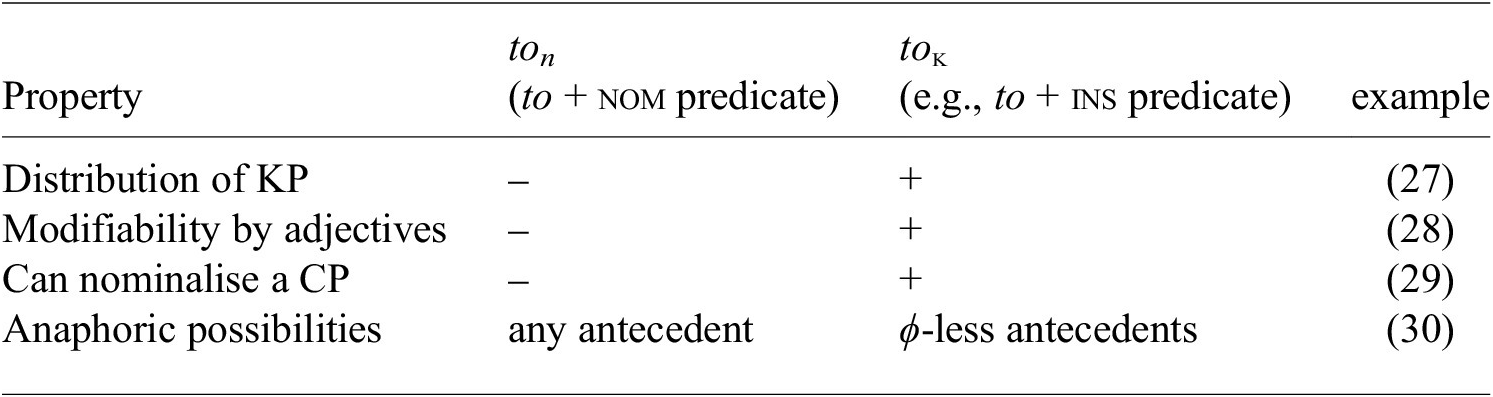

 Open access

