1 Introduction
Italian Sign Language (LIS) exhibits the syntactic properties of a typical head-final language, at least in the clausal domain (Cecchetto, Geraci & Zucchi Reference Cecchetto, Geraci and Zucchi2006). However, according to corpus-based studies, word order flexibility is attested to some degree in the syntax of the nominal domain (Mantovan & Geraci Reference Mantovan and Geraci2017), wh- interrogatives (Branchini et al. Reference Branchini, Cardinaletti, Cecchetto, Donati and Geraci2013), and basic sign order in declarative sentences (Branchini & Geraci Reference Branchini and Geraci2011).
In this paper, we focus on a particular category of nominal modifiers, namely cardinal numerals, which has not yet been systematically examined. We provide new evidence showing that (i) cardinals are found both in the prenominal and the postnominal position, as in (1) below; (ii) the sign one is not ambiguous between a cardinal and an indefinite determiner use, at least in the younger generation of signers, as in (2); and (iii) Measure Phrases have a fixed syntactic distribution, as in (3). For the sake of clarity, in the examples below, cardinals are boldfaced and the relevant nominal expression is indicated by square brackets. Following the general convention for sign language, the glosses for signs are in small caps.

We also show that definiteness and contrastive focus impose restrictions in the word order flexibility found in nominal constructions. We adopt the cartographic approach to account for word order variation (Cinque Reference Cinque2005, Reference Cinque2010, Reference Cinque2012).
The literature on cardinals is sufficiently large that a number of topics fall outside the scope of the present paper. Issues such as the categorical specification of cardinals (for a general discussion, see Corbett Reference Corbett1978 and Zweig Reference Zweig, Bateman and Ussery2006), the semantic composition of complex cardinals (for a general discussion, see Ionin & Matushansky Reference Ionin and Matushansky2006), and the morphological interaction between cardinal and noun are not addressed due to time and space limitations (for a general overview, see Hurford Reference Hurford and Plank2003; for a study on Slavic languages, see Franks Reference Franks1994).
The paper is organized as follows. Section 2 summarizes what has been documented so far on the distribution of cardinals and presents an unexpected discrepancy between elicited and corpus data. Section 3 discusses the main methodological issues linked to the different data sources employed in the present study. Section 4 describes the cardinal system in LIS and provides an overview of the formational strategies for expressing cardinality. In Section 5, we show that not all cardinals should be considered alike. Specifically, the sign one and cardinals included in Measure Phrases display a special morphosyntactic behavior. In Section 6, we show that the distribution of cardinals is sensitive to definiteness and contrastive focus. Section 7 provides a formal account, and Section 8 concludes the paper.
2 Background on LIS cardinals
In previous work, there has been no systematic study on the syntax of cardinals in LIS, but a small number of studies mention the position of cardinals in the Determiner Phrase (DP) in LIS in passing. These studies are divided into two groups: those based on elicited data (Bertone Reference Bertone2007, Branchini Reference Branchini2007, Cecchetto, Geraci & Zucchi Reference Cecchetto, Geraci and Zucchi2009, Brunelli Reference Brunelli2011), and one based on corpus data (Mantovan & Geraci Reference Mantovan and Geraci2017).
Bertone (Reference Bertone2007, Reference Bertone2009), Branchini (Reference Branchini2007), and Brunelli (Reference Brunelli2011) address the internal structure of the DP domain in LIS. The empirical base of these three studies is represented, to a large extent, by elicited data. The three authors substantially agree that nominal modifiers occur in postnominal position. Considering the three noun (N) modifiers mentioned in Greenberg’s (Reference Greenberg and Greenberg1963) Universal 20 (i.e. demonstrative (Dem), cardinal numeral (Card), and adjective (Adj)), the canonical DP-internal word order is claimed to be head-initial, as illustrated in (4).

Cardinals behave similarly to other nominal modifiers in that they occur after the noun. This is illustrated in the examples in (5)–(7).


Bertone (Reference Bertone2007), Branchini (Reference Branchini2007), and Brunelli (Reference Brunelli2011) offer a stable picture in which the order of the noun and the cardinal seems to be invariant (i.e. N>Card). A slightly different perspective is offered by Cecchetto et al. (Reference Cecchetto, Geraci and Zucchi2009). They claim that the order N>Card is the prevalent one, as exemplified in (8a) below, but the order Card>N is also possible, as illustrated in (8b), even if such an order is employed to a lesser extent.

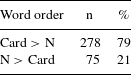
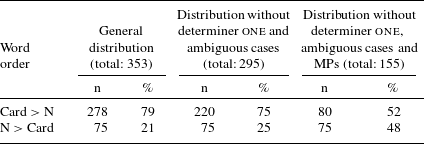
In Mantovan & Geraci (Reference Mantovan and Geraci2017), the syntax of nominal expressions in LIS has been investigated through a quantitative study based on corpus data. The authors report that the majority of LIS modifiers (1216 tokens, 60%) occur in postnominal position, although a considerable number of prenominal modifiers were also found (692 tokens, 34%) together with a marginal number of cases of repetition (115 tokens, 6%). Focusing on cardinal numerals, Mantovan & Geraci show that the order Card>N is the most frequent option in their corpus analysis (79% of occurrences), contra Bertone (Reference Bertone2007), Branchini (Reference Branchini2007), and Brunelli (Reference Brunelli2011). The distribution of cardinals in Mantovan & Geraci’s study is reported in Table 1.Footnote [5] The repetition cases, Card>N>Card and N>Card>N, are omitted as irrelevant.
Distribution of cardinal numerals in corpus data (total: 353). Pearson’s chi-squared test:
 $\unicode[STIX]{x1D712}^{2}=116.74$
,
 $df=1$
,
 $p<.001$
.

The pattern that emerges from previous studies on the distribution of cardinals is thus conflicting. On the one hand, studies based on elicited data (Bertone Reference Bertone2007, Branchini Reference Branchini2007, and Brunelli Reference Brunelli2011) report that the most common or even the only possible order is N>Card; on the other hand, another study based on elicited data, Cecchetto et al. (Reference Cecchetto, Geraci and Zucchi2006), claims that both N>Card and Card>N orders are equally possible, while Mantovan & Geraci (Reference Mantovan and Geraci2017) report that Card>N is significantly the most frequent option in their corpus data.
Within this picture, our goal is first to offer a general description of how the cardinal system of LIS works (Section 4) and then to shed light on what drives the distribution of cardinals and in what respect the Card>N order is different from the N>Card order (Sections 5 and 6).
3 Method
The linguistic data discussed in this paper come from several sources, namely dictionaries, spontaneous narratives found in a corpus, elicitations from a picture description task, and acceptability judgments. In this section, we briefly discuss the main methodological aspects characterizing our data collection.
The general description of the cardinal system of LIS offered in Section 4 is based on data from the following two LIS dictionaries: Dizionario Bilingue Elementare della Lingua Italiana dei Segni (Radutzky Reference Radutzky2001) and Spread the Sign, an online dictionary (www.spreadthesign.com/it, accessed May 2018). The data reported in the dictionaries are consistent with the LIS cardinals signed by our informants.
The data included in Section 5 are taken from the LIS corpus project (Geraci et al. Reference Geraci, Bayley, Branchini, Cardinaletti, Cecchetto, Donati, Giudice, Mereghetti, Poletti, Santoro, Zucchi, Calzolari, Choukri, Maegaard, Mariani, Odijk, Piperidis, Rosner and Tapias2010, Cardinaletti, Cecchetto & Donati Reference Cardinaletti, Cecchetto and Donati2011). In this project, fluent signers from all over Italy participated in four different linguistic tasks: individual spontaneous narration, a question-answer elicitation task, free conversation among three people, and a picture-naming task. Here we focus on the spontaneous narratives produced by 162 signers coming from ten Italian cities, ranging in age from 18 to 81 years old, with different familial and educational backgrounds. In this specific task, participants were encouraged to talk about their personal experiences connected with education, family, job, etc.
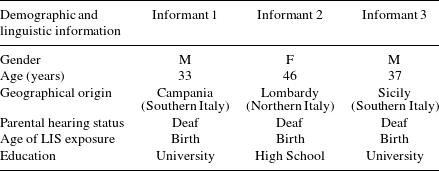
In Section 6 below, we discuss data elicited from a picture description task and acceptability judgments. These data come from three Deaf native LIS signers. Details of their linguistic and demographic background are provided in Table 2.
Linguistic and demographic background of the informants.

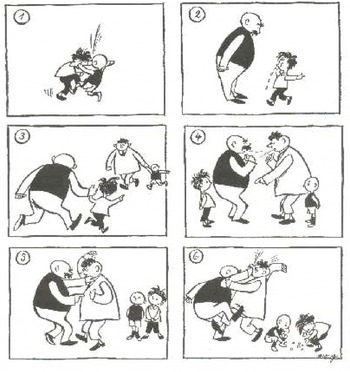
To ensure a more controlled but still relatively natural environment, we engaged our informants in a picture-based narrative task. The picture story is reproduced in Figure 1 (Ohser Reference Ohser2000).
Extract from ‘Vater und Sohn’ (Ohser Reference Ohser2000).

This task has proven to be useful in identifying the role of definiteness in determining word order preferences. The story is self-explanatory and does not contain any written text. Our specific interest was to observe how the cardinal two was produced in the first and in the fifth (or sixth) panel. Of relevance, in the first panel, two children are represented for the very first time. As first-mentioned referents, they are expected to be introduced into the discourse by an indefinite nominal expression (e.g. ‘two children were fighting on the street’). By contrast, the two children represented in the fifth panel are pre-established referents (they are the same two children as those in the first panel), therefore they are expected to be referred to by a definite nominal expression (e.g. ‘the two children were looking at their fathers’). The production of the signers was annotated using ELAN (Johnston & Crasborn Reference Johnston and Crasborn2006). Manual markers and non-manual markers (NMMs) were carefully annotated on separate tiers. The NMMs relevant to this study are head position (left, right, raised, down, forward, back), body posture (left, right, down, forward, back), eyebrows (lowered, raised), and eyes (blink, squint, close, wide, trackhands eye-gaze).
Finally, acceptability and felicity judgments were elicited to verify fine-grained hypotheses about the structure of Measure Phrases and to collect preliminary information about the effect of specificity and various kinds of focus on the distribution of cardinals.
4 On the cardinal system of LIS
The cardinal system of LIS involves the use of both hands and is a base-10 system. Typologically, both spoken and sign languages show a preference for using 10 as numeral base (Zeshan et al. Reference Zeshan, Delgado, Dikyuva, Panda and de Vos2013). This preference is clearly linked to the anatomical configuration of human hands as verbal counting very often has its origin in manual counting (Hanke Reference Hanke, Wohlgemuth and Cysouw2010: 72).
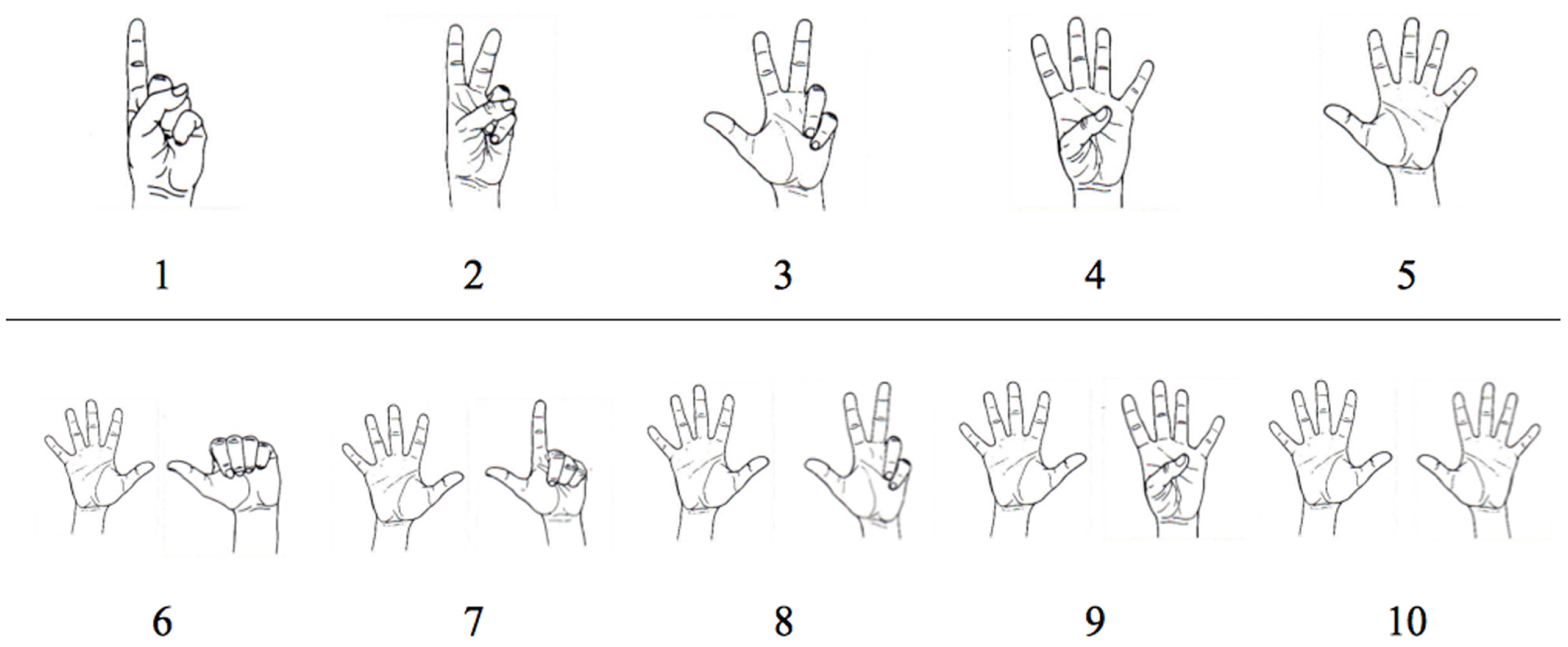
In LIS, cardinals from 1 to 10 are realized by extending the corresponding number of fingers, as shown by the handshapes reported in Figure 2.Footnote [6]
LIS cardinals from 1 to 10.
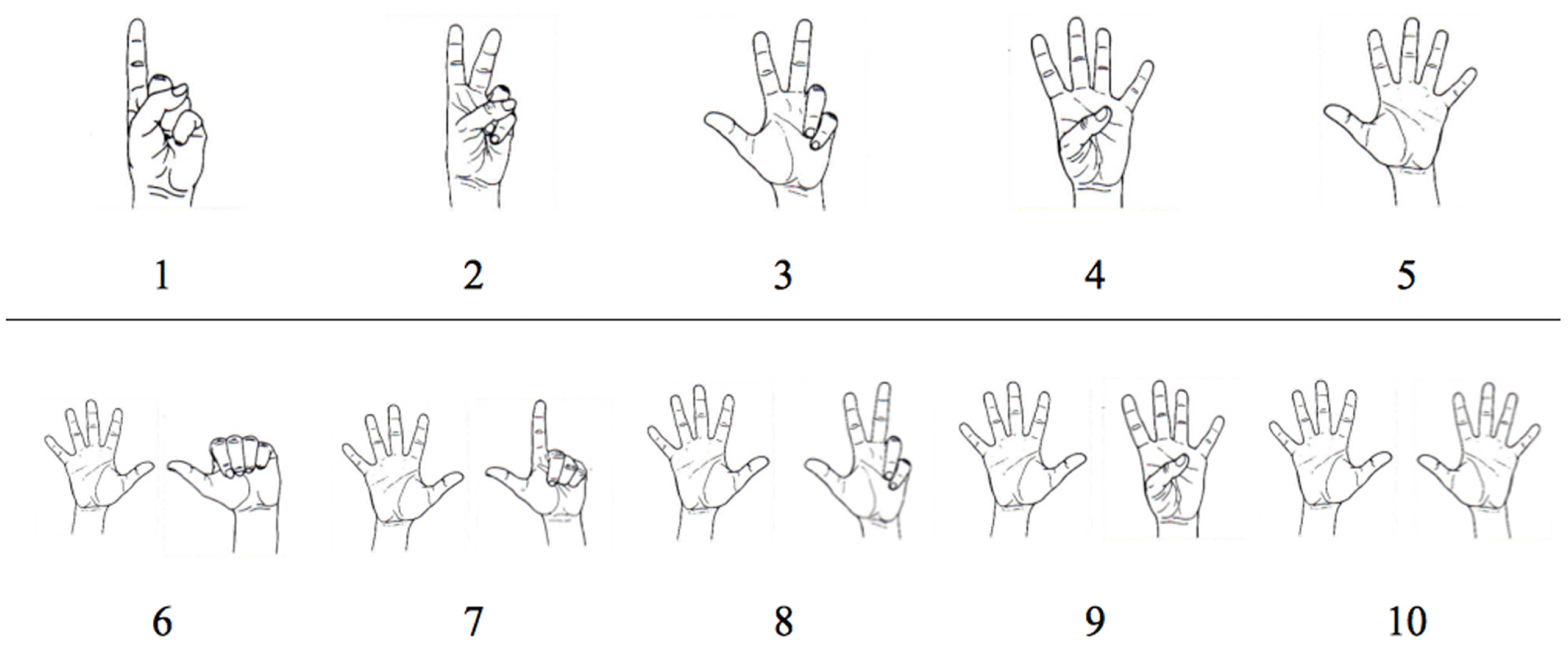
Variation is attested to some degree. Specifically, some LIS signers produce the sign one by extending the thumb (extended-A handshape) instead of the index finger (1 handshape),Footnote [7] and produce the sign two by extending thumb and index finger (L handshape) instead of index and middle finger (V handshape). These alternatives (i.e. extended-A and L handshapes) are obligatorily articulated by the dominant hand in cardinals six and seven, respectively. Note also that from 6 to 10, the non-dominant hand always realizes the 5 handshape.Footnote [8]
Crosslinguistic data suggest that the formation of complex cardinals capitalizes on basic arithmetic operations (Hurford Reference Hurford and Plank2003).Footnote [9] Zeshan et al. (Reference Zeshan, Delgado, Dikyuva, Panda and de Vos2013) show that these operations are applied to construct complex cardinals in the visual modality, too. The authors propose a typological classification accounting for the main formational strategies commonly adopted to express cardinality in the world’s sign languages. The classification includes the following strategies: multiplication, addition, subtraction, digital strategies as well as spatial modification. Applying Zeshan et al.’s (Reference Zeshan, Delgado, Dikyuva, Panda and de Vos2013) classification to LIS complex cardinals, three formational strategies emerge: (i) multiplication, (ii) digital strategy, and (iii) addition.
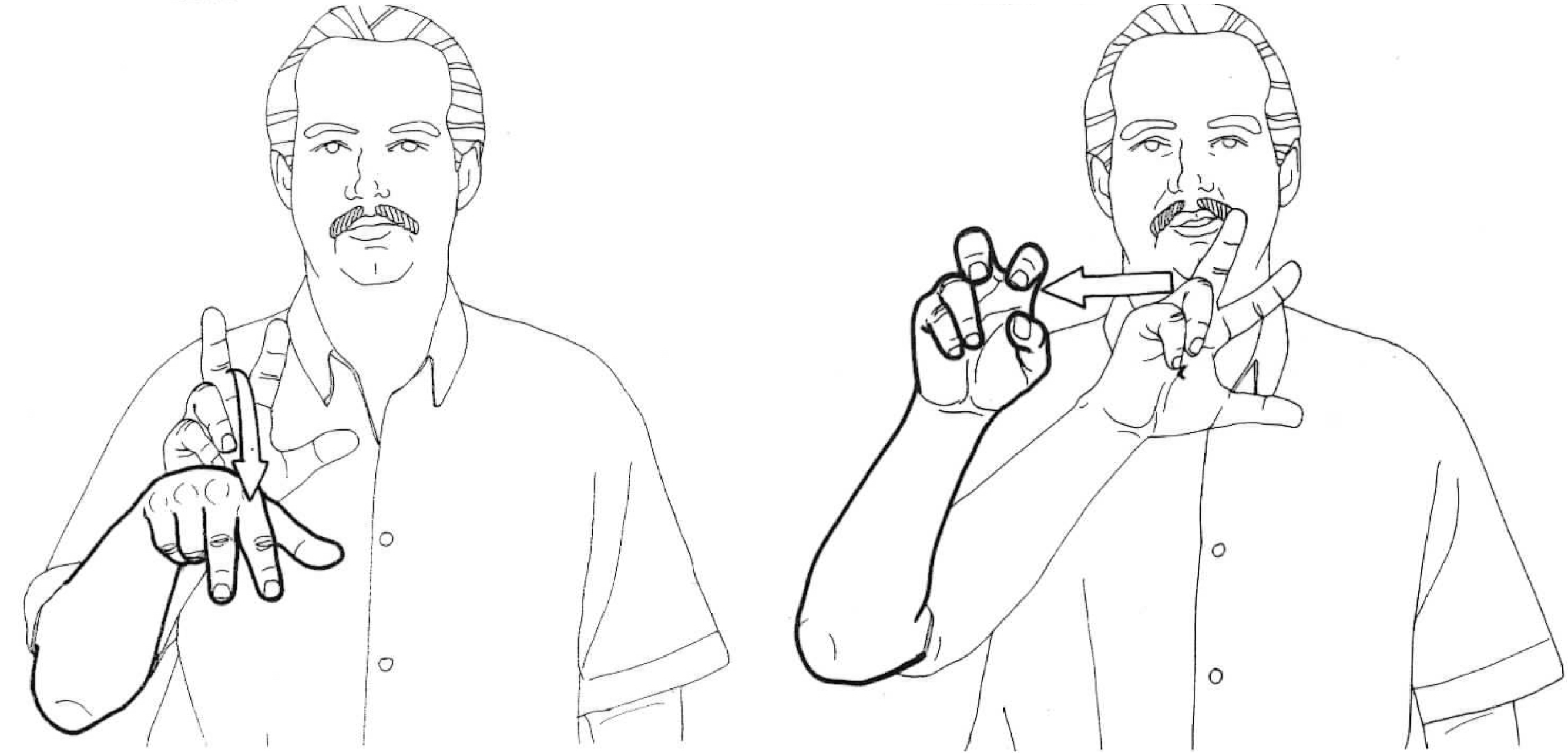
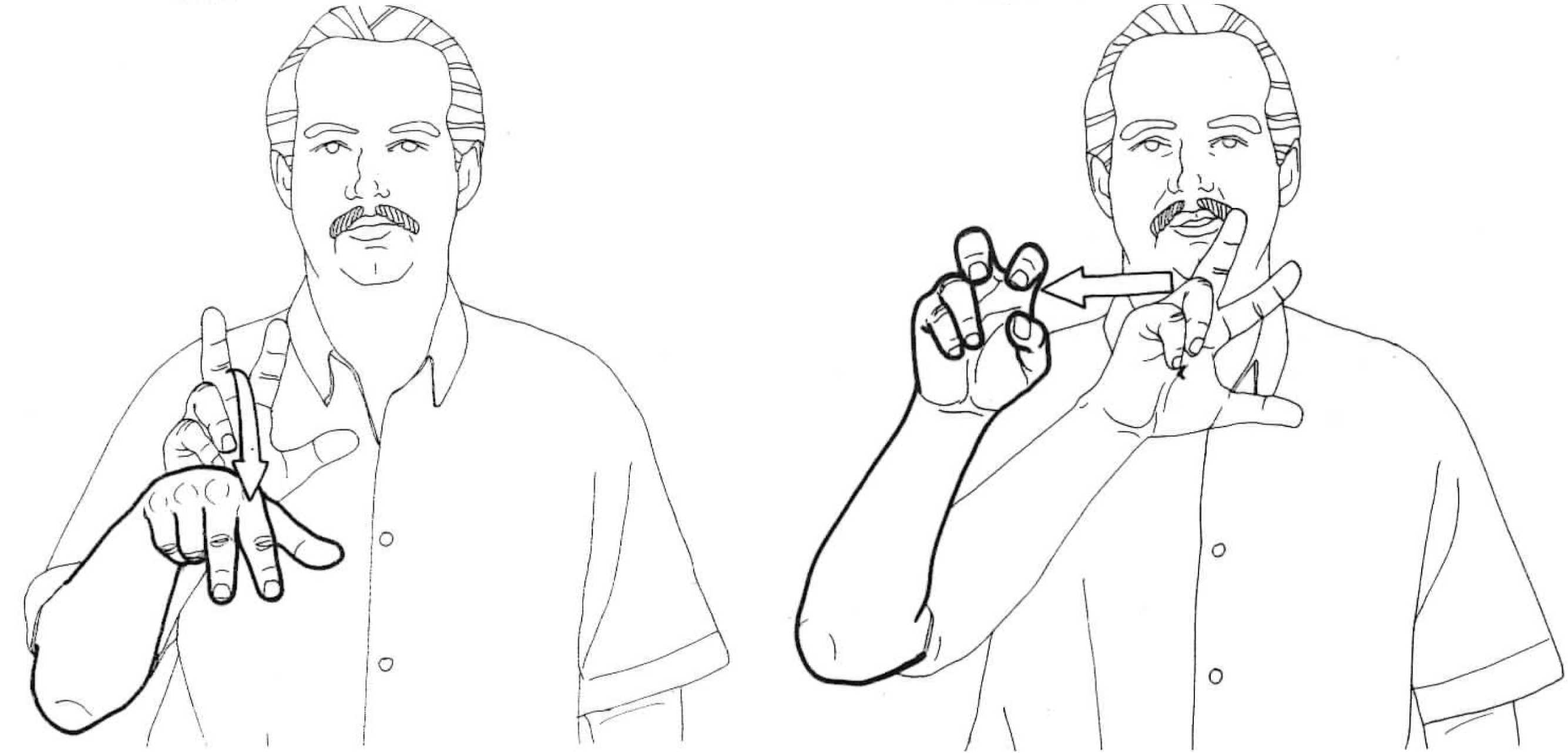
Multiplication simultaneously combines digit handshapes with particular hand or wrist movements. This strategy is used in LIS to express tens, hundreds, and thousands. These three groups of cardinals are all produced with outward palm orientation (i.e. the palm(s) is/are oriented away from the signer) and can be distinguished by movement type. Tens combine handshapes from 2 to 9 with finger bending. In some cases (e.g. forty), there are two possibilities: bending all fingers or bending the index finger only.Footnote [10] Thousands combine handshapes from 1 to 10 with downward wrist flexion. This is exemplified in the left panel in Figure 3 (Radutzky Reference Radutzky2001: Figure 352.1), which represents the sign three-thousand. The movement employed in hundreds is a more complex one because it involves an outward shift toward the ipsilateral side of the signing space and simultaneous finger bending. The sign three-hundred represented in the right panel in Figure 3 (Radutzky Reference Radutzky2001: Figure 346.2) is an illustrative example.
LIS signs: (left) three-thousand; (right) three-hundred (multiplicative strategy).
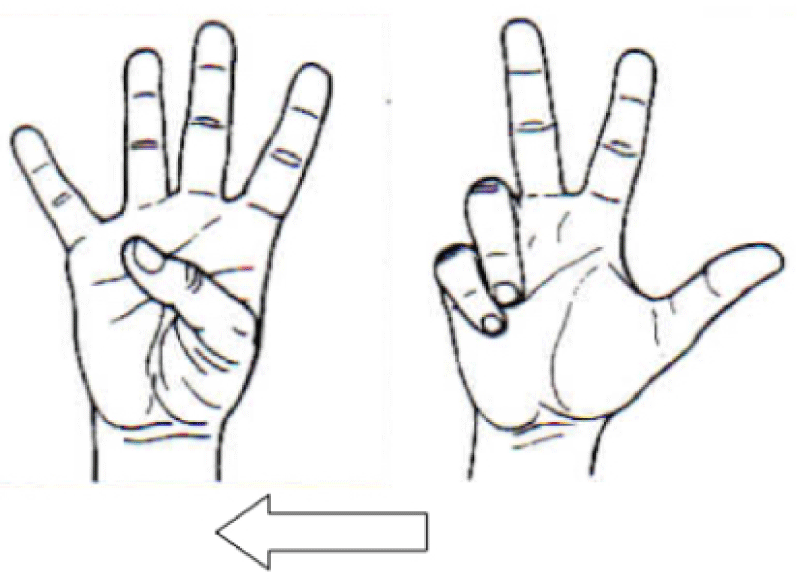
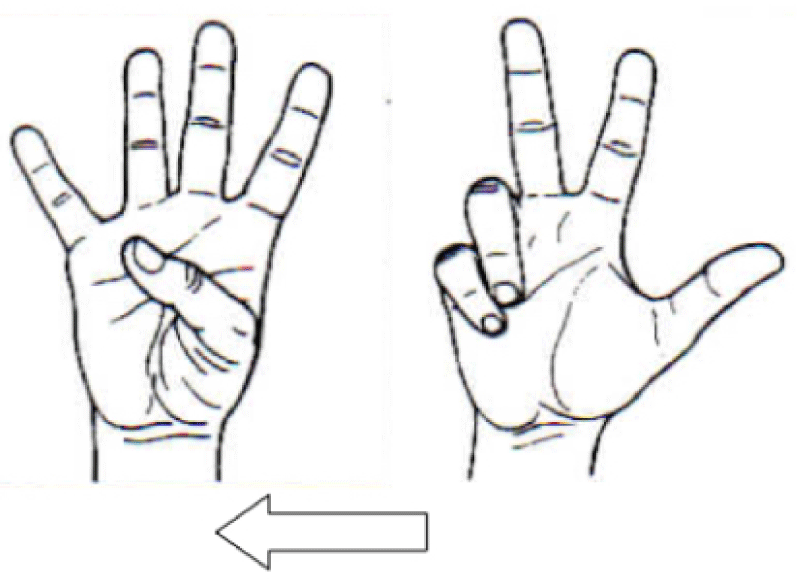
The digital strategy is used for cardinals from 21 to 99 (with the exclusion of tens). It consists of sequentially producing individual digits in the order in which they appear in writing. For example, the sign thirty-four is realized by juxtaposing three and four, as illustrated in Figure 4. The transitional movement from one sign to the other may involve a slight outward shift toward the ipsilateral side of the signing space (especially when the two digits are identical, e.g. 33).
LIS sign thirty-four (digital strategy).
Finally, addition is used for cardinals above 100. This strategy combines two or more signs, the sum of which equals the quantity expressed by the cardinal. The signs are sequentially arranged one after the other and are not linked by any overt conjunction. This can be seen as a case of asyndetic coordination (Ionin & Matushansky Reference Ionin and Matushansky2006). To illustrate this formational strategy, we consider the sign for 3409. It is formed by three signs ordered from the highest to the lowest: three-thousand, followed by four-hundred, followed by nine.
A special case concerns cardinals from 11 to 19. In the most widespread variants, digit handshapes are combined with wrist movements. In cardinals from 11 to 15, handshapes from 1 to 5 realized with contralateral palm orientation are associated with a repeated downward twist of the wrist on the sagittal plane. Cardinals from 16 to 19 are similarly produced except that the palm orientation is toward the signer and the repeated downward twist of the wrist is on the vertical plane. This group of cardinals is structurally complex and cannot straightforwardly be analyzed within any of the strategies included in Zeshan et al.’s (Reference Zeshan, Delgado, Dikyuva, Panda and de Vos2013) classification. The repeated movement characterizing these cardinals suggests the presence of an additional morpheme, and thus a morphological process is likely to be involved.Footnote [11]
Like many other sign languages, LIS allows numeral incorporation. This is a morphological process that incorporates the cardinal handshape into a sign. The signs that can be combined with cardinals are plural personal pronouns (e.g. 
 nouns referring to time (e.g. month, year, hour), and a few other signs (e.g. floor, mark). The cardinals that can be incorporated are either from 1 to 5 (e.g. with the sign day) or from 1 to 10 (e.g. with the sign month). From 1 to 5, numeral incorporation involves the dominant hand only, while from 6 to 10, it involves both hands. The combination of a cardinal and a noun referring to time is discussed from a syntactic perspective in Section 7.2 below.
Although ordinal numerals in LIS are not under investigation in this paper, it is worth mentioning that they constitute a defective class since they are a limited series of ten items, from 1st to 10th. From a phonological point of view, they share the handshapes and the location with their cardinal counterparts (see Figure 2 above), while movement and hand orientation vary according to the kind of entity the ordinals refer to (e.g. sequences, winning positions, railway platforms, house floors).
5 On the distribution of cardinals in LIS
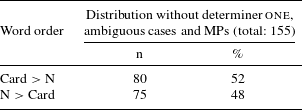
Although Mantovan & Geraci (Reference Mantovan and Geraci2017) showed that overall the majority of cardinals occur in prenominal position in their corpus (see Section 2 above), a deeper analysis of their data combined with new data collected in this study provides evidence that not all occurrences of cardinals in the corpus should be regarded as regular cardinal numerals. We found two exceptional cases: (i) the sign one, which is potentially ambiguous between a cardinal and an indefinite determiner (see Borer Reference Borer2005: Chapter 7 for the proposal to treat ‘one’ differently from other cardinals in Hebrew), and (ii) cardinals included in Measure Phrases (e.g. three week; henceforth MPs), which are only found in prenominal position (see Corver Reference Corver2009 for a discussion on the syntactic peculiarities of this construction). Because of their special nature, these cases are treated separately in Sections 5.1 and 5.2 below, respectively. Interestingly, once the two exceptional cases are removed from the picture, the distribution of cardinals becomes even more puzzling in that DPs with pre- and postnominal cardinals have a virtually identical distribution. As a preview to the discussion in Section 6, Table 3 shows the distribution of the data.
Distribution of cardinals with and without the two confounders.

In the first column, we report the overall distribution of cardinals in the corpus data. In the second column, we report the distribution without the cases where one is clearly used as a determiner or where one is ambiguous between a determiner and a cardinal. In the last column, we further excluded cardinals included in MPs.
5.1 The case of one
Careful inspection of corpus data revealed that the sign one is ambiguous between a cardinal and an indefinite determiner reading. The examples below illustrate the two functions. In (9), one qualifies as cardinal because it indicates how many steps the king piece can move in a chess game.

In (10), one qualifies as indefinite determiner because it does not quantify over anything; rather it introduces a first-mentioned referent (town).

In both cases, the context is crucial for detecting the status of one and understanding its meaning. However, in the corpus, we also found cases where it was impossible to determine the function of the sign one. One example is given in (11), where it is not clear whether one is used to denote a quantity or introduce a new referent.

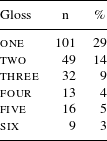
Because of this dual status, the sign one has a completely different frequency with respect to the other cardinals, as shown in Table 4.
The six most frequent cardinals in the corpus (220/353).

The sign one is by far the most frequent item with 101 occurrences (out of 353 annotated cardinals), twice more than the second most frequent cardinal (two) (Pearson’s chi-squared test:
 $\unicode[STIX]{x1D712}^{2}$
 $=$
18.29,
 $p$
< .001). This huge discrepancy can be easily accounted for by arguing that one is ambiguous between a cardinal and an indefinite determiner (as reported for 112 languages out of 534 in the WALS database, Dryer Reference Dryer, Dryer and Haspelmath2013).
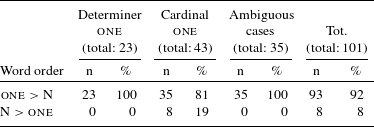
The different semantic status of one (cardinal vs. determiner) in LIS is also reflected in the syntax. The data in Table 5 show that one significantly appears before the noun (92%,
 $\unicode[STIX]{x1D712}^{2}=71.5$
,
 $p<.001$
). However, when used as a determiner, one never appears in postnominal position in our corpus. The distribution of cardinal one is predominantly prenominal (81% in prenominal and 19% in postnominal position). It is important to note that this group of tokens includes 19 cases of cardinal one within MPs (e.g. one liter). In this construction, cardinals show a categorical distribution as they always occur in prenominal position (see Section 5.2 below). Once these 19 tokens are discarded, the remaining 24 cases of cardinal one still show a predominantly prenominal distribution: 16 tokens (66%) appear before the noun and eight tokens (33%) appear after the noun.
Distribution of one in corpus data.

An anonymous JL referee suggested that the strong prenominal preference of cardinal one might be explained in terms of definiteness. As we will see in Section 6.1, definite cardinals in LIS require the N>Card order. Our corpus data, in which there is an overall preference for cardinal one in prenominal position, is in line with the more general fact that the cardinal ‘one’ is unlikely to be used with a definite interpretation (e.g. in English, a phrase such as the one cat is rarely used, relative to the two cats, and is only possible with focus on one).
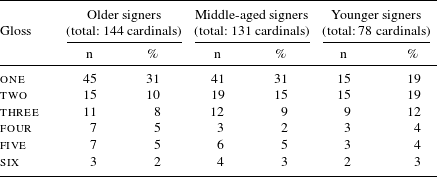
The sign one becomes even more interesting once we look at its distribution by age group. Signers participating in the LIS corpus project were divided into three age groups. The groupings reflected the evolution of educational policies in Italy: older signers (over the age of 55 years) attended (residential) schools for the deaf, middle-aged signers (aged 31–54 years) were in the middle of the transition from the Deaf school system to mainstream education, and the majority of younger signers (aged 18–30 years) attended mainstream schools (Geraci et al. Reference Geraci, Battaglia, Cardinaletti, Cecchetto, Donati, Giudice and Mereghetti2011). Table 6 shows the distribution of cardinals from 1 to 6 by the three age groups.
Frequency data of cardinals according to signers’ age group.

Cardinals from 2 to 6 occur with similar frequency across the three age groups. The main difference concerns the distribution of the sign one. Older and middle-aged signers produce it more frequently than younger signers (31% of the total number of cardinals, as opposed to 19%). We compared the occurrences of one and two (i.e. the two most frequent items) with respect to the variable Age group (older vs. younger signers). The analysis revealed that there was a significant difference between the groups of older and middle-aged signers, and the group of younger signers (
 $\unicode[STIX]{x1D712}^{\text{2}}=4.55$
, df
 $=$
1,
 $p=.03$
).
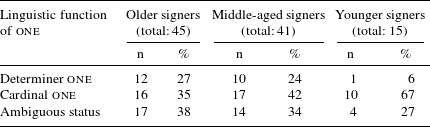
Focusing on the semantic functions of one, Table 7 reports the distribution of determiner vs. cardinal uses for unambiguous cases, like those in examples (9) and (10) above.
Instances of one in the three age groups.

In the older and middle-aged signers, the pattern is very similar to what happens in Italian, where the words un/uno/un’/una are ambiguous between the cardinal and the determiner reading. As for the younger signers, one is almost exclusively used as a cardinal.Footnote [12] We can speculate that one has evolved from being ambiguous between a determiner and a cardinal to the status of a pure cardinal. This process seems to be almost completed as occurrences of determiner one were virtually absent from the production of the younger signers of the corpus (this fact also explains why there were fewer ambiguous cases) and none of our informants used one as a determiner.
One possible explanation for this diachronic effect is that some form of sociolinguistic pressure is at play. Nowadays, there is generally more awareness of LIS as an independent linguistic system (Geraci Reference Geraci2012) and this is reflected in the educational policy with the gradual disuse of mixed forms of communication like Signed Italian (Mantovan et al. Reference Mantovan, Duarte, Geraci and Cardinaletti2016). We speculate that younger signers, being more aware of the linguistic status of LIS, unconsciously perceive the ambiguous status of one as a direct influence of Italian, and hence a non-genuine pattern. A comparable process has been documented in younger speakers of Sipakapense (a Mayan language), who avoid the SVO order because they perceive it as a direct influence from Spanish, the language spoken by colonialists, even in the linguistic contexts where old Mayan allows SVO (Barrett Reference Barrett2008).
If the use of one as an indefinite determiner has been reduced over generations, younger signers are expected to formulate indefinite nominal expressions through other linguistic means. This does seem to be the case. In particular, indefinite NPs are produced with a facial expression denoting uncertainty, which consists in pulling the corners of the mouth down (Mantovan & Geraci Reference Mantovan, Geraci, Barberà and Hofherr2018). This can be combined with a shrug, as similarly reported for Catalan Sign Language (LSC) (see Barberà Reference Barberà2012: 237).
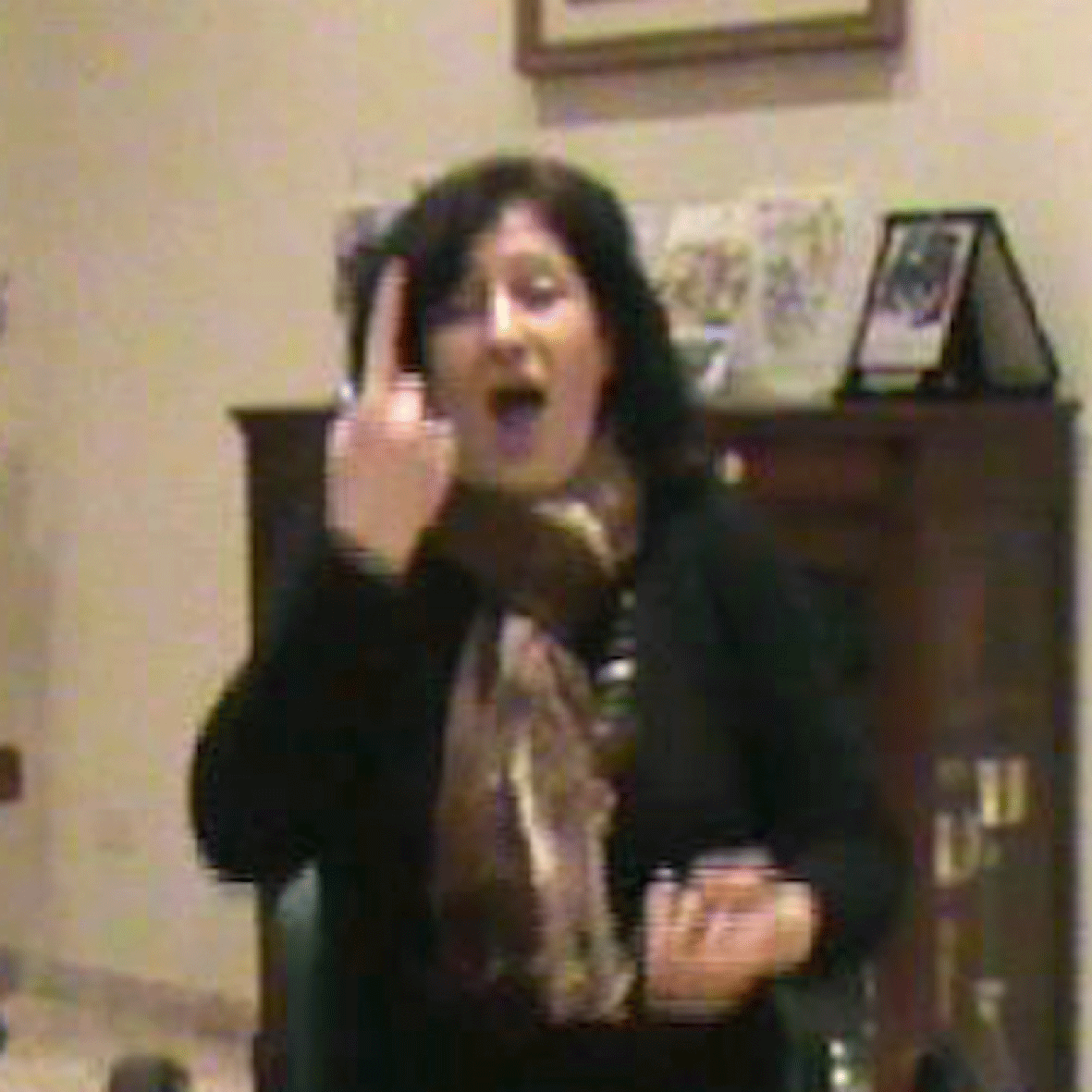
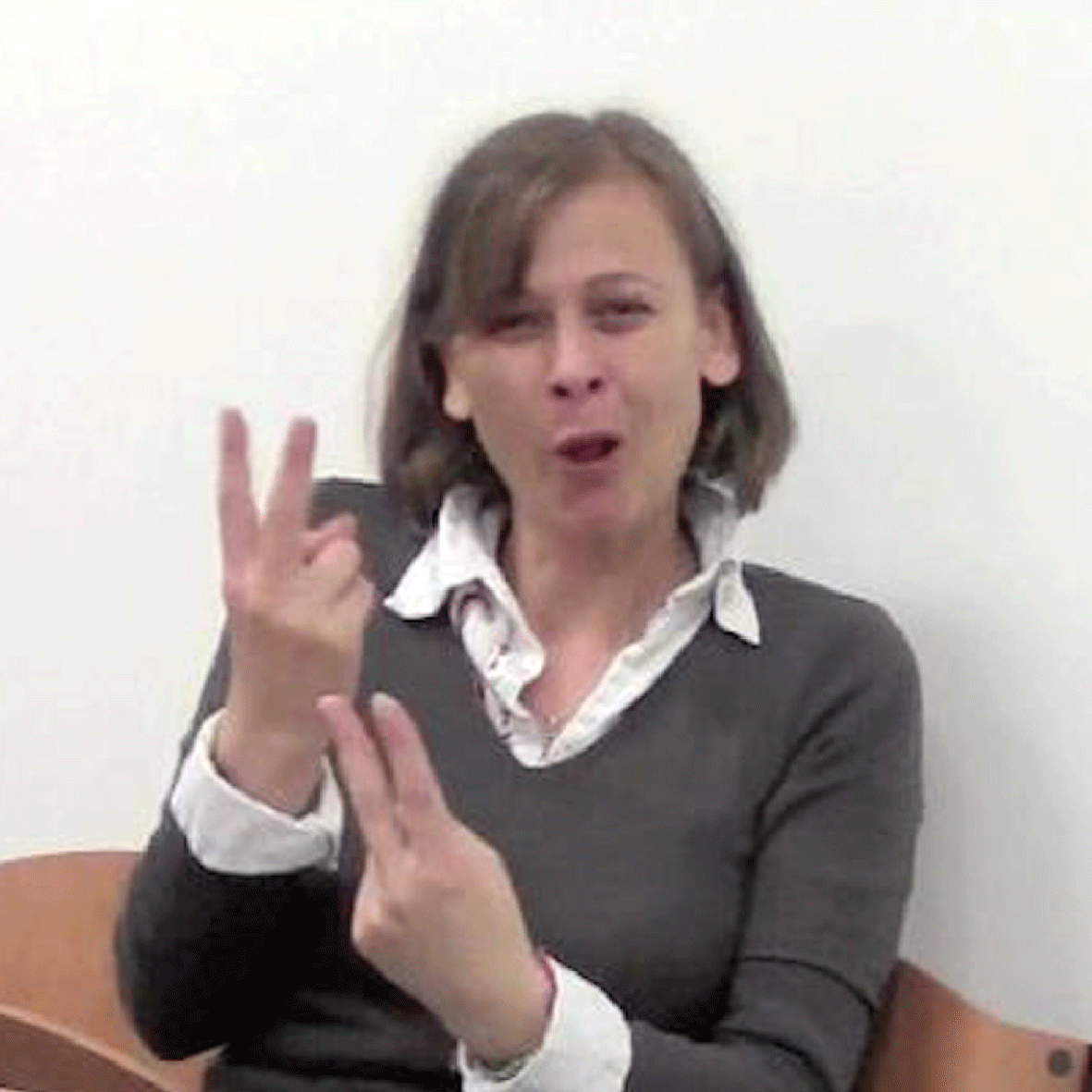
In some cases, it is possible to disambiguate the function of one by examining subtle phonological cues. As illustrated in Figure 5, cardinal one is usually associated with neutral NMMs (i.e. head and eyebrows in neutral position). Determiner one often co-occurs with some NMMs, such as backward-tilted head and slightly raised eyebrows (see Figure 6). These NMMs are often used to convey indefiniteness (this aspect is further discussed in Section 6.1 below).
Palm orientation may also provide cues to disambiguate the two uses of one. Specifically, cardinal one is usually articulated with the palm facing the signer (see Figure 5). This happened in 32 occurrences out of the 43 clear instances of cardinal one in the corpus (74%). The difference is statistically significant (
 $\unicode[STIX]{x1D712}^{\text{2}}=10.256$
,
 $p=.002$
).Footnote
[13]
Note that this pattern is similar to the one discussed for Hong Kong Sign Language (Tang & Sze Reference Tang, Sze, Meier, Cormier and Quinto-Pozos2002). In contrast, determiner one is usually produced with contralateral palm orientation (see Figure 6). This happens in 15 occurrences out of the 23 clear instances of determiner one in the corpus (65%).Footnote
[14]
Apparent counterexamples in our corpus data can be explained in terms of phonological assimilation.Footnote
[15]
NMMs associated with cardinal one.

NMMs associated with determiner one.

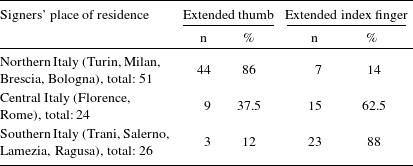
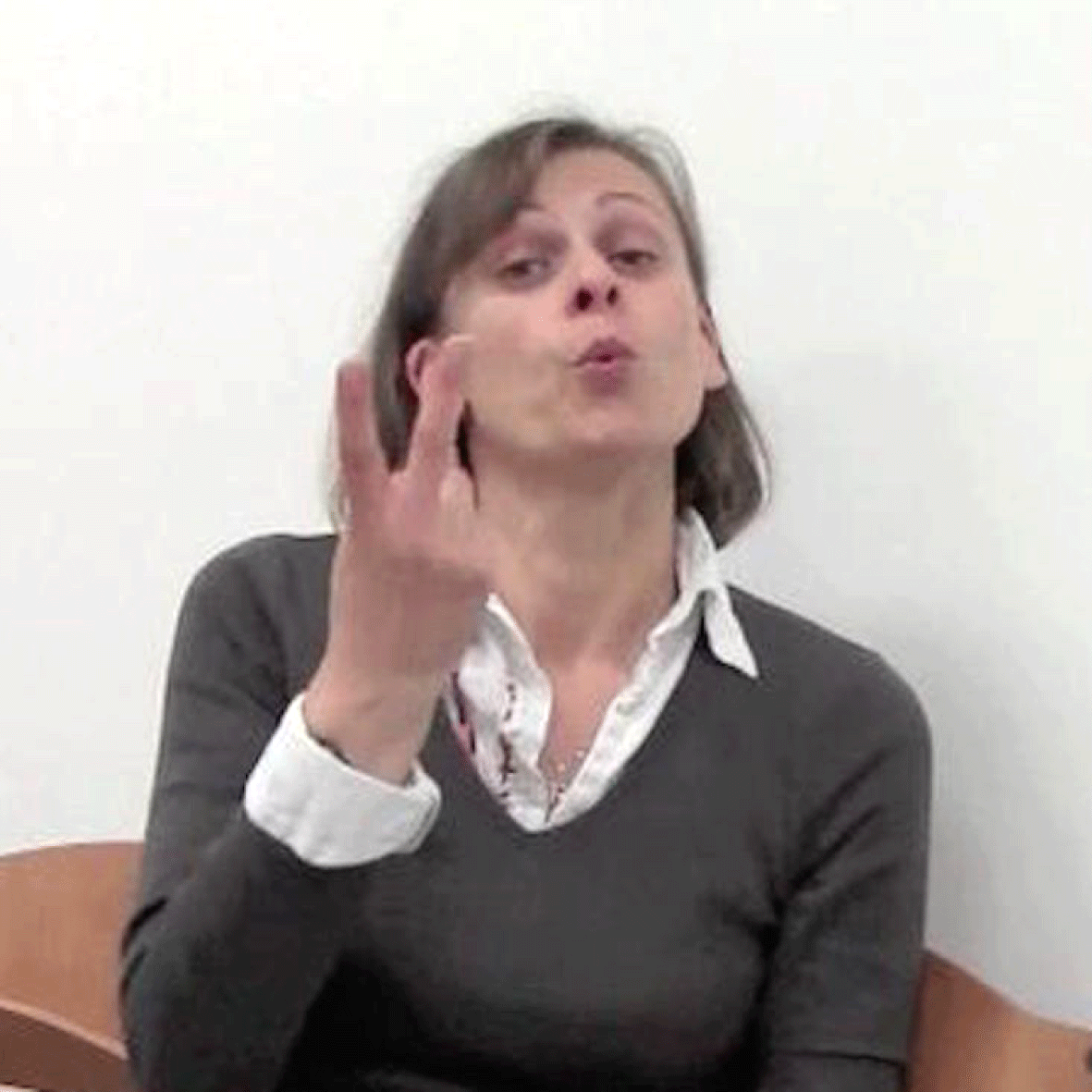
Corpus data revealed another interesting phonological difference: one can be realized either with extended thumb (56 occurrences) or extended index finger (45 occurrences). The two handshapes are shown in Figures 7 and 8, respectively.
One with extended thumb (middle-aged signer from Turin).

One with extended index finger (middle-aged signer from Salerno).

These options do not show any correlation with the functions cardinal and determiner. Rather, this handshape variation is influenced by geographical factors. The extended index finger version of one is preferred by Southern signers, whereas the extended thumb variant is more common in the North. Signers from Central Italy tend to use both hand configurations, as shown in Table 8.Footnote [16]
Variation of the handshape of one according to signers’ place of residence.

In summary, the sign one is subject to both regional and diachronic variation. Variation in handshape (index vs. thumb extension) distinguishes between Northern vs. non-Northern varieties. Younger signers use one almost exclusively as a cardinal, while older signers can use it both as an indefinite determiner and a cardinal. In the latter population, word order, hand orientation, facial expression, and the linguistic context may help disambiguate the relevant semantic functions.
5.2 Measure Phrases
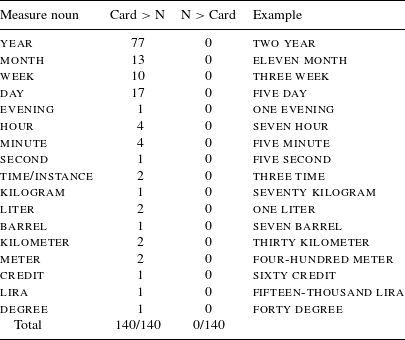
Measure Phrases are the other case that calls for special attention. A considerable proportion of the cardinals in the corpus occur in MPs (140 out of 353 cardinals, 40%). The nouns that occur in MPs are measure nouns referring to time, capacity, weight, length, temperature, and currency. Some examples are in (12).

The distribution of cardinals with respect to measure nouns is illustrated in Table 9. In MPs, the cardinal always precedes the measure noun. Cases in which the cardinal follows the measure noun are unattested.
Distribution of cardinals included in MPs.

Care must be taken not to assume that what is unattested in a corpus is simply ungrammatical. The fact that postnominal cardinals have not been found does not necessarily mean that the order N>Card is ungrammatical in MPs. However, our informants confirmed that cardinals included in MPs cannot follow the measure noun. As shown by the contrast in (13), only the option Card>N is acceptable (the notation ++ in these examples means sign reduplication).

The fact that cardinals within MPs show a categorical distribution (i.e. they only occur before the noun) indicates that this subset of cardinals has a behavior independent from that of the other cardinals. This fact calls for an independent and possibly principled explanation, an issue that we address in Section 7.2, devoted to the syntactic analysis.
6 On the sign order of the cardinal and nominal head
As already shown in Table 3 above, once the tokens of MPs, determiner one, and cases in which the determiner/cardinal ambiguity of one could not be solved have been removed from the data, the distribution of cardinals in the corpus reveals a balanced situation. For ease of reference, the distribution of cardinals without the two confounders is reported in Table 10.
Distribution of cardinals without the two confounders.

We checked whether word order was influenced by the quantity expressed by the cardinals. As Corbett (Reference Corbett1978: 365) has reported, this correlation is found in Yoruba, where cardinals up to 19 occur in postnominal position (like adjectives), whereas cardinals from 20 upwards occur in prenominal position. Our data do not show any effect of numerical gradation on word order; in the corpus, prenominal cardinals range from one to one-thousand and postnominal cardinals range from one to four-hundred.
In Sections 6.1 and 6.2, we investigate to what extent it is possible to account for the distribution of cardinals in terms of definiteness, specificity, and focus.
6.1 Definite vs. indefinite interpretation
The data collected through the picture-based narrative task (see Section 3) reveal that the position of cardinals is partially influenced by information structure. When the children are first mentioned (see the first panel in Figure 1 above), both orders (Card>N and N>Card) are possible, while in further mentions (see the fifth and sixth panels in Figure 1), only the N>Card order is attested. This suggests that new discourse information (i.e. indefinite, first-mentioned referents) is compatible with both orders, whereas old discourse information (i.e. definite, already-mentioned referents) is compatible with postnominal cardinals only. This is confirmed by our informants. Both sign order options are accepted in indefinite nominal expressions, as shown in (14), whereas only the N>Card order is accepted in definite nominal expressions, as shown in (15).

The relative order of the cardinal with respect to the noun only partially depends on the discourse function, as both new and old information can be conveyed by the N>Card order. In these cases, NMMs may provide additional and independent cues. When the signer is dealing with a new referent, the prenominal or postnominal cardinal is accompanied by backward-tilted head and raised eyebrows (see Figure 9). When the referent has already been mentioned in the discourse, then the postnominal cardinal is accompanied by squinted eyes, lowered eyebrows, and chin down (see Figure 10).
Two as new-discourse information.

Two as old-discourse information.

Another way in which our informants disambiguated old vs. new information in the case of N>Card order is by means of classifier (CL) signs.Footnote [17] The relevant example is given in (16); the two classifiers that can be used in this construction are shown in Figure 11. Both of them are whole-entity classifiers indicating the referents’ location in space.Footnote [18]

Classifier signs following cardinals in definite nominal expressions.

Classifiers of this type locate the referents at a specific point in space, so it is not unexpected that they only occur in a definite environment.Footnote [19] Moreover, these classifiers require a discourse antecedent and, as such, they are expected to be included in definite expressions (for discussion, see Barberà & Quer Reference Barberà, Quer, Hübl and Steinbach2018). Therefore, the presence of these classifiers provides independent evidence for the definite status of the relevant nominal expressions.
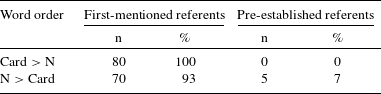
Corpus data confirm the pattern that emerges from the elicited data in that (i) indefinite nominal expressions allow both orders (Card>N and N>Card); and (ii) out of 80 prenominal cardinals, none is connected to a pre-established referent.Footnote [20] The general pattern is given in Table 11.
Distribution of cardinals according to referent type (corpus data).
 $\unicode[STIX]{x1D712}^{2}$
(with simulated
 $p$
-value)
 $=$
5.5,
 $p<.05$
.

Interestingly, there are cases in the corpus in which signers introduce new referents by using a numeral expression and then refer back to them later in the discourse by using another numeral expression. We present and discuss two relevant examples. In the first one, in (17), a young signer from Florence talks about her life as a deaf mother of a hearing child.

With respect to the languages mastered by her child, the signer reports that s/he is acquiring two languages. The cardinal in (17a) is in prenominal position (two language) and conveys new discourse information. Later in the discourse, the signer explains that her hearing child is acquiring both Italian and LIS. The cardinal in (17b) is in postnominal position (language two) and is associated with old discourse information. As for the NMMs, the cardinal two in (17a) is produced with neutral facial expression, whereas the cardinal two in (17b) is realized with squinted eyes. The two cardinals also look different with respect to location in space. The former is not directed toward any particular point in space, whereas the latter is produced with a slight forward and downward movement. We consider this movement feature as an additional morpheme that localizes the nominal expression carrying old discourse information at a specific point in the signing space.
The second example, produced by a middle-aged signer from Florence, is reported in (18).

In (18a), the signer introduces her two sisters as new referents. Here the cardinal is produced in prenominal position (two sister). In (18b), she mentions the same referents again and produces the N>Card pattern (sister two). The different NMMs correlate with the different discourse interpretations: neutral NMMs occur with new discourse information, whereas chin down and lowered eyebrows accompany old discourse information. The definite cardinal construction in (18b) includes a whole-entity classifier sign which locates the two sisters in a specific point in the signing space (as we saw in the elicited data shown in Figure 11 above).
The fact that word order differences correlate with a definite/indefinite interpretation is not a new observation in the literature. Similarly to LIS, in Shupamem (a Bantu language spoken in South Western Cameroon), the position of the cardinal with respect to the noun reveals its semantic interpretation. When the cardinal follows the noun, it yields a definite reading; when it precedes the noun, it is associated with an indefinite reading. The two Shupamem cases are exemplified in (19), adapted from Vázquez-Rojas (Reference Vázquez-Rojas, Myler and Wood2011: 235).

When the NP has a definite interpretation, as in (19b), the cardinal occurs in the postnominal position and, interestingly, an agreement marker (pí) appears between the noun and the cardinal. In LIS, too, the cardinal follows the noun when a definite interpretation is involved. As previously noted, definiteness in LIS is conveyed through NMMs, a DP-internal classifier, or an extra morpheme inducing the cardinal to move toward a point in space. Such a morpheme bears a resemblance to the Shupamem agreement marker pí and might indicate a concord phenomenon. The difference between LIS and Shupamem is that in LIS, the postnominal position is open to cardinals in indefinite expressions as well.
6.2 Indefinite constructions: Specificity and focus
In order to better understand the word order variation in indefinite constructions, we tested the role of specificity and focus.Footnote [21] On the one hand, cardinals contained in non-specific DPs are expected to behave like MPs in that this construction is by default non-specific (for a discussion on the lack of specificity in MPs, see Bhattacharya Reference Bhattacharya and Singh1999). On the other hand, word order is one of the strategies in which focus is marked crosslinguistically (Büring Reference Büring, Zimmermann and Féry2009).
As for specificity, Mantovan & Geraci (Reference Mantovan, Geraci, Barberà and Hofherr2018) show that different degrees of referentiality are normally marked by the use of NMMs, independently of sign order. This is confirmed in the case of NPs modified by cardinals. Indefinite DPs receive a specific interpretation when marked by squinted eyes (se) and a non-specific interpretation when marked by mouth-corners (m-c) down, as shown in (20).

These examples show that specificity (i) is conveyed non-manually, and (ii) does not play a role in determining the distribution of LIS cardinals since both prenominal and postnominal cardinals can receive a [±specific] interpretation.
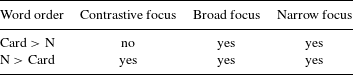
As for focus, we controlled for contrastive, broad, and narrow focus.Footnote [22] The data in (21)–(23) below report acceptability judgments elicited from our informants. Contrastive focus is marked by raised eyebrows, head nod, and forward body lean. In the example in (21), the focalized cardinal is boldfaced. It only occurs in postnominal position.

Broad focus and narrow focus are produced with neutral NMMs. As shown in (22) and (23) respectively, both positions are possible.

Table 12 summarizes the word order distribution with respect to the three kinds of focus we tested.
Distribution of cardinals according to different kinds of focus.

Qualitative data reveal that contrastive focus plays a role in constraining the distribution of cardinals in indefinite constructions, while specificity does not.
7 Analysis
Having considered the data from both quantitative and qualitative perspectives, in this section, we turn to a syntactic account of the distribution of cardinals in LIS. In particular, we need to explain (i) why indefinite cardinal constructions allow two orders; (ii) why cardinals with a definite interpretation occur in postnominal position only; and (iii) why cardinals in MPs are categorically prenominal.
In line with Bertone’s (Reference Bertone2007) proposal, we assume that nominal constructions in LIS contain the functional DP layer. The head of this projection (D) plays a crucial role in determining the referentiality of the whole construction. In order to derive the different sign order options in LIS, we adopt Cinque’s (Reference Cinque2005, Reference Cinque2010, Reference Cinque2012) hierarchy of the DP structure, according to which each nominal modifier comes with two projections: one is assigned to the modifier and the other is a functional agreement projection which is the target of DP-internal movement. The framework also assumes that DP-internal movements must be limited to portions of structure that contain the NP, the maximal projection of the head noun. Within this theoretical framework, we implement Cardinaletti & Giusti’s (Reference Cardinaletti, Giusti, Everaert and van Riemsdijk2006) proposal that cardinals sit in two distinct projections, namely a DP-external and a DP-internal projection. In languages with articles (or article languages), cardinals which are not preceded by a definite determiner are claimed to function as quantifiers and occupy the head of the DP-external Quantifier Projection (QP). When cardinals are preceded by a definite determiner, they are claimed to function as quantitative adjectives (QuantAP) and occupy the specifier position of a lower DP-internal projection.
Following Cardinaletti & Giusti (Reference Cardinaletti, Giusti, Everaert and van Riemsdijk2006), we propose that when cardinals in LIS are included in a construction with an indefinite reading, they are pure quantifiers since they actually quantify over the referent(s) introduced in the discourse. When cardinals appear in a construction with a definite reading, they do not count anything: rather, they are nominal modifiers used to refer back to an entity that has already been mentioned and counted. We also follow Bertone (Reference Bertone2011) in assuming that some instances of pointing signs correspond to the functional equivalents of definite determiners attested in spoken article languages.Footnote [23] However, as noted in Section 6.1 above, definiteness is also signaled by prosodic and/or morphosyntactic cues. The former are specific NMMs (squinted eyes, lowered eyebrows, chin down), the latter are a DP-internal classifier or an additional morpheme inducing the cardinal to move slightly forward and downward to a specific point in space (see Section 6.1).
7.1 Explaining the distribution of cardinals in LIS
We begin by looking at cases of cardinals in DPs yielding a definite reading, as in child two, for example. These are cases in which the cardinal must occur in the postnominal position. The cardinal functions as a quantitative adjective (QuantA) and is merged inside the DP structure (Cardinaletti & Giusti Reference Cardinaletti, Giusti, Everaert and van Riemsdijk2006). We assume that in definite constructions, the nominal element (child) obligatorily raises along the structure and moves into the specifier of the DP to gain its referential interpretation. The relevant steps of the derivation are shown in (24). The mandatory movement of the noun across the cardinal derives the ungrammaticality of the Card>N order with the definite interpretation.

In indefinite constructions, the cardinal functions as a quantifier and occupies a high position in the structure being located in the projection of the quantifier (QP), which sits in the specifier of a functional projection above the DP.Footnote [24] The fact that in these uses the noun may either precede or follow the cardinal can be explained by appealing to optional movement of the noun to a higher projection. The derivation is sketched in the diagram in (25), where the dashed arrow indicates optionality.

This optionality accounts for the two attested sign orders in indefinite nominal expressions. Being associated with a particular prosodic requirement (e.g. lengthening), contrastive focus may force the cardinal to appear in the postnominal position. However, this cannot be the whole story as the N>Card order in indefinites does not necessarily require contrastive focus. Indeed, focalized phrases aside, our informants do not report any semantic differences between the two orders, which are also associated with the same NMMs (see Section 6.1 and Figure 9 above). In this respect, LIS is different from languages like Russian, where the canonical order is Card>N and the reversed order (N>Card) leads to an approximative reading (Yadroff & Billings Reference Yadroff, Billings, Bošković, Franks and Snyder1998: 319). LIS appears to provide an instance of true optionality.
7.2 The syntax of Measure Phrases in LIS
In Section 5.2, we saw that cardinals in MPs have an obligatory Card>N order. An illustrative example of MP is in (26). For the sake of clarity, the relevant nominal expression is marked by square brackets.

Our proposal is that the measure noun, exemplified by kilo here, is not the real head of the NP, but rather that it constitutes a complex element together with the cardinal (two kilo) that quantifies over a lexical noun (sausage). It is this nominal element that is the head of the nominal expression. Note that in LIS MPs, lexical nouns are not preceded by any preposition (as in e.g. Italian due chili di salsicce ‘two kilos of sausages’).
Evidence for this analysis is found in (27).

The sentence in (27a) has the order Card>Measure N>Lexical N>Adjective. Crucially, in (27b), the lexical noun precedes both the cardinal and the measure noun. This latter order is derived via movement of the lexical noun to the left of the cardinal leaving the measure noun in situ. The derivation is sketched in the diagram in (28).

The cardinal sits in the specifier of the QP, while the measure noun (MeasN) sits in its head. The different order options are derived by moving the head noun (sausage) obligatorily across the quality adjective (delicious) and optionally across the MP (two kilo).
Since, by assumption, DP-internal movements are only possible if the moved constituent contains the nominal head (see Cinque Reference Cinque2005), we have clear evidence that sausage in (27b) is the real head noun, as it is the only moving element. As for the quality adjective (delicious), it is stranded in the lower part of the structure. The fact that in (27b) both the adjective and the MP are left in situ confirms that the measure noun is not the head noun of the whole construction.
Interestingly, the measure noun must remain adjacent to the cardinal. No lexical material can be inserted between these two elements, as shown in (29a),Footnote [25] and no order permutation within the MP is allowed, as shown in (29b).

The ungrammaticality of (29b) confirms that the noun kilo cannot move as lexical nouns do in the DP.
The lexical noun and the measure noun are not always obligatorily expressed (for relevant discussion on silent elements, see Kayne Reference Kayne2005 and subsequent work). The example in (30) illustrates an instance of a silent lexical noun (i.e. the lexical noun distance is not produced).

The examples in (31) illustrate a case of a silent measure noun (i.e. the measure noun year is not produced).

The examples in (30) and (31) differ in a crucial aspect. According to our informants, when the lexical noun is silent, the measure noun can only appear after the cardinal (two kilometer/*kilometer two). When the measure noun is silent, the lexical noun can be produced either before or after the cardinal (age twenty/twenty age). These facts provide independent evidence for the different status of lexical and measure nouns. On the one hand, only the lexical noun can move along the structure, allowing word order permutations. Thus, it functions as the head of the whole construction. On the other hand, the measure noun must follow the cardinal and cannot move along the structure.
Our speculation is that the strict Card>Measure N order is derived by the syntactic Spec–head configuration that characterizes the two elements. In some cases, this Spec-head relation results in morphological incorporation/fusion.Footnote [26] An example of this is the MP three-month, shown here in Figure 12. Other examples of overt incorporation are two-day, three-hour, four-year.
Measure Phrase incorporation three-month.

8 Conclusions
The cardinal numeral system of human language is quite an intricate topic of study, where different levels of description and explanation intersect. Sign languages offer an even more special viewpoint given the massive use of iconicity, especially in the case of digits and numeral incorporation. Crosslinguistic and language-internal variation has been documented in various sign languages (e.g. one-handed vs. two-handed systems for digits, how to represent the cardinal 10 in two-handed systems, how to represent cardinals above 10, etc.). In their most natural use, cardinal numerals belong to the class of nominal modifiers and interact with the syntax of nominal expressions. Furthermore, at the semantic level, ‘one’ has a special status in many languages, being ambiguous between a cardinal and a determiner. The picture is even more complicated by the particular sociolinguistic situation of sign languages. As minority languages, sociolinguistic pressures may induce ambiguity as a result of transfer from the dominant (spoken) language.
LIS seems to have all these interesting properties: (i) it is a 10-base system where complex cardinals are generated by different types of formational strategies (i.e. multiplicative, digital, and additive); (ii) it has regional variation at the phonological level; (iii) it allows for numeral incorporation; and (iv) it displays an intricate interaction with the syntax of nominal modification, which is in part regulated by semantic factors like definiteness and focus (distribution of non-manual components, presence vs. absence of whole-entity classifiers, etc.). We have capitalized on several of these aspects to provide an account for word order variability within the cartographic approach to syntax. In a general situation of linguistically determined variability, the invariable structure of Measure Phrases in LIS has also been accounted for. Finally, this study has provided solid evidence that the sign one has undergone a diachronic change. Older signers appear to use one both as a cardinal numeral and as an indefinite determiner (like in spoken Italian), while younger signers appear to use one almost exclusively as a cardinal. Although more research is needed, this apparent specialization in the function of the sign one can be attributed to sociolinguistic factors, as a more or less conscious differentiation of LIS from spoken Italian.
All in all, this study has provided a first overview of the cardinal numeral system in LIS and investigated phenomena operating at all levels of linguistic description. Some of them show interesting ramifications, which we have to leave for future research. However, we would like to highlight two of them here: one is numeral incorporation, which seems to be governed by both syntactic and phonological restrictions; the other is the interaction between cardinals and overt number marking both at the nominal and verbal levels. LIS displays morphological plural by reduplication (although phonologically highly constrained) and verbal number marking (but only in object position); however these agreement/concord systems seem to be optional. A study on the interaction between the cardinal system and other systems of number marking may shed light on these facts.