1 Introduction
Paradigms are considered descriptively and theoretically essential for explaining inflectional relations and inflectional morphology in the Word-and-Paradigm (WP) approach (e.g. Anderson Reference Anderson1982; Stump Reference Stump1991, Reference Stump2016; Pounder Reference Pounder1996; Carstairs-McCarthy Reference Carstairs-McCarthy1998; Spencer Reference Spencer2001) and other (word-based) approaches (such as those proposed by Wurzel Reference Wurzel1989, Plank Reference Plank and Plank1991, and Williams Reference Williams1994). Importantly, paradigms are proposed also for derivational morphology (e.g. Guilbert Reference Guilbert1975, Pounder Reference Pounder2000, Blevins Reference Blevins2001, Booij Reference Booij, Montermini, Boyé and Hathout2007).
Whereas the current study also concerns itself with the notion of paradigm, it scrutinizes (i) a word-formation (derivational) paradigm (rather than inflection), (ii) the dynamism of the paradigm based on rules (in contrast to a static schema with word-form entries, for example), and (iii) the (paradigmatic) relation of compounding and derivation in Turkish. The data are based on my native knowledge of (Modern Spoken) Turkish and it mostly involves Noun–Noun compounding and derivations involving compounding in Turkish.
For the purposes of this study, it is important to give an account of the so-called compound marker (cm) -(
 $s$
)
 $I$
Footnote
[2]
in Turkish novel Noun–Noun compounds, such as
 ‘water-fairy’, presented in (1a) below.Footnote
[3]
An adequate account of this item, i.e. -(
 $s$
)
 $I$
, will bring along a semantic and a formal analysis of Noun–Noun compounds (NNCs) including this suffix and derivations involving such NNCs. Derivations including such NNCs are at the heart of this study. They are interesting because some of these formations exclude the compound marker, as seen in (1b), whereas others may necessarily or optionally include it, as seen in (2a) and (2b), respectively.

Note that the compound su peri-si (1a) would be ungrammatical without -(
 $s$
)
 $I$
, *su peri_ ‘water-fairy’, and that the derivation su peri-li, which includes the derivational (ornative/proprietive) suffix -lI, would not be grammatical with the compound marker -(
 $s$
)
 $I$
: *su peri-
si
-
li
‘with (a) water-fairy’. This means that whereas -(
 $s$
)
 $I$
is necessarily affixed to compounds, as in (1a), it cannot co-occur with, for example, the derivational suffix -lI seen in (1b). In contrast, there are instances in which -(
 $s$
)
 $I$
must appear in combination with a derivational suffix, e.g. with the derivational (status) suffix -lIK, as in (2a). Furthermore, there is a variation in derivations, such as (2b), where -(
 $s$
)
 $I$
may be added and both forms are acceptable. This variation often involves the derivational (agentive/actor) suffix -CI. Another case of this variation, i.e. the possibility of formations with and without -(
 $s$
)
 $I$
, is compounds with the term bilim ‘science’ as the compound head, such as felsefe bilim (-
i
) ‘philosophical science (philosophy science-cm)’. Such compounds are also examined in the current study. Proposing a paradigmatic word-formation system in Turkish, this study accounts for why certain sequences including -(
 $s$
)
 $I$
are permitted, and other such sequences are not permitted, and why there is optionality/variation in the case of forms like su peri-ci (-
si
) ‘water-fairy expert (water fairy-agt-cm)’ or buz paten-ci (-
si
) ‘ice-skater (ice skate-agt-cm)’ and felsefe bilim (-
i
) ‘philosophical science (philosophy science-cm)’ or anlam bilim (-
i
) ‘meaning science: semantics (meaning science-cm)’.
Briefly, in this paper, I deal with (i) what -(
 $s$
)
 $I$
does in Turkish NNCs; (ii) how it is relevant to complex derivations involving NNCs like the key expressions su peri-
li
, su peri-
liğ-
i
, su peri-
ci
(-
si
) above; and (iii) what such expressions show about paradigms in morphology, i.e. why such data are important in describing paradigms and their theoretical status.
The fact that the -(
 $s$
)
 $I$
suffix also appears in possessive constructions/phrases (PCs), such as the one in (3b), makes this suffix interesting for inflectional morphology.

As can be seen above, Turkish NNCs (3a) and PCs (3b) are morphologically similar because they both include -(
 $s$
)
 $I$
, but they are not identical: the PC includes also the genitive suffix (-(
 $n$
)In). Their syntactic behavior is also different: unlike the constituents of NNCs, the constituents of PCs are separable.Footnote
[4]
I will investigate what such a formal contrast between NNCs and PCs shows about the structure and localization of compounding in the grammatical architecture in Section 5. Moreover, (3c) and (3d) show that the -(
 $s$
)
 $I$
in a PC may be omitted when pragmatically allowed, in contrast to the -(
 $s$
)
 $I$
in NNCs, which cannot be omitted based on pragmatics. Another relevant formal contrast between the two formations with -(
 $s$
)
 $I$
is that while the cm cannot occur in NNCs in the context of certain derivations, such as the -lI derivation in (1b), in PCs, the poss -(
 $s$
)
 $I$
may freely follow derivations (see Section 4.2, example (8)). I treat both the structure of compounds and the function of -(
 $s$
)
 $I$
in compounds as different from those of possessive constructions. As the focus of the current study is word formation and the role of -(
 $s$
)
 $I$
in a word-formation paradigm, the PC formation and the (inflectional) role of -(
 $s$
)
 $I$
in PCs is not discussed here.Footnote
[5]
One approach to -(
 $s$
)
 $I$
claims that -(
 $s$
)
 $I$
is the 3rd person possessive marker in NNCs as well as in PCs (e.g. Underhill Reference Underhill1976, Yükseker Reference Yükseker, Booij, Ralli and Scalise1998, Lewis Reference Lewis2000). Another view claims that -(
 $s$
)
 $I$
is a compound marker in NNCs and is distinct from the -(
 $s$
)
 $I$
in PCs (Swift Reference Swift1963, Hayasi Reference Hayasi, Berta, Brendemoen and Schönig1996, van Schaaik Reference van Schaaik1996, Kornfilt Reference Kornfilt1997, Schroeder Reference Schroeder1999, Bozşahin Reference Bozşahin2002, Göksel & Kerslake Reference Göksel and Kerslake2005, Göksel Reference Göksel2009, Kharytonava Reference Kharytonava2011, Kunduracı Reference Kunduracı2013). Based on the relationships between derivational suffixes and -(
 $s$
)
 $I$
, this study lends support to the latter view.
As in the theory of compounding in general, the structure of NNCs in Turkish and their formation are also controversial. Under analyses such as Dede (Reference Dede1978), Yükseker (Reference Yükseker, Avery and Yükseker1987, Reference Yükseker, Johanson, Csato, Locke, Menz and Winterling1994, Reference Yükseker, Booij, Ralli and Scalise1998), Bozşahin (Reference Bozşahin2002), Kharytonava (Reference Kharytonava2011), and Ralli (Reference Ralli2011), Turkish NNCs and PCs are syntactic formations. In another approach, e.g. Aslan & Altan (Reference Aslan and Altan2006), Turkish compounds are lexical formations. There is also an intermediate view, such as Hayasi (Reference Hayasi, Berta, Brendemoen and Schönig1996) and Göksel (Reference Göksel2009), which suggests that compounding cannot be ascribed to a single component: NNCs and PCs have both similarities and differences.
While the current study does not describe the differences between NNCs and PCs (see the studies cited above), it shows the relation between compounding and derivations, and explains the form and the meaning of complex derivatives. The analysis is framed within a process-based (processual) approach to morphology in line with Anderson (Reference Anderson1992), Aronoff (Reference Aronoff1994), Beard (Reference Beard1995), and Pounder (Reference Pounder2000). I aim to show the advantages of an indirect mapping of form and meaning in a processual approach, such as the current one, in accounting for the (paradigmatic) suffixation of the compound marker -(
 $s$
)
 $I$
in the formation of Turkish NNCs and its (unexpected) absence in certain derivatives. Note that the fact that the two compounded nouns in all the expressions in (1) and (2) have identical meanings although only (1a) includes -(
 $s$
)
 $I$
has not been examined previously. The current study highlights and accounts for this intriguing puzzle of form and meaning, and, importantly, shows why and when the compound marker -(
 $s$
)
 $I$
must or must not appear.
The outline of the paper is as follows: in Section 2, I present the results of a data-gathering survey conducted for the problems noted above. In Section 3, a processual analysis of the semantics and the form of NNCs with -(
 $s$
)
 $I$
in Turkish is provided. Section 4 presents a word-formation paradigm involving Turkish Noun–Noun compounding and reveals the relationship between the compound marker and derivational suffixes. Finally, Section 5 discusses the experimental and theoretical outcomes of the data within the present analysis.
2 Survey
2.1 Description of the survey
The survey investigated the relation of compounding, derivation and paradigm structures outlined in Section 1. It tested the acceptability of derivational suffixes following novel NNCs in the absence of the compound marker, such as seen in (1b) above, in the presence of the compound marker, seen in (2a) above, and the optionality in the suffixation of the compound marker, seen in (2b) above. The survey explored whether there are other suffixes that are similar to the compound marker in terms of the affixation conditions (i.e. bases that they attach to) and whether there is really optionality/variation in the addition of -(
 $s$
)
 $I$
to compounds in some cases.
The survey comprised an acceptability judgement task, conducted through an online questionnaire administered by FluidSurveys. There were 120 multiple-choice questions (experiment questions and distractors). Most of the data included novel Turkish N–N compounds and derivatives which include these. The expressions were made up by myself on the basis of my native knowledge of Turkish; there were also a small number of expressions collected from movies and online sources. The survey sought answers to the following research questions:

These research questions will be discussed in Section 2.2 below.
Twenty-five native speakers of Turkish between the ages of 15 and 35 years, from different professional and educational backgrounds (four undergraduate students, nine postgraduates, ten with a master’s degree, and two with a doctoral degree), participated in the survey. Thirteen subjects were females and twelve were males.
In the sentences in the survey, the expressions which the participants were to make judgements on were highlighted. The participants were asked to evaluate the acceptability of the highlighted formations in each sentence by selecting one of the following four options: ‘good’, ‘(a little) weird’, ‘bad’, and ‘not sure’. See Appendix A for the multiple-choice questions and the English version of the instructions. Results were calculated as percentages of total responses; significance of results was measured using Fisher’s Exact test for a 2
 $\times$
2 contingency table (spreadsheet downloaded from http://udel.edu/∼mcdonald/statfishers.html). For the statistical analyses of the second and third research questions, the responses ‘good’ and ‘(a little) weird’ were collapsed as acceptable in contrast to ‘bad’, which is ‘unacceptable’. The ‘not sure’ responses were discarded (there were very few of these). No statistical analysis was done for the data regarding the first research question.
2.2 Results
2.2.1 First research question results

Table 1 shows the results of the interactions involving the suffixes -CE and -(
 $I$
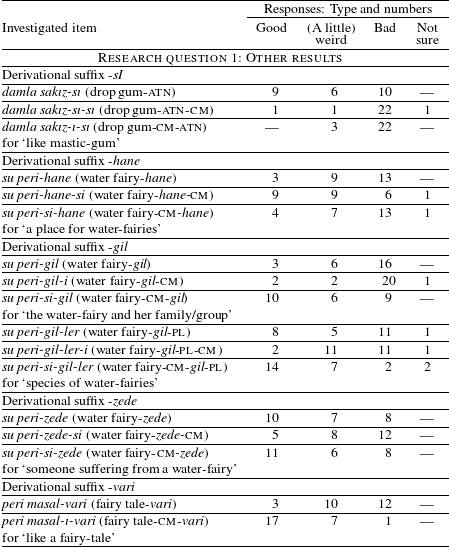
)msI, and the approximate percentages of the forms mentioned in Question 1. See also Table A1 in Appendix B for the rest of the results, i.e. those including the derivational suffixes -sI, -hane, -gil, -zede, and -vari.
First research question results: Compound marker and derivational suffixes.

The table shows the relationship between the compound marker -(
 $s$
)
 $I$
and a group of derivational suffixes. First, there are other derivational suffixes which may immediately follow N–N stems (similar to -CI, -lI, and -sIz suffixations). According to the results shown in the table (and my native intuitions), the derivational attenuative -(
 $I$
)msI and -sI suffixes, as in mavi-
msi
‘bluish (blue-atn)’ and çocuk-
su
‘childish (child-atn)’, and the -CE suffix which is used for deriving language names, e.g. Türk-
çe
‘Turkish (Turk-lng)’, are similar to -lI in that they may directly follow an N–N compound stem, with the compound marker absent. Second, the derivational suffixes -CE, (again) used for deriving language names, and -hane, which is a borrowing from Farsi and used for denoting places for specific purposes, e.g. hasta-hane ‘hospital (patient-hane)’ are similar to -lIK and -CIK in that they appear to be able to precede the compound marker. Finally, the derivational suffix -gil, which is used for a family, proximity, or species membership, as in Talay-gil ‘Talay and his family/friends (Talay-gil)’; (again) -CE, which is used for deriving language names (see above) and for a person’s perspective as in ben-ce ‘according to me (I-CE)’; -zede, which is a borrowing from Farsi and used for denoting victims of an event as in kaza-zede ‘casualty (accident-zede)’; and -vari, which is a borrowing from Farsi and is used for comparison, e.g. şarkı-vari ‘songlike (song-vari)’, seem to be able to follow the compound marker; however, we do not frequently hear such forms in daily conversation (see Section 4 for further detail and Section 5 for the theoretical points).
2.2.2 Second research question results

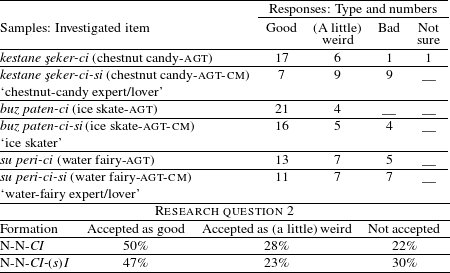
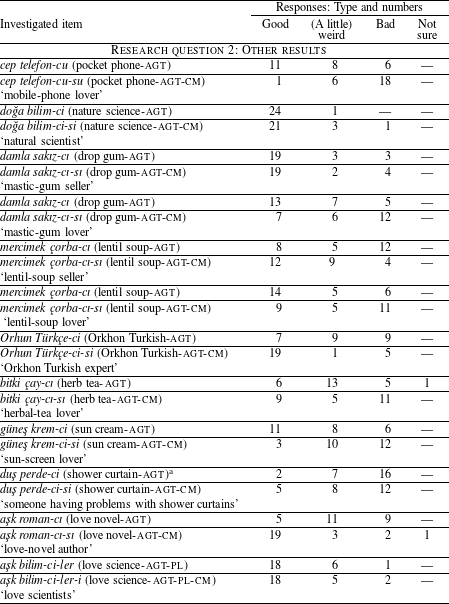
Table 2 shows the results of the interactions of compounds and the derivational suffix -CI, and summarizes the approximate percentages of the formations investigated within the research question 2 (see Table A2 in Appendix B for the rest of the results).
Second research question results: Compound marker and agentive suffix.

This table shows that both formations are often acceptable for the speakers, as hypothesized. The null hypothesis is that there is no difference between the acceptability of N–N-CI and N–N-CI-(
 $s$
)
 $I$
. The proportion of acceptance of the form without the compound marker, i.e. N–N-CI, is significantly higher than of the form with the compound marker, i.e. N–N-CI-(
 $s$
)
 $I$
according to Fisher’s Exact test:Footnote
[6]
the null hypothesis is rejected. The results thus confirm that both formations are acceptable, justifying the current hypothesis. Further to that, N–N-CI appears to be more acceptable than N–N-CI-(
 $s$
)
 $I$
.
It is also interesting that whereas the N–N-CI formation was mostly preferred to the N–N-CI-(
 $s$
)
 $I$
formation in some cases, in others, N–N-CI-(
 $s$
)
 $I$
was preferred to N–N-CI. For instance, the expression kestane şeker-ci (chestnut candy-agt) with the meaning ‘chestnut-candy lover’ was judged to be good by 68% of the speakers. With regard to the expression kestane şeker-ci-si ‘chestnut-candy lover (chestnut candy-agt-cm)’, it was good for only 28%. Both formations were judged to be good by four speakers. Unlike this case, the formation Orhun Türkçe-ci ‘Orkhon-Turkish expert (Orkhon Turkish-agt)’ was good for only 28% of the speakers, whereas Orhun Türkçe-ci-si ‘Orkhon-Turkish expert (Orkhon Turkish-agt-cm)’ was good for 76%. Interestingly, in another case, doğa bilim-ci (nature science-agt) and doğa bilim-ci-si (nature science-agt-cm) ‘natural scientist’, 21 speakers (84%) accepted both N–N-CI and N–N-CI-(
 $s$
)
 $I$
formations as good. Therefore, this variation in the combination of -CI and -(
 $s$
)
 $I$
needs to be accounted for as does the constant nonappearance of -(
 $s$
)
 $I$
with the -lI type suffixes investigated under research question 1 (see Section 4 for the analysis and Section 5 for the discussion).
2.2.3 Third research question results

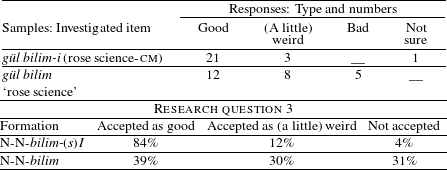
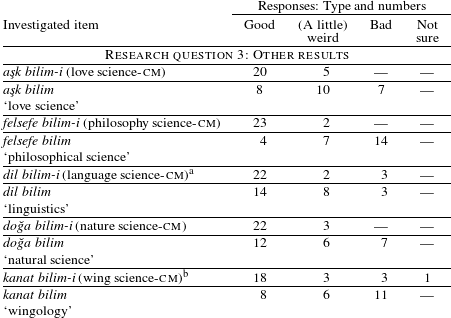
Table 3 includes some samples and summarizes the approximate percentages of the formations regarding research question 3.
Third research question results: Compounds with bilim ‘science’.

The table shows that the majority of the participants prefer N-bilim-(
 $s$
)
 $I$
to N-bilim_, as hypothesized: N-bilim_ is not a native way of N–N compounding in Turkish. Only 39% of the participants accepted the N-bilim_ formation as good, whereas the formation with -(
 $s$
)
 $I$
, N-bilim-(
 $s$
)
 $I$
, was accepted as good by 84%, which is a huge proportion (see Table A3 in Appendix B for the rest of the results). The null hypothesis that there will be no difference between the results for N-bilim-(
 $s$
)
 $I$
and N-bilim_ is rejected as the acceptance rate for N-bilim-(
 $s$
)
 $I$
is significantly higher than that for N-bilim_ according to Fisher’s Exact test.Footnote
[7]
3 Current analysis
This section provides an account for the permitted and unpermitted suffix combinations referred to in the previous sections: I first consider the nature of the meaning of NNCs (Section 3.1), which constitutes a step in the paradigm structure of word formation (Section 3.2).
3.1 Meaning
One could consider that it is the -(
 $s$
)
 $I$
suffix which is responsible for the semantics in NNCs. However, this cannot be the case. The compounded nouns hold the same (associative) semantics also when they lack -(
 $s$
)
 $I$
and feed derivation, as in
su peri
-li masal ‘a/the tale with a/the water-fairy (water fairy-orn tale)’. Therefore, in this section, I focus on the nature of the relationship between the two nouns and argue that the fundamental semantic constituent in NNCs is a semantic function, which is superior to the role of pragmatics or lexical semantic classes, which must be of secondary importance, i.e. circumstantial.Footnote
[8]
Let us consider the meaning of the NNC gümüş kutu-su ‘(a/the) box for silver (items) (silver box-cm)’ in contrast to the meaning of the NP gümüş kutu ‘a/the silver box (silver box)’. The semantic relation between the two nouns in the NNC gümüş kutu-su ‘(a/the) box for silver (items)’ is not the same as the relation between the constituents of the NP. Unlike NPs, in NNCs the meaning of the first linguistic element does not refer to a property of the second element. Rather, there is a semantic unit (association (ASN) function here) which is not overtly expressed in NNCs. The NNC gümüş kutu-su ‘(a/the) box for silver (items)’ means ‘a type of box associated with, i.e. for, silver (items)’, in which the semantic relation for, for example, is not overt. This fact is crucial because such a covert semantic relation makes NNCs distinct from NPs semantically.Footnote [9] Footnote [10]
N
 $+$
N combinations like gümüş kutu ‘a/the silver box’ or çocuk
şair ‘a/the child poet’ are only superficially similar to the comparable compounds as these formations are separable (unlike NNCs), e.g. gümüş bir kutu ‘a silver box (silver a box)’ and çocuk her şair ‘every child poet (child every poet)’. Therefore, these are NPs according to this study.Footnote
[11]
While there is an associative type of modification in NNCs, there is no such semantics in NPs. Similarly, the meaning of the compound su peri-si ‘a/the water-fairy’, mentioned in Section 1, is distinguished from the comparable NPs güçlü (bir) peri ‘a/the strong fairy’ and anne (her) peri ‘a/the/every mother fairy’ by means of the association relation between the nouns in the compound, again. Turkish NNCs thus appear to involve association semantically; importantly, only this type of N–N compounding is productive in Turkish.Footnote
[12]
The semantics of NNCs appears to be a counterexample to the Fregean Principle of semantic compositionality: they involve a covert relation. Partee (Reference Partee, Gleitman and Liberman1995: 337) considers the semantics of NNCs a limitation to compositionality and questions what a semantic theory would say about compounds. She notes that a toy store, for example, is ‘a store that sells toys’, but a toy box means ‘a box that holds toys’ and implies that there is no general rule for predicting the meaning in compounds. Similarly, Di Sciullo (Reference Di Sciullo2009) and Jackendoff (Reference Jackendoff2009) note that the meaning of NNCs is distinctive in terms of compositionality in comparison to syntactic units. I rely on a theory of semantics which allows us to describe meaning compositions by means of semantic analyses, such as type-driven semantics. In Heim & Kratzer (Reference Heim and Kratzer1998), the semantic rules Function Application (FA) and Predicate Modification (PM) are used for the modification involved in NPs. FA applies when combining different semantic types (e.g. an adjective
 $\ll$
e, t
 ${>}<$
e, t
 $\gg$
and a noun
 ${<}$
e, t
 ${>}$
as in a small elephant). For the modification in NPs, PM is also proposed as an alternative to FA; PM, however, is a conjunctive composition and applies to identical semantic types, such as an adjective with the type
 ${<}$
e, t
 ${>}$
, and a noun with the same type,
 ${<}$
e, t
 ${>}$
, as in a gray cat (Heim & Kratzer Reference Heim and Kratzer1998: 61–65).Footnote
[13]
Neither FA nor PM (in their present condition) seems to apply in the semantic composition of NNCs because, unlike NPs, NNCs involve a semantic constituent which is not expressed overtly: the association (ASN) function in the current study. This function expresses a type of relatedness between separate lexical meanings.Footnote [14] The semantic relation corresponding to the syntactic outputs, i.e. NPs such as parlak (bir) kutu ‘a/the shiny box (shiny (a) box)’ and gümüş bir kutu ‘a/the silver box (silver (a) box)’, is not what we find in compounds such as gümüş kutu-su ‘a/the box for silver items (silver box-cm)’. Ascription (ascriptive modification) as in gümüş/parlak (bir) kutu ‘a/the silver/shiny box’ is possible with FA and PM, which apply in syntactic phrase-formation,Footnote [15] but not compound formation.Footnote [16]
With regard to pragmatics, it must play a role in cases where NNCs are semantically ambiguous, as more than one ASN function may be available due to lexical semantics. Note, however, that no matter how many different paraphrases an NNC can have,Footnote [17] its meaning can be expressed by at least one (ASN) function, i.e. the default function (‘relatedness’/about). The intended meaning can be obtained pragmatically in such cases. This does not require that it is the pragmatic context that creates the ASN function. The ASN function comes from the semantic component in the current analysis (see also Jackendoff Reference Jackendoff2009), which interacts with the morphological component, and when necessary, pragmatics is called for clarifying the meaning.Footnote [18]
3.2 Form
This section is dedicated to the formation of novel NNCs with the compound marker, such as the expression seen in (1a) above, su peri-si ‘water fairy (water fairy-cm)’, which is highly productive in Turkish. The formation of NNCs without the compound marker like anne-anne ‘maternal grandmother (mother mother)’ is unproductive and restricted to a limited number of lexicalized expressions; these might have lost -(
 $s$
)
 $I$
prior to lexicalization. I also do not investigate lexicalized NNCs with the compound marker so as to avoid problems which might result from the idiosyncratic properties of lexicalized forms. The NNC kavun+iç+
 $i$
(melon+inside+cm), for example, means ‘orange (colour)’ with the lexicalized interpretation, but ‘inside part of a melon’ with the novel interpretation. I assume that lexicalized and novel NNCs are produced identically, i.e. they undergo the same morphological operation presented below. However, NNCs with a lexicalized meaning (such as kavun+iç+
 $i$
‘orange’), involve one more additional process, which is lexicalization. The distinction lies in whether or not a previously novel NNC has undergone a lexicalization process, which involves the attachment of a new meaning (at a distinct semantic level probably) based on a metaphor or idiomatization, for example.Footnote
[19]
Other nominal combinations which are not investigated here are co-ordinate N–N formations including an and relation, such as baba-k
ı
z ‘father and daughter (father-girl)’, and appositive formations, such as ressam-müzisyen ‘painter-musician (painter-musician)’, which are beyond the scope of this study. It remains to be determined whether such formations, which do not involve the compound marker, are also compounds or another type of Noun–Noun concatenation.Footnote
[20]
Since the main goal here is to explain the suffixation process of the compound marker and its absence in Turkish word formations, the specific compound type investigated is Noun–Noun compounds with the compound marker, which are endocentric and right-headed, as in the examples seen thus far. In this study these compounds are analysed within a processual morphological framework. Processual approaches to morphology regard morphological operations as a system of rules which specify the relation between form and meaning. Rather than morphological items such as affixes, morphological rules and operations are significant. Affixation and nonconcatenative processes are treated similarly, i.e. they are considered relational, rather than being lexical form–meaning units. Therefore, in contrast to the morpheme-based approaches, affixes are rule-elements in process(ual) morphology (see Aronoff Reference Aronoff1976, Reference Aronoff1994; Zwicky Reference Zwicky, Nikiforidou, van Clay, Niepokuj and Feder1986; Spencer Reference Spencer1991; Anderson Reference Anderson1992; Beard Reference Beard1995; Pounder Reference Pounder2000; Stump Reference Stump2001).
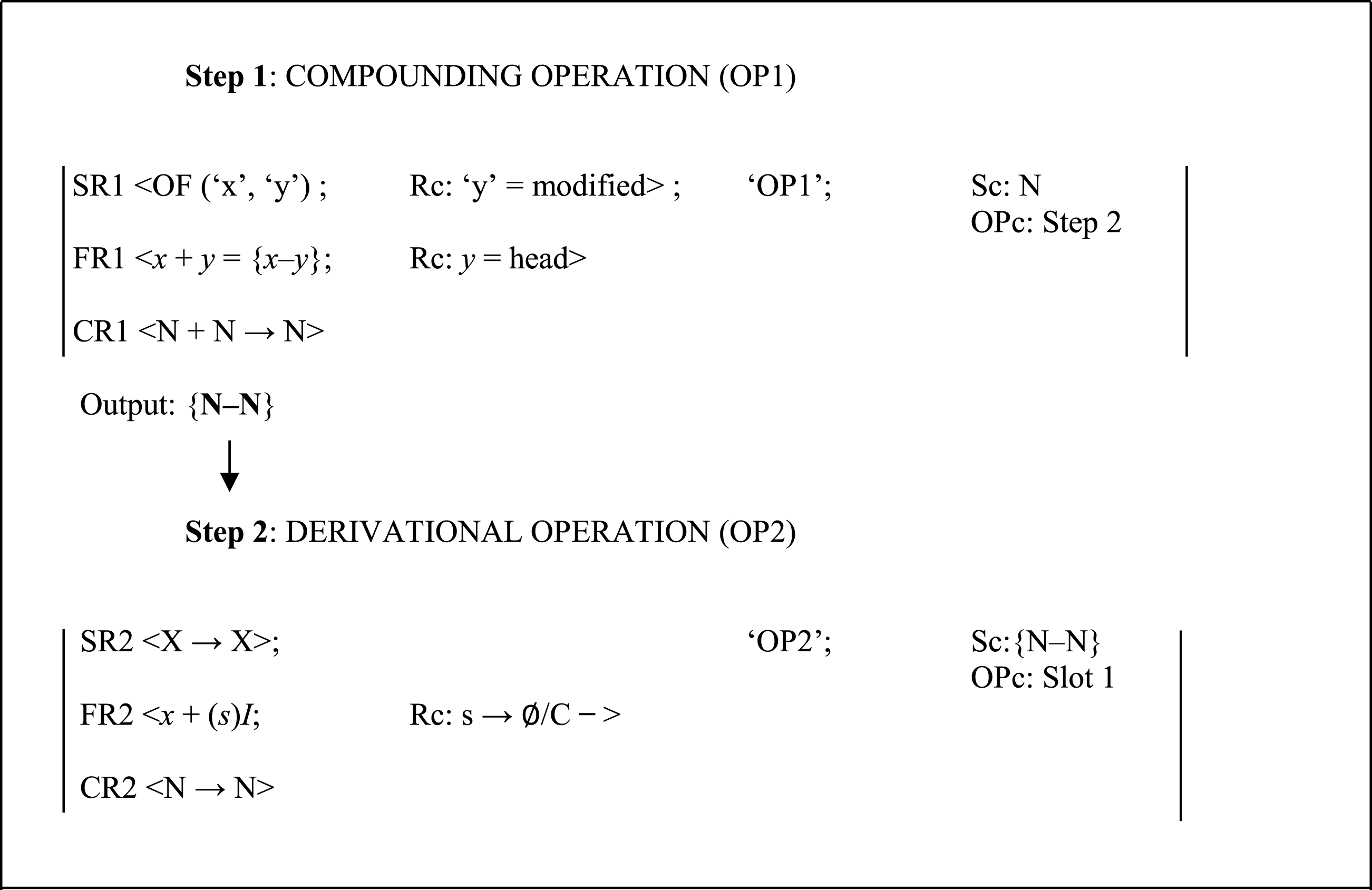
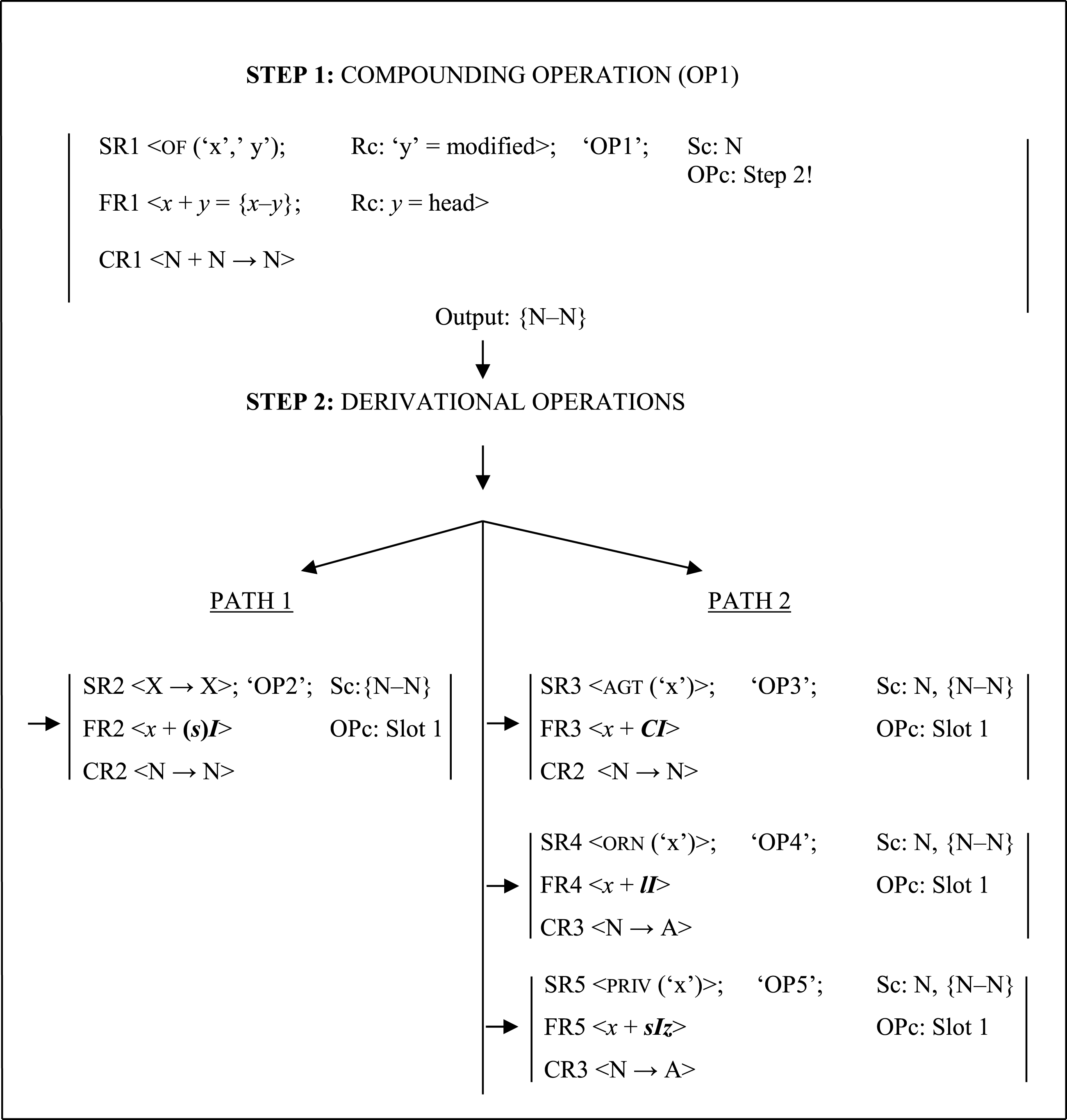
In line with the Process and Paradigm framework (Pounder Reference Pounder2000), I adopt a system which includes rules mapping onto each other as described in Jackendoff (Reference Jackendoff1975), Aronoff (Reference Aronoff1976), and Pounder (Reference Pounder2000).Footnote [21] In the present mechanism, a morphological operation consists of mapping of form rules (FRs), semantic rules (SRs), and categorial rules (CRs).Footnote [22] Besides this mapping, a morphological operation also includes stem/baseFootnote [23] conditions (Scs) and rule conditions (Rcs), which express what type of units, i.e. bases, it can apply to. Finally, there are operation conditions (OPcs), which specify any further operations which must necessarily follow a given operation (see Pounder Reference Pounder2000: 65–67, 71). The current analysis of the formation of Turkish NNCs is based on this conception, represented in Figure 1.
Noun–Noun compound formation.

The first step in Figure 1 involves a semantic rule, SR1:

The semantic rule SR1 is responsible for the combination of the meanings of the two nouns with an association function, of here, which is not expressed overtly (as discussed in Section 3.1 above). This means that to form the compound su peri-si (water fairy-cm) ‘water fairy’, for instance, we take the meaning of su ‘water’ and combine it with the meaning of peri ‘fairy’ via
 $f$
(x, y), the combinatory semantic rule proposed for NNCs in the present model:
 $f$
in this rule represents an association function. In this relation, which I call Function Insertion (FI), the first element is determined as the modifier and the second, the modified. Thus, the meanings of both constituents of NNCs serve as the arguments of
 $f$
, the modifier being the first argument.Footnote
[24]
The SR1 involved in the formation of the NNC su peri-si ‘water fairy’ includes an of relation as the association function,Footnote [25] as shown in (4), and more explicitly, in (5):

In su peri-si, SR1 is of(x, y), with a rule condition, Rc, which determines ‘y’ as the modified element and ‘x’ as the modifier. This rule enables us to establish an association relation with an ASN function in an NNC, the of function here. This rule does not allow an ascription relation between ‘x’ and ‘y’ (which would be obtained either by FA or PM as discussed in Section 3.1). SR1 maps onto FR1, the first form rule, which combines the two nouns
 $x$
and
 $y$
:Footnote
[26]

Note that FR1 involves only compounding the two noun stems,
 $x+y$
, but not the suffixation of -(
 $s$
)
 $I$
. Rc, the rule condition on FR1, shows that -
 $y$
is the formal head. With regard to the final rule involved in the mapping, the categorial rule CR1, it states that both the two inputs and the output of this rule are of noun category, which means that this operation needs categorial information: CR1
 ${<}$
N
 $+$
N
 $\rightarrow$
N
 ${>}$
.
SR1, FR1, and CR1 map onto each other, and constitute the first step in Figure 1, Step 1, which is Operation 1 (OP1). There is a stem condition on this operation: OP1 applies to elements of the noun category. There is also an operation condition: OP1 must be necessarily followed by the second step, OP2. Namely, the outputs of OP1 are not complete and legitimate forms since OP1 is not a terminal operation. Therefore, the second step, Operation 2 (OP2), must be taken. In the second step, again, there are three rules mapping onto each other. However, two of these are identity rules: SR2 and CR2 do not change the meaning or the category of the input:

However, FR2 is not an identity rule. This rule suffixes -(
 $s$
)
 $I$
to the compounded base {N–N} (created in the first step):

Note that by separating the suffixation of -(
 $s$
)
 $I$
(FR2) from combining the two nouns (FR1), and assigning the -(
 $s$
)
 $I$
suffixation to Step 2, the -(
 $s$
)
 $I$
suffixation is also separated from the meaning. In other words, the NNC formation in Figure 1 does not allow the -(
 $s$
)
 $I$
suffixation to map onto the semantic rule, of(x, y), which belongs to the previous step. Rather, -(
 $s$
)
 $I$
suffixation maps onto the identity SR2. Thus, the compound marker does not add any meaning to the structure; the meaning of the compound is attained in Step 1, before -(
 $s$
)
 $I$
is added (in Step 2). With regard to the rule condition on FR2, Rc, it states that the consonant of the - (
s
)
 $I$
suffix is not added when the stem ends in a consonant.Footnote
[27]
SR2, FR2, and CR2 map onto each other, and constitute the second step in the formation of NNCs, which is OP2. The conditions on OP2 are as follows: Sc requires that OP2 applies to Noun–Noun compounds; Oc requires that the - (
 $s$
)
 $I$
suffix occupies Slot 1, which is an instruction for the affix to be placed immediately after the N–N base. Briefly, OP1 and OP2 together constitute the NNC formation in Turkish, where Step 2 is required by Step 1. In this system, the -(
 $s$
)
 $I$
suffix itself does not contain or add any meaning to the formation; the compound marker belongs to OP2 only, and signals that a word-formation process has taken place, i.e. a lexeme form has been created.
In this analysis, the formal status of -(
 $s$
)
 $I$
, which is morphological, is significant: as - (
 $s$
)
 $I$
is added following the compounding operation (OP1), it is responsible for lexeme creation, i.e. creating candidates for the lexicon from N–N bases. Bare N–N bases (compounds) are not correct word formations in Turkish, e.g. *su peri (water fairy) for ‘water fairy’; they cannot serve as lexeme forms. -(
 $s$
)
 $I$
is thus a lexeme-creator according to the current study (see Kunduracı Reference Kunduracı, Büyükkantarcıoğlu, Özyıldırım and Yarar2017). Thus, it has a formal (morphological) function and it is derivational (when following compounds). However, this does not mean that we cannot call -(
 $s$
)
 $I$
a compound marker as it appears following (N–N) compounds and derives lexeme forms based on N–N compounds without changing the meaning of these compounds. The current formal derivational function of - (
 $s$
)
 $I$
also shows that derivational tasks (or types) may also involve formatting items, as above, in addition to featural, functional, categorial and expressive changes, which are classified by Beard (Reference Beard1998: 57–60).Footnote
[28]
Recall the case with the NNCs headed by the noun bilim ‘science’, which may be followed by the compound marker optionally, e.g. gül bilim (-i) ‘rose science (rose science(-cm))’. When they include - (
 $s$
)
 $I$
, they are created by the steps represented in Figure 1; the system outputs NNCs with bilim followed by - (
 $s$
)
 $I$
. As for the outputs which do not include - (
 $s$
)
 $I$
after bilim, they must undergo only the first step in Figure 1, and then leave the system without the compound marker. While such forms without - (
 $s$
)
 $I$
may appear in formal contexts, e.g. gösterge
 $+$
bilim ‘semiotics (sign-science)’, in casual speech the forms with - (
 $s$
)
 $I$
, e.g. müzik bilim-
i
‘musical science (music science-cm)’, appear more often (with the same meaning). I thus assume that the absence of the compound marker in such NNCs follows from a non-native type of neologism, which lacks - (
 $s$
)
 $I$
. Recall also the survey on these NNCs (Section 2.2.3 above), which shows that the NNC form without -(
 $s$
)
 $I$
is not as natural as the one with -(
 $s$
)
 $I$
for native speakers.
There is an interesting formal point regarding the plural NNCs. In plural NNCs, the sequence of the plural suffix -lAr and -(
 $s$
)
 $I$
is N-N-lAr- (
 $s$
)
 $I$
, as illustrated in (6a), rather than N-N- (
 $s$
)I-lAr, as in (6b). If - (
 $s$
)
 $I$
is word-formational, as argued here, it would be expected to precede the plural suffix, unlike the actual case in (6):

However, the acceptable sequence in (6) must not immediately lead us to regard - (
 $s$
)
 $I$
as inflectional rather than derivational. Recall that - (
 $s$
)
 $I$
does not occur in combination with some derivational suffixes; this is not a common behavior of inflection. Rather, in line with Hoeksema (Reference Hoeksema1985: 48–49), I propose that number inflection in Turkish NNCs involves a head operation, which applies only to the head of the compound. The head in (6) is masal ‘tale’, to which the plural suffix -lAr is added. That is, inside the N–N stem, there is a slot following the head, masal above, which is reserved for Number inflection in NNCs: {N–N_}-(
 $s$
)
 $I$
. When a plural NNC is formed, this reserved slot is filled with -lAr; otherwise it remains empty. This analysis also parallels Stump’s (Reference Stump1991: 693) Head-application Property regarding the realizations of inflections.Footnote
[29]
Importantly, Beard also states that it is not rare for inflection to appear inside derivation crosslinguistically (Reference Beard1995, Reference Beard1998: 45–46) and he shows how head operations (the one proposed in the current study, for example) can lead to such inflections (Reference Beard1998: 52–53). Moreover, Booij (Reference Booij, Booij and van Marle1994, Reference Booij, Booij and van Marle1996) proposes that number in nouns is inherent inflection that is not required by the syntactic context, and it can thus feed word formation.Footnote
[30]
Given these points, the fact that the plural suffix precedes the compound marker in Turkish does not pose a problem for the current word-formational/derivational account of the compound marker at all. Rather, this case tells us more about autonomous morphology: derivations may follow inflections too (see Section 5 below).
To summarize, the outputs of the present system are word formations.Footnote [31] Importantly, in this system, the meaning of the compound is created before the compound marker is added. In Section 4, I proceed to the paradigmatic aspect of the analysis, i.e. the relation between the compound marker and derivational suffixes, and why such relation is significant.
4 Compounding and derivation: A close relation
4.1 Derivational paradigms
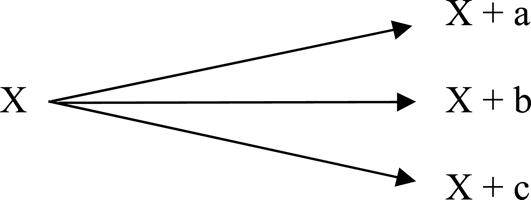
As noted in Section 1, one aim of this study is to bring into focus that paradigms are essential for derivational morphology too; the current section describes the nature of a derivational paradigm. Figure 2 illustrates a derivational paradigm from Guilbert (Reference Guilbert1975). In this figure, the possible formations/outputs of a stem/base X are indicated with an arrow. For more complex stems, cumulative series are used, such as X
 $\rightarrow$
X
 $+$
a
 $\rightarrow$
(X
 $+$
a)
 $+$
b, where X is a stem, and a, b, c are affixes (Guilbert Reference Guilbert1975: 180–185).
Guilbertian derivational paradigm (Guilbert Reference Guilbert1975).

Listing the possible contrastive formations, which are paths, Figure 2 represents the dynamics and relations in a morphological paradigm structure. In parallel with Guilbert, a derivational paradigm has a form-based structure with a stem and the individual formations departing from the stem in Pounder (Reference Pounder2000); however, Pounder (Reference Pounder2000: 91–95) argues that a complete paradigm model should also involve prefixation and compounding. Pounder’s paradigm structure contains paths from a base to potential operations assigned to slots, and stem operations applying to the base; an output of the paradigm may enter the systematic derivational paradigm of its new category if there is one, or the same derivational paradigm recursively, and also the inflectional paradigms.
Blevins (Reference Blevins2001: 211–217) views derivational paradigms in the following way: all inflection can be regarded as paradigmatic, but it is not necessary that all paradigmatic processes are inflectional, namely, derivational stems are also forms of a basic lexeme, which may feed derivational processes such as lexeme formation or compounding. Thus, outputs of a paradigm share certain properties as emphasized in Carstairs-McCarthy (Reference Carstairs-McCarthy1998) and Booij (Reference Booij, Montermini, Boyé and Hathout2007). Suffixes which belong to different paths in a paradigm mutually exclude each other as they occupy the same slot (see Anderson Reference Anderson1982, Reference Anderson1992). In addition to these formal properties, Stump (Reference Stump1991) emphasizes the semantic characteristic that is shared by the outputs of a paradigm: all the products maintain the meaning of the base. Given these points, a derivational paradigm can be described as follows:

The Turkish data investigated in this study lends itself to a paradigmatic mechanism as described above: the data involve semantically and formally related items that are mutually exclusive, as discussed in the next subsection.
4.2 The current paradigmatic structure
This section resolves the formal issue regarding NNCs with - (
 $s$
)
 $I$
, introduced in Section 1 and investigated in the survey (Section 2): the formations which, contrary to expectations, lack -(
 $s$
)
 $I$
. The absence of - (
 $s$
)
 $I$
in combination with -lI (orn) and -sIz (priv), which normally attach to N bases and derive adjectives from nouns, e.g. şeker-
li
‘sugary (candy/sugar-orn)’ and şeker-
siz
‘sugar-free (candy/sugar-priv)’, has been investigated previously (e.g. Hayasi Reference Hayasi, Berta, Brendemoen and Schönig1996, van Schaaik Reference van Schaaik1996). According to van Schaaik (Reference van Schaaik1996: 166), the compound marker is not added when there is adjectival derivation with -lI and -sIz.Footnote
[32]
The present study, however, shows that this cannot be about category and that this case, i.e. the absence of the compound marker with -lI and -sIz, is not limited only to adjectival derivation, i.e. -lI and -sIz suffixations (see Sections 1 and 2 above): there are at least four other suffixes with which -(
 $s$
)
 $I$
may not co-occur: -CI (agt), -CE (lng) (neither of which necessarily derives adjectives), - (
 $I$
)msI (atn), and -sI (atn).
First, let us recall the problematic formal issue introduced in Section 1: -(
 $s$
)
 $I$
in the NNC su peri-
si
‘water fairy’ cannot come either before, as seen in (7c, d), or after the derivational suffixes, as seen in (7e, f).

The reason for expecting the compound marker in the above formations would be semantics: (7a, b) involve the same semantic relation (ASN function) between the two nouns, as in the compound with -(
 $s$
)
 $I$
, su peri-si ‘water-fairy: (a/the) fairy of (or for) water’, but there is no -(
 $s$
)
 $I$
in (7a, b). Therefore, the absence of -(
 $s$
)
 $I$
is crucial: there appears a mismatch between form and meaning. Recall also (from Section 1, example (3)) that the - (
 $s$
)
 $I$
in NNCs contrasts with the - (
 $s$
)
 $I$
in possessive constructions (PCs). The poss
- (
 $s$
)
 $I$
can follow these derivational suffixes, as illustrated in (8). As just seen in (7) above, however, -(
 $s$
)
 $I$
cannot co-occur with these derivational suffixes in NNCs, where it is a compound marker.

It is thus necessary to show what precludes the combination of -(
 $s$
)
 $I$
and derivational suffixes, i.e. the -lI type suffixes. As discussed above (Sections 1 and 2), -(
 $s$
)
 $I$
does not appear before the derivational suffix -CI (agt) either, as shown in (9b, c, d), nor after -CI for some speakers (9c). This fact, i.e. the optionality in the case of -CI, makes it necessary to account for the relation of -(
 $s$
)
 $I$
and the -CI type suffixes, which includes -CE (lng) as in (9e, f):

Note that N–N-CI/CE forms, such as the ones in (9c, e), do not involve shortening of N–N-CI/CE- (
 $s$
)
 $I$
. The N–N-CI/CE form without - (
 $s$
)
 $I$
is also attested by native speakers (including myself) and is grammatical; the casual speech includes both of these formations (see also the survey results in Section 2, Table A2).
As mentioned above, the absence of -(
 $s$
)
 $I$
with -lI and -sIz is regarded in previous studies as a categorial restriction (van Schaaik Reference van Schaaik1996) or a deletion of -(
 $s$
)
 $I$
(e.g. Hayasi Reference Hayasi, Berta, Brendemoen and Schönig1996, Aslan & Altan Reference Aslan and Altan2006), and there is no account (apart from Kunduracı Reference Kunduracı2013) of the optionality of -(
 $s$
)
 $I$
in co-occurrence with -CI, highlighted in (9). Above, I have already shown that the absence of -(
 $s$
)
 $I$
with the -lI type suffixes cannot follow from categorial selection (see Tables A1, A2, and footnote 32). As for deletion, it does not account for the permitted sequences of a derivational suffix and -(
 $s$
)
 $I$
. Namely, it is not the case that -(
 $s$
)
 $I$
disappears in the presence of all derivational suffixes. Indeed, as noted in Section 1, it must occur following some derivational suffixes unlike the -lI type:

The expression in (10a) is interesting firstly because, unlike in (7) above, - (
 $s$
)
 $I$
is obligatory, and secondly, -(
 $s$
)
 $I$
follows the derivational suffix -CIK in (10). I propose that such restrictions on the compound marker points to a formal relationship between the compound marker and certain derivational suffixes, i.e., the -lI type (but not the -CIK type), for which I provide a paradigmatic system represented by Figure 3. Figure 3, an extended model of that in Figure 1 above, provides a system creating NNCs and derivations based on these NNCs.
Word-formation paradigm.

Recall that in Figure 1, it is proposed that -(
 $s$
)
 $I$
is added to the compound base {N–N}after OP1, which involves SR1. The fact the semantics of the compound {N–N}is also maintained in N–N-CI, N–N-lI, and N–N-sIz (and N–N
 $+$
another -lI type suffix), which do not contain -(
 $s$
)
 $I$
, supports the current analysis. Namely, all of these derivational suffixes, i.e. the -lI type suffixes represented with -lI, -sIz and -CI in Figure 3, must be added to the bare compound {N–N}once we have established the semantic relation between the two nouns and they have been compounded. The operations involving the -(
 $s$
)
 $I$
, -CI, -lI, and -sIz suffixations (and other -lI type suffixations) must apply only after the OP1, so that we can keep the same semantics in all formations regardless of -(
 $s$
)
 $I$
suffixation, and guarantee not to suffix -(
 $s$
)
 $I$
before the -lI type suffixes.
In other words, I argue that the suffixation of -(
 $s$
)
 $I$
and the -lI type derivational suffixes points to a formal paradigmatic relationship between these suffixations: these occupy alternative end-nodes in a word-formation (derivational) paradigm. Each suffix can be attached to an N–N base, but only one is chosen: {{N–N}
 $+$
one suffix}.
The machinery in Figure 3 starts with SR1, which applies the ASN function to the meanings of the constituents and maps onto FR1, as explained in connection with Figure 1, in Section 3 above. SR1 maps onto FR1,
 $x+y=$
{
 $x$
–
 $y$
}, and the CR1, N
 $+$
N
 $\rightarrow$
N. The output of OP1 is thus an N–N stem with associative semantics.
In the second step, however, there are two paths, which makes Figure 3 different from Figure 1. If there is no need for a semantic modification, i.e. a further (full) SR, we directly take Path 1 for -(
 $s$
)
 $I$
suffixation (FR2) which maps onto the identity semantic rule, SR2, (X
 $\rightarrow$
X), and the identity categorial rule CR2 (N
 $\rightarrow$
N), and derives lexemes from N–N compounds. Namely, Step 2 in Figure 1 constitutes a path in Figure 3. SR2, FR2, and CR2 together constitute OP2 as already explained in connection with Figure 1. Recall that in OP2, -(
 $s$
)
 $I$
suffixation (FR2) is separated from Step 1 rules (SR1 and FR1). This separation is crucial: it accounts for why it is possible to maintain the semantics of N–N-(
 $s$
)
 $I$
but not the compound marker in the -lI type suffixations (N–N-CI, N–N-lI and N–N-sIz above). That is, all the formations of the paradigm include Step 1, which involves OP1 and SR1 (where an ASN function is inserted and the meaning is obtained via the function).
If a semantic modification is desired, Path 2 is taken instead of Path 1, and one of the derivational operations is chosen (OP3, OP4, OP5). The first alternative in this path is OP3, which comprises the rules SR3, FR3, and CR2. SR3 creates an ‘agent/actor’ on the basis of the meaning of the compound. This rule maps onto FR3, which suffixes -CI to the compound, i.e. the N–N base. The final rule in OP3 is CR2, which derives an N from an N input. There is a base condition on the operation: Sc requires that OP3 may apply to Ns, as in şeker-ci ‘candy seller/maker/lover (candy/sugar-agt)’ or peri-ci ‘fairy expert (fairy-agt)’, and N–N bases as in {su-peri }-ci ‘water-fairy expert (water fairy-agt)’. There is also an operation condition, OPc, which reserves the first slot following an N–N base for -CI.
The second alternative in Path 2 is OP4, with the rules SR4, FR4, and CR3. SR4 is responsible for the meaning ‘with x’, where ‘x’ is the meaning of the compound. This rule maps onto FR4, which suffixes -lI to the N–N base. The final rule of the OP4 is CR3, which derives adjectives from nouns: N
 $\rightarrow$
A. There is a stem condition, Sc, requiring that this operation may apply to Ns, as in peri-li ‘with (a) fairy (fairy-orn)’, and N–N bases, as in {su-peri }-li ‘with (a) water-fairy (water fairy-orn)’. Finally, the operation condition, OPc, reserves the first slot following an N–N base for the -lI suffix.
The third alternative in Path 2 is OP5, with the rules SR5, FR5, and CR3. SR5 is responsible for the meaning ‘without x’ where ‘x’ is the meaning of the compound. SR5 maps onto FR5, which suffixes -sIz to the N–N base. The final rule of OP5 is CR3, which has been already defined above: N
 $\rightarrow$
A. The stem condition on OP5 requires that OP5 may apply to Ns as in peri-siz ‘without (a) fairy (fairy-priv)’, and N–N bases as in {su-peri }-siz ‘without (a) water-fairy (water fairy-priv)’. With regard to the operation condition, it reserves the first slot following an N–N base for the -sIz suffix.
Note that all the paths in Step 2 have the same stem condition, Sc, which means that these operations apply to simplex {N}and complex {N–N}bases; they also have the same operation condition, OPc, which requires that all the suffixes are positioned in Slot 1, which is the slot immediately following the N–N base. These conditions result in a competition between the suffix of Path 1 (-(
 $s$
)
 $I$
) and the suffixes of Path 2 (the -lI type derivational suffixes), which accounts for why only one of these suffixes can occur following a bare N–N compound: these suffixes are paradigmatic, i.e. they are slot competitors. The derivatives with these suffixes have certain points in common: they all involve OP1, thus they share the same base, N–N, and the semantics mapping onto this base,
 $f$
(x, y). Therefore, N–N-CI, N–N-lI, and N–N-sIz maintain the semantic relation between ‘x’ and ‘y’, in addition to the additional meanings agentive, ornative, and
privative.
Having accounted for the impossible co-occurrence of - (
 $s$
)
 $I$
with the -lI type suffixes, I now turn to the required co-occurrence of -(
 $s$
)
 $I$
with another type of derivational suffixes. Recall from Section 1 and example (10) above that the compound marker must follow some derivational suffixes, such as -CIK:

The expression in (11) supports the claim that -(
 $s$
)
 $I$
must be in a formal paradigmatic relationship with only certain derivational suffixes, e.g. -CI (for some speakers), -lI (for all speakers), and -sIz (for all speakers), unlike suffixes such as -CIK in (11). The former type of suffixes (the -lI type) are slot competitors with - (
 $s$
)
 $I$
within the paradigm represented in Figure 3. The -lIK/-CIK type suffixations, however, cannot be end-nodes in this paradigm. Thus, I propose that the structure of expressions, such as (11) cannot be {{N–N} + suffix} (as in Figure 3), but must be {{N + {N + suffix}} + -(
 $s$
)
 $I$
}, where -CIK attaches to an N, but not to an N–N base. The fact that such suffixes cannot attach to N–N bases precludes them from occupying end-nodes in the paradigm.Footnote
[34]
.
Now recall the optionality in expressions like su peri-ci (-si) ‘water-fairy expert (water fairy-agt-cm)’ and su peri-ce (-si) ‘water-fairy language (water fairy-lng-cm)’ illustrated in (9b–e) above. I attribute this case to the structure: if a speaker attaches -CI (or -CE) to an N–N base, as in the case of -lI type suffixes, no -(
 $s$
)
 $I$
appears. This makes -CI (and -CE) a paradigmatic suffix with the compound marker in the word-formation paradigm for such speakers: {{N + N} + CI }. This means that OP3 (in Figure 3) may apply not only to N bases but also to N–N bases in such speakers’ systems. If however, a -CI type suffix is first added to an N as a derivation, and then this derivation with -CI becomes an input to OP1 (compounding), it results in the suffixation of -(
 $s$
)
 $I$
: {{N + {N + CI }} + (
 $s$
)
 $I$
}. In this case, with the compound marker present, -CI is not regarded as a paradigmatic suffix: OP3 does not apply to an N–N base.
There is a point to be made about the dynamism of paradigms here. The agentive suffix -CI (and similar suffixes, like -CE) must have entered the derivational paradigm including compounding for some speakers and not other speakers. Apparently, the stem conditions on the OP3 (which involves -CI suffixation) is different for the latter group of speakers: OP3 applies only to N stems, but not to N–N stems. I also propose that for another group of speakers, for whom both formations (with and without -(
 $s$
)
 $I$
) are acceptable, -CI suffixation serves as an end-node in the paradigm for some derivations unlike other derivations. Such speakers use either structure for a formation. This is why both the N–N-CI and N–N-CI-(
 $s$
)
 $I$
formations are acceptable for these speakers. However, at some point in future, this last group of speakers might prefer N–N-CI to N–N-CI-(
 $s$
)
 $I$
for all formations if -CI (and other similar suffixes, e.g. -CE) becomes a totally paradigmatic suffix for them, for example.
The optionality, then, arises due to the fact that suffixes like -CI may either attach to an {N–N}stem or to an {N}stem for a speaker in a given case. Such optionality in speakers’ mind is a proof for the dynamic nature of derivational paradigms, which are, apparently, full of alternative, active options (paths), and may change in the course of time.
In sum, the superficial mismatch problem of form and meaning (introduced in Section 1) has been resolved in this section. The current paradigm structure accounts for why {N–N}-(
 $s$
)
 $I$
, {N–N}-CI, {N–N}-lI, and {N–N}-sIz formations are morphologically, semantically, and structurally related to each other: they are all word formations produced within the same paradigmatic system. This, however, does not mean that -CI, -lI, and -sIz are compound markers like -(
 $s$
)
 $I$
. Rather, this means that a word formation is derived from an N–N base at the end of all of these derivational operations, i.e. OP2, OP3, OP4, OP5 (and other -lI type derivations like -(
 $I$
)msI and -sI). That is, NNCs with - (
 $s$
)
 $I$
are also word formations.
Note that if the suffixation of - (
 $s$
)
 $I$
were not separated from the Step 1 rules, the system would produce ungrammatical forms such as *N–N-(
 $s$
)I-CI, *N–N-(
 $s$
)I-lI, and *N–N- (
 $s$
)I-sIz, as -(
 $s$
)
 $I$
suffixation would map onto SR1, then the -lI type suffixesFootnote
[35]
would attach immediately following -(
 $s$
)
 $I$
(in order to maintain the associated meaning within the bare compound). With regard to other derivational suffixes which -(
 $s$
)
 $I$
follows, as in (11) above, their suffixations do not constitute a paradigmatic contrast with -(
 $s$
)
 $I$
suffixation since their stem conditions do not permit such suffixes to attach to N–N bases, i.e. they have distinct base conditions/restrictions.
4.3 Why {N–N-derivatinal suffix} overrides {N-derivational suffix}
One can consider how the native speakers know which possible form to take when multiple options are available, namely, how the -lI type suffixations obtain the correct base types in distinct instances: {N–N}-lI vs. {N}-lI.
When a formation like {su peri } li masal ‘a/the tale with a/the water-fairy (water fairy-orn tale)’ is built, what precludes a speaker from taking the other base option for -lI, as in {peri } li masal ‘a/the tale with a/the fairy (fairy-orn tale)’, must be speaker’s anticipation based on the autonomy and the nature of morphological operations, rather than a cyclic or a layered morphology,Footnote [36] for example. Recall that morphological operations, as described here, involve form and meaning rules separately, so even though the form rule (FR) is identical in the -lI suffixations in the above expressions including peri ‘fairy’, the operations which the formal -lI suffixation belongs to are distinct: one involves compounding and the other does not, which makes a big difference at the beginning. That is, when a speaker (with the derivational paradigm structure) intends to express a semantic category such as ‘x: x involves a fairy that is related to water in a way’, this speaker makes a choice among the OPs that the autonomous morphology provides her/him with. The OP that (s)he chooses already contains the information about the base type (stem condition) {N–N}, which precludes her/him from being confused or adding -lI to the single N {peri } in contrast to the complex N–N:{su peri } above. If, however, the speaker needs to express a less complex meaning such as ‘x: x with a fairy’, then the OP (s)he chooses will be a distinct one even though this OP will involve the same FR, i.e. the formal -lI suffixation. The current study thus shows the role of speaker’s anticipation in establishing complex formations such as those described above: apparently, speaker’s anticipation enables to make the correct choices among others.Footnote [37]
5 Discussion and conclusions
Turkish Noun–Noun compounding and subsequent derivation shed light on important interactions between compounding and derivation as well as the nature of the morphological component. By analyzing these interactions, I have aimed to show that the way one approaches morphology either increases or decreases the number of problems. A processual, paradigmatic approach which recognizes certain relations between affixations and which separates form from meaning, is able to account for the semantic, formal, and syntactic properties of the structures discussed here. In the analysis argued for here, I separate the meaning of NNCs – handled by semantic rules – from the compounding rule – form, handled by form rules – and also separate -(
 $s$
)
 $I$
suffixation from both of these rules, which makes -(
 $s$
)
 $I$
an identity suffix in terms of semantics and an active suffix in terms of form: -(
 $s$
)
 $I$
suffixation has a function, i.e. lexeme derivation (as a stem formative in Kunduracı Reference Kunduracı, Büyükkantarcıoğlu, Özyıldırım and Yarar2017), but no meaning.Footnote
[38]
The formation and localization of compounding has been controversial between the lexicalist and syntactic approaches. In the lexicalist view, compounds are formed in the lexicon, which makes compounds lexical units (e.g. Jackendoff Reference Jackendoff1975; Giegerich Reference Giegerich1999, Reference Giegerich2009; Lieber Reference Lieber2004). Given the Lexical Integrity Principle/Hypothesis (LIP), it is guaranteed that syntax cannot manipulate morphological structure (Postal Reference Postal, Binnick, Davison, Green and Morgan1969, Lapointe Reference Lapointe1980). This approach, thus, can easily account for the systematic semantic, syntactic, and prosodic distinctions between compounds and phrasal units crosslinguistically. There is, however, no way to account for phrasal compounds (compounds with embedded phrasal units) in lexicalism in general, as the No Phrase Constraint (NPC) does not allow syntactic items to enter/exist in internal word structure (Botha Reference Botha1984). A complex compound formation like  ‘a/the green apple tree: tree of green apples (green apple tree-cm)’, which contains a clearly syntactic unit embedded in the compound, cannot be built or explained lexically and thus poses an important problem for the lexicalist analyses of compounding: phrasal compounds like this, and coordinate compounds as exemplified in footnote 31, are also productive. In the syntactic view, on the other hand, compounds are formed in the syntax, which makes compounds units formed by syntactic rules (e.g. Lees Reference Lees1966, Levi Reference Levi1978, Baker Reference Baker, Lapointe, Brentari and Farrell1998, Borer Reference Borer2009, Harley Reference Harley2009). This approach thus accounts for phrasal compounds; however, it cannot account for the systematic characteristics of compounds distinct from those of phrasal units (inseparability of the constituents, for example). Therefore, what is an advantage for the lexicalist view constitutes a disadvantage for the syntactic view, and vice versa: the two views create different flaws. The alternative, third view argues for a specific component of word formation for compounding (e.g. Allen Reference Allen1978, Sadock Reference Sadock, Lapointe, Brentari and Farrell1998, Pounder Reference Pounder2000, Di Sciullo Reference Di Sciullo2009). The data examined in the present study show that this specific location constitutes a dynamic subsystem of the autonomous morphological component: word formation.
The current system of autonomous morphology can produce compounds without restricting this productive process to lexicon, and at the same time, does not overlook the syntactic, semantic, and formal properties of NNCs as different from those of phrasal units. As outputs of a word-formation process, NNCs are syntactic atoms, i.e. inseparable word formations, in contrast to NPs (including PCs). Note also that with an autonomous morphology with operations that are not strictly ordered relative to syntactic operations (see Kunduracı Reference Kunduracı2013), as argued for here, phrasal compounds will not be a huge problem to explain.Footnote [39] A noun phrase, for example, can occupy the modifier position of a compound. Importantly, such cases do not necessarily show that compound formation is syntactic. Rather, we see that even syntactic structures are reduced to serve as a constituent in a word formation (NNCs here). Therefore, it is theoretically important to regard the distinction between an operation and an input of an operation: we cannot warrant that an operation is syntactic simply because its input is syntactic.
In this conception, derivation and inflection are both handled with the autonomous morphology of the multimodular grammar. Both the derivational and the inflectional subsystems can use identical formal/shaping processes such as suffixation, can create complex words and provide productivity (under conditions). The two subsystems are also similar in terms of feeding, namely, neither derivational nor inflectional operations are limited to presyntactic or postsyntactic steps: both will apply when the grammar requires them. However, their tasks are distinct: (morphological) derivation creates new potential lexemes (no matter how complex these are, e.g. derivations based on compounds, Section 4.2) so as to express new semantic notions. Inflection, however, operates because a grammar requires it for marking a set of abstract categories (e.g. predicate, subject, object) and relations between these (e.g. agreement and case).Footnote [40] What makes the two morphological subsystems distinct is thus not necessarily their timing, i.e. operating before/after syntax or each other, or the complexity of their inputs/outputs, but the need and condition for their operating (recall that an inflectional (plural) suffix may occur before a derivational compound marker, Section 3.2).
With an autonomous morphology which is not restricted to the lexicon, we do not have to identify the semantic relation expressed by the compound as the meaning of -(
 $s$
)
 $I$
or recognize a series of homophonous -(
 $s$
)
 $I$
suffixes all with distinct meanings. More importantly, we are able to account for how we preserve the compound meaning when the compound marker is absent in the case of subsequent derivation following compounding in Turkish. With an autonomous morphology which is also not restricted to the syntax, we can account for why in Turkish we have both NNCs and PCs (Section 1) which contain the same suffix form whereas they are syntactically, morphologically and referentially distinct.
Concerning the importance of such data for paradigms, we have seen that paradigms are not restricted to inflectional morphology; derivational paradigms also involve mutually exclusive affixations. Paradigms are not restricted to the lexicon either: the word-formation paradigm proposed here is not a static one, it produces possible outputs, presents alternatives, and may accept new operations – it is a dynamic structure of morphology. The current, dynamic derivational system accounts for the possible and impossible suffix combinations via a rule-based paradigm structure, which reveals the relation between derivation and compounding. The paradigm proposed in Figure 3 can be extended further, more derivational suffixes can be on the way to enter this paradigm. Note that there is no deletion of -(
 $s$
)
 $I$
in any of these cases since these are paradigmatic formations. Rather, what we have is the unsuffixation of -(
 $s$
)
 $I$
due to speaker’s anticipation based on paradigmatic selection, i.e. slot competition.
The permitted and unpermitted suffix combinations involving the compound marker reveal that it is not only the compound marker which can be suffixed to N–N stems in Turkish. Rather, there is a set of derivational suffixes which can attach to bare N–N compounds as well as simple noun stems.Footnote
[41]
Footnote
[42]
Footnote
[43]
Further, I have identified two more sets of derivational suffixes: those which precede -(
 $s$
)
 $I$
since they are part of derivation feeding compounding, and those which seem to follow -(
 $s$
)
 $I$
under certain circumstances. This variety in terms of the base types that an autonomous morphological operation may apply to shows the necessity of base/stem conditions in operations: each morphological operation has at least one specific base type.
In brief, the Turkish data examined here show that (i) derivations with compounds are paradigmatic, i.e. they have certain restrictions on affix combinations; (ii) derivations with compounds are dynamic processes, i.e. one speaker may have alternative suffix combinations or different speakers may have different combinations (e.g. with -CE, -CI); and (iii) derivations with compounds are productive. We have also seen that a processual view of morphology is also elucidatory in agglutinative languages, such as Turkish, which is often considered to display canonical mappings between meaning and form.Footnote [44] Neither lexical meanings nor syntactic positions assigned to affixes, but affixations, i.e. morphological processes, have resolved the intriguing puzzle between form and meaning in the examined data.
Given these considerations and the theoretical issues above, I do not ascribe the compounding operation either to the lexicon or to the syntax (or a syntactic model of morphology, such as Distributed Morphology, where the notion of paradigm and morphological autonomy are not either accepted or explained).Footnote [45] Footnote [46] Zwicky (Reference Zwicky, Nikiforidou, van Clay, Niepokuj and Feder1986), Di Sciullo & Williams (Reference Di Sciullo and Williams1987), Aronoff (Reference Aronoff1994), Beard (Reference Beard1995), Pounder (Reference Pounder2000), Di Sciullo (Reference Di Sciullo2009), Sadock (Reference Sadock2012), Kunduracı (Reference Kunduracı2013), and Kunduracı & Göksel (Reference Kunduracı, Göksel, Audring, Masini and Sandler2016) have already argued that morphology is a separate autonomous component, and Anderson (Reference Anderson1982, Reference Anderson1992, Reference Anderson and van Sterkenberg2004), Bresnan & Mchombo (Reference Bresnan and Mchombo1995), and Bisetto & Scalise (Reference Bisetto, Scalise and Mereu1999) (among others) highlight that morphological principles are distinct from syntactic principles.Footnote [47] The findings and remarks in the present study demonstrate this autonomy. Perhaps, another distinct formalism which also follows separationism and explains mutually exclusive forms could reach parallel results; however, without a morphologically autonomous paradigm structure, it might not provide the organization and dynamism required by a multimodular grammar. Thus, the choice of the model of grammatical architecture is not a trivial one.
APPENDIX A
Survey instructions (in English translation)
You are expected to make judgements regarding the highlighted words/structures in the following sentences. If the highlighted structure sounds good/natural for you, and if you think it is very likely to appear in everyday speech, you should choose ‘good’. If it sounds (a little) weird, you should choose ‘(a little) weird’. If it sounds horrible, and if you think it is very unlikely to appear in everyday speech, you should choose ‘bad’.
A form is ‘good’ if you could use it under appropriate circumstances and if it sounds good to you when somebody else uses it. A form is ‘bad’ if you would never use it and if it bothers you very much when you hear it. A form is ‘(a little) weird’ if you can interpret it when you hear it but at the same time if it is not totally good for you and you would use another form instead. If you cannot decide, then you should choose ‘not sure’.
Please remember that in this survey, I am interested in what you think. Therefore do not restrict yourself by considering that there should be standard answers on the basis of what you have learnt from dictionaries and grammar books. This survey investigates your intuitions and your natural knowledge of your native language, Turkish. In addition, please do not spend much time on the questions; this survey seeks your first responses/reactions.
The results of this study will be used in academic publications. You will not be asked for your identity, which will be anonymous. However, at the end of the test, there will be three questions about your age, sex, and educational level.
Survey questions
The list of the total 120 multiple-choice questions used in the survey can be seen below; ten of them have been translated into English for the benefit of those readers who are not familiar with Turkish. Highlighting marks the words the participants were to make judgements on; their counterparts in the English translations are underlined and annotated (agt: agent(ive)/actor, atn: attenuative, cm: compound marker, pl: plural).


APPENDIX B
Interactions between the compound marker and derivational suffixes
First research question, other results.

The compound marker and the agentive suffix
Second research question, other results.

Compounds with bilim ‘science’
Third research question, other results.