1. Case on verbs?
Case is conventionally defined as a nominal category, whose major function is to mark the role of the noun phrase in a clause (see Matthews Reference Matthews1997, Blake Reference Blake2001: 1, Dixon forthcoming a). Functions of a noun phrase in a clause can be marked with a bound morpheme, or with an adposition (a preposition or postposition; see Iggesen Reference Iggesen2005: 2, and Blake Reference Blake2001: 9–12, on ‘synthetic’ cases expressed with bound morphemes, and ‘analytic cases’ expressed with adpositions).
In a number of languages of the world, case markers – bound morphemes or adpositions – are not restricted to noun phrases. They also appear on verb roots or inflected verbal forms. Similarities in meaning between the case marker on nouns and the same form on verbs are such that it appears counterintuitive to brush such instances aside as pure coincidence and fortuitous homonymy. Languages for which this phenomenon has been described are listed in appendix 1 (alongside additional extended uses of case not included in this discussion). This paper is the first attempt at a cross-linguistic analysis of case morphemes marking categories other than grammatical relations within a clause. ‘Verbal’ cases can express:
(i) temporal, causal and other relationships between clauses, and
(ii) aspectual and modal meanings within a clause.
If used as a clause-linking device, a case has a whole clause – rather than just a noun phrase – as its scope. This is comparable to the use, in some languages, of the same set of conjunctions to coordinate noun phrases and clauses. Cases can mark obligatory (core) arguments or optional obliques (non-core, peripherals, or adjuncts).Footnote 2 We will see, throughout the paper, that core and non-core cases on verbs display somewhat different behaviours. The existence of such ‘versatile’ cases takes us to a broader issue: a category traditionally associated with one word class can in fact be associated with other classes.
This issue is not entirely new. For instance, tense, aspect and mood are commonly viewed as verbal categories par excellence. Recently, Nordlinger & Sadler (2004) have demonstrated that these can also be categories of nominals.Footnote 3 Another example of a verbal category is evidentiality, the grammaticalized expression of information source (Aikhenvald Reference Aikhenvald2004 and references there). However, in a few languages, a noun phrase within a clause can occur marked with an evidential which is different from the evidential specification of the clause (marked on its verbal predicate), to signal that the information about this noun phrase was acquired from a different source than that of the verb (see Aikhenvald Reference Aikhenvald2004: 88).
Example (1), from Jarawara, illustrates this. Jarawara has an obligatory firsthand versus non-firsthand evidential distinction in all past tenses, and also a reported evidential. The example comes from a story which relates the personal experience of the speaker who had seen the day dawn. This is why the verb is cast in firsthand evidential. The event took place a long time ago: this accounts for the remote past form of the verb ‘become dawn’ (Dixon Reference Dixon2004: 193). However, the speaker's source of information about the fact that the place where the day dawned was the mouth of the Banawá River is hearsay (he had seen the place, but was told what the place was). This is why the oblique noun phrase in (1) is marked for reported evidentiality.Footnote 4
(1) {[[[Banawaa batori]-tee-mone] jaa] faja otaa ka-waha-ro otaa-ke}Banawá mouth-cust-rep.fem at then 1nsg.exc.s appl-become.dawn-rem.p.firsthand.fem 1nsg-decl.fem‘Then the day dawned on us (firsthand) (lit. we with-dawned) at the place reported to be the mouth of the Banawá River’
Such differential marking of information source on different clausal constituents is reminiscent of nominal tense marking whereby the time reference of a noun or a noun phrase may be different from that of the clause, as in (2), from Tariana:
(2) [diha panisi-pena] alia-pidanahe house-fut.nominal exist-rem.p.rep‘There (reportedly) was his future house’
Tense, aspect, mood, and evidentiality on nominals share their meanings with tense, aspect, mood and evidentiality on verbs (even if they are expressed differently: see the discussion in Nordlinger & Sadler Reference Nordlinger and Louise2004). For instance, in Tariana, nominal and verbal future cover future reference, and past covers past (Aikhenvald Reference Aikhenvald2003: 183–187). That is, their meaning does not significantly change depending on where they occur.
Some affixes can occur on nouns and on verbs with essentially the same meaning. In Classical Sanskrit, the suffix -tara was used to form ‘the comparative degree of adjectives and rarely … of substantives’, ‘added (in older language) to adverbs … and (in later language) to verbs’ (Monier-Williams Reference Monier-Williams1899: 438). Comparative on adjectives and nouns marks comparison of qualities, e.g. adjective priyá ‘beloved, dear’, comparative priyá tara ‘dearer’ (Whitney Reference Whitney1891: 175; Monier-Williams Reference Monier-Williams1899: 710); noun v&iotamacr;rá ‘man; hero’, comparative v&iotamacr;rá tara ‘stronger man; greater hero’ (Whitney Reference Whitney1891: 176; Monier-Williams Reference Monier-Williams1899: 1005). Comparative on verbs marks comparison of actions or states, e.g. vyatháyati ‘to disquiet, agitate’ (causative of vyath ‘tremble, fail’), comparative vyathayati tarā(m) ‘disturbs more’ (Whitney Reference Whitney1891: 176; Monier-Williams Reference Monier-Williams1899: 1005).
In other languages, verbs, just like nouns, may occur with diminutive marking – compare Late Medieval Latin scribillare ‘scribble, write a bit’, a diminutive formation on Latin scribere ‘write’ (containing the same marker as nominal diminutives, e.g. asellus ‘young donkey’ and many others; Palmer Reference Palmer1954: 236f.). The same morpheme means ‘do a bit’ with verbs and ‘small size; young age’ with nouns. This does not mean that we have two different morphemes. Their general meanings remain the same, and the relatively minor semantic difference is a side-effect of the meanings of prototypical verbs and of prototypical nouns. A verb refers to an activity, and a noun to a ‘thing’. Along similar lines, in Tariana (Arawak: Aikhenvald Reference Aikhenvald2003: 193–195, 366f.) diminutive and augmentative enclitics occur both with verbs and on nouns. The diminutive with nouns implies the small size or young age of the referent. With verbs, it marks small extent of action, that is, doing something ‘a little bit’. The augmentative on nominals expresses large size of the referent, while on verbs it indicates an intensive action or state (and has an overtone of ‘really’).Footnote 5
That is, the meaning of a morpheme used in different morphosyntactic contexts changes because of the context itself. In line with this, the functions and meanings of cases on verbal forms, clauses and noun phrases tend to be similar but not identical. The recurrent semantic correspondences between them can be traced back to the inherent semantic differences between prototypical nouns and verbs, and to the semantic principles behind clause linking. Such a morpheme is not polysemous (in the sense of having an array of distinct but related meanings: Lyons Reference Lyons1977: 561); rather, it has a prototypical or central meaning specified by the morphosyntactic context.
We start with a typological perspective on verbal case, focussing on the meanings and functions of case morphemes on verbs, as clause-linkers and as markers of clausal categories (section 2). A case study of multiple functions of versatile case morphemes in Manambu, a Papuan language from the Sepik area of New Guinea, is given in section 3. The final section contains brief conclusions.
2. Typological perspective on versatile case
2.1 Where can case morphemes go?
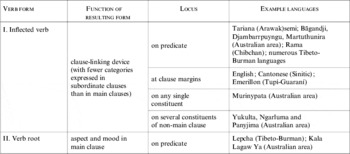
Case markers can appear on (a) fully or partially inflected verbs; and (b) unmarked verb roots. A case marker with clausal scope may be able to occur on any single constituent in a clause, or on several constituents, or at the margins of a clause. Table 1 contains a summary of morphosyntactic contexts (or loci) of cases and the functions of the resulting forms, with example languages.Footnote 6
Case morphemes on verb roots and on inflected verbs

As mentioned in section 1, functions of a noun phrase in a clause can be expressed either through bound case morphemes or through adpositions (see Blake Reference Blake2001). Table 1 includes both versatile nominal cases and versatile adpositions (e.g. prepositions in English, postpositions in Rama). Based on this summary, we can note two tendencies, discussed at A and B below.
A. If a case morpheme occurs on an inflected verb, it is most likely to be used as a clause-linking device. In such a use, the ‘case-marked’ verb is the predicate of a subordinate clause, and thus tends to express fewer categories than would be possible in main clauses. For instance, Tariana (Arawak: Aikhenvald Reference Aikhenvald2003: 524) employs two case morphemes on verbs inflected for person. The marker -se, whose meaning with noun phrases covers location, direction and source, means ‘as soon as’ when used as a clause-linker. The case marker -ne ‘instrument; reason; location “along”; comitative “together with”’ marks clauses with the meaning of ‘reason’ (Aikhenvald Reference Aikhenvald2003: 530f.; 2006: 185f.). Example (3), from Tariana (author's fieldnotes), illustrates -se both on a noun phrase and with a clausal scope.
(3) {panisi-se nu-nu-se} {nu-wana-de pi-na}house-loc 1sg-come-loc/as.soon.as 1sg-call-fut 2sg-obj‘As soon as I come into the house I will call you’Footnote 7
A case marker with clausal scope may have additional freedom in its position within the clause which a nominal case lacks. For instance, in Murinypata (Australian: Walsh Reference Walsh1976: 163, 263–266) the ergative-instrumental inflection – which attaches to nouns – is the same as the affix ‘when’, which can attach to any constituent (most often to verbs). In Yukulta (Australian: Keen Reference Keen, Dixon and Blake1983, Dench & Evans Reference Dench and Nicholas1988: 22f.) a case marker as a clause-linking device can occur on any constituent except for the subject (similar phenomena have been noted in Ngarluma and Panyjima: Dench & Evans Reference Dench and Nicholas1988: 23f.; see Dixon Reference Dixon2002: 238f. for a summary). Such curious facts are relevant for synchronic descriptions, but they are of little help in determining which context of the case marker is diachronically prior.
Other languages provide clues which are relevant for the path of development of the markers. A case-morpheme with clausal scope may have a different morpho-syntactic status than the same morpheme with a noun phrase. Postpositions in Rama are independent phonological and grammatical words (for instance, they have their own stress, and can be separated from the noun by intervening constituents), while the corresponding subordinators are suffixes. This difference in morpho-syntactic status is relevant for determining the direction of grammaticalization of these morphemes: from a postposition (a free morpheme) to a subordinator (a bound morpheme). A selection of these is shown in (4) (Craig Reference Craig, Traugott and Heine1991: 470).Footnote 8
(4) Postposition Subordinator
kama ‘goal’ -kama ‘purpose’
ka(ng) ‘ablative’ -ka ‘time, condition’
su ‘locative’ -su ‘time, after/upon’
Versatile cases can occupy different positions depending on whether their scope is a noun phrase or a clause. When used adnominally, they may be clitics or free morphemes (see section 1 above and Blake Reference Blake2001: 9–12). Once they have clausal scope, they occur on clause margins (similarly to other clause-linkers in a given language). English has a number of such prepositions, as, for instance, since, which can be used with either a noun phrase or a clause as its scope (see (7a, b)–(8a)).Footnote 9
B. Case morphology on a bare verbal root marks aspectual and modal categories, as in Lepcha (Tibeto-Burman: Plaisier Reference Plaisier2006: 120) and in Kala Lagaw Ya (Kennedy Reference Kennedy1984: 162). These morphemes show no differences in their morphosyntactic status or position in the clause whether they occur on noun phrases or on verbs. In (5), from Lepcha, the morpheme marking locative case on the noun phrase ‘his house’ also marks a hortative form of the verb:
(5) hudo-sá lí-ká nóng-ká3sg.obl-gen house-loc go-loc‘Let's go to his house’
We will now turn to a brief survey of case markers as clause linkers and as markers of clausal categories.
2.2 Cases as markers of clause linking
2.2.1 An overview
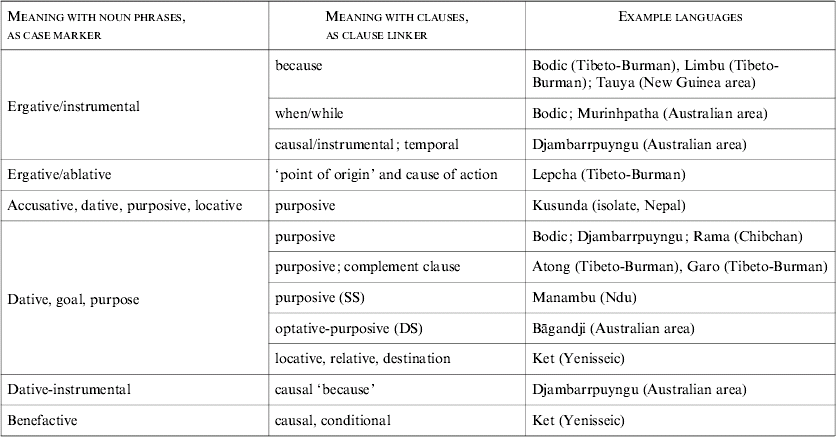
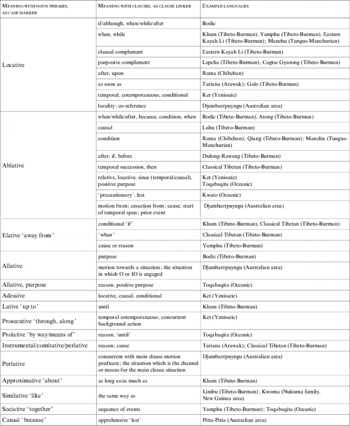
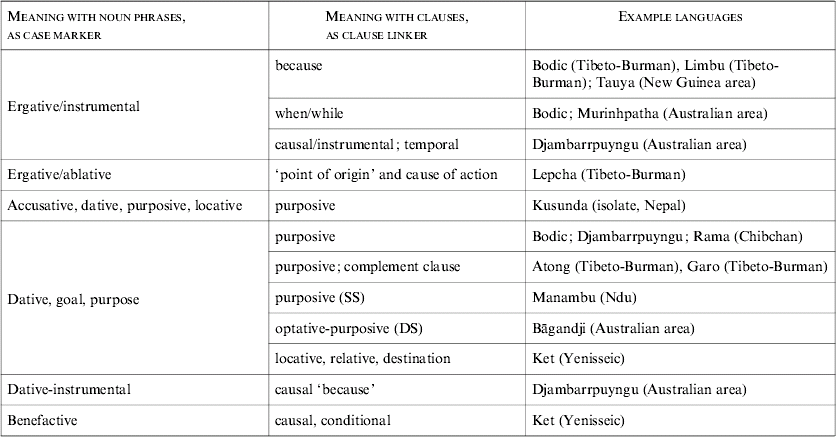
Tables 2 and 3 contain a list of recurrent meaning correspondences between cases with noun phrases, and with clauses, as their scope. Table 2 features cases which combine core and non-core (oblique, or peripheral) functions (ergative-instrumental, ergative-ablative, etc.). Table 3 features cases that only have non-core functions (locative, allative, etc.). In each instance, I provide one or two illustrative examples of languages where such a phenomenon has been documented synchronically (the sources are listed in appendix 2).Footnote 10
Meanings of cases having core uses, with noun phrases and with clauses
Meanings of cases lacking core uses, with noun phrases and with clauses

2.2.2 Semantics of cases as clause linkers
Polysemous cases which combine core and oblique functions appear to be more likely to have a clause as their scope than purely core cases. The few examples of purely core cases marking clause linking involve Muskogean languages (e.g. Koasati, where the nominative case suffix -k is identical to the same-subject switch reference suffix, and the accusative -n to the different-subject marker: see Kimball Reference Kimball1991: 225, 391–395, 522–525; parallel phenomena in Choctaw are in Nicklas Reference Nicklas1974: 98, 211; see also Jelinek Reference Jelinek, Marácz and Muysken1989: 135–137, and Jacobsen Reference Jacobsen, Haiman and Munro1983: 176). In Yuman languages the erstwhile allative suffix -m came to be used as a same-subject marker in clause linking (Kendall Reference Kendall1975: 4, Langdon Reference Langdon, Campbell and Mithun1979: 630). In some Yuman languages it also developed into an object case and subsequently acquired the role of a clause complementizer (Jacobsen Reference Jacobsen, Haiman and Munro1983: 175). The correlation between nominal core objective case and a complementizer was pointed out for Diegueño by Gorbet (Reference Gorbet1973: 221); see also Gorbet (Reference Gorbet1976: 121–128; 1979: 261–263) for the putative development of subjective case into a same-subject clause-linking morpheme. Muskogean and Yuman (where the interpretation varies depending on the reconstruction and approach) have not been included in table 2, so as to keep it relatively simple.
In Lepcha and Bodic languages (Tibeto-Burman), and in Murinypata and Djambarrpuyngu (Australian), the ergative case has an additional, oblique-argument marking function, and is employed to link clauses. In Kusunda, the accusative-purposive case marks direct object, recipient, beneficiary and purpose (in addition to ‘dative subject’), and location; it is also employed as a clause-linking device. Tables 2 and 3 show that there are few if any semantic differences between core and non-core cases when they are used as clause-linking markers. The two sets of case-markers are presented in separate tables simply for ease of reference.
Cases and adpositions on noun phrases mark the functions of those noun phrases within the clause (see the overview in Blake Reference Blake2001). In contrast, the meanings of the same morphemes as clause linkers are consistent with the major semantic types of clause linking (see Dixon forthcoming b; and also the partial list in Thompson & Longacre Reference Longacre and Shopen1985: 177), which include temporal sequence, condition, cause, purpose, possible consequence, location, and manner. Case markers are also used as complementizers. There appear to be no examples of cases used for expressing conjunction or disjunction of clauses. Tables 2 and 3 show that a case may sometimes have a very similar meaning when it occurs with a noun phrase and with a clause. Other times, there are consistent differences.
Before proceeding to generalizations capturing these differences, we examine two examples, (a) from English, and (b) from Ket.
(a) English has a handful of prepositions which can also occur on a clause, marking its syntactic relationship with another clause. These are: after, before, since, until, till, and for. The meaning of most prepositions when used with a noun phrase and with a clause is the same: compare (6a) and (6b). Curly brackets indicate the boundaries of the noun phrase and of the clause within the scope of the preposition.
- (6)
(a) She had a hard time after {the death of her husband}.
(b) She had a hard time after {her husband died}.
The preposition since is less straightforward: it has a temporal meaning when used with a noun phrase and either a temporal or a causal meaning when used with a clause. Both (7a) and (7b) are acceptable, and the preposition since has a temporal meaning in both examples; in (7a) its scope is a noun phrase, and in (7b) it is a clause.
- (7)
(a) I've been very lazy since {the end of summer school}.
(b) I've been very lazy since {summer school ended}.
However, in its causal meaning since can only be used with a clause, as in (8a). This meaning with a noun phrase argument would not be grammatical, as shown in (8b).
- (8)
(a) Since {I disliked his manner}, I turned him down.
(b) *Since my dislike for his manner, I turned him down.
Further discussion can be found in Long (Reference Long1965) and in Quirk et al. (Reference Quirk, Greenbaum, Leech and Svartvik1985: 659f.). The temporal and the causal meanings are semantically linked – if two events are mentioned together as following each other in time, it may be possible to infer that one is the cause of the other (see Thompson & Longacre Reference Longacre and Shopen1985: 181ff., Longacre Reference Longacre and Shopen1985). However, the fact that since expresses a causal relationship only when it links clauses alerts us to the fact that the context of use may entail different semantic overtones for what has traditionally been considered the same polysemous morpheme. Along similar lines, a locational case may have a somewhat different array of meanings with nouns and with clauses. This takes us to the next example.
(b) Ket (a Yenisseic language: Werner Reference Werner1997a: 105, 354) has nine clausal cases (not counting genitive), six of which can be used for clause linking.Footnote 11 Adessive case means ‘at, towards’ when used with nouns, as shown in (9) (from Vajda Reference Vajda2004: 27). It can also mark the second argument of verbs denoting thinking (about something) or narrating (about something).
(9) bū láɣ-ìn-nà-ŋta òn s
 k du-o-il-daq3masc Selkup-pl-ap-ades many years 3masc.sj-d-pt-live‘He lived among the Selkups (lit. at the Selkups, that is, at their camp) for many years’
 k
 du-o-il-daq3masc Selkup-pl-
If used with clausal scope, the meaning of the adessive is causal, locative, or conditional. The causal meaning ‘because’ is illustrated in (10) (unglossed example from Werner Reference Werner1997a: 353; glosses from Anderson Reference Anderson and Vajda2004: 68):
(10) {at t-lɔver-a-vet-diŋta} at saʔj iñ-d-aqI 1-work-present-sf-ades I tea p/perf-1-give‘Because I work, give me tea’
The locational meaning of the adessive case is typical of nominal cases, while causal and conditional meanings are typical of clause-linking semantics (see Thompson & Longacre Reference Thompson, Longacre and Shopen1985: 177, and Dixon forthcoming b).
In a nutshell, the meanings of cases on noun phrases are consistent with the semantic functions of noun phrases, as recipients, beneficiaries, instruments, and locations. The meanings of cases as clause-linkers follow the major semantic types in linking clauses. These clause-linker meanings are intertwined: temporal sequence often has overtones of condition and cause; purposive clause linking may also indicate cause, or consequence, or ‘lest’ (Dixon forthcoming b). Based on the selection of language-specific correlations between the meanings of a case when occurring with a noun phrase and with a clause, as exemplified in tables 2 and 3, we can suggest a number of semantic correspondences between noun-phrase functions and clause-linking devices.
I. Noun-phrase markers with a dative, purposive, or benefactive meaning tend to have purposive meanings as clause linkers. But, despite its frequency, this is not a steadfast rule: in Ket, the dative case marker is used to mark locative clauses and even relative clauses (Werner Reference Werner1997a: 353), alongside ‘destination’ (Vajda Reference Vajda2004: 25).
II. Noun-phrase markers with locational meanings are likely to develop temporal connotations indicating relative time – ‘while, as soon as, after, upon’ and others – if they have a clause as their scope. This correlation is akin to the well-documented semantic extension from spatial to temporal notions in the domain of adverbs and of case markers (Haspelmath Reference Haspelmath1997; Heine & Kuteva Reference Heine and Tania2002: 40f., 179f., 183). This is supported by recent psychological experiments, confirming that ‘spatial representations are the source of temporal representations’ (Gentner et al. Reference Gentner, Imai and Boroditsky2002: 557).
The locational meaning of a noun-phrase marker can carry over to its meaning when occurring with a clause, but within a temporal rather than a spatial domain. For example, the perlative case means ‘along’ in Djambarrpuyngu noun phrases, and ‘concurrent with main clause’ when used on clauses containing motion predicates. An additional extension of ‘along’ when used with clausal scope is ‘the situation which is the channel or means for the main clause situation’ (Wilkinson Reference Wilkinson1991: 641f.). In Kham, lative ‘up to’ means ‘until’ when used with a clause (Watters Reference Watters2002: 317; see also examples in Blake Reference Blake1999: 307f., from Australian languages; and especially Genetti Reference Genetti1986, Reference Genetti, Traugott and Heine1991).
There can be additional extensions. A conditional meaning for a locative case marker when used as a clause-linker is documented for Ket; this can be viewed as an extension of its temporal meaning (Werner Reference Werner1997a: 354). Elative and ablative have conditional meanings in a number of languages (Rama, Qiang, Kham and Classical Tibetan). This development can be considered an extension of an erstwhile temporal meaning of a locative morpheme (see also Thompson & Longacre Reference Thompson, Longacre and Shopen1985, for links between condition and time in clause-linking). A locational case marker can express purpose. In some Tibeto-Burman languages, a locative marks purpose complement (as in Lepcha: Plaisier Reference Plaisier2006: 119f.; and Cogtse Gyarong: Nagano Reference Nagano, Thurgood and LaPolla2003: 487). Lichtenberk (Reference Lichtenberk, Traugott and Heine1991: 71–74) provides an explanation of how an ablative postposition came to mark positive purpose in Toqabaqita, and negative consequence ‘lest’ in Kwaio.
III. Noun-phrase markers with instrumental meaning have a causal or a temporal meaning when used as clause linkers. At least in one of the languages where this development has been attested the instrumental case on a noun can also express cause as a clausal linker, as in Tariana (Aikhenvald Reference Aikhenvald2003). We will see in section 3.4.2 that an instrumental case without a causal meaning is used for manner clause linking.
Other, more ‘exotic’ non-core cases are relatively straightforward. The similative case ‘like’ in Kwoma and in Limbu has the same meaning as a clause linker; the sociative marker on nouns expresses sequence of events in Yamphu and Toqabaqita. Approximative ‘about’ in Kham develops an appropriate clause-linking meaning of temporal ‘as long as’, or quantitative ‘as much as’ (Watters Reference Watters2002: 317).
In none of the instances mentioned in tables 2 and 3 using what looks like a nominal morpheme – a case or an adposition – on a verb does not imply an underlying nominalization.Footnote 12 In the absence of an overt nominalizing morpheme, to say that a verb must be nominalized with a zero marker in order to be used with a case or an adposition is pure conjecture. There is no reason to believe that a verb like nu-nu-se ‘as soon as I come’ in (3) in Tariana is nominalized. If it were, it would be the only instance of a zero-marked nominalization in the language.
In addition, in Tibeto-Burman languages (such as Lepcha: Plaisier Reference Plaisier2006), the subject of a nominalization is marked differently from that of a subordinate clause whose predicate takes a case marker as a linking device. English also has a wide variety of nominalizing devices (see Dixon Reference Dixon2005: 322–352); but there are no language-internal reasons to consider dependent clauses like the ones in (6b) and (7b) and (8a) as ‘nominalized’. Along similar lines, Genetti (Reference Genetti, Traugott and Heine1991: 246) argues that in Classical Newari, ‘the first stage in the development of postpositions to subordinators’ was ‘the suffixation of nominal postpositions to fully inflected finite’ verb forms, ‘which lacked overt nominalizing suffixes’.
We conclude that, as expected, the semantics of ‘cases’ as clause-linkers fits in with the mould of semantic patterns of clause linking. A recurrent semantic correspondence is that holding between a spatial meaning of a nominal case and a temporal meaning of a clause linker, confirming that the domains of space and time share conceptual structure (see Boroditsky Reference Boroditsky2000: 25f. for experimental results to this effect, and the discussion of the underlying mental representations).
In terms of its historical development, the polysemy of nominal cases and clause-linkers has often been understood as a product of ‘grammaticalization’ of cases to clause linkers (in the conventional sense of the term, see Meillet Reference Meillet1912; Heine & Kuteva Reference Heine and Tania2002). The facts of Rama (Craig Reference Craig, Traugott and Heine1991: 471) corroborate this. Postpositions with noun phrase scope in Rama (see (4)) are free morphemes, while the corresponding markers with clausal scope are bound morphemes. This can be interpreted as pointing towards a unidirectional grammaticalization path:Footnote 13
(11) adposition (free morpheme) with noun-phrase scope>adposition with clausal scope (developed into a bound morpheme)
The direction of development in (11) is congruent with a general path of semantic change (especially in grammaticalization) whereby more specific meanings, or meanings based on a specific situation, become more general, or ‘based on the textual situation’ (Genetti Reference Genetti, Traugott and Heine1991: 249).Footnote 14
2.3 Cases as markers of clausal categories
Cases as markers of clausal categories of aspect, mood and modalities can historically originate from cases as clause-linkers – see section 2.3.1. Cases on noun phrases within a clause can also impart aspectual value to the clause as a whole – see section 2.3.2.
2.3.1 How clause-linking cases come to mark categories of a main clause
We can recall from table 1 that, when case markers occur on verb roots,Footnote 15 they are likely to express clausal categories such as aspect, modality, and mood.
Similar developments occur if case markers attach to deverbal nominalizations used as predicates of dependent clauses. If a dependent clause becomes reinterpreted as a main clause via ellipsis, the case morphemes are reinterpreted as aspect or modality markers. This path is summarized by Blake (Reference Blake1999, especially his table 3 on p. 304), for Australian languages.Footnote 16
For instance, a dependent apprehensive clause referring to possible negative consequence typically occurs with the main clause expressing a warning, or something to be avoided, as in (12), from Pitta-Pitta (Blake Reference Blake1999: 307, 310).
(12) wilakana-ya kiniyarri [nhan-(nh)a-ka piyawarli-lu patya-ka-la]hide-present girl she-acc-here dog-erg bite-[p]-lest‘The girl is hiding lest the dog bite her’
The case marker -la – which means ‘lest’ with clauses – has a causal meaning with noun phrases. It also marks the complement of verbs of fear (Blake Reference Blake, Dixon and Blake1979: 198), as in (13):Footnote 17
(13) kiniyari &ndsqrb;an-pa-ka
alala kupakupa-lagirl she-nomin-here afraid old.man-causal‘The girl is frightened of the old man’
 alala kupakupa-lagirl she-
The main clause may be left out in Pitta-Pitta, and then the erstwhile dependent clause comes to be used on its own, with the same ‘apprehensive’ meaning, as in (14) (Blake Reference Blake1999: 310):
(14) nhan-(nh)a-ka piyawarli-lu patya-ka-lashe-acc-here dog-erg bite-[p]-lest‘The dog might bite her’
In Dixon's (Reference Dixon2002: 239) words, ‘types of subordinate clauses have been reanalyzed as main clauses, so that what were verbal suffixes marking subordination now take on TAM [tense, aspect, mood] values’. A typical development involves the aversive case ‘for fear of’ on a noun phrase to apprehensive modality on a verb in a clause (shown in (13) and (14)), and from dative case on noun phrases to purposive, intentional, or future on clauses (Dixon Reference Dixon2002: 237–239; Blake Reference Blake1999: 309f., 1993: 40).
Along similar lines, in Dyirbal -gu (Dixon Reference Dixon1972) is used both as dative on nouns and as purposive marker on verbs (of one conjugation). In Kalkatungu (Blake Reference Blake1999: 315), the dative case marker -ya forms a purposive in combination with past and proprietive markers (the resulting form is: -ny-tya-ya p-prop-dat). In this same language, a combination of -ya ‘dative’ (on nouns) and future -mi forms potential -mi-ya.Footnote 18
Reanalysis of dependent clauses as main clauses does not always proceed through the intermediary of a nominalization (as happens in Australian languages). The manifold meanings of -k and -m in Maricopa (Yuman) verbs in independent clauses appear to go back to their uses in dependent clauses (Gordon Reference Gordon and Munro1980: 140), but no nominalization is postulated.Footnote 19
2.3.2 ‘Aspectual’ cases
A clausal category can be expressed not only by a case marker on a predicate, but also by case on a noun phrase, as illustrated in this section. In numerous Balto-Finnic languages, especially Finnish, the choice of partitive vs. accusative case for the object of a number of verbs has aspectual implications.Footnote 20 Examples (15) and (16) (from Kiparsky Reference Kiparsky, Butt and Geuder1998) illustrate this semantic effect. The ‘irresultative’, unbounded, and atelic event in (15) involves partitive case on the object; the bear was shot at, but not killed.
(15) Ammu-i-n karhu-ashoot-p-1sg bear-part‘I shot at the/a bear’
In contrast, the resultative and bounded version in (16) involves the object marked with the accusative. (16) ‘denotes an accomplishment, “to shoot dead”’, while (15) ‘denotes an activity’ (Kiparsky Reference Kiparsky, Butt and Geuder1998: 267):Footnote 21
(16) Ammu-i-n karhu-n shoot-p-1sg bear-acc‘I shot the/a bear (it is dead)’
Finnish also has intrinsically ‘unbounded’ verbs (such as ‘love’, ‘touch’) which require partitive objects, and intrinsically bounded verbs (such as ‘kill’, ‘find’) which require the accusative. The partitive case also denotes objects of indeterminate quantity (‘some’), and can be described as a marker of indefiniteness (see Sands Reference Sands2000; Sands & Campbell Reference Sands, Campbell, Aikhenvald, Dixon and Onishi2001).
In addition to this, in Finnish, ‘the use of local cases […] has aspectual implications. The inessive and adessive case imply a continuing activity and so have imperfective aspect, whereas the elative, illative, ablative and allative all imply an end-point of the activity and perfective aspect’ (Sands Reference Sands2000: 277; and a summary in Hakulinen Reference Hakulinen1961: 333). ‘The process as opposed to the result is indicated with the static-location cases (inessive and adessive)’ (Sands Reference Sands2000: 277). If the allative case is used, as in (17), the activity is considered to be a result; this station may be the train's final destination:
(17) Juna pysähtyi asema-lletrain stop.p.3sg station-all‘The train stopped at the station (lit. towards the station as its final destination)’
In (18), the adessive case implies that the station is ‘simply a stopping point on the train's journey, and the train continues on’. (Comparable phenomena in Estonian are addressed in Tuldava Reference Tuldava1994: 106f.).
(18) Juna pysähtyi asema-llatrain stop.p.3sg station-ades‘The train stopped at the station (lit. at the station as a passing point)’
In each of these instances, the way in which a noun phrase is marked affects the aspectual value of the clause. The semantic effect of case is reminiscent of the absolutive/dative case alternation in Warlpiri: marking the object (O) of a verb like ‘shoot’ as dative rather than as absolutive describes ‘the situation in which the effect normally resulting from the action denoted by the verb is, for one reason or another, aborted or else is subordinated in importance to the action itself’ (Hale Reference Hale and Swartz1982: 249). This phenomenon has further been characterized as a ‘conative’ case alternation which imparts a special ‘irresultative’ aspectual value to the clause as a whole (see Kiparsky Reference Kiparsky, Butt and Geuder1998: 266, 295f., and further references there). All this helps to confirm the status of aspect and modality as clausal categories which do not necessarily have to be marked specifically on the predicate.Footnote 22
Historically speaking, the partitive case in the Balto-Finnic subgroup of Finno-Ugric comes from a locational case with a separative meaning ‘from’ (see Laanest Reference Laanest1975; Kiparsky Reference Kiparsky, Butt and Geuder1998). Correlations of case marking with aspect are generally considered a later development in Balto-Finnic. Larjavaara (Reference Larjavaara1991) hypothesizes that the locational ‘from’ case developed an aspectual overtone via a ‘quantificational’ meaning ‘some’ with a noun phrase. Further historical and comparative evidence indicates that, in Balto-Finnic, ‘the partitive's emergence as a structural case is a precondition for the rise of its aspectual function’ (Kiparsky Reference Kiparsky, Butt and Geuder1998: 305). That is, the noun-phrase-level function of a case is primary with respect to its other functions, such as marking aspect. This is comparable to the generalization under (11) above: a case or an adposition with noun phrase scope may develop into a case or an adposition with clausal scope, but not the other way round.
We now turn to similar phenomena in Manambu, a previously undescribed language from New Guinea.
3. Versatile case in Manambu
Manambu, from the Ndu family (East Sepik, Papua New Guinea),Footnote 23 offers a particularly rich array of cases that can be employed both with noun phrases and on verb roots. Case morphemes are used both as clause-linking devices (cf. section 2.2) and as markers of clausal categories (cf. sections 2.3.1–2.3.2).
3.1 Background information
Manambu is predominantly suffixing and agglutinating with some fusion, and combines both dependent-marking and head-marking. Nouns and verbs are clearly distinguished in terms of their categories, inflectional possibilities and syntactic behaviour. Nominal categories are gender, number, a system of nine case forms, and a number of derivational processes. Verbal categories include person, number, gender, aspect, mood, modality, direction, and a variety of clause-chaining markers.
Declarative verbs cross-reference two arguments: the subject and any other argument – except copula complement and speech report – which is more topical than the subject. Verbs in different-subject medial clauses cross-reference just the subject. No argument is cross-referenced on verbs marked for modalities such as desiderative and frustrative and a number of aspects. Likewise, predicates in same-subject clauses take no cross-referencing markers.
A verbal root or an inflected verb cannot be used as an argument or head a noun phrase. Deverbal action nominalizations are used instead; these are derived from the verbal root via full reduplication, e.g. war ‘ascend’, warwar ‘ascending’.
3.2 Cases on nouns and on verbs in Manambu
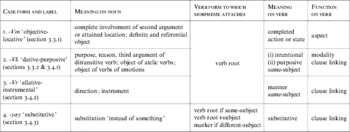
Four of the nine case suffixes in Manambu can occur on verbs. All cases (except for the adnominal comitative) are marked once per noun phrase, almost always on its last word, which is also the head of the noun phrase.Footnote 24 When used on verbs, they appear once per clause. Meanings and functions of cases on nouns and on verbs are summarized in table 4. Cases as markers of aspect and modality are addressed in section 3.3. Cases as markers of clause linking are discussed in section 3.4.
Meanings and functions of cases in Manambu on nouns and verbs

3.3 Cases as markers of aspect and modality
Two cases – the objective-locative and the dative-purposive – can occur on predicates of a main clause, and impart an aspectual or a modal meaning to the whole clause. The resulting verbal forms have the same argument structure as a verb in any other context; they cannot take any cross-referencing. The person reference is either specified with a pronoun, or is recoverable from the context.
3.3.1 The objective-locative case and completive aspect
The objective-locative case -Vm on noun phrases marks a second argument if the latter is completely involved in the action, or if it is completely affected, or if the action is telic. Consider the verb kwakə-. It means ‘find’ if the object is marked with the objective-locative in its function as ‘complete involvement case’, as in (19), and ‘search, look for’ if the object is unmarked, as in (20):
(19) {[a takwa:m] kwakə-ku} {wiya:r wula:l}dem.dist+fem.sg woman+lk+obj/loc look.for/find-compl.ss house+lk+all/instr go.inside+3fem.sgbas.p ‘After having found that woman, she went inside the house’
(20) [ñanugw amæy] kwakə-ya-banachildren mother look.for-come-1plsubj.nonpast+3fem.sgbas.nonpast‘We keep looking for children's mother’
The other major function of the objective-locative case is to mark a location which has been reached. An example is given in (21). The objective-locative case also conveys the idea of a completed action of reaching the cassowary's breast by climbing. (The cassowary, a flightless bird, is conceptualized here as a mythological woman. (21) comes from a myth about a man's head clinging to the cassowary's breast as if he was her baby.)
(21) [a məd lə-kə muñ-a:m] ata war-də-ldem.dist+fem.sg cassowary she-obl+fem.sg breast-lk+obj/loc then ascend-3masc.sgsubj.p-3fem.sgbas.p‘He (the man's head) went up to the cassowary's breast (reached it and stayed on it)’
If the destination has not yet been reached, the allative is appropriate, as in (22):
(22) pətəkaur ata war-də-lladder+all/instr then ascend-3masc.sgsubj.p-3fem.sgbas.p‘Then he went up a ladder (but did not reach the top)’
The objective-locative case thus conflates two functions: it marks a core or an oblique argument, and at the same time contributes an aspectual value of ‘completeness’ to the whole clause. This is reminiscent of the aspectual overtones of the partitive case in Finnish discussed in section 2.3.2, and even more so of the locational cases (see (17) and (18) above).
This same objective-locative case morpheme occurs on verbal roots. There, it indicates completion of an action, or total achievement of a state, e.g. (23):
(23) wun [də-kə-m] wukəmar-ə-mI he-lk-obj/loc forget-lk-obj/loc‘I completely forgot him’
The completive meaning of the objective-locative case on a verb is strongly reminiscent of the overtone of ‘complete’ involvement of an object or a location which is characteristic of the objective-locative as used with noun phrases. None of Manambu's relatives has any cognates of the objective-locative case. Consequently, we cannot tell which function of the -Vm form is historically prior. This is quite unlike the Balto-Finnic languages (see section 2.3.2), where – as we know – the primary function of cases with ‘aspectual’ overtones was to mark grammatical relations, while the aspectual overtones represent a later development.
3.3.2 The dative-purposive case and intentional modality
The dative-purposive case -Vk with noun phrases expresses intention and purpose, as in the first clause of (24), and the third argument of a ditransitive verb, as in the second clause:
(24) [sana:k ya-k-na-di] sa:n dayak kui-tukwamoney+lk+dat/purp come-fut-act.foc-3plbas.nonpast money they+dat give.to.third.person-proh‘They will come for money (to get money, with the intention to receive money), don't give them money’
The dative-purposive case is also used to mark reason (as in (26), on agwajapək ‘what for’), the object of verbs of emotions, such as ‘like’, ‘dislike’, ‘yearn for’, ‘refuse’, and the object of verbs of fear. It can also mark the object of an atelic verb with slightly frustrative overtones. We can recall, from (19), that the verb kwakə- means ‘find (telic action)’ if its object is marked with the objective-locative case, indicating complete involvement of the second argument; if the object is unmarked, the action is atelic (‘look for’), as in (20). If the object is instead marked with the dative-purposive case, the action is equally atelic, but with an additional frustrative overtone of ‘doing something in vain’:
(25) amæyik kwakə-danamother+lk+dat/purp look.for-3plsubj.nonpast+3fem.sgbas.nonpast‘They are looking for their mother in vain (and not finding her)’
The semantic effect of the objective-locative case in (19), as compared to that of the dative-purposive case in (25), is strongly reminiscent of the absolutive/dative case alternation in Warlpiri (see Hale Reference Hale and Swartz1982: 249; and section 2.3.2 above). The dative-purposive case imparts a modal frustrative value to the whole clause.
The dative-purposive case when occurring on a verbal root form marks intentional modality. In (26), it attaches to the verb root warya- ‘fight’:
(26) ñən wun-a-wa agwa-japək warya-kyou.fem I-lk-com what-thing+lk+dat fight-dat/purp‘I am going to fight, why (lit. what for) are you going to fight with me?’
The semantic link between the purposive meaning of the dative-purposive on nouns, as in (24), and on verbs, as in (26), is straightforward. The dative-purposive on verbs is also used as a clause-linking device – see the next section.
3.4 Cases as markers of clause linking in Manambu
Three case forms in Manambu are used as clause-linking devices. The dative-purposive case occurs on the root of the predicate of a dependent clause to mark a same-subject purposive complement. The allative-instrumental case on a verb root marks the predicate of a same-subject manner clause. The substitutive case on a verb root marks a same-subject dependent clause with the substitutive meaning ‘instead of doing X, rather than doing X’. If the substitute attaches to a verb inflected just for subject, it marks a different-subject dependent clause with the same substitutive meaning.
We can recall, from section 3.1, that predicates of all same-subject clauses in Manambu are unmarked for subject. Predicates of different-subject clauses do mark subject. The behaviour of case-marked dependent clauses is consistent with this pattern.Footnote 25
3.4.1 The dative-purposive case and same-subject purposive clauses
The intentional or purposive meaning of dative-purposive-marked predicates echoes the meaning of similarly marked noun phrases. A same-subject purpose complement to a verb of motion is shown in (27):
(27) {wun {mən-a:m karda-k} war-na-dəwun}I you:masc-lk+obj/loc take+down-purp.ss ascend-act.foc-1masc.sgbas.nonpast‘I have come up to take you downwards’
A noun marked with the dative-purposive and a verb marked with the same-subject verbal purposive are used in identical contexts. (28) illustrates a dative-purposive-marked verb warya- ‘to fight’ expressing purpose of speaking. In (29), a dative-purposive-marked noun di ‘shit’ is used.
(28) warya-k wa-nafight-purp.ss say-act.foc+3fem.sgbas.nonpast‘She intends to fight (lit. she said she was going to fight)’
(29) diya:k wa-nashit+lk+dat/purp say-act.foc+3fem.sgbas.nonpast‘She intends to have a shit (lit. she said for shit)’
There is no reason to consider the same-subject purposive form, or the intentional, a nominalization. These forms have no nominal properties whatsoever. Neither does the bare root of a verb. The intentional and the same-subject purposive are semantically similar. One may hypothesize that both go back to the dependent purposive, and postulate a subsequent reanalysis of the dependent purposive as a main clause, and of the verb form as intentional modality (along the lines of section 2.3.1 above). This analysis is plausible. However, it does not account for the lack of same-subject constraint when the morpheme occurs in intentional modality, and thus remains a mere hypothesis.
Whether an originally nominal case in fact got extended to a verbal environment in Manambu is an open issue. The cognates of the Manambu dative-purposive appear on both nouns and verbs in related languages. The Maprik dialect of Ambulas (Ndu family, Papua New Guinea: Wilson Reference Wilson1980: 68–75, 119f.) has a ‘referential’ case -ke which marks purpose, goal and theme (of a conversation). The same case-morpheme occurs as a marker of intentional modality in dependent clauses (cf. also Wendel Reference Wendel1993: 88, 102). This suggests that the dative-purposive in Proto-Ndu could have been just as polyfunctional as it is in the present-day languages, and that there is no reason to consider either the nominal or the verbal context to be diachronically prior.
3.4.2 The allative-instrumental case and same-subject manner clauses
Unlike the objective-locative and the dative-purposive cases which can mark core arguments, the allative-instrumental case always marks obliques. When used with noun phrases, the allative-instrumental case -Vr marks direction, as in (22), and instrument, as in (30):Footnote 26
(30) [am-awa nəbi:r] ata vya-də-dibow-lk+com arrow+instr then hit-3masc.sgsubj.p-3plbas.p‘He then hit them with bow and arrow’
The allative-instrumental case has an additional meaning of ‘along’ (e.g. a road). It does not have any comitative overtones; neither is it used to express reason.
The allative-instrumental case appears on verbal roots to mark the predicate of same-subject manner clauses, as in (31).
(31) {ñam kuyar} {ñanugwa:k kamna:gw kui-la}chewed.food give.to.third.person+instr children+lk+dat food give.to.third.person-3fem.sgsubj.p+3fem.sgbas.p‘She gave food to children by giving (them) chewed food’
Tables 2 and 3 show that cross-linguistically an instrumental case occurring with clauses typically expresses causal or temporal linkage. The unusual meaning of manner linkage of the instrumental case in Manambu may be due to its lack of causal overtones; this is where it differs from the instrumental case in Tariana (see III in section 2.2.2 above). An instrumenal case typically acquires a manner extension (Blake Reference Blake2001). However, Manambu is unusual in that the allative-instrumental case marks manner only when used with verbs as a clause-linking device, and does not express any other semantic relationships (e.g. reason, as in other languages). A noun expressing manner is unmarked for case. Also note that, except in Manambu, case markers do not seem to be used for manner linkage in the languages for which descriptions were available (see table 3).
The allative-instrumental case has clear cognates throughout the Ndu family. However, its use with verb roots has not been documented for any language other than Manambu.
3.4.3 The substitutive case and substitutive clauses
The substitutive case when used with noun phrases means ‘instead of’. Just like the allative-instrumental case, it occurs on obliques only, as in (32).
(32) pilou-a-yæy kusu-wapwi a-takpillow-lk-subst wear-clothes impv-put‘Put clothes (on your bed) instead of a pillow’
The substitutive -yæy on a verbal root is a same-subject sequencing marker with the meaning ‘instead of, rather than’:
(33) {awarwa warya-yæy} {aka kəp lakati-dana}rec fight-subst:ss then just sort.out-3plsubj.nonpast+3fem.sgbas.nonpast‘Instead of fighting each other, they just sorted it out’
If the subjects are different, the substitutive case marker attaches to a partially inflected verb (which, as we can recall, implies cross-referencing just the subject). An example is (34).
(34) {ñən kiya-ñəna-yæy} {də-kə-m vya-təpul-kə-la-d}you.fem die-2fem.sgsubj.nonpast-subst he-obl-obj kill-‘hit’-fut-3fem.sgsubj.nonpast-3masc.sgbas.nonpast‘Instead of you dying, she will kill him’
The substitutive case has no cognates in other Ndu languages. That is, we have no historical information as to whether its adnominal or its verbal use is diachronically prior.
3.5 Case on nouns and on verbs in Manambu: a summary
Manambu demonstrates an unusually rich array of cases used both with nouns and with verbs. In contrast to other verbal predicates of declarative clauses, a ‘case-marked’ verb never cross-references two arguments. This property is consistent with the categories expressed by ‘case-marked’ verbs, since in Manambu most modalities, aspects and same-subject clauses take no cross-referencing. Different-subject clauses cross-reference only the subject. None of the case-marked verbal forms has any nominal properties.
We saw above that some languages employ case morphemes as clause-linkers; others use them to express aspectual and modal meanings. Manambu appears to be unique in that it offers both options. Three case markers link clauses – these are dative-purposive, allative-instrumental and substitutive. Two case markers express main clause categories of aspect and modality – these are objective-locative and dative-purposive. Case morphemes on verbs in Manambu have a wider array of functions than in any other language described so far which exhibits the versatile case phenomenon.
The meanings of these case morphemes on verbs are transparently related to those of the same case morphemes on nouns. But the detailed correlations are not identical. The objective-locative case has a distinct overtone of complete involvement of the second argument, that is, a completely affected object, as in (19). On an oblique it marks a completely attained location, as in (21). The case on a noun imparts an overtone of telicity to its clause. This semantic feature of completeness acquires enhanced prominence when the case marker attaches to the predicate: the objective-locative case on verbs marks completive aspect.
The dative-purposive case has the object of intention or incompletely affected object one is seeking to affect as components of its meaning (see (24)). This intentional meaning becomes prominent once the marker attaches to a verb root. The result is intentional modality. In addition, the dative-purposive case on a noun may impart a meaning of atelic action (with an overtone of frustrative ‘in vain’) to the whole clause (see (25)).
One multifunctional morpheme thus imparts an aspectual meaning of ‘completion’ and of telicity to the predicate and to the clause; the other imparts a modal meaning of intentionality, and an aspectual one of atelicity. These effects of core cases on verbs are summarized in schema 1. Shared semantic features are in bold.
Semantic overlap in core case markers with noun phrases and with verbs in Manambu

The dative-purposive case on verbs also links clauses. So do the allative-instrumental and substitutive cases. Manambu is unusual (see table 3) in that the allative-instrumental case on nouns marks manner clauses rather than having a causal or temporal meaning. As stated above, the allative-instrumental case does not mark manner on nouns. The substitutive case has identical meanings on nouns and on verbs; this is in line with a few other ‘exotic’ cases mentioned in section 2.2, e.g. similative or sociative, which have the same meaning when used on nouns and as clause-linking devices.
Of the four relevant case forms in Manambu, the adnominal use of the allative-instrumental can be considered historically older than its verbal use, as predicted by the generalization in (11) on page 580 above. For the objective-locative and substitutive cases we cannot tell, due to the absence of cognates. The dative-purposive marker is used both adnominally and with verbs in other languages of the Ndu family. This suggests an old polyfunctionality of the marker -Vk with nouns and with verbs.
Proto-Ndu may have had other versatile cases. Iatmul, another Ndu language, has an oblique case marker -(n)kət which marks recipients, beneficiaries, purpose and intention (and also objects high on the nominal hierarchy: Staalsen Reference Staalsen1965). This form is not used with verbs. It is cognate to Manambu -kər, a marker of purposive-desiderative modality, e.g. wun və-kər (I see-des) ‘I want to see, I intend to see’. The Manambu form is no longer used with nouns. As expected, over the history of individual languages, a conventionalized usage of a morpheme in a given environment may result in its reinterpretation, as is the case with Manambu -kər.
4. What can we conclude?
Case morphemes need not be restricted to noun phrases. If they occur on a verb root, or on an inflected verb, they may link clauses or they may express aspects, modalities and moods. The most common semantic correspondences between the same morpheme as marker of the function of a noun phrase and as clause-linking device are:
I. Dative or purposive marking on a noun phrase tends to have a purposive meaning when used as a clause linker.
II. Locational marking on a noun phrase tends to have temporal or, more rarely, conditional or purposive meaning when used as a clause linker.
III. Instrumental marking on a noun phrase tends to have a causal or temporal, or (more rarely) a manner meaning when used as a clause linker.
The meanings of cases as markers of grammatical functions of a noun phrase and as clause linkers are determined by the syntactic environment. In other words, the same set of morphemes marks typical functions of noun phrases and typical relationships between clauses.
A morpheme may originate as a case with a noun phrase as its scope, and then get extended to be a case with clausal scope, in agreement with the generalization in (11) above (page 580). This direction of development is congruent with a general path of semantic change in grammaticalization – more specific meanings become more general.
Alternatively, the case markers may be inherently polyfunctional, being used both with noun phrases and with clauses. Their meanings will then be partly conditioned by the syntactic environment. They will mark typical semantic functions of noun phrases, such as location, and typical semantic types of clause linking, such as temporal or causal relationships (as outlined by Thompson & Longacre Reference Thompson, Longacre and Shopen1985; Dixon forthcoming b). It is also possible for the same morpheme to mark case and clausal categories of aspect, modality and mood. This second function may develop out of the first one as the result of reinterpretation of erstwhile dependent clauses as main clauses. If so, then case morphemes as exponents of clausal categories can be traced back to their use as clause linkers.
Alternatively, case morphemes on verbs may have aspectual and modal meanings by virtue of their inherent polyfunctionality. A prime example comes from Manambu (also cf. Kennedy Reference Kennedy1984: 162 for a similar approach to Kala Lagaw Ya). Since nouns typically have more concrete meanings than verbs, the underlying semantic differences between word classes trigger the meaning differences between the same morphemes when occurring on nouns and on verbs. The inherent polyfunctionality of cases as markers of aspect and modality in Manambu verbs is corroborated by the way in which these cases impart aspectual and modal meaning to a clause even when they occur on a noun phrase (see schema 1).
We hypothesize that core cases are likely to affect the aspect and modality value of the whole clause. This is corroborated by the evidence from Manambu and a number of other languages (see Kiparsky Reference Kiparsky, Butt and Geuder1998). The same generalisation is also true for cases which can be used both as core and as non-core cases. In contrast, non-core cases are more likely to ‘double’ as clause-linkers only.
To conclude: cases which are used both on noun phrases and on verbs are ‘chameleon’ morphemes with fairly general semantics which acquire more specific meanings appropriate to their particular morphosyntactic locus (that is, noun phrases or verbs) and syntactic scope (that is, noun phrase or clause). This is quite unlike nominal vs. verbal tense and aspect, which constitute distinct groups of grammatical categories, each in its own right. To the extent that it has been possible to establish generalisations about the contribution of word class to the specific meanings of these case morphemes, this has implications for word class typology, suggesting a semantic basis underlying the grammar of nouns and verbs as universal word classes.
5. APPENDIX 1
5.1 Languages with cases on verbs and the sources
Case morphemes used with verbs have been noted in the following areas:
• Australian languages (Dixon Reference Dixon1972, Reference Dixon1977, Reference Dixon2002; Hercus Reference Hercus1982; Blake Reference Blake, Laycock and Winter1987, Reference Blake1993, Reference Blake1999; Dench & Evans Reference Dench and Nicholas1988; Simpson Reference Simpson and Austin1988), including Kala Lagaw Ya (Kennedy Reference Kennedy1984; Dixon Reference Dixon2002: 239)
• a few languages from Central Siberia, especially Ket and Yugh (Werner Reference Werner1997a, Reference Wernerb; Vajda Reference Vajda2004; Anderson Reference Anderson and Vajda2004)
• a few languages and language families of the Americas, such as Yuman (Gorbet Reference Gorbet1973, Reference Gorbet1976, Reference Gorbet1979; Gordon Reference Gordon and Munro1980: 141; Kendall Reference Kendall1975), Muskogean (Kimball Reference Kimball1991: 225; Nicklas Reference Nicklas1974: 98; Jelinek Reference Jelinek, Marácz and Muysken1989; Jacobsen Reference Jacobsen, Haiman and Munro1983), Kalapalo (Carib: Ellen Basso, p.c.) and Tariana (Arawak: Aikhenvald Reference Aikhenvald2003)
• a few Oceanic languages (Lichtenberk Reference Lichtenberk, Traugott and Heine1991), and languages from the New Guinea area (Tauya: MacDonald Reference MacDonald, Haiman and Thompson1988, Reference MacDonald1990; Kwoma: Kooyers Reference Kooyers1974)
• numerous Tibeto-Burman languages (e.g. Genetti Reference Genetti1986, Reference Genetti, Traugott and Heine1991; Watters Reference Watters2002; Burling Reference Burling2004; Plaisier Reference Plaisier2006; LaPolla Reference LaPolla2004, Reference LaPolla2006; Post Reference Post2007; van Breugel forthcoming; and papers in Thurgood & LaPolla Reference Thurgood and LaPolla2003)
• the recently discovered isolate Kusunda spoken in Nepal (Watters Reference Watters2005a, Reference Watters, Yadava, Bhattarai, Lohani, Prasain and Parajulib).
As with bound cases, adpositions may have a whole clause rather than just a noun phrase as their scope (some describe these as adpositions with a subordinating function). This has been described by Long (Reference Long1965) for English; by Genetti (Reference Genetti1986, Reference Genetti, Traugott and Heine1991) for languages from the Bodic subgroup of Tibeto-Burman; and by Craig (Reference Craig, Traugott and Heine1991) for Rama (Chibchan). Rose (Reference Rose, Bril and Rebuschi2005) offers a partial analysis of this phenomenon in general, adding a few other languages, including Emerillon (of the Tupí-Guaraní group; see also Rose Reference Rose2003). Other studies include Ohori (Reference Ohori and Casad1996) and Akiba (Reference Akiba1977). Konow (Reference Konow1909: 9) was perhaps the first scholar ever to notice this phenomenon in a Tibeto-Burman language.
Case markers can also occur on deverbal nominalizations which otherwise have few nominal properties. Such nominalizations – be they action nominalizations, relative forms of verbs, or ‘participles’, ‘infinitives’, or ‘supines’ – already have some non-verbal features (and some may arguably be considered ‘defective’ nouns or ‘defective’ adjectives). This has been noted for languages from the Cushitic subgroup of Afroasiatic (Palmer Reference Palmer1957; Hetzron Reference Hetzron1969; Hudson Reference Hudson and Bender1976; and summary in Dolgopolsky Reference Dolgopolsky1991), Turkic and Samoyedic (see overview in Anderson Reference Anderson and Vajda2004), Australian (e.g. Dyirbal, Warlpiri, Yidiñ: see Dixon Reference Dixon2002: 237–239), Balto-Finnic and numerous Indo-European languages (see, for instance, Blake Reference Blake1999: 299f.), and Japanese (Ohori Reference Ohori and Casad1996; Martin Reference Martin1975: 885). Tibeto-Burman languages in which case markers attach to nominalized verbs include Meithei (Chelliah Reference Chelliah1997: 172–175), Dumi (van Driem Reference Driem1993: 271, 245f.), and some instances in Yamphu (Rutgers Reference Rutgers1998: 267, 274f.; see also examples in Moravcsik Reference Moravcsik1972). An in-depth study of these is a topic for a separate project which is not undertaken here.
Likewise, I exclude discussion of constructions in which an adposition has to be followed by a subordinator in order to be able to occur with a clause in its scope, as is the case of French avant+Noun Phrase ‘before, in front’ and avant que+clause ‘before’. Similar examples include preposition+that clauses in highly colloquial varieties of American English, e.g. It's something I loved since that I was a kid (Arnold Zwicky, p.c.). Another type of evolving dependent clause structure found in some varieties of Modern American English is wh- constructions accompanied by an additional subordinator that, illustrated in the title of Zwicky (Reference Zwicky, Beaver, Martinez, Clark and Kaufman2002), and discussed there. These constructions also lie outside the scope of this discussion. The effects of cases with deverbal nominalizations, and of composite clause-linkers consisting of an adposition and a subordinator, are comparable to those of cases and adpositions with clausal scope; however, they involve different mechanisms (see the discussion in Rose Reference Rose, Bril and Rebuschi2005 and Ohori Reference Ohori and Casad1996). To limit the scope of the discussion here, I will not consider instances of case markers on a dependent clause which already contains a marker of syntactic dependency.
6. APPENDIX 2
6.1 Sources for languages cited in tables 2 and 3
Atong (Tibeto-Burman): van Breugel (Reference van Breugel2006)
Bāgandji (Australian area): Hercus (Reference Hercus1982: 215)
Bodic (Tibeto-Burman): Genetti (Reference Genetti1986, Reference Genetti, Traugott and Heine1991)
Classical Tibetan (Tibeto-Burman): DeLancey (Reference DeLancey, Thurgood and LaPolla2003: 266)
Cogtse Gyarong (Tibeto-Burman): Nagano (Reference Nagano, Thurgood and LaPolla2003: 487)
Djambarrpuyngu (Australian area): Wilkinson (Reference Wilkinson1991: 634–636)
Dulong-Rawang (Tibeto-Burman): LaPolla (Reference LaPolla2006)
Eastern Kayah Li (Tibeto-Burman): Solnit (Reference Solnit1997: 213, 249, 259)
Galo (Tibeto-Burman): Post (2007)
Garo (Tibeto-Burman): Burling (Reference Burling2004: 189, 319)
Ket (Yenisseic): Werner (Reference Werner1997a: 105, 354)
Kham (Tibeto-Burman): Watters (Reference Watters2002: 317)
Kusunda (isolate, Nepal): Watters (Reference Watters2005a: 62–66, 145–150), Watters (Reference Watters, Yadava, Bhattarai, Lohani, Prasain and Parajuli2005b)
Kwaio (Oceanic): Keesing (Reference Keesing1985), Lichtenberk (Reference Lichtenberk, Traugott and Heine1991: 71)
Kwoma (Nukuma family, New Guinea area): Kooyers (Reference Kooyers1974)
Lahu (Tibeto-Burman): Matisoff (Reference Matisoff1973: 168, 419)
Lepcha (Tibeto-Burman): Plaisier (Reference Plaisier2006: 119–123)
Limbu (Tibeto-Burman): van Driem (Reference Driem1987: 230–235)
Manambu (Ndu): own fieldwork; Aikhenvald (Reference Aikhenvald2008)
Manchu (Tungus-Manchurian): Holm (Reference Holm2006)
Murinypata (Australian area): Walsh (Reference Walsh1976: 263f.)
Pitta-Pitta (Australian area): Blake (Reference Blake, Dixon and Blake1979: 198; 1999: 307, 310)
Qiang (Tibeto-Burman): LaPolla (Reference LaPolla2004: 93, 244f.)
Rama (Chibchan): Craig (Reference Craig, Traugott and Heine1991)
Tariana (Arawak): Aikhenvald (Reference Aikhenvald2003: 530f.)
Tauya (New Guinea area): MacDonald (Reference MacDonald, Haiman and Thompson1988, 1990: 236–238)
Toqabaqita (Oceanic): Lichtenberk (Reference Lichtenberk, Traugott and Heine1991: 67)
Yamphu (Tibeto-Burman): Rutgers (Reference Rutgers1998: 267f.)
7. ABBREVIATIONS
- 1 –
first person
- 2 –
second person
- 3 –
third person
- acc –
accusative
- act.foc –
action focus
- ades –
adessive
- all –
allative
- all/instr –
allative-instrumental
- ap –
animate plural
- appl –
applicative
- bas –
basic person marking
- com –
comitative
- compl –
completive non-main clause
- cust –
customary
- d –
durative marker
- dat –
dative
- dat/purp –
dative-purposive
- decl –
declarative
- dem.dist –
distal demonstrative
- des –
desiderative
- ds –
different-subject
- erg –
ergative
- exc –
exclusive
- fem –
feminine
- fut –
future
- gen –
genitive
- impv –
imperative
- instr –
instrumental
- IO –
indirect object
- lk –
linker
- loc –
locative
- masc –
masculine
- nomin –
nominative
- nsg –
nonsingular
- o –
object function
- obj –
objective
- obj/loc –
objective-locative
- obl –
oblique marker
- p –
past
- part –
partitive
- perf –
perfect
- pl –
plural
- proh –
prohibitive
- prop –
proprietive case
- pt –
past tense
- purp –
purposive
- rec –
reciprocal
- rem.p –
remote past
- rep –
reported
- s –
intransitive subject
- sf –
stem formant
- sg –
singular
- sj –
verb-internal subject agreeent affix, or subject pronoun
- ss –
same-subject
- subj –
subject person marking
- subst –
substitutive case