INTRODUCTION
Among concepts of organizational commitment based on Becker's (Reference Becker1960) theory of commitment resulting from ‘side bets’ that bind the employee to the organization, the continuance commitment (CC) construct developed by Meyer, Allen, and colleagues (Allen & Meyer, Reference Allen and Meyer1990; Meyer & Allen, Reference Meyer and Allen1984, Reference Meyer and Allen1991, Reference Meyer and Allen1997) has received the most research attention. Recent meta-analyses (Meyer, Stanley, Herscovitch, & Topolnytsky, Reference Meyer, Stanley, Herscovitch and Topolnytsky2002; Cooper-Hakim & Viswesvaran, Reference Cooper-Hakim and Viswesvaran2005) found that over the past 20 years more than 100 published studies have used this construct and its measure, the continuance commitment scale (CCS), to explain important career-development eventualities, including absenteeism, job satisfaction and performance, citizenship behavior, and turnover. Though Meyer and Allen (Reference Meyer and Allen1984) originally conceptualized CC as a unidimensional construct, commitment based on leaving costs, as per Becker's (Reference Becker1960) ‘side bet theory,’ and expected the CCS items to load on a single factor, studies exploring the construct validity of the CCS have consistently revealed a two-dimensional factor structure (McGee & Ford, Reference McGee and Ford1987; Meyer, Allen, & Gellatly, Reference Meyer, Allen and Gellatly1990; Somers, Reference Somers1993; Dunham, Grube, & Castaneda, Reference Dunham, Grube and Castaneda1994; Hackett, Bycio, & Hausdorf, Reference Hackett, Bycio and Hausdorf1994; Jaros, Reference Jaros1997; Ko, Price, & Mueller, Reference Ko, Price and Mueller1997; Iverson & Buttigieg, Reference Iverson and Buttigieg1999; Culpepper, Reference Culpepper2011). These two factors are often referred to as the ‘low alternatives’ and ‘high sacrifices’ subscales, because one subscale's items seem to tap employee commitment based on perceptions that they lack alternatives to their present employment situation, while the other items appear to reflect perceived social and economic sacrifices to be incurred if the employee gives up organizational membership.
Interpretations of the meaning of the CCS's two factors
Throughout the more than 20-year history of this research, disagreement about the implications of multiple continuance factors for the meaning of CC and of the CCS has been evident. McGee and Ford (Reference McGee and Ford1987) argued that the ‘high sacrifice’ factor (hereafter called CC-HS) reflects Becker's (Reference Becker1960) notion of side bets binding employees to the organization, but the ‘low alternatives’ factor (hereafter called CC-LA) reflected ‘something else.’ Picking up on this theme, other researchers (Jaros, Jermier, Koehler, & Sincich, Reference Jaros, Jermier, Koehler and Sincich1993; Brown, Reference Brown1996; Ko, Price, & Mueller, Reference Ko, Price and Mueller1997; Mitchell, Holtom, Lee, Sablynski, & Erez, Reference Mitchell, Holtom, Lee, Sablynski and Erez2001; Powell & Meyer, Reference Powell and Meyer2004; Jaros, Reference Jaros2009) have argued that CC-LA actually measures a construct called ‘perceived employment alternatives’ (hereafter called PEA), a construct frequently used in turnover research (cf. Griffeth & Hom, Reference Griffeth and Hom1988) which reflects the employee's perception of available job options in the labor market. This perspective advocates eliminating the CC-LA items from the CCS on the grounds that they do not tap CC as the construct was conceived by Becker and do tap another construct, PEA.
In contrast, other researchers (Meyer, Allen, & Gellatly, Reference Meyer, Allen and Gellatly1990; Allen & Meyer, Reference Allen and Meyer1990; Hackett, Bycio, & Hausdorf, Reference Hackett, Bycio and Hausdorf1994; Meyer & Allen, Reference Meyer and Allen1997; Iverson & Buttigieg, Reference Iverson and Buttigieg1999; Meyer & Herscovitch, Reference Meyer and Herscovitch2001; Gardner, Hang, Pierce, Niu, & Lee, Reference Gardner, Huang, Pierce, Niu and Lee2010) have inferred from these findings that CC is properly understood as a multidimensional construct, one comprised of ‘low alternatives’ and ‘high sacrifices’ dimensions that are tapped by CC-LA and CC-HS. These researchers tend to follow Meyer, Allen, and Gellatly (Reference Meyer, Allen and Gellatly1990) argument, which makes a subtle distinction between the two factors’ items such that CC-LA is argued to reflect commitment experienced as a result of a lack of perceived alternatives – as opposed to PEA, which is said to assess employee's perceptions of employment alternatives, per se. These researchers also point to empirical findings that the two CCS factors (a) are highly correlated and (b) have been found to relate similarly with some antecedents and outcomes (cf. Dunham, Grube, & Castaneda, Reference Dunham, Grube and Castaneda1994; Hackett, Bycio, & Hausdorf, Reference Hackett, Bycio and Hausdorf1994; Johnson, Chang, & Yang, Reference Johnson, Chang and Yang2010; Vandenberghe, Panaccio, & Ben-Ayed, Reference Vandenberghe, Panaccio and Ben Ayed2011), as evidence that they both tap aspects of CC.
Finally, some researchers have focused on uncertainty about the CCS so as to question the utility of both subscales. Lee, Mitchell, Sablyinski, Burton, and Holtom (Reference Lee, Mitchell, Sablynski, Burton and Holtom2004) developed their ‘job embeddedness’ construct based in part on arguments about the inadequacy of the CCS scale. Lee et al. posited that CC-LA taps PEA, not CC, and (2) the CC-HS items might be too ‘general’ in nature to assess specific kinds of side bets that may embed an employee in the organization and explain turnover behavior. In contrast, Shore, Tetrick, Shore, and Barksdale (Reference Shore, Tetrick, Shore and Barksdale2000) argue that Meyer and Allen's conceptualization (as reflected by the CCS) is ‘too narrow’ – they argue that the CCS taps economic side-bets but ignores social costs such as non-work and co-worker relationships that act as binding forces that tie the employee to the organization, and developed scales to tap these specific binding forces. Finally, while Powell and Meyer (Reference Powell and Meyer2004) concluded that the CC-LA items should be eliminated from the CCS on the grounds that they do not tap CC, they also argued that the CC-HS items were too few in number and failed to capture the range of side-bets described by Becker (Reference Becker1960), and developed additional CC-HS items to rectify this perceived problem. These studies are reflective of researcher dissatisfaction with and uncertainty about the meaning of this scale and the construct on which it is based.
Importance of the issue
To date, the divergent perspectives on the nature of the CC construct (i.e., unidimensional, and accurately tapped by CC-HS with CC-LA regarded as a measure of PEA, or multidimensional with the dimensions tapped by CC-HS and CC-LA) have developed in parallel fashion rather than by direct engagement between them. No substantial attempt has been made by advocates of either perspective to empirically test these competing ideas. This presents two non-trivial problems in this literature stream. First, it leaves unresolved a key theoretical issue underlying the Meyer and Allen construct formulation. The argument that CC is a multidimensional construct comprised of CC-LA and CC-HS subdimensions implies that CC is comprised of one dimension that taps commitment that results from ‘low perceived alternatives’ only (CC-LA), and a second dimension (assessed by CC-HS) that captures all other factors mentioned by Becker's (Reference Becker1960) original theory that combine to create a sense of being ‘bound’ to the organization. Thus, the CCS is structured such that a lack of employment alternatives is conceived to be as important a component of CC as all other binding circumstances put together. In contrast, the theoretical assumption behind the McGee et al. perspective is that the CC-LA items actually tap a different construct – PEA, not an aspect of CC, and thus inclusion of these items prevents researchers from accurately assessing an employee's CC to the organization.
Second, despite conflicting views on the nature and utility of Meyer and Allen's concept of CC and the CCS scale, its wide use by researchers has continued unabated. As noted earlier, more than 100 studies have employed the Meyer and Allen continuance construct, as operationalized by the CCS, to draw conclusions about the impact of CC on important attitudinal and behavioral outcomes. Of that number, at least 90 of these treated the scale as unitary, despite much evidence that subdimensions are distinguishable and correlate differently with some outcomes, including affective commitment and turnover intentions. Uncertainty about what constructs the CCS items tap make it difficult for the field to understand CC's nomological network and assign accurate meaning to the relationships between the CCS subscales and correlates reported by existing research, even through meta-analysis.
Problems addressed by this study
Thus, the core problem reflected in these conflicting views about the CC construct involves the dimensionality of CC. Each perspective strikes us as plausible: on the one hand, and consistent with the ‘Hi-Sac only’ view of CC, Becker's (Reference Becker1960) theory does posit a variety of side-bets and investments as reflecting CC, and does not seem to emphasize ‘low alternatives’ as more than a minor factor in its development. Combined with the fact that there is a ‘PEA’ construct in the organizational behavior literature that is regarded as distinct from CC, it is plausible that the CC-LA items tap this PEA construct and thus should not be part of the conceptual domain, or measure, of CC. But, there is also evidence supporting the multidimensional view: meta-analytic research shows that CC-LA and CC-HS are highly correlated, suggesting they share significant conceptual space. Also, it is possible that the CC-LA items do not reflect PEA, but rather reflect CC based on a lack of alternatives. Finally, while Becker's theory does not contemplate a ‘low alternatives’ factor as a separate subdimension of CC, there is no reason to necessarily treat Becker's original theoretical work from 50 years ago as ‘holy writ’ not subject to future modification. Although not explicitly stated by any subscribers of the multidimensional view, one possible justification for it is that subsequent research into CC by Meyer, Allen, justifies an evolved concept of CC that includes distinct, albeit highly related, CC-HS and CC-LA subdimensions. Thus, rather than proceed on the basis that one perspective is more likely to be correct, our approach is to take an impartial a priori stance, and aim to resolve the issue.
Therefore, we adopt the following analytical approach. Since each perspective (and we) agrees that CC-HS does tap aspects of CC as theorized by Becker and others, while the controversy refers to the status of CC-LA as a dimension of CC, the focus of our analysis is on CC-LA. We must assess the adequacy of the CC-LA items as a measure of the CC construct, which requires addressing the issue of whether it taps a dimension of CC or whether it is in fact a measure of PEA. This means establishing the factor structure of the CCS and, if as in prior research, distinct CC-HS and CC-LA dimensions are found, establishing whether they have relations with outcomes are theoretically consistent with the concept of CC, whether from a Becker or a multidimensional ‘evolved’ point of view. It also means including established PEA scale items in our analysis so as to determine CC-LA's distinguishability from PEA.
Finally, recent theoretical advances in understanding multidimensional constructs suggests that answering the question of whether CC-LA is a ‘dimension’ of CC means that we must investigate the kind of multidimensional construct CC might be. Researchers studying the multidimensional view regularly refer to CC-HS and CC-LA as ‘dimensions’ that reflect CC (cf. Meyer, Allen, & Gellatly, Reference Meyer, Allen and Gellatly1990; Johnson, Chang, & Yang, Reference Johnson, Chang and Yang2010) or ‘components’ of CC (cf. Iverson & Buttieg, Reference Iverson and Buttigieg1999; Powell & Meyer, Reference Powell and Meyer2004). Researchers tend to use these terms interchangeably, but, as noted by Edwards (Reference Edwards2001) and others and explained below, dimensions and components are not the same thing and have different implications for the nature of the CC construct. Since the dispute about CC is a dispute about dimensionality, a thorough investigation of what it means for CC to be multidimensional seems warranted.
Research strategy
Recent developments in the theory and measurement of multidimensional constructs suggest that traditional factor analysis and inspection of correlate relations is necessary, but insufficient, to assess the existence and nature of purported unidimensionality or multi-dimensionality (cf. Jaros, Reference Jaros1994; Law, Wong, & Mobley, Reference Law, Wong and Mobley1998; Edwards, Reference Edwards2001; Mackenzie, Podsakoff, & Jarvis, Reference Mackenzie, Podsakoff and Jarvis2005). These researchers argue that there are different forms that may characterize a multidimensional construct, and that the kind of form that a multidimensional construct has impacts substantively on how the construct affects behavioral outcomes.
Analyzing CC using Edwards's (Reference Edwards2001) typology of multidimensional constructs
In this study we conducted a systematic inquiry into the dimensionality of CC utilizing Edwards's (Reference Edwards2001) taxonomy and method of investigating multidimensional constructs. Edwards (Reference Edwards2001) argues that a multidimensional construct may be superordinate, aggregate, or multivariate in nature. If CC is a multidimensional construct of the superordinate type, then CC-HS and CC-LA (or possibly even other PEA-type constructs) would be different manifestations of a ‘higher order’ CC construct. In other words, employees experience CC, and this experience is then manifested in perceptions of being ‘locked in place’ by side-bets and an absence of alternatives. In measurement terms, CC would be a second-order factor that explains correlations among the first-order dimensions, and there would be no direct influence of these first-order dimensions on outcomes such as turnover intentions or job satisfaction, because the CC construct underpins relations between these first-order dimensions and outcomes. An example of this kind of multidimensional model including CC-HS, CC-LA, and PEA scales as first-order dimensions of a superordinate CC construct with its respective outcomes is depicted in Figure 1. This model of CC is consistent with the notion that CC-HS and CC-LA are ‘dimensions’ of CC.
Superordinate Model

However, if CC is an aggregate construct, then an employee's experience of CC would be the composite of CC-HS, CC-LA, and/or PEA components. In this case, these components would not reflect CC, but rather combine to comprise and form it. An employee's experience of CC would be the sum total of the effects of their experience of perceived high-sacrifice side bets and a lack of perceived job options. The combination of component constructs should explain all or virtually all of the variance in CC (in that they would be its sole causes), and the aggregate CC construct would be expected to capture and mediate any relationships between the dimensions and outcome variables. Additionally, the omission of any dimensions from such a model would fail to properly measure CC because a part of the construct would be missing (Edwards, Reference Edwards2001). An example of this model is depicted in Figure 2.
Aggregate Model
Finally, it is possible that the dimensionality of CC is best represented by a multivariate structural model. In this formulation, CC-HS, CC-LA (and possibly PEA measures) are theorized as a ‘set’ of related CC-dimensions that influence outcomes together, and therefore each dimension must be included in any analyses of behavior that includes the construct (Edwards, Reference Edwards2001). These constructs are theorized to directly impact on outcomes and they neither reflect nor combine to form a general CC construct. However, to be judged part of this related ‘set’ of CC constructs, each purported dimension must have relationships with outcomes consistent with the theory of CC. This means that if only one proposed CC dimension (and/or PEA) were to have the expected relationships, we would conclude that CC is a unidimensional construct captured by that particular measure. Of course, if none of the proposed dimensions were to have expected relationships with outcomes, we would conclude that CC is not tapped by any of them. This model is depicted in Figure 3.
Multivariate Structural Model
Under this analytical approach, if CC is truly a multidimensional construct, then the nature of its multidimensionality has important implications for (1) theory explaining how high sacrifice and low alternatives dimensions relate to outcomes and (2) correct modeling of the construct and interpretation of empirical results. For example, if CC is a superordinate multidimensional construct, then an analysis of direct effects only between the CC-dimensions and outcomes such as turnover intentions might produce misleading findings, because these relations would be spurious manifestations of the joint dependence of dimensions and outcomes on the higher-order construct. If CC is an aggregate construct, then an examination of direct effects between CC components and outcomes would miss the mediating role played by the aggregate CC construct.
To summarize, our inquiry goes beyond comparing the models of CC proposed in the literature (e.g., McGee & Ford, Reference McGee and Ford1987, Meyer, Allen, & Gellatly, Reference Meyer, Allen and Gellatly1990) using traditional factor analysis (Dunham, Grube, & Castaneda, Reference Dunham, Grube and Castaneda1994; Hackett, Bycio, & Hausdorf, Reference Hackett, Bycio and Hausdorf1994; Culpepper, Reference Culpepper2000; Magazine, Williams, & Williams, Reference Magazine, Williams and Williams1996). We tested the full range of possibilities outlined by Edwards (Reference Edwards2001) concerning the nature of the CC construct's multidimensionality and used these analyses to draw inferences about important persistent issues in this literature stream leading to divergent theoretical positions.
Theorized outcomes of CC
Outcomes included in our analyses were turnover intentions, job satisfaction, and affective commitment. First, according to all perspectives on the nature of CC, any aspect of CC should be significantly and negatively related to turnover intentions (Becker, Reference Becker1960; Meyer & Herscovitch, Reference Meyer and Herscovitch2001) because the construct is based on the core idea that leaving costs – social, psychological, economic compel an employee to maintain organizational membership. This finding has been supported by meta-analytic research analyzing a variety of turnover intentions measures and measures of commitment that purport to reflect continuance or cost-based commitment (cf. Meyer et al., Reference Meyer, Stanley, Herscovitch and Topolnytsky2002; Cooper-Hakim & Viswesvaran, Reference Cooper-Hakim and Viswesvaran2005).
Also, researchers drawing on dissonance reduction theory (Meyer, Allen, & Gellatly, Reference Meyer, Allen and Gellatly1990; Somers, Reference Somers1993) have proposed that CC should be positively related to emotion-related attitudes such as affective commitment and job satisfaction, on the grounds that employees may rationalize the experience of being ‘bound’ to the organization by adopting a positive affective posture toward their job and organization. However, it is also possible that an employee may react to being ‘bound’ to the organization by developing a resentment toward their jobs or organization, leading to a significant negative relationship between CC and the affective job/organizational attitudes (Meyer, Allen, & Gellatly, Reference Meyer, Allen and Gellatly1990; Randall, Fedor, & Longenecker, Reference Randall, Fedor and Longenecker1990). Thus either a significantly positive or significantly negative relationship between proposed CC-constructs and affective commitment or job satisfaction would be consistent with theory. In contrast, if CC-LA is actually a measure of PEA, then the only significant relationship expected between any measure of PEA and outcomes is a modestly negative one with turnover intentions as this construct has not been theorized to influence an employee's affective commitment or job satisfaction (Griffeth & Hom, Reference Griffeth and Hom1988), and in meta-analytic research has been found to have a modest negative relationship with turnover intentions (cf. Griffeth, Hom, & Gaertner, Reference Griffeth, Hom and Gaertner2000).
Criteria for assessing model utility
Before specifying superordinate, aggregate, and multivariate structural models, we first had to determine if CCS items load on a single factor or multiple factors (Edwards, Reference Edwards2001). Furthermore, as part of our analysis aimed at determining whether CC-LA is a measure of PEA, not CC, we also included items from other established PEA scales to determine if CC-LA items load with PEA items, with CC-HS items, or separately. First, if all of the items were to load on a single factor, then there would be no cause for further analysis (i.e., no need to test the multidimensional models). Second, if the CC-HS items were to load on one factor and the CC-LA and PEA items on another, we would specify superordinate, aggregate, and multivariate structural models with these two factors as separate dimensions/components of CC.
Third, were CC-HS and PEA items to load on three separate factors, then we would specify each multidimensional model type with these three distinct dimensions/components. In this event, even though factor analyses suggested that CC-LA and PEA are separate constructs, we could only draw that conclusion if we: (1) determined if they are both components or dimensions of an aggregate or superordinate CC construct or not, and (2) employing the multivariate model, examined whether relationships with outcome variables differed for the PEA and CC-LA scales. Thus, in this third case, the PEA factor would be included in the multidimensional models with the CC-LA and CC-HS factors.
As per Edwards (Reference Edwards2001) the criteria for determining model utility were: (1) adequacy of overall fit statistics in relative and absolute terms (2) regarding aggregate and superordinate models, support for expected relationships between the CC construct and dimensions and/or components (i.e., CC-HS, CC-LA and/or PEA), and the existence of theory-based relationships between the CC construct and outcome variables, and (3) in the case of the multivariate structural model, obtaining expected relationships between the component constructs and outcomes.
METHOD
Data collection
Analyses were conducted using data collected from 232 full-time employees who were either enrolled in a graduate-level college course or were colleagues of students who volunteered to participate in the study. Deletion of missing data resulted in a sample of 225. Occupational types for this sample were diverse, spanning banking, construction, medical, retail, telecommunications, travel, and various manufacturing-related industries.
The maximum number of employees from a single organization was eight. Average age of respondents was 35 years (SD = 12); organizational tenure, 5.7 years (SD = 3.6); average education level, 15 years (SD = 2.2); and 51% of respondents (n = 115) were female. Nineteen percent identified themselves as occupying managerial positions (n = 43), 35% clerical positions (n = 79), and 14% blue collar positions (n = 32). Before data collection, researchers informed employees that their participation was voluntary, and their responses would be confidential and anonymous.
Measures
PEA
The six PEA items included in our analysis are listed in the Appendix. Three of the items came from widely used single-item scales developed by Gerhart (Reference Gerhart1990), Michaels and Spector (Reference Michaels and Spector1982) and Allen and Meyer (Reference Allen and Meyer1990). We also included three items adapted from Price and Mueller's (Reference Price and Mueller1986) scale. Adaptations involved minor word changes so that all items stems would be positive and therefore avoid the possible obfuscation of relevant information by a reverse code methods artifact, demonstrated in previous work (Magazine, Williams, & Williams, Reference Magazine, Williams and Williams1996).
CC-HS and CC-LA
The three items identified by McGee and Ford (Reference McGee and Ford1987) as assessing the low alternatives subdimension of Meyer and Allen's (Reference Meyer and Allen1984) CCS were used to measure CC-LA. Similarly, three items identified by McGee and Ford as indicators of ‘high sacrifice’, or leaving costs, were used to assess CC-HS.
Outcomes of CC
Affective commitment was measured with Allen and Meyer's (Reference Allen and Meyer1990) widely used affective commitment scale (ACS). Job satisfaction was measured with a three-item general satisfaction scale written for this study (sample item: ‘I am very satisfied with my job’). Turnover intentions were measured with Mobley, Horner, and Hollingsworth's (Reference Mobley, Horner and Hollingsworth1978) scale.
The PEA, CC-HS, CC-LA scales and each of the three outcome scales described above were all fitted to a 5-point, strongly agree-strongly disagree response set and were positively worded. See the Appendix for all scale items.
Data analysis
Confirmatory factor analysis (CFA) models
Three measurement models were tested using CFA and LISREL 8.5 (Joreskog & Sorbom, Reference Joreskog and Sorbom1993) to determine if CC-HS, CC-LA, and PEA items loaded on (1) one general factor, (2) two factors – one of which combined CC-HS and CC-LA items, or (3) three separate factors corresponding to the CC-LA, and PEA scales. As recommended by Harrison, Hochwarter, Perrewe, and Ralston (Reference Harrison, Hochwarter, Perrewe and Ralston1998), model fit was assessed using measures of (1) absolute fit, that evaluate how well the proposed model corresponds to the data's covariance matrix, in this case, the goodness of fit index (GFI) and the root mean square residual (RMSR), (2) incremental fit, which compares the proposed model to the null model, here the comparative fit index (CFI; Bentler, Reference Bentler1990) and (3) parsimonious fit, which assesses whether the fit of the model has been achieved by overfitting the model, in this case, the adjusted goodness of fit index (AGFI). AGFI, GFI, and CFI values of 0.90 or greater are generally considered indicative of good overall fit (Medsker, Williams, & Holahan, Reference Medsker, Williams and Holahan1994). RMSR values at 0.05 or below are also considered indicative of good fit.
Multidimensional models
Because the CFA did reveal a three-factor solution reflecting CC-HS, CC-LA, and PEA (a prerequisite for CC being multidimensional – see the Results section of the paper and the ‘CFA Results’ section of Table 2), we tested structural models consistent with the superordinate, aggregate and multivariate hypotheses, following the procedure outlined by Edwards (Reference Edwards2001). As per Edwards, the RMSR statistic was replaced by the root mean square error of approximation (RMSEA) statistic as a goodness-of-fit measure for the structural models.
Superordinate models
As recommended by Edwards (Reference Edwards2001) three versions of the superordinate model (Figure 1) were tested to assess specific aspects of the proposed higher-order CC construct's relationships with the proposed dimensions and outcomes. Since one of our goals was to determine if CC-LA and PEA tap the same construct or not, we needed to test the degree to which these constructs reflect the proposed second-order CC-factor. These models are hierarchically ordered most to least restrictive. We tested (1) a parallel version, which specified that CC-LA, CC-HS, and PEA factors manifest CC to the same degree – with equal loadings between CC and each dimension – and that the CC construct explains the same variance in each dimension – with equal residual variances, (2) a tau-equivalent version, which proposes that the dimensions manifest CC to the same degree but that CC explains different amounts of variance in each, and (3) a congeneric version, which allows both the loadings between CC and its dimensions and the variances in the dimensions explained by CC to vary empirically. In each version, relationships between CC and the outcome variables (AC, JS, TI) were allowed to vary, that is, not constrained to equivalence. Consistent with Edwards (Reference Edwards2001), CC was proposed to underpin the relationship between the three first-order CC dimensions and the outcome variables (Figure 1). In each of these three models, the superordinate construct, CC, is considered the only source of covariance among dimensions.
Aggregate models
Four versions of the aggregate model were tested to evaluate the degree to which CC and PEA combine to form an aggregate CC construct. An equal loadings model proposed that each causal component has the same weight in the formation of CC. A principal components version was tested that assigned different weights to the paths between each component and CC based on principal component estimation of their comparative importance as causes. An estimated-weights version was tested that allowed the relationships between the three components and CC to be estimated empirically, with the criterion for deriving weights in this case being the reproduction of covariance's among dimensions and effects of the construct. Each of these versions specified no residual variance for CC, meaning that the three components were hypothesized to be its sole causes. Finally, an estimated-weights with residual variance model was tested that not only allowed the path values between the components and CC to vary empirically, but also relaxed the assumption that dimensions account for all variance in CC and are therefore its sole causes by including a residual variance term for CC. In all versions, the aggregate CC construct was specified as mediating relations between the three components and the outcome variables, and no restrictions were placed on the paths between CC and the outcome variables (see Figure 2).
Multivariate structural model
As per Edwards (Reference Edwards2001) fit of the superordinate and aggregate models was compared with fit of a multivariate structural model. This model proposed that there is no aggregate or superordinate CC construct, such that CC-HS, CC-LA, and PEA have direct, unmediated relationships with affective commitment, job satisfaction, and turnover intentions. This model proposes that there is no unified or underlying experience of ‘CC to the organization’ that is caused by or reflected in these dimensions. Instead, it proposes that the three constructs may (if all have relations with outcomes consistent with the theory of CC) constitute a related ‘set of dimensions’ that collectively capture the employee's CC to the organization (Figure 3). However, should only one of these components have expected relations with outcomes, we would conclude that CC is unidimensional and tapped by that scale alone.
Results
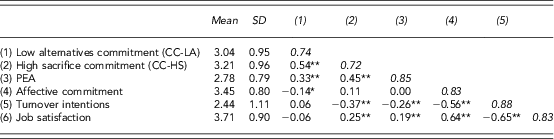
Means, standard deviations, reliability estimates and correlations among the study variables are reported in Table 1. All multi-item scales had acceptable reliability scores.
Descriptive statistics and intercorrelations among continuance commitment subdimensions, perceived employment alternatives and outcomes
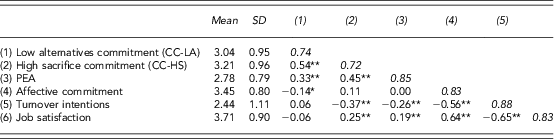
Notes. Scale reliabilities (Cronbach's α) reported in italics along the diagonal.
CC-HS = continuance commitment-high sacrifice; CC-LA = continuance commitment-low alternatives; PEA = perceived employment alternatives.
*p < .01. **p < .001.
CFA Results
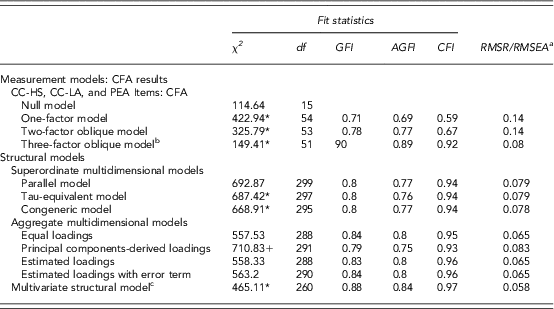
Listwise deletion of missing data for CFA measurement tests resulted in n = 225. CFA results (Table 2) showed that the three-factor model, treating CC-HS, CC-LA, and PEA items as three distinct factors, provided the best fit to the data. All fit indices (GFI, AGFI, CFI, and RMSR) showed significant improvements for this model compared with those for the one-factor and two-factors models, and χ2 difference tests indicated significantly better than for the other two models (p < .001). In absolute terms, GFI and CFI statistics met or exceeded the 0.90 threshold of good fit, AGFI approached this level, and RMSR met the rule of thumb for good fit. In contrast, none of the fit indices associated with models 1 or 2 approached the level of a good fitting model. For the three-factor model, correlations between low alternatives commitment and PEA latent variables = 0.34, that between low alternatives and high sacrifice commitment affective = −0.61, and between PEA and high sacrifice commitment = 0.45.
Confirmatory factor analyses and structural model tests
Notes. aFor the structural models, the fit statistics for this column are RMSEA.
bAll factor loadings except one were 0.49 or higher and t-values exceeded 7.10. For PEA item 6, the factor loading was 0.29 and the t-value was 4.32.
cχ2 difference tests showed a significant improvement in model fit (p < .01) compared with the best-fitting superordinate and aggregate models.
*χ2 relative to the preceding model is significant at the p < .01 level.
+The χ2 values for the equal loadings, estimated loadings, and estimated loadings w/error term versions of the aggregate model were all significantly better (p < .01) than the χ2 value for the principle components version – but did not significantly differ from each other.
AGFI = adjusted goodness of fit index; CC-HS = continuance commitment-high sacrifice; CC-LA = continuance commitment-low alternatives; CFA = confirmatory factor analysis; CFI = comparative fit index; GFI = goodness of fit index; PEA = perceived employment alternatives; RMSEA = root mean square error of approximation; RMSR = root mean square residual.
Multidimensional structural model results
Superordinate model results
Regarding the superordinate model (Table 2), the χ2 statistic indicated a significantly better fit for the congeneric (least restrictive) model (p < .01) compared with the tau-equivalent and parallel versions. However, the goodness-of-fit statistics for all three versions of this model were almost identical, indicating that removing restrictions on loadings between the three ‘dimensions’ and the CC construct, as well as on respective residual variances, did not substantially increase the fit of the model. For the marginally best-fitting (congeneric) version, the CC construct was more strongly related to the set of outcome variables (multivariate r = 0.56) indicating that CC explained 56% of the total variance in the three outcome variables – while CC explained variance in the three dimensions of only 2% (multivariate r = 0.02). The latter result provides little if any support for the notion that PEA, CC-HS, and CC-LA are dimensions of a higher-order CC construct, because the proposed CC construct explained almost none of the covariance among these ‘dimensions.’ Additionally, modification indices suggested model improvements could be made by adding direct paths between the CC dimensions and the outcome variables. This suggests that direct relationships between dimensions and outcomes would not be a spurious result of the common CC antecedent posited in this model, but are a result of real, direct associations between dimensions and outcomes.
Aggregate model results
Overall, goodness-of-fit statistics for all versions of the aggregate model – which posits that CC is a product of the combined effects of CC-HS, CC-LA, and PEA (as depicted in Figure 2)- – were superior to the best-fitting superordinate model. Among the equal loadings, estimated loadings, and estimated loadings with residual variance versions of the aggregate model, none were statistically superior (using χ2 difference tests at p < .01) to any of the others. The principal components model, however, was statistically superior to all three of the other models (p < .001). However, coefficients measuring the adequacy of combined effects of CC-LA, CC-HS, and PEA on the aggregate CC construct fell far short of the 0.90 rule of thumb indicating model support – 0.64, 0.61, 0.60, and 0.32 for the equal loadings, principal components, estimated loadings and estimated error versions, respectively. Thus, CC-LA, CC-HS, and PEA did not collectively account for a total or near-total amount of variation in the proposed CC aggregate construct. This implies that other unmeasured causes are influencing the construct's formation (Edwards, Reference Edwards2001). The three best-fitting aggregate models did show that the aggregate CC construct was strongly related to outcome variables (multivariate r = −0.57), but modification indices indicated that the model could be improved by adding direct paths between the CC dimensions and affective commitment, turnover intentions, and job satisfaction. This mitigates against the mediating role for the aggregate CC construct posited by the aggregate model.
Multivariate structural model results
Chi-square and goodness-of-fit statistics for the multivariate structural model (Table 2) exceeded those for the best-fitting versions of either the superordinate or aggregate models in explaining the relationship between potential CC dimensions and outcomes. In absolute terms, values for CFI and RMSEA exceeded standards for ‘good fit,’ while the GFI value approached the 0.90 threshold. Goodness of fit statistics were across the board modestly better than those of the best-fitting version of the superordinate and aggregate models, and χ2 difference test showed a significant improvement in model fit (p < .01) over the other models as well.
Path estimates indicated reasonably strong relationships between the set of proposed CC dimensions and proposed outcomes (multivariate r = 0.74). Overall, these fit statistics suggest that the multivariate structural model is comparatively the best-fitting of the multidimensional models, and in absolute terms, a reasonably good-fitting model.
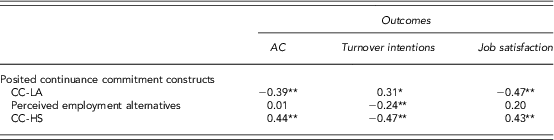
We next had to determine whether or not each construct in the multivariate structural model had correct theoretical relationships with outcome variables (Table 3), that is, whether relationships were consistent with expectations for CC to the organization. CC-HS had significant, positive relationships with affective commitment and job satisfaction, while CC-LA had negative relationships with these outcomes – consistent with dissonance-reduction or ‘resentment’ theoretical explanations (Meyer, Allen, & Gellatly, Reference Meyer, Allen and Gellatly1990; Randall, Fedor, & Longenecker, Reference Randall, Fedor and Longenecker1990; Somers, Reference Somers1993). However, though CC-HS was a strong negative predictor of turnover intentions, CC-LA was actually modestly positively related to turnover intentions. Since the idea that CC should be significantly and negatively related to turnover intentions is a cornerstone of all formulations of the construct (Becker, Reference Becker1960; Meyer & Herscovitch, Reference Meyer and Herscovitch2001), these results indicate that while CC-HS likely measures CC, CC-LA does not tap this construct. Likewise, the lack of a significant negative relationship with turnover intentions suggests that CC-LA does not measure PEA either.
Multivariate model: path relationships

Note. CC-HS = continuance commitment-high sacrifice; CC-LA = continuance commitment-low alternatives.
*p < .05, **p < .01.
Finally, as predicted, PEA was not significantly related to affective commitment and job satisfaction, but was negatively related to turnover intentions, although modestly so. These results are theoretically consistent with the notion that the PEA items used in this research do in fact measure the ‘PEA’ construct (Griffeth, Hom, & Gaertner, Reference Griffeth, Hom and Gaertner2000) but not CC to the organization.
Discussion
The purpose of this research was to investigate the dimensionality of CC as developed within the Allen and Meyer paradigm. The results of this study provided evidence that (1) CC is not a multidimensional construct, (2) CC-HS is a measure of CC to the organization, and (3) CC-LA is neither a measure of CC nor a measure of PEA.
Using Edwards's (Reference Edwards2001) analytical approach, we concluded that CC is not a multidimensional construct of the superordinate, aggregate, or multivariate structural type. First, all versions of superordinate and aggregate models fit the data worse than the multivariate structural model, which posited that the proposed CC dimensions and PEA have direct, unmediated relations with the outcome variables. Thus, proposed superordinate and aggregate CC constructs failed to account for unique outcome variance that was attributable to dimensions.
Second, the proposed overall CC construct in the superordinate model failed to explain a reasonably large amount of variance in the CC dimension constructs. Thus, in this study, we found no joint dependence of the dimensions and outcomes on a higher-order CC construct. Similarly, analyses of the aggregate model revealed that CC-HS, CC-LA, and PEA did not collectively explain the near-total variance in the proposed CC aggregate construct, meaning that they did not combine to cause its formation (Edwards, Reference Edwards2001). Modification indices suggested improvements to the aggregate models by specifying direct paths between CC-LA, PEA, and the outcome variables – mitigating against the mediating role for an aggregate CC construct.
Finally, while the multivariate structural model fit the data best, path estimates indicating relationships between PEA, CC-HS, and CC-LA and outcomes were inconsistent with theory – suggesting they do not influence primary outcomes as a related ‘set’ of dimensions (Edwards, Reference Edwards2001). Crucially, CC-LA failed to negatively influence turnover intentions, which would be expected if it were a measure of either CC or PEA. This finding mirrors other research showing CC-LA to be a weak or non-significant predictor of turnover intentions (Jaros, Reference Jaros1997; Iverson & Buttigieg, Reference Iverson and Buttigieg1999).
Thus, with the caveat that the findings of a single study may not be definitive and require corroboration from future research, our results suggest some important implications for debates that have surrounding the CC concept within the Meyer and Allen work commitment paradigm.
Implications for the debate about the CC concept
Regarding disagreement in the literature concerning the dimensionality of CC, our findings support the contention of McGee and Ford (Reference McGee and Ford1987) and others who argue that the CC-LA items do not tap CC, and contradict claims such as that made recently by Johnson, Chang, and Yang (Reference Johnson, Chang and Yang2010) that CC-LA is a valid aspect of CC. Our results suggest that while a lack of perceived work alternatives may in some cases be one of many binding factors that contribute to the employee's experience of CC, it does not reflect the construct itself. Also, our results are not supportive of the key theoretical assumption underlying CC as a bi-dimensional construct (e.g., Allen & Meyer, Reference Allen and Meyer1990) – that a perceived lack of employment alternatives is such an important ‘binding factor’ that it merits a separate scale dimension designed to tap it.
This empirical finding is buttressed by theoretical analysis. As noted earlier, when they developed the CCS, Meyer and Allen (Reference Meyer and Allen1984) designed it to capture Becker's (Reference Becker1960) concept of commitment, without any additional theoretical refinement of that concept. Since then, other researchers who subscribe to the multidimensional view (CC-LA and CC-HS both reflecting CC) have likewise not offered or argued for a reconceptualization of CC (Jaros, Reference Jaros2009; Johnson, Chang, & Yang, Reference Johnson, Chang and Yang2010). Thus, implicit in their view is that Becker (Reference Becker1960) conceptualized CC to reflect alternative employment opportunities and ‘sunk costs’ or sacrifices as the two primary means by which CC develops, such that it makes sense for any scale that captures Becker's concept, like the CCS, to reflect these two subdimensions. In other words, implicit in the multidimensional view is that Becker's theory conceptualizes CC as multidimensional, really two-dimensional, reflecting LA and HS bases (cf. Meyer, Allen, & Gellatly, Reference Meyer, Allen and Gellatly1990).
However, this two-dimensional concept of CC is, by our reading, difficult to square with Becker's (Reference Becker1960) theory. Becker describes not two but four major categories of ‘side bets’ that lead to the development of CC: face-to-face interactions with others (e.g., promises made to others to be loyal to a firm), generalized cultural expectations (social norms about remaining with a firm), bureaucratic arrangements (e.g., pension fund accruals), and individual adjustments to their job (e.g., accrual of task-specific skills that make a particular job ‘easy’ to perform). Of these, the only one that we believe could plausibly be argued to reflect ‘lack of employment alternatives’ would be the ‘individual adjustments’ basis, and this basis is what is cited by Meyer, Allen, and Gellatly (Reference Meyer, Allen and Gellatly1990) to argue for the inclusion of a CC-LA subdimension within the concept of CC and hence its measure, the CCS. But, Becker (Reference Becker1960) makes no indication that this basis is more important than any of the others, such that it accounts for 50% of an employee's CC, as implied by the two-dimensional view.
In fact, our interpretation of Becker (Reference Becker1960: 37) is that he meant this basis to refer to lateral movement between jobs within an organization as much or more so than the accrual of firm-specific skills that would make other organizations seem less attractive (and hence no longer serve as viable alternatives). Thus, even the one (out of four) bases of commitment that could encompass a lack of employment alternatives and thus justify items tapping this in a measurement scale is itself reflective of factors other than that one. At best, our reading of Becker suggests that in an eight-item scale assessing CC, perhaps one could justify including one item that captures a sense of being committed due to firm-specific skills that make other organizations unattractive. Thus, there is from our point of view little theoretical justification for inclusion of a CC-LA subdimension within a Becker-based concept of CC. Therefore, we argue against the notion that the CC-LA subdimension belongs in the CCS, but failed to relate to outcomes as expected because its items were poorly written, and should be re-written rather than discarded from the CCS. In contrast, all of the four side-bet categories referenced by Becker seem to meet the criterion of ‘sacrifices that would have to be made’ – social or financial – if one left the organization (cf. Powell & Meyer, Reference Powell and Meyer2004; Jaros, Reference Jaros2009), hence these items comport with Becker's theory and properly reflect CC. Likewise, the failure of the CC-LA subscale to predict outcomes as would be expected if it were a valid measure of CC argues against any suggestion that perhaps research findings justify modifying Becker's original CC concept to include a CC-LA subdimension.
That said, while we believe our interpretation of Becker's original theory is accurate and thus provides a solid conceptual basis for the conclusions about CC's meaning and measurement we have drawn from it, we acknowledge that other researchers might interpret Becker's work differently and thus draw other conclusions about how CC should be conceptualized and measured. Therefore, we invite future theoretical work that analyzes Becker's concept of CC, as a means of further refining our understanding of this form of work commitment.
Implications for apprehending CC's nomological net
Our findings lead us to conclude that the current practice of including CC-LA items in the CCS, or as a separate dimension of the CCS (cf. Johnson, Chang, & Yang, Reference Johnson, Chang and Yang2010), may distort our understanding of how CC relates to turnover intentions, job satisfaction, and other correlates and outcomes. Indeed substantial evidence for such distortion arguably already exists. For example, Mathieu and Zajac's (Reference Mathieu and Zajac1990) meta-analysis reported much more robust correlations between CC and turnover outcomes (turnover, r = −0.25; turnover intentions, r = −0.22) than meta-analytic findings obtained by Meyer et al. (Reference Meyer, Stanley, Herscovitch and Topolnytsky2002; −0.15 and −0.16, respectively). The latter study included correlations based on the unitary CCS which conflates perceived low alternatives and high sacrifice/side bet commitment – notwithstanding evidence (e.g., Dunham, Grube, & Castaneda, Reference Dunham, Grube and Castaneda1994; Jaros, Reference Jaros1997) showing CC-LA weakly if at all related to turnover outcomes and CC-HS strongly related. The practice of combining the two dimensions essentially splits the difference, and greatly understates the CC-turnover relationship (cf. Culpepper, Reference Culpepper2011).
Our understandings of how CC relates to other non-turnover outcomes are also likely distorted by this practice. As reported in the Meyer et al. (Reference Meyer, Stanley, Herscovitch and Topolnytsky2002) meta-analysis, CC-HS was significantly and positively correlated with normative commitment (r = 0.16) but CC-LA was marginally significantly and slightly negatively correlated with normative commitment (r = −0.02). In a later study, Powell and Meyer (Reference Powell and Meyer2004) found that a revised CCS including only CC-HS items correlated at 0.34 (p < .01) with normative commitment while CC-LA was significantly and negatively correlated with normative commitment (−0.15, p < .05). Powell and Meyer (Reference Powell and Meyer2004) also found that CC-HS was significantly and positively related to the employee's perceptions about whether early work experiences met their pre-employment expectations (0.30) while CC-LA was negatively related to these perceptions (−0.13), and determined that they differed in their relationship with the employee's satisfaction with the firm's bureaucratic arrangements. Similarly, Dunham, Grube, and Castaneda (Reference Dunham, Grube and Castaneda1994) found significantly different correlations between the two CCS dimensions and age, tenure, and perceptions of task significance. Also, Taing, Groff, and Granger (Reference Taing, Groff, Granger, Jackson and Johnson2011) tested the impact of CC-HS and CC-LA on several outcomes and found that while CC-HS was positively related to job satisfaction, organizational citizenship behaviors, and in-role performance, CC-LA was negatively related to all of them. Thus, given that CC-HS and CC-LA often have different relationships with correlates, it is likely that our understanding of CC's relationship with a variety of organizational outcomes is distorted by the inclusion of CC-LA items in measures of CC. Future research using a CC-HS only measure of CC is likely to reveal different relationships between CC and antecedents and outcomes, thus likely altering our understanding of CC and its nomological net.
We therefore recommend that in future research, only CC-HS items be utilized to assess CC no matter what outcomes are being studied. A recommendation that flows from this is the need to develop a CC-HS only CC scale that includes additional CC-HS items (cf. Powell & Meyer, Reference Powell and Meyer2004; Jaros, Reference Jaros2007) so as to achieve greater scale reliability. In the present study, the reliability coefficient for the three-item CC-HS scale was 0.72, acceptable by rule-of-thumb standards in social science research, but marginally so. In contrast, the ACS exhibited a reliability estimate of 0.83, more robust, and typical for this eight-item scale in previous research (cf. Meyer et al., Reference Meyer, Stanley, Herscovitch and Topolnytsky2002). Of course, in order to avoid the problems that plagued the original CCS, researchers should be careful to include only items that reflect CC-HS, items that comport with Becker's (Reference Becker1960) concept of commitment based on sunk costs and investments. This scale could then be subject to confirmatory evaluation to assess its validity as well. Development of a more reliable and valid CC-HS-based scale for CC will aid researchers in assessing its nomological net and overall construct viability.
Implications for the study of other multidimensional constructs
Likewise, our findings have implications for the study of other multidimensional constructs that attempt to capture work attitudes. For example, Harrison, Newman, and Roth (Reference Harrison, Newman and Roth2006) posited that job satisfaction and affective commitment are two dimensions of a construct they called ‘job attitudes,’ reflecting a ‘fundamental evaluation’ of an employee's job experiences. Their research showed that a model positing job satisfaction and affective commitment as first-order factors reflecting a second-order job attitudes construct fit the data well, and it had predictive validity with respect to absenteeism and job performance. But, Harrison et al. did not compare this model, essentially a superordinate model, with the other two theoretically plausible models described in our research, an aggregate model which would treat ‘job attitudes’ as the sum of the effects of job satisfaction and affective commitment, or a multivariate structural model that would posit direct effects between job satisfaction and affective commitment and outcomes such as job performance and turnover. Thus, Harrison et al.'s conclusion, that employees experience a general, but fundamental, evaluation of their jobs which then causes the employee to be satisfied with their job and to become emotionally (affective) committed to it, might prove to be spurious if their data were subject to the kind of multidimensional model testing advocated by Edwards (Reference Edwards2001) and exhibited in our paper. Similarly, the systematic analysis of model types conducted here could be useful in helping job embeddedness researchers determine if the ‘on the job’ and ‘off the job’ dimensions of job embeddedness (cf. Tanova & Holtom, Reference Tanova and Holtom2008; Felps, Mitchell, Hekman, Lee, Harman, & Holtom, Reference Felps, Mitchell, Hekman, Lee, Harman and Holtom2009) reflect underling dimensions of job embeddedness or whether one reflects job embeddedness while the other reflects another construct entirely.
What does CC-LA measure?
Our findings are also inconsistent with the position (cf. Brown, Reference Brown1996; Ko, Price & Mueller, Reference Ko, Price and Mueller1997) that CC-LA is a measure of PEA. Though the PEA scale had the relations with outcomes that would be expected theoretically for a measure of PEA, CC-LA exhibited virtually no nomological similarity with the PEA scale. When combined with the CFA evidence in our study showing that CC-LA and PEA items load on distinct factors, it is unlikely that CC-LA items measure PEA.
The results of this study provide evidence that CC-LA does not measure CC or perceived job alternatives, so what does it measure? Our findings fit with both recent and historical explanations by those critics of the CCS who have explained the existence of CC-LA items in the CCS as an artifact of the original scale construction process. For example, in the study that originally found the CCS to consist of CC-HS and CC-LA dimensions, McGee and Ford (Reference McGee and Ford1987) note that Meyer and Allen (Reference Meyer and Allen1984) experimentally manipulated subject's perceptions of CC by asking them about both ‘side bets’ and ‘alternative employment.’ More recently, Jaros (Reference Jaros2012: 65) noted that Meyer and Allen (Reference Meyer and Allen1984: 375) describe the construction of the CCS in these terms (our italics):
This 8-item measure, also developed by the authors, assesses the extent to which employees feel committed to their organizations by virtue of the costs that they feel are associated with leaving (e.g., investments and/or lack of attractive alternatives). As such, the CCS is considered a measure of organizational commitment of the sort Becker (Reference Becker1960) describes.
Thus, Meyer and Allen (Reference Meyer and Allen1984)'s experimental manipulation and the items they wrote to represent CC reveal that they conceptualized CC as reflecting two primary components, side-bets and ‘lack of attractive alternatives,’ the two dimensions of the CCS originally found by McGee and Ford (Reference McGee and Ford1987).
But, if Meyer and Allen (Reference Meyer and Allen1984) conceptualized CC as having a significant ‘lack of alternatives’ component, and designed the CCS to include PEA items, why did our study find that CC-LA items loaded separately from PEA items, and lacked relations with outcomes that would be expected of a PEA scale? One plausible explanation is that the CC-LA items tap ‘PEA’ to some extent, but do so in a poor manner. The PEA items seem to clearly focus on the relative difficulty of finding a job with another organization, but on our reading only one of the CC-LA items does so. For example, consider the PEA items and CC-LA items listed in the Appendix. Of the six items that comprise PEA, every one of them refers specifically to ‘finding another job’ and/or finding another ‘job’ or ‘employment.’ Respondents would therefore be unlikely to interpret these items as asking them about anything other than their beliefs about how easy it would be to find another job or employer and that a lack thereof would be the reason that causes them to remain with their current employer.
In contrast, consider the three items that comprise the CC-LA scale: while item #1 does refer specifically to a lack of ‘available employment,’ in our view items two and three refer more vaguely to ‘staying with the organization out of necessity’ and having ‘too few options’ to be able to leave, respectively. It strikes us as very plausible that while some respondents might think of staying out of necessity or having too few options to leave in terms of staying because one lacks employment alternatives, others could interpret these items to refer to side-bets or investments in their present organization as making it difficult to leave or ‘necessary’ to remain with the organization. This interpretation is bolstered by the results reported in the correlation matrix (Table 1), which shows that CC-LA is significantly more correlated with CC-HS than with PEA, and a Williams test revealed that these correlations were significantly different (p < .01).
Also, the lack of specificity in CC-LA items 2 and 3 about what the respondent would be leaving for could cause confusion as well. Whereas CC-LA item 1, like the PEA items, clearly mentions leaving for another job, by our reading items two and three refer vaguely to ‘other options’ (item 3) or do not mention what the employee would leave for at all (item 2). Since employees may leave their organization for reasons other than another job (e.g., to retire, start their own business, go back to school, etc.), the exit-purpose vagueness of these items could cause study subjects to respond to them differently than they responded to the PEA items that are more specific about why one is remaining and what they would be leaving for. Thus, CC-LA may lack clarity – to a certain extent it taps (and conflates) both ‘high sacrifices’ and ‘PEA,’ but not as well as either the CC-HS or PEA scales do individually, enough so that in CFA the CC-LA items segregate as a separate factor, but such that when it is entered in multivariate models with these variables as predictors of outcomes, it has little explanatory power.
Thus, our conclusion is that while Meyer and Allen (Reference Meyer and Allen1984) intended for CC-LA items to reflect the idea of an employee remaining with the organization because they lack alternative job options (i.e., PEA), the items were vaguely written such that many respondents are likely to interpret them in terms of either investments or lack of alternatives as the cause of their staying, and to interpret what they might leave the organization for in terms of other jobs, but also other career or life options as well. Thus, CC-LA may not reflect PEA very accurately. Of course, it is also possible that other researchers, particularly those who favor retaining CC-LA as a component of CC and view it as a valid measure of PEA, might read the same scale items discussed in this section and interpret them differently than we have. Thus, we invite research that furthers item-level understanding of CC-LA, and look forward to engaging such research in discussions about their meaning. However, as explained above, since in our view CC is properly captured by CC-HS items alone, the corrective for creating a new CCS that would accurately reflect the CC concept would not be to re-write the CC-LA items to make them accurately reflect PEA and then combine them with CC-HS items in a new CCS, or to retain them if one believes they already do accurately reflect PEA, but rather is to strip the CCS of these CC-LA items.
LIMITATIONS AND CONCLUSION
There are reasons to interpret the results of this study with caution. Foremost, all of the data analyzed in this study were gathered using the same questionnaire methodology, raising the possibility of common method effects. However, three factors mitigate this potential problem: (1) following Spector (Reference Spector1994), we used the most valid measures of the attitudinal variables available to us, (2) scales employed in our study have been the object of much previous research and zero-order relationship patterns were largely consistent with previous work, and (3) while common method bias suggests large systematic bias in a single direction, the covariance matrix used in our analyses showed highly diverse correlations in terms of strength and sign.
Also, advances in our understanding of the meaning of these constructs and their measures, like all other substantive and methodological research in the social sciences, require replication and further extensions. Our conclusions are derived from a single study, and, as in all field studies, not every aspect of the research context was controlled for. Thus, despite our efforts to study a sample of respondents broadly representative and thus likely to produce generalizable results, future research may reveal our findings to be at least somewhat idiosyncratic. This may be more likely for attempts to replicate or extend our findings in non-Western cultures, as our study was conducted in the United States, and there is some evidence that cultural context may impact how employees interpret and respond to commitment scale items (cf. Ko, Price, & Mueller, Reference Ko, Price and Mueller1997). Thus, we invite additional research that will attempt to corroborate our findings in a variety of organizational and cultural settings. More generally, we encourage others to conduct research that will provide more evidence addressing the dimensionality of scales reflecting commitment dimensions, perceived alternatives, and their relationships.
Acknowledgments
The authors thank the Editor and anonymous reviewers for their helpful comments on this manuscript.
APPENDIX
Commitment items and outcome variable items included in CFA and Structural models
CC-HS
(1) One of the major reasons I continue to work for this organization is that leaving would require considerable personal sacrifice -another organization may not match the overall benefits I have here.
(2) It would be very hard for me to leave my organization right now, even if I wanted to.
(3) Too much in my life would be disrupted if I decided I wanted to leave my organization right now.
CC-LA
(4) One of the few negative consequences of leaving this organization would be the lack of available employment alternatives.
(5) Right now, staying with this organization is a matter of necessity as much as desire.
(6) I believe I have too few options to consider leaving this organization.
PEA
(1) If I were to leave my current job, it would be hard for me to find another one just as good.
(2) It would be easy for me to find alternative acceptable employment.
(3) I feel it would be easy for me to obtain comparable or better employment with another organization.
(4) It would be difficult to find a job with another employer.
(5) It would be difficult to find another job as good as my current one.
(6) I would describe the number of jobs available to me that are similar to mine and requiring similar qualifications as ‘few.’
Turnover intentions
(1) How often do you think about quitting your organization?
(2) How likely is it that you will search for a job with another employer in the next year?
(3) How likely is it that you will leave this organization within the next year?
ACS
(1) I would be very happy to spend the rest of my career with this organization.
(2) I enjoy discussing my organization with people outside it.
(3) I really feel as if this organization's problems are my own.
(4) I think that I could easily become as attached to another organization as I am to this one.
(5) I feel like ‘part of the family’ at my organization.
(6) I feel ‘emotionally attached’ to this organization.
(7) This organization has a great deal of personal meaning for me.
(8) I feel a strong sense of belonging to my organization.
Job satisfaction
(1) I am very satisfied with my job.
(2) My job makes me happy.
(3) Thinking about my job evokes pleasurable feelings for me.
Note: Scales and items listed in accordance with order they appeared in survey instrument. Items 1–6 are taken from Allen Meyer (Reference Allen and Meyer1990). PEA item 1 was taken from Gerhart (Reference Gerhart1990), PEA item 2 was taken from Michaels and Spector (Reference Michaels and Spector1982), and PEA item 3 is adapted from Allen and Meyer (Reference Allen and Meyer1990); PEA items 4–6 are adapted from Price and Mueller (Reference Price and Mueller1986). All ACS items were taken from Allen and Meyer (Reference Allen and Meyer1990). ACS items 5, 7, and 8 were modified to create positive item stems. Turnover intentions items were taken from Mobley, Horner, and Hollingsworth (Reference Mobley, Horner and Hollingsworth1978)as cited by Jaros (Reference Jaros1997).