Introduction
Most knowledge workers and skilled employees aspire for growth in their careers. They realize this growth happens by taking initiative, acquiring and honing various skills and succeeding in challenging assignments. Companies that provide such opportunities through the proper design of jobs may see higher organizational commitment (OC) in their employees (Eisenberger, Fasolo, & Davis-LaMastro, Reference Eisenberger, Fasolo and Davis-LaMastro1990; Chang & Lee, Reference Chang and Lee2006). Complexity and skill variety in jobs can be challenging, which may either lead to hardship or motivation of employees. When there is proper leadership and empowerment, job complexity can result in positive outcomes.
Prior studies have proven that job characteristics, high on core dimensions, lead to OC (Liu & Norcio, Reference Liu and Norcio2008; Ozturk, Hancer, & Young Im, Reference Ozturk, Hancer and Young Im2014) and that empowerment also results in commitment (Jha, Reference Jha2011). This paper researches the role of empowerment in the relationship between job characteristics and affective commitment with a sample taken from four countries, while controlling the variables gender, age and country. Leadership is also known to positively influence commitment (Avolio, Zhu, Koh, & Bhatia, Reference Avolio, Zhu, Koh and Bhatia2004; Bacha, Reference Bacha2014). Effective managers provide leadership across multiple dimensions often balancing competing demands. Some managerial leaders display behavioral complexity by balancing seemingly contradicting roles such as being adaptable on one hand and providing stability on the other and being a vision setter and a task master at the same time (Hart & Quinn, Reference Hart and Quinn1993). Employees may find such leadership complexity very useful in coping with challenges at work, navigating through variety of job demands and attaining goals. But there are no known studies that explore the moderating impact of leadership complexity on the effects of job characteristics and empowerment on affective commitment. This research examines the mediating role of empowerment and the moderating role of leadership complexity. The theoretical framework is presented in Figure 2. To the best of our knowledge, such a configuration has not been presented in earlier literature.
Theoretical background and past empirical research studies are first reviewed, from which the hypotheses are derived. The paper then describes the research method, findings and concludes with practical implications and suggestions for future research.
THEORETICAL BACKGROUND AND HYPOTHESES
Organizational commitment (OC)
OC can be best explained as the psychological attachment felt by an employee toward his or her organization (O’Reilly & Chatman, Reference O'Reilly and Chatman1986). It is the force that binds an individual to an organization (Allen & Meyer, Reference Allen and Meyer1990; Meyer & Herscovitch, Reference Meyer and Herscovitch2001) and can be determined by how strongly an individual identifies with and involves in an organization (Mowday, Steers, & Porter, Reference Mowday, Steers and Porter1979).
The benefits of OC are many including work efforts, work-place performance and employee retention (Luchak & Gellatly, Reference Luchak and Gellatly2007; Paré & Tremblay, Reference Paré and Tremblay2007). Past research shows that individuals committed to an organization take more initiative, participate in broader roles, work toward improvements and remain longer with an organization (Jones, Reference Jones2006).
Organizational and attitudinal variables such as job characteristics, leadership style, job involvement, organizational climate, perceived equity are crucial to developing and maintaining OC (Welsch & LaVan, Reference Wallach and Mueller1981; Zahra, Reference Yucel, McMillan and Richard1984; Riaz et al., Reference Riaz, Akram and Ijaz2011). The focus of OC development is to ultimately create a wholesome quality of work-life (Zahra, Reference Yucel, McMillan and Richard1984). Research studies have shown that job characteristics, leadership and empowerment are significantly related to OC (Madi, Abu-Jarad, & Alqahtani, Reference Madi, Abu-Jarad and Alqahtani2012; Arciniega & Menon, Reference Arciniega and Menon2013; Harwiki, Reference Harwiki2013).
Meyer and Allen (Reference Meyer and Allen1997) have identified three dimensions of OC: Continuance, Normative and Affective commitments. An employee may commit to an organization due to the perceived losses of leaving an organization, lack of choices or inadequacy of external options. Such commitment is called Continuance commitment. Normative commitment is explained by the feelings of obligation, moral binding and gratitude due to investments an organization makes in an employee. Affective commitment is perhaps the strongest of the three and is attributed to an employee’s positive emotional attachment to the organization and the employee’s identification with the organizational goals (Meyer and Allen, Reference Meyer and Allen1997). This research examines how job characteristics, leadership and empowerment can elicit affective commitment from employees.
Job characteristics
Employees who enjoy their work are more likely to perform well and prosper in their jobs. When employees experience meaningfulness, responsibility and knowledge of results on the job, they tend to feel good about their work and perform well (Hackman & Oldham, Reference Hackman and Oldham1975). Hackman and Oldham (Reference Hackman and Oldham1976) identified five core job characteristics that lead to such job enrichment:
(1) Skill variety – opportunity to engage in challenging activities and in tasks that would require a variety of different skills.
(2) Task identity – the extent to which the job requires a whole and identifiable piece of work, which has a palpable outcome.
(3) Task significance – the degree to which the job impacts the work or lives of other people within or outside the organization.
(4) Autonomy – the extent of freedom, independence and discretion in carrying out the work.
(5) Feedback – the extent to which the job itself provides information about the effectiveness of one’s performance.
The job characteristics model theorized that the above five core job dimensions cause the three psychological states, experienced meaningfulness, experienced responsibility and knowledge of the results, which in turn lead to personal and work outcomes such as high intrinsic motivation, performance, satisfaction and low employee turnover (Hackman & Oldham, Reference Hackman and Oldham1976).
Job characteristics were found to be related to employee well-being (De Jonge & Schaufeli, Reference De Jonge and Schaufeli1998). Higher the perceived job complexity, higher is the OC among employees, as evident from diverse industries (Joo & Lim, Reference Joo and Lim2009). Abbott, Boyd, and Miles (Reference Abbott, Boyd and Miles2006) found that job characteristics influenced team commitment, during a research study conducted in the United States. In a Taiwanese study involving banking, service and manufacturing industries, job characteristics were proven to significantly influence OC (Chang & Lee, Reference Chang and Lee2006). Job characteristics have a significant positive impact particularly on Affective commitment (Madi, Abu-Jarad, & Alqahtani, Reference Madi, Abu-Jarad and Alqahtani2012; Ozturk et al., 2014). Earlier empirical research had also supported the relationship between job characteristics and OC in various geographical regions (Van Der Vegt, Emans, & Van De Vliert, Reference Tuna, Ghazzawi, Tuna and Çatir2000; Fang, Reference Fang2001; Niehoff, Moorman, Blakely, & Fuller, Reference Niehoff, Moorman, Blakely and Fuller2001; Lin & Hsieh, Reference Lin and Hsieh2002; Schneider, Reference Schneider2003; Liu & Norcio, Reference Liu and Norcio2008).
Hypothesis 1: Job Characteristics are positively related to Affective commitment.
Psychological empowerment
To empower is to give power to and enable a person to achieve a goal. Employee empowerment fosters decision making at the lower hierarchical levels in an organization while improving the work lives of employees (Liden, Wayne, & Sparrow, Reference Liden, Wayne and Sparrow2000). Researchers described employee empowerment as feeling effective, in control and influential on the job (Gagné, Senécal, & Koestner, Reference Gagné, Senécal and Koestner1997). Empowerment has been defined in multiple ways but there are two main streams of conceptualization: (a) Structural Empowerment, which focuses on delegation of decision making in order to authorize and enable employees at lower levels in the organizational hierarchy (Heller, Reference Heller2003) and (b) Psychological Empowerment whereby feelings of self-efficacy are enhanced among employees by identifying and removing the conditions that foster powerlessness (Conger & Kanungo, Reference Conger and Kanungo1988).
The most used definition of Psychological Empowerment is the multidimensional concept offered by Thomas and Velthouse (Reference Thomas and Velthouse1990). They defined empowerment as increased intrinsic task motivation, reflecting one’s orientation to his or her work role, embodied in four cognitions: meaning, competence, self-determination and impact. Meaning is the value or purpose of the work in relation to one’s own ideals. Competence is self-efficacy and is one’s own belief in his or her capabilities and skills to perform the work role. Self-determination is a sense of having choice and freedom in initiating and performing tasks. Impact is the influence one has on strategic, administrative or operative outcomes on the job (Thomas & Velthouse, Reference Thomas and Velthouse1990). Spreitzer (Reference Spreitzer1995, Reference Spreitzer1996) developed and validated a scale to measure psychological empowerment based on the above definitions and argued that the four dimensions combine to create an overall psychological empowerment construct.
Work environments that enhance the perception of employee empowerment can have beneficial and long-lasting effects on employees (Laschinger, Finegan, Shamian, & Wilk, Reference Laschinger, Finegan, Shamian and Wilk2004). Various studies in private and public sectors revealed that employee empowerment is positively related to desirable outcomes such as managerial and organizational effectiveness, employee retention, innovativeness, performance, job satisfaction and OC (Spreitzer, Reference Spreitzer1995; Kirkman & Rosen, Reference Kirkman and Rosen1999; Chang & Lee, Reference Chang and Lee2006; Park & Rainey, Reference Park and Rainey2007; Moynihan & Landuyt, Reference Moynihan and Landuyt2008; Fernandez & Moldogaziev, Reference Fernandez and Moldogaziev2013). Psychological empowerment is proven to impact affective commitment, by a study conducted among service sector executives (Jha, Reference Jha2011).
Hypothesis 2: Psychological Empowerment is positively related to Affective commitment.
Job characteristics, empowerment and affective commitment
Based on the theoretical foundation of the job characteristics model (Hackman & Oldham, Reference Hackman and Oldham1976), jobs high on the core dimensions of ‘job characteristics’ lead to high work motivation. Such job characteristics include challenging and meaningful skills, variety, whole tasks with visible outcomes, tasks that have an impact, autonomy and discretion in work and feedback about one’s efficacy (Hackman & Oldham, Reference Hackman and Oldham1976). By the very definition by Thomas and Velthouse (Reference Thomas and Velthouse1990), employee empowerment is the increased task motivation embodied in meaning, competence, self-determination and impact. Therefore, it is expected that job characteristics high on the core dimensions, lead to feelings of empowerment.
Empowered employees are those who experience choice and freedom in initiating and performing tasks, self-efficacy, meaning and opportunity to make an impact. Such employees are likely to reciprocate with commitment to their organizations (Eisenberger et al., Reference Eisenberger, Fasolo and Davis-LaMastro1990; Liden, Wayne, & Sparrow, Reference Liden, Wayne and Sparrow2000), which leads to the thinking that empowerment impacts OC. We posit that empowerment mediates between job characteristics and affective commitment because jobs high in impact, challenge, freedom, independence and variety lead to feelings of empowerment which when reciprocated lead to affective commitment toward the organization.
A few research studies have proven that job characteristics play an important role in the much desirable employee empowerment. Job characteristics such as structure of role, participatory decision-making and positive relationship with supervisors, subordinates and peers, were found to influence the sense of empowerment among paraprofessional staff (Wallach & Mueller, Reference Van Der Vegt, Emans and Van De Vliert2006). In another study among front-line employees of hospitality sector, job characteristics showed a positive impact on psychological empowerment (Jha & Nair, Reference Jha and Nair2008). After implementation of job redesign in a sample of nurses, Kraimer, Seibert, and Liden (Reference Kraimer, Seibert and Liden1999) established that job characteristics related to employee empowerment. The research study by Kraimer, Seibert, and Liden (Reference Kraimer, Seibert and Liden1999) also established that empowerment predicts OC though it does not explicitly test empowerment as a mediator. But only two studies were found, which tested a similar meditational model proposed by this research. Liden, Wayne, and Sparrow (Reference Liden, Wayne and Sparrow2000) tested the influence of job characteristics on OC, in one company in the United States, and the results indicated that the meaning dimension of psychological empowerment mediated the relationship. Using the Spanish version of the psychological empowerment scale by Menon (Reference Menon2001), Arciniega and Menon (Reference Arciniega and Menon2013) explored the mediating power of perceived control, competence and goal internalization on the relationship between job characteristics and affective commitment. The results of that study, conducted in a manufacturing facility in Venezuela, supported the role of goal internalization as a mediator between job characteristics and affective commitment.
The model presented here (Figure 1b) is tested among knowledge workers across four countries from various industries for generalization. The study was conducted in Australia, India, Singapore and United States in product development, instrumentation, mechanical engineering, software development and service industries. Since the core dimensions of job characteristics combine to form a motivational potential score (Hackman & Oldham, Reference Hackman and Oldham1976) and the psychological empowerment dimensions combine to provide a total empowerment score (Spreitzer, Reference Spreitzer1995, Reference Spreitzer1996), relationships between the whole constructs are examined, while maintaining the factor structure in the structural equation model. Furthermore, unlike the previous two studies, age, country and gender are controlled, in this research, because demographics such as age and gender are known to influence OC (Fang, Reference Fang2001).
Hypothesis 3: Age, Country and Gender have an influence on Affective Commitment.
Hypothesis 4: Job Characteristics are positively related to Psychological Empowerment.
Hypothesis 5: Psychological Empowerment mediates the relationship between Job Characteristics and OC.
The Mediation Model

Leadership complexity and its influence
Leaders can exert tremendous influence on their followers and organizations. Good leadership can motivate employees to improve job performance and achieve organizational objectives (Hersey & Blanchard, Reference Hersey and Blanchard1974). Research shows that good leaders affect employee health and well-being in a positive manner (Smith, Reference Smith2008), which could lead to reciprocal feelings of OC. Leadership behavior and style are thus critical in fostering OC (Yiing, Zaman, & Ahmad, Reference Yeh and Hong2009; Yeh & Hong, Reference Welsch and LaVan2012) in general and affective commitment in particular (Riaz et al., Reference Riaz, Akram and Ijaz2011).
Many studies have examined the impact of transformational leadership on OC (Avolio et al., Reference Avolio, Zhu, Koh and Bhatia2004; McMurray, Pirola-Merlo, Sarros, & Islam, Reference McMurray, Pirola-Merlo, Sarros and Islam2010; Ali, Babar, & Bangash, Reference Ali, Babar and Bangash2011; Ismail, Mohamed, Sulaiman, Mohamad, & Yusuf, Reference Ismail, Mohamed, Sulaiman, Mohamad and Yusuf2011; Riaz et al., Reference Riaz, Akram and Ijaz2011; Tuna, Ghazzawi, Tuna, & Çatir, Reference Thomas and Velthouse2011; Atmojo, Reference Atmojo2012; Baek-Kyoo, Yoon, & Chang-Wook, Reference Baek-Kyoo (Brian), Yoon and Chang-Wook2012; Yeh & Hong, Reference Welsch and LaVan2012; Clinebell, Skudiene, Trijonyte, & Reardon, Reference Clinebell, Skudiene, Trijonyte and Reardon2013; Jackson, Meyer, & Wang, Reference Jackson, Meyer and Wang2013; Bacha, Reference Bacha2014; Yucel, McMillan, & Richard, Reference Yiing, Zaman and Ahmad2014). A few studies have also shown that other types of leadership lead to OC. Servant leadership was found to explain the commitment of employees of service organizations (Schneider & George, Reference Schneider and George2011). Theory Y leadership was shown to exhibit a positive relation with affective commitment via leader–member exchange (Sahin, Reference Sahin2012). Such models of leadership (Theory X vs. Theory Y; transactional vs. transformational leadership), create dichotomies of leadership, whereas effective leadership may require a balancing of seemingly paradoxical capabilities (Hart & Quinn, Reference Hart and Quinn1993). Effective leaders think across multiple dimensions. They balance contrasting roles such as providing visionary leadership while paying attention to detail; being flexible and adaptable while also offering stability; and providing directorship sometimes and sometimes mentorship (Quinn & Cameron Reference Quinn and Cameron1988; Hart & Quinn, Reference Hart and Quinn1993). The competing values framework is a useful tool based on the behavioral complexity of managerial leaders. Competing values framework has also generated renewed interest from researchers and scholars, in the recent times (Cameron & Quinn, Reference Cameron and Quinn2006; Belasen, Reference Belasen2007).
Leadership complexity is the ability of leaders to deal with the competing demands through the mastery of seemingly contradictory or paradoxical roles: Vision Setter, Motivator, Analyzer and Task Master (Hart & Quinn, Reference Hart and Quinn1993). The behavioral complexity of leaders, i.e. leadership complexity, is high when they score high on all the four dimensions (Hart & Quinn, Reference Hart and Quinn1993). Leaders with high behavioral complexity can provide the necessary vision and motivation while staying hands-off in guiding knowledge workers. At the same time, such leaders can guide employees by being hands-on and analytical when new challenges present themselves. Such ability could be very useful in helping employees cope with the variety and challenge in their jobs, attain goals, thrive and develop affective commitment. Hence, we posit that leadership complexity influences the relationship between job characteristics and affective commitment. As far as we know, this is the first study to explore the moderating effect of Leadership Complexity on the relationship between job characteristics and affective commitment.
Leaders are also known to influence the empowerment of followers (Liden, Wayne, & Sparrow, Reference Liden, Wayne and Sparrow2000; Avolio et al., Reference Avolio, Zhu, Koh and Bhatia2004; Ismail et al., Reference Ismail, Mohamed, Sulaiman, Mohamad and Yusuf2011). Liden, Wayne, and Sparrow (Reference Liden, Wayne and Sparrow2000) established the impact of leadership by proving that leader–member exchange and team–member exchange combined with job characteristics and empowerment led to OC. Based on such influence of leadership, we posit that the mediation of empowerment between job characteristics and affective commitment is different for the two groups varying on leadership complexity. Our final hypothesis is that the influence of job characteristics and empowerment on affective commitment is greater when the behavioral complexity of the immediate leaders of the employees, is higher. The hypotheses are better explained by the structural model presented in Figure 2. The demographic variables Age, Gender and Country are controlled.
Hypothesis 6: Leadership Complexity moderates the relationship between Job Characteristics and Psychological Empowerment and the relationship between Job Characteristics and Affective Commitment.
Hypothesis 7: The impact of Job Characteristics and Psychological Empowerment on Affective Commitment is greater when the Leadership Complexity is higher.
The Full Hypothesized Model
Method
Sample
The data were collected from knowledge workers working in Australia, India, Singapore and United States in product development, instrumentation, mechanical engineering, software development and service industries. An online survey was administered to collect the data. Out of the 646 responses received, 616 responses were found usable after deleting responses that were mostly blank. These responses were removed only after ensuring that their values were completely missing at random (MCAR). Multivariate outliers were detected using Mahalanobis distance. Mahalanobis D 2 measures each observation’s distance from the mean center of all observations, in a multidimensional space. This method provides a single D 2 value for each observation. Higher D 2 values represent observations farther removed from the general distribution of observations in the experiment (Hair, Black, Babin, Anderson, & Tatham, Reference Hair, Black, Babin, Anderson and Tatham2009). The procedure identified 11 outliers, which were removed from the sample resulting in 605 responses. Of those, 71% of the respondents were male. Fifteen percent worked in Australia, 39% in India, 14% in Singapore and 32% in United States. Twenty percent of the participants were 25 years or younger, 38% were among the 25 to 34 age group, 30% fell into the 35 to 44-year group and 12% were older than 45 years.
Measures
Job characteristics
The Job Diagnostic Survey (Hackman & Oldham, Reference Hackman and Oldham1975) is used to measure job characteristics with the exception of the core dimension autonomy. The psychological empowerment scale (Spreitzer, Reference Spreitzer1995), used to measure empowerment in this study, is based on Hackman and Oldham’s autonomy items and therefore the autonomy job characteristic is not included, in this study, to avoid redundancy. The job characteristics, Skill Variety, Task Identity, Task Significance and Feedback, are measured on a 7-point Likert-type scale. The instrument was found to be reliable, using the current sample (α=0.76). A confirmatory factor analysis was done using the sample (χ2=134.56, df=46, CMIN/df=2.93, GFI=0.96, CFI=0.98, NFI=0.98, RMSEA=0.056).
Psychological empowerment
The psychological empowerment is measured by using the scale developed by Spreitzer (Reference Spreitzer1995). Spreitzer (Reference Spreitzer1995) identified four dimensions – Meaning, Competence, Self-determination and Impact. These are measured using a 7-point Likert-type scale varying from ‘strongly disagree’ to ‘strongly agree’. The instrument was found to be reliable when tested with the current sample (α=0.87). Confirmatory factor analysis has shown a good model fit (χ2=145.87, df=86, CMIN/df=1.70, GFI=0.97, CFI=0.99, NFI=0.98, RMSEA=0.034).
Leadership complexity
The competing values leadership instrument measures the leadership roles Vision Setter, Motivator, Analyzer and Task Master in the framework of competing values (Quinn, Reference Quinn1988, Reference Quinn1991). This study measures how frequently a managerial leader employs certain behaviors, using the 7-point Likert-type scale ranging from ‘almost never’ to ‘almost always’. Example of an item: ‘My manager comes up with inventive ideas’. Leadership complexity is taken as ‘high’ when the scores on all four dimensions are higher than the means, and as ‘low’ for the rest. When checked with the current sample, the instrument was found to be reliable (α=0.81) and the confirmatory factor analysis demonstrated good model fit (χ2=360.60, df=113, CMIN/df=3.19, GFI=0.93, CFI=0.98, NFI=0.97, RMSEA=0.060).
Affective commitment
The Organizational Commitment Survey (Meyer & Allen, Reference Meyer and Allen1997) has a subscale that measures Affective Commitment on a 7-point scale ranging from ‘strongly disagree’ to ‘strongly agree’. Chronbach’s α indicated good reliability of the instrument (α=0.81). The confirmatory factor analysis yielded a good model fit (χ2=15.07, df=6, χ2/df=2.51, GFI=0.99, CFI=0.99, NFI=0.99, RMSEA=0.05).
Results
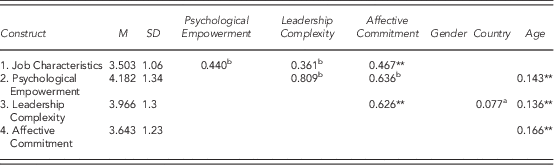
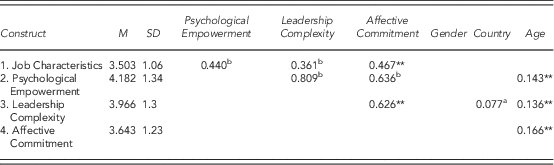
Means, standard deviations and correlations for all the constructs are provided in Table 1. Gender and country did not exhibit a significant correlation with Affective Commitment. Age, on the other hand, showed a significant correlation of limited magnitude with Affective Commitment. Analysis of variance test can be used to identify group differences (Hair et al., Reference Hair, Black, Babin, Anderson and Tatham2009). Analysis of variance test performed on the dependent variable Affective Commitment revealed that the mean differences in commitment are significant for the ‘45 years and above’ age group when compared with the ‘24 years and below’ (mean difference=0.855, p=.000), ‘25 to 34 years’ (mean difference=0.647, p=.001) and ‘35 to 44 years’ (mean difference=0.591, p=.004) age groups. Therefore, Age was included as a control variable in the analysis.
Means, standard deviations and significant correlations
Notes:
a Correlation is significant at the 0.05 level.
b Correlation is significant at the 0.01 level.
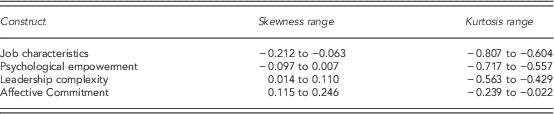
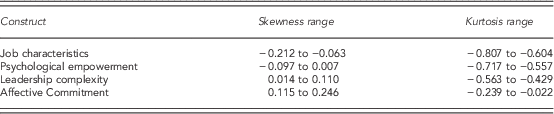
We tested our proposed model as a structural equation model using AMOS 20.0 and maximum likelihood estimation. Muthen and Kaplan (Reference Muthen and Kaplan1992) suggested that the maximum likelihood estimation is acceptable if the kurtosis and skewness of the variables range from −1 to +1. The skewness and kurtosis of the constructs are presented in Table 2.
Skewness and kurtosis ranges
In the first part of the analysis, we set out to test the mediation model shown in Figure 1b, using path analysis. Baron and Kenny (Reference Baron and Kenny1986), Judd and Kenny (Reference Judd and Kenny1981), James and Brett (Reference James and Brett1984) and Frazier, Tix, and Barron (Reference Frazier, Tix and Barron2004) described the following steps in proving mediation. First, the criterion variable is regressed on the independent variable to establish that the latter has a significant effect on the former. This effect is called the total effect (path c in Figure 1a). Second, the mediator is used as the criterion variable to ascertain that the independent variable’s effect on the mediator is significant (path a in Figure 1b). Third, the dependent variable is regressed on the mediator variable while controlling the effect of the independent variable, to corroborate the effect of the mediator on the dependent variable (path b in Figure 1b). Fourth, from the same equation as in the third step, the mediation can be inferred to be complete if path c' (Figure 1b) becomes zero or insignificant. The mediation is partial if path c' remains significant but reduces in magnitude as compared with path c.
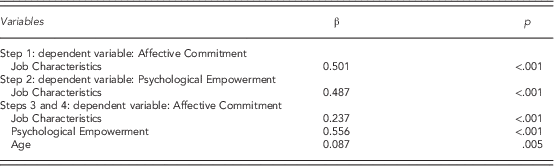
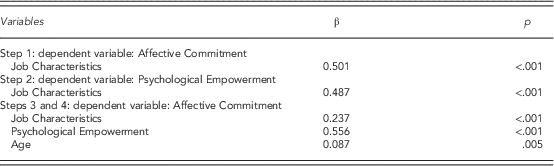
The β weight for path c was found to be significant supporting the first step and Hypothesis 1 that Job Characteristics significantly impact the Affective Commitment. The results for the step 2 (path a) indicated that Job Characteristics have a positive influence on Psychological Empowerment thus providing empirical support for the second step and Hypothesis 4. Finally, Hypothesis 2 and the third step are supported as the Psychological Empowerment was found to be significantly and positively related to Affective Commitment (path b). The β weights are given in Table 3. There is a drop in the β weight of Job Characteristics→Affective Commitment when mediated through Psychological Empowerment (from 0.501 to 0.237). The two-tailed significance of the indirect effect (ab) is 0.006. The model showed a good fit (χ2=155.53; df=85; CMIN/df=1.83; NFI=0.988; CFI=0.995, GFI=0.979; RMSEA=0.034). This evidence supports Hypothesis 5 and more specifically indicates that Psychological Empowerment partially mediates the relationship between Job Characteristics and Affective Commitment. Age was found to have a limited impact on Affective Commitment (β=0.087, p=.005), partially supporting Hypothesis 3.
Mediation analysis – path coefficients
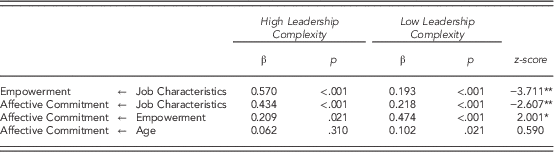
In the second part of the analysis, we sought to test Hypotheses 6 and 7. The hypothesized moderating variable is Leadership Complexity, which has two levels – high and low. The standardized regression weight of Job Characteristics→Affective Commitment, for the group whose leaders were perceived to have high behavioral complexity, was 0.552 (p=.001) and the same was 0.310 (p=.001) for the group with low leadership complexity establishing that Leadership Complexity moderates the impact of Job Characteristics on Affective Commitment.
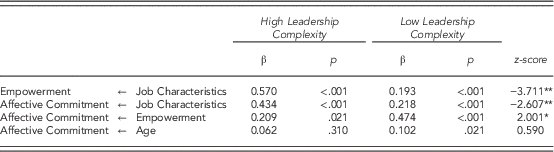
It is possible, that the effect of mediation is stronger for one group than another. Moderated mediation happens if the mediating process is different for two or more groups of people (Muller, Judd, & Yzerbyt, Reference Muller, Judd and Yzerbyt2005). In terms of path analysis, moderated mediation means that either or both of the paths that constitute the indirect effect (path a and path b), vary across the groups identified by the levels of the moderator (Edwards & Lambert, Reference Edwards and Lambert2007). The resultant model (Figures 3a and 3b) demonstrated a good fit: χ2=268.251; df=170; CMIN/df=1.578; NFI=0.957; CFI=0.984, GFI=0.944; RMSEA=0.031. There is a significant drop in the path coefficient for Job Characteristics→Psychological Empowerment and Job Characteristics→Affective Commitment for the group whose leaders have low behavioral complexity as compared with the high leadership complexity group, as shown in Figures 3a and 3b. The z-scores show significant differences between the two groups (Table 4). These results indicate that the effect of job characteristics and mediating effect of empowerment are stronger on Affective Commitment for the group whose leaders balanced competing demands across various dimensions, supporting the Hypotheses 6 and 7. Age was found to be insignificant for the high leadership complexity group but had an influence on Affective Commitment of the low leadership complexity group (β=0.102; p=.021). Thus, Job Characteristics, Psychological Empowerment and Leadership Complexity helped significantly in explaining the variation in Affective Commitment.
Moderation by Leadership Complexity
Moderating effect of leadership complexity
Note: **p-value<.01; *p-value<.05.
Discussion
The major theoretical contribution of this study is the finding that the behavioral complexity of the immediate leaders and psychological empowerment of employees, enhance the impact of job characteristics on affective commitment. The study is unique in that it tests the influence of leadership complexity on the relationship between job characteristics and affective commitment. The other major strength of the research is the diversity of the sample across four different nations, various industries and different age groups. Several theoretical and practical implications follow from the results. Consistent with the previous studies, results supported that job characteristics high on the core dimensions, lead to affective commitment (Madi, Abu-Jarad, & Alqahtani, Reference Madi, Abu-Jarad and Alqahtani2012; Ozturk et al., 2014). This underscores the importance of good job design, for organizations. To build affective commitment, jobs should be enriched with challenge in activities and opportunities to utilize many different skills. Jobs should be designed such that tasks are wholesome and have a potential to make a difference to the organization or the customers. Feedback mechanisms, when built into the job design, help employees improve and appreciate their work, leading to affective commitment.
Liden, Wayne, and Sparrow (Reference Liden, Wayne and Sparrow2000) affirmed that the meaning dimension of empowerment mediated the relationship Job Characterisitcs→Organizational Commitment. This research substantiates that psychological empowerment, taken as a whole construct, mediates the relationship between job characteristics and affective commitment. The practical implication for leaders and organizations is that they can build affective commitment through good job characteristics more effectively when they foster the feelings of empowerment in their employees.
Results of this research indicate that leaders having higher behavioral complexity are more successful in eliciting affective commitment through job characteristics. Leaders are therefore advised to develop superior skills in all dimensions of leadership and not just a few, to deal with competing demands. Vision setting is just as important as being result focused. Motivating employees and being analytical are also just as important.
The limitations of the current study should be noted. The direction of causality is supported by theory but the cross-sectional design of the study does not empirically prove the direction of causality. The subjects of the study were knowledge workers. The same findings may not be fully generalized to people whose jobs encompass routine tasks and do not require advanced knowledge.
We recommend further research of the same constructs, among workers whose jobs are characterized by repetitious and routine tasks. It may be possible to make those jobs a bit more interesting and challenging. We recommend a longitudinal study to see how inclusion of challenge, creativity and variety of tasks in the job design impacts affective commitment in such workers.
Acknowledgement
The authors are grateful to the knowledge workers who responded to the research survey and the reviewers and experts who helped improve this article.